

ISO 16845-2:2018
(Main)Road vehicles — Controller area network (CAN) conformance test plan — Part 2: High-speed medium access unit — Conformance test plan
General Information
- Abstract
This document specifies the conformance test plan for the CAN physical layer as standardized in ISO 11898‑2:2016. It specifies static and dynamic tests. The dynamic tests includes the test cases for the partly implemented Classical CAN protocol and CAN FD protocol as standardized in ISO 11898‑1:2015. The static tests describe the data to be given in datasheets.
- Status
- Published
- Publication Date
- 16-Jul-2018
- Technical Committee
- ISO/TC 22/SC 31 - Data communication
- Drafting Committee
- ISO/TC 22/SC 31/WG 3 - In-vehicle networks
- Current Stage
- 9092 - International Standard to be revised
- Start Date
- 28-Oct-2024
- Completion Date
- 29-Aug-2026
Buy Documents
ISO 16845-2:2018 - Road vehicles -- Controller area network (CAN) conformance test plan
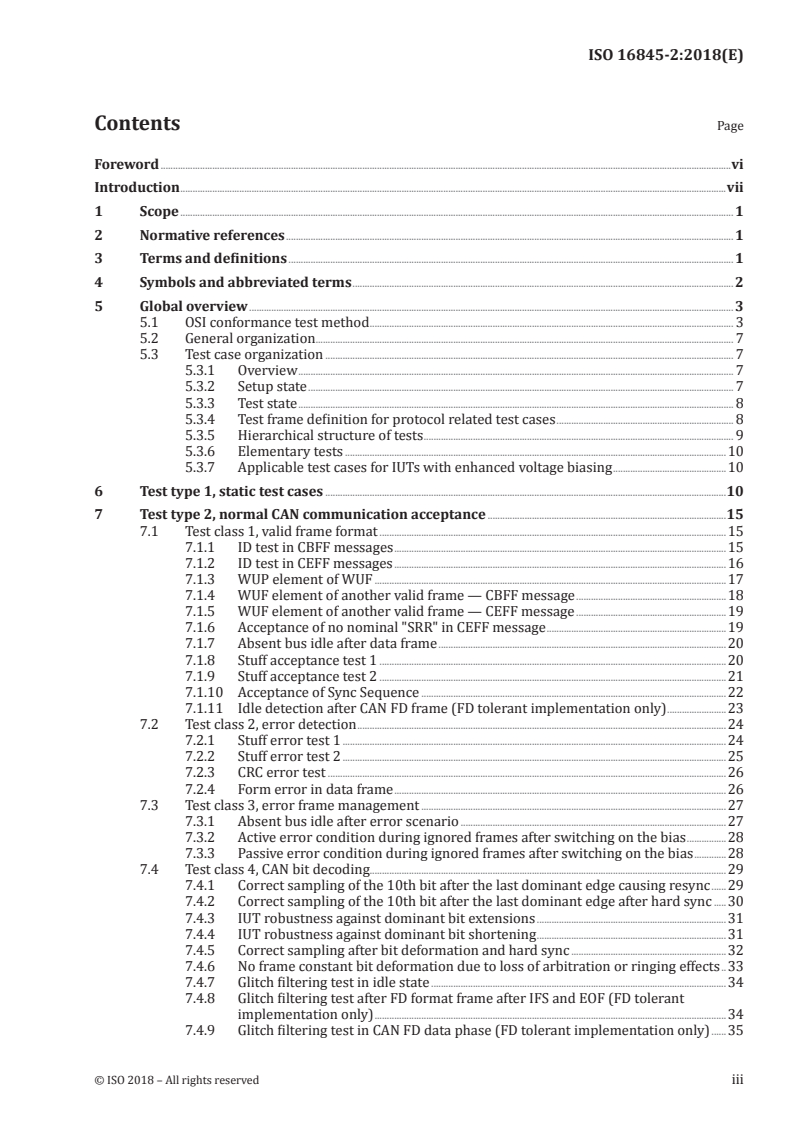
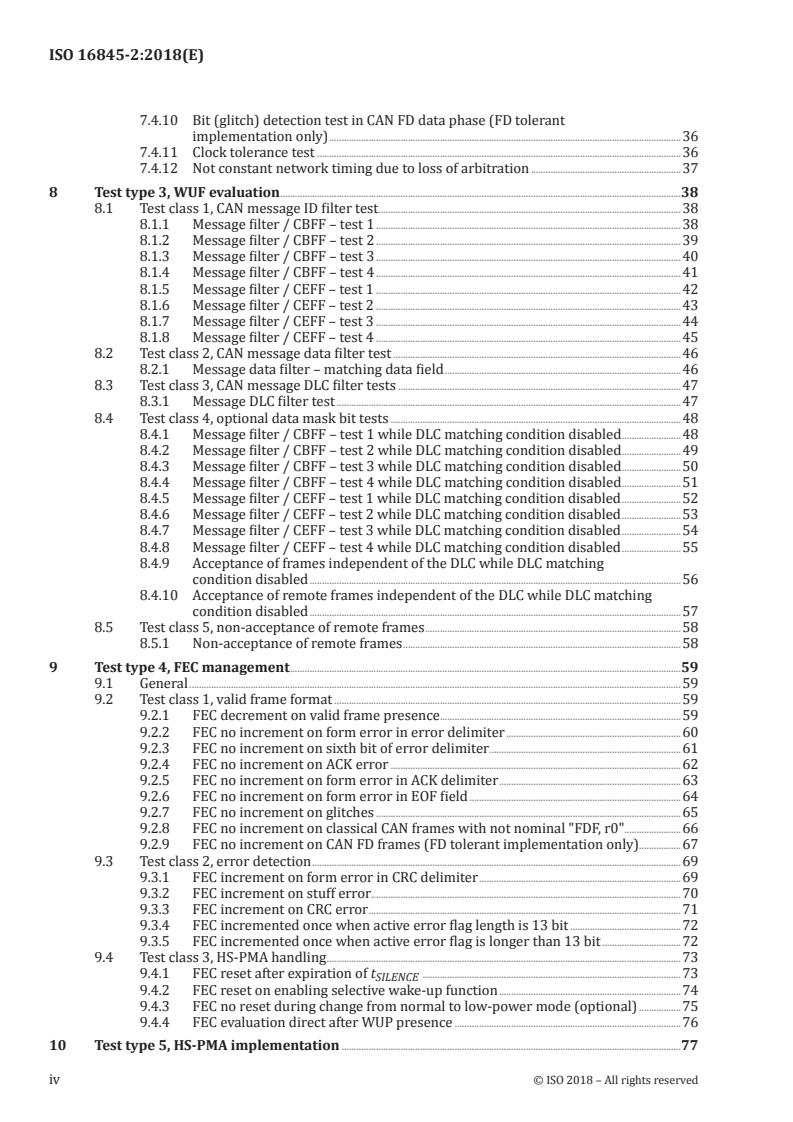
ISO 16845-2:2018 - Road vehicles — Controller area network (CAN) conformance test plan — Part 2: High-speed medium access unit — Conformance test plan/17/2018
Overview
ISO 16845-2:2018 specifies a conformance test plan for the Controller Area Network (CAN) physical layer as defined in ISO 11898-2:2016. Focused on the high‑speed medium access unit (HS‑PMA), the standard defines both static (datasheet information) and dynamic test suites covering Classical CAN and CAN FD behavior (as referenced in ISO 11898-1:2015). ISO 16845-2 is intended to verify conformity, interoperability and robust operation of CAN transceivers and HS‑PMA implementations.
Key topics and technical requirements
- Test methodology and organization
- OSI-based conformance test method and hierarchical test case structure
- Definitions of setup state, test state and elementary tests
- Test types
- Type 1 - Static tests: required datasheet entries and static conformance requirements
- Type 2 - Normal CAN communication acceptance: valid frame formats, error detection, error-frame handling, bit decoding and timing tolerance (applies to Classical CAN and partly to CAN FD)
- Type 3 - Wake-up Frame (WUF) evaluation: message ID, data and DLC filtering, optional mask bit behavior and remote-frame handling
- Type 4 - FEC management: handling of frame/error conditions and FEC behavior in presence of errors and valid frames
- Type 5 - HS‑PMA implementation: wake-up, low-power operation, biasing and transmitter behavior under low-power or V availability conditions
- Support for CAN variants
- Test cases include behavior for Classical CAN and CAN FD (FD‑tolerant implementations), and for partly implemented protocol options
- Practical test elements
- Stuff/CRC/form error tests, glitch filtering, clock tolerance, arbitration loss, idle detection and low‑power wake‑up timers
Practical applications - who uses this standard
- Automotive OEMs and Tier‑1 suppliers validating ECU and transceiver hardware
- Semiconductor and CAN transceiver vendors ensuring physical‑layer conformance
- Independent test laboratories and certification bodies performing CAN compliance tests
- System integrators and quality engineers who require predictable wake‑up, error handling and timing behavior for CAN networks
Related standards
- ISO 11898-2:2016 - CAN physical layer (referenced normative standard)
- ISO 11898-1:2015 - CAN protocol specification (Classical CAN and CAN FD behavior used in dynamic tests)
ISO 16845-2:2018 is essential for ensuring CAN physical‑layer interoperability, robust wake‑up behavior and reliable error handling, making it a key document for anyone building or validating high‑speed CAN hardware and networks.
Relations
- Effective Date
- 05-Nov-2015
Buy Documents
ISO 16845-2:2018 - Road vehicles -- Controller area network (CAN) conformance test plan
ISO 16845-2:2018 - Road vehicles — Controller area network (CAN) conformance test plan — Part 2: High-speed medium access unit — Conformance test plan/17/2018
Get Certified
Connect with accredited certification bodies for this standard

TÜV Rheinland
TÜV Rheinland is a leading international provider of technical services.

TÜV SÜD
TÜV SÜD is a trusted partner of choice for safety, security and sustainability solutions.

DEKRA Certification Inc.
DEKRA US certification services.
Sponsored listings
Frequently Asked Questions
ISO 16845-2:2018 is a standard published by the International Organization for Standardization (ISO). Its full title is "Road vehicles — Controller area network (CAN) conformance test plan — Part 2: High-speed medium access unit — Conformance test plan". This standard covers: This document specifies the conformance test plan for the CAN physical layer as standardized in ISO 11898‑2:2016. It specifies static and dynamic tests. The dynamic tests includes the test cases for the partly implemented Classical CAN protocol and CAN FD protocol as standardized in ISO 11898‑1:2015. The static tests describe the data to be given in datasheets.
This document specifies the conformance test plan for the CAN physical layer as standardized in ISO 11898‑2:2016. It specifies static and dynamic tests. The dynamic tests includes the test cases for the partly implemented Classical CAN protocol and CAN FD protocol as standardized in ISO 11898‑1:2015. The static tests describe the data to be given in datasheets.
ISO 16845-2:2018 is classified under the following ICS (International Classification for Standards) categories: 43.040.15 - Car informatics. On board computer systems. The ICS classification helps identify the subject area and facilitates finding related standards.
ISO 16845-2:2018 has the following relationships with other standards: It is inter standard links to ISO 16845-2:2014. Understanding these relationships helps ensure you are using the most current and applicable version of the standard.
ISO 16845-2:2018 is available in PDF format for immediate download after purchase. The document can be added to your cart and obtained through the secure checkout process. Digital delivery ensures instant access to the complete standard document.
Standards Content (Sample)
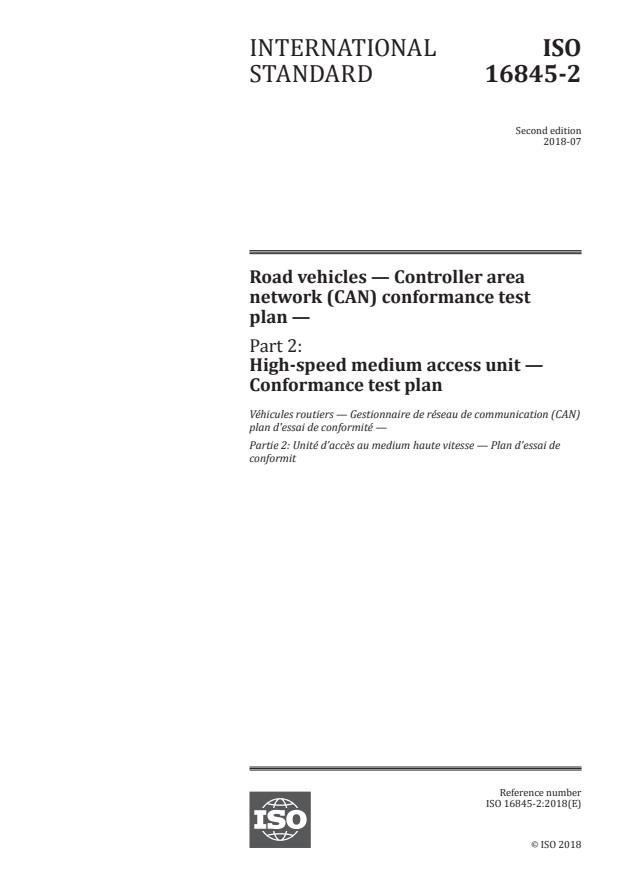
INTERNATIONAL ISO
STANDARD 16845-2
Second edition
2018-07
Road vehicles — Controller area
network (CAN) conformance test
plan —
Part 2:
High-speed medium access unit —
Conformance test plan
Véhicules routiers — Gestionnaire de réseau de communication (CAN)
plan d'essai de conformité —
Partie 2: Unité d’accès au medium haute vitesse — Plan d'essai de
conformit
Reference number
©
ISO 2018
© ISO 2018
All rights reserved. Unless otherwise specified, or required in the context of its implementation, no part of this publication may
be reproduced or utilized otherwise in any form or by any means, electronic or mechanical, including photocopying, or posting
on the internet or an intranet, without prior written permission. Permission can be requested from either ISO at the address
below or ISO’s member body in the country of the requester.
ISO copyright office
CP 401 • Ch. de Blandonnet 8
CH-1214 Vernier, Geneva
Phone: +41 22 749 01 11
Fax: +41 22 749 09 47
Email: copyright@iso.org
Website: www.iso.org
Published in Switzerland
ii © ISO 2018 – All rights reserved
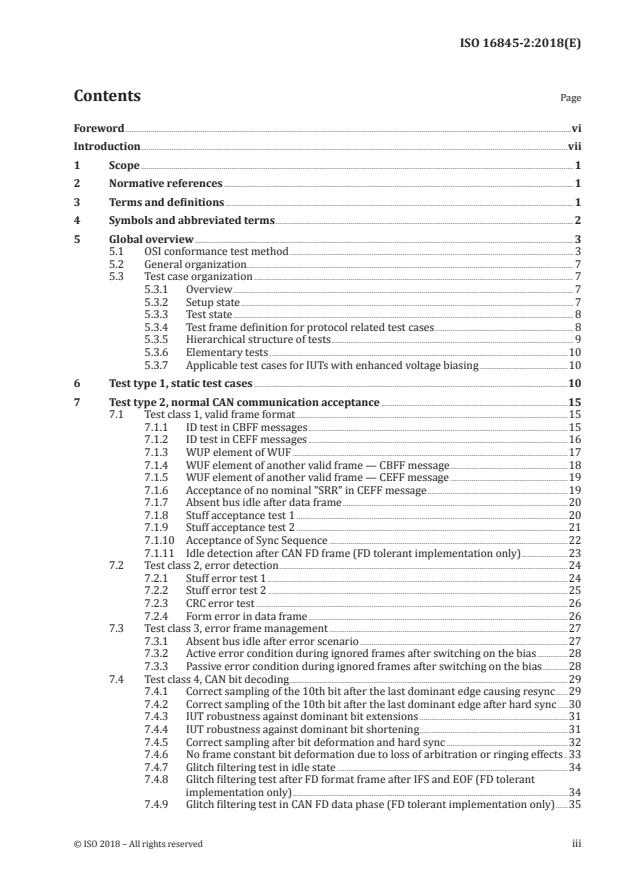
Contents Page
Foreword .vi
Introduction .vii
1 Scope . 1
2 Normative references . 1
3 Terms and definitions . 1
4 Symbols and abbreviated terms . 2
5 Global overview . 3
5.1 OSI conformance test method . 3
5.2 General organization . . 7
5.3 Test case organization . 7
5.3.1 Overview . 7
5.3.2 Setup state . 7
5.3.3 Test state . 8
5.3.4 Test frame definition for protocol related test cases . 8
5.3.5 Hierarchical structure of tests . 9
5.3.6 Elementary tests .10
5.3.7 Applicable test cases for IUTs with enhanced voltage biasing .10
6 Test type 1, static test cases .10
7 Test type 2, normal CAN communication acceptance .15
7.1 Test class 1, valid frame format .15
7.1.1 ID test in CBFF messages .15
7.1.2 ID test in CEFF messages .16
7.1.3 WUP element of WUF .17
7.1.4 WUF element of another valid frame — CBFF message .18
7.1.5 WUF element of another valid frame — CEFF message .19
7.1.6 Acceptance of no nominal "SRR" in CEFF message .19
7.1.7 Absent bus idle after data frame .20
7.1.8 Stuff acceptance test 1 .20
7.1.9 Stuff acceptance test 2 .21
7.1.10 Acceptance of Sync Sequence .22
7.1.11 Idle detection after CAN FD frame (FD tolerant implementation only) .23
7.2 Test class 2, error detection .24
7.2.1 Stuff error test 1 .24
7.2.2 Stuff error test 2 .25
7.2.3 CRC error test .26
7.2.4 Form error in data frame .26
7.3 Test class 3, error frame management .27
7.3.1 Absent bus idle after error scenario .27
7.3.2 Active error condition during ignored frames after switching on the bias .28
7.3.3 Passive error condition during ignored frames after switching on the bias .28
7.4 Test class 4, CAN bit decoding.29
7.4.1 Correct sampling of the 10th bit after the last dominant edge causing resync .29
7.4.2 Correct sampling of the 10th bit after the last dominant edge after hard sync .30
7.4.3 IUT robustness against dominant bit extensions .31
7.4.4 IUT robustness against dominant bit shortening .31
7.4.5 Correct sampling after bit deformation and hard sync .32
7.4.6 No frame constant bit deformation due to loss of arbitration or ringing effects .33
7.4.7 Glitch filtering test in idle state .34
7.4.8 Glitch filtering test after FD format frame after IFS and EOF (FD tolerant
implementation only) .34
7.4.9 Glitch filtering test in CAN FD data phase (FD tolerant implementation only) .35
7.4.10 Bit (glitch) detection test in CAN FD data phase (FD tolerant
implementation only) .36
7.4.11 Clock tolerance test .36
7.4.12 Not constant network timing due to loss of arbitration .37
8 Test type 3, WUF evaluation .38
8.1 Test class 1, CAN message ID filter test .38
8.1.1 Message filter / CBFF – test 1 .38
8.1.2 Message filter / CBFF – test 2 .39
8.1.3 Message filter / CBFF – test 3 .40
8.1.4 Message filter / CBFF – test 4 .41
8.1.5 Message filter / CEFF – test 1 .42
8.1.6 Message filter / CEFF – test 2 .43
8.1.7 Message filter / CEFF – test 3 .44
8.1.8 Message filter / CEFF – test 4 .45
8.2 Test class 2, CAN message data filter test .46
8.2.1 Message data filter – matching data field .46
8.3 Test class 3, CAN message DLC filter tests .47
8.3.1 Message DLC filter test .47
8.4 Test class 4, optional data mask bit tests .48
8.4.1 Message filter / CBFF – test 1 while DLC matching condition disabled .48
8.4.2 Message filter / CBFF – test 2 while DLC matching condition disabled .49
8.4.3 Message filter / CBFF – test 3 while DLC matching condition disabled .50
8.4.4 Message filter / CBFF – test 4 while DLC matching condition disabled .51
8.4.5 Message filter / CEFF – test 1 while DLC matching condition disabled .52
8.4.6 Message filter / CEFF – test 2 while DLC matching condition disabled .53
8.4.7 Message filter / CEFF – test 3 while DLC matching condition disabled .54
8.4.8 Message filter / CEFF – test 4 while DLC matching condition disabled .55
8.4.9 Acceptance of frames independent of the DLC while DLC matching
condition disabled .56
8.4.10 Acceptance of remote frames independent of the DLC while DLC matching
condition disabled .57
8.5 Test class 5, non-acceptance of remote frames .58
8.5.1 Non-acceptance of remote frames .58
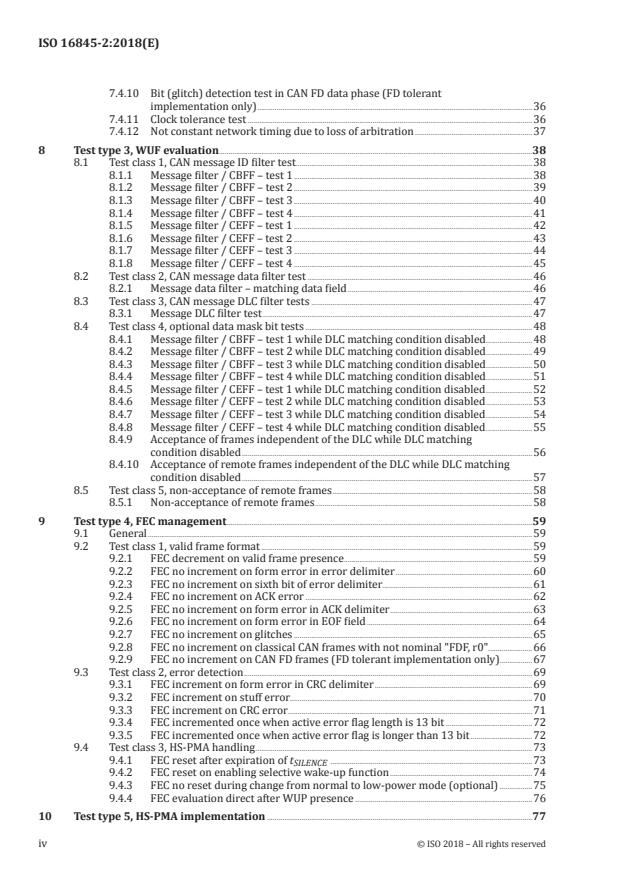
9 Test type 4, FEC management .59
9.1 General .59
9.2 Test class 1, valid frame format .59
9.2.1 FEC decrement on valid frame presence .59
9.2.2 FEC no increment on form error in error delimiter .60
9.2.3 FEC no increment on sixth bit of error delimiter.61
9.2.4 FEC no increment on ACK error .62
9.2.5 FEC no increment on form error in ACK delimiter .63
9.2.6 FEC no increment on form error in EOF field .64
9.2.7 FEC no increment on glitches .65
9.2.8 FEC no increment on classical CAN frames with not nominal "FDF, r0".66
9.2.9 FEC no increment on CAN FD frames (FD tolerant implementation only).67
9.3 Test class 2, error detection .69
9.3.1 FEC increment on form error in CRC delimiter .69
9.3.2 FEC increment on stuff error.70
9.3.3 FEC increment on CRC error .71
9.3.4 FEC incremented once when active error flag length is 13 bit .72
9.3.5 FEC incremented once when active error flag is longer than 13 bit .72
9.4 Test class 3, HS-PMA handling .73
9.4.1 FEC reset after expiration of t .73
SILENCE
9.4.2 FEC reset on enabling selective wake-up function .74
9.4.3 FEC no reset during change from normal to low-power mode (optional) .75
9.4.4 FEC evaluation direct after WUP presence .76
10 Test type 5, HS-PMA implementation .77
iv © ISO 2018 – All rights reserved
10.1 Test class 1, WUP .77
10.1.1 Wake-up after valid WUP .77
10.1.2 No wake-up after invalid WUP .78
10.1.3 No wake-up after expiration of optional timer t .79
Wake
10.1.4 Reset of the optional timer t .80
Wake
10.1.5 No wake-up due to not stabilized recessive bus state .81
10.2 Test class 2, low-power mode operation .82
10.2.1 Reset of the timer t .82
SILENCE
10.2.2 Expiration of the timer t AND implementation in low-power mode.83
SILENCE
10.2.3 Biasing independency from V availability.84
CC
10.2.4 Transmitter in low-power mode .85
10.2.5 Wake-up independency from V availability .86
CC
Bibliography .87
Foreword
ISO (the International Organization for Standardization) is a worldwide federation of national standards
bodies (ISO member bodies). The work of preparing International Standards is normally carried out
through ISO technical committees. Each member body interested in a subject for which a technical
committee has been established has the right to be represented on that committee. International
organizations, governmental and non-governmental, in liaison with ISO, also take part in the work.
ISO collaborates closely with the International Electrotechnical Commission (IEC) on all matters of
electrotechnical standardization.
The procedures used to develop this document and those intended for its further maintenance are
described in the ISO/IEC Directives, Part 1. In particular the different approval criteria needed for the
different types of ISO documents should be noted. This document was drafted in accordance with the
editorial rules of the ISO/IEC Directives, Part 2 (see www .iso .org/directives).
Attention is drawn to the possibility that some of the elements of this document may be the subject of
patent rights. ISO shall not be held responsible for identifying any or all such patent rights. Details of
any patent rights identified during the development of the document will be in the Introduction and/or
on the ISO list of patent declarations received (see www .iso .org/patents).
Any trade name used in this document is information given for the convenience of users and does not
constitute an endorsement.
For an explanation on the voluntary nature of standards, the meaning of ISO specific terms and
expressions related to conformity assessment, as well as information about ISO's adherence to the
World Trade Organization (WTO) principles in the Technical Barriers to Trade (TBT) see the following
URL: www .iso .org/iso/foreword .html.
This document was prepared by ISO/TC 22, Road vehicles, Subcommittee SC 31, Data communication.
This second edition cancels and replaces the first edition (ISO 16845-2:2014), which has been technically
revised and includes the following changes:
— several clauses, subclauses, tables and figures have been technically revised. In particular, the test
cases and test requirements to verify if the CAN transceiver with implemented selective wake-up
functions conform to the specified functionalities within ISO 11898-6:2013 were extended. This was
done to provide a conformance test plan for the whole CAN medium access unit implementations
compliant with ISO 11898-2:2016 (which is the result of the merge of ISO 11898-2:2003,
ISO 1898-5:2007 and ISO 11898-6:2013).
A list of all the parts in the ISO 16845 series can be found on the ISO website.
vi © ISO 2018 – All rights reserved
Introduction
ISO 16845 was first published in 2004 to provide a test plan for conformance testing of the CAN data
link layer and physical signalling as standardized in ISO 11898-1. With ISO 11898-6:2013, CAN high-
speed medium access units were standardized, which partly implements a CAN data link layer, in order
to provide selective wake-up functionality. This standard was merged together with ISO 11898-5:2007
and ISO 11898-2:2003 to produce ISO 11898-2:2016. In order to provide a conformance test plan for
CAN medium access unit implementations compliant with ISO 11898-2:2016, this document has been
developed. It comprises static tests and dynamic tests.
INTERNATIONAL STANDARD ISO 16845-2:2018(E)
Road vehicles — Controller area network (CAN)
conformance test plan —
Part 2:
High-speed medium access unit — Conformance test plan
1 Scope
This document specifies the conformance test plan for the CAN physical layer as standardized in
ISO 11898-2:2016. It specifies static and dynamic tests. The dynamic tests includes the test cases for the
partly implemented Classical CAN protocol and CAN FD protocol as standardized in ISO 11898-1:2015.
The static tests describe the data to be given in datasheets.
2 Normative references
The following documents are referred to in the text in such a way that some or all of their content
constitutes requirements of this document. For dated references, only the edition cited applies. For
undated references, the latest edition of the referenced document (including any amendments) applies.
ISO 11898-1:2015, Road vehicles — Controller area network (CAN) — Part 1: Data link layer and physical
signalling
ISO 11898-2:2016, Road vehicles — Controller area network (CAN) — Part 2: High-speed medium access unit
3 Terms and definitions
For the purposes of this document, the terms and definitions given in ISO 11898-2:2016 and the
following apply.
ISO and IEC maintain terminological databases for use in standardization at the following addresses:
— IEC Electropedia: available at http: //www .electropedia .org/
— ISO Online browsing platform: available at https: //www .iso .org/obp
3.1
implementation under test
IUT
HS-PMA which will be conformance tested according to this document
EXAMPLE Standalone transceiver or SBC.
3.2
lower tester
LT
part of the test system, which emulates the interfaces of the underlying OSI layer from sight of the IUT
3.3
normal mode
mode, in which biasing as well as RX and TX are enabled and low-power mode is disabled
3.4
system under test
SUT
system, which embeds the IUT as a part or contains the IUT, because it cannot operate as a stand-alone
component
3.5
test system
TS
system, which fulfils in this case all requirements to perform the tests defined in this specification
3.6
upper tester
UT
part of the test system, which emulates the interfaces of the overlying OSI layer from sight of the IUT
3.7
valid frame
syntactically correct CAN frame
3.8
invalid frame
syntactically incorrect CAN frame with CAN conform error treatment
3.9
sync frame
syntactically correct CAN frame which is present on the bus while the IUT is in low power mode.
Note 1 to entry: It could be a WUF or non WUF.
3.10
sync sequence
group of sync frames which the IUT may use to calibrate or fine tune internal parameter to be prepared
to detect a WUF
4 Symbols and abbreviated terms
The following symbols and abbreviated terms are used in this document:
ACK acknowledge
ASP abstract service primitives
CAN controller area network
CBFF classical base frame format
CEFF classical extended frame format
CRC cyclic redundancy check
DLC data length code
EOF end of frame
FBFF FD base frame format
FEC frame error counter
FEFF FD extended frame format
2 © ISO 2018 – All rights reserved
ID identifier
IMF intermission field
MAC medium access control
OSI open system interconnection
PCO point of control and observation
PHS physical signalling
PL physical layer
PMA physical medium attachment
SBC system base chip
SOF start of frame
WUF wake-up frame
WUP wake-up pattern
5 Global overview
5.1 OSI conformance test method
OSI conformance testing was mainly introduced by the ISO 9646, ISO 9646-1 and ISO 9646-2, for the
purpose of regulating and harmonizing impartial tests. In general information about the internal
structure of the implementation as well as source code is not available to the party performing the
tests. This explains why the preferred OSI conformance testing methodology is black box testing and
consequently does not take into account any implementation details.
Figure 1 — The OSI coordinated test method depicts the OSI coordinated test method.
Key
ASP abstract service primitives
IUT implementation under test
LOG logger
LT lower tester
PCO point of control and observation
SUT system under test
TCP test coordination procedure
TS test system
UT upper tester
Figure 1 — The OSI coordinated test method
OSI conformance testing proposes many test methods suitable for different sorts of IUT, providing
different points of control and observation.
A coordinated test method which provides a simple interface to the IUT is the most suitable for HS-
PMA, i.e. the CAN network itself, and a flexible test coordination protocol using CAN messages between
the LT as part of the TS and the UT in the SUT. The LT controls and observes the IUT lower service
boundary indirectly via the underlying service provider, using the ASPs of the CAN protocol. The UT
controls and observes the IUT upper service boundary. The TCPs ensure the cooperation between the
LT and the UT.
In case of IUTs with partial networking functionalities, influencing variables from the UT side are the
digital CAN signals (RXD and TXD), host interface signals and I/O signals like INH or wake. The LT
influencing variables are the analogue bus interface with the signals CAN_H and CAN_L and the supply
power. Figure 2 depicts the influencing variables on the IUT.
4 © ISO 2018 – All rights reserved
Key
CAN_H CAN high signal
CAN_L CAN low signal
INH inhibit output
IUT implementation under test
I/O input/output
RXD receive data output
TXD transmit data input
V battery supply input
BAT
V supply input
CC
Wake mode signalling output
Figure 2 — Influencing variables on IUT
To realise all services stimulating the IUT and recording the responses of the IUT regarding all
influencing variables, abstract logical devices are defined as followed.
Figure 3 — Abstract logical devices of UT and LT depicts abstract logical devices of UT and LT.
Key
IUT implementation under test
LT lower tester
TCP test coordination procedure
UT upper tester
Figure 3 — Abstract logical devices of UT and LT
The OSI model divides a communication interface in seven logical layers which contain defined
interfaces from / to the upper or lower layer (as introduced by the ISO 7498-1). Following the OSI
coordinated test method the TS realises the upper layer with help of the UT and the lower layer with
help of the LT. For IUTs without partial networking capability, the IUT is implemented inside the logical
layer 1 – the physical layer with the lower interface as the CAN network and the upper interface to the
layer 2, known as the data link- or protocol layer, with logical signals TXD and RXD. In case of an IUT
supporting partial networking the IUT itself contains functionalities appropriate to the data link layer
(partial networking functionalities) and physical layer (typical transceiver functionalities). To follow
the OSI coordinated test method this test specification is split in a physical layer part, verifying the
transceiver characteristics appropriated to the OSI physical layer and a data link layer part, verifying
the protocol implementation necessary for partial networking functionalities.
6 © ISO 2018 – All rights reserved
5.2 General organization
The abstract test suites of the TS are independent to one another. Each abstract test suite checks the
behaviour of the IUT for a particular parameter of the CAN protocol as defined in ISO 11898-1:2015.
Each test case may be executed one after another in any order or alone.
Test cases requiring variations of individual parameters shall be repeated for each value of the
parameter. Each repetition is named elementary test. A test case including different elementary tests is
valid only if all tests pass.
The result of executing a test case on an IUT should be the same whenever it is performed. To realize
such reproducibility of test results, this document is designed in the way to minimize the possibility
that a test case produces different test outcomes on different occasions. Therefore, test requirements,
which shall be met, and how the verdicts are to be assigned are defined in an unambiguous way.
All parameters in a test case are given for the electrical interface pins of IUT. The stimulus generator
should correctly signal delays and voltage drops of test setup.
If not explicitly different described in test case, all applied stimuli for CAN data and remote frames are
built according to the CAN protocol behaviour as expected on a real CAN network.
5.3 Test case organization
5.3.1 Overview
All defined test cases should be executed in accordance with the supported IUT-specific bit rates
defined in the IUT’s datasheet.
In case the IUT supports other bit rates, the following scenarios are possible.
— if the IUT supports only one bit rate, then all test cases should be executed using this specific bit rate;
— if the IUT supports two bit rates, then all test cases should be executed with both bit rate; and
— if the IUT supports more than two bit rates or a range of bit rates, then all test cases should be
executed considering the highest and the lowest bit rate, as well as a bit rate in-between.
5.3.2 Setup state
5.3.2.1 General
The setup state is a defined and explicitly entered and verified state in which the IUT shall be before
entering the test state. A test starts with unpowered IUT. The first step is to set IUT power supply on.
The IUT, unless otherwise specified, is configured with data as found in 5.3.4.2.
Each elementary test is made of three states:
— setup state;
— test state; and
— verification state.
Before the first elementary test is started, the IUT shall be initialised into the default state.
5.3.2.2 Default setup
Figure 4 describes the default setup for the test, which shall be applied unless otherwise specified in
setup of the test case description. Furthermore, the setup information of the related IUT documentation
shall be followed.
Key
CAN_H CAN high signal
CAN_L CAN low signal
GND ground
IUT implementation under test
I/O input/output
RXD receive data output
TXD transmit data input
V battery supply input
BAT
V supply input
CC
V logic supply input
I/O
R test load resistance of 60 Ω ± 0,6 Ω
L
C test load capacitance of 4,7 nF ± 0,235 nF (absent unless otherwise specified)
C differential test load capacitance if 100 pF ± 1 pF
Figure 4 — Default setup for test
5.3.2.3 Default state
The default state is characterised by the following default value:
— IUT power supply on;
— IUT configured to the bit rate(s) for the particular test; and
— IUT set to Normal mode.
After the end of each elementary test, the default state should be re-applied.
5.3.3 Test state
The time between two frames on the bus shall be zero bits of idle after IMF, unless otherwise specified.
The idle phase shall not be longer than t .
SILENCE(min)
5.3.4 Test frame definition for protocol related test cases
5.3.4.1 Elements of CAN test frames
In the CAN protocol related test cases; the focus is on correct frame handling. Therefore, the test frames
or test patterns sent to the IUT are conforming to CAN protocol. In case of valid, syntactically correct
frames and also for invalid, syntactically incorrect frames, the treatment around the bus failure shall
8 © ISO 2018 – All rights reserved
be compliant to the CAN Protocol. The test frames and error treatments are structured as depicted in
ISO 11898-1:2015.
5.3.4.2 IUT configuration and default parameters
Unless otherwise specified in the corresponding test case definition, the used test frame shall be as
defined in Table 1.
Table 1 — Definition of the default test frames
Frame
CAN ID field DLC Data field ACK bit
format
CBFF 000 1 01 0
h h b
CEFF 00000000 1 01 0
h h b
Further default parameters which shall be used unless otherwise specified in the corresponding test
case definition:
— Used frame type: CBFF;
— ID configuration: corresponding to the used test frame (wake-up condition fulfilled);
— Data field configuration: corresponding to the used test frame (wake-up condition fulfilled);
— ID mask: set all bits to "care";
— Data mask bit: if implemented, it shall be set to enable; and
— t : eight recessive bits after intermission field.
WAIT
5.3.4.3 Sync frame sequence
The sync frame sequence as it is used in several test cases shall be as defined in Table 2.
Table 2 — Definition of the sync frame sequence
Frame ID DLC Data
1 078 1 FF
h h
a
2 to 5 555 1 FF
h h
a
2 to 9 in case of data rate > 500 kbit/s
The frame generator sends each sync frame without a dominant ACK bit followed by an active error
frame with intermission field. The first frame will be followed by additional idle time of 250 µs for bias
reaction time.
5.3.5 Hierarchical structure of tests
5.3.5.1 Overview
All the tests defined in the test plan are grouped into categories in order to aid planning, development,
understanding or execution of each test case. There are two levels of categories:
— the test groups; and
— the test cases.
5.3.5.2 Test group structure
The test cases are grouped by different functional blocks of the IUT which will be verified separately.
Each test group consists of one or several test cases.
5.3.5.3 Test case structure
Each test case of a test group focuses one particular requirement which will be verified.
Each test case is defined by a specific number and a particular name in order to differentiate the test
cases and to easily summarise the goal of the test case.
Table 3 depicts the structure of the defined test cases.
Table 3 — Structure of the defined test cases
Item title Test case item title and remarks of the test case
Purpose Short description of the purpose of the test case
CAN version Classical CAN and / or CAN FD tolerant
HS-PMA Mode of HS-PMA wakeup capabilities
Test variables The parameter definition of the test case
[optional: test frame sequence definition]
Elementary test Describes the number of tests / measurements
cases
Setup Setup of the test case
Execution Test steps dealing with the setup being applied and what is observed and measured
Response Description about what is expected as the result
Reference Link to the requirement specification
5.3.6 Elementary tests
Some test cases may be subdivided into elementary tests which are repetitions of the test case for
several values of the focussed parameter to test. Each elementary test has its own parameter definition
which is defined in the test variables of the test case definition.
5.3.7 Applicable test cases for IUTs with enhanced voltage biasing
It should be distinguished between implementations which support the complete requirements or
only the enhanced biasing functionalities defined in ISO 11898-2:2016. The following test cases are
applicable for IUTs which support only the enhanced voltage biasing compliant to ISO 11898-2:2016.
— Static test cases: Clause 6
— Dynamic test cases: Clause 7 to Clause 10
6 Test type 1, static test cases
The motivation of static test cases is to check the availability and the boundaries in the data sheet of
the IUT. For all integrated circuits every related parameter in Table 4 shall be part of the data sheet and
fulfil the specified boundaries in terms of physical worst-case condition. Data sheet parameter names
may deviate from the names in Table 4, but in this case, a cross-reference list (data sheet versus Table 4),
shall be provided for this test. Parameter conditions may deviate from the conditions in Table 4 , if the
data sheet conditions are according to the physical worst-case context in Table 4.
10 © ISO 2018 – All rights reserved
Table 4 — Static test case summary
Reference to ISO 11898-2 table no. / clause
d
No. Parameter Limits Conditions Conform- Test case
ance test valid for HS-
a
is passed if PMA type:
value
Min Max Unit ≤ ≥ a b c d
1 General max- Table 15 −27,0 +40,0 V −/− min max y y y y
imum rating
V and
CAN_H
V
CAN_L
2 Extended Table 15 −58,0 +58,0 V −/− min max y y y y
maximum
rating V
CAN_H
and V (if
CAN_L
supported)
3 Maximum rat- Table 15 −5,0 +10,0 V The maximum rating for min max y y y y
ing V VDiff excludes that all
Diff
combinations of VCAN_H
and VCAN_L are compli-
ant to this standard.
V = V – V .
Diff CAN_H CAN_L
This is required regard-
less whether general or
extended maximum rat-
ing for V and V
CAN_H CAN_L
is fulfilled
4 Single ended Table 5 +2,0 +3,0 V All requirements in max min y y y y
recessive Table 5 apply concur-
output voltage rently. Therefore, not all
on CAN_H combinations of V
CAN_H
(V ), bus and V are compliant
CAN_H CAN_L
biasing active with the defined differ-
ential output voltage. See
also ISO 11898-2:2016,
Table 5.
5 Single ended Table 5 +2,0 +3,0 V All requirements in max min y y y y
recessive Table 5 apply concur-
output voltage rently. Therefore, not all
on CAN_L combinations of V
CAN_H
(V ), bus and V are compliant
CAN_L CAN_L
biasing active with the defined differ-
ential output voltage. See
also ISO 11898-2:2016,
Table 5.
6 Differential re- Table 5 −0,5 +0,05 V All requirements in max min y y y y
cessive output Table 5 apply concur-
voltage (V ), rently. Therefore, not all
Diff
bus biasing combinations of V
CAN_H
active and V are compliant
CAN_L
with the defined differ-
ential output voltage. See
also ISO 11898-2:2016,
Table 5.
a
HS-PMA types: a - without low-power mode and partial network, b - with low-power mode, normal biasing and without partial
network, c - with low-power mode, automatic biasing and without partial network, d - with low-power mode, automatic biasing and
partial network; labelling: y – applicable, n – not applicable.
b
The minimum value of 0,3 ms is accepted for legacy implementations.
c
For legacy implementations a minimum value of 350 µs is acceptable.
d
Parameters within the conditions are aligned with Figure 4 p for test.
Table 4 (continued)
Reference to ISO 11898-2 table no. / clause
d
No. Parameter Limits Conditions Conform- Test case
ance test valid for HS-
a
is passed if PMA type:
value
Min Max Unit ≤ ≥ a b c d
7 Single ended Table 6 −0,1 +0,1 V See ISO 11898-2:2016, max min n y y y
recessive 5.10 to determine when
output voltage bias shall be inactive. See
on CAN_H also ISO 11898-2:2016,
(V ), bus Table 6.
CAN_H
biasing inactive
8 Single ended Table 6 −0,1 +0,1 V See ISO 11898-2:2016, max min n y y y
recessive out- 5.10 and Table 6.
put voltage on
CAN_L (V ),
CAN_L
bus biasing
inactive
9 Differential re- Table 6 −0,2 +0,2 V See ISO 11898-2:2016, max min n y y y
cessive output 5.10 and Table 6.
voltage (V ),
Diff
bus biasing
inactive
10 Single ended Table 2 +2,75 +4,50 V R = 50 Ω … 65 Ω max min y y y y
L
voltage on
CAN_H, dom-
inant output
(V )
CAN_H
11 Single ended Table 2 +0,5 +2,25 V R = 50 Ω … 65 Ω max min y y y y
L
voltage on
CAN_L, dom-
inant output
(V )
CAN_L
12 Differential Table 2 +1,5 +3,0 V R = 50 Ω … 65 Ω max min y y y y
L
voltage on
normal bus
load, dominant
output (V )
Dfiff
13 Differential Table 2 +1,5 +5,0 V R = 2 240 Ω max min y y y y
L
voltage on
effective re-
sistance during
arbitration,
dominant out-
put (V )
Diff
14 Differential Table 2 +1,4 +3,3 V R = 45 Ω … 70 Ω max min y y y y
L
voltage on
extended bus
load, dominant
output (V )
Diff
(if supported)
a
HS-PMA types: a - without low-power mode and partial network, b - with low-power mode, normal biasing and without partial
network, c - with low-power mode, automatic biasing and without partial network, d - with low-power mode, automatic biasing and
partial network; labelling: y – applicable, n – not applicable.
b
The minimum value of 0,3 ms is accepted for legacy implementations.
c
For legacy implementations a minimum value of 350 µs is acceptable.
d
Parameters within the conditions are aligned with Figure 4 p for test.
12 © ISO 2018 – All rights reserved
Table 4 (continued)
Reference to ISO 11898-2 table no. / clause
d
No. Parameter Limits Conditions Conform- Test case
ance test valid for HS-
a
is passed if PMA type:
value
Min Max Unit ≤ ≥ a b c d
15 Driver symme- Table 3 +0,9 +1,1 −/− R = 60 Ω; C = 4,7 nF max min y y y y
L 1
...
INTERNATIONAL ISO
STANDARD 16845-2
Second edition
2018-07
Road vehicles — Controller area
network (CAN) conformance test
plan —
Part 2:
High-speed medium access unit —
Conformance test plan
Véhicules routiers — Gestionnaire de réseau de communication (CAN)
plan d'essai de conformité —
Partie 2: Unité d’accès au medium haute vitesse — Plan d'essai de
conformit
Reference number
©
ISO 2018
© ISO 2018
All rights reserved. Unless otherwise specified, or required in the context of its implementation, no part of this publication may
be reproduced or utilized otherwise in any form or by any means, electronic or mechanical, including photocopying, or posting
on the internet or an intranet, without prior written permission. Permission can be requested from either ISO at the address
below or ISO’s member body in the country of the requester.
ISO copyright office
CP 401 • Ch. de Blandonnet 8
CH-1214 Vernier, Geneva
Phone: +41 22 749 01 11
Fax: +41 22 749 09 47
Email: copyright@iso.org
Website: www.iso.org
Published in Switzerland
ii © ISO 2018 – All rights reserved
Contents Page
Foreword .vi
Introduction .vii
1 Scope . 1
2 Normative references . 1
3 Terms and definitions . 1
4 Symbols and abbreviated terms . 2
5 Global overview . 3
5.1 OSI conformance test method . 3
5.2 General organization . . 7
5.3 Test case organization . 7
5.3.1 Overview . 7
5.3.2 Setup state . 7
5.3.3 Test state . 8
5.3.4 Test frame definition for protocol related test cases . 8
5.3.5 Hierarchical structure of tests . 9
5.3.6 Elementary tests .10
5.3.7 Applicable test cases for IUTs with enhanced voltage biasing .10
6 Test type 1, static test cases .10
7 Test type 2, normal CAN communication acceptance .15
7.1 Test class 1, valid frame format .15
7.1.1 ID test in CBFF messages .15
7.1.2 ID test in CEFF messages .16
7.1.3 WUP element of WUF .17
7.1.4 WUF element of another valid frame — CBFF message .18
7.1.5 WUF element of another valid frame — CEFF message .19
7.1.6 Acceptance of no nominal "SRR" in CEFF message .19
7.1.7 Absent bus idle after data frame .20
7.1.8 Stuff acceptance test 1 .20
7.1.9 Stuff acceptance test 2 .21
7.1.10 Acceptance of Sync Sequence .22
7.1.11 Idle detection after CAN FD frame (FD tolerant implementation only) .23
7.2 Test class 2, error detection .24
7.2.1 Stuff error test 1 .24
7.2.2 Stuff error test 2 .25
7.2.3 CRC error test .26
7.2.4 Form error in data frame .26
7.3 Test class 3, error frame management .27
7.3.1 Absent bus idle after error scenario .27
7.3.2 Active error condition during ignored frames after switching on the bias .28
7.3.3 Passive error condition during ignored frames after switching on the bias .28
7.4 Test class 4, CAN bit decoding.29
7.4.1 Correct sampling of the 10th bit after the last dominant edge causing resync .29
7.4.2 Correct sampling of the 10th bit after the last dominant edge after hard sync .30
7.4.3 IUT robustness against dominant bit extensions .31
7.4.4 IUT robustness against dominant bit shortening .31
7.4.5 Correct sampling after bit deformation and hard sync .32
7.4.6 No frame constant bit deformation due to loss of arbitration or ringing effects .33
7.4.7 Glitch filtering test in idle state .34
7.4.8 Glitch filtering test after FD format frame after IFS and EOF (FD tolerant
implementation only) .34
7.4.9 Glitch filtering test in CAN FD data phase (FD tolerant implementation only) .35
7.4.10 Bit (glitch) detection test in CAN FD data phase (FD tolerant
implementation only) .36
7.4.11 Clock tolerance test .36
7.4.12 Not constant network timing due to loss of arbitration .37
8 Test type 3, WUF evaluation .38
8.1 Test class 1, CAN message ID filter test .38
8.1.1 Message filter / CBFF – test 1 .38
8.1.2 Message filter / CBFF – test 2 .39
8.1.3 Message filter / CBFF – test 3 .40
8.1.4 Message filter / CBFF – test 4 .41
8.1.5 Message filter / CEFF – test 1 .42
8.1.6 Message filter / CEFF – test 2 .43
8.1.7 Message filter / CEFF – test 3 .44
8.1.8 Message filter / CEFF – test 4 .45
8.2 Test class 2, CAN message data filter test .46
8.2.1 Message data filter – matching data field .46
8.3 Test class 3, CAN message DLC filter tests .47
8.3.1 Message DLC filter test .47
8.4 Test class 4, optional data mask bit tests .48
8.4.1 Message filter / CBFF – test 1 while DLC matching condition disabled .48
8.4.2 Message filter / CBFF – test 2 while DLC matching condition disabled .49
8.4.3 Message filter / CBFF – test 3 while DLC matching condition disabled .50
8.4.4 Message filter / CBFF – test 4 while DLC matching condition disabled .51
8.4.5 Message filter / CEFF – test 1 while DLC matching condition disabled .52
8.4.6 Message filter / CEFF – test 2 while DLC matching condition disabled .53
8.4.7 Message filter / CEFF – test 3 while DLC matching condition disabled .54
8.4.8 Message filter / CEFF – test 4 while DLC matching condition disabled .55
8.4.9 Acceptance of frames independent of the DLC while DLC matching
condition disabled .56
8.4.10 Acceptance of remote frames independent of the DLC while DLC matching
condition disabled .57
8.5 Test class 5, non-acceptance of remote frames .58
8.5.1 Non-acceptance of remote frames .58
9 Test type 4, FEC management .59
9.1 General .59
9.2 Test class 1, valid frame format .59
9.2.1 FEC decrement on valid frame presence .59
9.2.2 FEC no increment on form error in error delimiter .60
9.2.3 FEC no increment on sixth bit of error delimiter.61
9.2.4 FEC no increment on ACK error .62
9.2.5 FEC no increment on form error in ACK delimiter .63
9.2.6 FEC no increment on form error in EOF field .64
9.2.7 FEC no increment on glitches .65
9.2.8 FEC no increment on classical CAN frames with not nominal "FDF, r0".66
9.2.9 FEC no increment on CAN FD frames (FD tolerant implementation only).67
9.3 Test class 2, error detection .69
9.3.1 FEC increment on form error in CRC delimiter .69
9.3.2 FEC increment on stuff error.70
9.3.3 FEC increment on CRC error .71
9.3.4 FEC incremented once when active error flag length is 13 bit .72
9.3.5 FEC incremented once when active error flag is longer than 13 bit .72
9.4 Test class 3, HS-PMA handling .73
9.4.1 FEC reset after expiration of t .73
SILENCE
9.4.2 FEC reset on enabling selective wake-up function .74
9.4.3 FEC no reset during change from normal to low-power mode (optional) .75
9.4.4 FEC evaluation direct after WUP presence .76
10 Test type 5, HS-PMA implementation .77
iv © ISO 2018 – All rights reserved
10.1 Test class 1, WUP .77
10.1.1 Wake-up after valid WUP .77
10.1.2 No wake-up after invalid WUP .78
10.1.3 No wake-up after expiration of optional timer t .79
Wake
10.1.4 Reset of the optional timer t .80
Wake
10.1.5 No wake-up due to not stabilized recessive bus state .81
10.2 Test class 2, low-power mode operation .82
10.2.1 Reset of the timer t .82
SILENCE
10.2.2 Expiration of the timer t AND implementation in low-power mode.83
SILENCE
10.2.3 Biasing independency from V availability.84
CC
10.2.4 Transmitter in low-power mode .85
10.2.5 Wake-up independency from V availability .86
CC
Bibliography .87
Foreword
ISO (the International Organization for Standardization) is a worldwide federation of national standards
bodies (ISO member bodies). The work of preparing International Standards is normally carried out
through ISO technical committees. Each member body interested in a subject for which a technical
committee has been established has the right to be represented on that committee. International
organizations, governmental and non-governmental, in liaison with ISO, also take part in the work.
ISO collaborates closely with the International Electrotechnical Commission (IEC) on all matters of
electrotechnical standardization.
The procedures used to develop this document and those intended for its further maintenance are
described in the ISO/IEC Directives, Part 1. In particular the different approval criteria needed for the
different types of ISO documents should be noted. This document was drafted in accordance with the
editorial rules of the ISO/IEC Directives, Part 2 (see www .iso .org/directives).
Attention is drawn to the possibility that some of the elements of this document may be the subject of
patent rights. ISO shall not be held responsible for identifying any or all such patent rights. Details of
any patent rights identified during the development of the document will be in the Introduction and/or
on the ISO list of patent declarations received (see www .iso .org/patents).
Any trade name used in this document is information given for the convenience of users and does not
constitute an endorsement.
For an explanation on the voluntary nature of standards, the meaning of ISO specific terms and
expressions related to conformity assessment, as well as information about ISO's adherence to the
World Trade Organization (WTO) principles in the Technical Barriers to Trade (TBT) see the following
URL: www .iso .org/iso/foreword .html.
This document was prepared by ISO/TC 22, Road vehicles, Subcommittee SC 31, Data communication.
This second edition cancels and replaces the first edition (ISO 16845-2:2014), which has been technically
revised and includes the following changes:
— several clauses, subclauses, tables and figures have been technically revised. In particular, the test
cases and test requirements to verify if the CAN transceiver with implemented selective wake-up
functions conform to the specified functionalities within ISO 11898-6:2013 were extended. This was
done to provide a conformance test plan for the whole CAN medium access unit implementations
compliant with ISO 11898-2:2016 (which is the result of the merge of ISO 11898-2:2003,
ISO 1898-5:2007 and ISO 11898-6:2013).
A list of all the parts in the ISO 16845 series can be found on the ISO website.
vi © ISO 2018 – All rights reserved
Introduction
ISO 16845 was first published in 2004 to provide a test plan for conformance testing of the CAN data
link layer and physical signalling as standardized in ISO 11898-1. With ISO 11898-6:2013, CAN high-
speed medium access units were standardized, which partly implements a CAN data link layer, in order
to provide selective wake-up functionality. This standard was merged together with ISO 11898-5:2007
and ISO 11898-2:2003 to produce ISO 11898-2:2016. In order to provide a conformance test plan for
CAN medium access unit implementations compliant with ISO 11898-2:2016, this document has been
developed. It comprises static tests and dynamic tests.
INTERNATIONAL STANDARD ISO 16845-2:2018(E)
Road vehicles — Controller area network (CAN)
conformance test plan —
Part 2:
High-speed medium access unit — Conformance test plan
1 Scope
This document specifies the conformance test plan for the CAN physical layer as standardized in
ISO 11898-2:2016. It specifies static and dynamic tests. The dynamic tests includes the test cases for the
partly implemented Classical CAN protocol and CAN FD protocol as standardized in ISO 11898-1:2015.
The static tests describe the data to be given in datasheets.
2 Normative references
The following documents are referred to in the text in such a way that some or all of their content
constitutes requirements of this document. For dated references, only the edition cited applies. For
undated references, the latest edition of the referenced document (including any amendments) applies.
ISO 11898-1:2015, Road vehicles — Controller area network (CAN) — Part 1: Data link layer and physical
signalling
ISO 11898-2:2016, Road vehicles — Controller area network (CAN) — Part 2: High-speed medium access unit
3 Terms and definitions
For the purposes of this document, the terms and definitions given in ISO 11898-2:2016 and the
following apply.
ISO and IEC maintain terminological databases for use in standardization at the following addresses:
— IEC Electropedia: available at http: //www .electropedia .org/
— ISO Online browsing platform: available at https: //www .iso .org/obp
3.1
implementation under test
IUT
HS-PMA which will be conformance tested according to this document
EXAMPLE Standalone transceiver or SBC.
3.2
lower tester
LT
part of the test system, which emulates the interfaces of the underlying OSI layer from sight of the IUT
3.3
normal mode
mode, in which biasing as well as RX and TX are enabled and low-power mode is disabled
3.4
system under test
SUT
system, which embeds the IUT as a part or contains the IUT, because it cannot operate as a stand-alone
component
3.5
test system
TS
system, which fulfils in this case all requirements to perform the tests defined in this specification
3.6
upper tester
UT
part of the test system, which emulates the interfaces of the overlying OSI layer from sight of the IUT
3.7
valid frame
syntactically correct CAN frame
3.8
invalid frame
syntactically incorrect CAN frame with CAN conform error treatment
3.9
sync frame
syntactically correct CAN frame which is present on the bus while the IUT is in low power mode.
Note 1 to entry: It could be a WUF or non WUF.
3.10
sync sequence
group of sync frames which the IUT may use to calibrate or fine tune internal parameter to be prepared
to detect a WUF
4 Symbols and abbreviated terms
The following symbols and abbreviated terms are used in this document:
ACK acknowledge
ASP abstract service primitives
CAN controller area network
CBFF classical base frame format
CEFF classical extended frame format
CRC cyclic redundancy check
DLC data length code
EOF end of frame
FBFF FD base frame format
FEC frame error counter
FEFF FD extended frame format
2 © ISO 2018 – All rights reserved
ID identifier
IMF intermission field
MAC medium access control
OSI open system interconnection
PCO point of control and observation
PHS physical signalling
PL physical layer
PMA physical medium attachment
SBC system base chip
SOF start of frame
WUF wake-up frame
WUP wake-up pattern
5 Global overview
5.1 OSI conformance test method
OSI conformance testing was mainly introduced by the ISO 9646, ISO 9646-1 and ISO 9646-2, for the
purpose of regulating and harmonizing impartial tests. In general information about the internal
structure of the implementation as well as source code is not available to the party performing the
tests. This explains why the preferred OSI conformance testing methodology is black box testing and
consequently does not take into account any implementation details.
Figure 1 — The OSI coordinated test method depicts the OSI coordinated test method.
Key
ASP abstract service primitives
IUT implementation under test
LOG logger
LT lower tester
PCO point of control and observation
SUT system under test
TCP test coordination procedure
TS test system
UT upper tester
Figure 1 — The OSI coordinated test method
OSI conformance testing proposes many test methods suitable for different sorts of IUT, providing
different points of control and observation.
A coordinated test method which provides a simple interface to the IUT is the most suitable for HS-
PMA, i.e. the CAN network itself, and a flexible test coordination protocol using CAN messages between
the LT as part of the TS and the UT in the SUT. The LT controls and observes the IUT lower service
boundary indirectly via the underlying service provider, using the ASPs of the CAN protocol. The UT
controls and observes the IUT upper service boundary. The TCPs ensure the cooperation between the
LT and the UT.
In case of IUTs with partial networking functionalities, influencing variables from the UT side are the
digital CAN signals (RXD and TXD), host interface signals and I/O signals like INH or wake. The LT
influencing variables are the analogue bus interface with the signals CAN_H and CAN_L and the supply
power. Figure 2 depicts the influencing variables on the IUT.
4 © ISO 2018 – All rights reserved
Key
CAN_H CAN high signal
CAN_L CAN low signal
INH inhibit output
IUT implementation under test
I/O input/output
RXD receive data output
TXD transmit data input
V battery supply input
BAT
V supply input
CC
Wake mode signalling output
Figure 2 — Influencing variables on IUT
To realise all services stimulating the IUT and recording the responses of the IUT regarding all
influencing variables, abstract logical devices are defined as followed.
Figure 3 — Abstract logical devices of UT and LT depicts abstract logical devices of UT and LT.
Key
IUT implementation under test
LT lower tester
TCP test coordination procedure
UT upper tester
Figure 3 — Abstract logical devices of UT and LT
The OSI model divides a communication interface in seven logical layers which contain defined
interfaces from / to the upper or lower layer (as introduced by the ISO 7498-1). Following the OSI
coordinated test method the TS realises the upper layer with help of the UT and the lower layer with
help of the LT. For IUTs without partial networking capability, the IUT is implemented inside the logical
layer 1 – the physical layer with the lower interface as the CAN network and the upper interface to the
layer 2, known as the data link- or protocol layer, with logical signals TXD and RXD. In case of an IUT
supporting partial networking the IUT itself contains functionalities appropriate to the data link layer
(partial networking functionalities) and physical layer (typical transceiver functionalities). To follow
the OSI coordinated test method this test specification is split in a physical layer part, verifying the
transceiver characteristics appropriated to the OSI physical layer and a data link layer part, verifying
the protocol implementation necessary for partial networking functionalities.
6 © ISO 2018 – All rights reserved
5.2 General organization
The abstract test suites of the TS are independent to one another. Each abstract test suite checks the
behaviour of the IUT for a particular parameter of the CAN protocol as defined in ISO 11898-1:2015.
Each test case may be executed one after another in any order or alone.
Test cases requiring variations of individual parameters shall be repeated for each value of the
parameter. Each repetition is named elementary test. A test case including different elementary tests is
valid only if all tests pass.
The result of executing a test case on an IUT should be the same whenever it is performed. To realize
such reproducibility of test results, this document is designed in the way to minimize the possibility
that a test case produces different test outcomes on different occasions. Therefore, test requirements,
which shall be met, and how the verdicts are to be assigned are defined in an unambiguous way.
All parameters in a test case are given for the electrical interface pins of IUT. The stimulus generator
should correctly signal delays and voltage drops of test setup.
If not explicitly different described in test case, all applied stimuli for CAN data and remote frames are
built according to the CAN protocol behaviour as expected on a real CAN network.
5.3 Test case organization
5.3.1 Overview
All defined test cases should be executed in accordance with the supported IUT-specific bit rates
defined in the IUT’s datasheet.
In case the IUT supports other bit rates, the following scenarios are possible.
— if the IUT supports only one bit rate, then all test cases should be executed using this specific bit rate;
— if the IUT supports two bit rates, then all test cases should be executed with both bit rate; and
— if the IUT supports more than two bit rates or a range of bit rates, then all test cases should be
executed considering the highest and the lowest bit rate, as well as a bit rate in-between.
5.3.2 Setup state
5.3.2.1 General
The setup state is a defined and explicitly entered and verified state in which the IUT shall be before
entering the test state. A test starts with unpowered IUT. The first step is to set IUT power supply on.
The IUT, unless otherwise specified, is configured with data as found in 5.3.4.2.
Each elementary test is made of three states:
— setup state;
— test state; and
— verification state.
Before the first elementary test is started, the IUT shall be initialised into the default state.
5.3.2.2 Default setup
Figure 4 describes the default setup for the test, which shall be applied unless otherwise specified in
setup of the test case description. Furthermore, the setup information of the related IUT documentation
shall be followed.
Key
CAN_H CAN high signal
CAN_L CAN low signal
GND ground
IUT implementation under test
I/O input/output
RXD receive data output
TXD transmit data input
V battery supply input
BAT
V supply input
CC
V logic supply input
I/O
R test load resistance of 60 Ω ± 0,6 Ω
L
C test load capacitance of 4,7 nF ± 0,235 nF (absent unless otherwise specified)
C differential test load capacitance if 100 pF ± 1 pF
Figure 4 — Default setup for test
5.3.2.3 Default state
The default state is characterised by the following default value:
— IUT power supply on;
— IUT configured to the bit rate(s) for the particular test; and
— IUT set to Normal mode.
After the end of each elementary test, the default state should be re-applied.
5.3.3 Test state
The time between two frames on the bus shall be zero bits of idle after IMF, unless otherwise specified.
The idle phase shall not be longer than t .
SILENCE(min)
5.3.4 Test frame definition for protocol related test cases
5.3.4.1 Elements of CAN test frames
In the CAN protocol related test cases; the focus is on correct frame handling. Therefore, the test frames
or test patterns sent to the IUT are conforming to CAN protocol. In case of valid, syntactically correct
frames and also for invalid, syntactically incorrect frames, the treatment around the bus failure shall
8 © ISO 2018 – All rights reserved
be compliant to the CAN Protocol. The test frames and error treatments are structured as depicted in
ISO 11898-1:2015.
5.3.4.2 IUT configuration and default parameters
Unless otherwise specified in the corresponding test case definition, the used test frame shall be as
defined in Table 1.
Table 1 — Definition of the default test frames
Frame
CAN ID field DLC Data field ACK bit
format
CBFF 000 1 01 0
h h b
CEFF 00000000 1 01 0
h h b
Further default parameters which shall be used unless otherwise specified in the corresponding test
case definition:
— Used frame type: CBFF;
— ID configuration: corresponding to the used test frame (wake-up condition fulfilled);
— Data field configuration: corresponding to the used test frame (wake-up condition fulfilled);
— ID mask: set all bits to "care";
— Data mask bit: if implemented, it shall be set to enable; and
— t : eight recessive bits after intermission field.
WAIT
5.3.4.3 Sync frame sequence
The sync frame sequence as it is used in several test cases shall be as defined in Table 2.
Table 2 — Definition of the sync frame sequence
Frame ID DLC Data
1 078 1 FF
h h
a
2 to 5 555 1 FF
h h
a
2 to 9 in case of data rate > 500 kbit/s
The frame generator sends each sync frame without a dominant ACK bit followed by an active error
frame with intermission field. The first frame will be followed by additional idle time of 250 µs for bias
reaction time.
5.3.5 Hierarchical structure of tests
5.3.5.1 Overview
All the tests defined in the test plan are grouped into categories in order to aid planning, development,
understanding or execution of each test case. There are two levels of categories:
— the test groups; and
— the test cases.
5.3.5.2 Test group structure
The test cases are grouped by different functional blocks of the IUT which will be verified separately.
Each test group consists of one or several test cases.
5.3.5.3 Test case structure
Each test case of a test group focuses one particular requirement which will be verified.
Each test case is defined by a specific number and a particular name in order to differentiate the test
cases and to easily summarise the goal of the test case.
Table 3 depicts the structure of the defined test cases.
Table 3 — Structure of the defined test cases
Item title Test case item title and remarks of the test case
Purpose Short description of the purpose of the test case
CAN version Classical CAN and / or CAN FD tolerant
HS-PMA Mode of HS-PMA wakeup capabilities
Test variables The parameter definition of the test case
[optional: test frame sequence definition]
Elementary test Describes the number of tests / measurements
cases
Setup Setup of the test case
Execution Test steps dealing with the setup being applied and what is observed and measured
Response Description about what is expected as the result
Reference Link to the requirement specification
5.3.6 Elementary tests
Some test cases may be subdivided into elementary tests which are repetitions of the test case for
several values of the focussed parameter to test. Each elementary test has its own parameter definition
which is defined in the test variables of the test case definition.
5.3.7 Applicable test cases for IUTs with enhanced voltage biasing
It should be distinguished between implementations which support the complete requirements or
only the enhanced biasing functionalities defined in ISO 11898-2:2016. The following test cases are
applicable for IUTs which support only the enhanced voltage biasing compliant to ISO 11898-2:2016.
— Static test cases: Clause 6
— Dynamic test cases: Clause 7 to Clause 10
6 Test type 1, static test cases
The motivation of static test cases is to check the availability and the boundaries in the data sheet of
the IUT. For all integrated circuits every related parameter in Table 4 shall be part of the data sheet and
fulfil the specified boundaries in terms of physical worst-case condition. Data sheet parameter names
may deviate from the names in Table 4, but in this case, a cross-reference list (data sheet versus Table 4),
shall be provided for this test. Parameter conditions may deviate from the conditions in Table 4 , if the
data sheet conditions are according to the physical worst-case context in Table 4.
10 © ISO 2018 – All rights reserved
Table 4 — Static test case summary
Reference to ISO 11898-2 table no. / clause
d
No. Parameter Limits Conditions Conform- Test case
ance test valid for HS-
a
is passed if PMA type:
value
Min Max Unit ≤ ≥ a b c d
1 General max- Table 15 −27,0 +40,0 V −/− min max y y y y
imum rating
V and
CAN_H
V
CAN_L
2 Extended Table 15 −58,0 +58,0 V −/− min max y y y y
maximum
rating V
CAN_H
and V (if
CAN_L
supported)
3 Maximum rat- Table 15 −5,0 +10,0 V The maximum rating for min max y y y y
ing V VDiff excludes that all
Diff
combinations of VCAN_H
and VCAN_L are compli-
ant to this standard.
V = V – V .
Diff CAN_H CAN_L
This is required regard-
less whether general or
extended maximum rat-
ing for V and V
CAN_H CAN_L
is fulfilled
4 Single ended Table 5 +2,0 +3,0 V All requirements in max min y y y y
recessive Table 5 apply concur-
output voltage rently. Therefore, not all
on CAN_H combinations of V
CAN_H
(V ), bus and V are compliant
CAN_H CAN_L
biasing active with the defined differ-
ential output voltage. See
also ISO 11898-2:2016,
Table 5.
5 Single ended Table 5 +2,0 +3,0 V All requirements in max min y y y y
recessive Table 5 apply concur-
output voltage rently. Therefore, not all
on CAN_L combinations of V
CAN_H
(V ), bus and V are compliant
CAN_L CAN_L
biasing active with the defined differ-
ential output voltage. See
also ISO 11898-2:2016,
Table 5.
6 Differential re- Table 5 −0,5 +0,05 V All requirements in max min y y y y
cessive output Table 5 apply concur-
voltage (V ), rently. Therefore, not all
Diff
bus biasing combinations of V
CAN_H
active and V are compliant
CAN_L
with the defined differ-
ential output voltage. See
also ISO 11898-2:2016,
Table 5.
a
HS-PMA types: a - without low-power mode and partial network, b - with low-power mode, normal biasing and without partial
network, c - with low-power mode, automatic biasing and without partial network, d - with low-power mode, automatic biasing and
partial network; labelling: y – applicable, n – not applicable.
b
The minimum value of 0,3 ms is accepted for legacy implementations.
c
For legacy implementations a minimum value of 350 µs is acceptable.
d
Parameters within the conditions are aligned with Figure 4 p for test.
Table 4 (continued)
Reference to ISO 11898-2 table no. / clause
d
No. Parameter Limits Conditions Conform- Test case
ance test valid for HS-
a
is passed if PMA type:
value
Min Max Unit ≤ ≥ a b c d
7 Single ended Table 6 −0,1 +0,1 V See ISO 11898-2:2016, max min n y y y
recessive 5.10 to determine when
output voltage bias shall be inactive. See
on CAN_H also ISO 11898-2:2016,
(V ), bus Table 6.
CAN_H
biasing inactive
8 Single ended Table 6 −0,1 +0,1 V See ISO 11898-2:2016, max min n y y y
recessive out- 5.10 and Table 6.
put voltage on
CAN_L (V ),
CAN_L
bus biasing
inactive
9 Differential re- Table 6 −0,2 +0,2 V See ISO 11898-2:2016, max min n y y y
cessive output 5.10 and Table 6.
voltage (V ),
Diff
bus biasing
inactive
10 Single ended Table 2 +2,75 +4,50 V R = 50 Ω … 65 Ω max min y y y y
L
voltage on
CAN_H, dom-
inant output
(V )
CAN_H
11 Single ended Table 2 +0,5 +2,25 V R = 50 Ω … 65 Ω max min y y y y
L
voltage on
CAN_L, dom-
inant output
(V )
CAN_L
12 Differential Table 2 +1,5 +3,0 V R = 50 Ω … 65 Ω max min y y y y
L
voltage on
normal bus
load, dominant
output (V )
Dfiff
13 Differential Table 2 +1,5 +5,0 V R = 2 240 Ω max min y y y y
L
voltage on
effective re-
sistance during
arbitration,
dominant out-
put (V )
Diff
14 Differential Table 2 +1,4 +3,3 V R = 45 Ω … 70 Ω max min y y y y
L
voltage on
extended bus
load, dominant
output (V )
Diff
(if supported)
a
HS-PMA types: a - without low-power mode and partial network, b - with low-power mode, normal biasing and without partial
network, c - with low-power mode, automatic biasing and without partial network, d - with low-power mode, automatic biasing and
partial network; labelling: y – applicable, n – not applicable.
b
The minimum value of 0,3 ms is accepted for legacy implementations.
c
For legacy implementations a minimum value of 350 µs is acceptable.
d
Parameters within the conditions are aligned with Figure 4 p for test.
12 © ISO 2018 – All rights reserved
Table 4 (continued)
Reference to ISO 11898-2 table no. / clause
d
No. Parameter Limits Conditions Conform- Test case
ance test valid for HS-
a
is passed if PMA type:
value
Min Max Unit ≤ ≥ a b c d
15 Driver symme- Table 3 +0,9 +1,1 −/− R = 60 Ω; C = 4,7 nF max min y y y y
L 1
...