

ISO 14952-4:2003
(Main)Space systems — Surface cleanliness of fluid systems — Part 4: Rough-cleaning processes
General Information
- Abstract
ISO 14952-4:2003 provides requirements related to rough-cleaning processes used to prepare parts and components for precision cleaning. It identifies precleaning processes that can be used for ground support equipment, launch vehicles and spacecraft. Rough cleaning removes contaminants such as weld scale, heat-treat scale, corrosion, oxide films, oils, grease, shop soil, fuel and carbon deposits. Rough cleaning is considered a normal shop process and usually does not require special environmental controls, packaging, handling or storage beyond accepted good practice. ISO 14952-4:2003 is applicable equally to ground support equipment, launch vehicles and spacecraft.
- Status
- Published
- Publication Date
- 16-Nov-2003
- Technical Committee
- ISO/TC 20/SC 14 - Space systems and operations
- Drafting Committee
- ISO/TC 20/SC 14/WG 3 - Operations and support systems
- Current Stage
- 9093 - International Standard confirmed
- Start Date
- 26-Mar-2026
- Completion Date
- 29-Aug-2026
Buy Documents
ISO 14952-4:2003 - Space systems — Surface cleanliness of fluid systems — Part 4: Rough-cleaning processes Released:11/17/2003
ISO 14952-4:2003 - Systemes spatiaux — Propreté des surfaces en contact avec des fluides — Partie 4: Procédés de nettoyage grossier Released:3/24/2004
Overview
ISO 14952-4:2003 is an international standard developed by ISO that specifies the requirements for rough-cleaning processes applied to parts and components in space systems fluid systems. This standard focuses on the precleaning activities necessary before precision cleaning, ensuring that surfaces in contact with fluids in ground support equipment, launch vehicles, and spacecraft are prepared by removing contaminants such as weld scale, corrosion, oxide films, oils, grease, and carbon deposits.
Rough cleaning is considered a routine workshop process that generally does not need special environmental controls or packaging beyond standard good practices. This standard ensures a consistent and effective approach to preparing materials for subsequent fine cleaning processes.
Key Topics
Scope and Application
ISO 14952-4 applies to support equipment on the ground, launch vehicles, and spacecraft components requiring fluid system cleanliness. It addresses rough cleaning aimed at visibly removing contaminants before fine cleaning.Types of Contaminants Removed
- Weld scale and heat-treat scale
- Corrosion and oxide films
- Oils, grease, and hydrocarbons
- Shop soil and carbon residues
General Requirements
- Components must be disassembled as needed to allow thorough cleaning.
- Surface treatments to prevent future corrosion and latent contamination-such as passivation-should be applied appropriately.
- Rough cleaning results are usually verified by visual inspection or complementary methods such as water break tests or ultraviolet light examination.
Cleaning Techniques
- Acid detergents for removing corrosion and oxide films (e.g., nitric acid, phosphoric acid solutions)
- Alkaline detergents targeting organic and inorganic greases and soils
- Degreasers (both solvent and aqueous) to eliminate hydrocarbon-based contaminants
- Mild alkaline detergents for light oils and greases
- Mechanical cleaning techniques such as brushing, sandblasting, grinding, and similar abrasive methods
- Use of rinsing fluids, including tap water and high-purity water compliant with ISO 14951-10
- Neutralization and passivation solutions to protect cleaned surfaces from corrosion
Selection Considerations
- Compatibility of cleaning agents with the material to avoid corrosion, stress corrosion cracking, embrittlement, or degradation
- The risk of masking surface defects during cleaning
- Potential contamination residues left by mechanical cleaners
Applications
ISO 14952-4:2003 provides practical guidance for entities involved in the manufacturing, assembly, and maintenance of space system fluid components. Its application benefits include:
Ground Support Equipment (GSE)
Ensures equipment handling fluids is free of contaminants that may compromise system performance or safety.Launch Vehicles and Spacecraft
Helps maintain fluid system integrity during assembly and before launch by ensuring parts are free from contaminants that could impair functionality or cause corrosion.Manufacturing and Maintenance Workshops
Establishes standardized rough-cleaning procedures to prepare parts for precision cleaning stages, improving overall quality assurance and reliability.Design Considerations
Encourages designing systems with maintenance in mind-allowing easy disassembly for effective cleaning, which reduces risk and cost during servicing.
Related Standards
ISO 14952-4 is part of the broader ISO 14952 series, which addresses surface cleanliness in space systems fluid components comprehensively:
ISO 14952-1: Vocabularies
Defines terms and definitions critical to understanding cleanliness requirements.ISO 14952-2: Cleanliness Levels
Specifies cleanliness levels to be achieved in space system fluid surfaces.ISO 14952-3: Analytical Procedures
Details analytical methods for detecting non-volatile residues and particulate contamination.ISO 14952-5: Drying Processes
Covers processes for drying components post-cleaning to maintain cleanliness.ISO 14952-6: Fine Cleaning Methods
Provides guidelines for precision cleaning following rough cleaning to achieve high levels of cleanliness.
Additional relevant standards include:
- ISO 14951-10:1999 – Specifications for high purity water used in cleaning and rinsing space system components.
Keywords: ISO 14952-4, rough-cleaning processes, space systems cleanliness, fluid system cleaning, spacecraft cleaning standards, launch vehicle maintenance, ground support equipment cleaning, surface contamination removal, aerospace cleaning protocols, precision cleaning preparation.
Relations
- Consolidated By
ISO 13293:2012 - Recreational diving services — Requirements for gas blender training programmes - Effective Date
- 06-Jun-2022
Buy Documents
ISO 14952-4:2003 - Space systems — Surface cleanliness of fluid systems — Part 4: Rough-cleaning processes Released:11/17/2003
ISO 14952-4:2003 - Systemes spatiaux — Propreté des surfaces en contact avec des fluides — Partie 4: Procédés de nettoyage grossier Released:3/24/2004
Get Certified
Connect with accredited certification bodies for this standard

BUREAU VERITAS Certification Germany
Bureau Veritas certification in Germany.

Element Materials Technology
Materials testing and product certification.

AQMS Ltd.
AQMS provides ISO certification to SMEs across the UK.
Sponsored listings
Frequently Asked Questions
ISO 14952-4:2003 is a standard published by the International Organization for Standardization (ISO). Its full title is "Space systems — Surface cleanliness of fluid systems — Part 4: Rough-cleaning processes". This standard covers: ISO 14952-4:2003 provides requirements related to rough-cleaning processes used to prepare parts and components for precision cleaning. It identifies precleaning processes that can be used for ground support equipment, launch vehicles and spacecraft. Rough cleaning removes contaminants such as weld scale, heat-treat scale, corrosion, oxide films, oils, grease, shop soil, fuel and carbon deposits. Rough cleaning is considered a normal shop process and usually does not require special environmental controls, packaging, handling or storage beyond accepted good practice. ISO 14952-4:2003 is applicable equally to ground support equipment, launch vehicles and spacecraft.
ISO 14952-4:2003 provides requirements related to rough-cleaning processes used to prepare parts and components for precision cleaning. It identifies precleaning processes that can be used for ground support equipment, launch vehicles and spacecraft. Rough cleaning removes contaminants such as weld scale, heat-treat scale, corrosion, oxide films, oils, grease, shop soil, fuel and carbon deposits. Rough cleaning is considered a normal shop process and usually does not require special environmental controls, packaging, handling or storage beyond accepted good practice. ISO 14952-4:2003 is applicable equally to ground support equipment, launch vehicles and spacecraft.
ISO 14952-4:2003 is classified under the following ICS (International Classification for Standards) categories: 49.080 - Aerospace fluid systems and components; 49.140 - Space systems and operations. The ICS classification helps identify the subject area and facilitates finding related standards.
ISO 14952-4:2003 has the following relationships with other standards: It is inter standard links to ISO 13293:2012. Understanding these relationships helps ensure you are using the most current and applicable version of the standard.
ISO 14952-4:2003 is available in PDF format for immediate download after purchase. The document can be added to your cart and obtained through the secure checkout process. Digital delivery ensures instant access to the complete standard document.
Standards Content (Sample)
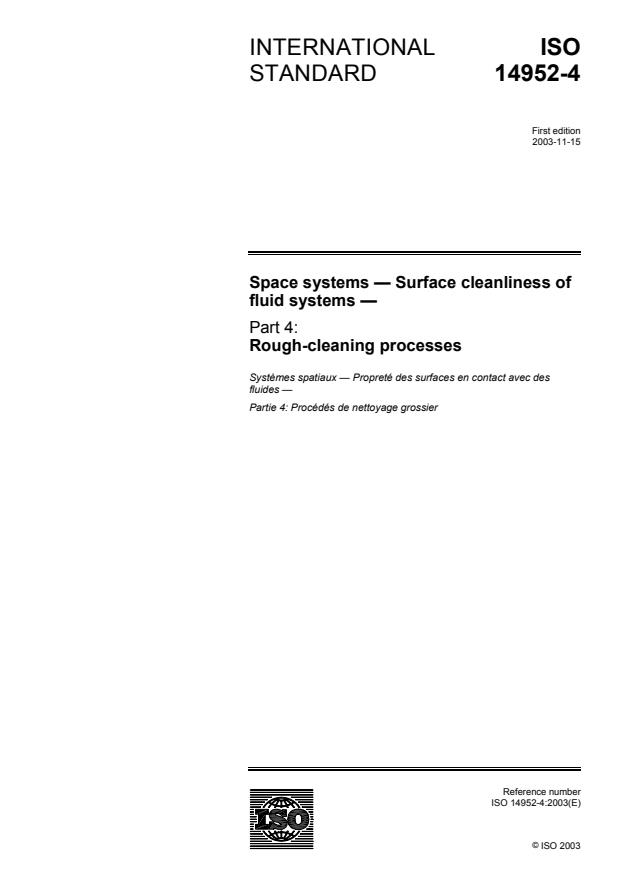
INTERNATIONAL ISO
STANDARD 14952-4
First edition
2003-11-15
Space systems — Surface cleanliness of
fluid systems —
Part 4:
Rough-cleaning processes
Systèmes spatiaux — Propreté des surfaces en contact avec des
fluides —
Partie 4: Procédés de nettoyage grossier
Reference number
©
ISO 2003
PDF disclaimer
This PDF file may contain embedded typefaces. In accordance with Adobe's licensing policy, this file may be printed or viewed but
shall not be edited unless the typefaces which are embedded are licensed to and installed on the computer performing the editing. In
downloading this file, parties accept therein the responsibility of not infringing Adobe's licensing policy. The ISO Central Secretariat
accepts no liability in this area.
Adobe is a trademark of Adobe Systems Incorporated.
Details of the software products used to create this PDF file can be found in the General Info relative to the file; the PDF-creation
parameters were optimized for printing. Every care has been taken to ensure that the file is suitable for use by ISO member bodies. In
the unlikely event that a problem relating to it is found, please inform the Central Secretariat at the address given below.
© ISO 2003
All rights reserved. Unless otherwise specified, no part of this publication may be reproduced or utilized in any form or by any means,
electronic or mechanical, including photocopying and microfilm, without permission in writing from either ISO at the address below or
ISO's member body in the country of the requester.
ISO copyright office
Case postale 56 • CH-1211 Geneva 20
Tel. + 41 22 749 01 11
Fax + 41 22 749 09 47
E-mail copyright@iso.org
Web www.iso.org
Published in Switzerland
ii © ISO 2003 — All rights reserved
Foreword
ISO (the International Organization for Standardization) is a worldwide federation of national standards bodies
(ISO member bodies). The work of preparing International Standards is normally carried out through ISO
technical committees. Each member body interested in a subject for which a technical committee has been
established has the right to be represented on that committee. International organizations, governmental and
non-governmental, in liaison with ISO, also take part in the work. ISO collaborates closely with the
International Electrotechnical Commission (IEC) on all matters of electrotechnical standardization.
International Standards are drafted in accordance with the rules given in the ISO/IEC Directives, Part 2.
The main task of technical committees is to prepare International Standards. Draft International Standards
adopted by the technical committees are circulated to the member bodies for voting. Publication as an
International Standard requires approval by at least 75 % of the member bodies casting a vote.
Attention is drawn to the possibility that some of the elements of this document may be the subject of patent
rights. ISO shall not be held responsible for identifying any or all such patent rights.
ISO 14952-4 was prepared by Technical Committee ISO/TC 20, Aircraft and space vehicles, Subcommittee
SC 14, Space systems and operations.
ISO 14952 consists of the following parts, under the general title Space systems — Surface cleanliness of
fluid systems:
Part 1: Vocabulary
Part 2: Cleanliness levels
Part 3: Analytical procedures for the determination of nonvolatile residues and particulate contamination
Part 4: Rough-cleaning processes
Part 5: Drying processes
Part 6: Precision-cleaning processes
Introduction
This part of ISO 14952 defines rough-cleaning processes intended for use prior to precision-cleaning
processes for equipment and components used in space fluid systems. The purpose of this part of ISO 14952
is to provide processes that can be used to achieve visibly clean parts and components.
iv © ISO 2003 — All rights reserved
INTERNATIONAL STANDARD ISO 14952-4:2003(E)
Space systems — Surface cleanliness of fluid systems —
Part 4:
Rough-cleaning processes
1 Scope
This part of ISO 14952 provides requirements related to rough-cleaning processes used to prepare parts and
components for precision cleaning. It identifies precleaning processes that can be used for ground support
equipment, launch vehicles and spacecraft.
Rough cleaning removes contaminants such as weld scale, heat-treat scale, corrosion, oxide films, oils,
grease, shop soil, fuel and carbon deposits. Rough cleaning is considered a normal shop process and usually
does not require special environmental controls, packaging, handling or storage beyond accepted good
practice.
This part of ISO 14952 is applicable equally to ground support equipment, launch vehicles and spacecraft.
NOTE The cleanliness level achieved by rough cleaning does not normally require verification beyond visual
inspection. (Wipe test, waterbreak test, ultraviolet inspection, special lights and mirrors are considered aids to visual
inspection.)
2 Normative references
The following referenced documents are indispensable for the application of this document. For dated
references, only the edition cited applies. For undated references, the latest edition of the referenced
document (including any amendments) applies.
ISO 14951-10:1999, Space systems — Fluid characteristics — Part 10: Water
ISO 14952-1:2003, Space systems — Surface cleanliness of fluid systems — Part 1: Vocabulary
3 Terms and definitions
For the purposes of this document, the terms and definitions given in ISO 14952-1 apply.
4 Rough-cleaning requirements
4.1 General
All parts, components, assemblies, systems or related equipment for use in ground support facilities, launch
vehicles and spacecraft shall be cleaned and inspected. Assembled parts that may be damaged during the
cleaning process shall be disassembled to a level to permit cleaning. The design for systems and system
components should, where practical, include the capability to remove all valves and components from the
system.
...
NORME ISO
INTERNATIONALE 14952-4
Première édition
2003-11-15
Systèmes spatiaux — Propreté des
surfaces en contact avec des fluides —
Partie 4:
Procédés de nettoyage grossier
Space systems — Surface cleanliness of fluid systems —
Part 4: Rough-cleaning processes
Numéro de référence
©
ISO 2003
PDF – Exonération de responsabilité
Le présent fichier PDF peut contenir des polices de caractères intégrées. Conformément aux conditions de licence d'Adobe, ce fichier
peut être imprimé ou visualisé, mais ne doit pas être modifié à moins que l'ordinateur employé à cet effet ne bénéficie d'une licence
autorisant l'utilisation de ces polices et que celles-ci y soient installées. Lors du téléchargement de ce fichier, les parties concernées
acceptent de fait la responsabilité de ne pas enfreindre les conditions de licence d'Adobe. Le Secrétariat central de l'ISO décline toute
responsabilité en la matière.
Adobe est une marque déposée d'Adobe Systems Incorporated.
Les détails relatifs aux produits logiciels utilisés pour la création du présent fichier PDF sont disponibles dans la rubrique General Info
du fichier; les paramètres de création PDF ont été optimisés pour l'impression. Toutes les mesures ont été prises pour garantir
l'exploitation de ce fichier par les comités membres de l'ISO. Dans le cas peu probable où surviendrait un problème d'utilisation,
veuillez en informer le Secrétariat central à l'adresse donnée ci-dessous.
© ISO 2003
Droits de reproduction réservés. Sauf prescription différente, aucune partie de cette publication ne peut être reproduite ni utilisée sous
quelque forme que ce soit et par aucun procédé, électronique ou mécanique, y compris la photocopie et les microfilms, sans l'accord écrit
de l'ISO à l'adresse ci-après ou du comité membre de l'ISO dans le pays du demandeur.
ISO copyright office
Case postale 56 • CH-1211 Geneva 20
Tel. + 41 22 749 01 11
Fax. + 41 22 749 09 47
E-mail copyright@iso.org
Web www.iso.org
Version française parue en 2004
Publié en Suisse
ii © ISO 2003 – Tous droits réservés
Avant-propos
L'ISO (Organisation internationale de normalisation) est une fédération mondiale d'organismes nationaux de
normalisation (comités membres de l'ISO). L'élaboration des Normes internationales est en général confiée
aux comités techniques de l'ISO. Chaque comité membre intéressé par une étude a le droit de faire partie du
comité technique créé à cet effet. Les organisations internationales, gouvernementales et non
gouvernementales, en liaison avec l'ISO participent également aux travaux. L'ISO collabore étroitement avec
la Commission électrotechnique internationale (CEI) en ce qui concerne la normalisation électrotechnique.
Les Normes internationales sont rédigées conformément aux règles données dans les Directives ISO/CEI,
Partie 2.
La tâche principale des comités techniques est d'élaborer les Normes internationales. Les projets de Normes
internationales adoptés par les comités techniques sont soumis aux comités membres pour vote. Leur
publication comme Normes internationales requiert l'approbation de 75 % au moins des comités membres
votants.
L'attention est appelée sur le fait que certains des éléments du présent document peuvent faire l'objet de
droits de propriété intellectuelle ou de droits analogues. L'ISO ne saurait être tenue pour responsable de ne
pas avoir identifié de tels droits de propriété et averti de leur existence.
L'ISO 14952-4 a été élaborée par le comité technique ISO/TC 20, Aéronautique et espace, sous-comité
SC 14, Systèmes spatiaux, développement et mise en œuvre.
L'ISO 14952 comprend les parties suivantes, présentées sous le titre général Systèmes spatiaux — Propreté
des surfaces en contact avec des fluide:
Partie 1: Vocabulaire
Partie 2: Niveaux de propreté
Partie 3: Modes opératoires analytiques pour la détermination des résidus non volatils et de la
contamination particulaire
Partie 4: Procédés de nettoyage grossier
Partie 5: Procédés de séchage
Partie 6: Procédés de nettoyage fin
Introduction
La présente partie de l'ISO 14952 définit les procédés de nettoyage grossier à appliquer avant les procédés
de nettoyage fin aux équipements et aux composants utilisés dans les systèmes de fluides dans le domaine
spatial. L'objet de la présente partie de l'ISO 14952 est de définir des procédés pouvant être utilisés pour
obtenir des éléments et des composants visuellement propres.
iv © ISO 2003 – Tous droits réservés
NORME INTERNATIONALE ISO 14952-4:2003(F)
Systèmes spatiaux — Propreté des surfaces en contact avec
des fluides —
Partie 4:
Procédés de nettoyage grossier
1 Domaine d'application
La présente partie de l'ISO 14952 fournit des exigences relatives aux procédés de nettoyage grossier utilisés
dans la préparation des éléments et des composants au nettoyage fin. Elle identifie les procédés de
prénettoyage pouvant être utilisés sur les équipements destinés au support au sol, sur les lanceurs spatiaux
et sur les véhicules spatiaux.
Le nettoyage grossier élimine les contaminants tels que battitures de soudage, tartre de traitement thermique,
corrosion, pellicules d'oxyde, huile, graisse, crasse d'atelier, carburant et dépôts de carbone. Le nettoyage
grossier est considéré comme une technique normale d'atelier ne nécessitant généralement pas un contrôle
particulier de l'environnement, ni un emballage, une manutention ou un stockage spéciaux.
La présente partie de l'ISO 14952 est applicable de la même manière aux équipements de support au sol, aux
lanceurs spatiaux et aux véhicules spatiaux.
NOTE En général, le niveau de propreté obtenu par le nettoyage grossier n'a pas besoin d'une autre vérification que
le contrôle visuel (le frottis, l'essai de rupture du film d'eau, le contrôle sous lumière ultraviolette, les éclairages spéciaux et
les miroirs sont considérés comme des compléments au contrôle visuel).
2 Références normatives
Les documents de référence suivants sont indispensables pour l'application du présent document. Pour les
références datées, seule l'édition citée s'applique. Pour les références non datées, la dernière édition du
document de référence s'applique (y compris les éventuels amendements).
ISO 14951-10:1999, Systèmes spatiaux — Caractéristiques des fluides — Partie 10: Eau
ISO 14952-1:2003, Systèmes spatiaux — Propreté des surfaces en contact avec des fluides — Partie 1:
Vocabulaire
3 Termes et définitions
Pour les besoins du présent document, les termes et définitions donnés dans l'ISO 14952-1 s'appliquent.
4 Exigences de nettoyage grossier
4.1 Généralités
Tous les éléments, composants, ensembles, systèmes ou équipements associés destinés à être utilisés dans
les installations de support au sol, dans les lanceurs spatiaux et dans les véhicules spatiaux doivent faire
l'objet d'un nettoyage et d'un contrôle. Les éléments assemblés susceptibles d'être endommagés au cours du
procédé de nettoyage doivent être démontés ju
...