

ISO 32312-11:2024
(Main)Aircraft ground support equipment — Specific requirements — Part 11: Container/Pallet dollies and loose load trailers
General Information
- Abstract
This document specifies the technical requirements to minimise the hazards listed in Clause 4 which can arise during the commissioning, operation and maintenance of container/pallet dollies and loose load trailers when carried out in accordance with the specifications given by the manufacturer or his authorised representative. It also takes into account some performance requirements recognised as essential by authorities, aircraft and ground support equipment (GSE) manufacturers as well as airlines and handling agencies. This document applies to container/pallet dollies using ball-mat, inverted cargo castors, or rollers and loose load trailers intended to be used for the transportation of baggage and cargo on airports (examples, see Annex A). This document does not apply to trailers of similar design as used on public roads, e.g., truck type trailers. This document does not establish requirements for noise and vibration. Noise and vibration are dealt with respectively in EN 1915-4 and EN 1915-3. This document is not applicable to container/pallet dollies and loose load trailers which are manufactured before the date of publication by ISO of this document. NOTE Certain measurements have been given in imperial units (in parentheses), following the metric measurements, since the containers/pallets to be handled are based mainly on the imperial system.
- Status
- Published
- Publication Date
- 12-Mar-2024
- Technical Committee
- ISO/TC 20/SC 9 - Air cargo and ground equipment
- Drafting Committee
- ISO/TC 20/SC 9 - Air cargo and ground equipment
- Current Stage
- 6060 - International Standard published
- Start Date
- 13-Mar-2024
- Due Date
- 13-Apr-2024
- Completion Date
- 13-Mar-2024
Buy Documents
ISO 32312-11:2024 - Aircraft ground support equipment — Specific requirements — Part 11: Container/Pallet dollies and loose load trailers Released:13. 03. 2024
ISO 32312-11:2024 - Matériel au sol pour aéronefs — Exigences particulieres — Partie 11: Remorques porte-conteneur/porte-palette et pour charges en vrac Released:13. 03. 2024
Overview
ISO 32312-11:2024 - Aircraft ground support equipment - Part 11: Container/Pallet dollies and loose load trailers - specifies safety, functional and some performance requirements for dolly and loose-load trailer design, commissioning, operation and maintenance at airports. It covers dollies using ball-mat, inverted cargo castors, or rollers and loose-load trailers for baggage, mail and cargo movement (ULDs and loose freight). The standard is a Type C machine-specific standard and complements general GSE requirements and risk-assessment principles.
Key topics and technical requirements
- Scope and applicability
- Applies to airport dollies and loose-load trailers; excludes truck-type road trailers and equipment manufactured before publication.
- Does not set requirements for noise/vibration (see EN 1915-4 / EN 1915-3).
- Hazard identification and risk assessment
- Lists hazards (Clause 4 and Annex B) and requires manufacturers to perform specific risk assessments for unclear crushing/shearing/falling points and machine interfaces.
- Structure and platform
- Structural stiffness must meet conveying surface load criteria (Annex C) and accommodate ULD dimensions/masses (Annex D).
- Corners/projections minimized - chamfer radius ≥ 3 mm where applicable.
- Platform rules: drainage for loose-load trailers, sloped surfaces to aid stability, minimum clearance of 13 mm below top of conveying surface for platform structure.
- Conveying and transfer units
- Supports ball transfer units, inverted castors and rollers; guidance on lead-on rollers and placement (max 100 mm from platform edge) and impact-absorbing geometry (ramps ≤ 15°; 15 mm mounting offset).
- Towing, brakes and coupling
- Designed for towing in trains (drawbar one end, towing coupling other), to avoid contact between adjacent dollies/ULDs.
- Requirements include steering, manoeuvring, wheel assemblies and overrun/auto-reverse brake considerations.
- Human factors and markings
- Controls must be operable with protective clothing/ gloves; clear marking, safety labeling and user instructions required (Clause 6).
- Verification and annexes
- Verification procedures and informative annexes include typical designs, conveying surface dimensions, ULD data and coupling types.
Practical applications and users
- Who uses it:
- GSE manufacturers and designers, airport operators, cargo handlers, airlines, regulatory authorities and procurement teams.
- Practical value:
- Ensures interoperability with ULDs, improves safety during loading/unloading and towing operations, reduces injury and equipment damage risk, and supports consistent procurement and certification of dollies and loose-load trailers.
Related standards
- EN 1915‑1:2001 (GSE - General requirements)
- EN 1915‑2+A1 (Stability and strength)
- EN 1915‑3 / EN 1915‑4 (vibration and noise)
- ISO 12100 (machine safety / risk assessment)
Keywords: ISO 32312-11:2024, aircraft ground support equipment, container/pallet dolly, loose load trailer, GSE, ULD, safety requirements, towing trains, risk assessment.
Relations
- Effective Date
- 12-Feb-2026
- Effective Date
- 06-Jun-2022
Buy Documents
ISO 32312-11:2024 - Aircraft ground support equipment — Specific requirements — Part 11: Container/Pallet dollies and loose load trailers Released:13. 03. 2024
ISO 32312-11:2024 - Matériel au sol pour aéronefs — Exigences particulieres — Partie 11: Remorques porte-conteneur/porte-palette et pour charges en vrac Released:13. 03. 2024
Get Certified
Connect with accredited certification bodies for this standard

BUREAU VERITAS Certification Germany
Bureau Veritas certification in Germany.

Element Materials Technology
Materials testing and product certification.

AQMS Ltd.
AQMS provides ISO certification to SMEs across the UK.
Sponsored listings
Frequently Asked Questions
ISO 32312-11:2024 is a standard published by the International Organization for Standardization (ISO). Its full title is "Aircraft ground support equipment — Specific requirements — Part 11: Container/Pallet dollies and loose load trailers". This standard covers: This document specifies the technical requirements to minimise the hazards listed in Clause 4 which can arise during the commissioning, operation and maintenance of container/pallet dollies and loose load trailers when carried out in accordance with the specifications given by the manufacturer or his authorised representative. It also takes into account some performance requirements recognised as essential by authorities, aircraft and ground support equipment (GSE) manufacturers as well as airlines and handling agencies. This document applies to container/pallet dollies using ball-mat, inverted cargo castors, or rollers and loose load trailers intended to be used for the transportation of baggage and cargo on airports (examples, see Annex A). This document does not apply to trailers of similar design as used on public roads, e.g., truck type trailers. This document does not establish requirements for noise and vibration. Noise and vibration are dealt with respectively in EN 1915-4 and EN 1915-3. This document is not applicable to container/pallet dollies and loose load trailers which are manufactured before the date of publication by ISO of this document. NOTE Certain measurements have been given in imperial units (in parentheses), following the metric measurements, since the containers/pallets to be handled are based mainly on the imperial system.
This document specifies the technical requirements to minimise the hazards listed in Clause 4 which can arise during the commissioning, operation and maintenance of container/pallet dollies and loose load trailers when carried out in accordance with the specifications given by the manufacturer or his authorised representative. It also takes into account some performance requirements recognised as essential by authorities, aircraft and ground support equipment (GSE) manufacturers as well as airlines and handling agencies. This document applies to container/pallet dollies using ball-mat, inverted cargo castors, or rollers and loose load trailers intended to be used for the transportation of baggage and cargo on airports (examples, see Annex A). This document does not apply to trailers of similar design as used on public roads, e.g., truck type trailers. This document does not establish requirements for noise and vibration. Noise and vibration are dealt with respectively in EN 1915-4 and EN 1915-3. This document is not applicable to container/pallet dollies and loose load trailers which are manufactured before the date of publication by ISO of this document. NOTE Certain measurements have been given in imperial units (in parentheses), following the metric measurements, since the containers/pallets to be handled are based mainly on the imperial system.
ISO 32312-11:2024 is classified under the following ICS (International Classification for Standards) categories: 49.100 - Ground service and maintenance equipment; 49.120 - Cargo equipment. The ICS classification helps identify the subject area and facilitates finding related standards.
ISO 32312-11:2024 has the following relationships with other standards: It is inter standard links to EN 12312-11:2005, ISO 7175-2:1988. Understanding these relationships helps ensure you are using the most current and applicable version of the standard.
ISO 32312-11:2024 is available in PDF format for immediate download after purchase. The document can be added to your cart and obtained through the secure checkout process. Digital delivery ensures instant access to the complete standard document.
Standards Content (Sample)
International
Standard
ISO 32312-11
First edition
Aircraft ground support
2024-03
equipment — Specific
requirements —
Part 11:
Container/Pallet dollies and loose
load trailers
Matériel au sol pour aéronefs — Exigences particulières —
Partie 11: Remorques porte-conteneur/porte-palette et pour
charges en vrac
Reference number
© ISO 2024
All rights reserved. Unless otherwise specified, or required in the context of its implementation, no part of this publication may
be reproduced or utilized otherwise in any form or by any means, electronic or mechanical, including photocopying, or posting on
the internet or an intranet, without prior written permission. Permission can be requested from either ISO at the address below
or ISO’s member body in the country of the requester.
ISO copyright office
CP 401 • Ch. de Blandonnet 8
CH-1214 Vernier, Geneva
Phone: +41 22 749 01 11
Email: copyright@iso.org
Website: www.iso.org
Published in Switzerland
ii
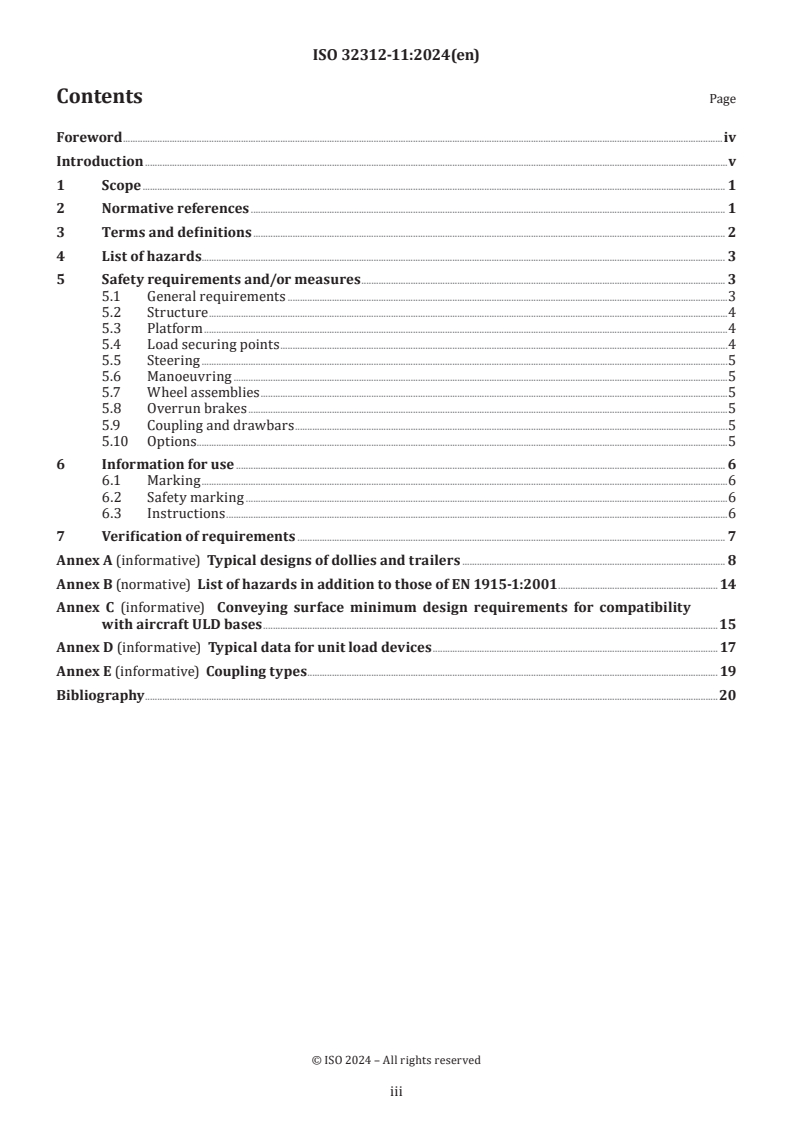
Contents Page
Foreword .iv
Introduction .v
1 Scope . 1
2 Normative references . 1
3 Terms and definitions . 2
4 List of hazards. 3
5 Safety requirements and/or measures . 3
5.1 General requirements .3
5.2 Structure .4
5.3 Platform .4
5.4 Load securing points .4
5.5 Steering .5
5.6 Manoeuvring .5
5.7 Wheel assemblies .5
5.8 Overrun brakes .5
5.9 Coupling and drawbars .5
5.10 Options.5
6 Information for use . 6
6.1 Marking .6
6.2 Safety marking .6
6.3 Instructions .6
7 Verification of requirements . 7
Annex A (informative) Typical designs of dollies and trailers . 8
Annex B (normative) List of hazards in addition to those of EN 1915-1:2001 . 14
Annex C (informative) Conveying surface minimum design requirements for compatibility
with aircraft ULD bases .15
Annex D (informative) Typical data for unit load devices . 17
Annex E (informative) Coupling types . 19
Bibliography .20
iii
Foreword
ISO (the International Organization for Standardization) is a worldwide federation of national standards
bodies (ISO member bodies). The work of preparing International Standards is normally carried out through
ISO technical committees. Each member body interested in a subject for which a technical committee
has been established has the right to be represented on that committee. International organizations,
governmental and non-governmental, in liaison with ISO, also take part in the work. ISO collaborates closely
with the International Electrotechnical Commission (IEC) on all matters of electrotechnical standardization.
The procedures used to develop this document and those intended for its further maintenance are described
in the ISO/IEC Directives, Part 1. In particular, the different approval criteria needed for the different types
of ISO document should be noted (see www.iso.org/directives).
ISO draws attention to the possibility that the implementation of this document may involve the use of (a)
patent(s). ISO takes no position concerning the evidence, validity or applicability of any claimed patent
rights in respect thereof. As of the date of publication of this document, ISO had not received notice of (a)
patent(s) which may be required to implement this document. However, implementers are cautioned that
this may not represent the latest information, which may be obtained from the patent database available at
www.iso.org/patents. ISO shall not be held responsible for identifying any or all such patent rights.
Any trade name used in this document is information given for the convenience of users and does not
constitute an endorsement.
For an explanation of the voluntary nature of standards, the meaning of ISO specific terms and expressions
related to conformity assessment, as well as information about ISO's adherence to the World Trade
Organization (WTO) principles in the Technical Barriers to Trade (TBT), see www.iso.org/iso/foreword.html.
This document was prepared by the European Committee for Standardization (CEN) (as EN 12312-11:2005)
and drafted in accordance with its editorial rules. It was assigned to Technical Committee ISO/TC 20,
Aircraft and space vehicles, Subcommittee SC 9, Air cargo and ground equipment and adopted under the “fast-
track procedure”.
A list of all parts in the ISO 32312 series can be found on the ISO website.
Any feedback or questions on this document should be directed to the user’s national standards body.
A complete listing of these bodies can be found at www.iso.org/members.html.
iv
Introduction
This document specifies health and safety requirements, as well as some functional and performance
requirements for container/pallet dollies and loose load trailers intended for moving unit load devices
(ULD), loose freight, mail and baggage on an airport.
The minimum essential criteria are considered to be of primary importance in providing safe, serviceable,
economical and practical container/pallet dollies and loose load trailers. Deviations from the recommended
criteria should occur only after careful consideration, extensive testing, risk assessment and thorough
service evaluation have shown alternative methods or conditions to be satisfactory.
This document is a type C standard as stated in both parts of ISO 12100.
The machinery concerned and the extent to which hazards, hazardous situations and events are covered are
indicated in the scope of this document.
When provisions of this type C standard are different from those which are stated in type A or B standards,
the provisions of this type C standard take precedence over the provisions of the other standards, for
machines that have been designed and built according to the provisions of this type C standard.
v
International Standard ISO 32312-11:2024(en)
Aircraft ground support equipment — Specific
requirements —
Part 11:
Container/Pallet dollies and loose load trailers
1 Scope
This document specifies the technical requirements to minimise the hazards listed in Clause 4 which can
arise during the commissioning, operation and maintenance of container/pallet dollies and loose load
trailers when carried out in accordance with the specifications given by the manufacturer or his authorised
representative. It also takes into account some performance requirements recognised as essential by
authorities, aircraft and ground support equipment (GSE) manufacturers as well as airlines and handling
agencies.
This document applies to container/pallet dollies using ball-mat, inverted cargo castors, or rollers and loose
load trailers intended to be used for the transportation of baggage and cargo on airports (examples, see
Annex A).
This document does not apply to trailers of similar design as used on public roads, e.g., truck type trailers.
This document does not establish requirements for noise and vibration.
Noise and vibration are dealt with respectively in EN 1915-4 and EN 1915-3.
This document is not applicable to container/pallet dollies and loose load trailers which are manufactured
before the date of publication by ISO of this document.
NOTE Certain measurements have been given in imperial units (in parentheses), following the metric
measurements, since the containers/pallets to be handled are based mainly on the imperial system.
2 Normative references
The following documents are referred to in the text in such a way that some or all of their content constitutes
requirements of this document. For dated references, only the edition cited applies. For undated references,
the latest edition of the referenced document (including any amendments) applies.
EN 1050:1996, Safety of machinery — Principles for risk assessment
EN 1915-1:2001, Aircraft ground support equipment — General requirements — Part 1: Basic safety
requirements
EN 1915-2+A1, Aircraft ground support equipment — General requirements — Part 2: Stability and strength
requirements, calculations and test methods
ISO 12100-1:2003, Safety of machinery — Basic concepts, general principles for design — Part 1: Basic
terminology, methodology (ISO 12100-1:2003)
ISO 12100-2:2003, Safety of machinery — Basic concepts, general principles for design — Part 2: Technical
principles (ISO 12100-2:2003)
3 Terms and definitions
For the purposes of this document, the terms and definitions given in ISO 12100-1:2003, ISO 12100-2:2003
and EN 1915-1:2001 and the following apply.
ISO and IEC maintain terminology databases for use in standardization at the following addresses:
— ISO Online browsing platform: available at https:// www .iso .org/ obp
— IEC Electropedia: available at https:// www .electropedia .org/
3.1
dolly
trailer designed for the transportation of containers or palletized loads
3.2
loose load trailer
trailer capable of transporting loose loads
EXAMPLE Baggage, parcels, mail bags.
3.3
container overhang
part of a container contoured beyond the base to match the design of an aircraft
3.4
overrun brake
brake operated by inertia to slow down a trailer in addition to the braking power of the towing vehicle
3.5
auto reverse brake
brake that releases automatically when the trailer is reversed
3.6
end towing
towing of a dolly from the shorter edge
3.7
side towing
towing of a dolly from the longer edge
3.8
end transfer (end loading)
loading/unloading of the ULD in line with the direction of travel of the trailer/dolly
3.9
side transfer (side loading)
loading/unloading of the ULD at 90° to the direction of travel of the dolly
3.10
roller
uni-directional transfer unit
3.11
inverted castor
omni-directional transfer unit
3.12
ball transfer unit
omni-directional transfer unit using ball modules
3.13
guide
fixed or retractable device used to maintain the desired direction of movement of ULDs
3.14
lead-on roller
special roller, positioned close to the edge of the platform to ease transfer of loads and absorb initial impact
3.15
lead-in flare
tapered end of guides to facilitate the easy transfer of ULDs
3.16
stop
fixed or retractable device capable of preventing horizontal movement of ULDs
3.17
lock
fixed or retractable device capable of preventing horizontal and vertical movement of ULDs
3.18
protective cover
fixed or flexible sheet to protect the load
3.19
cover stowage box
device to store flexible protective covers when not in use
4 List of hazards
The list of risks and hazards (see Annex B) is based on EN 1050:1996 and contains the hazards and hazardous
situations, as far as they are dealt with in this document, identified by risk assessment as significant for
container/pallet dollies and loose load trailers and which require action to eliminate or reduce risks.
5 Safety requirements and/or measures
5.1 General requirements
5.1.1 Container/pallet dollies and loose load trailers shall conform to the relevant requirements of
EN 1915-1:2001, unless otherwise specified in this document. They shall also conform to the specific
requirements of this document.
5.1.2 Stability and strength calculations shall be carried out in accordance with EN 1915-2+A1.
5.1.3 Container/pallet dollies and loose load trailers shall be designed to be towed in trains, e.g., by having
a drawbar at one end and a towing coupling at the other.
5.1.4 When dollies/trailers are towed in trains, the design shall be such as to avoid any contact between
adjacent dollies/trailers and ULDs intended to be carried when dollies/trailers are at 90° to each other.
5.1.5 Control device actuators, e.g., handles, foot pedals, shall be accessible and positioned so that they
can be operated whilst wearing protective clothing, e.g., cold weather protection, safety shoes. Handles shall
be designed to be operated by gloved hands.
5.1.6 In the case where it is not possible to identify clearly the crushing, shearing and falling points in this
document, the manufacturer shall carry out a specific risk assessment. The manufacturer shall also carry
out a specific risk assessment for the interface with other machines.
NOTE This risk assessment is part of the general risk assessment.
5.2 Structure
5.2.1 The support structure stiffness shall be such that the requirements of Annex C, in respect of the
support area, are satisfied taking into account the dimensions and masses of the payloads given in Annex D.
5.2.2 The structure of the trailer/dolly shall include no projections or corners that could cause injury,
e.g., corners shall be chamfered to a minimum radius of 3 mm unless smooth corners are provided by the
intrinsic design of the standard material profiles used in its construction.
5.3 Platform
5.3.1 On loose load trailers, drainage shall be provided to avoid accumulation of water on the platform.
5.3.2 On loose load trailers, the loading platform shall be designed to ease loading and assist with load
stability, e.g. the loading platform may be sloped towards the centre.
5.3.3 The platform
...
Norme
internationale
ISO 32312-11
Première édition
Matériel au sol pour aéronefs —
2024-03
Exigences particulières —
Partie 11:
Remorques porte-conteneur/porte-
palette et pour charges en vrac
Aircraft ground support equipment — Specific requirements —
Part 11: Container/Pallet dollies and loose load trailers
Numéro de référence
DOCUMENT PROTÉGÉ PAR COPYRIGHT
© ISO 2024
Tous droits réservés. Sauf prescription différente ou nécessité dans le contexte de sa mise en œuvre, aucune partie de cette
publication ne peut être reproduite ni utilisée sous quelque forme que ce soit et par aucun procédé, électronique ou mécanique,
y compris la photocopie, ou la diffusion sur l’internet ou sur un intranet, sans autorisation écrite préalable. Une autorisation peut
être demandée à l’ISO à l’adresse ci-après ou au comité membre de l’ISO dans le pays du demandeur.
ISO copyright office
Case postale 401 • Ch. de Blandonnet 8
CH-1214 Vernier, Genève
Tél.: +41 22 749 01 11
E-mail: copyright@iso.org
Web: www.iso.org
Publié en Suisse
ii
Sommaire Page
Avant-propos .iv
Introduction .v
1 Domaine d'application . 1
2 Références normatives . 1
3 Termes et définitions . 2
4 Liste des phénomènes dangereux. 3
5 Exigences et/ou mesures de sécurité. 3
5.1 Exigences générales .3
5.2 Structure .4
5.3 Plate-forme .4
5.4 Retenue des charges .4
5.5 Direction .5
5.6 Manœuvre .5
5.7 Ensembles de roues .5
5.8 Freins à inertie.5
5.9 Attelages et timons .5
5.10 Options.6
6 Informations d'utilisation . . 6
6.1 Marquage .6
6.2 Marquages de sécurité.6
6.3 Consignes .6
7 Vérification des exigences . 7
Annexe A (informative) Concepts types de remorques . 8
Annexe B (normative) Liste des dangers en plus de ceux cités dans l’EN 1915-1:2001 . 14
Annexe C (informative) Exigences minimales de conception pour des surfaces de transfert
compatibles avec les bases des ULD pour aéronefs .15
Annexe D (informative) Caractéristiques types des unités de charge . 17
Annexe E (informative) Attelages types . 19
Bibliographie .20
iii
Avant-propos
L'ISO (Organisation internationale de normalisation) est une fédération mondiale d'organismes nationaux
de normalisation (comités membres de l'ISO). L'élaboration des Normes internationales est en général
confiée aux comités techniques de l'ISO. Chaque comité membre intéressé par une étude a le droit de faire
partie du comité technique créé à cet effet. Les organisations internationales, gouvernementales et non
gouvernementales, en liaison avec l'ISO participent également aux travaux. L'ISO collabore étroitement avec
la Commission électrotechnique internationale (IEC) en ce qui concerne la normalisation électrotechnique.
Les procédures utilisées pour élaborer le présent document et celles destinées à sa mise à jour sont
décrites dans les Directives ISO/IEC, Partie 1. Il convient, en particulier, de prendre note des différents
critères d'approbation requis pour les différents types de documents ISO. Le présent document a
été rédigé conformément aux règles de rédaction données dans les Directives ISO/IEC, Partie 2 (voir
www.iso.org/directives).
L’ISO attire l’attention sur le fait que la mise en application du présent document peut entraîner l’utilisation
d’un ou de plusieurs brevets. L’ISO ne prend pas position quant à la preuve, à la validité et à l’applicabilité de
tout droit de propriété revendiqué à cet égard. À la date de publication du présent document, l’ISO n'avait pas
reçu notification qu’un ou plusieurs brevets pouvaient être nécessaires à sa mise en application. Toutefois,
il y a lieu d’avertir les responsables de la mise en application du présent document que des informations
plus récentes sont susceptibles de figurer dans la base de données de brevets, disponible à l'adresse
www.iso.org/brevets. L’ISO ne saurait être tenue pour responsable de ne pas avoir identifié tout ou partie de
tels droits de propriété.
Les appellations commerciales éventuellement mentionnées dans le présent document sont données pour
information, par souci de commodité, à l'intention des utilisateurs et ne sauraient constituer un engagement.
Pour une explication de la nature volontaire des normes, la signification des termes et expressions
spécifiques de l'ISO liés à l'évaluation de la conformité, ou pour toute information au sujet de l'adhésion de
l'ISO aux principes de l’Organisation mondiale du commerce (OMC) concernant les obstacles techniques au
commerce (OTC), voir www.iso.org/avant-propos.
Le présent document a été élaboré par le Comité Européen de Normalisation (CEN) (en tant
qu'EN 12312-11:2005) et rédigé conformément à ses règles de rédaction. Il a été attribué au Comité
technique ISO/TC 20 Aéronautique et espace, sous-comité SC 9, Chargement et équipement au sol, et adopté
selon la procédure accélérée ( fast-track).
Une liste de toutes les parties de la série ISO 32312 se trouve sur le site web de l’ISO.
Il convient que l'utilisateur adresse tout retour d'information ou toute question concernant le présent
document à l'organisme national de normalisation de son pays. Une liste exhaustive desdits organismes se
trouve à l'adresse www.iso.org/fr/members.html.
iv
Introduction
Le présent document définit des exigences en matière de santé et de sécurité, ainsi que des exigences
fonctionnelles et de performance pour les remorques porte-conteneur/porte-palette et pour charges en vrac
destinés à la manipulation d’unités de charge (ULD), de fret, poste et bagages en vrac sur un aéroport.
Ces critères essentiels minimums sont d’importance majeure pour garantir sûrs, durables, économiques et
pratiques les remorques porte-conteneur/porte-palette et pour charges en vrac. Il convient qu’un écart par
rapport aux critères recommandés ne soit autorisé qu’après démonstration par étude approfondie, essais
complets, analyse des risques et évaluation poussée en service, que la méthode ou condition alternative est
satisfaisante.
Le présent document est une norme de type C au sens des deux parties de l’ISO 12100.
Les matériels concernés et l’étendue de la couverture des dangers, événements et situations dangereux sont
indiqués dans le domaine d’application du présent document.
Chaque fois que des dispositions de la présente norme de type C diffèrent de celles spécifiées dans des
normes de type A ou B, les dispositions de la présente norme de type C priment sur celles des autres normes,
pour les machines conçues et construites en conformité aux dispositions de la présente norme de type C.
v
Norme internationale ISO 32312-11:2024(fr)
Matériel au sol pour aéronefs — Exigences particulières —
Partie 11:
Remorques porte-conteneur/porte-palette et pour charges en
vrac
1 Domaine d'application
Le présent document spécifie les exigences techniques pour minimiser les dangers listés à l'Article 4 qui
pourraient intervenir lors de la mise en service, de l’exploitation et de la maintenance des remorques porte-
conteneur/porte-palette et pour charges en vrac, lorsqu’elles sont effectuées selon les spécifications du
fabricant ou de son représentant autorisé. Il tient compte également d’exigences reconnues essentielles par
les autorités, les fabricants d’aéronefs et de GSE et les compagnies aériennes et entreprises de manutention.
Il s’applique aux remorques à plateaux à billes, roulettes orientables inversées ou rouleaux et pour charges
en vrac, destinés au transport de bagages et fret sur les aéroports (voir exemples en Annexe A).
Il ne s'applique pas aux remorques semblables conçues pour la voie publique, telles que remorques de
camions.
Le présent document ne prescrit pas d’exigences pour le bruit et les vibrations.
Le bruit et les vibrations sont traités respectivement dans l'EN 1915-4 et l'EN 1915-3.
Le présent document ne s'applique pas aux remorques porte-conteneur/porte-palette et pour charges en
vrac fabriquées avant la date de publication de cette norme ISO.
NOTE Certaines mesures sont données en unités inch-pound (entre parenthèses), après les mesures métriques,
car les conteneurs/palettes à manipuler sont fondés principalement sur le système inch-pound.
2 Références normatives
Les documents suivants sont cités dans le texte de sorte qu'ils constituent, pour tout ou partie de leur
contenu, des exigences du présent document. Pour les références datées, seule l'édition citée s'applique. Pour
les références non datées, la dernière édition du document de référence s'applique (y compris les éventuels
amendements).
EN 1050:1996, Sécurité des machines — Principes pour l’appréciation des risques
EN 1915-1:2001, Matériels au sol pour aéronefs — Exigences générales — Partie 1: Caractéristiques
fondamentales de sécurité
EN 1915-2+A1, Matériels au sol pour aéronefs — Exigences générales — Partie 2: Exigences de stabilité et de
résistance mécanique, calculs et méthodes d’essai
ISO 12100-1:2003, Sécurité des machines — Notions fondamentales, principes généraux de conception —
Partie 1: Terminologie de base, méthodologie
ISO 12100-2:2003, Sécurité des machines — Notions fondamentales, principes généraux de conception —
Partie 2: Principes techniques
3 Termes et définitions
Pour les besoins du présent document, les termes et définitions donnés dans l'ISO 12100-1:2003,
l'ISO 12100-2:2003 et l'EN 1915-1:2001 ainsi que les suivants s’appliquent.
L'ISO et l’IEC tiennent à jour des bases de données terminologiques destinées à être utilisées en normalisation,
consultables aux adresses suivantes:
— ISO Online browsing platform: disponible sur https:// www .iso .org/ obp
— IEC Electropedia: disponible à l'adresse https:// www .electropedia .org/
3.1
remorque porte-conteneur/porte-palette
remorque conçue pour le transport de conteneurs ou de charges palettisées
3.2
remorque pour charge en vrac
remorque capable du transport de charges en vrac
EXEMPLE Bagages, colis, sacs de poste.
3.3
surplomb de conteneur
partie d'un conteneur où le contour est plus grand que la base, pour adaptation à la conception d'un aéronef
3.4
frein à inertie
frein actionné par inertie et destiné à ralentir la remorque en plus de la capacité de freinage du véhicule
tracteur
3.5
frein autoréversible
frein dont le relâchement est automatique lorsque le sens de traction de la remorque est inversé
3.6
remorquage longitudinal
remorquage d'un chariot par son côté le plus court
3.7
remorquage latéral
remorquage d'un chariot par son côté le plus long
3.8
transfert longitudinal (chargement longitudinal)
chargement/déchargement de l'ULD dans le sens de déplacement de la remorque/du chariot
3.9
transfert latéral (chargement latéral)
chargement/déchargement de l'ULD à 90° du sens de déplacement du chariot
3.10
rouleau
unité de transfert unidirectionnelle
3.11
roulette orientable inversée
unité de transfert omnidirectionnelle
3.12
unité de transfert à billes
unité de transfert omnidirectionnelle utilisant des billes de manutention
3.13
guide
dispositif fixe ou rétractable utilisé pour maintenir le déplacement des ULD dans la direction désirée
3.14
rouleau d'entrée
rouleau spécial à proximité du bord de la plate-forme pour faciliter le transfert des charges et absorber le
choc
3.15
évasement d’entrée
extrémité des guides en forme évasée, destinée à faciliter le transfert des ULD
3.16
butée
dispositif fixe ou rétractable permettant d'empêcher les déplacements horizontaux des ULD
3.17
verrou
dispositif fixe ou rétractable empêchant les déplacements horizontaux et verticaux des ULD
3.18
bâche protectrice
feuille fixe ou flexible destinée à protéger la charge
3.19
compartiment de rangement de bâche
dispositif permettant d'entreposer les bâches protectrices flexibles lorsqu'elles ne sont pas utilisées
4 Liste des phénomènes dangereux
La liste des risques et dangers (voir l'Annexe B) s'appuie sur l'EN 1050:1996 et contient, dans la mesure où ils
sont traités dans le présent document, les risques et situations dangereuses identifiés par analyse de risques
comme significatifs pour les remorques, nécessitant d’agir pour les éliminer ou les réduire.
5 Exigences et/ou mesures de sécurité
5.1 Exigences générales
5.1.1 Sauf spécification contraire du présent document, les remorques porte-conteneur/porte-palette
et pour charges en vrac doivent satisfaire les exigences pertinentes de l’EN 1915-1:2001. Elles doivent
également satisfaire les exigences spécifiques du présent document.
5.1.2 Les calculs de stabilité et de résistance mécanique doivent être effectués en accord avec l’EN 1915-
2+A1.
5.1.3 Les remorques porte-conteneur/porte-palette et pour charges en vrac doivent être conçues pour
tractage en trains, par exemple avec un timon à une extrémité et un raccord d’attelage à l’autre extrémité.
5.1.4 La conception des remorques tractées en trains doit éviter tout contact entre remorques adjacentes
et ULD à transporter quand les remorques sont à 90° l’une de l’autre.
5.1.5 Les actionneurs de commandes tels que poignées ou pédales, doivent être accessibles et disposés
de façon à être utilisés avec des vêtements de protection tels que vêtements temps froid ou chaussures de
sécurité. Les poignées doivent être conçues pour des mains gantées.
5.1.6 Lorsqu’il n’est pas possible d’identifier clairement les points d’écrasement, cisaillement et chute du
présent document, le fabricant doit effectuer une évaluation de risque spécifique. Le fabricant doit effectuer
aussi une évaluation de risque spécifique aux interfaces avec les autres machines.
NOTE Cette évaluation de risque fait partie de l’évaluation de risque réglementaire globale.
5.2 Structure
5.2.1 La rigidité de la structure support doit satisfaire les exigences de l’Annexe C relatives à la surface
support, en tenant compte des dimensions et masses des charges utiles données en Annexe D.
5.2.2 La structure des remorques ne doit pas comporter de saillies ou angles pouvant causer des blessures;
par exemple, les angles doivent être chanfreinés à un rayon d’au moins 3 mm sauf si la conception intrinsèque
des profils des matériaux standards utilisés en construction donne des angles adoucis.
5.3 Plate-forme
5.3.1 Sur les remorques pour charge en vrac, un drainage doit empêcher l'accumulation d'eau sur la plate-
forme.
5.3.2 Sur les remorques pour charge en vrac, la conception de la plate-forme de chargement doit faciliter le
chargement et aider à la stabilité de la charge, par exemple elle peut être en pente vers le centre.
5.3.3 La conception
...