

ISO 2426-2:2020
(Main)Plywood — Classification by surface appearance — Part 2: Hardwood
General Information
- Abstract
This document specifies the nature and limits of characteristics inherent in wood and manufacturing defects enabling the visual assessment of the plywood for allocation to an appearance class. This document applies to plywood, the surface veneers of which are made from hardwood species[1] including tropical and temperate hardwood. It does not apply to overlaid panels. [1] Conventionally, broadleaved species.
- Status
- Published
- Publication Date
- 06-Apr-2020
- Technical Committee
- ISO/TC 89/SC 3 - Plywood
- Drafting Committee
- ISO/TC 89/SC 3 - Plywood
- Current Stage
- 9060 - Close of review
- Completion Date
- 02-Dec-2030
Buy Documents


ISO 2426-2:2020 - Plywood -- Classification by surface appearance
ISO 2426-2:2020 - Plywood — Classification by surface appearance — Part 2: Hardwood/7/2020
Overview
ISO 2426-2:2020 is an international standard providing a systematic classification for plywood made from hardwood species, based on surface appearance. This standard focuses on visual assessment criteria that define quality classes for hardwood plywood veneers, including both tropical and temperate broadleaved hardwood species. It serves as a key reference for manufacturers, suppliers, and users in evaluating the appearance of hardwood plywood and determining its suitability for various applications.
This document is part two of the ISO 2426 series and specifically excludes plywood panels that are overlaid or coated. The visual classification addresses inherent wood characteristics and manufacturing defects, providing clear guidelines for permissible surface features within specified appearance classes.
Key Topics
Scope and Application
ISO 2426-2:2020 applies exclusively to plywood surfaced with hardwood veneers. It defines the acceptable nature and limits of defects and characteristics found naturally in wood or resulting from manufacturing processes to allocate each plywood panel to one of five appearance classes: E, I, II, III, or IV.Appearance Classes and Criteria
The standard categorizes hardwood plywood surface quality into classes based on:- Presence and size of knots (pin knots, sound intergrown knots, unsound knots)
- Splits and checks, both open and closed
- Discoloration and irregularities in the wood structure
- Defects caused by insects, parasitic plants, marine borers, and fungal decay
- Manufacturing defects such as open joints, overlaps, blisters, roughness, glue penetration, and particles
Permissible Defects and Characteristics
Detailed tables in the standard specify limits for each defect type in terms of size, frequency, and condition (filled or unfilled). For example, pin knots up to 3 mm in diameter are generally permitted in all classes, whereas unsound knots and knot holes have stricter size and filling requirements depending on the class. Manufacturing defects like open joints and overlaps have defined permissible widths and quantities depending on the class.Visual Assessment Process
The evaluation follows procedures outlined in ISO 2426-1, ensuring consistency in the classification of hardwood plywood based on surface appearance.
Applications
ISO 2426-2:2020 is essential for stakeholders involved in the production, quality control, specification, and procurement of hardwood plywood. Practical applications include:
Quality Control in Manufacturing
Producers use this standard to classify plywood batches, ensure conformity with customer requirements, and reduce variability in product aesthetics.Specification and Procurement
Architects, designers, and builders reference the standard to select plywood that meets visual and aesthetic expectations for furniture, interior paneling, cabinetry, and decorative applications.Compliance and Certification
Certification bodies and inspection agencies employ the classification system to verify product quality claims and adherence to international norms.Market Standardization
Trade and commerce benefit from a unified terminology and classification system, enhancing communication across suppliers and customers worldwide.
Related Standards
ISO 2426-1: General Classification by Surface Appearance
Provides overarching principles and methods for evaluating plywood surface quality, forming the basis for part 2’s hardwood-specific criteria.ISO 2426-3: Softwood Plywood Classification
Complements part 2 by detailing classification requirements for plywood made with softwood veneers.ISO 1096: Plywood Classification
Covers general classification principles relevant to plywood quality.ISO 2074: Plywood Vocabulary
Offers standardized terminology for plywood products and defects.
Keywords: ISO 2426-2, plywood classification, hardwood plywood, surface appearance, plywood defects, hardwood veneer, plywood standards, plywood quality, visual assessment, manufacturing defects, hardwood species, plywood surface grading.
Relations
- Effective Date
- 06-Jun-2022
- Effective Date
- 15-Dec-2017
Buy Documents
ISO 2426-2:2020 - Plywood -- Classification by surface appearance
ISO 2426-2:2020 - Plywood — Classification by surface appearance — Part 2: Hardwood/7/2020
Get Certified
Connect with accredited certification bodies for this standard

Gozdarski inštitut Slovenije
Slovenian Forestry Institute. Forest management certification support, timber testing.
Sponsored listings
Frequently Asked Questions
ISO 2426-2:2020 is a standard published by the International Organization for Standardization (ISO). Its full title is "Plywood — Classification by surface appearance — Part 2: Hardwood". This standard covers: This document specifies the nature and limits of characteristics inherent in wood and manufacturing defects enabling the visual assessment of the plywood for allocation to an appearance class. This document applies to plywood, the surface veneers of which are made from hardwood species[1] including tropical and temperate hardwood. It does not apply to overlaid panels. [1] Conventionally, broadleaved species.
This document specifies the nature and limits of characteristics inherent in wood and manufacturing defects enabling the visual assessment of the plywood for allocation to an appearance class. This document applies to plywood, the surface veneers of which are made from hardwood species[1] including tropical and temperate hardwood. It does not apply to overlaid panels. [1] Conventionally, broadleaved species.
ISO 2426-2:2020 is classified under the following ICS (International Classification for Standards) categories: 79.060.10 - Plywood. The ICS classification helps identify the subject area and facilitates finding related standards.
ISO 2426-2:2020 has the following relationships with other standards: It is inter standard links to ISO 17225-8:2023, ISO 2426-2:2000. Understanding these relationships helps ensure you are using the most current and applicable version of the standard.
ISO 2426-2:2020 is available in PDF format for immediate download after purchase. The document can be added to your cart and obtained through the secure checkout process. Digital delivery ensures instant access to the complete standard document.
Standards Content (Sample)
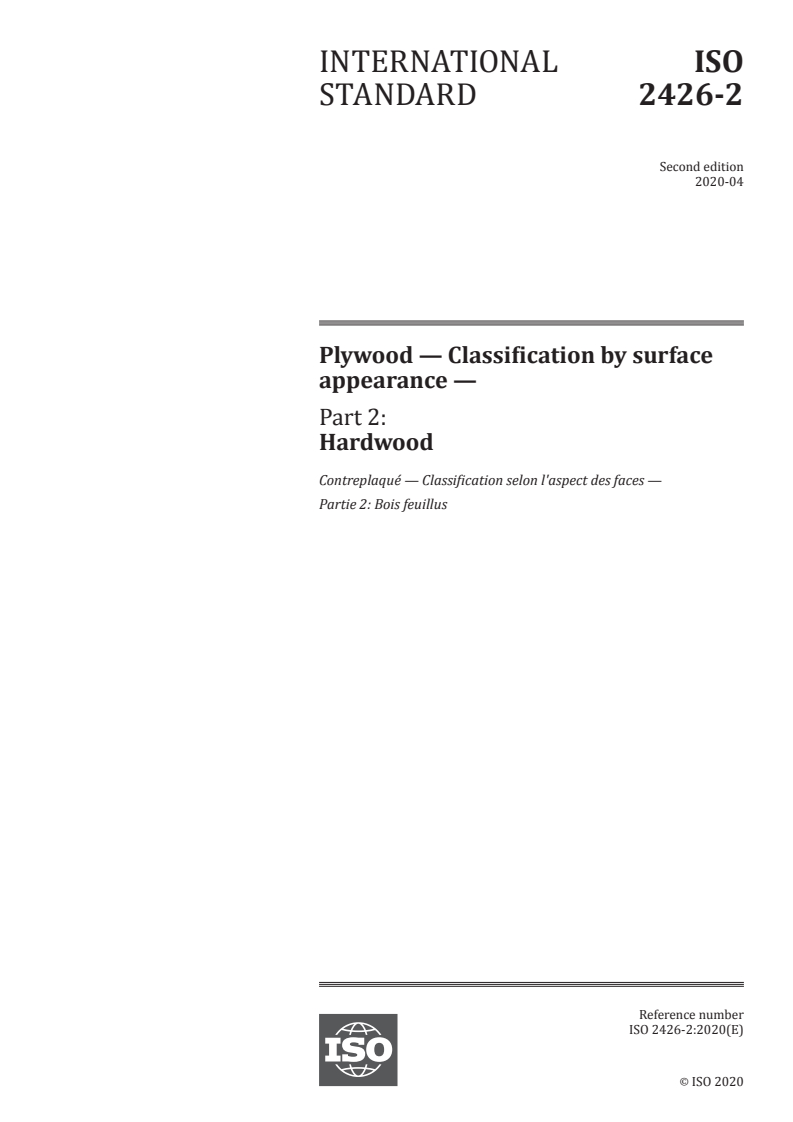
INTERNATIONAL ISO
STANDARD 2426-2
Second edition
2020-04
Plywood — Classification by surface
appearance —
Part 2:
Hardwood
Contreplaqué — Classification selon l'aspect des faces —
Partie 2: Bois feuillus
Reference number
©
ISO 2020
© ISO 2020
All rights reserved. Unless otherwise specified, or required in the context of its implementation, no part of this publication may
be reproduced or utilized otherwise in any form or by any means, electronic or mechanical, including photocopying, or posting
on the internet or an intranet, without prior written permission. Permission can be requested from either ISO at the address
below or ISO’s member body in the country of the requester.
ISO copyright office
CP 401 • Ch. de Blandonnet 8
CH-1214 Vernier, Geneva
Phone: +41 22 749 01 11
Fax: +41 22 749 09 47
Email: copyright@iso.org
Website: www.iso.org
Published in Switzerland
ii © ISO 2020 – All rights reserved
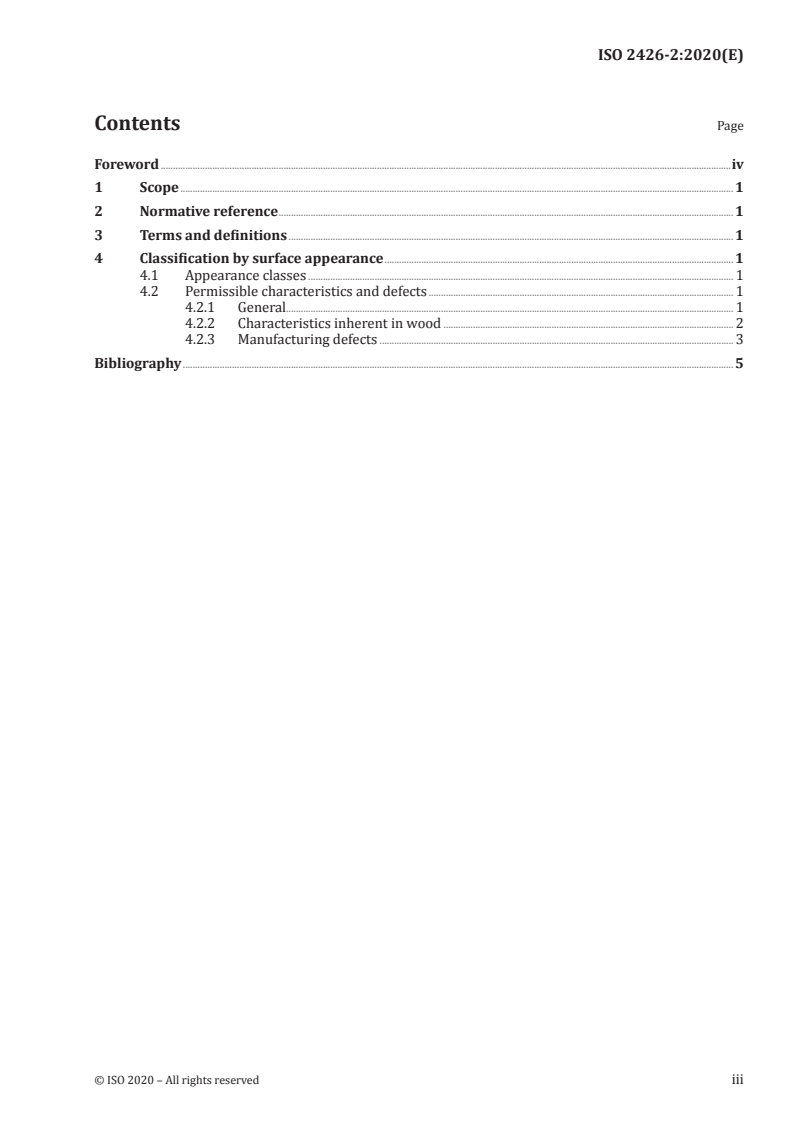
Contents Page
Foreword .iv
1 Scope . 1
2 Normative reference . 1
3 Terms and definitions . 1
4 Classification by surface appearance . 1
4.1 Appearance classes . 1
4.2 Permissible characteristics and defects . 1
4.2.1 General. 1
4.2.2 Characteristics inherent in wood . 2
4.2.3 Manufacturing defects . 3
Bibliography . 5
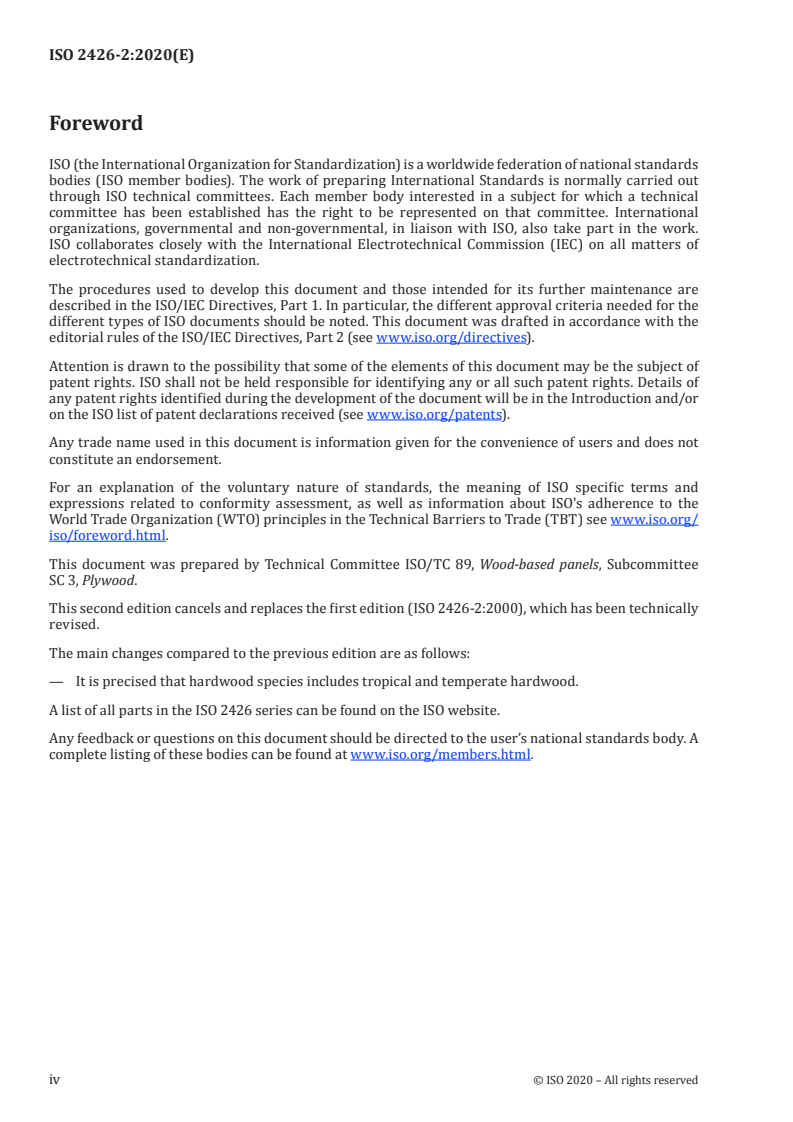
Foreword
ISO (the International Organization for Standardization) is a worldwide federation of national standards
bodies (ISO member bodies). The work of preparing International Standards is normally carried out
through ISO technical committees. Each member body interested in a subject for which a technical
committee has been established has the right to be represented on that committee. International
organizations, governmental and non-governmental, in liaison with ISO, also take part in the work.
ISO collaborates closely with the International Electrotechnical Commission (IEC) on all matters of
electrotechnical standardization.
The procedures used to develop this document and those intended for its further maintenance are
described in the ISO/IEC Directives, Part 1. In particular, the different approval criteria needed for the
different types of ISO documents should be noted. This document was drafted in accordance with the
editorial rules of the ISO/IEC Directives, Part 2 (see www .iso .org/ directives).
Attention is drawn to the possibility that some of the elements of this document may be the subject of
patent rights. ISO shall not be held responsible for identifying any or all such patent rights. Details of
any patent rights identified during the development of the document will be in the Introduction and/or
on the ISO list of patent declarations received (see www .iso .org/ patents).
Any trade name used in this document is information given for the convenience of users and does not
constitute an endorsement.
For an explanation of the voluntary nature of standards, the meaning of ISO specific terms and
expressions related to conformity assessment, as well as information about ISO's adherence to the
World Trade Organization (WTO) principles in the Technical Barriers to Trade (TBT) see www .iso .org/
iso/ foreword .html.
This document was prepared by Technical Committee ISO/TC 89, Wood-based panels, Subcommittee
SC 3, Plywood.
This second edition cancels and replaces the first edition (ISO 2426-2:2000), which has been technically
revised.
The main changes compared to the previous edition are as follows:
— It is precised that hardwood species includes tropical and temperate hardwood.
A list of all parts in the ISO 2426 series can be found on the ISO website.
Any feedback or questions on this document should be directed to the user’s national standards body. A
complete listing of these bodies can be found at www .iso .org/ members .html.
iv © ISO 2020 – All rights reserved
INTERNATIONAL STANDARD ISO 2426-2:2020(E)
Plywood — Classification by surface appearance —
Part 2:
Hardwood
1 Scope
This document specifies the nature and limits of characteristics inherent in wood and manufacturing
defects enabling the visual assessment of the plywood for allocation to an appearance class.
1)
This document applies to plywood, the surface veneers of which are made from hardwood
...
INTERNATIONAL ISO
STANDARD 2426-2
Second edition
2020-04
Plywood — Classification by surface
appearance —
Part 2:
Hardwood
Contreplaqué — Classification selon l'aspect des faces —
Partie 2: Bois feuillus
Reference number
©
ISO 2020
© ISO 2020
All rights reserved. Unless otherwise specified, or required in the context of its implementation, no part of this publication may
be reproduced or utilized otherwise in any form or by any means, electronic or mechanical, including photocopying, or posting
on the internet or an intranet, without prior written permission. Permission can be requested from either ISO at the address
below or ISO’s member body in the country of the requester.
ISO copyright office
CP 401 • Ch. de Blandonnet 8
CH-1214 Vernier, Geneva
Phone: +41 22 749 01 11
Fax: +41 22 749 09 47
Email: copyright@iso.org
Website: www.iso.org
Published in Switzerland
ii © ISO 2020 – All rights reserved
Contents Page
Foreword .iv
1 Scope . 1
2 Normative reference . 1
3 Terms and definitions . 1
4 Classification by surface appearance . 1
4.1 Appearance classes . 1
4.2 Permissible characteristics and defects . 1
4.2.1 General. 1
4.2.2 Characteristics inherent in wood . 2
4.2.3 Manufacturing defects . 3
Bibliography . 5
Foreword
ISO (the International Organization for Standardization) is a worldwide federation of national standards
bodies (ISO member bodies). The work of preparing International Standards is normally carried out
through ISO technical committees. Each member body interested in a subject for which a technical
committee has been established has the right to be represented on that committee. International
organizations, governmental and non-governmental, in liaison with ISO, also take part in the work.
ISO collaborates closely with the International Electrotechnical Commission (IEC) on all matters of
electrotechnical standardization.
The procedures used to develop this document and those intended for its further maintenance are
described in the ISO/IEC Directives, Part 1. In particular, the different approval criteria needed for the
different types of ISO documents should be noted. This document was drafted in accordance with the
editorial rules of the ISO/IEC Directives, Part 2 (see www .iso .org/ directives).
Attention is drawn to the possibility that some of the elements of this document may be the subject of
patent rights. ISO shall not be held responsible for identifying any or all such patent rights. Details of
any patent rights identified during the development of the document will be in the Introduction and/or
on the ISO list of patent declarations received (see www .iso .org/ patents).
Any trade name used in this document is information given for the convenience of users and does not
constitute an endorsement.
For an explanation of the voluntary nature of standards, the meaning of ISO specific terms and
expressions related to conformity assessment, as well as information about ISO's adherence to the
World Trade Organization (WTO) principles in the Technical Barriers to Trade (TBT) see www .iso .org/
iso/ foreword .html.
This document was prepared by Technical Committee ISO/TC 89, Wood-based panels, Subcommittee
SC 3, Plywood.
This second edition cancels and replaces the first edition (ISO 2426-2:2000), which has been technically
revised.
The main changes compared to the previous edition are as follows:
— It is precised that hardwood species includes tropical and temperate hardwood.
A list of all parts in the ISO 2426 series can be found on the ISO website.
Any feedback or questions on this document should be directed to the user’s national standards body. A
complete listing of these bodies can be found at www .iso .org/ members .html.
iv © ISO 2020 – All rights reserved
INTERNATIONAL STANDARD ISO 2426-2:2020(E)
Plywood — Classification by surface appearance —
Part 2:
Hardwood
1 Scope
This document specifies the nature and limits of characteristics inherent in wood and manufacturing
defects enabling the visual assessment of the plywood for allocation to an appearance class.
1)
This document applies to plywood, the surface veneers of which are made from hardwood
...