

ISO/IEC 4396-9:2023
(Main)Telecommunications and information exchange between systems — Recursive inter-network architecture — Part 9: Error and flow control protocol
General Information
- Abstract
This document provides the Error and Flow Control Protocol (EFCP) specification. EFCP provides an inter-process communication (IPC) service to an application process, which can be a (N+1)-IPC process (IPCP), with the requested Quality of Service (QoS). One or more service data units (SDUs) are passed on the (N)-port-id to the (N)-DIF (distributed IPC facility) to be sent to the destination application process. Protocol data units (PDUs) transferred by the (N)-DIF are delivered to the (N)-port-id for the using Application Process. This document describes the placement of EFCP within RINA, the components EFCP consists of, and the mechanisms and policies that are involved in EFCP’s work, and the timers and control mechanisms required to manage the connection. EFCP comprises two logical components, the data transfer procedures (DTP), providing tightly bound mechanisms and the data transfer control procedures (DTCP), which provides loosely bound mechanisms. This document provides: — the service definition; — an overview of EFCP; — a description of the placement of EFCP within recursive internetwork architecture (RINA); — the common elements of data transfer protocol (DTP) and data transfer control protocol (DTCP); — DTP structure and functions; — DTCP structure and functions; — an informative list of all policies in EFCP.en
- Status
- Published
- Publication Date
- 04-Dec-2023
- Current Stage
- 6060 - International Standard published
- Start Date
- 05-Dec-2023
- Due Date
- 11-May-2024
- Completion Date
- 05-Dec-2023


Overview
ISO/IEC 4396-9:2023 specifies the Error and Flow Control Protocol (EFCP) for the Recursive Inter-Network Architecture (RINA). EFCP is designed to provide robust inter-process communication (IPC) services between distributed computing systems with managed Quality of Service (QoS). EFCP plays a critical role in managing data transfer reliability, sequencing, fragmentation/reassembly, flow control, and error detection in layered RINA environments. It achieves these goals through its two main components: Data Transfer Procedures (DTP) and Data Transfer Control Procedures (DTCP), each handling tightly bound mechanisms and loosely bound control policies, respectively.
Key Topics
- EFCP Structure and Functionality:
EFCP serves as the core protocol for transferring information between application processes by managing service data units (SDUs) and converting them into protocol data units (PDUs) for robust delivery. - DTP and DTCP Components:
- Data Transfer Procedures (DTP): Handles primary data transmission tasks including sequencing, fragmentation, and SDU protection. DTP works closely with application read/write operations and ensures proper data delivery even in challenging network conditions.
- Data Transfer Control Procedures (DTCP): Focuses on flow control, retransmission, and reliability mechanisms. DTCP utilizes timers and feedback from receivers to manage the flow of PDUs and to recover from data loss or errors.
- Policy Separation:
EFCP uniquely enforces a clear separation of mechanism (the required functions) from policy (the rules defining operational preferences). This approach gives implementers the flexibility to customize EFCP behaviors without altering core functionalities. - Timers and Control Mechanisms:
Reliability is enforced by bounding lifetimes for PDUs, acknowledgment delays, and retransmission periods. Key timers ensure connection integrity and orderly release of resources. - Quality of Service (QoS):
EFCP supports various levels of service quality, allowing applications to specify performance and reliability requirements for IPC operations.
Applications
ISO/IEC 4396-9:2023 is highly relevant for:
- Telecommunications Networks:
Enabling reliable data transfer and robust error handling between distributed nodes in both public and private networks. - Enterprise IT Systems:
Supporting reliable IPC for distributed applications, backend microservices, and virtual network infrastructures. - Network Architecture Research & Development:
Providing a solid foundation for developers and researchers building next-generation, flexible, and secure networking solutions based on RINA principles. - Cybersecurity Contexts:
Offering mechanisms to safeguard data integrity, prevent replay or insertion attacks, and support flow control to mitigate denial-of-service risks.
Related Standards
- ISO/IEC 4396-1:
Telecommunications and information exchange between systems - Recursive Inter-Network Architecture - Part 1: RINA Reference Model
Provides the foundational architecture and terminology for RINA environments. - ISO/IEC 4396-7:
Telecommunications and information exchange between systems - Recursive Inter-Network Architecture - Part 7: RINA Flow Allocator
Details procedures for allocating and managing flows, integral to the EFCP lifecycle. - Other Related ISO/IEC Standards:
Higher layer protocols and associated control procedures within the ISO/IEC 4396 series support seamless interoperation with the EFCP.
Practical Value
Organizations that implement ISO/IEC 4396-9 gain:
- Enhanced data reliability and flow control across distributed and virtualized networks
- Interoperability in multi-vendor and open network environments adhering to RINA
- A flexible and policy-driven approach to customizing data transfer behaviors
- Improved security and error resilience in inter-process communication architectures
By adopting this international standard, network architects and application developers can ensure scalable, secure, and efficient communication across complex, distributed IT and telecommunications infrastructures.
For more information and access to the full specification, visit the ISO website.
Get Certified
Connect with accredited certification bodies for this standard

BSI Group
BSI (British Standards Institution) is the business standards company that helps organizations make excellence a habit.

NYCE
Mexican standards and certification body.
Sponsored listings
Frequently Asked Questions
ISO/IEC 4396-9:2023 is a standard published by the International Organization for Standardization (ISO). Its full title is "Telecommunications and information exchange between systems — Recursive inter-network architecture — Part 9: Error and flow control protocol". This standard covers: This document provides the Error and Flow Control Protocol (EFCP) specification. EFCP provides an inter-process communication (IPC) service to an application process, which can be a (N+1)-IPC process (IPCP), with the requested Quality of Service (QoS). One or more service data units (SDUs) are passed on the (N)-port-id to the (N)-DIF (distributed IPC facility) to be sent to the destination application process. Protocol data units (PDUs) transferred by the (N)-DIF are delivered to the (N)-port-id for the using Application Process. This document describes the placement of EFCP within RINA, the components EFCP consists of, and the mechanisms and policies that are involved in EFCP’s work, and the timers and control mechanisms required to manage the connection. EFCP comprises two logical components, the data transfer procedures (DTP), providing tightly bound mechanisms and the data transfer control procedures (DTCP), which provides loosely bound mechanisms. This document provides: — the service definition; — an overview of EFCP; — a description of the placement of EFCP within recursive internetwork architecture (RINA); — the common elements of data transfer protocol (DTP) and data transfer control protocol (DTCP); — DTP structure and functions; — DTCP structure and functions; — an informative list of all policies in EFCP.en
This document provides the Error and Flow Control Protocol (EFCP) specification. EFCP provides an inter-process communication (IPC) service to an application process, which can be a (N+1)-IPC process (IPCP), with the requested Quality of Service (QoS). One or more service data units (SDUs) are passed on the (N)-port-id to the (N)-DIF (distributed IPC facility) to be sent to the destination application process. Protocol data units (PDUs) transferred by the (N)-DIF are delivered to the (N)-port-id for the using Application Process. This document describes the placement of EFCP within RINA, the components EFCP consists of, and the mechanisms and policies that are involved in EFCP’s work, and the timers and control mechanisms required to manage the connection. EFCP comprises two logical components, the data transfer procedures (DTP), providing tightly bound mechanisms and the data transfer control procedures (DTCP), which provides loosely bound mechanisms. This document provides: — the service definition; — an overview of EFCP; — a description of the placement of EFCP within recursive internetwork architecture (RINA); — the common elements of data transfer protocol (DTP) and data transfer control protocol (DTCP); — DTP structure and functions; — DTCP structure and functions; — an informative list of all policies in EFCP.en
ISO/IEC 4396-9:2023 is classified under the following ICS (International Classification for Standards) categories: 35.100.30 - Network layer. The ICS classification helps identify the subject area and facilitates finding related standards.
ISO/IEC 4396-9:2023 is available in PDF format for immediate download after purchase. The document can be added to your cart and obtained through the secure checkout process. Digital delivery ensures instant access to the complete standard document.
Standards Content (Sample)
INTERNATIONAL ISO/IEC
STANDARD 4396-9
First edition
2023-12
Telecommunications and
information exchange between
systems — Recursive inter-network
architecture —
Part 9:
Error and flow control protocol
Télécommunications et échange d'information entre systèmes —
Architecture récursive inter-réseaux —
Partie 9: Protocole de contrôle d'erreurs et de flux
Reference number
© ISO/IEC 2023
© ISO/IEC 2023
All rights reserved. Unless otherwise specified, or required in the context of its implementation, no part of this publication may
be reproduced or utilized otherwise in any form or by any means, electronic or mechanical, including photocopying, or posting on
the internet or an intranet, without prior written permission. Permission can be requested from either ISO at the address below
or ISO’s member body in the country of the requester.
ISO copyright office
CP 401 • Ch. de Blandonnet 8
CH-1214 Vernier, Geneva
Phone: +41 22 749 01 11
Email: copyright@iso.org
Website: www.iso.org
Published in Switzerland
ii
© ISO/IEC 2023 – All rights reserved
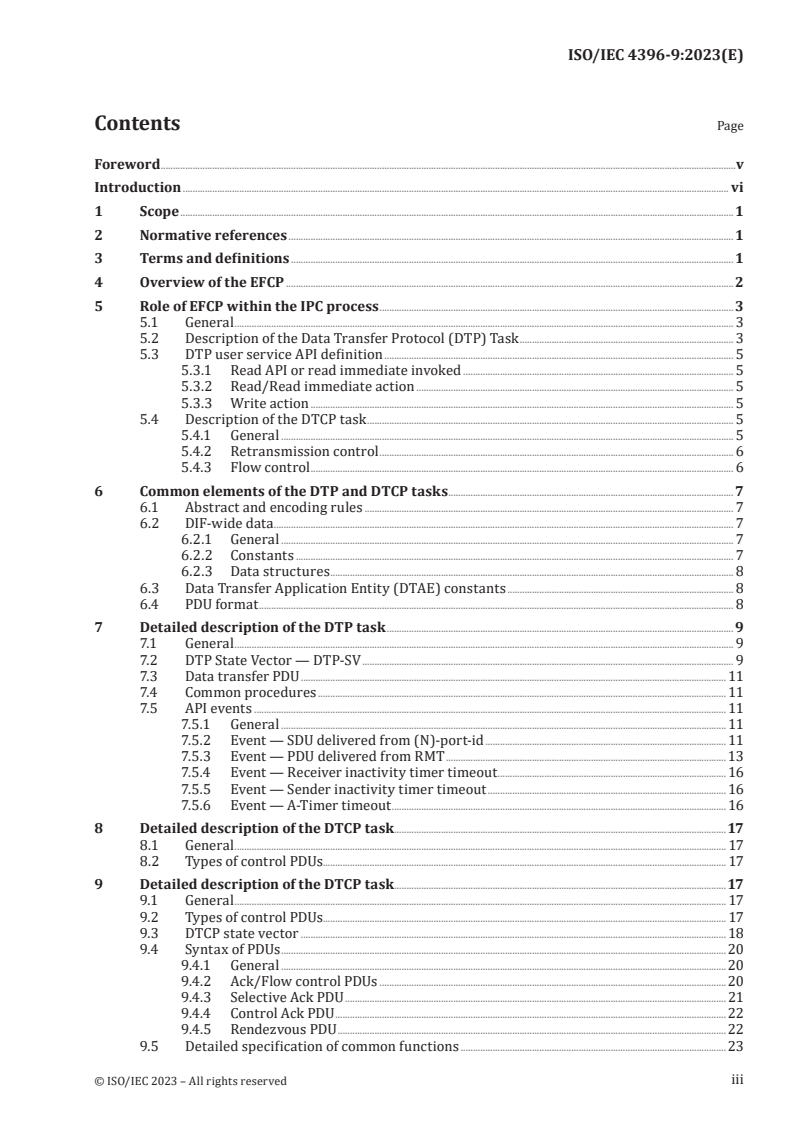
Contents Page
Foreword .v
Introduction . vi
1 Scope . 1
2 Normative references . 1
3 Terms and definitions . 1
4 Overview of the EFCP .2
5 Role of EFCP within the IPC process .3
5.1 General . 3
5.2 Description of the Data Transfer Protocol (DTP) Task . 3
5.3 DTP user service API definition . 5
5.3.1 Read API or read immediate invoked . 5
5.3.2 Read/Read immediate action . 5
5.3.3 Write action . 5
5.4 Description of the DTCP task . 5
5.4.1 General . 5
5.4.2 Retransmission control . 6
5.4.3 Flow control . 6
6 Common elements of the DTP and DTCP tasks . 7
6.1 Abstract and encoding rules . 7
6.2 DIF-wide data . 7
6.2.1 General . 7
6.2.2 Constants . 7
6.2.3 Data structures . 8
6.3 Data Transfer Application Entity (DTAE) constants . 8
6.4 PDU format . 8
7 Detailed description of the DTP task . 9
7.1 General . 9
7.2 DTP State Vector — DTP-SV . 9
7.3 Data transfer PDU . 11
7.4 Common procedures . 11
7.5 API events . 11
7.5.1 General . 11
7.5.2 Event — SDU delivered from (N)-port-id . 11
7.5.3 Event — PDU delivered from RMT . 13
7.5.4 Event — Receiver inactivity timer timeout . 16
7.5.5 Event — Sender inactivity timer timeout . 16
7.5.6 Event — A-Timer timeout . 16
8 Detailed description of the DTCP task .17
8.1 General . 17
8.2 Types of control PDUs. 17
9 Detailed description of the DTCP task .17
9.1 General . 17
9.2 Types of control PDUs. 17
9.3 DTCP state vector . 18
9.4 Syntax of PDUs . 20
9.4.1 General .20
9.4.2 Ack/Flow control PDUs .20
9.4.3 Selective Ack PDU . 21
9.4.4 Control Ack PDU . 22
9.4.5 Rendezvous PDU . 22
9.5 Detailed specification of common functions . 23
iii
© ISO/IEC 2023 – All rights reserved
9.6 Event processing .23
9.6.1 Event — SVUPdate(PDU.SequenceNumber) occurred .23
9.6.2 Event — Ack/Nack flow control PDUs arrived . 24
9.6.3 Event — Selective Ack . 25
9.6.4 Event — Rendezvous PDU . 25
9.6.5 Event — Retransmission Timer . 26
9.6.6 Event — Sending Rate Timer timeout . 27
9.6.7 Event — Rendezvous Timer . 27
9.6.8 Event — Rate-based Flow Control’s buffer state change . 27
Annex A (informative) List of DTP and DTCP policies .29
Bibliography .31
iv
© ISO/IEC 2023 – All rights reserved
Foreword
ISO (the International Organization for Standardization) and IEC (the International Electrotechnical
Commission) form the specialized system for worldwide standardization. National bodies that are
members of ISO or IEC participate in the development of International Standards through technical
committees established by the respective organization to deal with particular fields of technical
activity. ISO and IEC technical committees collaborate in fields of mutual interest. Other international
organizations, governmental and non-governmental, in liaison with ISO and IEC, also take part in the
work.
The procedures used to develop this document and those intended for its further maintenance
are described in the ISO/IEC Directives, Part 1. In particular, the different approval criteria
needed for the different types of document should be noted. This document was drafted in
accordance with the editorial rules of the ISO/IEC Directives, Part 2 (see www.iso.org/directives or
www.iec.ch/members_experts/refdocs).
ISO and IEC draw attention to the possibility that the implementation of this document may involve
the use of (a) patent(s). ISO and IEC take no position concerning the evidence, validity or applicability
of any claimed patent rights in respect thereof. As of the date of publication of this document, ISO and
IEC had received notice of (a) patent(s) which may be required to implement this document. However,
implementers are cautioned that this may not represent the latest information, which may be obtained
from the patent database available at www.iso.org/patents and https://patents.iec.ch. ISO and IEC shall
not be held responsible for identifying any or all such patent rights.
Any trade name used in this document is information given for the convenience of users and does not
constitute an endorsement.
For an explanation of the voluntary nature of standards, the meaning of ISO specific terms and
expressions related to conformity assessment, as well as information about ISO's adherence to
the World Trade Organization (WTO) principles in the Technical Barriers to Trade (TBT) see
www.iso.org/iso/foreword.html. In the IEC, see www.iec.ch/understanding-standards.
This document was prepared by Joint Technical Committee ISO/IEC JTC 1, Information technology,
Subcommittee SC 6 Telecommunications and information exchange between systems.
A list of all parts in the ISO/IEC 4396 series can be found on the ISO and IEC websites.
Any feedback or questions on this document should be directed to the user’s national standards
body. A complete listing of these bodies can be found at www.iso.org/members.html and
www.iec.ch/national-committees.
v
© ISO/IEC 2023 – All rights reserved
Introduction
This document describes the Error and Flow Control Protocol (EFCP) specification. EFCP is the data
[1] [2] [3]
transfer protocol of the Recursive InterNetwork Architecture (RINA). , , It supports a permanent
connection with all types of data transfer services.
RINA is a new network architecture based on the idea that networking is inter-process communication
(IPC) and only IPC. RINA imposes the strict separation of mechanisms and policies as one of the main
architectural features. EFCP assumes that other RINA components are in place and supplies other
mechanisms such as addressing and flow allocation, which are outside of its scope.
[4] [5] [6]
EFCP is based on the concept of timer-based reliable management of connections. , In this way,
EFCP operates with a minimum exchange of packets to manage connections and to keep protocol
machines involved in a connection synchronised. EFCP uses direct control messages to preserve data
from being lost, mis-sequenced or duplicated.
vi
© ISO/IEC 2023 – All rights reserved
INTERNATIONAL STANDARD ISO/IEC 4396-9:2023(E)
Telecommunications and information exchange between
systems — Recursive inter-network architecture —
Part 9:
Error and flow control protocol
1 Scope
This document provides the Error and Flow Control Protocol (EFCP) specification. EFCP provides an
inter-process communication (IPC) service to an application process, which can be a (N+1)-IPC process
(IPCP), with the requested Quality of Service (QoS). One or more service data units (SDUs) are passed on
the (N)-port-id to the (N)-DIF (distributed IPC facility) to be sent to the destination application process.
Protocol data units (PDUs) transferred by the (N)-DIF are delivered to the (N)-port-id for the using
Application Process. This document describes the placement of EFCP within RINA, the components
EFCP consists of, and the mechanisms and policies that are involved in EFCP’s work, and the timers and
control mechanisms required to manage the connection.
EFCP comprises two logical components, the data transfer procedures (DTP), providing tightly
bound mechanisms and the data transfer control procedures (DTCP), which provides loosely bound
mechanisms.
This document provides:
— the service definition;
— an overview of EFCP;
— a description of the placement of EFCP within recursive internetwork architecture (RINA);
— the common elements of data transfer protocol (DTP) and data transfer control protocol (DTCP);
— DTP structure and functions;
— DTCP structure and functions;
— an informative list of all policies in EFCP.en
2 Normative references
The following documents are referred to in the text in such a way that some or all of their content
constitutes requirements of this document. For dated references, only the edition cited applies. For
undated references, the latest edition of the referenced document (including any amendments) applies.
ISO/IEC 4396-1, Telecommunications and information exchange between systems — Recursive Inter-
Network Architecture — Part 1: RINA Reference Model
ISO/IEC 4396-7, Telecommunications and information exchange between systems — Recursive Inter-
Network Architecture — Part 7: RINA Flow Allocator
3 Terms and definitions
For the purposes of this document, the terms and definitions given in ISO/IEC 4396-1, ISO/IEC 4396-7
and the following apply.
© ISO/IEC 2023 – All rights reserved
ISO and IEC maintain terminology databases for use in standardization at the following addresses:
— ISO Online browsing platform: available at https:// www .iso .org/ obp
— IEC Electropedia: available at https:// www .electropedia .org/
3.1
data transfer state vector
DT-SV
vector that provides shared state information for the connection maintained by the data transfer
protocol (DTP) and the data transfer control protocol (DTCP)
3.2
maximum PDU lifetime
MPL
maximum time a protocol data unit (PDU) sent by a member of a distributed inter process
communication (IPC) facility (DIF) may exist in the DIF
3.3
data transfer application entity
DTAE
error and flow control protocol (EFCP)-protocol machine (PM) task managing the shared state with its
peer
4 Overview of the EFCP
EFCP assumes the fundamental idea that reliability can be achieved only through the bounding of
three times. These times are the maximum PDU lifetime (MPL), the maximum time for the delay in
acknowledging a PDU (A-time), and the maximum time to exhaust retransmitting a PDU (R-time). If
these times are bounded by the quantities MPL A (maximum delay to send an acknowledgement) and R
(maximum time before giving up retransmitting a PDU), then reliability can be guaranteed. Using these
bounds, two important times are set up to reliably manage the data transfer, the sender and receiver
inactivity times. The time Δt is calculated as the sum of Maximum PDU Lifetime, MPL; Maximum Time
to before Sending an Ack, A; and the Maximum Time to Exhaust Retries, R.
The upper bound for the receiver’s inactivity timer is 2 Δt and 3 Δt for the sender’s inactivity time.
Every flow instantiated within a DIF triggers the creation of an instance of EFCP and its associated
[3]
state vector. For security purposes, all EFCP connections have flow control, although retransmission
control may not be required. The EFCP is able to provide other services, such as reliable transmission
with QoS.
DTP uses a single PDU that carries addresses, a connection-id, a sequence number, and various flags to
signal congestion, and other conditions that are relevant to the operation of the protocol.
While there are four PDU types defined for DTCP, these are supported by only three PDU formats:
Selective Ack/Nack/Flow, Ack/Flow, and Rendezvous/Flow. Each of these carries addresses, a
connection-id, a sequence number, and retransmission control and/or flow control information, etc.
The opcodes indicate which fields in the PDU are valid. Not only is Ack and Flow Control information
sent to update the sender, but the receiver’s left window edge is sent with Credit as a check on the state.
All connections are flow controlled to provide a countermeasure against a denial-of-service attack.
While DTCP controls the flow of DTP PDUs, DTCP never has cause to inspect their contents. In essence,
DTP writes to the state vector and DTCP reads the DTP state from it.
[5]
EFCP is based on concepts first described by Watson in, and adapted as part of the RINA as the
mechanism to send and receive variable-length blocks of information.
EFCP separates mechanism and policy. There is a default action associated with each policy. The policy
can take additional action beyond the default or replace the default action. A policy may only reference
the state variables defined by this document and the parameters specified by the management objects
© ISO/IEC 2023 – All rights reserved
to instrument EFCP. Policies may define both local and persistent variables. Local variables are assumed
to be new instantiations on each call, while persistent variables retain their value between calls.
The latter allows a policy to maintain state, if necessary. An optional parameter list may be present.
The parameters used should be variables internal to the policy. The informative Annex A provides a
summary of the EFCP policies.
5 Role of EFCP within the IPC process
5.1 General
The EFCP is responsible for carrying out the data transfer and data transfer control tasks. In order to
do so, each EFCP instance exchanges protocol data units (PDUs) with an EFCP instance in another inter
process communication (IPC) process (IPCP) (although this other instance can also be located in the
same IPCP in a degenerate case).
The IPCP provides IPC services to one or more application processes (which in turn may be a higher-
layer IPCP). Each instantiation of an IPC data-transfer-service is called a flow and is identified by a port-
id. Application processes can write or read service data units (SDUs) from the port, thus communicating
with one or more remote application process instances. When an application process writes an SDU
to a port, first the delimiting module associated to the port may fragment the SDU or concatenate it
with other SDUs (or SDU fragments), producing one or more user data fields (UDFs). UDFs are delivered
to the EFCP instance associated to the port, which will add a header to the UDF [the protocol control
information (PCI)], producing a PDU that is delivered to multiplexing task (MT). The MT multiplexes
PDUs from different EFCP instances into one or more N-1 ports provided by one or more underlying
IPCPs.
In the “read path”, the MT will deliver to the EFCP module the PDUs addressed to the IPCP. EFCP then
makes available each PDU to the relevant EFCP instance, which will process the PCI, remove it and
deliver the UDF to the delimiting module to obtain the original SDUs. SDUs will be buffered until they
are read by the application process owning the port associated to the EFCP instance.
The lifecycle of EFCP instances is managed by a layer management component of the IPCP called flow
allocator (FA). When an application process requests the creation of a flow to the IPCP, the FA is the
component that deals with the request. Part of the responsibilities of the FA are to create the EFCP
instance (with the appropriate mix of policies) and bind it to the port providing the flow.
The FA monitors the EFCP connection and, at some point, it can decide that it is time to create a new
EFCP instance, bind it to the flow and remove the old one (for example, to prevent sequence number
rollover to happen). This capability is enabled by the fact that ports and EFCP instances are decoupled:
only ports are exposed to application processes outside of the layer. At any moment in time there can
only be one active EFCP instance bound to a specific port.
When the application process using the flow [or the operating system (OS) in its behalf, for example if
the application process has crashed] decides that it no longer needs it, it invokes the deallocate flow
primitive. This operation causes the FA to destroy the EFCP instance and release the port that was
associated to the flow.
5.2 Description of the Data Transfer Protocol (DTP) Task
A DTP Task is always created when a flow is allocated. DTP performs all mechanisms associated with
the Data Transfer PDU, e.g. sequencing, invokes SDU Protections and Delimiting to do fragmentation/
reassembly.
While the DTCP-State can be discarded during long periods of no traffic, the DTP-State Vector cannot.
The DTP-State is only discarded after an explicit release by the AP or by the System (if the AP crashes),
i.e. the port-ids are released. The DIF shall have procedures to ensure that when traffic resumes the
CEP-id is associated with the correct port-id.
© ISO/IEC 2023 – All rights reserved
The indirection introduced by the distinction between the port-id and CEP-id avoids the requirement of
a separate connection for integrity mechanisms (encryption). To prevent replay, insertion, or deletion,
a sequence number is introduced but it can’t be allowed to wrap. When using encryption in a DIF, as a
flow sequence number nears its limit, a new connection is allocated with different CEP-ids and bound
to the port-id. This will be monitored by the flow allocator instance (FAI) that created the flow. The FAI
will create the new connections and create the bindings with the port-id. There will be a period when
PDUs are accepted from both connections. After 2*∆t, the earlier connection will be allowed to expire.
For flows without encryption or flows that do not send sufficient data for sequence numbers to roll
over, the port-id and the CEP-id may be the same.
Depending on the policies in force on the flow, the Delimiting will provide fragmentation/reassembly
functions (breaking SDUs into more than one PDU) and concatenation/separation functions (combining
multiple SDUs into one PDU). DTP creates PDUs and processes them upon arrival and imposes
sequencing. DTCP provides either retransmission or flow control or both. If there is flow control and
the flow control window is closed, then PDUs are put on the closed window queue. There is a policy to
monitor the length of this queue, and sending PDUs comes under the control of the DTCP. A Transmission
Control Policy may override and queue PDUs to slow the data rate for other reasons. If flow control is
not present or the window is open, then the PDUs are posted to the Multiplexing Task. If retransmission
control is being used, a copy of the PDU is placed on the retransmission queue and a timer started.
When PDUs arrive for DTP, SDU Protection determines if they can be processed, and if so, they are
ordered. If Retransmission Control is in use, i.e. DTCP is present and a Data Transfer PDU is received,
if the Sequence Number of the PDU is less or equal than the last sequence number acknowledged, then
this PDU is a duplicate and is discarded. Otherwise, the PDU is put on the PDU Reassembly Queue and
Delimiting is invoked to create SDUs and deliver them to the using application process.
Since EFCP may allow gaps in the data stream, the concept of the left window edge exists regardless
of whether DTCP is present. With DTCP present, it is assumed that all PDUs with a sequence number
smaller than or equal to the value of the receiver left window edge (RcvLeftWindowEdge) have been
acknowledged. This means that there will be no retransmissions of PDUs with sequence numbers less
than or equal to the RcvLeftWindowEdge. All gaps have been resolved one way or another. When DTCP
is not present, this implies that all PDUs with sequence numbers smaller than or equal to the value of
the RcvLeftWindowEdge have been processed for delivery to the process above.
If out of order delivery is allowed, then it shall be in terms of SDUs. As indicated by the previous
discussion of the use of Left Window Edge in DTP, this makes the most sense when there is one SDU
per PDU. If not, the PDUs have to be effectively ordered to reassemble them. Randomly choosing initial
sequence numbers for sequences of PDUs that constitute an SDU is not recommended since this can
adversely affect the transmission rate.
This has implications for whether or not order is imposed on the PDUs. Regardless of whether there is
an ordering, a PDU identifier of some sort is required. Most implementations assign these sequentially.
Random assignment is not recommended for the following reasons:
a) much less of the sequence number space can be used within an MPL;
b) the assumption shall be made that an SDU is no larger than the Maximum PDU size.
If b) does not hold, then SDUs shall be reassembled and the order of the PDUs shall be known at least
within a sequence. If sequence numbers are assigned randomly and the number of PDUs sent within
an MPL is a sizable fraction total sequence number space of PDUs, the chances of the same sequence
number occurring with an MPL is fairly high. It can be necessary to limit transmission to 25 % or even
less of the sequence number space, whereas with sequential assignment the full sequence number space
can be used.
Transmission Control provides the means to control the sending or not sending of PDUs beyond what is
indicated by the feedback from the apposite DTCP instance. For example, there can be conditions under
which the destination indicates PDUs may be sent, but other conditions, e.g. congestion, that indicate
that PDUs should not be sent or fewer sent or sent at a slower rate. Transmission Control also responds
to the detection of Lost Control PDUs.
© ISO/IEC 2023 – All rights reserved
5.3 DTP user service API definition
5.3.1 Read API or read immediate invoked
Parameters: Port-id, pointer to a buffer, array of buffers, or list of buffers, a length in bytes.
This event occurs when the user of the flow does a Read or Read Immediate. Several options affect
the Read, such as Partial Delivery and MaxSDUSize. A Read will read available SDUs, but not those
with the A-timer running on them, i.e. there are gaps that may be filled. Read Immediate overrides the
constraints and reads as many SDUs as requested. Partial Delivery indicates that SDUs can be delivered
into more than one buffer or with multiple Reads. Incomplete Delivery indicates that SDUs with gaps
can be delivered, i.e. missing PDUs. In this latter case, the API should indicate that a gap in the SDU is
being delivered (usually by indicating an error with the Read). This error should differ from a read of a
zero-length SDU.
5.3.2 Read/Read immediate action
If Read Then
Copy as many SDUs as requested in the available buffers taking into account whether
partial delivery is allowed.
Updating RcvLeftWindowEdge and RcvRightWindowEdge has already occurred.
Fi
If Read Immediate Then
Copy as many SDUs as requested from the list of available SDUs taking into account
whether partial delivery is allowed. If that does not fulfil the request, go to the
PDUReassemblyQueue and invoke Delimiting on the PDUs there to fulfil the request.
This will require deactivating A-Timers and updating the RcvLeftWindowEdge and
RcvRightWindowEdge and sending the appropriate Ack/Flow Control PDU.
Fi
5.3.3 Write action
Parameters: Port-id, pointer to a buffer, array of buffers, or list of buffers, a length in bytes.
This API call delivers SDUs to the delimiting module, which delimits SDUs into some number of User-
data fields for the DTP task. Some OSs may assign semantics to reading a zero-length SDU. This implies
that the API shall allow a zero-length SDU and not “optimize” it out of existence.
5.4 Description of the DTCP task
5.4.1 General
DTCP is instantiated when the DTP is created. The DT-SV can be discarded during long periods of no
traffic. However, the state associated with the FAI for this data transfer application entity (DTAE)-
instance shall be explicitly released.
DTCP processing performs the more complex policies for flow control, transmission control and re-
transmission control. DTCP controls whether DTP PDUs can be posted to the RMT. It may do this based
on feedback information from the receiver or based on its own estimators. PDUs placed in its queues for
flow control and retransmission become DTCP’s responsibility to send at the appropriate time.
DTCP PM requires a degree of synchronization with its apposite to avoid deadlocks and to ensure
progress. DTCP uses the sequence numbers in the DTP PDUs and bounding three timers to ensure
© ISO/IEC 2023 – All rights reserved
synchronization. Data Transfer and the feedback mechanisms are used to establish this shared state.
The three timers shall be bounded and are:
— MPL;
— maximum time to ack, A;
— the time to attempt the maximum number of retries to deliver a PDU,R.
5.4.2 Retransmission control
Retransmission control requires sequencing in the associated DTP instance. Based on the sequence
numbers seen by the receiver, an ack PDU is sent to the sender. The Ack/Nack class of PDUs supports
what has been traditionally called positive (Ack) and negative (Nack) acknowledgements.
There are two modes in which the retransmission mechanism can be used: positive ack, or negative
ack. This mechanism applies to all PDUs generated for this flow. The sender of Data Transfer PDUs will
maintain a retransmission queue, i.e. each sender maintains such a queue. When a Data Transfer PDU
is sent by DTP, a copy is placed on this retransmission queue and a timer is started. The timer has a
value TR (~RTT + A + ε, where RTT is round trip time and ε is the local processing time and allows
for variation in time the Ack arrives, generally an estimate of standard deviation), and is generally a
function of round-trip time. Calculation of the timer value is carried out by the RTT estimator policy. If
the timer expires before an AckPDU is received, all PDUs on the retransmission queue with sequence
numbers less than or equal to the sequence number of the PDU associated with this time are re-sent.
If an ack is received, then the sender will delete all PDUs from the retransmission queue with sequence
Numbers less than or equal to the contents of the Ack/Nack field and discontinue any retransmission
timers associated with these PDUs. If a Nack is received, the sender will retransmit all PDUs on the
retransmission queue with sequence numbers greater than or equal to the contents of the Ack/Nack
field.
If a selective ack is received, the PDUs designated by the ranges of sequence numbers indicated by the
Ack/Nack List are deleted from the Retransmission Queue and any timers associated with these PDUs
are discontinued.
If a selective nack is received, the PDUs with sequence numbers from those ranges are retransmitted.
Since it is not possible to know whether a retransmitted PDU arrives, a negative ack can never cause
PDUs to be removed from the retransmission queue.
To ack or nack a single PDU, the entry in the selective ack/Nack List should have starting and ending
ranges of the same Sequence Number.
5.4.3 Flow control
Flow control policies may utilize both a rate-based strategy or the classic sliding window mechanism.
Both may be used with or without retransmission control. With either approach, the receiver of PDUs
provides an indication to the sender when it can send. With the window mechanism, the sender is given
the Left Window Edge and Credit from which the RightWindowEdge can be calculated. The sender can
send PDUs with sequence numbers less than the RightWindowEdge; whereas with the rate mechanism
the sender is told at what rate it may emit PDUs. Flow control is always expressed as the number of
PDUs or as the number of PDUs per unit time, or more precisely, how many PDUS may be sent in a unit
of time.
Each approach has its advantages depending on the traffic characteristics of the connection. By having
two independent methods, a policy may actually use both, allowing one to dominate the other, except
under extreme conditions when the other may exert an effect. For example, one can allow rate-based
flow control to dominate by keeping the right window edge sufficiently high that the receiving transport
protocol machine is delivering data at about the same rate. However, the credit level is maintained at
something close to the maximum buffer allocation for this connection. If the protocol machine should
get behind and begin to exceed its maximum buffer allocation, the credit-based flow control would
© ISO/IEC 2023 – All rights reserved
dominate and temporarily stop the flow on the connection, until the buffer pool was restored to an
appropriate level.
A mechanism required by flow control shall be considered to deal with the case of a zero-length window
and/or a zero rate: the rendezvous mechanism. When the sender’s state indicates that there is data to
send, and a zero window exists, the sender wants to be informed when the window gets open. This is
achieved through a special type of control PDU, the rendezvous PDU, which is sent by the sender to the
receiver. If there is retransmission control, another condition that has to be met for the rendezvous PDU
to be sent is that all data already transmitted have been Acked.
The rendezvous PDU is protected against duplication because it uses a sequence number from the
Control PDU sequence number space. Furthermore, it is a reliable PDU, because it is retransmitted until
acknowledged, thus protected against loss. The acknowledgement can be either a normal flow control
PDU opening the window or a ControlAck PDU to inform the sender that the receiver will keep the
window closed.
When the sender receives either one, it will stop sending the rendezvous PDU. If the ack is lost, the
Rendezvous PDU will be retransmitted and the receiver will know that it has to retransmit the ack.
Once the receiver opens the window, it sends a reliable Ack/FC PDU. The acknowledgment of this
reliable Ack/FC PDU consists of a DT PDU with the data run flag (DRF) set, signalling the start of a new
data run. This reliable Ack PDU is retransmitted until the receiver receives the DT PDU.
In case that at some point the exchange of reliable PDUs is interrupted, with all of them being lost,
eventually the maximum number of retransmissions will be achieved. At this point it will be for the
inactivity timers to restart the communication.
6 Common elements of the DTP and DTCP tasks
6.1 Abstract and encoding rules
EFCP abstract syntax defines the semantics and ordering of the fields of the different EFCP PDUs. This
syntax is defined primarily in terms of constants such as AddrLength or Port-id-length. These are
defined at “compile-time” for the DIF or class of DIFs, providing a concrete syntax for a specific EFCP
variant. In most cases, the length of the fields has very little effect on the design of the protocol beyond
the modulus of the arithmetic. Hence, there is no reason to define separate protocols for every field
length combination. The specification can be fully defined by utilizing the abstract syntax and defining
a set of concrete encoding rules, i.e. specific syntaxes for different operational environments. Choosing
lengths that are not a multiple of 8 bits will likely have a performance penalty.
6.2 DIF-wide data
6.2.1 General
All IPCPs working within a particular DIF have to agree on certain things.
6.2.2 Constants
QoSIdLength: Unsigned Integer – The length of a QoS-id field in bits.
PortIdLength: Unsigned Integer – The length of a Port-id field in bits.
CEPIdLength: Unsigned Integer – The length of a CEP-id field in bits.
SequenceNumberLength: Unsigned Integer – The length of a SequenceNumber field in bits.
AddressLength: Unsigned Integer – The length of an Address field in bits.
LengthLength: Unsigned Integer – The length of a Length field in bits.
© ISO/IEC 2023 – All rights reserved
DIF.Integrity: Boolean – This is True if PDUs in this DIF have data corruption detection, time-to-live,
and/or encryption. Since headers are encrypted, not just user data, if any flow uses encryption, all
flows within the same DIF shall do so and the same encryption algorithm shall be used for every PDU.
The flow that a particular PDU belongs to cannot be determined until it has been decrypted.
MPL: Unsigned integer – Maximum PDU Lifetime – Upper bound on in-flight PDUs.
6.2.3 Data structures
QoS-id: Unsigned( QoSIdLength )
CEP-id: Unsigned( CEPIdLength )
Port-id: Unsigned( PortIdLength )
Address: Unsigned( AddressLength )
Length: Unsigned( LengthLength )
SequenceNumber: Unsigned( SequenceNumberLength )Sequence numbers on a flow go from 0 to 2^n-1.
They identify PDUs.
Connection-id: Struct
QoS-id: QoS-id
Destination-CEP-id: CEP-id
Source-CEP-id: CEP-id
6.3 Data Transfer Application Entity (DTAE) constants
Max-SDU-Size: Unsigned. The maximum size of an SDU admitted by the DIF.
Max-PDU-Size: Unsigned. The maximum size of PDUs used within the DIF.
PCI-Length: Unsigned. The length of the EFCP header (PCI).
6.4 PDU format
The following fields are considered to be the Common PCI or just PCI. This PCI is present in all PDUs
with different PDU-Type. Meaning of all these fields is the same for every PDU-Type.
User-Data is formatted according to PDU-Type.
Version: 8 Bits
Destination-Address: AddressLength
Source-Address: AddressLength
Connection-id: Struct
QoS-id: QoSIdLength
Destination-CEP-id: CEPIdLength
Source-CEP-id: CEPIdLength
PDU-Type: 8 bits
Flags: 8 bits
© ISO/IEC 2023 – All rights reserved
PDU-Length: LengthLength
Sequence-Number: SequenceNumberLength
User-Data: Sequence
Version – An identifier indicating the version of the protocol. (seems prudent)
Destination-Address – A synonym for the Application-Process-Name designating an IPC-Process with
scope limited to the DIF and a binding to the Destination Application Process.
Source-Address – A synonym for the Application-Process-Name designating the IPC-Process with scope
limited to the DIF and a binding to the Destination Application Process.
Connection-id – A three-part identifier unambiguous within scope of two communicating IPC-Processes
used to distinguish connections between them. A Connection-id consists of the following:
QoS-id – A DIF-assigned identifier only known within the DIF that stands for a particular QoS
hypercube.
Destination-CEP-id – An identifie
...