

ISO 21859:2019
(Main)Fine ceramics (advanced ceramics, advanced technical ceramics) — Test method for plasma resistance of ceramic components in semiconductor manufacturing equipment
General Information
- Abstract
This document specifies a test method for plasma resistance of ceramic components in semiconductor manufacturing equipment. It is applicable to ceramic components of plasma-resistant components in dry etching chambers used in semiconductor manufacturing.
- Status
- Published
- Publication Date
- 17-Jun-2019
- Technical Committee
- ISO/TC 206 - Fine ceramics
- Drafting Committee
- ISO/TC 206/WG 12 - Engineering applications
- Current Stage
- 9093 - International Standard confirmed
- Start Date
- 04-Oct-2024
- Completion Date
- 29-Aug-2026
Buy Documents


ISO 21859:2019 - Fine ceramics (advanced ceramics, advanced technical ceramics) -- Test method for plasma resistance of ceramic components in semiconductor manufacturing equipment
ISO 21859:2019 - Fine ceramics (advanced ceramics, advanced technical ceramics) — Test method for plasma resistance of ceramic components in semiconductor manufacturing equipment/18/2019
Overview
ISO 21859:2019 defines a standardized test method for assessing plasma resistance of fine ceramic components used in semiconductor manufacturing equipment. Specifically designed for ceramic parts in dry etching chambers, this international standard ensures consistent and reliable evaluation of plasma erosion on advanced technical ceramics. The test method focuses on measuring erosion depth and changes in surface roughness caused by plasma exposure, critical parameters for maintaining the integrity and performance of ceramic components in semiconductor fabrication.
This standard is published by the International Organization for Standardization (ISO) under Technical Committee ISO/TC 206, Fine Ceramics, and applies to plasma-resistant ceramic components such as electrostatic chucks, gas injectors, and viewing ports exposed to plasma environments during dry etching.
Key Topics
Scope and Application
Applicable to ceramic components in semiconductor manufacturing dry etching chambers, ISO 21859:2019 addresses the plasma resistance properties critical to advanced ceramics facing corrosive plasma sources.Test Environment & Apparatus
Testing requires precise control of plasma-etching equipment, specifically reactive ion etching systems with 13.56 MHz radio-frequency plasma sources. The use of contact-probe profilometers and surface roughness profilometers compliant with ISO 18452, ISO 3274, and ISO 4287 ensures accurate measurement of erosion and surface texture changes.Measurement Principles
The principle centers on comparing surface height differences between masked and plasma-exposed areas via profilometric scanning. Surface roughness parameters like Ra and Rz are measured before and after plasma exposure to quantify erosion and surface modification.Procedure
Steps include preparing test pieces with appropriate masking, conducting plasma etching under controlled gas flow ratios (tetrafluoromethane and oxygen), measuring erosion depth and surface roughness post-test, and calculating mean erosion depth by averaging multiple measurements for accuracy.Reporting Requirements
Test reports must contain detailed information such as identification of the testing body, test conditions, sample descriptions, erosion depth values, surface roughness data, and any relevant observations or deviations.
Applications
Semiconductor Manufacturing
ISO 21859:2019 is vital for manufacturers and suppliers of plasma-resistant ceramic components used in semiconductor dry etching chambers. By adhering to this standard, they can verify component durability and performance under plasma exposure conditions.Quality Control and R&D
This test method supports quality assurance, material selection, and new ceramic development by providing standardized methods to measure plasma erosion, helping reduce manufacturing defects and improve equipment lifetime.Material Certification
Certification bodies can use the standard to validate claims of plasma resistance in advanced ceramics, ensuring compliance with industry expectations and facilitating global trade.Equipment Design Optimization
OEMs of semiconductor manufacturing tools can optimize materials and component designs based on plasma resistance data, thereby enhancing tool reliability and throughput.
Related Standards
- ISO 3274 - Geometrical Product Specifications (GPS): Surface texture using profile methods and contact (stylus) instruments.
- ISO 4287 - GPS surface texture: Profile methods including terms, definitions, and parameters for surface roughness.
- ISO 18452 - Fine ceramics - Determination of thickness for ceramic films by contact-probe profilometry.
These references complement ISO 21859:2019 by defining measurement techniques and parameters essential for accurate characterization of plasma erosion effects on ceramic components.
Keywords: ISO 21859, plasma resistance, advanced ceramics, semiconductor manufacturing, dry etching chambers, contact-probe profilometer, surface roughness, erosion depth, fine ceramics standard, reactive ion etching, plasma etching test, ceramic component durability.
Buy Documents
ISO 21859:2019 - Fine ceramics (advanced ceramics, advanced technical ceramics) -- Test method for plasma resistance of ceramic components in semiconductor manufacturing equipment
ISO 21859:2019 - Fine ceramics (advanced ceramics, advanced technical ceramics) — Test method for plasma resistance of ceramic components in semiconductor manufacturing equipment/18/2019
Frequently Asked Questions
ISO 21859:2019 is a standard published by the International Organization for Standardization (ISO). Its full title is "Fine ceramics (advanced ceramics, advanced technical ceramics) — Test method for plasma resistance of ceramic components in semiconductor manufacturing equipment". This standard covers: This document specifies a test method for plasma resistance of ceramic components in semiconductor manufacturing equipment. It is applicable to ceramic components of plasma-resistant components in dry etching chambers used in semiconductor manufacturing.
This document specifies a test method for plasma resistance of ceramic components in semiconductor manufacturing equipment. It is applicable to ceramic components of plasma-resistant components in dry etching chambers used in semiconductor manufacturing.
ISO 21859:2019 is classified under the following ICS (International Classification for Standards) categories: 81.060.30 - Advanced ceramics. The ICS classification helps identify the subject area and facilitates finding related standards.
ISO 21859:2019 is available in PDF format for immediate download after purchase. The document can be added to your cart and obtained through the secure checkout process. Digital delivery ensures instant access to the complete standard document.
Standards Content (Sample)
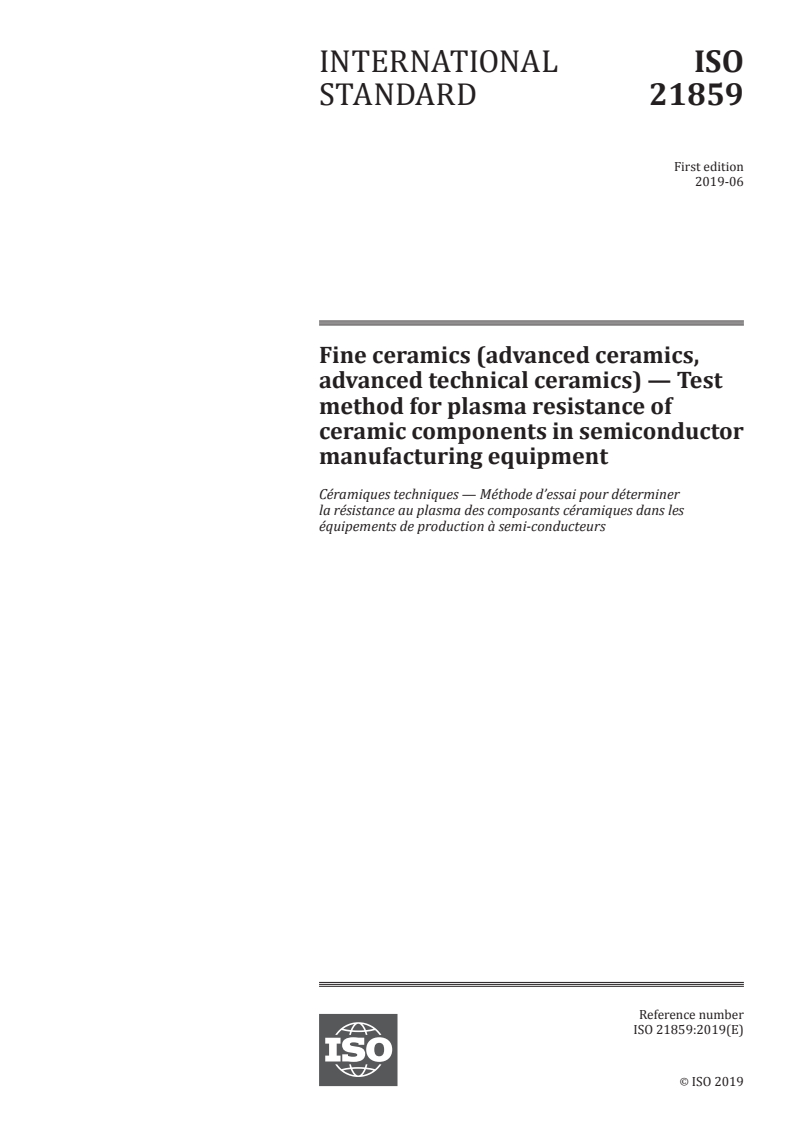
INTERNATIONAL ISO
STANDARD 21859
First edition
2019-06
Fine ceramics (advanced ceramics,
advanced technical ceramics) — Test
method for plasma resistance of
ceramic components in semiconductor
manufacturing equipment
Céramiques techniques — Méthode d’essai pour déterminer
la résistance au plasma des composants céramiques dans les
équipements de production à semi-conducteurs
Reference number
©
ISO 2019
© ISO 2019
All rights reserved. Unless otherwise specified, or required in the context of its implementation, no part of this publication may
be reproduced or utilized otherwise in any form or by any means, electronic or mechanical, including photocopying, or posting
on the internet or an intranet, without prior written permission. Permission can be requested from either ISO at the address
below or ISO’s member body in the country of the requester.
ISO copyright office
CP 401 • Ch. de Blandonnet 8
CH-1214 Vernier, Geneva
Phone: +41 22 749 01 11
Fax: +41 22 749 09 47
Email: copyright@iso.org
Website: www.iso.org
Published in Switzerland
ii © ISO 2019 – All rights reserved
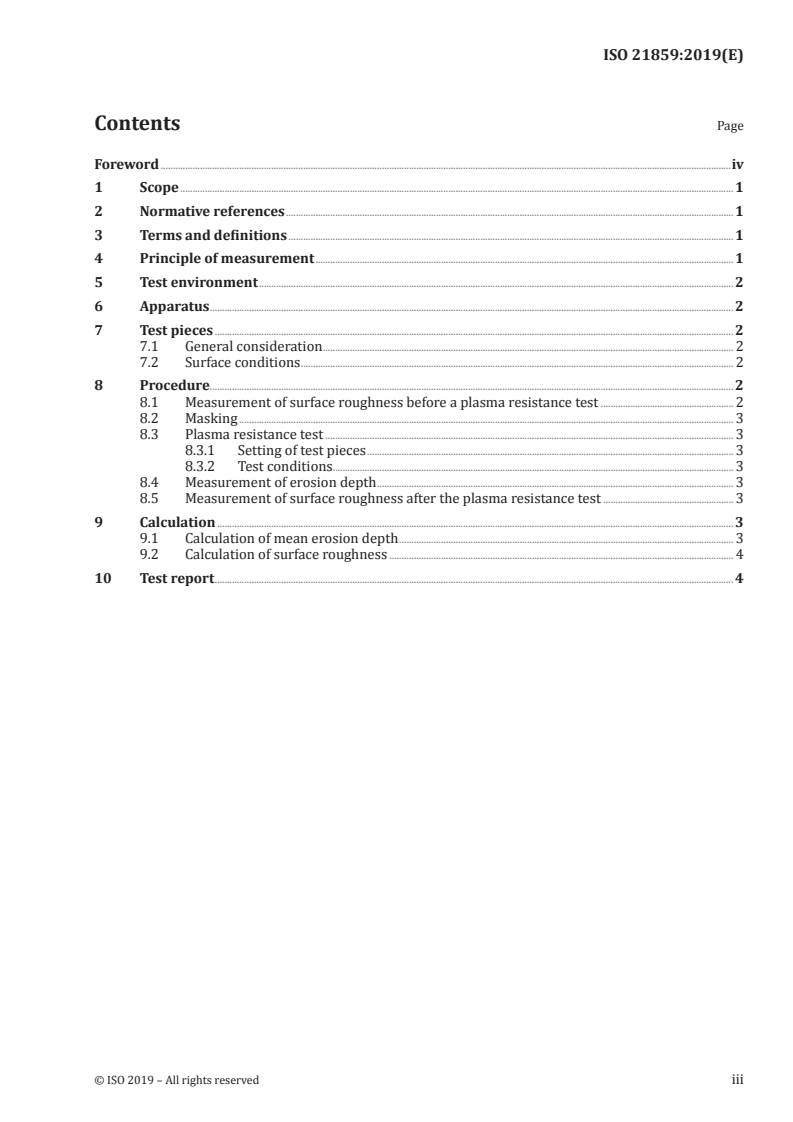
Contents Page
Foreword .iv
1 Scope . 1
2 Normative references . 1
3 Terms and definitions . 1
4 Principle of measurement . 1
5 Test environment . 2
6 Apparatus . 2
7 Test pieces . 2
7.1 General consideration . 2
7.2 Surface conditions . 2
8 Procedure. 2
8.1 Measurement of surface roughness before a plasma resistance test . 2
8.2 Masking . 3
8.3 Plasma resistance test . 3
8.3.1 Setting of test pieces . 3
8.3.2 Test conditions. 3
8.4 Measurement of erosion depth . 3
8.5 Measurement of surface roughness after the plasma resistance test . 3
9 Calculation . 3
9.1 Calculation of mean erosion depth . 3
9.2 Calculation of surface roughness . 4
10 Test report . 4
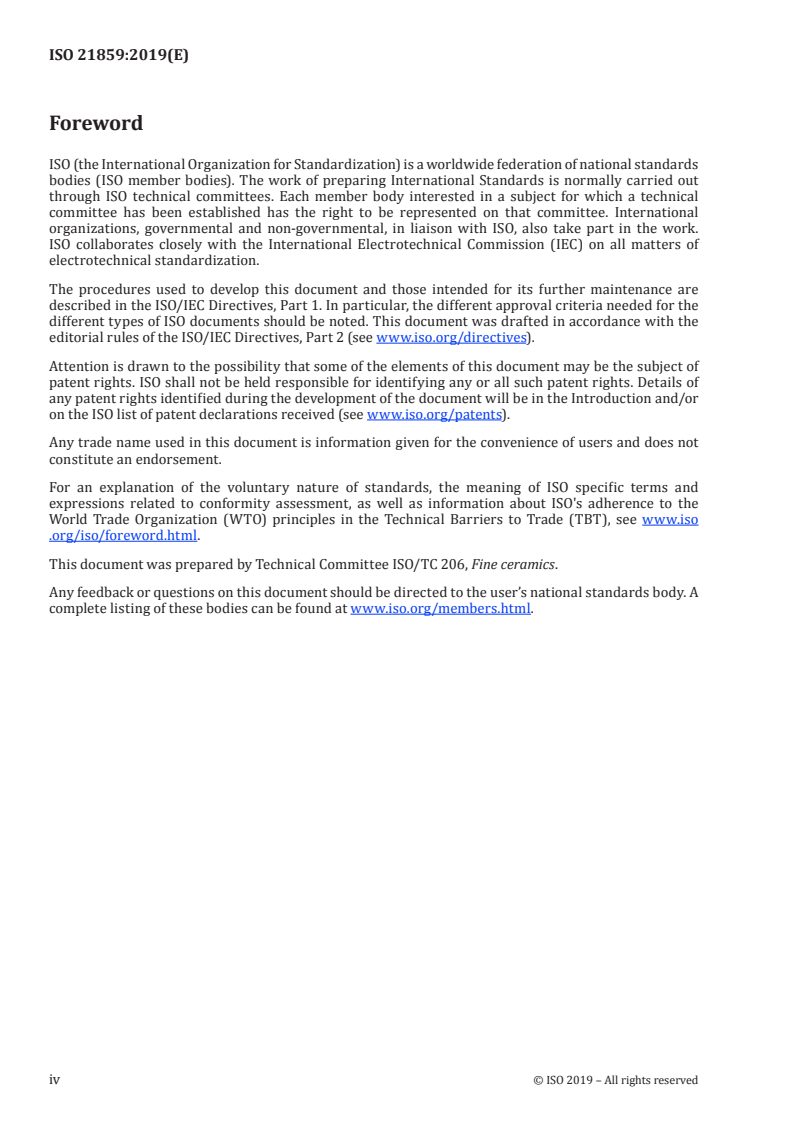
Foreword
ISO (the International Organization for Standardization) is a worldwide federation of national standards
bodies (ISO member bodies). The work of preparing International Standards is normally carried out
through ISO technical committees. Each member body interested in a subject for which a technical
committee has been established has the right to be represented on that committee. International
organizations, governmental and non-governmental, in liaison with ISO, also take part in the work.
ISO collaborates closely with the International Electrotechnical Commission (IEC) on all matters of
electrotechnical standardization.
The procedures used to develop this document and those intended for its further maintenance are
described in the ISO/IEC Directives, Part 1. In particular, the different approval criteria needed for the
different types of ISO documents should be noted. This document was drafted in accordance with the
editorial rules of the ISO/IEC Directives, Part 2 (see www .iso .org/directives).
Attention is drawn to the possibility that some of the elements of this document may be the subject of
patent rights. ISO shall not be held responsible for identifying any or all such patent rights. Details of
any patent rights identified during the development of the document will be in the Introduction and/or
on the ISO list of patent declarations received (see www .iso .org/patents).
Any trade name used in this document is information given for the convenience of users and does not
constitute an endorsement.
For an explanation of the voluntary nature of standards, the meaning of ISO specific terms and
expressions related to conformity assessment, as well as information about ISO's adherence to the
World Trade Organization (WTO) principles in the Technical Barriers to Trade (TBT), see www .iso
.org/iso/foreword .html.
This document was prepared by Technical Committee ISO/TC 206, Fine ceramics.
Any feedback or questions on this document should be directed to the user’s national standards body. A
complete listing of these bodies can be found at www .iso .org/members .html.
iv © ISO 2019 – All rights reserved
---
...
INTERNATIONAL ISO
STANDARD 21859
First edition
2019-06
Fine ceramics (advanced ceramics,
advanced technical ceramics) — Test
method for plasma resistance of
ceramic components in semiconductor
manufacturing equipment
Céramiques techniques — Méthode d’essai pour déterminer
la résistance au plasma des composants céramiques dans les
équipements de production à semi-conducteurs
Reference number
©
ISO 2019
© ISO 2019
All rights reserved. Unless otherwise specified, or required in the context of its implementation, no part of this publication may
be reproduced or utilized otherwise in any form or by any means, electronic or mechanical, including photocopying, or posting
on the internet or an intranet, without prior written permission. Permission can be requested from either ISO at the address
below or ISO’s member body in the country of the requester.
ISO copyright office
CP 401 • Ch. de Blandonnet 8
CH-1214 Vernier, Geneva
Phone: +41 22 749 01 11
Fax: +41 22 749 09 47
Email: copyright@iso.org
Website: www.iso.org
Published in Switzerland
ii © ISO 2019 – All rights reserved
Contents Page
Foreword .iv
1 Scope . 1
2 Normative references . 1
3 Terms and definitions . 1
4 Principle of measurement . 1
5 Test environment . 2
6 Apparatus . 2
7 Test pieces . 2
7.1 General consideration . 2
7.2 Surface conditions . 2
8 Procedure. 2
8.1 Measurement of surface roughness before a plasma resistance test . 2
8.2 Masking . 3
8.3 Plasma resistance test . 3
8.3.1 Setting of test pieces . 3
8.3.2 Test conditions. 3
8.4 Measurement of erosion depth . 3
8.5 Measurement of surface roughness after the plasma resistance test . 3
9 Calculation . 3
9.1 Calculation of mean erosion depth . 3
9.2 Calculation of surface roughness . 4
10 Test report . 4
Foreword
ISO (the International Organization for Standardization) is a worldwide federation of national standards
bodies (ISO member bodies). The work of preparing International Standards is normally carried out
through ISO technical committees. Each member body interested in a subject for which a technical
committee has been established has the right to be represented on that committee. International
organizations, governmental and non-governmental, in liaison with ISO, also take part in the work.
ISO collaborates closely with the International Electrotechnical Commission (IEC) on all matters of
electrotechnical standardization.
The procedures used to develop this document and those intended for its further maintenance are
described in the ISO/IEC Directives, Part 1. In particular, the different approval criteria needed for the
different types of ISO documents should be noted. This document was drafted in accordance with the
editorial rules of the ISO/IEC Directives, Part 2 (see www .iso .org/directives).
Attention is drawn to the possibility that some of the elements of this document may be the subject of
patent rights. ISO shall not be held responsible for identifying any or all such patent rights. Details of
any patent rights identified during the development of the document will be in the Introduction and/or
on the ISO list of patent declarations received (see www .iso .org/patents).
Any trade name used in this document is information given for the convenience of users and does not
constitute an endorsement.
For an explanation of the voluntary nature of standards, the meaning of ISO specific terms and
expressions related to conformity assessment, as well as information about ISO's adherence to the
World Trade Organization (WTO) principles in the Technical Barriers to Trade (TBT), see www .iso
.org/iso/foreword .html.
This document was prepared by Technical Committee ISO/TC 206, Fine ceramics.
Any feedback or questions on this document should be directed to the user’s national standards body. A
complete listing of these bodies can be found at www .iso .org/members .html.
iv © ISO 2019 – All rights reserved
---
...