


ISO 12234-4
(Main)Digital imaging — Image storage — Part 4: Digital negative format
Digital imaging — Image storage — Part 4: Digital negative format
This part of ISO 12234 specifies the DNG (digital negative) image file format, published by Adobe Systems as the “Digital Negative (DNG) Specification” This includes specifying DNG by capturing and reconciling major adoptions and implementations of Adobe DNG.
Imagerie numérique — Stockage d'image — Partie 4: Format négatif numérique
General Information
- Status
- Not Published
- Technical Committee
- ISO/TC 42 - Photography
- Drafting Committee
- ISO/TC 42 - Photography
- Current Stage
- 6000 - International Standard under publication
- Start Date
- 13-Nov-2025
- Completion Date
- 12-Feb-2026
Overview
ISO 12234-4:2025 is an international standard published by the International Organization for Standardization (ISO) under the technical committee ISO/TC 42/WG 18, with ANSI as the secretariat. This standard specifically defines the Digital Negative (DNG) image file format, originally developed and published by Adobe Systems as the “Digital Negative (DNG) Specification.”
The DNG format standardizes the storage and archival of raw image data captured by digital cameras, ensuring interoperability and long-term usability of digital negatives. It harmonizes the various proprietary raw image implementations into a consistent open format supported by major imaging and photo-processing applications.
Key Topics
The ISO 12234-4:2025 standard provides detailed specifications on multiple core aspects of the DNG format, including but not limited to:
- File Structure and Extensions: Defines the use of file extensions and the hierarchical organization of DNG files using TIFF sub-image file directories (SubIFDs).
- Metadata Handling: Specifies the critical metadata fields and tags that describe image capture information, camera profiles, image corrections, and other proprietary details.
- Pixel and Image Data Representation: Details how pixel data is encoded, including floating-point image data, defective and masked pixel handling, and the specification of transparency and enhanced image data.
- Camera Profiles and Color Processing: Clarifies the implementation of camera calibration matrices, profiles, and mapping from camera color spaces to CIE XYZ color space for color accuracy.
- Compatibility and Extensions: Covers limitations and new definitions for TIFF 6.0 tags, ensuring backward compatibility while accommodating new features unique to DNG.
- Image Processing Model: Provides a model for processing raw image values into linear and color-corrected outputs, incorporating the use of opcode lists for custom image transforms.
- Advanced Features: Includes support for proxy DNG files, depth maps, semantic masks, and 64-bit image data formats for enhanced precision.
Applications
The ISO 12234-4:2025 DNG standard is essential for professionals and organizations involved in digital imaging, photography, archiving, and software development:
- Camera Manufacturers: Can implement the open DNG format for raw image output, providing users with widely supported files and reducing proprietary format fragmentation.
- Photographers and Content Creators: Benefit from an industry-recognized raw file format that ensures better future-proofing and interoperability across imaging software.
- Imaging Software Developers: Gain a comprehensive and consistent format to support raw image editing, conversion, and archival functionalities.
- Digital Archives and Libraries: Utilize DNG for preserving raw digital images in a standardized, open format that includes extensive metadata and maintains image fidelity.
- Scientific and Industrial Imaging: Use DNG’s support for enhanced metadata and custom tags to store specialized sensor data with standard raw image data.
Related Standards
ISO 12234-4:2025 complements several other ISO standards and technical guidelines related to digital imaging and file formats, including:
- ISO 12234-1: General Image File Format – Specifies TIFF/EP, which serves as the base for DNG structure.
- ISO 12639: Digital Still Camera Image Metadata – Provides metadata guidelines for digital photography.
- ISO 19005 (PDF/A): Archival PDF standard, relevant for digital document preservation in which images may be embedded.
- TIFF 6.0 Specification: The foundational image file format on which DNG builds and provides extensions.
- Adobe DNG Specification: The original proprietary specification that ISO 12234-4 harmonizes with broader industry adoption.
By adhering to ISO 12234-4:2025, stakeholders ensure use of a robust, open standard for raw image capture, storage, and processing - essential for digital image quality, interoperability, and long-term digital asset management. The DNG format facilitates a consistent and future-proof approach to digital negative management across the imaging ecosystem.

ISO/PRF 12234-4 - Digital imaging — Image storage — Part 4: Digital negative format Released:10/15/2025
REDLINE ISO/PRF 12234-4 - Digital imaging — Image storage — Part 4: Digital negative format Released:10/15/2025
Frequently Asked Questions
ISO 12234-4 is a draft published by the International Organization for Standardization (ISO). Its full title is "Digital imaging — Image storage — Part 4: Digital negative format". This standard covers: This part of ISO 12234 specifies the DNG (digital negative) image file format, published by Adobe Systems as the “Digital Negative (DNG) Specification” This includes specifying DNG by capturing and reconciling major adoptions and implementations of Adobe DNG.
This part of ISO 12234 specifies the DNG (digital negative) image file format, published by Adobe Systems as the “Digital Negative (DNG) Specification” This includes specifying DNG by capturing and reconciling major adoptions and implementations of Adobe DNG.
ISO 12234-4 is classified under the following ICS (International Classification for Standards) categories: 37.040.99 - Other standards related to photography. The ICS classification helps identify the subject area and facilitates finding related standards.
ISO 12234-4 is available in PDF format for immediate download after purchase. The document can be added to your cart and obtained through the secure checkout process. Digital delivery ensures instant access to the complete standard document.
Standards Content (Sample)
International
Standard
First edition
Digital imaging — Image storage —
Part 4:
Digital negative format
Imagerie numérique — Stockage d'image —
Partie 4: Format négatif numérique
PROOF/ÉPREUVE
Reference number
© ISO 2025
All rights reserved. Unless otherwise specified, or required in the context of its implementation, no part of this publication may
be reproduced or utilized otherwise in any form or by any means, electronic or mechanical, including photocopying, or posting on
the internet or an intranet, without prior written permission. Permission can be requested from either ISO at the address below
or ISO’s member body in the country of the requester.
ISO copyright office
CP 401 • Ch. de Blandonnet 8
CH-1214 Vernier, Geneva
Phone: +41 22 749 01 11
Email: copyright@iso.org
Website: www.iso.org
Published in Switzerland
PROOF/ÉPREUVE
ii
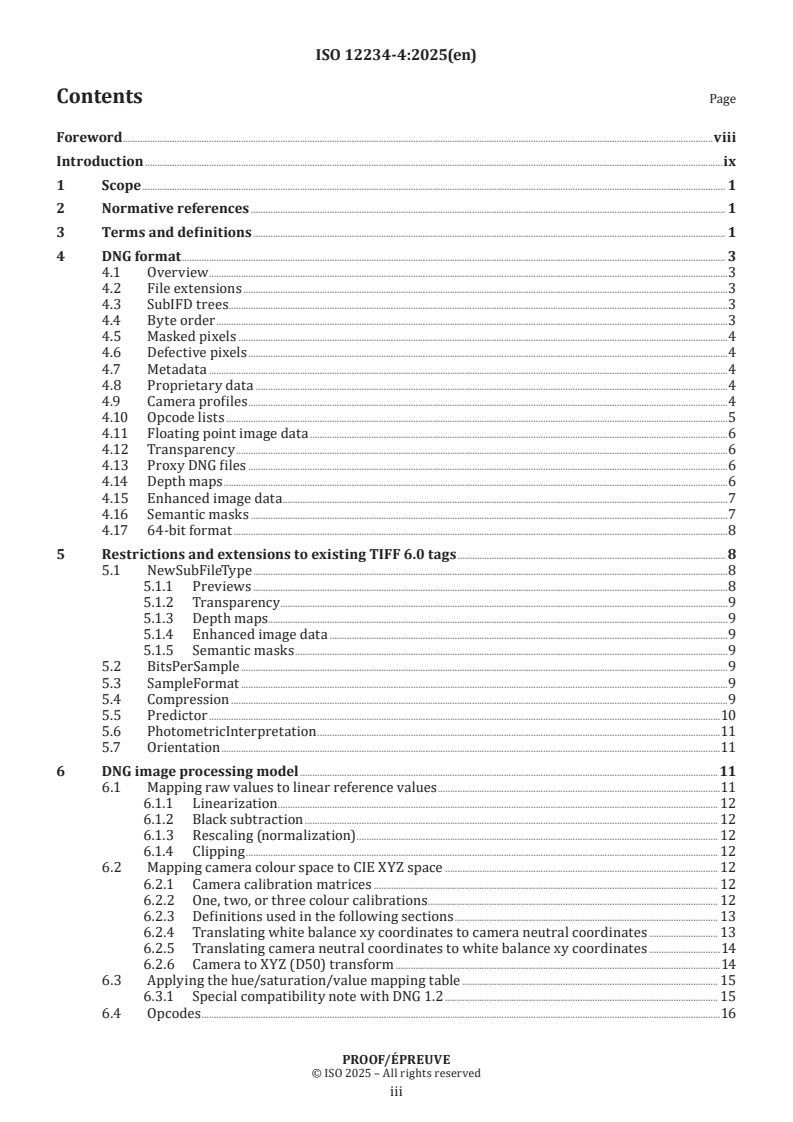
Contents Page
Foreword .viii
Introduction .ix
1 Scope . 1
2 Normative references . 1
3 Terms and definitions . 1
4 DNG format . 3
4.1 Overview .3
4.2 File extensions .3
4.3 SubIFD trees .3
4.4 Byte order .3
4.5 Masked pixels .4
4.6 Defective pixels .4
4.7 Metadata .4
4.8 Proprietary data .4
4.9 Camera profiles .4
4.10 Opcode lists .5
4.11 Floating point image data .6
4.12 Transparency .6
4.13 Proxy DNG files .6
4.14 Depth maps .6
4.15 Enhanced image data .7
4.16 Semantic masks .7
4.17 64-bit format .8
5 Restrictions and extensions to existing TIFF 6.0 tags . 8
5.1 NewSubFileType .8
5.1.1 Previews .8
5.1.2 Transparency . . .9
5.1.3 Depth maps.9
5.1.4 Enhanced image data .9
5.1.5 Semantic masks .9
5.2 BitsPerSample .9
5.3 SampleFormat .9
5.4 Compression .9
5.5 Predictor .10
5.6 PhotometricInterpretation .11
5.7 Orientation .11
6 DNG image processing model .11
6.1 Mapping raw values to linear reference values .11
6.1.1 Linearization . . 12
6.1.2 Black subtraction . 12
6.1.3 Rescaling (normalization) . 12
6.1.4 Clipping . 12
6.2 Mapping camera colour space to CIE XYZ space . 12
6.2.1 Camera calibration matrices . 12
6.2.2 One, two, or three colour calibrations . 12
6.2.3 Definitions used in the following sections . 13
6.2.4 Translating white balance xy coordinates to camera neutral coordinates . 13
6.2.5 Translating camera neutral coordinates to white balance xy coordinates .14
6.2.6 Camera to XYZ (D50) transform .14
6.3 Applying the hue/saturation/value mapping table . 15
6.3.1 Special compatibility note with DNG 1.2 . 15
6.4 Opcodes .16
PROOF/ÉPREUVE
iii
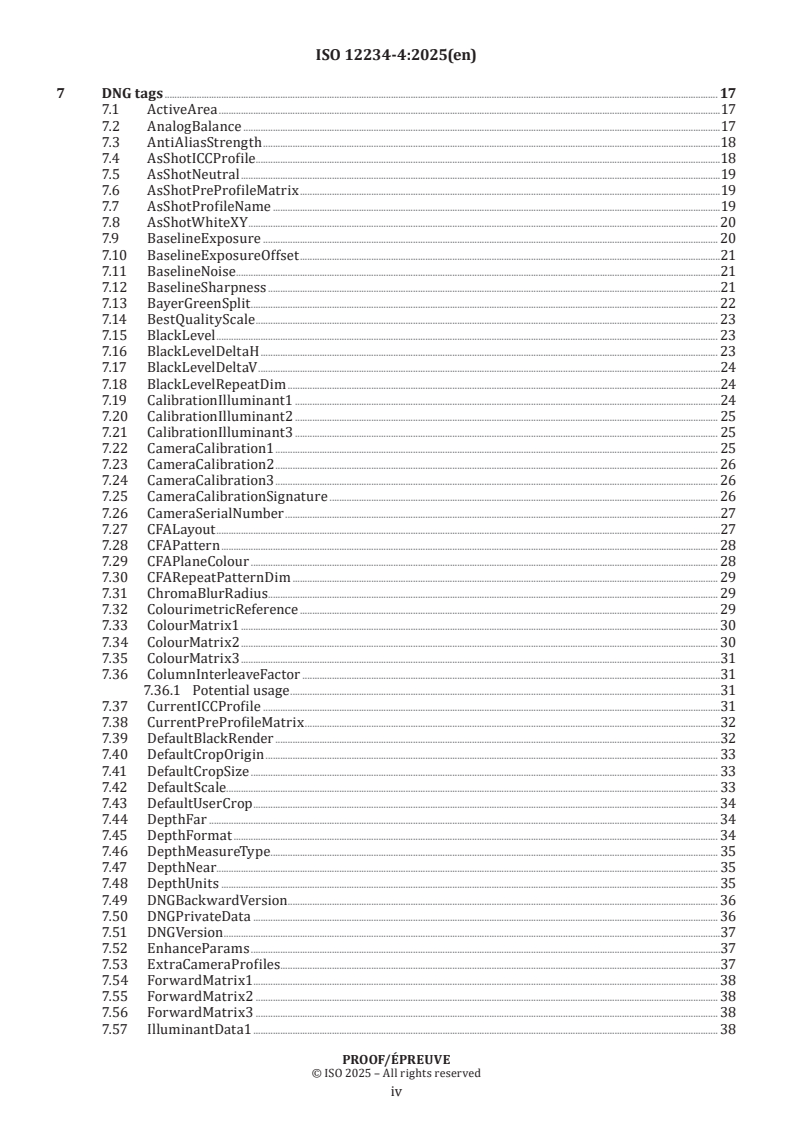
7 DNG tags . 17
7.1 ActiveArea .17
7.2 AnalogBalance .17
7.3 AntiAliasStrength .18
7.4 AsShotICCProfile . .18
7.5 AsShotNeutral .19
7.6 AsShotPreProfileMatrix .19
7.7 AsShotProfileName .19
7.8 AsShotWhiteXY . 20
7.9 BaselineExposure . 20
7.10 BaselineExposureOffset .21
7.11 BaselineNoise . .21
7.12 BaselineSharpness .21
7.13 BayerGreenSplit . 22
7.14 BestQualityScale . 23
7.15 BlackLevel . 23
7.16 BlackLevelDeltaH . 23
7.17 BlackLevelDeltaV .24
7.18 BlackLevelRepeatDim .24
7.19 CalibrationIlluminant1 .24
7.20 CalibrationIlluminant2 . 25
7.21 CalibrationIlluminant3 . 25
7.22 CameraCalibration1 . 25
7.23 CameraCalibration2 . 26
7.24 CameraCalibration3 . 26
7.25 CameraCalibrationSignature . 26
7.26 CameraSerialNumber .27
7.27 CFALayout .27
7.28 CFAPattern . 28
7.29 CFAPlaneColour . 28
7.30 CFARepeatPatternDim . 29
7.31 ChromaBlurRadius. 29
7.32 ColourimetricReference . 29
7.33 ColourMatrix1 . 30
7.34 ColourMatrix2 . 30
7.35 ColourMatrix3 .31
7.36 ColumnInterleaveFactor .31
7.36.1 Potential usage .31
7.37 CurrentICCProfile .31
7.38 CurrentPreProfileMatrix .32
7.39 DefaultBlackRender .32
7.40 DefaultCropOrigin . 33
7.41 DefaultCropSize . 33
7.42 DefaultScale. 33
7.43 DefaultUserCrop . 34
7.44 DepthFar . 34
7.45 DepthFormat . 34
7.46 DepthMeasureType . . 35
7.47 DepthNear. 35
7.48 DepthUnits . 35
7.49 DNGBackwardVersion . 36
7.50 DNGPrivateData . 36
7.51 DNGVersion .37
7.52 EnhanceParams .37
7.53 ExtraCameraProfiles.37
7.54 ForwardMatrix1 . 38
7.55 ForwardMatrix2 . 38
7.56 ForwardMatrix3 . 38
7.57 IlluminantData1 . 38
PROOF/ÉPREUVE
iv
7.58 IlluminantData2 . 39
7.59 IlluminantData3 . 40
7.60 ImageSequenceInfo . 40
7.61 ImageStats .41
7.62 JXLDistance . 44
7.63 JXLEffort . 44
7.64 JXLDecodeSpeed . 44
7.65 LensInfo .45
7.66 LinearizationTable . .45
7.67 LinearResponseLimit . .45
7.68 LocalizedCameraModel . 46
7.69 MakerNoteSafety . 46
7.70 MaskedAreas . .47
7.71 MaskSubArea .47
7.71.1 Example . 48
7.72 NewRawImageDigest . 48
7.73 NoiseProfile . 49
7.74 NoiseReductionApplied . 50
7.75 OpcodeList1 . 50
7.76 OpcodeList2 . 50
7.77 OpcodeList3 .51
7.78 OriginalBestQualityFinalSize .51
7.79 OriginalDefaultCropSize .51
7.80 OriginalDefaultFinalSize .52
7.81 OriginalRawFileData .52
7.82 OriginalRawFileDigest . 53
7.83 OriginalRawFileName . 54
7.84 PreviewApplicationName . 54
7.85 PreviewApplicationVersion . 54
7.86 PreviewColourSpace . 54
7.87 PreviewDateTime . 55
7.88 PreviewSettingsDigest . 55
7.89 PreviewSettingsName . 56
7.90 ProfileCalibrationSignature . 56
7.91 ProfileCopyright. 56
7.92 ProfileDynamicRange . 56
7.93 ProfileEmbedPolicy . 58
7.94 ProfileGainTableMap . 58
7.95 ProfileGainTableMap2 . 60
7.95.1 DataType .61
7.95.2 Gamma .62
7.95.3 GainMin and GainMax .62
7.95.4 Application .62
7.95.5 Compatibility with ProfileGainTableMap .62
7.95.6 IFD 0 vs Camera Profile IFD . 63
7.95.7 IFD 0 vs Raw IFD . 63
7.96 ProfileGroupName . . 63
7.97 ProfileHueSatMapData1 . 64
7.98 ProfileHueSatMapData2 . 64
7.99 ProfileHueSatMapData3 . 64
7.100 ProfileHueSatMapDims . 65
7.101 ProfileHueSatMapEncoding . 65
7.102 ProfileLookTableEncoding . 66
7.103 ProfileLookTableData .67
7.104 ProfileLookTableDims . 68
7.105 ProfileName . 68
7.106 ProfileToneCurve . 68
7.107 RawDataUniqueID . 69
7.108 RawImageDigest . 69
PROOF/ÉPREUVE
v
7.109 RawToPreviewGain .70
7.110 ReductionMatrix1 .70
7.111 ReductionMatrix2 .70
7.112 ReductionMatrix3 . .71
7.113 RGBTables .71
7.113.1 General .71
7.113.2 Notes on the tag fields . 72
7.113.3 Background table . 73
7.113.4 Table transform pipeline .74
7.113.5 Notes on applying the colour transforms . . 75
7.114 RowInterleaveFactor .76
7.115 SemanticInstanceID . 77
7.116 SemanticName . 77
7.117 SubTileBlockSize . 77
7.118 UniqueCameraModel . 78
7.119 WhiteLevel . 78
8 Opcodes .78
8.1 DeltaPerColumn . 79
8.1.1 Syntax . . 79
8.1.2 Description . 79
8.2 DeltaPerRow . 80
8.2.1 Syntax . . 80
8.2.2 Description . 80
8.3 FixBadPixelsConstant . 81
8.3.1 Syntax . . 81
8.3.2 Description . 81
8.4 FixBadPixelsList . 81
8.4.1 Syntax . 81
8.4.2 Description . 82
8.5 FixVignetteRadial . 82
8.5.1 Syntax . . 82
8.5.2 Description . 82
8.6 GainMap . 83
8.6.1 Syntax . . 83
8.6.2 Description . 84
8.7 MapPolynomial . . 85
8.7.1 Syntax . . 85
8.7.2 Description . 85
8.8 MapTable .
...
ISO/PRF 12234-4:2025(en)
ISO /TC 42/WG 18
Secretariat: ANSI
Date: 2025-09-08xx
Digital imaging — Image storage — —
Part 4:
Digital negative format
Imagerie numérique — Stockage d'image —
Partie 4: Format négatif numérique
PROOF
ISO/PRF 12234-4:2025(en)
All rights reserved. Unless otherwise specified, or required in the context of its implementation, no part of this publication
may be reproduced or utilized otherwise in any form or by any means, electronic or mechanical, including photocopying,
or posting on the internet or an intranet, without prior written permission. Permission can be requested from either ISO
at the address below or ISO’s member body in the country of the requester.
ISO copyright office
CP 401 • Ch. de Blandonnet 8
CH-1214 Vernier, Geneva
Phone: + 41 22 749 01 11
EmailE-mail: copyright@iso.org
Website: www.iso.org
Published in Switzerland
ii
ISO/PRF 12234-4:2025(en)
Contents
Foreword . vii
Introduction . viii
1 Scope . 1
2 Normative references . 1
3 Terms and definitions . 1
4 DNG format . 3
4.1 Overview . 3
4.2 File extensions . 3
4.3 SubIFD trees . 3
4.4 Byte order . 4
4.5 Masked pixels . 4
4.6 Defective pixels . 4
4.7 Metadata . 4
4.8 Proprietary data . 4
4.9 Camera profiles . 5
4.10 Opcode lists . 6
4.11 Floating point image data . 6
4.12 Transparency . 6
4.13 Proxy DNG files . 7
4.14 Depth maps . 7
4.15 Enhanced image data . 7
4.16 Semantic masks . 8
4.17 64-bit format . 8
5 Restrictions and extensions to existing TIFF 6.0 tags . 9
5.1 NewSubFileType . 9
5.2 BitsPerSample . 10
5.3 SampleFormat . 10
5.4 Compression . 10
5.5 Predictor . 11
5.6 PhotometricInterpretation . 12
5.7 Orientation . 12
6 DNG image processing model . 12
6.1 Mapping raw values to linear reference values . 12
6.2 Mapping camera colour space to CIE XYZ space . 13
6.3 Applying the hue/saturation/value mapping table . 16
6.4 Opcodes . 17
7 DNG tags . 18
7.1 ActiveArea . 19
7.2 AnalogBalance . 19
7.3 AntiAliasStrength . 19
7.4 AsShotICCProfile . 20
7.5 AsShotNeutral . 21
7.6 AsShotPreProfileMatrix . 21
7.7 AsShotProfileName . 21
7.8 AsShotWhiteXY . 22
7.9 BaselineExposure . 22
7.10 BaselineExposureOffset . 23
7.11 BaselineNoise . 23
iii
ISO/PRF 12234-4:2025(en)
7.12 BaselineSharpness . 24
7.13 BayerGreenSplit . 24
7.14 BestQualityScale . 25
7.15 BlackLevel . 25
7.16 BlackLevelDeltaH . 26
7.17 BlackLevelDeltaV . 26
7.18 BlackLevelRepeatDim . 26
7.19 CalibrationIlluminant1 . 27
7.20 CalibrationIlluminant2 . 27
7.21 CalibrationIlluminant3 . 28
7.22 CameraCalibration1 . 28
7.23 CameraCalibration2 . 28
7.24 CameraCalibration3 . 29
7.25 CameraCalibrationSignature . 29
7.26 CameraSerialNumber . 30
7.27 CFALayout . 30
7.28 CFAPattern . 31
7.29 CFAPlaneColour . 31
7.30 CFARepeatPatternDim . 32
7.31 ChromaBlurRadius . 32
7.32 ColourimetricReference . 33
7.33 ColourMatrix1 . 33
7.34 ColourMatrix2 . 34
7.35 ColourMatrix3 . 34
7.36 ColumnInterleaveFactor . 34
7.37 CurrentICCProfile . 35
7.38 CurrentPreProfileMatrix . 35
7.39 DefaultBlackRender . 36
7.40 DefaultCropOrigin . 36
7.41 DefaultCropSize . 37
7.42 DefaultScale . 37
7.43 DefaultUserCrop . 37
7.44 DepthFar . 38
7.45 DepthFormat . 38
7.46 DepthMeasureType . 39
7.47 DepthNear. 39
7.48 DepthUnits . 39
7.49 DNGBackwardVersion . 40
7.50 DNGPrivateData. 40
7.51 DNGVersion . 41
7.52 EnhanceParams . 41
7.53 ExtraCameraProfiles . 41
7.54 ForwardMatrix1 . 42
7.55 ForwardMatrix2 . 42
7.56 ForwardMatrix3 . 43
7.57 IlluminantData1 . 43
7.58 IlluminantData2 . 44
7.59 IlluminantData3 . 44
7.60 ImageSequenceInfo . 45
7.61 ImageStats . 46
7.62 JXLDistance . 49
7.63 JXLEffort . 49
7.64 JXLDecodeSpeed . 50
7.65 LensInfo . 50
iv
ISO/PRF 12234-4:2025(en)
7.66 LinearizationTable . 51
7.67 LinearResponseLimit . 51
7.68 LocalizedCameraModel. 51
7.69 MakerNoteSafety . 52
7.70 MaskedAreas . 52
7.71 MaskSubArea . 53
7.72 NewRawImageDigest . 54
7.73 NoiseProfile . 55
7.74 NoiseReductionApplied . 56
7.75 OpcodeList1 . 56
7.76 OpcodeList2 . 56
7.77 OpcodeList3 . 57
7.78 OriginalBestQualityFinalSize . 57
7.79 OriginalDefaultCropSize . 57
7.80 OriginalDefaultFinalSize . 58
7.81 OriginalRawFileData . 58
7.82 OriginalRawFileDigest . 60
7.83 OriginalRawFileName . 60
7.84 PreviewApplicationName . 60
7.85 PreviewApplicationVersion . 61
7.86 PreviewColourSpace . 61
7.87 PreviewDateTime . 62
7.88 PreviewSettingsDigest . 62
7.89 PreviewSettingsName . 62
7.90 ProfileCalibrationSignature . 63
7.91 ProfileCopyright . 63
7.92 ProfileDynamicRange . 63
7.93 ProfileEmbedPolicy . 65
7.94 ProfileGainTableMap . 66
7.95 ProfileGainTableMap2 . 68
7.96 ProfileGroupName . 71
7.97 ProfileHueSatMapData1 . 71
7.98 ProfileHueSatMapData2 . 72
7.99 ProfileHueSatMapData3 . 72
7.100 ProfileHueSatMapDims . 72
7.101 ProfileHueSatMapEncoding . 73
7.102 ProfileLookTableEncoding . 74
7.103 ProfileLookTableData . 75
7.104 ProfileLookTableDims . 76
7.105 ProfileName . 76
7.106 ProfileToneCurve . 76
7.107 RawDataUniqueID . 77
7.108 RawImageDigest . 77
7.109 RawToPreviewGain . 78
7.110 ReductionMatrix1 . 78
7.111 ReductionMatrix2 . 79
7.112 ReductionMatrix3 . 79
7.113 RGBTables . 79
7.114 RowInterleaveFactor . 85
7.115 SemanticInstanceID . 86
7.116 SemanticName . 86
7.117 SubTileBlockSize . 87
7.118 UniqueCameraModel . 87
7.119 WhiteLevel . 88
v
ISO/PRF 12234-4:2025(en)
8 Opcodes . 88
8.1 DeltaPerColumn . 88
8.2 DeltaPerRow . 89
8.3 FixBadPixelsConstant . 90
8.4 FixBadPixelsList . 91
8.5 FixVignetteRadial . 91
8.6 GainMap . 93
8.7 MapPolynomial . 95
8.8 MapTable . 96
8.9 ScalePerColumn . 97
8.10 ScalePerRow . 98
8.11 TrimBounds . 99
8.12 WarpFisheye . 99
8.13 WarpRectilinear . 101
8.14 WarpRectilinear2 . 104
Annex A (informative) Compatibility with Legacy Versions of DNG . 108
Bibliography . 112
vi
ISO/PRF 12234-4:2025(en)
Foreword
ISO (the International Organization for Standardization) is a worldwide federation of national standards
bodies (ISO member bodies). The work of preparing International Standards is normally carried out through
ISO technical committees. Each member body interested in a subject for which a technical committee has been
established has the right to be represented on that committee. International organizations, governmental and
non-governmental, in liaison with ISO, also take part in the work. ISO collaborates closely with the
International Electrotechnical Commission (IEC) on all matters of electrotechnical standardization.
The procedures used to develop this specificationdocument and those intended for its further maintenance
are described in the ISO/IEC Directives, Part 1. In particular, the different approval criteria needed for the
different types of ISO specificationdocument should be noted. This specificationdocument was drafted in
accordance with the editorial rules of the ISO/IEC Directives, Part 2 (see www.iso.org/directives).
ISO draws attention to the possibility that the implementation of this specificationdocument may involve the
use of (a) patent(s). ISO takes no position concerning the evidence, validity or applicability of any claimed
patent rights in respect thereof. As of the date of publication of this specificationdocument, ISO had not
received notice of (a) patent(s) which may be required to implement this specificationdocument. However,
implementers are cautioned that this may not represent the latest information, which may be obtained from
the patent database available at www.iso.org/patents. ISO shall not be held responsible for identifying any or
all such patent rights.
Any trade name used in this specificationdocument is information given for the convenience of users and does
not constitute an endorsement.
For an explanation of the voluntary nature of standards, the meaning of ISO specific terms and expressions
related to conformity assessment, as well as information about ISO's adherence to the World Trade
Organization (WTO) principles in the Technical Barriers to Trade (TBT), see
www.iso.org/iso/foreword.html.This specification was prepared by Technical Committee ISO/TC 42
Photography.
This document was prepared by Technical Committee ISO/TC 42, Photography.
A list of all parts in the ISO 12234 series can be found on the ISO website.
Any feedback or questions on this specificationdocument should be directed to the user’s national standards
body. A complete listing of these bodies can be found at www.iso.org/members.html.
vii
ISO/PRF 12234-4:2025(en)
Introduction
Advanced and professional photographers often choose to capture and edit photos in raw format, for
additional flexibility and artistic control. Unlike display-referred formats (such as JPEG, PNG, and TIFF) which
store images that have already been processed by the camera, raw formats store unprocessed or minimally
processed data directly from the camera sensor. This enables photographers to adjust many parameters to
taste, including white balance, tone mapping, noise reduction, sharpening, and so on. Photos in raw format are
analogous to film negatives in a photographer’s workflow, so they are often referred to as “digital negatives.”
The purpose of this specificationdocument is to define a standardized file format for storing raw photographs.
This file format can be used in a wide range of hardware and software applications for generating, processing,
managing, transcoding, or archiving raw photographs. Since raw photographs are closely tied to the camera
sensor and other characteristics, camera manufacturers may use and support their own Vendor Raw formats
to meet various design requirements.
The name of this file format is Digital Negative (DNG). DNG is an extension of TIFF 6.0 and is compatible with
TIFF-EP standard. It is possible (but not required) for a DNG file to simultaneously comply with both this
specificationdocument and the TIFF-EP standard.
Adobe Systems published the "Digital Negative (DNG) Specification." This includes specifying DNG by
capturing and reconciling major adoptions and implementations of Adobe DNG.
Annex AANNEX A describes the relationship of this standarddocument to the Adobe versions of DNG.
viii
ISO/PRF 12234-4:2025(en)
Digital imaging — Image storage — —
Part 4:
Digital negative format
1 Scope
This specificationdocument specifies the Digital Negative (DNG) image file format. A DNG file meets the
requirements provided in this specificationdocument.
2 Normative references
The following specificationsdocuments are referred to in the text in such a way that some or all of their content
constitutes requirements of this specification.document. For dated references, only the edition cited applies.
For undated references, the latest edition of the referenced specificationdocument (including any
amendments) applies.
ISO 12234--1, Electronic still-picture imaging — Removable memory — Part 1: Basic removable-memory model
ISO 12234--3, Electronic still picture imaging — Removable memory — Part 3: XMP for digital photography
ISO/TS 22028--3, Photography and graphic technology — Extended colour encodings for digital image storage,
manipulation and interchange — Part 3: Reference input medium metric RGB colour image encoding (RIMM
RGB)
IEC 61966-2-2, Multimedia systems and equipment — Colour measurement and management — Part 2-2: Colour
management — Extended RGB colour space — scRGB
ISO/IEC 10918-1, Information technology — Digital compression and coding of continuous-tone still images:
Requirements and guidelines
ISO/IEC 14495-1, Information technology — Lossless and near-lossless compression of continuous-tone still
images: Baseline — Part 1:
CIPA DC-010-2024, Exif metadata for XMP
IPTC Photo Metadadata Standard 2023.2
3 Terms and definitions
For the purposes of this specificationdocument, the following terms and definitions apply.
ISO and IEC maintain terminology databases for use in standardization at the following addresses:
— — ISO Online browsing platform: available at https://www.iso.org/obp
— — IEC Electropedia: available at https://www.electropedia.org/
3.1 3.1
opcode
image processing instruction to be executed on reading
ISO/PRF 12234-4:2025(en)
3.2 3.2
raw
unprocessed or minimally processed image data which is directly related to the colur information captured
by the sensor and suitable for further processing
Note 1 to entry: In this specificationdocument there is a distinction between "vendor raw" and "standard raw", defined
below, and use "raw" to refer to "'standardized raw".
3.3 3.3
reader
device that consumes files compliant with this standarddocument
3.4 3.4
standard raw
raw files conformant with this specificationdocument
Note 1 to entry: This is in contrast to vendor raw files which are typically vendor specific. In the context of this
specificationdocument, raw= = standard raw and vendor raw will be referred to as vendor raw.
3.5 3.6
tag
a 12-byte record having different formats
Note 1 to entry: The formats are as follow:
Bytes 0–1: The Tag ID Field, which is a number that identifies the particular tag.
Bytes 2–3: The Data Type Field, which is one of the following values:
1 = BYTE, an 8-bit unsigned integer.
2 = ASCII, a string of 8-bit bytes containing 7-bit ASCII character codes terminated with a NULL code.
3 = SHORT, a 16-bit (2-byte) unsigned integer.
4 = LONG, a 32-bit (4-byte) unsigned integer.
5 = RATIONAL, is two LONGs. The first LONG is the numerator and the second LONG is the
denominator.
6 = SBYTE, is a signed 8-bit integer
7 = UNDEFINED, indicates an 8-bit byte that can take any value depending on the field definition.
8 = SSHORT, is a signed 16-bit integer
9 = SLONG, is a signed 32-bit integer
10 = SRATIONAL, is two SLONGs: the first represents the numerator of the fraction, the second
represents the denominator, which shall be non-zero.
11 = FLOAT, is 32-bit (4-byte) float in IEEE-754 format
12 = DOUBLE, is 64-bit (8-byte) float in IEEE-754 format
Bytes 4–7: The Count Field, which indicates the number of Data Type values (not the number of bytes)
stored by the tag.
Bytes 8–11: The value or offset field, which indicates the tag value(s) if they can be stored in these 4 bytes, or
the offset to the data if more room is required. The offset value is the relative offset from the Byte Order field
in the file header.
ISO/PRF 12234-4:2025(en)
3.6 3.7
TIFF tag +and value
logical entity consisting of a TIFF tag and its value, where this logical concept is implemented as an 12 byte
IFD entry
Note 1 to entry: The tag value(s) if they can be stored in the last 4 bytes, or the offset to the data if more room is required.
The offset value is the relative offset from the byte order field, first two bytes of the file in the file header.
3.7 3.8
DNG file
file compliant with this specificationdocument
3.8 3.9
vendor raw
raw files referring to a variety of non-standardized raw file formats independently specified
by any number of vendors
Note 1 to entry: For the purposes of this specificationdocument, these will be referred to as 'vendor raw' and 'raw' will
refer to this 'standardized raw' specificationdocument.
3.9 3.10
colour space
colour space encoding in which manual edits or image enhancement processing is performed
Note 1 to entry: Manual edits in a colour space are performed viewing the effect of the edits on some medium which
becomes the reference medium for the editing process. Typically, the black and white points of this medium are encoded
at the minimum and maximum working colour space values. In this case, in order to obtain accurate colourimetric values,
the black and white scaling corresponding to the reference medium used must be undone. XYZ scaling is typically
recommended (see ISO 22028-2).
Note 2 to entry: When a colour space encoding used for a standard colour image encoding is also used as a currnet space,
it may still be necessary to perform a colour re-rendering of the values associated with the (potentially variable) working
colour space reference medium to make them appropriate for the colour image encoding reference medium, and for open
exchange. For example, When the sRGB colour space encoding specified in IEC 61966-2-1 is used as a working colour
space for the editing of motion picture content, viewing it in a dark theatrical environment, the resulting images will be
encoded in the sRGB colour space encoding but not in the sRGB colour image encoding. Consequently, they will not
produce good results if exchanged and interpreted according to the sRGB colour image encoding standard.
Note 3 to entry: Image enhancement processing may involve the application of algorithms in different working spaces
as different operations and algorithms may be optimized for particular working spaces.
4 DNG format
4.1 Overview
This clause describes the DNG file format. A DNG file shall comply with all of the format requirements of TIFF
6.0, unless otherwise noted in this specificationdocument.
4.2 File extensions
It is recommended to use the file extension DNG or dng. For example, IMG_1234.DNG or IMG_1234.dng.
4.3 SubIFD trees
It is recommended that DNG files use SubIFD trees, as described in TIFF-EP. However, DNG files shall not use
SubIFD chains.
ISO/PRF 12234-4:2025(en)
The highest-resolution and quality IFD shall use a NewSubFileType value of 0.
Reduced-resolution or reduced-quality thumbnails or previews, if any, should use NewSubFileType equal to
1 (for a primary preview) or 10001.H (for an alternate preview).
It is recommended that the first IFD contain a low-resolution thumbnail, as described in TIFF-EP.
4.4 Byte order
DNG files may use either byte order (big-endian or little-endian).
4.5 Masked pixels
Some camera sensors measure the black encoding level using masked pixels at the edges of the sensor. These
pixels can either be trimmed before storing the image, or they can be included in the stored image. If the
masked pixels are not trimmed, the area of the non-masked pixels shall be specified using the ActiveArea tag.
The black encoding level information extracted from these masked pixels should be used to either pre-
compensate the raw data stored in the file or they should be included in the file using the tags for specifying
the black level.
This black encoding level information shall be included, even if the masked pixels are not trimmed, to allow
DNG readers to process the image without requiring knowledge of the best way to compute the black levels
for any given camera model.
4.6 Defective pixels
There are two methods to treat defective pixels in a DNG file.
The first method is to remove (for instance, interpolate over) the defective pixels before storing the raw image
into the DNG file.
The second is to include an appropriate opcode (either FixBadPixelsConstant or FixBadPixelsList) in the
OpcodeList1 tag.
4.7 Metadata
Metadata can be stored in DNG in the following ways:
— — Using TIFF-EP (ISO 12234-2) metadata tags
— — Using EXIF metadata tags
— — Using the IPTC metadata tag (tag code 33723)
— — Using the XMP metadata tag (tag code 700)
NOTE TIFF-EP and EXIF use nearly the same metadata tag set, but TIFF-EP stores the tags in IFD 0, while EXIF store
the tags in a separate IFD. It is recommended to use a separate EXIF IFD.
4.8 Proprietary data
Proprietary data may be stored using private tags, private IFDs, or a private MakerNote. It is recommended to
use the DNGPrivateData and MakerNoteSafety tags to ensure that programs that edit DNG files preserve this
proprietary data.
ISO/PRF 12234-4:2025(en)
NOTE Camera manufacturers can include proprietary data in a raw file for use in their own software. Use of such
proprietary data maycan result in different images.
4.9 Camera profiles
A DNG file shall contain at least 1 camera profile. The primary camera profile shall be stored in IFD 0.
A DNG file may store additional camera profiles using the ExtraCameraProfiles tag.
A camera profile consists of a set of tags. Some tags are mandatory, while others are optional.
The tags belonging to a camera profile are:
— — BaselineExposureOffset
— — CalibrationIlluminant1
— — CalibrationIlluminant2
...
Questions, Comments and Discussion
Ask us and Technical Secretary will try to provide an answer. You can facilitate discussion about the standard in here.
Loading comments...