

ISO 23317:2025
(Main)Implants for surgery — Materials — Simulated body fluid (SBF) preparation procedure and test method to detect apatite formation in SBF for initial screening of bone-contacting implant materials
General Information
- Abstract
This document specifies a procedure for preparing the simulated body fluid (SBF) and a test method for use as an initial screening tool in the evaluation of apatite formation on the surfaces of bone-contacting implant materials. NOTE 1 The results of this SBF test (see REF Section_sec_7 \r \h Clause 7) alone do not establish bone-bonding ability. The test can be used along with other in vitro and in vivo confirmatory tests to establish an implant material’s ability to bond with bone tissue in vivo. This document is limited to an assessment of the in vitro apatite-forming ability of bulky solid materials used for bone-contacting implants and is not intended to be used to evaluate this ability of porous materials, particulate materials or solute molecules or ions. NOTE 2 Porous materials are excluded from test specimens because they require a large volume of SBF due to high surface area, and often have difficulty in penetration of SBF into their porous bodies. Furthermore, analysis of the inner surfaces of porous materials is difficult by the method described in this document.
- Status
- Published
- Publication Date
- 11-Jun-2025
- Technical Committee
- ISO/TC 150/SC 1 - Materials
- Drafting Committee
- ISO/TC 150/SC 1 - Materials
- Current Stage
- 6060 - International Standard published
- Start Date
- 12-Jun-2025
- Due Date
- 11-Nov-2025
- Completion Date
- 12-Jun-2025
Buy Documents
ISO 23317:2025 - Implants for surgery — Materials — Simulated body fluid (SBF) preparation procedure and test method to detect apatite formation in SBF for initial screening of bone-contacting implant materials Released:12. 06. 2025
ISO 23317:2025 - Implants chirurgicaux — Matériaux — Mode opératoire de préparation de fluide corporel simulé (FCS) et méthode d’essai pour détecter la formation d’apatite dans le FCS pour l’étude préliminaire de matériaux d’implant en contact avec l’os Released:26. 06. 2025
Overview
ISO 23317:2025 - Implants for surgery - Materials - Simulated body fluid (SBF) preparation procedure and test method to detect apatite formation in SBF for initial screening of bone-contacting implant materials - defines a standardized SBF preparation procedure and an in vitro screening test to detect apatite-like mineral formation on the surfaces of bulky, solid bone-contacting implant materials. The standard clarifies the limitations of the SBF test (it is acellular and does not alone establish bone-bonding ability) and is intended as an early screening tool to inform further in vitro and in vivo evaluations.
Key topics and technical requirements
- Scope and limitations
- Applies only to bulky solid materials for bone-contacting implants; porous, particulate or solute materials are excluded.
- Results do not by themselves demonstrate in vivo bone bonding.
- SBF composition and preparation
- Specifies reagents, stepwise preparation procedures and evaluation/preservation of the simulated body fluid (SBF) that mimics inorganic ion concentrations of blood plasma.
- Notes SBF’s metastable behaviour (can remain without precipitation under controlled conditions).
- Test specimen requirements
- Specifies specimen shape, dimensions, preparation and surface characterization prior to testing.
- Addresses specimen arrangement in SBF depending on density and shape.
- Test procedure
- Defines soaking conditions (including a specified seven-day soaking period introduced in this edition) and visual inspection requirements.
- Provides criteria for judging apatite-forming ability.
- Analytical detection
- Recommends conventional surface-analytical techniques for apatite detection such as X-ray diffraction (XRD), scanning electron microscopy (SEM), energy dispersive X-ray spectroscopy (EDX) and FT‑IR.
- Reporting
- Details required test report content to ensure reproducibility and comparability.
Practical applications
- Use ISO 23317:2025 for initial screening of new implant materials to determine whether their surface chemistry encourages apatite-like mineral formation.
- Supports R&D in biomaterials (glasses, ceramics, coated metals) by providing a low-cost, widely accessible in vitro test before investing in cell-culture or animal studies.
- Helps manufacturers document early-stage surface performance for regulatory submissions and material selection.
Who should use this standard
- Biomaterials scientists and engineers, implant manufacturers, quality and regulatory professionals, and academic researchers involved in implant surface evaluation, biomineralization studies, and preclinical screening.
Related standards
- ISO 23317:2025 complements other implant and biocompatibility guidance (for example, the ISO standards addressing surgical implants and the ISO 10993 biocompatibility series) and should be used alongside cellular and in vivo confirmatory tests when assessing bone-bonding potential.
Keywords: ISO 23317:2025, simulated body fluid, SBF test, apatite formation, bone-contacting implant materials, in vitro screening, implant surface analysis.
Relations
- Effective Date
- 06-Jun-2022
Buy Documents
ISO 23317:2025 - Implants for surgery — Materials — Simulated body fluid (SBF) preparation procedure and test method to detect apatite formation in SBF for initial screening of bone-contacting implant materials Released:12. 06. 2025
ISO 23317:2025 - Implants chirurgicaux — Matériaux — Mode opératoire de préparation de fluide corporel simulé (FCS) et méthode d’essai pour détecter la formation d’apatite dans le FCS pour l’étude préliminaire de matériaux d’implant en contact avec l’os Released:26. 06. 2025
Get Certified
Connect with accredited certification bodies for this standard

BSI Group
BSI (British Standards Institution) is the business standards company that helps organizations make excellence a habit.

TÜV Rheinland
TÜV Rheinland is a leading international provider of technical services.

TÜV SÜD
TÜV SÜD is a trusted partner of choice for safety, security and sustainability solutions.
Sponsored listings
Frequently Asked Questions
ISO 23317:2025 is a standard published by the International Organization for Standardization (ISO). Its full title is "Implants for surgery — Materials — Simulated body fluid (SBF) preparation procedure and test method to detect apatite formation in SBF for initial screening of bone-contacting implant materials". This standard covers: This document specifies a procedure for preparing the simulated body fluid (SBF) and a test method for use as an initial screening tool in the evaluation of apatite formation on the surfaces of bone-contacting implant materials. NOTE 1 The results of this SBF test (see REF Section_sec_7 \r \h Clause 7) alone do not establish bone-bonding ability. The test can be used along with other in vitro and in vivo confirmatory tests to establish an implant material’s ability to bond with bone tissue in vivo. This document is limited to an assessment of the in vitro apatite-forming ability of bulky solid materials used for bone-contacting implants and is not intended to be used to evaluate this ability of porous materials, particulate materials or solute molecules or ions. NOTE 2 Porous materials are excluded from test specimens because they require a large volume of SBF due to high surface area, and often have difficulty in penetration of SBF into their porous bodies. Furthermore, analysis of the inner surfaces of porous materials is difficult by the method described in this document.
This document specifies a procedure for preparing the simulated body fluid (SBF) and a test method for use as an initial screening tool in the evaluation of apatite formation on the surfaces of bone-contacting implant materials. NOTE 1 The results of this SBF test (see REF Section_sec_7 \r \h Clause 7) alone do not establish bone-bonding ability. The test can be used along with other in vitro and in vivo confirmatory tests to establish an implant material’s ability to bond with bone tissue in vivo. This document is limited to an assessment of the in vitro apatite-forming ability of bulky solid materials used for bone-contacting implants and is not intended to be used to evaluate this ability of porous materials, particulate materials or solute molecules or ions. NOTE 2 Porous materials are excluded from test specimens because they require a large volume of SBF due to high surface area, and often have difficulty in penetration of SBF into their porous bodies. Furthermore, analysis of the inner surfaces of porous materials is difficult by the method described in this document.
ISO 23317:2025 is classified under the following ICS (International Classification for Standards) categories: 11.040.40 - Implants for surgery, prosthetics and orthotics. The ICS classification helps identify the subject area and facilitates finding related standards.
ISO 23317:2025 has the following relationships with other standards: It is inter standard links to ISO 23317:2014. Understanding these relationships helps ensure you are using the most current and applicable version of the standard.
ISO 23317:2025 is available in PDF format for immediate download after purchase. The document can be added to your cart and obtained through the secure checkout process. Digital delivery ensures instant access to the complete standard document.
Standards Content (Sample)
International
Standard
ISO 23317
Fourth edition
Implants for surgery — Materials
2025-06
— Simulated body fluid (SBF)
preparation procedure and test
method to detect apatite formation
in SBF for initial screening of bone-
contacting implant materials
Implants chirurgicaux — Matériaux — Mode opératoire de
préparation de fluide corporel simulé (FCS) et méthode d’essai
pour détecter la formation d’apatite dans le FCS pour l’étude
préliminaire de matériaux d’implant en contact avec l’os
Reference number
© ISO 2025
All rights reserved. Unless otherwise specified, or required in the context of its implementation, no part of this publication may
be reproduced or utilized otherwise in any form or by any means, electronic or mechanical, including photocopying, or posting on
the internet or an intranet, without prior written permission. Permission can be requested from either ISO at the address below
or ISO’s member body in the country of the requester.
ISO copyright office
CP 401 • Ch. de Blandonnet 8
CH-1214 Vernier, Geneva
Phone: +41 22 749 01 11
Email: copyright@iso.org
Website: www.iso.org
Published in Switzerland
ii
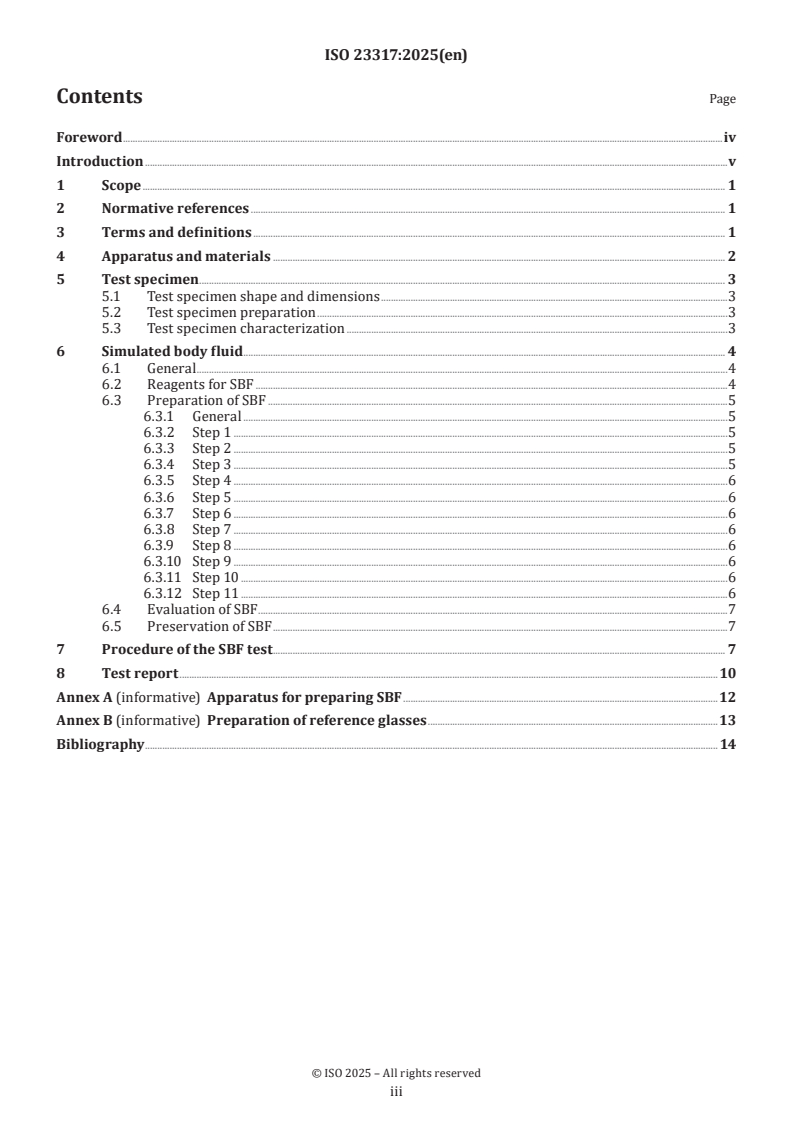
Contents Page
Foreword .iv
Introduction .v
1 Scope . 1
2 Normative references . 1
3 Terms and definitions . 1
4 Apparatus and materials . 2
5 Test specimen . 3
5.1 Test specimen shape and dimensions .3
5.2 Test specimen preparation .3
5.3 Test specimen characterization .3
6 Simulated body fluid . 4
6.1 General .4
6.2 Reagents for SBF .4
6.3 Preparation of SBF .5
6.3.1 General .5
6.3.2 Step 1 .5
6.3.3 Step 2 .5
6.3.4 Step 3 .5
6.3.5 Step 4 .6
6.3.6 Step 5 .6
6.3.7 Step 6 .6
6.3.8 Step 7 .6
6.3.9 Step 8 .6
6.3.10 Step 9 .6
6.3.11 Step 10 .6
6.3.12 Step 11 .6
6.4 Evaluation of SBF .7
6.5 Preservation of SBF .7
7 Procedure of the SBF test . . 7
8 Test report .10
Annex A (informative) Apparatus for preparing SBF .12
Annex B (informative) Preparation of reference glasses .13
Bibliography . 14
iii
Foreword
ISO (the International Organization for Standardization) is a worldwide federation of national standards
bodies (ISO member bodies). The work of preparing International Standards is normally carried out through
ISO technical committees. Each member body interested in a subject for which a technical committee
has been established has the right to be represented on that committee. International organizations,
governmental and non-governmental, in liaison with ISO, also take part in the work. ISO collaborates closely
with the International Electrotechnical Commission (IEC) on all matters of electrotechnical standardization.
The procedures used to develop this document and those intended for its further maintenance are described
in the ISO/IEC Directives, Part 1. In particular, the different approval criteria needed for the different types
of ISO document should be noted. This document was drafted in accordance with the editorial rules of the
ISO/IEC Directives, Part 2 (see www.iso.org/directives).
ISO draws attention to the possibility that the implementation of this document may involve the use of (a)
patent(s). ISO takes no position concerning the evidence, validity or applicability of any claimed patent
rights in respect thereof. As of the date of publication of this document, ISO had not received notice of (a)
patent(s) which may be required to implement this document. However, implementers are cautioned that
this may not represent the latest information, which may be obtained from the patent database available at
www.iso.org/patents. ISO shall not be held responsible for identifying any or all such patent rights.
Any trade name used in this document is information given for the convenience of users and does not
constitute an endorsement.
For an explanation of the voluntary nature of standards, the meaning of ISO specific terms and expressions
related to conformity assessment, as well as information about ISO's adherence to the World Trade
Organization (WTO) principles in the Technical Barriers to Trade (TBT), see www.iso.org/iso/foreword.html.
This document was prepared by Technical Committee ISO/TC 150, Implants or surgery, Subcommittee SC 1,
Materials.
This fourth edition cancels and replaces the third edition (ISO 23317:2014), which has been editorially
revised. The main changes are:
— the title, Introduction and scope have been revised to clarify the significance and limitations of the SBF test;
— the terms and definitions clause has been rearranged and revised for better understanding;
— the list of apparatus and materials has been enriched and detailed;
— the test specimen preparation has been revised, and test specimen characterization has been added;
— the preparation of SBF has been revised and described in more detail;
— a description of test specimens with lower density than SBF has been added;
— the arrangement of the test specimen in the SBF test has been revised and explained depending on the
specimen’s shape and density;
— the necessity of visual inspection of SBF has been added;
— the soaking period of seven days in the SBF test has been specified;
— the criteria for judging the specimen’s apatite-forming ability in the SBF test have been clarified;
— the test report has been detailed according to the revised SBF test procedure;
— the bibliography has been revised and each bibliographical entry has been cited at the relevant point in
this document.
Any feedback or questions on this document should be directed to the user’s national standards body. A
complete listing of these bodies can be found at www.iso.org/members.html.
iv
Introduction
The mechanism of action of bone-contacting implant materials is based upon a complex series of reactions
in the body that can be influenced by the surface properties of the implant material in contact with bone. In
some cases on synthetic bone-contacting implant materials such as Bioglass, Cerabone® A-W, Ceravital®-
1)
type glass-ceramic and sintered hydroxyapatite (Ca (PO ) (OH) ), a layer of an avascular, non-cellular
10 4 6 2
apatite-like mineral phase is found on the implant surface, at the bone-implant interface, and is said to
promote the bone-bonding behaviour. It has been shown that in vivo apatite formation can be initially
modelled in vitro using a number of different aqueous solutions, including an acellular simulated body fluid
[1]-[3]
(SBF) with inorganic ion concentrations nearly equal to those found in human blood plasma .
The apatite formed in an SBF test can indicate if an implant material's physicochemical surface features
warrant further evaluation and testing, including cell culture studies and animal studies, to demonstrate
[4],[5]
safety and efficacy of the implant material .
SBF described in this document is highly supersaturated with respect to apatite and several other calcium
phosphates and is similar in pH and inorganic ion concentrations to human blood plasma. SBF can retain
its metastable state without inducing calcium phosphate precipitation for four weeks under certain, well-
controlled conditions described in this document. SBF has been shown to produce a crystalline calcium
phosphate (apatite-like) layer that is chemically and crystallographically similar to bone mineral. Thus, SBF
can be used as a test solution for initial screening of the formation of calcium phosphate and apatite-like
mineral at the surface of a synthetic bone-contacting implant material.
Since SBF can be prepared easily from ultrapure water and ordinary chemical reagents (inorganic salts and
a buffer), and the proposed SBF test is a simple and low-cost method available in almost every laboratory,
SBF has been used worldwide over the past few decades to evaluate inorganic chemical reactions at the
implant surface exposed to the solution. These worldwide tests using SBF have been used to understand
biomineralization processes in humans and to be used as a screening tool to predict the potential for in vivo
apatite formation on an implant surface. However, SBF is an acellular, biomolecule-free pseudo-physiological
solution for mimicking in vivo inorganic chemical reactions only and is used under artificially controlled
static conditions. Hence, the SBF test, like other in vitro tests, cannot reproduce in vivo biologically based
reactions completely. Some of these limitations are given in the NOTES 1, 2, 3 and 4.
The apatite layer formed in this SBF test can, generally, be detected by conventional surface analytical
techniques such as X-ray diffraction (XRD) analysis, scanning electron microscopy (SEM), energy dispersive
X-ray spectroscopy (EDX) and Fourier transform infrared spectroscopy (FT-IR). The apatite formed in this
SBF test has some similarities to bone mineral (apatite), it is a Ca-deficient type low crystalline apatite which
2+ + – 2–
contains the ionic species Mg , Na , Cl , CO , etc.
NOTE 1 Conditions of the SBF test are different from in vivo conditions in several factors, e.g. lack of biological
substances (cells, proteins, etc.), that play a significant role in the ultimate formation of the bone-implant interface, lack
of body fluid circulation, lower carbonate and higher chloride concentrations and the presence of tris-hydroxymethyl
[6],[7]
aminomethane (TRIS) buffer. Note that all these factors affect apatite formation in an SBF test, and can account
for the discrepancy between the SBF test results and in vivo results.
NOTE 2 Biological responses (biomolecular events, cellular responses, immunological responses, toxicity, etc.)
cannot be evaluated by the SBF test.
NOTE 3 The glass compositions used as reference glasses in this document (in the Na O–CaO–SiO glass forming
2 2
system) have shown a positive correlation between bone-forming ability in a bone defect of a rabbit and apatite-
[8]
forming ability in this SBF test .
1) Bioglass, Cerabone® A-W, Ceravital®-type glass-ceramic and sintered hydroxyapatite are examples of suitable
products available commercially. This information is given for the convenience of users of this document and does not
constitute an endorsement by ISO of these products.
v
NOTE 4 The relationship between the in vitro formation of an apatite-like mineral layer as proposed in this
document and the ultimate in vivo response of the implant material is not direct and is subject to many variables.
[1]-[3],[8] [9] [10]
Bioglass (45S5 and other glasses in this series), CaO-SiO glasses, Cerabone® A-W, Ceravital®-type
[10] [10] [11]
glass-ceramic, sintered hydroxyapatite and alkali and heat treated titanium metal, all have shown to bond
to bone most likely through an apatite layer developed at the bone–implant interface in vivo and all form an apatite-
[12]-[20]
like mineral layer on their surfaces in an SBF test. However, there are materials with relatively high solubility
[21] [22]
such as beta-tricalcium phosphate (Ca (PO ) ) and calcium carbonate that can bond to bone without forming
3 4 2
an apatite layer on their surfaces, either in vitro (in an SBF test) or in vivo. Apatite formation in this test is a result of
chemically driven calcium phosphate precipitation, crystallization and growth. Some material formulations resorb
too quickly to form a direct bond to living bone, such as calcium sulfate hemihydrate, calcium sulfate dihydrate and
[6]
dicalcium phosphate dihydrate; but they can form an apatite-like layer on their surfaces in an SBF test. In addition,
even toxic materials and materials known to cause inflammatory responses upon implantation in bone can form
an apatite-like layer when soaked in SBF. Therefore, this document can only be used for initial screening of implant
materials to evaluate their potential use in bone implantation sites.
vi
International Standard ISO 23317:2025(en)
Implants for surgery — Materials — Simulated body fluid
(SBF) preparation procedure and test method to detect
apatite formation in SBF for initial screening of bone-
contacting implant materials
1 Scope
This document specifies a procedure for preparing the simulated body fluid (SBF) and a test method for use
as an initial screening tool in the evaluation of apatite formation on the surfaces of bone-contacting implant
materials.
NOTE 1 The results of this SBF test (see Clause 7) alone do not establish bone-bonding ability. The test can be used
along with other in vitro and in vivo confirmatory tests to establish an implant material’s ability to bond with bone
tissue in vivo.
This document is limited to an assessment of the in vitro apatite-forming ability of bulky solid materials
used for bone-contacting implants and is not intended to be used to evaluate this ability of porous materials,
particulate materials or solute molecules or ions.
NOTE 2 Porous materials are excluded from test specimens because they require a large volume of SBF due to high
surface area, and often have difficulty in penetration of SBF into their porous bodies. Furthermore, analysis of the
inner surfaces of porous materials is difficult by the method described in this document.
2 Normative references
The following documents are referred to in the text in such a way that some or all of their content constitutes
requirements of this document. For dated references, only the edition cited applies. For undated references,
the latest edition of the referenced document (including any amendments) applies.
ISO 3611, Geometrical product specifications (GPS) — Dimensional measuring equipment — Design and
metrological characteristics of micrometers for external measurements
ISO 3696, Water for analytical laboratory use — Specification and test methods
ISO 13385-1, Geometrical product specifications (GPS) — Dimensional measuring equipment — Part 1: Design
and metrological characteristics of callipers
ISO 13385-2, Geometrical product specifications (GPS) — Dimensional measuring equipment — Part 2: Design
and metrological characteristics of calliper depth gauges
ISO 14630, Non-active surgical implants — General requirements
3 Terms and definitions
For the purposes of this document, the terms and definitions given in ISO 14630 and the following apply.
ISO and IEC maintain terminology databases for use in standardization at the following addresses:
— ISO Online browsing platform: available at https:// www .iso .org/ obp
— IEC Electropedia: available at https:// www .electropedia .org/
3.1
apatite
2- + 2+
non-stoichiometric nano-crystalline hydroxyapatite containing CO , Na , Mg and vacancy in its crystal lattice
3.2
apatite-forming ability
capability of a material to form apatite (3.1) on its surface
3.3
simulated body fluid
SBF
biomolecule-free and acellular aqueous solution similar in ion concentrations and pH to human blood plasma
3.4
reference glass
class of glasses with chemical compositions showing known apatite-forming abilities (3.2) when soaked in
simulated body fluid (SBF), used for evaluating a material apatite-forming ability
Note 1 to entry: Some applicable chemical compositions are shown in Annex B. Glasses with these chemical
[8]
compositions have shown apatite-forming abilities when implanted in rabbit bone defects. Glasses with similar
[23]
compositions have been applied clinically as bone-contacting implants such as middle ear replacement prostheses .
3.5
X-ray diffraction
XRD
method for analysing crystalline structure of a material from a diffraction pattern obtained by X-ray
3.6
bone implant material
implant material intended to be in contact with bone, for which the apatite-forming ability (3.2) is investigated
4 Apparatus and materials
4.1 Balance, capable of measuring a mass with a maximum limit of error of 0,2 mg.
4.2 Temperature controlled water bath equipped with magnetic stirrer, capable of maintaining the
temperature of the solution within the range of 20 °C to 40 °C with a maximum limit of error of 1 °C.
4.3 pH-meter, capable of measuring the pH of a solution with a maximum limit of error of 0,02 pH units.
4.4 Thermometer, capable of measuring the temperature of a solution with a maximum limit of error
of 0,1 °C.
4.5 Plastic beaker, Griffin style beaker, with 1 000 ml nominal capacity and 100 ml graduations.
The inner surface of the plastic beaker shall be smooth and without scratches to avoid calcium phosphate
precipitation at the surface.
4.6 Syringe dropper, with 1 ml to 2 ml capacity.
4.7 Graduated cylinder, with 50 ml nominal capacity.
4.8 Volumetric flask, capable of measuring 1 000 ml with a tolerance of ≤0,4 ml.
4.9 Plastic bottles, sealable, cylindrical bottle with 100 ml to 1 000 ml nominal capacity for the
SBF preservation, cylindrical or conical bottle, with 13 ml to 50 ml nominal capacity for test specimens
recommended in 5.1, for the SBF test.
The inner surface of the plastic bottles shall be smooth and without scratches to avoid calcium phosphate
precipitation at the surface. Transparent and colourless bottles are recommended to check the condition of SBF.
4.10 X-ray diffractometer (XRD).
4.11 Scanning electron microscope (SEM), with a maximum magnification of at least ×10 000.
4.12 Vernier calliper and micrometer calliper, capable of measuring length with a maximum limit of
error of 0,1 mm, as specified in ISO 13385-1, ISO 13385-2 and ISO 3611, respectively.
5 Test specimen
5.1 Test specimen shape and dimensions
Test specimens with any shape and dimensions can be used for the SBF test. However, a disc or rectangular
type specimen is highly recommended, because apatite formation is caused by surface reactions of a material
with SBF and is evaluated by XRD and SEM. Recommended specimen dimensions are shown in Figure 1.
Dimensions in millimetres
a) Disc type specimen b) Rectangular type specimen
Figure 1 — Recommended specimen dimensions
5.2 Test specimen preparation
Surface properties of the bone implant material are important as they affect its apatite-forming ability when
soaked in SBF and in vivo. Test specimen preparation procedures, including the finishing process such as
surface polishing, cleaning, drying and sterilization, shall be identical to those of the final finished implant.
Test specimen for screening bone implant material resulting from a coating process, shall be made using the
same processes as the final finished implant.
5.3 Test specimen characterization
The test specimen surface shall be assessed by XRD and SEM. If necessary, other techniques such as FT-IR
and EDX can be additionally used.
Each test specimen dimension shall be measured using the calliper (4.12) at three or more different
uniformly distributed positions. Calculate the mean for each dimension. The mean shall be expressed to
within 0,1 mm.
The test specimen surface area shall be calculated based on the mean dimensions (for 7.1).
The final finished test specimen shall meet all the surface specifications as the final finished implant.
6 Simulated body fluid
6.1 General
Simulated body fluid (SBF) as characterized
...
Norme
internationale
ISO 23317
Quatrième édition
Implants chirurgicaux — Matériaux
2025-06
— Mode opératoire de préparation
de fluide corporel simulé (FCS) et
méthode d’essai pour détecter la
formation d’apatite dans le FCS pour
l’étude préliminaire de matériaux
d’implant en contact avec l’os
Implants for surgery — Materials — Simulated body fluid
(SBF) preparation procedure and test method to detect apatite
formation in SBF for initial screening of bone-contacting implant
materials
Numéro de référence
DOCUMENT PROTÉGÉ PAR COPYRIGHT
© ISO 2025
Tous droits réservés. Sauf prescription différente ou nécessité dans le contexte de sa mise en œuvre, aucune partie de cette
publication ne peut être reproduite ni utilisée sous quelque forme que ce soit et par aucun procédé, électronique ou mécanique,
y compris la photocopie, ou la diffusion sur l’internet ou sur un intranet, sans autorisation écrite préalable. Une autorisation peut
être demandée à l’ISO à l’adresse ci-après ou au comité membre de l’ISO dans le pays du demandeur.
ISO copyright office
Case postale 401 • Ch. de Blandonnet 8
CH-1214 Vernier, Genève
Tél.: +41 22 749 01 11
E-mail: copyright@iso.org
Web: www.iso.org
Publié en Suisse
ii
Sommaire Page
Avant-propos .iv
Introduction .vi
1 Domaine d'application . 1
2 Références normatives . 1
3 Termes et définitions . 1
4 Appareillage et matériaux . 2
5 Échantillon pour essai . 3
5.1 Forme et dimensions de l’échantillon pour essai .3
5.2 Préparation de l’échantillon pour essai .3
5.3 Caractérisation de l’échantillon pour essai .3
6 Fluide corporel simulé . 4
6.1 Généralités .4
6.2 Réactifs pour FCS .4
6.3 Préparation du FCS .5
6.3.1 Généralités .5
6.3.2 Étape 1 .5
6.3.3 Étape 2 .5
6.3.4 Étape 3 .6
6.3.5 Étape 4 .6
6.3.6 Étape 5 .6
6.3.7 Étape 6 .6
6.3.8 Étape 7 .6
6.3.9 Étape 8 .6
6.3.10 Étape 9 .6
6.3.11 Étape 10 .7
6.3.12 Étape 11 .7
6.4 Évaluation du FCS .7
6.5 Conservation du FCS . .7
7 Mode opératoire de l’essai FCS . 7
8 Rapport d’essai .11
Annexe A (informative) Appareillage pour la préparation de FCS .12
Annexe B (informative) Préparation des verres de référence .13
Bibliographie . 14
iii
Avant-propos
L'ISO (Organisation internationale de normalisation) est une fédération mondiale d'organismes nationaux
de normalisation (comités membres de l'ISO). L'élaboration des Normes internationales est en général
confiée aux comités techniques de l'ISO. Chaque comité membre intéressé par une étude a le droit de faire
partie du comité technique créé à cet effet. Les organisations internationales, gouvernementales et non
gouvernementales, en liaison avec l'ISO participent également aux travaux. L'ISO collabore étroitement avec
la Commission électrotechnique internationale (IEC) en ce qui concerne la normalisation électrotechnique.
Les procédures utilisées pour élaborer le présent document et celles destinées à sa mise à jour sont
décrites dans les Directives ISO/IEC, Partie 1. Il convient, en particulier, de prendre note des différents
critères d'approbation requis pour les différents types de documents ISO. Le présent document a
été rédigé conformément aux règles de rédaction données dans les Directives ISO/IEC, Partie 2 (voir
www.iso.org/directives).
L’ISO attire l’attention sur le fait que la mise en application du présent document peut entraîner l’utilisation
d’un ou de plusieurs brevets. L’ISO ne prend pas position quant à la preuve, à la validité et à l’applicabilité
de tout droit de brevet revendiqué à cet égard. À la date de publication du présent document, l’ISO [avait/
n'avait pas] reçu notification qu’un ou plusieurs brevets pouvaient être nécessaires à sa mise en application.
Toutefois, il y a lieu d’avertir les responsables de la mise en application du présent document que des
informations plus récentes sont susceptibles de figurer dans la base de données de brevets, disponible à
l'adresse www.iso.org/brevets. L’ISO ne saurait être tenue pour responsable de ne pas avoir identifié tout ou
partie de tels droits de propriété.
Les appellations commerciales éventuellement mentionnées dans le présent document sont données pour
information, par souci de commodité, à l’intention des utilisateurs et ne sauraient constituer un engagement.
Pour une explication de la nature volontaire des normes, la signification des termes et expressions
spécifiques de l'ISO liés à l'évaluation de la conformité, ou pour toute information au sujet de l'adhésion de
l'ISO aux principes de l’Organisation mondiale du commerce (OMC) concernant les obstacles techniques au
commerce (OTC), voir www.iso.org/avant-propos.
Le présent document a été élaboré par le comité technique ISO/TC 150, Implants chirurgicaux, sous-
comité SC 1, Matériaux.
Cette quatrième édition annule et remplace la troisième édition (ISO 23317:2014), qui a fait l'objet d'une
révision rédactionnelle. Les principales modifications sont les suivantes:
— révision du titre, de l’introduction et du domaine d’application pour clarifier l’importance et les
inconvénients de l’essai FCS;
— réagencement et révision de l’Article Termes et définitions pour une meilleure compréhension;
— enrichissement et description détaillée de la liste de l’appareillage et des matériaux;
— révision de la préparation de l’échantillon pour essai et ajout de la caractérisation de l’échantillon pour essai;
— révision et description détaillée de la préparation du FCS;
— ajout d’une description des échantillons pour essai ayant une masse volumique inférieure à celle du FCS;
— révision et explication sur l’agencement de l’échantillon pour essai lors de l’essai FCS en fonction de la
forme et de la masse volumique de l'échantillon;
— ajout de la nécessité de procéder à un examen visuel du FCS;
— spécification de la période d’immersion de sept jours lors de l’essai FCS;
— clarification des critères d’évaluation de la capacité de formation d’apatite de l’échantillon lors de l’essai FCS;
— description détaillée du rapport d’essai conformément au mode opératoire d’essai FCS révisé;
iv
— révision de la bibliographie et citation de chaque entrée bibliographique à l’emplacement opportun du
présent document.
Il convient que l’utilisateur adresse tout retour d’information ou toute question concernant le présent
document à l’organisme national de normalisation de son pays. Une liste exhaustive desdits organismes se
trouve à l’adresse www.iso.org/fr/members.html.
v
Introduction
Le mécanisme d’action des matériaux d’implant en contact avec l’os repose sur une série de réactions
complexes dans l’organisme, qui peuvent être influencées par les propriétés superficielles du matériau
d’implant en contact avec l’os. Dans certains cas tels que sur les matériaux d’implant synthétiques en contact
avec l’os comme le bioverre, le Cerabone® A-W, la vitrocéramique de type Ceravital® et l’hydroxyapatite
1)
frittée (Ca (PO ) (OH) ), une couche de phase minérale avasculaire et acellulaire apparentée à l’apatite
10 4 6 2
est présente à la surface de l’implant, à l’interface os/implant. Elle est censée stimuler la capacité de
liaison osseuse. Il est prouvé que la formation d’apatite in vivo peut être initialement modélisée in vitro à
l’aide de plusieurs solutions différentes, notamment un fluide corporel simulé (FCS) acellulaire dont les
concentrations en ions inorganiques sont pratiquement égales à celles trouvées dans le plasma sanguin
[1]-[3]
humain .
L’apatite formée lors d’un essai FCS peut indiquer si les propriétés physico-chimiques superficielles d'un
matériau d’implant nécessitent une évaluation et des essais plus poussés, notamment des études de cultures
[4],[5]
cellulaires et des études sur animaux, pour prouver l’innocuité et l’efficacité du matériau d'implant .
Le FCS décrit dans le présent document est hautement sursaturé en apatite et plusieurs autres phosphates
de calcium. Par ailleurs, son pH et ses concentrations en ions inorganiques sont similaires à ceux du plasma
sanguin humain. Le FCS peut conserver son état métastable sans induire de précipitation du phosphate
de calcium pendant quatre semaines sous certaines conditions bien contrôlées décrites dans le présent
document. Il est prouvé que le FCS produit une couche de phosphate de calcium cristallin (apparenté à
l’apatite) qui est similaire, d'un point de vue chimique et cristallographique, au minéral osseux. Ainsi, le FCS
peut être utilisé comme solution d’essai pour l'étude préliminaire de la formation de phosphate de calcium et
de minéral apparenté à l’apatite à la surface d’un matériau d’implant en contact avec l’os synthétique.
Étant donné que le FCS peut être facilement préparé à partir d’eau ultrapure et de réactifs chimiques
courants (des sels inorganiques et un tampon) et que l’essai FCS proposé est une méthode simple et peu
coûteuse disponible dans la plupart des laboratoires, le FCS est utilisé dans le monde entier depuis plusieurs
décennies pour évaluer les réactions chimiques inorganiques à la surface de l’implant exposée à la situation.
Ces essais internationaux utilisant du FCS sont utilisés pour comprendre les processus de biominéralisation
chez l’homme et servent d’outil d'étude pour prédire le potentiel de formation d’apatite in vivo à la surface
d’un implant. Toutefois, le FCS est une solution pseudo-physiologique acellulaire et exempte de biomolécules
qui permet uniquement de reproduire les réactions chimiques inorganiques in vivo et n’est utilisé que sous
certaines conditions statiques artificiellement contrôlées. Par conséquent, l’essai FCS, comme d’autres
essais in vitro, ne permet pas de reproduire complètement les réactions biologiques in vivo. Certains de ces
inconvénients sont indiqués dans les NOTES 1, 2, 3 et 4.
La couche d’apatite formée lors de cet essai FCS peut généralement être détectée par des techniques
d’analyse de surface classiques telles que la diffraction des rayons X (DRX), la microscopie électronique à
balayage (MEB), la spectroscopie de rayons X à dispersion d’énergie (EDX) et la spectroscopie infrarouge à
transformée de Fourier (FT-IR). L’apatite formée lors de cet essai FCS présente certaines similitudes avec le
minéral osseux (apatite): il s’agit d’une apatite faiblement cristalline pauvre en Ca qui contient les espèces
2+ + – 2–
ioniques Mg , Na , Cl , CO , etc.
NOTE 1 Les conditions de l’essai FCS diffèrent des conditions in vivo au niveau de plusieurs facteurs, par exemple
l’absence de substances biologiques (cellules, protéines, etc.), qui jouent un rôle important dans la formation finale
de l’interface os/implant, l’absence de circulation de liquide corporel, des concentrations en carbonate moins élevées
et des concentrations en chlorure plus élevées, ainsi que la présence de tampon tris-hydroxyméthylaminométhane
[6],[7]
(TRIS). Noter que tous ces facteurs influencent la formation d’apatite lors d'un essai FCS, et peuvent expliquer
l’écart entre les résultats de l’essai FCS et les résultats in vivo.
NOTE 2 Les réponses biologiques (événements biomoléculaires, réponses cellulaires, réponses immunologiques,
toxicité, etc.) ne peuvent pas être évaluées avec l’essai FCS.
1) Bioverre, le Cerabone® A-W, la vitrocéramique de type Ceravital® et l’hydroxyapatite frittée sont des exemples
de produits appropriés disponibles sur le marché. Cette information est donnée à l'intention des utilisateurs du présent
document et ne signifie nullement que l'ISO approuve l'emploi du produit ainsi désigné.
vi
NOTE 3 Les compositions vitreuses utilisées comme verres de référence dans le présent document (dans le réseau
vitreux Na O–CaO–SiO ) illustrent une corrélation positive entre la capacité de formation osseuse dans un défaut
2 2
[8]
osseux d’un lapin et la capacité de formation osseuse lors de cet essai FCS .
NOTE 4 La relation entre la formation in vitro d’une couche minérale apparentée à l’apatite telle que proposée
dans le présent document et la réponse in vivo finale du matériau d’implant n’est pas directe et est sujette à de
[1],[3],[8] [9]
nombreuses variables. Le bioverre (45S5 et d’autres verres de cette série), les verres CaO-SiO , le Cerabone®
[10] [10] [10]
A-W, la vitrocéramique de type Ceravital®, l’hydroxyapatite frittée ainsi que les alcalis et le titane traité
[11]
thermiquement se sont tous avérés se lier à l’os, selon toute vraisemblance par une couche d’apatite développée à
l'interface os/implant in vivo et forment tous une couche minérale apparentée à l’apatite sur leurs surfaces lors d’un
[12],[20]
essai FCS. Toutefois, certains matériaux ayant une solubilité relativement élevée, notamment le phosphate bêta-
[21] [22]
tricalcique (Ca (PO ) ) et le carbonate de calcium, peuvent se lier à l’os sans former de couche d’apatite sur leurs
3 4 2
surfaces, aussi bien in vitro (lors d’un essai FCS) qu’in vivo. Lors de cet essai, la formation d’apatite est le résultat de
la précipitation chimique, de la cristallisation et de la croissance du phosphate de calcium. Certaines formulations de
matériaux se résorbent trop rapidement pour former une liaison directe à l’os vivant, notamment le sulfate de calcium
hémihydraté, le sulfate de calcium dihydraté et le phosphate dicalcique dihydraté. Elles peuvent néanmoins former
[6]
une couche apparentée à l’apatite sur leurs surfaces lors d’un essai FCS. De plus, même les matériaux toxiques et
les matériaux connus pour provoquer des réactions inflammatoires lors de l’implantation dans l’os peuvent former
une couche apparentée à l’apatite lorsqu’ils sont immergés dans le FCS. Par conséquent, le présent document ne peut
être utilisé que pour l'étude préliminaire de matériaux d’implant afin d’évaluer leur usage potentiel sur les sites
d’implantation osseuse.
vii
Norme internationale ISO 23317:2025(fr)
Implants chirurgicaux — Matériaux — Mode opératoire de
préparation de fluide corporel simulé (FCS) et méthode d’essai
pour détecter la formation d’apatite dans le FCS pour l’étude
préliminaire de matériaux d’implant en contact avec l’os
1 Domaine d'application
Le présent document spécifie un mode opératoire de préparation du fluide corporel simulé (FCS) et une
méthode d’essai utilisable comme outil d’étude préliminaire lors de l’évaluation de la formation d’apatite sur
les surfaces des matériaux d’implant en contact avec l’os.
NOTE 1 Les résultats de cet essai FCS (voir Article 7) ne permettent pas d'établir à eux-seuls la capacité de liaison
osseuse. L’essai peut être utilisé avec d’autres essais de confirmation in vitro et in vivo pour établir la capacité d'un
matériau d'implant à se lier au tissu osseux in vivo.
Le présent document se limite à une évaluation de la capacité de formation d’apatite in vitro des matériaux
solides volumineux utilisés pour les implants en contact avec l’os et n’est pas destiné à être utilisé pour
évaluer la capacité des matériaux poreux, des matériaux particulaires ou des molécules ou ions de solutés.
NOTE 2 Les matériaux poreux sont exclus des échantillons pour essai car ils nécessitent un volume élevé de FCS
en raison de leur surface importante. De plus, ils peinent souvent à absorber le FCS dans leurs corps poreux. En outre,
il est difficile d’analyser les surfaces intérieures de matériaux poreux en utilisant la méthode décrite dans le présent
document.
2 Références normatives
Les documents suivants sont cités dans le texte de sorte qu’ils constituent, pour tout ou partie de leur
contenu, des exigences du présent document. Pour les références datées, seule l’édition citée s’applique. Pour
les références non datées, la dernière édition du document de référence s'applique (y compris les éventuels
amendements).
ISO 3611, Spécification géométrique des produits (GPS) — Équipement de mesurage dimensionnel —
Caractéristiques de conception et caractéristiques métrologiques des micromètres d'extérieur
ISO 3696, Eau pour laboratoire à usage analytique — Spécification et méthodes d'essai
ISO 13385-1, Spécification géométrique des produits (GPS) — Équipement de mesurage dimensionnel — Partie
1: Caractéristiques de conception et caractéristiques métrologiques des pieds à coulisse
ISO 13385-2, Spécification géométrique des produits (GPS) — Équipement de mesurage dimensionnel — Partie
2: Caractéristiques de conception et caractéristiques métrologiques des jauges de profondeur
ISO 14630, Implants chirurgicaux non actifs — Exigences générales
3 Termes et définitions
Pour les besoins du présent document, les termes et les définitions de l’ISO 14630 ainsi que les suivants
s’appliquent.
L’ISO et l’IEC tiennent à jour des bases de données terminologiques destinées à être utilisées en normalisation,
consultables aux adresses suivantes:
— ISO Online browsing platform: disponible à l’adresse https:// www .iso .org/ obp
— IEC Electropedia: disponible à l’adresse https:// www .electropedia .org/
3.1
apatite
2- + 2+
hydroxyapatite nanocristalline non-stœchiométrique contenant du CO , du Na , de Mg et des lacunes
dans son réseau cristallin
3.2
capacité de formation d’apatite
capacité d’un matériau à former de l’apatite (3.1) à sa surface
3.3
fluide corporel simulé
FCS
solution aqueuse acellulaire et exempte de biomolécules, dont les concentrations ioniques et le pH sont
similaires à ceux du plasma sanguin humain
3.4
verre de référence
classe de verre dont la composition chimique présente une capacité de formation d’apatite (3.2) connue
lorsqu'il est immergé dans le fluide corporel simulé (FCS), utilisée pour évaluer la capacité de formation
d’apatite d’un matériau
Note 1 à l'article: Certaines compositions chimiques applicables sont indiquées à l’Annexe B. Les verres ayant ces
compositions chimiques présentent des capacités de formation d’apatite lorsqu’ils sont implantés dans les défauts
[8]
osseux d’un lapin. Les verres de composition similaire ont été appliqués en milieu clinique comme implants en
[23]
contact avec l’os tels que les prothèses auditives .
3.5
diffraction des rayons X
DRX
méthode d’analyse de la structure cristalline d'un matériau d’après un diagramme de diffraction de rayons X
3.6
matériau d’implant osseux
matériau d’implant destiné à être en contact avec l’os, dont la capacité de formation d’apatite (3.2) est étudiée
4 Appareillage et matériaux
4.1 Balance, précise au minimum à 0,2 mg.
4.2 Bain-marie thermostaté équipé d'un agitateur magnétique, capable de maintenir la température
de la solution dans la gamme de 20 °C à 40 °C avec une précision au minimum de 1 °C.
4.3 pH-mètre, précis au minimum à 0,02 unité pH.
4.4 Thermomètre, précis au minimum à 0,1 °C.
4.5 Bécher en plastique, de type Griffin, d’une capacité nominale de 1 000 ml et gradué tous les 100 ml.
La surface intérieure du bécher en plastique doit être lisse et sans rayures pour éviter la précipitation du
phosphate de calcium à la surface.
4.6 Seringue doseuse, d’une capacité de 1 ml à 2 ml.
4.7 Éprouvette graduée, d’une capacité nominale de 50 ml.
4.8 Fiole jaugée, capable de mesurer 1 000 ml avec une tolérance ≤ 0,4 ml.
4.9 Flacons en plastique, refermables: flacon cylindrique, d'une capacité nominale de 100 ml à 1 000 ml,
pour la conservation du FCS; flacon cylindrique ou conique d’une capacité nominale de 13 ml à 50 ml pour
les échantillons pour essai recommandés en 5.1, pour l’essai FCS.
La surface intérieure des flacons en plastique doit être lisse et sans rayures pour éviter la précipitation
du phosphate de calcium à la surface. Il est recommandé d’utiliser des flacons transparents et translucides
pour contrôler l’état du FCS.
4.10 Diffractomètre à rayons X (DRX)
4.11 Microscope électronique à balayage (MEB), avec grossissement maximal d’au moins × 10 000.
4.12 Pied à coulisse Vernier et micromètre, précis au minimum à 0,1 mm, conformément aux
spécifications de l’ISO 13385-1, de l’ISO 13385-2 et de l’ISO 3611, respectivement.
5 Échantillon pour essai
5.1 Forme et dimensions de l’échantillon pour essai
Un échantillon pour essai de n’importe quelles formes et dimensions peut être utilisé pour l’essai FCS.
Cependant, il est vivement recommandé d’utiliser un échantillon en forme de disque ou de rectangle car
la formation d’apatite est provoquée par les réactions superficielles d'un matériau contenant du FCS et est
évaluée par DRX et MEB. Les dimensions recommandées de l’échantillon sont illustrées à la Figure 1.
Dimensions en millimètres
a) Échantillon en forme de disque b) Échantillon en forme de rectangle
Figure 1 — Dimensions recommandées de l’échantillon
5.2 Préparation de l’échantillon pour essai
Les propriétés de surface du matériau d’implant osseux sont importantes car elles influencent sa capacité
de formation d’apatite lorsqu’il est immergé dans du FCS et in vivo. Les modes opératoires de préparation de
l’échantillon pour essai, notamment le processus de finition tel que le polissage de surface, le nettoyage, le
séchage et la stérilisation, doivent être identiques à ceux de l’implant fini.
Un échantillon pour essai destiné à évaluer le matériau d’implant osseux résultant d’un processus de
revêtement, doit être produit en utilisant les mêmes processus que ceux employés pour l’implant fini.
5.3 Caractérisation de l’échantillon pour essai
La surface de l'échantillon pour essai doit être évaluée par DRX et MEB. Si nécessaire, d’autres techniques
telles que la FT-IR et l’EDX peuvent également être utilisées.
Chaque dimension d'échantillon pour essai doit être mesurée à l’aide du pied à coulisse (4.12) sur au moins
trois différentes positions uniformément réparties. Calculer la moyenne pour chaque dimension. La moyenne
doit être exprimée à 0,1 mm près.
La surface de l’échantillon pour essai doit être calculée d’après les dimensions moyennes (pour 7.1).
L'échantillon pour essai fini, tout comme l’implant fini, doit être conforme à toutes les spécifications de
surface.
6 Fluide corporel simulé
6.1 Généralités
Un fluide corporel simulé (FCS) conforme aux sp
...