

ISO 6016:2008
(Main)Earth-moving machinery — Methods of measuring the masses of whole machines, their equipment and components
General Information
- Abstract
ISO 6016:2008 specifies methods for measuring the masses of whole earth-moving machines, their equipment, attachments or components, using weighbridges or force transducers. It also defines the terms related to these masses. It is applicable to earth-moving machinery as defined in ISO 6165.
- Status
- Published
- Publication Date
- 24-Nov-2008
- Technical Committee
- ISO/TC 127/SC 1 - Test methods relating to safety and machine performance
- Current Stage
- 9093 - International Standard confirmed
- Start Date
- 09-Aug-2025
- Completion Date
- 29-Aug-2026
Buy Documents
ISO 6016:2008 - Earth-moving machinery — Methods of measuring the masses of whole machines, their equipment and components Released:11/25/2008
ISO 6016:2008 - Engins de terrassement — Méthodes de mesure des masses des engins de terrassement complets, de leurs équipements et de leurs organes constitutifs Released:11/25/2008
Overview
ISO 6016:2008 - "Earth‑moving machinery - Methods of measuring the masses of whole machines, their equipment and components" - specifies standardized procedures to determine the mass of earth‑moving machines, attachments, equipment and components. The standard covers use of weighbridges and force transducers, defines relevant mass terms (for example operating mass (OM), gross machinery mass (GMM), shipping mass (SM), rated payload (PL) and rated ballast mass (BM)) and sets out requirements for preparing, measuring and reporting mass data for machines defined under ISO 6165.
Key topics and technical requirements
- Measurement methods: Describes two principal methods - the single‑measurement method (simultaneous readings on weighbridges or suspended force transducers) and the cumulative measurement method (successive partial measurements summed to give total mass).
- Apparatus: Defines apparatus types - weighbridges, pressure/tension force transducers, decking and knife edges - and requires calibration and precision consistent with tolerances in ISO 9248.
- Preparation for testing: Machine must be clean and configured per manufacturer specification; operator, fuel and fluid levels set to defined states (e.g., OM includes operator 75 kg, full fuel and specified fluids); wheels/brakes and crawler contact must be correctly set; horizontal ground reactions must be zero.
- Measurement procedure details: Placement rules for weighbridges and transducers, use of decking/knife edges for crawlers, deduction of mass of slinging/decking from results, and recommendations for articulated machines (tested straight).
- Axle loads and components: Procedures for measuring axle load distribution and for determining masses of attachments, optional equipment or individual components.
- Reporting requirements: Test report must identify the machine (manufacturer, model, PIN), measurement method and apparatus, measurement results (including partial masses if cumulative method used) and specified defined masses (OM, GMM, SM, etc.).
Applications and who uses this standard
ISO 6016:2008 is intended for:
- Equipment manufacturers and designers documenting machine masses for identification plates and technical data.
- Test laboratories and conformity assessment bodies performing mass verification and certification.
- Fleet managers, transport and logistics planners calculating shipping weights and cargo loads.
- Regulatory bodies and authorities assessing axle loads, road use compliance, ROPS/brake approvals and safety standards.
- Engineers developing attachments, ballast configurations and stability analyses.
Keywords: ISO 6016:2008, earth‑moving machinery, mass measurement, weighbridge, force transducer, operating mass, axle load, cumulative measurement.
Related standards
- ISO 6165:2006 - Earth‑moving machinery - Basic types - Identification and terms and definitions
- ISO 9248:1992 - Earth‑moving machinery - Units for dimensions, performance and capacities, and their measurement accuracies
This standard provides a clear, repeatable framework for accurate mass measurement of construction machinery, supporting safety, transport planning and regulatory compliance.
Relations
- Effective Date
- 09-Feb-2026
- Effective Date
- 09-Feb-2026
- Effective Date
- 09-Feb-2026
- Effective Date
- 09-Feb-2026
- Effective Date
- 09-Feb-2026
- Referred By
EN 474-5:2022 - Earth-moving machinery - Safety - Part 5: Requirements for hydraulic excavators - Effective Date
- 09-Feb-2026
- Referred By
EN 474-2:2022 - Earth-moving machinery - Safety - Part 2: Requirements for tractor-dozers - Effective Date
- 09-Feb-2026
- Referred By
EN ISO 5010:2019 - Earth-moving machinery - Wheeled machines - Steering requirements (ISO 5010:2019) - Effective Date
- 09-Feb-2026
- Referred By
EN ISO 19296:2018 - Mining - Mobile machines working underground - Machine safety (ISO 19296:2018) - Effective Date
- 09-Feb-2026
- Effective Date
- 09-Feb-2026
- Referred By
EN 15830:2012 - Rough-terrain variable reach trucks - Visibility - Test methods and verification - Effective Date
- 09-Feb-2026
- Referred By
EN 474-10:2006+A1:2009 - Earth-moving machinery - Safety - Part 10: Requirements for trenchers - Effective Date
- 09-Feb-2026
- Referred By
EN 474-3:2006+A1:2009 - Earth-moving machinery - Safety - Part 3: Requirements for loaders - Effective Date
- 09-Feb-2026
- Effective Date
- 09-Feb-2026
- Referred By
EN 474-4:2006+A2:2012 - Earth-moving machinery - Safety - Part 4: Requirements for backhoe loaders - Effective Date
- 09-Feb-2026
Buy Documents
ISO 6016:2008 - Earth-moving machinery — Methods of measuring the masses of whole machines, their equipment and components Released:11/25/2008
ISO 6016:2008 - Engins de terrassement — Méthodes de mesure des masses des engins de terrassement complets, de leurs équipements et de leurs organes constitutifs Released:11/25/2008
Frequently Asked Questions
ISO 6016:2008 is a standard published by the International Organization for Standardization (ISO). Its full title is "Earth-moving machinery — Methods of measuring the masses of whole machines, their equipment and components". This standard covers: ISO 6016:2008 specifies methods for measuring the masses of whole earth-moving machines, their equipment, attachments or components, using weighbridges or force transducers. It also defines the terms related to these masses. It is applicable to earth-moving machinery as defined in ISO 6165.
ISO 6016:2008 specifies methods for measuring the masses of whole earth-moving machines, their equipment, attachments or components, using weighbridges or force transducers. It also defines the terms related to these masses. It is applicable to earth-moving machinery as defined in ISO 6165.
ISO 6016:2008 is classified under the following ICS (International Classification for Standards) categories: 53.100 - Earth-moving machinery. The ICS classification helps identify the subject area and facilitates finding related standards.
ISO 6016:2008 has the following relationships with other standards: It is inter standard links to EN 474-1:2022, EN 1459-1:2017+A1:2020, EN 1459-2:2015+A1:2018, EN 1459-1:2017, EN ISO 3450:2011, EN 474-5:2022, EN 474-2:2022, EN ISO 5010:2019, EN ISO 19296:2018, CEN/TS 18195:2025, EN 15830:2012, EN 474-10:2006+A1:2009, EN 474-3:2006+A1:2009, EN 474-1:2006+A3:2013, EN 474-4:2006+A2:2012. Understanding these relationships helps ensure you are using the most current and applicable version of the standard.
ISO 6016:2008 is available in PDF format for immediate download after purchase. The document can be added to your cart and obtained through the secure checkout process. Digital delivery ensures instant access to the complete standard document.
Standards Content (Sample)
INTERNATIONAL ISO
STANDARD 6016
Third edition
2008-12-01
Earth-moving machinery — Methods of
measuring the masses of whole
machines, their equipment and
components
Engins de terrassement — Méthodes de mesure des masses des
engins de terrassement complets, de leurs équipements et de leurs
organes constitutifs
Reference number
©
ISO 2008
PDF disclaimer
This PDF file may contain embedded typefaces. In accordance with Adobe's licensing policy, this file may be printed or viewed but
shall not be edited unless the typefaces which are embedded are licensed to and installed on the computer performing the editing. In
downloading this file, parties accept therein the responsibility of not infringing Adobe's licensing policy. The ISO Central Secretariat
accepts no liability in this area.
Adobe is a trademark of Adobe Systems Incorporated.
Details of the software products used to create this PDF file can be found in the General Info relative to the file; the PDF-creation
parameters were optimized for printing. Every care has been taken to ensure that the file is suitable for use by ISO member bodies. In
the unlikely event that a problem relating to it is found, please inform the Central Secretariat at the address given below.
© ISO 2008
All rights reserved. Unless otherwise specified, no part of this publication may be reproduced or utilized in any form or by any means,
electronic or mechanical, including photocopying and microfilm, without permission in writing from either ISO at the address below or
ISO's member body in the country of the requester.
ISO copyright office
Case postale 56 • CH-1211 Geneva 20
Tel. + 41 22 749 01 11
Fax + 41 22 749 09 47
E-mail copyright@iso.org
Web www.iso.org
Published in Switzerland
ii © ISO 2008 – All rights reserved
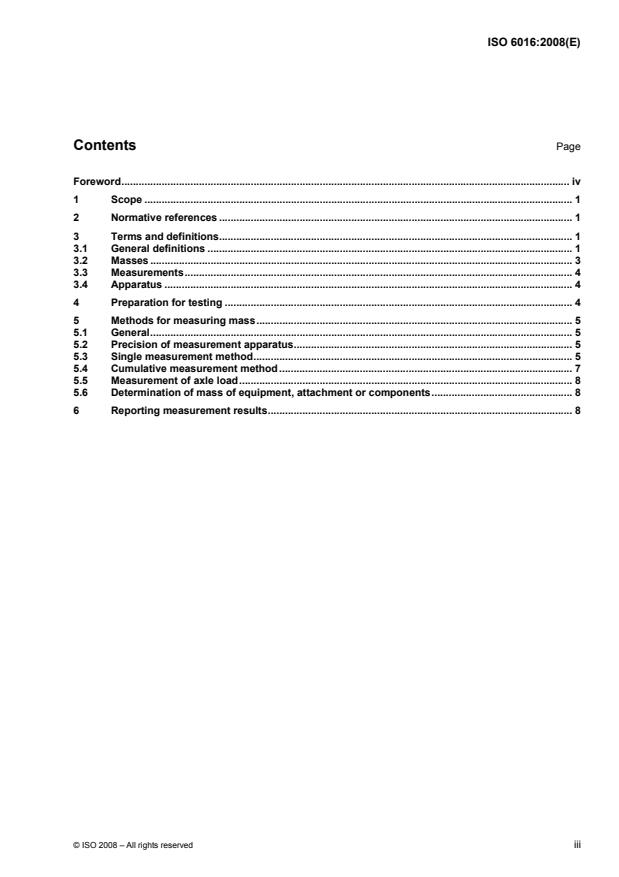
Contents Page
Foreword. iv
1 Scope . 1
2 Normative references . 1
3 Terms and definitions. 1
3.1 General definitions . 1
3.2 Masses . 3
3.3 Measurements. 4
3.4 Apparatus . 4
4 Preparation for testing . 4
5 Methods for measuring mass. 5
5.1 General. 5
5.2 Precision of measurement apparatus. 5
5.3 Single measurement method. 5
5.4 Cumulative measurement method. 7
5.5 Measurement of axle load. 8
5.6 Determination of mass of equipment, attachment or components. 8
6 Reporting measurement results. 8
Foreword
ISO (the International Organization for Standardization) is a worldwide federation of national standards bodies
(ISO member bodies). The work of preparing International Standards is normally carried out through ISO
technical committees. Each member body interested in a subject for which a technical committee has been
established has the right to be represented on that committee. International organizations, governmental and
non-governmental, in liaison with ISO, also take part in the work. ISO collaborates closely with the
International Electrotechnical Commission (IEC) on all matters of electrotechnical standardization.
International Standards are drafted in accordance with the rules given in the ISO/IEC Directives, Part 2.
The main task of technical committees is to prepare International Standards. Draft International Standards
adopted by the technical committees are circulated to the member bodies for voting. Publication as an
International Standard requires approval by at least 75 % of the member bodies casting a vote.
Attention is drawn to the possibility that some of the elements of this document may be the subject of patent
rights. ISO shall not be held responsible for identifying any or all such patent rights.
ISO 6016 was prepared by Technical Committee ISO/TC 127, Earth-moving machinery, Subcommittee SC 1,
Test methods relating to safety and machine performance.
This third edition cancels and replaces the second edition (ISO 6016:1998), which has been technically
revised.
iv © ISO 2008 – All rights reserved
INTERNATIONAL STANDARD ISO 6016:2008(E)
Earth-moving machinery — Methods of measuring the masses
of whole machines, their equipment and components
1 Scope
This International Standard specifies methods for measuring the masses of whole earth-moving machines,
their equipment, attachments or components, using weighbridges or force transducers. It also defines the
terms related to these masses.
It is applicable to earth-moving machinery as defined in ISO 6165.
2 Normative references
The following referenced documents are indispensable for the application of this document. For dated
references, only the edition cited applies. For undated references, the latest edition of the referenced
document (including any amendments) applies
ISO 6165:2006, Earth-moving machinery — Basic types — Identification and terms and definitions
ISO 9248:1992, Earth-moving machinery — Units for dimensions, performance and capacities, and their
measurement accuracies
3 Terms and definitions
For the purposes of this document, the following terms and definitions apply.
3.1 General definitions
3.1.1
base machine
machine with a cab or canopy and operator-protective structures if required, without equipment or
attachments but possessing the necessary mounting for such equipment and attachments
NOTE For an example, see Figure 1.
3.1.2
equipment
set of components mounted onto the base machine that allows an attachment to perform the primary design
function of the machine
NOTE For examples, see Figure 1.
3.1.3
optional equipment
optional components mounted onto the base machine or equipment to increase, for example, capacity,
flexibility, or enhance comfort
3.1.4
attachment
assembly of components that can be mounted onto the base machine or equipment for specific use
NOTE For examples, see Figure 1.
Key
1 attachment
2 equipment
3 base machine
4 backhoe portion
5 loader portion
NOTE This illustration of a loader, its equipment and attachments, is given by way of example only. Equipment and
attachments can differ from one machine to another and between machine types. Some base machines can be fitted
directly with an attachment (e.g. a grader with a dozer blade).
Figure 1 — Base machine, equipment and attachments
3.1.5
component
part, or assembly of parts, of a base machine, equipment or attachment
3.1.6
ballast
removable weight added to the base machine or equipment as specified by the manufacturer, which is used to
increase machine performance, e.g. stability, traction or compaction
NOTE Ballast can be added through the use of weights on wheels, frames or axles, counterweights, liquid-filled tyres,
or compartments to be filled with water, sand or iron parts.
3.1.7
left-hand [right-hand] side
side defined when the machine is oriented towards its primary direction of travel
2 © ISO 2008 – All rights reserved
3.1.8
front axle [rear axle] of machine
axle defined for the primary direction of travel
3.2 Masses
3.2.1
operating mass
OM
mass of the base machine, with equipment and empty attachment in the most usual configuration as specified
by the manufacturer, and with the operator (75 kg), full fuel tank and all fluid systems (i.e. hydraulic oil,
transmission oil, engine oil, engine coolant) at the levels specified by the manufacturer and, when applicable,
with sprinkler water tank(s) half full
NOTE 1 The mass of an operator is not included for non-riding machines.
NOTE 2 Ballast mass at delivery can be included if specified by the manufacturer.
3.2.2
rated payload
PL
paymass
mass that can be carried by the machine, as s
...
NORME ISO
INTERNATIONALE 6016
Troisième édition
2008-12-01
Engins de terrassement — Méthodes de
mesure des masses des engins de
terrassement complets, de leurs
équipements et de leurs organes
constitutifs
Earth-moving machinery — Methods of measuring the masses of whole
machines, their equipment and components
Numéro de référence
©
ISO 2008
PDF – Exonération de responsabilité
Le présent fichier PDF peut contenir des polices de caractères intégrées. Conformément aux conditions de licence d'Adobe, ce fichier
peut être imprimé ou visualisé, mais ne doit pas être modifié à moins que l'ordinateur employé à cet effet ne bénéficie d'une licence
autorisant l'utilisation de ces polices et que celles-ci y soient installées. Lors du téléchargement de ce fichier, les parties concernées
acceptent de fait la responsabilité de ne pas enfreindre les conditions de licence d'Adobe. Le Secrétariat central de l'ISO décline toute
responsabilité en la matière.
Adobe est une marque déposée d'Adobe Systems Incorporated.
Les détails relatifs aux produits logiciels utilisés pour la création du présent fichier PDF sont disponibles dans la rubrique General Info
du fichier; les paramètres de création PDF ont été optimisés pour l'impression. Toutes les mesures ont été prises pour garantir
l'exploitation de ce fichier par les comités membres de l'ISO. Dans le cas peu probable où surviendrait un problème d'utilisation,
veuillez en informer le Secrétariat central à l'adresse donnée ci-dessous.
DOCUMENT PROTÉGÉ PAR COPYRIGHT
© ISO 2008
Droits de reproduction réservés. Sauf prescription différente, aucune partie de cette publication ne peut être reproduite ni utilisée sous
quelque forme que ce soit et par aucun procédé, électronique ou mécanique, y compris la photocopie et les microfilms, sans l'accord écrit
de l'ISO à l'adresse ci-après ou du comité membre de l'ISO dans le pays du demandeur.
ISO copyright office
Case postale 56 • CH-1211 Geneva 20
Tel. + 41 22 749 01 11
Fax + 41 22 749 09 47
E-mail copyright@iso.org
Web www.iso.org
Publié en Suisse
ii © ISO 2008 – Tous droits réservés
Sommaire Page
Avant-propos. iv
1 Domaine d'application. 1
2 Références normatives . 1
3 Termes et définitions. 1
3.1 Définitions générales. 1
3.2 Masses . 3
3.3 Mesurages . 4
3.4 Appareillage . 4
4 Préparation de l'essai. 4
5 Méthodes de détermination des masses . 5
5.1 Généralités . 5
5.2 Exactitude de l'appareillage de mesure . 5
5.3 Méthode de mesure unique . 5
5.4 Méthode de mesure cumulative . 7
5.5 Mesurage de la charge par essieu . 8
5.6 Détermination de la masse des équipements, des accessoires ou des organes
constitutifs. 8
6 Rapport des résultats de mesure. 8
Avant-propos
L'ISO (Organisation internationale de normalisation) est une fédération mondiale d'organismes nationaux de
normalisation (comités membres de l'ISO). L'élaboration des Normes internationales est en général confiée
aux comités techniques de l'ISO. Chaque comité membre intéressé par une étude a le droit de faire partie du
comité technique créé à cet effet. Les organisations internationales, gouvernementales et non
gouvernementales, en liaison avec l'ISO participent également aux travaux. L'ISO collabore étroitement avec
la Commission électrotechnique internationale (CEI) en ce qui concerne la normalisation électrotechnique.
Les Normes internationales sont rédigées conformément aux règles données dans les Directives ISO/CEI,
Partie 2.
La tâche principale des comités techniques est d'élaborer les Normes internationales. Les projets de Normes
internationales adoptés par les comités techniques sont soumis aux comités membres pour vote. Leur
publication comme Normes internationales requiert l'approbation de 75 % au moins des comités membres
votants.
L'attention est appelée sur le fait que certains des éléments du présent document peuvent faire l'objet de
droits de propriété intellectuelle ou de droits analogues. L'ISO ne saurait être tenue pour responsable de ne
pas avoir identifié de tels droits de propriété et averti de leur existence.
L'ISO 6016 a été élaborée par le comité technique ISO/TC 127, Engins de terrassement, sous-comité SC 1,
Méthodes d'essais relatives aux performances et à la sécurité des engins.
Cette troisième édition annule et remplace la deuxième édition (ISO 6016:1998), qui a fait l'objet d'une
révision technique.
iv © ISO 2008 – Tous droits réservés
NORME INTERNATIONALE ISO 6016:2008(F)
Engins de terrassement — Méthodes de mesure des masses
des engins de terrassement complets, de leurs équipements et
de leurs organes constitutifs
1 Domaine d'application
La présente Norme internationale spécifie les méthodes de mesure des masses des engins de terrassement
complets, de leurs équipements et de leurs organes constitutifs à l'aide de ponts à bascule ou de capteurs de
force. Elle définit également les termes relatifs à ces masses.
Elle s'applique aux engins de terrassement tels que définis dans l'ISO 6165.
2 Références normatives
Les documents de référence suivants sont indispensables pour l'application du présent document. Pour les
références datées, seule l'édition citée s'applique. Pour les références non datées, la dernière édition du
document de référence s'applique (y compris les éventuels amendements).
ISO 6165, Engins de terrassement — Principaux types — Identification et termes et définitions
ISO 9248, Engins de terrassement — Unités pour exprimer les dimensions, les performances et les capacités,
et exactitude de leur mesurage
3 Termes et définitions
Pour les besoins du présent document, les termes et définitions suivants s'appliquent.
3.1 Définitions générales
3.1.1
engin de base
engin avec une cabine ou un toit et des structures de protection de l'opérateur, si nécessaire, sans
équipement ni accessoires mais comprenant les fixations nécessaires à la mise en place de l'équipement et
des accessoires
NOTE Voir Figure 1 pour un exemple.
3.1.2
équipement
ensemble des organes constitutifs montés sur l'engin de base pour permettre à un accessoire de remplir la
fonction principale pour laquelle l'engin est conçu
NOTE Voir Figure 1 pour un exemple.
3.1.3
équipement optionnel
composants optionnels de l'équipement montés sur l'engin de base ou l'accessoire pour augmenter, par
exemple, sa capacité, sa flexibilité, et améliorer son confort
3.1.4
accessoire
ensemble d'organes constitutifs pouvant être montés sur l'engin de base ou sur l'équipement pour une
utilisation particulière
NOTE Voir Figure 1 pour un exemple.
Légende
1 accessoires
2 équipement
3 engin de base
4 côté rétro
5 côté chargeuse
NOTE Cette figure n'est donnée qu'à titre d'exemple. L'équipement et ses accessoires peuvent différer d'un engin à
un autre ou d'un type de machine à un autre. Certains engins de base peuvent être équipés d'origine d'un accessoire (par
exemple une niveleuse avec une lame).
Figure 1 — Illustration des définitions d'un engin de base, d'un équipement et de ses accessoires
3.1.5
organe constitutif
élément ou ensemble d'éléments d'un engin de base, d'un équipement ou d'un accessoire
3.1.6
lest
poids amovible ajouté à l'engin de base ou à l'équipement selon les spécifications du fabricant pour
augmenter les performances de l'engin, par exemple en matière de stabilité, de traction ou de compactage
NOTE Du lest peut être ajouté sous forme de poids sur les roues, les châssis ou les essieux, de contrepoids, de
pneus remplis de liquide ou de compartiments remplis d'eau, de sable ou de ferraille.
2 © ISO 2008 – Tous droits réservés
3.1.7
côté gauche [droit]
côté défini dans le sens de la direction principale du trajet
3.1.8
essieu avant [essieu arrière] d'un engin
essieu défini par rapport à la direction principale du trajet
3.2 Masses
3.2.1
masse en service
OM
masse de l'engin de base avec équipement et accessoire vide dans la configuration la plus usuelle, tel que
spécifié par le constructeur, avec l'opérateur (75 kg), le réservoir de carburant et tous les circuits de fluide
(c'est-à-dire, liquide hydraulique, huile pour transmissions hydrauliques, huile pour moteur et liquide de
refroidissement du moteur) aux niveaux spécifiés par le constructeur, et, le cas échéant, avec le ou les
réservoirs d'asperseurs à moitié remplis d'eau
NOTE 1 La masse de l'opérateur n'est pas incluse dans le cas des machines autres qu'à conducteur porté.
NOTE 2 La masse de lest présente à la livraison peut être incluse dans ce chiffre si le constructeur le spécifie.
3.2.2
charge utile
PL
payload
masse nominale que l'engin peut porter, tel que
...