

ISO/IEC TR 14471:2007
(Main)Information technology — Software engineering — Guidelines for the adoption of CASE tools
General Information
- Abstract
Since CASE (computer aided software engineering) adoption is a subject of the broader technology transition problem, ISO/IEC TR 14471:2007 addresses the adoption practices appropriate for a wide range of computing organizations. ISO/IEC TR 14471:2007 neither dictates nor advocates particular development standards, software processes, design methods, methodologies, techniques, programming languages, or life-cycle paradigms. ISO/IEC TR 14471:2007 will: identify critical success factors (CSF); propose a set of adoption processes; guide successful adoption in consideration of organizational and cultural environment. The following groups are targeted as potential audiences: CASE users; information systems managers; chief information officers (CIO); CASE suppliers; software engineering consultants; those involved in the acquisition of CASE tools and technology. Therefore ISO/IEC TR 14471:2007 addresses aspects of CASE tools adoption. It is best used in conjunction with ISO/IEC 14102 for CASE tool evaluation and selection. It is complementary to related ISO/IEC documents which deal with the general aspects of these topics. The purpose of ISO/IEC TR 14471:2007 is to provide a recommended practice for CASE adoption. It provides guidance in establishing processes and activities that are to be applied for the successful adoption of CASE technology. The use of ISO/IEC TR 14471:2007 will help to maximize the return and minimize the risk of investing in CASE technology. However, ISO/IEC TR 14471:2007 does not establish compliance criteria.
- Status
- Published
- Publication Date
- 09-Oct-2007
- Technical Committee
- ISO/IEC JTC 1/SC 7 - Software and systems engineering
- Drafting Committee
- ISO/IEC JTC 1/SC 7/WG 4 - Tools and environment
- Current Stage
- 9093 - International Standard confirmed
- Start Date
- 20-Jun-2022
- Completion Date
- 29-Aug-2026
Overview
ISO/IEC TR 14471:2007 - "Information technology - Software engineering - Guidelines for the adoption of CASE tools" is a Technical Report that provides recommended practices for introducing Computer Aided Software Engineering (CASE) tools into organizations. It does not mandate specific development methods, languages, or compliance criteria. Instead, it describes critical success factors (CSFs) and a structured set of adoption processes to help maximize return and minimize risk when investing in CASE technology.
Key topics and technical focus
- Critical Success Factors (CSFs): a concise list of organizational, managerial and technical factors to monitor, including goal setting, management support, tool use strategy, training, expert support (champions), pilot projects, tool capability, methodology adjustability, and smooth changeover between old and new methods.
- Adoption processes: four major, repeatable processes that structure adoption activities:
- Preparation - set measurable goals, verify feasibility, set policy, and develop an overall adoption plan.
- Evaluation & Selection - define requirements, structure evaluations, produce technical evaluation reports and select candidate CASE tool(s). (This process is aligned with ISO/IEC 14102.)
- Pilot Project - plan and execute a controlled pilot to validate tool capability and organizational fit; evaluate pilot results before full rollout.
- Transition - training, initiation of routine use, phased changeover and post-adoption evaluation.
- Measurement and feasibility: emphasis on defining measurable adoption goals and verifying technical/economic feasibility before procurement or rollout.
- Organizational and cultural considerations: guidance on engagement, policy, and adjusting methods so CASE adoption fits the organization’s processes.
Practical applications
- Use ISO/IEC TR 14471:2007 to structure a CASE adoption program that reduces risk and improves likelihood of measurable benefits (for example, productivity or quality gains).
- Apply the Preparation → Evaluation & Selection → Pilot → Transition lifecycle to:
- Scope tool deployment (departmental vs corporate-wide)
- Validate tool capabilities in a controlled environment before full investment
- Design training, support and change management to ensure uptake
- Track CSFs throughout the project to align management, users and suppliers and to measure success against predefined goals.
Who should use this standard
- CASE users and developers
- Information systems managers and CIOs
- Software engineering consultants
- CASE tool suppliers and procurement teams
- Anyone involved in the acquisition, evaluation, pilot testing or transition of CASE tools
Related standards
- ISO/IEC 14102 - complementary standard for CASE tool evaluation and selection; recommended to be used together with ISO/IEC TR 14471:2007 for a complete adoption and selection workflow.
Keywords: ISO/IEC TR 14471:2007, CASE adoption, CASE tools, software engineering, adoption processes, critical success factors, evaluation and selection, pilot project, transition, ISO/IEC 14102.
Relations
- Effective Date
- 15-Apr-2008
Get Certified
Connect with accredited certification bodies for this standard

BSI Group
BSI (British Standards Institution) is the business standards company that helps organizations make excellence a habit.

BSCIC Certifications Pvt. Ltd.
Established 2006, accredited by NABCB, JAS-ANZ, EIAC, IAS. CDSCO Notified Body.

Intertek India Pvt. Ltd.
Delivers Assurance, Testing, Inspection & Certification since 1993 with 26 labs and 32 offices.
Sponsored listings
Frequently Asked Questions
ISO/IEC TR 14471:2007 is a technical report published by the International Organization for Standardization (ISO). Its full title is "Information technology — Software engineering — Guidelines for the adoption of CASE tools". This standard covers: Since CASE (computer aided software engineering) adoption is a subject of the broader technology transition problem, ISO/IEC TR 14471:2007 addresses the adoption practices appropriate for a wide range of computing organizations. ISO/IEC TR 14471:2007 neither dictates nor advocates particular development standards, software processes, design methods, methodologies, techniques, programming languages, or life-cycle paradigms. ISO/IEC TR 14471:2007 will: identify critical success factors (CSF); propose a set of adoption processes; guide successful adoption in consideration of organizational and cultural environment. The following groups are targeted as potential audiences: CASE users; information systems managers; chief information officers (CIO); CASE suppliers; software engineering consultants; those involved in the acquisition of CASE tools and technology. Therefore ISO/IEC TR 14471:2007 addresses aspects of CASE tools adoption. It is best used in conjunction with ISO/IEC 14102 for CASE tool evaluation and selection. It is complementary to related ISO/IEC documents which deal with the general aspects of these topics. The purpose of ISO/IEC TR 14471:2007 is to provide a recommended practice for CASE adoption. It provides guidance in establishing processes and activities that are to be applied for the successful adoption of CASE technology. The use of ISO/IEC TR 14471:2007 will help to maximize the return and minimize the risk of investing in CASE technology. However, ISO/IEC TR 14471:2007 does not establish compliance criteria.
Since CASE (computer aided software engineering) adoption is a subject of the broader technology transition problem, ISO/IEC TR 14471:2007 addresses the adoption practices appropriate for a wide range of computing organizations. ISO/IEC TR 14471:2007 neither dictates nor advocates particular development standards, software processes, design methods, methodologies, techniques, programming languages, or life-cycle paradigms. ISO/IEC TR 14471:2007 will: identify critical success factors (CSF); propose a set of adoption processes; guide successful adoption in consideration of organizational and cultural environment. The following groups are targeted as potential audiences: CASE users; information systems managers; chief information officers (CIO); CASE suppliers; software engineering consultants; those involved in the acquisition of CASE tools and technology. Therefore ISO/IEC TR 14471:2007 addresses aspects of CASE tools adoption. It is best used in conjunction with ISO/IEC 14102 for CASE tool evaluation and selection. It is complementary to related ISO/IEC documents which deal with the general aspects of these topics. The purpose of ISO/IEC TR 14471:2007 is to provide a recommended practice for CASE adoption. It provides guidance in establishing processes and activities that are to be applied for the successful adoption of CASE technology. The use of ISO/IEC TR 14471:2007 will help to maximize the return and minimize the risk of investing in CASE technology. However, ISO/IEC TR 14471:2007 does not establish compliance criteria.
ISO/IEC TR 14471:2007 is classified under the following ICS (International Classification for Standards) categories: 35.080 - Software. The ICS classification helps identify the subject area and facilitates finding related standards.
ISO/IEC TR 14471:2007 has the following relationships with other standards: It is inter standard links to ISO/IEC TR 14471:1999. Understanding these relationships helps ensure you are using the most current and applicable version of the standard.
ISO/IEC TR 14471:2007 is available in PDF format for immediate download after purchase. The document can be added to your cart and obtained through the secure checkout process. Digital delivery ensures instant access to the complete standard document.
Standards Content (Sample)
TECHNICAL ISO/IEC
REPORT TR
Second edition
2007-10-15
Information technology — Software
engineering — Guidelines for the
adoption of CASE tools
Technologies de l'information — Ingénierie du logiciel — Lignes
directrices pour l'adoption d'outils CASE
Reference number
©
ISO/IEC 2007
PDF disclaimer
This PDF file may contain embedded typefaces. In accordance with Adobe's licensing policy, this file may be printed or viewed but
shall not be edited unless the typefaces which are embedded are licensed to and installed on the computer performing the editing. In
downloading this file, parties accept therein the responsibility of not infringing Adobe's licensing policy. The ISO Central Secretariat
accepts no liability in this area.
Adobe is a trademark of Adobe Systems Incorporated.
Details of the software products used to create this PDF file can be found in the General Info relative to the file; the PDF-creation
parameters were optimized for printing. Every care has been taken to ensure that the file is suitable for use by ISO member bodies. In
the unlikely event that a problem relating to it is found, please inform the Central Secretariat at the address given below.
© ISO/IEC 2007
All rights reserved. Unless otherwise specified, no part of this publication may be reproduced or utilized in any form or by any means,
electronic or mechanical, including photocopying and microfilm, without permission in writing from either ISO at the address below or
ISO's member body in the country of the requester.
ISO copyright office
Case postale 56 • CH-1211 Geneva 20
Tel. + 41 22 749 01 11
Fax + 41 22 749 09 47
E-mail copyright@iso.org
Web www.iso.org
Published in Switzerland
ii © ISO/IEC 2007 – All rights reserved
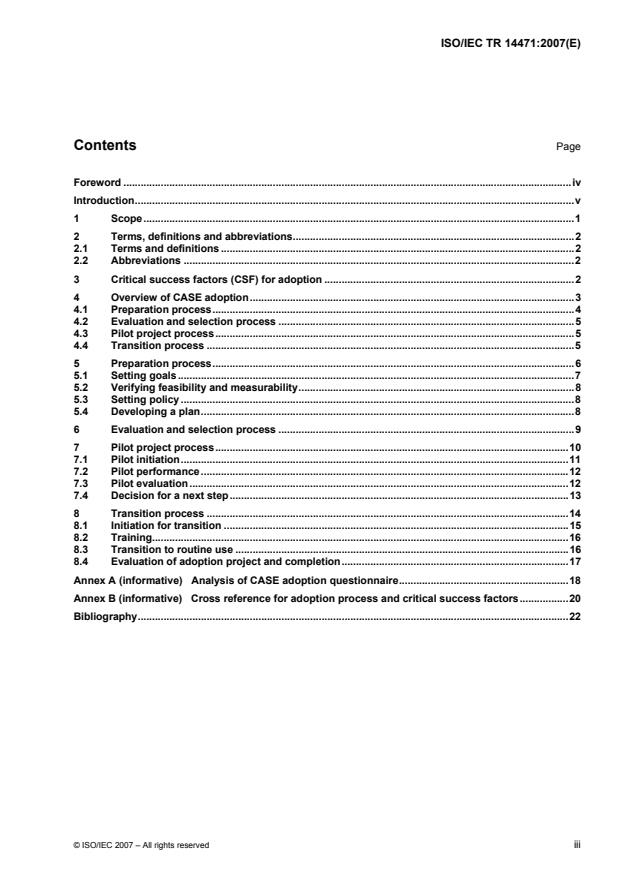
Contents Page
Foreword .iv
Introduction.v
1 Scope.1
2 Terms, definitions and abbreviations.2
2.1 Terms and definitions .2
2.2 Abbreviations .2
3 Critical success factors (CSF) for adoption .2
4 Overview of CASE adoption.3
4.1 Preparation process.4
4.2 Evaluation and selection process .5
4.3 Pilot project process.5
4.4 Transition process .5
5 Preparation process.6
5.1 Setting goals .7
5.2 Verifying feasibility and measurability.8
5.3 Setting policy .8
5.4 Developing a plan.8
6 Evaluation and selection process .9
7 Pilot project process.10
7.1 Pilot initiation.11
7.2 Pilot performance.12
7.3 Pilot evaluation.12
7.4 Decision for a next step.13
8 Transition process .14
8.1 Initiation for transition .15
8.2 Training.16
8.3 Transition to routine use .16
8.4 Evaluation of adoption project and completion.17
Annex A (informative) Analysis of CASE adoption questionnaire.18
Annex B (informative) Cross reference for adoption process and critical success factors.20
Bibliography.22
© ISO/IEC 2007 – All rights reserved iii
Foreword
ISO (the International Organization for Standardization) and IEC (the International Electrotechnical
Commission) form the specialized system for worldwide standardization. National bodies that are members of
ISO or IEC participate in the development of International Standards through technical committees
established by the respective organization to deal with particular fields of technical activity. ISO and IEC
technical committees collaborate in fields of mutual interest. Other international organizations, governmental
and non-governmental, in liaison with ISO and IEC, also take part in the work. In the field of information
technology, ISO and IEC have established a joint technical committee, ISO/IEC JTC 1.
International Standards are drafted in accordance with the rules given in the ISO/IEC Directives, Part 2.
The main task of the joint technical committee is to prepare International Standards. Draft International
Standards adopted by the joint technical committee are circulated to national bodies for voting. Publication as
an International Standard requires approval by at least 75 % of the national bodies casting a vote.
In exceptional circumstances, the joint technical committee may propose the publication of a Technical Report
of one of the following types:
— type 1, when the required support cannot be obtained for the publication of an International Standard,
despite repeated efforts;
— type 2, when the subject is still under technical development or where for any other reason there is the
future but not immediate possibility of an agreement on an International Standard;
— type 3, when the joint technical committee has collected data of a different kind from that which is
normally published as an International Standard (“state of the art”, for example).
Technical Reports of types 1 and 2 are subject to review within three years of publication, to decide whether
they can be transformed into International Standards. Technical Reports of type 3 do not necessarily have to
be reviewed until the data they provide are considered to be no longer valid or useful.
Attention is drawn to the possibility that some of the elements of this document may be the subject of patent
rights. ISO and IEC shall not be held responsible for identifying any or all such patent rights.
ISO/IEC TR 14471, which is a Technical Report of type 2, was prepared by Joint Technical Committee
ISO/IEC JTC 1, Information technology, Subcommittee SC 7, Software and systems engineering.
This second edition cancels and replaces the first edition (ISO/IEC TR 14471:1999), which has been
technically revised.
iv © ISO/IEC 2007 – All rights reserved
Introduction
Historically, there have been problems experienced by organisations in adopting CASE (computer aided
software engineering) tools. Because organisations have not gained the expected benefits of CASE
technology, it is hoped that the use of a well-founded CASE adoption process will help achieve successful
adoption of CASE tools.
A survey conducted by ISO/IEC JTC1/SC7/WG4 (See Annex A: Analysis of CASE adoption questionnaire)
offers some hope that these problems may be improving. This survey suggests that CASE tools are
performing new capabilities and getting easier to use, that users’ expectations are getting more sophisticated,
and that CASE tools are more likely to meet their goals. However, according to the survey, there remain a
number of continuing problems. There has not been sufficient attention given to pilot trials of CASE
technology before using it on actual projects, and users report a need for additional top management support,
a total process for CASE adoption, and a preparation of the organisation for the introduction of the
technology. This Technical Report addresses the continued needs reported by users.
The purpose of this Technical Report is to provide a recommended practice for CASE adoption. It provides
guidance in establishing processes and activities that are to be applied for the successful adoption of CASE
technology. The use of this Technical Report will help to maximise the return and minimise the risk of
investing in CASE technology. However, this Technical Report does not establish compliance criteria.
© ISO/IEC 2007 – All rights reserved v
TECHNICAL REPORT ISO/IEC TR 14471:2007(E)
Information technology — Software engineering — Guidelines for
the adoption of CASE tools
1 Scope
Since CASE adoption is a subject of the broader technology transition problem, this Technical Report addresses
the adoption practices appropriate for a wide range of computing organisations. This Technical Report neither
dictates nor advocates particular development standards, software processes, design methods, methodologies,
techniques, programming languages, or life-cycle paradigms.
This Technical Report will:
⎯ identify critical success factors (CSF);
⎯ propose a set of adoption processes;
⎯ guide successful adoption in consideration of organisational and cultural environment.
The following groups are targeted as potential audiences:
⎯ CASE users;
⎯ information systems managers;
⎯ chief information officers (CIO);
⎯ CASE suppliers;
⎯ software engineering consultants;
⎯ those involved in the acquisition of CASE tools and technology.
Therefore this Technical Report addresses aspects of CASE tools adoption. It is best used with ISO/IEC 14102
for CASE tool evaluation and selection. It is complementary to related ISO/IEC documents which deal with the
general aspects of these topics.
© ISO/IEC 2007 – All rights reserved 1
2 Terms, definitions and abbreviations
2.1 Terms and definitions
For the purposes of this document, the following terms and definitions apply.
2.1.1
successful adoption
extent to which the use of CASE tools can measurably meet an organisation's uniquely defined adoption goals
2.1.2
adoption process
set of activities by which an organisation brings CASE tools into widespread use
2.1.3
CASE needs
organisational requirements which are met by CASE tool characteristics
NOTE These characteristics are detailed in ISO/IEC 14102:1995. They include management process, development
process, maintenance, documentation, configuration management, quality assurance, verification, validation, environment
needs, CASE tool integrability, quality characteristics, acquisition needs, implementation needs, support indicators, and
certification requirements.
2.2 Abbreviations
CASE computer aided software engineering
CSF critical success factor
3 Critical success factors (CSF) for adoption
One of the primary goals of this Technical Report is to identify major factors which are critical to success in CASE
adoption. A comprehensive set of technical, managerial, organisational, and cultural factors should be
considered in order to successfully introduce CASE technology into an organisation. These factors should be
monitored through the adoption processes when applicable. A cross reference table for the processes and the
factors is provided in Annex B.
The following critical success factors are to be considered and evaluated.
a) Goal setting: The definition of a clear, measurable set of goals and expectations for CASE adoption, including
both business and technical goals.
NOTE 1 Examples of measurable set of goals for CASE adoption might be “twenty percent increase of productivity in
unit test activity”, “sixteen percent improvement of quality in requirements specification activity”, “fifty percent gain of
reusability in object oriented design activity”, “sixty percent of projects should use CASE tools”, etc.
b) Management support: The extent to which high level management actively encourages CASE adoption,
including but not limited to the willingness to allocate the necessary resources.
2 © ISO/IEC 2007 – All rights reserved
c) Tool use strategy: The definition of a clear strategy for the scope of tool use.
NOTE 2 Examples of strategy might include tool use on a specific set of application types, use by a specific business
component or corporate-wide use.
d) Total adoption process plan: A plan and design for the total process of bringing the tool into the organisational
component.
e) Engagement: The extent to which the people involved in the adoption effort become active, motivated
participants.
f) Methodology adjustability: The willingness and technical feasibility of adjusting, as necessary, existing
organisational methods and typical methods of using the CASE tool so as to arrive at a single consistent set
of methods.
NOTE 3 For example, existing process-oriented methods and candidate object-oriented programming tools might not be
adjusted as a single consistent set of methods.
g) Training: Provision of the training and information necessary and appropriate at each step for each person
involved in the adoption process.
h) Expert support: Provision of enthusiastic, expert tool use support during the pilot project and continuing as the
tool moves into routine use throughout the organisational component.
NOTE 4 The experts (or champions) assigned to the pilot project, as a group, should have a combination of skills,
including capability of being proponents for the new technology, experience in the tool use, experience in the process and
procedures of the organisation, and influence within the organisation.
i) Pilot project: The performance of a controlled pilot project prior to the final adoption decision.
j) Tool capability: The technical capability of the tool, in its hardware and software environment, to satisfy the
defined goals in the context of the intended scope.
k) Smooth changeover: Due consideration paid to ensuring the ability of the organisation to simultaneously
operate in both the old and new methods until the entire organisational component has fully changed over to
the new methods.
4 Overview of CASE adoption
This Technical Report will describe a set of adoption processes that can be used in a broad range of environments,
where the definition of success can be tailored to the organisation. Successful CASE adoption requires more than
casual adoption activities. This clause shows the major processes for adoption and the overview of the processes as
shown in Figure 1. Adoption of CASE tools includes four major processes:
a) preparation process,
b) evaluation and selection process,
c) pilot project process,
d) transition process.
© ISO/IEC 2007 – All rights reserved 3
Figure 1 — The adoption process
4.1 Preparation process
The purpose of the preparation process is to establish the general objectives and goals of the CASE adoption
effort, to establish the high level direction, and to define the management aspects of the effort (e.g., schedule,
resources, cost).
The preparation process is composed of four activities:
a) Setting goals: identifies CASE adoption goals where CASE can help meet business objectives.
b) Verifying feasibility and measurability: develops and verifies technically and economically feasible and
measurable subgoals for a CASE adoption project.
c) Setting policy: provides the rationale and general policy for adoption of CASE tools incorporating the critical
success factors.
d) Developing a plan: produces a plan for the entire adoption project.
4 © ISO/IEC 2007 – All rights reserved
4.2 Evaluation and selection process
The purpose of the evaluation and selection process is to identify the most suitable CASE tool(s) among the
candidate tools, and to ensure that the recommended tool(s) meets the original goals.
The evaluation and selection process is fully defined in ISO/IEC 14102:1995, and is composed of following sub
processes (activities):
a) Preparation: defines the objectives and requirements of the intended evaluation and selection of CASE tools.
b) Structuring: elaborates a set of structured requirements based upon the CASE tool characteristics in
ISO/IEC 14102:1995.
c) Evaluation: produces technical evaluation reports that will be the major input for the selection sub process.
d) Selection: identifies the most suitable CASE tool(s) among the candidate tools.
4.3 Pilot project process
The purpose of the Pilot project process is to aid in validating the work performed in the earlier processes of
CASE adoption process and to determine if the actual capability of the tool meets the organisational needs.
The Pilot project process is composed of four activities:
a) Pilot initiation: defines plans, procedures, resources, and training to perform a pilot project.
b) Pilot performance: executes a controlled project in which the newly acquired CASE tools can be tried out.
c) Pilot evaluation: provides the evaluation results of the performance of the pilot project.
d) Decision for a next step: decides whether to go ahead with the adoption process, abandon the tool or
perform a second pilot project, and identify organisational learning experience for the transition process.
4.4 Transition process
The purpose of the transition process is to minimise disruptions during the changeover from the current processes
to new technology based on the maximum use of the pilot project experiences.
The transition process is composed of five activities:
a) Initiation for transition: defines plans, procedures, and resources to perform transition and outlines, use of
the tool.
b) Training: trains new CASE tool users.
c) Institutionalisation: progressively applies the tool to larger segments of the target environment until its use
becomes part of normal organisational practice.
d) Monitoring and continuous support: identifies whether the adoption is in fact working, and ensures on-
going training and other resources as needed during the transition period.
© ISO/IEC 2007 – All rights reserved 5
e) Evaluation of adoption project and completion: measures the success of CASE adoption, and provides
organisational learning experience for future adoption projects.
5 Preparation process
The first process in a CASE adoption effort is the preparation of CASE adoption goals and the project plan. Four
major activities in the preparation process are:
a) setting goals,
b) verifying feasibility and measurability,
c) setting policy,
d) developing a plan.
Starting with the review of business objectives, CASE adoption goals will be defined and validated. A business
objective is a higher level objective (e.g., improve competitive position of the organisation, increase productivity),
which is not tied to any specific software engineering life-cycle objective. However, business objectives should be
used to derive core (possibly alternate) sets of CASE adoption goals (e.g., improve process, improve design
quality). These goals are related to software engineering life-cycle processes to ensure the effectiveness of the
organisational functions and performances.
The activity of verifying feasibility and measurability examines the conformance of the business and CASE
adoption objectives and it assesses technical and economic validity.
The activity of setting policy develops the direction for the remainder of the adoption process. In this activity, the
critical success factors defined in Clause 5 should be tailored for a specific CASE adoption effort. Finally, the last
activity in the preparation process is to organise a plan for the total process of bringing the tool into the
organisational component. The overview of the preparation process in shown in Figure 2.
6 © ISO/IEC 2007 – All rights reserved
Figure 2 — Overview of preparation process
5.1 Setting goals
This activity includes the following tasks:
a) Review (existing) business objectives.
b) Review strategic impact of software engineering in the organisation or in the organisational component.
c) Decompose business objectives to the level of the strategic impact of software engineering.
d) Identify several alternatives by which CASE can help meet business objectives.
e) Ask “Where do we want to go?”.
f) Select and set CASE adoption goals from the alternatives.
g) Define and quantify the expectations of the CASE adoption effort based upon the goals.
© ISO/IEC 2007 – All rights reserved 7
5.2 Verifying feasibility and measurability
This activity includes the following tasks:
a) Develop technically and economically feasible and measurable subgoals.
b) Perform competitor analysis (e.g., What technology are they using?).
c) Perform technical analysis (e.g., Is it technically achievable?).
d) Assess the organisation’s current software engineering capability and maturity level.
e) Review current and near-term CASE state-of-the-practice.
f) Identify potential tools.
g) Ask again, " Where do we want to go?" (In a more precise way).
h) Identify specific subgoals and measures for them.
5.3 Setting policy
This activity includes the following tasks:
a) Ask "How can we achieve the CASE adoption goals?".
b) Identify the strategic roadmap of the adoption project.
c) Tailor the CSFs to meet business objectives and CASE adoption goals.
d) Provide a guide for the availability of resources (e.g., manpower, money, support).
e) Set a guide for monitoring and controlling the project.
5.4 Developing a plan
This activity includes the following tasks:
a) Organise a project team with assigned responsibilities.
b) Develop a set of steps to apply the CSFs in the appropriate process under the decided policies.
c) Identify a set of operational guidelines for the whole adoption process based upon the policies previously
established.
d) Prepare a schedule of milestones, activities and their tasks, along with an estimate of resource
requirements and a cost estimate.
e) Provide a means of monitoring and controlling the execution of the plan.
8 © ISO/IEC 2007 – All rights reserved
6 Evaluation and selection process
This clause provides an overview of the evaluation and selection of CASE tools discussed in ISO/IEC 14102:1995
as shown in Figure 3. Evaluation and selection of CASE tools includes four major sub processes (activities):
a) preparation sub process,
b) structuring sub process,
c) evaluation sub process,
d) selection sub process.
Figure 3 — Overview of evaluation and selection
A key step is the specification of a set of requirements against which candidate CASE tools are to be evaluated,
and upon which selection decisions will be based. The CASE tool characteristics defined in ISO/IEC 14102:1995
form the basis for requirements structuring, and play a central role in the overall steps of the evaluation and
selection process. In order to pursue this process for successful adoption, the steps in ISO/IEC 14102:1995
should be applied.
© ISO/IEC 2007 – All rights reserved 9
7 Pilot project process
A pilot project process should be conducted to provide a realistic trial for the CASE tools in their intended
environment. While the tool was exercised during evaluation and selection, that process does not require a
realistic use of the tool. E
...