

ISO 14085-5:2015
(Main)Aerospace series — Hydraulic filter elements — Test methods — Part 5: Resistance to flow fatigue
General Information
- Abstract
ISO 14085-5:2015 specifies a method for determining the resistance of a filter element to flow fatigue caused by varying flow through the filter in various stages of the filter contaminant loading process. The filter is subjected to a uniform varying flow rate for a specified number of cycles, at a number of predetermined differential pressures. Although the number of cycles and differential pressure conditions used in this part of ISO 14085 is meant to simulate possible service conditions, this part of ISO 14085 is not intended to qualify a filter element under replicate conditions of service; this can only be done by a specific test protocol developed for the purpose, including actual conditions of use, for example the operating fluid, contamination, and exact cyclic flow conditions. ISO 14085-5:2015 establishes a method for verifying the ability of a filter element to withstand the stress caused by cyclic differential pressures induced by a variable flow rate. The test data resulting from application of this part of ISO 14085 can be used to compare the performance of aerospace hydraulic filter elements.
- Status
- Published
- Publication Date
- 25-Feb-2015
- Technical Committee
- ISO/TC 20/SC 10 - Aerospace fluid systems and components
- Drafting Committee
- ISO/TC 20/SC 10/WG 8 - Hydraulic fluids and fluid contamination control
- Current Stage
- 9060 - Close of review
- Completion Date
- 04-Jun-2031
Overview
ISO 14085-5:2015 - "Aerospace series - Hydraulic filter elements - Test methods - Part 5: Resistance to flow fatigue" defines a laboratory method to verify the ability of an aerospace hydraulic filter element to withstand stress from cyclic flow (flow fatigue). The standard specifies test equipment, waveform shape, test fluids and contaminants, measurement accuracy, and a multi-stage duty cycle to expose elements to varying differential pressures and repeated flow cycles. Results are intended for performance comparison, not as a full qualification for in-service conditions.
Key topics and technical requirements
- Scope and purpose: Measures resistance to flow-induced fatigue caused by variable flow through a filter element at different contaminant loading stages. Not a substitute for service-specific qualification testing.
- Test waveform and cycle: A uniform varying flow rate waveform is defined (rise, hold, fall times and pressure dwell periods). Cycle rates are in the range 0.2 Hz to 1 Hz.
- Duty cycle and load levels: Typical duty conditions include:
- 2× clean element Δp at max flow for 90 000 cycles
- 4× clean element Δp at max flow for 8 000 cycles
- Terminal element Δp for 2 000 cycles
- System pressure or by-pass Δp for 500 cycles
- Test equipment & materials:
- Flow fatigue cycle test stand capable of 0 → rated flow variations
- Pressure sensors with adequate frequency response
- Test fluid compatible with element materials (recommended viscosity 14–32 mm²/s)
- Contaminant: ISO Fine Test Dust (ISO FTD), grade A2
- Measurements & tolerances: Flow ±2 %, differential pressure ±2 % (with –0 %/+10 % variation allowed), temperature ±1 °C, and cycle rate ±10 %.
- Pre- and post-tests: Fabrication integrity (ISO 2942) and material compatibility (ISO 2943) checks; data presentation and reporting formats are specified.
Applications and users
ISO 14085-5:2015 is useful for:
- Filter manufacturers - to benchmark element designs and validate robustness against cyclic loading.
- Aerospace systems engineers - to select and specify hydraulic filter elements for aircraft and space-vehicle fluid systems.
- Test laboratories and quality control - to perform standardized comparative tests and provide objective performance data.
- Procurement and airworthiness authorities - to compare candidate filter elements during supplier evaluation.
Practical uses include comparative performance testing, design validation to mitigate flow-fatigue failure modes, and supporting product datasheets and procurement specifications. Note: for true in-service qualification, a bespoke protocol that replicates actual operating fluid, contamination and cyclic conditions is required.
Related standards
- ISO 14085 series (Parts 1–6)
- ISO 2942, ISO 2943, ISO 5598, ISO 12103-1, ISO 1219-1
Keywords: ISO 14085-5:2015, hydraulic filter elements, flow fatigue, aerospace hydraulic filters, differential pressure, test methods, ISO FTD.
Get Certified
Connect with accredited certification bodies for this standard

BUREAU VERITAS Certification Germany
Bureau Veritas certification in Germany.

Element Materials Technology
Materials testing and product certification.

AQMS Ltd.
AQMS provides ISO certification to SMEs across the UK.
Sponsored listings
Frequently Asked Questions
ISO 14085-5:2015 is a standard published by the International Organization for Standardization (ISO). Its full title is "Aerospace series — Hydraulic filter elements — Test methods — Part 5: Resistance to flow fatigue". This standard covers: ISO 14085-5:2015 specifies a method for determining the resistance of a filter element to flow fatigue caused by varying flow through the filter in various stages of the filter contaminant loading process. The filter is subjected to a uniform varying flow rate for a specified number of cycles, at a number of predetermined differential pressures. Although the number of cycles and differential pressure conditions used in this part of ISO 14085 is meant to simulate possible service conditions, this part of ISO 14085 is not intended to qualify a filter element under replicate conditions of service; this can only be done by a specific test protocol developed for the purpose, including actual conditions of use, for example the operating fluid, contamination, and exact cyclic flow conditions. ISO 14085-5:2015 establishes a method for verifying the ability of a filter element to withstand the stress caused by cyclic differential pressures induced by a variable flow rate. The test data resulting from application of this part of ISO 14085 can be used to compare the performance of aerospace hydraulic filter elements.
ISO 14085-5:2015 specifies a method for determining the resistance of a filter element to flow fatigue caused by varying flow through the filter in various stages of the filter contaminant loading process. The filter is subjected to a uniform varying flow rate for a specified number of cycles, at a number of predetermined differential pressures. Although the number of cycles and differential pressure conditions used in this part of ISO 14085 is meant to simulate possible service conditions, this part of ISO 14085 is not intended to qualify a filter element under replicate conditions of service; this can only be done by a specific test protocol developed for the purpose, including actual conditions of use, for example the operating fluid, contamination, and exact cyclic flow conditions. ISO 14085-5:2015 establishes a method for verifying the ability of a filter element to withstand the stress caused by cyclic differential pressures induced by a variable flow rate. The test data resulting from application of this part of ISO 14085 can be used to compare the performance of aerospace hydraulic filter elements.
ISO 14085-5:2015 is classified under the following ICS (International Classification for Standards) categories: 49.080 - Aerospace fluid systems and components. The ICS classification helps identify the subject area and facilitates finding related standards.
ISO 14085-5:2015 is available in PDF format for immediate download after purchase. The document can be added to your cart and obtained through the secure checkout process. Digital delivery ensures instant access to the complete standard document.
Standards Content (Sample)
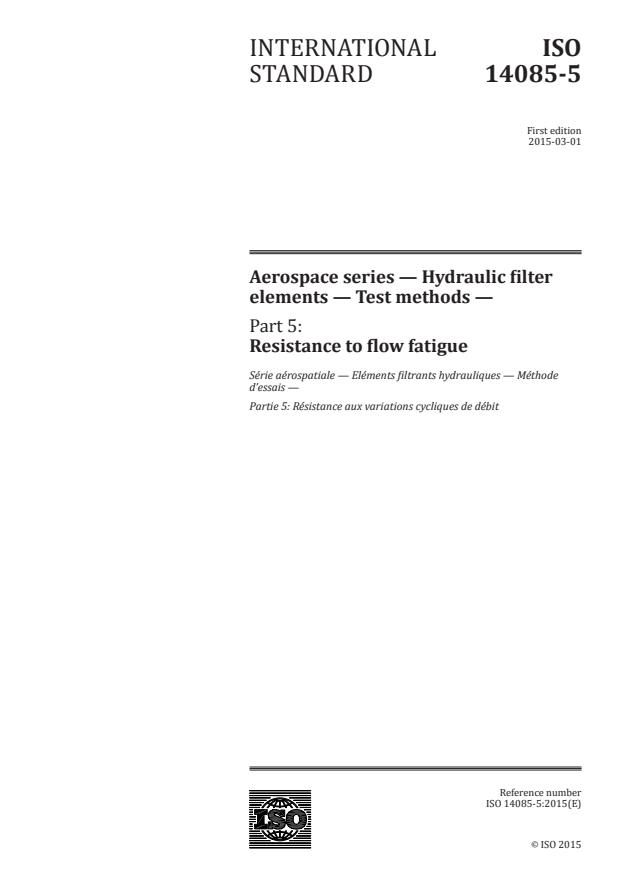
INTERNATIONAL ISO
STANDARD 14085-5
First edition
2015-03-01
Aerospace series — Hydraulic filter
elements — Test methods —
Part 5:
Resistance to flow fatigue
Série aérospatiale — Eléments filtrants hydrauliques — Méthode
d’essais —
Partie 5: Résistance aux variations cycliques de débit
Reference number
©
ISO 2015
© ISO 2015
All rights reserved. Unless otherwise specified, no part of this publication may be reproduced or utilized otherwise in any form
or by any means, electronic or mechanical, including photocopying, or posting on the internet or an intranet, without prior
written permission. Permission can be requested from either ISO at the address below or ISO’s member body in the country of
the requester.
ISO copyright office
Case postale 56 • CH-1211 Geneva 20
Tel. + 41 22 749 01 11
Fax + 41 22 749 09 47
E-mail copyright@iso.org
Web www.iso.org
Published in Switzerland
ii © ISO 2015 – All rights reserved
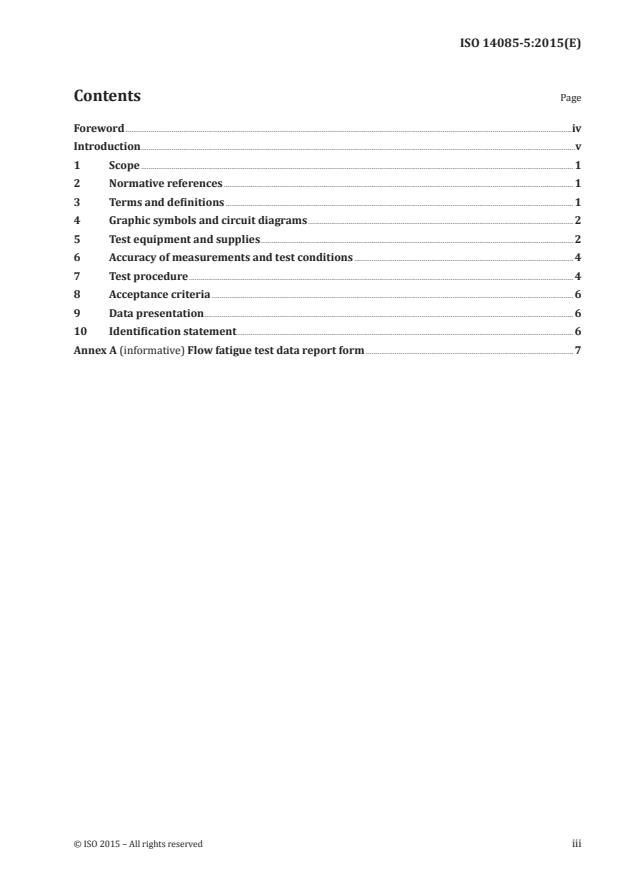
Contents Page
Foreword .iv
Introduction .v
1 Scope . 1
2 Normative references . 1
3 Terms and definitions . 1
4 Graphic symbols and circuit diagrams . 2
5 Test equipment and supplies. 2
6 Accuracy of measurements and test conditions . 4
7 Test procedure . 4
8 Acceptance criteria . 6
9 Data presentation . 6
10 Identification statement . 6
Annex A (informative) Flow fatigue test data report form . 7
Foreword
ISO (the International Organization for Standardization) is a worldwide federation of national standards
bodies (ISO member bodies). The work of preparing International Standards is normally carried out
through ISO technical committees. Each member body interested in a subject for which a technical
committee has been established has the right to be represented on that committee. International
organizations, governmental and non-governmental, in liaison with ISO, also take part in the work.
ISO collaborates closely with the International Electrotechnical Commission (IEC) on all matters of
electrotechnical standardization.
The procedures used to develop this document and those intended for its further maintenance are
described in the ISO/IEC Directives, Part 1. In particular the different approval criteria needed for the
different types of ISO documents should be noted. This document was drafted in accordance with the
editorial rules of the ISO/IEC Directives, Part 2 (see www.iso.org/directives).
Attention is drawn to the possibility that some of the elements of this document may be the subject of
patent rights. ISO shall not be held responsible for identifying any or all such patent rights. Details of
any patent rights identified during the development of the document will be in the Introduction and/or
on the ISO list of patent declarations received (see www.iso.org/patents).
Any trade name used in this document is information given for the convenience of users and does not
constitute an endorsement.
For an explanation on the meaning of ISO specific terms and expressions related to conformity
assessment, as well as information about ISO’s adherence to the WTO principles in the Technical Barriers
to Trade (TBT) see the following URL: Foreword - Supplementary information
The committee responsible for this document is ISO/TC 20, Aircraft and space vehicles, Subcommittee
SC 10, Aerospace fluid systems and components.
ISO 14085 consists of the following parts, under the general title Aerospace series — Hydraulic Filter
elements — Test methods:
— Part 1: Test sequence
— Part 2: Conditioning
— Part 3: Filtration efficiency and retention capacity
— Part 4: Verification of collapse/burst pressure rating
— Part 5: Resistance to flow fatigue
— Part 6: Cleanliness Level
iv © ISO 2015 – All rights reserved
Introduction
In aerospace hydraulic fluid power systems, power is transmitted and controlled through a liquid
under pressure. The liquid is both a lubricant and power-transmitting medium. The presence of solid
contaminant particles in the liquid interferes with the ability of the hydraulic fluid to lubricate and
causes wear and malfunction of the components. The extent of contamination in the fluid has a direct
bearing in the performance, reliability, and safety of the system, and needs to be controlled to levels that
are considered appropriate for the system concerned.
Different principles are used to control the contamination level of the fluid by removing solid contaminant
particles; one of them uses a filter element enclosed in a filter housing. The filter element is the porous
device that performs the actual process of filtration. The complete assembly is designated as a filter.
The effectiveness of the filter element in controlling contaminants is dependent on its design and its
sensitivity to any dynamic operating conditions that may stress the filter element and cause damage to
it, especially as it becomes clogged and the differential pressure rises.
This part of ISO 14085 provides a procedure to determine the ability of a filter element, under increasing
differential pressures, to withstand dynamic operating conditions by evaluating its remaining integrity
and performance after being subjected to cyclic flow variations.
INTERNATIONAL STANDARD ISO 14085-5:2015(E)
Aerospace series — Hydraulic filter elements — Test
methods —
Part 5:
Resistance to flow fatigue
1 Scope
This part of ISO 14085 specifies a method for determining the resistance of a filter element to flow
fatigue caused by varying flow through the filter in various stages of the filter contaminant loading
process. The filter is subjected to a uniform varying flow rate for a specified number of cycles, at a
number of predetermined differential pressures.
Although the number of cycles and differential pressure conditions used in this part of ISO 14085 is
meant to simulate possible service conditions, this part of ISO 14085 is not intended to qualify a filter
element under replicate conditions of service; this can only be done by a specific test protocol developed
for the purpose, including actual conditions of use, for example the operating fluid, contamination, and
exact cyclic flow conditions.
This part of ISO 14085 establishes a method for verifying the ability of a filter element to withstand the
stress caused by cyclic differential pressures induced by a variable flow rate.
The test data resulting from application of this part of ISO 14085 can be used to compare the performance
of aerospace hydraulic filter elements.
2 Normative references
The following documents, in whole or in part, are normatively referenced in this document and are
indispensable for its application. For dated references, only the edition cited applies. For undated
references, the latest edition of the referenced document (including any amendments) applies
ISO 1219-1,Fluid power systems and components — Graphic symbols and circuit diagrams — Part 1: Graphic
symbols for conventional use and data-processing applications
ISO 2942, Hydraulic fluid power — Filter elements — Verification of fabrication integrity and determination
of the first bubble point
ISO 2943, Hydraulic fluid power — Filter elements — Verification of material compatibility with fluids
ISO 5598, Fluid power systems and components — Vocabulary
ISO 12103-1, Road vehicles — Test dust for filter evaluation — Part 1: Arizona test dust
ISO 14085-3, Aerospace series — Hydraulic filter elements - Test methods — Part 3: Filtration efficiency and
retention capacity
3 Terms and definitions
For the purposes of this document, the terms and definitions given in ISO 5598 and the following apply.
3.1
clean assembly differential pressure
difference between the tested component inlet and outlet pressure as measured with a clean filter
housing containing a clean filter element
3.2
clean element differential pressure
differential pressure of the clean element at rated flow, calculated as the difference between the clean
assembly differential pressure (3.1) and the housing differential pressure
3.3
differential pressure
∆p
difference between the inlet and outlet pressures of the component under test, as measured under
specified conditions
3.4
filter element resistance to flow fatigue
ability of a filter element to resist structural failure or performance degradation due to flexing caused
by cyclic system flow rate conditions
3.5
housing differential pressure
differential pressure (3.3) of the filter housing without an element
3.6
rated flow rate
maximum design flow rate for the filter element as specified by the manufacturer
3.7
terminal element differential pressure
maximum differential pressure (3.3) across the filter element as designated by the manufacturer to limit
useful performance
4 Graphic symbols and circuit diagrams
Graphic symbols are used in accordance with ISO 1219-1.
5 Test equipment and supplies
5.1 Press
...