

ISO/IEC 15408-3:2022
(Main)Information security, cybersecurity and privacy protection — Evaluation criteria for IT security — Part 3: Security assurance components
General Information
- Abstract
This document defines the assurance requirements of the ISO/IEC 15408 series. It includes the individual assurance components from which the evaluation assurance levels and other packages contained in ISO/IEC 15408-5 are composed, and the criteria for evaluation of Protection Profiles (PPs), PP-Configurations, PP-Modules, and Security Targets (STs).
- Status
- Withdrawn
- Publication Date
- 08-Aug-2022
- Current Stage
- 9599 - Withdrawal of International Standard
- Start Date
- 19-May-2026
- Completion Date
- 29-Aug-2026

Overview
ISO/IEC 15408-3:2022 - part of the Common Criteria family - defines the security assurance components used to evaluate IT products and systems for information security, cybersecurity and privacy protection. This fourth edition specifies the assurance requirements from which evaluation assurance levels (EALs) and other assurance packages (referenced in ISO/IEC 15408-5) are composed. It also sets criteria for evaluating Protection Profiles (PPs), PP‑Configurations, PP‑Modules and Security Targets (STs).
Keywords: ISO/IEC 15408-3:2022, Common Criteria, security assurance components, evaluation assurance levels, Protection Profile, Security Target, IT security evaluation, cybersecurity assurance, privacy protection.
Key topics and requirements
- Assurance paradigm and approach: explains the assurance model, significance and causes of vulnerabilities, and how assurance is provided through evaluation.
- Evaluation assurance scale: establishes the framework used to map components into EALs and assurance packages.
- Assurance class structure: organizes components into classes and families with clear naming, introductions and application notes.
- Assurance family and component structure: defines family objectives, component levelling, dependencies, application guidance and component identification.
- Assurance elements: the low‑level building blocks that form components and support consistent evaluation evidence.
- Component taxonomy and levelling: provides a consistent taxonomy and levels for tailoring assurance requirements to different evaluation scopes.
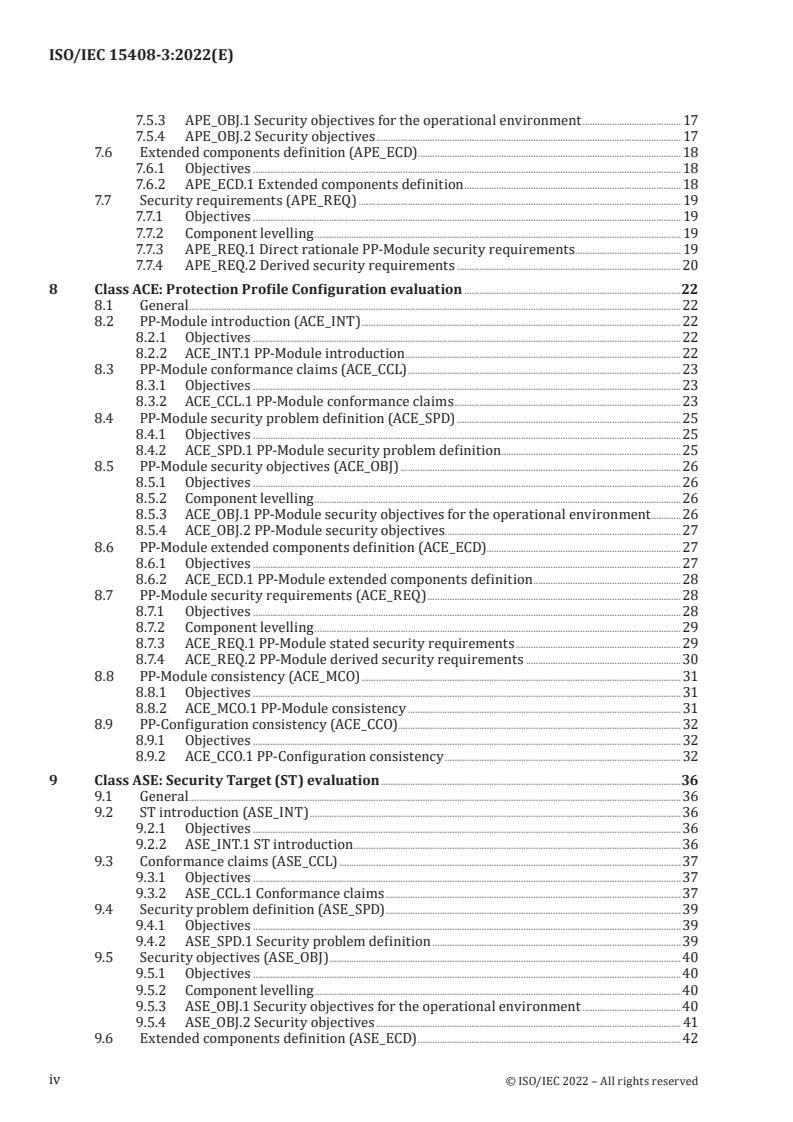
- Evaluation criteria for PPs, PP‑Modules, PP‑Configurations and STs: includes classes such as APE (Protection Profile evaluation), ACE (PP‑Module/Configuration evaluation) and ASE (Security Target evaluation) with specific component objectives (e.g., introductions, conformance claims, problem definitions, objectives, requirements and consistency checks).
Applications
- Developing and writing Protection Profiles (PPs), PP‑Modules and Security Targets (STs) that meet internationally recognized assurance criteria.
- Structuring product or system evaluations for certification against Common Criteria and demonstrating appropriate assurance to customers or regulators.
- Designing security assurance packages and mapping assurance evidence to evaluation assurance levels (EALs) for procurement or compliance.
- Informing secure product development lifecycle practices where formal assurance evidence is required.
Who uses this standard
- Certification bodies and evaluation laboratories performing Common Criteria evaluations
- Product vendors and system integrators preparing PPs or STs
- Security architects, assurance engineers and QA teams producing evaluation evidence
- Procurement officers and compliance teams specifying assurance requirements
- Regulators and auditors assessing security claims
Related standards
- ISO/IEC 15408 series (Common Criteria) - Parts 1, 2 and 5 are directly related
- ISO/IEC 15408-5 (assurance packages and EAL composition) - referenced by this part
ISO/IEC 15408-3:2022 is essential for anyone involved in formal IT security evaluation, providing the detailed assurance component definitions needed to achieve repeatable, auditable cybersecurity and privacy assurance.
Relations
- Effective Date
- 25-Aug-2026
- Effective Date
- 03-Jun-2026
- Effective Date
- 03-Jun-2026
- Effective Date
- 27-May-2026
- Effective Date
- 27-May-2026
- Effective Date
- 06-May-2026
- Effective Date
- 06-Jun-2022
- Effective Date
- 28-Oct-2023
- Effective Date
- 17-Dec-2016
Get Certified
Connect with accredited certification bodies for this standard

BSI Group
BSI (British Standards Institution) is the business standards company that helps organizations make excellence a habit.

Bureau Veritas
Bureau Veritas is a world leader in laboratory testing, inspection and certification services.

DNV
DNV is an independent assurance and risk management provider.
Sponsored listings
Frequently Asked Questions
ISO/IEC 15408-3:2022 is a standard published by the International Organization for Standardization (ISO). Its full title is "Information security, cybersecurity and privacy protection — Evaluation criteria for IT security — Part 3: Security assurance components". This standard covers: This document defines the assurance requirements of the ISO/IEC 15408 series. It includes the individual assurance components from which the evaluation assurance levels and other packages contained in ISO/IEC 15408-5 are composed, and the criteria for evaluation of Protection Profiles (PPs), PP-Configurations, PP-Modules, and Security Targets (STs).
This document defines the assurance requirements of the ISO/IEC 15408 series. It includes the individual assurance components from which the evaluation assurance levels and other packages contained in ISO/IEC 15408-5 are composed, and the criteria for evaluation of Protection Profiles (PPs), PP-Configurations, PP-Modules, and Security Targets (STs).
ISO/IEC 15408-3:2022 is classified under the following ICS (International Classification for Standards) categories: 35.030 - IT Security. The ICS classification helps identify the subject area and facilitates finding related standards.
ISO/IEC 15408-3:2022 has the following relationships with other standards: It is inter standard links to EN ISO/IEC 19896-3:2023, EN ISO/IEC 18045:2023, EN ISO/IEC 15408-1:2023, EN ISO/IEC 15408-2:2023, EN ISO/IEC 15408-4:2023, EN ISO/IEC 15408-5:2023, ISO 7668:2021, ISO/IEC 15408-3:2026, ISO/IEC 15408-3:2008. Understanding these relationships helps ensure you are using the most current and applicable version of the standard.
ISO/IEC 15408-3:2022 is available in PDF format for immediate download after purchase. The document can be added to your cart and obtained through the secure checkout process. Digital delivery ensures instant access to the complete standard document.
Standards Content (Sample)
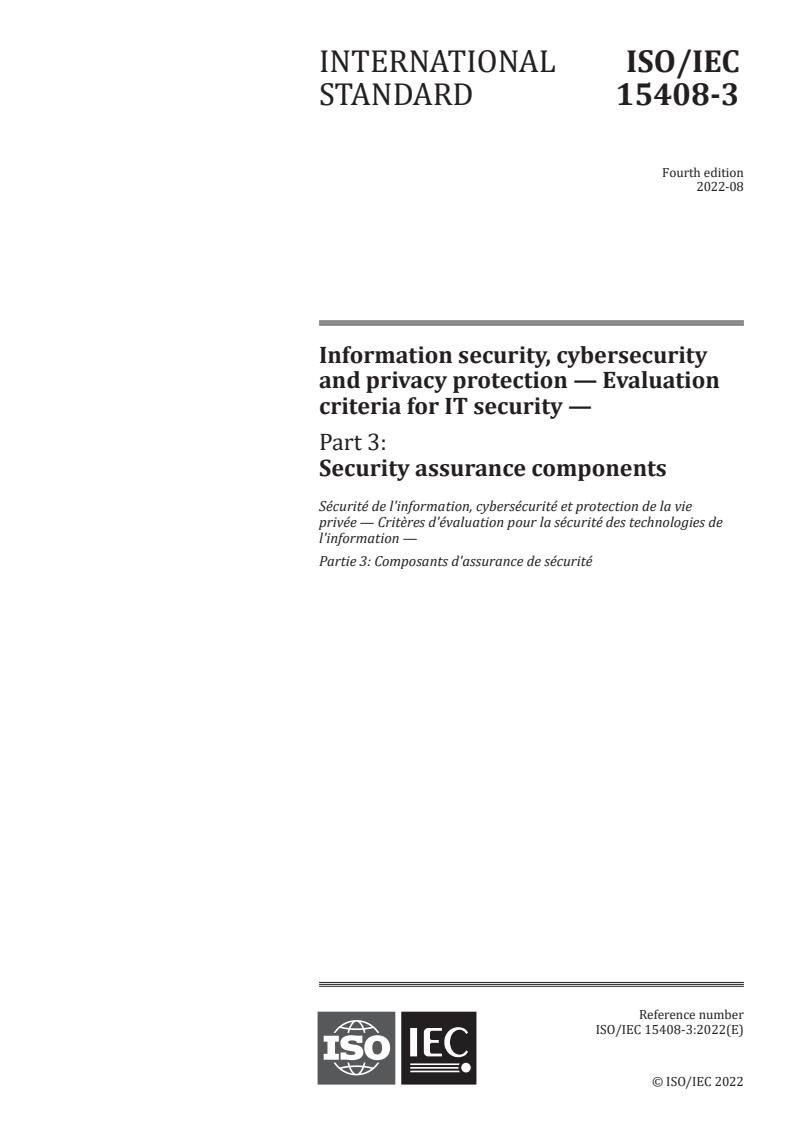
INTERNATIONAL ISO/IEC
STANDARD 15408-3
Fourth edition
2022-08
Information security, cybersecurity
and privacy protection — Evaluation
criteria for IT security —
Part 3:
Security assurance components
Sécurité de l'information, cybersécurité et protection de la vie
privée — Critères d'évaluation pour la sécurité des technologies de
l'information —
Partie 3: Composants d'assurance de sécurité
Reference number
© ISO/IEC 2022
© ISO/IEC 2022
All rights reserved. Unless otherwise specified, or required in the context of its implementation, no part of this publication may
be reproduced or utilized otherwise in any form or by any means, electronic or mechanical, including photocopying, or posting on
the internet or an intranet, without prior written permission. Permission can be requested from either ISO at the address below
or ISO’s member body in the country of the requester.
ISO copyright office
CP 401 • Ch. de Blandonnet 8
CH-1214 Vernier, Geneva
Phone: +41 22 749 01 11
Email: copyright@iso.org
Website: www.iso.org
Published in Switzerland
ii
© ISO/IEC 2022 – All rights reserved
Contents Page
Foreword .x
Introduction .xii
1 Scope . 1
2 Normative references . 1
3 Terms and definitions . 1
4 Overview . 5
5 Assurance paradigm .6
5.1 General . 6
5.2 ISO/IEC 15408 series approach . 6
5.3 Assurance approach . 6
5.3.1 General . 6
5.3.2 Significance of vulnerabilities . 6
5.3.3 Cause of vulnerabilities . 7
5.3.4 ISO/IEC 15408 series assurance . 7
5.3.5 Assurance through evaluation . 7
5.4 ISO/IEC 15408 series evaluation assurance scale . 8
6 Security assurance components . 8
6.1 General . 8
6.2 Assurance class structure . 8
6.2.1 General . 8
6.2.2 Class name . 8
6.2.3 Class introduction . 8
6.2.4 Assurance families . 9
6.3 Assurance family structure . 9
6.3.1 Family name . 9
6.3.2 Objectives . 9
6.3.3 Component levelling . 10
6.3.4 Application notes . 10
6.3.5 Assurance components . 10
6.4 Assurance component structure . 10
6.4.1 General . 10
6.4.2 Component identification . 11
6.4.3 Objectives . 11
6.4.4 Application notes . 11
6.4.5 Dependencies . 11
6.4.6 Assurance elements . 11
6.5 Assurance elements .12
6.6 Component taxonomy .12
7 Class APE: Protection Profile (PP) evaluation .12
7.1 General .12
7.2 PP introduction (APE_INT) . 13
7.2.1 Objectives .13
7.2.2 APE_INT.1 PP introduction . 13
7.3 Conformance claims (APE_CCL) . 14
7.3.1 Objectives . 14
7.3.2 APE_CCL.1 Conformance claims . 14
7.4 Security problem definition (APE_SPD) . 16
7.4.1 Objectives . 16
7.4.2 APE_SPD.1 Security problem definition . 16
7.5 Security objectives (APE_OBJ) . 16
7.5.1 Objectives . 16
7.5.2 Component levelling . 17
iii
© ISO/IEC 2022 – All rights reserved
7.5.3 APE_OBJ.1 Security objectives for the operational environment . 17
7.5.4 APE_OBJ.2 Security objectives . 17
7.6 Extended components definition (APE_ECD) . 18
7.6.1 Objectives . 18
7.6.2 APE_ECD.1 Extended components definition . 18
7.7 Security requirements (APE_REQ) . 19
7.7.1 Objectives . 19
7.7.2 Component levelling . 19
7.7.3 APE_REQ.1 Direct rationale PP-Module security requirements . . 19
7.7.4 APE_REQ.2 Derived security requirements . 20
8 Class ACE: Protection Profile Configuration evaluation .22
8.1 General .22
8.2 PP-Module introduction (ACE_INT) . 22
8.2.1 Objectives .22
8.2.2 ACE_INT.1 PP-Module introduction . 22
8.3 PP-Module conformance claims (ACE_CCL) . 23
8.3.1 Objectives .23
8.3.2 ACE_CCL.1 PP-Module conformance claims . 23
8.4 PP-Module security problem definition (ACE_SPD) . 25
8.4.1 Objectives . 25
8.4.2 ACE_SPD.1 PP-Module security problem definition . 25
8.5 PP-Module security objectives (ACE_OBJ) . 26
8.5.1 Objectives . 26
8.5.2 Component levelling . 26
8.5.3 ACE_OBJ.1 PP-Module security objectives for the operational environment .26
8.5.4 ACE_OBJ.2 PP-Module security objectives. 27
8.6 PP-Module extended components definition (ACE_ECD). 27
8.6.1 Objectives . 27
8.6.2 ACE_ECD.1 PP-Module extended components definition .28
8.7 PP-Module security requirements (ACE_REQ) .28
8.7.1 Objectives .28
8.7.2 Component levelling .29
8.7.3 ACE_REQ.1 PP-Module stated security requirements .29
8.7.4 ACE_REQ.2 PP-Module derived security requirements .30
8.8 PP-Module consistency (ACE_MCO) . 31
8.8.1 Objectives . 31
8.8.2 ACE_MCO.1 PP-Module consistency . 31
8.9 PP-Configuration consistency (ACE_CCO) . 32
8.9.1 Objectives . 32
8.9.2 ACE_CCO.1 PP-Configuration consistency . 32
9 Class ASE: Security Target (ST) evaluation .36
9.1 General .36
9.2 ST introduction (ASE_INT) . 36
9.2.1 Objectives .36
9.2.2 ASE_INT.1 ST introduction .36
9.3 Conformance claims (ASE_CCL) . 37
9.3.1 Objectives . 37
9.3.2 ASE_CCL.1 Conformance claims . 37
9.4 Security problem definition (ASE_SPD) . 39
9.4.1 Objectives .39
9.4.2 ASE_SPD.1 Security problem definition .39
9.5 Security objectives (ASE_OBJ) .40
9.5.1 Objectives .40
9.5.2 Component levelling .40
9.5.3 ASE_OBJ.1 Security objectives for the operational environment .40
9.5.4 ASE_OBJ.2 Security objectives . 41
9.6 Extended components definition (ASE_ECD) . 42
iv
© ISO/IEC 2022 – All rights reserved
9.6.1 Objectives . 42
9.6.2 ASE_ECD.1 Extended components definition . 42
9.7 Security requirements (ASE_REQ). 43
9.7.1 Objectives . 43
9.7.2 Component levelling . 43
9.7.3 ASE_REQ.1 Direct rationale security requirements . 43
9.7.4 ASE_REQ.2 Derived security requirements .44
9.8 TOE summary specification (ASE_TSS) . 45
9.8.1 Objectives . 45
9.8.2 Component levelling .46
9.8.3 ASE_TSS.1 TOE summary specification .46
9.8.4 ASE_TSS.2 TOE summary specification with architectural design summary .46
9.9 Consistency of composite product Security Target (ASE_COMP) . 47
9.9.1 Objectives . 47
9.9.2 Component levelling . 47
9.9.3 Application notes . 47
9.9.4 ASE_COMP.1 Consistency of Security Target (ST) .48
10 Class ADV: Development .49
10.1 General .49
10.2 Security Architecture (ADV_ARC) . 53
10.2.1 Objectives .53
10.2.2 Component levelling .53
10.2.3 Application notes .54
10.2.4 ADV_ARC.1 Security architecture description .54
10.3 Functional specification (ADV_FSP) . 55
10.3.1 Objectives . 55
10.3.2 Component levelling . 55
10.3.3 Application notes .56
10.3.4 ADV_FSP.1 Basic functional specification .58
10.3.5 ADV_FSP.2 Security-enforcing functional specification. 59
10.3.6 ADV_FSP.3 Functional specification with complete summary . 59
10.3.7 ADV_FSP.4 Complete functional specification .60
10.3.8 ADV_FSP.5 Complete semi-formal functional specification with additional
error information . 61
10.3.9 ADV_FSP.6 Complete semi-formal functional specification with additional
formal specification . 62
10.4 Implementation representation (ADV_IMP) .63
10.4.1 Objectives .63
10.4.2 Component levelling .64
10.4.3 Application notes .64
10.4.4 ADV_IMP.1 Implementation representation of the TSF .65
10.4.5 ADV_IMP.2 Complete mapping of the implementation representation of the
TSF .65
10.5 TSF internals (ADV_INT) .66
10.5.1 Objectives .66
10.5.2 Component levelling .66
10.5.3 Application notes .66
10.5.4 ADV_INT.1 Well-structured subset of TSF internals . 67
10.5.5 ADV_INT.2 Well-structured internals .68
10.5.6 ADV_INT.3 Minimally complex internals .68
10.6 Security policy modelling (ADV_SPM) . 69
10.6.1 Objectives .69
10.6.2 Component levelling . 70
10.6.3 Application notes . 70
10.6.4 ADV_SPM.1 Formal TOE security policy model . 70
10.7 TOE design (ADV_TDS) .72
10.7.1 Objectives .72
10.7.2 Component levelling .72
v
© ISO/IEC 2022 – All rights reserved
10.7.3 Application notes .72
10.7.4 ADV_TDS.1 Basic design .73
10.7.5 ADV_TDS.2 Architectural design .74
10.7.6 ADV_TDS.3 Basic modular design . 75
10.7.7 ADV_TDS.4 Semiformal modular design . 76
10.7.8 ADV_TDS.5 Complete semiformal modular design . 78
10.7.9 ADV_TDS.6 Complete semiformal modular design with formal high-level
design presentation .79
10.8 Composite design compliance (ADV_COMP) .80
10.8.1 Objectives .80
10.8.2 Component levelling .80
10.8.3 Application notes .80
10.8.4 ADV_COMP.1 Design compliance with the base component-related user
guidance, ETR for composite evaluation and report of the base component
evaluation authority . . .81
11 Class AGD: Guidance documents .82
11.1 General .82
11.2 Operational user guidance (AGD_OPE) .82
11.2.1 Objectives .82
11.2.2 Component levelling .82
11.2.3 Application notes .82
11.2.4 AGD_OPE.1 Operational user guidance.83
11.3 Preparative procedures (AGD_PRE) .84
11.3.1 Objectives .84
11.3.2 Component levelling .84
11.3.3 Application notes .84
11.3.4 AGD_PRE.1 Preparative procedures .84
12 Class ALC: Life-cycle support .85
12.1 General .85
12.2 CM capabilities (ALC_CMC) .86
12.2.1 Objectives .86
12.2.2 Component levelling .87
12.2.3 Application notes .87
12.2.4 ALC_CMC.1 Labelling of the TOE .87
12.2.5 ALC_CMC.2 Use of the CM system .88
12.2.6 ALC_CMC.3 Authorization controls .89
12.2.7 ALC_CMC.4 Production support, acceptance procedures and automation . 91
12.2.8 ALC_CMC.5 Advanced support . 93
12.3 CM scope (ALC_CMS) .96
12.3.1 Objectives .96
12.3.2 Component levelling .96
12.3.3 Application notes .96
12.3.4 ALC_CMS.1 TOE CM coverage .96
12.3.5 ALC_CMS.2 Parts of the TOE CM coverage .97
12.3.6 ALC_CMS.3 Implementation representation CM coverage .98
12.3.7 ALC_CMS.4 Problem tracking CM coverage .99
12.3.8 ALC_CMS.5 Development tools CM coverage .99
12.4 Delivery (ALC_DEL) .100
12.4.1 Objectives .100
12.4.2 Component levelling . 101
12.4.3 Application notes . 101
12.4.4 ALC_DEL.1 Delivery procedures . 101
12.5 Developer environment security (ALC_DVS) .102
12.5.1 Objectives .102
12.5.2 Component levelling . 102
12.5.3 Application notes . 102
12.5.4 ALC_DVS.1 Identification of security controls .102
vi
© ISO/IEC 2022 – All rights reserved
12.5.5 ALC_DVS.2 Sufficiency of security controls .103
12.6 Flaw remediation (ALC_FLR) .103
12.6.1 Objectives .103
12.6.2 Component levelling .103
12.6.3 Application notes .103
12.6.4 ALC_FLR.1 Basic flaw remediation .104
12.6.5 ALC_FLR.2 Flaw reporting procedures .104
12.6.6 ALC_FLR.3 Systematic flaw remediation .106
12.7 Development Life-cycle definition (ALC_LCD) .107
12.7.1 Objectives .107
12.7.2 Component levelling .107
12.7.3 Application notes .108
12.7.4 ALC_LCD.1 Developer defined life-cycle processes .108
12.7.5 ALC_LCD.2 Measurable life-cycle model .109
12.8 TOE Development Artefacts (ALC_TDA) . 110
12.8.1 Objectives . 110
12.8.2 Component levelling . 110
12.8.3 Application notes . 110
12.8.4 ALC_TDA.1 Uniquely identifying implementation representation . 111
12.8.5 ALC_TDA.2 Matching CMS scope of implementation representation .112
12.8.6 ALC_TDA.3 Regenerate TOE with well-defined development tools . 114
12.9 Tools and techniques (ALC_TAT) . 117
12.9.1 Objectives . 117
12.9.2 Component levelling . 117
12.9.3 Application notes . 117
12.9.4 ALC_TAT.1 Well-defined development tools .118
12.9.5 ALC_TAT.2 Compliance with implementation standards .118
12.9.6 ALC_TAT.3 Compliance with implementation standards - all parts. 119
12.10 Integration of composition parts and consistency check of delivery procedures
(ALC_COMP) .120
12.10.1 Objectives .120
12.10.2
...