

ISO/IEC 23008-12:2022
(Main)Information technology — High efficiency coding and media delivery in heterogeneous environments — Part 12: Image File Format
General Information
- Abstract
This document specifies the Image File Format, an interoperable storage format for a single image, a collection of images, and sequences of images. The format defined in this document is built on tools defined in ISO/IEC 14496-12 and enables the interchange, editing, and display of images, as well as the carriage of metadata associated with those images. The Image File Format defines structures used to contain metadata, how to link that metadata to the images, and defines how metadata of certain forms is carried. This document also specifies brands for the storage of images and image sequences conforming to High Efficiency Video Coding (HEVC), Advanced Video Coding (AVC), JPEG, Versatile Video Coding (VVC) and Essential Video Coding (EVC). NOTE The storage of HEVC, AVC, VVC and EVC video sequences is out of scope and is provided in ISO/IEC 14496‑15.
- Status
- Withdrawn
- Publication Date
- 28-Sep-2022
- Current Stage
- 9599 - Withdrawal of International Standard
- Start Date
- 03-Jul-2025
- Completion Date
- 29-Aug-2026


Overview
ISO/IEC 23008-12:2022 specifies an Image File Format for interoperable storage of a single image, image collections, and image sequences. Built on the ISO base media file format (ISO/IEC 14496-12), this standard enables reliable interchange, editing, display and carriage of image-associated metadata. It also defines storage brands for images and image sequences conforming to HEVC, AVC, JPEG, VVC and EVC codecs. (Note: storage of HEVC/AVC/VVC/EVC video sequences is out of scope and is provided in ISO/IEC 14496‑15.)
Key topics and technical requirements
- File derivation and structure: Reuses ISO/IEC 14496-12 foundations for box/atom structures and container interoperability.
- Image types and roles: Single images, collections, multi-layer images, pre-derived and derived images, thumbnails, cover and auxiliary images, master images and predictively coded items.
- Image properties: Definitions and handling of spatial extents, pixel aspect ratio, colour information, pixel formats, decoder configuration, clean aperture, rotation, mirroring, scaling, content light level and colour volume metadata.
- Metadata and linking: Structures to contain metadata, mechanisms to link metadata to images, and formats for carrying metadata (including accessibility text, creation/modification time, and technical capture attributes).
- Derived content and edits: Rules for derived images, region items, masks, annotations, and derived region items for editing workflows.
- Sequence and timed presentation: Support for image sequences, sample groups, timed tracks and presentation constraints for slideshows, burst capture and image playback.
- Auxiliary samples: Support for alpha planes, depth maps and other auxiliary image sample formats.
- Entity and sample grouping: Grouping constructs to relate untimed items to timed sequences (e.g., bursts, panoramas, slideshows).
Applications and who uses it
- Image software vendors: Editors, compositors, and asset managers use the format for interoperable storage, multi-layer imagery and rich metadata support.
- Device manufacturers: Cameras and mobile devices implement the format to store capture sequences, depth maps, alpha channels and capture metadata.
- Web and media platforms: CDNs, media servers and browsers adopt the standard for efficient image delivery, slideshows and image collections.
- Archiving and publishing: Digital libraries and publishers rely on standardized metadata, color volume and mastering information for reliable long-term access.
- Codec and standards implementers: Developers building encoders/decoders and format readers for HEVC/AVC/VVC/EVC/JPEG-based images.
Related standards
- ISO/IEC 14496-12 - ISO base media file format (foundation for container structures)
- ISO/IEC 14496-15 - Storage of video sequences for HEVC/AVC/VVC/EVC (video sequence storage out of scope in Part 12)
Keywords: ISO/IEC 23008-12:2022, Image File Format, image sequences, metadata, ISO base media file format, HEVC, AVC, VVC, EVC, JPEG, image interchange, multi-layer images.
Relations
- Effective Date
- 17-Feb-2024
- Effective Date
- 06-Jun-2022
- Effective Date
- 06-Jun-2022
Get Certified
Connect with accredited certification bodies for this standard

BSI Group
BSI (British Standards Institution) is the business standards company that helps organizations make excellence a habit.

NYCE
Mexican standards and certification body.
Sponsored listings
Frequently Asked Questions
ISO/IEC 23008-12:2022 is a standard published by the International Organization for Standardization (ISO). Its full title is "Information technology — High efficiency coding and media delivery in heterogeneous environments — Part 12: Image File Format". This standard covers: This document specifies the Image File Format, an interoperable storage format for a single image, a collection of images, and sequences of images. The format defined in this document is built on tools defined in ISO/IEC 14496-12 and enables the interchange, editing, and display of images, as well as the carriage of metadata associated with those images. The Image File Format defines structures used to contain metadata, how to link that metadata to the images, and defines how metadata of certain forms is carried. This document also specifies brands for the storage of images and image sequences conforming to High Efficiency Video Coding (HEVC), Advanced Video Coding (AVC), JPEG, Versatile Video Coding (VVC) and Essential Video Coding (EVC). NOTE The storage of HEVC, AVC, VVC and EVC video sequences is out of scope and is provided in ISO/IEC 14496‑15.
This document specifies the Image File Format, an interoperable storage format for a single image, a collection of images, and sequences of images. The format defined in this document is built on tools defined in ISO/IEC 14496-12 and enables the interchange, editing, and display of images, as well as the carriage of metadata associated with those images. The Image File Format defines structures used to contain metadata, how to link that metadata to the images, and defines how metadata of certain forms is carried. This document also specifies brands for the storage of images and image sequences conforming to High Efficiency Video Coding (HEVC), Advanced Video Coding (AVC), JPEG, Versatile Video Coding (VVC) and Essential Video Coding (EVC). NOTE The storage of HEVC, AVC, VVC and EVC video sequences is out of scope and is provided in ISO/IEC 14496‑15.
ISO/IEC 23008-12:2022 is classified under the following ICS (International Classification for Standards) categories: 35.040.40 - Coding of audio, video, multimedia and hypermedia information. The ICS classification helps identify the subject area and facilitates finding related standards.
ISO/IEC 23008-12:2022 has the following relationships with other standards: It is inter standard links to ISO/IEC 23008-12:2025, ISO/IEC 23008-12:2017/Amd 1:2020, ISO/IEC 23008-12:2017. Understanding these relationships helps ensure you are using the most current and applicable version of the standard.
ISO/IEC 23008-12:2022 is available in PDF format for immediate download after purchase. The document can be added to your cart and obtained through the secure checkout process. Digital delivery ensures instant access to the complete standard document.
Standards Content (Sample)
INTERNATIONAL ISO/IEC
STANDARD 23008-12
Second edition
2022-09
Information technology — MPEG
systems technologies —
Part 12:
Image File Format
Technologies de l'information — Technologies des systèmes MPEG —
Partie 12: Format de fichier d'image
Reference number
© ISO/IEC 2022
© ISO/IEC 2022
All rights reserved. Unless otherwise specified, or required in the context of its implementation, no part of this publication may
be reproduced or utilized otherwise in any form or by any means, electronic or mechanical, including photocopying, or posting on
the internet or an intranet, without prior written permission. Permission can be requested from either ISO at the address below
or ISO’s member body in the country of the requester.
ISO copyright office
CP 401 • Ch. de Blandonnet 8
CH-1214 Vernier, Geneva
Phone: +41 22 749 01 11
Email: copyright@iso.org
Website: www.iso.org
Published in Switzerland
ii
© ISO/IEC 2022 – All rights reserved
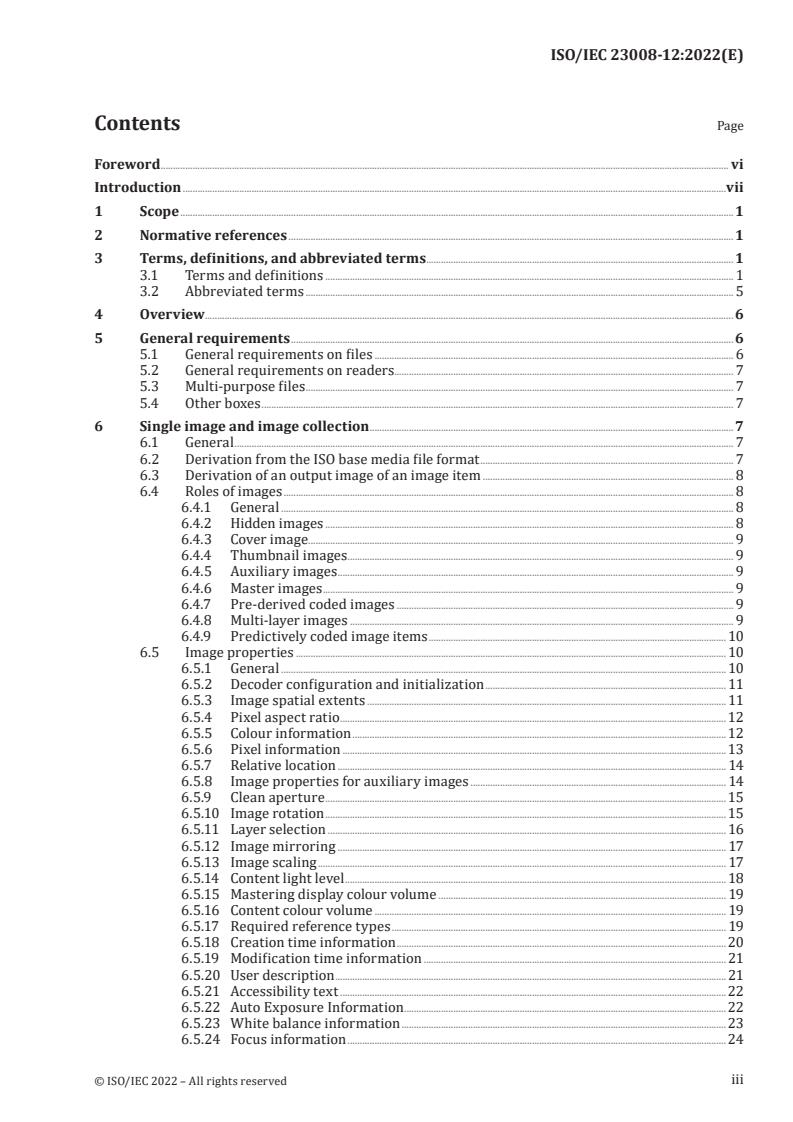
Contents Page
Foreword . vi
Introduction .vii
1 Scope . 1
2 Normative references . 1
3 Terms, definitions, and abbreviated terms . 1
3.1 Terms and definitions . 1
3.2 Abbreviated terms . 5
4 Overview . 6
5 General requirements . 6
5.1 General requirements on files . 6
5.2 General requirements on readers. 7
5.3 Multi-purpose files . 7
5.4 Other boxes . 7
6 Single image and image collection .7
6.1 General . 7
6.2 Derivation from the ISO base media file format . 7
6.3 Derivation of an output image of an image item . 8
6.4 Roles of images . 8
6.4.1 General . 8
6.4.2 Hidden images . 8
6.4.3 Cover image . . 9
6.4.4 Thumbnail images . 9
6.4.5 Auxiliary images . 9
6.4.6 Master images . 9
6.4.7 Pre-derived coded images . 9
6.4.8 Multi-layer images . 9
6.4.9 Predictively coded image items . 10
6.5 Image properties . 10
6.5.1 General . 10
6.5.2 Decoder configuration and initialization . 11
6.5.3 Image spatial extents . 11
6.5.4 Pixel aspect ratio .12
6.5.5 Colour information .12
6.5.6 Pixel information .13
6.5.7 Relative location . 14
6.5.8 Image properties for auxiliary images . 14
6.5.9 Clean aperture . 15
6.5.10 Image rotation . 15
6.5.11 Layer selection . 16
6.5.12 Image mirroring . 17
6.5.13 Image scaling . 17
6.5.14 Content light level . 18
6.5.15 Mastering display colour volume . 19
6.5.16 Content colour volume . 19
6.5.17 Required reference types . 19
6.5.18 Creation time information . 20
6.5.19 Modification time information . 21
6.5.20 User description . 21
6.5.21 Accessibility text .22
6.5.22 Auto Exposure Information . 22
6.5.23 White balance information . 23
6.5.24 Focus information . 24
iii
© ISO/IEC 2022 – All rights reserved
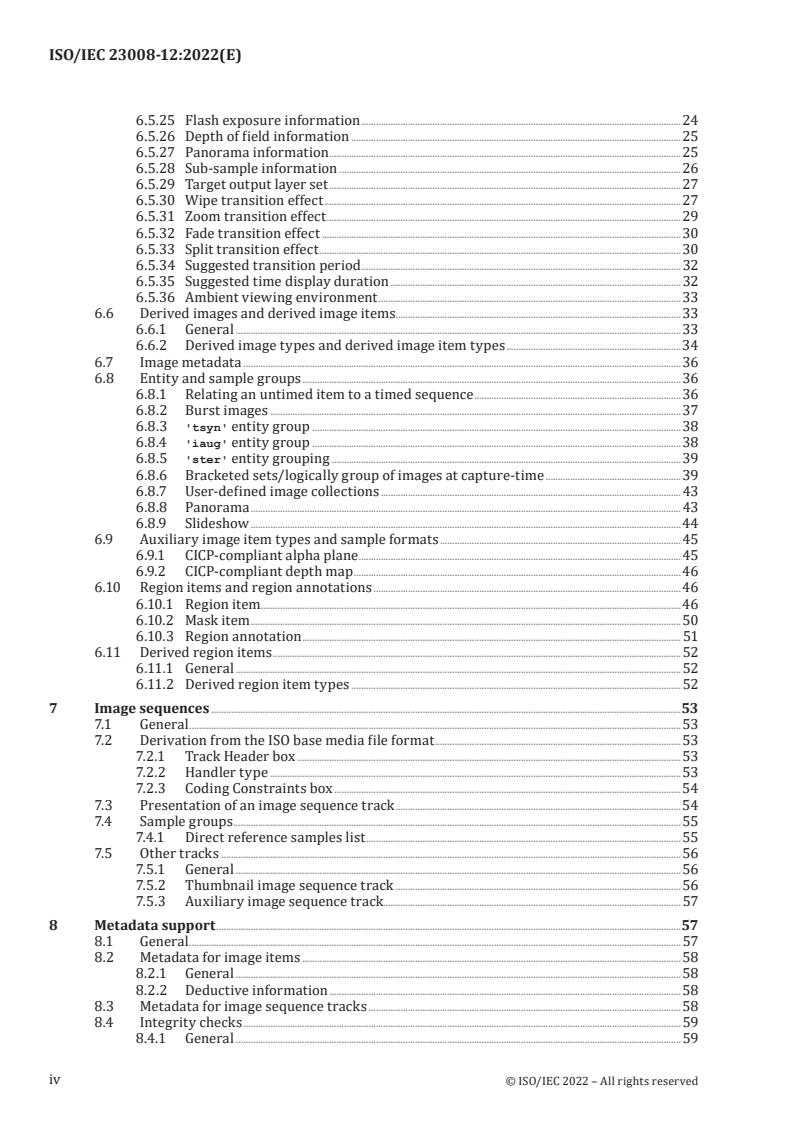
6.5.25 Flash exposure information . 24
6.5.26 Depth of field information . 25
6.5.27 Panorama information .25
6.5.28 Sub-sample information . 26
6.5.29 Target output layer set . 27
6.5.30 Wipe transition effect . 27
6.5.31 Zoom transition effect .29
6.5.32 Fade transition effect .30
6.5.33 Split transition effect .30
6.5.34 Suggested transition period . 32
6.5.35 Suggested time display duration . 32
6.5.36 Ambient viewing environment . 33
6.6 Derived images and derived image items. 33
6.6.1 General . 33
6.6.2 Derived image types and derived image item types .34
6.7 Image metadata . 36
6.8 Entity and sample groups .36
6.8.1 Relating an untimed item to a timed sequence .36
6.8.2 Burst images . 37
6.8.3 'tsyn' entity group .38
6.8.4 'iaug' entity group .38
6.8.5 'ster' entity grouping . 39
6.8.6 Bracketed sets/logically group of images at capture-time .39
6.8.7 User-defined image collections . 43
6.8.8 Panorama . 43
6.8.9 Slideshow .44
6.9 Auxiliary image item types and sample formats . 45
6.9.1 CICP-compliant alpha plane . 45
6.9.2 CICP-compliant depth map .46
6.10 Region items and region annotations .46
6.10.1 Region item.46
6.10.2 Mask item .50
6.10.3 Region annotation . 51
6.11 Derived region items . 52
6.11.1 General . 52
6.11.2 Derived region item types . 52
7 Image sequences .53
7.1 General .53
7.2 Derivation from the ISO base media file format . 53
7.2.1 Track Header box . 53
7.2.2 Handler type .53
7.2.3 Coding Constraints box .54
7.3 Presentation of an image sequence track .54
7.4 Sample groups . 55
7.4.1 Direct reference samples list . 55
7.5 Other tracks .56
7.5.1 General .56
7.5.2 Thumbnail image sequence track .56
7.5.3 Auxiliary image sequence track. 57
8 Metadata support .57
8.1 General . 57
8.2 Metadata for image items .58
8.2.1 General .58
8.2.2 Deductive information .58
8.3 Metadata for image sequence tracks .58
8.4 Integrity checks . 59
8.4.1 General . 59
iv
© ISO/IEC 2022 – All rights reserved
8.4.2 Syntax . . 59
8.4.3 Semantics .60
9 Extensions to the ISO base media file format.60
10 Image File Format brands .60
10.1 General .60
10.2 Image and image collection brands .60
10.2.1 General requirements on brands .60
10.2.2 'mif1' structural brand . 61
10.2.3 'mif2' structural brand .63
10.2.4 'pred' brand .63
10.2.5 '1pic' brand .64
10.3 Image sequence brands.64
10.3.1 'msf1' structural brand.64
Annex A (normative) Storage of externally specified metadata .66
Annex B (normative) HEVC Image File Format .68
Annex C (normative) High efficiency image file MIME type registration.79
Annex D (normative) High efficiency image sequence file MIME type registration .82
Annex E (normative) AVC in the Image File Format .84
Annex F (normative) Advanced coding image MIME type registration .88
Annex G (normative) Advanced coding sequence MIME type registration .90
Annex H (normative) JPEG in the Image File Format .92
Annex I (informative) Guidelines for specifying storage of image coding formats .95
Annex J (informative) Examples of image collections .96
Annex K (informative) Guidelines for progressive refinement . 100
Annex L (normative) VVC Image File Format . 102
Annex M (normative) EVC Image File Format . 112
Annex N (informative) Privacy and security considerations .117
Bibliography .119
v
© ISO/IEC 2022 – All rights reserved
Foreword
ISO (the International Organization for Standardization) and IEC (the International Electrotechnical
Commission) form the specialized system for worldwide standardization. National bodies that are
members of ISO or IEC participate in the development of International Standards through technical
committees established by the respective organization to deal with particular fields of technical
activity. ISO and IEC technical committees collaborate in fields of mutual interest. Other international
organizations, governmental and non-governmental, in liaison with ISO and IEC, also take part in the
work.
The procedures used to develop this document and those intended for its further maintenance
are described in the ISO/IEC Directives, Part 1. In particular, the different approval criteria
needed for the different types of document should be noted. This document was drafted in
accordance with the editorial rules of the ISO/IEC Directives, Part 2 (see www.iso.org/directives or
www.iec.ch/members_experts/refdocs).
Attention is drawn to the possibility that some of the elements of this document may be the subject
of patent rights. ISO and IEC shall not be held responsible for identifying any or all such patent
rights. Details of any patent rights identified during the development of the document will be in the
Introduction and/or on the ISO list of patent declarations received (see www.iso.org/patents) or the IEC
list of patent declarations received (see https://patents.iec.ch).
Any trade name used in this document is information given for the convenience of users and does not
constitute an endorsement.
For an explanation of the voluntary nature of standards, the meaning of ISO specific terms and
expressions related to conformity assessment, as well as information about ISO's adherence to
the World Trade Organization (WTO) principles in the Technical Barriers to Trade (TBT) see
www.iso.org/iso/foreword.html. In the IEC, see www.iec.ch/understanding-standards.
This document was prepared by Joint Technical Committee ISO/IEC JTC 1, Information technology, SC 29,
Coding of audio, picture, multimedia and hypermedia information.
This second edition cancels and replaces the first edition (ISO/IEC 23008-12:2017), which has been
technically revised. It also incorporates the Amendments ISO/IEC 23008-12:2017/Amd.1:2020,
ISO/IEC 23008-12:2017/DAmd.2:2019 and the Technical Corrigendum ISO/IEC 23008-12:2017/Cor.
1:2020.
The main changes are as follows:
— addition of Annexes L to N;
— support for predictive image coding, bursts, bracketing and region annotations.
A list of all parts in the ISO/IEC 23008 series can be found on the ISO and IEC websites.
Any feedback or questions on this document should be directed to the user’s national standards
body. A complete listing of these bodies can be found at www.iso.org/members.html and
www.iec.ch/national-committees.
vi
© ISO/IEC 2022 – All rights reserved
Introduction
The Image File Format is designed to enable the interchange of images and image sequences, as well as
their associated metadata. It forms part of a family of specifications that are box-structured, and is built
using tools defined in the ISO base media file format. This document specifies both structural brands
that can be used with any codec and brands specific to High Efficiency Video Coding (HEVC). The file
format specified in this document is referred to as the High Efficiency Image File Format (HEIF). It is
suggested that HEIF be pronounced "heaff" (like heath with an ff ending). When the requirements of
the HEVC-specific brands are applied, the file format can be referred to as the HEVC Image File Format.
The International Organization for Standardization (ISO) and International Electrotechnical
Commission (IEC) draw attention to the fact that it is claimed that compliance with this document may
involve the use of a patent.
ISO and IEC take no position concerning the evidence, validity and scope of this patent right.
The holder of this patent right has assured ISO and IEC that he/she is willing to negotiate licences under
reasonable and non-discriminatory terms and conditions with applicants throughout the world. In this
respect, the statement of the holder of this patent right is registered with ISO and IEC. Information may
be obtained from the patent database available at www.iso.org/patents.
Attention is drawn to the possibility that some of the elements of this document may be the subject
of patent rights other than those in the patent database. ISO and IEC shall not be held responsible for
identifying any or all such patent rights.
This document is organized as follows:
— Clause 5 specifies general requirements on files and file readers conforming to the Image File
Format.
— Clause 6 specifies the file structures for the storage of a single image and an image collection.
Additionally, general requirements that shall be supported in all files using the Image File Format
for the storage of a single image or an image collection are specified.
— Clause 7 specifies the file structures for the storage of image sequences. Additionally, general
requirements that shall be supported in all files using the Image File Format for the storage of image
sequences are specified.
— Clause 8 specifies the metadata structures for a single image, an image collection, and image
sequences.
— Clause 9 specifies enhancements to the ISO base media file format.
— Clause 10 specifies structural brands for a single image and an image collection, as well as image
sequences. Requirements on both files and file readers are specified.
— Annex A specifies the format for storing Exif, XMP, and MPEG-7 metadata in files conforming to the
Image File Format.
— Annex B specifies the format for encapsulating HEVC-coded images, image collections, and image
sequences according to the Image File Format. Annex B also specifies HEVC-specific brands for a
single image and an image collection as well as image sequences. Requirements on both files and file
readers are specified.
— Annex C and Annex D specify the MIME type registration for a single image or an image collection,
and image sequences, respectively, for the structural and HEVC-specific brands.
— Annex E specifies the format for encapsulating AVC-coded images, image collections, and image
sequences according to the Image File Format.
vii
© ISO/IEC 2022 – All rights reserved
— Annex F and Annex G specify the MIME type registration for a single image or an image collection,
and image sequences, respectively, for the AVC-specific brands.
— Annex H specifies the format for encapsulating JPEG-coded images, image collections, and image
sequences according to the Image File Format.
— Annex I outlines guidelines on defining new image formats and brands.
— Annex J contains informative examples of single image and image collection file structures
conforming to the Image File Format.
— Annex K provides guidelines for a player operation for progressive refinement and file structures
enabling progressive refinement.
— Annex L specifies the format for encapsulating VVC-coded images, image collections, and image
sequences according to the Image File Format. Annex L also specifies VVC-specific brands for a
single image and an image collection as well as image sequences. Requirements on both files and file
readers are specified.
— Annex M specifies the format for encapsulating EVC-coded images, image collections, and image
sequences according to the Image File Format. Annex M also specifies EVC-specific brands for a
single image and an image collection as well as image sequences. Requirements on both files and file
readers are specified.
— Annex N contains considerations on privacy and security relating to the use of the Image File Format.
viii
© ISO/IEC 2022 – All rights reserved
INTERNATIONAL STANDARD ISO/IEC 23008-12:2022(E)
Information technology — MPEG systems technologies —
Part 12:
Image File Format
1 Scope
This document specifies the Image File Format, an interoperable storage format for a single image, a
collection of images, and sequences of images.
The format defined in this document is built on tools defined in ISO/IEC 14496-12 and enables the
interchange, editing, and display of images, as well as the carriage of metadata associated with those
images. The Image File Format defines structures used to contain metadata, how to link that metadata
to the images, and defines how metadata of certain forms is carried.
This document also specifies brands for the storage of images and image sequences conforming to High
Efficiency Video Coding (HEVC), Advanced Video Coding (AVC), JPEG, Versatile Video Coding (VVC) and
Essential Video Coding (EVC).
NOTE The storage of HEVC, AVC, VVC and EVC video sequences is out of scope and is provided in
ISO/IEC 14496-15.
2 Normative references
The following documents are referred to in the text in such a way that some or all of their content
constitutes requirements of this document. For dated references, only the edition cited applies. For
undated references, the latest edition of the referenced document (including any amendments) applies.
ISO/IEC 10918-1, Information technology — Digital compression and coding of continuous-tone still images
— Part 1: Requirements and guidelines
ISO/IEC 14496-10, Information technology — Coding of audio-visual objects — Part 10: Advanced Video
Coding
ISO/IEC 14496-12, Information technology — Coding of audio-visual objects — Part 12: ISO base media file
format
ISO/IEC 14496-15, Information technology — Coding of moving pictures and audio – Part 15: Carriage of
network abstraction layer (NAL) unit structured video in the ISO base media file format
ISO/IEC 23008-2, Information technology — High efficiency coding and media delivery in heterogeneous
environments — Part 2: High efficiency video coding
ISO/IEC 23090-3, Information technology — Coded representation of immersive media — Part 3: Versatile
video coding
ISO/IEC 23094-1, Information technology — General video coding — Part 1: Essential video coding
3 Terms, definitions, and abbreviated terms
3.1 Terms and definitions
For the purposes of this document, the terms and definitions given in ISO/IEC 14496-12,
ISO/IEC 14496-15 and the following apply.
© ISO/IEC 2022 – All rights reserved
ISO and IEC maintain terminology databases for use in standardization at the following addresses:
— ISO Online browsing platform: available at https:// www .iso .org/ obp
— IEC Electropedia: available at https:// www .electropedia .org/
3.1.1
alternate group
group of entities (3.1.11) that are alternatives to each other and out of which only one should be selected
for processing
3.1.2
associated image item
image item (3.1.18) that is associated with the item property (3.1.28) through the ItemPropertiesBox
3.1.3
auxiliary image
image (3.1.16) that may not be intended to be displayed but provides supplemental information, such as
transparency data, complementing a respective master image (3.1.29)
3.1.4
coded image
coded representation of an image (3.1.16)
3.1.5
coded image item
item (3.1.27) whose data is a coded image (3.1.4)
3.1.6
crop-rotate-mirror derived image item
derived image item (3.1.8) of type 'iden' that is not associated with any other types of essential item
properties (3.1.12) than 'irot', 'clap', and 'imir'
3.1.7
derived image
representation of an image (3.1.16) as an operation (3.1.33) on other images
3.1.8
derived image item
item (3.1.27) whose data is a derived image (3.1.7)
3.1.9
derived region item
item (3.1.27) whose data is a representation of the shape, position and size of a region within an image
item (3.1.18), with which it is associated via item reference, as an operation (3.1.33) on other region
items (3.1.39)
3.1.10
descriptive item property
item property (3.1.28) that describes rather than transforms the associated item
3.1.11
entity
item or track
3.1.12
essential item property
item property (3.1.28) that readers are required to process
3.1.13
HEVC image item
image item (3.1.18) of type 'hvc1' or 'lhv1'
© ISO/IEC 2022 – All rights reserved
3.1.14
hidden image
image (3.1.16) that is not intended to be displayed
3.1.15
hidden sample
sample that is not intended to be displayed
3.1.16
image
one or more arrays of pixels of different colour components described by an image item (3.1.18) or a
sample
3.1.17
image collection
set of images (3.1.16) stored as items (3.1.27)of a single file according to this document
3.1.18
image item
coded image item (3.1.5) or derived image item (3.1.8)
3.1.19
Image File Format
file format specified by this document
3.1.20
image property
item property (3.1.28) for an image item (3.1.18)
3.1.21
image sequence
sequence of coded images (3.1.4) which may be associated with advisory timing and in which images
may use inter prediction (3.1.24)
3.1.22
image sequence track
track that contains an image sequence (3.1.21)
3.1.23
input image
image (3.1.16) that is used as an input for the operation (3.1.33) of the derived image item (3.1.8)
3.1.24
inter prediction
prediction derived in a manner that is dependent on data elements (e.g. sample values or motion
vectors) of images (3.1.16) other than the current image
3.1.25
intra coding
coding of an image (3.1.16) that may use intra prediction (3.1.26) and does not use inter prediction
(3.1.24)
3.1.26
intra prediction
prediction derived from only data elements (e.g. sample values) of the same decoded image
3.1.27
item
data that does not require timed processing, as opposed to sample data, and is described by the boxes
contained in a MetaBox
© ISO/IEC 2022 – All rights reserved
3.1.28
item property
descriptive or transformative information about an item (3.1.27) as stored in the item properties array
3.1.29
master image
image that is stored as an item (3.1.27) and is not an auxiliary image (3.1.3) or a thumbnail image
3.1.30
master image sequence
sequence of images that is stored as an image sequence track (3.1.22) and is not an auxiliary image (3.1.3)
sequence or a thumbnail image sequence (3.1.21)
3.1.31
metadata item
item (3.1.27) containing metadata that may for example describe an image item (3.1.18)
Note 1 to entry: ISO/IEC 14496-12 uses the terms item and metadata item interchangeably to refer to an item of
any type. This document overrides the metadata item definition of the ISO base media file format.
3.1.32
non-essential item property
item property (3.1.28) that readers are allowed to ignore
3.1.33
operation
for a derived image item (3.1.8), manipulation, identified by the item type, that produces a reconstructed
image (3.1.37) from a set of input images (3.1.23). For a derived region item (3.1.9), manipulation,
identified by the item type, that produces the shape, position and size of regions of an image (3.1.16)
from a set of regions from input region items (3.1.39).
3.1.34
output image
image (3.1.16) that results when the reconstructed image of the image item (3.1.18) is transformed
according to the transformative item properties (3.1.42) of the image item
3.1.35
pre-derived coded image
coded image (3.1.4) that has been derived from one or more other images
3.1.36
predictively coded image item
image item (3.1.18) that has a decoding dependency to one or more other coded image items (3.1.5)
3.1.37
reconstructed image
image (3.1.16) that results when the coded image item (3.1.5) is decoded or when the operation (3.1.33)
of the derived image item (3.1.8), if any, is applied
3.1.38
reference image
image (3.1.16) that may be used as a reference for inter prediction (3.1.24) of another image
3.1.39
region item
item (3.1.27) whose data defines the shape, position and size of a region within an image item (3.1.18)
with which it is associated via item reference
© ISO/IEC 2022 – All rights reserved
3.1.40
source image item
image item (3.1.18) referred to by the 'dimg' item reference from the derived image item (3.1.8) or from
another derived image item that is a source image item for the derived image item
Note 1 to entry: In other words, an image item is a source image item for a derived image item when it is required
for deriving the output image of the derived image item.
Note 2 to entry: The definition of the source image item is recursive: an image item is a source image item for a
particular derived image item, when the output image of the image item is used as an input image for any derived
image item in the 'dimg'-item-reference-linked chain of derived image items ending at that particular derived
image item, inclusive.
3.1.41
time-parallel sample
sample in the reference track that has the same or, when a sample with the same decoding time is not
available, the closest preceding decoding time relative to that of the particular sample in the particular
track
3.1.42
transformative item property
item property (3.1.28) that transforms the reconstructed representation of the item content
Note 1 to entry: A transformative item property may for example specify rotation by 90, 180, or 270 degrees of a
reconstructed image of an image item.
3.1.43
unique ID
identifier for either an item, an entity group or a track that fulfils the requirements of the 'unif' brand
Note 1 to entry: Requirements on the 'unif' brand are specified in ISO/IEC 14496-12.
3.1.44
visual context
visual rendering surface such as a screen buffer, which may already contain visual material, and onto
which an image (3.1.16) can be rendered
3.2 Abbreviated terms
ASCII American Standard Code for Information Interchange
AVC Advanced Video Coding (Rec. ITU-T H.264 | ISO/IEC 14496-10)
DCF Design rule for Camera File system (JEITA CP-3461)
EVC Essential Video Coding (ISO/IEC 23094-1)
Exif Exchangeable Image File Format (JEITA CP-3451)
HDR high dynamic range
HEIF High Efficiency Image File Format (this document: ISO/IEC 23008-12)
HEVC High Efficiency Video Coding (Rec. ITU-T H.265 | ISO/IEC 23008-2)
MD5 Message Digest algorithm 5
MIME Multi-purpose I
...