

ISO 19426-2:2018
(Main)Structures for mine shafts — Part 2: Headframe structures
General Information
- Abstract
This document specifies the design loads and the design procedures for the structural design of headframe structures of mine shafts and their components for permanent and sinking operations. The headframe includes all structures and their foundations, that are required at the head of all vertical and decline mine shafts for the purposes of supporting and installing winding and sinking ropes, conveyance guides, rope guides and rubbing ropes, equipment for loading and unloading conveyances, safety devices, as well as ancillary sinking and maintenance equipment. The headframe also includes the bank and sub-bank levels. This document does not cover matters of operational safety or layout of the headframe. This document adopts a limit states design philosophy.
- Status
- Withdrawn
- Publication Date
- 03-May-2018
- Technical Committee
- ISO/TC 82 - Mining
- Drafting Committee
- ISO/TC 82/WG 4 - Structures for mine shafts
- Current Stage
- 9599 - Withdrawal of International Standard
- Start Date
- 15-Sep-2026
- Completion Date
- 19-Sep-2026


Overview
ISO 19426-2:2018 - "Structures for mine shafts - Part 2: Headframe structures" specifies the design loads and design procedures for structural design of mine shaft headframes and their components for both permanent and sinking operations. The standard covers all structures and foundations at the head of vertical and decline shafts required to support and install winding and sinking ropes, conveyance and rope guides, rubbing ropes, loading/unloading equipment, safety devices and ancillary sinking/maintenance equipment, including bank and sub-bank levels. It adopts a limit states design philosophy and does not address operational safety or headframe layout.
Key topics and technical requirements
- Design loads and categories
- Permanent loads (structural self-weight, equipment loads)
- Imposed loads (floor/platform, bins/chutes, conveyor and winder loads, kibble and bank door loads, abnormal and seismic loads)
- Rope and conveyance installation loads (winding rope installation, doubling-down, tail rope, rope guides, conveyance change-over)
- Rope operating loads (winding ropes, stage ropes, lateral loads on sheaves, rope guides and rubbing ropes)
- Emergency loads (rope emergency loads, dropback, crash beam/catch plate, emergency arrestor anchors, energy release after rope break, dogging systems)
- Design procedures
- Adoption of limit states design and guidance on design load combinations, partial factors and load effects
- Requirements for overall stability and serviceability (including deflection limits)
- Special provisions for headframe‑mounted winders
- Materials
- Permitted structural materials include structural steel, concrete, and timber, referenced to relevant ISO material standards
- Documentation
- Specifies reference to normative documents and symbols, and assumes local structural design standards are applied where appropriate
Applications and users
ISO 19426-2 is intended for:
- Structural engineers and geotechnical engineers designing mine shaft headframes
- Mining companies and project owners commissioning new shafts or refurbishing headframes
- Winder and shaft-equipment manufacturers integrating structural load requirements
- Consultants preparing tender documents, risk assessments and compliance reports for permanent and sinking operations Practical uses include designing foundations and headframe members, specifying load combinations for fabrication checks, and harmonizing international design practices for global mining projects.
Related standards
Relevant documents referenced by or alongside ISO 19426-2:
- ISO 19426-1 (Vocabulary), ISO 19426-3 (Sinking stage), ISO 19426-4 (Conveyances)
- ISO 22111 (Bases for design - General requirements)
- ISO 2394 (General principles on reliability for structures)
- ISO 3010 (Seismic actions)
- ISO 10721-1 (Steel structures), ISO 19338 (Structural concrete), ISO 12122-1 (Timber)
Keywords: ISO 19426-2, headframe structures, mine shaft design, design loads, rope installation loads, emergency loads, limit states design.
Relations
- Effective Date
- 16-Sep-2023
Get Certified
Connect with accredited certification bodies for this standard

Bureau Veritas Chile
Bureau Veritas certification services in Chile.
Bureau Veritas Peru
Bureau Veritas certification services in Peru.
BVQI Peru
Bureau Veritas certification in Peru.
Sponsored listings
Frequently Asked Questions
ISO 19426-2:2018 is a standard published by the International Organization for Standardization (ISO). Its full title is "Structures for mine shafts — Part 2: Headframe structures". This standard covers: This document specifies the design loads and the design procedures for the structural design of headframe structures of mine shafts and their components for permanent and sinking operations. The headframe includes all structures and their foundations, that are required at the head of all vertical and decline mine shafts for the purposes of supporting and installing winding and sinking ropes, conveyance guides, rope guides and rubbing ropes, equipment for loading and unloading conveyances, safety devices, as well as ancillary sinking and maintenance equipment. The headframe also includes the bank and sub-bank levels. This document does not cover matters of operational safety or layout of the headframe. This document adopts a limit states design philosophy.
This document specifies the design loads and the design procedures for the structural design of headframe structures of mine shafts and their components for permanent and sinking operations. The headframe includes all structures and their foundations, that are required at the head of all vertical and decline mine shafts for the purposes of supporting and installing winding and sinking ropes, conveyance guides, rope guides and rubbing ropes, equipment for loading and unloading conveyances, safety devices, as well as ancillary sinking and maintenance equipment. The headframe also includes the bank and sub-bank levels. This document does not cover matters of operational safety or layout of the headframe. This document adopts a limit states design philosophy.
ISO 19426-2:2018 is classified under the following ICS (International Classification for Standards) categories: 73.020 - Mining and quarrying. The ICS classification helps identify the subject area and facilitates finding related standards.
ISO 19426-2:2018 has the following relationships with other standards: It is inter standard links to ISO 19426-2:2026. Understanding these relationships helps ensure you are using the most current and applicable version of the standard.
ISO 19426-2:2018 is available in PDF format for immediate download after purchase. The document can be added to your cart and obtained through the secure checkout process. Digital delivery ensures instant access to the complete standard document.
Standards Content (Sample)
INTERNATIONAL ISO
STANDARD 19426-2
First edition
2018-05
Structures for mine shafts —
Part 2:
Headframe structures
Structures de puits de mine —
Partie 2: Chevalements
Reference number
©
ISO 2018
© ISO 2018
All rights reserved. Unless otherwise specified, or required in the context of its implementation, no part of this publication may
be reproduced or utilized otherwise in any form or by any means, electronic or mechanical, including photocopying, or posting
on the internet or an intranet, without prior written permission. Permission can be requested from either ISO at the address
below or ISO’s member body in the country of the requester.
ISO copyright office
CP 401 • Ch. de Blandonnet 8
CH-1214 Vernier, Geneva
Phone: +41 22 749 01 11
Fax: +41 22 749 09 47
Email: copyright@iso.org
Website: www.iso.org
Published in Switzerland
ii © ISO 2018 – All rights reserved
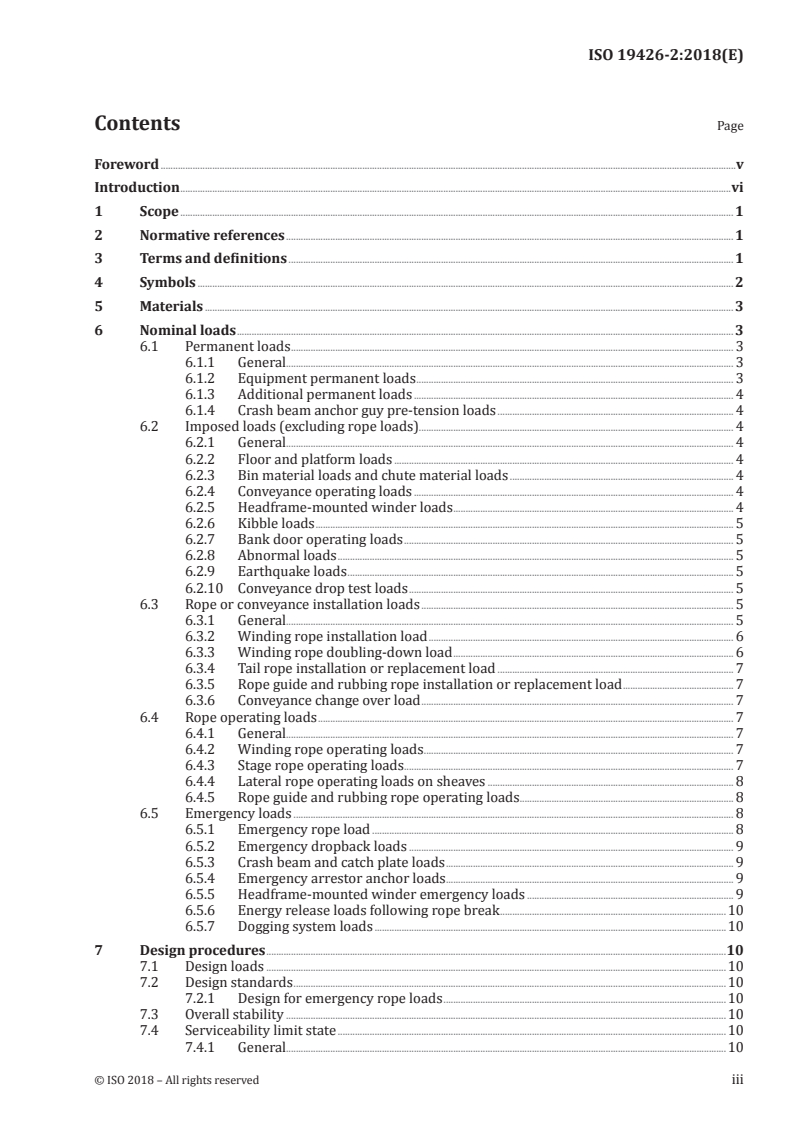
Contents Page
Foreword .v
Introduction .vi
1 Scope . 1
2 Normative references . 1
3 Terms and definitions . 1
4 Symbols . 2
5 Materials . 3
6 Nominal loads . 3
6.1 Permanent loads . 3
6.1.1 General. 3
6.1.2 Equipment permanent loads . 3
6.1.3 Additional permanent loads . 4
6.1.4 Crash beam anchor guy pre-tension loads . 4
6.2 Imposed loads (excluding rope loads). 4
6.2.1 General. 4
6.2.2 Floor and platform loads . 4
6.2.3 Bin material loads and chute material loads . 4
6.2.4 Conveyance operating loads . 4
6.2.5 Headframe-mounted winder loads . 4
6.2.6 Kibble loads . 5
6.2.7 Bank door operating loads . 5
6.2.8 Abnormal loads . 5
6.2.9 Earthquake loads . 5
6.2.10 Conveyance drop test loads . 5
6.3 Rope or conveyance installation loads . 5
6.3.1 General. 5
6.3.2 Winding rope installation load . 6
6.3.3 Winding rope doubling-down load . 6
6.3.4 Tail rope installation or replacement load . 7
6.3.5 Rope guide and rubbing rope installation or replacement load . 7
6.3.6 Conveyance change over load . 7
6.4 Rope operating loads . 7
6.4.1 General. 7
6.4.2 Winding rope operating loads . 7
6.4.3 Stage rope operating loads . 7
6.4.4 Lateral rope operating loads on sheaves . 8
6.4.5 Rope guide and rubbing rope operating loads . . 8
6.5 Emergency loads . 8
6.5.1 Emergency rope load . 8
6.5.2 Emergency dropback loads . 9
6.5.3 Crash beam and catch plate loads . 9
6.5.4 Emergency arrestor anchor loads . 9
6.5.5 Headframe-mounted winder emergency loads . 9
6.5.6 Energy release loads following rope break .10
6.5.7 Dogging system loads .10
7 Design procedures .10
7.1 Design loads .10
7.2 Design standards .10
7.2.1 Design for emergency rope loads .10
7.3 Overall stability .10
7.4 Serviceability limit state .10
7.4.1 General.10
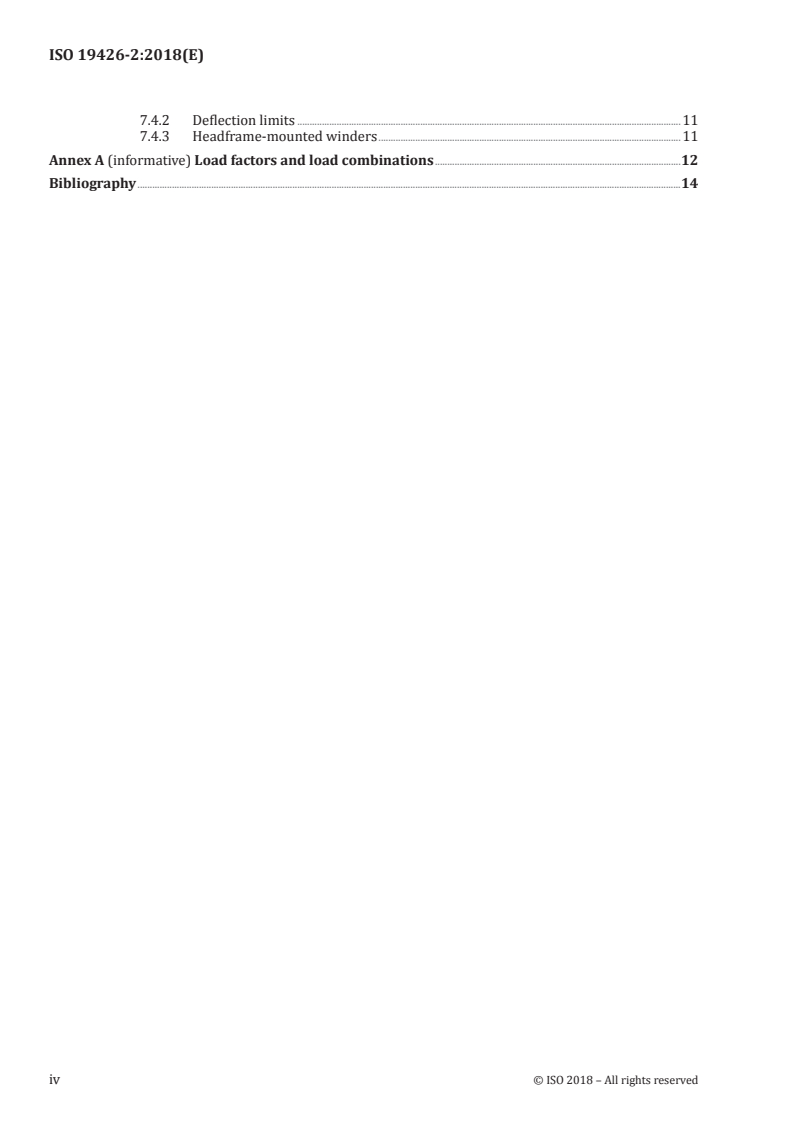
7.4.2 Deflection limits .11
7.4.3 Headframe-mounted winders .11
Annex A (informative) Load factors and load combinations .12
Bibliography .14
iv © ISO 2018 – All rights reserved
Foreword
ISO (the International Organization for Standardization) is a worldwide federation of national standards
bodies (ISO member bodies). The work of preparing International Standards is normally carried out
through ISO technical committees. Each member body interested in a subject for which a technical
committee has been established has the right to be represented on that committee. International
organizations, governmental and non-governmental, in liaison with ISO, also take part in the work.
ISO collaborates closely with the International Electrotechnical Commission (IEC) on all matters of
electrotechnical standardization.
The procedures used to develop this document and those intended for its further maintenance are
described in the ISO/IEC Directives, Part 1. In particular the different approval criteria needed for the
different types of ISO documents should be noted. This document was drafted in accordance with the
editorial rules of the ISO/IEC Directives, Part 2 (see www .iso .org/directives).
Attention is drawn to the possibility that some of the elements of this document may be the subject of
patent rights. ISO shall not be held responsible for identifying any or all such patent rights. Details of
any patent rights identified during the development of the document will be in the Introduction and/or
on the ISO list of patent declarations received (see www .iso .org/patents).
Any trade name used in this document is information given for the convenience of users and does not
constitute an endorsement.
For an explanation on the voluntary nature of standards, the meaning of ISO specific terms and
expressions related to conformity assessment, as well as information about ISO's adherence to the
World Trade Organization (WTO) principles in the Technical Barriers to Trade (TBT) see the following
URL: www .iso .org/iso/foreword .html.
This document was prepared by Technical Committee ISO/TC 82, Mining.
A list of all parts in the ISO 19426 series can be found on the ISO website.
Introduction
Many mining companies, and many of the engineering companies which provide designs for mines,
operate globally so ISO 19426 was developed in response to a desire for a unified global approach to
the safe and robust design of structures for mine shafts. The characteristics of ore bodies, such as
their depth and shape, vary in different areas so different design approaches have been developed and
proven with use over time in different countries. Bringing these approaches together in ISO 19426 will
facilitate improved safety and operational reliability.
The majority of the material in ISO 19426 deals with the loads to be applied in the design of structures
for mine shafts. Some principles for structural design are given, but for the most part it is assumed that
local standards will be used for the structural design.
vi © ISO 2018 – All rights reserved
INTERNATIONAL STANDARD ISO 19426-2:2018(E)
Structures for mine shafts —
Part 2:
Headframe structures
1 Scope
This document specifies the design loads and the design procedures for the structural design of
headframe structures of mine shafts and their components for permanent and sinking operations. The
headframe includes all structures and their foundations, that are required at the head of all vertical
and decline mine shafts for the purposes of supporting and installing winding and sinking ropes,
conveyance guides, rope guides and rubbing ropes, equipment for loading and unloading conveyances,
safety devices, as well as ancillary sinking and maintenance equipment. The headframe also includes
the bank and sub-bank levels.
This document does not cover matters of operational safety or layout of the headframe.
This document adopts a limit states design philosophy.
2 Normative references
The following documents are referred to in the text in such a way that some or all of their content
constitutes requirements of this document. For dated references, only the edition cited applies. For
undated references, the latest edition of the referenced document (including any amendments) applies.
ISO 2394, General principles on reliability for structures
ISO 3010, Bases for design of structures — Seismic actions on structures
ISO 12122-1, Timber structures — Determination of characteristic values — Part 1: Basic requirements
ISO 10721-1, Steel structures — Part 1: Materials and design
ISO 19338, Performance and assessment requirements for design standards on structural concrete
ISO 19426-1, Structures for mine shafts — Part 1: Vocabulary
ISO 19426-3, Structures for mine shafts — Part 3: Sinking stage
ISO 19426-4, Structures for mine shafts — Part 4: Conveyances
ISO 22111, Bases for design of structures — General requirements
3 Terms and definitions
For the purposes of this document, the terms and definitions given in ISO 19426-1 apply.
ISO and IEC maintain terminological databases for use in standardization at the following addresses:
— ISO Online browsing platform: available at http: //www .iso .org/obp
— IEC Electropedia: available at http: //www .electropedia .org
4 Symbols
D rope or conveyance installation load (N)
D winding rope doubling-down load (N)
dd
D rope guide or rubbing rope installation load (N)
g
D winding rope installation load (N)
h
D tail rope installation or replacement load (N)
t
D conveyance change-over load (N)
v
E emergency load (N)
E rope emergency load (N)
r
E and E tensions in the ropes on each side of the winder drum (N)
r1 r2
E energy release load following rope break (N)
re
E short circuit torque (Nm)
st
E winder brake failure load (Nm)
wb
e base for natural logarithms (mathematical constant)
F design load or load effect (N, Nm)
F pre-tension load of the crash-beam-anchor guy (N)
ag
F kibble load applied to the bank doors (N)
k
g gravity acceleration constant (m/s )
G permanent load or load effect (N, Nm)
G additional permanent load or load effect from rope guides and rubbing ropes (N)
a
G conveyance self-weight (N)
c
G weight of the relevant length of winding rope, rope guide or rubbing rope (N)
r
G weight of the relevant length of tail rope, rope guide or rubbing rope (N)
t
L full length of the rope guide or rubbing rope (m)
m unit mass of the rope guide or rubbing rope (kg/m)
r
n number of winding ropes
P payload used during doubling-down (N)
Q imposed load or load effect (excluding rope load) (N, Nm)
Q dominant imposed load or load effect under consideration (N, Nm)
Q to Q additional independent imposed loads or load effects (N, Nm)
3 n
R varying rope guide or rubbing rope horizontal load under operating conditions (N)
h
2 © ISO 2018 – All rights reserved
R varying rope guide or rubbing rope vertical load under operating conditions (N)
v
R to R rope operating loads (N)
1 n
minimum tension in a rope guide or rubbing rope, or the weight of the suspended ten-
T
r
sioning block (N)
T short circuit torque (Nm)
st
W weight of kibble and payload (N)
K
α rope or conveyance impact factor
c
α horizontal impact factor
ch
α temperature factor
cv
α short circuit torque impact factor
st
α vertical impact facto
v
μ coefficient of friction between winding rope and winder drum
γ partial load factor for all loads when combined with the rope emergency load (= 1,05)
e
γ partial load factor for permanent load
γ partial load factor for rope-operating load
f1
γ partial load factor for the dominant imposed load
f2
γ to γ partial load factors for imposed load
f3 fn
∑R governing combination of rope-operating loads under consideration
θ angle of wrap of winding rope on winder drum
Ψ to Ψ load combination factors.
3 n
5 Materials
The materials used in the construction of headframes shall be structural steel complying with
ISO 10721-1, structural concrete complying with ISO 19338 or structural timber complying with
ISO 12122. The material used shall be specified on the structural drawings.
6 Nomina
...
INTERNATIONAL ISO
STANDARD 19426-2
First edition
2018-05
Structures for mine shafts —
Part 2:
Headframe structures
Structures de puits de mine —
Partie 2: Chevalements
Reference number
©
ISO 2018
© ISO 2018
All rights reserved. Unless otherwise specified, or required in the context of its implementation, no part of this publication may
be reproduced or utilized otherwise in any form or by any means, electronic or mechanical, including photocopying, or posting
on the internet or an intranet, without prior written permission. Permission can be requested from either ISO at the address
below or ISO’s member body in the country of the requester.
ISO copyright office
CP 401 • Ch. de Blandonnet 8
CH-1214 Vernier, Geneva
Phone: +41 22 749 01 11
Fax: +41 22 749 09 47
Email: copyright@iso.org
Website: www.iso.org
Published in Switzerland
ii © ISO 2018 – All rights reserved
Contents Page
Foreword .v
Introduction .vi
1 Scope . 1
2 Normative references . 1
3 Terms and definitions . 1
4 Symbols . 2
5 Materials . 3
6 Nominal loads . 3
6.1 Permanent loads . 3
6.1.1 General. 3
6.1.2 Equipment permanent loads . 3
6.1.3 Additional permanent loads . 4
6.1.4 Crash beam anchor guy pre-tension loads . 4
6.2 Imposed loads (excluding rope loads). 4
6.2.1 General. 4
6.2.2 Floor and platform loads . 4
6.2.3 Bin material loads and chute material loads . 4
6.2.4 Conveyance operating loads . 4
6.2.5 Headframe-mounted winder loads . 4
6.2.6 Kibble loads . 5
6.2.7 Bank door operating loads . 5
6.2.8 Abnormal loads . 5
6.2.9 Earthquake loads . 5
6.2.10 Conveyance drop test loads . 5
6.3 Rope or conveyance installation loads . 5
6.3.1 General. 5
6.3.2 Winding rope installation load . 6
6.3.3 Winding rope doubling-down load . 6
6.3.4 Tail rope installation or replacement load . 7
6.3.5 Rope guide and rubbing rope installation or replacement load . 7
6.3.6 Conveyance change over load . 7
6.4 Rope operating loads . 7
6.4.1 General. 7
6.4.2 Winding rope operating loads . 7
6.4.3 Stage rope operating loads . 7
6.4.4 Lateral rope operating loads on sheaves . 8
6.4.5 Rope guide and rubbing rope operating loads . . 8
6.5 Emergency loads . 8
6.5.1 Emergency rope load . 8
6.5.2 Emergency dropback loads . 9
6.5.3 Crash beam and catch plate loads . 9
6.5.4 Emergency arrestor anchor loads . 9
6.5.5 Headframe-mounted winder emergency loads . 9
6.5.6 Energy release loads following rope break .10
6.5.7 Dogging system loads .10
7 Design procedures .10
7.1 Design loads .10
7.2 Design standards .10
7.2.1 Design for emergency rope loads .10
7.3 Overall stability .10
7.4 Serviceability limit state .10
7.4.1 General.10
7.4.2 Deflection limits .11
7.4.3 Headframe-mounted winders .11
Annex A (informative) Load factors and load combinations .12
Bibliography .14
iv © ISO 2018 – All rights reserved
Foreword
ISO (the International Organization for Standardization) is a worldwide federation of national standards
bodies (ISO member bodies). The work of preparing International Standards is normally carried out
through ISO technical committees. Each member body interested in a subject for which a technical
committee has been established has the right to be represented on that committee. International
organizations, governmental and non-governmental, in liaison with ISO, also take part in the work.
ISO collaborates closely with the International Electrotechnical Commission (IEC) on all matters of
electrotechnical standardization.
The procedures used to develop this document and those intended for its further maintenance are
described in the ISO/IEC Directives, Part 1. In particular the different approval criteria needed for the
different types of ISO documents should be noted. This document was drafted in accordance with the
editorial rules of the ISO/IEC Directives, Part 2 (see www .iso .org/directives).
Attention is drawn to the possibility that some of the elements of this document may be the subject of
patent rights. ISO shall not be held responsible for identifying any or all such patent rights. Details of
any patent rights identified during the development of the document will be in the Introduction and/or
on the ISO list of patent declarations received (see www .iso .org/patents).
Any trade name used in this document is information given for the convenience of users and does not
constitute an endorsement.
For an explanation on the voluntary nature of standards, the meaning of ISO specific terms and
expressions related to conformity assessment, as well as information about ISO's adherence to the
World Trade Organization (WTO) principles in the Technical Barriers to Trade (TBT) see the following
URL: www .iso .org/iso/foreword .html.
This document was prepared by Technical Committee ISO/TC 82, Mining.
A list of all parts in the ISO 19426 series can be found on the ISO website.
Introduction
Many mining companies, and many of the engineering companies which provide designs for mines,
operate globally so ISO 19426 was developed in response to a desire for a unified global approach to
the safe and robust design of structures for mine shafts. The characteristics of ore bodies, such as
their depth and shape, vary in different areas so different design approaches have been developed and
proven with use over time in different countries. Bringing these approaches together in ISO 19426 will
facilitate improved safety and operational reliability.
The majority of the material in ISO 19426 deals with the loads to be applied in the design of structures
for mine shafts. Some principles for structural design are given, but for the most part it is assumed that
local standards will be used for the structural design.
vi © ISO 2018 – All rights reserved
INTERNATIONAL STANDARD ISO 19426-2:2018(E)
Structures for mine shafts —
Part 2:
Headframe structures
1 Scope
This document specifies the design loads and the design procedures for the structural design of
headframe structures of mine shafts and their components for permanent and sinking operations. The
headframe includes all structures and their foundations, that are required at the head of all vertical
and decline mine shafts for the purposes of supporting and installing winding and sinking ropes,
conveyance guides, rope guides and rubbing ropes, equipment for loading and unloading conveyances,
safety devices, as well as ancillary sinking and maintenance equipment. The headframe also includes
the bank and sub-bank levels.
This document does not cover matters of operational safety or layout of the headframe.
This document adopts a limit states design philosophy.
2 Normative references
The following documents are referred to in the text in such a way that some or all of their content
constitutes requirements of this document. For dated references, only the edition cited applies. For
undated references, the latest edition of the referenced document (including any amendments) applies.
ISO 2394, General principles on reliability for structures
ISO 3010, Bases for design of structures — Seismic actions on structures
ISO 12122-1, Timber structures — Determination of characteristic values — Part 1: Basic requirements
ISO 10721-1, Steel structures — Part 1: Materials and design
ISO 19338, Performance and assessment requirements for design standards on structural concrete
ISO 19426-1, Structures for mine shafts — Part 1: Vocabulary
ISO 19426-3, Structures for mine shafts — Part 3: Sinking stage
ISO 19426-4, Structures for mine shafts — Part 4: Conveyances
ISO 22111, Bases for design of structures — General requirements
3 Terms and definitions
For the purposes of this document, the terms and definitions given in ISO 19426-1 apply.
ISO and IEC maintain terminological databases for use in standardization at the following addresses:
— ISO Online browsing platform: available at http: //www .iso .org/obp
— IEC Electropedia: available at http: //www .electropedia .org
4 Symbols
D rope or conveyance installation load (N)
D winding rope doubling-down load (N)
dd
D rope guide or rubbing rope installation load (N)
g
D winding rope installation load (N)
h
D tail rope installation or replacement load (N)
t
D conveyance change-over load (N)
v
E emergency load (N)
E rope emergency load (N)
r
E and E tensions in the ropes on each side of the winder drum (N)
r1 r2
E energy release load following rope break (N)
re
E short circuit torque (Nm)
st
E winder brake failure load (Nm)
wb
e base for natural logarithms (mathematical constant)
F design load or load effect (N, Nm)
F pre-tension load of the crash-beam-anchor guy (N)
ag
F kibble load applied to the bank doors (N)
k
g gravity acceleration constant (m/s )
G permanent load or load effect (N, Nm)
G additional permanent load or load effect from rope guides and rubbing ropes (N)
a
G conveyance self-weight (N)
c
G weight of the relevant length of winding rope, rope guide or rubbing rope (N)
r
G weight of the relevant length of tail rope, rope guide or rubbing rope (N)
t
L full length of the rope guide or rubbing rope (m)
m unit mass of the rope guide or rubbing rope (kg/m)
r
n number of winding ropes
P payload used during doubling-down (N)
Q imposed load or load effect (excluding rope load) (N, Nm)
Q dominant imposed load or load effect under consideration (N, Nm)
Q to Q additional independent imposed loads or load effects (N, Nm)
3 n
R varying rope guide or rubbing rope horizontal load under operating conditions (N)
h
2 © ISO 2018 – All rights reserved
R varying rope guide or rubbing rope vertical load under operating conditions (N)
v
R to R rope operating loads (N)
1 n
minimum tension in a rope guide or rubbing rope, or the weight of the suspended ten-
T
r
sioning block (N)
T short circuit torque (Nm)
st
W weight of kibble and payload (N)
K
α rope or conveyance impact factor
c
α horizontal impact factor
ch
α temperature factor
cv
α short circuit torque impact factor
st
α vertical impact facto
v
μ coefficient of friction between winding rope and winder drum
γ partial load factor for all loads when combined with the rope emergency load (= 1,05)
e
γ partial load factor for permanent load
γ partial load factor for rope-operating load
f1
γ partial load factor for the dominant imposed load
f2
γ to γ partial load factors for imposed load
f3 fn
∑R governing combination of rope-operating loads under consideration
θ angle of wrap of winding rope on winder drum
Ψ to Ψ load combination factors.
3 n
5 Materials
The materials used in the construction of headframes shall be structural steel complying with
ISO 10721-1, structural concrete complying with ISO 19338 or structural timber complying with
ISO 12122. The material used shall be specified on the structural drawings.
6 Nomina
...