

ISO/TS 20428:2024
(Main)Genomics Informatics — Data elements and their metadata for describing structured clinical genomic sequence information in electronic health records
General Information
- Abstract
The document defines the data elements and the requisite metadata essential for implementing a structured clinical genomic sequencing report in electronic health records, particularly focusing on the genomic data generated by next-generation sequencing technology. This document: — defines the composition of a structured clinical sequencing report (see Clause 6); — defines the required data fields and their metadata for a structured clinical sequencing report (see Clause 7); — defines the optional data (see Clause 8); — covers the DNA-level variation from human samples using whole genome sequencing, whole exome sequencing, and targeted sequencing (disease-targeted gene panels) by next-generation sequencing technologies (though whole transcriptome sequencing and other technologies are important to provide better patient care and enable precision medicine, this document only deals with DNA-level changes); — covers mainly clinical applications and clinical research such as clinical trials and translational research which uses clinical data (basic research and other scientific areas are outside the scope of this document); — does not cover the other biological species, i.e. genomes of viruses and microbes; — does not cover the Sanger sequencing methods.
- Status
- Published
- Publication Date
- 10-Jun-2024
- Technical Committee
- ISO/TC 215/SC 1 - Genomics Informatics
- Drafting Committee
- ISO/TC 215/SC 1 - Genomics Informatics
- Current Stage
- 6060 - International Standard published
- Start Date
- 11-Jun-2024
- Due Date
- 24-Aug-2024
- Completion Date
- 11-Jun-2024

Overview
ISO/TS 20428:2024 - Genomics Informatics - defines the data elements and metadata required to represent a structured clinical genomic sequencing report within electronic health records (EHRs). This Technical Specification focuses on DNA‑level variation produced by next‑generation sequencing (NGS) - whole genome sequencing (WGS), whole exome sequencing (WES), and targeted (disease‑targeted gene panel) sequencing - for clinical applications and clinical research. It is the second edition, updating the 2017 version to reflect advances in bioinformatics and broader clinical use.
Key topics and technical requirements
The document establishes a clear structure and nomenclature for clinical sequencing reports and their metadata. Major technical topics include:
- Composition of a clinical sequencing report (Clause 6): required sections such as summary interpretation and detailed content.
- Required data fields and metadata (Clause 7): subject/patient identifiers, sequencing order codes and dates, specimen and biomaterial details, performing laboratory and report generator information, associated diseases/phenotypes, and variant descriptions.
- Variant representation and classification: standardized capture of gene symbols, sequence variation information, pathogenicity and clinical relevance, and variant‑specific recommendations.
- Recommended treatment and clinical trial links: fields to record therapeutic guidance and trial information where applicable.
- Optional data elements (Clause 8): extended items such as family history/pedigree, reference genome version, population genomic context, karyotypic sex, and detailed sequencing/analysis metrics (quality control, platform and analysis information).
- Examples and implementation guidance: annex with example report structure to aid implementation.
Practical applications and users
ISO/TS 20428:2024 is intended for organizations implementing clinical genomics in healthcare and research settings, including:
- Clinical laboratories producing NGS reports
- Hospital IT teams and EHR vendors integrating genomic results
- Bioinformatics and clinical-decision support developers
- Clinical genomicists, genetic counselors and treating clinicians
- Sponsors and sites managing genomics-enabled clinical trials Adopting the standard improves interoperability, consistent capture of genomic data in EHRs, reliable information exchange for precision medicine, and reuse of structured data in translational research.
Related standards (applicability)
ISO/TS 20428:2024 is used alongside broader health‑informatics and genomic data‑sharing frameworks to enable end‑to‑end interoperability between laboratories, EHR systems, and research platforms. Implementers commonly align it with EHR interoperability standards and genomic consortium guidelines to support data exchange and clinical workflows.
Keywords: ISO/TS 20428:2024, genomics informatics, structured clinical sequencing report, electronic health records, next‑generation sequencing, DNA‑level variation, metadata, clinical genomics.
Relations
- Effective Date
- 06-Jun-2022
Get Certified
Connect with accredited certification bodies for this standard

BSI Group
BSI (British Standards Institution) is the business standards company that helps organizations make excellence a habit.

NYCE
Mexican standards and certification body.
Sponsored listings
Frequently Asked Questions
ISO/TS 20428:2024 is a technical specification published by the International Organization for Standardization (ISO). Its full title is "Genomics Informatics — Data elements and their metadata for describing structured clinical genomic sequence information in electronic health records". This standard covers: The document defines the data elements and the requisite metadata essential for implementing a structured clinical genomic sequencing report in electronic health records, particularly focusing on the genomic data generated by next-generation sequencing technology. This document: — defines the composition of a structured clinical sequencing report (see Clause 6); — defines the required data fields and their metadata for a structured clinical sequencing report (see Clause 7); — defines the optional data (see Clause 8); — covers the DNA-level variation from human samples using whole genome sequencing, whole exome sequencing, and targeted sequencing (disease-targeted gene panels) by next-generation sequencing technologies (though whole transcriptome sequencing and other technologies are important to provide better patient care and enable precision medicine, this document only deals with DNA-level changes); — covers mainly clinical applications and clinical research such as clinical trials and translational research which uses clinical data (basic research and other scientific areas are outside the scope of this document); — does not cover the other biological species, i.e. genomes of viruses and microbes; — does not cover the Sanger sequencing methods.
The document defines the data elements and the requisite metadata essential for implementing a structured clinical genomic sequencing report in electronic health records, particularly focusing on the genomic data generated by next-generation sequencing technology. This document: — defines the composition of a structured clinical sequencing report (see Clause 6); — defines the required data fields and their metadata for a structured clinical sequencing report (see Clause 7); — defines the optional data (see Clause 8); — covers the DNA-level variation from human samples using whole genome sequencing, whole exome sequencing, and targeted sequencing (disease-targeted gene panels) by next-generation sequencing technologies (though whole transcriptome sequencing and other technologies are important to provide better patient care and enable precision medicine, this document only deals with DNA-level changes); — covers mainly clinical applications and clinical research such as clinical trials and translational research which uses clinical data (basic research and other scientific areas are outside the scope of this document); — does not cover the other biological species, i.e. genomes of viruses and microbes; — does not cover the Sanger sequencing methods.
ISO/TS 20428:2024 is classified under the following ICS (International Classification for Standards) categories: 35.240.80 - IT applications in health care technology. The ICS classification helps identify the subject area and facilitates finding related standards.
ISO/TS 20428:2024 has the following relationships with other standards: It is inter standard links to ISO/TS 20428:2017. Understanding these relationships helps ensure you are using the most current and applicable version of the standard.
ISO/TS 20428:2024 is available in PDF format for immediate download after purchase. The document can be added to your cart and obtained through the secure checkout process. Digital delivery ensures instant access to the complete standard document.
Standards Content (Sample)
Technical
Specification
ISO/TS 20428
Second edition
Genomics Informatics — Data
2024-06
elements and their metadata for
describing structured clinical
genomic sequence information in
electronic health records
Informatique génomique — Éléments de données et leurs
métadonnées pour décrire les informations structurées de
la séquence génomique clinique dans les dossiers de santé
électroniques
Reference number
© ISO 2024
All rights reserved. Unless otherwise specified, or required in the context of its implementation, no part of this publication may
be reproduced or utilized otherwise in any form or by any means, electronic or mechanical, including photocopying, or posting on
the internet or an intranet, without prior written permission. Permission can be requested from either ISO at the address below
or ISO’s member body in the country of the requester.
ISO copyright office
CP 401 • Ch. de Blandonnet 8
CH-1214 Vernier, Geneva
Phone: +41 22 749 01 11
Email: copyright@iso.org
Website: www.iso.org
Published in Switzerland
ii
Contents Page
Foreword .v
Introduction .vi
1 Scope . 1
2 Normative references . 1
3 Terms and definitions . 1
4 Abbreviated terms . 5
5 Use case scenario . 6
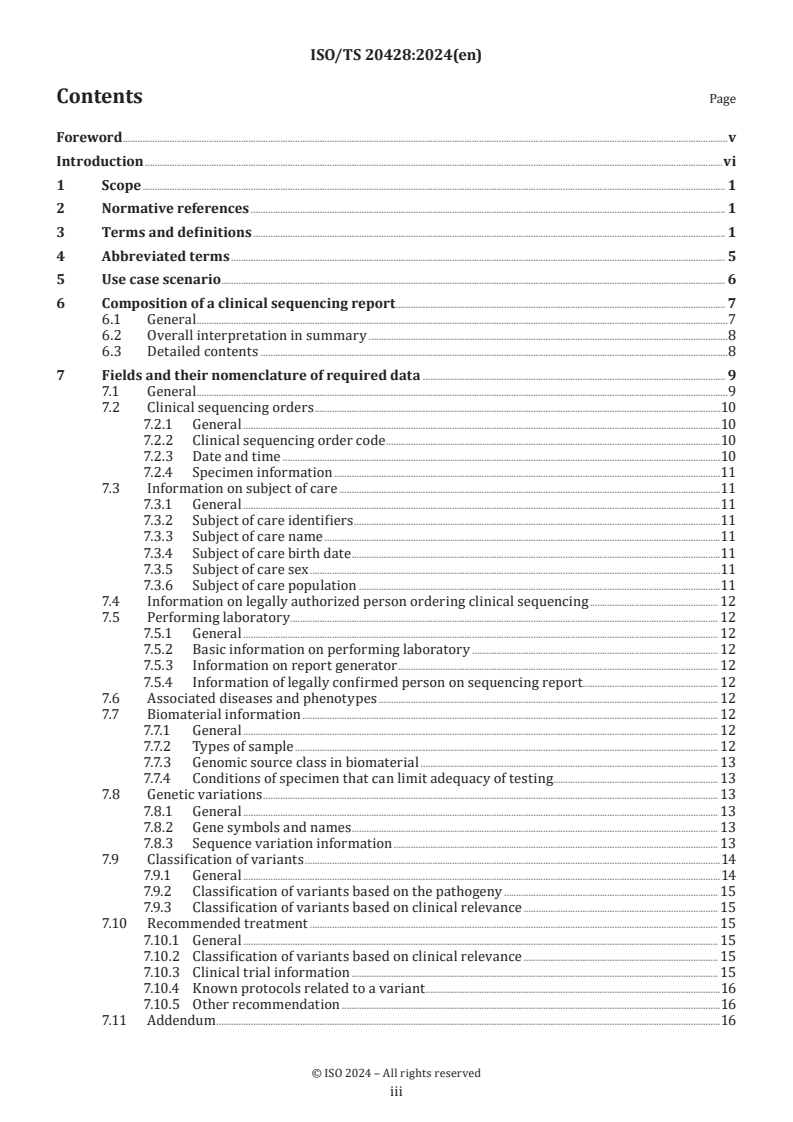
6 Composition of a clinical sequencing report . 7
6.1 General .7
6.2 Overall interpretation in summary .8
6.3 Detailed contents .8
7 Fields and their nomenclature of required data . 9
7.1 General .9
7.2 Clinical sequencing orders .10
7.2.1 General .10
7.2.2 Clinical sequencing order code .10
7.2.3 Date and time .10
7.2.4 Specimen information .11
7.3 Information on subject of care .11
7.3.1 General .11
7.3.2 Subject of care identifiers .11
7.3.3 Subject of care name .11
7.3.4 Subject of care birth date .11
7.3.5 Subject of care sex .11
7.3.6 Subject of care population .11
7.4 Information on legally authorized person ordering clinical sequencing . 12
7.5 Performing laboratory . 12
7.5.1 General . 12
7.5.2 Basic information on performing laboratory . 12
7.5.3 Information on report generator . 12
7.5.4 Information of legally confirmed person on sequencing report. 12
7.6 Associated diseases and phenotypes . 12
7.7 Biomaterial information . 12
7.7.1 General . 12
7.7.2 Types of sample . 12
7.7.3 Genomic source class in biomaterial . 13
7.7.4 Conditions of specimen that can limit adequacy of testing . . 13
7.8 Genetic variations . 13
7.8.1 General . 13
7.8.2 Gene symbols and names . . 13
7.8.3 Sequence variation information . 13
7.9 Classification of variants .14
7.9.1 General .14
7.9.2 Classification of variants based on the pathogeny . 15
7.9.3 Classification of variants based on clinical relevance . 15
7.10 Recommended treatment . 15
7.10.1 General . 15
7.10.2 Classification of variants based on clinical relevance . 15
7.10.3 Clinical trial information . 15
7.10.4 Known protocols related to a variant .16
7.10.5 Other recommendation .16
7.11 Addendum .16
iii
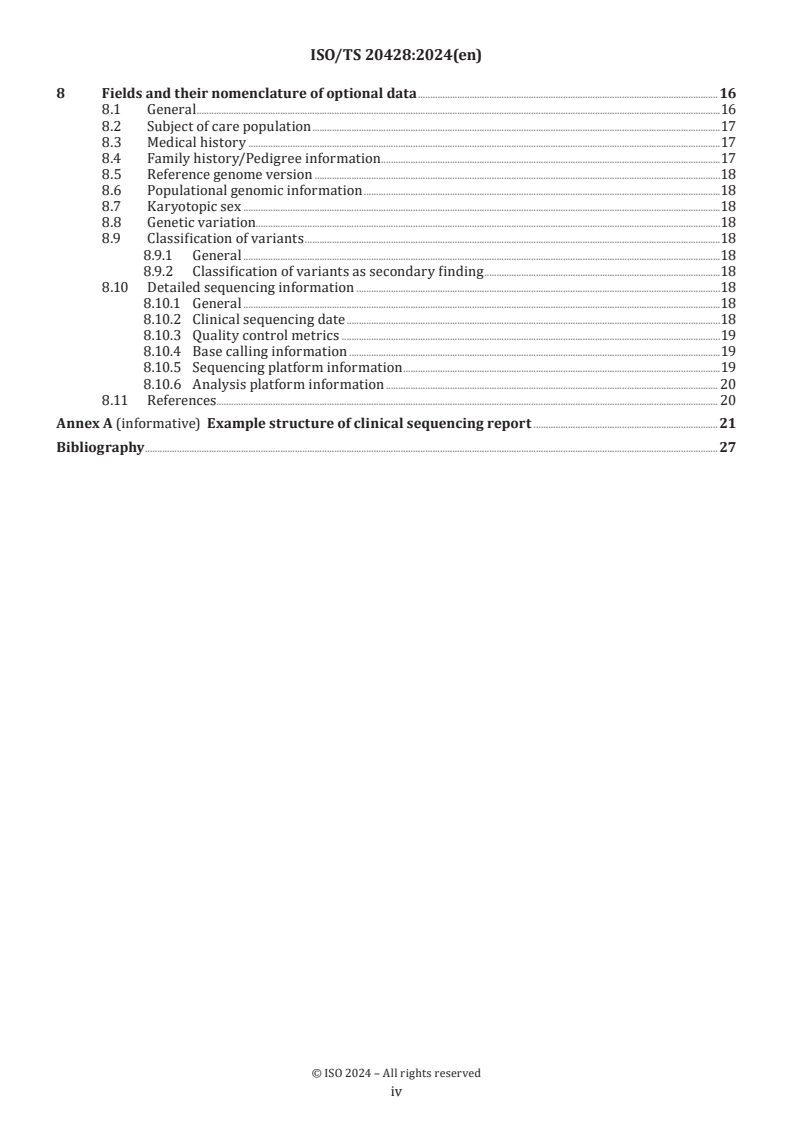
8 Fields and their nomenclature of optional data .16
8.1 General .16
8.2 Subject of care population .17
8.3 Medical history .17
8.4 Family history/Pedigree information .17
8.5 Reference genome version .18
8.6 Populational genomic information .18
8.7 Karyotopic sex .18
8.8 Genetic variation.18
8.9 Classification of variants .18
8.9.1 General .18
8.9.2 Classification of variants as secondary finding .18
8.10 Detailed sequencing information .18
8.10.1 General .18
8.10.2 Clinical sequencing date .18
8.10.3 Quality control metrics .19
8.10.4 Base calling information .19
8.10.5 Sequencing platform information .19
8.10.6 Analysis platform information . 20
8.11 References. 20
Annex A (informative) Example structure of clinical sequencing report .21
Bibliography .27
iv
Foreword
ISO (the International Organization for Standardization) is a worldwide federation of national standards
bodies (ISO member bodies). The work of preparing International Standards is normally carried out through
ISO technical committees. Each member body interested in a subject for which a technical committee
has been established has the right to be represented on that committee. International organizations,
governmental and non-governmental, in liaison with ISO, also take part in the work. ISO collaborates closely
with the International Electrotechnical Commission (IEC) on all matters of electrotechnical standardization.
The procedures used to develop this document and those intended for its further maintenance are described
in the ISO/IEC Directives, Part 1. In particular, the different approval criteria needed for the different types
of ISO document should be noted. This document was drafted in accordance with the editorial rules of the
ISO/IEC Directives, Part 2 (see www.iso.org/directives).
ISO draws attention to the possibility that the implementation of this document may involve the use of (a)
patent(s). ISO takes no position concerning the evidence, validity or applicability of any claimed patent
rights in respect thereof. As of the date of publication of this document, ISO had not received notice of (a)
patent(s) which may be required to implement this document. However, implementers are cautioned that
this may not represent the latest information, which may be obtained from the patent database available at
www.iso.org/patents. ISO shall not be held responsible for identifying any or all such patent rights.
Any trade name used in this document is information given for the convenience of users and does not
constitute an endorsement.
For an explanation of the voluntary nature of standards, the meaning of ISO specific terms and expressions
related to conformity assessment, as well as information about ISO's adherence to the World Trade
Organization (WTO) principles in the Technical Barriers to Trade (TBT), see www.iso.org/iso/foreword.html.
This document was prepared by Technical Committee ISO/TC 215, Health informatics.
This second edition cancels and replaces the first edition (ISO/TS 20428:2017), which has been technically
revised.
The main changes are as follows:
— title was updated;
— contents were enhanced to reflect advances in bioinformatics techniques and to cover more broad
clinical applications;
— terminology was refined for neural expression and elucidating content;
— Table 1 and Figure 1 were updated;
— Annex B was removed.
Any feedback or questions on this document should be directed to the user’s national standards body. A
complete listing of these bodies can be found at www.iso.org/members.html.
v
Introduction
Based on the rapid advancement of sequencing technologies, clinical sequencing has been highlighted as
one of methods to realize genomic medicine, personalized medicine and precision medicine. There are lots
[13]
of sequencing data in the public domain with clinical information. In addition, genome-scale clinical
[14]
sequencing is being adopted broadly in medical practice. Many hospitals have started to sequence
patients' whole genome, whole exome, or targeted genes using the next-generation sequencing technologies.
These genomic data obtained by next-generation sequencing technologies can be used for both clinical
purposes, to diagnose patients and choose the right medications, and research purposes. Therefore, the
management of genomic and clinical data are increasingly highlighted in precision medicine, clinical trial,
[15]
and translational research.
However, until now, there is no international standard for representing clinical sequencing results with a
structured format for electronic health records. Consequently, the necessary genomic test results are not
efficiently delivered to the clinicians. There are a few related standards for modelling genetic testing results
(i.e. ISO 25720 and several HL7 documents from HL7 clinical genomics working group). However, these
standards or drafts are mainly focused on the traditional genetic testing results for a single gene test. Based
on the rapid development and adoption of next-generation sequencing techniques which can detect diverse
genetic variants at the genome level, there is, therefore, still a need to develop a standard to present clinical
[16]
sequencing data in such a way they become useful for clinicians.
To implement a structured clinical sequencing report in electronic health records, all necessary data fields
and the metadata for each chosen field should be defined. For example, it needs to be determined which
vocabulary, in particular gene descriptions and/or disease codes, can be applied in particular fields. In
ISO TC 215, GSVML (Genomic Sequence Variation Markup Language) was proposed for the interoperability
[11]
of genomic variants, especially for single nucleotide polymorphism (SNP) data. HL7 is also developing a
[17]
domain analysis model for genomics using HL7 version 3 and fast healthcare interoperability resources
[18]
(FHIR). Recently, to facilitate genomic information, SMART on FHIR Genomics has been developed.
[19],[20]
The Clinical Data Interchange Standard Consortium (CDISC) published a study data tabulation model
[21]
implementation guide: pharmacogenomics/genetics. Several other international organizations, such as
the Global Alliance for Genomics and Health (GA4GH), Actionable Genome Consortium, and Displaying and
Integrating Genetic Information Through the EHR (DIGITizE) of the Institute of Medicine in the US, tried to
develop the similar standards. The working group of the American College of Medical Genetics and Genomics
Laboratory Quality Assurance Committee published the ACMG clinical laboratory standards for next-
[22]
generation sequencing. In addition, web-based tools become available that link genotypic information
to phenotypic information, and exchanging information and using it in personalized medicine can be very
[23]
helpful.
In this document, to enable the standard use of patient genomic data from clinical sequencing for healthcare
purposes as well as for clinical trials and research, the data elements and their metadata for a clinical
sequencing report for electronic health records are developed. This document further explains how and
where particular appropriate terminological systems that describe the genomes and/or diseases can
be applied in these fields. By defining the necessary fields with a structured format based on coded data
that adhere themselves to terminological principles such as concept representation and governance, this
document can help implement clinical decision support service.
vi
Technical Specification ISO/TS 20428:2024(en)
Genomics Informatics — Data elements and their metadata
for describing structured clinical genomic sequence
information in electronic health records
1 Scope
The document defines the data elements and the requisite metadata essential for implementing a structured
clinical genomic sequencing report in electronic health records, particularly focusing on the genomic data
generated by next-generation sequencing technology.
This document:
— defines the composition of a structured clinical sequencing report (see Clause 6);
— defines the required data fields and their metadata for a structured clinical sequencing report (see
Clause 7);
— defines the optional data (see Clause 8);
— covers the DNA-level variation from human samples using whole genome sequencing, whole exome
sequencing, and targeted sequencing (disease-targeted gene panels) by next-generation sequencing
technologies (though whole transcriptome sequencing and other technologies are important to provide
better patient care and enable precision medicine, this document only deals with DNA-level changes);
— covers mainly clinical applications and clinical research such as clinical trials and translational research
which uses clinical data (basic research and other scientific areas are outside the scope of this document);
— does not cover the other biological species, i.e. genomes of viruses and microbes;
— does not cover the Sanger sequencing methods.
2 Normative references
There are no normative references in this document.
3 Terms and definitions
For the purposes of this document, the following terms and definitions apply.
ISO and IEC maintain terminology databases for use in standardization at the following addresses:
— ISO Online browsing platform: available at https:// www .iso .org/ obp
— IEC Electropedia: available at https:// www .electropedia .org/
3.1
allele
one of several alternate forms of a gene (3.15) which occur at the same locus on homologous chromosomes
(3.4) and which become separated during meiosis and can be recombined following fusion of gametes
[SOURCE: ISO 16577:2016, 3.4]
3.2
benign
benign variant
alterations with very strong evidence against pathogenicity
3.3
biomaterial
materials taken from the human body such as tissue, blood, plasma, or urine
3.4
chromosome
structure that comprises discrete packages of DNA (3.11) and proteins that carries genetic information
which condense to form characteristically shaped bodies during nuclear division
[SOURCE: ISO 19238:2014, 2.7]
3.5
clinical sequencing
next-generation sequencing or later sequencing technologies with human samples for clinical practice and
clinical trials
3.6
ClinVar
freely accessible, public archive of reports of the relationships among human variations (3.31) and
phenotypes, with supporting evidence variant (3.31)
Note 1 to entry: ClinVar is available at https:// www .ncbi .nlm .nih .gov/ clinvar/ .
3.7
copy number variation
CNV
variation (3.31) in the number of copies of one or more sections of the DNA (3.11)
3.8
Catalogue of Somatic Mutations in Cancer
COSMIC
online database of somatically acquired mutations found in human cancer
Note 1 to entry: COSMIC is available at http:// cancer .sanger .ac .uk/ cosmic.
3.9
dbSNP
database of SNPs (3.32) provided by the US National Center for Biotechnology Information (NCBI)
Note 1 to entry: dbSNP is available at https:// www .ncbi .nlm .nih .gov/ snp/ .
3.10
deletion
variant (3.31) in which a part of a chromosome (3.4) or a sequence of DNA (3.11) is lost during DNA replication
3.11
deoxyribonucleic acid
DNA
molecule that encodes genetic information in the nucleus of cells
[SOURCE: ISO 25720:2009, 4.7]
3.12
DNA sequencing
determining the order of nucleotide bases (adenine, guanine, cytosine and thymine) in a molecule of DNA (3.11)
Note 1 to entry: Sequence is generally described from the 5’ end.
[SOURCE: ISO/TS 17822-1:2014, 3.20]
3.13
electronic medical record
EMR
electronic health record
EHR
electronic record derived from a computerized system used primarily for delivering patient care in a
clinical setting
[SOURCE: ISO/TR 24291:2021, 3.3, modified — The preferred term “electronic health record” and its
abbreviation “EHR” have been added.]
3.14
exome
part of the genome formed by exons
3.15
gene
basic unit of hereditary material that encodes and controls the expression of a protein or protein subunit
[SOURCE: ISO 11238:2012, 2.1.16]
3.16
gene panel
technique for sequencing the targeted genes (3.15) in a genome
3.17
genomic medicine
medical discipline that involves using genomic information about an individual as part of their clinical care
(e.g. for diagnostic or therapeutic decision-making) and the health outcomes and policy implications of that
clinical use
3.18
germline
series of germ cells each descended or developed from earlier cells in the series, regarded as continuing
through successive generations of an organism
3.19
indel
insertion (3.20) or/and deletion (3.10)
3.20
insertion
addition of one or more nucleotide base pairs into a DNA (3.11) sequence
3.21
inversion
chromosome (3.4) rearrangement in which a segment of a chromosome is reversed end to end
3.22
large indel
insertion (3.20) or deletion (3.10) of greater than 100 nucleotides and less than 1 000 nucleotides
3.23
likely benign
likely benign variant
alterations with strong evidence against pathogenicity
Note 1 to entry: Targeted testing of at-risk family members is not recommended.
3.24
likely pathogenic
likely pathogenic variant
alterations with strong evidence in favour of pathogenicity
3.25
pathogenic
pathogenic variant
genetic alteration that increases an individual’s susceptibility or predisposition to a certain disease or
disorder
[SOURCE: National Cancer Institute Dictionary of Genetic Terms]
3.26
prenatal
foetal
biomaterial (3.3) sample of foetuses before birth
Note 1 to entry: Prenatal DNA sequencing (3.12) is the reading of the DNA (3.11) of foetuses to diagnose Mendelian
disease of an unborn child.
3.27
sequence read
read
fragmented nucleotide sequences which are used to reconstruct the original sequence for next generation
sequencing technologies
3.28
read type
type of sequence read (3.27) whose format depends on the sequencing instrument
Note 1 to entry: It can be either single-end or paired-end.
Note 2 to entry: Single-end read are produced when the sequencing instrument reads from one end of a fragment to
the other end.
Note 3 to entry: Paired-end reads are produced when the sequencing instrument reads from one end to the other end,
and then starts another round of reading from the opposite end.
3.29
reference sequence
digital nucleic acid sequence database, assembled by scientists as a representative example of human genome
3.30
ribonucleic acid
RNA
polymer of ribonucleotides occurring in a double-stranded or single-stranded form
[SOURCE: ISO 22174:2005, 3.1.3]
3.31
sequence variation
DNA sequence variation
variation
variant
differences of DNA (3.11) sequence among individuals in a population
Note 1 to entry: Variant implies CNV (3.7), deletion (3.10), insertion (3.20), indel (3.19), small indel (3.33), large indel
(3.22), and SNP (3.32).
[SOURCE: ISO 25720:2009, 4.8, modified — The preferred terms “sequence variation”, “variation” and
“variant” have been added; the original note has been deleted and a new Note 1 to entry has been added.]
3.32
single nucleotide polymorphism
SNP
single nucleotide variation (3.31) in a genetic sequence that occurs at appreciable frequency in the population
Note 1 to entry: It is pronounced “snip”.
[SOURCE: ISO 25720:2009, 4.23, modified — Note 1 to entry has been added.]
3.33
small indel
insertion (3.20) or deletion (3.10) of 2 to 100 nucleotides
3.34
somatic variant
variant (3.31) that occurs in the cells of the body that are not germ line cells
3.35
biological specimen
biospecimen
specimen
sample of tissue, body fluid, food, or other substance that is collected or acquired to support the assessment,
diagnosis, treatment, mitigation or prevention of a disease, disorder or abnormal physical state, or its
symptoms
3.36
subject of care
SOC
person who uses, or is a potential user of, a health care service
[SOURCE: ISO/TS 22220:2011, 3.2, modified — The admitted term “subject of healthcare” and the Note have
been removed.]
3.37
target capture
method to capture genomic regions of interest from a DNA (3.11) sample prior to sequencing
3.38
uncertain significance
uncertain clinical relevance
variant (3.31) with limited and/or conflicting evidence regarding pathogenicity
3.39
whole exome sequencing
WES
technique for sequencing all the protein-coding genes in a genome
3.40
whole genome sequencing
WGS
technique that determines the complete DNA (3.11) sequence of an organism's genome at a single time
4 Abbreviated terms
This list of abbreviated terms includes all abbreviations used in this document.
ACMG the American College of Medical Genetics and Genomics
COSMIC the Catalogue of Somatic Mutations in Cancer
CPIC the Clinical Pharmacogenetics Implementation Consortium
ENUM Enumerated type
EHR Electronic Health Record
FHIR Fast Healthcare Interoperability Resources
HGNC the HUGO Gene Nomenclature Committee
HGVS the Human Genome Variation Society
HUGO the Human Genome Organization
IARC International Agency for Research on Cancer
LOINC Logical Observation Identifiers Names and Codes
NCBI National Center for Biotechnology Information
NCCN National Comprehensive Cancer Network
NGS Next Generation Sequencing
SNP Single Nucleotide Polymorphism
SPREC Standard Preanalytical Code
5 Use case scenario
The abstracted use case for generating a clinical genomic sequencing report is demonstrated in Figure 1. At
first, the clinician places a clinical sequencing order using the electronic health records (EHRs) system (step 1
in Figure 1). After the order, a responsible department requests DNA sequencing to the sequencing facility
(step 2). This sequencing facility can be located inside the hospital or it can be an independent sequencing
facility outside the hospital (step 3). When confirming the order, the sequencing facility requests a sample
from the patient (step 4). The hospital collects a sample from the patient (steps 5 and 6). Pre-collected
samples (i.e. biobank samples) or samples acquired by a previous laboratory or pathology orders can be used
as well. The biomaterial from the patients is delivered to the sequencing facility (step 7). After receipt, the
sequencing facility performs a sequencing analysis (step 8) and generates the report (step 9). This report is
sent to the requested hospital (step 10), and the report is updated in the EHR system (step 11). The ordering
clinician is notified of the completion of the sequencing order (step 12). Finally, the ordering clinician makes
a diagnosis or gives a proper treatment (step 13). A patient can have a copy of the final report.
Figure 1 — Abstracted flow of generating clinical genomic sequencing report
The possible use cases for the clinical sequencing orders are well described in Reference [17].
6 Composition of a clinical sequencing report
6.1 General
The structured clinical sequencing report may mainly consist of two parts: the summary part and the
detailed contents part as in Figure 2. The summary part can include the subset of required fields to help
[24],[25]
clinicians quickly overview the most important findings concisely. The detailed content part should
contain all required fields and the selected optional fields. Annex A contains an example of the summary
part and the detailed contents of a clinical sequencing report.
This document only defines the data elements and their metadata for the structured clinical sequencing
report in EHRs. Therefore, its layout can be designed based on the institutional decision if all elements are
included as in this document.
Figure 2 — Composition of a clinical sequencing report
6.2 Overall interpretation in summary
The summary part should report the overall interpretation of a genomic test with a succinct description:
[22]
identified, not identified, inconclusive, or carrier. Table 1 summarizes each interpretation.
Table 1 — Overall interpretation in the summary part
Interpretation Remarks
Identified detection of a variant that explains a patient’s condition
Not identified no variant identified of likely relevance to the diagnostic indication
a
Inconclusive a clear explanation of the patient’s condition was not found
Carrier identification of variants of recessive carrier screening tests
a
Inconclusive can result from variants of unknown significance being identified, or from a single heterozygous variant being
identified for a recessive condition.
6.3 Detailed contents
The detailed contents consist of two parts: the required and optional fields. The detailed content part should
contain all required fields and the selected optional fields. HL7 Implementation Guide for CDA Release 2
[33]
Genetic Testing Report can be a good example. However, HL7 Genetic Testing Report only focuses on the
single gene test and does not cover next-generation sequencing technology.
The required fields mainly focus on helping clinicians by providing the necessary genomic information,
interpretation results and the related treatments. They include all necessary fields for clinical practice. The
optional fields give more detailed information to clinicians. They also can facilitate translational research
with the necessary steps such as de-identification or consent from the patient. In Reference [24], the data
fields for the molecular genetic report templates were categorized into “required”, “optional”, “possible” and
“not necessary” based on the survey. The data fields in this document were re-categorized to implement a
structured clinical sequencing report by reviewing the existing free-text format sequencing report.
7 Fields and their nomenclature of required data
7.1 General
The required fields are chosen for clinical practice. The information which can be only described in the
clinical sequencing report is included in the required fields to minimize the length of clinical sequencing
report. Cardinality indicates that this data element shall appear once in the report (1.1), one to many (1.N),
or zero to many (0.N). The other relevant information can be included in the optional fields or other clinical
reports in the EHRs. The summary of data elements and their metadata is shown in Table 2.
Table 2 — Data elements and their metadata for required fields
Data elements Metadata (primary) Cardinality
Order code LOINC
Clinical sequencing
1.1
Information on
order code
TEXT
sequencing order
Order date
Specimen collection
Clinical sequencing
date
1.1
orders
Date and time Order received date ISO 8601
Report date
Addendum creation
0.N
date
Specimen information ISO/TS 22220:2011 1.1
Identifiers
ISO/TS 22220:2011
Name
Information on subject
Birth date ISO 8601 1.1
of care
Sex ISO/TS 22220:2011
Population HL7 v3 Code System Race
Information of legally authorized person ordering clinical sequencing ISO/TS 27527:2010 1.1
Basic information TEXT
Information of report generator TEXT
Performing laboratory 1.1
Information of legally confirmed person on
ISO/TS 27527:2010
sequencing report
ICD code with the version
Associated diseases and phenotypes 0.N
used
Type of sample SPREC
Biomaterial information Genomic source class in biomaterial LOINC 0.N
Conditions of specimen TEXT
Gene symbols and names HGNC
Notation HGVS
Effects of variants TEXT
Genetic variations 0.N
Sequence variation
(Name/version of the
information
reference database)
Sequence variant ID
Database unique ID
a
ENUM indicates the contents should be chosen among the given category.
TTabablele 2 2 ((ccoonnttiinnueuedd))
Data elements Metadata (primary) Cardinality
ENUM (“Pathogenic”, “Likely
pathogenic”, “Unknown sig-
Pathogeny
nificance”, “Likely benign”,
a
“Benign”)
Classification of variants
ENUM (“Identified”, “Likely
Clinical relevance identified”, “Uncertain”, “Not
0.N
identified”)
Medication ISO 11615
Clinical trial information Clinical trial ID
Recommended treat-
ment
Known protocols related to a variant TEXT
Other recommendation TEXT
a
ENUM indicates the contents should be chosen among the given category.
7.2 Clinical sequencing orders
7.2.1 General
When a clinician orders a clinical genomic sequencing, the order code and the required date information
should be given.
7.2.2 Clinical sequencing order code
7.2.2.1 Order code
The relevant clinical sequencing orders should be represented following guidance established in
LOINC (Logical Observation Identifiers Names and Codes) with the used LOINC coding system version.
Unfortunately, there are no LOINC codes for the given clinical sequencing orders, but only molecular genetic
codes until now. When LOINC codes become available, this can be considered. In the meantime, other
international, national or institutional coding system can be alternatively used, for example CPT (Current
Procedure Terminology) in the US or NPU (Nomenclature for Properties and Units) in the Scandinavian
countries.
7.2.2.2 Information on sequencing order
If the order code cannot fully describe the purpose of the clinical sequencing, the detailed description of the
sequencing can be added as free text, for example the sequencing panel name with gene information.
7.2.3 Date and time
7.2.3.1 General
For a clinical sequencing report, diverse dates and times should be reported due to time delay. All dates and
times in the report should be represented following guidance established in ISO 8601.
7.2.3.2 Order date
Order date is the date on which the clinician ordered the necessary clinical genomic sequencing.
7.2.3.3 Order received date
Order received date is the date that the performing laboratory received and confirmed the clinical genomic
sequencing order.
7.2.3.4 Specimen collection date
Specimen collection date indicates the date when the specimen was taken from the patient or tissue.
7.2.3.5 Report date
Report date is the date when the performing laboratory generates the sequencing report.
7.2.3.6 Addendum creation date
Addendum creation date is the date when the performing laboratory creates the addendum of the previous
report using up-to-date information. The analysis pipelines or referred database is updated due to technology
advancement. The reference sequence is regularly updated. In addition, when updating, the performing
laboratory should create the addendum of the existing sequencing report based on the clinician’s request.
7.2.4 Specimen information
The specimen information can be represented by subject of care identifier type code from ISO 22220:2011.
EXAMPLE 13-S-048435_A1 ‒ Pathology Number: ISO 22220:2011 [SOC identifier designation: 13-S-048435_A1,
SOC identifier geographic area: 1 (local), SOC identifier issuer: AMC (ABC Medical Center), 02 (speciality number ‒
pathology)].
7.3 Information on subject of care
7.3.1 General
Information on the subject of care whose specimen was sequenced should be represented following guidance
established in ISO 22220:2011, i.e. 12345678 ‒ ISO 22220:2011 [SOC identifier designation: 12345678, SOC
identifier geographic area: 1 (local), SOC identifier issuer: AMC (ABC Medical Center), 01 (unique identifier
for issuer)].
7.3.2 Subject of care identifiers
The unique identifiers for subjects of care should be included.
7.3.3 Subject of care name
The subject of care's name should be given.
7.3.4 Subject of care birth date
The subject of care’s birth date should be given to calculate the patient’s age. Birth date should be represented
following guidance established in by ISO 8601.
7.3.5 Subject of care sex
The subject of care’s sex should be represented following guidance established in ISO 22220:2011.
7.3.6 Subject of care population
The population of the subject of care should be notified to represent his or her genetic origin. The
1)
population information should be represented following guidance established in HL7 v3 Code System Race .
Alternatively, if there are national standards, those coding systems can be used, for example the US FDA
[26]
guidance for Industry ‒ from Collection of Race and Ethnicity data in Clinical Trials.
1) https:// terminology .hl7 .org/ 2 .0 .0/ CodeSystem -v3 -Race .html
7.4 Information on legally authorized person ordering clinical sequencing
Information on the legally authorized person who ordered the clinical sequencing can be represented by
ISO/TS 27527:2010.
The detailed items of this field such as the name of ordering physician, their medical speciality, or contact
numbers, can be chosen by the implem
...