


ISO/IEC 2382-34:1999
(Main)Information technology — Vocabulary — Part 34: Artificial intelligence — Neural networks
Information technology — Vocabulary — Part 34: Artificial intelligence — Neural networks
Technologies de l'information — Vocabulaire — Partie 34: Intelligence artificielle — Réseaux neuronaux
General Information
- Status
- Withdrawn
- Publication Date
- 18-Aug-1999
- Withdrawal Date
- 18-Aug-1999
- Technical Committee
- ISO/IEC JTC 1 - Information technology
- Drafting Committee
- ISO/IEC JTC 1 - Information technology
- Current Stage
- 9599 - Withdrawal of International Standard
- Start Date
- 29-Apr-2015
- Completion Date
- 12-Feb-2026
Relations
- Effective Date
- 23-Feb-2013
Get Certified
Connect with accredited certification bodies for this standard

BSI Group
BSI (British Standards Institution) is the business standards company that helps organizations make excellence a habit.

NYCE
Mexican standards and certification body.
Sponsored listings
Frequently Asked Questions
ISO/IEC 2382-34:1999 is a standard published by the International Organization for Standardization (ISO). Its full title is "Information technology — Vocabulary — Part 34: Artificial intelligence — Neural networks". This standard covers: Information technology — Vocabulary — Part 34: Artificial intelligence — Neural networks
Information technology — Vocabulary — Part 34: Artificial intelligence — Neural networks
ISO/IEC 2382-34:1999 is classified under the following ICS (International Classification for Standards) categories: 01.040.35 - Information technology (Vocabularies); 35.020 - Information technology (IT) in general. The ICS classification helps identify the subject area and facilitates finding related standards.
ISO/IEC 2382-34:1999 has the following relationships with other standards: It is inter standard links to ISO/IEC 2382:2015. Understanding these relationships helps ensure you are using the most current and applicable version of the standard.
ISO/IEC 2382-34:1999 is available in PDF format for immediate download after purchase. The document can be added to your cart and obtained through the secure checkout process. Digital delivery ensures instant access to the complete standard document.
Standards Content (Sample)
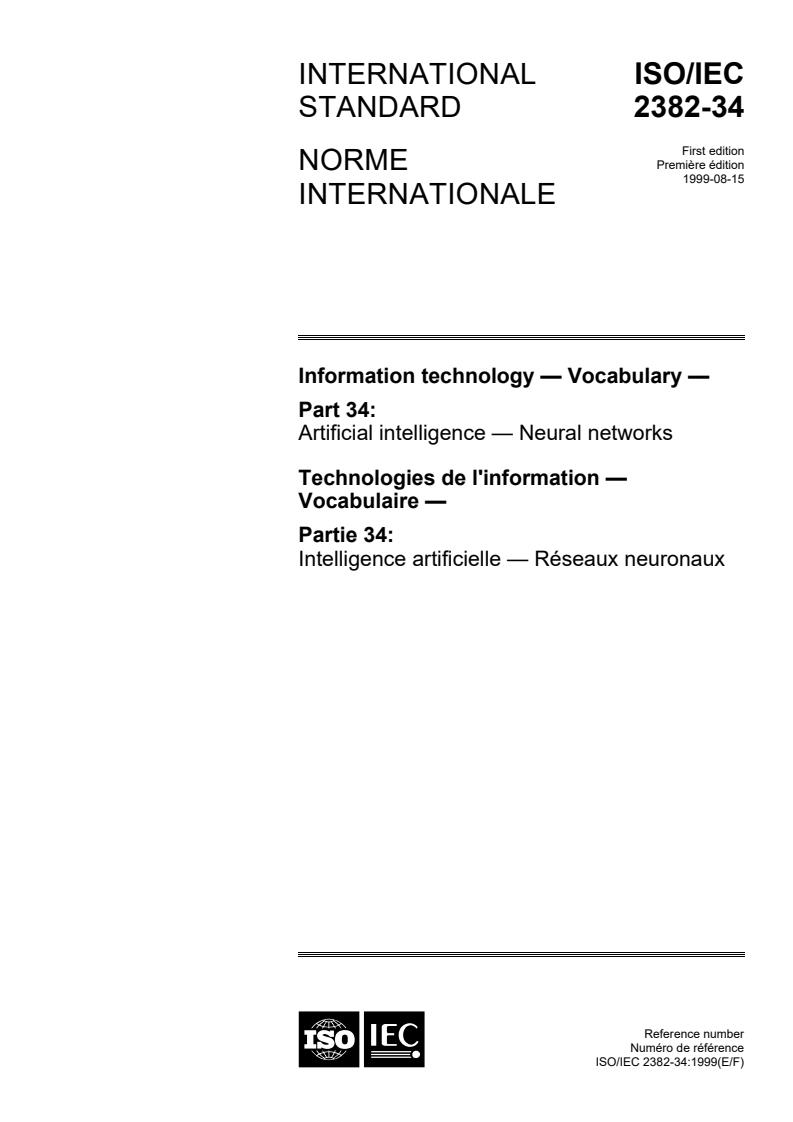
INTERNATIONAL ISO/IEC
STANDARD 2382-34
First edition
Première édition
NORME
1999-08-15
INTERNATIONALE
Information technology — Vocabulary —
Part 34:
Artificial intelligence — Neural networks
Technologies de l'information —
Vocabulaire —
Partie 34:
Intelligence artificielle — Réseaux neuronaux
Reference number
Numéro de référence
bc
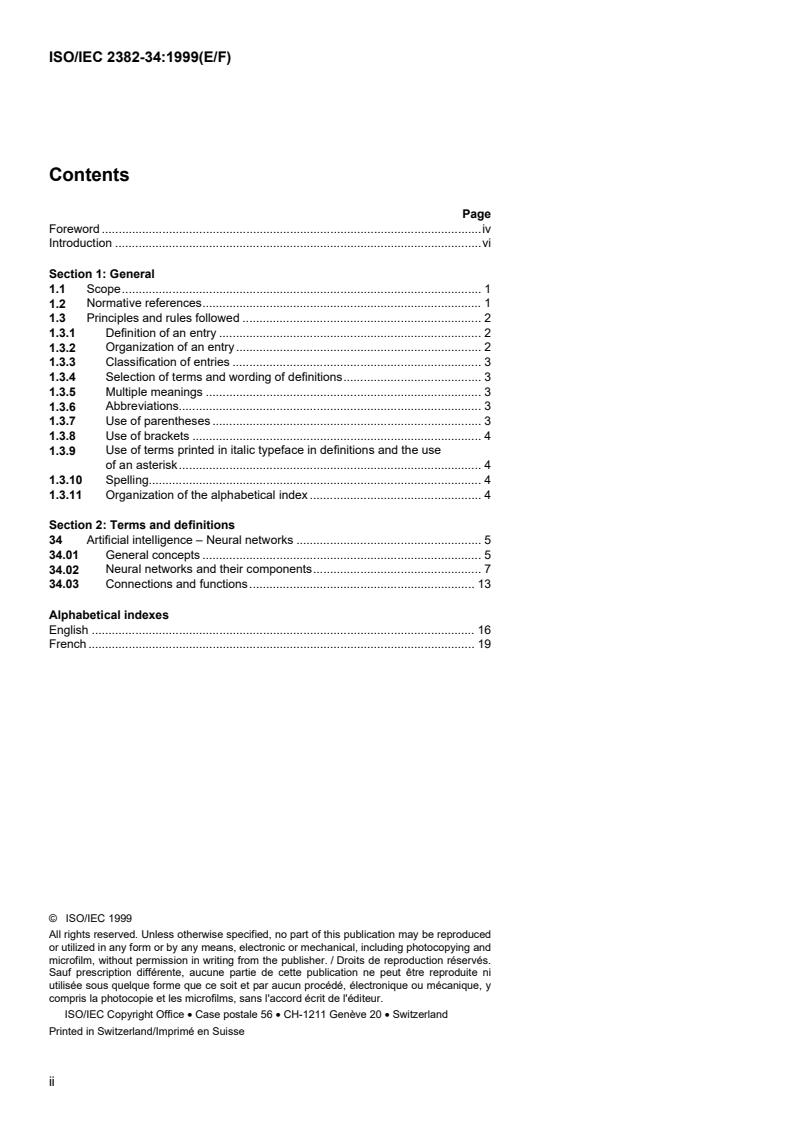
Contents
Page
Foreword .iv
Introduction .vi
Section 1: General
1.1 Scope. 1
1.2 Normative references. 1
1.3 Principles and rules followed . 2
1.3.1 Definition of an entry . 2
1.3.2 Organization of an entry. 2
1.3.3 Classification of entries . 3
1.3.4 Selection of terms and wording of definitions. 3
Multiple meanings . 3
1.3.5
Abbreviations. 3
1.3.6
Use of parentheses . 3
1.3.7
1.3.8 Use of brackets . 4
1.3.9 Use of terms printed in italic typeface in definitions and the use
of an asterisk. 4
1.3.10 Spelling. 4
1.3.11 Organization of the alphabetical index . 4
Section 2: Terms and definitions
34 Artificial intelligence – Neural networks . 5
34.01 General concepts . 5
34.02 Neural networks and their components. 7
34.03 Connections and functions. 13
Alphabetical indexes
English . 16
French . 19
© ISO/IEC 1999
All rights reserved. Unless otherwise specified, no part of this publication may be reproduced
or utilized in any form or by any means, electronic or mechanical, including photocopying and
microfilm, without permission in writing from the publisher. / Droits de reproduction réservés.
Sauf prescription différente, aucune partie de cette publication ne peut être reproduite ni
utilisée sous quelque forme que ce soit et par aucun procédé, électronique ou mécanique, y
compris la photocopie et les microfilms, sans l'accord écrit de l'éditeur.
ISO/IEC Copyright Office • Case postale 56 • CH-1211 Genève 20 • Switzerland
Printed in Switzerland/Imprimé en Suisse
ii
©
ISO/IEC ISO/IEC 2382-34:1999(E/F)
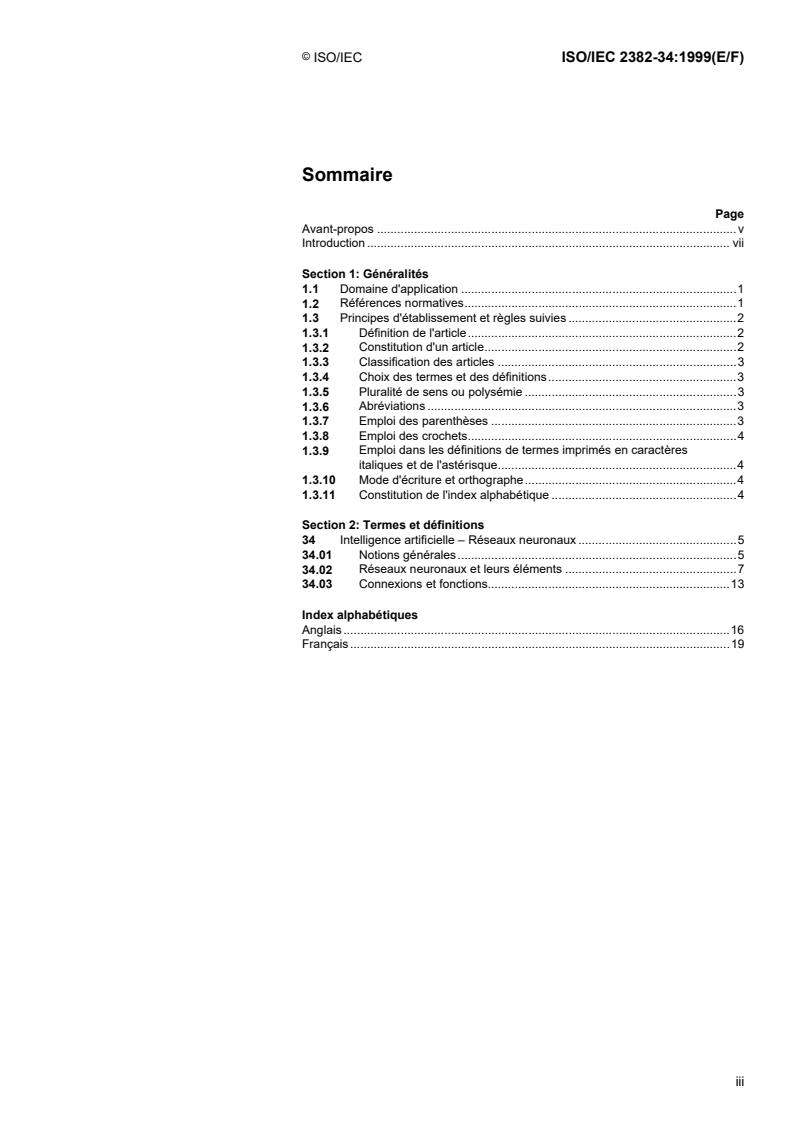
Sommaire
Page
Avant-propos .v
Introduction . vii
Section 1: Généralités
1.1 Domaine d'application .1
1.2 Références normatives.1
1.3 Principes d'établissement et règles suivies .2
1.3.1 Définition de l'article.2
1.3.2 Constitution d'un article.2
1.3.3 Classification des articles .3
1.3.4 Choix des termes et des définitions.3
Pluralité de sens ou polysémie .3
1.3.5
Abréviations .3
1.3.6
Emploi des parenthèses .3
1.3.7
1.3.8 Emploi des crochets.4
1.3.9 Emploi dans les définitions de termes imprimés en caractères
italiques et de l'astérisque.4
1.3.10 Mode d'écriture et orthographe.4
1.3.11 Constitution de l'index alphabétique .4
Section 2: Termes et définitions
34 Intelligence artificielle – Réseaux neuronaux .5
34.01 Notions générales.5
34.02 Réseaux neuronaux et leurs éléments .7
34.03 Connexions et fonctions.13
Index alphabétiques
Anglais .16
Français .19
iii
©
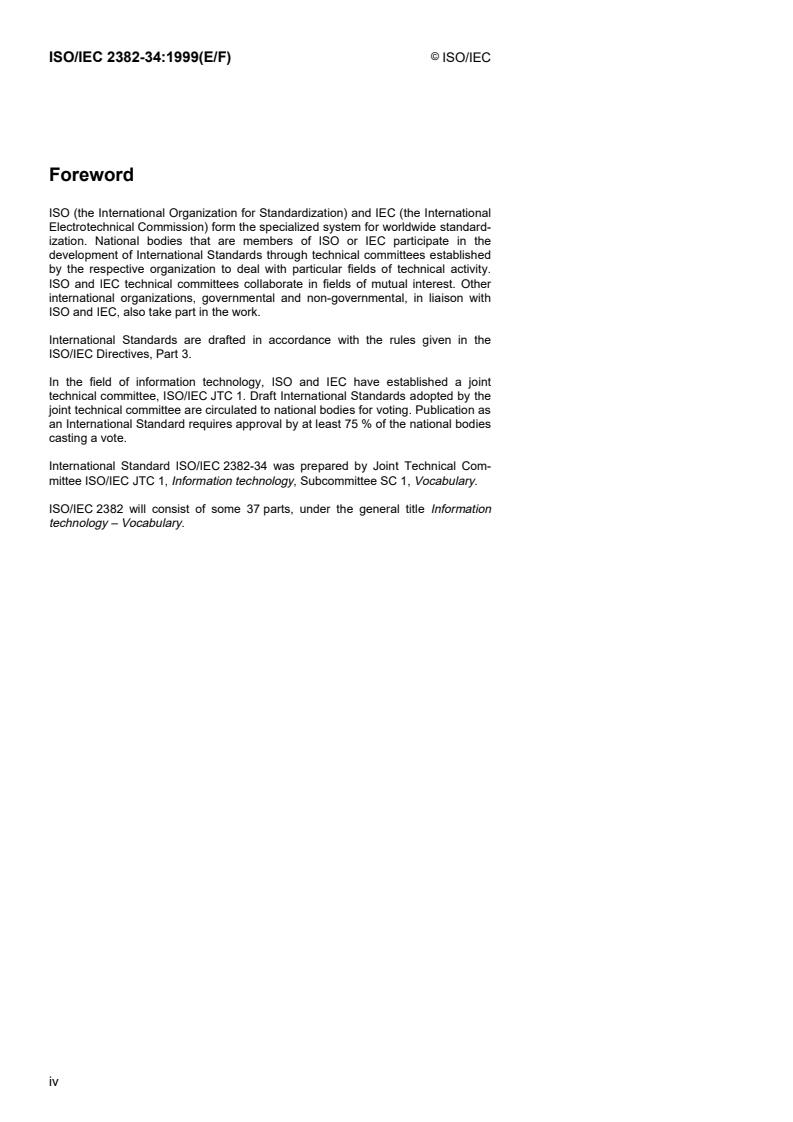
Foreword
ISO (the International Organization for Standardization) and IEC (the International
Electrotechnical Commission) form the specialized system for worldwide standard-
ization. National bodies that are members of ISO or IEC participate in the
development of International Standards through technical committees established
by the respective organization to deal with particular fields of technical activity.
ISO and IEC technical committees collaborate in fields of mutual interest. Other
international organizations, governmental and non-governmental, in liaison with
ISO and IEC, also take part in the work.
International Standards are drafted in accordance with the rules given in the
ISO/IEC Directives, Part 3.
In the field of information technology, ISO and IEC have established a joint
technical committee, ISO/IEC JTC 1. Draft International Standards adopted by the
joint technical committee are circulated to national bodies for voting. Publication as
an International Standard requires approval by at least 75 % of the national bodies
casting a vote.
International Standard ISO/IEC 2382-34 was prepared by Joint Technical Com-
mittee ISO/IEC JTC 1, Information technology, Subcommittee SC 1, Vocabulary.
ISO/IEC 2382 will consist of some 37 parts, under the general title Information
technology – Vocabulary.
iv
©
ISO/IEC ISO/IEC 2382-34:1999(E/F)
Avant-propos
L'ISO (Organisation internationale de normalisation) et la CEI (Commission
électrotechnique internationale) forment ensemble un système consacré à la
normalisation internationale considérée comme un tout. Les organismes nationaux
membres de l'ISO ou de la CEI participent au développement de Normes inter-
nationales par l'intermédiaire des comités techniques créés par l'organisation
concernée afin de s'occuper des différents domaines particuliers de l'activité
technique. Les comités techniques de l'ISO et de la CEI collaborent dans des
domaines d'intérêt commun. D'autres organisations internationales, gouverne-
mentales et non gouvernementales, en liaison avec l'ISO et la CEI participent
également aux travaux.
Les Normes internationales sont rédigées conformément aux règles données dans
les Directives ISO/CEI, Partie 3.
Dans le domaine des technologies de l'information, l'ISO et la CEI ont créé un
comité technique mixte, l'ISO/CEI JTC 1. Les projets de Normes internationales
adoptés par le comité technique mixte sont soumis aux organismes nationaux
pour approbation avant leur acceptation comme Normes internationales. Les
Normes internationales sont approuvées conformément aux procédures qui
requièrent l'approbation de 75 % au moins des organismes nationaux votants.
La Norme internationale ISO/CEI 2382-34 a été élaborée par le comité technique
mixte ISO/CEI JTC 1, Technologies de l'information, sous-comité SC 1,
Vocabulaire.
L'ISO/CEI 2382 comprendra environ 37 parties, présentées sous le titre général
Technologies de l'information – Vocabulaire.
v
©
Introduction
Information technology gives rise to numerous international exchanges of both an
intellectual and a material nature. These exchanges often become difficult, either
because of the great variety of terms used in various fields or languages to
express the same concept, or because of the absence or imprecision of the
definitions of useful concepts.
To avoid misunderstandings and to facilitate such exchanges it is essential to
clarify the concepts, to select terms to be used in various languages or in various
countries to express the same concept, and to establish definitions providing
satisfactory equivalents for the various terms in different languages.
ISO 2382 was initially based mainly on the usage to be found in the Vocabulary of
Information Processing which was established and published by the International
Federation for Information Processing and the International Computation Centre,
and in the American National Dictionary for Information Processing Systems and
its earlier editions published by the American National Standards Institute
(formerly known as the American Standards Association). Published and Draft
International Standards relating to information technology of other international
organizations (such as the International Telecommunication Union and the Inter-
national Electrotechnical Commission) as well as published and draft national
standards have also been considered.
The purpose of ISO/IEC 2382 is to provide definitions that are rigorous, uncom-
plicated and which can be understood by all concerned. The scope of each
concept defined has been chosen to provide a definition that is suitable for general
application. In those circumstances, where a restricted application is concerned,
the definition may need to be more specific.
However, while it is possible to maintain the self-consistency of individual parts,
the reader is warned that the dynamics of language and the problems associated
with the standardization and maintenance of vocabularies may introduce dupli-
cations and inconsistencies among parts.
vi
©
ISO/IEC ISO/IEC 2382-34:1999(E/F)
Introduction
Les technologies de l'information sont à l'origine de multiples échanges
intellectuels et matériels sur le plan international. Ceux-ci souffrent souvent de
difficultés provoquées par la diversité des termes utilisés pour exprimer la même
notion dans des langues ou des domaines différents, ou encore de l'absence ou
de l'imprécision des définitions pour les notions les plus utiles.
Pour éviter des malentendus et faciliter de tels échanges, il paraît essentiel de
préciser les notions, de choisir les termes à employer dans les différentes langues
et dans les divers pays pour exprimer la même notion, et d'établir pour ces termes
des définitions équivalentes dans chaque langue.
L'ISO 2382 a été basée à l'origine principalement sur l'usage tel qu'il a été relevé,
d'une part, dans le Vocabulary of Information Processing établi et publié par
l'International Federation for Information Processing et le Centre international de
calcul et, d'autre part, dans l'American National Dictionary for Information
Processing Systems y compris ses éditions précédentes publiées par l'American
National Standards Institute (connu auparavant sous l'appellation d'American
Standards Association). Les Normes internationales publiées ou au stade de
projets concernant les technologies de l'information émanant d'autres
organisations internationales (telles que l'Union internationale des
télécommunications et la Commission électrotechnique internationale) ainsi que
les normes nationales publiées ou au stade de projets, ont également été prises
en compte.
Le but de l'ISO/CEI 2382 est de procurer des définitions rigoureuses, simples et
compréhensibles pour tous les intéressés. La portée de chaque notion a été
choisie de façon que sa définition puisse avoir la valeur la plus générale.
Cependant, il est parfois nécessaire de restreindre une notion à un domaine plus
étroit et de lui donner alors une définition plus spécifique.
D'autre part, si l'on peut assurer la cohérence interne de chaque partie prise
individuellement, la cohérence des diverses parties entre elles est plus difficile à
atteindre. Le lecteur ne doit pas s'en étonner : la dynamique des langues et les
problèmes de l'établissement et de la révision des normes de vocabulaire peuvent
être à l'origine de quelques répétitions ou contradictions entre des parties qui ne
sont pas toutes préparées et publiées simultanément.
vii
INTERNATIONAL STANDARD
©
ISO/IEC ISO/IEC 2382-34:1999(E/F)
NORME INTERNATIONALE
Information technology – Technologies de
Vocabulary – l'information – Vocabulaire –
Part 34: Partie 34:
Artificial intelligence – Neural Intelligence artificielle –
networks Réseaux neuronaux
Section 1: General Section 1 : Généralités
1.1 Scope 1.1 Domaine d'application
This part of ISO/IEC 2382 is intended to facilitate La présente partie de l'ISO/CEI 2382 a pour objet de
international communication in information technology. It faciliter les échanges internationaux dans le domaine des
presents, in two languages, terms and definitions of technologies de l'information. À cet effet, elle présente un
selected concepts relevant to the field of information ensemble bilingue de termes et de définitions ayant trait à
technology and identifies relationships among the entries. des notions choisies dans ce domaine, et définit les
relations pouvant exister entre les différentes notions.
In order to facilitate their translation into other languages, Les définitions ont été établies de manière à éviter les
the definitions are drafted so as to avoid, as far as possible, particularismes propres à une langue donnée, en vue de
any peculiarity attached to a language. faciliter leur transposition dans les langues autres que
celles ayant servi à la rédaction initiale.
This part of ISO/IEC 2382 defines concepts in artificial La présente partie de l'ISO/CEI 2382 définit différentes
intelligence related to neural networks, their components, notions d'intelligence artificielle relatives aux réseaux
connections and functions. neuronaux, à leurs éléments, connexions et fonctions.
1.2 Normative references 1.2 Références normatives
The following standards contain provisions which, through Les normes suivantes contiennent des dispositions qui, par
reference in this text, constitute provisions of this part of suite de la référence qui en est faite, constituent des
ISO/IEC 2382. At the time of publication, the editions dispositions valables pour la présente partie de
indicated were valid. All standards are subject to revision, l'ISO/CEI 2382. Au moment de la publication, les éditions
and parties to agreements based on this part of indiquées étaient en vigueur. Toute norme est sujette à
ISO/IEC 2382 are encouraged to investigate the possibility révision et les parties prenantes des accords fondés sur la
of applying the most recent editions of the standards présente partie de l'ISO/CEI 2382 sont invitées à
indicated below. Members of IEC and ISO maintain rechercher la possibilité d'appliquer les éditions les plus
registers of currently valid International Standards. récentes des normes indiquées ci-après. Les membres de
la CEI et de l'ISO possèdent le registre des Normes
internationales en vigueur à un moment donné.
1) 1)
ISO/IEC 2382-1:1993 , Information technology – ISO/CEI 2382-1:1993 , Technologies de l'information –
Vocabulary – Part 1: Fundamental terms. Vocabulaire – Partie 1: Termes fondamentaux.
1) 1)
ISO 2382-12:1988 , Information processing systems – ISO 2382-12:1988 , Systèmes de traitement de
Vocabulary – Part 12: Peripheral equipment. l'information – Vocabulaire – Partie 12: Périphériques.
ISO/IEC 2382-28:1995, Information technology – ISO/CEI 2382-28:1995, Technologies de l'information –
Vocabulary – Part 28: Artificial intelligence – Basic concepts Vocabulaire – Partie 28: Intelligence artificielle – Notions
and expert systems. fondamentales et systèmes experts.
ISO/IEC 2382-31:1997, Information technology – ISO/CEI 2382-31:1997, Technologies de l'information –
Vocabulary – Part 31: Artificial intelligence – Machine Vocabulaire – Partie 31: Intelligence artificielle –
learning. Apprentissage automatique.
1) Currently under revision. 1) Actuellement en révision.
©
ISO/IEC
1.3 Principles and rules followed 1.3 Principes d'établissement et règles
suivies
1.3.1 Definition of an entry 1.3.1 Définition de l'article
Section 2 comprises a number of entries. Each entry La section 2 est composée d'un certain nombre d'articles.
consists of a set of essential elements that includes an Chaque article est composé d'un ensemble d'éléments
index number, one term or several synonymous terms, and essentiels comprenant le numéro de référence, le terme ou
a phrase defining one concept. In addition, an entry may plusieurs termes synonymes et la définition de la notion
include examples, notes or illustrations to facilitate couverte par ces termes. Cet ensemble peut être complété
understanding of the concept. par des exemples, des notes, des schémas ou des tableaux
destinés à faciliter la compréhension de la notion.
Occasionally, the same term may be defined in different Parfois, le même terme peut être défini dans des articles
entries, or two or more concepts may be covered by one différents, ou bien deux notions ou davantage peuvent être
entry, as described in 1.3.5 and 1.3.8 respectively. couvertes par un seul article : voir respectivement en 1.3.5
et 1.3.8.
Other terms such as vocabulary, concept, term, and D'autres termes tels que vocabulaire, notion, terme,
definition are used in this part of ISO/IEC 2382 with the définition, sont employés dans la présente partie de
meaning defined in ISO 1087. l'ISO/CEI 2382 avec le sens qui leur est donné dans l'ISO
1087.
1.3.2 Organization of an entry 1.3.2 Constitution d'un article
Each entry contains the essential elements defined in 1.3.1 Chaque article contient des éléments essentiels définis en
and, if necessary, additional elements. The entry may 1.3.1 et, si nécessaire, des éléments supplémentaires.
contain the following elements in the following order: L'article peut donc comprendre dans l'ordre les éléments
suivants :
a) an index number (common for all languages in which this a) un numéro de référence (le même, quelle que soit la
part of ISO/IEC 2382 is published); langue de publication de la présente partie de l'ISO/CEI
2382) ;
b) the term or the generally preferred term in the language. b) le terme, ou le terme préféré en général dans la langue.
The absence of a generally preferred term for the concept L'absence, dans une langue, de terme consacré ou à
in the language is indicated by a symbol consisting of five conseiller pour exprimer une notion est indiquée par un
dots (.); a row of dots may be used to indicate, in a term, symbole consistant en cinq points de suspension (.) ; les
a word to be chosen in each particular case; points de suspension peuvent être employés pour désigner,
dans un terme, un mot à choisir dans un cas particulier ;
c) the preferred term in a particular country (identified c) le terme préféré dans un certain pays (identifié selon les
according to the rules of ISO 3166); règles de l'ISO 3166) ;
d) the abbreviation for the term; d) l'abréviation pouvant être employée à la place du terme ;
e) permitted synonymous term(s); e) le terme ou les termes admis comme synonymes ;
f) the text of the definition (see 1.3.4); f) le texte de la définition (voir 1.3.4) ;
g) one or more examples with the heading "Example(s)"; g) un ou plusieurs exemples précédés du titre
« Exemple(s) » ;
h) one or more notes specifying particular cases in the field h) une ou plusieurs notes précisant le domaine d'application
of application of the concepts with the heading "NOTE(S)"; de la notion, précédées du titre « NOTE(S) » ;
i) a picture, a diagram, or a table which could be common to i) une figure, un schéma ou un tableau, pouvant être
several entries. communs à plusieurs articles.
©
ISO/IEC
1.3.3 Classification of entries 1.3.3 Classification des articles
A two-digit serial number is assigned to each part of Chaque partie de l'ISO/CEI 2382 reçoit un numéro d'ordre à
ISO/IEC 2382, beginning with 01 for "Fundamental terms". deux chiffres, en commençant par 01 pour la partie
« Termes fondamentaux ».
The entries are classified in groups to each of which is Les articles sont répartis en groupes qui reçoivent chacun
assigned a four-digit serial number; the first two digits being un numéro d'ordre à quatre chiffres, les deux premiers
those of the part of ISO/IEC 2382. chiffres étant ceux du numéro de la partie de l'ISO/CEI
2382.
Each entry is assigned a six-digit index number; the first Chaque article est repéré par un numéro de référence à six
four digits being those of the part of ISO/IEC 2382 and the chiffres, les quatre premiers chiffres étant ceux du numéro
group. de partie de l'ISO/CEI 2382 et de groupe.
To show the relationship between versions of ISO/IEC 2382 Les numéros des parties, des groupes et des articles sont
in various languages, the numbers assigned to parts, les mêmes pour toutes les langues, afin de mettre en
groups, and entries are the same for all languages. évidence les correspondances des versions de l'ISO/CEI
2382.
1.3.4 Selection of terms and wording of 1.3.4 Choix des termes et des définitions
definitions
The selection of terms and the wording of definitions have, Les choix qui ont été faits pour les termes et leurs
as far as possible, followed established usage. Where there définitions sont, dans toute la mesure du possible,
were contradictions, solutions agreeable to the majority compatibles avec les usages établis. Lorsque certains
have been sought. usages apparaissent contradictoires, des solutions de
compromis ont été retenues.
1.3.5 Multiple meanings 1.3.5 Pluralité de sens ou polysémie
When, in one of the working languages, a given term has Lorsque, dans l'une des langues de travail, un même terme
several meanings, each meaning is given a separate entry peut prendre plusieurs sens, ces sens sont définis dans des
to facilitate translation into other languages. articles différents, pour faciliter l'adaptation du vocabulaire
dans d'autres langues.
1.3.6 Abbreviations 1.3.6 Abréviations
As indicated in 1.3.2, abbreviations in current use are given Comme indiqué en 1.3.2, des abréviations d'usage courant,
for some terms. Such abbreviations are not used in the au moins en anglais, sont indiquées pour certains termes.
texts of the definitions, examples or notes. De telles abréviations ne sont pas employées dans le corps
des définitions, exemples ou notes.
1.3.7 Use of parentheses 1.3.7 Emploi des parenthèses
In some terms, one or more words printed in bold typeface Dans certains termes, un ou plusieurs mots imprimés en
are placed between parentheses. These words are part of caractères gras sont placés entre parenthèses. Ces mots
the complete term, but they may be omitted when use of the font partie intégrante du terme complet, mais peuvent être
abridged term in a technical context dœs not introduce omis lorsque le terme ainsi abrégé peut être employé dans
ambiguity. In the text of another definition, example, or note un contexte technique déterminé sans que cette omission
of ISO/IEC 2382, such a term is used only in its complete ne crée d'ambiguïté. Un tel terme n'est employé dans le
form. texte d'une autre définition, d'un exemple ou d'une note de
l'ISO/CEI 2382, que sous sa forme complète.
In some entries, the terms are followed by words in Dans certains articles, les termes définis sont suivis par des
parentheses in normal typeface. These words are not a part expressions imprimées en caractères normaux et placées
entre parenthèses. Ces expressions ne font pas partie du
of the term but indicate directives for the use of the term, its
particular field of application, or its grammatical form. terme mais indiquent des prescriptions d'emploi, précisent
un domaine d'application particulier ou indiquent une forme
grammaticale.
©
ISO/IEC
1.3.8 Use of brackets 1.3.8 Emploi des crochets
When several closely related terms can be defined by texts Lorsque plusieurs termes étroitement apparentés peuvent
that differ only in a few words, the terms and their être définis par des textes presque identiques, à quelques
definitions are grouped in a single entry. The words to be mots près, les termes et leurs définitions ont été groupés en
substituted in order to obtain the different meanings are un seul article. Les mots à substituer à ceux qui les
placed in brackets, i.e. [ ], in the same order in the term précèdent pour obtenir les différents sens sont placés entre
and in the definition. To clearly identify the words to be crochets (c'est-à-dire [ ]) dans le même ordre dans le
substituted, the last word that according to the above rule terme et la définition. En vue d'éviter toute incertitude sur
could be placed in front of the opening bracket is, wherever les mots à remplacer, le dernier mot qui, suivant la règle ci-
possible, placed inside the bracket and repeated for each dessus, pourrait être placé devant le crochet d'ouverture,
alternative. est placé, si possible, à l'intérieur des crochets et répété à
chaque occasion.
1.3.9 Use of terms printed in italic typeface in 1.3.9 Emploi dans les définitions de termes
definitions and the use of an asterisk imprimés en caractères italiques et de
l'astérisque
A term printed in italic typeface in a definition, an example, Dans le texte d'une définition, d'un exemple ou d'une note,
or a note is defined in another entry in ISO/IEC 2382, which tout terme imprimé en caractères italiques a le sens défini
may be in another part. However, the term is printed in italic dans un autre article de l'ISO/CEI 2382, qui peut se trouver
typeface only the first time it occurs in each entry. dans une autre partie. Cependant le terme est imprimé en
caractères italiques uniquement la première fois qu'il
apparaît dans chaque article.
Italic typeface is also used for other grammatical forms of a Les caractères italiques sont également utilisés pour les
term, for example, plurals of nouns and participles of verbs. autres formes grammaticales du terme, par exemple, les
noms au pluriel et les verbes au participe.
The basic forms of all terms printed in italic typeface which La liste des formes de base des termes imprimés en
are defined in this part of ISO/IEC 2382 are listed in the caractères italiques qui sont définis dans cette partie de
index at the end of the part (see 1.3.11). l'ISO/CEI 2382 est fournie dans l'index à la fin de la partie
(voir 1.3.11).
An asterisk is used to separate terms printed in italic L'astérisque sert à séparer les termes imprimés en
typeface when two such terms are referred to in separate caractères italiques quand deux termes se rapportent à des
entries and directly follow each other (or are separated only articles séparés et se suivent directement (ou bien sont
by a punctuation mark). séparés simplement par un signe de ponctuation).
Words or terms that are printed in normal typeface are to be Les mots ou termes imprimés en caractères normaux
understood as defined in current dictionaries or authoritative doivent être compris dans le sens qui leur est donné dans
technical vocabularies. les dictionnaires courants ou vocabulaires techniques
faisant autorité.
1.3.10 Spelling 1.3.10 Mode d'écriture et orthographe
In the English language version of this part of ISO/IEC Dans la version anglaise de la présente partie de l'ISO/CEI
2382, terms, definitions, examples, and notes are given in 2382, les termes, définitions, exemples et notes sont écrits
the spelling preferred in the USA. Other correct spellings suivant l'orthographe prévalant aux Etats-Unis. D'autres
may be used without violating this part of ISO/IEC 2382. orthographes correctes peuvent être utilisées sans violer la
présente partie de l'ISO/CEI 2382.
1.3.11 Organization of the alphabetical index 1.3.11 Constitution de l'index alphabétique
For each language used, an alphabetical index is provided Pour chaque langue de travail, un index alphabétique est
at the end of each part. The index includes all terms defined fourni à la fin de chaque partie. L'index comprend tous les
in the part. Multiple-word terms appear in alphabetical order termes définis dans la partie. Les termes composés de
under each of their key words. plusieurs mots sont répertoriés alphabétiquement suivant
chacun des mots clés.
©
ISO/IEC
Section 2: Terms and definitions Section 2 : Termes et définitions
34 Artificial intelligence — Neural 34 Intelligence artificielle —
networks Réseaux neuronaux
34.01 General concepts 34.01 Notions générales
34.01.01 34.01.01
connectionism
connexionnisme
connection science
Approche interdisciplinaire de l'intelligence artificielle selon
An interdisciplinary approach to artificial intelligence where
laquelle des calculs complexes sont effectués par un
complex computations are carried out by a network of
réseau d'unités de traitement élémentaires, dont chacune
simple processing elements, each of which is connected to
est connectée à un grand nombre d'autres et qui échangent
a great number of other elements, and which exchange
des messages simples, le traitement étant effectué en
simple messages, and where processing occurs
parallel parallèle par un grand nombre d'unités.
among a great number of such elements.
NOTE – Le connexionnisme est inspiré par le fonctionnement des
NOTE – Connectionism is inspired by the operation of biological systèmes nerveux biologiques tels que le cerveau humain.
neural systems such as the human brain.
34.01.02 34.01.02
connectionist model modèle connexionniste
A computational model for intelligent activities in which Modèle informatique des activités intelligentes dans lequel
pieces of information are collectively represented by a les éléments d'information sont représentés collectivement
network of a great number of simple processing elements par un réseau d'un grand nombre d'unités de traitement
that communicate by exchanging simple messages, and élémentaires qui communiquent en échangeant des
complex computations are carried out through parallel messages simples et où des calculs complexes sont
processing distributed among a great number of such effectués par un traitement réparti entre un grand nombre
elements. d'unités fonctionnant en parallèle.
NOTE – Connectionist models are for instance applied in NOTE – Les modèles connexionistes sont appliqués, par exemple,
knowledge representation,* pattern recognition,* computer vision,* en représentation des connaissances,* reconnaissance des
natural-language understanding,* learning (as defined in ISO/IEC formes,* vision par ordinateur,* compréhension du langage
2382-31), and motion control. naturel,* apprentissage (au sens défini dans ISO/CEI 2382-31) et
commande de mouvements.
34.01.03 34.01.03
subsymbolic representation représentation sous-symbolique
A technique for knowledge representation that distributes Méthode de représentation des connaissances qui répartit
the representation over a relatively large network rather les connaissances entre les éléments d'un réseau
than storing symbols directly. relativement grand plutôt que de stocker directement des
symboles.
NOTE – In the connectionist model, the knowledge stored in the
network is fragmented by using subsymbolic representation and
NOTE – Dans le modèle connexionniste, les connaissances
cannot easily be expressed as simple rules or symbolic forms.
stockées dans le réseau sont fragmentées par une représentation
sous-symbolique et ne peuvent pas être facilement exprimées par
des règles simples ou sous forme symbolique.
34.01.04 34.01.04
heterarchy hétérarchie
The structure of a system whose components can Structure d'un système qui permet une communication
communicate directly with each other. directe entre tous ses éléments.
34.01.05 34.01.05
hierarchy hiérarchie
The structure of a system whose components are ranked Structure d'un système dont les éléments sont répartis pour
into levels of subordination for communication purposes leurs communications mutuelles en niveaux subordonnés
according to specific rules. selon des règles particulières.
©
ISO/IEC
34.01.06 34.01.06
neural network réseau neuronal
neural net réseau de neurones artificiels
NN (abbreviation) RNA (abréviation)
artificial neural network réseau de neurones formels
ANN (abbreviation) Réseau d'unités élémentaires de traitement reliées entre
A network of primitive processing elements connected by elles par des connexions pondérées de poids ajustables,
weighted links with adjustable weights, in which each dans lequel chaque unité produit une valeur en appliquant
element produces a value by applying a nonlinear function une fonction non linéaire à ses valeurs d'entrée et la
to its input values, and transmits it to other elements or transmet à d'autres unités ou la présente comme valeur de
presents it as an output value. sortie.
NOTES NOTES
1 Whereas some neural networks are intended to simulate the 1 Certains réseaux neuronaux sont destinés à simuler le
functioning of neurons in the nervous system, most neural networks fonctionnement des neurones dans le système nerveux, mais la
are used in artificial intelligence as realizations of the connectionist plupart des réseaux neuronaux sont utilisés en intelligence
model. artificielle comme réalisations du modèle connexionniste.
2 Examples of nonlinear functions are a threshold function, a 2 Des exemples de fonctions non linéaires sont une fonction à
sigmoid function, and a polynomial function. seuil, une sigmoïde, une fonction polynomiale.
3 This entry is an improved version of the entry 28.01.22 in 3 Cet article est une version améliorée de l'article 28.01.22 dans
ISO/IEC 2382-28:1995. l'ISO/CEI 2382-28 : 1995.
34.01.07 34.01.07
artificial neuron neurone artificiel
neurode (deprecated) neurone formel
A primitive processing element in a neural network, with Unité élémentaire de traitement d'un réseau neuronal, ayant
several inputs and one output, the output value of which is a plusieurs entrées et une sortie, dont la valeur de sortie est
nonlinear function of a linear combination of the input une fonction non linéaire d'une combinaison linéaire des
values with adjustable weighting cœfficients. valeurs d'entrée, les cœfficients de pondération de la
combinaison étant ajustables.
NOTES
NOTES
1 Artificial neurons are modeled according to the functioning of
neurons in the nervous system and are interconnected in order to
1 Les neurones artificiels modélisent le fonctionnement des
exchange messages.
neurones dans le système nerveux et sont interconnectés de façon
à échanger des messages.
2 Each artificial neuron is a node of the neural network, that
cooperates and communicates with other neurons. A neural
2 Chaque neurone artificiel est un nœud du réseau neuronal, qui
network can also have input nodes which are not artificial neurons.
coopère et communique avec d'autres neurones artificiels. Un
réseau neuronal peut aussi avoir des nœuds d'entrée qui ne sont
pas des neurones artificiels.
34.01.08 34.01.08
neurocomputer ordinateur neuronal
neural computer ordinateur neuronique
A special-purpose computer built as a neural network. neuroordinateur
Ordinateur spécialisé construit sous forme d'un réseau
neuronal.
NOTE – The performance usually is measured in connection
updates per second.
NOTE – Le fonctionnement est généralement évalué en
connexions actualisées par seconde.
34.01.09 34.01.09
neurochip neuropuce
A reconfigurable chip that implements all or part of a neural- puce neuronale
network model. Puce reconfigurable qui réalise tout ou partie d'un modèle
de réseau neuronal.
34.01.10 34.01.10
neural-network model modèle de réseau neuronal
An abstract model of a neural network that can be modèle neuronal
simulated in software or implemented as a neurocomputer. Modèle abstrait de réseau neuronal que l'on peut simuler
par logiciel ou réaliser comme ordinateur neuronal.
©
ISO/IEC
34.02 Neural networks and their components 34.02 Réseaux neuronaux et leurs éléments
34.02.01 34.02.01
source node nœud source
A node of a neural network that supplies input * signals to Nœud d'un réseau neuronal qui alimente les neurones
artificial neurons. artificiels en signaux * d'entrée.
34.02.02 34.02.02
input neuron neurone d'entrée
An artificial neuron that receives signals from external Neurone artificiel qui reçoit des signaux provenant de
sources. sources extérieures.
34.02.03 34.02.03
output neuron neurone de sortie
An artificial neuron that sends signals to an external Neurone artificiel qui envoie des signaux à un système
system. extérieur.
34.02.04 34.02.04
visible neuron neurone visible
An artificial neuron that directly communicates with external Neurone artificiel qui communique directement avec des
systems. systèmes extérieurs.
NOTE – A visible neuron may be an input neuron, an output NOTE – Un neurone visible peut être un neurone d'entrée, un
neuron, or both. neurone de sortie ou les deux à la fois.
34.02.05 34.02.05
hidden neuron neurone caché
An artificial neuron that dœs not directly communicate with neurone intermédiaire
external systems. Neurone artificiel qui ne communique pas directement avec
des systèmes extérieurs.
34.02.06 34.02.06
layer (in neural networks) couche (dans les réseaux neuronaux)
In a hierarchically organized neural network, a group of Dans un réseau neuronal organisé hiérarchiquement,
artificial neurons whose outputs may connect to neurons in groupe de neurones artificiels dont les sorties peuvent être
a group toward the output of the network but not to neurons connectées à des neurones dans un groupe plus proche de
in a group back toward the input of the network. la sortie du réseau mais non à des neurones dans un
groupe plus proche de l'entrée.
NOTE – Artificial neurons of the same layer may have connections
among them.
NOTE – Les neurones artificiels d'une couche peuvent être
connectés entre eux.
34.02.07 34.02.07
input layer couche d'entrée
A layer whose artificial neurons receive signals from Couche dont les neurones artificiels reçoivent des signaux
external sources. provenant de sources extérieures.
NOTE – By extension, the term "input layer" is also used for a NOTE – Par extension, le terme « couche d'entrée » est aussi
group of source nodes. employé pour désigner un groupe de nœuds sources.
34.02.08 34.02.08
output layer couche de sortie
decision layer Couche dont les neurones artificiels envoient des signaux à
A layer whose artificial neurons send signals to an external un système extérieur.
system.
34.02.09 34.02.09
visible layer couche visible
A layer whose nodes directly communicate with external Couche dont les nœuds communiquent directement avec
systems. des systèmes extérieurs.
©
ISO/IEC
34.02.10 34.02.10
hidden layer couche cachée
A layer whose artificial neurons do not directly communicate couche intermédiaire
with external systems. Couche dont les neurones artificiels ne communiquent pas
directement avec des systèmes extérieurs.
34.02.11 34.02.11
bottleneck layer couche goulet
The hidden layer that forces a neural network to develop a
couche goulot
compact representation of the input data. Couche cachée qui force un réseau neuronal à se
constituer une représentation dense des données d'entrée.
34.02.12 34.02.12
slab plaque
A group of artificial neurons that share the same activation Groupe de neurones artificiels ayant la même fonction
function and learning rule, and that have equivalent d'activation, la même règle d'apprentissage et des
interconnection topologies. topologies d'interconnexion équivalentes.
NOTE – Slabs may be interconnected in a hierarchical fashion but NOTE – Les plaques peuvent être interconnectées
other architectures may also occur. hiérarchiquement mais il existe d'autres architectures.
34.02.13 34.02.13
layered network réseau en couches
A neural network whose artificial neurons are hierarchically Réseau neuronal dont les neurones artificiels sont
organized in layers. organisés hiérarchiquement en couches.
NOTE – A layered network may have a distinct group of source NOTE – Un réseau en couches peut comprendre un groupe distinct
nodes in addition to the layers of artificial neurons. de nœuds sources en plus des couches de neurones artificiels.
34.02.14 34.02.14
nonlayered network réseau sans couches
A neural network whose artificial neurons are not organized Réseau neuronal dont les neurones artificiels ne sont pas
in layers. organisés en couches.
34.02.15 34.02.15
single-layered network réseau monocouche
A layered network having only source nodes and one output Réseau en couches comprenant seulement des nœuds
layer, without hidden layers. sources et une couche de sortie, sans couches cachées.
NOTE – In a single-layered network, only the output layer performs NOTE – Dans un réseau monocouche, seule la couche de sortie
computation. effectue des calculs.
34.02.16 34.02.16
multilayered network réseau multicouche
A layered network having at least two layers. Réseau en couches comprenant au moins deux couches.
NOTE – A multilayered network may have a distinct group of NOTE – Un réseau multicouche peut comprendre un groupe
source nodes in addition to the layers of artificial neurons. In this distinct de nœuds sources en plus des couches de neurones
case there is at least one hidden layer. artificiels. Dans ce cas, il y a au moins une couche cachée.
34.02.17 34.02.17
partially connected network réseau partiellement connecté
diluted network Réseau sans couches dont chaque neurone artificiel n'est
A nonlayered network in which each artificial neuron is not pas nécessairement relié à tous les autres, ou réseau en
necessarily connected to all the others, or a layered couches dont chaque neurone artificiel d'une couche n'est
network in which each artificial neuron in a layer is not pas nécessairement relié à tous les neurones de la couche
necessarily connected to all neurons in the adjacent forward adjacente vers la sortie du réseau.
layer.
©
ISO/IEC
34.02.18 34.02.18
totally connected network réseau entièrement connecté
fully connected network réseau totalement connecté
A nonlayered network in which each artificial neuron is Réseau sans couches dont chaque neurone artificiel est
connected to all the others, or a layered network in which relié à tous les autres, ou réseau en couches dont chaque
each artificial neuron in
...
Questions, Comments and Discussion
Ask us and Technical Secretary will try to provide an answer. You can facilitate discussion about the standard in here.
Loading comments...