

ISO 3188:1978
(Main)Starches and derived products — Determination of nitrogen content by the Kjeldahl method — Titrimetric method
General Information
- Abstract
The found value only includes free amino acids, compounds producing amino acids on hydrolysis and ammonium compounds. The principle consists in destruction of organic matter by sulphuric acid in the presence of a compound catalyst (see ISO 1871), alkalization of the reaction products, distillation of the liberated ammonia and collection in a boric acid solution, followed by titration with a standard volumetric sulphuric acid solution. The method applies to contents greater than 0,01 % (m/m). For products with contents less than 0,025 % (m/m), see ISO 5378.
- Status
- Published
- Publication Date
- 31-Jul-1978
- Technical Committee
- ISO/TC 93 - Starch (including derivatives and by-products)
- Drafting Committee
- ISO/TC 93 - Starch (including derivatives and by-products)
- Current Stage
- 9093 - International Standard confirmed
- Start Date
- 25-Mar-2025
- Completion Date
- 29-Aug-2026
Buy Documents
ISO 3188:1978 - Starches and derived products -- Determination of nitrogen content by the Kjeldahl method -- Titrimetric method
ISO 3188:1978 - Starches and derived products — Determination of nitrogen content by the Kjeldahl method — Titrimetric method/1/1978
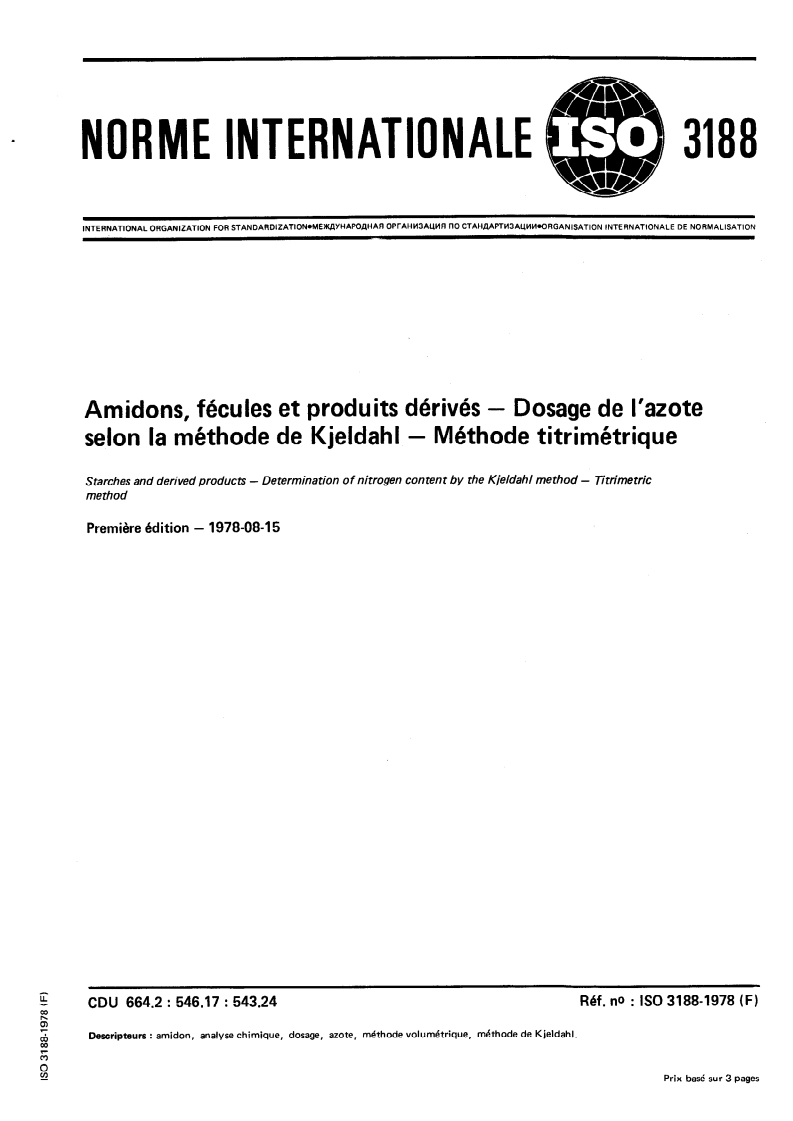
ISO 3188:1978 - Amidon, fécules et produits dérivés -- Dosage de l'azote selon la méthode de Kjeldahl -- Méthode titrimétrique
ISO 3188:1978 - Amidon, fécules et produits dérivés -- Dosage de l'azote selon la méthode de Kjeldahl -- Méthode titrimétrique
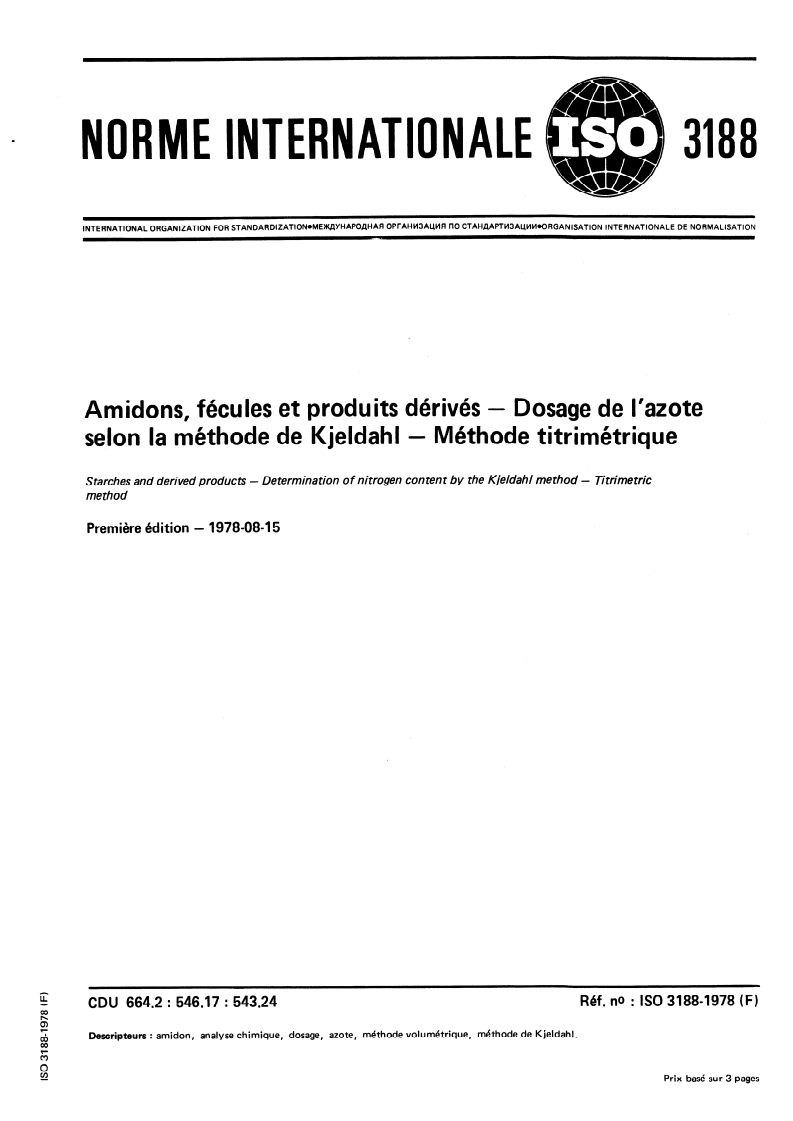
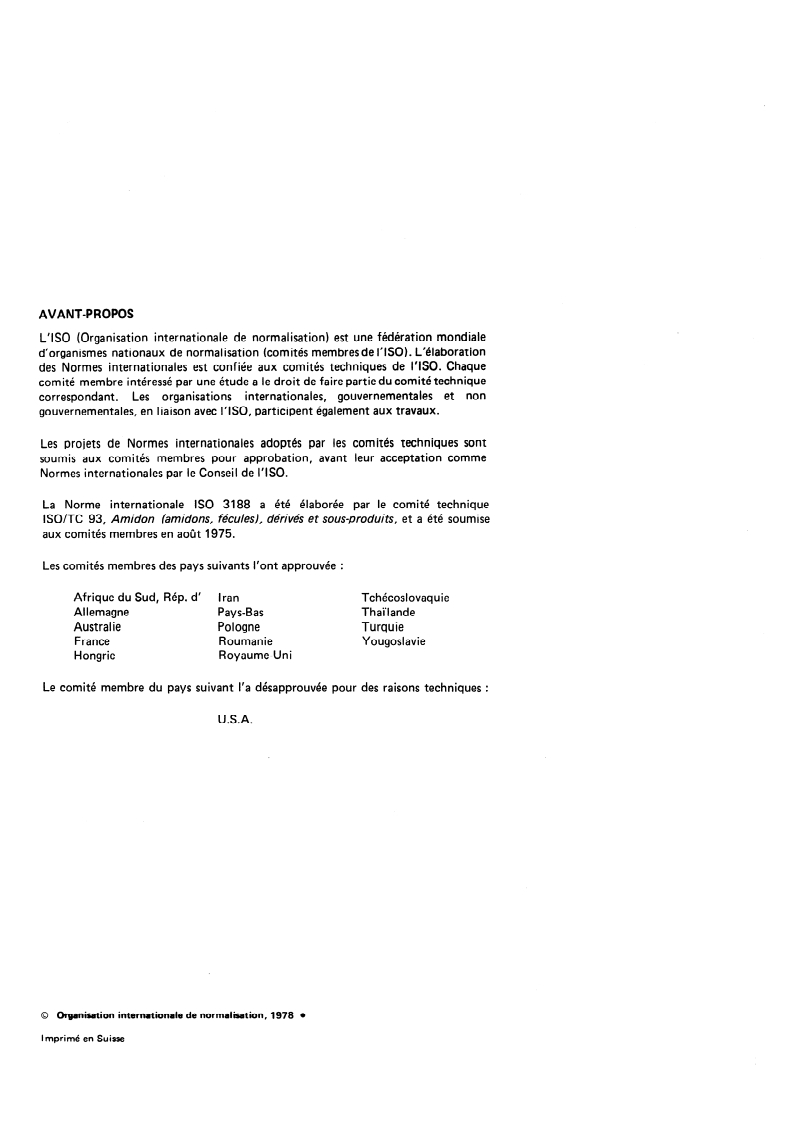
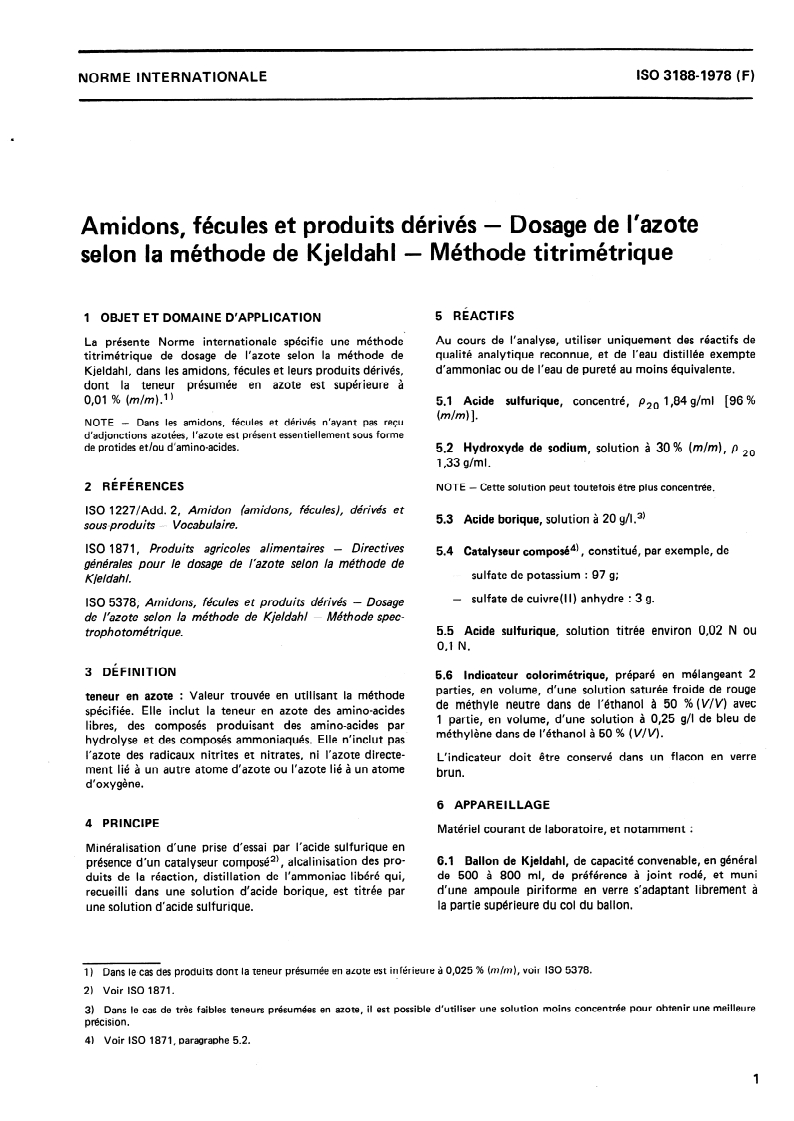
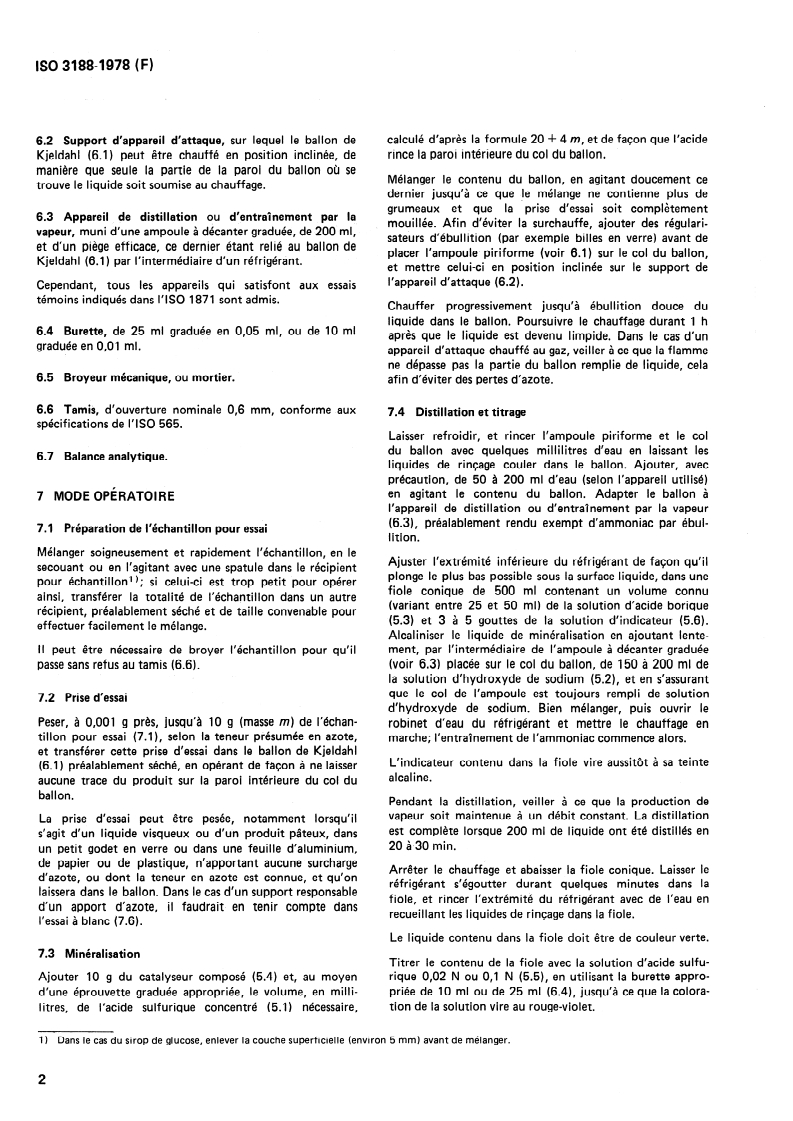
ISO 3188:1978 - Amidon, fécules et produits dérivés — Dosage de l'azote selon la méthode de Kjeldahl — Méthode titrimétrique/1/1978
ISO 3188:1978 - Amidon, fécules et produits dérivés — Dosage de l'azote selon la méthode de Kjeldahl — Méthode titrimétrique/1/1978
Overview
ISO 3188:1978 is an international standard established by the International Organization for Standardization (ISO) that specifies a titrimetric method for determining the nitrogen content in starches and their derived products. Using the well-established Kjeldahl method, this standard focuses on quantifying nitrogen from free amino acids, compounds that yield amino acids on hydrolysis, and ammonium compounds. It applies to samples with nitrogen content greater than 0.01% (m/m), with reference to ISO 5378 for lower nitrogen levels.
The method involves decomposing organic matter by sulphuric acid digestion in the presence of a catalyst, followed by alkalization and distillation of liberated ammonia. The ammonia is absorbed in a boric acid solution and subsequently titrated using standardized sulphuric acid. This procedure provides a reliable, reproducible approach for chemical analysis of nitrogen in starch-based materials.
Key Topics
- Nitrogen Determination: Measures nitrogen in starch products including free amino acids and ammonium compounds, excluding nitrogen bound in nitrates, nitrites, or molecular nitrogen bonds.
- Kjeldahl Method: Uses digestion with sulphuric acid and a compound catalyst for organic matter breakdown; ammonia is distilled and titrated.
- Titrimetric Analysis: The ammonia collected in boric acid solution is titrated with volumetric sulphuric acid to quantify nitrogen content.
- Scope of Application: Suitable for starches and derivatives with nitrogen content > 0.01% m/m. For contents below 0.025%, ISO 5378 recommends a spectrophotometric method.
- Reagents & Apparatus: Requires analytical-grade sulphuric acid, sodium hydroxide, boric acid, compound catalysts (e.g., potassium sulfate, copper sulfate), specialized Kjeldahl digestion and distillation apparatus, and precise volumetric equipment.
- Procedural Steps:
- Sample preparation (homogenizing and weighing),
- Acid digestion with catalyst,
- Distillation of ammonia,
- Collection in boric acid,
- Titration with standard acid,
- Calculation of nitrogen percentage.
- Result Expression: Calculated as a percentage by mass, averaging two titrations for accuracy.
- Reporting: Includes method details, operational conditions, deviations, and complete sample identification.
Applications
ISO 3188:1978 is critical for quality control and chemical characterization in industries relying on starch and starch-derived products, such as:
- Food Industry: Monitoring protein-related nitrogen content in starch ingredients to ensure compliance with nutritional labeling and safety standards.
- Pharmaceuticals: Quality testing of excipients derived from starch, verifying nitrogen content which relates to purity and composition.
- Agriculture and Feed: Assessing nitrogen levels in starch-based animal feeds and agricultural products for nutritional balancing.
- Research and Development: Analytical testing in laboratories for developing new starch derivatives and improving product functionality.
- Regulatory Compliance: Ensuring labelling accuracy and adherence to international standards in starch-based food additives and ingredients.
The standardized method supports consistent and comparable results globally, facilitating trade and regulatory acceptance.
Related Standards
- ISO 1871 - Agricultural food products: General directions for nitrogen determination by the Kjeldahl method. Provides foundational procedural guidance referenced by ISO 3188.
- ISO 5378 - Starches and derived products: Spectrophotometric method for nitrogen content determination for samples with nitrogen content below 0.025% m/m.
- ISO 1227 - Vocabulary related to starch, including derivatives and by-products, useful for understanding terminology in ISO 3188.
- ISO 565 - Specifies requirements for sieves used to prepare samples according to particle size for uniform analysis.
Adhering to these standards ensures uniformity in nitrogen analysis methods and enhances the reliability and acceptance of results across different laboratories and countries.
Keywords: ISO 3188, nitrogen determination, starch analysis, Kjeldahl method, titrimetric method, chemical analysis, starch derivatives, nitrogen content testing, industrial starch quality, ISO standards, analytical chemistry.
Relations
- Effective Date
- 06-Jun-2022
Buy Documents
ISO 3188:1978 - Starches and derived products -- Determination of nitrogen content by the Kjeldahl method -- Titrimetric method
ISO 3188:1978 - Starches and derived products — Determination of nitrogen content by the Kjeldahl method — Titrimetric method/1/1978
ISO 3188:1978 - Amidon, fécules et produits dérivés -- Dosage de l'azote selon la méthode de Kjeldahl -- Méthode titrimétrique
ISO 3188:1978 - Amidon, fécules et produits dérivés -- Dosage de l'azote selon la méthode de Kjeldahl -- Méthode titrimétrique
ISO 3188:1978 - Amidon, fécules et produits dérivés — Dosage de l'azote selon la méthode de Kjeldahl — Méthode titrimétrique/1/1978
ISO 3188:1978 - Amidon, fécules et produits dérivés — Dosage de l'azote selon la méthode de Kjeldahl — Méthode titrimétrique/1/1978
Get Certified
Connect with accredited certification bodies for this standard

BSI Group
BSI (British Standards Institution) is the business standards company that helps organizations make excellence a habit.

Bureau Veritas
Bureau Veritas is a world leader in laboratory testing, inspection and certification services.

DNV
DNV is an independent assurance and risk management provider.
Sponsored listings
Frequently Asked Questions
ISO 3188:1978 is a standard published by the International Organization for Standardization (ISO). Its full title is "Starches and derived products — Determination of nitrogen content by the Kjeldahl method — Titrimetric method". This standard covers: The found value only includes free amino acids, compounds producing amino acids on hydrolysis and ammonium compounds. The principle consists in destruction of organic matter by sulphuric acid in the presence of a compound catalyst (see ISO 1871), alkalization of the reaction products, distillation of the liberated ammonia and collection in a boric acid solution, followed by titration with a standard volumetric sulphuric acid solution. The method applies to contents greater than 0,01 % (m/m). For products with contents less than 0,025 % (m/m), see ISO 5378.
The found value only includes free amino acids, compounds producing amino acids on hydrolysis and ammonium compounds. The principle consists in destruction of organic matter by sulphuric acid in the presence of a compound catalyst (see ISO 1871), alkalization of the reaction products, distillation of the liberated ammonia and collection in a boric acid solution, followed by titration with a standard volumetric sulphuric acid solution. The method applies to contents greater than 0,01 % (m/m). For products with contents less than 0,025 % (m/m), see ISO 5378.
ISO 3188:1978 is classified under the following ICS (International Classification for Standards) categories: 67.180.20 - Starch and derived products. The ICS classification helps identify the subject area and facilitates finding related standards.
ISO 3188:1978 has the following relationships with other standards: It is inter standard links to ISO 15480:1999. Understanding these relationships helps ensure you are using the most current and applicable version of the standard.
ISO 3188:1978 is available in PDF format for immediate download after purchase. The document can be added to your cart and obtained through the secure checkout process. Digital delivery ensures instant access to the complete standard document.
Standards Content (Sample)
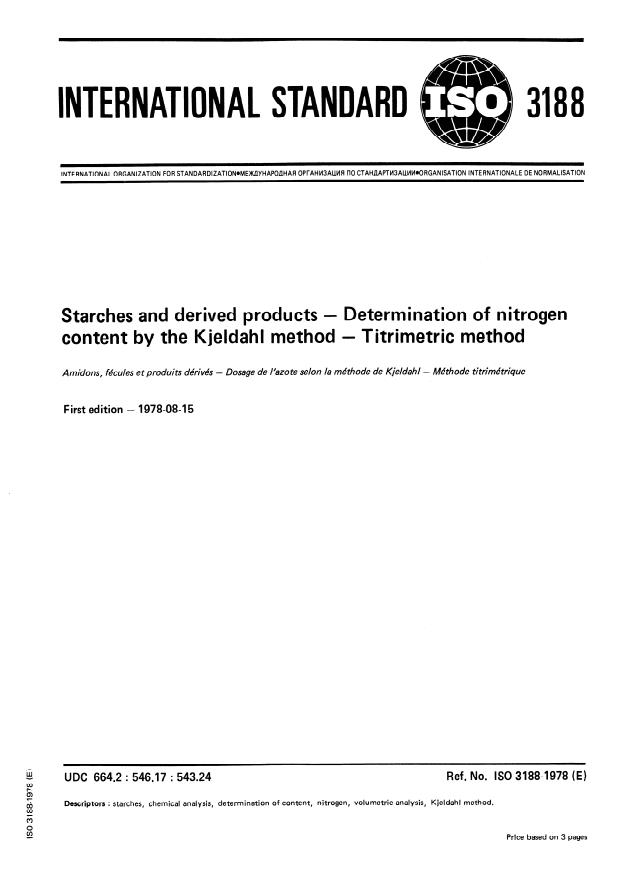
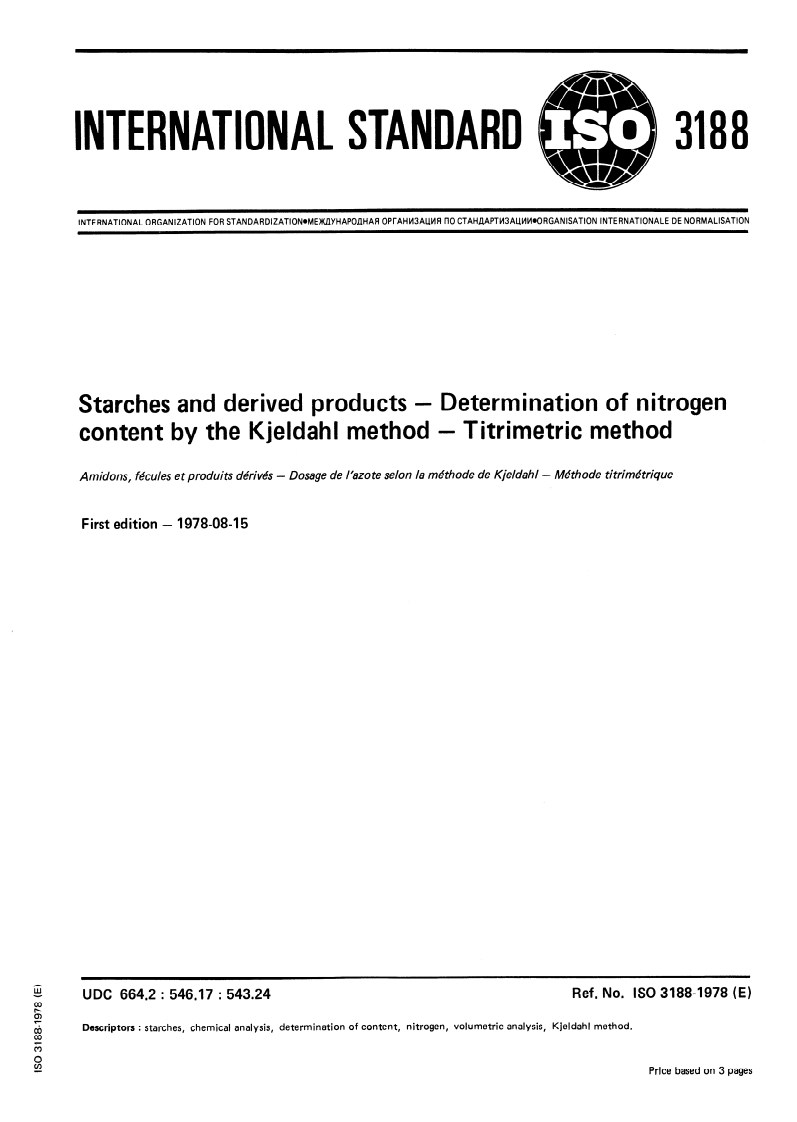
INTERNATIONAL STANDARD
INTERNATIONAL ORGANIZATION FOR STANDARDIZATIONWlEIKJjYHAPO,QHAR OPrAHM3AL&lR fl0 CTAH~APTM3AL&WWORGANISATION INTERNATIONALE DE NORMALISATION
Starches and derived products - Determination of nitrogen
content by the Kjeldahl method - Titrimetric method
Amidons, fdcules et produits d&iv& - Dosage de l’azote selon Ia methode de Kjeldahl - Mt!thode titrimetrique
First edition - 1978-08-15
Ei
-
UDC 664.2 : 546.17 : 543.24
Ref. No. ISO 3188-1978 (E)
Descriptors : starches, Chemical analysis, determination of content, nitrogen, volumetric analysis, Kjeldahl method.
Price based on 3 pages
FOREWORB
ISO (the International Organization for Standardization) is a worldwide federation
of national Standards institutes (ISO member bodies). The work of deweloping
International Standards is carried out through ISO technical committees. Ewery
member body interested in a subject for which a technical committee has been set
up has the right to be represented on that committee. International organizations,
governmental and non-governmental, in liaison with ISO, also take part in the work.
Draft International Standards adopted by the technical committees are circulated
to the member bodies for approval before their acceptance as International
Standards by the ISO Council.
International Standard ISO 3188 was developed by Technicai Committee
ISO/TC 93, Starch (including derivatives and by-products), and was circulated
to the member bodies in August 1975.
lt has been approved by the member bodies of the following countries :
Australia 1 ran Thailand
Czechoslovakia Netherlands Turkey
France Poland United Kingdom
Germany Romania Yugoslavia
Hungary South Africa, Rep. of
The member body of the following country expressed d isapprova I of the docume nt
on technical grounds :
U.S.A.
@ International Organisation for Standard ization, 9 978 l
Printed in Switzerland
ISO 31884978 (E)
INTERNATIONAL STANDARD
Starches and derived products - Determination of nitrogen
content by the Kjeldahl method - Titrimetric method
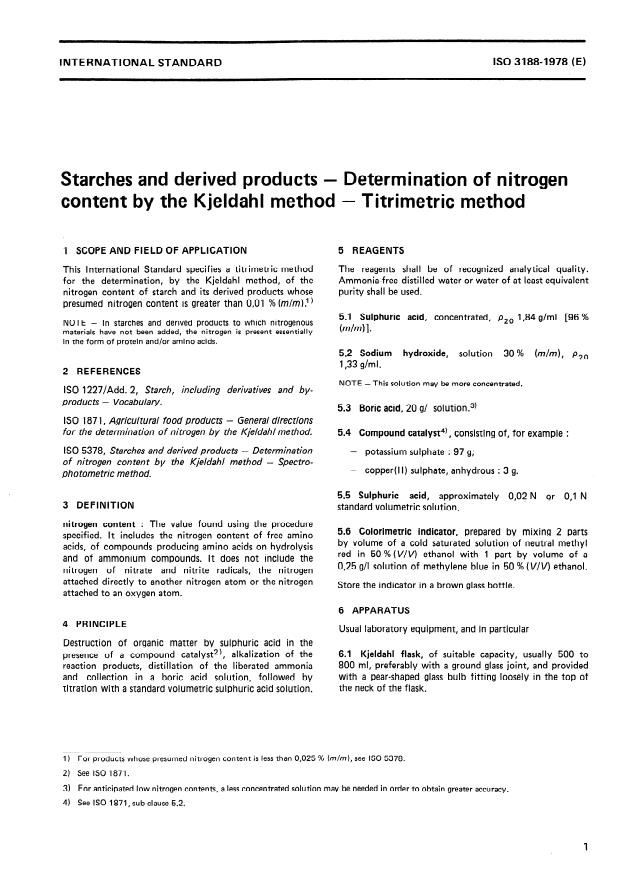
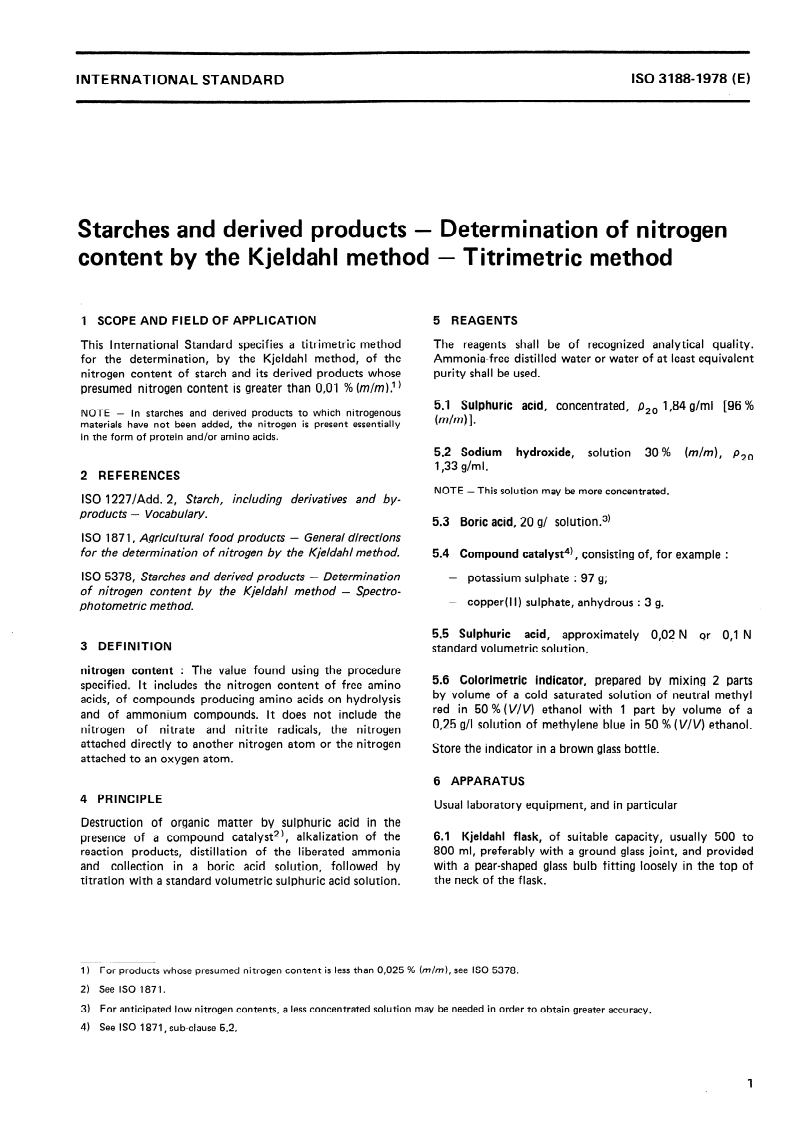
5 REAGENTS
1 SCOPE AND FIELD OF APPLICATION
The reagents shall be of recognized analytical quality.
This International Standard specifies a titrimetric method
Ammonia-free distilled water or water of at least equivalent
for the determination, by the Kjeldahl method, of the
purity shall be used.
nitrogen content of starch and its derived products whose
presumed nitrogen content is greater than 0,Ol % (mlm)? )
5.1 Sulphuric acid, concentrated, p20 1,84 g/ml [96 %
NOTE - In starches and derived products to which nitrogenous
(mhd].
materials have not been added, the nitrogen is present essentially
in the form of Protein and/or amino acids.
5.2 Sodium hydroxide, solution 30 % (mlm), p20
1,33 g/ml.
2 REFERENCES
NOTE - This Solution may be more concentrated.
ISO 1227fAdd. 2, Starch, including derivatives and by-
products - Vocabulary.
5.3 Boric acid, 20 g/ solution.3)
ISO 1871, Agricultural food products - General directions
for the determination of nitrogen by the Kjeldahlmethod.
5.4 Compound catalyst4), consisting of, for example :
ISO 5378, Starches and derived products - Determination
- potassium sulphate : 97 g;
of nitrogen content by the Kjeldahl method - Spectro-
- copper( II) sulphate, anhydrous : 3 g.
pho tome tric me thod,
5.5 Sulphuric acid,
approximately 0,02 N or 0,l N
-
3 DEFINITION
Standard volumetric Solution,
nitrogen content : The value found using the procedure
5.6 Colorimetric indicator, prepared by mixing 2 Parts
specified. lt includes the nitrogen content of free amino
by volume of a cold saturated Solution of neutral methyl
acids, of compounds producing amino acids on hydrolysis
red in 50 % (WV) ethanol with 1 part by volume of a
and of ammonium compounds. lt does not include the
0,25 g/l Solution of methylene blue in 50 % (VW) ethanol.
nitrogen of nitrate and nitrite radicals, the nitrogen
attached directly to another nitrogen atom or the nitrogen
Store the indicator in a brown glass bottle.
attached to an Oxygen atom.
6 APPARATUS
4 PRINCIPLE
Usual laboratory equipment, and in particular
Destruction of organic matter by sulphuric acid in the
presence of a compound catalyst*), alkalization of the 6.1 Kjeldahl flask, of suitable capacity, usually 500 to
800 ml, preferably with a ground glass joint, and provided
reaction products, distillation of the Iiberated ammonia
with a pear-shaped glass bulb fitting loosely in the top of
and collection in a boric acid Solution, followed by
the neck of the flask.
titration with a Standard volumetric sulphuric acid Solution.
1) For products whose presumed nitrogen content is less than 0,025 % (m/m), see ISO 5378.
2) See ISO 1871.
3) For anticipated low nitrogen contents, a less concentrated Solution may be needed in Order to obtain greater accuracy.
4) See ISO 1871, sub-clause 5.2,
ISO 31884978 (E)
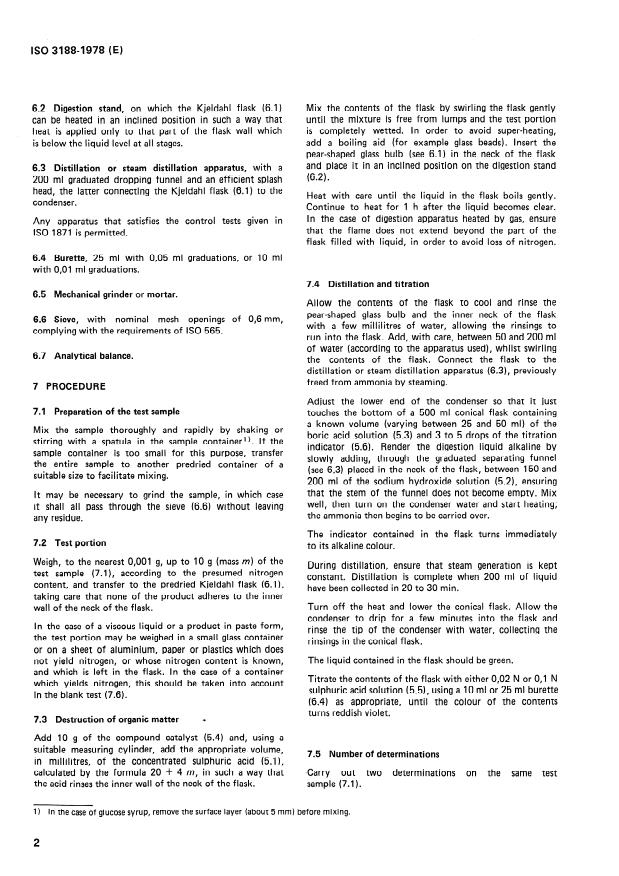
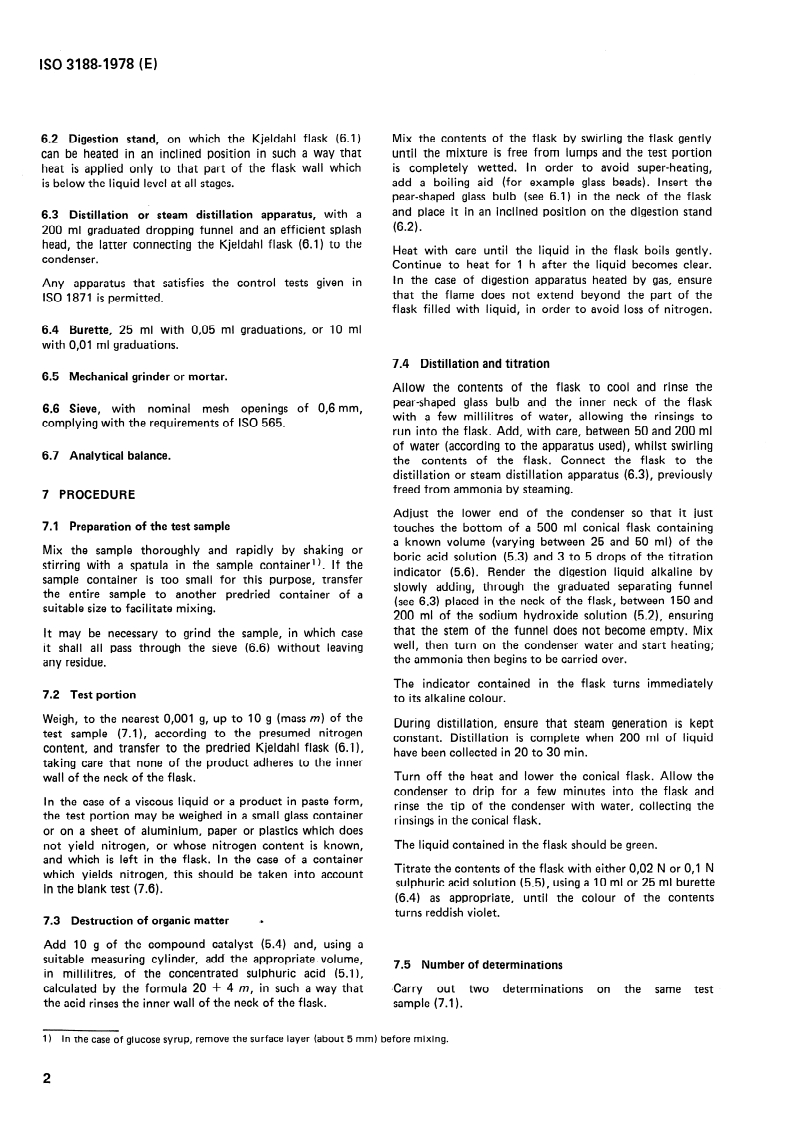
6.2 Digestion stand, on which the Kjeldahl flask (6.1) Mix the contents of the flask by swirling the flask gently
until the mixture is free from lumps and the test Portion
tan be heated in an inclined Position in such a way that
is completely wetted. In Order to avoid super-heating,
heat is applied only to that part of the flask wall which
add a boiling aid (for example glass beads). Insert the
is below the liquid level at all stages.
pear-shaped glass bulb (see 6.1) in the neck of the flask
and place it in an inclined Position on the digestion stand
6.3 Distillation or steam distillation apparatus, with a
(6.2).
200 ml graduated dropping funnel and an efficient splash
head, the latter connecting t
...
INTERNATIONAL STANDARD
INTERNATIONAL ORGANIZATION FOR STANDARDIZATIONWlEIKJjYHAPO,QHAR OPrAHM3AL&lR fl0 CTAH~APTM3AL&WWORGANISATION INTERNATIONALE DE NORMALISATION
Starches and derived products - Determination of nitrogen
content by the Kjeldahl method - Titrimetric method
Amidons, fdcules et produits d&iv& - Dosage de l’azote selon Ia methode de Kjeldahl - Mt!thode titrimetrique
First edition - 1978-08-15
Ei
-
UDC 664.2 : 546.17 : 543.24
Ref. No. ISO 3188-1978 (E)
Descriptors : starches, Chemical analysis, determination of content, nitrogen, volumetric analysis, Kjeldahl method.
Price based on 3 pages
FOREWORB
ISO (the International Organization for Standardization) is a worldwide federation
of national Standards institutes (ISO member bodies). The work of deweloping
International Standards is carried out through ISO technical committees. Ewery
member body interested in a subject for which a technical committee has been set
up has the right to be represented on that committee. International organizations,
governmental and non-governmental, in liaison with ISO, also take part in the work.
Draft International Standards adopted by the technical committees are circulated
to the member bodies for approval before their acceptance as International
Standards by the ISO Council.
International Standard ISO 3188 was developed by Technicai Committee
ISO/TC 93, Starch (including derivatives and by-products), and was circulated
to the member bodies in August 1975.
lt has been approved by the member bodies of the following countries :
Australia 1 ran Thailand
Czechoslovakia Netherlands Turkey
France Poland United Kingdom
Germany Romania Yugoslavia
Hungary South Africa, Rep. of
The member body of the following country expressed d isapprova I of the docume nt
on technical grounds :
U.S.A.
@ International Organisation for Standard ization, 9 978 l
Printed in Switzerland
ISO 31884978 (E)
INTERNATIONAL STANDARD
Starches and derived products - Determination of nitrogen
content by the Kjeldahl method - Titrimetric method
5 REAGENTS
1 SCOPE AND FIELD OF APPLICATION
The reagents shall be of recognized analytical quality.
This International Standard specifies a titrimetric method
Ammonia-free distilled water or water of at least equivalent
for the determination, by the Kjeldahl method, of the
purity shall be used.
nitrogen content of starch and its derived products whose
presumed nitrogen content is greater than 0,Ol % (mlm)? )
5.1 Sulphuric acid, concentrated, p20 1,84 g/ml [96 %
NOTE - In starches and derived products to which nitrogenous
(mhd].
materials have not been added, the nitrogen is present essentially
in the form of Protein and/or amino acids.
5.2 Sodium hydroxide, solution 30 % (mlm), p20
1,33 g/ml.
2 REFERENCES
NOTE - This Solution may be more concentrated.
ISO 1227fAdd. 2, Starch, including derivatives and by-
products - Vocabulary.
5.3 Boric acid, 20 g/ solution.3)
ISO 1871, Agricultural food products - General directions
for the determination of nitrogen by the Kjeldahlmethod.
5.4 Compound catalyst4), consisting of, for example :
ISO 5378, Starches and derived products - Determination
- potassium sulphate : 97 g;
of nitrogen content by the Kjeldahl method - Spectro-
- copper( II) sulphate, anhydrous : 3 g.
pho tome tric me thod,
5.5 Sulphuric acid,
approximately 0,02 N or 0,l N
-
3 DEFINITION
Standard volumetric Solution,
nitrogen content : The value found using the procedure
5.6 Colorimetric indicator, prepared by mixing 2 Parts
specified. lt includes the nitrogen content of free amino
by volume of a cold saturated Solution of neutral methyl
acids, of compounds producing amino acids on hydrolysis
red in 50 % (WV) ethanol with 1 part by volume of a
and of ammonium compounds. lt does not include the
0,25 g/l Solution of methylene blue in 50 % (VW) ethanol.
nitrogen of nitrate and nitrite radicals, the nitrogen
attached directly to another nitrogen atom or the nitrogen
Store the indicator in a brown glass bottle.
attached to an Oxygen atom.
6 APPARATUS
4 PRINCIPLE
Usual laboratory equipment, and in particular
Destruction of organic matter by sulphuric acid in the
presence of a compound catalyst*), alkalization of the 6.1 Kjeldahl flask, of suitable capacity, usually 500 to
800 ml, preferably with a ground glass joint, and provided
reaction products, distillation of the Iiberated ammonia
with a pear-shaped glass bulb fitting loosely in the top of
and collection in a boric acid Solution, followed by
the neck of the flask.
titration with a Standard volumetric sulphuric acid Solution.
1) For products whose presumed nitrogen content is less than 0,025 % (m/m), see ISO 5378.
2) See ISO 1871.
3) For anticipated low nitrogen contents, a less concentrated Solution may be needed in Order to obtain greater accuracy.
4) See ISO 1871, sub-clause 5.2,
ISO 31884978 (E)
6.2 Digestion stand, on which the Kjeldahl flask (6.1) Mix the contents of the flask by swirling the flask gently
until the mixture is free from lumps and the test Portion
tan be heated in an inclined Position in such a way that
is completely wetted. In Order to avoid super-heating,
heat is applied only to that part of the flask wall which
add a boiling aid (for example glass beads). Insert the
is below the liquid level at all stages.
pear-shaped glass bulb (see 6.1) in the neck of the flask
and place it in an inclined Position on the digestion stand
6.3 Distillation or steam distillation apparatus, with a
(6.2).
200 ml graduated dropping funnel and an efficient splash
head, the latter connecting t
...
-
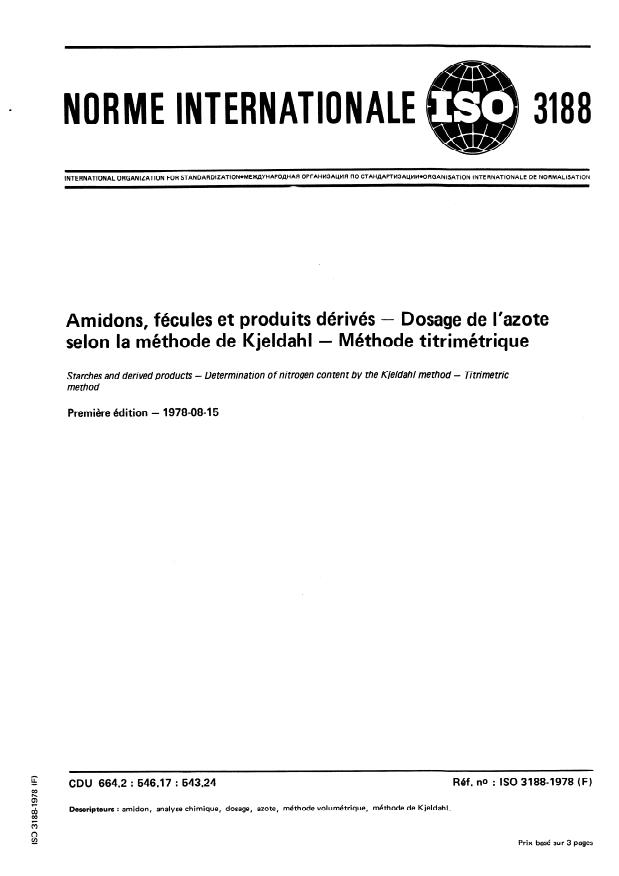
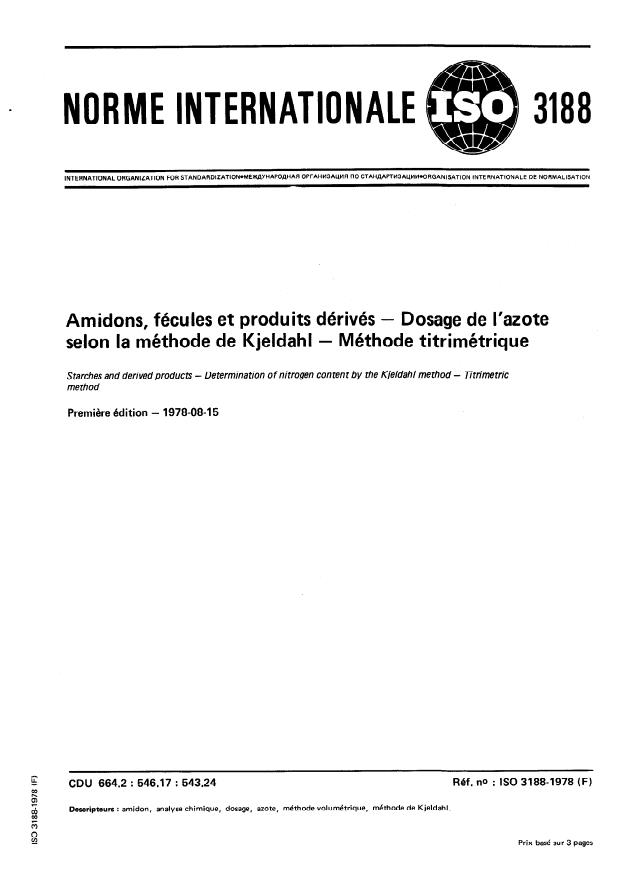
NORME INTERNATIONALE
INTERNATIONAL ORGANIZATION FOR STANDARDIZATIONOME~YHAPDCIHAR OPrAHM3AUMR n0 CTAHAA~~~AUM~~RGANISATION INTERNATIONALE DE NORMALISATION
Amidons, fécules et produits dérivés - Dosage de l’azote
selon la méthode de Kjeldahl - Méthode titrimétrique
Determination of nitrogen content b y the Kjeldahl method - Titrimetric
Starches and derived products -
method
Première 6dition - 1978-08-I 5
îî
Y Ref. no : ISO 3188-1978 (F)
CDU 664.2 : 546.17 : 543.24
méthode volumkrique, méthode de Kjeldahl.
Descripteurs : amidon, analyse chimique, dosage, azote,
Prix basé sur 3 pages
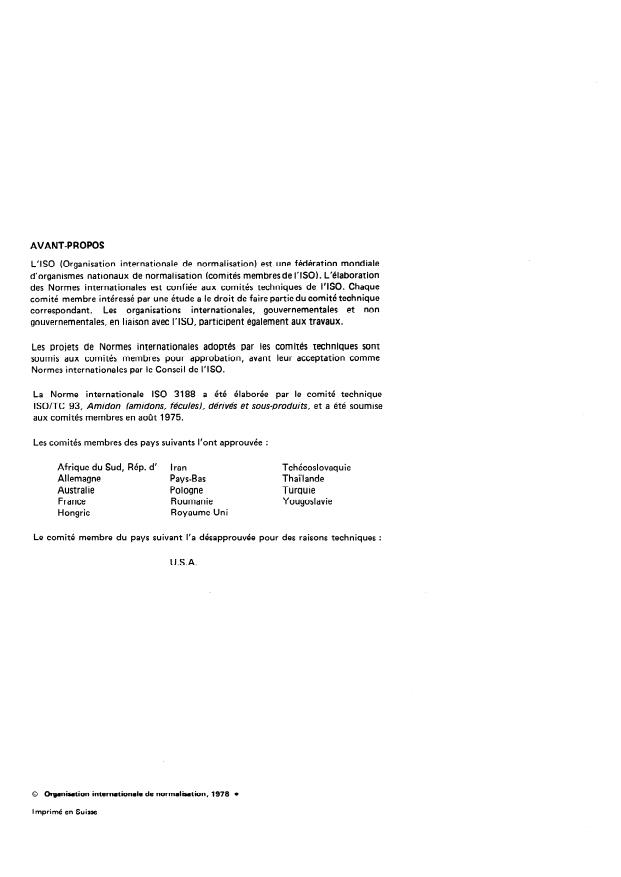
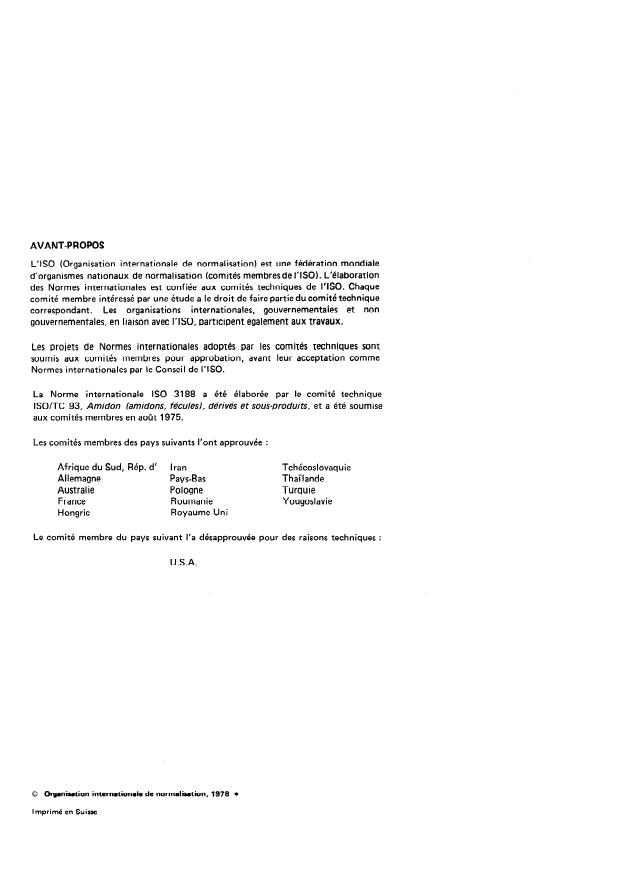
AVANT-PROPOS
L’ISO (Organisation internationale de normalisation) est une fédération mondiale
d’organismes nationaux de normalisation (comités membres de I’ISO). L’élaboration
des Normes internationales est confiée aux comités techniques de 1’60. Chaque
comité membre intéressé par une étude a le droit de faire partie du comité technique
correspondant. Les organisations internationales, gouvernementales et non
gouvernementales, en I iaison avec I’ISO, participent également aux travaux.
Les projets de Normes internationales adoptés par les comités techniques sont
soumis aux comités membres pour approbation, avant leur acceptation comme
Normes internationales par le Conseil de I’ISO.
La Norme internationale ISO 3188 a été élaborée par le comité technique
ISO/TC 93, Amidon (amidons, fécules), dérivés et sous-produits, et a été soumise
aux comités membres en août 1975.
Les comités membres des pays suivants l’ont approuvée :
Afrique du Sud, Rép. d’ Iran
Tchécoslovaquie
Allemagne
Pays-Bas Thaïlande
Australie Pologne Turquie
France Roumanie Yougoslavie
Hongrie Royaume-Uni
Le comité membre du pays suivant l’a désapprouvée pour des raisons techniques :
U.S.A.
0 Organisation internationale de normalisation, 1978 l
Imprimé en Suisse
ISO 31884978 (F)
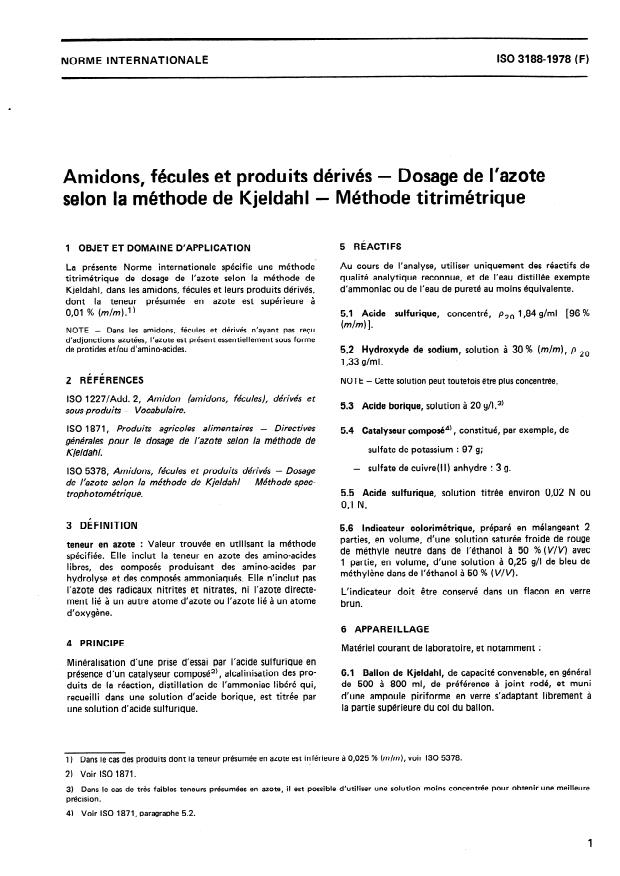
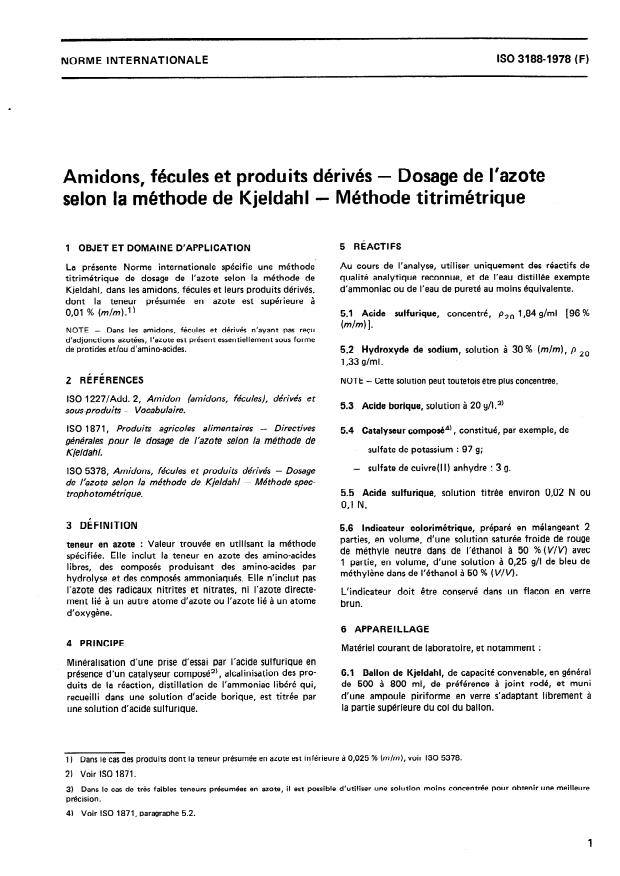
NORME INTERNATIONALE
produits dérivés - Dosage de l’azote
Amidons, fécules et
Kjeldahl - Méthode titrimétrique
selon la méthode de
5 RÉACTIFS
1 OBJET ET DOMAINE D’APPLICATION
Au cours de l’analyse, utiliser uniquement des réactifs de
La présente Norme internationale spécifie une méthode
qualité analytique reconnue, et de l’eau distillée exempte
titrimétrique de dosage de l’azote selon la méthode de
d’ammoniac ou de l’eau de pureté au moins équivalente.
Kjeldahl, dans les amidons, fécules et leurs produits dérivés,
dont la teneur présumée en azote est supérieure à
0,Ol % (mlm)?
5.1 Acide sulfurique, concentré, p20 1,84 g/ml [96 %
(mlm) ]m
NOTE - Dans les amidons, fécules et dérivés n’ayant pas reçu
d’adjonctions azotées, l’azote est présent essentiellement sous forme
de protides et/ou d’amino-acides.
5.2 Hydroxyde de sodium, solution à 30 % (mlm), p 20
1,33 g/ml.
2 RÉFÉRENCES NOTE - Cette solution peut toutefois être plus concentrée.
ISO 1227/Add. 2, Amidon (amidons, fécules), dérivés et
5.3 Acide borique, solution à 20 g/l.3)
sous-produits - Vocabulaire.
ISO 187 1, Produits agricoles alimentaires - Directives
5.4 Catalyseur composé4), constitué, par exemple, de
générales pour le dosage de l’azote selon la méthode de
-
sulfate de potassium : 97 g;
Kjeldahl.
-
sulfate de Cuivre(1 1) anhydre : 3 g.
ISO 5378; Amidons, fécules et produits dérivés - Dosage
de l’azote selon la méthode de Kjeldahl - Méthode spec-
tropho tométrique. 5.5 Acide sulfurique, solution titrée environ 0,02 N ou
0,l N.
3 DÉFINITION
5.6 Indicateur calorimétrique, préparé en mélangeant 2
parties, en volume, d’une solution saturée froide de rouge
teneur en azote : Valeur trouvée en utilisant la méthode
de méthyle neutre dans de I’éthanol à 50 % (WV) avec
spécifiée. Elle inclut la teneur en azote des amino-acides
1 partie, en volume, d’une solution à 0,25 g/l de bleu de
libres, des composés produisant des amino-acides par
méthylène dans de I’éthanol à 50 % (WV).
hydrolyse et des composés ammoniaqués. Elle n’inclut pas
l’azote des radicaux nitrites et nitrates, ni l’azote directe-
L’indicateur doit être conservé dans un flacon en verre
ment lié à un autre atome d’azote ou l’azote lié à un atome
brun.
d’oxygène.
6 APPAREILLAGE
4 PRINCIPE
Matériel courant de laboratoire, et notamment :
Minéralisation d’une prise d’essai par l’acide sulfurique en
6.1 Ballon de Kjeldahl, de capacité convenable, en général
présence d’un catalyseur composé2), alcalinisation des pro-
de 500 à 800 ml, de préférence à joint rodé, et muni
duits de la réaction, distillation de l’ammoniac libéré qui,
d’une ampoule piriforme en verre s’adaptant librement à
recueilli dans une solution d’acide borique, est titrée par
la partie supérieure du col du ballon.
une solution d’acide sulfurique.
1) Dans le cas des produits dont la teneur présumée en azote est inférieure à 0,025 % (mh), voir ISO 5378.
2) Voir ISO 1871.
3) Dans le cas de très faibles teneurs présumées en azote, il est possible d’utiliser une solution moins concentrée pour obtenir une meilleure
précision.
4) Voir ISO 1871, paragraphe 5.2,
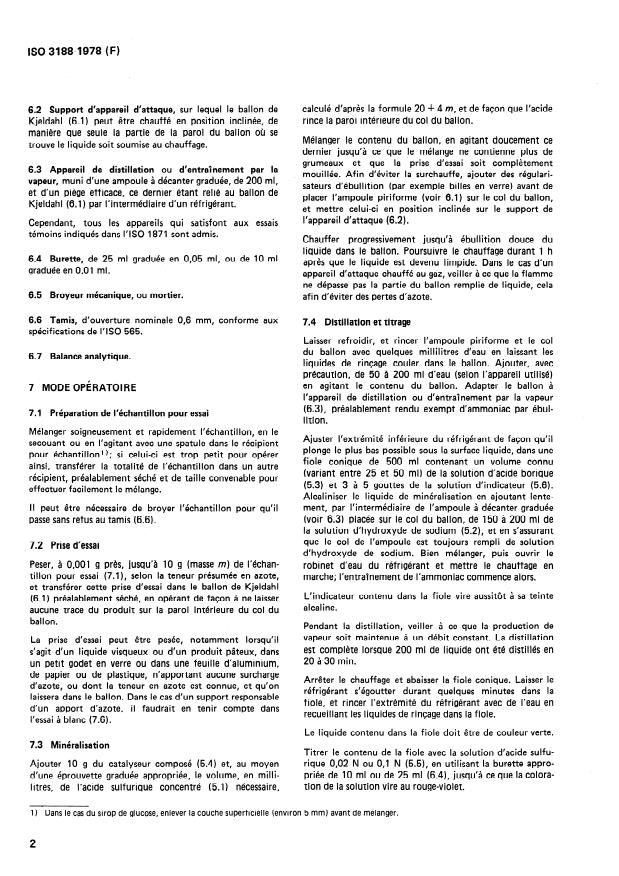
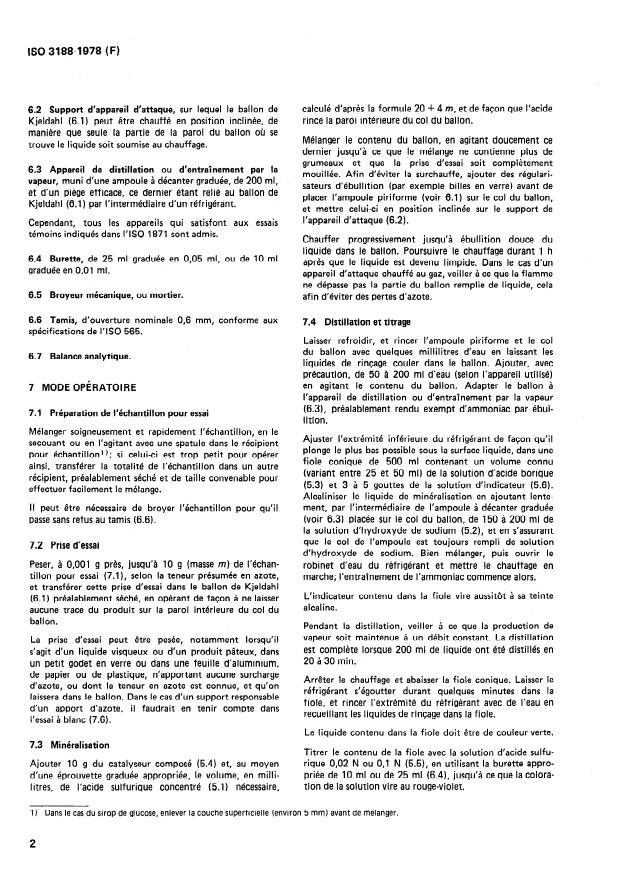
ISO3188-1978 (F)
calculé d’après la formule 20 + 4 m, et de façon que l’acide
6.2 Support d’appareil d’attaque, sur lequel le ballon de
rince la paroi intérieure du col du ballon.
Kjeldahl (6.1) peut être chauffé en position inclinée, de
manière que seule la partie de la paroi du ballon où se
Mélanger le contenu du ballon, en agitant doucement ce
trouve le liquide soit soumise au chauffage.
dernier jusqu’à ce que le mélange ne contienne plus de
grumeaux et que la ‘prise d’essai soit complètement
6.3 Appareil de distillation ou d’entraînement par la
mouillée. Afin d’éviter la surchauffe, ajouter des régulari-
vapeur, muni d’une ampoule à décanter graduée, de 200 ml,
sateurs d’ébullition (par exemple billes en verre) avant de
et d’un piège efficace, ce dernier étant relie au ballon de
placer l’ampoule piriforme (voir 6.1) sur le col du ballon,
Kjeldahl (6.1) par l’intermédiaire d’un réfrigérant.
et mettre celui-ci en position inclinée sur le support de
l’appareil d’attaque (6.2).
Cepen
...
-
NORME INTERNATIONALE
INTERNATIONAL ORGANIZATION FOR STANDARDIZATIONOME~YHAPDCIHAR OPrAHM3AUMR n0 CTAHAA~~~AUM~~RGANISATION INTERNATIONALE DE NORMALISATION
Amidons, fécules et produits dérivés - Dosage de l’azote
selon la méthode de Kjeldahl - Méthode titrimétrique
Determination of nitrogen content b y the Kjeldahl method - Titrimetric
Starches and derived products -
method
Première 6dition - 1978-08-I 5
îî
Y Ref. no : ISO 3188-1978 (F)
CDU 664.2 : 546.17 : 543.24
méthode volumkrique, méthode de Kjeldahl.
Descripteurs : amidon, analyse chimique, dosage, azote,
Prix basé sur 3 pages
AVANT-PROPOS
L’ISO (Organisation internationale de normalisation) est une fédération mondiale
d’organismes nationaux de normalisation (comités membres de I’ISO). L’élaboration
des Normes internationales est confiée aux comités techniques de 1’60. Chaque
comité membre intéressé par une étude a le droit de faire partie du comité technique
correspondant. Les organisations internationales, gouvernementales et non
gouvernementales, en I iaison avec I’ISO, participent également aux travaux.
Les projets de Normes internationales adoptés par les comités techniques sont
soumis aux comités membres pour approbation, avant leur acceptation comme
Normes internationales par le Conseil de I’ISO.
La Norme internationale ISO 3188 a été élaborée par le comité technique
ISO/TC 93, Amidon (amidons, fécules), dérivés et sous-produits, et a été soumise
aux comités membres en août 1975.
Les comités membres des pays suivants l’ont approuvée :
Afrique du Sud, Rép. d’ Iran
Tchécoslovaquie
Allemagne
Pays-Bas Thaïlande
Australie Pologne Turquie
France Roumanie Yougoslavie
Hongrie Royaume-Uni
Le comité membre du pays suivant l’a désapprouvée pour des raisons techniques :
U.S.A.
0 Organisation internationale de normalisation, 1978 l
Imprimé en Suisse
ISO 31884978 (F)
NORME INTERNATIONALE
produits dérivés - Dosage de l’azote
Amidons, fécules et
Kjeldahl - Méthode titrimétrique
selon la méthode de
5 RÉACTIFS
1 OBJET ET DOMAINE D’APPLICATION
Au cours de l’analyse, utiliser uniquement des réactifs de
La présente Norme internationale spécifie une méthode
qualité analytique reconnue, et de l’eau distillée exempte
titrimétrique de dosage de l’azote selon la méthode de
d’ammoniac ou de l’eau de pureté au moins équivalente.
Kjeldahl, dans les amidons, fécules et leurs produits dérivés,
dont la teneur présumée en azote est supérieure à
0,Ol % (mlm)?
5.1 Acide sulfurique, concentré, p20 1,84 g/ml [96 %
(mlm) ]m
NOTE - Dans les amidons, fécules et dérivés n’ayant pas reçu
d’adjonctions azotées, l’azote est présent essentiellement sous forme
de protides et/ou d’amino-acides.
5.2 Hydroxyde de sodium, solution à 30 % (mlm), p 20
1,33 g/ml.
2 RÉFÉRENCES NOTE - Cette solution peut toutefois être plus concentrée.
ISO 1227/Add. 2, Amidon (amidons, fécules), dérivés et
5.3 Acide borique, solution à 20 g/l.3)
sous-produits - Vocabulaire.
ISO 187 1, Produits agricoles alimentaires - Directives
5.4 Catalyseur composé4), constitué, par exemple, de
générales pour le dosage de l’azote selon la méthode de
-
sulfate de potassium : 97 g;
Kjeldahl.
-
sulfate de Cuivre(1 1) anhydre : 3 g.
ISO 5378; Amidons, fécules et produits dérivés - Dosage
de l’azote selon la méthode de Kjeldahl - Méthode spec-
tropho tométrique. 5.5 Acide sulfurique, solution titrée environ 0,02 N ou
0,l N.
3 DÉFINITION
5.6 Indicateur calorimétrique, préparé en mélangeant 2
parties, en volume, d’une solution saturée froide de rouge
teneur en azote : Valeur trouvée en utilisant la méthode
de méthyle neutre dans de I’éthanol à 50 % (WV) avec
spécifiée. Elle inclut la teneur en azote des amino-acides
1 partie, en volume, d’une solution à 0,25 g/l de bleu de
libres, des composés produisant des amino-acides par
méthylène dans de I’éthanol à 50 % (WV).
hydrolyse et des composés ammoniaqués. Elle n’inclut pas
l’azote des radicaux nitrites et nitrates, ni l’azote directe-
L’indicateur doit être conservé dans un flacon en verre
ment lié à un autre atome d’azote ou l’azote lié à un atome
brun.
d’oxygène.
6 APPAREILLAGE
4 PRINCIPE
Matériel courant de laboratoire, et notamment :
Minéralisation d’une prise d’essai par l’acide sulfurique en
6.1 Ballon de Kjeldahl, de capacité convenable, en général
présence d’un catalyseur composé2), alcalinisation des pro-
de 500 à 800 ml, de préférence à joint rodé, et muni
duits de la réaction, distillation de l’ammoniac libéré qui,
d’une ampoule piriforme en verre s’adaptant librement à
recueilli dans une solution d’acide borique, est titrée par
la partie supérieure du col du ballon.
une solution d’acide sulfurique.
1) Dans le cas des produits dont la teneur présumée en azote est inférieure à 0,025 % (mh), voir ISO 5378.
2) Voir ISO 1871.
3) Dans le cas de très faibles teneurs présumées en azote, il est possible d’utiliser une solution moins concentrée pour obtenir une meilleure
précision.
4) Voir ISO 1871, paragraphe 5.2,
ISO3188-1978 (F)
calculé d’après la formule 20 + 4 m, et de façon que l’acide
6.2 Support d’appareil d’attaque, sur lequel le ballon de
rince la paroi intérieure du col du ballon.
Kjeldahl (6.1) peut être chauffé en position inclinée, de
manière que seule la partie de la paroi du ballon où se
Mélanger le contenu du ballon, en agitant doucement ce
trouve le liquide soit soumise au chauffage.
dernier jusqu’à ce que le mélange ne contienne plus de
grumeaux et que la ‘prise d’essai soit complètement
6.3 Appareil de distillation ou d’entraînement par la
mouillée. Afin d’éviter la surchauffe, ajouter des régulari-
vapeur, muni d’une ampoule à décanter graduée, de 200 ml,
sateurs d’ébullition (par exemple billes en verre) avant de
et d’un piège efficace, ce dernier étant relie au ballon de
placer l’ampoule piriforme (voir 6.1) sur le col du ballon,
Kjeldahl (6.1) par l’intermédiaire d’un réfrigérant.
et mettre celui-ci en position inclinée sur le support de
l’appareil d’attaque (6.2).
Cepen
...
-
NORME INTERNATIONALE
INTERNATIONAL ORGANIZATION FOR STANDARDIZATIONOME~YHAPDCIHAR OPrAHM3AUMR n0 CTAHAA~~~AUM~~RGANISATION INTERNATIONALE DE NORMALISATION
Amidons, fécules et produits dérivés - Dosage de l’azote
selon la méthode de Kjeldahl - Méthode titrimétrique
Determination of nitrogen content b y the Kjeldahl method - Titrimetric
Starches and derived products -
method
Première 6dition - 1978-08-I 5
îî
Y Ref. no : ISO 3188-1978 (F)
CDU 664.2 : 546.17 : 543.24
méthode volumkrique, méthode de Kjeldahl.
Descripteurs : amidon, analyse chimique, dosage, azote,
Prix basé sur 3 pages
AVANT-PROPOS
L’ISO (Organisation internationale de normalisation) est une fédération mondiale
d’organismes nationaux de normalisation (comités membres de I’ISO). L’élaboration
des Normes internationales est confiée aux comités techniques de 1’60. Chaque
comité membre intéressé par une étude a le droit de faire partie du comité technique
correspondant. Les organisations internationales, gouvernementales et non
gouvernementales, en I iaison avec I’ISO, participent également aux travaux.
Les projets de Normes internationales adoptés par les comités techniques sont
soumis aux comités membres pour approbation, avant leur acceptation comme
Normes internationales par le Conseil de I’ISO.
La Norme internationale ISO 3188 a été élaborée par le comité technique
ISO/TC 93, Amidon (amidons, fécules), dérivés et sous-produits, et a été soumise
aux comités membres en août 1975.
Les comités membres des pays suivants l’ont approuvée :
Afrique du Sud, Rép. d’ Iran
Tchécoslovaquie
Allemagne
Pays-Bas Thaïlande
Australie Pologne Turquie
France Roumanie Yougoslavie
Hongrie Royaume-Uni
Le comité membre du pays suivant l’a désapprouvée pour des raisons techniques :
U.S.A.
0 Organisation internationale de normalisation, 1978 l
Imprimé en Suisse
ISO 31884978 (F)
NORME INTERNATIONALE
produits dérivés - Dosage de l’azote
Amidons, fécules et
Kjeldahl - Méthode titrimétrique
selon la méthode de
5 RÉACTIFS
1 OBJET ET DOMAINE D’APPLICATION
Au cours de l’analyse, utiliser uniquement des réactifs de
La présente Norme internationale spécifie une méthode
qualité analytique reconnue, et de l’eau distillée exempte
titrimétrique de dosage de l’azote selon la méthode de
d’ammoniac ou de l’eau de pureté au moins équivalente.
Kjeldahl, dans les amidons, fécules et leurs produits dérivés,
dont la teneur présumée en azote est supérieure à
0,Ol % (mlm)?
5.1 Acide sulfurique, concentré, p20 1,84 g/ml [96 %
(mlm) ]m
NOTE - Dans les amidons, fécules et dérivés n’ayant pas reçu
d’adjonctions azotées, l’azote est présent essentiellement sous forme
de protides et/ou d’amino-acides.
5.2 Hydroxyde de sodium, solution à 30 % (mlm), p 20
1,33 g/ml.
2 RÉFÉRENCES NOTE - Cette solution peut toutefois être plus concentrée.
ISO 1227/Add. 2, Amidon (amidons, fécules), dérivés et
5.3 Acide borique, solution à 20 g/l.3)
sous-produits - Vocabulaire.
ISO 187 1, Produits agricoles alimentaires - Directives
5.4 Catalyseur composé4), constitué, par exemple, de
générales pour le dosage de l’azote selon la méthode de
-
sulfate de potassium : 97 g;
Kjeldahl.
-
sulfate de Cuivre(1 1) anhydre : 3 g.
ISO 5378; Amidons, fécules et produits dérivés - Dosage
de l’azote selon la méthode de Kjeldahl - Méthode spec-
tropho tométrique. 5.5 Acide sulfurique, solution titrée environ 0,02 N ou
0,l N.
3 DÉFINITION
5.6 Indicateur calorimétrique, préparé en mélangeant 2
parties, en volume, d’une solution saturée froide de rouge
teneur en azote : Valeur trouvée en utilisant la méthode
de méthyle neutre dans de I’éthanol à 50 % (WV) avec
spécifiée. Elle inclut la teneur en azote des amino-acides
1 partie, en volume, d’une solution à 0,25 g/l de bleu de
libres, des composés produisant des amino-acides par
méthylène dans de I’éthanol à 50 % (WV).
hydrolyse et des composés ammoniaqués. Elle n’inclut pas
l’azote des radicaux nitrites et nitrates, ni l’azote directe-
L’indicateur doit être conservé dans un flacon en verre
ment lié à un autre atome d’azote ou l’azote lié à un atome
brun.
d’oxygène.
6 APPAREILLAGE
4 PRINCIPE
Matériel courant de laboratoire, et notamment :
Minéralisation d’une prise d’essai par l’acide sulfurique en
6.1 Ballon de Kjeldahl, de capacité convenable, en général
présence d’un catalyseur composé2), alcalinisation des pro-
de 500 à 800 ml, de préférence à joint rodé, et muni
duits de la réaction, distillation de l’ammoniac libéré qui,
d’une ampoule piriforme en verre s’adaptant librement à
recueilli dans une solution d’acide borique, est titrée par
la partie supérieure du col du ballon.
une solution d’acide sulfurique.
1) Dans le cas des produits dont la teneur présumée en azote est inférieure à 0,025 % (mh), voir ISO 5378.
2) Voir ISO 1871.
3) Dans le cas de très faibles teneurs présumées en azote, il est possible d’utiliser une solution moins concentrée pour obtenir une meilleure
précision.
4) Voir ISO 1871, paragraphe 5.2,
ISO3188-1978 (F)
calculé d’après la formule 20 + 4 m, et de façon que l’acide
6.2 Support d’appareil d’attaque, sur lequel le ballon de
rince la paroi intérieure du col du ballon.
Kjeldahl (6.1) peut être chauffé en position inclinée, de
manière que seule la partie de la paroi du ballon où se
Mélanger le contenu du ballon, en agitant doucement ce
trouve le liquide soit soumise au chauffage.
dernier jusqu’à ce que le mélange ne contienne plus de
grumeaux et que la ‘prise d’essai soit complètement
6.3 Appareil de distillation ou d’entraînement par la
mouillée. Afin d’éviter la surchauffe, ajouter des régulari-
vapeur, muni d’une ampoule à décanter graduée, de 200 ml,
sateurs d’ébullition (par exemple billes en verre) avant de
et d’un piège efficace, ce dernier étant relie au ballon de
placer l’ampoule piriforme (voir 6.1) sur le col du ballon,
Kjeldahl (6.1) par l’intermédiaire d’un réfrigérant.
et mettre celui-ci en position inclinée sur le support de
l’appareil d’attaque (6.2).
Cepen
...
-
NORME INTERNATIONALE
INTERNATIONAL ORGANIZATION FOR STANDARDIZATIONOME~YHAPDCIHAR OPrAHM3AUMR n0 CTAHAA~~~AUM~~RGANISATION INTERNATIONALE DE NORMALISATION
Amidons, fécules et produits dérivés - Dosage de l’azote
selon la méthode de Kjeldahl - Méthode titrimétrique
Determination of nitrogen content b y the Kjeldahl method - Titrimetric
Starches and derived products -
method
Première 6dition - 1978-08-I 5
îî
Y Ref. no : ISO 3188-1978 (F)
CDU 664.2 : 546.17 : 543.24
méthode volumkrique, méthode de Kjeldahl.
Descripteurs : amidon, analyse chimique, dosage, azote,
Prix basé sur 3 pages
AVANT-PROPOS
L’ISO (Organisation internationale de normalisation) est une fédération mondiale
d’organismes nationaux de normalisation (comités membres de I’ISO). L’élaboration
des Normes internationales est confiée aux comités techniques de 1’60. Chaque
comité membre intéressé par une étude a le droit de faire partie du comité technique
correspondant. Les organisations internationales, gouvernementales et non
gouvernementales, en I iaison avec I’ISO, participent également aux travaux.
Les projets de Normes internationales adoptés par les comités techniques sont
soumis aux comités membres pour approbation, avant leur acceptation comme
Normes internationales par le Conseil de I’ISO.
La Norme internationale ISO 3188 a été élaborée par le comité technique
ISO/TC 93, Amidon (amidons, fécules), dérivés et sous-produits, et a été soumise
aux comités membres en août 1975.
Les comités membres des pays suivants l’ont approuvée :
Afrique du Sud, Rép. d’ Iran
Tchécoslovaquie
Allemagne
Pays-Bas Thaïlande
Australie Pologne Turquie
France Roumanie Yougoslavie
Hongrie Royaume-Uni
Le comité membre du pays suivant l’a désapprouvée pour des raisons techniques :
U.S.A.
0 Organisation internationale de normalisation, 1978 l
Imprimé en Suisse
ISO 31884978 (F)
NORME INTERNATIONALE
produits dérivés - Dosage de l’azote
Amidons, fécules et
Kjeldahl - Méthode titrimétrique
selon la méthode de
5 RÉACTIFS
1 OBJET ET DOMAINE D’APPLICATION
Au cours de l’analyse, utiliser uniquement des réactifs de
La présente Norme internationale spécifie une méthode
qualité analytique reconnue, et de l’eau distillée exempte
titrimétrique de dosage de l’azote selon la méthode de
d’ammoniac ou de l’eau de pureté au moins équivalente.
Kjeldahl, dans les amidons, fécules et leurs produits dérivés,
dont la teneur présumée en azote est supérieure à
0,Ol % (mlm)?
5.1 Acide sulfurique, concentré, p20 1,84 g/ml [96 %
(mlm) ]m
NOTE - Dans les amidons, fécules et dérivés n’ayant pas reçu
d’adjonctions azotées, l’azote est présent essentiellement sous forme
de protides et/ou d’amino-acides.
5.2 Hydroxyde de sodium, solution à 30 % (mlm), p 20
1,33 g/ml.
2 RÉFÉRENCES NOTE - Cette solution peut toutefois être plus concentrée.
ISO 1227/Add. 2, Amidon (amidons, fécules), dérivés et
5.3 Acide borique, solution à 20 g/l.3)
sous-produits - Vocabulaire.
ISO 187 1, Produits agricoles alimentaires - Directives
5.4 Catalyseur composé4), constitué, par exemple, de
générales pour le dosage de l’azote selon la méthode de
-
sulfate de potassium : 97 g;
Kjeldahl.
-
sulfate de Cuivre(1 1) anhydre : 3 g.
ISO 5378; Amidons, fécules et produits dérivés - Dosage
de l’azote selon la méthode de Kjeldahl - Méthode spec-
tropho tométrique. 5.5 Acide sulfurique, solution titrée environ 0,02 N ou
0,l N.
3 DÉFINITION
5.6 Indicateur calorimétrique, préparé en mélangeant 2
parties, en volume, d’une solution saturée froide de rouge
teneur en azote : Valeur trouvée en utilisant la méthode
de méthyle neutre dans de I’éthanol à 50 % (WV) avec
spécifiée. Elle inclut la teneur en azote des amino-acides
1 partie, en volume, d’une solution à 0,25 g/l de bleu de
libres, des composés produisant des amino-acides par
méthylène dans de I’éthanol à 50 % (WV).
hydrolyse et des composés ammoniaqués. Elle n’inclut pas
l’azote des radicaux nitrites et nitrates, ni l’azote directe-
L’indicateur doit être conservé dans un flacon en verre
ment lié à un autre atome d’azote ou l’azote lié à un atome
brun.
d’oxygène.
6 APPAREILLAGE
4 PRINCIPE
Matériel courant de laboratoire, et notamment :
Minéralisation d’une prise d’essai par l’acide sulfurique en
6.1 Ballon de Kjeldahl, de capacité convenable, en général
présence d’un catalyseur composé2), alcalinisation des pro-
de 500 à 800 ml, de préférence à joint rodé, et muni
duits de la réaction, distillation de l’ammoniac libéré qui,
d’une ampoule piriforme en verre s’adaptant librement à
recueilli dans une solution d’acide borique, est titrée par
la partie supérieure du col du ballon.
une solution d’acide sulfurique.
1) Dans le cas des produits dont la teneur présumée en azote est inférieure à 0,025 % (mh), voir ISO 5378.
2) Voir ISO 1871.
3) Dans le cas de très faibles teneurs présumées en azote, il est possible d’utiliser une solution moins concentrée pour obtenir une meilleure
précision.
4) Voir ISO 1871, paragraphe 5.2,
ISO3188-1978 (F)
calculé d’après la formule 20 + 4 m, et de façon que l’acide
6.2 Support d’appareil d’attaque, sur lequel le ballon de
rince la paroi intérieure du col du ballon.
Kjeldahl (6.1) peut être chauffé en position inclinée, de
manière que seule la partie de la paroi du ballon où se
Mélanger le contenu du ballon, en agitant doucement ce
trouve le liquide soit soumise au chauffage.
dernier jusqu’à ce que le mélange ne contienne plus de
grumeaux et que la ‘prise d’essai soit complètement
6.3 Appareil de distillation ou d’entraînement par la
mouillée. Afin d’éviter la surchauffe, ajouter des régulari-
vapeur, muni d’une ampoule à décanter graduée, de 200 ml,
sateurs d’ébullition (par exemple billes en verre) avant de
et d’un piège efficace, ce dernier étant relie au ballon de
placer l’ampoule piriforme (voir 6.1) sur le col du ballon,
Kjeldahl (6.1) par l’intermédiaire d’un réfrigérant.
et mettre celui-ci en position inclinée sur le support de
l’appareil d’attaque (6.2).
Cepen
...