

ISO 10426-5:2024
(Main)Oil and gas industries including lower carbon energy — Cements and materials for well cementing — Part 5: Determination of shrinkage and expansion of well cement formulations
General Information
- Abstract
This document provides the methods for the testing of well cement formulations to determine the dimension changes during the curing process (cement hydration) at atmospheric and elevated pressure and the stress generated by expansion in a confined environment under elevated temperature and pressure.
- Status
- Published
- Publication Date
- 19-Sep-2024
- Current Stage
- 6060 - International Standard published
- Start Date
- 20-Sep-2024
- Due Date
- 20-Jul-2025
- Completion Date
- 20-Sep-2024
Buy Documents


ISO 10426-5:2024 - Oil and gas industries including lower carbon energy — Cements and materials for well cementing — Part 5: Determination of shrinkage and expansion of well cement formulations Released:20. 09. 2024

ISO 10426-5:2024 - Industries du pétrole et du gaz, y compris les énergies a faible teneur en carbone — Ciments et matériaux pour la cimentation des puits — Partie 5: Détermination du retrait et de l'expansion des formulations de ciments pour puits Released:20. 09. 2024
Overview
ISO 10426-5:2024 is an international standard developed by ISO for the oil and gas industry, including lower carbon energy applications. This standard, part of the ISO 10426 series, focuses on the determination of shrinkage and expansion in well cement formulations. It specifies laboratory test methods to evaluate dimensional changes-shrinkage or expansion-that occur in cement slurries during the curing process under various conditions, including atmospheric and elevated pressures, and assesses the stress generated by expansion under confined environments at elevated temperature and pressure.
Accurately determining the volumetric stability of well cement formulations is crucial in oil and gas well construction and integrity. This standard provides reliable test procedures to help industry professionals assess the performance of cements and additives, optimize slurry designs, and enhance operational safety.
Key Topics
- Shrinkage and Expansion of Well Cements: Evaluation of changes in external volume or dimensions resulting from the curing of cement slurries.
- Test Methods: Procedures for measuring shrinkage or expansion:
- Under free access to water at atmospheric pressure (Annular ring test)
- Under impermeable conditions using a membrane or sealed bag
- Under elevated temperature and pressure in confined environments (informative annex)
- Equipment and Apparatus: Specification of moulds, water curing baths, temperature-measuring systems, consistometers, electronic scales, and re-sealable bags suitable for testing.
- Measurement and Calculations: Guidance for measuring dimensional changes and calculating percentage shrinkage or expansion.
- Impact on Well Integrity: Relationship between dimensional stability of cement and the integrity of zonal isolation, prevention of micro-annulus formation, and sealing effectiveness.
Applications
This standard has significant practical value for organizations involved in well design, construction, integrity, and abandonment within the oil, gas, and lower carbon energy sectors. Key applications include:
- Well Integrity Validation: Ensuring that cement formulations maintain hydraulic isolation between geological formations and protect against crossflow and casing pressure.
- Plug and Abandonment Operations: Determining expansion and stress generation to optimize cement plugs used for permanent well abandonment.
- Additive Evaluation: Assessing the efficacy of expansion additives in counteracting hydration shrinkage and improving long-term well performance.
- Quality Control & Research: Standardizing laboratory testing processes for R&D and quality assurance in both routine field operations and specialized research laboratories.
Related Standards
ISO 10426-5:2024 is closely linked to other foundational documents and industry practices, including:
- API Specification 10A: Cements and Materials for Well Cementing - provides requirements for cement used in well applications.
- API Recommended Practice 10B-2: Recommended Practice for Testing Well Cements - outlines testing procedures for cement mixers and evaluators.
- Other Parts of ISO 10426 Series: Cover broader aspects of cement properties, testing methods, and additives relevant to the oil and gas sector.
By adopting ISO 10426-5:2024, organizations benefit from harmonized, reliable methods for evaluating well cements' shrinkage and expansion. This supports regulatory compliance, operational efficiency, and safety in well construction and maintenance, especially as the industry transitions towards lower carbon energy solutions.
Relations
- Effective Date
- 12-Feb-2026
- Effective Date
- 29-Jul-2023
- Effective Date
- 22-Apr-2023
Buy Documents
ISO 10426-5:2024 - Oil and gas industries including lower carbon energy — Cements and materials for well cementing — Part 5: Determination of shrinkage and expansion of well cement formulations Released:20. 09. 2024
ISO 10426-5:2024 - Industries du pétrole et du gaz, y compris les énergies a faible teneur en carbone — Ciments et matériaux pour la cimentation des puits — Partie 5: Détermination du retrait et de l'expansion des formulations de ciments pour puits Released:20. 09. 2024
Get Certified
Connect with accredited certification bodies for this standard

DIBt (Deutsches Institut für Bautechnik)
German Institute for Building Technology.
DIN CERTCO
DIN Group product certification.

Element Materials Technology
Materials testing and product certification.
Sponsored listings
Frequently Asked Questions
ISO 10426-5:2024 is a standard published by the International Organization for Standardization (ISO). Its full title is "Oil and gas industries including lower carbon energy — Cements and materials for well cementing — Part 5: Determination of shrinkage and expansion of well cement formulations". This standard covers: This document provides the methods for the testing of well cement formulations to determine the dimension changes during the curing process (cement hydration) at atmospheric and elevated pressure and the stress generated by expansion in a confined environment under elevated temperature and pressure.
This document provides the methods for the testing of well cement formulations to determine the dimension changes during the curing process (cement hydration) at atmospheric and elevated pressure and the stress generated by expansion in a confined environment under elevated temperature and pressure.
ISO 10426-5:2024 is classified under the following ICS (International Classification for Standards) categories: 75.020 - Extraction and processing of petroleum and natural gas; 91.100.10 - Cement. Gypsum. Lime. Mortar. The ICS classification helps identify the subject area and facilitates finding related standards.
ISO 10426-5:2024 has the following relationships with other standards: It is inter standard links to EN ISO 10426-5:2024, ISO 5149-2:2014/Amd 1:2020, ISO 10426-5:2004. Understanding these relationships helps ensure you are using the most current and applicable version of the standard.
ISO 10426-5:2024 is available in PDF format for immediate download after purchase. The document can be added to your cart and obtained through the secure checkout process. Digital delivery ensures instant access to the complete standard document.
Standards Content (Sample)
International
Standard
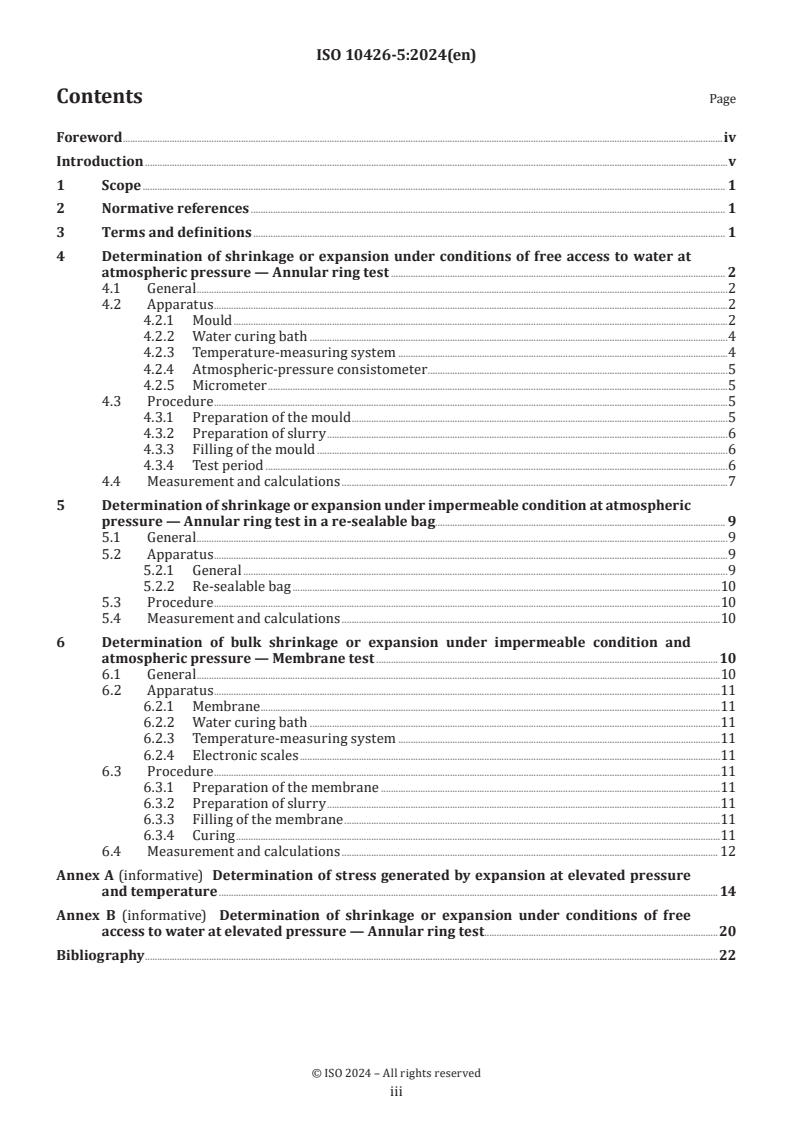
ISO 10426-5
Second edition
Oil and gas industries including
2024-09
lower carbon energy — Cements
and materials for well cementing —
Part 5:
Determination of shrinkage
and expansion of well cement
formulations
Industries du pétrole et du gaz, y compris les énergies à faible
teneur en carbone — Ciments et matériaux pour la cimentation
des puits —
Partie 5: Détermination du retrait et de l'expansion des
formulations de ciments pour puits
Reference number
© ISO 2024
All rights reserved. Unless otherwise specified, or required in the context of its implementation, no part of this publication may
be reproduced or utilized otherwise in any form or by any means, electronic or mechanical, including photocopying, or posting on
the internet or an intranet, without prior written permission. Permission can be requested from either ISO at the address below
or ISO’s member body in the country of the requester.
ISO copyright office
CP 401 • Ch. de Blandonnet 8
CH-1214 Vernier, Geneva
Phone: +41 22 749 01 11
Email: copyright@iso.org
Website: www.iso.org
Published in Switzerland
ii
Contents Page
Foreword .iv
Introduction .v
1 Scope . 1
2 Normative references . 1
3 Terms and definitions . 1
4 Determination of shrinkage or expansion under conditions of free access to water at
atmospheric pressure — Annular ring test . 2
4.1 General .2
4.2 Apparatus .2
4.2.1 Mould .2
4.2.2 Water curing bath .4
4.2.3 Temperature-measuring system .4
4.2.4 Atmospheric-pressure consistometer .5
4.2.5 Micrometer .5
4.3 Procedure .5
4.3.1 Preparation of the mould .5
4.3.2 Preparation of slurry .6
4.3.3 Filling of the mould .6
4.3.4 Test period .6
4.4 Measurement and calculations .7
5 Determination of shrinkage or expansion under impermeable condition at atmospheric
pressure — Annular ring test in a re-sealable bag. 9
5.1 General .9
5.2 Apparatus .9
5.2.1 General .9
5.2.2 Re-sealable bag .10
5.3 Procedure .10
5.4 Measurement and calculations .10
6 Determination of bulk shrinkage or expansion under impermeable condition and
atmospheric pressure — Membrane test . 10
6.1 General .10
6.2 Apparatus .11
6.2.1 Membrane .11
6.2.2 Water curing bath .11
6.2.3 Temperature-measuring system .11
6.2.4 Electronic scales .11
6.3 Procedure .11
6.3.1 Preparation of the membrane .11
6.3.2 Preparation of slurry .11
6.3.3 Filling of the membrane .11
6.3.4 Curing .11
6.4 Measurement and calculations . 12
Annex A (informative) Determination of stress generated by expansion at elevated pressure
and temperature . 14
Annex B (informative) Determination of shrinkage or expansion under conditions of free
access to water at elevated pressure — Annular ring test . .20
Bibliography .22
iii
Foreword
ISO (the International Organization for Standardization) is a worldwide federation of national standards
bodies (ISO member bodies). The work of preparing International Standards is normally carried out through
ISO technical committees. Each member body interested in a subject for which a technical committee
has been established has the right to be represented on that committee. International organizations,
governmental and non-governmental, in liaison with ISO, also take part in the work. ISO collaborates closely
with the International Electrotechnical Commission (IEC) on all matters of electrotechnical standardization.
The procedures used to develop this document and those intended for its further maintenance are described
in the ISO/IEC Directives, Part 1. In particular, the different approval criteria needed for the different types
of ISO document should be noted. This document was drafted in accordance with the editorial rules of the
ISO/IEC Directives, Part 2 (see www.iso.org/directives).
ISO draws attention to the possibility that the implementation of this document may involve the use of (a)
patent(s). ISO takes no position concerning the evidence, validity or applicability of any claimed patent
rights in respect thereof. As of the date of publication of this document, ISO had not received notice of (a)
patent(s) which may be required to implement this document. However, implementers are cautioned that
this may not represent the latest information, which may be obtained from the patent database available at
www.iso.org/patents. ISO shall not be held responsible for identifying any or all such patent rights.
Any trade name used in this document is information given for the convenience of users and does not
constitute an endorsement.
For an explanation of the voluntary nature of standards, the meaning of ISO specific terms and expressions
related to conformity assessment, as well as information about ISO's adherence to the World Trade
Organization (WTO) principles in the Technical Barriers to Trade (TBT), see www.iso.org/iso/foreword.html.
This document was prepared by Technical Committee ISO/TC 67, Oil and gas industries including lower
carbon energy, Subcommittee SC 3, Drilling and completion fluids, well cements and treatment fluids, in
collaboration with the European Committee for Standardization (CEN) Technical Committee CEN/TC 12, Oil
and gas industries including lower carbon energy, in accordance with the Agreement on technical cooperation
between ISO and CEN (Vienna Agreement).
This second edition cancels and replaces the first edition (ISO 10426-5:2004), which has been technically
revised.
The main changes are as follows:
— addition of the Introduction, with background information on expansion and shrinkage;
— addition of annular ring test under impermeable conditions at atmospheric pressure;
— inclusion of an informative annex describing a method to determine the stress generated by expansion
under confined conditions at elevated temperature and pressure;
— inclusion of an informative annex describing the annular ring test at elevated pressure.
A list of all parts in the ISO 10426 series can be found on the ISO website.
Any feedback or questions on this document should be directed to the user’s national standards body. A
complete listing of these bodies can be found at www.iso.org/members.html.
iv
Introduction
When Portland cement reacts with water, there is an overall reduction in the absolute volume of components:
V + V > V (1)
c w ch
where
V is the volume of cement;
c
V is the volume of water;
w
V is the volume of cement hydrates.
ch
In this document the absolute volume decrease [(V + V ) − V ] is referred to as hydration shrinkage,
c w ch
although in other documents it can also be referred to as chemical shrinkage, total chemical contraction, or
hydration volume reduction.
Depending on the exposure conditions, presence of external stresses during setting and, most importantly,
access to external water, the hydration shrinkage may lead to bulk shrinkage of the set cement.
The change in the sample dimensions is referred to as bulk shrinkage or expansion. Bulk shrinkage and
expansion of the cement refer to the result of the measurement of a linear dimensional change or volume
change. The volume to which all volume changes are related is the volume of the slurry immediately after
mixing and emplacement in the experimental equipment. For small values of shrinkage or expansion,
typically the case in well cement systems, the fractional volume dimensional change can be approximated as
3 times the fractional linear dimensional change.
Bulk shrinkage may cause:
— formation of a micro-annulus, potentially affecting cement evaluation logs;
— loss of zonal isolation leading to crossflow or sustained casing pressure;
— lack of a hydraulic seal when using cement inflatable packers;
— poor sealing of abandonment plugs.
Additives are available that can overcome the effects of hydration shrinkage and generate bulk expansion
of set cement. In plug applications, bulk expansion of cement generates stress at the cement-rock or cement-
formation interface. A method of measuring the stress generated by expansion in a plug-type geometry is
given in Annex A.
In this document, SI units are used; and where practical, U.S. customary units are included in brackets for
information.
This document is based on API Technical Report 10TR 2.
v
International Standard ISO 10426-5:2024(en)
Oil and gas industries including lower carbon energy —
Cements and materials for well cementing —
Part 5:
Determination of shrinkage and expansion of well cement
formulations
1 Scope
This document provides the methods for the testing of well cement formulations to determine the dimension
changes during the curing process (cement hydration) at atmospheric and elevated pressure and the stress
generated by expansion in a confined environment under elevated temperature and pressure.
2 Normative references
The following documents are referred to in the text in such a way that some or all of their content constitutes
requirements of this document. For dated references, only the edition cited applies. For undated references,
the latest edition of the referenced document (including any amendments) applies.
API Specification 10A, Cements and Materials for Well Cementing
API Recommended Practice 10B-2, Recommended Practice for Testing Well Cements
3 Terms and definitions
For the purposes of this document, the following terms and definitions apply.
ISO and IEC maintain terminology databases for use in standardization at the following addresses:
— ISO Online browsing platform: available at https:// www .iso .org/ obp
— IEC Electropedia: available at https:// www .electropedia .org/
3.1
bulk expansion
increase in the external volume or dimensions of a cement sample
3.2
bulk shrinkage
decrease in the external volume or dimensions of a cement sample
3.3
CEA
cement expansion additive
additive used in a cement slurry formulation to provide bulk expansion (3.1), or reduce bulk shrinkage (3.2)
3.4
hydration shrinkage
difference in the volume between the hydration products and the volume of the dry cement, additives and water
3.5
radial interface stress
stress generated at the interface between the set cement and casing or borehole wall due to bulk shrinkage
(3.2) or bulk expansion (3.1) of the cement
3.6
UCA
ultrasonic cement analyser
instrument used for the non-destructive sonic determination of compressive strength of cement
4 Determination of shrinkage or expansion under conditions of free access to water
at atmospheric pressure — Annular ring test
4.1 General
The annular expansion mould is a device suitable for measuring only the linear bulk shrinkage or expansion
properties of a cement formulation. The magnitude of expansion depends on the amount and type of
expanding agent, cement powder, slurry design and curing condition (pressure, temperature, time, fluid
access). It should be noted that expansion is strongly affected by boundary conditions. The chemical process
of synthetic mineral growth is strongly controlled by the state of stress and growth tends to occur relatively
more in low stress locations, for example, in pore spaces within the cement matrix. Therefore, the degree
of cement shrinkage and expansion is dependent on several conditions, not all of which can be uniquely
defined. The test does not fully represent the annulus of a well.
A method for determining the shrinkage or expansion at pressures above atmospheric pressure is given in
Annex B.
4.2 Apparatus
4.2.1 Mould
4.2.1.1 General
Use corrosion-resistant material (e.g. stainless steel). The outer diameter (OD) of the internal ring shall be
50,8 mm ± 0,3 mm (2,0 in ± 0,01 in) and the OD of the external ring shall be 88,9 mm ± 0,3 mm (3,5 in ± 0,01
in). See Figures 1, and 2.
Key
1 bottom plate
2 inner and outer rings placed on the top plate (step d of 4.3.1)
Figure 1 — Typical mould assembly
Dimensions in millimetres (inches)
a) Base b) Lid
c) Internal ring d) Annular ring mould
e) External ring f) Spacer block
Figure 2 — Schema of typical mould assembly parts
4.2.1.2 Mould verification
The resilience of the ring of the mould shall be verified annually. If the ring is dropped or damaged during
use, then the resilience shall be verified. The resilience shall be such that the mass of 1 000 g ± 1 g applied
as shown in Figure 3 shall increase the distance between the two steel measurement balls (see Figure 8)
by 2 mm ± 0,3 mm (0,078 7 in ± 0,011 8 in) without permanent deformation. The load shall be applied
perpendicular to the gap (90°). The readings shall be repeated at least three times to obtain an average
value with a standard deviation of 0,05 mm (0,002 in).
Dimensions in millimetres (inches)
Key
1 ring
2 mass, 0 g
3 mass, 1 000 g ± 1 g
Figure 3 — Schema of a calibration measurement of the ring — Resilience test
4.2.1.3 Spacer block
The spacer block shall be used only in the case of shrinkage measurement. It is used to slightly increase the
diameter of the outer ring prior to slurry-pouring and to measure shrinkage by removing it once the cement
has set. The dimensions of the block shall be (3,2 mm ± 0,1 mm) × (6,4 mm ± 0,1 mm) (0,125 in × 0,25 in) and
22,0 mm (0,866 in) tall; see Figure 2. To ensure that the spacer block’s thermal expansion properties are the
same as those of the expandable outer ring, the block shall be made of the same material as the mould (e.g.
stainless steel).
4.2.2 Water curing bath
A curing bath or tank having dimensions suitable for the complete immersion of a mould(s) in water and
which can be maintained within ±2 °C (±3 °F) of the prescribed test temperature shall be employed. The
curing bath is an atmospheric-pressure apparatus (bath) for curing specimens at a temperature of up to
88 °C (190 °F). It shall have an agitator or circulating system.
4.2.3 Temperature-measuring system
The temperature-measuring system shall be calibrated to an accuracy of ±1 °C (±2 °F). Calibration shall be no
less frequent than quarterly. The procedure described in API Recommended Practice 10B-2 should be used.
4.2.4 Atmospheric-pressure consistometer
The atmospheric-pressure consistometer shall meet the requirements of the apparatus defined in API
Specification 10A.
4.2.5 Micrometer
A micrometer with a digital step of 0,001 mm (0,000 05 in) or smaller shall be used to measure the separation
of the measurement balls. The micrometer shall be calibrated to an accuracy of ±0,005 mm (0,000 2 in) no
less frequently than annually.
4.3 Procedure
4.3.1 Preparation of the mould
The assembled moulds shall be watertight to avoid leakage. The interior faces of the moulds and contact
surfaces of the plates may be lightly coated with a release agent. Alternatively, the interior faces of the
moulds and contact surfaces of the plates may be left clean and dry. In the case of a shrinkage test, place the
spacer block inside the split of the outer ring. Prepare the mould as follows.
a) Clean the mould thoroughly.
b) Place a bead of grease on the upper and lower plates where the inner stationary ring and the outer
expandable ring touch. For tests using the spacer block to measure shrinkage, it is essential that the
beads of grease be sufficient to completely fill the space between the outer ring and the mating parts on
the top and bottom plates. If cement penetrates these gaps, it prevents inwards movement of the outer
ring giving erroneous shrinkage measurements.
c) If desired, apply a very thin film of release agent to the inner and outer rings and to the surface of the
top and bottom covers that contact the cement.
d) With the top cover inverted, place the inner and outer rings on the top cover.
e) To test for shrinkage, coat a spacer block with grease and place the block with the small side between
the split in the outer expandable ring; see Figures 4 and 5.
f) Place the bottom cover over the inner and outer rings.
g) Insert the bolt into the centre hole and tighten the bolt to hold the mould together.
h) Verify that the expandable outer ring rotates freely and place the big hole adjacent to the split (Figure 8).
i) Place a small amount of grease between the split in the outer expandable ring. The grease forms a seal
and prevents the slurry from leaking before it sets.
Figure 4 — Mould with a spacer block (top view)
Figure 5 — Mould with a spacer block (side view)
4.3.2 Preparation of slurry
The cement slurry shall be mixed and conditioned in accordance with the procedures described in API
Recommended Practice 10B-2.
4.3.3 Filling of the mould
After conditioning, the slurry shall be re-stirred with a spatula to ensure uniformity. The slurry is poured
into the large fill hole at the outer portion of the top of the ring mould. The small hole in the top of the mould
is for venting air from the mould during filling. The mould is filled until the slurry exits the small hole. On
some more viscous slurries, the mould can need to be tapped or vibrated to ensure it is filled. Once the
slurry is poured, the mould is placed in a water bath that has been preheated to the test temperature. The
slurry is in contact with water during the entire test. Water entry compensates for any inner shrinkage if the
cement matrix is permeable. If the set cement expands, the outside diameter of ring expands.
4.3.4 Test period
The test period is the elapsed time from subjecting the sample to test temperature in the atmospheric
consistometer to the time of final measurement at the end of curing time. Measurements may be made at
intermediate times to determine the expansion profile. In this case the cells ar
...
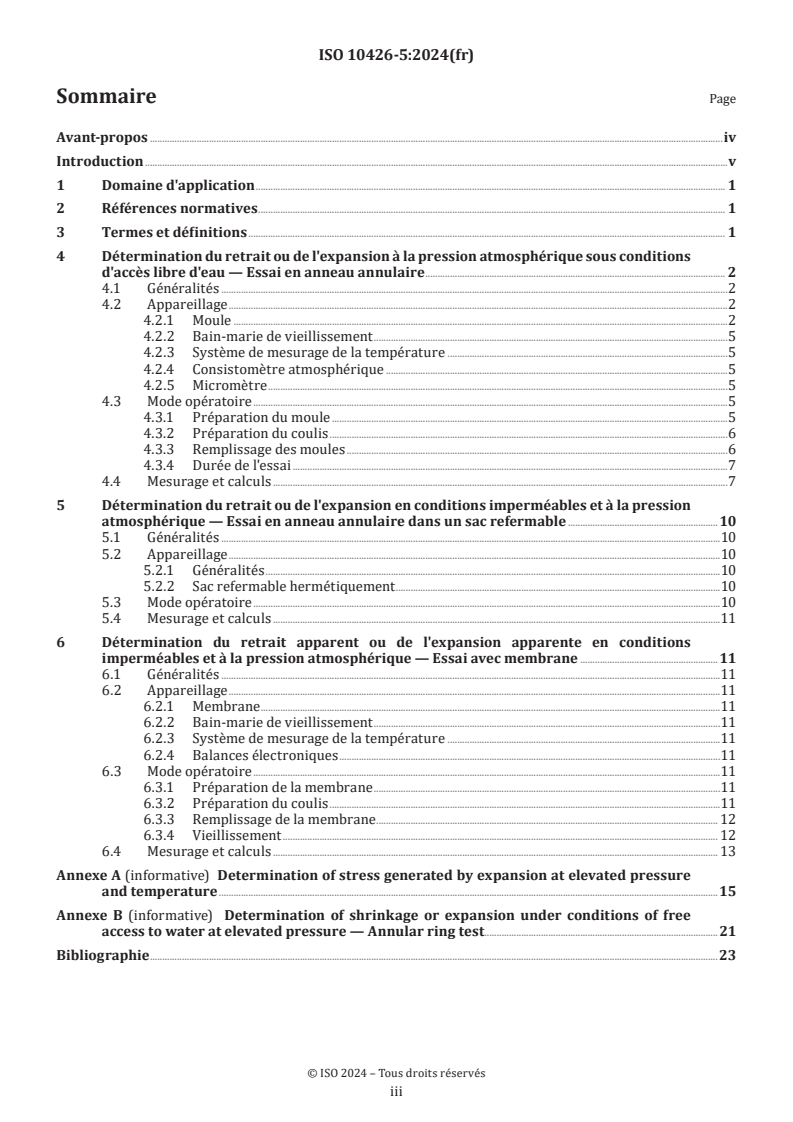
Norme
internationale
ISO 10426-5
Deuxième édition
Industries du pétrole et du gaz, y
2024-09
compris les énergies à faible teneur
en carbone — Ciments et matériaux
pour la cimentation des puits —
Partie 5:
Détermination du retrait et de
l'expansion des formulations de
ciments pour puits
Oil and gas industries including lower carbon energy — Cements
and materials for well cementing —
Part 5: Determination of shrinkage and expansion of well cement
formulations
Numéro de référence
DOCUMENT PROTÉGÉ PAR COPYRIGHT
© ISO 2024
Tous droits réservés. Sauf prescription différente ou nécessité dans le contexte de sa mise en œuvre, aucune partie de cette
publication ne peut être reproduite ni utilisée sous quelque forme que ce soit et par aucun procédé, électronique ou mécanique,
y compris la photocopie, ou la diffusion sur l’internet ou sur un intranet, sans autorisation écrite préalable. Une autorisation peut
être demandée à l’ISO à l’adresse ci-après ou au comité membre de l’ISO dans le pays du demandeur.
ISO copyright office
Case postale 401 • Ch. de Blandonnet 8
CH-1214 Vernier, Genève
Tél.: +41 22 749 01 11
E-mail: copyright@iso.org
Web: www.iso.org
Publié en Suisse
ii
Sommaire Page
Avant-propos .iv
Introduction .v
1 Domaine d'application . 1
2 Références normatives . 1
3 Termes et définitions . 1
4 Détermination du retrait ou de l'expansion à la pression atmosphérique sous conditions
d'accès libre d'eau — Essai en anneau annulaire . 2
4.1 Généralités .2
4.2 Appareillage .2
4.2.1 Moule .2
4.2.2 Bain-marie de vieillissement .5
4.2.3 Système de mesurage de la température .5
4.2.4 Consistomètre atmosphérique .5
4.2.5 Micromètre .5
4.3 Mode opératoire .5
4.3.1 Préparation du moule .5
4.3.2 Préparation du coulis .6
4.3.3 Remplissage des moules .6
4.3.4 Durée de l'essai .7
4.4 Mesurage et calculs .7
5 Détermination du retrait ou de l'expansion en conditions imperméables et à la pression
atmosphérique — Essai en anneau annulaire dans un sac refermable .10
5.1 Généralités .10
5.2 Appareillage .10
5.2.1 Généralités .10
5.2.2 Sac refermable hermétiquement .10
5.3 Mode opératoire .10
5.4 Mesurage et calculs .11
6 Détermination du retrait apparent ou de l'expansion apparente en conditions
imperméables et à la pression atmosphérique — Essai avec membrane .11
6.1 Généralités .11
6.2 Appareillage .11
6.2.1 Membrane .11
6.2.2 Bain-marie de vieillissement .11
6.2.3 Système de mesurage de la température .11
6.2.4 Balances électroniques .11
6.3 Mode opératoire .11
6.3.1 Préparation de la membrane .11
6.3.2 Préparation du coulis .11
6.3.3 Remplissage de la membrane . 12
6.3.4 Vieillissement . 12
6.4 Mesurage et calculs . 13
Annexe A (informative) Determination of stress generated by expansion at elevated pressure
and temperature .15
Annexe B (informative) Determination of shrinkage or expansion under conditions of free
access to water at elevated pressure — Annular ring test . .21
Bibliographie .23
iii
Avant-propos
L'ISO (Organisation internationale de normalisation) est une fédération mondiale d'organismes nationaux
de normalisation (comités membres de l'ISO). L'élaboration des Normes internationales est en général
confiée aux comités techniques de l'ISO. Chaque comité membre intéressé par une étude a le droit de faire
partie du comité technique créé à cet effet. Les organisations internationales, gouvernementales et non
gouvernementales, en liaison avec l'ISO participent également aux travaux. L'ISO collabore étroitement avec
la Commission électrotechnique internationale (IEC) en ce qui concerne la normalisation électrotechnique.
Les procédures utilisées pour élaborer le présent document et celles destinées à sa mise à jour sont
décrites dans les Directives ISO/IEC, Partie 1. Il convient, en particulier, de prendre note des différents
critères d'approbation requis pour les différents types de documents ISO. Le présent document a
été rédigé conformément aux règles de rédaction données dans les Directives ISO/IEC, Partie 2 (voir
www.iso.org/directives).
L’ISO attire l’attention sur le fait que la mise en application du présent document peut entraîner l’utilisation
d’un ou de plusieurs brevets. L’ISO ne prend pas position quant à la preuve, à la validité et à l’applicabilité de
tout droit de brevet revendiqué à cet égard. À la date de publication du présent document, l’ISO n'avait pas
reçu notification qu’un ou plusieurs brevets pouvaient être nécessaires à sa mise en application. Toutefois,
il y a lieu d’avertir les responsables de la mise en application du présent document que des informations
plus récentes sont susceptibles de figurer dans la base de données de brevets, disponible à l'adresse
www.iso.org/brevets. L’ISO ne saurait être tenue pour responsable de ne pas avoir identifié tout ou partie de
tels droits de propriété.
Les appellations commerciales éventuellement mentionnées dans le présent document sont données pour
information, par souci de commodité, à l’intention des utilisateurs et ne sauraient constituer un engagement.
Pour une explication de la nature volontaire des normes, la signification des termes et expressions
spécifiques de l'ISO liés à l'évaluation de la conformité, ou pour toute information au sujet de l'adhésion de
l'ISO aux principes de l’Organisation mondiale du commerce (OMC) concernant les obstacles techniques au
commerce (OTC), voir www.iso.org/avant-propos.
Le présent document a été élaboré par le comité technique ISO/TC 67, Industries du pétrole et du gaz, y compris
les énergies à faible teneur en carbone, sous-comité SC 3, Fluides de forage et de complétion, ciments à puits et
fluides de traitement en collaboration avec le Comité Européen de Normalisation (CEN), Comité Technique
CEN/TC 12, Industries du pétrole et du gaz, y compris les énergies à faible teneur en carbone, conformément à
l'Accord de coopération technique entre l'ISO et le CEN (Accord de Vienne).
Cette deuxième édition annule et remplace la première édition (ISO 10426-5:2004), qui a fait l'objet d'une
révision technique.
Les principales modifications par rapport à l'édition précédente sont les suivantes :
— ajout d'une Introduction, avec des informations de contexte concernant l'expansion et le retrait ;
— ajout d'un essai en anneau annulaire en conditions imperméables à la pression atmosphérique ;
— inclusion d'une annexe informative décrivant une méthode de détermination de la contrainte générée
par l'expansion dans des conditions de confinement à température et pression élevées. ;
— inclusion d'une annexe informative décrivant l’essai en anneau annulaire à pression élevée.
Une liste de toutes les parties de la série ISO 10426 se trouve sur le site web de l'ISO.
Il convient que l’utilisateur adresse tout retour d’information ou toute question concernant le présent
document à l’organisme national de normalisation de son pays. Une liste exhaustive desdits organismes se
trouve à l’adresse www.iso.org/fr/members.html.
iv
Introduction
Lorsque le ciment Portland réagit avec l'eau, on observe une réduction globale du volume absolu des
composants :
V + V > V (1)
c w ch
où
V est le volume de ciment ;
c
V est le volume d’eau ;
w
V est le volume des produits d’hydratation de ciment.
ch
Dans le présent document, la diminution absolue du volume [(V + V ) – V ] est appelée retrait d'hydratation,
c w ch
bien que dans d'autres documents, elle peut également être désignée sous le nom de retrait chimique, de
contraction chimique totale ou de réduction du volume d'hydratation.
En fonction des conditions d'exposition, de la présence de contraintes externes pendant la prise et, surtout,
de l'accès à l'eau extérieure, le retrait d'hydratation peut entraîner un retrait apparent du ciment durci.
La variation des dimensions de l'échantillon est désignée par le terme de retrait apparent ou d'expansion. Le
retrait apparent et l'expansion du ciment désignent le résultat du mesurage de la variation des dimensions
linéaires ou du volume. Le volume auquel sont rapportées toutes les variations de volume est celui du laitier
immédiatement après mélange et mise en place dans l'équipement expérimental. Pour de faibles valeurs de
retrait ou d'expansion, comme c'est généralement le cas dans les systèmes de ciments pour puits, la variation
dimensionnelle du volume partiel peut être approximativement égale à trois fois la variation dimensionnelle
linéaire partielle.
Le retrait apparent peut entraîner :
— la formation d'un micro-espace annulaire, affectant potentiellement la diagraphie d'évaluation du
ciment ;
— une perte d'isolation des zones provoquant un flux transverse ou une pression soutenue dans le tubage ;
— un manque d'étanchéité hydraulique lors de l'utilisation de garnitures d'étanchéité (« packers »)
gonflables au ciment ;
— une mauvaise étanchéité des bouchons d'abandon.
Des additifs permettant de pallier les effets du retrait d'hydratation et de générer une expansion apparente
du ciment durci sont disponibles.
Dans les applications de bouchons, l'expansion apparente du ciment génère des contraintes à l'interface
ciment-roche ou ciment-formation. Une méthode de mesure de la contrainte générée par l'expansion dans
une géométrie de type bouchon est présentée à l'Annexe A.
Dans le présent document, les unités SI sont utilisées, et pour des raisons pratiques, les unités couramment
utilisées aux États-Unis sont données entre parenthèses pour information.
Le présent document est basé sur le rapport technique de l’API 10TR 2.
v
Norme internationale ISO 10426-5:2024(fr)
Industries du pétrole et du gaz, y compris les énergies à
faible teneur en carbone — Ciments et matériaux pour la
cimentation des puits —
Partie 5:
Détermination du retrait et de l'expansion des formulations
de ciments pour puits
1 Domaine d'application
Le présent document fournit les méthodes d'essai des formulations de ciments pour puits afin de déterminer
les variations de dimensions au cours du processus de vieillissement (hydratation du ciment), à pression
atmosphérique et élevée, ainsi que l'expansion dans un environnement de confinement à température et
pression élevées.
2 Références normatives
Les documents suivants sont cités dans le texte de sorte qu’ils constituent, pour tout ou partie de leur
contenu, des exigences du présent document. Pour les références datées, seule l’édition citée s’applique. Pour
les références non datées, la dernière édition du document de référence s'applique (y compris les éventuels
amendements).
API Specification 10A, Cements and Materials for Well Cementing
API Recommended Practice 10B-2, Recommended Practice for Testing Well Cements
3 Termes et définitions
Pour les besoins du présent document, les termes et définitions suivants s’appliquent.
L’ISO et l’IEC tiennent à jour des bases de données terminologiques destinées à être utilisées en normalisation,
consultables aux adresses suivantes:
— ISO Online browsing platform: disponible à l’adresse https:// www .iso .org/ obp
— IEC Electropedia: disponible à l’adresse https:// www .electropedia .org/
3.1
expansion apparente
augmentation du volume ou des dimensions externes d'un échantillon de ciment
3.2
retrait apparent
diminution du volume ou des dimensions externes d'un échantillon de ciment
3.3
CEA (cement expansion additive)
additif d'expansion pour ciment
additif utilisé dans la formulation d'un coulis de ciment pour assurer l'expansion apparente (3.1) ou réduire
le retrait apparent (3.2)
3.4
retrait d'hydratation
différence de volume entre les produits d'hydratation et le volume du ciment sec, des additifs et de l'eau
3.5
contrainte d'interface radiale
contrainte générée à l'interface entre le ciment pris et le tubage ou la paroi du sondage en raison du retrait
apparent (3.2) ou de l'expansion apparente (3.1) du ciment
3.6
UCA (ultrasonic cement analyser)
analyseur de ciment par ultrasons
instrument utilisé pour la détermination sonique non destructive de la résistance à la compression du ciment
4 Détermination du retrait ou de l'expansion à la pression atmosphérique sous
conditions d'accès libre d'eau — Essai en anneau annulaire
4.1 Généralités
Le moule d'expansion annulaire est un dispositif uniquement adapté au mesurage des propriétés de
retrait apparent linéaire ou d'expansion d'une formulation de ciment. L'ampleur de l'expansion dépend de
la quantité et du type d'agent d'expansion, du ciment poudre, de la conception du coulis de ciment et des
conditions de vieillissement (pression, température, temps, accès aux fluides). Il convient de remarquer que
l'expansion est fortement influencée par les conditions aux limites. Le processus chimique de croissance des
minéraux synthétiques est fortement contrôlé par le niveau de contrainte, et la croissance a tendance à se
produire de manière relativement plus importante dans les endroits à faible contrainte, par exemple dans
les espaces poreux de la matrice cimentaire.
Le degré de retrait et d'expansion du ciment dépend toutefois de plusieurs conditions, qui ne peuvent pas
toutes être définies de manière unique. L'essai ne représente pas complètement l'annulaire d'un puits.
Une méthode de détermination du retrait ou de l'expansion à des pressions supérieures à la pression
atmosphérique figure à l'Annexe B.
4.2 Appareillage
4.2.1 Moule
4.2.1.1 Généralités
Utiliser un matériau résistant à la corrosion (par exemple, un acier inoxydable). Le diamètre extérieur (OD)
de l'anneau interne doit être de 50,8 mm ± 0,3 mm (2,0 in ± 0,01 in) et le diamètre extérieur (OD) de l'anneau
externe doit être de 88,9 mm ± 0,3 mm (3,5 in ± 0,01 in). Voir les Figures 1 et 2.
Légende
1 plaque inférieure
2 anneaux interne et externe placés sur la plaque supérieure (étape d de 4.3.1)
Figure 1 — Assemblage de moule typique
Dimensions en millimètres (pouces)
a) Base b) Couvercle
c) Anneau interne d) Moule de l’anneau annulaire
e) Anneau externe f) Entretoise
Figure 2 — Schéma des pièces d’un assemblage de moule typique
4.2.1.2 Étalonnage du moule
La résilience de l'anneau du moule doit être vérifiée annuellement. Si l'anneau tombe ou est endommagé
pendant l'utilisation, la résilience doit être vérifiée. La résilience doit être telle que la masse de 1 000 g ± 1 g,
appliquée telle qu'en Figure 3, doit augmenter la distance entre les deux billes de mesurage en acier (voir
Figure 8) de 2 mm ± 0,3 mm (0,078 7 in ± 0,011 8 in) sans déformation permanente. La charge doit être
appliquée perpendiculairement à l'écart (90°). Les lectures doivent être répétées au moins trois fois afin
d’obtenir une valeur moyenne avec un écart type de 0,05 mm (0,002 in).
Dimensions en millimètres (pouces)
Légende
1 anneau
2 masse, 0 g
3 masse, 1 000 g ± 1 g
Figure 3 — Schéma d'un mesurage d'étalonnage de l'anneau — Essai de résilience
4.2.1.3 Entretoise
L'entretoise doit être utilisée seulement dans le cas d'un mesurage du retrait. Elle est utilisée pour
augmenter légèrement le diamètre de l'anneau externe avant de verser le coulis et pour mesurer le retrait
en l'enlevant une fois que le ciment a pris. Les dimensions de l'entretoise doivent être de (3,2 mm ± 0,1 mm)
x (6,4 mm ± 0,1 mm) (0,125 in × 0,25 in) et de 22,0 mm (0,866 in) en hauteur ; voir la Figure 2. Il faut que
l'entretoise soit faite du même matériau que le moule (par ex. en acier inoxydable), pour s'assurer que les
propriétés d'expansion thermique de l'entretoise sont identiques à celles de l'anneau externe expansible.
4.2.2 Bain-marie de vieillissement
Un bain de vieillissement ou un bac dont les dimensions permettent une immersion complète du (des)
moule(s) dans l'eau et qui peut être maintenu à ± 2 °C (± 3 °F) de la température d'essai prescrite doit
être employé. Le bain de vieillissement est un appareil (bain) à la pression atmosphérique destiné au
vieillissement d'échantillons jusqu'à une température de 88 °C (190 °F). Il doit être équipé d'un agitateur ou
d'un système de circulation.
4.2.3 Système de mesurage de la température
Le système de mesurage de la température doit être étalonné avec une précision de ± 1 °C (± 2 °F). Un
étalonnage doit être réalisé tous les trois mois, au minimum. Il convient d'utiliser le mode opératoire décrit
dans la pratique recommandée de l'API 10B-2.
4.2.4 Consistomètre atmosphérique
Le consistomètre atmosphérique doit satisfaire aux exigences de l'appareillage définies dans la spécification
de l'API 10A.
4.2.5 Micromètre
Un micromètre avec un pas numérique de 0,001 mm (0,000 05 in) ou moins doit être utilisé pour mesurer
la séparation des billes de mesurage. Le micromètre doit être étalonné avec une précision de ± 0,005 mm
(0,000 2 in) au moins une fois par an.
4.3 Mode opératoire
4.3.1 Préparation du moule
Les moules assemblés doivent être étanches à l'eau pour éviter les fuites. Les faces intérieures des moules
et les surfaces de contact des plaques peuvent être légèrement enduites d'un agent de démoulage. Sinon,
les faces intérieures des moules et les surfaces de contact des plaques doivent être conservées propres et
sèches. Dans le cas d'un essai de retrait, placer l'entretoise dans la fente de l'anneau externe. Préparer les
moules comme suit :
a) Nettoyer soigneusement le moule.
b) Mettre un peu de graisse sur les plaques supérieure et inférieure, au niveau du contact entre l'anneau
interne fixe et l'anneau externe expansible. Pour les essais utilisant l'entretoise pour mesurer le retrait,
il est essentiel que les cordons de graisse soient suffisants pour remplir entièrement l'espace entre
l'anneau externe et les parties correspondantes sur les plaques supérieure et inférieure. Si du ciment
pénètre dans ces interstices, il empêche le mouvement vers l'intérieur de l'anneau externe, ce qui fausse
les mesurages de retrait.
c) Si désiré, appliquer une très fine couche d'agent de démoulage sur les anneaux interne et externe et sur
la surface des couvercles supérieur et inférieur qui sont en contact avec le ciment.
d) Avec le couvercle supérieur à l'envers, placer les anneaux interne et externe sur le couvercle supérieur.
e) Pour contrôler le retrait, enduire une entretoise de graisse et la placer en positionnant le petit côté dans
la fente de l'anneau externe expansible ; voir les Figures 4 et 5.
f) Placer le couvercle inférieur sur les anneaux interne et externe.
g) Insérer la vis dans le trou central et la serrer pour maintenir les pièces du moule.
h) Vérifier que l'anneau externe expansible tourne librement et placer le gros trou en face de la fente
(Figure 8).
i) Mettre une petite quantité de graisse entre les fentes de l'anneau expansible externe. La graisse forme
un joint et empêche les fuites de coulis avant qu'il ne prenne.
Figure 4 — Moule avec une entretoise (vue de dessus)
Figure 5 — Moule avec une entretoise (vue latérale)
4.3.2 Préparation du coulis
Le coulis de ciment doit être mélangé et conditionné conformément aux modes opératoires décrits dans la
pratique recommandée de l’API 10B-2.
4.3.3 Remplissage des moules
Après conditionnement, le coulis doit être brassé avec une spatule, pour en assurer l'uniformité. Le coulis
est versé par le grand trou de remplissage sur l'extérieur du dessus du moule anneau. Le petit trou du dessus
du moule est destiné à évacuer l'air pendant le remplissage du moule. Le moule est rempli jusqu'à ce que le
coulis sorte par le petit trou. Pour des coulis plus visqueux, il peut être nécessaire de tapoter sur le moule
ou de le faire vibrer, afin de s'assurer qu'il est rempli. Une fois que le coulis est versé, le moule est placé dans
un bain-marie qui a été préchauffé à la température d'essai. Le coulis est en contact avec l'eau pendant la
totalité de l'essai. L'entrée d'eau compense tout retrait interne si la matrice de ciment est perméable. Si le
ciment pris se dilate, le diamètre extérieur de l'anneau augmente.
...