

ISO 9809-4:2021
(Main)Gas cylinders — Design, construction and testing of refillable seamless steel gas cylinders and tubes — Part 4: Stainless steel cylinders with an R m value of less than 1 100 MPa
General Information
- Abstract
This document specifies the minimum requirements for the materials, design, construction and workmanship, manufacturing processes, examinations and testing at time of manufacture for refillable, seamless, stainless steel gas cylinders with water capacities up to and including 150 l. It is applicable to cylinders for compressed, liquefied and dissolved gases with a maximum actual tensile strength, Rma, of less than 1 100 MPa. NOTE If so desired, cylinders of water capacity between 150 l and 450 l can be manufactured to be in full conformance to this document.
- Status
- Withdrawn
- Publication Date
- 02-Nov-2021
- Technical Committee
- ISO/TC 58/SC 3 - Cylinder design
- Drafting Committee
- ISO/TC 58/SC 3/WG 33 - Refillable seamless stainless steel gas cylinders
- Current Stage
- 9599 - Withdrawal of International Standard
- Start Date
- 23-Feb-2026
- Completion Date
- 29-Aug-2026
Buy Documents



ISO 9809-4:2021 - Gas cylinders -- Design, construction and testing of refillable seamless steel gas cylinders and tubes

ISO 9809-4:2021 - Gas cylinders — Design, construction and testing of refillable seamless steel gas cylinders and tubes — Part 4: Stainless steel cylinders with an R m value of less than 1 100 MPa/3/2021



ISO 9809-4:2021 - Gas cylinders — Design, construction and testing of refillable seamless steel gas cylinders and tubes — Part 4: Stainless steel cylinders with an R m value of less than 1 100 MPa Released:14. 10. 2022
Overview
ISO 9809-4:2021 - "Gas cylinders - Design, construction and testing of refillable seamless steel gas cylinders and tubes - Part 4" - specifies minimum requirements for refillable seamless stainless steel gas cylinders. It applies to cylinders with water capacities up to and including 150 L (with optional extension up to 450 L) and to cylinders made from stainless steels whose maximum actual tensile strength (Rma) is less than 1 100 MPa. The standard covers materials, design, construction, workmanship, manufacturing processes, examinations and testing at the time of manufacture for cylinders intended for compressed, liquefied and dissolved gases.
Key technical topics and requirements
ISO 9809-4 details the full product lifecycle from material selection to final marking and certification. Major technical topics include:
- Materials and metallurgy
- Requirements for stainless steel chemical composition, heat treatment, cold working/cryoforming and controls on mechanical properties.
- Design
- Calculation and requirements for shell thickness, convex and concave ends, neck and foot/neck rings, and complete design drawings.
- Construction and workmanship
- Manufacture tolerances: wall thickness, out-of-roundness, mean diameter, straightness, verticality and surface imperfections.
- Non-destructive and destructive testing
- Ultrasonic examination, hydraulic burst tests, proof pressure and volumetric expansion tests, tensile, bend/flattening and impact tests, intergranular corrosion testing and leak tests.
- Type approval, batch testing and certification
- Prototype testing (including pressure cycling and base checks), type approval certificates, specific production/batch tests and acceptance procedures.
- Marking and documentation
- Manufacturer marking, capacity checks and certification records; annexes provide examples and evaluation criteria for manufacturing imperfections.
Practical applications and users
ISO 9809-4 is used by:
- Cylinder manufacturers and fabricators who design and produce refillable seamless stainless steel cylinders.
- Quality and testing laboratories performing type approval, batch testing and NDT (ultrasonic, hydraulic, tensile).
- Gas producers, distributors and end users requiring safe supply containers for compressed, liquefied and dissolved gases.
- Regulators, inspection bodies and transport authorities referencing accepted international requirements for cylinder safety and conformity.
- Procurement/specification teams writing technical specifications for gas cylinder purchases.
Related standards
- Other parts of the ISO 9809 series (referenced for alternative materials or cylinder classes).
- The standard is suitable to be referenced in the UN Model Regulations for transport of dangerous goods.
- Prepared by ISO/TC 58, Subcommittee SC 3 (Cylinder design).
Keywords: ISO 9809-4, stainless steel gas cylinders, refillable seamless cylinders, cylinder design, cylinder testing, hydraulic burst test, ultrasonic examination, gas cylinder certification.
Relations
- Effective Date
- 25-Aug-2026
- Effective Date
- 25-Aug-2026
- Effective Date
- 03-Sep-2022
- Effective Date
- 28-Oct-2023
- Effective Date
- 23-Apr-2020
Buy Documents
ISO 9809-4:2021 - Gas cylinders -- Design, construction and testing of refillable seamless steel gas cylinders and tubes
ISO 9809-4:2021 - Gas cylinders — Design, construction and testing of refillable seamless steel gas cylinders and tubes — Part 4: Stainless steel cylinders with an R m value of less than 1 100 MPa/3/2021
ISO 9809-4:2021 - Gas cylinders — Design, construction and testing of refillable seamless steel gas cylinders and tubes — Part 4: Stainless steel cylinders with an R m value of less than 1 100 MPa Released:14. 10. 2022
Get Certified
Connect with accredited certification bodies for this standard

Institut za varilstvo d.o.o. (Welding Institute)
Slovenia's leading welding institute since 1952. ISO 3834, EN 1090, pressure equipment certification, NDT personnel, welder qualification. Only IIW Au
Sponsored listings
Frequently Asked Questions
ISO 9809-4:2021 is a standard published by the International Organization for Standardization (ISO). Its full title is "Gas cylinders — Design, construction and testing of refillable seamless steel gas cylinders and tubes — Part 4: Stainless steel cylinders with an R m value of less than 1 100 MPa". This standard covers: This document specifies the minimum requirements for the materials, design, construction and workmanship, manufacturing processes, examinations and testing at time of manufacture for refillable, seamless, stainless steel gas cylinders with water capacities up to and including 150 l. It is applicable to cylinders for compressed, liquefied and dissolved gases with a maximum actual tensile strength, Rma, of less than 1 100 MPa. NOTE If so desired, cylinders of water capacity between 150 l and 450 l can be manufactured to be in full conformance to this document.
This document specifies the minimum requirements for the materials, design, construction and workmanship, manufacturing processes, examinations and testing at time of manufacture for refillable, seamless, stainless steel gas cylinders with water capacities up to and including 150 l. It is applicable to cylinders for compressed, liquefied and dissolved gases with a maximum actual tensile strength, Rma, of less than 1 100 MPa. NOTE If so desired, cylinders of water capacity between 150 l and 450 l can be manufactured to be in full conformance to this document.
ISO 9809-4:2021 is classified under the following ICS (International Classification for Standards) categories: 23.020.35 - Gas cylinders. The ICS classification helps identify the subject area and facilitates finding related standards.
ISO 9809-4:2021 has the following relationships with other standards: It is inter standard links to EN ISO 11118:2025, EN 12245:2022, ISO 10565:2026, ISO 9809-4:2026, ISO 9809-4:2014. Understanding these relationships helps ensure you are using the most current and applicable version of the standard.
ISO 9809-4:2021 is available in PDF format for immediate download after purchase. The document can be added to your cart and obtained through the secure checkout process. Digital delivery ensures instant access to the complete standard document.
Standards Content (Sample)
INTERNATIONAL ISO
STANDARD 9809-4
Second edition
2021-11
Gas cylinders — Design, construction
and testing of refillable seamless steel
gas cylinders and tubes —
Part 4:
Stainless steel cylinders with an R
m
value of less than 1 100 MPa
Bouteilles à gaz — Conception, construction et essais des bouteilles à
gaz et des tubes rechargeables en acier sans soudure —
Partie 4: Bouteilles en acier inoxydable avec une valeur R
m
inférieure à 1 100 MPa
Reference number
© ISO 2021
All rights reserved. Unless otherwise specified, or required in the context of its implementation, no part of this publication may
be reproduced or utilized otherwise in any form or by any means, electronic or mechanical, including photocopying, or posting on
the internet or an intranet, without prior written permission. Permission can be requested from either ISO at the address below
or ISO’s member body in the country of the requester.
ISO copyright office
CP 401 • Ch. de Blandonnet 8
CH-1214 Vernier, Geneva
Phone: +41 22 749 01 11
Email: copyright@iso.org
Website: www.iso.org
Published in Switzerland
ii
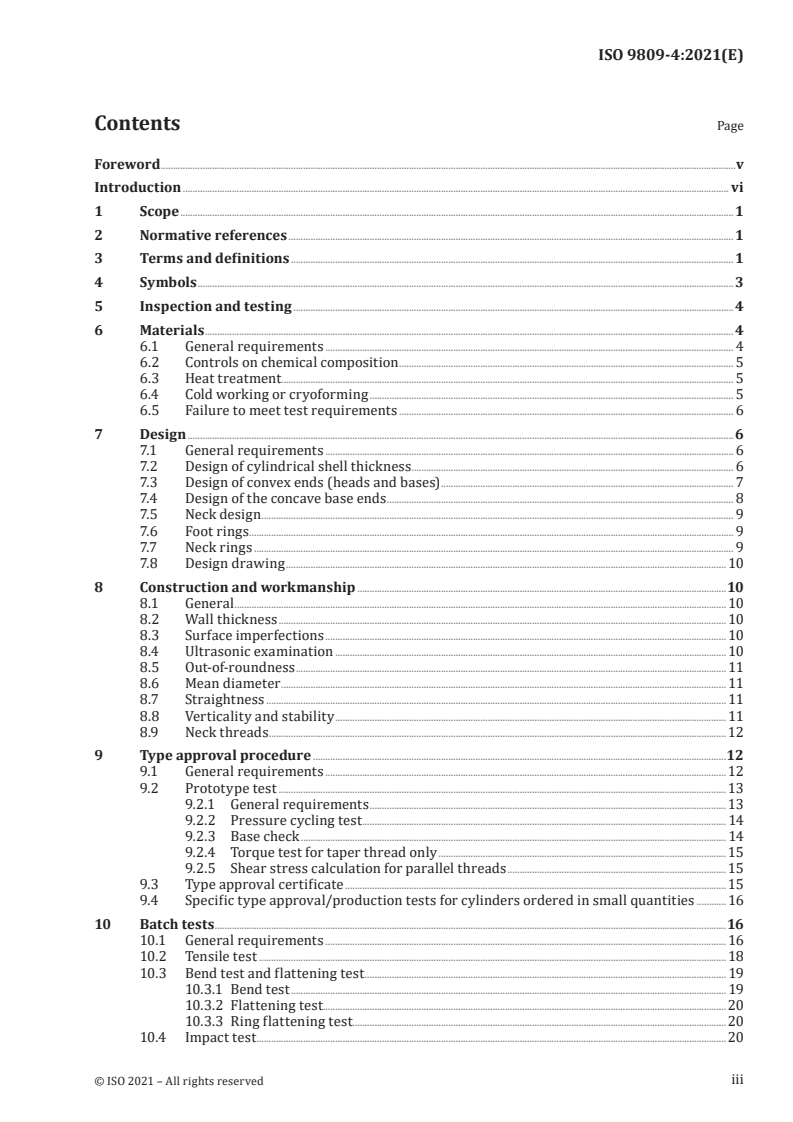
Contents Page
Foreword .v
Introduction . vi
1 Scope . 1
2 Normative references . 1
3 Terms and definitions . 1
4 Symbols . 3
5 Inspection and testing .4
6 Materials . 4
6.1 General requirements . 4
6.2 Controls on chemical composition . 5
6.3 Heat treatment. 5
6.4 Cold working or cryoforming . 5
6.5 Failure to meet test requirements . 6
7 Design . 6
7.1 General requirements . 6
7.2 Design of cylindrical shell thickness . 6
7.3 Design of convex ends (heads and bases) . 7
7.4 Design of the concave base ends . 8
7.5 Neck design . 9
7.6 Foot rings . . 9
7.7 Neck rings . 9
7.8 Design drawing . 10
8 Construction and workmanship .10
8.1 General . 10
8.2 Wall thickness . 10
8.3 Surface imperfections . 10
8.4 Ultrasonic examination . 10
8.5 Out-of-roundness . 11
8.6 Mean diameter . 11
8.7 Straightness . 11
8.8 Verticality and stability . 11
8.9 Neck threads .12
9 Type approval procedure .12
9.1 General requirements . 12
9.2 Prototype test . 13
9.2.1 General requirements . 13
9.2.2 Pressure cycling test . 14
9.2.3 Base check . 14
9.2.4 Torque test for taper thread only . 15
9.2.5 Shear stress calculation for parallel threads . 15
9.3 Type approval certificate .15
9.4 Specific type approval/production tests for cylinders ordered in small quantities . 16
10 Batch tests . .16
10.1 General requirements . 16
10.2 Tensile test . 18
10.3 Bend test and flattening test . 19
10.3.1 Bend test . 19
10.3.2 Flattening test . . 20
10.3.3 Ring flattening test. 20
10.4 Impact test . 20
iii
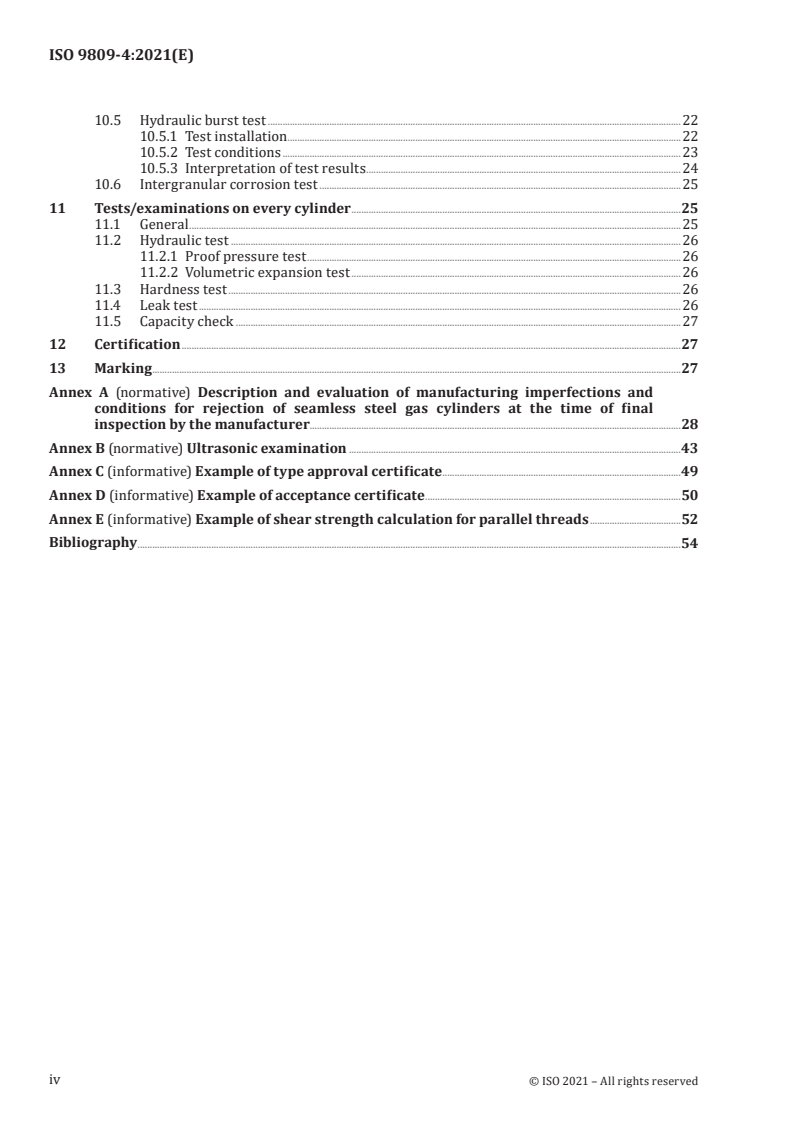
10.5 Hydraulic burst test . 22
10.5.1 Test installation . .22
10.5.2 Test conditions . 23
10.5.3 Interpretation of test results . 24
10.6 Intergranular corrosion test .25
11 Tests/examinations on every cylinder .25
11.1 General . 25
11.2 Hydraulic test . 26
11.2.1 Proof pressure test .26
11.2.2 Volumetric expansion test . 26
11.3 Hardness test . 26
11.4 Leak test . 26
11.5 Capacity check . 27
12 Certification .27
13 Marking . .27
Annex A (normative) Description and evaluation of manufacturing imperfections and
conditions for rejection of seamless steel gas cylinders at the time of final
inspection by the manufacturer.28
Annex B (normative) Ultrasonic examination .43
Annex C (informative) Example of type approval certificate .49
Annex D (informative) Example of acceptance certificate .50
Annex E (informative) Example of shear strength calculation for parallel threads .52
Bibliography .54
iv
Foreword
ISO (the International Organization for Standardization) is a worldwide federation of national standards
bodies (ISO member bodies). The work of preparing International Standards is normally carried out
through ISO technical committees. Each member body interested in a subject for which a technical
committee has been established has the right to be represented on that committee. International
organizations, governmental and non-governmental, in liaison with ISO, also take part in the work.
ISO collaborates closely with the International Electrotechnical Commission (IEC) on all matters of
electrotechnical standardization.
The procedures used to develop this document and those intended for its further maintenance are
described in the ISO/IEC Directives, Part 1. In particular, the different approval criteria needed for the
different types of ISO documents should be noted. This document was drafted in accordance with the
editorial rules of the ISO/IEC Directives, Part 2 (see www.iso.org/directives).
Attention is drawn to the possibility that some of the elements of this document may be the subject of
patent rights. ISO shall not be held responsible for identifying any or all such patent rights. Details of
any patent rights identified during the development of the document will be in the Introduction and/or
on the ISO list of patent declarations received (see www.iso.org/patents).
Any trade name used in this document is information given for the convenience of users and does not
constitute an endorsement.
For an explanation of the voluntary nature of standards, the meaning of ISO specific terms and
expressions related to conformity assessment, as well as information about ISO's adherence to
the World Trade Organization (WTO) principles in the Technical Barriers to Trade (TBT), see
www.iso.org/iso/foreword.html.
This document was prepared by Technical Committee ISO/TC 58, Gas cylinders, Subcommittee SC 3,
Cylinder design.
This second edition cancels and replaces the first edition (ISO 9809-4:2014), which has been technically
revised. The main changes compared with the previous edition are as follows:
— update of Clause 5;
— clarification of Figure 3;
— clarification of 8.9;
— modification of 9.1, 9.2, 9.2.4 and Annex A;
— new subclause 9.2.5 for parallel threads;
— new subclause 9.4 for cylinders ordered in small quantities.
A list of all parts in the ISO 9809 series can be found on the ISO website.
Any feedback or questions on this document should be directed to the user’s national standards body. A
complete listing of these bodies can be found at www.iso.org/members.html.
v
Introduction
This document provides a specification for the design, manufacture, inspection and testing of a
seamless stainless steel cylinder. The objective is to balance the design and economic efficiency against
international acceptance and universal utility.
ISO 9809 (all parts) aims to eliminate the concern about climate, duplicate inspections and restrictions
because of the lack of definitive International Standards.
[1]
This document has been written so that it is suitable to be referenced in the UN Model Regulations .
vi
INTERNATIONAL STANDARD ISO 9809-4:2021(E)
Gas cylinders — Design, construction and testing of
refillable seamless steel gas cylinders and tubes —
Part 4:
Stainless steel cylinders with an R value of less than 1 100
m
MPa
1 Scope
This document specifies the minimum requirements for the materials, design, construction and
workmanship, manufacturing processes, examinations and testing at time of manufacture for refillable,
seamless, stainless steel gas cylinders with water capacities up to and including 150 l.
It is applicable to cylinders for compressed, liquefied and dissolved gases with a maximum actual
tensile strength, R , of less than 1 100 MPa.
ma
NOTE If so desired, cylinders of water capacity between 150 l and 450 l can be manufactured to be in full
conformance to this document.
2 Normative references
The following documents are referred to in the text in such a way that some or all of their content
constitutes requirements of this document. For dated references, only the edition cited applies. For
undated references, the latest edition of the referenced document (including any amendments) applies.
ISO 148-1, Metallic materials — Charpy pendulum impact test — Part 1: Test method
ISO 3651-2, Determination of resistance to intergranular corrosion of stainless steels — Part 2:
Ferritic,austenitic and ferritic-austenitic (duplex) stainless steels — Corrosion test in media containing
sulfuric acid
ISO 6506-1, Metallic materials — Brinell hardness test — Part 1: Test method
ISO 6508-1, Metallic materials — Rockwell hardness test — Part 1: Test method
ISO 6892-1, Metallic materials — Tensile testing — Part 1: Method of test at room temperature
ISO 9328-1, Steel flat products for pressure purposes — Technical delivery conditions — Part 1: General
requirements
ISO 9329-4, Seamless steel tubes for pressure purposes — Technical delivery conditions — Part 4: Austenitic
stainless steels
ISO 9712, Non-destructive testing — Qualification and certification of NDT personnel
ISO 10286, Gas cylinders — Vocabulary
ISO 13341, Gas cylinders — Fitting of valves to gas cylinders
ISO 13769, Gas cylinders — Stamp marking
3 Terms and definitions
For the purposes of this document, the terms and definitions given in ISO 10286 and the following apply.
ISO and IEC maintain terminological databases for use in standardization at the following addresses:
— ISO Online browsing platform: available at https:// www .iso .org/ obp
— IEC Electropedia: available at http:// www .electropedia .org/
3.1
batch
quantity of up to 200 cylinders, plus cylinders for destructive testing of the same nominal diameter,
thickness, length and design made successively on the same equipment, from the same cast of steel, and
subjected to the same heat treatment for the same duration of time
3.2
burst pressure
p
b
highest pressure reached in a cylinder during a burst test
3.3
cold working
process in which a cylinder is subjected to a pressure higher than the cylinder test pressure (3.11) to
increase the yield strength (3.12) of the steel
3.4
cryoforming
process where the cylinder is subjected to a controlled low-temperature deformation treatment that
results in a permanent increase in strength
3.5
design stress factor
F
ratio of the equivalent wall stress at test pressure, p , (3.11) to guaranteed minimum yield strength, R
h eg
3.6
quenching
hardening heat treatment in which a cylinder, which has been heated to a uniform temperature above
the upper critical point, Ac , of the steel, is cooled rapidly on a suitable medium
3.7
reject
action to set aside a cylinder (Level 2 or Level 3) that is not allowed to go into service
3.8
rendered unserviceable
cylinder that has been treated in such a way as to render it impossible for use
Note 1 to entry: Examples for acceptable methods to render cylinders unserviceable can be found in ISO 18119.
Any actions on cylinders rendered unserviceable are outside the scope of this document.
3.9
repair
action to return a rejected cylinder to a Level 1 condition
3.10
tempering
toughening heat treatment which follows quenching (3.6), in which the cylinder is heated to a uniform
temperature below the critical point, Ac , of the steel
3.11
test pressure
p
h
required pressure applied during a pressure test
Note 1 to entry: Test pressure is used for the cylinder wall thickness calculation.
3.12
yield strength
stress value corresponding to the 0,2 % proof stress or for austenitic steels in the solution-annealed
condition, 1 % proof stress
3.13
working pressure
settled pressure of a compressed gas at a uniform reference temperature of 15 °C in a full gas cylinder
4 Symbols
A percentage elongation after fracture
a calculated minimum thickness, in millimetres, of the cylindrical shell
a′ guaranteed minimum thickness, in millimetres, of the cylindrical shell
a guaranteed minimum thickness, in millimetres, of a concave base at the knuckle (see Figure 2)
a guaranteed minimum thickness, in millimetres, at the centre of a concave base (see Figure 2)
b guaranteed minimum thickness, in millimetres, at the centre of a convex base (see Figure 1)
c maximum permissible deviation, in millimetres, of burst profile for quenched and tempered
cylinders (see Figure 11)
c maximum permissible deviation, in millimetres, of the burst profile for cryoformed or solution-
annealed cylinders with less than 7,5 mm wall thickness (see Figure 12)
D nominal outside diameter of the cylinder, in millimetres (see Figure 1)
D diameter, in millimetres, of former (see Figure 6)
f
F design stress factor (variable)
H outside height, in millimetres, of the domed part (convex head or base end) (see Figure 1)
h outside depth (concave base end), in millimetres (see Figure 2)
L original gauge length, in millimetres, as defined in ISO 6892-1 (see Figure 5)
o
l overall length of the cylinder, in millimetres (see Figure 3)
n ratio of the diameter of the bend test former to the actual thickness of test piece, t
p measured burst pressure, in bar, above atmospheric pressure
b
NOTE 1 bar = 10 Pa = 0,1 MPa.
p hydraulic test pressure, in bar, above atmospheric pressure
h
p observed pressure when the cylinder starts yielding during the hydraulic burst test, in bar, above
y
atmospheric pressure
r inside knuckle radius, in millimetres (see Figures 1 and 2)
R actual value of the yield strength, in megapascals, as determined by the tensile test (see 10.2)
ea
R minimum guaranteed value of the yield strength (see 7.1.1), in megapascals, for the finished cylinder
eg
R actual value of the tensile strength, in megapascals, as determined by the tensile test (see 10.2)
ma
R minimum guaranteed value of the tensile strength, in megapascals, for the finished cylinder
mg
S original cross-sectional area of the tensile test piece, in square millimetres, in accordance with
o
ISO 6892-1
t actual thickness of the test specimen, in millimetres
t average cylinder wall thickness at the position of testing during the flattening test, in millimetres
m
u ratio of the distance between the knife edges or platens in the flattening test to the average
cylinder wall thickness at the position of the test
V water capacity of the cylinder, in litres
w width, in millimetres, of the tensile test piece (see Figure 5)
5 Inspection and testing
Assessment of conformity to this document shall take into account the applicable regulations of the
countries of use.
To ensure that cylinders conform to this document, they shall be subject to inspection and testing in
accordance with Clauses 9, 10 and 11.
Tests and examinations performed to demonstrate compliance with this document shall be conducted
using instruments calibrated before being put into service and thereafter according to an established
programme.
6 Materials
6.1 General requirements
6.1.1 Materials for the manufacture of gas cylinders shall fall within one of the following categories:
a) internationally recognized cylinder steels;
b) nationally recognized cylinder steels;
c) new cylinder steels resulting from technical progress.
For all categories, the relevant conditions specified in 6.2 and 6.3 shall be satisfied.
6.1.2 There is a risk of intergranular corrosion in austenitic and duplex stainless steels resulting
from hot processing which can cause sensitization of the steel (e.g. chromium depletion in the grain
boundary). Intergranular corrosion testing shall be carried out for such materials in accordance with
10.6.
6.1.3 The cylinder manufacturer shall establish the means to identify the cylinders with the cast of
steel from which they are made.
6.1.4 Grades of steel used for the cylinder manufacture shall be compatible with the intended gas
service, e.g. corrosive gases and embrittling gases (see ISO 11114-1).
6.1.5 Some grades of stainless steel can be susceptible to environmental stress corrosion cracking.
Special precautions shall be taken in such cases, such as appropriate coating.
6.1.6 Some grades of stainless steel can be susceptible to phase transformation at low temperatures
resulting in a brittle alloy. Special precautions shall be taken in such cases, i.e. not using the cylinder
below the minimum acceptable temperature.
6.2 Controls on chemical composition
6.2.1 The following are the four broad categories of stainless steels:
— ferritic;
— martensitic;
— austenitic;
— austenitic/ferritic (duplex).
Recognized steels are listed in ISO 15510. Other grades of stainless steel can also be used provided that
they fulfil all the requirements of this document.
6.2.2 The cylinder manufacturer shall obtain and make available certificates of cast (heat) analyses
of the steels supplied for the construction of gas cylinders.
Should check analyses be required, they shall be carried out either on the specimens taken during the
manufacture from the material in the form as supplied by the steel maker to the cylinder manufacturer,
or from finished cylinders. In any check analysis, the maximum permissible deviation from the limits
specified for the cast analyses shall conform to the values specified in ISO 9329-4.
6.3 Heat treatment
6.3.1 The cylinder manufacturer shall certify the heat treatment process applied to the finished
cylinders.
6.3.2 The finished cylinders made from the ferritic or martensitic steel categories shall be quenched
and tempered, except if they are cold worked (see 6.4).
6.3.3 For the ferritic and martensitic steels, the heat treatment process shall achieve the required
mechanical properties.
6.3.4 The actual temperature to which a type of steel is subjected to obtain a given tensile strength
shall not deviate by more than ±30 °C from the temperature specified by the cylinder manufacturer.
6.4 Cold working or cryoforming
Cold working or cryoforming is used to enhance the finished mechanical properties in certain stainless
steel materials.
For cylinders that are subjected to cold working or to the cryoforming process, all the heat treatment
requirements refer to the cylinder preform operations. Cold worked or cryoformed cylinders shall not
be subjected to any subsequent heat treatment.
6.5 Failure to meet test requirements
In the event of failure to meet the test requirements, retesting or reheat treatment and retesting shall
be carried out as follows to the satisfaction of the inspector.
a) If there is evidence of a fault in carrying out a test, or an error of measurement, a further test shall
be performed. If the result of this test is satisfactory, the first test shall be ignored.
b) If the test has been carried out in a satisfactory manner, the cause of test failure shall be identified.
1) If the failure is considered to be due to the heat treatment applied, the manufacturer may
subject all the cylinders implicated by the failure to only one further heat treatment, e.g. if
the failure is in a test representing the prototype or batch cylinders. Test failure shall require
reheat treatment of all the represented cylinders prior to retesting. This reheat treatment
shall consist of either re-tempering or complete reheat treatment. Whenever the cylinders are
reheat-treated, the minimum guaranteed wall thickness shall be maintained. Only the relevant
prototype or batch tests needed to prove the acceptability of the new batch shall be performed
again. If one or more tests prove even partially unsatisfactory, all the cylinders of the batch
shall be rejected.
2) If the failure is due to a cause other than the heat treatment applied, all the cylinders with
imperfections shall be either rejected or repaired such that the repaired cylinders pass the
test(s) required for the repair. They shall then be reinstated as part of the original batch.
7 Design
7.1 General requirements
7.1.1 The calculation of the wall thickness of the pressure-containing parts shall be related to the
guaranteed minimum yield strength, R , of the material in the finished cylinder.
eg
7.1.2 Cylinders shall be designed with one or two openings along the central cylinder axis only.
7.1.3 The internal pressure upon which the calculation of wall thickness is based shall be the
hydraulic test pressure, p .
h
7.2 Design of cylindrical shell thickness
The guaranteed minimum thickness of the cylindrical shell, a′, shall not be less than the thickness
calculated using Formulae (1) and (2), and additionally, Formula (3) shall be satisfied.
10FR − 3p
D
eg h
a=−1 (1)
2 10FR
eg
where the value of F is equal to 0,77.
The wall thickness shall also satisfy Formula (2):
D
a≥+1 (2)
with an absolute minimum of a = 1,5 mm.
The burst ratio shall be satisfied by test as given in Formula (3).
p /p ≥ 1,6 (3)
b h
NOTE It is generally assumed that p = 1,5 times working pressure for compressed gases for cylinders
h
designed and manufactured to conform with this document.
7.3 Design of convex ends (heads and bases)
7.3.1 When convex base ends (see Figure 1) are used, the thickness, b, at the centre of a convex end
shall be not less than that required by the following criteria: where the inside knuckle radius, r, is not
less than 0,075 D, then:
— b ≥ 1,5 a for 0,40 > H/D ≥ 0,20;
— b ≥ a for H/D ≥ 0,40.
To obtain a satisfactory stress distribution in the region where the end joins the shell, any thickening
of the end when required shall be gradual from the point of juncture, particularly at the base. For the
application of this rule, the point of juncture between the shell and the end is defined by the horizontal
lines indicating dimension H in Figure 1.
Shape b) shall not be excluded from this requirement.
7.3.2 The cylinder manufacturer shall prove by the pressure cycling test detailed in 9.2.2 that the
design is satisfactory.
The shapes shown in Figure 1 are typical of convex heads and base ends. Shapes a), b), d) and e) are
base ends, and shapes c) and f) are heads.
a) b) c)
d) e) f)
Key
1 cylindrical part
Figure 1 — Typical convex ends
7.4 Design of the concave base ends
7.4.1 When concave base ends (see Figure 2) are used, the following design values are recommended:
— a ≥ 2 a;
— a ≥ 2 a;
— h ≥ 0,12 D;
— r ≥ 0,075 D.
The design drawing shall at least show values for a , a , h and r.
1 2
To obtain a satisfactory stress distribution, the thickness of the cylinder shall increase progressively in
the transition region between the cylindrical part and the base.
7.4.2 The cylinder manufacturer shall in any case prove by the application of the pressure cycling
test detailed in 9.2.2 that the design is satisfactory.
Figure 2 — Concave base ends
7.5 Neck design
7.5.1 The external diameter and thickness of the formed neck end of the cylinder shall be adequate
for the torque applied in fitting the valve to the cylinder. The torque can vary according to the valve
type, diameter of the thread, the form of the thread and the sealant used in the fitting of the valve.
NOTE For information on torques, see ISO 13341.
7.5.2 In establishing the minimum thickness, the thickness of the wall in the cylinder neck shall
prevent permanent expansion of the neck during the initial and subsequent fittings of the valve into
the cylinder without support of an attachment. The external diameter and thickness of the formed neck
end of the cylinder shall not be damaged (no permanent expansion or crack) by the application of the
maximum torque required to fit the valve to the cylinder (see ISO 13341) and the stresses when the
cylinder is subjected to its test pressure. In specific cases (e.g. very thin-walled cylinders) where these
stresses cannot be supported by the neck itself, the neck maybe designed to require reinforcement,
such as a neck ring or shrunk on collar, provided the reinforcement material and dimensions are clearly
specified by the manufacturer and this configuration is part of the type approval procedure (see 9.2.4
and 9.2.5).
7.6 Foot rings
When a foot ring is provided, it shall be made of material compatible with that of the cylinder. The shape
should preferably be cylindrical and shall give the cylinder stability. The foot ring shall be secured to
the cylinder by a method other than welding, brazing or soldering. Any gaps which can form water
traps shall be sealed by a method other than welding, brazing or soldering.
7.7 Neck rings
When a neck ring is provided, it shall made of a material compatible with that of the cylinder and shall
be securely attached by a method other than welding, brazing or soldering.
The axial load to remove the neck ring shall be greater than 10 times the weight of the empty cylinder
but not less than 1 000 N, and that the torque to turn the neck ring is greater than 100 Nm.
7.8 Design drawing
A fully dimensioned drawing shall be prepared which includes the specification of the material and
details relevant to the design of the permanent fittings. Dimensions of non-safety related fittings can be
agreed between the customer and manufacturer and need not be shown on the design drawing.
8 Construction and workmanship
8.1 General
The cylinder shall be produced by:
a) forging or drop forging from a solid ingot or billet;
b) manufacturing from seamless tube;
c) pressing from a flat plate;
d) cold working or cryoforming preform.
Metal shall not be added in the process of closure of the end. Manufacturing defects shall not be
corrected by plugging of bases (e.g. addition of metal by welding).
8.2 Wall thickness
During production, each cylinder or semi-finished shell shall be examined for thickness. The wall
thickness at any point shall be not less than the minimum thickness specified.
8.3 Surface imperfections
The internal and external surfaces of the finished cylinder shall be free from imperfections which could
adversely affect the safe working of the cylinder. For examples of imperfections and assistance on their
evaluation, see Annex A.
8.4 Ultrasonic examination
8.4.1 After completion of the final heat treatment and cold working and after the final cylindrical
wall thickness has been achieved, each cylinder shall be ultrasonically examined for internal, external
and sub-surface imperfections in accordance with Annex B.
8.4.2 In addition to the ultrasonic examination as specified in 8.4.1, the cylindrical area to be
closed (which creates the shoulder and in case of cylinders made from tube, also the base) shall be
ultrasonically examined prior to the forming process to detect any defects that after closure could be
positioned in the cylinder ends.
In case of cylinders produced from tubes (provided that the thickness of the tube is unaltered), this
additional test is not required if the tube is 100 % ultrasonic tested before closure of the ends in
accordance with Annex B.
The test shall be performed as close as possible to the open end of the shell.
The untested area shall extend to a length of not more than 40 mm from the open end of the shell.
In both 8.4.1 and 8.4.2, it is not required to perform the ultrasonic examination for small cylinders with
a cylindrical length of less than 200 mm or where the product of p × V < 600 bar. l (for R ≥ 650 MPa)
h ma
or p × V < 1 200 bar. l (for R < 650 MPa).
h ma
8.5 Out-of-roundness
The out-of-roundness of the cylindrical shell, i.e. the difference between the maximum and minimum
outside diameters at the same cross-section, shall not exceed 2 % of the mean of these diameters.
For cold stretch and cryoformed cylinders, higher values are acceptable provided they are validated by
the pressure cycling test and the maximum shall be specified on the approved design drawing.
8.6 Mean diameter
The mean external diameter of the cylindrical part outside the transition zones on a cross-section shall
not deviate by more than ±1 % from the nominal design diameter.
For cold stretch and cryoformed cylinders, higher values are acceptable provided they are validated by
the pressure cycling test and the maximum shall be specified on the approved design drawing.
8.7 Straightness
The maximum deviation, b, of the cylindrical part of the shell from a straight line shall not exceed 3 mm
per metre in length (see Figure 3).
For cold stretch and cryoformed cylinders, higher values can be used provided that they are acceptable
for the intended application.
8.8 Verticality and stability
For a cylinder designed to stand on its base, the deviation, a, from vertical shall not exceed 10 mm
per metre in length (l ) (see Figure 3). The outer diameter of the surface in contact with the ground is
recommended to be greater than 75 % of the nominal outside diameter.
For cold stretch and cryoformed cylinders, higher values for deviation from vertical can be used
provided that they are acceptable for the intended application.
Key
a
maximum 0,01 × l (see 8.8)
b
maximum 0,003 × l (see 8.7)
Figure 3 — Deviation of the cylindrical part of the shell from a straight line and from vertical
8.9 Neck threads
The internal neck threads shall conform to a recognized standard agreed between the parties to permit
the use of a corresponding valve thus minimizing neck stresses following the valve torqueing operation.
Internal neck threads shall be checked using gauges corresponding to the agreed neck thread or by an
alternative method agreed between the parties.
EXAMPLE Where the neck thread is specified to be in accordance with ISO 11363-1, the corresponding
gauges are specified in ISO 11363-2.
Particular care shall be taken to ensure that neck threads are accurately cut, are of full form and are
free from any sharp profiles, e.g. burrs.
9 Type approval procedure
9.1 General requirements
A technical specification of each new design of cylinder or cylinder family as defined in f), including
design drawing, design calculations, steel details, manufacturing process and heat treatment details,
shall be submitted by the manufacturer to the inspector. The type approval tests detailed in 9.2 shall be
carried out on each new design under the supervision of the inspector.
A cylinder shall be considered to be of a new design, compared with an existing approved design, when
at least one of the following applies:
a) it is manufactured in a different factory;
b) it is manufactured by a different process (see 8.1); this includes the case when major process
changes are made during the production period, e.g. end forging to spinning, change in heat
treatment process;
c) it is manufactured from a steel of different specified chemical composition range from that defined
in 6.2;
d) it is given a different heat treatment beyond the limits stipulated in 6.3 and 6.4;
e) the base or the base profile has changed, e.g. concave, convex, hemispherical, or the base thickness/
cylinder diameter ratio has changed;
f) the overall length of the cylinder has increased by more than 50 % (cylinders with a length/
diameter ratio less than 3 shall not be used as reference cylinders for any new design with this
ratio greater than 3);
g) the nominal outside diameter has changed;
h) the guaranteed minimum thickness has changed;
i) the hydraulic test pressure, p , has been increased (where a cylinder is to be used for lower-
h
pressure duty than that for which design approval has been given, it shall not be deemed to be a
new design);
NOTE When the test pressure has decreased, a revision of the type approval certificate can be needed.
j) the guaranteed minimum yield strength, R , and/or the guaranteed minimum tensile strength,
eg
R , for the finished cylinder have changed.
mg
If the diameter of the internal thread has increased by less than 50 % then:
— in case of tapered threads, the torque test shall be perfor
...
INTERNATIONAL ISO
STANDARD 9809-4
Second edition
2021-11
Gas cylinders — Design, construction
and testing of refillable seamless steel
gas cylinders and tubes —
Part 4:
Stainless steel cylinders with an R
m
value of less than 1 100 MPa
Bouteilles à gaz — Conception, construction et essais des bouteilles à
gaz et des tubes rechargeables en acier sans soudure —
Partie 4: Bouteilles en acier inoxydable avec une valeur R
m
inférieure à 1 100 MPa
Reference number
© ISO 2021
All rights reserved. Unless otherwise specified, or required in the context of its implementation, no part of this publication may
be reproduced or utilized otherwise in any form or by any means, electronic or mechanical, including photocopying, or posting on
the internet or an intranet, without prior written permission. Permission can be requested from either ISO at the address below
or ISO’s member body in the country of the requester.
ISO copyright office
CP 401 • Ch. de Blandonnet 8
CH-1214 Vernier, Geneva
Phone: +41 22 749 01 11
Email: copyright@iso.org
Website: www.iso.org
Published in Switzerland
ii
Contents Page
Foreword .v
Introduction . vi
1 Scope . 1
2 Normative references . 1
3 Terms and definitions . 1
4 Symbols . 3
5 Inspection and testing .4
6 Materials . 4
6.1 General requirements . 4
6.2 Controls on chemical composition . 5
6.3 Heat treatment. 5
6.4 Cold working or cryoforming . 5
6.5 Failure to meet test requirements . 6
7 Design . 6
7.1 General requirements . 6
7.2 Design of cylindrical shell thickness . 6
7.3 Design of convex ends (heads and bases) . 7
7.4 Design of the concave base ends . 8
7.5 Neck design . 9
7.6 Foot rings . . 9
7.7 Neck rings . 9
7.8 Design drawing . 10
8 Construction and workmanship .10
8.1 General . 10
8.2 Wall thickness . 10
8.3 Surface imperfections . 10
8.4 Ultrasonic examination . 10
8.5 Out-of-roundness . 11
8.6 Mean diameter . 11
8.7 Straightness . 11
8.8 Verticality and stability . 11
8.9 Neck threads .12
9 Type approval procedure .12
9.1 General requirements . 12
9.2 Prototype test . 13
9.2.1 General requirements . 13
9.2.2 Pressure cycling test . 14
9.2.3 Base check . 14
9.2.4 Torque test for taper thread only . 15
9.2.5 Shear stress calculation for parallel threads . 15
9.3 Type approval certificate .15
9.4 Specific type approval/production tests for cylinders ordered in small quantities . 16
10 Batch tests . .16
10.1 General requirements . 16
10.2 Tensile test . 18
10.3 Bend test and flattening test . 19
10.3.1 Bend test . 19
10.3.2 Flattening test . . 20
10.3.3 Ring flattening test. 20
10.4 Impact test . 20
iii
10.5 Hydraulic burst test . 22
10.5.1 Test installation . .22
10.5.2 Test conditions . 23
10.5.3 Interpretation of test results . 24
10.6 Intergranular corrosion test .25
11 Tests/examinations on every cylinder .25
11.1 General . 25
11.2 Hydraulic test . 26
11.2.1 Proof pressure test .26
11.2.2 Volumetric expansion test . 26
11.3 Hardness test . 26
11.4 Leak test . 26
11.5 Capacity check . 27
12 Certification .27
13 Marking . .27
Annex A (normative) Description and evaluation of manufacturing imperfections and
conditions for rejection of seamless steel gas cylinders at the time of final
inspection by the manufacturer.28
Annex B (normative) Ultrasonic examination .43
Annex C (informative) Example of type approval certificate .49
Annex D (informative) Example of acceptance certificate .50
Annex E (informative) Example of shear strength calculation for parallel threads .52
Bibliography .54
iv
Foreword
ISO (the International Organization for Standardization) is a worldwide federation of national standards
bodies (ISO member bodies). The work of preparing International Standards is normally carried out
through ISO technical committees. Each member body interested in a subject for which a technical
committee has been established has the right to be represented on that committee. International
organizations, governmental and non-governmental, in liaison with ISO, also take part in the work.
ISO collaborates closely with the International Electrotechnical Commission (IEC) on all matters of
electrotechnical standardization.
The procedures used to develop this document and those intended for its further maintenance are
described in the ISO/IEC Directives, Part 1. In particular, the different approval criteria needed for the
different types of ISO documents should be noted. This document was drafted in accordance with the
editorial rules of the ISO/IEC Directives, Part 2 (see www.iso.org/directives).
Attention is drawn to the possibility that some of the elements of this document may be the subject of
patent rights. ISO shall not be held responsible for identifying any or all such patent rights. Details of
any patent rights identified during the development of the document will be in the Introduction and/or
on the ISO list of patent declarations received (see www.iso.org/patents).
Any trade name used in this document is information given for the convenience of users and does not
constitute an endorsement.
For an explanation of the voluntary nature of standards, the meaning of ISO specific terms and
expressions related to conformity assessment, as well as information about ISO's adherence to
the World Trade Organization (WTO) principles in the Technical Barriers to Trade (TBT), see
www.iso.org/iso/foreword.html.
This document was prepared by Technical Committee ISO/TC 58, Gas cylinders, Subcommittee SC 3,
Cylinder design.
This second edition cancels and replaces the first edition (ISO 9809-4:2014), which has been technically
revised. The main changes compared with the previous edition are as follows:
— update of Clause 5;
— clarification of Figure 3;
— clarification of 8.9;
— modification of 9.1, 9.2, 9.2.4 and Annex A;
— new subclause 9.2.5 for parallel threads;
— new subclause 9.4 for cylinders ordered in small quantities.
A list of all parts in the ISO 9809 series can be found on the ISO website.
Any feedback or questions on this document should be directed to the user’s national standards body. A
complete listing of these bodies can be found at www.iso.org/members.html.
v
Introduction
This document provides a specification for the design, manufacture, inspection and testing of a
seamless stainless steel cylinder. The objective is to balance the design and economic efficiency against
international acceptance and universal utility.
ISO 9809 (all parts) aims to eliminate the concern about climate, duplicate inspections and restrictions
because of the lack of definitive International Standards.
[1]
This document has been written so that it is suitable to be referenced in the UN Model Regulations .
vi
INTERNATIONAL STANDARD ISO 9809-4:2021(E)
Gas cylinders — Design, construction and testing of
refillable seamless steel gas cylinders and tubes —
Part 4:
Stainless steel cylinders with an R value of less than 1 100
m
MPa
1 Scope
This document specifies the minimum requirements for the materials, design, construction and
workmanship, manufacturing processes, examinations and testing at time of manufacture for refillable,
seamless, stainless steel gas cylinders with water capacities up to and including 150 l.
It is applicable to cylinders for compressed, liquefied and dissolved gases with a maximum actual
tensile strength, R , of less than 1 100 MPa.
ma
NOTE If so desired, cylinders of water capacity between 150 l and 450 l can be manufactured to be in full
conformance to this document.
2 Normative references
The following documents are referred to in the text in such a way that some or all of their content
constitutes requirements of this document. For dated references, only the edition cited applies. For
undated references, the latest edition of the referenced document (including any amendments) applies.
ISO 148-1, Metallic materials — Charpy pendulum impact test — Part 1: Test method
ISO 3651-2, Determination of resistance to intergranular corrosion of stainless steels — Part 2:
Ferritic,austenitic and ferritic-austenitic (duplex) stainless steels — Corrosion test in media containing
sulfuric acid
ISO 6506-1, Metallic materials — Brinell hardness test — Part 1: Test method
ISO 6508-1, Metallic materials — Rockwell hardness test — Part 1: Test method
ISO 6892-1, Metallic materials — Tensile testing — Part 1: Method of test at room temperature
ISO 9328-1, Steel flat products for pressure purposes — Technical delivery conditions — Part 1: General
requirements
ISO 9329-4, Seamless steel tubes for pressure purposes — Technical delivery conditions — Part 4: Austenitic
stainless steels
ISO 9712, Non-destructive testing — Qualification and certification of NDT personnel
ISO 10286, Gas cylinders — Vocabulary
ISO 13341, Gas cylinders — Fitting of valves to gas cylinders
ISO 13769, Gas cylinders — Stamp marking
3 Terms and definitions
For the purposes of this document, the terms and definitions given in ISO 10286 and the following apply.
ISO and IEC maintain terminological databases for use in standardization at the following addresses:
— ISO Online browsing platform: available at https:// www .iso .org/ obp
— IEC Electropedia: available at http:// www .electropedia .org/
3.1
batch
quantity of up to 200 cylinders, plus cylinders for destructive testing of the same nominal diameter,
thickness, length and design made successively on the same equipment, from the same cast of steel, and
subjected to the same heat treatment for the same duration of time
3.2
burst pressure
p
b
highest pressure reached in a cylinder during a burst test
3.3
cold working
process in which a cylinder is subjected to a pressure higher than the cylinder test pressure (3.11) to
increase the yield strength (3.12) of the steel
3.4
cryoforming
process where the cylinder is subjected to a controlled low-temperature deformation treatment that
results in a permanent increase in strength
3.5
design stress factor
F
ratio of the equivalent wall stress at test pressure, p , (3.11) to guaranteed minimum yield strength, R
h eg
3.6
quenching
hardening heat treatment in which a cylinder, which has been heated to a uniform temperature above
the upper critical point, Ac , of the steel, is cooled rapidly on a suitable medium
3.7
reject
action to set aside a cylinder (Level 2 or Level 3) that is not allowed to go into service
3.8
rendered unserviceable
cylinder that has been treated in such a way as to render it impossible for use
Note 1 to entry: Examples for acceptable methods to render cylinders unserviceable can be found in ISO 18119.
Any actions on cylinders rendered unserviceable are outside the scope of this document.
3.9
repair
action to return a rejected cylinder to a Level 1 condition
3.10
tempering
toughening heat treatment which follows quenching (3.6), in which the cylinder is heated to a uniform
temperature below the critical point, Ac , of the steel
3.11
test pressure
p
h
required pressure applied during a pressure test
Note 1 to entry: Test pressure is used for the cylinder wall thickness calculation.
3.12
yield strength
stress value corresponding to the 0,2 % proof stress or for austenitic steels in the solution-annealed
condition, 1 % proof stress
3.13
working pressure
settled pressure of a compressed gas at a uniform reference temperature of 15 °C in a full gas cylinder
4 Symbols
A percentage elongation after fracture
a calculated minimum thickness, in millimetres, of the cylindrical shell
a′ guaranteed minimum thickness, in millimetres, of the cylindrical shell
a guaranteed minimum thickness, in millimetres, of a concave base at the knuckle (see Figure 2)
a guaranteed minimum thickness, in millimetres, at the centre of a concave base (see Figure 2)
b guaranteed minimum thickness, in millimetres, at the centre of a convex base (see Figure 1)
c maximum permissible deviation, in millimetres, of burst profile for quenched and tempered
cylinders (see Figure 11)
c maximum permissible deviation, in millimetres, of the burst profile for cryoformed or solution-
annealed cylinders with less than 7,5 mm wall thickness (see Figure 12)
D nominal outside diameter of the cylinder, in millimetres (see Figure 1)
D diameter, in millimetres, of former (see Figure 6)
f
F design stress factor (variable)
H outside height, in millimetres, of the domed part (convex head or base end) (see Figure 1)
h outside depth (concave base end), in millimetres (see Figure 2)
L original gauge length, in millimetres, as defined in ISO 6892-1 (see Figure 5)
o
l overall length of the cylinder, in millimetres (see Figure 3)
n ratio of the diameter of the bend test former to the actual thickness of test piece, t
p measured burst pressure, in bar, above atmospheric pressure
b
NOTE 1 bar = 10 Pa = 0,1 MPa.
p hydraulic test pressure, in bar, above atmospheric pressure
h
p observed pressure when the cylinder starts yielding during the hydraulic burst test, in bar, above
y
atmospheric pressure
r inside knuckle radius, in millimetres (see Figures 1 and 2)
R actual value of the yield strength, in megapascals, as determined by the tensile test (see 10.2)
ea
R minimum guaranteed value of the yield strength (see 7.1.1), in megapascals, for the finished cylinder
eg
R actual value of the tensile strength, in megapascals, as determined by the tensile test (see 10.2)
ma
R minimum guaranteed value of the tensile strength, in megapascals, for the finished cylinder
mg
S original cross-sectional area of the tensile test piece, in square millimetres, in accordance with
o
ISO 6892-1
t actual thickness of the test specimen, in millimetres
t average cylinder wall thickness at the position of testing during the flattening test, in millimetres
m
u ratio of the distance between the knife edges or platens in the flattening test to the average
cylinder wall thickness at the position of the test
V water capacity of the cylinder, in litres
w width, in millimetres, of the tensile test piece (see Figure 5)
5 Inspection and testing
Assessment of conformity to this document shall take into account the applicable regulations of the
countries of use.
To ensure that cylinders conform to this document, they shall be subject to inspection and testing in
accordance with Clauses 9, 10 and 11.
Tests and examinations performed to demonstrate compliance with this document shall be conducted
using instruments calibrated before being put into service and thereafter according to an established
programme.
6 Materials
6.1 General requirements
6.1.1 Materials for the manufacture of gas cylinders shall fall within one of the following categories:
a) internationally recognized cylinder steels;
b) nationally recognized cylinder steels;
c) new cylinder steels resulting from technical progress.
For all categories, the relevant conditions specified in 6.2 and 6.3 shall be satisfied.
6.1.2 There is a risk of intergranular corrosion in austenitic and duplex stainless steels resulting
from hot processing which can cause sensitization of the steel (e.g. chromium depletion in the grain
boundary). Intergranular corrosion testing shall be carried out for such materials in accordance with
10.6.
6.1.3 The cylinder manufacturer shall establish the means to identify the cylinders with the cast of
steel from which they are made.
6.1.4 Grades of steel used for the cylinder manufacture shall be compatible with the intended gas
service, e.g. corrosive gases and embrittling gases (see ISO 11114-1).
6.1.5 Some grades of stainless steel can be susceptible to environmental stress corrosion cracking.
Special precautions shall be taken in such cases, such as appropriate coating.
6.1.6 Some grades of stainless steel can be susceptible to phase transformation at low temperatures
resulting in a brittle alloy. Special precautions shall be taken in such cases, i.e. not using the cylinder
below the minimum acceptable temperature.
6.2 Controls on chemical composition
6.2.1 The following are the four broad categories of stainless steels:
— ferritic;
— martensitic;
— austenitic;
— austenitic/ferritic (duplex).
Recognized steels are listed in ISO 15510. Other grades of stainless steel can also be used provided that
they fulfil all the requirements of this document.
6.2.2 The cylinder manufacturer shall obtain and make available certificates of cast (heat) analyses
of the steels supplied for the construction of gas cylinders.
Should check analyses be required, they shall be carried out either on the specimens taken during the
manufacture from the material in the form as supplied by the steel maker to the cylinder manufacturer,
or from finished cylinders. In any check analysis, the maximum permissible deviation from the limits
specified for the cast analyses shall conform to the values specified in ISO 9329-4.
6.3 Heat treatment
6.3.1 The cylinder manufacturer shall certify the heat treatment process applied to the finished
cylinders.
6.3.2 The finished cylinders made from the ferritic or martensitic steel categories shall be quenched
and tempered, except if they are cold worked (see 6.4).
6.3.3 For the ferritic and martensitic steels, the heat treatment process shall achieve the required
mechanical properties.
6.3.4 The actual temperature to which a type of steel is subjected to obtain a given tensile strength
shall not deviate by more than ±30 °C from the temperature specified by the cylinder manufacturer.
6.4 Cold working or cryoforming
Cold working or cryoforming is used to enhance the finished mechanical properties in certain stainless
steel materials.
For cylinders that are subjected to cold working or to the cryoforming process, all the heat treatment
requirements refer to the cylinder preform operations. Cold worked or cryoformed cylinders shall not
be subjected to any subsequent heat treatment.
6.5 Failure to meet test requirements
In the event of failure to meet the test requirements, retesting or reheat treatment and retesting shall
be carried out as follows to the satisfaction of the inspector.
a) If there is evidence of a fault in carrying out a test, or an error of measurement, a further test shall
be performed. If the result of this test is satisfactory, the first test shall be ignored.
b) If the test has been carried out in a satisfactory manner, the cause of test failure shall be identified.
1) If the failure is considered to be due to the heat treatment applied, the manufacturer may
subject all the cylinders implicated by the failure to only one further heat treatment, e.g. if
the failure is in a test representing the prototype or batch cylinders. Test failure shall require
reheat treatment of all the represented cylinders prior to retesting. This reheat treatment
shall consist of either re-tempering or complete reheat treatment. Whenever the cylinders are
reheat-treated, the minimum guaranteed wall thickness shall be maintained. Only the relevant
prototype or batch tests needed to prove the acceptability of the new batch shall be performed
again. If one or more tests prove even partially unsatisfactory, all the cylinders of the batch
shall be rejected.
2) If the failure is due to a cause other than the heat treatment applied, all the cylinders with
imperfections shall be either rejected or repaired such that the repaired cylinders pass the
test(s) required for the repair. They shall then be reinstated as part of the original batch.
7 Design
7.1 General requirements
7.1.1 The calculation of the wall thickness of the pressure-containing parts shall be related to the
guaranteed minimum yield strength, R , of the material in the finished cylinder.
eg
7.1.2 Cylinders shall be designed with one or two openings along the central cylinder axis only.
7.1.3 The internal pressure upon which the calculation of wall thickness is based shall be the
hydraulic test pressure, p .
h
7.2 Design of cylindrical shell thickness
The guaranteed minimum thickness of the cylindrical shell, a′, shall not be less than the thickness
calculated using Formulae (1) and (2), and additionally, Formula (3) shall be satisfied.
10FR − 3p
D
eg h
a=−1 (1)
2 10FR
eg
where the value of F is equal to 0,77.
The wall thickness shall also satisfy Formula (2):
D
a≥+1 (2)
with an absolute minimum of a = 1,5 mm.
The burst ratio shall be satisfied by test as given in Formula (3).
p /p ≥ 1,6 (3)
b h
NOTE It is generally assumed that p = 1,5 times working pressure for compressed gases for cylinders
h
designed and manufactured to conform with this document.
7.3 Design of convex ends (heads and bases)
7.3.1 When convex base ends (see Figure 1) are used, the thickness, b, at the centre of a convex end
shall be not less than that required by the following criteria: where the inside knuckle radius, r, is not
less than 0,075 D, then:
— b ≥ 1,5 a for 0,40 > H/D ≥ 0,20;
— b ≥ a for H/D ≥ 0,40.
To obtain a satisfactory stress distribution in the region where the end joins the shell, any thickening
of the end when required shall be gradual from the point of juncture, particularly at the base. For the
application of this rule, the point of juncture between the shell and the end is defined by the horizontal
lines indicating dimension H in Figure 1.
Shape b) shall not be excluded from this requirement.
7.3.2 The cylinder manufacturer shall prove by the pressure cycling test detailed in 9.2.2 that the
design is satisfactory.
The shapes shown in Figure 1 are typical of convex heads and base ends. Shapes a), b), d) and e) are
base ends, and shapes c) and f) are heads.
a) b) c)
d) e) f)
Key
1 cylindrical part
Figure 1 — Typical convex ends
7.4 Design of the concave base ends
7.4.1 When concave base ends (see Figure 2) are used, the following design values are recommended:
— a ≥ 2 a;
— a ≥ 2 a;
— h ≥ 0,12 D;
— r ≥ 0,075 D.
The design drawing shall at least show values for a , a , h and r.
1 2
To obtain a satisfactory stress distribution, the thickness of the cylinder shall increase progressively in
the transition region between the cylindrical part and the base.
7.4.2 The cylinder manufacturer shall in any case prove by the application of the pressure cycling
test detailed in 9.2.2 that the design is satisfactory.
Figure 2 — Concave base ends
7.5 Neck design
7.5.1 The external diameter and thickness of the formed neck end of the cylinder shall be adequate
for the torque applied in fitting the valve to the cylinder. The torque can vary according to the valve
type, diameter of the thread, the form of the thread and the sealant used in the fitting of the valve.
NOTE For information on torques, see ISO 13341.
7.5.2 In establishing the minimum thickness, the thickness of the wall in the cylinder neck shall
prevent permanent expansion of the neck during the initial and subsequent fittings of the valve into
the cylinder without support of an attachment. The external diameter and thickness of the formed neck
end of the cylinder shall not be damaged (no permanent expansion or crack) by the application of the
maximum torque required to fit the valve to the cylinder (see ISO 13341) and the stresses when the
cylinder is subjected to its test pressure. In specific cases (e.g. very thin-walled cylinders) where these
stresses cannot be supported by the neck itself, the neck maybe designed to require reinforcement,
such as a neck ring or shrunk on collar, provided the reinforcement material and dimensions are clearly
specified by the manufacturer and this configuration is part of the type approval procedure (see 9.2.4
and 9.2.5).
7.6 Foot rings
When a foot ring is provided, it shall be made of material compatible with that of the cylinder. The shape
should preferably be cylindrical and shall give the cylinder stability. The foot ring shall be secured to
the cylinder by a method other than welding, brazing or soldering. Any gaps which can form water
traps shall be sealed by a method other than welding, brazing or soldering.
7.7 Neck rings
When a neck ring is provided, it shall made of a material compatible with that of the cylinder and shall
be securely attached by a method other than welding, brazing or soldering.
The axial load to remove the neck ring shall be greater than 10 times the weight of the empty cylinder
but not less than 1 000 N, and that the torque to turn the neck ring is greater than 100 Nm.
7.8 Design drawing
A fully dimensioned drawing shall be prepared which includes the specification of the material and
details relevant to the design of the permanent fittings. Dimensions of non-safety related fittings can be
agreed between the customer and manufacturer and need not be shown on the design drawing.
8 Construction and workmanship
8.1 General
The cylinder shall be produced by:
a) forging or drop forging from a solid ingot or billet;
b) manufacturing from seamless tube;
c) pressing from a flat plate;
d) cold working or cryoforming preform.
Metal shall not be added in the process of closure of the end. Manufacturing defects shall not be
corrected by plugging of bases (e.g. addition of metal by welding).
8.2 Wall thickness
During production, each cylinder or semi-finished shell shall be examined for thickness. The wall
thickness at any point shall be not less than the minimum thickness specified.
8.3 Surface imperfections
The internal and external surfaces of the finished cylinder shall be free from imperfections which could
adversely affect the safe working of the cylinder. For examples of imperfections and assistance on their
evaluation, see Annex A.
8.4 Ultrasonic examination
8.4.1 After completion of the final heat treatment and cold working and after the final cylindrical
wall thickness has been achieved, each cylinder shall be ultrasonically examined for internal, external
and sub-surface imperfections in accordance with Annex B.
8.4.2 In addition to the ultrasonic examination as specified in 8.4.1, the cylindrical area to be
closed (which creates the shoulder and in case of cylinders made from tube, also the base) shall be
ultrasonically examined prior to the forming process to detect any defects that after closure could be
positioned in the cylinder ends.
In case of cylinders produced from tubes (provided that the thickness of the tube is unaltered), this
additional test is not required if the tube is 100 % ultrasonic tested before closure of the ends in
accordance with Annex B.
The test shall be performed as close as possible to the open end of the shell.
The untested area shall extend to a length of not more than 40 mm from the open end of the shell.
In both 8.4.1 and 8.4.2, it is not required to perform the ultrasonic examination for small cylinders with
a cylindrical length of less than 200 mm or where the product of p × V < 600 bar. l (for R ≥ 650 MPa)
h ma
or p × V < 1 200 bar. l (for R < 650 MPa).
h ma
8.5 Out-of-roundness
The out-of-roundness of the cylindrical shell, i.e. the difference between the maximum and minimum
outside diameters at the same cross-section, shall not exceed 2 % of the mean of these diameters.
For cold stretch and cryoformed cylinders, higher values are acceptable provided they are validated by
the pressure cycling test and the maximum shall be specified on the approved design drawing.
8.6 Mean diameter
The mean external diameter of the cylindrical part outside the transition zones on a cross-section shall
not deviate by more than ±1 % from the nominal design diameter.
For cold stretch and cryoformed cylinders, higher values are acceptable provided they are validated by
the pressure cycling test and the maximum shall be specified on the approved design drawing.
8.7 Straightness
The maximum deviation, b, of the cylindrical part of the shell from a straight line shall not exceed 3 mm
per metre in length (see Figure 3).
For cold stretch and cryoformed cylinders, higher values can be used provided that they are acceptable
for the intended application.
8.8 Verticality and stability
For a cylinder designed to stand on its base, the deviation, a, from vertical shall not exceed 10 mm
per metre in length (l ) (see Figure 3). The outer diameter of the surface in contact with the ground is
recommended to be greater than 75 % of the nominal outside diameter.
For cold stretch and cryoformed cylinders, higher values for deviation from vertical can be used
provided that they are acceptable for the intended application.
Key
a
maximum 0,01 × l (see 8.8)
b
maximum 0,003 × l (see 8.7)
Figure 3 — Deviation of the cylindrical part of the shell from a straight line and from vertical
8.9 Neck threads
The internal neck threads shall conform to a recognized standard agreed between the parties to permit
the use of a corresponding valve thus minimizing neck stresses following the valve torqueing operation.
Internal neck threads shall be checked using gauges corresponding to the agreed neck thread or by an
alternative method agreed between the parties.
EXAMPLE Where the neck thread is specified to be in accordance with ISO 11363-1, the corresponding
gauges are specified in ISO 11363-2.
Particular care shall be taken to ensure that neck threads are accurately cut, are of full form and are
free from any sharp profiles, e.g. burrs.
9 Type approval procedure
9.1 General requirements
A technical specification of each new design of cylinder or cylinder family as defined in f), including
design drawing, design calculations, steel details, manufacturing process and heat treatment details,
shall be submitted by the manufacturer to the inspector. The type approval tests detailed in 9.2 shall be
carried out on each new design under the supervision of the inspector.
A cylinder shall be considered to be of a new design, compared with an existing approved design, when
at least one of the following applies:
a) it is manufactured in a different factory;
b) it is manufactured by a different process (see 8.1); this includes the case when major process
changes are made during the production period, e.g. end forging to spinning, change in heat
treatment process;
c) it is manufactured from a steel of different specified chemical composition range from that defined
in 6.2;
d) it is given a different heat treatment beyond the limits stipulated in 6.3 and 6.4;
e) the base or the base profile has changed, e.g. concave, convex, hemispherical, or the base thickness/
cylinder diameter ratio has changed;
f) the overall length of the cylinder has increased by more than 50 % (cylinders with a length/
diameter ratio less than 3 shall not be used as reference cylinders for any new design with this
ratio greater than 3);
g) the nominal outside diameter has changed;
h) the guaranteed minimum thickness has changed;
i) the hydraulic test pressure, p , has been increased (where a cylinder is to be used for lower-
h
pressure duty than that for which design approval has been given, it shall not be deemed to be a
new design);
NOTE When the test pressure has decreased, a revision of the type approval certificate can be needed.
j) the guaranteed minimum yield strength, R , and/or the guaranteed minimum tensile strength,
eg
R , for the finished cylinder have changed.
mg
If the diameter of the internal thread has increased by less than 50 % then:
— in case of tapered threads, the torque test shall be perfor
...
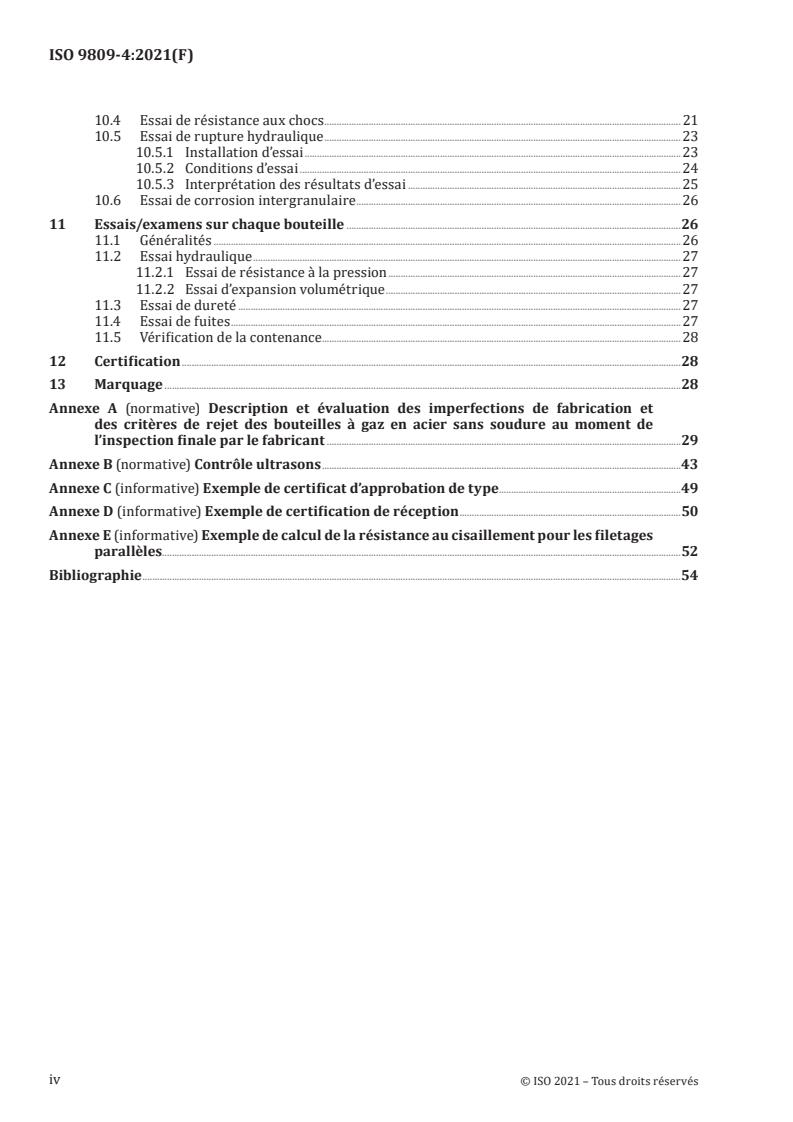
NORME ISO
INTERNATIONALE 9809-4
Deuxième édition
2021-11
Bouteilles à gaz — Conception,
construction et essais des bouteilles
à gaz et des tubes rechargeables en
acier sans soudure —
Partie 4:
Bouteilles en acier inoxydable ayant
une valeur de R inférieure à 1 100
m
MPa
Gas cylinders — Design, construction and testing of refillable
seamless steel gas cylinders and tubes —
Part 4: Stainless steel cylinders with an R value of less than 1 100
m
MPa
Numéro de référence
DOCUMENT PROTÉGÉ PAR COPYRIGHT
© ISO 2021
Tous droits réservés. Sauf prescription différente ou nécessité dans le contexte de sa mise en œuvre, aucune partie de cette
publication ne peut être reproduite ni utilisée sous quelque forme que ce soit et par aucun procédé, électronique ou mécanique,
y compris la photocopie, ou la diffusion sur l’internet ou sur un intranet, sans autorisation écrite préalable. Une autorisation peut
être demandée à l’ISO à l’adresse ci-après ou au comité membre de l’ISO dans le pays du demandeur.
ISO copyright office
Case postale 401 • Ch. de Blandonnet 8
CH-1214 Vernier, Genève
Tél.: +41 22 749 01 11
E-mail: copyright@iso.org
Web: www.iso.org
Publié en Suisse
ii
Sommaire Page
Avant-propos .v
Introduction . vi
1 Domaine d’application . 1
2 Références normatives .1
3 Termes et définitions . 2
4 Symboles . 3
5 Contrôles et essais .4
6 Matériaux . 5
6.1 Exigences générales . 5
6.2 Contrôles de la composition chimique . 5
6.3 Traitement thermique . 6
6.4 Formage à froid ou cryoformage . 6
6.5 Non-respect des exigences relatives aux essais . 6
7 Conception .7
7.1 Exigences générales . 7
7.2 Conception de l’épaisseur de l’enveloppe cylindrique . 7
7.3 Conception des extrémités convexes (ogives et fonds) . 7
7.4 Conception des fonds concaves . 9
7.5 Conception du goulot . 9
7.6 Frettes de pied . 10
7.7 Collerettes . 10
7.8 Plan de conception . 10
8 Construction et exécution .10
8.1 Généralités . 10
8.2 Épaisseur de la paroi . 10
8.3 Imperfections de surface . 11
8.4 Contrôle ultrasons . 11
8.5 Ovalisation . 11
8.6 Diamètre moyen . 11
8.7 Rectitude . 11
8.8 Verticalité et stabilité .12
8.9 Filetage du goulot .12
9 Procédure d’approbation de type .13
9.1 Exigences générales .13
9.2 Essai de prototype. 14
9.2.1 Exigences générales . 14
9.2.2 Essai de cyclage en pression . 14
9.2.3 Vérification du fond . 15
9.2.4 Essai de serrage pour filtrage conique uniquement .15
9.2.5 Calcul de la contrainte de cisaillement pour les filetages parallèles . 16
9.3 Certificat d’approbation de type . 16
9.4 Essais d’approbation de type/de production spécifiques pour les bouteilles
commandées en petites quantités. 16
10 Essais par lot .17
10.1 Exigences générales . 17
10.2 Essai de traction . 19
10.3 Essai de pliage et essai d’aplatissement . 19
10.3.1 Essai de pliage . . 19
10.3.2 Essai d’aplatissement . 20
10.3.3 Essai d’aplatissement sur anneau . 21
iii
10.4 Essai de résistance aux chocs . 21
10.5 Essai de rupture hydraulique . 23
10.5.1 Installation d’essai .23
10.5.2 Conditions d’essai . 24
10.5.3 Interprétation des résultats d’essai . 25
10.6 Essai de corrosion intergranulaire . 26
11 Essais/examens sur chaque bouteille .26
11.1 Généralités . 26
11.2 Essai hydraulique . 27
11.2.1 Essai de résistance à la pression . 27
11.2.2 Essai d’expansion volumétrique . 27
11.3 Essai de dureté . 27
11.4 Essai de fuites . 27
11.5 Vérification de la contenance .28
12 Certification .28
13 Marquage .28
Annexe A (normative) Description et évaluation des imperfections de fabrication et
des critères de rejet des bouteilles à gaz en acier sans soudure au moment de
l’inspection finale par le fabricant .29
Annexe B (normative) Contrôle ultrasons .43
Annexe C (informative) Exemple de certificat d’approbation de type.49
Annexe D (informative) Exemple de certification de réception .50
Annexe E (informative) Exemple de calcul de la résistance au cisaillement pour les filetages
parallèles.52
Bibliographie .54
iv
Avant-propos
L'ISO (Organisation internationale de normalisation) est une fédération mondiale d'organismes
nationaux de normalisation (comités membres de l'ISO). L'élaboration des Normes internationales est
en général confiée aux comités techniques de l'ISO. Chaque comité membre intéressé par une étude
a le droit de faire partie du comité technique créé à cet effet. Les organisations internationales,
gouvernementales et non gouvernementales, en liaison avec l'ISO participent également aux travaux.
L'ISO collabore étroitement avec la Commission électrotechnique internationale (IEC) en ce qui
concerne la normalisation électrotechnique.
Les procédures utilisées pour élaborer le présent document et celles destinées à sa mise à jour sont
décrites dans les Directives ISO/IEC, Partie 1. Il convient, en particulier, de prendre note des différents
critères d'approbation requis pour les différents types de documents ISO. Le présent document a
été rédigé conformément aux règles de rédaction données dans les Directives ISO/IEC, Partie 2 (voir
www.iso.org/directives).
L'attention est attirée sur le fait que certains des éléments du présent document peuvent faire l'objet de
droits de propriété intellectuelle ou de droits analogues. L'ISO ne saurait être tenue pour responsable
de ne pas avoir identifié de tels droits de propriété et averti de leur existence. Les détails concernant
les références aux droits de propriété intellectuelle ou autres droits analogues identifiés lors de
l'élaboration du document sont indiqués dans l'Introduction et/ou dans la liste des déclarations de
brevets reçues par l'ISO (voir www.iso.org/brevets).
Les appellations commerciales éventuellement mentionnées dans le présent document sont données
pour information, par souci de commodité, à l’intention des utilisateurs et ne sauraient constituer un
engagement.
Pour une explication de la nature volontaire des normes, la signification des termes et expressions
spécifiques de l'ISO liés à l'évaluation de la conformité, ou pour toute information au sujet de l'adhésion
de l'ISO aux principes de l’Organisation mondiale du commerce (OMC) concernant les obstacles
techniques au commerce (OTC), voir www.iso.org/avant-propos.
Le présent document a été élaboré par le comité technique ISO/TC 58, Bouteilles à gaz, sous-comité SC 3,
Construction des bouteilles.
Cette deuxième édition annule et remplace la première édition (ISO 9809-4:2014), qui a fait l’objet d’une
révision technique. Les principales modifications par rapport à l’édition précédente sont les suivantes:
— mise à jour de l’Article 5;
— clarification de la Figure 3;
— clarification de 8.9;
— modification de 9.1, 9.2, 9.2.4 et de l’Annexe A;
— ajout du paragraphe 9.2.5 pour les filetages parallèles;
— ajout du paragraphe 9.4 pour les bouteilles commandées en petites quantités.
Une liste de toutes les parties de la série ISO 9809 se trouve sur le site web de l’ISO.
Il convient que l’utilisateur adresse tout retour d’information ou toute question concernant le présent
document à l’organisme national de normalisation de son pays. Une liste exhaustive desdits organismes
se trouve à l’adresse www.iso.org/fr/members.html.
v
Introduction
Le présent document fournit une spécification pour la conception, la fabrication, le contrôle et les essais
d’une bouteille en acier inoxydable sans soudure. L’objectif est de parvenir à un équilibre entre les
aspects liés à la conception et au rendement économique d’une part, et les exigences d’acceptabilité
internationale et d’utilité universelle d’autre part.
L’ISO 9809 (toutes les parties) vise à éliminer les préoccupations concernant le climat, les contrôles
redondants et les restrictions imposées du fait de l’absence de Normes internationales reconnues.
Le présent document a été élaboré de sorte à pouvoir être référencé dans le Règlement type des
[1]
Nations Unies .
vi
NORME INTERNATIONALE ISO 9809-4:2021(F)
Bouteilles à gaz — Conception, construction et essais des
bouteilles à gaz et des tubes rechargeables en acier sans
soudure —
Partie 4:
Bouteilles en acier inoxydable ayant une valeur de R
m
inférieure à 1 100 MPa
1 Domaine d’application
Le présent document spécifie les exigences minimales concernant le matériau, la conception, la
construction et la mise en œuvre, les procédés de fabrication, les examens et les essais au moment de la
fabrication des bouteilles à gaz rechargeables en acier sans soudure d’une contenance en eau inférieure
ou égale à 150 l.
Il s’applique aux bouteilles pour les gaz comprimés, liquéfiés et dissous ayant une résistance à la traction
réelle, R , maximale inférieure à 1 100 MPa.
ma
NOTE Si cela est souhaité, les bouteilles d’une contenance en eau comprise entre 150 l et 450 l peuvent être
fabriquées conformément au présent document.
2 Références normatives
Les documents suivants sont cités dans le texte de sorte qu’ils constituent, pour tout ou partie de leur
contenu, des exigences du présent document. Pour les références datées, seule l’édition citée s’applique.
Pour les références non datées, la dernière édition du document de référence s’applique (y compris les
éventuels amendements).
ISO 148-1, Matériaux métalliques — Essai de flexion par choc sur éprouvette Charpy — Partie 1: Méthode
d'essai
ISO 3651-2, Détermination de la résistance à la corrosion intergranulaire des aciers inoxydables — Partie 2:
Aciers ferritiques, austénitiques et austéno-ferritiques (duplex) — Essais de corrosion en milieux contenant
de l'acide sulfurique
ISO 6506-1, Matériaux métalliques — Essai de dureté Brinell — Partie 1: Méthode d'essai
ISO 6508-1, Matériaux métalliques — Essai de dureté Rockwell — Partie 1: Méthode d’essai
ISO 6892-1, Matériaux métalliques — Essai de traction — Partie 1: Méthode d'essai à température ambiante
ISO 9328-1, Produits plats en acier pour service sous pression — Conditions techniques de livraison —
Partie 1: Exigences générales
ISO 9329-4, Tubes sans soudure en acier pour service sous pression — Conditions techniques de livraison —
Partie 4: Aciers inoxydables austénitiques
ISO 9712, Essais non destructifs — Qualification et certification du personnel END
ISO 10286, Bouteilles à gaz — Vocabulaire
ISO 13341, Bouteilles à gaz — Montage des robinets sur les bouteilles à gaz
ISO 13769, Bouteilles à gaz — Marquage
3 Termes et définitions
Pour les besoins du présent document, les termes et définitions de l'ISO 10286 ainsi que les suivants,
s’appliquent.
L’ISO et l’IEC tiennent à jour des bases de données terminologiques destinées à être utilisées en
normalisation, consultables aux adresses suivantes:
— ISO Online browsing platform: disponible à l’adresse https:// www .iso .org/ obp;
— IEC Electropedia: disponible à l’adresse https:// www .electropedia .org/ .
3.1
lot
quantité pouvant atteindre 200 bouteilles, plus celles nécessaires aux essais destructifs, de même
diamètre nominal, de même épaisseur, de même longueur et de même conception, fabriquées de
manière consécutive sur une même installation à partir de la même coulée d’acier et ayant subi le même
traitement thermique pendant la même durée
3.2
pression de rupture
p
b
pression la plus haute atteinte dans une bouteille lors d’un essai de rupture
3.3
formage à froid
procédé dans lequel la bouteille est soumise à une pression supérieure à la pression d’épreuve (3.11)
de la bouteille afin d’accroître la limite d’élasticité (3.12) de l’acier
3.4
cryoformage
procédé selon lequel la bouteille est soumise à un traitement de déformation contrôlé à basse
température afin d’augmenter sa résistance de façon permanente
3.5
facteur de contrainte théorique
F
rapport de la contrainte équivalente de paroi à la pression d’épreuve, p , (3.11) à la la contrainte minimale
h
d’élasticité garantie, R
eg
3.6
trempe
traitement thermique de durcissement au cours duquel une bouteille qui a été portée à une température
uniforme supérieure à celle du point critique supérieur, Ac , de l’acier, est refroidie rapidement dans un
milieu adapté
3.7
rejeter
mettre une bouteille de côté (niveau 2 ou 3) et refuser sa mise en service
3.8
rendre inutilisable
traiter une bouteille de manière à rendre impossible son utilisation
Note 1 à l'article: Des exemples de méthodes acceptables pour rendre les bouteilles inutilisables peuvent
être trouvés dans l’ISO 18119. Le présent document ne couvre pas les actions visant à rendre les bouteilles
inutilisables.
3.9
réparer
ramener l’état d’une bouteille rejetée au niveau 1
3.10
revenu
traitement thermique d’adoucissement qui suit la trempe (3.6), au cours duquel une bouteille est portée
à une température uniforme inférieure à celle du point critique, Ac , de l’acier
3.11
pression d’épreuve
p
h
pression requise appliquée pendant un essai de pression
Note 1 à l'article: La pression d’épreuve est utilisée pour le calcul de l’épaisseur de la paroi de la bouteille.
3.12
limite d’élasticité
valeur correspondant à la limite conventionnelle d’élasticité à 0,2 %, ou, pour les aciers austénitiques
à l’état recuit de mise en solution, à la limite conventionnelle d’élasticité à 1 %
3.13
pression de service
pression établie d’un gaz comprimé à une température de référence uniforme de 15 °C dans une
bouteille à gaz pleine
4 Symboles
A allongement après rupture, exprimé en pourcentage
a épaisseur minimale calculée de l’enveloppe cylindrique, exprimée en millimètres
a′ épaisseur minimale garantie de l’enveloppe cylindrique, exprimée en millimètres
a épaisseur minimale garantie d’un fond concave à la jointure, exprimée en millimètres
(voir Figure 2)
a épaisseur minimale garantie au centre d’un fond concave, exprimée en millimètres
(voir Figure 2)
b épaisseur minimale garantie au centre d’un fond convexe, exprimée en millimètres
(voir Figure 1)
c écart maximal autorisé du profil de rupture pour les bouteilles trempées et revenues,
exprimé en millimètres (voir Figure 11)
c écart maximal autorisé du profil de rupture pour les bouteilles cryoformées ou en recuit de
mise en solution ayant une épaisseur de paroi inférieure à 7,5 mm, exprimé en millimètres
(voir Figure 12)
D diamètre nominal extérieur de la bouteille, exprimé en millimètres (voir Figure 1)
D diamètre du mandrin, exprimé en millimètres (voir Figure 6)
f
F facteur de contrainte théorique (variable)
H hauteur extérieure de la partie bombée (ogive ou fond convexe), exprimée en millimètres
(voir Figure 1)
h profondeur extérieure (fond concave), exprimée en millimètres (voir Figure 2)
L longueur initiale entre repères comme définie dans l’ISO 6892-1, exprimée en millimètres
o
(voir Figure 5)
l longueur totale de la bouteille, exprimée en millimètres (voir Figure 3)
n rapport du diamètre du mandrin utilisé pour l’essai de pliage à l’épaisseur réelle de l’éprouvette,
t
p pression de rupture réelle, exprimée en bars, au-dessus de la pression atmosphérique
b
NOTE 1 bar = 10 Pa = 0,1 MPa.
p pression d’épreuve hydraulique, exprimée en bars, au-dessus de la pression atmosphérique
h
p pression à la limite élastique observée pendant l’essai de rupture hydraulique, exprimée en bars,
y
au-dessus de la pression atmosphérique
r rayon de raccordement interne, exprimé en millimètres (voir Figure 1 et Figure 2)
R valeur réelle de la limite d’élasticité déterminée par l’essai de résistance à la traction,
ea
exprimée en mégapascals (voir 10.2)
R valeur minimale garantie de la limite d’élasticité (voir 7.1.1) pour la bouteille finie,
eg
exprimée en mégapascals
R valeur réelle de la résistance à la traction déterminée par l’essai de résistance à la traction,
ma
exprimée en mégapascals (voir 10.2)
R valeur minimale garantie de la résistance à la traction pour la bouteille finie, exprimée
mg
en mégapascals
S section initiale de l’éprouvette de traction conformément à l’ISO 6892-1,
o
exprimée en millimètres carrés
t épaisseur réelle de l’éprouvette, exprimée en millimètres
t épaisseur moyenne de la paroi d’une bouteille dans la zone de l’essai d’aplatissement,
m
exprimée en millimètres
u rapport de la distance entre les bords du couteau ou des plateaux pour l’essai d’aplatissement
à l’épaisseur moyenne de la paroi de la bouteille dans la zone de l’essai
V contenance en eau de la bouteille, en litres
w largeur de l’éprouvette de traction, en millimètres (voir Figure 5)
5 Contrôles et essais
L’évaluation de la conformité du présent document doit prendre en compte la règlementation applicable
dans les pays d’utilisation.
Afin de s’assurer que les bouteilles sont conformes au présent document, elles doivent être soumises
à des contrôles et essais conformément aux Articles 9, 10 et 11.
Les essais et examens visant à démontrer la conformité au présent document doivent être effectués
à l’aide d’instruments étalonnés avant leur mise en service et réalisés selon un programme établi.
6 Matériaux
6.1 Exigences générales
6.1.1 Les matériaux utilisés pour la fabrication des bouteilles à gaz doivent faire partie de l’une des
catégories suivantes:
a) aciers pour bouteilles reconnus au plan international;
b) aciers pour bouteilles reconnus au plan national;
c) nouvelles catégories d’acier pour bouteilles, résultant de progrès techniques.
Toutes ces catégories doivent respecter les conditions pertinentes énoncées en 6.2 et 6.3.
6.1.2 Le traitement à chaud des aciers inoxydables austénitiques et duplex entraîne un risque
de sensibilisation à la corrosion intergranulaire (par exemple, appauvrissement en chrome au joint
de grains). Un essai de corrosion intergranulaire doit être réalisé pour ces matériaux conformément à
10.6.
6.1.3 Le fabricant de bouteilles doit établir des moyens permettant d’identifier les bouteilles avec les
coulées d’acier à partir desquelles elles ont été fabriquées.
6.1.4 Les nuances d’acier utilisées pour la fabrication des bouteilles doivent être compatibles avec
le gaz prévu en service, par exemple, gaz corrosifs et gaz fragilisants (voir l’ISO 11114-1).
6.1.5 Certaines nuances d’acier inoxydable peuvent être sensibles au phénomène de corrosion sous
contrainte lié à l’environnement. Des précautions particulières, telles qu’un revêtement approprié,
doivent être prises dans ces cas.
6.1.6 Certaines nuances d’acier inoxydable peuvent être sensibles à une transformation de phase
à basse température conduisant à un alliage fragile. Des précautions particulières doivent être prises
dans ces cas, c’est-à-dire ne pas utiliser la bouteille à une température inférieure à la température
minimale acceptable.
6.2 Contrôles de la composition chimique
6.2.1 Les quatre grandes catégories d’aciers inoxydables sont les suivantes:
— ferritique;
— martensitique;
— austénitique;
— austéno-ferritique (duplex).
Les aciers reconnus sont listés dans l’ISO 15510. D’autres nuances d’acier inoxydable peuvent également
être utilisées sous réserve qu’elles satisfassent à toutes les exigences du présent document.
6.2.2 Le fabricant de bouteilles doit obtenir et tenir à disposition les certificats d’analyses
(thermiques) de coulée des aciers fournis pour la fabrication des bouteilles à gaz.
Lorsque des analyses de vérification sont exigées, elles doivent être réalisées soit sur des échantillons
prélevés pendant la fabrication sur le matériau tel que fourni par l’aciériste au fabricant de bouteilles,
soit sur des bouteilles finies. Dans toute analyse de vérification, les écarts maximaux admis par rapport
aux limites spécifiées pour les analyses de coulée doivent être conformes aux valeurs indiquées dans
l’ISO 9329-4.
6.3 Traitement thermique
6.3.1 Le fabricant de bouteilles doit certifier le traitement thermique appliqué aux bouteilles finies.
6.3.2 Les bouteilles finies fabriquées à partir des catégories d’acier ferritique ou martensitique
doivent être trempées et revenues, sauf si elles sont formées à froid (voir 6.4).
6.3.3 Pour les aciers ferritiques et martensitiques, le procédé de traitement thermique doit permettre
d’obtenir les propriétés mécaniques requises.
6.3.4 La température réelle appliquée à un type d’acier pour obtenir une résistance à la traction
donnée ne doit pas s’écarter de plus de 30 °C de celle spécifiée par le fabricant de bouteilles.
6.4 Formage à froid ou cryoformage
Le formage à froid ou cryoformage est utilisé pour améliorer les propriétés mécaniques finies de
certains matériaux en acier inoxydable.
Pour les bouteilles soumises au formage à froid ou au processus de cryoformage, toutes les exigences
de traitement thermique se réfèrent aux opérations de préformage de la bouteille. Les bouteilles
formées à froid ou cryoformées ne doivent être soumises à aucun traitement thermique ultérieur.
6.5 Non-respect des exigences relatives aux essais
En cas de non-respect des exigences relatives aux essais, un contre-essai ou un nouveau traitement
thermique suivi d’un nouvel essai doivent être effectués de la manière suivante à la satisfaction
de l’inspecteur.
a) Lorsqu’il est prouvé qu’une erreur a été commise dans l’exécution de l’essai, ou dans le cas d’une
erreur de mesure, un nouvel essai doit être effectué. Si ce dernier est satisfaisant, le premier essai
doit être ignoré.
b) Si l’essai a été réalisé de façon satisfaisante, la cause de la non-conformité de l’essai doit être
identifiée.
1) Si la non-conformité est due au traitement thermique appliqué, le fabricant peut soumettre
toutes les bouteilles non conformes à un seul nouveau traitement thermique. Par exemple,
si la non-conformité concerne un essai de bouteilles d’un lot ou de prototypes, toutes les
bouteilles représentatives doivent faire l’objet d’un nouveau traitement thermique avant
le contre-essai. Ce nouveau traitement thermique doit consister en un nouveau revenu ou
un nouveau traitement thermique total. Lorsque les bouteilles sont soumises à un nouveau
traitement thermique, l’épaisseur minimale garantie de la paroi doit être conservée. Seuls
les essais applicables à un prototype ou à un lot doivent être réalisés une nouvelle fois pour
prouver la conformité du nouveau lot. Si un ou plusieurs d’entre eux ne sont pas satisfaisants,
même partiellement, toutes les bouteilles du lot doivent être refusées.
2) Si la non-conformité porte sur autre chose que le traitement thermique appliqué, toutes les
bouteilles défectueuses doivent être refusées ou réparées par une méthode approuvée. Si les
bouteilles réparées satisfont à l’essai ou aux essais requis pour la réparation, elles doivent
ensuite être considérées comme faisant partie du lot d’origine.
7 Conception
7.1 Exigences générales
7.1.1 Le calcul de l’épaisseur de la paroi des parties soumises à des pressions doit prendre en compte
la valeur minimale garantie de la limite d’élasticité, R , du matériau de la bouteille finie.
eg
7.1.2 Les bouteilles doivent être conçues avec une ou deux ouvertures le long de l’axe central de la
bouteille uniquement.
7.1.3 La pression interne, sur laquelle est basé le calcul de l’épaisseur de paroi, doit être la pression
d’épreuve hydraulique p .
h
7.2 Conception de l’épaisseur de l’enveloppe cylindrique
L’épaisseur minimale garantie de l’enveloppe cylindrique, a′, ne doit pas être inférieure à l’épaisseur
calculée à l’aide des Formules (1) et (2), et la Formule (3) doit en outre être satisfaite.
10FpR − 3
D
eg h
a=−1 (1)
2 10FR
eg
où la valeur de F est égale à 0,77.
L’épaisseur de la paroi doit également satisfaire à la Formule (2):
D
a≥+1 (2)
avec un minimum absolu de a = 1,5 mm.
Le rapport de rupture doit être satisfait par essai selon la Formule (3).
p /p ≥ 1,6 (3)
b h
NOTE Il est généralement admis que, pour les gaz comprimés, p = 1,5 fois la pression de service pour les
h
bouteilles conçues et fabriquées en vue d’une conformité au présent document.
7.3 Conception des extrémités convexes (ogives et fonds)
7.3.1 Lorsque les bouteilles sont à fond convexe (voir Figure 1), l’épaisseur b au centre du fond
convexe ne doit pas être inférieure à celle requise pour satisfaire aux critères suivants: si le rayon de
raccordement interne r n’est pas inférieur à 0,075 D, alors:
— b ≥ 1,5 a pour 0,40 > H/D ≥ 0,20;
— b ≥ a pour H/D ≥ 0,40.
Afin d’obtenir une répartition satisfaisante des contraintes dans la zone de raccordement de l’extrémité
à la partie cylindrique, toute augmentation de l’épaisseur du fond lorsqu’elle est requise doit être
progressive à partir du point de raccordement, en particulier au fond. Pour l’application de cette règle,
le point de raccordement entre la partie cylindrique et l’extrémité est défini par les lignes horizontales
indiquant la cote H à la Figure 1.
La forme b) ne doit pas être exclue de ces exigences.
7.3.2 Le fabricant de bouteilles doit prouver, par l’essai de cyclage en pression détaillé en 9.2.2, que la
conception est satisfaisante.
La Figure 1 montre des configurations types d’ogives et de fonds convexes. Les formes a), b), d) et e)
représentent des fonds; les formes c) et f) représentent des ogives.
a) b) c)
d) e) f)
Légende
1 partie cylindrique
Figure 1 — Extrémités convexes types
7.4 Conception des fonds concaves
7.4.1 Lorsque les bouteilles sont à fond concave (voir Figure 2), il est recommandé d’utiliser les
valeurs de conception suivantes:
— a ≥ 2 a;
— a ≥ 2 a;
— h ≥ 0,12 D;
— r ≥ 0,075 D.
Le plan de conception doit au moins indiquer les valeurs de a , a , h et r.
1 2
Afin d’obtenir une répartition satisfaisante des contraintes, l’épaisseur de la paroi de la bouteille doit
augmenter progressivement dans la zone de transition entre la partie cylindrique et le fond.
7.4.2 Le fabricant de bouteilles doit, dans tous les cas, prouver par l’essai de cyclage en pression
détaillé en 9.2.2 que la conception est satisfaisante.
Figure 2 — Fonds concaves
7.5 Conception du goulot
7.5.1 Le diamètre extérieur du goulot et l’épaisseur de sa paroi doivent être adaptés au le couple
appliqué lors du montage du robinet sur la bouteille. Ce couple peut varier selon le type de robinet,
le diamètre et la forme du filetage ainsi que le moyen d’étanchéité utilisé dans le montage du robinet.
NOTE Pour des informations sur les couples, voir l’ISO 13341.
7.5.2 Lors de la détermination de l’épaisseur minimale, l’épaisseur de paroi du goulot de la bouteille
doit empêcher toute dilatation permanente du goulot au cours du montage initial ou des montages
ultérieurs du robinet sur la bouteille, sans aide d’une pièce rapportée. Le diamètre extérieur et
l’épaisseur du goulot de la bouteille ne doivent pas être endommagés (aucune déformation permanente
ou fissure) du fait de l’application du couple maximal requis pour fixer le robinet sur la bouteille (voir
l’ISO 13341) et des contraintes exercées lorsque la bouteille est soumise à sa pression d’épreuve. Dans
des cas spécifiques (par exemple bouteilles à paroi très mince) où ces contraintes ne peuvent pas être
supportées par le goulot lui-même, ce dernier peut être conçu pour être équipé d’un renfort, tel qu’une
collerette ou une bague frettée, à condition que le matériau et les dimensions du renfort soient clairement
spécifiés par le fabricant et que cette configuration fasse partie de la procédure d’approbation de type
(voir 9.2.4 et 9.2.5).
7.6 Frettes de pied
Lorsqu’une frette de pied est fournie, elle doit être réalisée dans un matériau compatible avec celui de
la bouteille. Il convient que sa forme soit de préférence cylindrique et elle doit donner de la stabilité
à la bouteille. La frette de pied doit être fixée sur la bouteille par une méthode autre que le soudage,
le brasage dur ou le brasage tendre. Tous les interstices pouvant constituer des retenues d’eau doivent
être rendus étanches par une méthode autre que le soudage, le brasage dur ou le brasage tendre.
7.7 Collerettes
Lorsqu’une collerette est prévue, elle doit être réalisée dans un matériau compatible avec celui de
la bouteille et elle doit être fixée par une méthode autre que le soudage, le brasage dur ou le brasage
tendre.
La charge axiale à appliquer pour retirer la collerette doit être supérieure à 10 fois la masse de la
bouteille vide et au moins égale à 1 000 N, et le couple nécessaire pour faire tourner la collerette est
supérieur à 100 Nm.
7.8 Plan de conception
Un plan indiquant toutes les cotes ainsi que les spécifications du matériau et les détails relatifs à la
conception des raccords permanents doit être réalisé. Les dimensions des raccords non liés à la sécurité
peuvent être convenues entre le client et le fabricant; il n’est donc pas utile de les indiquer dans le plan
de conception.
8 Construction et exécution
8.1 Généralités
La bouteille doit être réalisée:
a) par forgeage ou matriçage à partir d’une billette ou d’un lingot massif;
b) à partir d’un tube sans soudure;
c) par emboutissage d’une tôle;
d) par formage à froid ou cryoformage.
Le procédé de fermeture du fond ne doit comporter aucun apport de métal. Les défauts de fabrication
des fonds ne doivent pas être colmatés (par exemple, ajout de métal par soudage).
8.2 Épaisseur de la paroi
Pendant la production, l’épaisseur de chaque bouteille ou enveloppe semi-finie doit être vérifiée.
L’épaisseur de la paroi ne doit, en aucun point, être inférieure à l’épaisseur minimale spécifiée.
8.3 Imperfections de surface
Les surfaces interne et externe de la bouteille finie doivent être exemptes d’imperfections susceptibles
de nuire à la sécurité de la bouteille en service. Pour des exemples d’imperfections et une aide pour leur
évaluation, voir l’Annexe A.
8.4 Contrôle ultrasons
8.4.1 Après le traitement thermique final de la bouteille et le formage à froid et après obtention
de l’épaisseur finale de la paroi cylindrique, chaque bouteille doit faire l’objet d’un contrôle ultrasons
pour rechercher les imperfections internes, externes et sous-jacentes, conformément à l’Annexe B.
8.4.2 En sus du contrôle ultrasons spécifié en 8.4.1, la surface cylindrique devant être fermée
(pour créer l’ogive et, dans le cas de bouteilles fabriquées à partir de tube, également le fond) doit subir
un contrôle ultrasons avant le procédé de formage afin de détecter tout défaut qui, après la fermeture,
pourrait être situé dans les extrémités de la bouteille.
Dans le cas de bouteilles produites à partir de tube (sous réserve que l’épaisseur du tube reste
inchangée), cet essai supplémentaire n’est pas requis si le tube est intégralement soumis à un contrôle
ultrasons avant la fermeture des extrémités conformément à l’Annexe B.
L’essai doit être réalisé aussi près que possible de l’extrémité ouverte de l’enveloppe.
La zone non soumise à essai doit s’étendre jusqu’à une longueur de 40 mm au maximum de l’extrémité
ouverte de l’enveloppe.
En 8.4.1 et 8.4.2, le contrôle ultrasons n’est pas requis pour les petites bouteilles dont la longueur
cylindrique est inférieure à 200 mm, ou pour lesquelles le produit p × V < 600 bar.l (pour R ≥ 650 MPa)
h ma
ou p × V < 1 200 bar.l (pour R < 650 MPa).
h ma
8.5 Ovalisation
L’ovalisation de la paroi cylindrique, c’est-à-dire la différence entre les diamètres extérieurs maximal
et minimal d’une même section, ne doit pas être supérieure à 2 % de la valeur moyenne de ces diamètres.
Pour l’étirement à froid et les bouteilles cryoformées, de plus hautes valeurs sont acceptables à condition
qu’elles soient validées par un essai de cyclage en pression, et le maximum doit être spécifié sur le plan
de conception approuvé.
8.6 Diamètre moyen
Le diamètre extérieur moyen de la partie cylindrique à l’extérieur des zones de transition d’une section
transversale ne doit pas s’écarter de plus de ±1 % du diamètre de conception nominal.
Pour l’étirement à froid et les bouteilles cryoformées, de plus hautes valeurs sont acceptables à condition
qu’elles soient validées par un essai de cyclage en pression, et le maximum doit être spécifié sur le plan
de conception approuvé.
8.7 Rectitude
L’écart maximal b de la partie cylindrique de l’enveloppe par rapport à une ligne droite ne doit pas
dépasser 3 mm par mètre de longueur (voir Figure 3).
Dans le cas du formage à froid et des b
...