


ISO/R 716:1968
(Main)Verification of Rockwell B and C scale hardness testing machines
Verification of Rockwell B and C scale hardness testing machines
Contrôle des machines d'essai de dureté Rockwell (échelles B et C)
General Information
- Status
- Withdrawn
- Publication Date
- 30-Apr-1968
- Withdrawal Date
- 30-Apr-1968
- Technical Committee
- ISO/TC 164/SC 3 - Hardness testing
- Drafting Committee
- ISO/TC 164/SC 3 - Hardness testing
- Current Stage
- 9599 - Withdrawal of International Standard
- Start Date
- 01-Dec-1986
- Completion Date
- 12-Feb-2026
ISO/R 716:1968 - Verification of Rockwell B and C scale hardness testing machines
ISO/R 716:1968 - Verification of Rockwell B and C scale hardness testing machines Released:5/1/1968
Get Certified
Connect with accredited certification bodies for this standard

Element Materials Technology
Materials testing and product certification.

Inštitut za kovinske materiale in tehnologije
Institute of Metals and Technology. Materials testing, metallurgical analysis, NDT.
Sponsored listings
Frequently Asked Questions
ISO/R 716:1968 is a standard published by the International Organization for Standardization (ISO). Its full title is "Verification of Rockwell B and C scale hardness testing machines". This standard covers: Verification of Rockwell B and C scale hardness testing machines
Verification of Rockwell B and C scale hardness testing machines
ISO/R 716:1968 is classified under the following ICS (International Classification for Standards) categories: 77.040.10 - Mechanical testing of metals. The ICS classification helps identify the subject area and facilitates finding related standards.
ISO/R 716:1968 is available in PDF format for immediate download after purchase. The document can be added to your cart and obtained through the secure checkout process. Digital delivery ensures instant access to the complete standard document.
Standards Content (Sample)
UDC 620.1.05 : 620.178.152.42
Ref. No. : ISO/R 716-1968 (E)
IS0
ORGAN I2 AT I ON FOR STAN DARD IZATl O N
I N T E RN AT1 O N A L
I SO R ECO M M EN DATI O N
R 716
VERIFICATION OF ROCKWELL B AND C SCALE
HARDNESS TESTING MACHINES
1 st EDITION
May 1968
COPYRIGHT RESERVED
The copyright of IS0 Recommendations and IS0 Standards
belongs to IS0 Member Bodies. Reproduction of these
documents, in any country, may be authorized therefore only
by the national standards organization of that country, being
a member of ISO.
For each individual country the only valid standard is the national standard of that country.
Printed in Switzerland
Also issued in French and Russian. Copies to be obtained through the national standards organizations.
BRIEF HISTORY
The IS0 Recommendation R 716, Verification of Rockwell B and C scale hardness testing
machines, was drawn up by Technical Committee ISO/TC 17, Steel, the Secretariat of which is held
by the British Standards Institution (BSI).
Work on this question by the Technical Committee began in 1961 and led, in 1965, to the
adoption of a Draft IS0 Recommendation, which replaced Draft IS0 Recommendation No. 522.
W-
In March 1966, this Draft IS0 Recommendation (No. 928) was circulated to all the IS0
Member Bodies for enquiry. It was approved, subject to a few modifications of an editorial nature, by
the following Member Bodies :
Argentina Israel Sweden
Austria Italy Switzerland
Belgium
Japan Turkey
Canada Korea, Rep. of
U.A.R.
Chile Netherlands United Kingdom
Czechoslovakia New Zealand U.S.A.
Denmark Norway U.S.S.R.
Finland Portugal Yugoslavia
France Romania
Germany South Africa,
Rep. of
Hu%asr
India
Spain
No Member Body opposed the approval of the Draft.
The Draft IS0 Recommendation was then submitted by correspondence to the IS0 Council
which decided, in May 1968, to accept it as an IS0 RECOMMENDATION.
-2-
ISO/R 716-1968 (f
IS0 Recommendation R 716 May 1968
VERIFICATION OF ROCKWELL 6 AND C SCALE
HARDNESS TESTING MACHINES
1. SCOPE
This IS0 Recommendation applies to the verification of testing machines for determining Rockwell
hardness in accordance with IS0 Recommendation R 80,* Rockwell hardness test (B and C scales)
for steel.
It describes the indirect method which is suitable for machines in service, and the direct method which
is suitable for the initial verification of new machines by the manufacturer and for the verification of
rebuilt machines.
2. DIRECT VERIFICATION
Direct verification involves
verification of the load-applying mechanism (see clause 2.1),
(a)
verification of the indenter (see clause 2.2),
(b)
verification of the measuring device (see clause 2.3).
(c)
Before verification is carried out, certain details of the testing machine should be checked (see
Annex A).
2.1 Verification of the load-applying mechanism
2.1.1 The verification of the load-applying mechanism at the required loads should be carried out
either by means of standardized weights (masses) or by means of an elastic device or proving
levers.
2.1.2 The preliminary load and each total load should be measured and, wherever possible, this
should be done at not less than three positions of the plunger throughout its range of move-
ment.
2.1.3 The loads should be measured by one of the following three methods :
balancing against standardized weights (masses) accurate to f 0.1
(a)
balancing against a load, accurate to f 0.2 applied by means of standardized
(b)
weights (masses) with mechanical advantage;
measuring the applied load by means of the deformation of an elastic device'which
(c)
has been previously calibrated to an accuracy off 0.2
2.1.4 Three readings should be taken for each load at each position of the plunger (see clause
2.1.2). Immediately before each reading is taken, the plunger should have been moved in the
same direction as during testing.
* 2nd edition, 1968.
-3-
ISO/R 716-1968 (E)
2.1.5 Each reading of the preliminary load before application and after removal of the additional
load should be
10 f 0.2 kgf
Each reading of the total load should be
150 f 0.9 kgf for a cone indenter (C scale),
100 f 0.65 kgf for a bail indenter (B scale),
2.2 Verification of the indenter (B and C scales)
2.2.1 Cscale
The verification of the form of the diamond cone can be made by direct measure-
2.2.1.1
ment or by measurement of its projection on a screen. The verification should be made
at not less than four sections.
2.2.1.2 The diamond cone should have an included angle of 120 f 0.5" and should have its
axis in line with the axis of the indenter within 0.5". The tip of the cone should be
spherical with a radius equal to 0.200 mm. The contour of the whole of the tip should
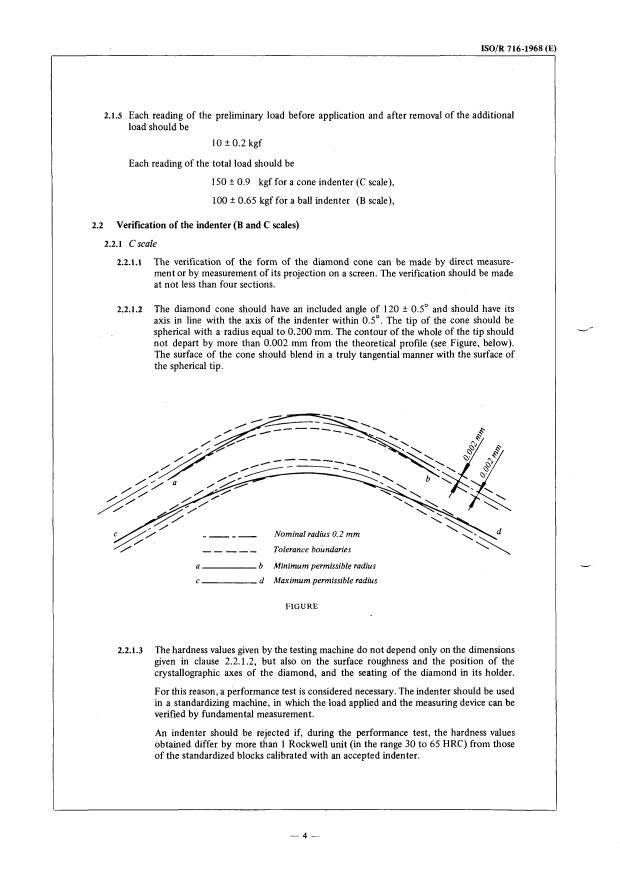
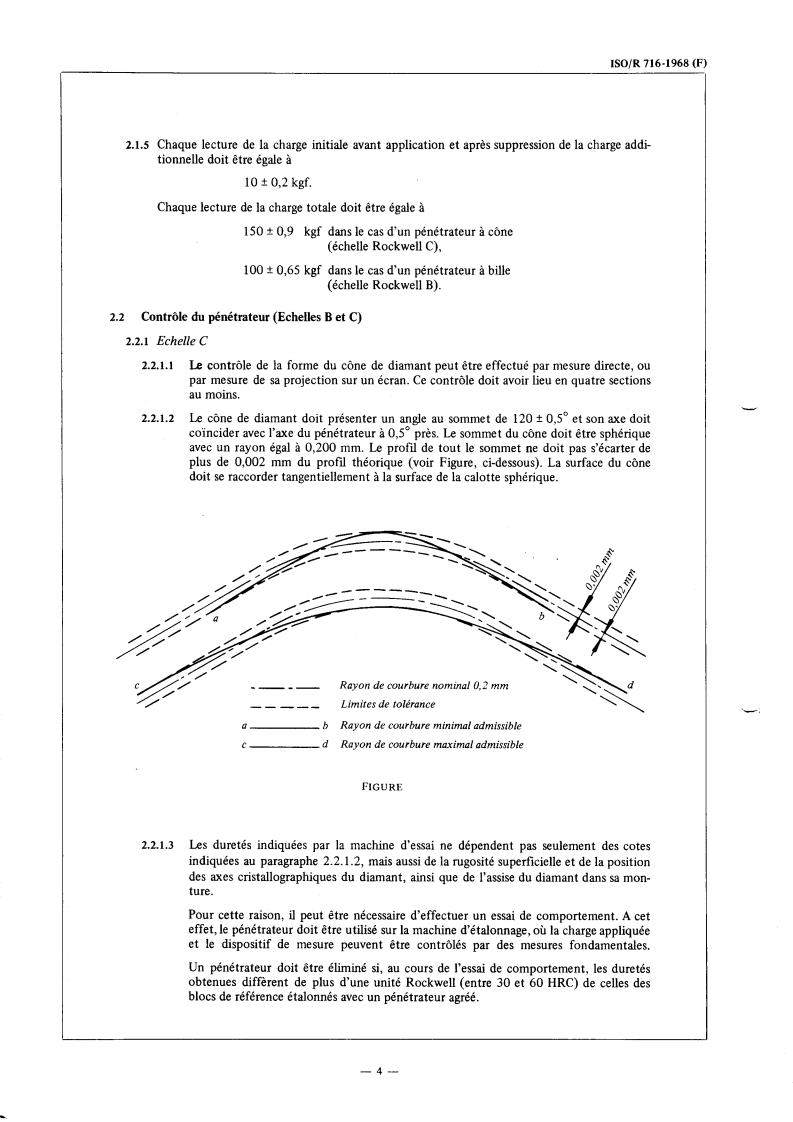
not depart by more than 0.002 mm from the theoretical profile (see Figure, below).
The surface of the cone should blend in a truly tangential manner with the surface of
the spherical tip.
- - - - Nominal radius 0.2 mm
- - - - - Tolerance boundaries '\
a b Minimum permissible radius
C d Maximum permissible radius
FIGURE
2.2.1.3 The hardness values given by the testing machine do not depend only on the dimensions
given in clause 2.2.1.2, but also on the surface roughness and the position of the
crystallographic axes of the diamond, and the seating of the diamond in its holder.
For this reason, a performance test is considered necessary. The indenter should be used
in a standardizing machine, in which the load applied and the measuring device can be
verified by fundamental measurement.
An indenter should be rejected if, during the performance test, the hardness values
obtained differ by more than 1 Rockwell unit (in the range 30 to 65 HRC) from those
of the standardized blocks calibrated with an accepted indenter.
-4-
ISO/R 716-1968 (E
2.2.2 BScale
2.2.2.1 For the purpose of verifying the size and hardness of the steel ball used in the indenter,
it is considered sufficient to test a sample selected at random from a batch. The
ball(s) tested for hardness should be discarded.
2.2.2.2 The balls should satisfy the following requirements :
the diameter, when measured at not less than three positions, should not differ
(a)
from the nominal diameter by more than 0.0035 mm (0.00015 in);*
the Vickers hardness of the balls should not be less than 850 HV 10 when
(b)
measured in accordance with IS0 Recommendation R 81,** Vickers hardness
test for steel, and applying the appropriate correction for curvature as given in
IS0 Recommendation R 409, Table of Vickers hardness values (HV) for metallic
materials. The maximum value of the mean diagonal of the indentation made
with a Vickers indenter at 10 kgf is therefore 0.141 mm for a 1.5875 mm
(1/16 in) ball.
2.3 Verificatio
...
CDU 620.1.05 : 620.178.152.42 Réf. No : ISO/R 716-1968 (FI
IS0
ORGAN IS AT1 ON I NT ERN AT I ON A LE DE NORM A LI SAT1 ON
RECOMMANDATION IS0
_-.
R 716
L
CONTRÔLE DES MACHINES D‘ESSAI DE DURETÉ ROCKWELL
(ÉCHELLES B ETC)
ibre EDITION
Mai 1968
REPRODUCTION INTERDITE
Le droit de reproduction des Recommandations IS0 et des Normes
IS0 est la propriété des Comités Membres de 1’ISO. En consé-
quence, dans chaque pays, la reproduction de ces documents ne
peut être autorisée que par l’organisation nationale de normali-
sation de ce pays, membre de I’ISO.
Seules les normes nationales sont valables dans leurs pays respectifs.
Imprimé en Suisse
Ce document est également éditk en anglais et en russe. I1 peut ëtre obtenu auprés des organisations
nationales de normalisation.
HISTORIQUE
La Recommandation ISO/R 7 16, Contrôle des machines d'essai de dureté Rockwell (échelles B
et C), a été élaborée par le Comité Technique ISO/TC 17, Acier, dont le Secrétariat est assuré par la
British Standards Institution (BSI).
Les travaux relatifs à cette question furent entrepris par le Comité Technique en 1961 et abou-
tirent, en 1965, à l'adoption d'un Projet de Recommandation IS0 qui remplace le Projet No 522.
En mars 1966, ce Projet de Recommandation IS0 (No 928) fut soumis à l'enquête de tous les
Comités Membres de VISO. I1 fut approuvé, sous réserve de quelques modifications d'ordre rédaction-
nel, par les Comités Membres suivants :
Royaume-Uni
Afrique du Sud, France
Rép. d' Hongrie Suède
Allemagne Inde Suisse
Argentine Israël Tchécoslovaquie
Turquie
Autriche Italie
U.R.S.S.
Belgique Japon
Canada Norvège U.S.A.
Nouvelle-Zélande Yougoslavie
Chili
Corée, Rép. de Pays-Bas
Danemark Portugal
Espagne R.A.U.
Roumanie
Finlande
Aucun Comité Membre ne se déclara opposé à l'approbation du Projet.
Le Projet de Recommandation IS0 fut alors soumis par correspondance au Conseil de VISO qui
décida, en mai 1968, de l'accepter comme RECOMMANDATION ISO.
-2-
ISO/R 716-1968 (F
~~~~
Mai 1968
Recommandation IS0 R 716
CONTRÔLE DES MACHINES D’ESSAI DE DURETÉ ROCKWELL
B ETC)
(ÉCHELLES
1. OBJET
La présente Recommandation IS0 concerne le contrôle des machines d’essai pour la détermination de
la dureté Rockwell, conformément à la Recommandation ISO/R 80*, Essai de dureté Rockwell
L
(échelles B et C) pour 1 ’acier.
Elle décrit la méthode indirecte applicable aux machines en service, et la méthode directe, applicable
au contrôle initiai des machines neuves par le fabricant, et à celui des machines revisées.
2. CONTROLE DIRECT
Le contrôle direct comporte
le contrôle du mécanisme d’application de la charge (voir paragraphe 2.1),
a)
le contrôle du pénétrateur (voir paragraphe 2.2),
b)
le contrôle du dispositif de mesure (voir paragraphe 2.3).
c)
Avant d’effectuer le contrôle, certains détails de la machine d’essai doivent être contrôlés (voir
Annexe A).
2.1 Contrôle du mécanisme d’application de la charge
2.1.1 Le contrôle du mécanisme d’application de la charge pour les charges spécifiées doit être
effectué soit au moyen de poids (masses) étalonnés, soit au moyen d’un dynamomètre ou de
I--
leviers d‘épreuve.
\
2.1.2 La charge initiale et chacune des charges totales doivent être mesurées et, chaque fois que
possible, cette mesure sera effectuée pour trois positions au moins de l’équipage mobile,
réparties sur toute l’étendue de sa course.
2.1.3 Les charges doivent être mesurées par l’un des trois procédés suivants :
par comparaison avec des poids (masses) étalonnés, exacts à 0,l près;
a)
près, appliquée au moyen de
par comparaison avec une charge exacte à 0,2
b)
poids (masses) étalonnés, agissant sur un bras de levier;
par mesure de la. charge appliquée au moyen de la déformation d’un dynamo-
c)
mètre, préalablement taré à 0,2 près.
2.1.4 Trois lectures doivent être faites pour chaque charge et pour chaque position de l’équipage
mobile (voir paragraphe 2.1.2). Immédiatement avant chaque lecture, l’équipage mobile doit
avoir été déplacé dans le même sens qu’au cours de l’essai.
2ème édition, 1968.
-3-
ISO/R 716-1968 (F)
2.1.5 Chaque lecture de la charge initiale avant application et après suppression de la charge addi-
tionnelle doit être égale à
10 f 0,2 kgf.
Chaque lecture de la charge totale doit être égale à
150 f 0,9 kgf dans le cas d'un pénétrateur à cône
(échelle Rockwell C),
100 f 0,65 kgf dans le cas d'un pénétrateur à bille
(échelle Rockwell B).
2.2 Contrôle du pénétrateur (Echeiles B et C)
2.2.1 Echelle C
2.2.1.1 Le contrôle de la forme du cône de diamant peut être effectué par mesure directe, ou
par mesure de sa projection sur un écran. Ce contrôle doit avoir lieu en quatre sections
au moins.
2.2.1.2 Le cône de diamant doit présenter un angle au sommet de 120 f 0,s" et son axe doit
coïncider avec l'axe du pénétrateur à 0,s" près. Le sommet du cône doit être sphérique
avec un rayon égal à 0,200 mm. Le profil de tout le sommet ne doit pas s'écarter de
plus de 0,002 mm du profd théorique (voir Figure, ci-dessous). La surface du cône
doit se raccorder tangentiellement à la surface de la calotte sphérique.
-/---
- - - - Rayon de courbure nominal 0,2 mm
Limites de tolérance
- - - - -
-'\
a b Rayon de courbure minimal admissible
C d Rayon de courbure maximal admissible
FIGURE
2.2.1.3 Les duretés indiquées par la machine d'essai ne dépendent pas seulement des cotes
indiquées au paragraphe 2.2.1.2, mais aussi de la rugosité superficielle et de la position
des axes cristallographiques du diamant, ainsi que de l'assise du diamant dans sa mon-
ture.
Pour cette raison, il peut être nécessaire d'effectuer un essai de comportement. A cet
effet, le pénétrateur doit être utilisé sur la machine d'étalonnage, où la charge appliquée
et le dispositif de mesure peuvent être contrôlés par des mesures fondamentales.
Un pénétrateur doit être éliminé si, au cours de l'essai de comportement, les duretés
obtenues diffèrent de plus d'une unité Rockwell (entre 30 et 60 HRC) de celles des
blocs de référence étalonnés avec un pénétrateur agréé.
-4-
ISO/R 716-1968 (F
2.2.2 Echelle B
2.2.2.1 Le contrôle de la dimension et de la dureté des billes d’acier utilisées comme pénétra-
teurs peut se limiter à un seul échantillon choisi au hasard dans un lot. La ou les billes
essayées pour dureté seront éliminées.
2.2.2.2 Les billes doivent satisfaire aux conditions suivantes :
le diamètre, mesuré en trois positions au moins, ne doit pas différer du diamètre
a)
nominal de plus de 0,0035 mm (0,00015 in)*;
la dureté Vickers des billes, mesurée conformément à la Recommandation
b)
ISO/R 81**, Essai de dureté Vickers pour l’acier (charges de 5 à 100 kgf), ne
sera pas inférieure à 850 HV 10. Les corrections de courbure données dans la
Recommandation ISO/R 409, Tableaux des valeurs de dureté Vickers (HV) pour
matériaux métalliques, seront appliquées. La valeur maximale de la diagonale
moyenne obtenue avec un pénétrateur Vickers sous 10 kgf est donc de 0,141 mm
pour une bille de 1,5875 mm (1/16 in) de diamètre.
,
2.3 Contrôle du dispositif de mesure
L
Le dispositif de mesure de l’enfoncement doit être contrôlé sur au moins trois intervalles de
valeurs, parmi lesquels les intervalles correspondant aux duretés minimales et maximales, pour
lesquelles les échelles de mesure sont n
...
Questions, Comments and Discussion
Ask us and Technical Secretary will try to provide an answer. You can facilitate discussion about the standard in here.
Loading comments...