

ISO 12617:2015
(Main)Road vehicles — Liquefied natural gas (LNG) refuelling connector — 3,1 MPa connector
General Information
- Abstract
ISO 12617:2015 specifies liquefied natural gas (LNG) refuelling nozzles and receptacles constructed entirely of new and unused parts and materials for road vehicles powered by LNG. An LNG refuelling connector consists of, as applicable, the receptacle and its protective cap (mounted on the vehicle) and the nozzle. This International standard is applicable only to such devices designed for a maximum working pressure of 3,4 MPa (34 bar) to those using LNG as vehicle fuel and having standardized mating components. NOTE All references to pressures given in megapascals and bar (1 bar = 0,1 MPa = 105 Pa; 1 MPa = 1 N/mm2) are to be considered gauge pressures, unless otherwise specified.
- Status
- Published
- Publication Date
- 17-Mar-2015
- Technical Committee
- ISO/TC 22/SC 41 - Specific aspects for gaseous fuels
- Current Stage
- 9092 - International Standard to be revised
- Start Date
- 03-Sep-2025
- Completion Date
- 29-Aug-2026
Buy Documents

ISO 12617:2015 - Road vehicles — Liquefied natural gas (LNG) refuelling connector — 3,1 MPa connector Released:1/7/2016
ISO 12617:2015 - Véhicules routiers — Connecteur de remplissage de gaz naturel liquéfié (GNL) — Connecteur a 3,1 MPa Released:2/7/2017
Overview
ISO 12617:2015 - Road vehicles - Liquefied natural gas (LNG) refuelling connector - defines requirements for LNG nozzles and receptacles (connector and protective cap) used on road vehicles. The standard applies to devices constructed entirely of new parts and materials, intended for use with LNG as vehicle fuel and having standardized mating components. The published scope specifies devices designed for a maximum working pressure of 3.4 MPa (34 bar) (pressures are gauge unless noted). ISO 12617 covers the connector profile, mating dimensions and compatibility so certified nozzles and receptacles are functionally interchangeable.
Key topics and technical requirements
- Scope & applicability: Only nozzles and receptacles (not full refuelling systems); new and unused components for road vehicle refuelling.
- Mating profile & dimensions: Standardized receptacle profile and nozzle probe geometry to ensure cross-manufacturer compatibility.
- Pressure ratings: Working pressure, maximum service pressure and hydrostatic test requirements (3.4 MPa / 34 bar as specified).
- Materials & corrosion protection: Material selection, body materials and corrosion-resistance expectations for cryogenic LNG service.
- Operational design: Hand operation, sealing changeability, venting/depressurization, internal check valves and protective caps.
- User interface & safety: Positive locking, safe disconnection, manual force limits at warm/cold conditions, impact resistance, and protective-cap performance.
- Performance testing: Leakage tests at room temperature, hydrostatic strength, durability/cycling (receptacles tested to 10 000 connect/disconnect cycles; Class A nozzles defined for high-frequency use at 100 000 cycles), abnormal-load tests, electrical conductivity and no-ignition evaluation.
- Marking & instructions: Manufacturer, standard information, date of manufacture, installation and user instructions, list of tools.
- Quality & certification: Test procedures and acceptance criteria to support examination, testing and certification of components.
Applications and who uses it
- LNG refuelling equipment manufacturers (nozzle and receptacle design and production)
- Vehicle manufacturers integrating receptacles on LNG-powered road vehicles
- Test laboratories and certification bodies conducting compatibility, durability and pressure testing
- Fleet operators, gas suppliers and station designers specifying safe, interoperable LNG refuelling interfaces
- Regulators and standards committees referencing connector safety and interoperability requirements
Keywords: ISO 12617:2015, LNG refuelling connector, LNG nozzle, LNG receptacle, 3.4 MPa, 34 bar, LNG vehicle refuelling standard, LNG connector compatibility, LNG fueling safety.
Related standards
Refer to work from ISO Technical Committee ISO/TC 22/SC 25 (road vehicles using gaseous fuels) and other national/international regulations for gaseous-fuel vehicle refuelling systems and station safety.
Relations
- Effective Date
- 16-Sep-2026
- Effective Date
- 09-Feb-2026
Buy Documents
ISO 12617:2015 - Road vehicles — Liquefied natural gas (LNG) refuelling connector — 3,1 MPa connector Released:1/7/2016
ISO 12617:2015 - Véhicules routiers — Connecteur de remplissage de gaz naturel liquéfié (GNL) — Connecteur a 3,1 MPa Released:2/7/2017
Get Certified
Connect with accredited certification bodies for this standard

TÜV Rheinland
TÜV Rheinland is a leading international provider of technical services.

TÜV SÜD
TÜV SÜD is a trusted partner of choice for safety, security and sustainability solutions.

DEKRA Certification Inc.
DEKRA US certification services.
Sponsored listings
Frequently Asked Questions
ISO 12617:2015 is a standard published by the International Organization for Standardization (ISO). Its full title is "Road vehicles — Liquefied natural gas (LNG) refuelling connector — 3,1 MPa connector". This standard covers: ISO 12617:2015 specifies liquefied natural gas (LNG) refuelling nozzles and receptacles constructed entirely of new and unused parts and materials for road vehicles powered by LNG. An LNG refuelling connector consists of, as applicable, the receptacle and its protective cap (mounted on the vehicle) and the nozzle. This International standard is applicable only to such devices designed for a maximum working pressure of 3,4 MPa (34 bar) to those using LNG as vehicle fuel and having standardized mating components. NOTE All references to pressures given in megapascals and bar (1 bar = 0,1 MPa = 105 Pa; 1 MPa = 1 N/mm2) are to be considered gauge pressures, unless otherwise specified.
ISO 12617:2015 specifies liquefied natural gas (LNG) refuelling nozzles and receptacles constructed entirely of new and unused parts and materials for road vehicles powered by LNG. An LNG refuelling connector consists of, as applicable, the receptacle and its protective cap (mounted on the vehicle) and the nozzle. This International standard is applicable only to such devices designed for a maximum working pressure of 3,4 MPa (34 bar) to those using LNG as vehicle fuel and having standardized mating components. NOTE All references to pressures given in megapascals and bar (1 bar = 0,1 MPa = 105 Pa; 1 MPa = 1 N/mm2) are to be considered gauge pressures, unless otherwise specified.
ISO 12617:2015 is classified under the following ICS (International Classification for Standards) categories: 43.060.40 - Fuel systems. The ICS classification helps identify the subject area and facilitates finding related standards.
ISO 12617:2015 has the following relationships with other standards: It is inter standard links to EN ISO 16924:2026, EN ISO 16924:2018. Understanding these relationships helps ensure you are using the most current and applicable version of the standard.
ISO 12617:2015 is available in PDF format for immediate download after purchase. The document can be added to your cart and obtained through the secure checkout process. Digital delivery ensures instant access to the complete standard document.
Standards Content (Sample)
INTERNATIONAL ISO
STANDARD 12617
First edition
2015-03-15
Corrected version
2016-01-15
Road vehicles — Liquefied natural
gas (LNG) refuelling connector — 3,1
MPa connector
Véhicules routiers — Connecteur pour le remplissage de gaz naturel
liquéfié (GNL) — Connecteur à 3,1 MPa
Reference number
©
ISO 2015
© ISO 2015, Published in Switzerland
All rights reserved. Unless otherwise specified, no part of this publication may be reproduced or utilized otherwise in any form
or by any means, electronic or mechanical, including photocopying, or posting on the internet or an intranet, without prior
written permission. Permission can be requested from either ISO at the address below or ISO’s member body in the country of
the requester.
ISO copyright office
Ch. de Blandonnet 8 • CP 401
CH-1214 Vernier, Geneva, Switzerland
Tel. +41 22 749 01 11
Fax +41 22 749 09 47
copyright@iso.org
www.iso.org
ii © ISO 2015 – All rights reserved
Contents Page
Foreword .v
1 Scope . 1
2 Normative references . 1
3 Terms and definitions . 1
4 General construction requirements . 3
4.1 General . 3
4.2 LNG refuelling nozzles . 3
4.3 LNG nozzles and receptacles. 3
4.4 Pressure rating . 4
4.4.1 Working pressure (maximum allowable pressure) . 4
4.4.2 Maximum service pressure . 4
4.4.3 Hydrostatic pressure . 4
4.4.4 Working temperature . 4
4.5 Materials . 4
4.5.1 Corrosion protection . 4
4.5.2 LNG nozzle and receptacles . 4
4.5.3 Material of the bodies of the receptacle and of the nozzle . 4
4.6 Hand operation . 4
4.7 Sealing exchange . 4
4.8 Installation . 5
5 Nozzles . 5
5.1 Venting depressurization . 5
5.2 Identification . 5
5.3 Internal check valve . 5
6 Standard receptacle dimensions . 5
6.1 Drawing . 5
7 Receptacle . 6
7.1 Cycle life . 6
7.2 Design . 6
7.3 Protective cap . 6
7.4 Mounting . 7
7.5 Maximum working temperature . 7
8 Instructions . 7
8.1 Clarity . 7
8.2 List of tools . 7
9 Marking . 7
9.1 Clarity . 7
9.2 Manufacturer and International Standard information . 7
9.3 Date of manufacture . 8
9.3.1 First and second digits . 8
9.3.2 Third and fourth digits . 8
9.4 Alternative marking . 8
9.5 Additional marking . 8
10 Tests . 8
10.1 General requirements . 8
10.2 User interface . 9
10.2.1 Positive locking . 9
10.2.2 Safe disconnection . 9
10.2.3 Manual force in warm conditions . 9
10.2.4 Manual force at cold conditions under frost . 9
10.3 Impact resistance of a nozzle. 9
10.4 Receptacle protective cap .10
10.5 Leakage at room temperature .10
10.5.1 Nozzle .10
10.5.2 Receptacle .10
10.6 Abnormal loads .11
10.6.1 General.11
10.6.2 Test in the unpressurized condition .11
10.6.3 Test in pressurized condition .11
10.7 Durability of the device (Cycle life) .12
10.7.1 Concept of the test of a device .12
10.7.2 Cycle definition .12
10.7.3 Test series .12
10.7.4 Exchange of seal of the nozzle and/or receptacle .12
10.8 Electrical conductivity .12
10.9 Hydrostatic strength .13
10.9.1 Test configurations.13
10.9.2 Test procedure and evaluation .13
10.10 Corrosion resistance .13
10.11 Non-igniting evaluation .13
Bibliography .14
iv © ISO 2015 – All rights reserved
Foreword
ISO (the International Organization for Standardization) is a worldwide federation of national standards
bodies (ISO member bodies). The work of preparing International Standards is normally carried out
through ISO technical committees. Each member body interested in a subject for which a technical
committee has been established has the right to be represented on that committee. International
organizations, governmental and non-governmental, in liaison with ISO, also take part in the work.
ISO collaborates closely with the International Electrotechnical Commission (IEC) on all matters of
electrotechnical standardization.
The procedures used to develop this document and those intended for its further maintenance are
described in the ISO/IEC Directives, Part 1. In particular the different approval criteria needed for the
different types of ISO documents should be noted. This document was drafted in accordance with the
editorial rules of the ISO/IEC Directives, Part 2 (see www.iso.org/directives).
Attention is drawn to the possibility that some of the elements of this document may be the subject of
patent rights. ISO shall not be held responsible for identifying any or all such patent rights. Details of
any patent rights identified during the development of the document will be in the Introduction and/or
on the ISO list of patent declarations received (see www.iso.org/patents).
Any trade name used in this document is information given for the convenience of users and does not
constitute an endorsement.
For an explanation on the meaning of ISO specific terms and expressions related to conformity
assessment, as well as information about ISO’s adherence to the WTO principles in the Technical
Barriers to Trade (TBT), see the following URL: Foreword — Supplementary information.
The committee responsible for this document is ISO/TC 22, Road vehicles, Subcommittee SC 25, Vehicles
using gaseous fuels.
The corrected version of ISO 12617:2015 incorporates the following corrections.
Figure 1 has been corrected and the key to Figure 1 has been updated to reflect the changes.
INTERNATIONAL STANDARD ISO 12617:2015(E)
Road vehicles — Liquefied natural gas (LNG) refuelling
connector — 3,1 MPa connector
1 Scope
This International Standard specifies liquefied natural gas (LNG) refuelling nozzles and receptacles
constructed entirely of new and unused parts and materials for road vehicles powered by LNG. An
LNG refuelling connector consists of, as applicable, the receptacle and its protective cap (mounted on
the vehicle) and the nozzle. This International standard is applicable only to such devices designed
for a maximum working pressure of 3,4 MPa (34 bar) to those using LNG as vehicle fuel and having
standardized mating components.
NOTE All references to pressures given in megapascals and bar (1 bar = 0,1 MPa = 105 Pa; 1 MPa = 1 N/mm )
are to be considered gauge pressures, unless otherwise specified.
2 Normative references
The following documents, in whole or in part, are normatively referenced in this document and are
indispensable for its application. For dated references, only the edition cited applies. For undated
references, the latest edition of the referenced document (including any amendments) applies.
ISO 14469, Road vehicles — Compressed natural gas (CNG) refuelling connector
ISO 15500-2, Road vehicles — Compressed natural gas (CNG) fuel system components — Part 2:
Performance and general test methods
3 Terms and definitions
For the purposes of this document, the following terms and definitions apply.
3.1
check valve
part of the receptacle, or of the nozzle, mounted inside which prevents return flow or venting of fuel
after the nozzle was disconnected from the receptacle
3.2
cycle life
number of refuelling cycles, as specified in this International Standard, which the component can
withstand without leak or without another fail of function
3.3
device
nozzle or receptacle
3.4
dry air
air with moisture content such that the dew point of the air at the required test pressure is at least
11 °C below the ambient test temperature
3.5
hydrostatic pressure
pressure to which a component is taken to verify the structural strength of the component
3.6
liquefied natural gas (LNG)
cryogenic liquid produced by reducing the temperature of natural gas to about −162 °C at
atmospheric pressure
3.7
LNG refuelling connector
joined assembly of LNG refuelling nozzle (3.8) and receptacle
Note 1 to entry: Both parts have to have integrated mechanically opened check valves (3.1) which are operated by
each other. The volume between the two check valves shall be reduced to a minimum to minimize the loss of fuel
during the disconnection process.
3.8
LNG refuelling nozzle
device (3.3) which permits quick connection and disconnection of fuel supply hose to the LNG receptacle
in a safe manner
3.9
LNG refuelling receptacle
device (3.3) connected to a vehicle or storage system which receives the LNG refuelling nozzle (3.8) and
permits safe transfer of fuel
Note 1 to entry: The receptacle consists as minimum from a receptacle body and from a check valve (3.1) mounted
inside the body.
3.10
maximum service pressure
maximum pressure of the fuel delivered by the fuelling station
3.11
nominal flow rate
flow rate through the connector at specified density of LNG and at specified pressure difference
3.12
poppet
movable closing part of the check valve (3.1)
3.13
positive locking means
feature which requires actuation of an interlocking mechanism to allow connection/disconnection of
the nozzle from the receptacle
Note 1 to entry: It shall not be possible, except by actuation of the interlocking mechanism, to disconnect under
unsafe conditions when an uncontrolled release of LNG can happen which causes damage to the user and/or
the environment.
3.14
probe
part of the nozzle which enters inner space of the receptacle
3.15
working pressure (maximum allowable pressure)
maximum pressure that an LNG refuelling connector (3.7) can be expected to withstand in actual service
3.16
vapour spillage space
dead volume between the nozzle and the receptacle measured with trapped water
2 © ISO 2015 – All rights reserved
4 General construction requirements
4.1 General
This International Standard was developed to use in the examination, testing, and certification of newly
produced liquefied natural gas (LNG) vehicle refuelling nozzles and receptacles and, as such, applies
only to the nozzles and receptacles used in LNG refuelling systems and not to the system itself.
A nozzle certified to this International Standard will be functionally compatible
...
NORME ISO
INTERNATIONALE 12617
Première édition
2015-03-15
Véhicules routiers — Connecteur de
remplissage de gaz naturel liquéfié
(GNL) — Connecteur à 3,1 MPa
Road vehicles — Liquefied natural gas (LNG) refuelling connector —
3,1 MPa connector
Numéro de référence
©
ISO 2015
DOCUMENT PROTÉGÉ PAR COPYRIGHT
© ISO 2015, Publié en Suisse
Droits de reproduction réservés. Sauf indication contraire, aucune partie de cette publication ne peut être reproduite ni utilisée
sous quelque forme que ce soit et par aucun procédé, électronique ou mécanique, y compris la photocopie, l’affichage sur
l’internet ou sur un Intranet, sans autorisation écrite préalable. Les demandes d’autorisation peuvent être adressées à l’ISO à
l’adresse ci-après ou au comité membre de l’ISO dans le pays du demandeur.
ISO copyright office
Ch. de Blandonnet 8 • CP 401
CH-1214 Vernier, Geneva, Switzerland
Tel. +41 22 749 01 11
Fax +41 22 749 09 47
copyright@iso.org
www.iso.org
ii © ISO 2015 – Tous droits réservés
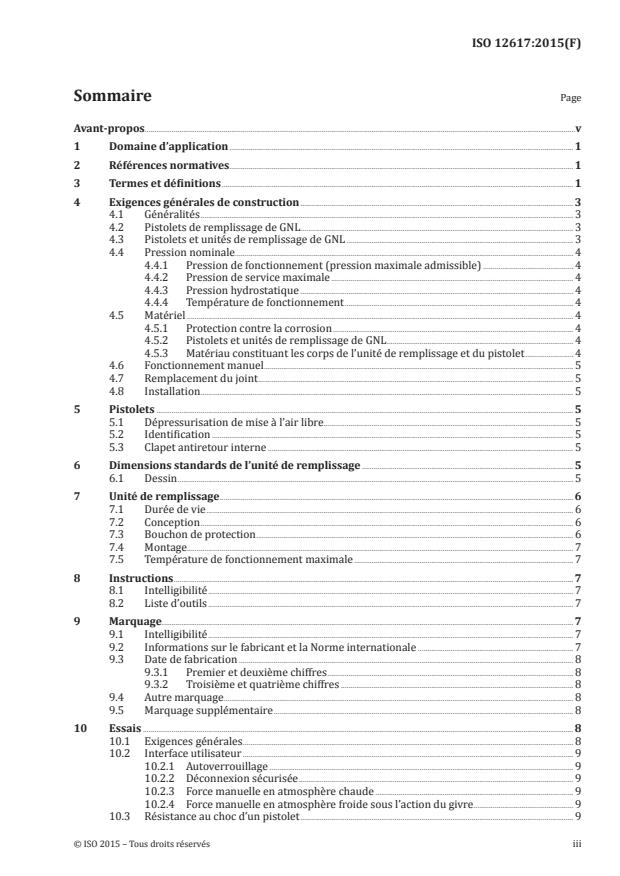
Sommaire Page
Avant-propos .v
1 Domaine d’application . 1
2 Références normatives . 1
3 Termes et définitions . 1
4 Exigences générales de construction . 3
4.1 Généralités . 3
4.2 Pistolets de remplissage de GNL . 3
4.3 Pistolets et unités de remplissage de GNL . 3
4.4 Pression nominale . 4
4.4.1 Pression de fonctionnement (pression maximale admissible) . 4
4.4.2 Pression de service maximale . 4
4.4.3 Pression hydrostatique . 4
4.4.4 Température de fonctionnement . 4
4.5 Matériel . 4
4.5.1 Protection contre la corrosion . 4
4.5.2 Pistolets et unités de remplissage de GNL . 4
4.5.3 Matériau constituant les corps de l’unité de remplissage et du pistolet . 4
4.6 Fonctionnement manuel . 5
4.7 Remplacement du joint . 5
4.8 Installation . 5
5 Pistolets . 5
5.1 Dépressurisation de mise à l’air libre. 5
5.2 Identification . 5
5.3 Clapet antiretour interne . 5
6 Dimensions standards de l’unité de remplissage . 5
6.1 Dessin . 5
7 Unité de remplissage . 6
7.1 Durée de vie . 6
7.2 Conception . 6
7.3 Bouchon de protection . 6
7.4 Montage . 7
7.5 Température de fonctionnement maximale . 7
8 Instructions . 7
8.1 Intelligibilité . 7
8.2 Liste d’outils . 7
9 Marquage . 7
9.1 Intelligibilité . 7
9.2 Informations sur le fabricant et la Norme internationale . 7
9.3 Date de fabrication . 8
9.3.1 Premier et deuxième chiffres . 8
9.3.2 Troisième et quatrième chiffres . 8
9.4 Autre marquage . 8
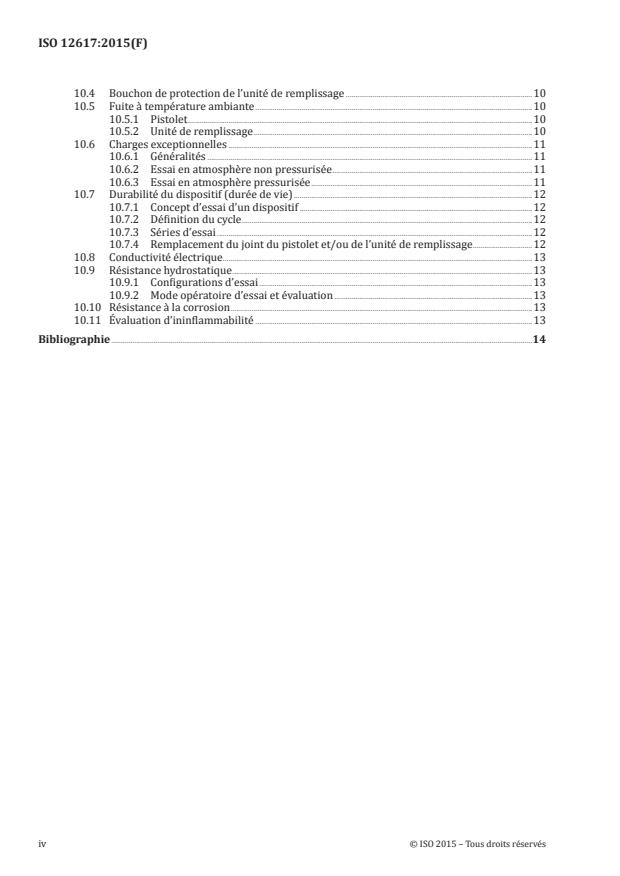
9.5 Marquage supplémentaire . 8
10 Essais . 8
10.1 Exigences générales . 8
10.2 Interface utilisateur . 9
10.2.1 Autoverrouillage . 9
10.2.2 Déconnexion sécurisée . 9
10.2.3 Force manuelle en atmosphère chaude . 9
10.2.4 Force manuelle en atmosphère froide sous l’action du givre . 9
10.3 Résistance au choc d’un pistolet . 9
10.4 Bouchon de protection de l’unité de remplissage .10
10.5 Fuite à température ambiante .10
10.5.1 Pistolet .10
10.5.2 Unité de remplissage .10
10.6 Charges exceptionnelles .11
10.6.1 Généralités .11
10.6.2 Essai en atmosphère non pressurisée .11
10.6.3 Essai en atmosphère pressurisée .11
10.7 Durabilité du dispositif (durée de vie) .12
10.7.1 Concept d’essai d’un dispositif .12
10.7.2 Définition du cycle .12
10.7.3 Séries d’essai .12
10.7.4 Remplacement du joint du pistolet et/ou de l’unité de remplissage .12
10.8 Conductivité électrique .13
10.9 Résistance hydrostatique .13
10.9.1 Configurations d’essai .13
10.9.2 Mode opératoire d’essai et évaluation .13
10.10 Résistance à la corrosion .13
10.11 Évaluation d’ininflammabilité .13
Bibliographie .14
iv © ISO 2015 – Tous droits réservés
Avant-propos
L’ISO (Organisation internationale de normalisation) est une fédération mondiale d’organismes
nationaux de normalisation (comités membres de l’ISO). L’élaboration des Normes internationales est
en général confiée aux comités techniques de l’ISO. Chaque comité membre intéressé par une étude
a le droit de faire partie du comité technique créé à cet effet. Les organisations internationales,
gouvernementales et non gouvernementales, en liaison avec l’ISO participent également aux travaux.
L’ISO collabore étroitement avec la Commission électrotechnique internationale (IEC) en ce qui
concerne la normalisation électrotechnique.
Les procédures utilisées pour élaborer le présent document et celles destinées à sa mise à jour sont
décrites dans les Directives ISO/IEC, Partie 1. Il convient, en particulier de prendre note des différents
critères d’approbation requis pour les différents types de documents ISO. Le présent document a été
rédigé conformément aux règles de rédaction données dans les Directives ISO/IEC, Partie 2 (voir www.
iso.org/directives).
L’attention est appelée sur le fait que certains des éléments du présent document peuvent faire l’objet de
droits de propriété intellectuelle ou de droits analogues. L’ISO ne saurait être tenue pour responsable
de ne pas avoir identifié de tels droits de propriété et averti de leur existence. Les détails concernant
les références aux droits de propriété intellectuelle ou autres droits analogues identifiés lors de
l’élaboration du document sont indiqués dans l’Introduction et/ou dans la liste des déclarations de
brevets reçues par l’ISO (voir www.iso.org/brevets).
Les appellations commerciales éventuellement mentionnées dans le présent document sont données
pour information, par souci de commodité, à l’intention des utilisateurs et ne sauraient constituer un
engagement.
Pour une explication de la signification des termes et expressions spécifiques de l’ISO liés à l’évaluation
de la conformité, ou pour toute information au sujet de l’adhésion de l’ISO aux principes de l’Organisation
mondiale du commerce (OMC) concernant les obstacles techniques au commerce (OTC), voir le lien
suivant: www.iso.org/iso/fr/avant-propos.html
Le comité chargé de l’élaboration du présent document est l’ISO/TC 22, Véhicules routiers, sous-comité
SC 25, Véhicules utilisant des carburants gazeux.
La version corrigée de l’ISO 12617:2015 inclut les corrections suivantes:
La Figure 1 a été corrigée et la légende de la Figure 1 a été mise à jour pour refléter les modifications.
NORME INTERNATIONALE ISO 12617:2015(F)
Véhicules routiers — Connecteur de remplissage de gaz
naturel liquéfié (GNL) — Connecteur à 3,1 MPa
1 Domaine d’application
La présente Norme internationale spécifie des pistolets et des unités de remplissage de gaz naturel
liquéfié (GNL) entièrement constitués de pièces et matériaux neufs et non usagés pour les véhicules
routiers fonctionnant au GNL. Un connecteur de remplissage de GNL comprend, le cas échéant, l’unité
de remplissage et son bouchon de protection (fixés sur le véhicule) et le pistolet. La présente Norme
internationale est applicable uniquement aux dispositifs conçus pour une pression de fonctionnement
maximale de 3,4 MPa (34 bar) et à ceux utilisant le GNL comme carburant et ayant des composants
adjacents standardisés.
NOTE Sauf indication contraire, toutes les références aux pressions exprimées en mégapascals et en bars
(1 bar = 0,1 MPa = 105 Pa; 1 MPa = 1 N/mm ) doivent être considéré comme des pressions manométriques.
2 Références normatives
Les documents ci-après, dans leur intégralité ou non, sont des références normatives indispensables à
l’application du présent document. Pour les références datées, seule l’édition citée s’applique. Pour les
références non datées, la dernière édition du document de référence s’applique (y compris les éventuels
amendements).
ISO 14469, Véhicules routiers — Connecteur de remplissage en gaz naturel comprimé (GNC)
ISO 15500-2, Véhicules routiers — Composants des systèmes de combustible gaz naturel comprimé
(GNC) — Partie 2: Performances et méthodes d’essai générales
3 Termes et définitions
Pour les besoins du présent document, les termes et définitions suivants s’appliquent.
3.1
clapet antiretour
partie de l’unité de remplissage, ou du pistolet, fixée à l’intérieur et qui empêche le reflux ou la mise à
l’air libre du carburant après avoir déconnecté le pistolet de l’unité de remplissage
3.2
durée de vie
nombre de cycles de remplissage, tel que spécifié dans la présente Norme internationale, que le
composant peut supporter sans présenter de fuite ou de dysfonctionnement
3.3
dispositif
pistolet ou unité de remplissage
3.4
air sec
air ayant un taux d’humidité tel que le point de rosée de l’air à la pression d’essai requise est au moins
11 °C en-dessous de la température d’essai ambiante
3.5
pression hydrostatique
pression à laquelle un composant est prélevé pour vérifier la résistance structurelle du composant
3.6
gaz naturel liquéfié (GNL)
liquide cryogénique produit par réduction de la température du gaz naturel à environ −162 °C à pression
atmosphérique
3.7
connecteur de remplissage de GNL
assemblage du pistolet de remplissage de GNL (3.8) et de l’unité de remplissage
Note 1 à l’article: Les deux pièces doivent être munies de clapets antiretour (3.1) à ouverture mécanique intégrés
qui sont mutuellement actionnés Le volume entre les deux clapets antiretour doit être réduit à un minimum pour
réduire le plus possible la perte de carburant pendant le processus de déconnexion.
3.8
pistolet de remplissage de GNL
dispositif (3.3) permettant de connecter et déconnecter rapidement et sans danger le tuyau
d’alimentation en carburant à/de l’unité de remplissage de GNL
3.9
unité de remplissage de GNL
dispositif (3.3) raccordé à un véhicule ou un système de stockage qui reçoit le pistolet de remplissage de
GNL (3.8) et permet un transfert sécurisé du carburant
Note 1 à l’article: L’unité de remplissage est constituée, au minimum, d’un corps d’unité de remplissage et d’un
clapet antiretour (3.1) fixé à l’intérieur du corps.
3.10
pression de service maximale
pression maximale du carburant distribué par la station de remplissage
3.11
débit nominal
débit dans le connecteur à la densité spécifiée du GNL et à la différence de pression spécifiée
3.12
poupée
pièce de fermeture amovible du clapet antiretour (3.1)
3.13
moyen d’autoverrouillage
élément nécessitant l’actionnement d’un mécanisme d’interverrouillage pour connecter/déconnecter le
pistolet à/de l’unité de remplissage
Note 1 à l’article: Il ne doit pas être possible, sauf en cas d’actionnement du mécanisme d’interverrouillage, de
procéder à une déconnexion dans des conditions non sécurisées lorsqu’un déversement non contrôlé de GNL peut
se produire et provoquer des dommages pour l’utilisateur et/ou l’environnement.
3.14
sonde
pièce du pistolet qui entre dans l’espace interne de l’unité de remplissage
3.15
pression de fonctionnement (pression maximale admissible)
pression maximale qu’un connecteur de remplissage de GNL (3.7) peut supporter dans des conditions
réelles de fonctionnement
3.16
espace de décharge de vapeur
volume mort entre le pistolet et l’unité de remplissage mesuré avec de l’eau fossile
2 © ISO 2015 – Tous droits réservés
4 Exigences générales de construction
4.1 Généralités
La présente Norme internationale a été élaborée pour être utilisée lors de l’étude, des essais et de la
certification de nouveaux pistolets et unités de remplissage de gaz naturel liquéfié (GNL) automobiles
et, à ce titre, s’applique uniquement aux pistolets et unités de remplissage utilisés dans les systèmes de
remplissage de GNL et non au système à proprement parler.
Un pistolet certifié selon la présente Norme internationale sera fonctionnellement compatible, du point
de vue de la sécurité et de la performance, avec toutes les unités de remplissage énumérées ayant un
profil et une pression système compatibles. De la même manière, une unité de remplissage certifiée
sera fonctionnellement compatible, du point de vue de la sécurité et de la performance, avec tous les
pistolets énumérés ayant un profil et une pression système compatibles.
Étant donné qu’il existe de très nombreux types de pistolets et d’unités de remplissage disponibles
auprès de différents fabricants qui, pour des raisons de sécurité, doivent tous être compatibles entre
eux, la présente Norme internationale spécifie un profil d’unité de remplissage. La sonde du pistolet
doit être conforme au profil de l’unité de remplissage. Ce profil standard inclut la spécification de
conception (dimensions de raccordement, géométrie et tolérances, et exigences relatives aux matériaux)
qui peut être prise en compte lors de la certification d’un pistolet ou d’une unité de remplissage soumis.
La présente Norme internationale fait uniquement référence à une pression de fonctionnement et une
application.
La construction et les performances des pistolets et des unités de remplissage reposent sur l’observation
selon laquelle trois principaux paramètres affectent la sécurité de l’utilisateur et la compatibilité du
système, à savoir les suivants:
a) la pression de fonctionnement;
Tous les pistolets et les unités de remplissage sont conçus pour présenter une pression de
fonctionnement de 3,4 MPa.
b) la durée de vie de conception;
La fréquence d’utilisation est le deuxième paramètre à prendre en compte. Étant donné que la
fréquence d’utilisation sera d
...