

ISO 26143:2021
(Main)Space data and information transfer systems — Space link extension (SLE) — Return operational control fields service specification
General Information
- Abstract
The purpose of this document is to define the Space Link Extension (SLE) Return Operational Control Fields (ROCF) service in conformance with the SLE Reference Model (reference [1]). The ROCF service is an SLE transfer service that delivers to a mission user all operational control fields from one master channel or one virtual channel. This document defines, in an abstract manner, the ROCF service in terms of: the operations necessary to provide the service; the parameter data associated with each operation; the behaviors that result from the invocation of each operation; and the relationship between, and the valid sequence of, the operations and resulting behaviors. It does not specify: individual implementations or products; the implementation of entities or interfaces within real systems; the methods or technologies required to acquire telemetry frames from signals received from a spacecraft; the methods or technologies required to provide a suitable environment for communications; or the management activities required to schedule, configure, and control the ROCF service. NOTE – Reference [1] defines the Return Master Channel Operational Control Field (Rtn MC-OCF) service and the Return Virtual Channel Operational Control Field (Rtn VC-OCF) service as two distinct services. Subsequent study has indicated that it is preferable to define one service that provides the functionality of both. The ROCF service defined here does just that. It is anticipated that a future issue of reference [1] will take the same approach, deleting the Rtn MC-OCF and Rtn VC-OCF services and replacing them with the Rtn OCF service.
- Status
- Published
- Publication Date
- 29-Jun-2021
- Technical Committee
- ISO/TC 20/SC 13 - Space data and information transfer systems
- Drafting Committee
- ISO/TC 20/SC 13 - Space data and information transfer systems
- Current Stage
- 9060 - Close of review
- Completion Date
- 02-Dec-2031
Buy Documents



ISO 26143:2021 - Space data and information transfer systems -- Space link extension (SLE) -- Return operational control fields service specification
ISO 26143:2021 - Space data and information transfer systems — Space link extension (SLE) — Return operational control fields service specification/30/2021
Overview
ISO 26143:2021 - Space data and information transfer systems - Space Link Extension (SLE) - Return Operational Control Fields (ROCF) service specification - defines, at an abstract level, the SLE ROCF transfer service used to deliver operational control fields from one master or virtual channel to a mission user. Published as the third edition in 2021 and based on CCSDS work, the standard specifies the service operations, parameters, provider behaviors and valid operation sequences while remaining implementation‑agnostic.
Key topics and technical requirements
- Service definition and scope: Abstract specification of the ROCF transfer service (consolidating previous Rtn MC‑OCF and Rtn VC‑OCF concepts into one service).
- Operations and parameters: Formal operations include ROCF‑BIND, ROCF‑UNBIND, ROCF‑START, ROCF‑STOP, ROCF‑TRANSFER‑DATA, ROCF‑SYNC‑NOTIFY, ROCF‑SCHEDULE‑STATUS‑REPORT, ROCF‑STATUS‑REPORT, ROCF‑GET‑PARAMETER, and ROCF‑PEER‑ABORT with associated parameters and behaviors.
- Provider behavior and protocol: State transitions and dynamic behavior of the SLE ROCF service provider are defined (state diagrams and event sequences).
- Data types and conformance: ASN.1 data type definitions (Annex A) and a conformance matrix (Annex C) guide compliant implementations.
- Communications service requirements: The underlying communications service must guarantee ordered delivery, integrity, no duplication, flow control for congestion, and notification on communication disruption.
- Production status & management: Annex B addresses production status handling; the document describes service management context but not scheduling/operations management methods.
- Security considerations: The standard includes security aspects relevant to SLE ROCF transfer.
Practical applications and users
ISO 26143:2021 is intended for organizations implementing cross‑support telemetry and ground segment interoperability. Typical users:
- Ground system architects and integrators designing SLE service providers or mission user entities.
- Mission operations teams that consume operational control fields for telemetry analysis, flight dynamics, and spacecraft monitoring.
- Software developers and vendors of ground data handling systems, SLE APIs and protocol mappings (e.g., TCP/IP mappings).
- Space agencies and cross‑support organizations seeking interoperable, vendor‑neutral standards for return link data transfer.
Practical uses include reliable transfer of spacecraft operational control field data from tracking stations to mission users, enabling multi‑agency ground station sharing, and standardizing interfaces between ground segment components.
Related standards
- SLE Reference Model (CCSDS) - framework and terminology for SLE services.
- SLE API and Internet Protocol for Transfer Services - API and TCP/IP mappings used with SLE transfer services.
- CCSDS documents and other SLE service specifications for forward and return links.
Relations
- Effective Date
- 23-Sep-2017
Buy Documents
ISO 26143:2021 - Space data and information transfer systems -- Space link extension (SLE) -- Return operational control fields service specification
ISO 26143:2021 - Space data and information transfer systems — Space link extension (SLE) — Return operational control fields service specification/30/2021
Get Certified
Connect with accredited certification bodies for this standard

BUREAU VERITAS Certification Germany
Bureau Veritas certification in Germany.

Element Materials Technology
Materials testing and product certification.

AQMS Ltd.
AQMS provides ISO certification to SMEs across the UK.
Sponsored listings
Frequently Asked Questions
ISO 26143:2021 is a standard published by the International Organization for Standardization (ISO). Its full title is "Space data and information transfer systems — Space link extension (SLE) — Return operational control fields service specification". This standard covers: The purpose of this document is to define the Space Link Extension (SLE) Return Operational Control Fields (ROCF) service in conformance with the SLE Reference Model (reference [1]). The ROCF service is an SLE transfer service that delivers to a mission user all operational control fields from one master channel or one virtual channel. This document defines, in an abstract manner, the ROCF service in terms of: the operations necessary to provide the service; the parameter data associated with each operation; the behaviors that result from the invocation of each operation; and the relationship between, and the valid sequence of, the operations and resulting behaviors. It does not specify: individual implementations or products; the implementation of entities or interfaces within real systems; the methods or technologies required to acquire telemetry frames from signals received from a spacecraft; the methods or technologies required to provide a suitable environment for communications; or the management activities required to schedule, configure, and control the ROCF service. NOTE – Reference [1] defines the Return Master Channel Operational Control Field (Rtn MC-OCF) service and the Return Virtual Channel Operational Control Field (Rtn VC-OCF) service as two distinct services. Subsequent study has indicated that it is preferable to define one service that provides the functionality of both. The ROCF service defined here does just that. It is anticipated that a future issue of reference [1] will take the same approach, deleting the Rtn MC-OCF and Rtn VC-OCF services and replacing them with the Rtn OCF service.
The purpose of this document is to define the Space Link Extension (SLE) Return Operational Control Fields (ROCF) service in conformance with the SLE Reference Model (reference [1]). The ROCF service is an SLE transfer service that delivers to a mission user all operational control fields from one master channel or one virtual channel. This document defines, in an abstract manner, the ROCF service in terms of: the operations necessary to provide the service; the parameter data associated with each operation; the behaviors that result from the invocation of each operation; and the relationship between, and the valid sequence of, the operations and resulting behaviors. It does not specify: individual implementations or products; the implementation of entities or interfaces within real systems; the methods or technologies required to acquire telemetry frames from signals received from a spacecraft; the methods or technologies required to provide a suitable environment for communications; or the management activities required to schedule, configure, and control the ROCF service. NOTE – Reference [1] defines the Return Master Channel Operational Control Field (Rtn MC-OCF) service and the Return Virtual Channel Operational Control Field (Rtn VC-OCF) service as two distinct services. Subsequent study has indicated that it is preferable to define one service that provides the functionality of both. The ROCF service defined here does just that. It is anticipated that a future issue of reference [1] will take the same approach, deleting the Rtn MC-OCF and Rtn VC-OCF services and replacing them with the Rtn OCF service.
ISO 26143:2021 is classified under the following ICS (International Classification for Standards) categories: 49.140 - Space systems and operations. The ICS classification helps identify the subject area and facilitates finding related standards.
ISO 26143:2021 has the following relationships with other standards: It is inter standard links to ISO 26143:2013. Understanding these relationships helps ensure you are using the most current and applicable version of the standard.
ISO 26143:2021 is available in PDF format for immediate download after purchase. The document can be added to your cart and obtained through the secure checkout process. Digital delivery ensures instant access to the complete standard document.
Standards Content (Sample)
INTERNATIONAL ISO
STANDARD 26143
Third edition
2021-06
Space data and information transfer
systems — Space link extension (SLE)
— Return operational control fields
service specification
Systèmes de transfert des données et informations spatiales —
Extension de liaisons spatiales (SLE) — Service des champs de
contrôle de retour opérationnel
Reference number
©
ISO 2021
© ISO 2021
All rights reserved. Unless otherwise specified, or required in the context of its implementation, no part of this publication may
be reproduced or utilized otherwise in any form or by any means, electronic or mechanical, including photocopying, or posting
on the internet or an intranet, without prior written permission. Permission can be requested from either ISO at the address
below or ISO’s member body in the country of the requester.
ISO copyright office
CP 401 • Ch. de Blandonnet 8
CH-1214 Vernier, Geneva
Phone: +41 22 749 01 11
Email: copyright@iso.org
Website: www.iso.org
Published in Switzerland
ii © ISO 2021 – All rights reserved
Foreword
ISO (the International Organization for Standardization) is a worldwide federation of national standards
bodies (ISO member bodies). The work of preparing International Standards is normally carried out
through ISO technical committees. Each member body interested in a subject for which a technical
committee has been established has the right to be represented on that committee. International
organizations, governmental and non-governmental, in liaison with ISO, also take part in the work. ISO
collaborates closely with the International Electrotechnical Commission (IEC) on all matters of
electrotechnical standardization.
The procedures used to develop this document and those intended for its further maintenance are
described in the ISO/IEC Directives, Part 1. In particular, the different approval criteria needed for the
different types of ISO documents should be noted (see www.iso.org/directives).
Attention is drawn to the possibility that some of the elements of this document may be the subject of
patent rights. ISO shall not be held responsible for identifying any or all such patent rights. Details of any
patent rights identified during the development of the document will be in the Introduction and/or on
the ISO list of patent declarations received (see www.iso.org/patents).
Any trade name used in this document is information given for the convenience of users and does not
constitute an endorsement.
For an explanation of the voluntary nature of standards, the meaning of ISO specific terms and
expressions related to conformity assessment, as well as information about ISO's adherence to the World
Trade Organization (WTO) principles in the Technical Barriers to Trade (TBT) see
www.iso.org/iso/foreword.html.
This document was prepared by the Consultative Committee for Space Data Systems (CCSDS) (as CCSDS
911.5-B-3, August 2016) and was adopted (without modifications) by Technical Committee ISO/TC 20,
Space vehicles, Subcommittee SC 13, Space data and information transfer systems.
This third edition cancels and replaces the second edition (ISO 26143:2013), which has been technically
revised.
The main changes compared to the previous edition are as follows:
— adds clarifications and corrections;
— adds production status annex.
Any feedback or questions on this document should be directed to the user’s national standards body. A
complete listing of these bodies can be found at www.iso.org/members.html.
CCSDS RECOMMENDED STANDARD FOR SLE ROCF SERVICE
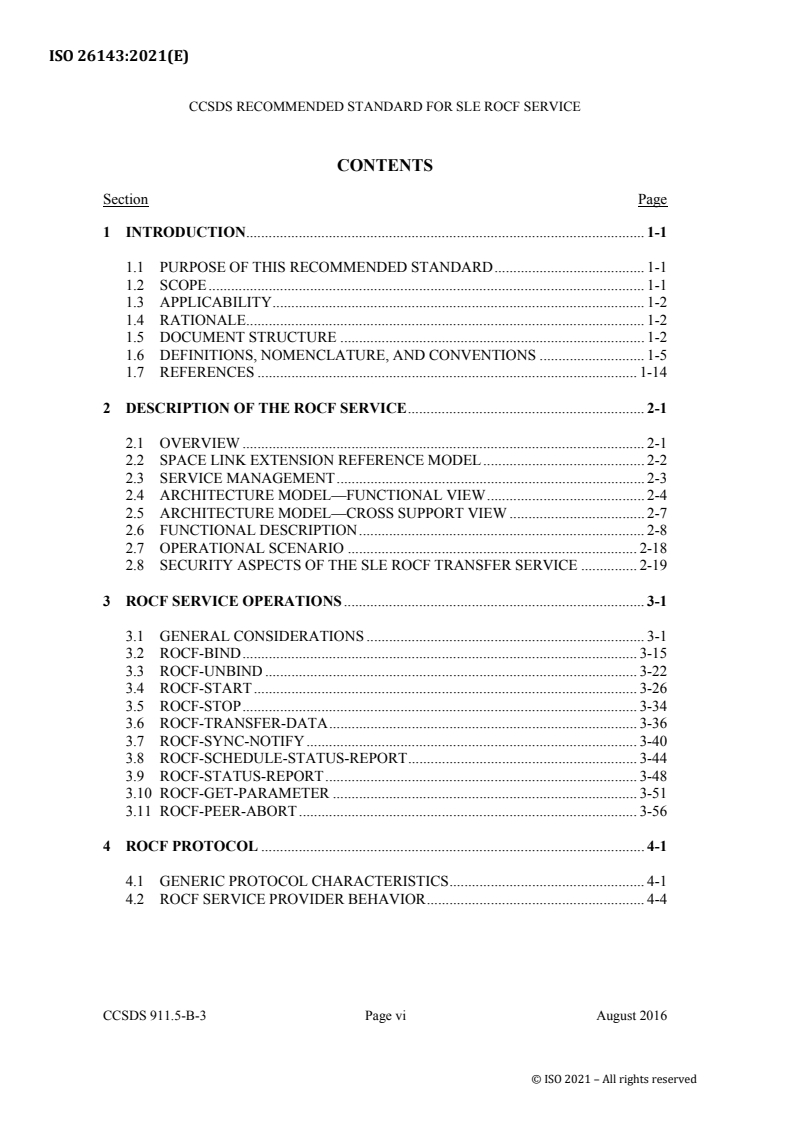
CONTENTS
Section Page
1 INTRODUCTION . 1-1
1.1 PURPOSE OF THIS RECOMMENDED STANDARD . 1-1
1.2 SCOPE . 1-1
1.3 APPLICABILITY . 1-2
1.4 RATIONALE . 1-2
1.5 DOCUMENT STRUCTURE . 1-2
1.6 DEFINITIONS, NOMENCLATURE, AND CONVENTIONS . 1-5
1.7 REFERENCES . 1-14
2 DESCRIPTION OF THE ROCF SERVICE . 2-1
2.1 OVERVIEW . 2-1
2.2 SPACE LINK EXTENSION REFERENCE MODEL . 2-2
2.3 SERVICE MANAGEMENT . 2-3
2.4 ARCHITECTURE MODEL—FUNCTIONAL VIEW . 2-4
2.5 ARCHITECTURE MODEL—CROSS SUPPORT VIEW . 2-7
2.6 FUNCTIONAL DESCRIPTION . 2-8
2.7 OPERATIONAL SCENARIO . 2-18
2.8 SECURITY ASPECTS OF THE SLE ROCF TRANSFER SERVICE . 2-19
3 ROCF SERVICE OPERATIONS . 3-1
3.1 GENERAL CONSIDERATIONS . 3-1
3.2 ROCF-BIND . 3-15
3.3 ROCF-UNBIND . 3-22
3.4 ROCF-START . 3-26
3.5 ROCF-STOP . 3-34
3.6 ROCF-TRANSFER-DATA . 3-36
3.7 ROCF-SYNC-NOTIFY . 3-40
3.8 ROCF-SCHEDULE-STATUS-REPORT . 3-44
3.9 ROCF-STATUS-REPORT . 3-48
3.10 ROCF-GET-PARAMETER . 3-51
3.11 ROCF-PEER-ABORT . 3-56
4 ROCF PROTOCOL . 4-1
4.1 GENERIC PROTOCOL CHARACTERISTICS . 4-1
4.2 ROCF SERVICE PROVIDER BEHAVIOR . 4-4
CCSDS 911.5-B-3 Page vi August 2016
CCSDS RECOMMENDED STANDARD FOR SLE ROCF SERVICE
CONTENTS (continued)
Section Page
ANNEX A DATA TYPE DEFINITIONS (NORMATIVE) . A-1
ANNEX B PRODUCTION STATUS (NORMATIVE) .B-1
ANNEX C CONFORMANCE MATRIX (NORMATIVE) . C-1
ANNEX D INDEX TO DEFINITIONS (INFORMATIVE) . D-1
ANNEX E ACRONYMS (INFORMATIVE) .E-1
ANNEX F INFORMATIVE REFERENCES (INFORMATIVE) . F-1
Figure
1-1 SLE Services Documentation . 1-4
2-1 Return Frame Processing SLE-FG . 2-4
2-2 ROCF Service Production and Provision . 2-7
2-3 Example of the Management and Provision of ROCF Service . 2-8
2-4 Simplified ROCF Service Provider State Transition Diagram . 2-11
2-5 Communications Realization of ROCF Service . 2-13
2-6 Buffers and Delivery Modes . 2-18
B-1 ROCF Production Status Transitions .B-1
Table
2-1 ROCF Operations . 2-9
3-1 Setting of ROCF Service Configuration Parameters . 3-6
3-2 ROCF-BIND Parameters . 3-16
3-3 ROCF-UNBIND Parameters . 3-23
3-4 ROCF-START Parameters . 3-27
3-5 ROCF-STOP Parameters . 3-34
3-6 ROCF-TRANSFER-DATA Parameters . 3-36
3-7 ROCF-SYNC-NOTIFY Parameters . 3-40
3-8 ROCF-SCHEDULE-STATUS-REPORT Parameters . 3-45
3-9 ROCF-STATUS-REPORT Parameters . 3-48
3-10 ROCF-GET-PARAMETER Parameters . 3-51
3-11 ROCF Parameters . 3-53
3-12 ROCF-PEER-ABORT Parameters . 3-56
4-1 Provider Behavior . 4-6
4-2 Event Description References . 4-12
4-3 Predicate Descriptions . 4-12
4-4 Boolean Flags . 4-13
4-5 Compound Action Definitions . 4-13
B-1 Production Status Changes and Notifications .B-2
B-2 Effect of Production Status on Operations .B-3
C-1 Conformance Matrix for ROCF Service (Operations) .C-1
C-2 Conformance Matrix for ROCF Service (Other Requirements) .C-2
CCSDS 911.5-B-3 Page vii August 2016
CCSDS RECOMMENDED STANDARD FOR SLE ROCF SERVICE
1 INTRODUCTION
1.1 PURPOSE OF THIS RECOMMENDED STANDARD
The purpose of this Recommended Standard is to define the Space Link Extension (SLE)
Return Operational Control Fields (ROCF) service in conformance with the SLE Reference
Model (reference [1]). The ROCF service is an SLE transfer service that delivers to a
mission user all operational control fields from one master channel or one virtual channel.
NOTE – Reference [1] defines the Return Master Channel Operational Control Field (Rtn
MC-OCF) service and the Return Virtual Channel Operational Control Field (Rtn
VC-OCF) service as two distinct services. Subsequent study has indicated that it
is preferable to define one service that provides the functionality of both. The
ROCF service defined here does just that. It is anticipated that a future issue of
reference [1] will take the same approach, deleting the Rtn MC-OCF and Rtn
VC-OCF services and replacing them with the Rtn OCF service.
1.2 SCOPE
This Recommended Standard defines, in an abstract manner, the ROCF service in terms of:
a) the operations necessary to provide the service;
b) the parameter data associated with each operation;
c) the behaviors that result from the invocation of each operation; and
d) the relationship between, and the valid sequence of, the operations and resulting
behaviors.
It does not specify:
a) individual implementations or products;
b) the implementation of entities or interfaces within real systems;
c) the methods or technologies required to acquire telemetry frames from signals
received from a spacecraft;
d) the methods or technologies required to provide a suitable environment for
communications; or
e) the management activities required to schedule, configure, and control the ROCF
service.
CCSDS 911.5-B-3 Page 1-1 August 2016
CCSDS RECOMMENDED STANDARD FOR SLE ROCF SERVICE
1.3 APPLICABILITY
1.3.1 APPLICABILITY OF THIS RECOMMENDED STANDARD
This Recommended Standard provides a basis for the development of real systems that
implement the ROCF service. Implementation of the ROCF service in a real system
additionally requires the availability of a communications service to convey invocations and
returns of ROCF service operations between ROCF service users and providers. This
Recommended Standard requires that such a communications service must ensure that
invocations and returns of operations are transferred:
a) in sequence;
b) completely and with integrity;
c) without duplication;
d) with flow control that notifies the application layer in the event of congestion; and
e) with notification to the application layer in the event that communications between
the ROCF service user and the ROCF service provider are disrupted, possibly
resulting in a loss of data.
It is the specific intent of this Recommended Standard to define the ROCF service in a
manner that is independent of any particular communications services, protocols, or
technologies.
1.3.2 LIMITS OF APPLICABILITY
This Recommended Standard specifies the ROCF service that may be provided by an SLE
Complex for inter-Agency cross support. It is neither a specification of, nor a design for, real
systems that may be implemented for the control and monitoring of existing or future
missions.
1.4 RATIONALE
The goal of this Recommended Standard is to create a standard for interoperability between
the tracking stations or ground data handling systems of various Agencies and the consumers
of spacecraft telemetry.
1.5 DOCUMENT STRUCTURE
1.5.1 ORGANIZATION
This document is organized as follows:
CCSDS 911.5-B-3 Page 1-2 August 2016
CCSDS RECOMMENDED STANDARD FOR SLE ROCF SERVICE
a) section 1 presents the purpose, scope, applicability and rationale of this
Recommended Standard and lists the definitions, conventions, and references used
throughout the Recommended Standard;
b) section 2 provides an overview of the ROCF service including a functional
description, the service management context, and protocol considerations;
c) section 3 specifies the operations of the ROCF service;
d) section 4 specifies the dynamic behavior of the ROCF service in terms of the state
transitions of the ROCF service provider;
e) annex A provides a formal specification of ROCF service data types using Abstract
Syntax Notation One (ASN.1);
f) annex B specifies the relationship of the ROCF service provision to the production
status;
g) annex C provides a conformance matrix that defines what capabilities must be
provided for an implementation to be considered compliant with this Recommended
Standard;
h) annex D lists all terms used in this Recommended Standard and identifies where they
are defined;
i) annex E lists all acronyms used within this document;
j) annex F provides a list of informative references.
1.5.2 SLE SERVICES DOCUMENTATION TREE
This Recommended Standard is based on the cross support model defined in the SLE
Reference Model (reference [1]). It expands upon the concept of an SLE transfer service as
an interaction between an SLE Mission User Entity (MUE) and an SLE transfer service
provider for the purpose of providing the ROCF transfer service.
This Recommended Standard is part of a suite of documents specifying the SLE services.
The SLE services constitute one of the three types of Cross Support Services:
a) Part 1: SLE Services;
b) Part 2: Ground Domain Services;
c) Part 3: Ground Communications Services.
The basic organization of the SLE services documentation is shown in figure 1-1. The
various documents are described in the following paragraphs.
CCSDS 911.5-B-3 Page 1-3 August 2016
CCSDS RECOMMENDED STANDARD FOR SLE ROCF SERVICE
Space Link Extension
Cross Support
Cross Support Concept SLE Executive
Reference Model
Part 1: SLE Services Summary
Part 1: SLE Services
SLE Transfer Services
Forward SLE Service
Return SLE Service
Specifications Specifications
SLE Service
Management Suite
SLE API for Internet Protocol for
Transfer Services Transfer Services
Recommended Recommended Informational
Legend:
Record (Yellow)
Standard (Blue) Practice (Magenta) Report (Green)
Figure 1-1: SLE Services Documentation
a) Cross Support Concept—Part 1: Space Link Extension Services (reference [F2]): a
Report introducing the concepts of cross support and the SLE services;
b) Cross Support Reference Model—Part 1: Space Link Extension Services
(reference [1]): a Recommended Standard that defines the framework and
terminology for the specification of SLE services;
c) SLE Return Service Specifications: a set of Recommended Standards that will
provide specification of all return link SLE services (this Recommended Standard is
one of the specifications in that set);
d) SLE Forward Service Specifications: a set of Recommended Standards that will
provide specification of all forward link SLE services;
e) SLE API for Transfer Services Specifications: a set of Recommended Practices that
provide specifications of an Application Program Interface; a set of Recommended
Standards that provide specifications of an Application Program Interface and a
mapping to TCP/IP as underlying communications service for SLE services;
f) Internet Protocol for Transfer Services: defines a protocol for transfer of SLE
Protocol Data Units using TCP/IP as underlying communications service for SLE
services;
g) SLE Service Management Specifications: a set of Recommended Standards that
establish the basis of SLE service management.
CCSDS 911.5-B-3 Page 1-4 August 2016
CCSDS RECOMMENDED STANDARD FOR SLE ROCF SERVICE
1.6 DEFINITIONS, NOMENCLATURE, AND CONVENTIONS
1.6.1 DEFINITIONS
1.6.1.1 Definitions from Open Systems Interconnection (OSI) Basic Reference Model
This Recommended Standard makes use of a number of terms defined in reference [8]. The
use of those terms in this Recommended Standard shall be understood in a generic sense, i.e.,
in the sense that those terms are generally applicable to technologies that provide for the
exchange of information between real systems. Those terms are:
a) abstract syntax;
b) application entity;
c) application layer;
d) application process;
e) flow control;
f) Open Systems Interconnection (OSI);
g) real system;
h) Service Access Point (SAP).
1.6.1.2 Definitions from Abstract Syntax Notation One
This Recommended Standard makes use of the following terms defined in reference [9]:
a) Abstract Syntax Notation One (ASN.1);
b) object identifier;
c) (data) type;
d) (data) value.
NOTE – In annex A of this Recommended Standard, ASN.1 is used for specifying the
abstract syntax of ROCF service operation invocations and returns. The use of
ASN.1 as a descriptive language is intended to support the specification of the
abstract ROCF service; it is not intended to constrain implementations. In
particular, there is no requirement for implementations to employ ASN.1
encoding rules. ASN.1 is simply a convenient tool for formally describing the
abstract syntax of ROCF service operation invocations and returns.
1.6.1.3 Definitions from TM Synchronization and Channel Coding
This Recommended Standard makes use of the following terms defined in reference [2]:
CCSDS 911.5-B-3 Page 1-5 August 2016
CCSDS RECOMMENDED STANDARD FOR SLE ROCF SERVICE
a) Attached Sync Marker;
b) Reed-Solomon check symbols;
c) Reed-Solomon code.
1.6.1.4 Definitions from TM Space Data Link Protocol
This Recommended Standard makes use of the following term defined in reference [3]:
a) Frame Error Control Field (FECF);
b) (Virtual Channel or Master Channel) Operational Control Field (OCF);
c) TM Transfer Frame.
1.6.1.5 Definitions from TC Space Data Link Protocol
This Recommended Standard makes use of the following terms defined in reference [4]:
a) Communications Link Control Word (CLCW);
b) Control Word Type.
1.6.1.6 Definitions from AOS Space Data Link Protocol
This Recommended Standard makes use of the following terms defined in reference [6]:
a) AOS Transfer Frame;
b) Frame Error Control Field (FECF);
c) (Virtual Channel or Master Channel) Operational Control Field (OCF).
1.6.1.7 Definitions from SLE Reference Model
This Recommended Standard makes use of the following terms defined in reference [1]:
a) abstract binding;
b) abstract object;
c) abstract port;
d) abstract service;
e) invoker;
f) Master Channel Operational Control Field SLE data channel (MCOCF channel)
CCSDS 911.5-B-3 Page 1-6 August 2016
CCSDS RECOMMENDED STANDARD FOR SLE ROCF SERVICE
g) Mission Data Operation System (MDOS);
h) Mission User Entity (MUE);
i) offline delivery mode;
j) online delivery mode;
k) operation;
l) performer;
m) physical channel;
n) return data;
o) Return All Frames channel (RAF channel);
p) Return All Frames service (RAF service);
q) Return Master Channel Operational Control Field service (MCOCF service);
r) Return Virtual Channel Operational Control Field service (VCOCF service);
s) service agreement;
t) service provider (provider);
u) service user (user);
v) SLE Complex;
w) SLE Complex Management;
x) SLE data channel;
y) SLE Functional Group (SLE-FG);
z) SLE Protocol Data Unit (SLE-PDU);
aa) SLE Service Data Unit (SLE-SDU);
bb) SLE service package;
cc) SLE transfer service instance;
dd) SLE transfer service production;
ee) SLE transfer service provision;
ff) SLE Utilization Management;
gg) space link;
hh) space link data channel;
CCSDS 911.5-B-3 Page 1-7 August 2016
CCSDS RECOMMENDED STANDARD FOR SLE ROCF SERVICE
ii) Space Link Data Unit (SL-DU);
jj) space link session;
kk) Virtual Channel Operational Control Field SLE data channel (VCOCF channel).
1.6.1.8 Additional Definitions
1.6.1.8.1 Association
An association is a cooperative relationship between an SLE service-providing application
entity and an SLE service-using application entity. An association is formed by the
exchange of SLE protocol data units through the use of an underlying communications
service.
1.6.1.8.2 Communications Service
A communications service is a capability that enables an SLE service-providing application
entity and an SLE service-using application entity to exchange information.
NOTE – If an SLE service user and an SLE service provider are implemented using
different communications services, then interoperability between them is possible
only by means of a suitable gateway. Adherence to this Recommended Standard
ensures, at least in principle, that it is possible to construct such a gateway.
1.6.1.8.3 Confirmed Operation
A confirmed operation is an operation that requires the performer to return a report of its
outcome to the invoker.
1.6.1.8.4 Delivery Criteria
Delivery criteria are rules that determine whether a data unit acquired from the space link by
an SLE service provider shall be delivered to a user.
NOTE – For ROCF service, the delivery criteria are:
a) the Earth Receive Time (ERT) of the frame from which the OCF is extracted
is within the period defined by the start and stop times specified in the
ROCF-START operation;
b) the spacecraft identifier (SCID) of the frame matches the SCID of the global
VCID specified in the ROCF-START operation;
c) the virtual channel identifier (VCID) of the frame matches the VCID of the
global VCID specified in the ROCF-START operation;
CCSDS 911.5-B-3 Page 1-8 August 2016
CCSDS RECOMMENDED STANDARD FOR SLE ROCF SERVICE
d) the type of the control word contained in the extracted OCF matches the type
specified in the ROCF-START operation;
e) for CLCW reports, i.e., for OCFs containing a control word of type ‘0’
(reference [4]), the telecommand virtual channel that the report refers to
matches the telecommand virtual channel specified in the ROCF-START
operation.
1.6.1.8.5 Frame Error Control Field
The Frame Error Control Field (FECF) of a frame is the FECF of a TM Transfer Frame
(reference [3]) or the FECF of an AOS Transfer Frame (reference [6]), as applicable.
1.6.1.8.6 Initiator
The initiator is the object that issues the request to bind to another object (the responder).
NOTE – In other words, the initiator is always the invoker of the request to bind to
another object. Therefore, in the context of the request to bind, the terms
‘initiator’ and ‘invoker’ refer to the same object and are synonyms.
1.6.1.8.7 Invocation
The invocation of an operation is the making of a request by an object (the invoker) to
another object (the performer) to carry out the operation.
1.6.1.8.8 Master Channel
The sequence of all telemetry frames with the same Transfer Frame Version Number
(TFVN) and the same SCID on the same physical channel constitutes a master channel.
NOTE – Depending on the TFVN, the definition of SCID is as given in either reference
[3] or reference [6].
1.6.1.8.9 Operational Control Field
The Operational Control Field (OCF) of a telemetry frame is the frame OCF of either a TM
Transfer Frame (reference [3]) or an AOS Transfer Frame (reference [6]).
CCSDS 911.5-B-3 Page 1-9 August 2016
CCSDS RECOMMENDED STANDARD FOR SLE ROCF SERVICE
1.6.1.8.10 Parameter
A parameter of an operation is data that may accompany the operation’s invocation or return.
NOTE – The term parameter is also used to refer to mission-dependent configuration
information used in the production or provision of the service.
1.6.1.8.11 Performance
The performance of an operation is the carrying out of the operation by an object (the
performer).
1.6.1.8.12 Port Identifier
A port identifier identifies a source or a destination in a communications system.
NOTE – See 2.6.4.5 for more information.
1.6.1.8.13 Responder
The responder is the object that receives a request to bind and completes the binding (if
possible) with the initiator in order for a service association to exist between the two objects.
NOTE – In other words, the responder is always the performer of the binding. Therefore,
in the context of binding, the terms ‘responder’ and ‘performer’ refer to the same
object and are synonyms.
1.6.1.8.14 Return
The return of an operation is a report, from the performer to the invoker, of the outcome of
the performance of the operation.
1.6.1.8.15 Service Instance Provision Period
A service instance provision period is the time during which a service instance (i.e., the
capability to transfer one or more SLE data channels of a given type) is scheduled to be
provided.
NOTE – Reaching of the beginning of this period constitutes the event ‘start of service
instance provision period’ (see 4.2.2).
CCSDS 911.5-B-3 Page 1-10 August 2016
CCSDS RECOMMENDED STANDARD FOR SLE ROCF SERVICE
1.6.1.8.16 Spacecraft Identifier
The spacecraft identifier (SCID) of a telemetry frame is as defined in reference [3] if the
frame is a TM Transfer Frame or as defined in reference [6] if the frame is an AOS Transfer
Frame.
1.6.1.8.17 Telemetry Frame
A (telemetry) frame is a TM Transfer Frame (as defined in reference [3]) or an AOS Transfer
Frame (as defined in reference [6]). In case a distinction of the frame versions is necessary,
the full term as per references [3] or [6] is used.
1.6.1.8.18 Transfer Frame Version Number
The Transfer Frame Version Number (TFVN) is either the TFVN as defined in reference [3]
or the TFVN as defined in reference [6].
NOTE – The definitions of TFVN given in references [3] and [6] are equivalent. If a
CCSDS-compatible telemetry frame is known to contain no errors, the TFVN
enables one to distinguish between a TM Transfer Frame and an AOS Transfer
Frame.
1.6.1.8.19 Unconfirmed Operation
An unconfirmed operation is an operation that does not require a report of its outcome to be
returned to the invoker by the performer.
1.6.1.8.20 Virtual Channel
All telemetry frames with the same TFVN, the same SCID, and the same virtual channel
identifier (VCID) on the same physical channel constitute a virtual channel.
1.6.1.8.21 Virtual Channel Identifier
The virtual channel identifier (VCID) of a telemetry frame is as defined in reference [3] if the
telemetry frame is a TM transfer frame or as defined in reference [6] if the telemetry frame is
an AOS Transfer Frame.
CCSDS 911.5-B-3 Page 1-11 August 2016
CCSDS RECOMMENDED STANDARD FOR SLE ROCF SERVICE
1.6.2 NOMENCLATURE
The following conventions apply throughout this Recommended Standard:
a) the words ‘shall’ and ‘must’ imply a binding and verifiable specification;
b) the word ‘should’ implies an optional, but desirable, specification;
c) the word ‘may’ implies an optional specification;
d) the words ‘is’, ‘are’, and ‘will’ imply statements of fact.
1.6.3 CONVENTIONS
1.6.3.1 Specification of Operations
1.6.3.1.1 General
Section 3 of this Recommended Standard specifies the operations that constitute the ROCF
service. The specification of each operation is divided into subsections as described in
1.6.3.1.2 through 1.6.3.1.4.
1.6.3.1.2 Purpose Subsection
The Purpose subsection provides a brief description of the purpose of the operation.
Additionally, it indicates whether the operation may be invoked by the user, provider, or
both; whether the operation is confirmed or unconfirmed; and whether there are any
constraints on when the operation may be invoked.
1.6.3.1.3 Invocation, Return, and Parameters Subsection
The Invocation, Return, and Parameters subsection describes the parameters associated with
each operation, including their semantics. A table accompanying the description of each
operation lists all parameters associated with the operation and, for both the invocation and
return, whether the parameter is always present, always absent, or conditionally present.
For parameters that are conditionally present, the parameter description specifies the
conditions for the presence or absence of the parameter. The condition is generally based on
the value of another parameter in the same invocation or return; for example, in the return of
an operation, the diagnostic parameter is present if and only if the value of the result
parameter is ‘negative result’. For a conditional parameter in a return, the condition may be
based on the value of a parameter in the corresponding invocation.
CCSDS 911.5-B-3 Page 1-12 August 2016
CCSDS RECOMMENDED STANDARD FOR SLE ROCF SERVICE
In the table, the following convention is used to indicate whether a parameter is always
present, always absent, or conditionally present:
M Always present
C Conditionally present
Blank Always absent
NOTE – Even though a parameter may be characterized as always present, its description
may specify that its value is permitted to be ‘null’ or ‘unused’ or the like.
1.6.3.1.4 Effects Subsection
The Effects subsection describes the effects an operation has on the invoker, the performer,
the association between them, or any combination thereof. The details of how those effects
occur or the mechanisms used are outside the scope of this Recommended Standard.
1.6.3.2 Typographic Conventions
1.6.3.2.1 Operation Names
Names of ROCF service operations appear in uppercase and begin with the characters
‘ROCF-’ (e.g., ROCF-TRANSFER-DATA).
1.6.3.2.2 Parameter Names
In the main text, names of parameters of ROCF service operations generally appear in
lowercase and are typeset in a fixed-width font (e.g., responder-port-identifier).
In annex A, the corresponding name is formed by omitting any hyphens contained in the
name and using mixed-case (e.g., responderPortIdentifier).
1.6.3.2.3 Value Names
The values of many parameters discussed in this Recommended Standard are represented by
names. In the main text, those names are shown in quotation marks (e.g., ‘no such service
instance’). The corresponding name in annex A is formed by omitting any hyphens or white
space contained in the name and using mixed-case (e.g., noSuchServiceInstance).
The actual value associated with the name is constrained by the type of the parameter taking
on that value. Parameter types are specified in annex A of this Recommended Standard.
NOTE – The name of a value does not imply anything about its type. For example, the
value ‘no such service instance’ has the appearance of a character string but
might be assigned to a parameter whose type is ‘integer’.
CCSDS 911.5-B-3 Page 1-13 August 2016
CCSDS RECOMMENDED STANDARD FOR SLE ROCF SERVICE
1.6.3.2.4 State Names
This Recommended Standard specifies the states of ROCF service providers. States may be
referred to by number (e.g., state 2) or by name. State names are always shown in quotation
marks (e.g., ‘active’).
1.6.3.2.5 SLE-PDU Names
The names of SLE-PDUs appear in mixed-case (e.g., rocfBindInvocation).
1.6.3.2.6 Data Type Definitions
Data type definitions for the ROCF service are presented in annex A in the form of a set of
ASN.1 modules. Regardless of the conventions used elsewhere in this Recommended
Standard, the text of the ASN.1 modules is typeset entirely in a fixed-width font.
1.6.3.3 Other Conventions
This Recommended Standard uses the conventions specified in reference [1].
1.7 REFERENCES
The following documents contain provisions which, through reference in this text, constitute
provisions of this Recommended Standard. At the time of publication, the editions indicated
were valid. All documents are subject to revision, and users of this Recommended Standard
are encouraged to investigate the possibility of applying the most recent editions of the
documents indicated below. The CCSDS Secretariat maintains a register of currently valid
CCSDS Recommended Standards.
NOTES
1 A list of informative references is provided in annex F.
2 This document takes advantage of the harmonized terminology introduced by
restructured documentation of the space link protocols (references [2], [3], [6], and
[7]). From an interoperability point of view, they do not introduce any
incompatibilities with respect to the original set of space link protocol documents
(references [F3], [F4], [F5], and [F6]).
[1] Cross Support Reference Model—Part 1: Space Link Extension Services. Issue 2.
Recommendation for Space Data System Standards (Blue Book), CCSDS 910.4-B-2.
Washington, D.C.: CCSDS, October 2005.
CCSDS 911.5-B-3 Page 1-14 August 2016
CCSDS RECOMMENDED STANDARD FOR SLE ROCF SERVICE
[2] TM Synchronization and Channel Coding. Issue 2. Recommendation for Space Data
System Standards (Blue Book), CCSDS 131.0-B-2. Washington, D.C.: CCSDS, August
2011.
[3] TM Space Data Link Protocol. Issue2. Recommendation for Space Data System
Standards (Blue Book), CCSDS 132.0-B-2. Washington, D.C.: CCSDS, September 2015.
[4] TC Space Data Link Protocol. Issue 3. Recommendation for Space Data System
Standards (Blue Book), CCSDS 232.0-B-3. Washington, D.C.: CCSDS, September 2015.
[5] Time Code Formats. Issue 4. Recommendation for Space Data System Standards (Blue
Book), CCSDS 301.0-B-4. Washington, D.C.: CCSDS, November 2010.
[6] AOS Space Data Link Protocol. Issue 3. Recommendation for Space Data System
Standards (Blue Book), CCSDS 732.0-B-3. Washington, D.C.: CCSDS, September
2015.
[7] Space Packet Protocol. Issue 1. Recommendation for Space Data System Standards
(Blue Book), CCSDS 133.0-B-1. Washington, D.C.: CCSDS, September 2003.
[8] Information Technology—Open Systems Interconnection—Basic Reference Model: The
Basic Model. 2nd ed. International Standard, ISO/IEC 7498-1:1994. Geneva: ISO, 1994.
[9] Information Technology—Abstract Syntax Notation One (ASN.1): Specification of
Basic Notation. 4th ed. International Standard, ISO/IEC 8824-1:2008. Geneva: ISO,
2008.
CCSDS 911.5-B-3 Page 1-15 August 2016
CCSDS RECOMMENDED STANDARD FOR SLE ROCF SERVICE
2 DESCRIPTION OF THE ROCF SERVICE
2.1 OVERVIEW
The ROCF service enables the user of the service to obtain all or a subset of the operational
control fields (OCFs) contained in the telemetry frames from one master channel or one
virtual channel. A master channel consists of all telemetry frames with the same Transfer
Frame Version Number (TFVN) and the same spacecraft identifier (SCID) on the same
physical channel. A virtual channel consists of all telemetry frames with the same TFVN,
the same SCID, and the same VCID on the same physical channel. A telemetry frame is a
TM Transfer Frame or an AOS Transfer Frame. A space link physical channel carries one
stream of telemetry frames separated by attached sync markers. A physical channel may be
comprised of one or more master channels, each of which may be comprised of one or more
virtual channels. A complete specification of these concepts is provided in references [2],
[3], and [6].
For delivery to the user, from each frame acquired from the space link the OCF is extracted
and, if it meets the delivery criteria, encapsulated in an SLE SDU that also carries annotation,
i.e., additional information such as the Earth Receive Time (ERT) of the frame. In general,
the ROCF service delivers OCFs extracted from the telemetry frames to the user in the order
in which they were received from the space link.
The operations defined in section 3 of this Recommended Standard enable an ROCF service
user to interact with an ROCF service provider to:
a) establish an association between the user and the provider;
b) receive annotated OCFs extracted from one master channel or from one virtual
channel;
c) obtain notifications and reports regarding the status, configuration and performance
of the service;
d) temporarily suspend and later re-start the delivery of OCFs from the same master
channel or any of the permitted virtual channels;
e) change the values of certain parameters that affect the behavior of the service; and
f) release an association.
In any given service instance, only one master channel, or only one VC, or a single master
channel plus a set of VCs (where the set may have a single member), is permitted. Only
OCFs from the permitted master channel or one of the permitted virtual channels are
delivered to the user at a time.
The provision of ROCF service for one master channel or one virtual channel for access by
one service user constitutes one instance of service. The provision of ROCF service for one
master channel or one virtual channel to multiple service users and the provision of ROCF
CCSDS 911.5-B-3 Page 2-1 August 2016
CCSDS RECOMMENDED STANDARD FOR SLE ROCF SERVICE
service for multiple master channels or multiple virtual channels concurrently to one or more
service users are permitted but are specified to constitute multiple service instances.
2.2 SPACE LINK EXTENSION REFERENCE MODEL
2.2.1 INTRODUCTION
The ROCF service is specified within the framework defined by the SLE Reference Model
(reference [1]). The following subsections summarize selected concepts from the SLE
Reference Model.
2.2.2 ABSTRACT OBJECT
An abstract object is a functional entity that interacts with other abstract objects. Objects are
of different types, which determine their function and behavior. Objects are characterized by
their interfaces, which are called abstract ports, and the operations that are made available
through those interfaces. One object may provide multiple abstract ports.
2.2.3 ABSTRACT SERVICE
An abstract service is the capability provided by a set of operations that an abstract object
exposes at one or more of its abstract ports.
NOTE – The concept of an abstract service is to be distinguished from the concept of an
(N)-service as defined in the OSI Basic Reference Model (reference [8]). The
definition of (N)-service is in terms of the capability provided by one layer in the
OSI architecture to the layer above it. The definition of abstract service is in
terms of the capability provided by one abstract object to another abstract object.
In a cross support scenario where one Agency is providing an SLE service to
another Agency, the object that provides the service typically is associated with
one Agency, and the object that uses the service typically is associated with the
other Agency.
2.2.4 ABSTRACT BINDING
When two abstract ports have an association established between them, they are said to be
bound. The act of establishing such an association is called abstract binding. One object (the
initiator) invokes a bind operation that is accepted (or rejected) by another object (the
responder).
CCSDS 911.5-B-3 Page 2-2 August 2016
CCSDS RECOMMENDED STANDARD FOR SLE ROCF SERVICE
2.2.5 SERVICE USER/PROVIDER
An object that offers a service to another by means of one or more of its ports is called a
service provider (provider). The other object is called a service user (user). An object may
be a provider of some services and a user of others.
The terms user and provider are used to distinguish the roles of two interacting objects. In
this Recommended Standard, when two objects are involved in provision of a service, the
object closer to the space link is considered to be the provider of the service, and the object
further from the space link is considered to be the user.
2.2.6 OPERATION
An operation is a pro
...
INTERNATIONAL ISO
STANDARD 26143
Third edition
2021-06
Space data and information transfer
systems — Space link extension (SLE)
— Return operational control fields
service specification
Systèmes de transfert des données et informations spatiales —
Extension de liaisons spatiales (SLE) — Service des champs de
contrôle de retour opérationnel
Reference number
©
ISO 2021
© ISO 2021
All rights reserved. Unless otherwise specified, or required in the context of its implementation, no part of this publication may
be reproduced or utilized otherwise in any form or by any means, electronic or mechanical, including photocopying, or posting
on the internet or an intranet, without prior written permission. Permission can be requested from either ISO at the address
below or ISO’s member body in the country of the requester.
ISO copyright office
CP 401 • Ch. de Blandonnet 8
CH-1214 Vernier, Geneva
Phone: +41 22 749 01 11
Email: copyright@iso.org
Website: www.iso.org
Published in Switzerland
ii © ISO 2021 – All rights reserved
Foreword
ISO (the International Organization for Standardization) is a worldwide federation of national standards
bodies (ISO member bodies). The work of preparing International Standards is normally carried out
through ISO technical committees. Each member body interested in a subject for which a technical
committee has been established has the right to be represented on that committee. International
organizations, governmental and non-governmental, in liaison with ISO, also take part in the work. ISO
collaborates closely with the International Electrotechnical Commission (IEC) on all matters of
electrotechnical standardization.
The procedures used to develop this document and those intended for its further maintenance are
described in the ISO/IEC Directives, Part 1. In particular, the different approval criteria needed for the
different types of ISO documents should be noted (see www.iso.org/directives).
Attention is drawn to the possibility that some of the elements of this document may be the subject of
patent rights. ISO shall not be held responsible for identifying any or all such patent rights. Details of any
patent rights identified during the development of the document will be in the Introduction and/or on
the ISO list of patent declarations received (see www.iso.org/patents).
Any trade name used in this document is information given for the convenience of users and does not
constitute an endorsement.
For an explanation of the voluntary nature of standards, the meaning of ISO specific terms and
expressions related to conformity assessment, as well as information about ISO's adherence to the World
Trade Organization (WTO) principles in the Technical Barriers to Trade (TBT) see
www.iso.org/iso/foreword.html.
This document was prepared by the Consultative Committee for Space Data Systems (CCSDS) (as CCSDS
911.5-B-3, August 2016) and was adopted (without modifications) by Technical Committee ISO/TC 20,
Space vehicles, Subcommittee SC 13, Space data and information transfer systems.
This third edition cancels and replaces the second edition (ISO 26143:2013), which has been technically
revised.
The main changes compared to the previous edition are as follows:
— adds clarifications and corrections;
— adds production status annex.
Any feedback or questions on this document should be directed to the user’s national standards body. A
complete listing of these bodies can be found at www.iso.org/members.html.
CCSDS RECOMMENDED STANDARD FOR SLE ROCF SERVICE
CONTENTS
Section Page
1 INTRODUCTION . 1-1
1.1 PURPOSE OF THIS RECOMMENDED STANDARD . 1-1
1.2 SCOPE . 1-1
1.3 APPLICABILITY . 1-2
1.4 RATIONALE . 1-2
1.5 DOCUMENT STRUCTURE . 1-2
1.6 DEFINITIONS, NOMENCLATURE, AND CONVENTIONS . 1-5
1.7 REFERENCES . 1-14
2 DESCRIPTION OF THE ROCF SERVICE . 2-1
2.1 OVERVIEW . 2-1
2.2 SPACE LINK EXTENSION REFERENCE MODEL . 2-2
2.3 SERVICE MANAGEMENT . 2-3
2.4 ARCHITECTURE MODEL—FUNCTIONAL VIEW . 2-4
2.5 ARCHITECTURE MODEL—CROSS SUPPORT VIEW . 2-7
2.6 FUNCTIONAL DESCRIPTION . 2-8
2.7 OPERATIONAL SCENARIO . 2-18
2.8 SECURITY ASPECTS OF THE SLE ROCF TRANSFER SERVICE . 2-19
3 ROCF SERVICE OPERATIONS . 3-1
3.1 GENERAL CONSIDERATIONS . 3-1
3.2 ROCF-BIND . 3-15
3.3 ROCF-UNBIND . 3-22
3.4 ROCF-START . 3-26
3.5 ROCF-STOP . 3-34
3.6 ROCF-TRANSFER-DATA . 3-36
3.7 ROCF-SYNC-NOTIFY . 3-40
3.8 ROCF-SCHEDULE-STATUS-REPORT . 3-44
3.9 ROCF-STATUS-REPORT . 3-48
3.10 ROCF-GET-PARAMETER . 3-51
3.11 ROCF-PEER-ABORT . 3-56
4 ROCF PROTOCOL . 4-1
4.1 GENERIC PROTOCOL CHARACTERISTICS . 4-1
4.2 ROCF SERVICE PROVIDER BEHAVIOR . 4-4
CCSDS 911.5-B-3 Page vi August 2016
CCSDS RECOMMENDED STANDARD FOR SLE ROCF SERVICE
CONTENTS (continued)
Section Page
ANNEX A DATA TYPE DEFINITIONS (NORMATIVE) . A-1
ANNEX B PRODUCTION STATUS (NORMATIVE) .B-1
ANNEX C CONFORMANCE MATRIX (NORMATIVE) . C-1
ANNEX D INDEX TO DEFINITIONS (INFORMATIVE) . D-1
ANNEX E ACRONYMS (INFORMATIVE) .E-1
ANNEX F INFORMATIVE REFERENCES (INFORMATIVE) . F-1
Figure
1-1 SLE Services Documentation . 1-4
2-1 Return Frame Processing SLE-FG . 2-4
2-2 ROCF Service Production and Provision . 2-7
2-3 Example of the Management and Provision of ROCF Service . 2-8
2-4 Simplified ROCF Service Provider State Transition Diagram . 2-11
2-5 Communications Realization of ROCF Service . 2-13
2-6 Buffers and Delivery Modes . 2-18
B-1 ROCF Production Status Transitions .B-1
Table
2-1 ROCF Operations . 2-9
3-1 Setting of ROCF Service Configuration Parameters . 3-6
3-2 ROCF-BIND Parameters . 3-16
3-3 ROCF-UNBIND Parameters . 3-23
3-4 ROCF-START Parameters . 3-27
3-5 ROCF-STOP Parameters . 3-34
3-6 ROCF-TRANSFER-DATA Parameters . 3-36
3-7 ROCF-SYNC-NOTIFY Parameters . 3-40
3-8 ROCF-SCHEDULE-STATUS-REPORT Parameters . 3-45
3-9 ROCF-STATUS-REPORT Parameters . 3-48
3-10 ROCF-GET-PARAMETER Parameters . 3-51
3-11 ROCF Parameters . 3-53
3-12 ROCF-PEER-ABORT Parameters . 3-56
4-1 Provider Behavior . 4-6
4-2 Event Description References . 4-12
4-3 Predicate Descriptions . 4-12
4-4 Boolean Flags . 4-13
4-5 Compound Action Definitions . 4-13
B-1 Production Status Changes and Notifications .B-2
B-2 Effect of Production Status on Operations .B-3
C-1 Conformance Matrix for ROCF Service (Operations) .C-1
C-2 Conformance Matrix for ROCF Service (Other Requirements) .C-2
CCSDS 911.5-B-3 Page vii August 2016
CCSDS RECOMMENDED STANDARD FOR SLE ROCF SERVICE
1 INTRODUCTION
1.1 PURPOSE OF THIS RECOMMENDED STANDARD
The purpose of this Recommended Standard is to define the Space Link Extension (SLE)
Return Operational Control Fields (ROCF) service in conformance with the SLE Reference
Model (reference [1]). The ROCF service is an SLE transfer service that delivers to a
mission user all operational control fields from one master channel or one virtual channel.
NOTE – Reference [1] defines the Return Master Channel Operational Control Field (Rtn
MC-OCF) service and the Return Virtual Channel Operational Control Field (Rtn
VC-OCF) service as two distinct services. Subsequent study has indicated that it
is preferable to define one service that provides the functionality of both. The
ROCF service defined here does just that. It is anticipated that a future issue of
reference [1] will take the same approach, deleting the Rtn MC-OCF and Rtn
VC-OCF services and replacing them with the Rtn OCF service.
1.2 SCOPE
This Recommended Standard defines, in an abstract manner, the ROCF service in terms of:
a) the operations necessary to provide the service;
b) the parameter data associated with each operation;
c) the behaviors that result from the invocation of each operation; and
d) the relationship between, and the valid sequence of, the operations and resulting
behaviors.
It does not specify:
a) individual implementations or products;
b) the implementation of entities or interfaces within real systems;
c) the methods or technologies required to acquire telemetry frames from signals
received from a spacecraft;
d) the methods or technologies required to provide a suitable environment for
communications; or
e) the management activities required to schedule, configure, and control the ROCF
service.
CCSDS 911.5-B-3 Page 1-1 August 2016
CCSDS RECOMMENDED STANDARD FOR SLE ROCF SERVICE
1.3 APPLICABILITY
1.3.1 APPLICABILITY OF THIS RECOMMENDED STANDARD
This Recommended Standard provides a basis for the development of real systems that
implement the ROCF service. Implementation of the ROCF service in a real system
additionally requires the availability of a communications service to convey invocations and
returns of ROCF service operations between ROCF service users and providers. This
Recommended Standard requires that such a communications service must ensure that
invocations and returns of operations are transferred:
a) in sequence;
b) completely and with integrity;
c) without duplication;
d) with flow control that notifies the application layer in the event of congestion; and
e) with notification to the application layer in the event that communications between
the ROCF service user and the ROCF service provider are disrupted, possibly
resulting in a loss of data.
It is the specific intent of this Recommended Standard to define the ROCF service in a
manner that is independent of any particular communications services, protocols, or
technologies.
1.3.2 LIMITS OF APPLICABILITY
This Recommended Standard specifies the ROCF service that may be provided by an SLE
Complex for inter-Agency cross support. It is neither a specification of, nor a design for, real
systems that may be implemented for the control and monitoring of existing or future
missions.
1.4 RATIONALE
The goal of this Recommended Standard is to create a standard for interoperability between
the tracking stations or ground data handling systems of various Agencies and the consumers
of spacecraft telemetry.
1.5 DOCUMENT STRUCTURE
1.5.1 ORGANIZATION
This document is organized as follows:
CCSDS 911.5-B-3 Page 1-2 August 2016
CCSDS RECOMMENDED STANDARD FOR SLE ROCF SERVICE
a) section 1 presents the purpose, scope, applicability and rationale of this
Recommended Standard and lists the definitions, conventions, and references used
throughout the Recommended Standard;
b) section 2 provides an overview of the ROCF service including a functional
description, the service management context, and protocol considerations;
c) section 3 specifies the operations of the ROCF service;
d) section 4 specifies the dynamic behavior of the ROCF service in terms of the state
transitions of the ROCF service provider;
e) annex A provides a formal specification of ROCF service data types using Abstract
Syntax Notation One (ASN.1);
f) annex B specifies the relationship of the ROCF service provision to the production
status;
g) annex C provides a conformance matrix that defines what capabilities must be
provided for an implementation to be considered compliant with this Recommended
Standard;
h) annex D lists all terms used in this Recommended Standard and identifies where they
are defined;
i) annex E lists all acronyms used within this document;
j) annex F provides a list of informative references.
1.5.2 SLE SERVICES DOCUMENTATION TREE
This Recommended Standard is based on the cross support model defined in the SLE
Reference Model (reference [1]). It expands upon the concept of an SLE transfer service as
an interaction between an SLE Mission User Entity (MUE) and an SLE transfer service
provider for the purpose of providing the ROCF transfer service.
This Recommended Standard is part of a suite of documents specifying the SLE services.
The SLE services constitute one of the three types of Cross Support Services:
a) Part 1: SLE Services;
b) Part 2: Ground Domain Services;
c) Part 3: Ground Communications Services.
The basic organization of the SLE services documentation is shown in figure 1-1. The
various documents are described in the following paragraphs.
CCSDS 911.5-B-3 Page 1-3 August 2016
CCSDS RECOMMENDED STANDARD FOR SLE ROCF SERVICE
Space Link Extension
Cross Support
Cross Support Concept SLE Executive
Reference Model
Part 1: SLE Services Summary
Part 1: SLE Services
SLE Transfer Services
Forward SLE Service
Return SLE Service
Specifications Specifications
SLE Service
Management Suite
SLE API for Internet Protocol for
Transfer Services Transfer Services
Recommended Recommended Informational
Legend:
Record (Yellow)
Standard (Blue) Practice (Magenta) Report (Green)
Figure 1-1: SLE Services Documentation
a) Cross Support Concept—Part 1: Space Link Extension Services (reference [F2]): a
Report introducing the concepts of cross support and the SLE services;
b) Cross Support Reference Model—Part 1: Space Link Extension Services
(reference [1]): a Recommended Standard that defines the framework and
terminology for the specification of SLE services;
c) SLE Return Service Specifications: a set of Recommended Standards that will
provide specification of all return link SLE services (this Recommended Standard is
one of the specifications in that set);
d) SLE Forward Service Specifications: a set of Recommended Standards that will
provide specification of all forward link SLE services;
e) SLE API for Transfer Services Specifications: a set of Recommended Practices that
provide specifications of an Application Program Interface; a set of Recommended
Standards that provide specifications of an Application Program Interface and a
mapping to TCP/IP as underlying communications service for SLE services;
f) Internet Protocol for Transfer Services: defines a protocol for transfer of SLE
Protocol Data Units using TCP/IP as underlying communications service for SLE
services;
g) SLE Service Management Specifications: a set of Recommended Standards that
establish the basis of SLE service management.
CCSDS 911.5-B-3 Page 1-4 August 2016
CCSDS RECOMMENDED STANDARD FOR SLE ROCF SERVICE
1.6 DEFINITIONS, NOMENCLATURE, AND CONVENTIONS
1.6.1 DEFINITIONS
1.6.1.1 Definitions from Open Systems Interconnection (OSI) Basic Reference Model
This Recommended Standard makes use of a number of terms defined in reference [8]. The
use of those terms in this Recommended Standard shall be understood in a generic sense, i.e.,
in the sense that those terms are generally applicable to technologies that provide for the
exchange of information between real systems. Those terms are:
a) abstract syntax;
b) application entity;
c) application layer;
d) application process;
e) flow control;
f) Open Systems Interconnection (OSI);
g) real system;
h) Service Access Point (SAP).
1.6.1.2 Definitions from Abstract Syntax Notation One
This Recommended Standard makes use of the following terms defined in reference [9]:
a) Abstract Syntax Notation One (ASN.1);
b) object identifier;
c) (data) type;
d) (data) value.
NOTE – In annex A of this Recommended Standard, ASN.1 is used for specifying the
abstract syntax of ROCF service operation invocations and returns. The use of
ASN.1 as a descriptive language is intended to support the specification of the
abstract ROCF service; it is not intended to constrain implementations. In
particular, there is no requirement for implementations to employ ASN.1
encoding rules. ASN.1 is simply a convenient tool for formally describing the
abstract syntax of ROCF service operation invocations and returns.
1.6.1.3 Definitions from TM Synchronization and Channel Coding
This Recommended Standard makes use of the following terms defined in reference [2]:
CCSDS 911.5-B-3 Page 1-5 August 2016
CCSDS RECOMMENDED STANDARD FOR SLE ROCF SERVICE
a) Attached Sync Marker;
b) Reed-Solomon check symbols;
c) Reed-Solomon code.
1.6.1.4 Definitions from TM Space Data Link Protocol
This Recommended Standard makes use of the following term defined in reference [3]:
a) Frame Error Control Field (FECF);
b) (Virtual Channel or Master Channel) Operational Control Field (OCF);
c) TM Transfer Frame.
1.6.1.5 Definitions from TC Space Data Link Protocol
This Recommended Standard makes use of the following terms defined in reference [4]:
a) Communications Link Control Word (CLCW);
b) Control Word Type.
1.6.1.6 Definitions from AOS Space Data Link Protocol
This Recommended Standard makes use of the following terms defined in reference [6]:
a) AOS Transfer Frame;
b) Frame Error Control Field (FECF);
c) (Virtual Channel or Master Channel) Operational Control Field (OCF).
1.6.1.7 Definitions from SLE Reference Model
This Recommended Standard makes use of the following terms defined in reference [1]:
a) abstract binding;
b) abstract object;
c) abstract port;
d) abstract service;
e) invoker;
f) Master Channel Operational Control Field SLE data channel (MCOCF channel)
CCSDS 911.5-B-3 Page 1-6 August 2016
CCSDS RECOMMENDED STANDARD FOR SLE ROCF SERVICE
g) Mission Data Operation System (MDOS);
h) Mission User Entity (MUE);
i) offline delivery mode;
j) online delivery mode;
k) operation;
l) performer;
m) physical channel;
n) return data;
o) Return All Frames channel (RAF channel);
p) Return All Frames service (RAF service);
q) Return Master Channel Operational Control Field service (MCOCF service);
r) Return Virtual Channel Operational Control Field service (VCOCF service);
s) service agreement;
t) service provider (provider);
u) service user (user);
v) SLE Complex;
w) SLE Complex Management;
x) SLE data channel;
y) SLE Functional Group (SLE-FG);
z) SLE Protocol Data Unit (SLE-PDU);
aa) SLE Service Data Unit (SLE-SDU);
bb) SLE service package;
cc) SLE transfer service instance;
dd) SLE transfer service production;
ee) SLE transfer service provision;
ff) SLE Utilization Management;
gg) space link;
hh) space link data channel;
CCSDS 911.5-B-3 Page 1-7 August 2016
CCSDS RECOMMENDED STANDARD FOR SLE ROCF SERVICE
ii) Space Link Data Unit (SL-DU);
jj) space link session;
kk) Virtual Channel Operational Control Field SLE data channel (VCOCF channel).
1.6.1.8 Additional Definitions
1.6.1.8.1 Association
An association is a cooperative relationship between an SLE service-providing application
entity and an SLE service-using application entity. An association is formed by the
exchange of SLE protocol data units through the use of an underlying communications
service.
1.6.1.8.2 Communications Service
A communications service is a capability that enables an SLE service-providing application
entity and an SLE service-using application entity to exchange information.
NOTE – If an SLE service user and an SLE service provider are implemented using
different communications services, then interoperability between them is possible
only by means of a suitable gateway. Adherence to this Recommended Standard
ensures, at least in principle, that it is possible to construct such a gateway.
1.6.1.8.3 Confirmed Operation
A confirmed operation is an operation that requires the performer to return a report of its
outcome to the invoker.
1.6.1.8.4 Delivery Criteria
Delivery criteria are rules that determine whether a data unit acquired from the space link by
an SLE service provider shall be delivered to a user.
NOTE – For ROCF service, the delivery criteria are:
a) the Earth Receive Time (ERT) of the frame from which the OCF is extracted
is within the period defined by the start and stop times specified in the
ROCF-START operation;
b) the spacecraft identifier (SCID) of the frame matches the SCID of the global
VCID specified in the ROCF-START operation;
c) the virtual channel identifier (VCID) of the frame matches the VCID of the
global VCID specified in the ROCF-START operation;
CCSDS 911.5-B-3 Page 1-8 August 2016
CCSDS RECOMMENDED STANDARD FOR SLE ROCF SERVICE
d) the type of the control word contained in the extracted OCF matches the type
specified in the ROCF-START operation;
e) for CLCW reports, i.e., for OCFs containing a control word of type ‘0’
(reference [4]), the telecommand virtual channel that the report refers to
matches the telecommand virtual channel specified in the ROCF-START
operation.
1.6.1.8.5 Frame Error Control Field
The Frame Error Control Field (FECF) of a frame is the FECF of a TM Transfer Frame
(reference [3]) or the FECF of an AOS Transfer Frame (reference [6]), as applicable.
1.6.1.8.6 Initiator
The initiator is the object that issues the request to bind to another object (the responder).
NOTE – In other words, the initiator is always the invoker of the request to bind to
another object. Therefore, in the context of the request to bind, the terms
‘initiator’ and ‘invoker’ refer to the same object and are synonyms.
1.6.1.8.7 Invocation
The invocation of an operation is the making of a request by an object (the invoker) to
another object (the performer) to carry out the operation.
1.6.1.8.8 Master Channel
The sequence of all telemetry frames with the same Transfer Frame Version Number
(TFVN) and the same SCID on the same physical channel constitutes a master channel.
NOTE – Depending on the TFVN, the definition of SCID is as given in either reference
[3] or reference [6].
1.6.1.8.9 Operational Control Field
The Operational Control Field (OCF) of a telemetry frame is the frame OCF of either a TM
Transfer Frame (reference [3]) or an AOS Transfer Frame (reference [6]).
CCSDS 911.5-B-3 Page 1-9 August 2016
CCSDS RECOMMENDED STANDARD FOR SLE ROCF SERVICE
1.6.1.8.10 Parameter
A parameter of an operation is data that may accompany the operation’s invocation or return.
NOTE – The term parameter is also used to refer to mission-dependent configuration
information used in the production or provision of the service.
1.6.1.8.11 Performance
The performance of an operation is the carrying out of the operation by an object (the
performer).
1.6.1.8.12 Port Identifier
A port identifier identifies a source or a destination in a communications system.
NOTE – See 2.6.4.5 for more information.
1.6.1.8.13 Responder
The responder is the object that receives a request to bind and completes the binding (if
possible) with the initiator in order for a service association to exist between the two objects.
NOTE – In other words, the responder is always the performer of the binding. Therefore,
in the context of binding, the terms ‘responder’ and ‘performer’ refer to the same
object and are synonyms.
1.6.1.8.14 Return
The return of an operation is a report, from the performer to the invoker, of the outcome of
the performance of the operation.
1.6.1.8.15 Service Instance Provision Period
A service instance provision period is the time during which a service instance (i.e., the
capability to transfer one or more SLE data channels of a given type) is scheduled to be
provided.
NOTE – Reaching of the beginning of this period constitutes the event ‘start of service
instance provision period’ (see 4.2.2).
CCSDS 911.5-B-3 Page 1-10 August 2016
CCSDS RECOMMENDED STANDARD FOR SLE ROCF SERVICE
1.6.1.8.16 Spacecraft Identifier
The spacecraft identifier (SCID) of a telemetry frame is as defined in reference [3] if the
frame is a TM Transfer Frame or as defined in reference [6] if the frame is an AOS Transfer
Frame.
1.6.1.8.17 Telemetry Frame
A (telemetry) frame is a TM Transfer Frame (as defined in reference [3]) or an AOS Transfer
Frame (as defined in reference [6]). In case a distinction of the frame versions is necessary,
the full term as per references [3] or [6] is used.
1.6.1.8.18 Transfer Frame Version Number
The Transfer Frame Version Number (TFVN) is either the TFVN as defined in reference [3]
or the TFVN as defined in reference [6].
NOTE – The definitions of TFVN given in references [3] and [6] are equivalent. If a
CCSDS-compatible telemetry frame is known to contain no errors, the TFVN
enables one to distinguish between a TM Transfer Frame and an AOS Transfer
Frame.
1.6.1.8.19 Unconfirmed Operation
An unconfirmed operation is an operation that does not require a report of its outcome to be
returned to the invoker by the performer.
1.6.1.8.20 Virtual Channel
All telemetry frames with the same TFVN, the same SCID, and the same virtual channel
identifier (VCID) on the same physical channel constitute a virtual channel.
1.6.1.8.21 Virtual Channel Identifier
The virtual channel identifier (VCID) of a telemetry frame is as defined in reference [3] if the
telemetry frame is a TM transfer frame or as defined in reference [6] if the telemetry frame is
an AOS Transfer Frame.
CCSDS 911.5-B-3 Page 1-11 August 2016
CCSDS RECOMMENDED STANDARD FOR SLE ROCF SERVICE
1.6.2 NOMENCLATURE
The following conventions apply throughout this Recommended Standard:
a) the words ‘shall’ and ‘must’ imply a binding and verifiable specification;
b) the word ‘should’ implies an optional, but desirable, specification;
c) the word ‘may’ implies an optional specification;
d) the words ‘is’, ‘are’, and ‘will’ imply statements of fact.
1.6.3 CONVENTIONS
1.6.3.1 Specification of Operations
1.6.3.1.1 General
Section 3 of this Recommended Standard specifies the operations that constitute the ROCF
service. The specification of each operation is divided into subsections as described in
1.6.3.1.2 through 1.6.3.1.4.
1.6.3.1.2 Purpose Subsection
The Purpose subsection provides a brief description of the purpose of the operation.
Additionally, it indicates whether the operation may be invoked by the user, provider, or
both; whether the operation is confirmed or unconfirmed; and whether there are any
constraints on when the operation may be invoked.
1.6.3.1.3 Invocation, Return, and Parameters Subsection
The Invocation, Return, and Parameters subsection describes the parameters associated with
each operation, including their semantics. A table accompanying the description of each
operation lists all parameters associated with the operation and, for both the invocation and
return, whether the parameter is always present, always absent, or conditionally present.
For parameters that are conditionally present, the parameter description specifies the
conditions for the presence or absence of the parameter. The condition is generally based on
the value of another parameter in the same invocation or return; for example, in the return of
an operation, the diagnostic parameter is present if and only if the value of the result
parameter is ‘negative result’. For a conditional parameter in a return, the condition may be
based on the value of a parameter in the corresponding invocation.
CCSDS 911.5-B-3 Page 1-12 August 2016
CCSDS RECOMMENDED STANDARD FOR SLE ROCF SERVICE
In the table, the following convention is used to indicate whether a parameter is always
present, always absent, or conditionally present:
M Always present
C Conditionally present
Blank Always absent
NOTE – Even though a parameter may be characterized as always present, its description
may specify that its value is permitted to be ‘null’ or ‘unused’ or the like.
1.6.3.1.4 Effects Subsection
The Effects subsection describes the effects an operation has on the invoker, the performer,
the association between them, or any combination thereof. The details of how those effects
occur or the mechanisms used are outside the scope of this Recommended Standard.
1.6.3.2 Typographic Conventions
1.6.3.2.1 Operation Names
Names of ROCF service operations appear in uppercase and begin with the characters
‘ROCF-’ (e.g., ROCF-TRANSFER-DATA).
1.6.3.2.2 Parameter Names
In the main text, names of parameters of ROCF service operations generally appear in
lowercase and are typeset in a fixed-width font (e.g., responder-port-identifier).
In annex A, the corresponding name is formed by omitting any hyphens contained in the
name and using mixed-case (e.g., responderPortIdentifier).
1.6.3.2.3 Value Names
The values of many parameters discussed in this Recommended Standard are represented by
names. In the main text, those names are shown in quotation marks (e.g., ‘no such service
instance’). The corresponding name in annex A is formed by omitting any hyphens or white
space contained in the name and using mixed-case (e.g., noSuchServiceInstance).
The actual value associated with the name is constrained by the type of the parameter taking
on that value. Parameter types are specified in annex A of this Recommended Standard.
NOTE – The name of a value does not imply anything about its type. For example, the
value ‘no such service instance’ has the appearance of a character string but
might be assigned to a parameter whose type is ‘integer’.
CCSDS 911.5-B-3 Page 1-13 August 2016
CCSDS RECOMMENDED STANDARD FOR SLE ROCF SERVICE
1.6.3.2.4 State Names
This Recommended Standard specifies the states of ROCF service providers. States may be
referred to by number (e.g., state 2) or by name. State names are always shown in quotation
marks (e.g., ‘active’).
1.6.3.2.5 SLE-PDU Names
The names of SLE-PDUs appear in mixed-case (e.g., rocfBindInvocation).
1.6.3.2.6 Data Type Definitions
Data type definitions for the ROCF service are presented in annex A in the form of a set of
ASN.1 modules. Regardless of the conventions used elsewhere in this Recommended
Standard, the text of the ASN.1 modules is typeset entirely in a fixed-width font.
1.6.3.3 Other Conventions
This Recommended Standard uses the conventions specified in reference [1].
1.7 REFERENCES
The following documents contain provisions which, through reference in this text, constitute
provisions of this Recommended Standard. At the time of publication, the editions indicated
were valid. All documents are subject to revision, and users of this Recommended Standard
are encouraged to investigate the possibility of applying the most recent editions of the
documents indicated below. The CCSDS Secretariat maintains a register of currently valid
CCSDS Recommended Standards.
NOTES
1 A list of informative references is provided in annex F.
2 This document takes advantage of the harmonized terminology introduced by
restructured documentation of the space link protocols (references [2], [3], [6], and
[7]). From an interoperability point of view, they do not introduce any
incompatibilities with respect to the original set of space link protocol documents
(references [F3], [F4], [F5], and [F6]).
[1] Cross Support Reference Model—Part 1: Space Link Extension Services. Issue 2.
Recommendation for Space Data System Standards (Blue Book), CCSDS 910.4-B-2.
Washington, D.C.: CCSDS, October 2005.
CCSDS 911.5-B-3 Page 1-14 August 2016
CCSDS RECOMMENDED STANDARD FOR SLE ROCF SERVICE
[2] TM Synchronization and Channel Coding. Issue 2. Recommendation for Space Data
System Standards (Blue Book), CCSDS 131.0-B-2. Washington, D.C.: CCSDS, August
2011.
[3] TM Space Data Link Protocol. Issue2. Recommendation for Space Data System
Standards (Blue Book), CCSDS 132.0-B-2. Washington, D.C.: CCSDS, September 2015.
[4] TC Space Data Link Protocol. Issue 3. Recommendation for Space Data System
Standards (Blue Book), CCSDS 232.0-B-3. Washington, D.C.: CCSDS, September 2015.
[5] Time Code Formats. Issue 4. Recommendation for Space Data System Standards (Blue
Book), CCSDS 301.0-B-4. Washington, D.C.: CCSDS, November 2010.
[6] AOS Space Data Link Protocol. Issue 3. Recommendation for Space Data System
Standards (Blue Book), CCSDS 732.0-B-3. Washington, D.C.: CCSDS, September
2015.
[7] Space Packet Protocol. Issue 1. Recommendation for Space Data System Standards
(Blue Book), CCSDS 133.0-B-1. Washington, D.C.: CCSDS, September 2003.
[8] Information Technology—Open Systems Interconnection—Basic Reference Model: The
Basic Model. 2nd ed. International Standard, ISO/IEC 7498-1:1994. Geneva: ISO, 1994.
[9] Information Technology—Abstract Syntax Notation One (ASN.1): Specification of
Basic Notation. 4th ed. International Standard, ISO/IEC 8824-1:2008. Geneva: ISO,
2008.
CCSDS 911.5-B-3 Page 1-15 August 2016
CCSDS RECOMMENDED STANDARD FOR SLE ROCF SERVICE
2 DESCRIPTION OF THE ROCF SERVICE
2.1 OVERVIEW
The ROCF service enables the user of the service to obtain all or a subset of the operational
control fields (OCFs) contained in the telemetry frames from one master channel or one
virtual channel. A master channel consists of all telemetry frames with the same Transfer
Frame Version Number (TFVN) and the same spacecraft identifier (SCID) on the same
physical channel. A virtual channel consists of all telemetry frames with the same TFVN,
the same SCID, and the same VCID on the same physical channel. A telemetry frame is a
TM Transfer Frame or an AOS Transfer Frame. A space link physical channel carries one
stream of telemetry frames separated by attached sync markers. A physical channel may be
comprised of one or more master channels, each of which may be comprised of one or more
virtual channels. A complete specification of these concepts is provided in references [2],
[3], and [6].
For delivery to the user, from each frame acquired from the space link the OCF is extracted
and, if it meets the delivery criteria, encapsulated in an SLE SDU that also carries annotation,
i.e., additional information such as the Earth Receive Time (ERT) of the frame. In general,
the ROCF service delivers OCFs extracted from the telemetry frames to the user in the order
in which they were received from the space link.
The operations defined in section 3 of this Recommended Standard enable an ROCF service
user to interact with an ROCF service provider to:
a) establish an association between the user and the provider;
b) receive annotated OCFs extracted from one master channel or from one virtual
channel;
c) obtain notifications and reports regarding the status, configuration and performance
of the service;
d) temporarily suspend and later re-start the delivery of OCFs from the same master
channel or any of the permitted virtual channels;
e) change the values of certain parameters that affect the behavior of the service; and
f) release an association.
In any given service instance, only one master channel, or only one VC, or a single master
channel plus a set of VCs (where the set may have a single member), is permitted. Only
OCFs from the permitted master channel or one of the permitted virtual channels are
delivered to the user at a time.
The provision of ROCF service for one master channel or one virtual channel for access by
one service user constitutes one instance of service. The provision of ROCF service for one
master channel or one virtual channel to multiple service users and the provision of ROCF
CCSDS 911.5-B-3 Page 2-1 August 2016
CCSDS RECOMMENDED STANDARD FOR SLE ROCF SERVICE
service for multiple master channels or multiple virtual channels concurrently to one or more
service users are permitted but are specified to constitute multiple service instances.
2.2 SPACE LINK EXTENSION REFERENCE MODEL
2.2.1 INTRODUCTION
The ROCF service is specified within the framework defined by the SLE Reference Model
(reference [1]). The following subsections summarize selected concepts from the SLE
Reference Model.
2.2.2 ABSTRACT OBJECT
An abstract object is a functional entity that interacts with other abstract objects. Objects are
of different types, which determine their function and behavior. Objects are characterized by
their interfaces, which are called abstract ports, and the operations that are made available
through those interfaces. One object may provide multiple abstract ports.
2.2.3 ABSTRACT SERVICE
An abstract service is the capability provided by a set of operations that an abstract object
exposes at one or more of its abstract ports.
NOTE – The concept of an abstract service is to be distinguished from the concept of an
(N)-service as defined in the OSI Basic Reference Model (reference [8]). The
definition of (N)-service is in terms of the capability provided by one layer in the
OSI architecture to the layer above it. The definition of abstract service is in
terms of the capability provided by one abstract object to another abstract object.
In a cross support scenario where one Agency is providing an SLE service to
another Agency, the object that provides the service typically is associated with
one Agency, and the object that uses the service typically is associated with the
other Agency.
2.2.4 ABSTRACT BINDING
When two abstract ports have an association established between them, they are said to be
bound. The act of establishing such an association is called abstract binding. One object (the
initiator) invokes a bind operation that is accepted (or rejected) by another object (the
responder).
CCSDS 911.5-B-3 Page 2-2 August 2016
CCSDS RECOMMENDED STANDARD FOR SLE ROCF SERVICE
2.2.5 SERVICE USER/PROVIDER
An object that offers a service to another by means of one or more of its ports is called a
service provider (provider). The other object is called a service user (user). An object may
be a provider of some services and a user of others.
The terms user and provider are used to distinguish the roles of two interacting objects. In
this Recommended Standard, when two objects are involved in provision of a service, the
object closer to the space link is considered to be the provider of the service, and the object
further from the space link is considered to be the user.
2.2.6 OPERATION
An operation is a pro
...