

ISO 19146:2018
(Main)Geographic information — Cross-domain vocabularies
General Information
- Abstract
This document establishes a methodology for cross-mapping vocabularies. It also specifies an implementation of ISO 19135-1:2015 for the purpose of registering cross-mapped vocabulary entries. Methodologies for the development of ontologies and taxonomies that relate to geographic information and geomatics are not within the scope of this document.
- Status
- Published
- Publication Date
- 21-May-2018
- Technical Committee
- ISO/TC 211 - Geographic information/Geomatics
- Drafting Committee
- ISO/TC 211 - Geographic information/Geomatics
- Current Stage
- 9093 - International Standard confirmed
- Start Date
- 20-Sep-2023
- Completion Date
- 29-Aug-2026
Buy Documents



ISO 19146:2018 - Geographic information -- Cross-domain vocabularies

ISO 19146:2018 - Geographic information — Cross-domain vocabularies/22/2018


ISO 19146:2018 - Information géographique -- Vocabulaires interdomaines
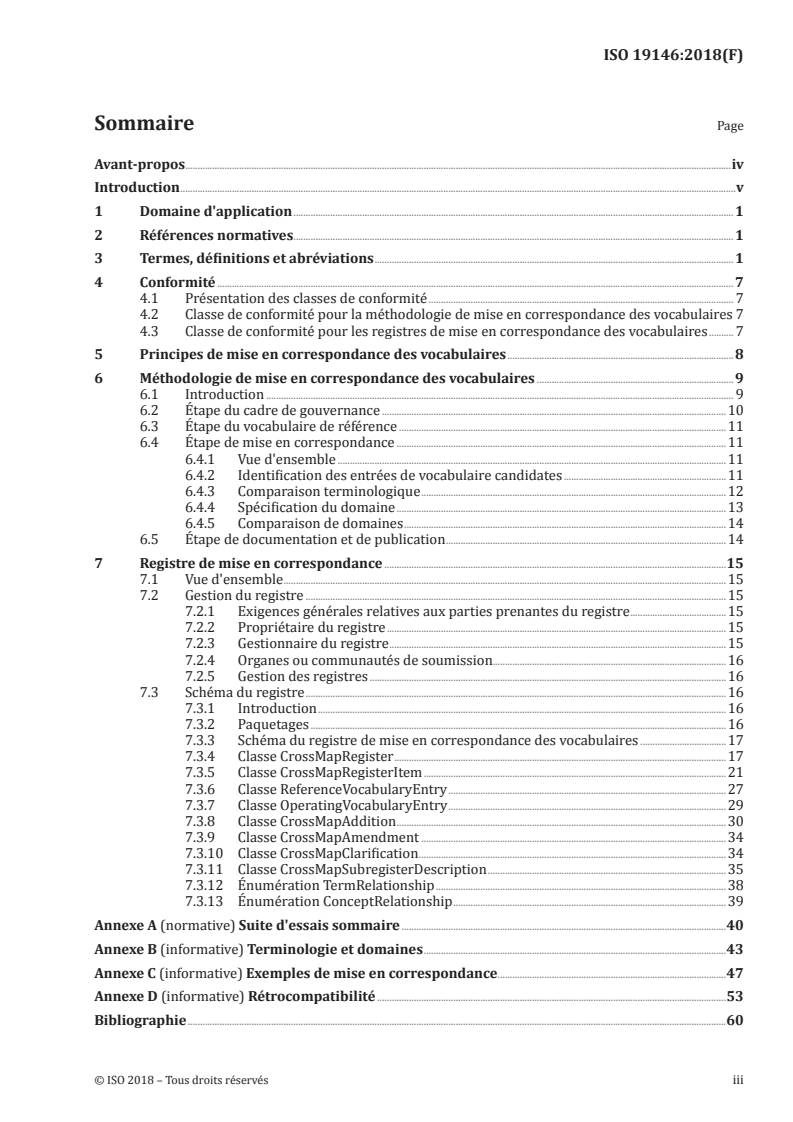
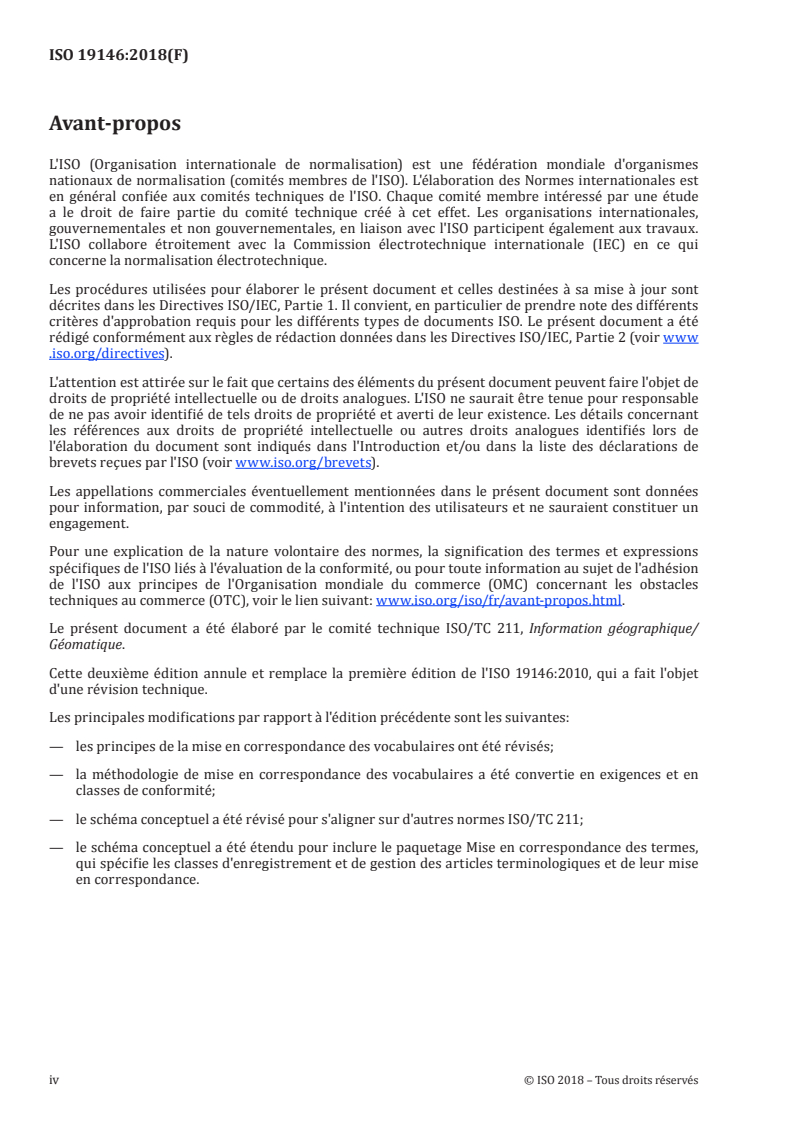
ISO 19146:2018 - Information géographique — Vocabulaires interdomaines/20/2018
Overview
ISO 19146:2018 - Geographic information - Cross-domain vocabularies defines a methodology for cross-mapping vocabularies and specifies an implementation of ISO 19135-1:2015 for registering cross-mapped vocabulary entries. The standard targets semantic interoperability in the geospatial domain by providing rules and a register model to document relationships between terminological entries from different domains. It is principally intended for geospatial communities but is applicable across other domains that require vocabulary cross-walking.
Key topics and technical requirements
- Scope and purpose
- Establishes procedures for cross-mapping vocabularies; explicitly excludes methodologies for developing ontologies and taxonomies.
- Conformance
- Defines conformance classes, including a vocabulary cross-mapping methodology class and a vocabulary cross-map registers class.
- Principles and methodology
- Provides principles for cross-mapping and a staged methodology:
- Governance framework stage - governance, stakeholders and process controls
- Reference vocabulary stage - selecting and preparing reference vocabularies
- Cross-mapping stage - identification of candidate entries, term comparison, domain specification, and concept comparison
- Documentation and publication stage - capture and publish cross-map records
- Provides principles for cross-mapping and a staged methodology:
- Cross-map register model
- Specifies register management roles (register owner, register manager, submitting organizations/communities) and management requirements.
- Defines a register schema and conceptual classes such as CrossMapRegister, CrossMapRegisterItem, ReferenceVocabularyEntry, OperatingVocabularyEntry, and change classes (e.g., CrossMapAddition, CrossMapAmendment).
- Supporting materials
- Includes normative abstract test suite and informative annexes with terminology, cross-mapping examples, and backward-compatibility guidance.
Practical applications
- Enabling semantic interoperability when integrating heterogeneous geospatial datasets from different professional communities (e.g., transport, land management, utilities).
- Creating cross-walks between domain vocabularies to support data fusion, cataloguing, metadata harmonization, and automated data processing pipelines.
- Establishing authoritative cross-map registers for organizations or communities that maintain shared vocabulary mappings.
- Informing development of ontologies/taxonomies by providing consistent cross-mapping records and provenance (while not prescribing ontology construction).
Who should use ISO 19146
- GIS data managers and integrators
- Metadata specialists and cataloguers
- Standards bodies and registry operators
- Semantic web engineers and terminology managers working with geospatial or cross-domain vocabularies
Related standards
- ISO 19135-1:2015 - Procedures for item registration (implemented for registers)
- ISO 19103:2015 - Conceptual schema language
- ISO 19104:2016 - Terminology
- ISO 19115-1:2014 - Metadata - Fundamentals
By following ISO 19146, organizations can systematically document vocabulary relationships, improve data interoperability, and manage cross-map registers in a standards-compliant way.
Relations
- Effective Date
- 12-Feb-2026
- Effective Date
- 06-Jun-2022
- Effective Date
- 27-Aug-2016
Buy Documents
ISO 19146:2018 - Geographic information -- Cross-domain vocabularies
ISO 19146:2018 - Geographic information — Cross-domain vocabularies/22/2018
ISO 19146:2018 - Information géographique -- Vocabulaires interdomaines
ISO 19146:2018 - Information géographique — Vocabulaires interdomaines/20/2018
Get Certified
Connect with accredited certification bodies for this standard

BSI Group
BSI (British Standards Institution) is the business standards company that helps organizations make excellence a habit.

NYCE
Mexican standards and certification body.
Sponsored listings
Frequently Asked Questions
ISO 19146:2018 is a standard published by the International Organization for Standardization (ISO). Its full title is "Geographic information — Cross-domain vocabularies". This standard covers: This document establishes a methodology for cross-mapping vocabularies. It also specifies an implementation of ISO 19135-1:2015 for the purpose of registering cross-mapped vocabulary entries. Methodologies for the development of ontologies and taxonomies that relate to geographic information and geomatics are not within the scope of this document.
This document establishes a methodology for cross-mapping vocabularies. It also specifies an implementation of ISO 19135-1:2015 for the purpose of registering cross-mapped vocabulary entries. Methodologies for the development of ontologies and taxonomies that relate to geographic information and geomatics are not within the scope of this document.
ISO 19146:2018 is classified under the following ICS (International Classification for Standards) categories: 35.240.70 - IT applications in science. The ICS classification helps identify the subject area and facilitates finding related standards.
ISO 19146:2018 has the following relationships with other standards: It is inter standard links to EN ISO 19146:2018, ISO 1680:2013, ISO 19146:2010. Understanding these relationships helps ensure you are using the most current and applicable version of the standard.
ISO 19146:2018 is available in PDF format for immediate download after purchase. The document can be added to your cart and obtained through the secure checkout process. Digital delivery ensures instant access to the complete standard document.
Standards Content (Sample)
INTERNATIONAL ISO
STANDARD 19146
Second edition
2018-06
Geographic information — Cross-
domain vocabularies
Information géographique — Vocabulaires interdomaines
Reference number
©
ISO 2018
© ISO 2018
All rights reserved. Unless otherwise specified, or required in the context of its implementation, no part of this publication may
be reproduced or utilized otherwise in any form or by any means, electronic or mechanical, including photocopying, or posting
on the internet or an intranet, without prior written permission. Permission can be requested from either ISO at the address
below or ISO’s member body in the country of the requester.
ISO copyright office
CP 401 • Ch. de Blandonnet 8
CH-1214 Vernier, Geneva
Phone: +41 22 749 01 11
Fax: +41 22 749 09 47
Email: copyright@iso.org
Website: www.iso.org
Published in Switzerland
ii © ISO 2018 – All rights reserved
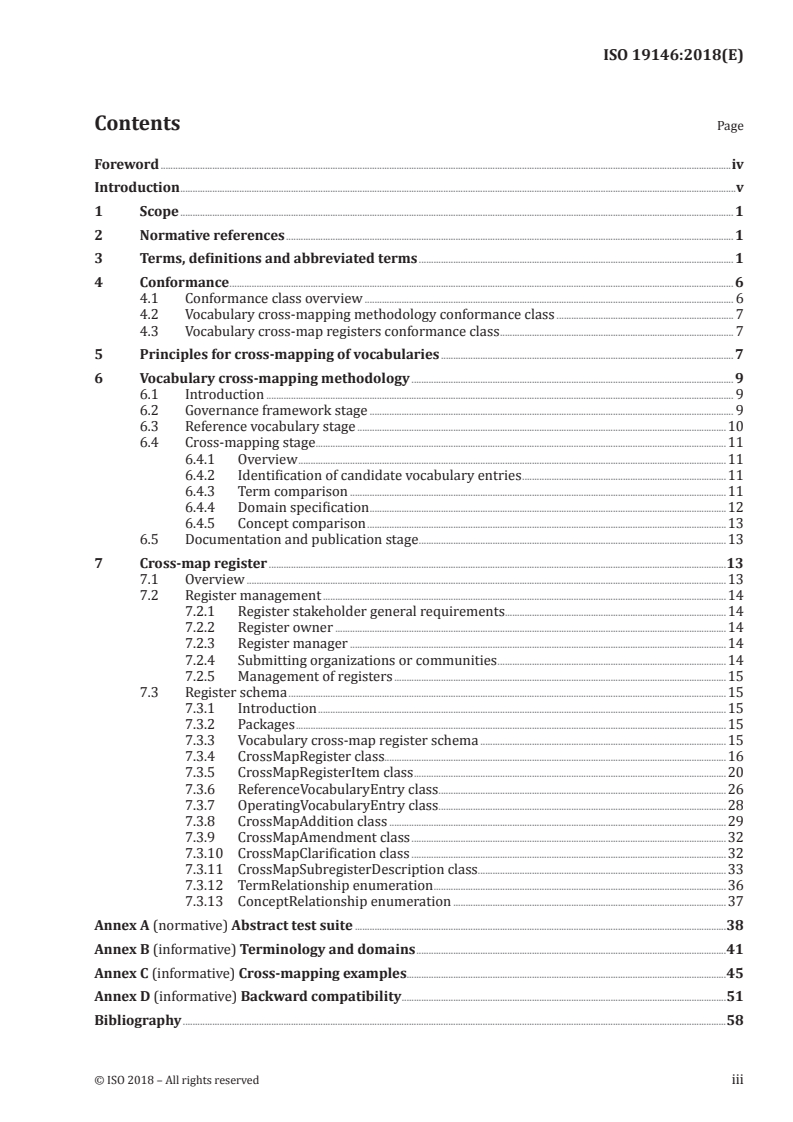
Contents Page
Foreword .iv
Introduction .v
1 Scope . 1
2 Normative references . 1
3 Terms, definitions and abbreviated terms . 1
4 Conformance . 6
4.1 Conformance class overview . 6
4.2 Vocabulary cross-mapping methodology conformance class . 7
4.3 Vocabulary cross-map registers conformance class . 7
5 Principles for cross-mapping of vocabularies . 7
6 Vocabulary cross-mapping methodology . 9
6.1 Introduction . 9
6.2 Governance framework stage . 9
6.3 Reference vocabulary stage .10
6.4 Cross-mapping stage .11
6.4.1 Overview .11
6.4.2 Identification of candidate vocabulary entries .11
6.4.3 Term comparison .11
6.4.4 Domain specification .12
6.4.5 Concept comparison .13
6.5 Documentation and publication stage .13
7 Cross-map register .13
7.1 Overview .13
7.2 Register management .14
7.2.1 Register stakeholder general requirements .14
7.2.2 Register owner .14
7.2.3 Register manager .14
7.2.4 Submitting organizations or communities .14
7.2.5 Management of registers .15
7.3 Register schema .15
7.3.1 Introduction .15
7.3.2 Packages .15
7.3.3 Vocabulary cross-map register schema .15
7.3.4 CrossMapRegister class.16
7.3.5 CrossMapRegisterItem class .20
7.3.6 ReferenceVocabularyEntry class .26
7.3.7 OperatingVocabularyEntry class .28
7.3.8 CrossMapAddition class .29
7.3.9 CrossMapAmendment class .32
7.3.10 CrossMapClarification class .32
7.3.11 CrossMapSubregisterDescription class .33
7.3.12 TermRelationship enumeration .36
7.3.13 ConceptRelationship enumeration .37
Annex A (normative) Abstract test suite .38
Annex B (informative) Terminology and domains .41
Annex C (informative) Cross-mapping examples.45
Annex D (informative) Backward compatibility .51
Bibliography .58
Foreword
ISO (the International Organization for Standardization) is a worldwide federation of national standards
bodies (ISO member bodies). The work of preparing International Standards is normally carried out
through ISO technical committees. Each member body interested in a subject for which a technical
committee has been established has the right to be represented on that committee. International
organizations, governmental and non-governmental, in liaison with ISO, also take part in the work.
ISO collaborates closely with the International Electrotechnical Commission (IEC) on all matters of
electrotechnical standardization.
The procedures used to develop this document and those intended for its further maintenance are
described in the ISO/IEC Directives, Part 1. In particular the different approval criteria needed for the
different types of ISO documents should be noted. This document was drafted in accordance with the
editorial rules of the ISO/IEC Directives, Part 2 (see www .iso .org/directives).
Attention is drawn to the possibility that some of the elements of this document may be the subject of
patent rights. ISO shall not be held responsible for identifying any or all such patent rights. Details of
any patent rights identified during the development of the document will be in the Introduction and/or
on the ISO list of patent declarations received (see www .iso .org/patents).
Any trade name used in this document is information given for the convenience of users and does not
constitute an endorsement.
For an explanation on the voluntary nature of standards, the meaning of ISO specific terms and
expressions related to conformity assessment, as well as information about ISO's adherence to the
World Trade Organization (WTO) principles in the Technical Barriers to Trade (TBT) see the following
URL: www .iso .org/iso/foreword .html.
This document was prepared by Technical Committee ISO/TC 211, Geographic information/Geomatics.
This second edition cancels and replaces the first edition of ISO 19146:2010 which has been technically
revised.
The main changes compared to the previous edition are as follows:
— the principles for the cross-mapping of vocabularies have been revised;
— the vocabulary cross-mapping methodology has been reformatted into requirements and
conformance classes;
— the conceptual schema has been revised to harmonize with other ISO/TC 211 standards;
— the conceptual schema has been expanded to include the package Term Cross Map which specifies
the classes for registering and managing terminological entries and their cross-mapping.
iv © ISO 2018 – All rights reserved
Introduction
The development of information products frequently requires the acquisition and combination of
multiple datasets from different data suppliers. The manner in which the data is combined depends on
the nature of the business need under consideration and may vary from the simple assembly of thematic
representations through to sophisticated integration, analysis and rendering. In every case, the data
suppliers and processors need to share a common understanding of the data's characteristics to ensure
their appropriate interpretation and use. The more complex or automated the processing becomes, the
more necessary it is for this understanding to be unambiguous.
A challenge that arises when combining disparate datasets stems from differing terminology
conventions adopted by the contributing suppliers. Frequently, a dataset will originate from a
community of professionals that provide support to a particular industry (for example, road transport).
The terminology used to describe the content, relationships and behaviour of the data reflects the
industry's alignment of concepts with its specialist culture, conventions and practices. A particular
concept, therefore, may be identified by different terms depending on the industry context in which it
is used.
The capacity to combine data that have been sourced from different professional communities is
dependent upon a common comprehension of the terms and concepts used to describe the business
meaning of the data. The availability of cross-mapping that reconciles the semantic differences between
the communities' vocabularies is therefore required.
This document establishes a methodology for cross-mapping between vocabularies. It is principally
intended for use by geospatial communities but may have wider application.
It is not the objective of this document to define an ontology or taxonomy; its purpose is to provide rules
for ensuring consistency when implementing cross-mapping processes. The rules, however, have been
developed with regard to taxonomic and ontological concepts and with a view to enabling semantic
interoperability. Their application to vocabulary cross-mapping, therefore, can be expected to provide
input to any future ontology or taxonomy initiatives.
This document applies the provisions of ISO 19135-1:2015 to the registration of geospatial concepts. It
also adopts terms and concepts that are taken from UML and terminology theory and practice.
INTERNATIONAL STANDARD ISO 19146:2018(E)
Geographic information — Cross-domain vocabularies
1 Scope
This document establishes a methodology for cross-mapping vocabularies. It also specifies an
implementation of ISO 19135-1:2015 for the purpose of registering cross-mapped vocabulary entries.
Methodologies for the development of ontologies and taxonomies that relate to geographic information
and geomatics are not within the scope of this document.
2 Normative references
The following documents are referred to in the text in such a way that some or all of their content
constitutes requirements of this document. For dated references, only the edition cited applies. For
undated references, the latest edition of the referenced document (including any amendments) applies.
ISO 19103:2015, Geographic information — Conceptual schema language
ISO 19104:2016, Geographic information — Terminology
ISO 19115-1:2014, Geographic information — Metadata — Part 1: Fundamentals
ISO 19135-1:2015, Geographic information — Procedures for item registration — Part 1: Fundamentals
3 Terms, definitions and abbreviated terms
3.1 Terms and definitions
For the purposes of this document, the following terms and definitions apply.
ISO and IEC maintain terminological databases for use in standardization at the following addresses:
— IEC Electropedia: available at http: //www .electropedia .org/
— ISO Online browsing platform: available at http: //www .iso .org/obp
3.1.1
associative concept system
concept system (3.1.5) based on associative relations (3.1.2)
3.1.2
associative relation
pragmatic relation
relation between two concepts (3.1.4) having a non-hierarchical thematic connection by virtue of
experience
Note 1 to entry: An associative relation exists between the concepts 'education' and 'teaching', 'baking' and 'oven'.
[SOURCE: ISO 1087-1:2000, 3.2.23]
3.1.3
characteristic
abstraction of a property of an object or of a set of objects
Note 1 to entry: Characteristics are used for describing concepts (3.1.4).
[SOURCE: ISO 1087-1:2000, 3.2.4]
3.1.4
concept
unit of knowledge created by a unique combination of characteristics (3.1.3)
Note 1 to entry: Concepts are not necessarily bound to particular languages. They are, however, influenced by
the social or cultural background which often leads to different categorizations.
[SOURCE: ISO 1087-1:2000, 3.2.1]
3.1.5
concept system
system of concepts
set of concepts (3.1.4) structured according to the relations among them
[SOURCE: ISO 1087-1:2000, 3.2.11]
3.1.6
cross-map entry
part of a cross-mapping (3.1.8) data collection which documents the cross-mapped relationships
between two concepts (3.1.4)
3.1.7
cross-map register
register of cross-map entries (3.1.6)
Note 1 to entry: A cross-map register may be realized as a subregister in a hierarchical register. In such cases, the
term (3.1.28) "cross-map subregister" may be used.
3.1.8
cross-mapping
comparison of terminological entries (3.1.31) from different domains (3.1.12) to determine their
semantic relationship
3.1.9
definition
representation of a concept (3.1.4) by a descriptive statement which serves to differentiate it from
related concepts
[SOURCE: ISO 1087-1:2000, 3.3.1]
3.1.10
delimiting characteristic
essential characteristic (3.1.14) used for distinguishing a concept (3.1.4) from related concepts
Note 1 to entry: The delimiting characteristic support for the back may be used for distinguishing the concepts
‘stool’ and ‘chair’.
[SOURCE: ISO 1087-1:2000, 3.2.7]
3.1.11
designation
designator
representation of a concept (3.1.4) by a sign which denotes it
Note 1 to entry: In terminology work three types of designations are distinguished: symbols, appellations and
terms (3.1.28).
[SOURCE: ISO 1087-1:2000, 3.4.1]
2 © ISO 2018 – All rights reserved
3.1.12
domain
distinct area of human knowledge to which a terminological entry (3.1.31) is
assigned
Note 1 to entry: Within a database or other terminology collection, a set of domains will generally be defined.
More than one domain can be associated with a given concept (3.1.4).
[SOURCE: ISO 19104:2016, 4.11]
3.1.13
domain concept
concept (3.1.4) that is associated with a specific domain (3.1.12)
Note 1 to entry: A concept may be associated with several domains and separately identified as a domain concept
in relation to each.
3.1.14
essential characteristic
characteristic (3.1.3) which is indispensable to understanding a concept (3.1.4)
[SOURCE: ISO 1087-1:2000, 3.2.6]
3.1.15
general concept
concept (3.1.4) which corresponds to two or more objects which form a group by reason of common
properties
Note 1 to entry: Examples of general concepts are ‘planet’, ’tower’.
[SOURCE: ISO 1087-1:2000, 3.2.3]
3.1.16
generic concept
concept (3.1.4) in a generic relation (3.1.18) having the narrower intension (3.1.20)
Note 1 to entry: In this context, a narrower intension means fewer characteristics (3.1.3), resulting in a concept
definition (3.1.9) with a broader scope.
[SOURCE: ISO 1087-1:2000, 3.2.15, modified — Note 1 to entry has been added.]
3.1.17
generic concept system
concept system (3.1.5) in which concepts (3.1.4) that belong to the category of the subordinate concept
(3.1.25) are part of the extension of the superordinate concept (3.1.26)
3.1.18
generic relation
genus-species relation
relation between two concepts (3.1.4) where the intension (3.1.20) of one of the concepts includes that of
the other concept and at least one additional delimiting characteristic (3.1.10)
Note 1 to entry: A generic relation exists between the concepts ‘word’ and ‘pronoun’, ‘vehicle’ and ‘car’, ‘person’
and ‘child’.
[SOURCE: ISO 1087-1:2000, 3.2.21]
3.1.19
homonymy
relation between designations (3.1.11) and concepts (3.1.4) in a given language in which one designation
represents two or more unrelated concepts
Note 1 to entry: An example of homonymy is:
— bark;
— ‘sound made by a dog’;
— ‘outside covering of the stem of woody plants’;
— ‘sailing vessel’.
Note 2 to entry: The designations in the relation of homonymy are called homonyms.
[SOURCE: ISO 1087-1:2000, 3.4.25]
3.1.20
intension
set of characteristics (3.1.3) which makes up the concept (3.1.4)
[SOURCE: ISO 1087-1:2000, 3.2.9]
3.1.21
monosemy
relation between designations (3.1.11) and concepts (3.1.4) in a given language in which one designation
only relates to one concept
Note 1 to entry: The designations in the relation of monosemy are called monosemes.
[SOURCE: ISO 1087-1:2000, 3.4.23]
3.1.22
operating vocabulary
vocabulary (3.1.32) that is not a reference vocabulary (3.1.24)
3.1.23
polysemy
relation between designations (3.1.11) and concepts (3.1.4) in a given language in which one designation
represents two or more concepts sharing certain characteristics (3.1.3)
Note 1 to entry: An example of polysemy is:
— bridge;
— ‘structure to carry traffic over a gap’;
— ‘part of a string instrument’;
— ‘dental plate’.
Note 2 to entry: The designations in the relation of polysemy are called polysemes.
[SOURCE: ISO 1087-1:2000, 3.4.24]
3.1.24
reference vocabulary
vocabulary (3.1.32) that is the basis for terminological comparisons with one or more other vocabularies
3.1.25
subordinate concept
narrower concept
concept (3.1.4) which is either a specific concept or a partitive concept
[SOURCE: ISO 1087-1:2000, 3.2.14]
4 © ISO 2018 – All rights reserved
3.1.26
superordinate concept
broader concept
concept (3.1.4) which is either a generic concept (3.1.16) or a comprehensive concept
[SOURCE: ISO 1087-1:2000, 3.2.13]
3.1.27
synonymy
relation between or among terms (3.1.28) in a given language representing the same concept (3.1.4)
Note 1 to entry: The relation of synonymy exists, for example, between deuterium and heavy hydrogen.
Note 2 to entry: Terms which are interchangeable in all contexts are called synonyms; if they are interchangeable
only in some contexts, they are called quasi-synonyms.
[SOURCE: ISO 1087-1:2000, 3.4.19]
3.1.28
term
verbal designation (3.1.11) of a general concept (3.1.15) in a specific subject field
Note 1 to entry: A term may contain symbols and can have variants, e.g. different forms of spelling.
Note 2 to entry: In this document, a verbal designation is always a written designation.
[SOURCE: ISO 1087-1:2000, 3.4.3]
3.1.29
terminological data
data related to concepts (3.1.4) or their designations (3.1.11)
Note 1 to entry: The more common terminological data include entry term (3.1.28), definition (3.1.9), note,
grammatical label, subject label, language identifier, country identifier and source identifier.
[SOURCE: ISO 1087-1:2000, 3.8.1]
3.1.30
terminological dictionary
technical dictionary
collection of terminological entries (3.1.31) presenting information related to concepts (3.1.4) or
designations (3.1.11) from one or more specific subject fields
[SOURCE: ISO 1087-1:2000, 3.7.1]
3.1.31
terminological entry
part of a terminological data (3.1.29) collection (ISO 10241-1:2011, 3.1.2) which contains the
terminological data related to one concept (3.1.4)
Note 1 to entry: A terminological entry prepared in accordance with the principles and methods given in ISO 704
follows the same structural principles whether it is monolingual or multi-lingual.
[SOURCE: ISO 1087-1:2000, 3.8.2, modified — Note 1 to entry has been added.]
3.1.32
vocabulary
terminological dictionary (3.1.30) which contains designations (3.1.11) and definitions (3.1.9) from one
or more specific subject fields
Note 1 to entry: The vocabulary may be monolingual, bilingual or multilingual.
[SOURCE: ISO 1087-1:2000, 3.7.2]
3.2 Abbreviated terms
The following abbreviated terms are used in this document.
LBS Location-based services
UML Unified Modeling Language
3.3 Conceptual schema notation
The conceptual schema specified by this document is described using the Unified Modeling
Language (UML) and follows the profile specified by ISO 19103:2015 Geographic information —
Conceptual schema language.
Several model elements used in this document are defined in packages specified in other International
Standards; these are listed in Table 1.
Table 1 — UML package identifiers
Prefix Package
CI Citation [ISO 19115-1:2014]
RE Register [ISO 19135-1:2015]
TR Terminology Register [ISO 19146:2010]
In earlier versions of ISO/TC 211 standards, the names of UML classes (with the exception of basic data
type classes) included a two-letter prefix that identified both the standard and the UML package in
which the class was specified. In newer versions of ISO/TC 211 standards, this convention is no longer
applied. The two letter prefixes specified for classes adopted from earlier International Standards are
continued in this document. Classes and packages new to this document do not use a prefix.
In accordance with the guidance of ISO 19103, all data element names are presented as character
strings which combine multiple lower-case words as needed to form precise and understandable names
without using any intervening characters (such as “_”, “-“, or space). For attributes and operation names,
association roles, and parameters, capitalization is applied to the first letter of each word after the first
word. For package, class, type-specification, and association names, capitalization is also applied to the
first letter of the first word.
This document has a normative reference (and conformance class dependency) to ISO 19103, ISO 19104,
ISO 19115-1 and ISO 19135-1. The result of this is that all classes (except enumerations and codelists)
are stereotyped <>.
4 Conformance
4.1 Conformance class overview
This document defines conformance classes for:
— Vocabulary cross-mapping methodology;
— Vocabulary cross-map registers.
To conform to this document:
— a vocabulary cross-mapping methodology shall satisfy all of the requirements in Table 2 with the
corresponding abstract test suite given in A.1;
— a vocabulary cross-map register shall satisfy all of the requirements in Table 3 with the corresponding
abstract test suite given in A.2 and ISO 19135-1:2015, A.1, A.2 and A.3.
6 © ISO 2018 – All rights reserved
4.2 Vocabulary cross-mapping methodology conformance class
Table 2 defines the characteristics of the conformance class for the vocabulary cross-mapping
methodology.
Table 2 — Vocabulary cross-mapping methodology conformance class
Conformance class identifier vocabulary cross-mapping methodology
.iso .org/iso/19146/conf/cmm>
Standardization target vocabulary cross-mapping
Dependency ISO 19104:2016
Requirements All requirements in Clause 6.
Tests All tests in A.1.
4.3 Vocabulary cross-map registers conformance class
Table 3 defines the characteristics of the conformance class for vocabulary cross-map registers.
Table 3 — Vocabulary cross-map register conformance class
Conformance class identifier vocabulary cross-map register
.org/iso/19146/conf/cmr>
Standardization target vocabulary cross-map
Dependency ISO 19103:2015
ISO 19104:2016
ISO 19115-1:2014
ISO 19135-1:2015
Requirements All requirements in Clause 7.
Tests All tests in A.2.
All tests in ISO 19135-1:2015, A.1, A.2 and A.3.
5 Principles for cross-mapping of vocabularies
A vocabulary is the medium through which a national, ethnic or occupational community of interest
formalizes and communicates its adopted language. It is an important resource for all who seek
an understanding of the community's cultures and practices. The terms and definitions identify the
concepts that characterize the community's philosophies, technologies and activities. Its structure and
supporting information identify the relationships between the concepts and the context in which they
are to be used.
Vocabulary cross-mapping is the medium through which two or more communities of interest formalize
and communicate the relationships between their languages. It is also the mechanism through which
the terminologies of different communities can be integrated, harmonized and rationalized. While
ostensibly a process of comparing terms and definitions, its outcome is highly dependent on the level of
cultural understanding that exists between the participating communities. The active involvement of
all is required to resolve semantic differences and achieve a common understanding of concepts.
Vocabulary cross-mapping is an integral part of the broader standardization agenda. It should, therefore,
be implemented in a manner that complements other standardization practices while respecting and
reconciling the cultures, processes and viewpoints of the participating communities. The following
overarching principles (which have equal importance) support this expectation. It is recommended
that they be observed during any cross-mapping initiative.
— Cross-mapping should proceed as a collaborative venture.
The active participation of all communities is required to reconcile differing semantics and achieve
a common understanding of concepts. A community should not cross-map its vocabulary to that of
another community without collaborating with that community.
— Cross-mapping should take place in an open and transparent environment.
All deliberations should take place in an open environment and should be communicated to all
participating communities. Each participating community should have unrestricted access to
the vocabularies of the other communities. If communities have published their vocabularies in
different languages (for example, one community has published in English and another in French),
translations of each should be provided in all relevant languages, accompanied by information
regarding degree of correspondence (ISO 19104:2016, 8.4.3).
— The authority of each community in relation to its vocabulary should be acknowledged.
Each participating community should be acknowledged as the ultimate authority regarding the
correct use and interpretation of its terms and definitions. Terms and conventions applied by each
community should be respected.
— A stable reference vocabulary, published in a specified reference language, should be adopted for all
cross-mapping undertakings involving a particular discipline.
A reference vocabulary is necessary to provide consistency when multiple cross-mapping initiatives
are to be undertaken over a period of time. The reference vocabulary may segment or partition its
contents and may include terms and definitions from external sources. A reference vocabulary that
replicates terminological entries from recognized industry or International Standards should be
used if possible.
In the case of geographic information, the reference vocabulary should be the English terms and
definitions included in the ISO 19100 series of standards and published on the ISO Online Browsing
Platform (https: //www .iso .org/obp/ui/).
— Cross-mapping should not circumvent established processes.
Cross-mapping should not be used to circumvent the established processes of the individual
collaborating communities. For example, it should not directly deprecate terms, nor should it
nominate new terms and definitions to address perceived gaps in a concept system. However, it may
trigger other processes within the collaborating communities to deprecate terms or to improve
concept system structures.
— Terminology should be consolidated rather than proliferated.
The purpose of vocabulary cross-mapping is to standardize the association of specific terms
with specific concepts. It should not be used as a mechanism for permanently entrenching
unnecessary duplication in terminology conventions. The cross-mapping process may facilitate
the rationalization of terminology by identifying synonyms for deprecation. Ultimately, the cross-
mapping process should lead to the consistent application of terms and definitions.
— Cross-mapping should be recognized through publication in a register.
The cross-mapping should be readily accessible to all user groups if the objective of rationalizing
terminology is to be achieved. An authoritative public register should formally report the outcome
of a cross-mapping initiative.
8 © ISO 2018 – All rights reserved
— Vocabulary cross-mapping should lead to an expanded knowledge base.
Vocabulary cross-mapping should relate vocabularies that are maintained in various types of
knowledge base such as thesaurus, taxonomy and ontology, integrating established domain-based
concepts and content into an expanded knowledge base.
— Cross-mapping should accommodate continuous change.
Vocabularies, including reference vocabularies, will evolve over time in response to technology and
business process development. The cross-mapping of concepts should be periodically reviewed to
identify and accommodate any changes.
6 Vocabulary cross-mapping methodology
6.1 Introduction
The vocabulary cross-mapping methodology specified in this document comprises four stages, being:
— the governance framework stage – in which the working relationship between the participating
communities (vocabulary owners) is formalized;
— the reference vocabulary stage – in which the participating communities select a reference
vocabulary for the cross-mapping initiative;
— the cross-mapping stage – in which the term and concept relationships between cross-mapped
terminological entries are classified;
— the registration and publication stage – in which an authoritative repository for cross-mapping
outcomes is provided.
6.2 Governance framework stage
The governance framework stage establishes a governance regime to
— facilitate the smooth progression of the cross-mapping initiative, and
— legitimize the initiative's outcomes to the members of the participating communities of interest.
The governance framework is jointly developed by the participating communities and is the subject of a
formal agreement based on a mutual understanding.
Requirement 1. The participating communities shall co-sponsor any initiative to cross-map their
vocabularies. The co-sponsors shall establish an open and transparent governance regime to provide
oversight of the project. The governance regime shall be incorporated in a formal agreement between
the participating communities.
The formal agreement identifies the roles and processes to be implemented during the initiative. It may
also include information regarding resources, schedules and publication arrangements.
Requirement 2. The formal agreement shall specify:
— the establishment and membership of a steering committee;
— the establishment, membership and reporting obligations of a project team;
— the dispute resolution process;
— the publication arrangements for the completed cross-mapping;
— the ownership of any existing registers and sub-registers utilized during the process;
— the ownership of any new registers and sub-registers established during the process.
The following should be noted.
— The steering committee should ensure that the cross-mapping project is undertaken in accordance
with the principles described in Clause 5 of this document.
— The composition and operation of the project team should be determined by the participating
communities. In instances where one or more of the communities is an open community, the project
team may include all members of that community working through social media.
— The project team's role is to collectively consider the cross-mapping of terms and concepts. During
the process, it may identify opportunities to improve a vocabulary’s structure or content. The
project team should not be empowered to change the content of any vocabulary (unless this is
specifically allowed by the affected community). However, it may provide recommendations to the
participating communities regarding additions, amendments or retirements from their respective
vocabularies.
— In the event that the project team cannot agree on a cross-mapping issue, the issue should be
escalated to the steering committee. Members of the steering committee should consult with their
communities and subsequently jointly consider the respective positions. If consensus cannot be
agreed, then the issue should be recorded as an unresolved conflict.
— The project team should prepare a draft document for the steering committee. The draft should
identify instances where cross-mapping has been achieved and the nature of the relationships
identified. It should also identify instances where additions or amendments to the vocabularies
should be considered. The steering committee members should circulate the draft within their
communities, seeking comments. The comments should be provided to the project team. The project
team should consider the comments and amend the cross-mapping and draft as appropriate.
— Requirements regarding the documentation and publication of cross-mapping outcomes are
specified in 6.5. The project team should submit the final cross-mapping documentation to the
steering committee for consideration. Each participating community should seek endorsement for
the document's proposals through its normal balloting or approval arrangements. The proposals
and outcomes should not be formally adopted until endorsed by all participating communities.
6.3 Reference vocabulary stage
The reference vocabulary stage identifies the reference and operating vocabularies that are to be
utilized during the cross-mapping process.
A reference vocabulary shall be selected by each of the participating communities before cross-mapping
can begin (see Requirement 3). There are two options, being:
— Agreement by all participants to recognise a single reference vocabulary (for example, a nominated
community vocabulary or a vocabulary published by an ISO Technical Committee);
— Each participant adopting its community vocabulary as its reference vocabulary, the cross-mapping
being documented differently by each of the participants.
The first option should be adopted wherever possible. However, the latter option may become necessary
in situations where a community-based focus has to be retained by a participating community. In
such instances, the reference vocabulary for one participant will be an operating vocabulary for other
participants.
The vocabularies maintained by each of the communities should be made available to the other
participants for the duration of the cross-mapping process.
Requirement 3. Each participating community shall identify and adopt its preferred reference vocab-
ulary prior to commencing cross-mapping.
10 © ISO 2018 – All rights reserved
6.4 Cross-mapping stage
6.4.1 Overview
The purpose of the cross-mapping stage is to
— identify candidate vocabulary entries, and
— undertake term, concept and domain comparisons.
The process requirements are specified in 6.4.2, 6.4.3, 6.4.4 and 6.4.5. Supplementary information
regarding the relationships between terms, definitions, concepts and domains is provided in Annex B.
6.4.2 Identification of candidate vocabulary entries
The reference and operating vocabularies should be simultaneously reviewed to identify terminological
pairs or clusters that are candidates for cross-mapping. The process for identifying candidate
vocabulary records should be jointly determined by the participating communities.
The terminological pairs or clusters should include all instances where the vocabularies contain:
— identical terms with identical definitions;
— identical terms with dissimilar definitions;
— similar definitions for different terms.
In addition, instances where a common underlying concept (for example, the description of a network)
has been adopted by two or more participating industries or communities (for example, the electricity
supply industry, the water supply industry) but adapted using different terms and definitions to
describe generically similar features (for example, ‘circuit breaker’, ‘stop valve’) should be included as
candidates.
In most cases, the members of a terminological pair or cluster will relate to a common concept system.
There may be instances, however, where cross-mapping can be effective in emphasizing the absence of
a relationship. Vocabulary records that use similar or identical terms to describe distinctly different
concepts provide an example.
[2]
ISO 860:2007 specifies a methodological approach to the harmonization of concepts, concept systems,
[14]
definitions and terms. ISO 25964-2:2013 provides recommendations regarding cross-mapping
between vocabularies.
6.4.3 Term comparison
A term is a designation by which a concept is commonly known. The relationship between the concept
and designation may not be unique. A concept may be designated by two or more terms. Similarly, a
term may designate two or more concepts.
When comparing terms from different vocabularies during a cross-mapping initiative, it is necessary to
determine whether two or more terms:
— are identical and designate the same concept;
— are different but designate the same concept, indicating a synonymic relationship between the terms;
— are identical but designate different concepts, indicating polysemic or homonymic relationships
between the term instances;
— are different and designate different concepts.
Synonymic relationships are common within vocabularies as well as between vocabularies. In a
terminological entry, the preferred term and any admitted terms have a synonymic relationship.
A polysemic relationship exists when a single term designates two or more concepts that share certain
characteristics. Consider, for example, the term "constraint". In the context of location based services,
its definition is:
"restriction on how a link or turn may be traversed by a vehicle, such as vehicle classification, physical
[13]
or temporal constraint" [ISO 19133:2005, 4.16]
In the context of Unified Modeling Language, however, its definition is
"condition or restriction expressed in natural language text or in a machine readable language for the
purpose of declaring some of the semantics of an element" [ISO 19103:2015, 4.13]
The definitions share the characteristic "restriction", creating a polysemic relationship between the
occurrences of the term.
A homonymic relationship exists between designations when a single designation represents two
or more unrelated concepts. Consider, for example, the term "attitude". In the context of an airborne
sensor, its definition is:
"orientation of a body, described by the angles between the axes of that body’s coordinate system and
[10]
the axes of an external coordinate system" [ISO 19116:2004, 4.2]
In the context of psychology, its definition is:
"a relatively enduring organization of beliefs, feelings, and behavioral tendencies towards socially
[15]
significant o
...
INTERNATIONAL ISO
STANDARD 19146
Second edition
2018-06
Geographic information — Cross-
domain vocabularies
Information géographique — Vocabulaires interdomaines
Reference number
©
ISO 2018
© ISO 2018
All rights reserved. Unless otherwise specified, or required in the context of its implementation, no part of this publication may
be reproduced or utilized otherwise in any form or by any means, electronic or mechanical, including photocopying, or posting
on the internet or an intranet, without prior written permission. Permission can be requested from either ISO at the address
below or ISO’s member body in the country of the requester.
ISO copyright office
CP 401 • Ch. de Blandonnet 8
CH-1214 Vernier, Geneva
Phone: +41 22 749 01 11
Fax: +41 22 749 09 47
Email: copyright@iso.org
Website: www.iso.org
Published in Switzerland
ii © ISO 2018 – All rights reserved
Contents Page
Foreword .iv
Introduction .v
1 Scope . 1
2 Normative references . 1
3 Terms, definitions and abbreviated terms . 1
4 Conformance . 6
4.1 Conformance class overview . 6
4.2 Vocabulary cross-mapping methodology conformance class . 7
4.3 Vocabulary cross-map registers conformance class . 7
5 Principles for cross-mapping of vocabularies . 7
6 Vocabulary cross-mapping methodology . 9
6.1 Introduction . 9
6.2 Governance framework stage . 9
6.3 Reference vocabulary stage .10
6.4 Cross-mapping stage .11
6.4.1 Overview .11
6.4.2 Identification of candidate vocabulary entries .11
6.4.3 Term comparison .11
6.4.4 Domain specification .12
6.4.5 Concept comparison .13
6.5 Documentation and publication stage .13
7 Cross-map register .13
7.1 Overview .13
7.2 Register management .14
7.2.1 Register stakeholder general requirements .14
7.2.2 Register owner .14
7.2.3 Register manager .14
7.2.4 Submitting organizations or communities .14
7.2.5 Management of registers .15
7.3 Register schema .15
7.3.1 Introduction .15
7.3.2 Packages .15
7.3.3 Vocabulary cross-map register schema .15
7.3.4 CrossMapRegister class.16
7.3.5 CrossMapRegisterItem class .20
7.3.6 ReferenceVocabularyEntry class .26
7.3.7 OperatingVocabularyEntry class .28
7.3.8 CrossMapAddition class .29
7.3.9 CrossMapAmendment class .32
7.3.10 CrossMapClarification class .32
7.3.11 CrossMapSubregisterDescription class .33
7.3.12 TermRelationship enumeration .36
7.3.13 ConceptRelationship enumeration .37
Annex A (normative) Abstract test suite .38
Annex B (informative) Terminology and domains .41
Annex C (informative) Cross-mapping examples.45
Annex D (informative) Backward compatibility .51
Bibliography .58
Foreword
ISO (the International Organization for Standardization) is a worldwide federation of national standards
bodies (ISO member bodies). The work of preparing International Standards is normally carried out
through ISO technical committees. Each member body interested in a subject for which a technical
committee has been established has the right to be represented on that committee. International
organizations, governmental and non-governmental, in liaison with ISO, also take part in the work.
ISO collaborates closely with the International Electrotechnical Commission (IEC) on all matters of
electrotechnical standardization.
The procedures used to develop this document and those intended for its further maintenance are
described in the ISO/IEC Directives, Part 1. In particular the different approval criteria needed for the
different types of ISO documents should be noted. This document was drafted in accordance with the
editorial rules of the ISO/IEC Directives, Part 2 (see www .iso .org/directives).
Attention is drawn to the possibility that some of the elements of this document may be the subject of
patent rights. ISO shall not be held responsible for identifying any or all such patent rights. Details of
any patent rights identified during the development of the document will be in the Introduction and/or
on the ISO list of patent declarations received (see www .iso .org/patents).
Any trade name used in this document is information given for the convenience of users and does not
constitute an endorsement.
For an explanation on the voluntary nature of standards, the meaning of ISO specific terms and
expressions related to conformity assessment, as well as information about ISO's adherence to the
World Trade Organization (WTO) principles in the Technical Barriers to Trade (TBT) see the following
URL: www .iso .org/iso/foreword .html.
This document was prepared by Technical Committee ISO/TC 211, Geographic information/Geomatics.
This second edition cancels and replaces the first edition of ISO 19146:2010 which has been technically
revised.
The main changes compared to the previous edition are as follows:
— the principles for the cross-mapping of vocabularies have been revised;
— the vocabulary cross-mapping methodology has been reformatted into requirements and
conformance classes;
— the conceptual schema has been revised to harmonize with other ISO/TC 211 standards;
— the conceptual schema has been expanded to include the package Term Cross Map which specifies
the classes for registering and managing terminological entries and their cross-mapping.
iv © ISO 2018 – All rights reserved
Introduction
The development of information products frequently requires the acquisition and combination of
multiple datasets from different data suppliers. The manner in which the data is combined depends on
the nature of the business need under consideration and may vary from the simple assembly of thematic
representations through to sophisticated integration, analysis and rendering. In every case, the data
suppliers and processors need to share a common understanding of the data's characteristics to ensure
their appropriate interpretation and use. The more complex or automated the processing becomes, the
more necessary it is for this understanding to be unambiguous.
A challenge that arises when combining disparate datasets stems from differing terminology
conventions adopted by the contributing suppliers. Frequently, a dataset will originate from a
community of professionals that provide support to a particular industry (for example, road transport).
The terminology used to describe the content, relationships and behaviour of the data reflects the
industry's alignment of concepts with its specialist culture, conventions and practices. A particular
concept, therefore, may be identified by different terms depending on the industry context in which it
is used.
The capacity to combine data that have been sourced from different professional communities is
dependent upon a common comprehension of the terms and concepts used to describe the business
meaning of the data. The availability of cross-mapping that reconciles the semantic differences between
the communities' vocabularies is therefore required.
This document establishes a methodology for cross-mapping between vocabularies. It is principally
intended for use by geospatial communities but may have wider application.
It is not the objective of this document to define an ontology or taxonomy; its purpose is to provide rules
for ensuring consistency when implementing cross-mapping processes. The rules, however, have been
developed with regard to taxonomic and ontological concepts and with a view to enabling semantic
interoperability. Their application to vocabulary cross-mapping, therefore, can be expected to provide
input to any future ontology or taxonomy initiatives.
This document applies the provisions of ISO 19135-1:2015 to the registration of geospatial concepts. It
also adopts terms and concepts that are taken from UML and terminology theory and practice.
INTERNATIONAL STANDARD ISO 19146:2018(E)
Geographic information — Cross-domain vocabularies
1 Scope
This document establishes a methodology for cross-mapping vocabularies. It also specifies an
implementation of ISO 19135-1:2015 for the purpose of registering cross-mapped vocabulary entries.
Methodologies for the development of ontologies and taxonomies that relate to geographic information
and geomatics are not within the scope of this document.
2 Normative references
The following documents are referred to in the text in such a way that some or all of their content
constitutes requirements of this document. For dated references, only the edition cited applies. For
undated references, the latest edition of the referenced document (including any amendments) applies.
ISO 19103:2015, Geographic information — Conceptual schema language
ISO 19104:2016, Geographic information — Terminology
ISO 19115-1:2014, Geographic information — Metadata — Part 1: Fundamentals
ISO 19135-1:2015, Geographic information — Procedures for item registration — Part 1: Fundamentals
3 Terms, definitions and abbreviated terms
3.1 Terms and definitions
For the purposes of this document, the following terms and definitions apply.
ISO and IEC maintain terminological databases for use in standardization at the following addresses:
— IEC Electropedia: available at http: //www .electropedia .org/
— ISO Online browsing platform: available at http: //www .iso .org/obp
3.1.1
associative concept system
concept system (3.1.5) based on associative relations (3.1.2)
3.1.2
associative relation
pragmatic relation
relation between two concepts (3.1.4) having a non-hierarchical thematic connection by virtue of
experience
Note 1 to entry: An associative relation exists between the concepts 'education' and 'teaching', 'baking' and 'oven'.
[SOURCE: ISO 1087-1:2000, 3.2.23]
3.1.3
characteristic
abstraction of a property of an object or of a set of objects
Note 1 to entry: Characteristics are used for describing concepts (3.1.4).
[SOURCE: ISO 1087-1:2000, 3.2.4]
3.1.4
concept
unit of knowledge created by a unique combination of characteristics (3.1.3)
Note 1 to entry: Concepts are not necessarily bound to particular languages. They are, however, influenced by
the social or cultural background which often leads to different categorizations.
[SOURCE: ISO 1087-1:2000, 3.2.1]
3.1.5
concept system
system of concepts
set of concepts (3.1.4) structured according to the relations among them
[SOURCE: ISO 1087-1:2000, 3.2.11]
3.1.6
cross-map entry
part of a cross-mapping (3.1.8) data collection which documents the cross-mapped relationships
between two concepts (3.1.4)
3.1.7
cross-map register
register of cross-map entries (3.1.6)
Note 1 to entry: A cross-map register may be realized as a subregister in a hierarchical register. In such cases, the
term (3.1.28) "cross-map subregister" may be used.
3.1.8
cross-mapping
comparison of terminological entries (3.1.31) from different domains (3.1.12) to determine their
semantic relationship
3.1.9
definition
representation of a concept (3.1.4) by a descriptive statement which serves to differentiate it from
related concepts
[SOURCE: ISO 1087-1:2000, 3.3.1]
3.1.10
delimiting characteristic
essential characteristic (3.1.14) used for distinguishing a concept (3.1.4) from related concepts
Note 1 to entry: The delimiting characteristic support for the back may be used for distinguishing the concepts
‘stool’ and ‘chair’.
[SOURCE: ISO 1087-1:2000, 3.2.7]
3.1.11
designation
designator
representation of a concept (3.1.4) by a sign which denotes it
Note 1 to entry: In terminology work three types of designations are distinguished: symbols, appellations and
terms (3.1.28).
[SOURCE: ISO 1087-1:2000, 3.4.1]
2 © ISO 2018 – All rights reserved
3.1.12
domain
distinct area of human knowledge to which a terminological entry (3.1.31) is
assigned
Note 1 to entry: Within a database or other terminology collection, a set of domains will generally be defined.
More than one domain can be associated with a given concept (3.1.4).
[SOURCE: ISO 19104:2016, 4.11]
3.1.13
domain concept
concept (3.1.4) that is associated with a specific domain (3.1.12)
Note 1 to entry: A concept may be associated with several domains and separately identified as a domain concept
in relation to each.
3.1.14
essential characteristic
characteristic (3.1.3) which is indispensable to understanding a concept (3.1.4)
[SOURCE: ISO 1087-1:2000, 3.2.6]
3.1.15
general concept
concept (3.1.4) which corresponds to two or more objects which form a group by reason of common
properties
Note 1 to entry: Examples of general concepts are ‘planet’, ’tower’.
[SOURCE: ISO 1087-1:2000, 3.2.3]
3.1.16
generic concept
concept (3.1.4) in a generic relation (3.1.18) having the narrower intension (3.1.20)
Note 1 to entry: In this context, a narrower intension means fewer characteristics (3.1.3), resulting in a concept
definition (3.1.9) with a broader scope.
[SOURCE: ISO 1087-1:2000, 3.2.15, modified — Note 1 to entry has been added.]
3.1.17
generic concept system
concept system (3.1.5) in which concepts (3.1.4) that belong to the category of the subordinate concept
(3.1.25) are part of the extension of the superordinate concept (3.1.26)
3.1.18
generic relation
genus-species relation
relation between two concepts (3.1.4) where the intension (3.1.20) of one of the concepts includes that of
the other concept and at least one additional delimiting characteristic (3.1.10)
Note 1 to entry: A generic relation exists between the concepts ‘word’ and ‘pronoun’, ‘vehicle’ and ‘car’, ‘person’
and ‘child’.
[SOURCE: ISO 1087-1:2000, 3.2.21]
3.1.19
homonymy
relation between designations (3.1.11) and concepts (3.1.4) in a given language in which one designation
represents two or more unrelated concepts
Note 1 to entry: An example of homonymy is:
— bark;
— ‘sound made by a dog’;
— ‘outside covering of the stem of woody plants’;
— ‘sailing vessel’.
Note 2 to entry: The designations in the relation of homonymy are called homonyms.
[SOURCE: ISO 1087-1:2000, 3.4.25]
3.1.20
intension
set of characteristics (3.1.3) which makes up the concept (3.1.4)
[SOURCE: ISO 1087-1:2000, 3.2.9]
3.1.21
monosemy
relation between designations (3.1.11) and concepts (3.1.4) in a given language in which one designation
only relates to one concept
Note 1 to entry: The designations in the relation of monosemy are called monosemes.
[SOURCE: ISO 1087-1:2000, 3.4.23]
3.1.22
operating vocabulary
vocabulary (3.1.32) that is not a reference vocabulary (3.1.24)
3.1.23
polysemy
relation between designations (3.1.11) and concepts (3.1.4) in a given language in which one designation
represents two or more concepts sharing certain characteristics (3.1.3)
Note 1 to entry: An example of polysemy is:
— bridge;
— ‘structure to carry traffic over a gap’;
— ‘part of a string instrument’;
— ‘dental plate’.
Note 2 to entry: The designations in the relation of polysemy are called polysemes.
[SOURCE: ISO 1087-1:2000, 3.4.24]
3.1.24
reference vocabulary
vocabulary (3.1.32) that is the basis for terminological comparisons with one or more other vocabularies
3.1.25
subordinate concept
narrower concept
concept (3.1.4) which is either a specific concept or a partitive concept
[SOURCE: ISO 1087-1:2000, 3.2.14]
4 © ISO 2018 – All rights reserved
3.1.26
superordinate concept
broader concept
concept (3.1.4) which is either a generic concept (3.1.16) or a comprehensive concept
[SOURCE: ISO 1087-1:2000, 3.2.13]
3.1.27
synonymy
relation between or among terms (3.1.28) in a given language representing the same concept (3.1.4)
Note 1 to entry: The relation of synonymy exists, for example, between deuterium and heavy hydrogen.
Note 2 to entry: Terms which are interchangeable in all contexts are called synonyms; if they are interchangeable
only in some contexts, they are called quasi-synonyms.
[SOURCE: ISO 1087-1:2000, 3.4.19]
3.1.28
term
verbal designation (3.1.11) of a general concept (3.1.15) in a specific subject field
Note 1 to entry: A term may contain symbols and can have variants, e.g. different forms of spelling.
Note 2 to entry: In this document, a verbal designation is always a written designation.
[SOURCE: ISO 1087-1:2000, 3.4.3]
3.1.29
terminological data
data related to concepts (3.1.4) or their designations (3.1.11)
Note 1 to entry: The more common terminological data include entry term (3.1.28), definition (3.1.9), note,
grammatical label, subject label, language identifier, country identifier and source identifier.
[SOURCE: ISO 1087-1:2000, 3.8.1]
3.1.30
terminological dictionary
technical dictionary
collection of terminological entries (3.1.31) presenting information related to concepts (3.1.4) or
designations (3.1.11) from one or more specific subject fields
[SOURCE: ISO 1087-1:2000, 3.7.1]
3.1.31
terminological entry
part of a terminological data (3.1.29) collection (ISO 10241-1:2011, 3.1.2) which contains the
terminological data related to one concept (3.1.4)
Note 1 to entry: A terminological entry prepared in accordance with the principles and methods given in ISO 704
follows the same structural principles whether it is monolingual or multi-lingual.
[SOURCE: ISO 1087-1:2000, 3.8.2, modified — Note 1 to entry has been added.]
3.1.32
vocabulary
terminological dictionary (3.1.30) which contains designations (3.1.11) and definitions (3.1.9) from one
or more specific subject fields
Note 1 to entry: The vocabulary may be monolingual, bilingual or multilingual.
[SOURCE: ISO 1087-1:2000, 3.7.2]
3.2 Abbreviated terms
The following abbreviated terms are used in this document.
LBS Location-based services
UML Unified Modeling Language
3.3 Conceptual schema notation
The conceptual schema specified by this document is described using the Unified Modeling
Language (UML) and follows the profile specified by ISO 19103:2015 Geographic information —
Conceptual schema language.
Several model elements used in this document are defined in packages specified in other International
Standards; these are listed in Table 1.
Table 1 — UML package identifiers
Prefix Package
CI Citation [ISO 19115-1:2014]
RE Register [ISO 19135-1:2015]
TR Terminology Register [ISO 19146:2010]
In earlier versions of ISO/TC 211 standards, the names of UML classes (with the exception of basic data
type classes) included a two-letter prefix that identified both the standard and the UML package in
which the class was specified. In newer versions of ISO/TC 211 standards, this convention is no longer
applied. The two letter prefixes specified for classes adopted from earlier International Standards are
continued in this document. Classes and packages new to this document do not use a prefix.
In accordance with the guidance of ISO 19103, all data element names are presented as character
strings which combine multiple lower-case words as needed to form precise and understandable names
without using any intervening characters (such as “_”, “-“, or space). For attributes and operation names,
association roles, and parameters, capitalization is applied to the first letter of each word after the first
word. For package, class, type-specification, and association names, capitalization is also applied to the
first letter of the first word.
This document has a normative reference (and conformance class dependency) to ISO 19103, ISO 19104,
ISO 19115-1 and ISO 19135-1. The result of this is that all classes (except enumerations and codelists)
are stereotyped <>.
4 Conformance
4.1 Conformance class overview
This document defines conformance classes for:
— Vocabulary cross-mapping methodology;
— Vocabulary cross-map registers.
To conform to this document:
— a vocabulary cross-mapping methodology shall satisfy all of the requirements in Table 2 with the
corresponding abstract test suite given in A.1;
— a vocabulary cross-map register shall satisfy all of the requirements in Table 3 with the corresponding
abstract test suite given in A.2 and ISO 19135-1:2015, A.1, A.2 and A.3.
6 © ISO 2018 – All rights reserved
4.2 Vocabulary cross-mapping methodology conformance class
Table 2 defines the characteristics of the conformance class for the vocabulary cross-mapping
methodology.
Table 2 — Vocabulary cross-mapping methodology conformance class
Conformance class identifier vocabulary cross-mapping methodology
.iso .org/iso/19146/conf/cmm>
Standardization target vocabulary cross-mapping
Dependency ISO 19104:2016
Requirements All requirements in Clause 6.
Tests All tests in A.1.
4.3 Vocabulary cross-map registers conformance class
Table 3 defines the characteristics of the conformance class for vocabulary cross-map registers.
Table 3 — Vocabulary cross-map register conformance class
Conformance class identifier vocabulary cross-map register
.org/iso/19146/conf/cmr>
Standardization target vocabulary cross-map
Dependency ISO 19103:2015
ISO 19104:2016
ISO 19115-1:2014
ISO 19135-1:2015
Requirements All requirements in Clause 7.
Tests All tests in A.2.
All tests in ISO 19135-1:2015, A.1, A.2 and A.3.
5 Principles for cross-mapping of vocabularies
A vocabulary is the medium through which a national, ethnic or occupational community of interest
formalizes and communicates its adopted language. It is an important resource for all who seek
an understanding of the community's cultures and practices. The terms and definitions identify the
concepts that characterize the community's philosophies, technologies and activities. Its structure and
supporting information identify the relationships between the concepts and the context in which they
are to be used.
Vocabulary cross-mapping is the medium through which two or more communities of interest formalize
and communicate the relationships between their languages. It is also the mechanism through which
the terminologies of different communities can be integrated, harmonized and rationalized. While
ostensibly a process of comparing terms and definitions, its outcome is highly dependent on the level of
cultural understanding that exists between the participating communities. The active involvement of
all is required to resolve semantic differences and achieve a common understanding of concepts.
Vocabulary cross-mapping is an integral part of the broader standardization agenda. It should, therefore,
be implemented in a manner that complements other standardization practices while respecting and
reconciling the cultures, processes and viewpoints of the participating communities. The following
overarching principles (which have equal importance) support this expectation. It is recommended
that they be observed during any cross-mapping initiative.
— Cross-mapping should proceed as a collaborative venture.
The active participation of all communities is required to reconcile differing semantics and achieve
a common understanding of concepts. A community should not cross-map its vocabulary to that of
another community without collaborating with that community.
— Cross-mapping should take place in an open and transparent environment.
All deliberations should take place in an open environment and should be communicated to all
participating communities. Each participating community should have unrestricted access to
the vocabularies of the other communities. If communities have published their vocabularies in
different languages (for example, one community has published in English and another in French),
translations of each should be provided in all relevant languages, accompanied by information
regarding degree of correspondence (ISO 19104:2016, 8.4.3).
— The authority of each community in relation to its vocabulary should be acknowledged.
Each participating community should be acknowledged as the ultimate authority regarding the
correct use and interpretation of its terms and definitions. Terms and conventions applied by each
community should be respected.
— A stable reference vocabulary, published in a specified reference language, should be adopted for all
cross-mapping undertakings involving a particular discipline.
A reference vocabulary is necessary to provide consistency when multiple cross-mapping initiatives
are to be undertaken over a period of time. The reference vocabulary may segment or partition its
contents and may include terms and definitions from external sources. A reference vocabulary that
replicates terminological entries from recognized industry or International Standards should be
used if possible.
In the case of geographic information, the reference vocabulary should be the English terms and
definitions included in the ISO 19100 series of standards and published on the ISO Online Browsing
Platform (https: //www .iso .org/obp/ui/).
— Cross-mapping should not circumvent established processes.
Cross-mapping should not be used to circumvent the established processes of the individual
collaborating communities. For example, it should not directly deprecate terms, nor should it
nominate new terms and definitions to address perceived gaps in a concept system. However, it may
trigger other processes within the collaborating communities to deprecate terms or to improve
concept system structures.
— Terminology should be consolidated rather than proliferated.
The purpose of vocabulary cross-mapping is to standardize the association of specific terms
with specific concepts. It should not be used as a mechanism for permanently entrenching
unnecessary duplication in terminology conventions. The cross-mapping process may facilitate
the rationalization of terminology by identifying synonyms for deprecation. Ultimately, the cross-
mapping process should lead to the consistent application of terms and definitions.
— Cross-mapping should be recognized through publication in a register.
The cross-mapping should be readily accessible to all user groups if the objective of rationalizing
terminology is to be achieved. An authoritative public register should formally report the outcome
of a cross-mapping initiative.
8 © ISO 2018 – All rights reserved
— Vocabulary cross-mapping should lead to an expanded knowledge base.
Vocabulary cross-mapping should relate vocabularies that are maintained in various types of
knowledge base such as thesaurus, taxonomy and ontology, integrating established domain-based
concepts and content into an expanded knowledge base.
— Cross-mapping should accommodate continuous change.
Vocabularies, including reference vocabularies, will evolve over time in response to technology and
business process development. The cross-mapping of concepts should be periodically reviewed to
identify and accommodate any changes.
6 Vocabulary cross-mapping methodology
6.1 Introduction
The vocabulary cross-mapping methodology specified in this document comprises four stages, being:
— the governance framework stage – in which the working relationship between the participating
communities (vocabulary owners) is formalized;
— the reference vocabulary stage – in which the participating communities select a reference
vocabulary for the cross-mapping initiative;
— the cross-mapping stage – in which the term and concept relationships between cross-mapped
terminological entries are classified;
— the registration and publication stage – in which an authoritative repository for cross-mapping
outcomes is provided.
6.2 Governance framework stage
The governance framework stage establishes a governance regime to
— facilitate the smooth progression of the cross-mapping initiative, and
— legitimize the initiative's outcomes to the members of the participating communities of interest.
The governance framework is jointly developed by the participating communities and is the subject of a
formal agreement based on a mutual understanding.
Requirement 1. The participating communities shall co-sponsor any initiative to cross-map their
vocabularies. The co-sponsors shall establish an open and transparent governance regime to provide
oversight of the project. The governance regime shall be incorporated in a formal agreement between
the participating communities.
The formal agreement identifies the roles and processes to be implemented during the initiative. It may
also include information regarding resources, schedules and publication arrangements.
Requirement 2. The formal agreement shall specify:
— the establishment and membership of a steering committee;
— the establishment, membership and reporting obligations of a project team;
— the dispute resolution process;
— the publication arrangements for the completed cross-mapping;
— the ownership of any existing registers and sub-registers utilized during the process;
— the ownership of any new registers and sub-registers established during the process.
The following should be noted.
— The steering committee should ensure that the cross-mapping project is undertaken in accordance
with the principles described in Clause 5 of this document.
— The composition and operation of the project team should be determined by the participating
communities. In instances where one or more of the communities is an open community, the project
team may include all members of that community working through social media.
— The project team's role is to collectively consider the cross-mapping of terms and concepts. During
the process, it may identify opportunities to improve a vocabulary’s structure or content. The
project team should not be empowered to change the content of any vocabulary (unless this is
specifically allowed by the affected community). However, it may provide recommendations to the
participating communities regarding additions, amendments or retirements from their respective
vocabularies.
— In the event that the project team cannot agree on a cross-mapping issue, the issue should be
escalated to the steering committee. Members of the steering committee should consult with their
communities and subsequently jointly consider the respective positions. If consensus cannot be
agreed, then the issue should be recorded as an unresolved conflict.
— The project team should prepare a draft document for the steering committee. The draft should
identify instances where cross-mapping has been achieved and the nature of the relationships
identified. It should also identify instances where additions or amendments to the vocabularies
should be considered. The steering committee members should circulate the draft within their
communities, seeking comments. The comments should be provided to the project team. The project
team should consider the comments and amend the cross-mapping and draft as appropriate.
— Requirements regarding the documentation and publication of cross-mapping outcomes are
specified in 6.5. The project team should submit the final cross-mapping documentation to the
steering committee for consideration. Each participating community should seek endorsement for
the document's proposals through its normal balloting or approval arrangements. The proposals
and outcomes should not be formally adopted until endorsed by all participating communities.
6.3 Reference vocabulary stage
The reference vocabulary stage identifies the reference and operating vocabularies that are to be
utilized during the cross-mapping process.
A reference vocabulary shall be selected by each of the participating communities before cross-mapping
can begin (see Requirement 3). There are two options, being:
— Agreement by all participants to recognise a single reference vocabulary (for example, a nominated
community vocabulary or a vocabulary published by an ISO Technical Committee);
— Each participant adopting its community vocabulary as its reference vocabulary, the cross-mapping
being documented differently by each of the participants.
The first option should be adopted wherever possible. However, the latter option may become necessary
in situations where a community-based focus has to be retained by a participating community. In
such instances, the reference vocabulary for one participant will be an operating vocabulary for other
participants.
The vocabularies maintained by each of the communities should be made available to the other
participants for the duration of the cross-mapping process.
Requirement 3. Each participating community shall identify and adopt its preferred reference vocab-
ulary prior to commencing cross-mapping.
10 © ISO 2018 – All rights reserved
6.4 Cross-mapping stage
6.4.1 Overview
The purpose of the cross-mapping stage is to
— identify candidate vocabulary entries, and
— undertake term, concept and domain comparisons.
The process requirements are specified in 6.4.2, 6.4.3, 6.4.4 and 6.4.5. Supplementary information
regarding the relationships between terms, definitions, concepts and domains is provided in Annex B.
6.4.2 Identification of candidate vocabulary entries
The reference and operating vocabularies should be simultaneously reviewed to identify terminological
pairs or clusters that are candidates for cross-mapping. The process for identifying candidate
vocabulary records should be jointly determined by the participating communities.
The terminological pairs or clusters should include all instances where the vocabularies contain:
— identical terms with identical definitions;
— identical terms with dissimilar definitions;
— similar definitions for different terms.
In addition, instances where a common underlying concept (for example, the description of a network)
has been adopted by two or more participating industries or communities (for example, the electricity
supply industry, the water supply industry) but adapted using different terms and definitions to
describe generically similar features (for example, ‘circuit breaker’, ‘stop valve’) should be included as
candidates.
In most cases, the members of a terminological pair or cluster will relate to a common concept system.
There may be instances, however, where cross-mapping can be effective in emphasizing the absence of
a relationship. Vocabulary records that use similar or identical terms to describe distinctly different
concepts provide an example.
[2]
ISO 860:2007 specifies a methodological approach to the harmonization of concepts, concept systems,
[14]
definitions and terms. ISO 25964-2:2013 provides recommendations regarding cross-mapping
between vocabularies.
6.4.3 Term comparison
A term is a designation by which a concept is commonly known. The relationship between the concept
and designation may not be unique. A concept may be designated by two or more terms. Similarly, a
term may designate two or more concepts.
When comparing terms from different vocabularies during a cross-mapping initiative, it is necessary to
determine whether two or more terms:
— are identical and designate the same concept;
— are different but designate the same concept, indicating a synonymic relationship between the terms;
— are identical but designate different concepts, indicating polysemic or homonymic relationships
between the term instances;
— are different and designate different concepts.
Synonymic relationships are common within vocabularies as well as between vocabularies. In a
terminological entry, the preferred term and any admitted terms have a synonymic relationship.
A polysemic relationship exists when a single term designates two or more concepts that share certain
characteristics. Consider, for example, the term "constraint". In the context of location based services,
its definition is:
"restriction on how a link or turn may be traversed by a vehicle, such as vehicle classification, physical
[13]
or temporal constraint" [ISO 19133:2005, 4.16]
In the context of Unified Modeling Language, however, its definition is
"condition or restriction expressed in natural language text or in a machine readable language for the
purpose of declaring some of the semantics of an element" [ISO 19103:2015, 4.13]
The definitions share the characteristic "restriction", creating a polysemic relationship between the
occurrences of the term.
A homonymic relationship exists between designations when a single designation represents two
or more unrelated concepts. Consider, for example, the term "attitude". In the context of an airborne
sensor, its definition is:
"orientation of a body, described by the angles between the axes of that body’s coordinate system and
[10]
the axes of an external coordinate system" [ISO 19116:2004, 4.2]
In the context of psychology, its definition is:
"a relatively enduring organization of beliefs, feelings, and behavioral tendencies towards socially
[15]
significant o
...
NORME ISO
INTERNATIONALE 19146
Deuxième édition
2018-06
Information géographique —
Vocabulaires interdomaines
Geographic information — Cross-domain vocabularies
Numéro de référence
©
ISO 2018
DOCUMENT PROTÉGÉ PAR COPYRIGHT
© ISO 2018
Tous droits réservés. Sauf prescription différente ou nécessité dans le contexte de sa mise en œuvre, aucune partie de cette
publication ne peut être reproduite ni utilisée sous quelque forme que ce soit et par aucun procédé, électronique ou mécanique,
y compris la photocopie, ou la diffusion sur l’internet ou sur un intranet, sans autorisation écrite préalable. Une autorisation peut
être demandée à l’ISO à l’adresse ci-après ou au comité membre de l’ISO dans le pays du demandeur.
ISO copyright office
Case postale 401 • Ch. de Blandonnet 8
CH-1214 Vernier, Genève
Tél.: +41 22 749 01 11
Fax: +41 22 749 09 47
E-mail: copyright@iso.org
Web: www.iso.org
Publié en Suisse
ii © ISO 2018 – Tous droits réservés
Sommaire Page
Avant-propos .iv
Introduction .v
1 Domaine d'application . 1
2 Références normatives . 1
3 Termes, définitions et abréviations . 1
4 Conformité . 7
4.1 Présentation des classes de conformité . 7
4.2 Classe de conformité pour la méthodologie de mise en correspondance des vocabulaires 7
4.3 Classe de conformité pour les registres de mise en correspondance des vocabulaires . 7
5 Principes de mise en correspondance des vocabulaires . 8
6 Méthodologie de mise en correspondance des vocabulaires . 9
6.1 Introduction . 9
6.2 Étape du cadre de gouvernance .10
6.3 Étape du vocabulaire de référence .11
6.4 Étape de mise en correspondance .11
6.4.1 Vue d'ensemble .11
6.4.2 Identification des entrées de vocabulaire candidates .11
6.4.3 Comparaison terminologique .12
6.4.4 Spécification du domaine .13
6.4.5 Comparaison de domaines .14
6.5 Étape de documentation et de publication .14
7 Registre de mise en correspondance .15
7.1 Vue d'ensemble .15
7.2 Gestion du registre .15
7.2.1 Exigences générales relatives aux parties prenantes du registre .15
7.2.2 Propriétaire du registre .15
7.2.3 Gestionnaire du registre .15
7.2.4 Organes ou communautés de soumission.16
7.2.5 Gestion des registres .16
7.3 Schéma du registre .16
7.3.1 Introduction .16
7.3.2 Paquetages .16
7.3.3 Schéma du registre de mise en correspondance des vocabulaires .17
7.3.4 Classe CrossMapRegister .17
7.3.5 Classe CrossMapRegisterItem .21
7.3.6 Classe ReferenceVocabularyEntry .27
7.3.7 Classe OperatingVocabularyEntry .29
7.3.8 Classe CrossMapAddition .30
7.3.9 Classe CrossMapAmendment .34
7.3.10 Classe CrossMapClarification .34
7.3.11 Classe CrossMapSubregisterDescription .35
7.3.12 Énumération TermRelationship .38
7.3.13 Énumération ConceptRelationship .39
Annexe A (normative) Suite d'essais sommaire .40
Annexe B (informative) Terminologie et domaines .43
Annexe C (informative) Exemples de mise en correspondance .47
Annexe D (informative) Rétrocompatibilité .53
Bibliographie .60
Avant-propos
L'ISO (Organisation internationale de normalisation) est une fédération mondiale d'organismes
nationaux de normalisation (comités membres de l'ISO). L'élaboration des Normes internationales est
en général confiée aux comités techniques de l'ISO. Chaque comité membre intéressé par une étude
a le droit de faire partie du comité technique créé à cet effet. Les organisations internationales,
gouvernementales et non gouvernementales, en liaison avec l'ISO participent également aux travaux.
L'ISO collabore étroitement avec la Commission électrotechnique internationale (IEC) en ce qui
concerne la normalisation électrotechnique.
Les procédures utilisées pour élaborer le présent document et celles destinées à sa mise à jour sont
décrites dans les Directives ISO/IEC, Partie 1. Il convient, en particulier de prendre note des différents
critères d'approbation requis pour les différents types de documents ISO. Le présent document a été
rédigé conformément aux règles de rédaction données dans les Directives ISO/IEC, Partie 2 (voir www
.iso .org/directives).
L'attention est attirée sur le fait que certains des éléments du présent document peuvent faire l'objet de
droits de propriété intellectuelle ou de droits analogues. L'ISO ne saurait être tenue pour responsable
de ne pas avoir identifié de tels droits de propriété et averti de leur existence. Les détails concernant
les références aux droits de propriété intellectuelle ou autres droits analogues identifiés lors de
l'élaboration du document sont indiqués dans l'Introduction et/ou dans la liste des déclarations de
brevets reçues par l'ISO (voir www .iso .org/brevets).
Les appellations commerciales éventuellement mentionnées dans le présent document sont données
pour information, par souci de commodité, à l'intention des utilisateurs et ne sauraient constituer un
engagement.
Pour une explication de la nature volontaire des normes, la signification des termes et expressions
spécifiques de l'ISO liés à l'évaluation de la conformité, ou pour toute information au sujet de l'adhésion
de l'ISO aux principes de l'Organisation mondiale du commerce (OMC) concernant les obstacles
techniques au commerce (OTC), voir le lien suivant: www .iso .org/iso/fr/avant -propos .html.
Le présent document a été élaboré par le comité technique ISO/TC 211, Information géographique/
Géomatique.
Cette deuxième édition annule et remplace la première édition de l'ISO 19146:2010, qui a fait l'objet
d'une révision technique.
Les principales modifications par rapport à l'édition précédente sont les suivantes:
— les principes de la mise en correspondance des vocabulaires ont été révisés;
— la méthodologie de mise en correspondance des vocabulaires a été convertie en exigences et en
classes de conformité;
— le schéma conceptuel a été révisé pour s'aligner sur d'autres normes ISO/TC 211;
— le schéma conceptuel a été étendu pour inclure le paquetage Mise en correspondance des termes,
qui spécifie les classes d'enregistrement et de gestion des articles terminologiques et de leur mise
en correspondance.
iv © ISO 2018 – Tous droits réservés
Introduction
Le développement de produits d'information requiert fréquemment l'acquisition et la combinaison
de plusieurs ensembles de données issus de différents fournisseurs de données. La combinaison
de ces données dépend de la nature du besoin métier évalué; il peut s'agir d'un simple assemblage
de représentations thématiques ou d'une intégration, d'une analyse et d'un rendu sophistiqués.
Dans tous les cas, il est nécessaire que les fournisseurs et les traiteurs de données s'appuient sur
une compréhension commune du caractère des données afin de garantir une interprétation et une
utilisation cohérentes. Plus le traitement est complexe et automatisé, moins cette compréhension doit
être ambiguë.
Lors de la combinaison d'ensembles de données disparates, la difficulté provient des différentes
conventions terminologiques adoptées par les divers fournisseurs. Souvent, un ensemble de données
provient d'une communauté de professionnels apportant un soutien à un secteur d'activité particulier
(le transport routier, par exemple). La terminologie utilisée pour décrire le contenu, les relations et le
comportement des données reflète l'alignement des concepts du secteur industriel avec la culture, les
conventions et les pratiques de ce secteur. Par conséquent, un concept particulier peut être identifié par
différents termes, selon le contexte industriel dans lequel il s'inscrit.
La capacité à combiner les données provenant de différentes communautés professionnelles dépend de
la compréhension commune des termes et concepts utilisés pour décrire la signification des données.
Il est donc nécessaire d'obtenir une mise en correspondance qui rapproche les différences sémantiques
entre les vocabulaires employés par les différentes communautés.
Le présent document établit une méthodologie de mise en correspondance entre les vocabulaires. Il est
principalement destiné à être utilisé par les communautés géospatiales, bien qu'il puisse être adapté à
une application plus vaste.
Le présent document n'a pas pour objet de définir une ontologie ou une taxonomie. Il vise à fournir
les règles de cohérence lors de la mise en place des processus de mise en correspondance. Toutefois,
ces règles ont été développées en tenant compte des concepts taxonomiques et ontologiques, et en vue
d'établir une interopérabilité sémantique. Par conséquent, leur application à la mise en correspondance
du vocabulaire peut ouvrir des portes à de futures initiatives ontologiques ou taxonomiques.
Le présent document applique les dispositions de l'ISO 19135-1:2015 à l'enregistrement des concepts
géospatiaux. Il adopte également les termes et concepts issus de la théorie et de la pratique du
langage UML et de la terminologie.
NORME INTERNATIONALE ISO 19146:2018(F)
Information géographique — Vocabulaires interdomaines
1 Domaine d'application
Le présent document établit une méthodologie de mise en correspondance des vocabulaires. Il spécifie
également une mise en place de l'ISO 19135-1:2015 pour l'enregistrement d'entrées de vocabulaire
mises en correspondance.
Les méthodologies de développement des ontologies et taxonomies liées aux informations géographiques
et à la géomatique n'entrent pas dans le domaine d'application du présent document.
2 Références normatives
Les documents suivants cités dans le texte constituent, pour tout ou partie de leur contenu, des
exigences du présent document. Pour les références datées, seule l'édition citée s'applique. Pour les
références non datées, la dernière édition du document de référence s'applique (y compris les éventuels
amendements).
ISO 19103:2015, Information géographique — Langage de schéma conceptuel
ISO 19104:2016, Information géographique — Terminologie
ISO 19115-1:2014, Information géographique — Métadonnées — Partie 1: Principes de base
ISO 19135-1:2015, Information géographique — Procédures pour l'enregistrement d'éléments — Partie 1:
Principes de base
3 Termes, définitions et abréviations
3.1 Termes et définitions
Pour les besoins du présent document, les termes et définitions suivants s'appliquent.
L'ISO et l'IEC tiennent à jour des bases de données terminologiques destinées à être utilisées en
normalisation, consultables aux adresses suivantes:
— IEC Electropedia: disponible à l'adresse http: //www .electropedia .org/
— ISO Online browsing platform: disponible à l'adresse http: //www .iso .org/obp
3.1.1
système de notions associatives
système de concepts (3.1.5) fondé sur des relations associatives (3.1.2)
3.1.2
relation associative
relation pragmatique
relation entre deux concepts (3.1.4) ayant des liens thématiques non hiérarchiques fondés sur
l'expérience
Note 1 à l'article: Une relation associative existe entre les concepts «éducation» et «apprentissage», «cuisson»
et «four».
[SOURCE: ISO 1087-1:2000, 3.2.23]
3.1.3
caractère
propriété abstraite d'un objet ou d'un ensemble d'objets
Note 1 à l'article: Les caractères servent à décrire les concepts (3.1.4).
[SOURCE: ISO 1087-1:2000, 3.2.4]
3.1.4
concept
unité de connaissance créée par une combinaison unique de caractères (3.1.3)
Note 1 à l'article: Les concepts ne sont pas nécessairement liés à des langues particulières. Ils sont cependant
soumis à l'influence du contexte socioculturel qui conduit souvent à des catégorisations différentes.
[SOURCE: ISO 1087-1:2000, 3.2.1]
3.1.5
système de concepts
système de notions
ensemble de concepts (3.1.4) structuré selon les relations qui les unissent
[SOURCE: ISO 1087-1:2000, 3.2.11]
3.1.6
entrée de mise en correspondance
partie d'une collecte de données de mise en correspondance (3.1.8) qui documente les relations mises en
correspondance entre deux concepts (3.1.4)
3.1.7
registre de mise en correspondance
registre d'entrées de mise en correspondance (3.1.6)
Note 1 à l'article: Un registre de mise en correspondance peut être matérialisé comme un sous-registre d'un
registre hiérarchique. Dans ce cas, le terme (3.1.28) «sous-registre de mise en correspondance» peut être
employé.
3.1.8
mise en correspondance
comparaison d'articles terminologiques (3.1.31) de différents domaines (3.1.12) afin de déterminer leur
relation sémantique
3.1.9
définition
représentation d'un concept (3.1.4) par un énoncé descriptif permettant de le différencier des concepts
associés
[SOURCE: ISO 1087-1:2000, 3.3.1]
3.1.10
caractère distinctif
caractère essentiel (3.1.14) utilisé pour distinguer un concept (3.1.4) d'autres concepts associés
Note 1 à l'article: Le caractère distinctif dossier peut être utilisé pour distinguer les concepts «tabouret» et
«chaise».
[SOURCE: ISO 1087-1:2000, 3.2.7]
2 © ISO 2018 – Tous droits réservés
3.1.11
désignation
représentation d'un concept (3.1.4) par un signe qui le dénomme
Note 1 à l'article: Dans le travail terminologique, on distingue trois types de désignation: les symboles, les
appellations et les termes (3.1.28).
[SOURCE: ISO 1087-1:2000, 3.4.1]
3.1.12
domaine
partie distincte du savoir à laquelle se rapporte un article terminologique (3.1.31)
Note 1 à l'article: Les bases de données ou autres fonds terminologiques comprennent généralement un ensemble
de domaines. On peut distinguer plus d'un domaine pour un concept (3.1.4) donné.
[SOURCE: ISO 19104:2016, 4.11, modifiée]
3.1.13
concept de domaine
concept (3.1.4) associé à un domaine (3.1.12) particulier
Note 1 à l'article: Un concept peut être associé à plusieurs domaines et identifié séparément comme un concept de
domaine en relation avec chacun de ces domaines.
3.1.14
caractère essentiel
caractère (3.1.3) indispensable pour comprendre un concept (3.1.4)
[SOURCE: ISO 1087-1:2000, 3.2.6]
3.1.15
concept général
concept (3.1.4) qui correspond à deux objets ou plus, qui forment un groupe en raison de propriétés
communes
Note 1 à l'article: Exemples de concepts généraux: «planète», «tour».
[SOURCE: ISO 1087-1:2000, 3.2.3]
3.1.16
concept générique
concept (3.1.4) ayant la plus petite compréhension (3.1.20) dans une relation générique (3.1.18)
Note 1 à l'article: Dans ce contexte, une plus petite compréhension désigne un nombre restreint de caractères
(3.1.3), qui conduit à obtenir une définition (3.1.9) de concept d'une plus grande portée.
[SOURCE: ISO 1087‑1:2000, 3.2.15, modifiée — La Note 1 à l'article a été ajoutée]
3.1.17
système de concepts génériques
système de concepts (3.1.5) dans lequel les concepts (3.1.4) appartenant à la catégorie du concept
subordonné (3.1.25) font partie de l'extension du concept superordonné (3.1.26)
3.1.18
relation générique
relation genre-espèce
relation entre deux concepts (3.1.4) dans laquelle la compréhension (3.1.20) de l'un des concepts inclut
celle de l'autre concept et au moins un caractère distinctif (3.1.10) supplémentaire
Note 1 à l'article: Une relation générique existe entre les concepts «mot» et «pronom», «véhicule» et «voiture»,
«personne» et «enfant».
[SOURCE: ISO 1087-1:2000, 3.2.21]
3.1.19
homonymie
relation entre désignation (3.1.11) et concept (3.1.4) dans une langue donnée dans laquelle une
désignation représente deux concepts ou plus sans rapport entre eux
Note 1 à l'article: Exemple d'homonymie:
— pêche:
— fruit;
— prise de poissons;
— coup sur la figure.
Note 2 à l'article: Dans une relation d'homonymie, les désignations sont appelées homonymes.
[SOURCE: ISO 1087-1:2000, 3.4.25]
3.1.20
compréhension
ensemble des caractères (3.1.3) constituant un concept (3.1.4)
[SOURCE: ISO 1087-1:2000, 3.2.9]
3.1.21
monosémie
relation entre désignation (3.1.11) et concept (3.1.4) dans une langue donnée dans laquelle une
désignation représente un seul concept
Note 1 à l'article: Dans une relation de monosémie, les désignations sont appelées monosèmes.
[SOURCE: ISO 1087-1:2000, 3.4.23]
3.1.22
vocabulaire de fonctionnement
vocabulaire (3.1.32) qui n'est pas un vocabulaire de référence (3.1.24)
3.1.23
polysémie
relation entre désignation (3.1.11) et concept (3.1.4) dans une langue donnée dans laquelle une
désignation représente deux concepts ou plus ayant certains caractères (3.1.3) en commun
Note 1 à l'article: Exemple de polysémie:
— fer:
— métal;
— objet en fer.
Note 2 à l'article: Dans une relation de polysémie, les désignations sont appelées polysèmes.
[SOURCE: ISO 1087-1:2000, 3.4.24]
3.1.24
vocabulaire de référence
vocabulaire (3.1.32) servant de base à des comparaisons terminologiques avec un ou plusieurs autres
vocabulaires
4 © ISO 2018 – Tous droits réservés
3.1.25
concept subordonné
concept (3.1.4) correspondant soit à un concept spécifique, soit à un concept partitif
[SOURCE: ISO 1087-1:2000, 3.2.14]
3.1.26
concept superordonné
concept (3.1.4) correspondant soit à un concept générique (3.1.16), soit à un concept intégrant
[SOURCE: ISO 1087-1:2000, 3.2.13]
3.1.27
synonymie
relation entre termes (3.1.28) représentant le même concept (3.1.4) dans une langue donnée
Note 1 à l'article: Il existe par exemple une relation de synonymie entre deutérium et hydrogène lourd.
Note 2 à l'article: Les termes qui sont interchangeables dans tous les contextes sont appelés synonymes. Lorsqu'ils
sont interchangeables uniquement dans certains contextes, ils sont appelés quasi-synonymes.
[SOURCE: ISO 1087-1:2000, 3.4.19]
3.1.28
terme
désignation (3.1.11) verbale d'un concept général (3.1.15) dans un domaine spécifique
Note 1 à l'article: Un terme peut être constitué de symboles et peut avoir des variantes, par exemple des
orthographes différentes.
Note 2 à l'article: Dans le présent document, une désignation verbale est toujours une désignation écrite.
[SOURCE: ISO 1087-1:2000, 3.4.3]
3.1.29
donnée terminologique
donnée relative à un concept (3.1.4) ou à sa désignation (3.1.11)
Note 1 à l'article: Les données terminologiques les plus courantes sont: le terme (3.1.28) d'entrée, la définition
(3.1.9), la note, la marque grammaticale, le domaine d'emploi, l'indicatif de langue, l'indicatif de pays et l'indicatif
de source.
[SOURCE: ISO 1087-1:2000, 3.8.1]
3.1.30
dictionnaire terminologique
dictionnaire technique
ensemble d'articles terminologiques (3.1.31) répertoriant des informations relatives à des concepts
(3.1.4) ou des désignations (3.1.11) d'un ou plusieurs domaines particuliers
[SOURCE: ISO 1087-1:2000, 3.7.1]
3.1.31
article terminologique
partie d'une collecte (ISO 10241-1:2011, 3.1.2) de données terminologiques (3.1.29) qui contient les
données terminologiques relatives à un concept (3.1.4)
Note 1 à l'article: Un article terminologique élaboré conformément aux principes et méthodes donnés dans
l'ISO 704 suit les mêmes principes de structure, qu'il soit monolingue ou multilingue.
[SOURCE: ISO 1087‑1:2000, 3.8.2, modifiée — La Note 1 à l'article a été ajoutée]
3.1.32
vocabulaire
dictionnaire terminologique (3.1.30) contenant des désignations (3.1.11) et des définitions (3.1.9) tirées
d'un ou plusieurs domaines particuliers
Note 1 à l'article: Un vocabulaire peut être unilingue, bilingue ou multilingue.
[SOURCE: ISO 1087-1:2000, 3.7.2]
3.2 Abréviations
Les abréviations suivantes sont utilisées dans le présent document:
LBS Location-Based Services/Services basés sur la localisation
UML Unified Modeling Language/Langage de modélisation unifié
3.3 Notation de schéma conceptuel
Le schéma conceptuel spécifié par le présent document est décrit en utilisant le langage de modélisation
unifié (UML) et suit le profil spécifié par l'ISO 19103:2015, Information géographique — Langage de
schéma conceptuel.
Plusieurs éléments de modèle utilisés dans le présent document sont définis dans les modules spécifiés
dans d'autres Normes internationales; ils sont énumérés dans le Tableau 1.
Tableau 1 — Identifiants de paquetage UML
Préfixe Paquetage
CI Citation [ISO 19115-1:2014]
RE Registre [ISO 19135-1:2015]
TR Registre terminologique [ISO 19146:2010]
Dans les versions précédentes des normes ISO/TC 211, les noms des classes UML (à l'exception des
classes de type données de base) comportaient un préfixe à deux lettres qui identifiait à la fois la
norme et le paquetage UML dans lequel la classe était spécifiée. Dans les versions plus récentes des
normes ISO/TC 211, cette convention n'est plus appliquée. Les préfixes à deux lettres spécifiés pour les
classes adoptées conformément aux anciennes Normes internationales sont maintenus dans le présent
document. Les nouvelles classes et les nouveaux paquetages introduits dans le présent document
n'utilisent pas de préfixe.
Conformément aux recommandations de l'ISO 19103, tous les noms d'éléments de données sont
présentés en chaînes de caractères qui combinent plusieurs mots en minuscules comme requis pour
former des noms précis et compréhensibles sans utiliser de caractères intermédiaires (tels que «_»,
«-» ou espace). Pour les noms d'attributs et d'opérations, les rôles d'association et les paramètres, la
première lettre de chaque mot qui suit le premier mot est en majuscule. Pour le paquetage, la classe,
la spécification de type et les noms d'association, la première lettre du premier mot est également en
majuscule.
Le présent document comporte une référence normative (et une dépendance aux classes de conformité)
à l'ISO 19103, l'ISO 19104, l'ISO 19115-1 et l'ISO 19135-1. Par conséquent, toutes les classes (à l'exception
des énumérations et des listes de codes) sont stéréotypées < > .
6 © ISO 2018 – Tous droits réservés
4 Conformité
4.1 Présentation des classes de conformité
Le présent document définit des classes de conformité pour:
— la méthodologie de mise en correspondance des vocabulaires; et
— les registres de mise en correspondance des vocabulaires.
Pour être conforme au présent document:
— une méthodologie de mise en correspondance des vocabulaires doit satisfaire à l'ensemble des
exigences du Tableau 2 ainsi qu'à la suite d'essais sommaire correspondante présentée en A.1;
— un registre de mise en correspondance des vocabulaires doit satisfaire à l'ensemble des exigences
du Tableau 3 ainsi qu'à la suite d'essais sommaire correspondante présentée en A.2 et dans
l'ISO 19135-1:2015, A.1, A.2 et A.3.
4.2 Classe de conformité pour la méthodologie de mise en correspondance des
vocabulaires
Le Tableau 2 définit les caractères de la classe de conformité pour la méthodologie de mise en
correspondance des vocabulaires.
Tableau 2 — Classe de conformité pour la mise en correspondance des vocabulaires
Identificateur de classe de confor- méthodologie de mise en correspondance des vocabulaires < http:
mité //standards .iso .org/iso/19146/conf/cmm >
Cible de normalisation mise en correspondance des vocabulaires
Dépendance ISO 19104:2016
Exigences Toutes les exigences de l'Article 6.
Essais Tous les essais en A.1.
4.3 Classe de conformité pour les registres de mise en correspondance des
vocabulaires
Le Tableau 3 définit les caractères de la classe de conformité pour les registres de mise en
correspondance des vocabulaires.
Tableau 3 — Classe de conformité pour les registres de mise en correspondance des
vocabulaires
Identificateur de classe de conformité registres de mise en correspondance des vocabulaires < http:
//standards .iso .org/iso/19146/conf/cmr >
Cible de normalisation mise en correspondance des vocabulaires
Dépendance ISO 19103:2015
ISO 19104:2016
ISO 19115-1:2014
ISO 19135-1:2015
Exigences Toutes les exigences de l'Article 7.
Essais Tous les essais en A.2.
Tous les essais de l'ISO 19135-1:2015, A.1, A.2 et A.3.
5 Principes de mise en correspondance des vocabulaires
Un vocabulaire est un moyen utilisé par une communauté nationale, ethnique ou professionnelle
concernée pour formaliser et communiquer son langage d'adoption. Il constitue une ressource
importante pour tous ceux qui cherchent à comprendre les cultures et pratiques de la communauté. Les
termes et définitions identifient les concepts qui caractérisent les philosophies, les technologies et les
activités de la communauté. La structure et les informations à l'appui de celle‑ci identifient les relations
entre les concepts et le contexte dans lequel ils doivent être utilisés.
La mise en correspondance des vocabulaires est le moyen par lequel deux communautés concernées
ou plus formalisent et communiquent les relations entre leurs langages. Elle désigne également le
mécanisme permettant d'intégrer, d'harmoniser et de rationaliser les terminologies de différentes
communautés. Bien qu'il s'agisse manifestement d'un processus consistant à comparer des termes et
des définitions, son résultat dépend fortement du niveau de compréhension culturelle observé entre
les communautés participantes. L'implication active de toutes ces communautés est nécessaire pour
résoudre les différences sémantiques et favoriser une compréhension commune des concepts.
La mise en correspondance des vocabulaires fait partie intégrante d'un calendrier de normalisation plus
large. En conséquence, il convient de la mettre en place de manière à compléter d'autres pratiques de
normalisation, tout en respectant et en rapprochant les cultures, les processus et les points de vue des
communautés participantes. Les principes fondamentaux suivants (qui revêtent tous une importance
identique) viennent à l'appui de cette exigence. Il est recommandé de les observer lors d'une initiative
de mise en correspondance.
— Il convient de percevoir la mise en correspondance comme une collaboration.
La participation active de toutes les communautés est nécessaire pour rapprocher les différentes
sémantiques et favoriser une compréhension commune des concepts. Il convient qu'une
communauté ne mette pas en correspondance son vocabulaire avec celui d'une autre communauté
sans collaborer avec la communauté concernée.
— Il convient que la mise en correspondance se déroule dans un environnement ouvert et transparent.
Il convient que toutes les délibérations interviennent dans un environnement ouvert et qu'elles soient
communiquées à l'ensemble des communautés participantes. Il convient que chaque communauté
participante dispose d'un accès illimité aux vocabulaires des autres communautés. Si des
communautés ont publié leurs vocabulaires dans d'autres langues (par exemple, une communauté
a publié son vocabulaire en langue anglaise et une autre en français), il convient de fournir une
traduction de chacune de ces publications dans toutes les langues pertinentes et de compléter cette
traduction par des informations concernant le degré de correspondance (ISO 19104:2016, 8.4.3).
— Il convient de reconnaître l'autorité de chaque communauté par rapport à son vocabulaire.
Il convient de reconnaître chaque communauté participante comme l'autorité suprême quant à la
bonne utilisation et interprétation de ses termes et définitions. Il convient de respecter les termes
et conventions appliqués par chaque communauté.
— Il convient d'adopter un vocabulaire de référence stable, publié dans une langue de référence
spécifiée, pour toute initiative de mise en correspondance dans le cadre d'une discipline particulière.
Un vocabulaire de référence est nécessaire pour assurer la cohérence entre plusieurs initiatives de
mise en correspondance réalisées sur une période donnée. Il est admis de segmenter ou partitionner
le contenu d'un vocabulaire de référence et d'inclure des termes et définitions provenant de sources
extérieures. Il convient d'utiliser, si possible, un vocabulaire de référence qui réplique les articles
terminologiques de Normes internationales ou industrielles reconnues.
Dans le cas des informations géographiques, il convient que le vocabulaire de référence soit les
termes et définitions en anglais inclus dans les normes de la série ISO 19100 et publiés sur l'ISO
Online Browsing Platform (https: //www .iso .org/obp/ui/).
8 © ISO 2018 – Tous droits réservés
— Il convient que la mise en correspondance ne contourne pas les processus établis.
Il convient de ne pas utiliser la mise en correspondance pour contourner les processus établis
des communautés en collaboration individuelles. Par exemple, il convient qu'elle ne déclasse pas
directement les termes ni ne propose de nouveaux termes et définitions pour répondre aux lacunes
apparentes d'un système de concepts. Toutefois, elle peut déclencher d'autres processus à l'intérieur
des communautés en collaboration afin de déclasser des termes ou d'améliorer les structures de
système de concepts.
— Il convient que la terminologie fasse l'objet d'une consolidation plutôt que d'une prolifération.
La mise en correspondance des vocabulaires a pour objet de normaliser l'association de termes
spécifiques à des concepts spécifiques. Il convient de ne pas l'utiliser comme un mécanisme
d'enracinement permanent de duplications inutiles dans les conventions terminologiques. Le
processus de mise en correspondance peut faciliter la rationalisation de la terminologie en
identifiant les synonymes à déprécier. Enfin, il convient que le processus de mise en correspondance
donne lieu à une application cohérente des termes et des définitions.
— Il convient de reconnaître la mise en correspondance par sa publication dans un registre.
Il convient que la mise en correspondance soit aisément accessible à tous les groupes d'utilisateurs
si l'objectif est de rationaliser la terminologie. Il convient qu'un registre public faisant autorité
rapporte le résultat d'une initiative de mise en correspondance.
— Il convient que la mise en correspondance des vocabulaires conduise à la création d'une vaste base
de connaissances.
Il convient que la mise en correspondance des vocabulaires relie des vocabulaires gérés dans
différents types de bases de connaissances (par exemple, thésaurus, taxonomie et ontologie), en
intégrant du contenu et des concepts établis liés à un domaine dans une vaste base de connaissances.
— Il convient que la mise en correspondance s'adapte aux évolutions.
Les vocabulaires, notamment les vocabulaires de référence, évoluent dans le temps au fil des
développements des processus technologiques et d'entreprise. Il convient de revoir régulièrement
la mise en correspondance des concepts afin d'identifier ces évolutions et de procéder aux
adaptations nécessaires.
6 Méthodologie de mise en correspondance des vocabulaires
6.1 Introduction
La méthodologie de mise en correspondance des vocabulaires spécifiée dans le présent document se
décompose en quatre étapes, à savoir:
— l'étape du cadre de gouvernance, au cours de laquelle est formalisée la relation de travail entre les
communautés participantes (détenteurs du vocabulaire);
— l'étape du vocabulaire de référence, au cours de laquelle les communautés participantes choisissent
un vocabulaire de référence pour l'initiative de mise en correspondance;
— l'étape de mise en correspondance, au cours de laquelle sont classifiées les relations terminologiques
et conceptuelles entre les articles terminologiques mis en correspondance;
— l'étape d'enregistrement et de publication, au cours de laquelle est fourni un référentiel faisant
autorité pour les résultats de la mise en correspondance.
6.2 Étape du cadre de gouvernance
L'étape du cadre de gouvernance établit un régime de gouvernance pour:
— faciliter la progression de l'initiative de mise en correspondance; et
— légitimer les résultats de l'initiative auprès des membres des communautés intéressées.
Le cadre de gouvernance est développé conjointement par les communautés participantes et fait l'objet
d'un accord formel reposant sur une compréhension mutuelle.
Exigence 1. Les communautés participantes doivent soutenir toutes les initiatives de mise en corres-
pondance de leurs vocabulaires. Les co-sponsors doivent établir un régime de gouvernance ouvert et
transparent afin d'offrir un aperçu du projet. Le régime de gouvernance doit être incorporé dans un
accord formel entre les communautés participantes.
L'accord formel identifie les rôles et processus à mettre en place au cours de l'initiative. Elle peut
également contenir des informations relatives aux dispositions liées aux ressources, aux calendriers et
aux publications.
Exigence 2. L'accord formel doit spécifier:
— l'établissement et l'adhésion d'un comité directeur;
— l'établissement, l'adhésion et les obligations de déclaration d'une équipe de projet;
— le processus de règlement des différends;
— les dispositions en matière de publication pour la mise en correspondance à l'état finalisé;
— la propriété de tous registres et sous-registres existants au cours du processus;
— la propriété de tous nouveaux registres et sous-registres établis au cours du processus.
Il convient de prendre en compte les points suivants:
— il convient que le comité directeur s'assure que la mise en correspondance se déroule conformément
aux principes décrits dans l'Article 5 du présent document;
— il convient que les communautés participantes déterminent la composition et le fonctionnement de
l'équipe de projet. Dans les cas où au moins une communauté est une communauté ouverte, l'équipe
de projet peut inclure tous les membres de cette communauté moyennant une collaboration basée
sur les réseaux sociaux.;
— le rôle de l'équipe de projet consiste à procéder collectivement à la mise en correspondance des
termes et des concepts. Au cours du processus, elle peut saisir des opportunités d'amélioration de
la structure ou du contenu du vocabulaire. Il convient que l'équipe de projet ne soit pas habilitée à
modifier le contenu d'un vocabulaire (sauf si cela est spécifiquement autorisé par la communauté
concernée). Toutefois, elle peut adresser des recommandations aux communautés participantes
quant à des ajouts, des modifications ou des retraits de leurs vocabulaires respectifs;
— si l'équipe de projet ne trouve pas d'accord sur un élément de la mise en correspondance, il convient
de porter la question à l'appréciation du comité directeur. Il convient que les membres du comité
directeur s'entretiennent avec leurs communautés, puis étudient conjointement leurs positions
respectives. En l'absence de consensus, il convient d'enregistrer la question comme un désaccord
non résolu;
— il convient que l'équipe de projet prépare un projet de rapport à l'attention du comité directeur.
Il convient que ce document identifie les instances dans lesquelles la mise en correspondance a
été obtenue et la nature des relations identifiées. Il convient qu'il identifie également les cas où il
est recommandé d'envisager des ajouts ou des modifications aux vocabulaires. Il convient que les
membres du comité directeur fassent circuler le projet dans leur communauté pour le commenter. Il
10 © ISO 2018 – Tous droits réservés
convient que les commentaires soient transmis à l'équipe de projet. Il convient que l'équipe de projet
tienne compte des commentaires et modifie la mise en correspondance et le projet en conséquence;
— les exigences applicables à la documentation et à la publication des résultats de la mise en
correspondance sont spécifiées en 6.5. Il convient que l'équipe de projet soumette la documentation
finale de la mise en correspondance au comité directeur à des fins d'examen. Il convient que chaque
communauté participante approuve les propositions du document par une procédure normale de
vote ou d'approbation. Il convient que les propositions et les résultats ne soient pas formellement
adoptés tant que toutes les communautés participantes ne les ont pas approuvés.
6.3 Étape du vocabulaire de référence
L'étape du vocabulaire de référence identifie les vocabulaires de référence et de fonctionnement qui
doivent être utilisés au cours du processus de mise en correspondance.
Chacune des communautés participantes doit choisir un vocabulaire de référence avant le début de la
mise en correspondance (voir Exigence 3). Deux options s'offrent à elle:
— tous les participants s'accordent à reconnaître un seul vocabulaire de référence (un vocabulaire
nominé par la communauté ou un vocabulaire publié par un comité technique de l'ISO, par exemple);
— chaque participant adopte le vocabulaire de sa communauté comme vocabulaire de référence, la
mise en correspondance étant documentée différemment par chacun d'eux.
Dans la mesure du possible, il convient d'adopter la première option. Toutefois, la deuxième option peut
s'avérer nécessaire dans les situations où une communauté participante doit conserver la spécificité
(communautaire) de son vocabulaire. Dans ces situations, le vocabulaire de référence d'un participant
donné devient un vocabulaire de fonctionnement pour les autres participants.
Il convient que les vocabulaires gérés par chacune des communautés soient à la disposition des autres
participants pendant la durée du processus de mise en correspondance.
Exigence 3. Chaque communauté participante doit identifier et adopter son vocabulaire de référence
préféré avant de commencer la mise en correspondance.
6.4 Étape de mise en correspondance
6.4.1 Vue d'ensemble
L'étape de la mise en correspondance a pour objet:
— l'identification des entrées de vocabulaire candidates; et
— la comparaison des termes, des concepts et des domaines.
Les exigences du processus sont définies en 6.4.2, 6.4.3, 6.4.4 et 6.4.5. L'Annexe B fournit des informations
supplémentaires concernant les relations entre les termes, les définitions, les concepts et le
...
NORME ISO
INTERNATIONALE 19146
Deuxième édition
2018-06
Information géographique —
Vocabulaires interdomaines
Geographic information — Cross-domain vocabularies
Numéro de référence
©
ISO 2018
DOCUMENT PROTÉGÉ PAR COPYRIGHT
© ISO 2018
Tous droits réservés. Sauf prescription différente ou nécessité dans le contexte de sa mise en œuvre, aucune partie de cette
publication ne peut être reproduite ni utilisée sous quelque forme que ce soit et par aucun procédé, électronique ou mécanique,
y compris la photocopie, ou la diffusion sur l’internet ou sur un intranet, sans autorisation écrite préalable. Une autorisation peut
être demandée à l’ISO à l’adresse ci-après ou au comité membre de l’ISO dans le pays du demandeur.
ISO copyright office
Case postale 401 • Ch. de Blandonnet 8
CH-1214 Vernier, Genève
Tél.: +41 22 749 01 11
Fax: +41 22 749 09 47
E-mail: copyright@iso.org
Web: www.iso.org
Publié en Suisse
ii © ISO 2018 – Tous droits réservés
Sommaire Page
Avant-propos .iv
Introduction .v
1 Domaine d'application . 1
2 Références normatives . 1
3 Termes, définitions et abréviations . 1
4 Conformité . 7
4.1 Présentation des classes de conformité . 7
4.2 Classe de conformité pour la méthodologie de mise en correspondance des vocabulaires 7
4.3 Classe de conformité pour les registres de mise en correspondance des vocabulaires . 7
5 Principes de mise en correspondance des vocabulaires . 8
6 Méthodologie de mise en correspondance des vocabulaires . 9
6.1 Introduction . 9
6.2 Étape du cadre de gouvernance .10
6.3 Étape du vocabulaire de référence .11
6.4 Étape de mise en correspondance .11
6.4.1 Vue d'ensemble .11
6.4.2 Identification des entrées de vocabulaire candidates .11
6.4.3 Comparaison terminologique .12
6.4.4 Spécification du domaine .13
6.4.5 Comparaison de domaines .14
6.5 Étape de documentation et de publication .14
7 Registre de mise en correspondance .15
7.1 Vue d'ensemble .15
7.2 Gestion du registre .15
7.2.1 Exigences générales relatives aux parties prenantes du registre .15
7.2.2 Propriétaire du registre .15
7.2.3 Gestionnaire du registre .15
7.2.4 Organes ou communautés de soumission.16
7.2.5 Gestion des registres .16
7.3 Schéma du registre .16
7.3.1 Introduction .16
7.3.2 Paquetages .16
7.3.3 Schéma du registre de mise en correspondance des vocabulaires .17
7.3.4 Classe CrossMapRegister .17
7.3.5 Classe CrossMapRegisterItem .21
7.3.6 Classe ReferenceVocabularyEntry .27
7.3.7 Classe OperatingVocabularyEntry .29
7.3.8 Classe CrossMapAddition .30
7.3.9 Classe CrossMapAmendment .34
7.3.10 Classe CrossMapClarification .34
7.3.11 Classe CrossMapSubregisterDescription .35
7.3.12 Énumération TermRelationship .38
7.3.13 Énumération ConceptRelationship .39
Annexe A (normative) Suite d'essais sommaire .40
Annexe B (informative) Terminologie et domaines .43
Annexe C (informative) Exemples de mise en correspondance .47
Annexe D (informative) Rétrocompatibilité .53
Bibliographie .60
Avant-propos
L'ISO (Organisation internationale de normalisation) est une fédération mondiale d'organismes
nationaux de normalisation (comités membres de l'ISO). L'élaboration des Normes internationales est
en général confiée aux comités techniques de l'ISO. Chaque comité membre intéressé par une étude
a le droit de faire partie du comité technique créé à cet effet. Les organisations internationales,
gouvernementales et non gouvernementales, en liaison avec l'ISO participent également aux travaux.
L'ISO collabore étroitement avec la Commission électrotechnique internationale (IEC) en ce qui
concerne la normalisation électrotechnique.
Les procédures utilisées pour élaborer le présent document et celles destinées à sa mise à jour sont
décrites dans les Directives ISO/IEC, Partie 1. Il convient, en particulier de prendre note des différents
critères d'approbation requis pour les différents types de documents ISO. Le présent document a été
rédigé conformément aux règles de rédaction données dans les Directives ISO/IEC, Partie 2 (voir www
.iso .org/directives).
L'attention est attirée sur le fait que certains des éléments du présent document peuvent faire l'objet de
droits de propriété intellectuelle ou de droits analogues. L'ISO ne saurait être tenue pour responsable
de ne pas avoir identifié de tels droits de propriété et averti de leur existence. Les détails concernant
les références aux droits de propriété intellectuelle ou autres droits analogues identifiés lors de
l'élaboration du document sont indiqués dans l'Introduction et/ou dans la liste des déclarations de
brevets reçues par l'ISO (voir www .iso .org/brevets).
Les appellations commerciales éventuellement mentionnées dans le présent document sont données
pour information, par souci de commodité, à l'intention des utilisateurs et ne sauraient constituer un
engagement.
Pour une explication de la nature volontaire des normes, la signification des termes et expressions
spécifiques de l'ISO liés à l'évaluation de la conformité, ou pour toute information au sujet de l'adhésion
de l'ISO aux principes de l'Organisation mondiale du commerce (OMC) concernant les obstacles
techniques au commerce (OTC), voir le lien suivant: www .iso .org/iso/fr/avant -propos .html.
Le présent document a été élaboré par le comité technique ISO/TC 211, Information géographique/
Géomatique.
Cette deuxième édition annule et remplace la première édition de l'ISO 19146:2010, qui a fait l'objet
d'une révision technique.
Les principales modifications par rapport à l'édition précédente sont les suivantes:
— les principes de la mise en correspondance des vocabulaires ont été révisés;
— la méthodologie de mise en correspondance des vocabulaires a été convertie en exigences et en
classes de conformité;
— le schéma conceptuel a été révisé pour s'aligner sur d'autres normes ISO/TC 211;
— le schéma conceptuel a été étendu pour inclure le paquetage Mise en correspondance des termes,
qui spécifie les classes d'enregistrement et de gestion des articles terminologiques et de leur mise
en correspondance.
iv © ISO 2018 – Tous droits réservés
Introduction
Le développement de produits d'information requiert fréquemment l'acquisition et la combinaison
de plusieurs ensembles de données issus de différents fournisseurs de données. La combinaison
de ces données dépend de la nature du besoin métier évalué; il peut s'agir d'un simple assemblage
de représentations thématiques ou d'une intégration, d'une analyse et d'un rendu sophistiqués.
Dans tous les cas, il est nécessaire que les fournisseurs et les traiteurs de données s'appuient sur
une compréhension commune du caractère des données afin de garantir une interprétation et une
utilisation cohérentes. Plus le traitement est complexe et automatisé, moins cette compréhension doit
être ambiguë.
Lors de la combinaison d'ensembles de données disparates, la difficulté provient des différentes
conventions terminologiques adoptées par les divers fournisseurs. Souvent, un ensemble de données
provient d'une communauté de professionnels apportant un soutien à un secteur d'activité particulier
(le transport routier, par exemple). La terminologie utilisée pour décrire le contenu, les relations et le
comportement des données reflète l'alignement des concepts du secteur industriel avec la culture, les
conventions et les pratiques de ce secteur. Par conséquent, un concept particulier peut être identifié par
différents termes, selon le contexte industriel dans lequel il s'inscrit.
La capacité à combiner les données provenant de différentes communautés professionnelles dépend de
la compréhension commune des termes et concepts utilisés pour décrire la signification des données.
Il est donc nécessaire d'obtenir une mise en correspondance qui rapproche les différences sémantiques
entre les vocabulaires employés par les différentes communautés.
Le présent document établit une méthodologie de mise en correspondance entre les vocabulaires. Il est
principalement destiné à être utilisé par les communautés géospatiales, bien qu'il puisse être adapté à
une application plus vaste.
Le présent document n'a pas pour objet de définir une ontologie ou une taxonomie. Il vise à fournir
les règles de cohérence lors de la mise en place des processus de mise en correspondance. Toutefois,
ces règles ont été développées en tenant compte des concepts taxonomiques et ontologiques, et en vue
d'établir une interopérabilité sémantique. Par conséquent, leur application à la mise en correspondance
du vocabulaire peut ouvrir des portes à de futures initiatives ontologiques ou taxonomiques.
Le présent document applique les dispositions de l'ISO 19135-1:2015 à l'enregistrement des concepts
géospatiaux. Il adopte également les termes et concepts issus de la théorie et de la pratique du
langage UML et de la terminologie.
NORME INTERNATIONALE ISO 19146:2018(F)
Information géographique — Vocabulaires interdomaines
1 Domaine d'application
Le présent document établit une méthodologie de mise en correspondance des vocabulaires. Il spécifie
également une mise en place de l'ISO 19135-1:2015 pour l'enregistrement d'entrées de vocabulaire
mises en correspondance.
Les méthodologies de développement des ontologies et taxonomies liées aux informations géographiques
et à la géomatique n'entrent pas dans le domaine d'application du présent document.
2 Références normatives
Les documents suivants cités dans le texte constituent, pour tout ou partie de leur contenu, des
exigences du présent document. Pour les références datées, seule l'édition citée s'applique. Pour les
références non datées, la dernière édition du document de référence s'applique (y compris les éventuels
amendements).
ISO 19103:2015, Information géographique — Langage de schéma conceptuel
ISO 19104:2016, Information géographique — Terminologie
ISO 19115-1:2014, Information géographique — Métadonnées — Partie 1: Principes de base
ISO 19135-1:2015, Information géographique — Procédures pour l'enregistrement d'éléments — Partie 1:
Principes de base
3 Termes, définitions et abréviations
3.1 Termes et définitions
Pour les besoins du présent document, les termes et définitions suivants s'appliquent.
L'ISO et l'IEC tiennent à jour des bases de données terminologiques destinées à être utilisées en
normalisation, consultables aux adresses suivantes:
— IEC Electropedia: disponible à l'adresse http: //www .electropedia .org/
— ISO Online browsing platform: disponible à l'adresse http: //www .iso .org/obp
3.1.1
système de notions associatives
système de concepts (3.1.5) fondé sur des relations associatives (3.1.2)
3.1.2
relation associative
relation pragmatique
relation entre deux concepts (3.1.4) ayant des liens thématiques non hiérarchiques fondés sur
l'expérience
Note 1 à l'article: Une relation associative existe entre les concepts «éducation» et «apprentissage», «cuisson»
et «four».
[SOURCE: ISO 1087-1:2000, 3.2.23]
3.1.3
caractère
propriété abstraite d'un objet ou d'un ensemble d'objets
Note 1 à l'article: Les caractères servent à décrire les concepts (3.1.4).
[SOURCE: ISO 1087-1:2000, 3.2.4]
3.1.4
concept
unité de connaissance créée par une combinaison unique de caractères (3.1.3)
Note 1 à l'article: Les concepts ne sont pas nécessairement liés à des langues particulières. Ils sont cependant
soumis à l'influence du contexte socioculturel qui conduit souvent à des catégorisations différentes.
[SOURCE: ISO 1087-1:2000, 3.2.1]
3.1.5
système de concepts
système de notions
ensemble de concepts (3.1.4) structuré selon les relations qui les unissent
[SOURCE: ISO 1087-1:2000, 3.2.11]
3.1.6
entrée de mise en correspondance
partie d'une collecte de données de mise en correspondance (3.1.8) qui documente les relations mises en
correspondance entre deux concepts (3.1.4)
3.1.7
registre de mise en correspondance
registre d'entrées de mise en correspondance (3.1.6)
Note 1 à l'article: Un registre de mise en correspondance peut être matérialisé comme un sous-registre d'un
registre hiérarchique. Dans ce cas, le terme (3.1.28) «sous-registre de mise en correspondance» peut être
employé.
3.1.8
mise en correspondance
comparaison d'articles terminologiques (3.1.31) de différents domaines (3.1.12) afin de déterminer leur
relation sémantique
3.1.9
définition
représentation d'un concept (3.1.4) par un énoncé descriptif permettant de le différencier des concepts
associés
[SOURCE: ISO 1087-1:2000, 3.3.1]
3.1.10
caractère distinctif
caractère essentiel (3.1.14) utilisé pour distinguer un concept (3.1.4) d'autres concepts associés
Note 1 à l'article: Le caractère distinctif dossier peut être utilisé pour distinguer les concepts «tabouret» et
«chaise».
[SOURCE: ISO 1087-1:2000, 3.2.7]
2 © ISO 2018 – Tous droits réservés
3.1.11
désignation
représentation d'un concept (3.1.4) par un signe qui le dénomme
Note 1 à l'article: Dans le travail terminologique, on distingue trois types de désignation: les symboles, les
appellations et les termes (3.1.28).
[SOURCE: ISO 1087-1:2000, 3.4.1]
3.1.12
domaine
partie distincte du savoir à laquelle se rapporte un article terminologique (3.1.31)
Note 1 à l'article: Les bases de données ou autres fonds terminologiques comprennent généralement un ensemble
de domaines. On peut distinguer plus d'un domaine pour un concept (3.1.4) donné.
[SOURCE: ISO 19104:2016, 4.11, modifiée]
3.1.13
concept de domaine
concept (3.1.4) associé à un domaine (3.1.12) particulier
Note 1 à l'article: Un concept peut être associé à plusieurs domaines et identifié séparément comme un concept de
domaine en relation avec chacun de ces domaines.
3.1.14
caractère essentiel
caractère (3.1.3) indispensable pour comprendre un concept (3.1.4)
[SOURCE: ISO 1087-1:2000, 3.2.6]
3.1.15
concept général
concept (3.1.4) qui correspond à deux objets ou plus, qui forment un groupe en raison de propriétés
communes
Note 1 à l'article: Exemples de concepts généraux: «planète», «tour».
[SOURCE: ISO 1087-1:2000, 3.2.3]
3.1.16
concept générique
concept (3.1.4) ayant la plus petite compréhension (3.1.20) dans une relation générique (3.1.18)
Note 1 à l'article: Dans ce contexte, une plus petite compréhension désigne un nombre restreint de caractères
(3.1.3), qui conduit à obtenir une définition (3.1.9) de concept d'une plus grande portée.
[SOURCE: ISO 1087‑1:2000, 3.2.15, modifiée — La Note 1 à l'article a été ajoutée]
3.1.17
système de concepts génériques
système de concepts (3.1.5) dans lequel les concepts (3.1.4) appartenant à la catégorie du concept
subordonné (3.1.25) font partie de l'extension du concept superordonné (3.1.26)
3.1.18
relation générique
relation genre-espèce
relation entre deux concepts (3.1.4) dans laquelle la compréhension (3.1.20) de l'un des concepts inclut
celle de l'autre concept et au moins un caractère distinctif (3.1.10) supplémentaire
Note 1 à l'article: Une relation générique existe entre les concepts «mot» et «pronom», «véhicule» et «voiture»,
«personne» et «enfant».
[SOURCE: ISO 1087-1:2000, 3.2.21]
3.1.19
homonymie
relation entre désignation (3.1.11) et concept (3.1.4) dans une langue donnée dans laquelle une
désignation représente deux concepts ou plus sans rapport entre eux
Note 1 à l'article: Exemple d'homonymie:
— pêche:
— fruit;
— prise de poissons;
— coup sur la figure.
Note 2 à l'article: Dans une relation d'homonymie, les désignations sont appelées homonymes.
[SOURCE: ISO 1087-1:2000, 3.4.25]
3.1.20
compréhension
ensemble des caractères (3.1.3) constituant un concept (3.1.4)
[SOURCE: ISO 1087-1:2000, 3.2.9]
3.1.21
monosémie
relation entre désignation (3.1.11) et concept (3.1.4) dans une langue donnée dans laquelle une
désignation représente un seul concept
Note 1 à l'article: Dans une relation de monosémie, les désignations sont appelées monosèmes.
[SOURCE: ISO 1087-1:2000, 3.4.23]
3.1.22
vocabulaire de fonctionnement
vocabulaire (3.1.32) qui n'est pas un vocabulaire de référence (3.1.24)
3.1.23
polysémie
relation entre désignation (3.1.11) et concept (3.1.4) dans une langue donnée dans laquelle une
désignation représente deux concepts ou plus ayant certains caractères (3.1.3) en commun
Note 1 à l'article: Exemple de polysémie:
— fer:
— métal;
— objet en fer.
Note 2 à l'article: Dans une relation de polysémie, les désignations sont appelées polysèmes.
[SOURCE: ISO 1087-1:2000, 3.4.24]
3.1.24
vocabulaire de référence
vocabulaire (3.1.32) servant de base à des comparaisons terminologiques avec un ou plusieurs autres
vocabulaires
4 © ISO 2018 – Tous droits réservés
3.1.25
concept subordonné
concept (3.1.4) correspondant soit à un concept spécifique, soit à un concept partitif
[SOURCE: ISO 1087-1:2000, 3.2.14]
3.1.26
concept superordonné
concept (3.1.4) correspondant soit à un concept générique (3.1.16), soit à un concept intégrant
[SOURCE: ISO 1087-1:2000, 3.2.13]
3.1.27
synonymie
relation entre termes (3.1.28) représentant le même concept (3.1.4) dans une langue donnée
Note 1 à l'article: Il existe par exemple une relation de synonymie entre deutérium et hydrogène lourd.
Note 2 à l'article: Les termes qui sont interchangeables dans tous les contextes sont appelés synonymes. Lorsqu'ils
sont interchangeables uniquement dans certains contextes, ils sont appelés quasi-synonymes.
[SOURCE: ISO 1087-1:2000, 3.4.19]
3.1.28
terme
désignation (3.1.11) verbale d'un concept général (3.1.15) dans un domaine spécifique
Note 1 à l'article: Un terme peut être constitué de symboles et peut avoir des variantes, par exemple des
orthographes différentes.
Note 2 à l'article: Dans le présent document, une désignation verbale est toujours une désignation écrite.
[SOURCE: ISO 1087-1:2000, 3.4.3]
3.1.29
donnée terminologique
donnée relative à un concept (3.1.4) ou à sa désignation (3.1.11)
Note 1 à l'article: Les données terminologiques les plus courantes sont: le terme (3.1.28) d'entrée, la définition
(3.1.9), la note, la marque grammaticale, le domaine d'emploi, l'indicatif de langue, l'indicatif de pays et l'indicatif
de source.
[SOURCE: ISO 1087-1:2000, 3.8.1]
3.1.30
dictionnaire terminologique
dictionnaire technique
ensemble d'articles terminologiques (3.1.31) répertoriant des informations relatives à des concepts
(3.1.4) ou des désignations (3.1.11) d'un ou plusieurs domaines particuliers
[SOURCE: ISO 1087-1:2000, 3.7.1]
3.1.31
article terminologique
partie d'une collecte (ISO 10241-1:2011, 3.1.2) de données terminologiques (3.1.29) qui contient les
données terminologiques relatives à un concept (3.1.4)
Note 1 à l'article: Un article terminologique élaboré conformément aux principes et méthodes donnés dans
l'ISO 704 suit les mêmes principes de structure, qu'il soit monolingue ou multilingue.
[SOURCE: ISO 1087‑1:2000, 3.8.2, modifiée — La Note 1 à l'article a été ajoutée]
3.1.32
vocabulaire
dictionnaire terminologique (3.1.30) contenant des désignations (3.1.11) et des définitions (3.1.9) tirées
d'un ou plusieurs domaines particuliers
Note 1 à l'article: Un vocabulaire peut être unilingue, bilingue ou multilingue.
[SOURCE: ISO 1087-1:2000, 3.7.2]
3.2 Abréviations
Les abréviations suivantes sont utilisées dans le présent document:
LBS Location-Based Services/Services basés sur la localisation
UML Unified Modeling Language/Langage de modélisation unifié
3.3 Notation de schéma conceptuel
Le schéma conceptuel spécifié par le présent document est décrit en utilisant le langage de modélisation
unifié (UML) et suit le profil spécifié par l'ISO 19103:2015, Information géographique — Langage de
schéma conceptuel.
Plusieurs éléments de modèle utilisés dans le présent document sont définis dans les modules spécifiés
dans d'autres Normes internationales; ils sont énumérés dans le Tableau 1.
Tableau 1 — Identifiants de paquetage UML
Préfixe Paquetage
CI Citation [ISO 19115-1:2014]
RE Registre [ISO 19135-1:2015]
TR Registre terminologique [ISO 19146:2010]
Dans les versions précédentes des normes ISO/TC 211, les noms des classes UML (à l'exception des
classes de type données de base) comportaient un préfixe à deux lettres qui identifiait à la fois la
norme et le paquetage UML dans lequel la classe était spécifiée. Dans les versions plus récentes des
normes ISO/TC 211, cette convention n'est plus appliquée. Les préfixes à deux lettres spécifiés pour les
classes adoptées conformément aux anciennes Normes internationales sont maintenus dans le présent
document. Les nouvelles classes et les nouveaux paquetages introduits dans le présent document
n'utilisent pas de préfixe.
Conformément aux recommandations de l'ISO 19103, tous les noms d'éléments de données sont
présentés en chaînes de caractères qui combinent plusieurs mots en minuscules comme requis pour
former des noms précis et compréhensibles sans utiliser de caractères intermédiaires (tels que «_»,
«-» ou espace). Pour les noms d'attributs et d'opérations, les rôles d'association et les paramètres, la
première lettre de chaque mot qui suit le premier mot est en majuscule. Pour le paquetage, la classe,
la spécification de type et les noms d'association, la première lettre du premier mot est également en
majuscule.
Le présent document comporte une référence normative (et une dépendance aux classes de conformité)
à l'ISO 19103, l'ISO 19104, l'ISO 19115-1 et l'ISO 19135-1. Par conséquent, toutes les classes (à l'exception
des énumérations et des listes de codes) sont stéréotypées < > .
6 © ISO 2018 – Tous droits réservés
4 Conformité
4.1 Présentation des classes de conformité
Le présent document définit des classes de conformité pour:
— la méthodologie de mise en correspondance des vocabulaires; et
— les registres de mise en correspondance des vocabulaires.
Pour être conforme au présent document:
— une méthodologie de mise en correspondance des vocabulaires doit satisfaire à l'ensemble des
exigences du Tableau 2 ainsi qu'à la suite d'essais sommaire correspondante présentée en A.1;
— un registre de mise en correspondance des vocabulaires doit satisfaire à l'ensemble des exigences
du Tableau 3 ainsi qu'à la suite d'essais sommaire correspondante présentée en A.2 et dans
l'ISO 19135-1:2015, A.1, A.2 et A.3.
4.2 Classe de conformité pour la méthodologie de mise en correspondance des
vocabulaires
Le Tableau 2 définit les caractères de la classe de conformité pour la méthodologie de mise en
correspondance des vocabulaires.
Tableau 2 — Classe de conformité pour la mise en correspondance des vocabulaires
Identificateur de classe de confor- méthodologie de mise en correspondance des vocabulaires < http:
mité //standards .iso .org/iso/19146/conf/cmm >
Cible de normalisation mise en correspondance des vocabulaires
Dépendance ISO 19104:2016
Exigences Toutes les exigences de l'Article 6.
Essais Tous les essais en A.1.
4.3 Classe de conformité pour les registres de mise en correspondance des
vocabulaires
Le Tableau 3 définit les caractères de la classe de conformité pour les registres de mise en
correspondance des vocabulaires.
Tableau 3 — Classe de conformité pour les registres de mise en correspondance des
vocabulaires
Identificateur de classe de conformité registres de mise en correspondance des vocabulaires < http:
//standards .iso .org/iso/19146/conf/cmr >
Cible de normalisation mise en correspondance des vocabulaires
Dépendance ISO 19103:2015
ISO 19104:2016
ISO 19115-1:2014
ISO 19135-1:2015
Exigences Toutes les exigences de l'Article 7.
Essais Tous les essais en A.2.
Tous les essais de l'ISO 19135-1:2015, A.1, A.2 et A.3.
5 Principes de mise en correspondance des vocabulaires
Un vocabulaire est un moyen utilisé par une communauté nationale, ethnique ou professionnelle
concernée pour formaliser et communiquer son langage d'adoption. Il constitue une ressource
importante pour tous ceux qui cherchent à comprendre les cultures et pratiques de la communauté. Les
termes et définitions identifient les concepts qui caractérisent les philosophies, les technologies et les
activités de la communauté. La structure et les informations à l'appui de celle‑ci identifient les relations
entre les concepts et le contexte dans lequel ils doivent être utilisés.
La mise en correspondance des vocabulaires est le moyen par lequel deux communautés concernées
ou plus formalisent et communiquent les relations entre leurs langages. Elle désigne également le
mécanisme permettant d'intégrer, d'harmoniser et de rationaliser les terminologies de différentes
communautés. Bien qu'il s'agisse manifestement d'un processus consistant à comparer des termes et
des définitions, son résultat dépend fortement du niveau de compréhension culturelle observé entre
les communautés participantes. L'implication active de toutes ces communautés est nécessaire pour
résoudre les différences sémantiques et favoriser une compréhension commune des concepts.
La mise en correspondance des vocabulaires fait partie intégrante d'un calendrier de normalisation plus
large. En conséquence, il convient de la mettre en place de manière à compléter d'autres pratiques de
normalisation, tout en respectant et en rapprochant les cultures, les processus et les points de vue des
communautés participantes. Les principes fondamentaux suivants (qui revêtent tous une importance
identique) viennent à l'appui de cette exigence. Il est recommandé de les observer lors d'une initiative
de mise en correspondance.
— Il convient de percevoir la mise en correspondance comme une collaboration.
La participation active de toutes les communautés est nécessaire pour rapprocher les différentes
sémantiques et favoriser une compréhension commune des concepts. Il convient qu'une
communauté ne mette pas en correspondance son vocabulaire avec celui d'une autre communauté
sans collaborer avec la communauté concernée.
— Il convient que la mise en correspondance se déroule dans un environnement ouvert et transparent.
Il convient que toutes les délibérations interviennent dans un environnement ouvert et qu'elles soient
communiquées à l'ensemble des communautés participantes. Il convient que chaque communauté
participante dispose d'un accès illimité aux vocabulaires des autres communautés. Si des
communautés ont publié leurs vocabulaires dans d'autres langues (par exemple, une communauté
a publié son vocabulaire en langue anglaise et une autre en français), il convient de fournir une
traduction de chacune de ces publications dans toutes les langues pertinentes et de compléter cette
traduction par des informations concernant le degré de correspondance (ISO 19104:2016, 8.4.3).
— Il convient de reconnaître l'autorité de chaque communauté par rapport à son vocabulaire.
Il convient de reconnaître chaque communauté participante comme l'autorité suprême quant à la
bonne utilisation et interprétation de ses termes et définitions. Il convient de respecter les termes
et conventions appliqués par chaque communauté.
— Il convient d'adopter un vocabulaire de référence stable, publié dans une langue de référence
spécifiée, pour toute initiative de mise en correspondance dans le cadre d'une discipline particulière.
Un vocabulaire de référence est nécessaire pour assurer la cohérence entre plusieurs initiatives de
mise en correspondance réalisées sur une période donnée. Il est admis de segmenter ou partitionner
le contenu d'un vocabulaire de référence et d'inclure des termes et définitions provenant de sources
extérieures. Il convient d'utiliser, si possible, un vocabulaire de référence qui réplique les articles
terminologiques de Normes internationales ou industrielles reconnues.
Dans le cas des informations géographiques, il convient que le vocabulaire de référence soit les
termes et définitions en anglais inclus dans les normes de la série ISO 19100 et publiés sur l'ISO
Online Browsing Platform (https: //www .iso .org/obp/ui/).
8 © ISO 2018 – Tous droits réservés
— Il convient que la mise en correspondance ne contourne pas les processus établis.
Il convient de ne pas utiliser la mise en correspondance pour contourner les processus établis
des communautés en collaboration individuelles. Par exemple, il convient qu'elle ne déclasse pas
directement les termes ni ne propose de nouveaux termes et définitions pour répondre aux lacunes
apparentes d'un système de concepts. Toutefois, elle peut déclencher d'autres processus à l'intérieur
des communautés en collaboration afin de déclasser des termes ou d'améliorer les structures de
système de concepts.
— Il convient que la terminologie fasse l'objet d'une consolidation plutôt que d'une prolifération.
La mise en correspondance des vocabulaires a pour objet de normaliser l'association de termes
spécifiques à des concepts spécifiques. Il convient de ne pas l'utiliser comme un mécanisme
d'enracinement permanent de duplications inutiles dans les conventions terminologiques. Le
processus de mise en correspondance peut faciliter la rationalisation de la terminologie en
identifiant les synonymes à déprécier. Enfin, il convient que le processus de mise en correspondance
donne lieu à une application cohérente des termes et des définitions.
— Il convient de reconnaître la mise en correspondance par sa publication dans un registre.
Il convient que la mise en correspondance soit aisément accessible à tous les groupes d'utilisateurs
si l'objectif est de rationaliser la terminologie. Il convient qu'un registre public faisant autorité
rapporte le résultat d'une initiative de mise en correspondance.
— Il convient que la mise en correspondance des vocabulaires conduise à la création d'une vaste base
de connaissances.
Il convient que la mise en correspondance des vocabulaires relie des vocabulaires gérés dans
différents types de bases de connaissances (par exemple, thésaurus, taxonomie et ontologie), en
intégrant du contenu et des concepts établis liés à un domaine dans une vaste base de connaissances.
— Il convient que la mise en correspondance s'adapte aux évolutions.
Les vocabulaires, notamment les vocabulaires de référence, évoluent dans le temps au fil des
développements des processus technologiques et d'entreprise. Il convient de revoir régulièrement
la mise en correspondance des concepts afin d'identifier ces évolutions et de procéder aux
adaptations nécessaires.
6 Méthodologie de mise en correspondance des vocabulaires
6.1 Introduction
La méthodologie de mise en correspondance des vocabulaires spécifiée dans le présent document se
décompose en quatre étapes, à savoir:
— l'étape du cadre de gouvernance, au cours de laquelle est formalisée la relation de travail entre les
communautés participantes (détenteurs du vocabulaire);
— l'étape du vocabulaire de référence, au cours de laquelle les communautés participantes choisissent
un vocabulaire de référence pour l'initiative de mise en correspondance;
— l'étape de mise en correspondance, au cours de laquelle sont classifiées les relations terminologiques
et conceptuelles entre les articles terminologiques mis en correspondance;
— l'étape d'enregistrement et de publication, au cours de laquelle est fourni un référentiel faisant
autorité pour les résultats de la mise en correspondance.
6.2 Étape du cadre de gouvernance
L'étape du cadre de gouvernance établit un régime de gouvernance pour:
— faciliter la progression de l'initiative de mise en correspondance; et
— légitimer les résultats de l'initiative auprès des membres des communautés intéressées.
Le cadre de gouvernance est développé conjointement par les communautés participantes et fait l'objet
d'un accord formel reposant sur une compréhension mutuelle.
Exigence 1. Les communautés participantes doivent soutenir toutes les initiatives de mise en corres-
pondance de leurs vocabulaires. Les co-sponsors doivent établir un régime de gouvernance ouvert et
transparent afin d'offrir un aperçu du projet. Le régime de gouvernance doit être incorporé dans un
accord formel entre les communautés participantes.
L'accord formel identifie les rôles et processus à mettre en place au cours de l'initiative. Elle peut
également contenir des informations relatives aux dispositions liées aux ressources, aux calendriers et
aux publications.
Exigence 2. L'accord formel doit spécifier:
— l'établissement et l'adhésion d'un comité directeur;
— l'établissement, l'adhésion et les obligations de déclaration d'une équipe de projet;
— le processus de règlement des différends;
— les dispositions en matière de publication pour la mise en correspondance à l'état finalisé;
— la propriété de tous registres et sous-registres existants au cours du processus;
— la propriété de tous nouveaux registres et sous-registres établis au cours du processus.
Il convient de prendre en compte les points suivants:
— il convient que le comité directeur s'assure que la mise en correspondance se déroule conformément
aux principes décrits dans l'Article 5 du présent document;
— il convient que les communautés participantes déterminent la composition et le fonctionnement de
l'équipe de projet. Dans les cas où au moins une communauté est une communauté ouverte, l'équipe
de projet peut inclure tous les membres de cette communauté moyennant une collaboration basée
sur les réseaux sociaux.;
— le rôle de l'équipe de projet consiste à procéder collectivement à la mise en correspondance des
termes et des concepts. Au cours du processus, elle peut saisir des opportunités d'amélioration de
la structure ou du contenu du vocabulaire. Il convient que l'équipe de projet ne soit pas habilitée à
modifier le contenu d'un vocabulaire (sauf si cela est spécifiquement autorisé par la communauté
concernée). Toutefois, elle peut adresser des recommandations aux communautés participantes
quant à des ajouts, des modifications ou des retraits de leurs vocabulaires respectifs;
— si l'équipe de projet ne trouve pas d'accord sur un élément de la mise en correspondance, il convient
de porter la question à l'appréciation du comité directeur. Il convient que les membres du comité
directeur s'entretiennent avec leurs communautés, puis étudient conjointement leurs positions
respectives. En l'absence de consensus, il convient d'enregistrer la question comme un désaccord
non résolu;
— il convient que l'équipe de projet prépare un projet de rapport à l'attention du comité directeur.
Il convient que ce document identifie les instances dans lesquelles la mise en correspondance a
été obtenue et la nature des relations identifiées. Il convient qu'il identifie également les cas où il
est recommandé d'envisager des ajouts ou des modifications aux vocabulaires. Il convient que les
membres du comité directeur fassent circuler le projet dans leur communauté pour le commenter. Il
10 © ISO 2018 – Tous droits réservés
convient que les commentaires soient transmis à l'équipe de projet. Il convient que l'équipe de projet
tienne compte des commentaires et modifie la mise en correspondance et le projet en conséquence;
— les exigences applicables à la documentation et à la publication des résultats de la mise en
correspondance sont spécifiées en 6.5. Il convient que l'équipe de projet soumette la documentation
finale de la mise en correspondance au comité directeur à des fins d'examen. Il convient que chaque
communauté participante approuve les propositions du document par une procédure normale de
vote ou d'approbation. Il convient que les propositions et les résultats ne soient pas formellement
adoptés tant que toutes les communautés participantes ne les ont pas approuvés.
6.3 Étape du vocabulaire de référence
L'étape du vocabulaire de référence identifie les vocabulaires de référence et de fonctionnement qui
doivent être utilisés au cours du processus de mise en correspondance.
Chacune des communautés participantes doit choisir un vocabulaire de référence avant le début de la
mise en correspondance (voir Exigence 3). Deux options s'offrent à elle:
— tous les participants s'accordent à reconnaître un seul vocabulaire de référence (un vocabulaire
nominé par la communauté ou un vocabulaire publié par un comité technique de l'ISO, par exemple);
— chaque participant adopte le vocabulaire de sa communauté comme vocabulaire de référence, la
mise en correspondance étant documentée différemment par chacun d'eux.
Dans la mesure du possible, il convient d'adopter la première option. Toutefois, la deuxième option peut
s'avérer nécessaire dans les situations où une communauté participante doit conserver la spécificité
(communautaire) de son vocabulaire. Dans ces situations, le vocabulaire de référence d'un participant
donné devient un vocabulaire de fonctionnement pour les autres participants.
Il convient que les vocabulaires gérés par chacune des communautés soient à la disposition des autres
participants pendant la durée du processus de mise en correspondance.
Exigence 3. Chaque communauté participante doit identifier et adopter son vocabulaire de référence
préféré avant de commencer la mise en correspondance.
6.4 Étape de mise en correspondance
6.4.1 Vue d'ensemble
L'étape de la mise en correspondance a pour objet:
— l'identification des entrées de vocabulaire candidates; et
— la comparaison des termes, des concepts et des domaines.
Les exigences du processus sont définies en 6.4.2, 6.4.3, 6.4.4 et 6.4.5. L'Annexe B fournit des informations
supplémentaires concernant les relations entre les termes, les définitions, les concepts et le
...