

ISO/IEC 19757-3:2025
(Main)Information technology — Document Schema Definition Languages (DSDL) — Part 3: Rule-based validation using Schematron
General Information
- Abstract
This document specifies Schematron, a schema language for XML. This document establishes requirements for Schematron schemas and specifies when an XML document matches the patterns specified by a Schematron schema. Schematron uses query languages such as XPath for writing assertions.
- Status
- Published
- Publication Date
- 28-Sep-2025
- Technical Committee
- ISO/IEC JTC 1/SC 34 - Document description and processing languages
- Drafting Committee
- ISO/IEC JTC 1/SC 34 - Document description and processing languages
- Current Stage
- 9092 - International Standard to be revised
- Start Date
- 30-Sep-2025
- Completion Date
- 29-Aug-2026
Overview
ISO/IEC 19757-3:2025 defines Schematron, a rule‑based schema language for validating XML documents as part of the Document Schema Definition Languages (DSDL) family. The standard establishes the syntax, semantics and conformance requirements for Schematron schemas and describes when an XML document matches the patterns and assertions expressed in a Schematron schema. Schematron relies on query languages such as XPath (and bindings for XSLT, XQuery, XPath versions) to write expressive assertions and reports.
Key topics and technical requirements
- Core syntax and elements: normative definition of Schematron elements such as schema, pattern, rule, assert, report, let, include, extends, group, phase, value-of and ancillary elements/attributes (diagnostic, severity, properties, title, ns, param, etc.).
- Well‑formedness and namespace rules, whitespace handling and minimal syntax requirements.
- Semantics and processing model: formal validation function, abstract pattern processing, order/side‑effect behavior, localization/language fixup and base URI fixup.
- Query language binding: normative bindings for multiple query/execution environments (Annexes cover XSLT2/3, XPath2/3/3.1, XQuery3/3.1 and default bindings).
- Conformance: definitions for simple conformance and full conformance of Schematron processors and schemas.
- Normative and informative annexes: RELAX NG schema for Schematron, extra constraint schemas, default query binding, and examples. Annex D describes the Schematron Validation Report Language (SVRL) for standardized reporting.
Practical applications and who uses it
- XML authors and schema designers who need rule‑based validation that complements grammar-based schemas (RELAX NG, XML Schema).
- Quality‑assurance and data validation teams who require expressive business rules, cross‑element constraints and readable error reporting.
- Tool developers and integrators building Schematron processors, validators or reporting tools (must implement query language bindings and conformance rules).
- Standards bodies and document publishers that embed business or editorial rules in technical document processing pipelines.
- Use cases include document quality checks, complex content constraints, conditional validation based on context/phase, and multi‑lingual validation workflows.
Related standards & keywords
- Related DSDL parts and XML schema technologies (RELAX NG, XML Schema).
- Keywords: ISO/IEC 19757-3, Schematron, DSDL, XML validation, rule-based validation, XPath, XSLT, XQuery, SVRL, query language binding, conformance.
This standard is essential when you need an ISO‑level, interoperable definition of Schematron for robust, rule‑oriented XML validation and standardized reporting.
Relations
- Effective Date
- 17-Sep-2022
Get Certified
Connect with accredited certification bodies for this standard

BSI Group
BSI (British Standards Institution) is the business standards company that helps organizations make excellence a habit.

NYCE
Mexican standards and certification body.
Sponsored listings
Frequently Asked Questions
ISO/IEC 19757-3:2025 is a standard published by the International Organization for Standardization (ISO). Its full title is "Information technology — Document Schema Definition Languages (DSDL) — Part 3: Rule-based validation using Schematron". This standard covers: This document specifies Schematron, a schema language for XML. This document establishes requirements for Schematron schemas and specifies when an XML document matches the patterns specified by a Schematron schema. Schematron uses query languages such as XPath for writing assertions.
This document specifies Schematron, a schema language for XML. This document establishes requirements for Schematron schemas and specifies when an XML document matches the patterns specified by a Schematron schema. Schematron uses query languages such as XPath for writing assertions.
ISO/IEC 19757-3:2025 is classified under the following ICS (International Classification for Standards) categories: 35.240.30 - IT applications in information, documentation and publishing. The ICS classification helps identify the subject area and facilitates finding related standards.
ISO/IEC 19757-3:2025 has the following relationships with other standards: It is inter standard links to ISO/IEC 19757-3:2020. Understanding these relationships helps ensure you are using the most current and applicable version of the standard.
ISO/IEC 19757-3:2025 is available in PDF format for immediate download after purchase. The document can be added to your cart and obtained through the secure checkout process. Digital delivery ensures instant access to the complete standard document.
Standards Content (Sample)
International
Standard
ISO/IEC 19757-3
Fourth edition
Information technology —
2025-09
Document Schema Definition
Languages (DSDL) —
Part 3:
Rule-based validation using
Schematron
Technologies de l'information — Langages de définition de
schéma de documents (DSDL) —
Partie 3: Validation basée sur des règles à l'aide de Schematron
Reference number
© ISO/IEC 2025
All rights reserved. Unless otherwise specified, or required in the context of its implementation, no part of this publication may
be reproduced or utilized otherwise in any form or by any means, electronic or mechanical, including photocopying, or posting on
the internet or an intranet, without prior written permission. Permission can be requested from either ISO at the address below
or ISO’s member body in the country of the requester.
ISO copyright office
CP 401 • Ch. de Blandonnet 8
CH-1214 Vernier, Geneva
Phone: +41 22 749 01 11
Email: copyright@iso.org
Website: www.iso.org
Published in Switzerland
© ISO/IEC 2025 – All rights reserved
ii
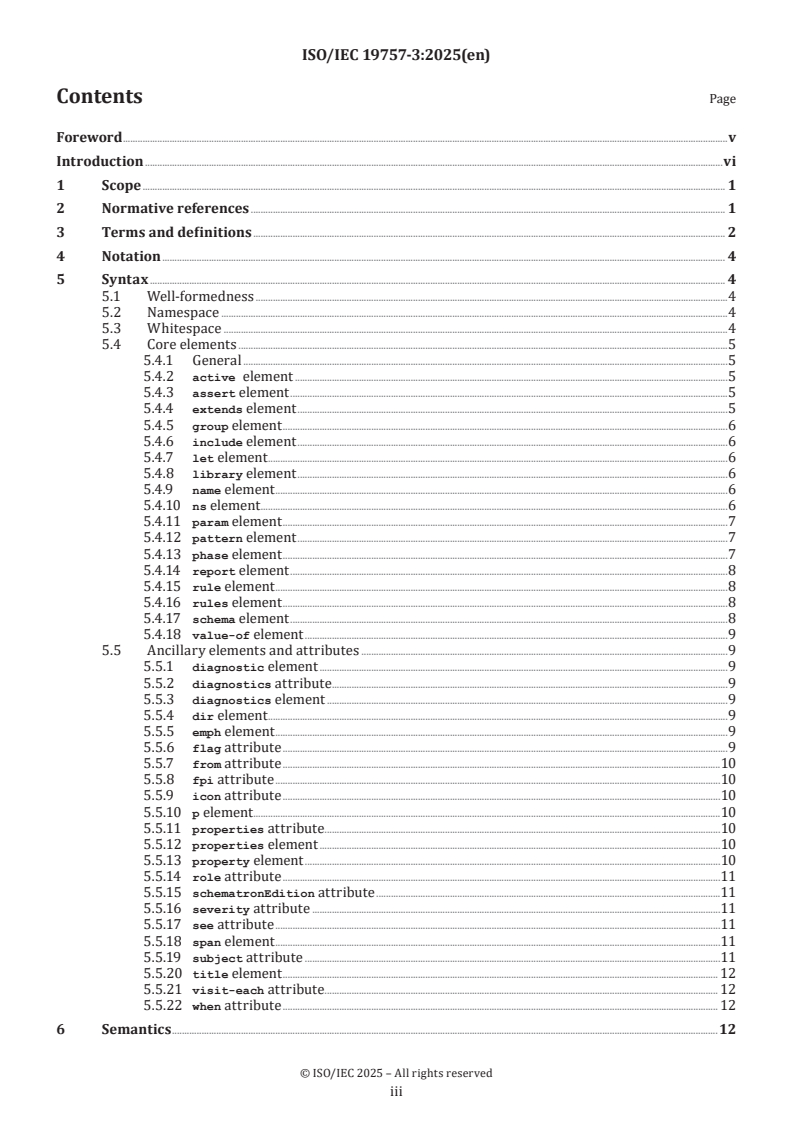
Contents Page
Foreword .v
Introduction .vi
1 Scope . 1
2 Normative references . 1
3 Terms and definitions . 2
4 Notation . 4
5 Syntax . 4
5.1 Well-formedness .4
5.2 Namespace .4
5.3 Whitespace .4
5.4 Core elements .5
5.4.1 General .5
5.4.2 active element .5
5.4.3 assert element .5
5.4.4 extends element .5
5.4.5 group element .6
5.4.6 include element .6
5.4.7 let element .6
5.4.8 library element .6
5.4.9 name element .6
5.4.10 ns element .6
5.4.11 param element .7
5.4.12 pattern element .7
5.4.13 phase element .7
5.4.14 report element .8
5.4.15 rule element .8
5.4.16 rules element .8
5.4.17 schema element .8
5.4.18 value-of element .9
5.5 Ancillary elements and attributes .9
5.5.1 diagnostic element .9
5.5.2 diagnostics attribute . .9
5.5.3 diagnostics element .9
5.5.4 dir element .9
5.5.5 emph element .9
5.5.6 flag attribute .9
5.5.7 from attribute .10
5.5.8 fpi attribute .10
5.5.9 icon attribute .10
5.5.10 p element .10
5.5.11 properties attribute.10
5.5.12 properties element .10
5.5.13 property element .10
5.5.14 role attribute .11
5.5.15 schematronEdition attribute .11
5.5.16 severity attribute .11
5.5.17 see attribute .11
5.5.18 span element .11
5.5.19 subject attribute .11
5.5.20 title element . 12
5.5.21 visit-each attribute. 12
5.5.22 when attribute . 12
6 Semantics .12
© ISO/IEC 2025 – All rights reserved
iii
6.1 Validation function . 12
6.2 Minimal syntax. 13
6.3 Processing model . 13
6.4 Abstract pattern processing . .14
6.5 Query language binding .16
6.6 Order and side-effects .16
6.7 Localization and language fixup .17
6.8 Base URI fixup .17
7 Conformance . 17
7.1 Simple conformance .17
7.2 Full conformance .17
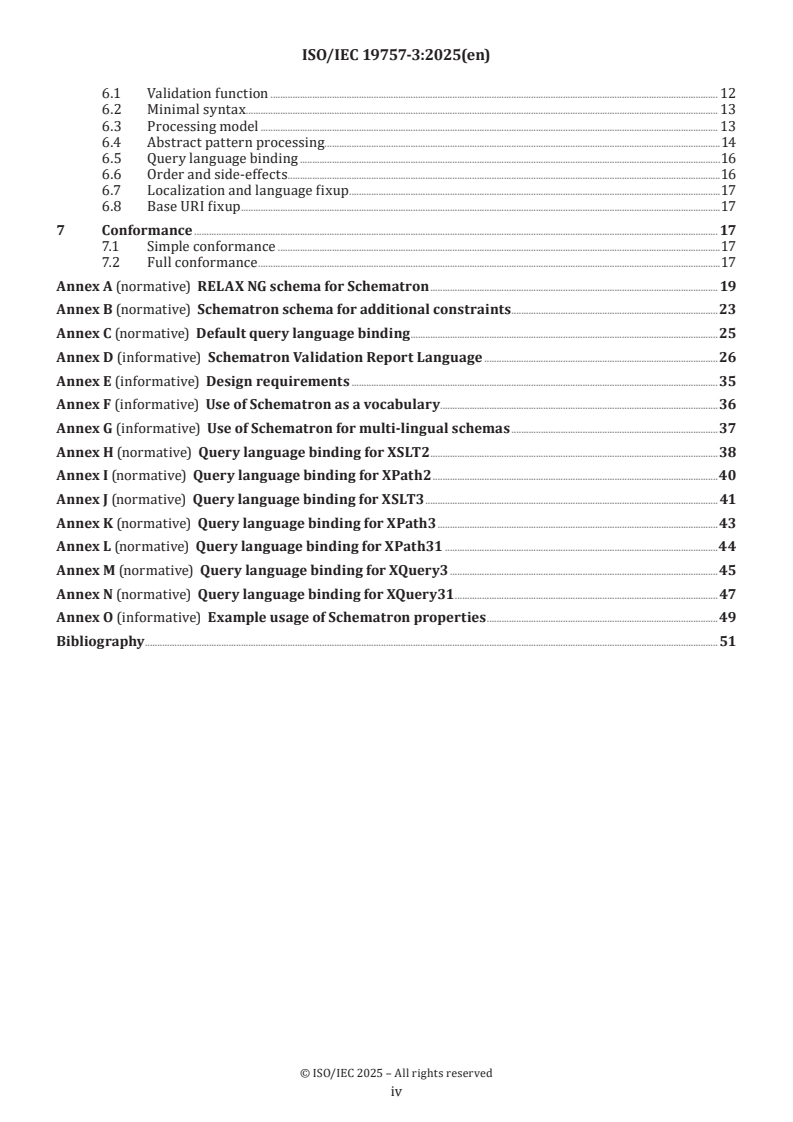
Annex A (normative) RELAX NG schema for Schematron . 19
Annex B (normative) Schematron schema for additional constraints .23
Annex C (normative) Default query language binding .25
Annex D (informative) Schematron Validation Report Language .26
Annex E (informative) Design requirements .35
Annex F (informative) Use of Schematron as a vocabulary.36
Annex G (informative) Use of Schematron for multi-lingual schemas .37
Annex H (normative) Query language binding for XSLT2 .38
Annex I (normative) Query language binding for XPath2 .40
Annex J (normative) Query language binding for XSLT3 . 41
Annex K (normative) Query language binding for XPath3 .43
Annex L (normative) Query language binding for XPath31 .44
Annex M (normative) Query language binding for XQuery3 .45
Annex N (normative) Query language binding for XQuery31 . 47
Annex O (informative) Example usage of Schematron properties .49
Bibliography .51
© ISO/IEC 2025 – All rights reserved
iv
Foreword
ISO (the International Organization for Standardization) and IEC (the International Electrotechnical
Commission) form the specialized system for worldwide standardization. National bodies that are
members of ISO or IEC participate in the development of International Standards through technical
committees established by the respective organization to deal with particular fields of technical activity.
ISO and IEC technical committees collaborate in fields of mutual interest. Other international organizations,
governmental and non-governmental, in liaison with ISO and IEC, also take part in the work.
The procedures used to develop this document and those intended for its further maintenance are described
in the ISO/IEC Directives, Part 1. In particular, the different approval criteria needed for the different types of
document should be noted. This document was drafted in accordance with the editorial rules of the ISO/IEC
Directives, Part 2 (see https://www.iso.org/directives or https://www.iec.ch/members_experts/refdocs).
ISO and IEC draw attention to the possibility that the implementation of this document may involve the
use of (a) patent(s). ISO and IEC take no position concerning the evidence, validity or applicability of any
claimed patent rights in respect thereof. As of the date of publication of this document, ISO and IEC had not
received notice of (a) patent(s) which may be required to implement this document. However, implementers
are cautioned that this may not represent the latest information, which may be obtained from the patent
database available at https://www.iso.org/patents and https://patents.iec.ch. ISO and IEC shall not be held
responsible for identifying any or all such patent rights.
Any trade name used in this document is information given for the convenience of users and does not
constitute an endorsement.
For an explanation of the voluntary nature of standards, the meaning of ISO specific terms and expressions
related to conformity assessment, as well as information about ISO's adherence to the World Trade Organization
(WTO) principles in the Technical Barriers to Trade (TBT) see https://www.iso.org/iso/foreword.html. In
the IEC, see https://www.iec.ch/understanding-standards.
This document was prepared by Joint Technical Committee ISO/IEC JTC 1, Information technology,
Subcommittee SC 34, Document description and processing languages.
[1]
This fourth edition cancels and replaces the third edition (ISO/IEC 19757-3:2020 ), which has been
technically revised.
The main changes are as follows:
— a query language binding has been added for XQuery3 (Annex M);
— new elements group (5.4.5), library (5.4.8) and rules (5.4.16) have been added;
— new attribute as has been added to element let (5.4.7), to enable datatyping of variables;
— new attributes schematronEdition (5.5.15) and severity (5.5.16) have been added;
— param elements (5.4.11) are now allowed for schemas and abstract patterns and in the latter case their
value can act as a default;
— attributes flag (5.5.6), role (5.5.14) and severity (5.5.16) are dynamically evaluated if their value is a
variable reference;
— element extends (5.4.4) is made available at the top level of a schema;
— the methods of base URI fixup (6.8) and language fixup (6.7) are specified;
— a mapping of schema to SVRL structures is provided in Annex D.
A list of all parts in the ISO/IEC 19757 series can be found on the ISO website.
Any feedback or questions on this document should be directed to the user’s national standards body. A
complete listing of these bodies can be found at www.iso.org/members.html.
© ISO/IEC 2025 – All rights reserved
v
Introduction
[2]
ISO/IEC 19757 (all parts) defines a set of Document Schema Definition Languages (DSDL) that can be used
[3]
to specify one or more validation processes performed against Extensible Markup Language (XML 1.0 )
or Standard Generalized Markup Language (SGML) documents. [XML is an application profile SGML (see
[4]
ISO 8879 ).
A document model is an expression of the constraints to be placed on the structure and content of documents
to be validated with the model. A number of technologies have been developed through various formal
and informal consortia since the development of Document Type Definitions (DTDs) as part of ISO 8879
[4]
, notably by the World Wide Web Consortium (W3C) and the Organization for the Advancement of
Structured Information Standards (OASIS). A number of validation technologies are standardized in DSDL
to complement those already available as standards or from the industry.
Through the validation that a structured document conforms to specified constraints in structure and
content, the potentially many applications acting on the document are relieved from duplicating the task
of confirming that such requirements have been met. Historically, such tasks and expressions have been
developed and utilized in isolation, without consideration of how the features and functionality available in
other technologies can enhance validation objectives.
[2]
The main objective of ISO/IEC 19757 (all parts) is to bring together different validation-related tasks
and expressions to form a single extensible framework that allows technologies to work in series or in
parallel to produce a single or a set of validation results. The extensibility of DSDL accommodates validation
technologies not yet designed or specified.
In the past, different design and use criteria have led users to choose different validation technologies
for different portions of their information. Bringing together information within a single XML document
sometimes prevents existing document models from being used to validate sections of data. By providing
an integrated suite of constraint description languages that can be applied to different subsets of a single
[2]
XML document, ISO/IEC 19757 (all parts) allows different validation technologies to be integrated under
a well-defined validation policy.
The structure of this document is as follows. Clause 5 describes the syntax of a Schematron schema. Clause 6
describes the semantics of a correct Schematron schema; the semantics specify when a document is valid
with respect to a Schematron schema. Clause 7 describes conformance requirements for implementations
[5]
of Schematron validators. Annex A provides the ISO/IEC 19757-2 (RELAX NG) schema for Schematron.
Annex B provides the Schematron schema for constraints in Schematron that cannot be expressed by the
schema of Annex A. Annex C provides the default query language binding to XSLT1. Annex D provides an
[5]
ISO/IEC 19757-2 (RELAX NG compact syntax) schema and corresponding Schematron schema for a simple
XML language Schematron Validation Report Language. Annex E provides motivating design requirements
for Schematron. Annex F specifies certain Schematron elements to be used in external vocabularies. Annex G
provides a simple example of a multi-lingual schema. Annex H to Annex M provide query language bindings.
Annex O shows example usage of Schematron properties.
[1]
This edition is backwards compatible with ISO/IEC 19757-3:2020 to the extent that validation results
produced by existing schemas are unaffected by the changes this edition makes, supersedes it and provides
extra query language bindings, for XQuery3.
Considered as a document type, a Schematron schema contains natural-language assertions concerning a set
of documents, marked up with various elements and attributes for testing these natural-language assertions
and for simplifying and grouping assertions.
Considered theoretically, a Schematron schema reduces to a non-chaining rule system whose terms are
Boolean functions invoking an external query language on the instance and other visible XML documents,
with syntactic features to reduce specification size and to allow efficient implementation.
Considered analytically, Schematron has two characteristic high-level abstractions: the pattern and the
[5]
phase. These allow the representation of non-regular, non-sequential constraints that ISO/IEC 19757-2
cannot specify and various dynamic or contingent constraints.
© ISO/IEC 2025 – All rights reserved
vi
[6] [7]
This document is based on the Schematron assertion language. The let element is based on XCSL .
Other features arise from the half-dozen early open-source implementations of Schematron in diverse
programming languages and from discussions in electronic forums by Schematron users and implementers.
© ISO/IEC 2025 – All rights reserved
vii
International Standard ISO/IEC 19757-3:2025(en)
Information technology — Document Schema Definition
Languages (DSDL) —
Part 3:
Rule-based validation using Schematron
1 Scope
This document specifies Schematron, a schema language for XML. This document establishes requirements
for Schematron schemas and specifies when an XML document matches the patterns specified by a
Schematron schema. Schematron uses query languages such as XPath for writing assertions.
2 Normative references
The following documents are referred to in the text in such a way that some or all of their content constitutes
requirements of this document. For dated references, only the edition cited applies. For undated references,
the latest edition of the referenced document (including any amendments) applies.
Extensible Markup Language (XML) 1.0 (Fifth Edition), 26 November 2008, https:// www .w3 .org/ TR/ 2008/
REC -xml -20081126/
ISO/IEC 19757-2, Information technology — Document Schema Definition Language (DSDL) — Part 2: Regular-
grammar-based validation — RELAX NG
XML 1.1, Extensible Markup Language (XML) 1.1 (Second Edition), 16 August 2006, https:// www .w3 .org/ TR/
2006/ REC -xml11 -20060816/
XML Inclusions (XInclude) Version 1.0 (Second Edition), 15 November 2006, https://w ww .w3 .org/ TR/ 2006/
REC -xinclude -20061115/
XML Path Language (XPath) 2.0, W3C Recommendation, 23 January 2007, https:// www .w3 .org/ TR/
xpath20/
XML Path Language (XPath) 3.0, W3C Recommendation, 8 April 2014, https:// www .w3 .org/ TR/ xpath -30/
XML Path Language (XPath) 3.1, 21 March 2017, https:// www .w3 .org/ TR/ xpath -31/
XML Path Language (XPath) Version 1.0, W3C Recommendation, 16 November 1999, https:// www .w3 .org/
TR/ xpath -10/
XPath and XQuery Functions and Operators 3.0, W3C Recommendation, 8 April 2014, https:// www .w3 .org/
TR/ xpath -functions -30/
XQuery 1.0 and XPath 2.0 Functions and Operators, W3C Recommendation, 14 December 2010, https:// www
.w3 .org/ TR/ 2010/ REC -xpath -functions -20101214/
XQuery 3.0: An XML Query Language, 08 April 2014, https:// www .w3 .org/ TR/ xquery -30/
XQuery 3.1: An XML Query Language, 21 March 2017, https:// www .w3 .org/ TR/ xquery -31/
XSL Transformations (XSLT) Version 1.0, W3C Recommendation, 16 November 1999, https://w ww .w3 .org/
TR/ xslt -10/
© ISO/IEC 2025 – All rights reserved
XSL Transformations (XSLT) Version 2.0, W3C Recommendation, 23 January 2007, http:// www .w3 .org/ TR/
xslt20/
XSL Transformations (XSLT) Version 3.0, W3C Recommendation, 8 June 2017, https://w ww .w3 .org/ TR/ xslt -30/
3 Terms and definitions
For the purposes of this document, the following terms and definitions apply.
ISO and IEC maintain terminology databases for use in standardization at the following addresses:
— ISO Online browsing platform: available at https:// www .iso .org/ obp
— IEC Electropedia: available at https:// www .electropedia .org/
3.1
abstract pattern
pattern (3.13) in a Schematron schema (3.7) that has been parameterized to enable reuse
3.2
abstract rule
collection of assertions (3.5) which can be included in other rules (3.18) but which does not fire itself
3.3
active pattern
pattern (3.13) belonging to the active phase (3.4)
3.4
active phase
phase (3.14) whose patterns (3.13) are used for validation
3.5
assertion
natural-language statement with associated assertion test (3.6) and ancillary attributes
3.6
assertion test
query returning a Boolean value
Note 1 to entry: An assertion test "succeeds" or "fails".
3.7
Schematron schema
document that satisfies all the requirements of this document
3.8
diagnostic
named natural-language statements providing information to end-users of validators concerning the
expected and actual values together with repair hints
3.9
elaborated rule-context expression
single rule-context expression (3.20) which explicitly disallows items selected by lexically previous rule
contexts (3.19) in the same pattern (3.13)
3.10
implementation
instantiation of a Schematron validator
© ISO/IEC 2025 – All rights reserved
3.11
name
mixture of characters with a restricted set of initial characters
[3]
Note 1 to entry: See Production 5 of XML 1.0 .
3.12
natural-language assertion
natural-language statement expressing some part of a pattern (3.13)
Note 1 to entry: A natural-language assertion is "met" or "unmet".
3.13
pattern
collection of rules (3.18) with an optional identifier and ancillary information
Note 1 to entry: Patterns of a schema do not have a defined order.
Note 2 to entry: Patterns are represented in schemas by elements pattern (5.4.12) and group (5.4.5).
3.14
phase
named, unordered collection of patterns (3.13)
Note 1 to entry: Patterns may belong to more than one phase.
Note 2 to entry: Three strings, #ALL, #ANY and #DEFAULT, are reserved with particular meanings.
3.15
progressive validation
validation of constraints in stages determined or grouped to some extent by the schema author rather than,
for example, entirely determined by the document order
3.16
property
named data giving additional metadata on an assertion (3.5) or report
3.17
query language binding
named set, specified in a document, of the languages and conventions used for assertion tests (3.6), rule-
context expressions (3.20) and so on, by a particular Schematron implementation (3.10)
3.18
rule
unordered collection of assertions (3.5) with a rule-context expression (3.20) and ancillary attributes
3.19
rule context
element or other information item used for assertion tests (3.6)
Note 1 to entry: A rule (3.18) is said to fire when an information item matches the rule context.
3.20
rule-context expression
query to specify subjects (3.21)
Note 1 to entry: A rule context (3.19) is said to match an information item when that information item has not been
matched by any lexically-previous rule-context expressions in the same pattern (3.13) and the information item is one
of the information items that the query would specify.
© ISO/IEC 2025 – All rights reserved
3.21
subject
particular information item which corresponds to the object of interest of the natural-language assertions
(3.12) and typically is matched by the context expression of a rule (3.18)
Note 1 to entry: Subjects can be more precisely defined in schemas by the subject attribute (5.5.19).
3.22
valid
passing all assertion tests (3.6) in fired rules (3.18) of active patterns (3.3)
3.23
variable
constant value, represented by a name (3.11), evaluated within the parent schema, phase (3.14), pattern
(3.13) or rule (3.18) and scoped within the parent schema, phase, pattern or rule
Note 1 to entry: Variables are represented in schemas by elements let (5.4.7) and param (5.4.11).
4 Notation
This document uses XPath to identify information items, to the extent that items in the XPath data model
[8]
can be derived from those defined by XML Infoset , in Schematron schemas.
5 Syntax
5.1 Well-formedness
A Schematron schema shall be a well-formed XML document, according to the version of XML (XML 1.0 or
XML 1.1) used.
5.2 Namespace
[9]
All elements shown in the grammar for Schematron are qualified with the namespace URI [IRI ]:
http://purl.oclc.org/dsdl/schematron
In this document, the prefix sch is taken as bound to the Schematron namespace URI for exposition purposes.
The prefix sch is not reserved or required by this document. Any element can also have foreign attributes
in addition to the attributes shown in the grammar. A foreign attribute is an attribute with a name whose
namespace URI is neither the empty string nor the Schematron namespace URI. Any non-empty element may
have foreign child elements in addition to the child elements shown in the grammar. A foreign element is an
element with a name whose namespace URI is not the Schematron namespace URI. There are no constraints
on the relative position of foreign child elements with respect to other child elements.
5.3 Whitespace
Any element can also have children strings that consist entirely of whitespace characters, where a
whitespace character is one of U+0020, U+009, U+00D or U+00A. There are no constraints on the relative
position of whitespace string children with respect to child elements.
Leading and trailing whitespace should be stripped from attributes defined by this document. Whitespace
should be collapsed in elements defined by this document that allow text. Whitespace may be stripped from
elements defined by this document that do not allow text.
© ISO/IEC 2025 – All rights reserved
5.4 Core elements
5.4.1 General
A Schematron schema shall follow the grammar given in Annex A.
For information on the use of Schematron elements in external vocabularies, see Annex F.
5.4.2 active element
The required pattern attribute is a reference to a pattern that is active in the current phase.
5.4.3 assert element
This element indicates an assertion made about the context nodes. The data content is a natural-language
assertion. The required test attribute is an assertion test evaluated in the current context. If the test
evaluates positive, the assertion succeeds. The optional diagnostics attribute is a reference to further
diagnostic information. The optional properties attribute is a reference to additional arbitrary properties.
The natural-language assertion shall be a positive statement of a constraint.
The icon, see and fpi attributes (5.5.9, 5.5.17 and 5.5.8) allow rich interfaces and documentation.
The flag attribute (5.5.6) allows more detailed outcomes.
The role and subject attributes (5.5.14 and 5.5.19) allow explicit identification of some part of a pattern.
The optional severity attribute (5.5.16) expresses the relative importance of an assertion.
The natural-language assertion may contain information about actual values in addition to expected
values and may contain diagnostic information. Users should note, however, that the diagnostic element is
provided for such information to encourage clear statement of the natural-language assertion.
5.4.4 extends element
The extends element allows reference to the contents of other declarations. The extends element shall either
have an href attribute or a rule attribute but not both.
Abstract rules are named lists of assertions without a context expression. An extends element with a rule
attribute shall reference an abstract rule. The current rule uses all the assertions from the abstract rule it
extends.
An extends element with an href attribute shall reference external declarations. An external declaration is a
Schematron element of the same type as the parent element of the extends element: schema, library or rule.
NOTE There is no requirement for rule elements referenced using an href attribute to be abstract.
The href attribute is an IRI reference to an external well-formed XML document or to an element in an
external well-formed XML document. If a document is referenced, its root element is the external declaration,
otherwise the element referenced is the external declaration. The contents of the external declaration shall
be inserted in place of the extends element.
In such a case, the relative position of elements in the post-inclusion document may be to that extent invalid
against the schema for Schematron in Annex A; however, other schema constraints such as containment
shall still apply.
An implementation shall report any errors encountered during the processing of extends, for diagnostic
purposes. Whether an implementation terminates in this event is implementation-defined.
© ISO/IEC 2025 – All rights reserved
5.4.5 group element
The group element has the same structure and semantics as element pattern (5.4.12), except that the if-then-
else behaviour of evaluating rules within a pattern shall not apply (see 6.6).
5.4.6 include element
The required href attribute shall be an IRI reference to a well-formed XML document or to an element in a
well-formed XML document.
The referenced element shall be inserted in place of the include element. The referenced element shall be a
type which is allowed by the grammar for Schematron at the location of the include element.
An implementation shall report any errors encountered during the processing of include, for diagnostic
purposes. Whether an implementation terminates in this event is implementation-defined.
5.4.7 let element
The let element declares a named variable. If the let element is the child of a rule element, the variable is
calculated and scoped to the current rule and context. Otherwise, the variable is calculated with the context
of the instance document root.
The required name attribute is the name of the variable. The value attribute is an expression evaluated in the
current context. If no value attribute is specified, the value of the attribute is the element content of the let
element.
The optional as attribute is the datatype of the variable. The query language binding shall determine
whether the as attribute is supported and how it is processed.
It is an error to reference a variable that has not been defined in the current schema, phase, pattern or rule,
if the query language binding allows this to be determined reliably. It is an error for a variable to be multiply
defined in the current schema, phase, pattern and rule.
The variable is substituted into assertion tests and other expressions in the same rule before the test or
expression is evaluated. The query language binding specifies which lexical conventions are used to detect
references to variables.
5.4.8 library element
The library element is an allowed root element containing external declarations, including abstract rules
(see 5.4.16) and patterns (see 5.4.12 and 5.4.5).
The contents of this element can be included in a schema by using extends (see 5.4.4).
5.4.9 name element
The name element provides the names of nodes from the instance document to allow clearer assertions and
diagnostics. The optional path attribute is an expression evaluated in the current context that returns a
string that is the name of a node. If the path attribute is omitted, the name of the context node is used.
5.4.10 ns element
The ns element specifies a namespace prefix and URI. The required prefix attribute is an XML name with no
colon character. The required uri attribute is a namespace URI [IRI].
Namespace prefixes in context expressions, assertion tests and other query expressions shall be defined by this
element. Namespace prefixes shall not use the namespace bindings in scope for element and attribute names.
[10]
NOTE 1 Namespace declarations as specified in XML 1.0 Namespaces (e.g. xmlns:foo="http://www.example.
com") do not apply to namespace prefixes in context expressions, assertion tests and other query expressions.
© ISO/IEC 2025 – All rights reserved
[3]
NOTE 2 Because the characters allowed as names can change in versions of XML subsequent to W3C XML 1.0 , the
[5]
ISO/IEC 19757-2 (RELAX NG Compact Syntax) schema for Schematron does not constrain the prefix to particular
characters.
5.4.11 param element
The param element specifies a name-value pair providing parameters for an abstract pattern or a schema.
The required name attribute is an XML name with no colon. The value attribute is a fragment of a query.
The value attribute is required for parameters specified for schemas. The value of a parameter for a schema
may be overridden at user option. This mechanism is implementation-defined.
The value of a parameter is specified for concrete patterns by the value attribute or if absent by the value
attribute of a parameter whose name attribute matches that of a parameter for the abstract pattern the
concrete pattern instantiates. It is an error if no parameter value is thereby specified for a concrete pattern.
In a schema the names of pattern parameters and the number specified shall correspond between abstract
and concrete patterns.
Parameter names shall be distinct within the scope of a pattern or schema.
5.4.12 pattern element
The id attribute provides a unique name for the pattern and is required for abstract patterns. The child rule
elements of a pattern give constraints that are in some way related.
The optional documents attribute provides IRIs of the subordinate documents the rule contexts are relative
to. The documents attribute is evaluated in the context of the original instance document root. Variables
scoped to the pattern are not in scope when evaluating the documents attribute. The pattern is sought in
each of the documents located at the IRI(s) which result from evaluating the expression and is not sought
in the original instance document. Relative IRIs are resolved relative to the base IRI of the original instance
document.
Conformant implementations should retrieve the subordinate documents in such a way that the results are
deterministic. Where a document cannot be retrieved, the implementation shall report this for diagnostic
purposes, and may do so by using element svrl:error (see Annex D). Whether the processor terminates in
this event is implementation-defined.
The icon, see and fpi attributes (5.5.9, 5.5.17 and 5.5.8) allow rich interfaces and documentation.
When a pattern element has the attribute abstract with a value true, then the pattern defines an abstract
pattern. An abstract pattern shall not have an is-a attribute and shall have an id attribute.
5.4.13 phase element
The phase element provides the means to declare named groups of patterns, for example to support
progressive validation. Additional information on design requirements for progressive validation is
provided in Annex E.
The required id attribute is the name of the phase. The element specifies the phase to be used for validating
documents, for example, by user command.
The optional from attribute (see 5.5.7) can be used to restrict validation to a subset of a document.
The optional when attribute (see 5.5.22) can be used to select the active phase based on the evaluation of its
expression.
...