

ISO 18943:2014
(Main)Imaging materials — Magnetic hard drives used for image storage — Care and handling
General Information
- Abstract
ISO 18943:2014 concerns the storage, care, and handling of HDDs. It recommends handling procedures to maximise the effective life of the data written on magnetic HDDs. Faulty care and handling methods can cause damage to a disk and the contents written thereon. It also recommends storage practices to preserve both the hard disk media and the content encoded thereon. The recommendations in this International Standard apply where the desired result is extended-term retention of the data encoded on the disk. The use of the phrase "care and handling" in this International Standard is restricted to the physical domain or hardware aspects of the HDD. This International Standard is not intended to address associated or relative system aspects of HDDs. With recognition that the scope of systems is covered in other standards, this International Standard precisely aims to fill a void of information on HDDs as physical media with failure mechanisms and handling risks. This International Standard does not promote or advocate that proper physical care and handling represents the only element on the path to extended-term usage (more than two years), but rather is part of a comprehensive set of practices to mitigate risks in the long term preservation of content stored on HDDs.
- Status
- Published
- Publication Date
- 25-Nov-2014
- Technical Committee
- ISO/TC 42 - Photography
- Current Stage
- 9093 - International Standard confirmed
- Start Date
- 17-Jun-2024
- Completion Date
- 29-Aug-2026
Overview
ISO 18943:2014 - "Imaging materials - Magnetic hard drives used for image storage - Care and handling" provides best-practice guidance for the physical storage, care and handling of magnetic hard disk drives (HDDs) used to store image and other digital content. The standard focuses on hardware and media-level risks and failure mechanisms that affect the effective life of data on HDDs and on practices to maximize data retention for extended-term use. It explicitly does not cover higher‑level system aspects (file systems, application software or networked storage architectures).
Key topics and technical requirements
- Scope and purpose: Recommendations aimed at extended‑term retention of data encoded on HDDs; care and handling limited to physical/hardware aspects.
- HDD components and configurations: Describes disks/platters, spindle/motor, read/write and servo heads, control electronics, and typical physical configurations (single drives, disk arrays).
- Access modes: Defines operational states - online (powered), online but inactive, and off‑line - and associated handling implications.
- Environmental factors: Guidance on temperature, humidity, condensation, acclimatisation and magnetic field exposure as factors that affect HDD reliability.
- Failure mechanisms: Identification of risks such as physical shock, connector stress from plugging/unplugging, head‑to‑disk stiction, heat, humidity, particulates and magnetic degradation.
- Reliability, data quality and obsolescence: Notes limitations of HDDs for medium/long‑term passive storage; recommends migration, backups and system mirroring as mitigation strategies.
- Transport, disaster and recovery: Handling procedures for shipping, freighting and initial response after disasters (fire, water, earthquake, contamination).
- Operational controls: Staff training, minimum handling checklist, and annex material (e.g., RAID and MAID levels, informative resources).
Practical applications and target users
ISO 18943:2014 is useful for professionals responsible for the preservation and operational care of HDDs, including:
- Archivists, digital preservation specialists and imaging professionals
- IT and data‑centre managers specifying HDD handling and storage policies
- Records managers, librarians and museums managing digital collections
- Procurement and QA teams writing vendor requirements or acceptance criteria
Typical applications:
- Creating HDD handling SOPs and training programs
- Defining storage environments and transport packaging
- Integrating HDD care into disaster recovery and migration policies
- Developing minimum handling checklists and procurement specifications
Related standards
ISO 18943 complements system‑level standards covering storage architectures and interoperability. It also contains informative annexes on RAID/MAID and references for further guidance on HDD lifecycle management.
Keywords: ISO 18943:2014, HDD care and handling, magnetic hard drives, data preservation, imaging materials, HDD storage, HDD failure mechanisms, long‑term retention.
Frequently Asked Questions
ISO 18943:2014 is a standard published by the International Organization for Standardization (ISO). Its full title is "Imaging materials — Magnetic hard drives used for image storage — Care and handling". This standard covers: ISO 18943:2014 concerns the storage, care, and handling of HDDs. It recommends handling procedures to maximise the effective life of the data written on magnetic HDDs. Faulty care and handling methods can cause damage to a disk and the contents written thereon. It also recommends storage practices to preserve both the hard disk media and the content encoded thereon. The recommendations in this International Standard apply where the desired result is extended-term retention of the data encoded on the disk. The use of the phrase "care and handling" in this International Standard is restricted to the physical domain or hardware aspects of the HDD. This International Standard is not intended to address associated or relative system aspects of HDDs. With recognition that the scope of systems is covered in other standards, this International Standard precisely aims to fill a void of information on HDDs as physical media with failure mechanisms and handling risks. This International Standard does not promote or advocate that proper physical care and handling represents the only element on the path to extended-term usage (more than two years), but rather is part of a comprehensive set of practices to mitigate risks in the long term preservation of content stored on HDDs.
ISO 18943:2014 concerns the storage, care, and handling of HDDs. It recommends handling procedures to maximise the effective life of the data written on magnetic HDDs. Faulty care and handling methods can cause damage to a disk and the contents written thereon. It also recommends storage practices to preserve both the hard disk media and the content encoded thereon. The recommendations in this International Standard apply where the desired result is extended-term retention of the data encoded on the disk. The use of the phrase "care and handling" in this International Standard is restricted to the physical domain or hardware aspects of the HDD. This International Standard is not intended to address associated or relative system aspects of HDDs. With recognition that the scope of systems is covered in other standards, this International Standard precisely aims to fill a void of information on HDDs as physical media with failure mechanisms and handling risks. This International Standard does not promote or advocate that proper physical care and handling represents the only element on the path to extended-term usage (more than two years), but rather is part of a comprehensive set of practices to mitigate risks in the long term preservation of content stored on HDDs.
ISO 18943:2014 is classified under the following ICS (International Classification for Standards) categories: 37.040.99 - Other standards related to photography. The ICS classification helps identify the subject area and facilitates finding related standards.
ISO 18943:2014 is available in PDF format for immediate download after purchase. The document can be added to your cart and obtained through the secure checkout process. Digital delivery ensures instant access to the complete standard document.
Standards Content (Sample)
INTERNATIONAL ISO
STANDARD 18943
First edition
2014-12-01
Imaging materials — Magnetic hard
drives used for image storage — Care
and handling
Matériaux d’imagerie — Disques durs magnétiques utilisés pour le
stockage d’images — Soins et manipulation
Reference number
©
ISO 2014
© ISO 2014
All rights reserved. Unless otherwise specified, no part of this publication may be reproduced or utilized otherwise in any form
or by any means, electronic or mechanical, including photocopying, or posting on the internet or an intranet, without prior
written permission. Permission can be requested from either ISO at the address below or ISO’s member body in the country of
the requester.
ISO copyright office
Case postale 56 • CH-1211 Geneva 20
Tel. + 41 22 749 01 11
Fax + 41 22 749 09 47
E-mail copyright@iso.org
Web www.iso.org
Published in Switzerland
ii © ISO 2014 – All rights reserved
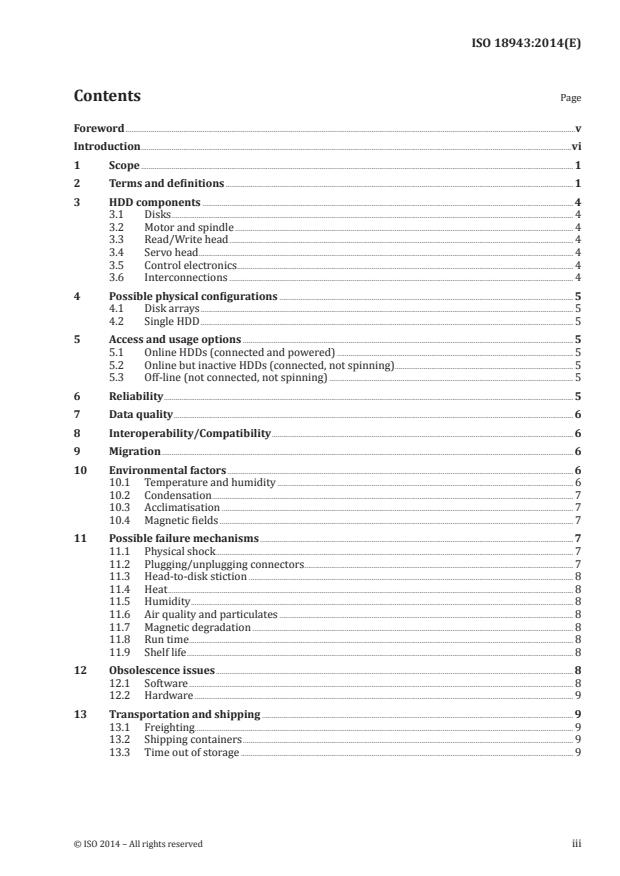
Contents Page
Foreword .v
Introduction .vi
1 Scope . 1
2 Terms and definitions . 1
3 HDD components . 4
3.1 Disks . 4
3.2 Motor and spindle . 4
3.3 Read/Write head . 4
3.4 Servo head . 4
3.5 Control electronics . 4
3.6 Interconnections . 4
4 Possible physical configurations . 5
4.1 Disk arrays . 5
4.2 Single HDD . 5
5 Access and usage options . 5
5.1 Online HDDs (connected and powered) . 5
5.2 Online but inactive HDDs (connected, not spinning) . 5
5.3 Off-line (not connected, not spinning) . 5
6 Reliability . 5
7 Data quality . 6
8 Interoperability/Compatibility . 6
9 Migration . 6
10 Environmental factors . 6
10.1 Temperature and humidity . 6
10.2 Condensation . 7
10.3 Acclimatisation . 7
10.4 Magnetic fields . 7
11 Possible failure mechanisms . 7
11.1 Physical shock . 7
11.2 Plugging/unplugging connectors . . 7
11.3 Head-to-disk stiction . 8
11.4 Heat . 8
11.5 Humidity . 8
11.6 Air quality and particulates . 8
11.7 Magnetic degradation . 8
11.8 Run time . 8
11.9 Shelf life . 8
12 Obsolescence issues . 8
12.1 Software . 8
12.2 Hardware . 9
13 Transportation and shipping . 9
13.1 Freighting. 9
13.2 Shipping containers . 9
13.3 Time out of storage . 9
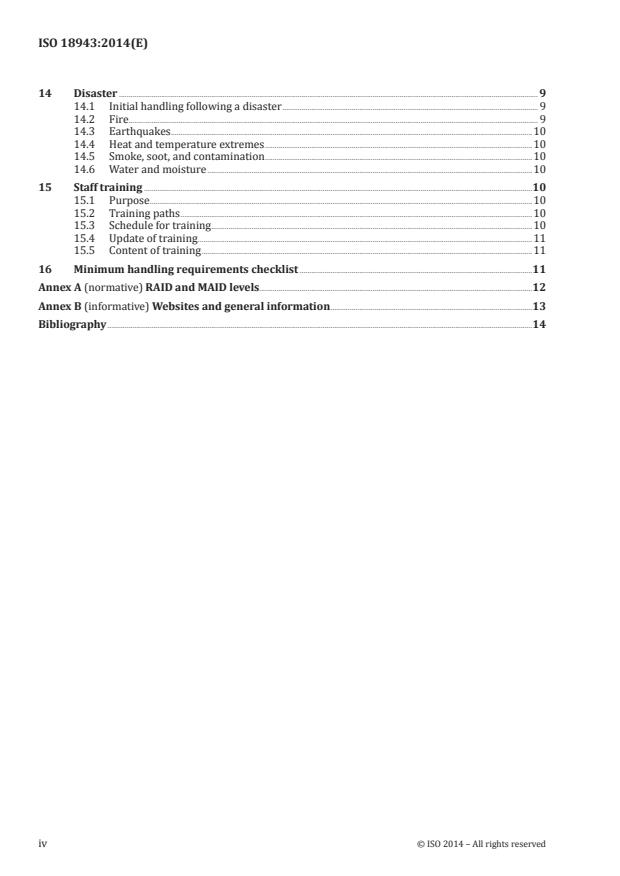
14 Disaster . 9
14.1 Initial handling following a disaster . 9
14.2 Fire . . 9
14.3 Earthquakes .10
14.4 Heat and temperature extremes .10
14.5 Smoke, soot, and contamination .10
14.6 Water and moisture .10
15 Staff training .10
15.1 Purpose .10
15.2 Training paths .10
15.3 Schedule for training .10
15.4 Update of training .11
15.5 Content of training .11
16 Minimum handling requirements checklist .11
Annex A (normative) RAID and MAID levels.12
Annex B (informative) Websites and general information .13
Bibliography .14
iv © ISO 2014 – All rights reserved
Foreword
ISO (the International Organization for Standardization) is a worldwide federation of national standards
bodies (ISO member bodies). The work of preparing International Standards is normally carried out
through ISO technical committees. Each member body interested in a subject for which a technical
committee has been established has the right to be represented on that committee. International
organizations, governmental and non-governmental, in liaison with ISO, also take part in the work.
ISO collaborates closely with the International Electrotechnical Commission (IEC) on all matters of
electrotechnical standardization.
The procedures used to develop this document and those intended for its further maintenance are
described in the ISO/IEC Directives, Part 1. In particular the different approval criteria needed for the
different types of ISO documents should be noted. This document was drafted in accordance with the
editorial rules of the ISO/IEC Directives, Part 2 (see www.iso.org/directives).
Attention is drawn to the possibility that some of the elements of this document may be the subject of
patent rights. ISO shall not be held responsible for identifying any or all such patent rights. Details of
any patent rights identified during the development of the document will be in the Introduction and/or
on the ISO list of patent declarations received (see www.iso.org/patents).
Any trade name used in this document is information given for the convenience of users and does not
constitute an endorsement.
For an explanation on the meaning of ISO specific terms and expressions related to conformity
assessment, as well as information about ISO’s adherence to the WTO principles in the Technical Barriers
to Trade (TBT) see the following URL: Foreword - Supplementary information
The committee responsible for this document is ISO/TC 42, Photography.
Introduction
Magnetic hard disk drives (HDD) are used widely for short and extended-term storage of data, including
audio, still, and moving images. HDDs are popular because they are small, inexpensive, self-contained,
and have very high storage capacities. The most common form of HDD comes in a semi-sealed metal
housing that measures 25 mm × 100 mm × 130 mm. Each unit has a connector for power and a connector
for receiving and transmitting data and commands. Each HDD of this form contains one to as many as
five 89 mm diameter magnetic disks (sometimes called platters) coated on an aluminium substrate. The
location of working HDDs can be internal or external to computer workstations, and can be connected
singly or in groups.
There are three broad categories of HDDs.
a) Consumer. Consumer HDDs are the most common types of HDDs. They are low in cost and are made
for consumer and office work.
b) Enterprise. Enterprise HHDs cost more, are subjected to additional testing at the factory, and are
intended for higher performance and reliability, and more intensive usage. They are typically used
as part of data centre storage systems. They usually run at a higher rotational speed.
c) Miniature. Miniature HDDs have disks with smaller diameters and are used in mobile computers,
including laptop computers and mobile consumer electronic devices.
There are several operating modes for HDDs, and these are described in Clause 3. In general, the three
most common modes of HDDs are
a) online,
b) online but inactive, and
c) off-line.
The main longevity issues for HDDs are failures due to natural disasters, manufacturing defects, faulty
electronic components, or obsolescence of the software interface. Proper care and handling helps
reduce the risk of failure from physical impact, environmental extremes, and contamination, but proper
care and handling by itself will not prevent failure. Migration and the making of backup copies are also
strategies to mitigate against failure. Many HDD users migrate their entire digital collections every five
years. Medium- and long-term storage of data on HDDs is not endorsed. Medium- and long-term storage
of data on HDDs requires frequent backup copying, system mirroring, or other procedure to mitigate
the significant problems posed by the use of HDDs.
HDDs used for storage purposes should not be left inactive for several years as no experience documents
the reliability of HDDs in an extended idle storage mode. Also, all electronic media, including HDDs, have
the possibility of failure. Therefore, all data shall be duplicated.
This International Standard focuses on the care and handling of HDDs, as well as the preservation of
data stored on HDDs. The physical media is only one component in the preservation of data on HDDs.
Data preservation is dependent on a total system to ensure data integrity.
vi © ISO 2014 – All rights reserved
INTERNATIONAL STANDARD ISO 18943:2014(E)
Imaging materials — Magnetic hard drives used for image
storage — Care and handling
1 Scope
This International Standard concerns the storage, care, and handling of HDDs. It recommends handling
procedures to maximise the effective life of the data written on magnetic HDDs. Faulty care and handling
methods can cause damage to a disk and the contents written thereon. It also recommends storage
practices to preserve both the hard disk media and the content encoded thereon.
The recommendations in this International Standard apply where the desired result is extended-term
retention of the data encoded on the disk. The use of the phrase “care and handling” in this International
Standard is restricted to the physical domain or hardware aspects of the HDD. This International
Standard is not intended to address associated or relative system aspects of HDDs. With recognition
that the scope of systems is covered in other standards, this International Standard precisely aims to fill
a void of information on HDDs as physical media with failure mechanisms and handling risks.
This International Standard does not promote or advocate that proper physical care and handling
represents the only element on the path to extended-term usage (more than two years), but rather is part of
a comprehensive set of practices to mitigate risks in the long term preservation of content stored on HDDs.
2 Terms and definitions
For the purposes of this document, the following terms and definitions apply.
2.1
advanced technology attachment
ATA
type of protocol that interfaces the hard disk drive with the computer
Note 1 to entry: Also, see SATA.
2.2
backup
duplicate of stored data
Note 1 to entry: It is recommended to store the back-ups at a remote site in case of a disaster.
2.3
BLER
number of erroneous blocks per second measured at the input of the C1 decoder (see ISO/IEC 60908)
during playback at the standard (x 1) data rate averaged over a 10 second measuring period
Note 1 to entry: Standards ISO/IEC 10149 and ANSI/NAPM IT9.21-1996 specify a maximum BLER rate of 220.
2.4
cartridge
housing for recording media
Note 1 to entry: Cartridges for removable HDDs contain only the disk and not the read/write heads or
interface electronics.
2.5
disk array
multiple HDDs with a common controller and file system
2.6
disk format
structure and composition of data storage on a disk
2.7
enterprise storage
ES HDDs
HDDs intended for data center storage systems with higher performance and reliability, and usually
running at higher rotational speed
Note 1 to entry: These cost more than consumer HDDs, but are subjected to additional testing at the factory.
2.8
extended-term storage conditions.
storage conditions suitable for the preservation of recorded information having permanent value
2.9
fibre channel
FC
hard drive electrical-optical interconnect allowing high performance data transfer speed
2.10
file
encapsulation of data and metadata
2.11
file format
structure and composition of data and its associated metadata in a file
2.12
hard disk
writable computer storage medium consisting of an aluminum alloy platter coated with a magnetic
material and a protective layer
2.13
hard disk drive
HDD
electromechanical device consisting of one or more magnetic disks (platters), read & write heads, a
motor, and control electronics usually contained within an enclosure and used to store data
Note 1 to entry: Also commonly referred to as hard drives or disk drives.
2.14
integrated development environment
IDE
software application that provides comprehensive facilities to computer programmers for software
development
2.15
massive array of idle disks
MAID
disk array consisting of HDDs that are normally inactive but can be powered up quickly on demand
Note 1 to entry: These HDDs can be configured as a RAID system with the data written on more than one HDD.
2.16
media
any physical material that stores data
2 © ISO 2014 – All rights reserved
2.17
migration
copying of data from one storage medium to another
2.18
mirrored HDDs
data storage configuration in which identical data is stored on two or more HDDs
2.19
parallel advanced technology attachment
PATA
parallel HDD interconnect protocol
Note 1 to entry: See SATA.
2.20
parity
disk management configuration which stores error correction information (checksums) on a dedicated
disk for the purpose of automatic data recovery
2.21
redundant array of independent disks
RAID
disk array that employs two or more drives in combination for fault tolerance and performance
Note 1 to entry: The HDDs are always spinning and data can be written over several HDDs. There are several RAID
levels, with increasing performance per level (noted below). Levels 1 – 5 still maintain a risk of total data loss.
Note 2 to entry: See the Appendix for the description of each RAID level.
2.22
reformat
copying of data file or files from one file format to another file format
2.23
refresh
copying of data files without change in file format or medium
2.24
serial advanced technology attachment
SATA
HDD interconnect protocol that is faster than parallel (PATA)
Note 1 to entry: Also see ATA.
2.25
server
computer system that provides data and software to one or more computers on a network
2.26
small computer system interface
SCSI
HDD data transfer and control protocol that allows high speed data transfer between a
computer/workstation and peripherals.
Note 1 to entry: SCSI is a common interface for enterprise HDDs.
2.27
smart monitoring and reporting technology
SMART
standard diagnostic protocol built into HDDs and used to monitor the operating condition of a HDD or
HDDs and report potential problems to the user
2.28
striping
segmentation of logically sequential data, such as a single file, so that segments can be assigned to
multiple HDDs
3 HDD components
HDDs are magnetic storage devices consisting of one or more disks requiring a connection to a compatible
computer or other host device to allow for the persistent storage of data and/or programs. The following
are the components of an HDD.
3.1 Disks
HDDs contain one or more disk per HDD, each disk having a magnetic coating. Each disk is made of
aluminium with a thin coating of a magnetic material covered by a protective layer. The magnetic coating
is sometimes coated with a lubricant.
3.2 Motor and spindle
The disks are mounted on a common spindle usually concentric to the centre shaft of the drive motor.
3.3 Read/Write head
An electromagnetic transducer mounted on the moving end of an arm that traverses the disk reading
and writing data constitutes the typical read/write head. The head floats just above the disk surface on
a very thin cushion of air.
3.4 Servo head
The servo head is a separate magnetic head that is mounted on a movable arm located at the base of
a spindle. Pre-written tracks located on the disk are used to track
...