

ISO 7334:2025
(Main)Earth-moving machinery — Vocabulary and taxonomy for automation and autonomy
General Information
- Abstract
This document defines terms for levels of automation and autonomy (LAA), thereby establishing the taxonomy describing the levels of automation and autonomy (LAA). This document does not provide specifications or requirements on automated operating systems defined herein. This document applies to earth-moving machinery (EMM) as defined in ISO 6165[1].
- Status
- Published
- Publication Date
- 27-Mar-2025
- Current Stage
- 6060 - International Standard published
- Start Date
- 28-Mar-2025
- Due Date
- 07-Jun-2025
- Completion Date
- 28-Mar-2025
Buy Documents

ISO 7334:2025 - Earth-moving machinery — Vocabulary and taxonomy for automation and autonomy Released:28. 03. 2025

ISO 7334:2025 - Engins de terrassement — Vocabulaire et taxonomie pour l’automatisation et l’autonomie Released:28. 03. 2025
Overview
ISO 7334:2025 - "Earth-moving machinery - Vocabulary and taxonomy for automation and autonomy" is the first edition (2025) ISO standard that defines a common vocabulary and a six-level taxonomy for levels of automation and autonomy (LAA) applied to earth-moving machinery (EMM). It standardizes terms such as automated operating system (AOS), operational design domain (ODD), use case, dynamic operating task (DOT), fallback, and minimum risk condition, and clarifies the roles of onboard operators, remote operators and supervisors of autonomous systems (SAS). Note: ISO 7334 sets the taxonomy and definitions - it does not prescribe technical specifications or performance requirements for AOS.
Key technical topics and requirements
- Taxonomy of LAA (Levels 0–5): Six discrete levels (L0–L5) describe how responsibility for operation and fallback is distributed between people and AOS. Levels are assigned by the manufacturer based on system design and ODD.
- L0 - No automation
- L1 - Operator assistance (single function)
- L2 - Partial automation (multiple functions)
- L3 - Full automation (AOS performs use case; operator monitors and handles fallback)
- L4 - Partial autonomy (AOS does use case + fallback within a limited ODD)
- L5 - Full autonomy (AOS fully controls machine and completes fallback)
- Defined terminology: Clear definitions for AOS, ODD, target operational domain (TOD), current operational domain (COD), use case, feature, function, DOT, fallback, and minimum risk condition-enabling consistent communication and documentation.
- Assignment rules: Levels are assigned by manufacturers based on design, development and testing; LAA reflect the AOS’s defined ODD.
- Safety concepts: Emphasis on fallback strategies and minimum risk conditions; operator responsibilities for L1–L3 are explicitly retained.
- Scope limitations: The standard applies to EMM per ISO 6165 and does not include normative technical requirements.
Practical applications and users
- Manufacturers and OEMs: Classify machine features and assign LAA; document ODD and use cases for marketing, safety and compliance.
- System integrators & software developers: Align AOS functionality with defined LAA and design fallback behavior consistent with the taxonomy.
- Worksite owners / fleet managers: Specify required LAA for procurement, risk assessments, and operational planning (AOZ - autonomous operating zones).
- Safety engineers & regulators: Use consistent vocabulary for safety cases, testing protocols and incident analysis.
- Standards authors & researchers: Reference unified terms when developing technical requirements, testing methods, or comparative studies.
Related standards
- ISO 6165 (earth-moving machinery classification/definition)
- ISO 19014‑1, ISO 34503, ISO 7130 (terminology and related concepts cited in ISO 7334)
- ISO 18497‑1 (comparison in Annex C - agricultural machinery taxonomy)
Using ISO 7334:2025 improves clarity in specifications, procurement, safety documentation and communication across the earth-moving machinery ecosystem when discussing automation and autonomy.
Buy Documents
ISO 7334:2025 - Earth-moving machinery — Vocabulary and taxonomy for automation and autonomy Released:28. 03. 2025
ISO 7334:2025 - Engins de terrassement — Vocabulaire et taxonomie pour l’automatisation et l’autonomie Released:28. 03. 2025
Frequently Asked Questions
ISO 7334:2025 is a standard published by the International Organization for Standardization (ISO). Its full title is "Earth-moving machinery — Vocabulary and taxonomy for automation and autonomy". This standard covers: This document defines terms for levels of automation and autonomy (LAA), thereby establishing the taxonomy describing the levels of automation and autonomy (LAA). This document does not provide specifications or requirements on automated operating systems defined herein. This document applies to earth-moving machinery (EMM) as defined in ISO 6165[1].
This document defines terms for levels of automation and autonomy (LAA), thereby establishing the taxonomy describing the levels of automation and autonomy (LAA). This document does not provide specifications or requirements on automated operating systems defined herein. This document applies to earth-moving machinery (EMM) as defined in ISO 6165[1].
ISO 7334:2025 is classified under the following ICS (International Classification for Standards) categories: 01.040.53 - Materials handling equipment (Vocabularies); 53.100 - Earth-moving machinery. The ICS classification helps identify the subject area and facilitates finding related standards.
ISO 7334:2025 is available in PDF format for immediate download after purchase. The document can be added to your cart and obtained through the secure checkout process. Digital delivery ensures instant access to the complete standard document.
Standards Content (Sample)
International
Standard
ISO 7334
First edition
Earth-moving machinery —
2025-03
Vocabulary and taxonomy for
automation and autonomy
Engins de terrassement — Vocabulaire et taxonomie pour
l’automatisation et l’autonomie
Reference number
© ISO 2025
All rights reserved. Unless otherwise specified, or required in the context of its implementation, no part of this publication may
be reproduced or utilized otherwise in any form or by any means, electronic or mechanical, including photocopying, or posting on
the internet or an intranet, without prior written permission. Permission can be requested from either ISO at the address below
or ISO’s member body in the country of the requester.
ISO copyright office
CP 401 • Ch. de Blandonnet 8
CH-1214 Vernier, Geneva
Phone: +41 22 749 01 11
Email: copyright@iso.org
Website: www.iso.org
Published in Switzerland
ii
Contents Page
Foreword .iv
Introduction .v
1 Scope . 1
2 Normative references . 1
3 Terms and definitions . 1
4 Taxonomy and LAA . . 4
4.1 General .4
4.2 Levels of automation and autonomy .5
5 Application of LAA . 6
5.1 LAA examples .6
5.2 LAA flowchart .6
5.3 Operational domains .8
5.4 Fallback .8
5.4.1 Fallback in automated use cases .8
5.4.2 Fallback in autonomous use cases .8
Annex A (informative) Examples of machines and their corresponding LAA . 9
Annex B (informative) Relationships between LAA attributes .10
[5]
Annex C (informative) Comparison to ISO 18497-1 - Agricultural machinery and tractors.12
Bibliography .13
iii
Foreword
ISO (the International Organization for Standardization) is a worldwide federation of national standards
bodies (ISO member bodies). The work of preparing International Standards is normally carried out through
ISO technical committees. Each member body interested in a subject for which a technical committee
has been established has the right to be represented on that committee. International organizations,
governmental and non-governmental, in liaison with ISO, also take part in the work. ISO collaborates closely
with the International Electrotechnical Commission (IEC) on all matters of electrotechnical standardization.
The procedures used to develop this document and those intended for its further maintenance are described
in the ISO/IEC Directives, Part 1. In particular, the different approval criteria needed for the different types
of ISO document should be noted. This document was drafted in accordance with the editorial rules of the
ISO/IEC Directives, Part 2 (see www.iso.org/directives).
ISO draws attention to the possibility that the implementation of this document may involve the use of (a)
patent(s). ISO takes no position concerning the evidence, validity or applicability of any claimed patent
rights in respect thereof. As of the date of publication of this document, ISO had not received notice of (a)
patent(s) which may be required to implement this document. However, implementers are cautioned that
this may not represent the latest information, which may be obtained from the patent database available at
www.iso.org/patents. ISO shall not be held responsible for identifying any or all such patent rights.
Any trade name used in this document is information given for the convenience of users and does not
constitute an endorsement. For an explanation of the voluntary nature of standards, the meaning of ISO
specific terms and expressions related to conformity assessment, as well as information about ISO's
adherence to the World Trade Organization (WTO) principles in the Technical Barriers to Trade (TBT), see
www.iso.org/iso/foreword.html.
This document was prepared by Technical Committee ISO/TC 127, Earth-moving machinery, Subcommittee
SC 4, Terminology, commercial nomenclature, classification and ratings.
Any feedback or questions on this document should be directed to the user’s national standards body. A
complete listing of these bodies can be found at www.iso.org/members.html.
iv
Introduction
This document defines the terms for automation and autonomy, and provides supporting content in the
form of taxonomy for levels of automation and autonomy (LAA). This document can be used to describe, in a
consistent manner, the full range of automated operating system (AOS) features equipped on machines.
This document serves the following purposes:
— standardizing the levels of automation and autonomy;
— clarifying the role of the operator, if any, during automated operating system engagement;
— providing a useful framework for automation and autonomy specifications and technical requirements;
— providing clarity in communications on the topics of automation and autonomy.
v
International Standard ISO 7334:2025(en)
Earth-moving machinery — Vocabulary and taxonomy for
automation and autonomy
1 Scope
This document defines terms for levels of automation and autonomy (LAA), thereby establishing the
taxonomy describing the levels of automation and autonomy (LAA).
This document does not provide specifications or requirements on automated operating systems defined herein.
[1]
This document applies to earth-moving machinery (EMM) as defined in ISO 6165 .
2 Normative references
There are no normative references in this document.
3 Terms and definitions
ISO and IEC maintain terminology databases for use in standardization at the following addresses:
— IEC Electropedia: available at https:// www .electropedia .org/
— ISO Online browsing platform: available at https:// www .iso .org/ obp
3.1
machine control system
MCS
system which responds to input signals and generates output signals causing the machine to behave in the
intended manner
[2]
[SOURCE: ISO 19014-1:— , 3.3, modified — The input signal sources have been removed to be generic.]
3.2
worksite
job site
mine site
construction site
place where earth-moving machines are operated
[3]
[SOURCE: ISO 7130:2013 , 3.6, modified — The preferred term has been changed from "work site" to
"worksite"; the admitted terms have been added; "or where routine maintenance" has been removed at the
end of the definition.]
3.3
autonomous operating zone
AOZ
designated area, or areas, within a worksite (3.2) in which machines operate in an autonomous mode
3.4
authorized person
person approved or assigned to perform specific tasks, at specific locations, on the worksite (3.2)
Note 1 to entry: Authorization can be granted by the worksite owner, manager or supervisor.
3.5
operator
authorized person (3.4) who performs all, or part of, the use case (3.20) and fallback (3.23) for a machine,
and is aware of associated risks or hazards
Note 1 to entry: People capable of causing the machine to achieve the minimum risk condition (3.22) are considered
operators.
3.6
onboard operator
operator (3.5) located in, or on, the machine
3.7
remote operator
operator (3.5) not located in, or on, the machine
3.8
supervisor of autonomous system
SAS
authorized person (3.4) who oversees an autonomous system
Note 1 to entry: The SAS is only in control of the machine indirectly and does not perform fallback (3.23).
3.9
bystander
person including non-employee, child, or member of the public with little or no awareness of machine
hazards and no training
[2]
[SOURCE: ISO 19014-1:— , 3.4.3]
3.10
co-worker
authorized person (3.4) working in the vicinity of a machine and aware of associated hazards
[2]
[SOURCE: ISO 19014-1:— , 3.4.2, modified — "authorized" has been added.]
3.11
automation
EMM automation
operation of a machine control system (3.1) by automatic means, with operator (3.5) interaction
Note 1 to entry: Partial automation includes systems that assist the operator.
3.12
autonomy
EMM autonomy
operation of a machine control system (3.1) by automatic means, without operator (3.5) interaction, but with
limited SAS (3.8) interaction
3.13
automated operating system
AOS
hardware and software capable of automatically actuating a function (3.18) or multiple functions
Note 1 to entry: The hardware and software can include worksite (3.2) infrastructure and cloud-based control and
supervisory platforms.
3.14
operational design domain
ODD
conditions under which a machine or feature (3.17) is designed to operate
Note 1 to entry: The ODD is defined by the manufacturer.
Note 2 to entry: See 5.3 for further discussion on operational domains.
3.15
target operational domain
TOD
worksite (3.2) conditions which a machine or feature (3.17) is expected to encounter
Note 1 to entry: See 5.3 for further details.
[4]
[SOURCE: ISO 34503:2023 , 3.7, modified — "set of operating conditions" has been replaced by "worksite
conditions"; "an ADS" has been replaced by "a machine"; all examples have been removed from the definition;
note 1 to entry has been replaced by a new one.]
3.16
current operational domain
COD
worksite (3.2) operating conditions which exist presently in the immediate vicinity of a machine
Note 1 to entry: See 5.3 for further details.
[4]
[SOURCE: ISO 34503:2023 , 3.8, modified — "specific set of operating conditions" has been replaced by
"worksite operating conditions"; "an ADS" has been replaced by "a machine"; all examples have been
removed from the definition; note 1 to entry has been replaced by a new one.]
3.17
feature
design-specific functionality of a system capable of a given level of automation (3.11) or autonomy (3.12)
Note 1 to entry: A given AOS (3.13) can have multiple features (3.17), each associated with a particular level of
automation or autonomy and ODD (3.14).
3.18
function
real-time regulation of movement about, or along, a single axis
EXAMPLE The following are single functions that involve movement: propulsion, steering, braking, machine
direction, boom up or boom down, boom swing, arm in or arm out, bucket dump, or bucket curl.
Note 1 to entry: Movement can be that of the base machine, equipment or an attachment.
3.19
dynamic operating task
DOT
intended work that the machine was designed to perform by executing a single function (3.18) or multiple
functions
EXAMPLE 1 Digging a trench using an excavator: the excavator uses a single function or multiple functions, such as
propel, swing, raise the arm, extend or curl the bucket, to complete the DOT of digging a trench. In this example, none
of these functions, by themselves, constitute a DOT.
EXAMPLE 2 An excavator loading a dumper, backfilling a trench, and object handling are also DOT.
Note 1 to entry: Activities consisting of a single function or multiple functions, and which are incidental to operation,
may be considered DOT. These activities contribute to use cases (3.20) which are assigned the LAA. Examples of
incidental activities include fuelling, transport and repositioning.
3.20
use case
collection of DOT (3.19) within an application (3.21) and operational design domain (ODD) (3.14)
EXAMPLE Cycle of operations: dozing, ripping, and travel, are use cases of a dozer within the earth-moving
application.
Note 1 to entry: Use cases that consist of, or include, DOT incidental to operation may be assigned the LAA using
Table 1.
3.21
application
EMM application
different industries in which a machine is used and which can have different hazardous situations
Note 1 to entry: Applications can include earth-moving, mining, road construction, waste management, quarrying, etc.
[2]
[SOURCE: ISO 19014-1:— , 3.9, modified — The admitted term "EMM application" has been added; "from
one another" has been removed from the end of the definition; in note 1 to entry, "general construction" has
been replaced by "earth-moving, mining".]
3.22
minimum risk condition
operating state of the machine where risk is at an acceptable level
EXAMPLE A level 4 feature (3.17) designed to operate a machine at rated speed on haul roads experiences a
system failure and automatically removes the machine from the active haul road before coming to a stop.
Note 1 to entry: The minimum risk condition typically relates to safety of the operator (3.5), co-worker (3.10) or
bystander (3.9).
3.23
fallback
action to achieve the minimum risk condition (3.22)
Note 1 to entry: Fallback can include performing, or continuing to perform, the DOT if the hazard has been mitigated.
3.24
AOS operational performance
performance of the AOS (3.13) compared to the performance of manually-operated machines or another AOS
Note 1 to entry: AOS operational performance can indicate efficiency, reliability, and stability of the AOS compared to
a manually operated machine. Performance can be evaluated using factors such as operation time and work output
during the evaluation period.
In addition to the quantitative measurement method, qualitative measurement methods can be used.
3.25
indeterminate control system
ICS
complex system
non-deterministic system
system with uncertainty
probabilistic
...
Norme
internationale
ISO 7334
Première édition
Engins de terrassement —
2025-03
Vocabulaire et taxonomie pour
l’automatisation et l’autonomie
Earth-moving machinery — Vocabulary and taxonomy for
automation and autonomy
Numéro de référence
DOCUMENT PROTÉGÉ PAR COPYRIGHT
© ISO 2025
Tous droits réservés. Sauf prescription différente ou nécessité dans le contexte de sa mise en œuvre, aucune partie de cette
publication ne peut être reproduite ni utilisée sous quelque forme que ce soit et par aucun procédé, électronique ou mécanique,
y compris la photocopie, ou la diffusion sur l’internet ou sur un intranet, sans autorisation écrite préalable. Une autorisation peut
être demandée à l’ISO à l’adresse ci-après ou au comité membre de l’ISO dans le pays du demandeur.
ISO copyright office
Case postale 401 • Ch. de Blandonnet 8
CH-1214 Vernier, Genève
Tél.: +41 22 749 01 11
E-mail: copyright@iso.org
Web: www.iso.org
Publié en Suisse
ii
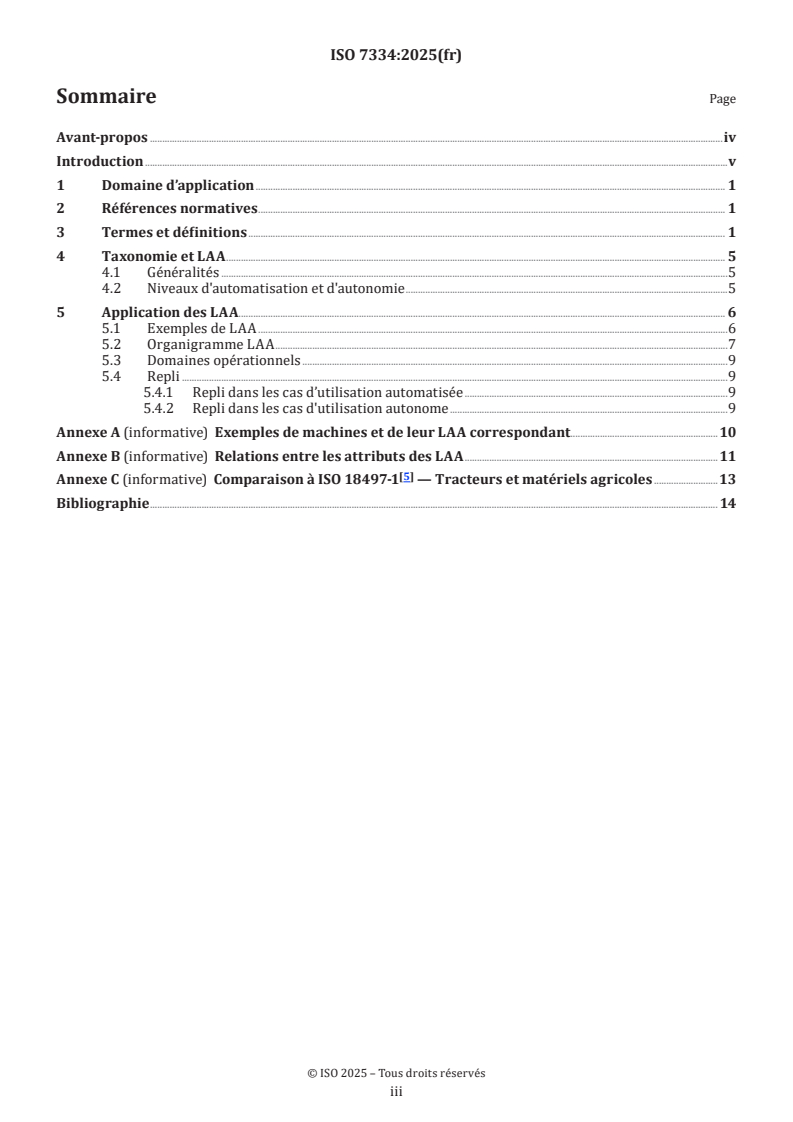
Sommaire Page
Avant-propos .iv
Introduction .v
1 Domaine d’application . 1
2 Références normatives . 1
3 Termes et définitions . 1
4 Taxonomie et LAA . 5
4.1 Généralités .5
4.2 Niveaux d'automatisation et d'autonomie .5
5 Application des LAA. 6
5.1 Exemples de LAA .6
5.2 Organigramme LAA .7
5.3 Domaines opérationnels .9
5.4 Repli .9
5.4.1 Repli dans les cas d’utilisation automatisée .9
5.4.2 Repli dans les cas d'utilisation autonome .9
Annexe A (informative) Exemples de machines et de leur LAA correspondant.10
Annexe B (informative) Relations entre les attributs des LAA .11
[5]
Annexe C (informative) Comparaison à ISO 18497-1 — Tracteurs et matériels agricoles .13
Bibliographie . 14
iii
Avant-propos
L'ISO (Organisation internationale de normalisation) est une fédération mondiale d'organismes nationaux
de normalisation (comités membres de l'ISO). L'élaboration des Normes internationales est en général
confiée aux comités techniques de l'ISO. Chaque comité membre intéressé par une étude a le droit de faire
partie du comité technique créé à cet effet. Les organisations internationales, gouvernementales et non
gouvernementales, en liaison avec l'ISO participent également aux travaux. L'ISO collabore étroitement avec
la Commission électrotechnique internationale (IEC) en ce qui concerne la normalisation électrotechnique.
Les procédures utilisées pour élaborer le présent document et celles destinées à sa mise à jour sont
décrites dans les Directives ISO/IEC, Partie 1. Il convient, en particulier, de prendre note des différents
critères d'approbation requis pour les différents types de documents ISO. Le présent document a
été rédigé conformément aux règles de rédaction données dans les Directives ISO/IEC, Partie 2 (voir
www.iso.org/directives).
L’ISO attire l’attention sur le fait que la mise en application du présent document peut entraîner l’utilisation
d’un ou de plusieurs brevets. L’ISO ne prend pas position quant à la preuve, à la validité et à l’applicabilité de
tout droit de propriété revendiqué à cet égard. À la date de publication du présent document, l’ISO n'avait pas
reçu notification qu’un ou plusieurs brevets pouvaient être nécessaires à sa mise en application. Toutefois,
il y a lieu d’avertir les responsables de la mise en application du présent document que des informations
plus récentes sont susceptibles de figurer dans la base de données de brevets, disponible à l'adresse
www.iso.org/brevets. L’ISO ne saurait être tenue pour responsable de ne pas avoir identifié tout ou partie de
tels droits de propriété.
Les appellations commerciales éventuellement mentionnées dans le présent document sont données pour
information, par souci de commodité, à l’intention des utilisateurs et ne sauraient constituer un engagement.
Pour une explication de la nature volontaire des normes, la signification des termes et expressions
spécifiques de l'ISO liés à l'évaluation de la conformité, ou pour toute information au sujet de l'adhésion de
l'ISO aux principes de l’Organisation mondiale du commerce (OMC) concernant les obstacles techniques au
commerce (OTC), voir www.iso.org/avant-propos.
Le présent document a été élaboré par le comité technique ISO/TC 127, Engins de terrassement, sous-comité
SC 4, Terminologie, nomenclature commerciale, classification et estimations.
Il convient que l’utilisateur adresse tout retour d’information ou toute question concernant le présent
document à l’organisme national de normalisation de son pays. Une liste exhaustive desdits organismes se
trouve à l’adresse www.iso.org/fr/members.html.
iv
Introduction
Ce document définit les termes d'automatisation et d'autonomie, et fournit un contenu de soutien sous la
forme d'une taxonomie pour les niveaux d'automatisation et d'autonomie (LAA). Le présent document peut
être utilisé pour décrire, de manière cohérente, l’ensemble des fonctionnalités du système de fonctionnement
automatisé (AOS) équipant les machines.
Le présent document poursuit les objectifs suivants:
— normaliser les niveaux d’automatisation et d’autonomie;
— clarifier le rôle de l’opérateur, le cas échéant, au cours de l’utilisation d’un système de fonctionnement
automatisé;
— fournir un cadre utile pour les spécifications et les exigences techniques d’automatisation et d’autonomie;
— clarifier les communications sur les sujets d’automatisation et d’autonomie.
v
Norme internationale ISO 7334:2025(fr)
Engins de terrassement — Vocabulaire et taxonomie pour
l’automatisation et l’autonomie
1 Domaine d’application
Le présent document définit les termes relatifs aux niveaux d'automatisation et d'autonomie (LAA),
établissant ainsi la taxonomie décrivant les niveaux d'automatisation et d'autonomie (LAA).
Le présent document ne fournit pas de spécifications ni d’exigences sur les systèmes de fonctionnement
automatisés définis ici.
[1]
Le présent document s’applique aux engins de terrassement (EMM) tels que définis dans l’ISO 6165 .
2 Références normatives
Le présent document ne contient aucune référence normative.
3 Termes et définitions
L'ISO et l'IEC tiennent à jour des bases de données terminologiques destinées à être utilisées en normalisation,
consultables aux adresses suivantes:
— IEC Electropedia: disponible à l'adresse https:// www .electropedia .org/
— ISO Online browsing platform: disponible à l'adresse https:// www .iso .org/ obp
3.1
système de commande de la machine
MCS
système qui répond aux signaux d’entrée et qui génère des signaux de sorties imposant à la machine un
comportement attendu
[2]
[SOURCE: ISO 19014-1:— , 3.3, modifié — Les sources de signaux d'entrée ont été supprimées pour être
génériques]
3.2
chantier
chantier
site minier
chantier de construction
lieu où des engins de terrassement sont exploités
[3]
[SOURCE: ISO 7130:2013 , 3.6, modifié — Le terme privilégié a été changé de «site de travail» à «chantier»;
les termes admis ont été ajoutés; «ou lorsque l’entretien de routine» a été supprimé à la fin de la définition.]
3.3
zone de fonctionnement autonome
AOZ
zone désignée, ou zones désignées, au sein d’un chantier (3.2) dans laquelle ou lesquelles les machines
fonctionnent en mode autonome
3.4
personne autorisée
personne approuvée ou désignée pour réaliser des tâches spécifiques, dans des lieux spécifiques, sur le
chantier (3.2)
Note 1 à l'article: L’autorisation peut être accordée par le propriétaire, le responsable ou le superviseur du chantier.
3.5
opérateur
personne autorisée (3.4) qui réalise, en tout ou en partie, le cas d’utilisation (3.20) et le repli (3.23) pour une
machine, et qui est consciente des risques ou phénomènes dangereux associés
Note 1 à l'article: Les personnes capables d’entraîner la machine à atteindre une condition de risque minimal (3.22) sont
considérées comme des opérateurs.
3.6
opérateur embarqué
opérateur (3.5) situé dans, ou sur, la machine
3.7
opérateur à distance
opérateur (3.5) non situé dans, ou sur, la machine
3.8
superviseur du système autonome
SAS
personne autorisée (3.4) qui supervise un système autonome
Note 1 à l'article: Le SAS ne commande qu’indirectement la machine et ne réalise pas de repli (3.23).
3.9
tiers
personne, y compris celles ne faisant pas partie du personnel, les enfants ou les membres du public n'ayant
que peu ou pas de connaissance des phénomènes dangereux liés à la machine et aucune formation
[2]
[SOURCE: ISO 19014-1:— , 3.4.3]
3.10
collaborateur
personne autorisée (3.4) travaillant à proximité de la machine et consciente des phénomènes dangereux
associés
[2]
[SOURCE: ISO 19014-1:— , modifié — «autorisé» a été ajouté.]
3.11
automatisation
automatisation d'un engin de terrassement
fonctionnement du système de commande de la machine (3.1) par des moyens automatiques, avec interaction
de l’opérateur (3.5)
Note 1 à l'article: L'automatisation partielle comprend des systèmes qui assistent l'opérateur.
3.12
autonomie
autonomie d'un engin de terrassement
fonctionnement du système de commande de la machine (3.1) par des moyens automatiques, sans l’interaction
d’un opérateur (3.5), mais avec l’interaction limitée d’un SAS (3.8)
3.13
système de fonctionnement automatisé
AOS
matériel et logiciel capable d’actionner automatiquement une fonction (3.18) ou plusieurs fonctions
Note 1 à l'article: Le matériel et les logiciels peuvent comprendre une infrastructure de chantier (3.2) et des plateformes
de contrôle et de supervision basées sur l'infonuagique.
3.14
domaine de conception opérationnelle
ODD
conditions dans lesquelles une machine ou une caractéristique (3.17) est conçue pour fonctionner
Note 1 à l'article: L’ODD est défini par le fabricant.
Note 2 à l'article: Voir 5.3 pour une discussion plus approfondie sur les domaines opérationnels.
3.15
domaine opérationnel cible
TOD
les conditions de chantier (3.2) auxquelles une machine ou une caractéristique (3.17) est susceptible de
rencontrer
Note 1 à l'article: Voir 5.3 pour plus de détails.
[4]
[SOURCE: ISO 34503:2023 , 3.7, modifié — «ensemble de conditions de fonctionnement» a été remplacé par
«conditions de chantier»; «un ADS» a été remplacé par «une machine»; tous les exemples ont été supprimés
de la définition; la note 1 à l’entrée a été remplacée par une nouvelle note.]
3.16
domaine opérationnel actuel
COD
conditions de fonctionnement de chantier (3.2) qui existent actuellement dans le voisinage immédiat de
la machine
Note 1 à l'article: Voir 5.3 pour plus de détails.
[4]
[SOURCE: ISO 34503:2023 , 3.8, modifié — «ensemble spécifique de conditions de fonctionnement» a été
remplacé par «conditions de fonctionnement du chantier»; «un ADS» a été remplacé par «une machine»; tous
les exemples ont été supprimés de la définition; la note 1 à l’entrée a été remplacée par une nouvelle note.]
3.17
caractéristique
fonctionnalité spécifique à la conception d’un système capable d’un niveau donné d’automatisation (3.11) ou
d’autonomie (3.12)
Note 1 à l'article: Un AOS (3.13) donné peut avoir plusieurs caractéristiques (3.17), chacune associée à un niveau
d’automatisation ou d’autonomie et à un ODD (3.14) particuliers.
3.18
fonction
régulation du mouvement en temps réel sur, ou le long, d’un seul axe
EXEMPLE Les exemples suivants constituent des fonctions simples qui impliquent un mouvement: propulsion,
direction, freinage, direction de machine, levage ou abaissement de flèche, orientation de flèche, rentrée ou sortie de
bras, basculement ou redressement de godet.
Note 1 à l'article: Le mouvement peut être celui d'une machine de base, d'un équipement ou d'un accessoire.
3.19
tâche de fonctionnement dynamique
DOT
travail prévu par la machine et pour lequel elle a été conçue en exécutant une fonction (3.18) simple, ou
plusieurs fonctions
EXEMPLE 1 Excavation d’une tranchée en utilisant une pelle: la pelle utilise une fonction simple ou plusieurs
fonctions, telles que propulsion, orientation, levage du bras, extension ou redressement du godet, pour réaliser la DOT
d’excavation d’une tranchée. Dans cet exemple, aucune de ces fonctions, en soi, ne constitue une DOT.
EXEMPLE 2 Une pelle qui charge un tombereau, le remblayage d’une tranchée et la manipulation d’objets sont
également des DOT.
Note 1 à l'article: Les activités qui consistent en une fonction simple ou en des fonctions multiples et qui sont annexes
à l’exploitation peuvent être considérées comme des DOT. Ces activités contribuent aux cas d'utilisation (3.20)
auxquels sont attribués les LAA. Le ravitaillement en carburant, le transport et le repositionnement sont des exemples
d’activités annexes.
3.20
cas d’utilisation
ensemble de DOT (3.19) dans une application (3.21) et un domaine de conception opérationnelle (ODD) (3.14)
EXEMPLE Cycle des opérations: remblayage, extraction, et déplacement, sont des cas d’utilisation d’un bouteur au
sein de l’application de terrassement.
Note 1 à l'article: Les cas d’utilisation qui consistent en, ou incluent, des DOT annexes au fonctionnement peuvent se
voir attribuer le LAA à l’aide du Tableau 1.
3.21
application
application d'un EMM
différentes industries dans lesquelles une machine est utilisée et qui peut présenter différentes situations
dangereuses
Note 1 à l'article: Les applications peuvent comprendre le terrassement, l’exploitation minière, la construction de
route, la gestion des déchets, l'exploitation de carrière, etc.
[2]
[SOURCE: ISO 19014-1:— , 3.9, modifié — Le terme admis «application EMM» a été ajouté; «les uns des
autres» a été supprimé à la fin de la définition; dans la note 1 à l’entrée, «construction générale» a été
remplacé par «terrassement, exploitation minière».]
3.22
condition de risque minimal
état de fonctionnement de la machine dans lequel le risque est à un niveau acceptable
EXEMPLE Une caractéristique (3.17) de niveau 4 conçue pour faire fonctionner une machine à une vitesse
nominale sur des chaussées rencontre une défaillance système et retire automatiquement la machine de la chaussée
active avant de s’arrêter.
Note 1 à l'article: La condition de risque minimal concerne généralement la sécurité de l’ opérateur (3.5), du
collaborateur (3.10) ou d’un tiers (3.9).
3.23
repli
action pour atteindre la condition de risque minimal (3.22)
Note 1 à l'article: Le repli peut comprendre la réalisation, ou la poursuite, la DOT si le phénomène dangereux a été
atténué.
3.24
performance opérationnelle de l’AOS
performance de l’AOS (3.13) par rapport à la performance d’une machine à commande manuelle ou d’un
autre AOS
Note 1 à l'article: Les performances opérationnelles de l’AOS peuvent indiquer l’efficacité, la fiabilité et la stabilité de
l’AOS par rapport à une machine à commande manuelle. La performance peut être évaluée à l'aide de facteurs tels que
le temps d'utilisation et le r
...