

ISO 17966:2016
(Main)Assistive products for personal hygiene that support users — Requirements and test methods
General Information
- Abstract
ISO 17966:2016 specifies requirements and associated test methods for assistive products for personal hygiene (APPHs) that support users and which are intended by the manufacturer to alleviate or compensate for disability. The work environment and safety aspects for assistants are also included. It specifies safety and performance requirements that apply during normal use and foreseeable misuse and failure. It also specifies methods of measurement of the forces necessary to operate controls and specifies limits on the forces needed for some operations. This International Standard specifies requirements and test methods for assistive products within the following divisions of ISO 9999:2011: 09 12 03 Commode chairs; NOTE This covers mobile and static products. 09 12 06 Toilets with built in raising and height adjustable mechanism; NOTE This excludes toilets with built-in douche and air dryers. 09 12 09 Toilet seats; 09 12 12 Raised toilet seats mounted on frame; 09 12 15 Toilet seats inserts; 09 12 18 Raised toilet seats fixed to toilet; 09 12 21 Toilet seats with built-in raising mechanism to help standing up and sitting down; 09 12 24 Toilet arm supports and toilet back supports mounted on toilet; 09 12 25 Toilet arm supports and toilet back supports, free standing; 09 12 36 Douches and air dryers for attachment to a toilet; 09 33 03 Bath/shower chairs (with and without wheels), bath boards, stools, back supports and seats; 09 33 12 Bathing stretchers, shower tables and diaper-changing tables; 18 15 06 Height adjustable plinths and brackets; NOTE Refers to height adjustable plinths and brackets when used as an assistive product for personal hygiene (APPH). Height adjustable mechanisms for other items such as basins may be included. 18 18 03 Handrails and support rails; 18 18 06 Fixed grab bars and handgrips; 18 18 10 Removable grab rails and handgrips; NOTE This excludes removable grab rails and handgrips which are static as defined in 3.27. 18 18 11 Hinged rails and arm supports; ISO 17966:2016 does not encompass requirements regarding: - safe mounting in building structures; - requirements regarding fixed building installations e.g. water and electricity; - bathtub hoists that are covered by ISO 10535; - 09 33 21 Bathtubs of ISO 9999:2011; - stability and friction issues in relation to slippery surfaces due to soap; - products that have been customised or custom-made for an individual user.
- Status
- Published
- Publication Date
- 03-Jan-2016
- Technical Committee
- ISO/TC 173 - Assistive products
- Drafting Committee
- ISO/TC 173 - Assistive products
- Current Stage
- 9092 - International Standard to be revised
- Start Date
- 24-Feb-2022
- Completion Date
- 29-Aug-2026
Buy Documents
ISO 17966:2016 - Assistive products for personal hygiene that support users -- Requirements and test methods
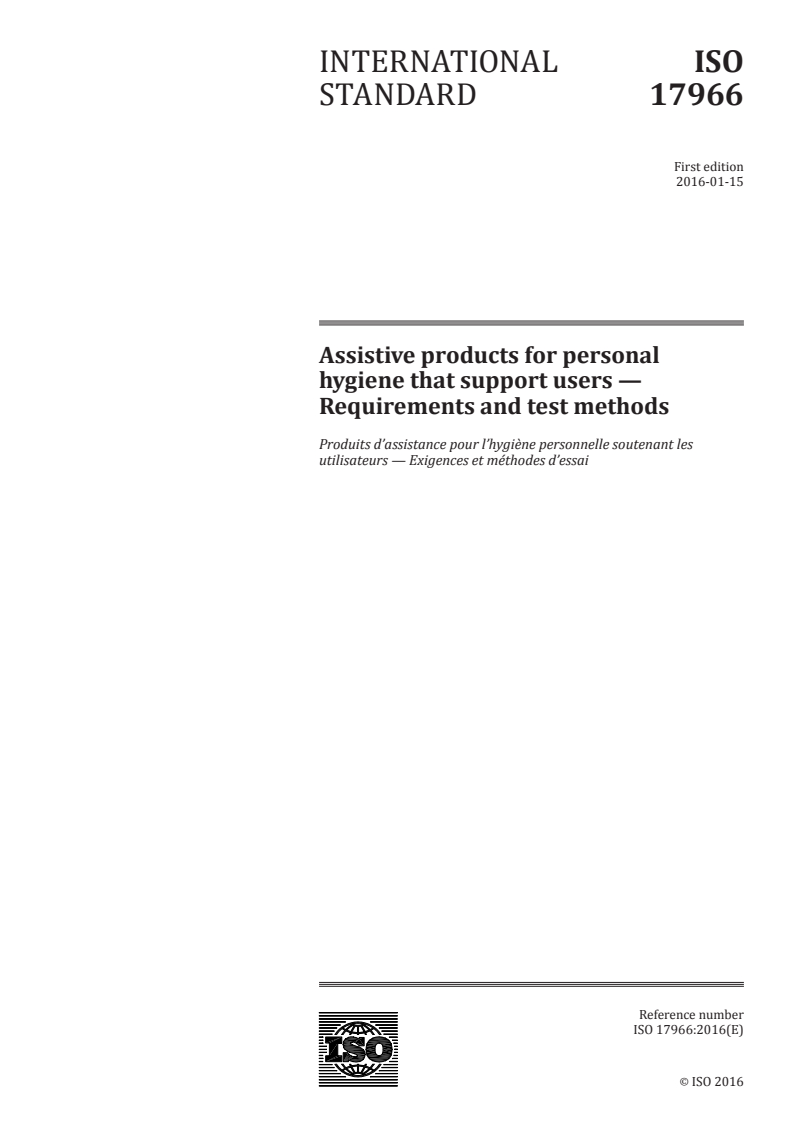
ISO 17966:2016 - Assistive products for personal hygiene that support users — Requirements and test methods/4/2016
Overview
ISO 17966:2016 - Assistive products for personal hygiene that support users - Requirements and test methods - defines safety, performance and testing requirements for assistive products for personal hygiene (APPHs) intended to alleviate or compensate for disability. It covers a broad range of products listed in ISO 9999:2011 (e.g., commode chairs, raised toilet seats, toilet arm supports, bath/shower chairs, bathing stretchers, grab rails, height‑adjustable plinths) and specifies requirements for normal use, foreseeable misuse and single‑fault conditions. The standard also addresses work environment and safety aspects for assistants.
Key topics and technical requirements
ISO 17966:2016 combines performance criteria with verifiable test methods. Major technical topics include:
- General requirements and risk analysis (clauses on intended performance, clinical evaluation, fasteners, user mass/load limits).
- Materials and biocompatibility - flammability, infection control, corrosion resistance and cleaning/disinfection provisions.
- Mechanical safety - static strength, impact, durability, stability and forces in soft tissues.
- Moving parts and entrapment risks - guarding of folding/locking mechanisms, squeeze and trapping zones, velocity limits for powered lifting/lowering.
- Ergonomics and usability - means to prevent falling out, comfortable contact temperatures, and forces required to operate controls (with measurement methods and limits).
- Electrical and EMC safety - requirements for electrical systems, battery housings, hold‑to‑run and emergency stop functions, ingress of liquids and circuit protection.
- Noise, vibration and emitted sound - limits and test procedures for audible warnings and vibration.
- Test methods and apparatus - defined test conditions, number of durability cycles, measurement formulas and test apparatus.
Practical applications and who uses this standard
ISO 17966 is intended for:
- Manufacturers and designers of APPHs to ensure products meet safety/performance criteria and to support CE marking or regulatory dossiers.
- Test laboratories and certification bodies applying the specified test methods to verify compliance.
- Healthcare procurement and facility managers selecting safe, durable hygiene aids for institutional use.
- Clinicians and occupational therapists advising on product selection and safe operation.
- Regulators and standards committees referencing harmonized requirements.
This standard supports safer product design, consistent testing and clear documentation of performance for assistive hygiene equipment.
Related standards
- References ISO 9999:2011 for classification of assistive products.
- Excludes some items covered by other standards (e.g., bathtub hoists covered by ISO 10535).
Keywords: ISO 17966, assistive products for personal hygiene, APPH, requirements and test methods, commode chairs, toilet aids, bath chairs, safety, durability, electrical safety.
Relations
- Effective Date
- 25-Aug-2026
- Revised
ISO 17966 - Assistive products for toileting, bathing and showering — Requirements and test methods - Effective Date
- 06-Jun-2022
Buy Documents
ISO 17966:2016 - Assistive products for personal hygiene that support users -- Requirements and test methods
ISO 17966:2016 - Assistive products for personal hygiene that support users — Requirements and test methods/4/2016
Get Certified
Connect with accredited certification bodies for this standard

BSI Group
BSI (British Standards Institution) is the business standards company that helps organizations make excellence a habit.

TÜV Rheinland
TÜV Rheinland is a leading international provider of technical services.

TÜV SÜD
TÜV SÜD is a trusted partner of choice for safety, security and sustainability solutions.
Sponsored listings
Frequently Asked Questions
ISO 17966:2016 is a standard published by the International Organization for Standardization (ISO). Its full title is "Assistive products for personal hygiene that support users — Requirements and test methods". This standard covers: ISO 17966:2016 specifies requirements and associated test methods for assistive products for personal hygiene (APPHs) that support users and which are intended by the manufacturer to alleviate or compensate for disability. The work environment and safety aspects for assistants are also included. It specifies safety and performance requirements that apply during normal use and foreseeable misuse and failure. It also specifies methods of measurement of the forces necessary to operate controls and specifies limits on the forces needed for some operations. This International Standard specifies requirements and test methods for assistive products within the following divisions of ISO 9999:2011: 09 12 03 Commode chairs; NOTE This covers mobile and static products. 09 12 06 Toilets with built in raising and height adjustable mechanism; NOTE This excludes toilets with built-in douche and air dryers. 09 12 09 Toilet seats; 09 12 12 Raised toilet seats mounted on frame; 09 12 15 Toilet seats inserts; 09 12 18 Raised toilet seats fixed to toilet; 09 12 21 Toilet seats with built-in raising mechanism to help standing up and sitting down; 09 12 24 Toilet arm supports and toilet back supports mounted on toilet; 09 12 25 Toilet arm supports and toilet back supports, free standing; 09 12 36 Douches and air dryers for attachment to a toilet; 09 33 03 Bath/shower chairs (with and without wheels), bath boards, stools, back supports and seats; 09 33 12 Bathing stretchers, shower tables and diaper-changing tables; 18 15 06 Height adjustable plinths and brackets; NOTE Refers to height adjustable plinths and brackets when used as an assistive product for personal hygiene (APPH). Height adjustable mechanisms for other items such as basins may be included. 18 18 03 Handrails and support rails; 18 18 06 Fixed grab bars and handgrips; 18 18 10 Removable grab rails and handgrips; NOTE This excludes removable grab rails and handgrips which are static as defined in 3.27. 18 18 11 Hinged rails and arm supports; ISO 17966:2016 does not encompass requirements regarding: - safe mounting in building structures; - requirements regarding fixed building installations e.g. water and electricity; - bathtub hoists that are covered by ISO 10535; - 09 33 21 Bathtubs of ISO 9999:2011; - stability and friction issues in relation to slippery surfaces due to soap; - products that have been customised or custom-made for an individual user.
ISO 17966:2016 specifies requirements and associated test methods for assistive products for personal hygiene (APPHs) that support users and which are intended by the manufacturer to alleviate or compensate for disability. The work environment and safety aspects for assistants are also included. It specifies safety and performance requirements that apply during normal use and foreseeable misuse and failure. It also specifies methods of measurement of the forces necessary to operate controls and specifies limits on the forces needed for some operations. This International Standard specifies requirements and test methods for assistive products within the following divisions of ISO 9999:2011: 09 12 03 Commode chairs; NOTE This covers mobile and static products. 09 12 06 Toilets with built in raising and height adjustable mechanism; NOTE This excludes toilets with built-in douche and air dryers. 09 12 09 Toilet seats; 09 12 12 Raised toilet seats mounted on frame; 09 12 15 Toilet seats inserts; 09 12 18 Raised toilet seats fixed to toilet; 09 12 21 Toilet seats with built-in raising mechanism to help standing up and sitting down; 09 12 24 Toilet arm supports and toilet back supports mounted on toilet; 09 12 25 Toilet arm supports and toilet back supports, free standing; 09 12 36 Douches and air dryers for attachment to a toilet; 09 33 03 Bath/shower chairs (with and without wheels), bath boards, stools, back supports and seats; 09 33 12 Bathing stretchers, shower tables and diaper-changing tables; 18 15 06 Height adjustable plinths and brackets; NOTE Refers to height adjustable plinths and brackets when used as an assistive product for personal hygiene (APPH). Height adjustable mechanisms for other items such as basins may be included. 18 18 03 Handrails and support rails; 18 18 06 Fixed grab bars and handgrips; 18 18 10 Removable grab rails and handgrips; NOTE This excludes removable grab rails and handgrips which are static as defined in 3.27. 18 18 11 Hinged rails and arm supports; ISO 17966:2016 does not encompass requirements regarding: - safe mounting in building structures; - requirements regarding fixed building installations e.g. water and electricity; - bathtub hoists that are covered by ISO 10535; - 09 33 21 Bathtubs of ISO 9999:2011; - stability and friction issues in relation to slippery surfaces due to soap; - products that have been customised or custom-made for an individual user.
ISO 17966:2016 is classified under the following ICS (International Classification for Standards) categories: 11.180.01 - Aids for disabled and handicapped persons in general; 11.180.99 - Other standards related to aids for disabled and handicapped people. The ICS classification helps identify the subject area and facilitates finding related standards.
ISO 17966:2016 has the following relationships with other standards: It is inter standard links to EN 12183:2022, ISO 17966. Understanding these relationships helps ensure you are using the most current and applicable version of the standard.
ISO 17966:2016 is available in PDF format for immediate download after purchase. The document can be added to your cart and obtained through the secure checkout process. Digital delivery ensures instant access to the complete standard document.
Standards Content (Sample)
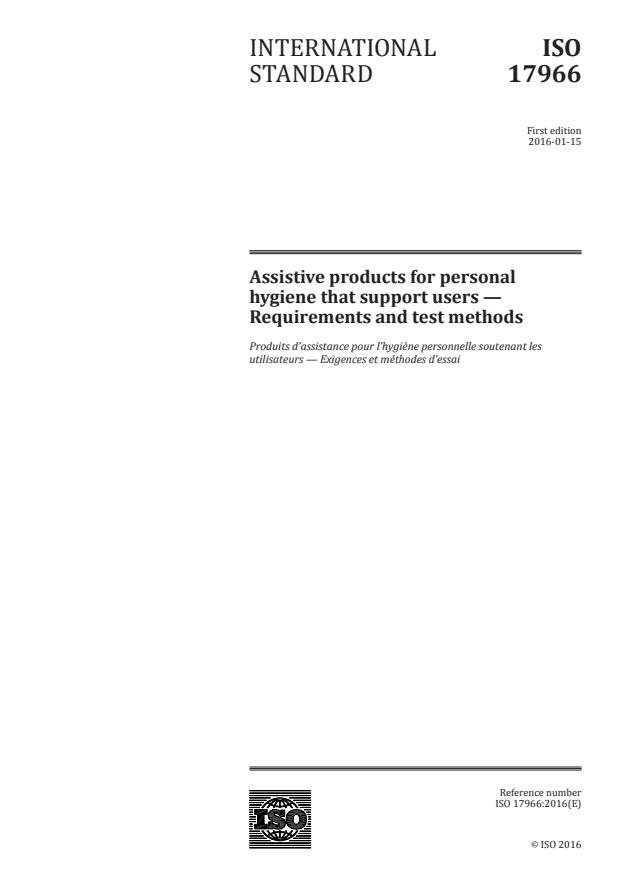
INTERNATIONAL ISO
STANDARD 17966
First edition
2016-01-15
Assistive products for personal
hygiene that support users —
Requirements and test methods
Produits d’assistance pour l’hygiène personnelle soutenant les
utilisateurs — Exigences et méthodes d’essai
Reference number
©
ISO 2016
© ISO 2016, Published in Switzerland
All rights reserved. Unless otherwise specified, no part of this publication may be reproduced or utilized otherwise in any form
or by any means, electronic or mechanical, including photocopying, or posting on the internet or an intranet, without prior
written permission. Permission can be requested from either ISO at the address below or ISO’s member body in the country of
the requester.
ISO copyright office
Ch. de Blandonnet 8 • CP 401
CH-1214 Vernier, Geneva, Switzerland
Tel. +41 22 749 01 11
Fax +41 22 749 09 47
copyright@iso.org
www.iso.org
ii © ISO 2016 – All rights reserved
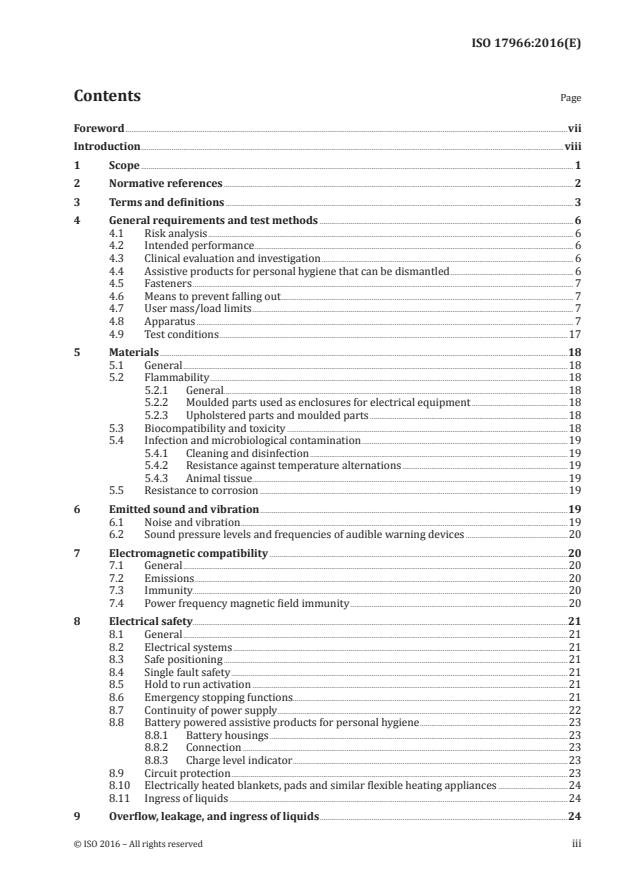
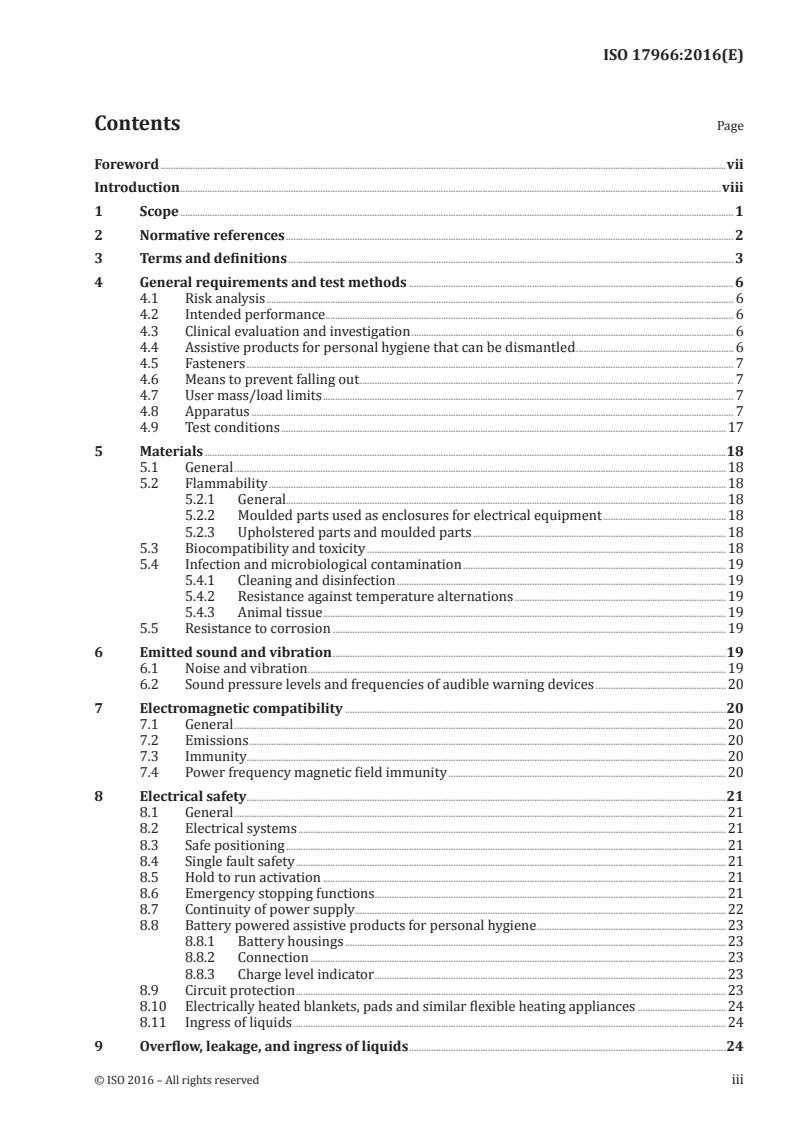
Contents Page
Foreword .vii
Introduction .viii
1 Scope . 1
2 Normative references . 2
3 Terms and definitions . 3
4 General requirements and test methods . 6
4.1 Risk analysis . 6
4.2 Intended performance . 6
4.3 Clinical evaluation and investigation . 6
4.4 Assistive products for personal hygiene that can be dismantled . 6
4.5 Fasteners . 7
4.6 Means to prevent falling out . 7
4.7 User mass/load limits . 7
4.8 Apparatus . 7
4.9 Test conditions .17
5 Materials .18
5.1 General .18
5.2 Flammability .18
5.2.1 General.18
5.2.2 Moulded parts used as enclosures for electrical equipment .18
5.2.3 Upholstered parts and moulded parts .18
5.3 Biocompatibility and toxicity .18
5.4 Infection and microbiological contamination .19
5.4.1 Cleaning and disinfection .19
5.4.2 Resistance against temperature alternations .19
5.4.3 Animal tissue .19
5.5 Resistance to corrosion .19
6 Emitted sound and vibration .19
6.1 Noise and vibration .19
6.2 Sound pressure levels and frequencies of audible warning devices .20
7 Electromagnetic compatibility .20
7.1 General .20
7.2 Emissions .20
7.3 Immunity.20
7.4 Power frequency magnetic field immunity .20
8 Electrical safety .21
8.1 General .21
8.2 Electrical systems .21
8.3 Safe positioning .21
8.4 Single fault safety .21
8.5 Hold to run activation .21
8.6 Emergency stopping functions.21
8.7 Continuity of power supply .22
8.8 Battery powered assistive products for personal hygiene .23
8.8.1 Battery housings .23
8.8.2 Connection .23
8.8.3 Charge level indicator .23
8.9 Circuit protection .23
8.10 Electrically heated blankets, pads and similar flexible heating appliances .24
8.11 Ingress of liquids .24
9 Overflow, leakage, and ingress of liquids .24
9.1 Ingress of liquids .24
9.1.1 Requirements .24
9.1.2 Test method .24
9.2 Overflow and leakage .24
9.2.1 General.24
9.2.2 Substances which may leak from an APPH in intended use and in
fault conditions.25
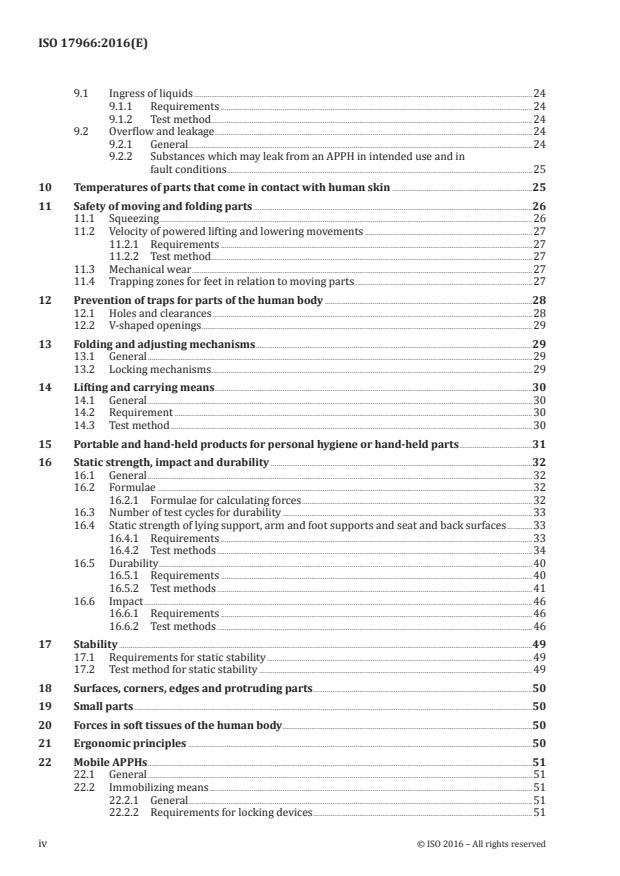
10 Temperatures of parts that come in contact with human skin .25
11 Safety of moving and folding parts .26
11.1 Squeezing .26
11.2 Velocity of powered lifting and lowering movements .27
11.2.1 Requirements .27
11.2.2 Test method .27
11.3 Mechanical wear .27
11.4 Trapping zones for feet in relation to moving parts .27
12 Prevention of traps for parts of the human body .28
12.1 Holes and clearances .28
12.2 V-shaped openings .29
13 Folding and adjusting mechanisms .29
13.1 General .29
13.2 Locking mechanisms .29
14 Lifting and carrying means .30
14.1 General .30
14.2 Requirement .30
14.3 Test method .30
15 Portable and hand-held products for personal hygiene or hand-held parts .31
16 Static strength, impact and durability .32
16.1 General .32
16.2 Formulae .32
16.2.1 Formulae for calculating forces .32
16.3 Number of test cycles for durability .33
16.4 Static strength of lying support, arm and foot supports and seat and back surfaces .33
16.4.1 Requirements .33
16.4.2 Test methods .34
16.5 Durability .40
16.5.1 Requirements .40
16.5.2 Test methods .41
16.6 Impact .46
16.6.1 Requirements .46
16.6.2 Test methods .46
17 Stability .49
17.1 Requirements for static stability .49
17.2 Test method for static stability .49
18 Surfaces, corners, edges and protruding parts .50
19 Small parts .50
20 Forces in soft tissues of the human body .50
21 Ergonomic principles .50
22 Mobile APPHs .51
22.1 General .51
22.2 Immobilizing means .51
22.2.1 General.51
22.2.2 Requirements for locking devices .51
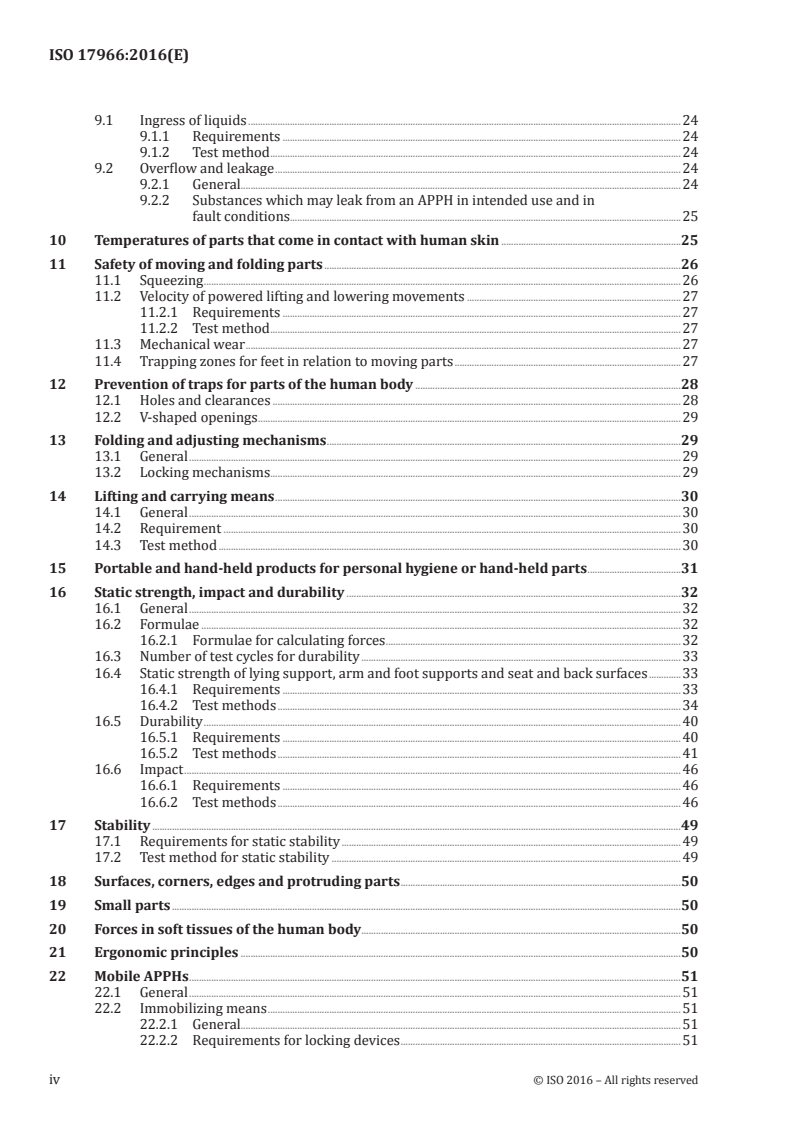
iv © ISO 2016 – All rights reserved
22.2.3 Test methods for locking devices .52
22.2.4 Test methods for durability of brakes .52
22.2.5 Brake operated by a lever .52
22.3 Electrical safety for mobile APPHs .52
22.3.1 Power-driven mobile APPHs .52
22.4 Rough handling and movement . .52
22.4.1 General.52
22.4.2 Requirements .52
22.4.3 Test method for movement over a threshold .53
22.4.4 Test method for door frame shock .53
22.5 Functional requirements for mobile APPHs .53
22.5.1 Foot supports .53
22.5.2 Position of push handles/points .53
22.5.3 Turning diameter of mobile APPHs .53
22.6 Moving forces .54
22.6.1 Requirements for moving forces .54
22.6.2 Test methods for moving forces.54
23 Fixed APPHs .55
23.1 General .55
23.2 Requirements .55
23.3 Shower seats (09 33 03) .56
23.3.1 Description . . .56
23.3.2 Test methods for static strength, durability and impact for shower seats .56
23.4 Bathing stretchers, shower tables and diaper changing tables (09 33 12) .57
23.4.1 Description . . .57
23.4.2 Test methods for static strength and durability for bathing stretchers,
shower tables and diaper changing tables .57
23.5 Bath/shower chairs (without wheels), bath boards, stools, back supports and
seats (09 33 03) .58
23.5.1 Description . . .58
23.5.2 Test method for durability .58
23.6 Raised toilet seats (09 12 18).59
23.6.1 Description . . .59
23.6.2 Requirements for static strength for raised toilet seats .59
23.6.3 Test methods for static strength and durability for raised toilet seats .59
23.7 Handrails, grab bars and handgrips (18 18 03 and 18 18 06) .60
23.7.1 Description . . .60
23.7.2 Ergonomic principles for handrails, grab bars and handgrips .60
23.7.3 Test methods for static strength and durability for handrails, grab bars
and handgrips . .61
23.8 Removable grab rails and handgrips (18 18 10) .62
23.8.1 Description . . .62
23.8.2 Ergonomic principles for removable grab rails and handgrips .62
23.8.3 Test methods for static strength and durability for removable grab rails
and handgrips . .62
23.9 Hinged rails and arm supports (18 18 11) .63
23.9.1 Description . . .63
23.9.2 General.63
23.9.3 Test method for static strength for hinged rails and arm supports .63
23.10 Height-adjustable plinths and brackets (18 15 06) .64
23.10.1 Description . . .64
23.10.2 Test methods for static strength and durability for height-adjustable
plinths and brackets . .64
24 Static APPHs .65
24.1 General .65
24.2 Stability and strength tests for static APPHs .65
24.3 Toilet seats inserts (non fixed) (09 12 15).65
24.3.1 Description . . .65
24.3.2 Impact .65
24.4 Toilet seats with built-in raising mechanism to help standing up and sitting down
(non-fixed) (09 12 21) .68
24.4.1 Description . . .68
24.4.2 Durability .68
24.5 Bath/shower chairs (without wheels), bath boards, stools, back supports and
seats (09 33 03) .68
24.5.1 Description . . .68
24.5.2 Materials .68
24.5.3 Stability .68
24.5.4 Stability tests for APPHs designed to be supported by the sides of a bathtub .68
24.5.5 Strength test of brackets .73
24.5.6 Friction test of bath board/seat .76
24.5.7 Static horizontal force test on handle .77
24.5.8 Static vertical force test of handle of bath and transfer boards .77
25 Requirements for information supplied by the manufacturer .78
25.1 General .78
25.2 Instructions for use .78
25.2.1 Pre-sale information .78
25.2.2 User information .79
25.2.3 Service information .80
25.3 Labelling .80
26 Packaging .80
27 Test report .81
Annex A (informative) Cognitive impairment .82
Annex B (informative) General recommendations .83
Annex C (informative) Environmental and consumer-related requirements .90
Annex D (informative) Periodic inspection .95
Bibliography .96
vi © ISO 2016 – All rights reserved
Foreword
ISO (the International Organization for Standardization) is a worldwide federation of national standards
bodies (ISO member bodies). The work of preparing International Standards is normally carried out
through ISO technical committees. Each member body interested in a subject for which a technical
committee has been established has the right to be represented on that committee. International
organizations, governmental and non-governmental, in liaison with ISO, also take part in the work.
ISO collaborates closely with the International Electrotechnical Commission (IEC) on all matters of
electrotechnical standardization.
The procedures used to develop this document and those intended for its further maintenance are
described in the ISO/IEC Directives, Part 1. In particular the different approval criteria needed for the
different types of ISO documents should be noted. This document was drafted in accordance with the
editorial rules of the ISO/IEC Directives, Part 2 (see www.iso.org/directives).
Attention is drawn to the possibility that some of the elements of this document may be the subject of
patent rights. ISO shall not be held responsible for identifying any or all such patent rights. Details of
any patent rights identified during the development of the document will be in the Introduction and/or
on the ISO list of patent declarations received (see www.iso.org/patents).
Any trade name used in this document is information given for the convenience of users and does not
constitute an endorsement.
For an explanation on the meaning of ISO specific terms and expressions related to conformity
assessment, as well as information about ISO’s adherence to the WTO principles in the Technical
Barriers to Trade (TBT) see the following URL: Foreword - Supplementary information
The committee responsible for this document is ISO/TC 173, Assistive products for persons with disability.
Introduction
This International Standard specifies requirements and test methods that are relevant to assistive
products for personal hygiene that support users in home care, institutions and public places. Some
of the devices can be used in more than one environment. This means that different requirements and
test methods can be applied to the same product depending on the environment. Clauses 1 to 21 and
Clause 25 contain general requirements for all types of products included in the Scope. Clauses 22 to 24
contain specific requirements for mobile, fixed and static products. These clauses indicate additional
requirements to the general clauses. In order for a product to claim compliance with this International
Standard, all relevant clauses need to be fulfilled, depending on the type of product. For example, some
products do not include electrical components; therefore, the clauses related to electrical components
may not be relevant.
In addition to the requirements in this International Standard, Annex B gives general recommendations.
viii © ISO 2016 – All rights reserved
INTERNATIONAL STANDARD ISO 17966:2016(E)
Assistive products for personal hygiene that support
users — Requirements and test methods
1 Scope
This International Standard specifies requirements and associated test methods for assistive products
for personal hygiene (APPHs) that support users and which are intended by the manufacturer to
alleviate or compensate for disability. The work environment and safety aspects for assistants are
also included. It specifies safety and performance requirements that apply during normal use and
foreseeable misuse and failure. It also specifies methods of measurement of the forces necessary to
operate controls and specifies limits on the forces needed for some operations.
This International Standard specifies requirements and test methods for assistive products within the
following divisions of ISO 9999:2011:
09 12 03 Commode chairs;
NOTE This covers mobile and static products.
09 12 06 Toilets with built in raising and height adjustable mechanism;
NOTE This excludes toilets with built-in douche and air dryers.
09 12 09 Toilet seats;
09 12 12 Raised toilet seats mounted on frame;
09 12 15 Toilet seats inserts;
09 12 18 Raised toilet seats fixed to toilet;
09 12 21 Toilet seats with built-in raising mechanism to help standing up and sitting down;
09 12 24 Toilet arm supports and toilet back supports mounted on toilet;
09 12 25 Toilet arm supports and toilet back supports, free standing;
09 12 36 Douches and air dryers for attachment to a toilet;
09 33 03 Bath/shower chairs (with and without wheels), bath boards, stools, back supports
and seats;
09 33 12 Bathing stretchers, shower tables and diaper-changing tables;
18 15 06 Height adjustable plinths and brackets;
NOTE Refers to height adjustable plinths and brackets when used as an assistive product for personal
hygiene (APPH). Height adjustable mechanisms for other items such as basins may be included.
18 18 03 Handrails and support rails;
18 18 06 Fixed grab bars and handgrips;
18 18 10 Removable grab rails and handgrips;
NOTE This excludes removable grab rails and handgrips which are static as defined in 3.27.
18 18 11 Hinged rails and arm supports;
This International Standard does not encompass requirements regarding:
— safe mounting in building structures;
— requirements regarding fixed building installations e.g. water and electricity;
— bathtub hoists that are covered by ISO 10535;
— 09 33 21 Bathtubs of ISO 9999:2011;
— stability and friction issues in relation to slippery surfaces due to soap;
— products that have been customised or custom-made for an individual user.
2 Normative references
The following referenced documents are indispensable for the application of this document. For dated
references, only the edition cited applies. For undated references, the latest edition of the referenced
document (including any amendments) applies.
CISPR 11, Industrial, scientific and medical (ISM) radio-frequency equipment — Electromagnetic
disturbance characteristics — Limits and methods of measurement
ISO 3746, Acoustics — Determination of sound power levels and sound energy levels of noise sources using
sound pressure — Survey method using an enveloping measurement surface over a reflecting plane
ISO 8191-1, Furniture — Assessment of the ignitability of upholstered furniture — Part 1: Ignition source:
smouldering cigarette
ISO 8191-2, Furniture — Assessment of ignitability of upholstered furniture — Part 2: Ignition source:
match-flame equivalent
ISO 9227, Corrosion tests in artificial atmospheres – Salt spray tests
ISO 9999:2011, Assistive products for persons with disability — Classification and terminology
ISO 10993-1, Biological evaluation of medical devices — Part 1: Evaluation and testing within a risk
management process
ISO 12100, Safety of machinery — General principles for design — Risk assessment and risk reduction
ISO 13850, Safety of machinery – Emergency stop – Principles for design
ISO 14155, Clinical investigation of medical devices for human subjects — Good clinical practice
ISO 14971, Medical devices — Application of risk management to medical devices
ISO 15223-1, Medical devices - Symbols to be used with medical device labels, labelling and information to
be supplied - Part 1: General requirements
ISO 22442-1, Medical devices utilizing animal tissues and their derivatives – Part 1: Application of risk
management
IEC 60335-1, Household and similar electrical appliances – Safety – Part 1: General requirements
IEC 60529, Degrees of protection provided by enclosures (IP Code)
IEC 60601-1:2005+A1:2012, Medical electrical equipment – Part 1: General requirements for basic safety
and essential performance
IEC 60601-1-2:2014, Medical electrical equipment - Part 1-2: General requirements for basic safety and
essential performance - Collateral standard: Electromagnetic compatibility - Requirements and tests
2 © ISO 2016 – All rights reserved
IEC 60601-2-35, Medical electrical equipment – Part 2: Particular requirements for the safety of blankets,
pads and mattresses, intended for heating in medical use
IEC 61000-3-2, Electromagnetic compatibility (EMC) — Part 3-2: Limits — Limits for harmonic current
emissions (equipment input current ≤16 A per phase)
IEC 61000-3-3, Electromagnetic compatibility (EMC) — Part 3-3: Limits – Limitation of voltage changes,
voltage fluctuations and flicker in public low-voltage supply systems, for equipment with rated current
≤16 A per phase and not subject to conditional connection
IEC 61000-4-3, Electromagnetic compatibility (EMC) — Part 4-3: Testing and measurement techniques —
Radiated, radio-frequency, electromagnetic field immunity test
IEC 61000-4-8, Electromagnetic compatibility (EMC) — Part 4-8: Testing and measurement techniques —
Power frequency magnetic field immunity test
IEC 60695-11-10, Fire hazard testing – Part 11-10: Test flames – 50 W horizontal and vertical flame test
methods
EN 614-1, Safety of machinery — Ergonomic design principles — Part 1: Terminology and general principles
EN 1041, Information supplied by the manufacturer of medical devices
EN 12527:1998, Castors and wheels - T
...
INTERNATIONAL ISO
STANDARD 17966
First edition
2016-01-15
Assistive products for personal
hygiene that support users —
Requirements and test methods
Produits d’assistance pour l’hygiène personnelle soutenant les
utilisateurs — Exigences et méthodes d’essai
Reference number
©
ISO 2016
© ISO 2016, Published in Switzerland
All rights reserved. Unless otherwise specified, no part of this publication may be reproduced or utilized otherwise in any form
or by any means, electronic or mechanical, including photocopying, or posting on the internet or an intranet, without prior
written permission. Permission can be requested from either ISO at the address below or ISO’s member body in the country of
the requester.
ISO copyright office
Ch. de Blandonnet 8 • CP 401
CH-1214 Vernier, Geneva, Switzerland
Tel. +41 22 749 01 11
Fax +41 22 749 09 47
copyright@iso.org
www.iso.org
ii © ISO 2016 – All rights reserved
Contents Page
Foreword .vii
Introduction .viii
1 Scope . 1
2 Normative references . 2
3 Terms and definitions . 3
4 General requirements and test methods . 6
4.1 Risk analysis . 6
4.2 Intended performance . 6
4.3 Clinical evaluation and investigation . 6
4.4 Assistive products for personal hygiene that can be dismantled . 6
4.5 Fasteners . 7
4.6 Means to prevent falling out . 7
4.7 User mass/load limits . 7
4.8 Apparatus . 7
4.9 Test conditions .17
5 Materials .18
5.1 General .18
5.2 Flammability .18
5.2.1 General.18
5.2.2 Moulded parts used as enclosures for electrical equipment .18
5.2.3 Upholstered parts and moulded parts .18
5.3 Biocompatibility and toxicity .18
5.4 Infection and microbiological contamination .19
5.4.1 Cleaning and disinfection .19
5.4.2 Resistance against temperature alternations .19
5.4.3 Animal tissue .19
5.5 Resistance to corrosion .19
6 Emitted sound and vibration .19
6.1 Noise and vibration .19
6.2 Sound pressure levels and frequencies of audible warning devices .20
7 Electromagnetic compatibility .20
7.1 General .20
7.2 Emissions .20
7.3 Immunity.20
7.4 Power frequency magnetic field immunity .20
8 Electrical safety .21
8.1 General .21
8.2 Electrical systems .21
8.3 Safe positioning .21
8.4 Single fault safety .21
8.5 Hold to run activation .21
8.6 Emergency stopping functions.21
8.7 Continuity of power supply .22
8.8 Battery powered assistive products for personal hygiene .23
8.8.1 Battery housings .23
8.8.2 Connection .23
8.8.3 Charge level indicator .23
8.9 Circuit protection .23
8.10 Electrically heated blankets, pads and similar flexible heating appliances .24
8.11 Ingress of liquids .24
9 Overflow, leakage, and ingress of liquids .24
9.1 Ingress of liquids .24
9.1.1 Requirements .24
9.1.2 Test method .24
9.2 Overflow and leakage .24
9.2.1 General.24
9.2.2 Substances which may leak from an APPH in intended use and in
fault conditions.25
10 Temperatures of parts that come in contact with human skin .25
11 Safety of moving and folding parts .26
11.1 Squeezing .26
11.2 Velocity of powered lifting and lowering movements .27
11.2.1 Requirements .27
11.2.2 Test method .27
11.3 Mechanical wear .27
11.4 Trapping zones for feet in relation to moving parts .27
12 Prevention of traps for parts of the human body .28
12.1 Holes and clearances .28
12.2 V-shaped openings .29
13 Folding and adjusting mechanisms .29
13.1 General .29
13.2 Locking mechanisms .29
14 Lifting and carrying means .30
14.1 General .30
14.2 Requirement .30
14.3 Test method .30
15 Portable and hand-held products for personal hygiene or hand-held parts .31
16 Static strength, impact and durability .32
16.1 General .32
16.2 Formulae .32
16.2.1 Formulae for calculating forces .32
16.3 Number of test cycles for durability .33
16.4 Static strength of lying support, arm and foot supports and seat and back surfaces .33
16.4.1 Requirements .33
16.4.2 Test methods .34
16.5 Durability .40
16.5.1 Requirements .40
16.5.2 Test methods .41
16.6 Impact .46
16.6.1 Requirements .46
16.6.2 Test methods .46
17 Stability .49
17.1 Requirements for static stability .49
17.2 Test method for static stability .49
18 Surfaces, corners, edges and protruding parts .50
19 Small parts .50
20 Forces in soft tissues of the human body .50
21 Ergonomic principles .50
22 Mobile APPHs .51
22.1 General .51
22.2 Immobilizing means .51
22.2.1 General.51
22.2.2 Requirements for locking devices .51
iv © ISO 2016 – All rights reserved
22.2.3 Test methods for locking devices .52
22.2.4 Test methods for durability of brakes .52
22.2.5 Brake operated by a lever .52
22.3 Electrical safety for mobile APPHs .52
22.3.1 Power-driven mobile APPHs .52
22.4 Rough handling and movement . .52
22.4.1 General.52
22.4.2 Requirements .52
22.4.3 Test method for movement over a threshold .53
22.4.4 Test method for door frame shock .53
22.5 Functional requirements for mobile APPHs .53
22.5.1 Foot supports .53
22.5.2 Position of push handles/points .53
22.5.3 Turning diameter of mobile APPHs .53
22.6 Moving forces .54
22.6.1 Requirements for moving forces .54
22.6.2 Test methods for moving forces.54
23 Fixed APPHs .55
23.1 General .55
23.2 Requirements .55
23.3 Shower seats (09 33 03) .56
23.3.1 Description . . .56
23.3.2 Test methods for static strength, durability and impact for shower seats .56
23.4 Bathing stretchers, shower tables and diaper changing tables (09 33 12) .57
23.4.1 Description . . .57
23.4.2 Test methods for static strength and durability for bathing stretchers,
shower tables and diaper changing tables .57
23.5 Bath/shower chairs (without wheels), bath boards, stools, back supports and
seats (09 33 03) .58
23.5.1 Description . . .58
23.5.2 Test method for durability .58
23.6 Raised toilet seats (09 12 18).59
23.6.1 Description . . .59
23.6.2 Requirements for static strength for raised toilet seats .59
23.6.3 Test methods for static strength and durability for raised toilet seats .59
23.7 Handrails, grab bars and handgrips (18 18 03 and 18 18 06) .60
23.7.1 Description . . .60
23.7.2 Ergonomic principles for handrails, grab bars and handgrips .60
23.7.3 Test methods for static strength and durability for handrails, grab bars
and handgrips . .61
23.8 Removable grab rails and handgrips (18 18 10) .62
23.8.1 Description . . .62
23.8.2 Ergonomic principles for removable grab rails and handgrips .62
23.8.3 Test methods for static strength and durability for removable grab rails
and handgrips . .62
23.9 Hinged rails and arm supports (18 18 11) .63
23.9.1 Description . . .63
23.9.2 General.63
23.9.3 Test method for static strength for hinged rails and arm supports .63
23.10 Height-adjustable plinths and brackets (18 15 06) .64
23.10.1 Description . . .64
23.10.2 Test methods for static strength and durability for height-adjustable
plinths and brackets . .64
24 Static APPHs .65
24.1 General .65
24.2 Stability and strength tests for static APPHs .65
24.3 Toilet seats inserts (non fixed) (09 12 15).65
24.3.1 Description . . .65
24.3.2 Impact .65
24.4 Toilet seats with built-in raising mechanism to help standing up and sitting down
(non-fixed) (09 12 21) .68
24.4.1 Description . . .68
24.4.2 Durability .68
24.5 Bath/shower chairs (without wheels), bath boards, stools, back supports and
seats (09 33 03) .68
24.5.1 Description . . .68
24.5.2 Materials .68
24.5.3 Stability .68
24.5.4 Stability tests for APPHs designed to be supported by the sides of a bathtub .68
24.5.5 Strength test of brackets .73
24.5.6 Friction test of bath board/seat .76
24.5.7 Static horizontal force test on handle .77
24.5.8 Static vertical force test of handle of bath and transfer boards .77
25 Requirements for information supplied by the manufacturer .78
25.1 General .78
25.2 Instructions for use .78
25.2.1 Pre-sale information .78
25.2.2 User information .79
25.2.3 Service information .80
25.3 Labelling .80
26 Packaging .80
27 Test report .81
Annex A (informative) Cognitive impairment .82
Annex B (informative) General recommendations .83
Annex C (informative) Environmental and consumer-related requirements .90
Annex D (informative) Periodic inspection .95
Bibliography .96
vi © ISO 2016 – All rights reserved
Foreword
ISO (the International Organization for Standardization) is a worldwide federation of national standards
bodies (ISO member bodies). The work of preparing International Standards is normally carried out
through ISO technical committees. Each member body interested in a subject for which a technical
committee has been established has the right to be represented on that committee. International
organizations, governmental and non-governmental, in liaison with ISO, also take part in the work.
ISO collaborates closely with the International Electrotechnical Commission (IEC) on all matters of
electrotechnical standardization.
The procedures used to develop this document and those intended for its further maintenance are
described in the ISO/IEC Directives, Part 1. In particular the different approval criteria needed for the
different types of ISO documents should be noted. This document was drafted in accordance with the
editorial rules of the ISO/IEC Directives, Part 2 (see www.iso.org/directives).
Attention is drawn to the possibility that some of the elements of this document may be the subject of
patent rights. ISO shall not be held responsible for identifying any or all such patent rights. Details of
any patent rights identified during the development of the document will be in the Introduction and/or
on the ISO list of patent declarations received (see www.iso.org/patents).
Any trade name used in this document is information given for the convenience of users and does not
constitute an endorsement.
For an explanation on the meaning of ISO specific terms and expressions related to conformity
assessment, as well as information about ISO’s adherence to the WTO principles in the Technical
Barriers to Trade (TBT) see the following URL: Foreword - Supplementary information
The committee responsible for this document is ISO/TC 173, Assistive products for persons with disability.
Introduction
This International Standard specifies requirements and test methods that are relevant to assistive
products for personal hygiene that support users in home care, institutions and public places. Some
of the devices can be used in more than one environment. This means that different requirements and
test methods can be applied to the same product depending on the environment. Clauses 1 to 21 and
Clause 25 contain general requirements for all types of products included in the Scope. Clauses 22 to 24
contain specific requirements for mobile, fixed and static products. These clauses indicate additional
requirements to the general clauses. In order for a product to claim compliance with this International
Standard, all relevant clauses need to be fulfilled, depending on the type of product. For example, some
products do not include electrical components; therefore, the clauses related to electrical components
may not be relevant.
In addition to the requirements in this International Standard, Annex B gives general recommendations.
viii © ISO 2016 – All rights reserved
INTERNATIONAL STANDARD ISO 17966:2016(E)
Assistive products for personal hygiene that support
users — Requirements and test methods
1 Scope
This International Standard specifies requirements and associated test methods for assistive products
for personal hygiene (APPHs) that support users and which are intended by the manufacturer to
alleviate or compensate for disability. The work environment and safety aspects for assistants are
also included. It specifies safety and performance requirements that apply during normal use and
foreseeable misuse and failure. It also specifies methods of measurement of the forces necessary to
operate controls and specifies limits on the forces needed for some operations.
This International Standard specifies requirements and test methods for assistive products within the
following divisions of ISO 9999:2011:
09 12 03 Commode chairs;
NOTE This covers mobile and static products.
09 12 06 Toilets with built in raising and height adjustable mechanism;
NOTE This excludes toilets with built-in douche and air dryers.
09 12 09 Toilet seats;
09 12 12 Raised toilet seats mounted on frame;
09 12 15 Toilet seats inserts;
09 12 18 Raised toilet seats fixed to toilet;
09 12 21 Toilet seats with built-in raising mechanism to help standing up and sitting down;
09 12 24 Toilet arm supports and toilet back supports mounted on toilet;
09 12 25 Toilet arm supports and toilet back supports, free standing;
09 12 36 Douches and air dryers for attachment to a toilet;
09 33 03 Bath/shower chairs (with and without wheels), bath boards, stools, back supports
and seats;
09 33 12 Bathing stretchers, shower tables and diaper-changing tables;
18 15 06 Height adjustable plinths and brackets;
NOTE Refers to height adjustable plinths and brackets when used as an assistive product for personal
hygiene (APPH). Height adjustable mechanisms for other items such as basins may be included.
18 18 03 Handrails and support rails;
18 18 06 Fixed grab bars and handgrips;
18 18 10 Removable grab rails and handgrips;
NOTE This excludes removable grab rails and handgrips which are static as defined in 3.27.
18 18 11 Hinged rails and arm supports;
This International Standard does not encompass requirements regarding:
— safe mounting in building structures;
— requirements regarding fixed building installations e.g. water and electricity;
— bathtub hoists that are covered by ISO 10535;
— 09 33 21 Bathtubs of ISO 9999:2011;
— stability and friction issues in relation to slippery surfaces due to soap;
— products that have been customised or custom-made for an individual user.
2 Normative references
The following referenced documents are indispensable for the application of this document. For dated
references, only the edition cited applies. For undated references, the latest edition of the referenced
document (including any amendments) applies.
CISPR 11, Industrial, scientific and medical (ISM) radio-frequency equipment — Electromagnetic
disturbance characteristics — Limits and methods of measurement
ISO 3746, Acoustics — Determination of sound power levels and sound energy levels of noise sources using
sound pressure — Survey method using an enveloping measurement surface over a reflecting plane
ISO 8191-1, Furniture — Assessment of the ignitability of upholstered furniture — Part 1: Ignition source:
smouldering cigarette
ISO 8191-2, Furniture — Assessment of ignitability of upholstered furniture — Part 2: Ignition source:
match-flame equivalent
ISO 9227, Corrosion tests in artificial atmospheres – Salt spray tests
ISO 9999:2011, Assistive products for persons with disability — Classification and terminology
ISO 10993-1, Biological evaluation of medical devices — Part 1: Evaluation and testing within a risk
management process
ISO 12100, Safety of machinery — General principles for design — Risk assessment and risk reduction
ISO 13850, Safety of machinery – Emergency stop – Principles for design
ISO 14155, Clinical investigation of medical devices for human subjects — Good clinical practice
ISO 14971, Medical devices — Application of risk management to medical devices
ISO 15223-1, Medical devices - Symbols to be used with medical device labels, labelling and information to
be supplied - Part 1: General requirements
ISO 22442-1, Medical devices utilizing animal tissues and their derivatives – Part 1: Application of risk
management
IEC 60335-1, Household and similar electrical appliances – Safety – Part 1: General requirements
IEC 60529, Degrees of protection provided by enclosures (IP Code)
IEC 60601-1:2005+A1:2012, Medical electrical equipment – Part 1: General requirements for basic safety
and essential performance
IEC 60601-1-2:2014, Medical electrical equipment - Part 1-2: General requirements for basic safety and
essential performance - Collateral standard: Electromagnetic compatibility - Requirements and tests
2 © ISO 2016 – All rights reserved
IEC 60601-2-35, Medical electrical equipment – Part 2: Particular requirements for the safety of blankets,
pads and mattresses, intended for heating in medical use
IEC 61000-3-2, Electromagnetic compatibility (EMC) — Part 3-2: Limits — Limits for harmonic current
emissions (equipment input current ≤16 A per phase)
IEC 61000-3-3, Electromagnetic compatibility (EMC) — Part 3-3: Limits – Limitation of voltage changes,
voltage fluctuations and flicker in public low-voltage supply systems, for equipment with rated current
≤16 A per phase and not subject to conditional connection
IEC 61000-4-3, Electromagnetic compatibility (EMC) — Part 4-3: Testing and measurement techniques —
Radiated, radio-frequency, electromagnetic field immunity test
IEC 61000-4-8, Electromagnetic compatibility (EMC) — Part 4-8: Testing and measurement techniques —
Power frequency magnetic field immunity test
IEC 60695-11-10, Fire hazard testing – Part 11-10: Test flames – 50 W horizontal and vertical flame test
methods
EN 614-1, Safety of machinery — Ergonomic design principles — Part 1: Terminology and general principles
EN 1041, Information supplied by the manufacturer of medical devices
EN 12527:1998, Castors and wheels - T
...