


ISO 19905-1:2016
(Main)Petroleum and natural gas industries — Site-specific assessment of mobile offshore units — Part 1: Jack-ups
Petroleum and natural gas industries — Site-specific assessment of mobile offshore units — Part 1: Jack-ups
ISO 19905-1:2016 specifies requirements and guidance for the site-specific assessment of independent leg jack‑up units for use in the petroleum and natural gas industries. It addresses: manned non-evacuated, manned evacuated and unmanned jack‑ups; the installed phase at a specific site. To ensure acceptable reliability, the provisions of this part of ISO 19905 form an integrated approach, which is used in its entirety for the site-specific assessment of a jack‑up. This part of ISO 19905 does not apply specifically to mobile offshore drilling units operating in regions subject to sea ice and icebergs. When assessing a jack-up operating in such areas, it is intended that the assessor supplement the provisions of this part of ISO 19905 with the provisions relating to ice actions and procedures for ice management contained in ISO 19906. This part of ISO 19905 does not address design, transportation to and from site, or installation and removal from site. However, it is advisable that the assumptions used in the assessment be checked against the as‑installed configuration. To ensure that the design of the jack‑up is sound and the structure is adequately maintained, this part of ISO 19905 is applicable only to independent leg jack‑ups that either: - hold a valid classification society certification from a recognized classification society (RCS) throughout the duration of the operation at the specific site subject to assessment; or - have been verified by an independent competent body to be structurally fit for purpose for elevated situations and are subject to periodic inspection, both to the standards of an RCS. NOTE 1 An RCS is an International Association of Classification Societies (IACS) member body, meeting the RCS definition given in 3.52. Jack‑ups that do not comply with this requirement are assessed according to the provisions of ISO 19902, supplemented by methodologies from this part of ISO 19905, where applicable. NOTE 2 Future revisions of this part of ISO 19905 can be expanded to cover mat-supported jack‑ups. NOTE 3 Well conductors are a safety-critical element for jack‑up operations. However, the integrity of well conductors is not part of the site-specific assessment process for jack‑ups and is, therefore, not addressed in this part of ISO 19905. Annex A provides references to other publications addressing this topic. Note 4 RCS rules and the IMO MODU code provide guidance for the design of jack-ups.
Industries du pétrole et du gaz naturel — Évaluation spécifique au site d'unités mobiles en mer — Partie 1: Plates-formes auto-élévatrices
L'ISO 19905-1:2016 spécifie les exigences et les lignes directrices pour l'évaluation spécifique au site d'unités de plates‑formes élévatrices à jambes indépendantes à utiliser dans les industries du pétrole et du gaz naturel. Elle traite: des plates‑formes auto-élévatrices occupées par du personnel, non évacuées; occupées par du personnel, évacuées, et non occupées par du personnel; de la phase installée au niveau d'un site spécifique. Pour assurer la fiabilité acceptable, les dispositions de l'ISO 19905-1:2016 forment une approche intégrée qui est utilisée dans sa totalité pour l'évaluation liée au site d'une plate‑forme. Elle ne s'applique pas spécifiquement aux unités de forage mobiles en mer fonctionnant dans des régions sujettes à la glace de mer et aux icebergs. Lors de l'évaluation d'une plate-forme auto-élévatrice opérant dans de telles zones, il est prévu que l'évaluateur complète les dispositions de l'ISO 19905-1:2016 par les dispositions se rapportant aux actions de la glace et par les procédures se rapportant à la gestion de la glace contenues dans l'ISO 19906. L'ISO 19905-1:2016 ne traite pas de la conception, du transport vers et depuis un site ou de l'installation et du retrait du site. Cependant, il est recommandé que les hypothèses utilisées dans l'évaluation soient vérifiées par rapport à la configuration à l'état installé. Pour garantir que la conception de la plate‑forme auto-élévatrice est saine et que la structure est entretenue de manière adéquate, l' ISO 19905-1:2016 est applicable seulement à des plates‑formes élévatrices à jambes indépendantes qui: - soit détiennent une certification valide de société de classification délivrée par une société de classification (RCS) reconnue durant toute la durée de l'exploitation au niveau du site spécifique soumis à l'évaluation; - soit ont fait l'objet d'une vérification par un organisme compétent indépendant concernant l'adéquation de la structure pour des situations en position élevée et sont soumises à une inspection périodique, toutes deux selon les normes d'une RCS. NOTE 1 Une RCS est un membre de l'Association of Classification Societies (IACS), répondant à la définition d'une RCS donnée en 3.52. Les plates‑formes élévatrices qui ne satisfont pas à cette exigence sont évaluées conformément aux dispositions de l'ISO 19902, complétées par des méthodologies issues de l'ISO 19905-1:2016, le cas échéant. NOTE 2 De futures révisions de la présente partie de l'ISO 19905 peuvent être étendues afin de couvrir les plates‑formes élévatrices supportées par un plancher de stabilité. NOTE 3 Les tubes conducteurs de puits sont un élément critique en termes de sécurité pour les opérations des plates‑formes auto-élévatrices. Cependant, l'intégrité des tubes conducteurs de puits ne fait pas partie du processus d'évaluation spécifique au site des plates‑formes auto-élévatrices et en conséquence n'est pas traitée dans l'ISO 19905-1 :2016. L'Annexe A fournit des références à d'autres publications qui traitent de ce sujet. Note 4 Les règles RCS et le code IMO MODU fournissent des lignes directrices pour la conception des plates‑formes auto-élévatrices.
General Information
- Status
- Withdrawn
- Publication Date
- 14-Jan-2016
- Technical Committee
- ISO/TC 67/SC 7 - Offshore structures
- Current Stage
- 9599 - Withdrawal of International Standard
- Start Date
- 30-Oct-2023
- Completion Date
- 12-Feb-2026
Relations
- Effective Date
- 12-Feb-2026
- Effective Date
- 06-Jun-2022
- Consolidated By
ISO 8654:2018/Amd 1:2019 - Jewellery — Colours of gold alloys — Definition, range of colours and designation — Amendment 1 - Effective Date
- 06-Jun-2022
- Effective Date
- 23-Apr-2020
- Effective Date
- 04-Nov-2015

ISO 19905-1:2016 - Petroleum and natural gas industries -- Site-specific assessment of mobile offshore units

ISO 19905-1:2016 - Industries du pétrole et du gaz naturel -- Évaluation spécifique au site d'unités mobiles en mer
Get Certified
Connect with accredited certification bodies for this standard

ABS Quality Evaluations Inc.
American Bureau of Shipping quality certification.

Element Materials Technology
Materials testing and product certification.

ABS Group Brazil
ABS Group certification services in Brazil.
Sponsored listings
Frequently Asked Questions
ISO 19905-1:2016 is a standard published by the International Organization for Standardization (ISO). Its full title is "Petroleum and natural gas industries — Site-specific assessment of mobile offshore units — Part 1: Jack-ups". This standard covers: ISO 19905-1:2016 specifies requirements and guidance for the site-specific assessment of independent leg jack‑up units for use in the petroleum and natural gas industries. It addresses: manned non-evacuated, manned evacuated and unmanned jack‑ups; the installed phase at a specific site. To ensure acceptable reliability, the provisions of this part of ISO 19905 form an integrated approach, which is used in its entirety for the site-specific assessment of a jack‑up. This part of ISO 19905 does not apply specifically to mobile offshore drilling units operating in regions subject to sea ice and icebergs. When assessing a jack-up operating in such areas, it is intended that the assessor supplement the provisions of this part of ISO 19905 with the provisions relating to ice actions and procedures for ice management contained in ISO 19906. This part of ISO 19905 does not address design, transportation to and from site, or installation and removal from site. However, it is advisable that the assumptions used in the assessment be checked against the as‑installed configuration. To ensure that the design of the jack‑up is sound and the structure is adequately maintained, this part of ISO 19905 is applicable only to independent leg jack‑ups that either: - hold a valid classification society certification from a recognized classification society (RCS) throughout the duration of the operation at the specific site subject to assessment; or - have been verified by an independent competent body to be structurally fit for purpose for elevated situations and are subject to periodic inspection, both to the standards of an RCS. NOTE 1 An RCS is an International Association of Classification Societies (IACS) member body, meeting the RCS definition given in 3.52. Jack‑ups that do not comply with this requirement are assessed according to the provisions of ISO 19902, supplemented by methodologies from this part of ISO 19905, where applicable. NOTE 2 Future revisions of this part of ISO 19905 can be expanded to cover mat-supported jack‑ups. NOTE 3 Well conductors are a safety-critical element for jack‑up operations. However, the integrity of well conductors is not part of the site-specific assessment process for jack‑ups and is, therefore, not addressed in this part of ISO 19905. Annex A provides references to other publications addressing this topic. Note 4 RCS rules and the IMO MODU code provide guidance for the design of jack-ups.
ISO 19905-1:2016 specifies requirements and guidance for the site-specific assessment of independent leg jack‑up units for use in the petroleum and natural gas industries. It addresses: manned non-evacuated, manned evacuated and unmanned jack‑ups; the installed phase at a specific site. To ensure acceptable reliability, the provisions of this part of ISO 19905 form an integrated approach, which is used in its entirety for the site-specific assessment of a jack‑up. This part of ISO 19905 does not apply specifically to mobile offshore drilling units operating in regions subject to sea ice and icebergs. When assessing a jack-up operating in such areas, it is intended that the assessor supplement the provisions of this part of ISO 19905 with the provisions relating to ice actions and procedures for ice management contained in ISO 19906. This part of ISO 19905 does not address design, transportation to and from site, or installation and removal from site. However, it is advisable that the assumptions used in the assessment be checked against the as‑installed configuration. To ensure that the design of the jack‑up is sound and the structure is adequately maintained, this part of ISO 19905 is applicable only to independent leg jack‑ups that either: - hold a valid classification society certification from a recognized classification society (RCS) throughout the duration of the operation at the specific site subject to assessment; or - have been verified by an independent competent body to be structurally fit for purpose for elevated situations and are subject to periodic inspection, both to the standards of an RCS. NOTE 1 An RCS is an International Association of Classification Societies (IACS) member body, meeting the RCS definition given in 3.52. Jack‑ups that do not comply with this requirement are assessed according to the provisions of ISO 19902, supplemented by methodologies from this part of ISO 19905, where applicable. NOTE 2 Future revisions of this part of ISO 19905 can be expanded to cover mat-supported jack‑ups. NOTE 3 Well conductors are a safety-critical element for jack‑up operations. However, the integrity of well conductors is not part of the site-specific assessment process for jack‑ups and is, therefore, not addressed in this part of ISO 19905. Annex A provides references to other publications addressing this topic. Note 4 RCS rules and the IMO MODU code provide guidance for the design of jack-ups.
ISO 19905-1:2016 is classified under the following ICS (International Classification for Standards) categories: 75.180.10 - Exploratory, drilling and extraction equipment. The ICS classification helps identify the subject area and facilitates finding related standards.
ISO 19905-1:2016 has the following relationships with other standards: It is inter standard links to EN ISO 19905-1:2016, ISO 10517:2009/Amd 1:2013, ISO 8654:2018/Amd 1:2019, ISO 19905-1:2023, ISO 19905-1:2012. Understanding these relationships helps ensure you are using the most current and applicable version of the standard.
ISO 19905-1:2016 is available in PDF format for immediate download after purchase. The document can be added to your cart and obtained through the secure checkout process. Digital delivery ensures instant access to the complete standard document.
Standards Content (Sample)
INTERNATIONAL ISO
STANDARD 19905-1
Second edition
2016-01-15
Petroleum and natural gas
industries — Site-specific assessment
of mobile offshore units —
Part 1:
Jack-ups
Industries du pétrole et du gaz naturel — Évaluation spécifique au
site d’unités mobiles en mer —
Partie 1: Plates-formes auto-élévatrices
Reference number
©
ISO 2016
© ISO 2016, Published in Switzerland
All rights reserved. Unless otherwise specified, no part of this publication may be reproduced or utilized otherwise in any form
or by any means, electronic or mechanical, including photocopying, or posting on the internet or an intranet, without prior
written permission. Permission can be requested from either ISO at the address below or ISO’s member body in the country of
the requester.
ISO copyright office
Ch. de Blandonnet 8 • CP 401
CH-1214 Vernier, Geneva, Switzerland
Tel. +41 22 749 01 11
Fax +41 22 749 09 47
copyright@iso.org
www.iso.org
ii © ISO 2016 – All rights reserved
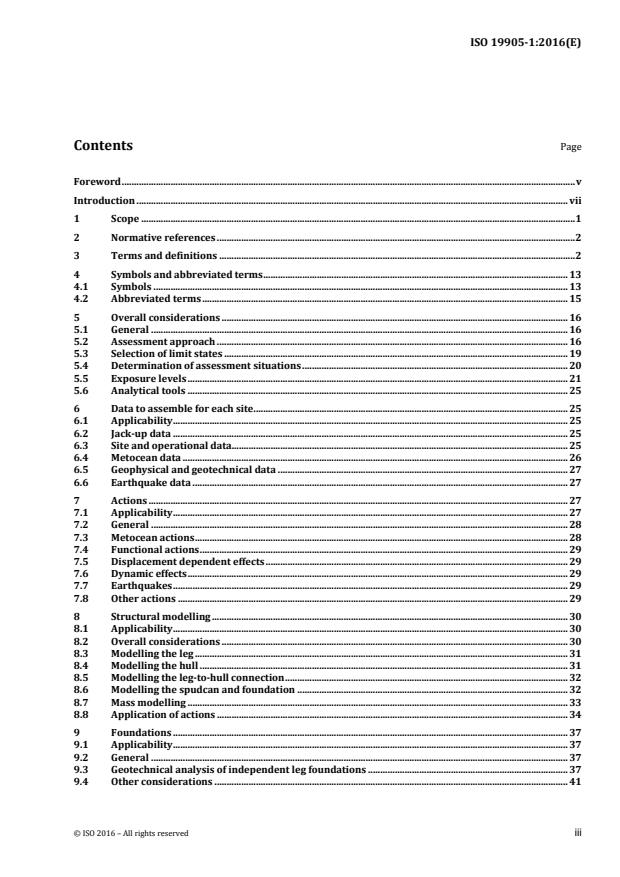
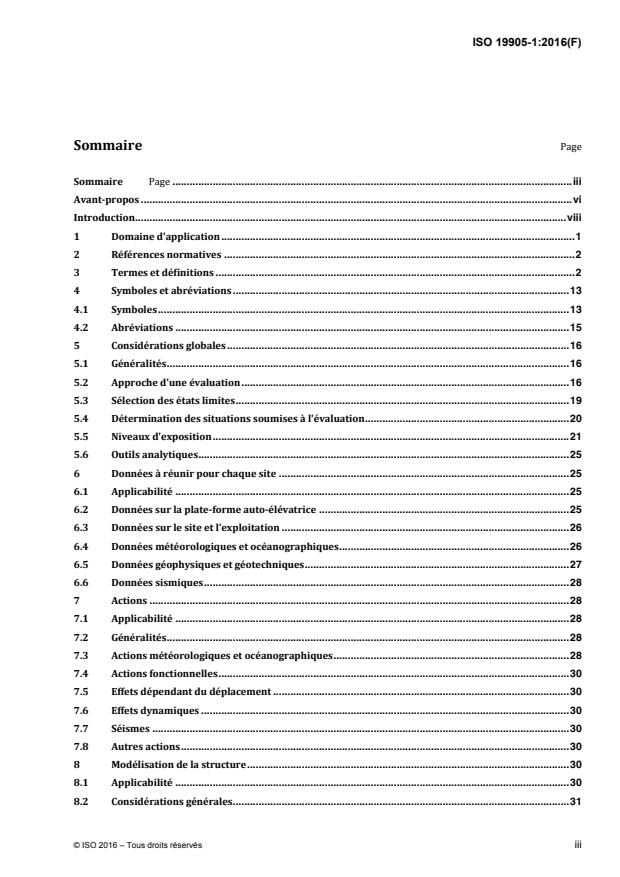
Contents Page
Foreword . v
Introduction . vii
1 Scope . 1
2 Normative references . 2
3 Terms and definitions . 2
4 Symbols and abbreviated terms . 13
4.1 Symbols . 13
4.2 Abbreviated terms . 15
5 Overall considerations . 16
5.1 General . 16
5.2 Assessment approach . 16
5.3 Selection of limit states . 19
5.4 Determination of assessment situations . 20
5.5 Exposure levels . 21
5.6 Analytical tools . 25
6 Data to assemble for each site . 25
6.1 Applicability . 25
6.2 Jack-up data . 25
6.3 Site and operational data. 25
6.4 Metocean data . 26
6.5 Geophysical and geotechnical data . 27
6.6 Earthquake data . 27
7 Actions . 27
7.1 Applicability . 27
7.2 General . 28
7.3 Metocean actions . 28
7.4 Functional actions . 29
7.5 Displacement dependent effects . 29
7.6 Dynamic effects . 29
7.7 Earthquakes . 29
7.8 Other actions . 29
8 Structural modelling . 30
8.1 Applicability . 30
8.2 Overall considerations . 30
8.3 Modelling the leg . 31
8.4 Modelling the hull . 31
8.5 Modelling the leg-to-hull connection . 32
8.6 Modelling the spudcan and foundation . 32
8.7 Mass modelling . 33
8.8 Application of actions . 34
9 Foundations . 37
9.1 Applicability . 37
9.2 General . 37
9.3 Geotechnical analysis of independent leg foundations . 37
9.4 Other considerations . 41
© ISO 2016 – All rights reserved iii
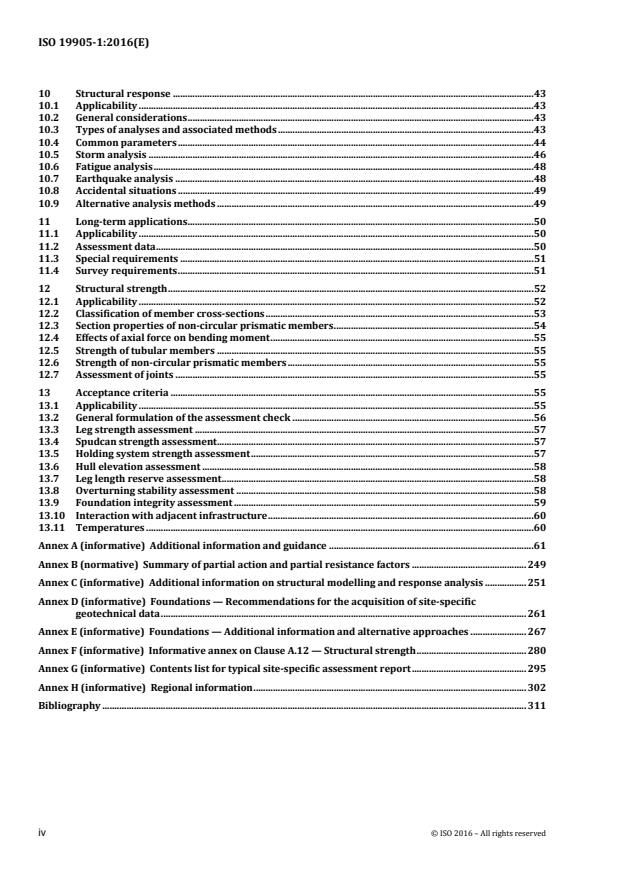
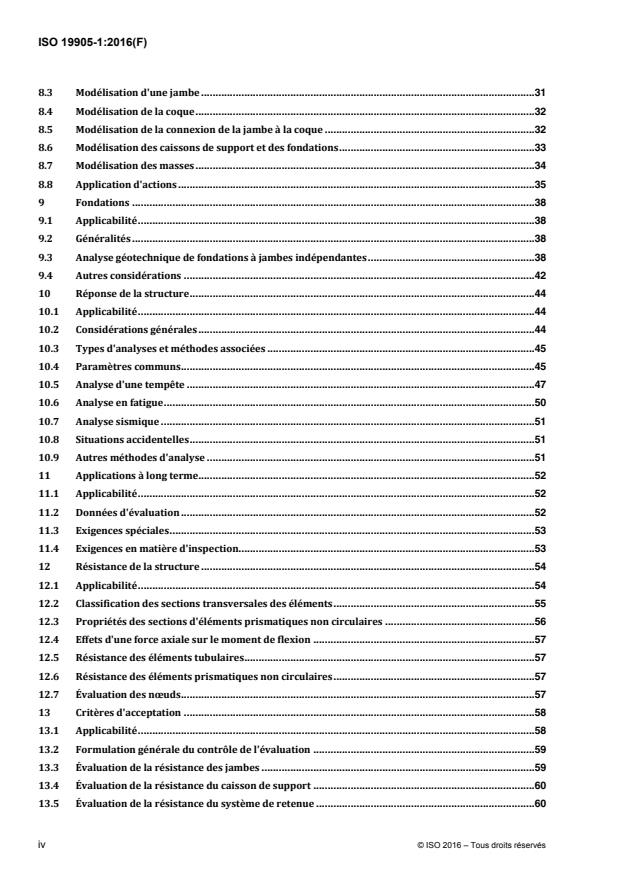
10 Structural response . 43
10.1 Applicability . 43
10.2 General considerations . 43
10.3 Types of analyses and associated methods . 43
10.4 Common parameters . 44
10.5 Storm analysis . 46
10.6 Fatigue analysis . 48
10.7 Earthquake analysis . 48
10.8 Accidental situations . 49
10.9 Alternative analysis methods . 49
11 Long-term applications . 50
11.1 Applicability . 50
11.2 Assessment data . 50
11.3 Special requirements . 51
11.4 Survey requirements . 51
12 Structural strength . 52
12.1 Applicability . 52
12.2 Classification of member cross-sections . 53
12.3 Section properties of non-circular prismatic members . 54
12.4 Effects of axial force on bending moment . 55
12.5 Strength of tubular members . 55
12.6 Strength of non-circular prismatic members . 55
12.7 Assessment of joints . 55
13 Acceptance criteria . 55
13.1 Applicability . 55
13.2 General formulation of the assessment check . 56
13.3 Leg strength assessment . 57
13.4 Spudcan strength assessment. 57
13.5 Holding system strength assessment . 57
13.6 Hull elevation assessment . 58
13.7 Leg length reserve assessment . 58
13.8 Overturning stability assessment . 58
13.9 Foundation integrity assessment . 59
13.10 Interaction with adjacent infrastructure . 60
13.11 Temperatures . 60
Annex A (informative) Additional information and guidance . 61
Annex B (normative) Summary of partial action and partial resistance factors . 249
Annex C (informative) Additional information on structural modelling and response analysis . 251
Annex D (informative) Foundations — Recommendations for the acquisition of site-specific
geotechnical data . 261
Annex E (informative) Foundations — Additional information and alternative approaches . 267
Annex F (informative) Informative annex on Clause A.12 — Structural strength . 280
Annex G (informative) Contents list for typical site-specific assessment report . 295
Annex H (informative) Regional information . 302
Bibliography . 311
iv © ISO 2016 – All rights reserved
Foreword
ISO (the International Organization for Standardization) is a worldwide federation of national
standards bodies (ISO member bodies). The work of preparing International Standards is normally
carried out through ISO technical committees. Each member body interested in a subject for which a
technical committee has been established has the right to be represented on that committee.
International organizations, governmental and non‐governmental, in liaison with ISO, also take part in
the work. ISO collaborates closely with the International Electrotechnical Commission (IEC) on all
matters of electrotechnical standardization.
The procedures used to develop this document and those intended for its further maintenance are
described in the ISO/IEC Directives, Part 1. In particular the different approval criteria needed for the
different types of ISO documents should be noted. This document was drafted in accordance with the
editorial rules of the ISO/IEC Directives, Part 2 (see www.iso.org/directives).
Attention is drawn to the possibility that some of the elements of this document may be the subject of
patent rights. ISO shall not be held responsible for identifying any or all such patent rights. Details of
any patent rights identified during the development of the document will be in the Introduction and/or
on the ISO list of patent declarations received (see www.iso.org/patents).
Any trade name used in this document is information given for the convenience of users and does not
constitute an endorsement.
For an explanation on the meaning of ISO specific terms and expressions related to conformity
assessment, as well as information about ISO's adherence to the WTO principles in the Technical
Barriers to Trade (TBT) see the following URL: Foreword ‐ Supplementary information
The committee responsible for this document is ISO/TC 67, Materials, equipment and offshore structures for
petroleum, petrochemical and natural gas industries, Subcommittee SC 7, Offshore structures.
This second edition cancels and replaces the first edition (ISO 19905‐1:2012), which has been technically revised.
ISO 19905 consists of the following parts, under the general title Petroleum and natural gas industries — Site-
specific assessment of mobile offshore units:
Part 1: Jack-ups
Part 2: Jack-ups commentary and detailed sample calculation [Technical Report]
The following parts are under preparation:
Part 3: Floating units
ISO 19905 is one of a series of International Standards for offshore structures. The full series comprises the
following:
ISO 19900, Petroleum and natural gas industries — General requirements for offshore structures
ISO 19901 (all parts), Petroleum and natural gas industries — Specific requirements for offshore structures
© ISO 2016 – All rights reserved v
ISO 19902, Petroleum and natural gas industries — Fixed steel offshore structures
ISO 19903, Petroleum and natural gas industries — Fixed concrete offshore structures
ISO 19904‐1, Petroleum and natural gas industries — Floating offshore structures — Part 1: Monohulls, semi-
submersibles and spars
ISO/TR 19905‐2, Petroleum and natural gas industries — Site-specific assessment of mobile offshore units —
Part 2: Jack-ups commentary and detailed sample calculation
ISO 19905‐3, Petroleum and natural gas industries — Site-specific assessment of mobile offshore units — Part 3:
Floating units
ISO 19906, Petroleum and natural gas industries — Arctic offshore structures
vi © ISO 2016 – All rights reserved
Introduction
The series of International Standards applicable to types of offshore structure, ISO 19900 to ISO 19906, addresses
design requirements and assessments for all offshore structures used by the petroleum and natural gas industries
worldwide. Through their application, the intention is to achieve reliability levels appropriate for manned and
unmanned offshore structures, whatever the type of structure and the nature or combination of the materials
used.
It is important to recognize that structural integrity is an overall concept comprising models for describing
actions, structural analyses, design or assessment rules, safety elements, workmanship, quality control procedures
and national requirements, all of which are mutually dependent. The modification of one aspect of design or
assessment in isolation can disturb the balance of reliability inherent in the overall concept or structural system.
The implications involved in modifications, therefore, need to be considered in relation to the overall reliability of
offshore structural systems.
The series of International Standards applicable to types of offshore structure is intended to provide a wide
latitude in the choice of structural configurations, materials and techniques, without hindering innovation. Sound
engineering judgement is therefore necessary in the use of these International Standards.
This part of ISO 19905, which has been developed from the Society of Naval Architects and Marine Engineers
(SNAME) Technical & Research Bulletin 5‐5A (2002), states the general principles and basic requirements for the
site‐specific assessment of mobile jack‐ups; it is intended to be used for assessment and not for design.
NOTE For the exposure level 1(L1) assessment and, where appropriate, the exposure level 2 (L2) assessment prior to
evacuation being effected, this part of ISO 19905 requires the use of 50 year independent or 100 year joint probability
metocean extremes, together with associated partial action factors. It is based on extensive benchmarking and best practice in
the international community.
Site‐specific assessment is normally carried out when an existing jack‐up unit is to be installed at a specific site.
The assessment is not intended to provide a full evaluation of the jack‐up; it assumes that aspects not addressed
herein have been addressed using other practices and standards at the design stage. In some instances, the
original design of all or part of the structure could be in accordance with other standards in the ISO 19900 series,
and in some cases, different practices or standards could have been applied.
The purpose of the site assessment is to demonstrate the adequacy of the jack‐up and its foundations for the
assessment situations and defined limit states, taking into account the consequences of failure. It is important that
the results of a site‐specific assessment be appropriately recorded and communicated to those persons required
to know or act on the conclusions and recommendations. Alternative approaches to the site‐specific assessment
can be used, provided that they have been shown to give a level of structural reliability equivalent, or superior, to
that implicit in this part of ISO 19905.
Annex A provides background to and guidance on the use of this part of ISO 19905. The clause numbering in
Annex A is the same as in the normative text in order to facilitate cross‐referencing. ISO/TR 19905‐2 provides
additional background to some clauses and a detailed sample 'go‐by' calculation.
Annex B summarizes the partial factors. Supplementary information is presented in Annexes C to H.
To meet certain needs of industry for linking software to specific elements in this part of ISO 19905, a special
numbering system has been permitted for figures, tables, formulae and bibliographic references.
In International Standards, the following verbal forms are used:
© ISO 2016 – All rights reserved vii
“shall” and “shall not” are used to indicate requirements strictly to be followed in order to conform to the
document and from which no deviation is permitted;
“should” and “should not” are used to indicate that, among several possibilities, one is recommended as
particularly suitable, without mentioning or excluding others, or that a certain course of action is preferred
but not necessarily required, or that (in the negative form) a certain possibility or course of action is
deprecated but not prohibited;
“may” is used to indicate a course of action permissible within the limits of the document;
“can” and “cannot” are used for statements of possibility and capability, whether material, physical or causal.
viii © ISO 2016 – All rights reserved
INTERNATIONAL STANDARD ISO 19905-1:2016(E)
Petroleum and natural gas industries — Site-specific assessment
of mobile offshore units — Part 1: Jack-ups
1 Scope
This part of ISO 19905 specifies requirements and guidance for the site‐specific assessment of independent leg
jack‐up units for use in the petroleum and natural gas industries. It addresses:
a) manned non‐evacuated, manned evacuated and unmanned jack‐ups;
b) the installed phase at a specific site.
To ensure acceptable reliability, the provisions of this part of ISO 19905 form an integrated approach, which is
used in its entirety for the site‐specific assessment of a jack‐up.
This part of ISO 19905 does not apply specifically to mobile offshore drilling units operating in regions subject to
sea ice and icebergs. When assessing a jack‐up operating in such areas, it is intended that the assessor supplement
the provisions of this part of ISO 19905 with the provisions relating to ice actions and procedures for ice
management contained in ISO 19906.
This part of ISO 19905 does not address design, transportation to and from site, or installation and removal from
site. However, it is advisable that the assumptions used in the assessment be checked against the as‐installed
configuration.
To ensure that the design of the jack‐up is sound and the structure is adequately maintained, this part of
ISO 19905 is applicable only to independent leg jack‐ups that either:
hold a valid classification society certification from a recognized classification society (RCS) throughout the
duration of the operation at the specific site subject to assessment; or
have been verified by an independent competent body to be structurally fit for purpose for elevated
situations and are subject to periodic inspection, both to the standards of an RCS.
NOTE 1 An RCS is an International Association of Classification Societies (IACS) member body, meeting the RCS definition
given in 3.52.
Jack‐ups that do not comply with this requirement are assessed according to the provisions of ISO 19902,
supplemented by methodologies from this part of ISO 19905, where applicable.
NOTE 2 Future revisions of this part of ISO 19905 can be expanded to cover mat‐supported jack‐ups.
NOTE 3 Well conductors are a safety‐critical element for jack‐up operations. However, the integrity of well conductors is
not part of the site‐specific assessment process for jack‐ups and is, therefore, not addressed in this part of ISO 19905. Annex A
provides references to other publications addressing this topic.
NOTE 4 RCS rules and the IMO MODU code provide guidance for the design of jack‐ups.
© ISO 2016 – All rights reserved
2 Normative references
The following documents, in whole or in part, are normatively referenced in this document and are indispensable
for its application. For dated references, only the edition cited applies. For undated references, the latest edition of
the referenced document (including any amendments) applies.
ISO 19900, Petroleum and natural gas industries — General requirements for offshore structures
ISO 19901‐1:2015, Petroleum and natural gas industries — Specific requirements for offshore structures — Part 1:
Metocean design and operating conditions
ISO 19901‐2, Petroleum and natural gas industries — Specific requirements for offshore structures — Part 2: Seismic
design procedures and criteria
ISO 19902, Petroleum and natural gas industries — Fixed steel offshore structures
3 Terms and definitions
For the purposes of this document, the terms and definitions given in ISO 19900, ISO 19901‐1, ISO 19901‐2 and
ISO 19902, and the following apply.
NOTE Other terms and definitions relevant for the use of this part of ISO 19905 are found in ISO 19901‐4 and ISO 19906.
3.1
abnormal wave crest
3 4
wave crest with probability of typically 10 to 10 per annum
3.2
accidental situation
exceptional situation of the structure
EXAMPLES Impact, fire, explosion, local failure, loss of intended differential pressure (e.g. buoyancy).
3.3
action
external load applied to the structure (direct action) or an imposed deformation or acceleration (indirect action)
EXAMPLE An imposed deformation can be caused by fabrication tolerances, settlement, temperature change or
moisture variation.
Note 1 to entry: An earthquake typically generates imposed accelerations.
[SOURCE: ISO 19900:2013, 3.3]
3.4
assessment
site-specific assessment
evaluation of the stability and structural integrity of a jack‐up and, where applicable, its seabed restraint or
support against the actions determined in accordance with the requirements of this part of ISO 19905
Note 1 to entry: An assessment can be limited to an evaluation of the components or members of the structure which, when
removed or damaged, could cause failure of the whole structure, or a significant part of it.
To be published. Replaces ISO 19901‐1:2005.
© ISO 2016 – All rights reserved
3.5
assessment situation
jack‐up configuration together with the environmental loading to be assessed
Note 1 to entry: For discussion on configuration, see 5.4.1.
Note 2 to entry: The assessment situations are checked against the acceptance criteria of this part of ISO 19905 to demonstrate
that the relevant limit states are not exceeded.
3.6
assessor
entity performing the site‐specific assessment
3.7
backfill
submerged weight of all of the soil that can be present on top of the spudcan
Note 1 to entry: Backfilling can occur during or after preloading. W refers to the submerged weight of the backfilling that
BF,o
occurs up to achieving the preload reaction. W refers to the submerged weight of the backfilling that occurs after the
BF,A
maximum preload has been applied and held. Both W and W can comprise backflow and/or infill. For discussion of the
BF,o BF,A
effects, see A.9.3.2.1.4.
3.8
backflow
soil that flows from beneath the spudcan around the sides and onto the top
Note 1 to entry: Backflow is part of backfill (3.7).
3.9
basic variable
one of a specified set of variables representing physical quantities which characterize actions, environmental
influences, geometrical quantities, or material properties including soil properties
[SOURCE: ISO 19900:2013, 3.7]
3.10
boundary conditions
actions and constraints on a (section of a) structural component (or a group of structural components) by other
structural components or by the environment surrounding it
Note 1 to entry: Boundary conditions can be used to generate reaction forces at locations of restraint.
[SOURCE: ISO 19902:2007, 3.6]
3.11
chart datum
local datum used to fix water depths on a chart or tidal heights over an area
Note 1 to entry: Chart datum is usually an approximation to the level of the lowest astronomical tide.
[SOURCE: ISO 19901‐1:2015, 3.2]
3.12
consequence category
classification system for identifying the environmental, economic and indirect personnel safety consequences of
failure of a jack‐up
© ISO 2016 – All rights reserved
Note 1 to entry: Categories for environmental and economic consequences are the following (see 5.3.3):
C1: high environmental or economic consequence;
C2: medium environmental or economic consequence;
C3: low environmental or economic consequence.
[SOURCE: ISO 19902:2007, definition 3.11, modified]
3.13
critical component
structural component, failure of which could cause failure of the whole structure, or a significant part of it
Note 1 to entry: A critical component is part of the primary structure.
[SOURCE: ISO 19902:2007, 3.12]
3.14
dynamic amplification factor
DAF
ratio of a dynamic action effect to the corresponding static action effect
Note 1 to entry: For a jack‐up, the dynamic action effect is best simulated by means of a concentrated or distributed inertial
loadset. It is usually not appropriate to factor the static actions to simulate the effects of dynamic actions.
Note 2 to entry: The DAF excluding the mean values, K , can typically be obtained from a single degree‐of‐freedom
DAF,SDOF
(SDOF) calculation. In this case, it is defined as the ratio of the amplitude of a dynamic action effect to the amplitude of the
corresponding static action effect for periodic excitation of a linear one degree‐of‐freedom model approximation of jack‐up
behaviour.
Note 3 to entry: The DAF including the mean values, K , can typically be obtained from a random wave calculation. In
DAF,RANDOM
this case, it is defined as the ratio of the absolute value of a dynamic action effect to the absolute value of the corresponding
static action effect, each including their mean value.
[SOURCE: ISO 19902:2007, definition 3.16, modified]
3.15
deterministic analysis
analysis in which the response is determined from a single combination of actions
3.16
exposure level
classification system used to define the requirements for a structure based on consideration of life‐safety and of
environmental and economic consequences of failure
Note 1 to entry: An exposure level 1 (L1) jack‐up is the most critical and exposure level 3 (L3) the least (see 5.5).
[SOURCE: ISO 19902:2007, definition 3.18, modified]
3.17
extreme storm event
extreme combination of wind, wave and current conditions to which the structure can be subjected during its
deployment
Note 1 to entry: This is the metocean event used for ULS storm assessment (see 5.5.4 and 6.4).
3.18
fixed load
permanent parts of the jack‐up, including hull, legs and spudcans, outfit, stationary and moveable‐fixed equipment
© ISO 2016 – All rights reserved
Note 1 to entry: Moveable‐fixed equipment normally includes the drilling package structure and associated permanently
attached equipment.
3.19
footprint
sea floor depression which remains when a jack‐up is removed from a site
3.20
foundation
soil and spudcan supporting a jack‐up leg
3.21
foundation fixity
rotational restraint offered by the soil to the spudcan
3.22
foundation stability
ability of the foundation to provide sufficient support to remain stable when subjected to actions and incremental
deformation
3.23
global analysis
determination of a consistent set of internal forces and moments, or stresses, in a structure that are in equilibrium
with a defined set of actions on the entire structure
Note 1 to entry: When a global analysis is of a transient situation (e.g. earthquake), the inertial response is part of the
equilibrium.
[SOURCE: ISO 19902:2007, definition 3.23, modified]
3.24
independent leg jack-up
jack‐up unit with legs that can be raised and lowered independently
3.25
inertial loadset
set of actions that approximates the effect of the inertial forces
Note 1 to entry: An inertial loadset is used only in quasi‐static analyses.
3.26
infill
soil above the plan area of the spudcan arising from sediment transport or hole sidewall collapse
Note 1 to entry: Infill is part of backfill (3.7).
3.27
intrinsic wave frequency
wave frequency of a periodic wave in a reference frame that is stationary with respect to the wave
Note 1 to entry: If there is no current, the reference frame is also stationary with respect to the sea floor. If there is a current,
the reference frame moves with the same speed and in the same direction as the current.
3.28
jack-up
mobile offshore unit with a buoyant hull and one or more legs that can be moved up and down relative to the hull
© ISO 2016 – All rights reserved
Note 1 to entry: A jack‐up reaches its operational mode by lowering the leg(s) to the seabed and then raising the hull to the
required elevation. The majority of jack‐ups have three or more legs, each of which can be moved independently and which are
supported in the seabed by spudcans.
3.29
jack-up owner
representative of the companies owning or chartering the jack‐up
3.30
joint probability metocean data
combinations of wind, wave and current that produce the action effect that can be expected to occur at a site, on
average, once in the return period
3.31
leaning instability
instability of an independent leg jack‐up that can arise when the rate of increase of actions on the foundation with
jack‐up inclination exceeds the rate of increase of foundation capacity with depth
3.32
life-safety category
classification system for identifying the applicable level of life‐safety of personnel on a jack‐up
Note 1 to entry: Categories for life‐safety are the following (see 5.5.2):
S1: manned non‐evacuated;
S2: manned evacuated;
S3: unmanned.
[SOURCE: ISO 19902:2007, definition 3.27, modified]
3.33
limit state
state beyond which the structure no longer fulfils the relevant assessment criteria
[SOURCE: ISO 19900:2013, definition 3.28, modified]
3.34
load case
compatible load arrangements, sets of deformations and imperfections considered simultaneously with
permanent actions and fixed variable actions for a particular design or verification
[SOURCE: ISO 19902:2007, 3.29]
3.35
long-term operation
operation of a jack‐up on one particular site for more than the RCS special survey period
3.36
lowest astronomical tide
LAT
level of low tide when all harmonic components causing the tides are in phase
Note 1 to entry: The harmonic components are in phase approximately once every 19 years, but these conditions are
approached several times each year.
[SOURCE: ISO 19901‐1:2015, 3.17]
© ISO 2016 – All rights reserved
3.37
mat-supported jack-up
jack‐up unit with the leg(s) rigidly connected by a foundation structure, such that the leg(s) are raised and
lowered in unison
3.38
mean high water spring tidal level
arithmetic mean of all high water spring tidal sea levels measured over a long period, ideally 19 years
3.39
mean low water spring tidal level
arithmetic mean of all low water spring tidal sea levels measured over a long period, ideally 19 years
3.40
mean sea level
MSL
arithmetic mean of all sea levels measured at hourly intervals over a long period, ideally 19 years
Note 1 to entry: Seasonal changes in mean level can be expected in some regions and over many years the mean sea level can
change.
[SOURCE: ISO 19901‐1:2015, 3.20]
3.41
mean zero-upcrossing period
average intrinsic period of the zero‐upcrossing waves in a sea state
Note 1 to entry: In practice, the mean zero‐crossing period is often estimated from the zeroth and second moments of the wave
spectrum as given by Formula (3.41‐1):
TT== m()f m()f=2m ()m() (3.41‐1)
z2 0 2 0 2
where
f is the frequency in cycles per second (hertz);
m is the zeroth spectral moment and is equivalent to σ, the variance of the corresponding time series;
m is the second spectral moment;
T and T are the average zero‐crossing period of the water surface elevation, defined by the zeroth and second order
2 z
spectral moments, (T = T);
2 z
ω is the wave frequency in radians per second.
[SOURCE: ISO 19901‐1:2015, definition 3.22, modified]
3.42
most probable maximum extreme
MPME
value of the maximum of a variable with the highest probability of occurring over a defined period of time
Note 1 to entry: A defined period of time can be, for example, X hours.
Note 2 to entry: The most probable maximum extreme is the value for which the probability density function of the maxima of
the variable has its peak. It is also called the mode or modus of the statistical distribution.
[SOURCE: ISO 19901‐1:2015, definition 3.24, modified]
© ISO 2016 – All rights reserved
3.43
nominal strength
strength calculated for a cross‐sectional area, taking into account the stress raising effects of the macro‐
geometrical shape of the component of which the section forms a part, but disregarding the local stress raising
effects from the section shape and any weldment or other fixing detail
[SOURCE: ISO 19902:2007, definition 3.34, modified]
3.44
nominal stress
stress calculated in a sectional area, including the stress raising effects of the macro‐geometrical shape of the
component of which the section forms a part, but disregarding the local stress raising effects from the section
shape and any weldment or other fixing detail
Note 1 to entry: Overall elastic behaviour is assumed when calculating nominal stresses.
[SOURCE: ISO 19902:2007, definition 3.34]
3.45
operating manual
marine operations manual
manual that defines the operational characteristics and capabilities of the jack‐up
Note 1 to entry: The assessor is advised to ensure that the operations manual referenced is the latest revision and that any
updated weight data are provided.
3.46
operator
representative of the companies leasing the site
Note 1 to entry: The operator is normally the oil company acting on behalf of co‐licensees.
3.47
preloading
installation of the spudcans by vertical loading of the soil beneath a jack‐up leg spudcan with the objective of
ensuring sufficient foundation capacity under assessment situations through to the time when the maximum load
is applied and held
Note 1 to entry: While three‐legged jack‐ups preload by taking water ballast on board, jack‐ups with four or more legs typically
achieve foundation preload by carrying the hull weight on pairs of legs in turn. This procedure is known as pre‐driving and
generally does not require the addition of water ballast. For the purposes of this part of ISO 19905, no distinction is made
between preload and pre‐drive.
3.48
preload reaction
maximum vertical reaction under a spudcan, V , supporting the in‐water weight of the jack‐up during the entire
Lo
preloading operation
Note 1 to entry: The in‐water weight is the full weight of the hull, variable load and preload ballast, plus the legs and spudcans
and any contained water, reduced by the buoyancy in water of the legs and spudcans (calculated from their external
dimensions). Soil buoyancy and the weight of any soil backfill above the spudcan are neglected. It is necessary to take care
when accounting for water contained in the spudcan (in some cases this can be included in the quoted leg weight).
Note 2 to entry: This is the maximum reaction on a spudcan, V , that would be obtained during preloading if the jack‐up were
Lo
installed on an infinitely rigid foundation.
3.49
punch-through
rapid, uncontrolled vertical leg movement due to soil failure in strong soil overlying weak soil
© ISO 2016 – All rights reserved
3.50
quasi-static
static representation of a dynamic process
Note 1 to entry: In some cases, the influence of structural accelerations can be approximated by using an equivalent inertial
loadset.
3.51
rack phase difference
RPD
relative difference in the position of adjacent leg chords within a leg measured parallel to the longitudinal axis of
the chords
Note 1 to entry: This is the ou
...
NORME ISO
INTERNATIONALE 19905-1
Deuxième édition
2016-01-15
Industries du pétrole et du gaz
naturel — Évaluation spécifique au
site d’unités mobiles en mer —
Partie 1:
Plates-formes auto-élévatrices
Petroleum and natural gas industries — Site-specific assessment of
mobile offshore units —
Part 1: Jack-ups
Numéro de référence
©
ISO 2016
DOCUMENT PROTÉGÉ PAR COPYRIGHT
© ISO 2016, Publié en Suisse
Droits de reproduction réservés. Sauf indication contraire, aucune partie de cette publication ne peut être reproduite ni utilisée
sous quelque forme que ce soit et par aucun procédé, électronique ou mécanique, y compris la photocopie, l’affichage sur
l’internet ou sur un Intranet, sans autorisation écrite préalable. Les demandes d’autorisation peuvent être adressées à l’ISO à
l’adresse ci-après ou au comité membre de l’ISO dans le pays du demandeur.
ISO copyright office
Ch. de Blandonnet 8 • CP 401
CH-1214 Vernier, Geneva, Switzerland
Tel. +41 22 749 01 11
Fax +41 22 749 09 47
copyright@iso.org
www.iso.org
ii © ISO 2016 – Tous droits réservés
Sommaire Page
Sommaire Page . iii
Avant-propos . vi
Introduction . viii
1 Domaine d'application . 1
2 Références normatives . 2
3 Termes et définitions . 2
4 Symboles et abréviations . 13
4.1 Symboles . 13
4.2 Abréviations . 15
5 Considérations globales . 16
5.1 Généralités . 16
5.2 Approche d'une évaluation . 16
5.3 Sélection des états limites . 19
5.4 Détermination des situations soumises à l'évaluation . 20
5.5 Niveaux d'exposition . 21
5.6 Outils analytiques . 25
6 Données à réunir pour chaque site . 25
6.1 Applicabilité . 25
6.2 Données sur la plate-forme auto-élévatrice . 25
6.3 Données sur le site et l’exploitation . 26
6.4 Données météorologiques et océanographiques . 26
6.5 Données géophysiques et géotechniques . 27
6.6 Données sismiques . 28
7 Actions . 28
7.1 Applicabilité . 28
7.2 Généralités . 28
7.3 Actions météorologiques et océanographiques . 28
7.4 Actions fonctionnelles . 30
7.5 Effets dépendant du déplacement . 30
7.6 Effets dynamiques . 30
7.7 Séismes . 30
7.8 Autres actions . 30
8 Modélisation de la structure . 30
8.1 Applicabilité . 30
8.2 Considérations générales . 31
8.3 Modélisation d'une jambe .31
8.4 Modélisation de la coque .32
8.5 Modélisation de la connexion de la jambe à la coque .32
8.6 Modélisation des caissons de support et des fondations .33
8.7 Modélisation des masses .34
8.8 Application d'actions .35
9 Fondations .38
9.1 Applicabilité .38
9.2 Généralités .38
9.3 Analyse géotechnique de fondations à jambes indépendantes .38
9.4 Autres considérations .42
10 Réponse de la structure .44
10.1 Applicabilité .44
10.2 Considérations générales .44
10.3 Types d'analyses et méthodes associées .45
10.4 Paramètres communs .45
10.5 Analyse d'une tempête .47
10.6 Analyse en fatigue .50
10.7 Analyse sismique .51
10.8 Situations accidentelles .51
10.9 Autres méthodes d'analyse .51
11 Applications à long terme.52
11.1 Applicabilité .52
11.2 Données d'évaluation .52
11.3 Exigences spéciales .53
11.4 Exigences en matière d'inspection.53
12 Résistance de la structure .54
12.1 Applicabilité .54
12.2 Classification des sections transversales des éléments .55
12.3 Propriétés des sections d'éléments prismatiques non circulaires .56
12.4 Effets d'une force axiale sur le moment de flexion .57
12.5 Résistance des éléments tubulaires .57
12.6 Résistance des éléments prismatiques non circulaires .57
12.7 Évaluation des nœuds .57
13 Critères d'acceptation .58
13.1 Applicabilité .58
13.2 Formulation générale du contrôle de l'évaluation .59
13.3 Évaluation de la résistance des jambes .59
13.4 Évaluation de la résistance du caisson de support .60
13.5 Évaluation de la résistance du système de retenue .60
iv © ISO 2016 – Tous droits réservés
13.6 Évaluation de l'élévation de la coque . 60
13.7 Évaluation de la réserve de longueur des jambes . 60
13.8 Évaluation de la stabilité au renversement . 61
13.9 Évaluation de l'intégrité des fondations . 62
13.10 Interaction avec une infrastructure adjacente . 63
13.11 Températures . 63
Annexe A (informative) Additional information and guidance . 64
Annexe B (normative) Résumé des coefficients partiels d'actions et des coefficients partiels de
résistance . 242
Annexe C (informative) Additional information on structural modelling and response analysis . 244
Annexe D (informative) Foundations — Recommendations for the acquisition of site-specific
geotechnical data . 254
Annexe E (informative) Foundations — Additional information and alternative approaches . 260
Annexe F (informative) Informative annex on Clause A.12 — Structural strength . 273
Annexe G (informative) Contents list for typical site-specific assessment report . 287
Annexe H (informative) Regional information . 294
Bibliographie . 303
Avant-propos
L'ISO (Organisation internationale de normalisation) est une fédération mondiale d'organismes nationaux de
normalisation (comités membres de l'ISO). L'élaboration des Normes internationales est en général confiée aux
comités techniques de l'ISO. Chaque comité membre intéressé par une étude a le droit de faire partie du comité
technique créé à cet effet. Les organisations internationales, gouvernementales et non gouvernementales, en
liaison avec l'ISO participent également aux travaux. L'ISO collabore étroitement avec la Commission
électrotechnique internationale (IEC) en ce qui concerne la normalisation électrotechnique.
Les procédures utilisées pour élaborer le présent document et celles destinées à sa mise à jour sont décrites dans
les Directives ISO/IEC, Partie 1. Il convient, en particulier de prendre note des différents critères d'approbation
requis pour les différents types de documents ISO. Le présent document a été rédigé conformément aux règles de
rédaction données dans les Directives ISO/IEC, Partie 2 (voir www.iso.org/directives).
L'attention est appelée sur le fait que certains des éléments du présent document peuvent faire l'objet de droits de
propriété intellectuelle ou de droits analogues. L'ISO ne saurait être tenue pour responsable de ne pas avoir
identifié de tels droits de propriété et averti de leur existence. Les détails concernant les références aux droits de
propriété intellectuelle ou autres droits analogues identifiés lors de l'élaboration du document sont indiqués dans
l'Introduction et/ou dans la liste des déclarations de brevets reçues par l'ISO (voir www.iso.org/brevets).
Les appellations commerciales éventuellement mentionnées dans le présent document sont données pour
information, par souci de commodité, à l’intention des utilisateurs et ne sauraient constituer un engagement.
Pour une explication de la signification des termes et expressions spécifiques de l'ISO liés à l'évaluation de la
conformité, ou pour toute information au sujet de l'adhésion de l'ISO aux principes de l'OMC concernant les
obstacles techniques au commerce (OTC), voir le lien suivant: Avant‐propos ‐ Informations supplémentaires.
Le comité chargé de l'élaboration du présent document est l'ISO/TC 67, Matériel, équipement et structures en mer
pour les industries pétrolière, pétrochimique et du gaz naturel, sous‐comité SC 7, Structures en mer.
Cette deuxième édition annule et remplace la première édition (ISO 19905‐1:2012), qui a fait l'objet d'une
révision technique.
L'ISO 19905 comprend les parties suivantes, présentées sous le titre général Industries du pétrole et du gaz
naturel — Évaluation spécifique au site d'unités mobiles en mer:
Partie 1: Plates-formes auto-élévatrices
Partie 2: Compléments sur les plates-formes auto-élévatrices [Rapport technique]
Les parties suivantes sont en cours d'élaboration:
Partie 3: Unité flottante
L'ISO 19905 fait partie d'une série de Normes internationales relatives aux structures en mer. La série complète
comprend les parties suivantes:
ISO 19900, Industries du pétrole et du gaz naturel — Exigences générales pour les structures en mer
ISO 19901 (toutes les parties), Industries du pétrole et du gaz naturel — Exigences spécifiques relatives aux
structures en mer
ISO 19902, Industries du pétrole et du gaz naturel — Structures en mer fixes en acier
vi © ISO 2016 – Tous droits réservés
ISO 19903, Industries du pétrole et du gaz naturel — Structures en mer fixes en béton
ISO 19904-1, Industries du pétrole et du gaz naturel — Structures en mer flottantes — Partie 1: Unités
monocoques, unités semi-submersibles et unités spars
ISO/TR 19905-2, Industries du pétrole et du gaz naturel — Évaluation liée au site des unités marines mobiles —
Partie 2: Compléments sur les plates-formes auto-élévatrices
ISO 19905-3, Industries du pétrole et du gaz naturel — Évaluation spécifique au site d’unités mobiles en mer —
Partie 3: Unité flottante
ISO 19906, Industries du pétrole et du gaz naturel — Structures arctiques en mer
Introduction
La série de Normes internationales applicables aux types de structures marines, l’ISO 19900 à l’ISO 19906, traite
des exigences et des évaluations de la conception de toutes les structures marines utilisées dans le monde entier
par les industries du pétrole et du gaz naturel. Grâce à leur application, l'intention est d'obtenir les niveaux de
fiabilité appropriés pour les structures marines occupées par du personnel et non occupées par du personnel,
quels que soient le type de la structure et la nature ou la combinaison des matériaux utilisés.
Il est important de se rendre compte que l'intégrité structurelle est un concept global comprenant des modèles
destinés à décrire des actions, des analyses structurelles, des règles de conception ou d'évaluation, des éléments
de sécurité, l'exécution des réalisations, des procédures de contrôle de la qualité et des exigences nationales,
toutes étant mutuellement dépendantes. La modification d'un aspect de la conception ou de l'évaluation pris
isolément peut perturber l'équilibre de la fiabilité inhérent au concept global ou au système structurel global. En
conséquence, les implications des modifications doivent être prises en considération en relation avec la fiabilité
globale des systèmes structuraux marins.
La série de Normes internationales applicables aux types de structures marines est destinée à fournir une grande
latitude de choix de configurations de structures, de matériaux et de techniques sans empêcher l'innovation. Un
jugement technique sain est en conséquence nécessaire pour utiliser les présentes Normes Internationales.
La présente partie de l'ISO 19905, qui a été élaborée à partir du Technical & Research Bulletin 5-5A (2002) de la
Society of Naval Architects and Marine Engineers (SNAME), établit les principes généraux et les exigences de base
pour une évaluation spécifique au site des plates‐formes auto‐élévatrices mobiles. Elle est destinée à être utilisée
pour l'évaluation et non pas pour la conception.
NOTE Pour l'évaluation du niveau d'exposition 1(L1) et, le cas échéant, l'évaluation du niveau d'exposition 2 (L2) avant
que l'évacuation ne soit effectuée, la présente partie de l'ISO 19905 exige l'utilisation des valeurs extrêmes indépendantes sur
50 ans ou des données météorologiques et océanographiques à probabilité conjointe de 100 ans, avec les coefficients partiels
d'action associés. Elle est basée sur un étalonnage complet et les meilleures pratiques appliquées dans la communauté
internationale.
L'évaluation liée au site est normalement exécutée lorsqu'une unité de plate‐forme auto‐élévatrice existante doit
être installée en un site spécifique. L'évaluation n'a pas pour but de fournir une évaluation complète de la
plate‐forme auto‐élévatrice. Elle suppose que les aspects non traités ici ont été traités en utilisant d'autres
pratiques et d'autres normes au stade de la conception. Dans certains cas, la conception d'origine de la totalité ou
d’une partie de la structure pourrait être conforme à d'autres normes de la série ISO 19900 et, dans certains cas,
d'autres pratiques ou d'autres normes pourraient avoir été appliquées.
Le but de l'évaluation d'un site est de démontrer le caractère adéquat de la plate‐forme auto‐élévatrice et de ses
fondations pour les situations de l'évaluation et les états limites définis, en prenant en compte les conséquences
d'une ruine. Il est important d'enregistrer de manière appropriée les résultats d'une évaluation spécifique au site
et de les communiquer aux personnes qui ont besoin des conclusions et des recommandations ou agissent au vu
de celles‐ci. D'autres approches de l'évaluation spécifique au site peuvent être utilisées, sous réserve qu'il ait été
démontré qu'elles confèrent un niveau de fiabilité structurelle équivalent ou supérieur à celui implicite dans la
présente partie de l'ISO 19905.
L'Annexe A fournit le contexte et les lignes directrices pour l'utilisation de la présente partie de l'ISO 19905. La
numérotation des articles et des paragraphes à l'Annexe A est la même que dans le texte normatif afin de faciliter
les références croisées. L'ISO/TR 19905‐2 fournit un contexte supplémentaire à certains articles et un exemple de
calcul détaillé.
L'Annexe B résume les coefficients partiels. Des informations supplémentaires sont présentées aux Annexes C à H.
Pour satisfaire certains besoins de l'industrie de relier des logiciels à des éléments spécifiques dans la présente
partie de l'ISO 19905, un système de numérotation spéciale a été autorisé pour les figures, les tableaux, les
formules et les références bibliographiques.
viii © ISO 2016 – Tous droits réservés
Dans les Normes internationales, les formes verbales suivantes sont utilisées:
«doit» et «ne doit pas» sont utilisés pour indiquer des exigences devant être rigoureusement respectées pour
se conformer au document et pour lesquelles aucun écart n'est autorisé;
«il convient de» et «il convient de ne pas» sont utilisés pour indiquer que, parmi plusieurs possibilités, l'une
est recommandée comme étant particulièrement adaptée, sans mentionner ni exclure les autres possibilités,
ou pour indiquer qu'un plan d'action donné est préféré mais pas nécessairement exigé, ou que (dans la forme
négative) une possibilité ou un plan d'action donné est déconseillé, sans pour autant être interdit;
«peut» est utilisé pour indiquer un plan d'action admissible dans les limites du document;
«peut» et «ne peut pas» sont utilisés pour introduire des notions de possibilité et de capacité, qu'elles soient
matérielles, physiques ou causales.
NORME INTERNATIONALE ISO 19905-1:2016(F)
Industries du pétrole et du gaz naturel — Évaluation spécifique au
site d'unités mobiles en mer —
Partie 1:
Plates-formes auto-élévatrices
1 Domaine d'application
La présente partie de l'ISO 19905 spécifie les exigences et les lignes directrices pour l'évaluation spécifique au site
d'unités de plates‐formes élévatrices à jambes indépendantes à utiliser dans les industries du pétrole et du gaz
naturel. Elle traite:
a) des plates‐formes auto‐élévatrices occupées par du personnel, non évacuées; occupées par du personnel,
évacuées, et non occupées par du personnel;
b) de la phase installée au niveau d'un site spécifique.
Pour assurer la fiabilité acceptable, les dispositions de la présente partie de l’ISO 19905 forment une approche
intégrée qui est utilisée dans sa totalité pour l'évaluation liée au site d'une plate‐forme.
La présente partie de l’ISO 19905 ne s'applique pas spécifiquement aux unités de forage mobiles en mer
fonctionnant dans des régions sujettes à la glace de mer et aux icebergs. Lors de l'évaluation d’une plate‐forme
auto‐élévatrice opérant dans de telles zones, il est prévu que l'évaluateur complète les dispositions de la présente
partie de l’ISO 19905 par les dispositions se rapportant aux actions de la glace et par les procédures se rapportant
à la gestion de la glace contenues dans l'ISO 19906.
La présente partie de l’ISO 19905 ne traite pas de la conception, du transport vers et depuis un site ou de
l'installation et du retrait du site. Cependant, il est recommandé que les hypothèses utilisées dans l'évaluation
soient vérifiées par rapport à la configuration à l'état installé.
Pour garantir que la conception de la plate‐forme auto‐élévatrice est saine et que la structure est entretenue de
manière adéquate, la présente partie de ISO 19905 est applicable seulement à des plates‐formes élévatrices à
jambes indépendantes qui:
soit détiennent une certification valide de société de classification délivrée par une société de classification
(RCS) reconnue durant toute la durée de l'exploitation au niveau du site spécifique soumis à l'évaluation;
soit ont fait l'objet d'une vérification par un organisme compétent indépendant concernant l’adéquation de la
structure pour des situations en position élevée et sont soumises à une inspection périodique, toutes deux
selon les normes d'une RCS.
NOTE 1 Une RCS est un membre de l’Association of Classification Societies (IACS), répondant à la définition d’une RCS
donnée en 3.52.
Les plates‐formes élévatrices qui ne satisfont pas à cette exigence sont évaluées conformément aux dispositions
de l’ISO 19902, complétées par des méthodologies issues de la présente partie de l’ISO 19905, le cas échéant.
NOTE 2 De futures révisions de la présente partie de l’ISO 19905 peuvent être étendues afin de couvrir les plates‐formes
élévatrices supportées par un plancher de stabilité.
NOTE 3 Les tubes conducteurs de puits sont un élément critique en termes de sécurité pour les opérations des plates‐formes
auto‐élévatrices. Cependant, l'intégrité des tubes conducteurs de puits ne fait pas partie du processus d'évaluation spécifique au
site des plates‐formes auto‐élévatrices et en conséquence n'est pas traitée dans la présente partie de l’ISO 19905. L'Annexe A
fournit des références à d'autres publications qui traitent de ce sujet.
NOTE 4 Les règles RCS et le code IMO MODU fournissent des lignes directrices pour la conception des plates‐formes auto‐
élévatrices.
2 Références normatives
Les documents ci‐après, dans leur intégralité ou non, sont des références normatives indispensables à
l’application du présent document. Pour les références datées, seule l'édition citée s'applique. Pour les références
non datées, la dernière édition du document de référence s'applique (y compris les éventuels amendements).
ISO 19900, Industries du pétrole et du gaz naturel — Exigences générales pour les structures en mer.
ISO 19901‐1:2015, Industries du pétrole et du gaz naturel — Exigences spécifiques relatives aux structures en mer —
1)
Partie 1: Dispositions océano-météorologiques pour la conception et l'exploitation .
ISO 19901‐2, Industries du pétrole et du gaz naturel — Exigences spécifiques relatives aux structures en mer —
Partie 2: Procédures de conception et critères sismiques.
ISO 19902, Industries du pétrole et du gaz naturel — Structures en mer fixes en acier.
3 Termes et définitions
Pour les besoins du présent document, les termes et définitions donnés dans l'ISO 19900, l'ISO 19901‐1,
l'ISO 19901‐2 et l'ISO 19902 ainsi que les suivants s'appliquent.
NOTE D’autres termes et définitions pertinents pour l’utilisation de la présente partie de l’ISO 19905 sont donnés dans
l’ISO 19901‐4 et l’ISO 19906.
3.1
crête de vague anormale
‐3 ‐4
crête d'une vague ayant une probabilité habituellement de 10 à 10 par an
3.2
situation accidentelle
situation exceptionnelle de la structure
EXEMPLES Choc, incendie, explosion, défaillance locale, perte de pression différentielle voulue (par exemple flottabilité).
3.3
action
charge extérieure appliquée à la structure (action directe) ou déformation ou accélération imposée (action
indirecte)
EXEMPLE Une déformation imposée peut être causée par des tolérances de fabrication, un tassement ou des variations
de température ou d'humidité.
Note 1 à l'article: Un tremblement de terre génère typiquement des accélérations imposées.
[SOURCE: ISO 19900:2013, 3.3]
3.4
évaluation
évaluation spécifique au site
évaluation de la stabilité et de l'intégrité structurelle d'une plate‐forme auto‐élévatrice et, le cas échéant, de son
encastrement dans le fond marin ou de son support sur le fond marin vis‐à‐vis des actions déterminées
conformément aux exigences de la présente partie de l’ISO 19905
Note 1 à l'article: Une évaluation peut être limitée à une évaluation des composants ou éléments de la structure qui, lorsqu'ils
sont enlevés ou endommagés, pourraient provoquer la défaillance de la structure entière ou d'une partie significative de celle‐
ci.
1)
À publier. Est destinée à remplacer l'ISO 19901‐1:2005.
2 © ISO 2016 – Tous droits réservés
3.5
situation pour l'évaluation
configuration de la plate‐forme auto‐élévatrice en même temps que le chargement dû à l'environnement devant
être évalué
Note 1 à l'article: Pour une description de la configuration, voir 5.4.1.
Note 2 à l'article: Les situations pour l’évaluation font l’objet d’une vérification par rapport aux critères d'acceptation de la
présente partie de l’ISO 19905 pour démontrer que les états limites concernés n'ont pas été dépassés.
3.6
évaluateur
entité effectuant l'évaluation spécifique au site
3.7
remblayage
poids submergé de la totalité du sol qui peut être présent au‐dessus du caisson de support
Note 1 à l'article: Un remblayage peut apparaître au cours ou après le préchargement. W désigne le poids submergé du
BF,o
remblayage qui apparaît jusqu'à la réalisation de la réaction de précharge. W désigne le poids submergé du remblayage qui
BF,A
apparaît après application et maintien de la précharge maximale. W et W peuvent comprendre le retour et/ou le
BF,o BF,A
remplissage. Pour une description des effets, voir A.9.3.2.1.4.
3.8
retour
sol qui s'écoule depuis le dessous du caisson de support autour des côtés et jusqu'en haut
Note 1 à l'article: Le retour fait partie du remblayage (3.7).
3.9
variable de base
ensemble de variables pouvant se rapporter aux grandeurs physiques qui caractérisent les actions, les incidences
de l'environnement, les quantités géométriques ou les propriétés des matériaux y compris les propriétés des sols
[SOURCE: ISO 19900:2013, 3.7]
3.10
conditions aux limites
actions et contraintes sur un (une section d'un) composant de structure (ou un groupe de composants de
structure) par d'autres composants de structure ou par l'environnement qui l'entoure
Note 1 à l'article: Les conditions aux limites peuvent être utilisées pour générer des forces de réaction aux emplacements de
retenue.
[SOURCE: ISO 19902:2007, 3.6]
3.11
zéro d'une carte marine
point de référence local utilisé pour fixer les profondeurs d'eau sur une carte ou les hauteurs de marée sur une
zone
Note 1 à l'article: En général, le zéro d'une carte marine correspond approximativement au niveau de la marée astronomique la
plus basse.
[SOURCE: ISO 19901‐1:2015, 3.2]
3.12
catégorie de conséquence
système de classification destiné à identifier les conséquences environnementales, économiques et indirectes
pour la sécurité du personnel d'une défaillance d'une plate‐forme auto‐élévatrice
Note 1 à l'article: Les catégories pour les conséquences environnementales et économiques sont les suivantes (voir
5.3.3):
C1: conséquence environnementale ou économique élevée;
C2: conséquence environnementale ou économique moyenne;
C3: conséquence environnementale ou économique faible.
[SOURCE: ISO 19902:2007, définition 3.11, modifiée]
3.13
composant critique
composant de structure, dont la défaillance provoquerait la défaillance de toute la structure ou d’une partie
importante de celle‐ci
Note 1 à l'article: Un composant critique fait partie de la structure principale.
[SOURCE: ISO 19902:2007, 3.12]
3.14
facteur d'amplification dynamique
DAF
rapport d'un effet d'action dynamique sur l'effet de l'action statique correspondant
Note 1 à l'article: Pour une plate‐forme auto‐élévatrice, l'effet d'action dynamique est le mieux simulé au moyen d'un
ensemble de charges inertielles concentrées ou réparties. Habituellement, il n'est pas approprié d'attribuer un coefficient aux
actions statiques pour simuler les effets des actions dynamiques.
Note 2 à l'article: Le DAF excluant les valeurs moyennes, K , peut habituellement être obtenu à partir d’un calcul
DAF,SDOF
avec un seul degré de liberté (SDOF). Dans ce cas, il est défini comme le rapport de l’amplitude de l’effet d’une action
dynamique sur l'amplitude de l'effet de l'action statique correspondant pour une excitation périodique, d’une approximation
du comportement de la plate‐forme auto‐élévatrice par un modèle linéaire à un seul degré de liberté.
Note 3 à l'article: Le DAF incluant les valeurs moyennes, K , peut habituellement être obtenu à partir du calcul
DAF,RANDOM
de vagues aléatoires. Dans ce cas, il est défini comme le rapport de la valeur absolue de l’effet d'une action dynamique sur la
valeur absolue de l'effet de l'action statique correspondant, chacun incluant leur valeur moyenne.
[SOURCE: ISO 19902:2007, définition 3.16, modifiée]
3.15
analyse déterministe
analyse dans laquelle la réponse est déterminée à partir d'une combinaison d'actions unique
3.16
niveau d'exposition
système de classification utilisé pour définir les exigences requises pour une structure à partir de considérations
sur la sécurité des personnes et sur les conséquences économiques et environnementales en cas de ruine
structurelle
Note 1 à l'article: Pour une plate‐forme auto‐élévatrice, le niveau d'exposition 1 (L1) est le niveau le plus critique et le niveau
d'exposition 3 (L3) est le niveau d'exposition le plus tolérant (voir 5.5).
[SOURCE: ISO 19902:2007, définition 3.18, modifiée]
3.17
évènement de tempête extrême
combinaison extrême de conditions de vent, de vagues et de courant à laquelle la structure peut être soumise au
cours de son déploiement
Note 1 à l'article: Il s'agit de l'évènement météorologique et océanographique utilisé pour l'évaluation de la tempête ULS
(voir 5.5.4 et 6.4).
3.18
charge fixe
partie permanente de la plate‐forme auto‐élévatrice comprenant la coque, les jambes et les caissons de support,
l’appareillage, les équipements d'armement, fixes et mobiles
4 © ISO 2016 – Tous droits réservés
Note 1 à l'article: Les équipements fixes et mobiles comprennent normalement la structure de l'appareil de forage et
l'équipement associé fixé de manière permanente.
3.19
empreinte au sol
dépression dans le fond océanique qui reste lorsqu'une plate‐forme auto‐élévatrice est enlevée d'un site
3.20
fondation
sol et caisson de support supportant une jambe de plate‐forme auto‐élévatrice
3.21
fixité de la fondation
encastrement en rotation offert par le sol au caisson de support
3.22
stabilité de la fondation
capacité de la fondation à fournir un support suffisant pour qu'elle reste stable lorsqu'elle est soumise à des
actions et à une déformation incrémentale
3.23
analyse globale
détermination d'un ensemble cohérent de forces et de moments internes, ou de contraintes, dans une structure,
qui sont en équilibre avec un ensemble défini d'actions sur la structure entière
Note 1 à l'article: Lorsqu'une analyse globale concerne une situation transitoire (par exemple un séisme), la réponse inertielle
fait partie de l'équilibre.
[SOURCE: ISO 19902:2007, définition 3.23, modifiée]
3.24
plate-forme auto-élévatrice à jambes indépendantes
unité de plate‐forme auto‐élévatrice comportant des jambes qui peuvent être relevées et abaissées
indépendamment
3.25
ensemble de charges inertielles
ensemble d'actions qui est une approximation de l'effet des forces inertielles
Note 1 à l'article: Un ensemble de charges inertielles est utilisé seulement dans les analyses quasi‐statiques.
3.26
remplissage
sol au‐dessus de la zone plane du caisson de support provenant d'un transport de sédiments ou d'un
effondrement de la paroi latérale du trou
Note 1 à l'article: Le remplissage fait partie du remblayage (3.7).
3.27
fréquence intrinsèque des vagues
fréquence d'une vague périodique dans un référentiel qui est stationnaire par rapport à la vague
Note 1 à l'article: S’il n’y a aucun courant, le référentiel est également stationnaire par rapport au fond océanique. En présence
d’un courant, le référentiel se déplace à la même vitesse et dans la même direction que le courant.
3.28
plate-forme auto-élévatrice
unité marine mobile comportant une coque flottante et une ou plusieurs jambes qui peuvent être levées et
baissées par rapport à la coque
Note 1 à l'article: Une plate‐forme auto‐élévatrice atteint son mode de fonctionnement en abaissant la ou les jambes
jusqu'à ce qu'elles viennent prendre appui sur le fond marin, puis en soulevant la coque jusqu'à la hauteur requise. La majorité
des plates‐formes auto‐élévatrices compte trois jambes ou plus dont chacune peut être déplacée indépendamment et qui sont
supportées dans le fond marin par des caissons de support.
3.29
armateur de la plate-forme
représentant des sociétés possédant la plate‐forme ou l'affrétant
3.30
données météorologiques et océanographiques à probabilité conjointe
combinaisons de vents, de vagues et de courants qui produisent l'effet d'actions dont on peut s’attendre à ce qu'il
se produise sur un site, en moyenne une fois au cours de la période de retour
3.31
instabilité à l'inclinaison
instabilité d'une plate‐forme auto‐élévatrice à jambes indépendantes qui peut apparaître lorsque le taux
d'augmentation des actions sur les fondations du fait de l'inclinaison de la plate‐forme auto‐élévatrice dépasse le
taux d'augmentation de la capacité des fondations avec la profondeur
3.32
catégorie de la sécurité des personnes
système de classification destiné à identifier le niveau applicable de sécurité des personnes sur une plate‐forme
auto‐élévatrice
Note 1 à l'article: Les catégories de sécurité des personnes sont les suivantes (voir 5.5.2):
S1: occupée par du personnel, non évacuée;
S2: occupée par du personnel, évacuée;
S3: non occupée par du personnel.
[SOURCE: ISO 19902:2007, définition 3.27, modifiée]
3.33
état limite
état au‐delà duquel la structure ne remplit plus les critères d'évaluation retenus
[SOURCE: ISO 19900:2013, définition 3.28, modifiée]
3.34
cas de charge
agencements de charges compatibles, ensembles de déformations et d'imperfections considérés simultanément à
des actions permanentes et des actions variables fixes pour une conception ou une vérification particulière
[SOURCE: ISO 19902:2007, 3.29]
3.35
exploitation à long terme
exploitation d'une plate‐forme auto‐élévatrice sur un site particulier pendant une période supérieure à la période
de surveillance spéciale par une société RCS
3.36
marée astronomique la plus basse
LAT (lowest astronomical tide)
niveau de marée basse atteint lorsque toutes les composantes harmoniques entraînant les marées sont en phase
Note 1 à l'article: Les composantes harmoniques sont en phase environ tous les 19 ans, mais ces conditions sont approchées
plusieurs fois par an.
[SOURCE: ISO 19901‐1:2015, 3.17]
3.37
plate-forme auto-élévatrice supportée par un plancher de stabilité
unité de plate‐forme auto‐élévatrice ayant la ou les jambes connectées rigidement par une structure de fondation
de sorte que la ou les jambes sont soulevées et abaissées à l’unisson
6 © ISO 2016 – Tous droits réservés
3.38
niveau moyen de marée haute de vive-eau
moyenne arithmétique de tous les niveaux de marée haute de vive‐eau mesurés sur une longue période,
idéalement 19 ans
3.39
niveau moyen de marée basse de vive-eau
moyenne arithmétique de tous les niveaux de marée basse de vive‐eau mesurés sur une longue période,
idéalement 19 ans
3.40
niveau moyen de la mer
MSL (mean sea level)
moyenne arithmétique de tous les niveaux de la mer mesurés à des intervalles d'une heure sur une longue
période, idéalement 19 ans
Note 1 à l'article: Dans certaines régions, des variations saisonnières du niveau moyen peuvent être attendues. Le niveau
moyen de la mer peut également varier sur plusieurs années.
[SOURCE: ISO 19901‐1:2015, 3.20]
3.41
période moyenne au niveau zéro dans le sens croissant
période moyenne intrinsèque entre les passages de vagues par zéro dans le sens croissant dans un état de mer
spécifique
Note 1 à l'article: Dans la pratique, la période moyenne au niveau zéro est souvent estimée à partir des moments
d'ordre 0 et 2 du spectre des vagues comme donné par la Formule (3.41‐1):
TT== m()f m(f)=2m()m()
z2 0 2 0 2
(3.41-1)
où:
f est la fréquence, en cycles par seconde (hertz);
m est le moment spectral d’ordre zéro et est équivalent à σ, la variance de la série chronologique correspondante;
m est le moment spectral de second ordre;
T et T sont les périodes moyennes de passage par zéro de l’élévation de la surface de l’eau, définies par les moments
2 z
spectraux d’ordre zéro et de second ordre, (T = T);
2 z
ω est la fréquence des vagues, en radians par seconde.
[SOURCE: ISO 19901‐1:2015, définition 3.22, modifiée]
3.42
extrême maximal le plus probable
MPME (most probable maximum extreme)
valeur du maximum d'une variable dont la probabilité d'occurrence est la plus élevée sur un intervalle de temps
défini
Note 1 à l'article: Un intervalle de temps défini peut être, par exemple, X heures.
Note 2 à l'a
...
Questions, Comments and Discussion
Ask us and Technical Secretary will try to provide an answer. You can facilitate discussion about the standard in here.
Loading comments...