

ISO 22213:2020
(Main)Traditional Chinese medicine — Glass cupping device
General Information
- Abstract
This document specifies the requirements for the glass cupping device applying negative pressure created by a heat source placed in its inner cavity. This document includes the requirements for configuration, material, performance, packaging and labelling, as well as appropriate test methods. This document applies to single-use and multiple-use glass cupping devices. This document does not apply to the air extraction cupping device covered by ISO 19611.
- Status
- Published
- Publication Date
- 27-Aug-2020
- Technical Committee
- ISO/TC 249 - Traditional Chinese medicine
- Current Stage
- 9092 - International Standard to be revised
- Start Date
- 09-Jun-2026
- Completion Date
- 29-Aug-2026
Buy Documents



ISO 22213:2020 - Traditional Chinese medicine -- Glass cupping device

ISO 22213:2020 - Traditional Chinese medicine — Glass cupping device/28/2020
Overview
ISO 22213:2020 specifies requirements for glass cupping devices used in Traditional Chinese Medicine (TCM) that create negative pressure by heating the cup’s inner cavity. The standard covers configuration, dimensions, materials, performance, packaging and labelling, and appropriate test methods for single‑use and multiple‑use glass cupping devices. It excludes air‑extraction cupping devices (see ISO 19611).
Keywords: ISO 22213:2020, glass cupping device, cupping therapy, Traditional Chinese Medicine, negative pressure, borosilicate glass.
Key topics and technical requirements
- Configuration & dimensions
- Cups are produced in five numeric sizes (1–5).
- Inner cavity volumes: Cup 1: 340 ± 17 ml, 2: 260 ± 13 ml, 3: 180 ± 9 ml, 4: 130 ± 6.5 ml, 5: 95 ± 4.8 ml.
- Glass thickness specified per cup (e.g., Cup 1: 7.50 ± 0.4 mm, Cup 5: 4.70 ± 0.2 mm).
- Material
- Made from borosilicate glass conforming to ISO 3585.
- Performance
- Negative pressure resistance: must resist instantaneous pressure of ≥ −91.50 kPa without cracking.
- Pressure maintenance: pressure loss between cup and skin not more than 10% over 10 minutes under defined test conditions.
- Test methods (Annex A) use a T‑shaped valve, suction pump, manometer and a silicon plate to measure instantaneous and sustained negative pressures (instantaneous test up to −95.10 kPa; maintenance range −54.57 to −62.38 kPa).
- Quality & biocompatibility
- Surface smoothness: external surface, lip and top must be smooth and free of burrs.
- Glass quality limits on impurities and bubble sizes (detailed in the standard).
- Biological evaluation per ISO 10993 series (selection, irritation, chemical characterization).
- Packaging & labelling
- Primary sealed packaging with no foreign matter; clear labelling (manufacturer, product name, size, lot/registration number, manufacture date, integrity warning).
- Secondary and transit packaging requirements and “Fragile” marking.
Applications and users
- Manufacturers of glass cupping devices (design, production, QA)
- Medical device regulatory authorities and conformity assessors
- Testing and certification laboratories (mechanical and biocompatibility tests)
- Packaging suppliers and sterilization service providers
- TCM clinics, hospitals and procurement teams seeking compliant devices for safe cupping therapy
Related standards
- ISO 3585 (borosilicate glass)
- ISO 10993‑1, ‑4, ‑10, ‑18 and ISO/TS 10993‑19 (biological evaluation)
- ISO 15223‑1 (medical device symbols)
- ISO 17664 (processing/sterilization information)
- ISO 11607‑1 (packaging for terminally disinfected devices)
- Exclusion: ISO 19611 (air extraction cupping devices)
This summary helps stakeholders understand ISO 22213:2020 for product design, testing, regulatory compliance and safe clinical use of glass cupping devices.
Buy Documents
ISO 22213:2020 - Traditional Chinese medicine -- Glass cupping device
ISO 22213:2020 - Traditional Chinese medicine — Glass cupping device/28/2020
Get Certified
Connect with accredited certification bodies for this standard

BSI Group
BSI (British Standards Institution) is the business standards company that helps organizations make excellence a habit.

TÜV Rheinland
TÜV Rheinland is a leading international provider of technical services.

TÜV SÜD
TÜV SÜD is a trusted partner of choice for safety, security and sustainability solutions.
Sponsored listings
Frequently Asked Questions
ISO 22213:2020 is a standard published by the International Organization for Standardization (ISO). Its full title is "Traditional Chinese medicine — Glass cupping device". This standard covers: This document specifies the requirements for the glass cupping device applying negative pressure created by a heat source placed in its inner cavity. This document includes the requirements for configuration, material, performance, packaging and labelling, as well as appropriate test methods. This document applies to single-use and multiple-use glass cupping devices. This document does not apply to the air extraction cupping device covered by ISO 19611.
This document specifies the requirements for the glass cupping device applying negative pressure created by a heat source placed in its inner cavity. This document includes the requirements for configuration, material, performance, packaging and labelling, as well as appropriate test methods. This document applies to single-use and multiple-use glass cupping devices. This document does not apply to the air extraction cupping device covered by ISO 19611.
ISO 22213:2020 is classified under the following ICS (International Classification for Standards) categories: 11.040.60 - Therapy equipment. The ICS classification helps identify the subject area and facilitates finding related standards.
ISO 22213:2020 is available in PDF format for immediate download after purchase. The document can be added to your cart and obtained through the secure checkout process. Digital delivery ensures instant access to the complete standard document.
Standards Content (Sample)
INTERNATIONAL ISO
STANDARD 22213
First edition
2020-08
Traditional Chinese medicine — Glass
cupping device
Médecine traditionnelle chinoise — Ventouses en verre
Reference number
©
ISO 2020
© ISO 2020
All rights reserved. Unless otherwise specified, or required in the context of its implementation, no part of this publication may
be reproduced or utilized otherwise in any form or by any means, electronic or mechanical, including photocopying, or posting
on the internet or an intranet, without prior written permission. Permission can be requested from either ISO at the address
below or ISO’s member body in the country of the requester.
ISO copyright office
CP 401 • Ch. de Blandonnet 8
CH-1214 Vernier, Geneva
Phone: +41 22 749 01 11
Email: copyright@iso.org
Website: www.iso.org
Published in Switzerland
ii © ISO 2020 – All rights reserved
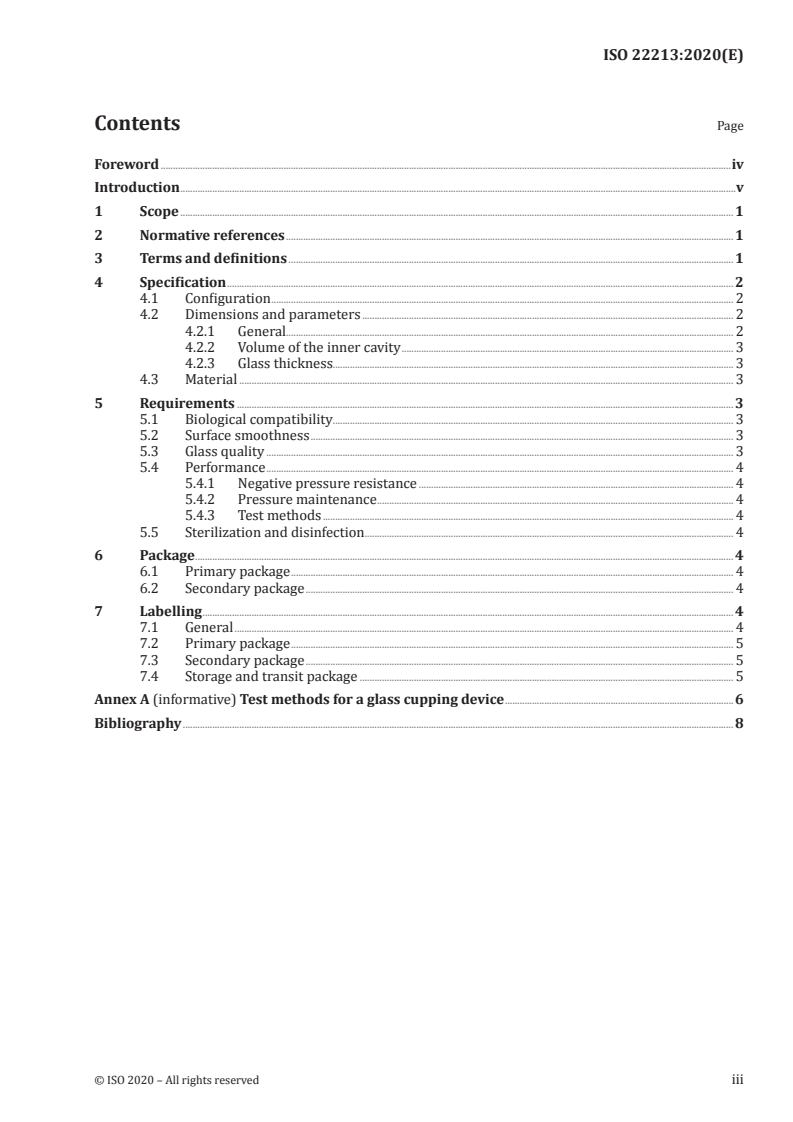
Contents Page
Foreword .iv
Introduction .v
1 Scope . 1
2 Normative references . 1
3 Terms and definitions . 1
4 Specification . 2
4.1 Configuration . 2
4.2 Dimensions and parameters . 2
4.2.1 General. 2
4.2.2 Volume of the inner cavity . 3
4.2.3 Glass thickness. 3
4.3 Material . 3
5 Requirements . 3
5.1 Biological compatibility. 3
5.2 Surface smoothness . 3
5.3 Glass quality . 3
5.4 Performance . 4
5.4.1 Negative pressure resistance . 4
5.4.2 Pressure maintenance . 4
5.4.3 Test methods . 4
5.5 Sterilization and disinfection . 4
6 Package . 4
6.1 Primary package . 4
6.2 Secondary package . 4
7 Labelling . 4
7.1 General . 4
7.2 Primary package . 5
7.3 Secondary package . 5
7.4 Storage and transit package . 5
Annex A (informative) Test methods for a glass cupping device . 6
Bibliography . 8
Foreword
ISO (the International Organization for Standardization) is a worldwide federation of national standards
bodies (ISO member bodies). The work of preparing International Standards is normally carried out
through ISO technical committees. Each member body interested in a subject for which a technical
committee has been established has the right to be represented on that committee. International
organizations, governmental and non-governmental, in liaison with ISO, also take part in the work.
ISO collaborates closely with the International Electrotechnical Commission (IEC) on all matters of
electrotechnical standardization.
The procedures used to develop this document and those intended for its further maintenance are
described in the ISO/IEC Directives, Part 1. In particular, the different approval criteria needed for the
different types of ISO documents should be noted. This document was drafted in accordance with the
editorial rules of the ISO/IEC Directives, Part 2 (see www .iso .org/ directives).
Attention is drawn to the possibility that some of the elements of this document may be the subject of
patent rights. ISO shall not be held responsible for identifying any or all such patent rights. Details of
any patent rights identified during the development of the document will be in the Introduction and/or
on the ISO list of patent declarations received (see www .iso .org/ patents).
Any trade name used in this document is information given for the convenience of users and does not
constitute an endorsement.
For an explanation of the voluntary nature of standards, the meaning of ISO specific terms and
expressions related to conformity assessment, as well as information about ISO's adherence to the
World Trade Organization (WTO) principles in the Technical Barriers to Trade (TBT), see www .iso .org/
iso/ foreword .html.
This document was prepared by Technical Committee ISO/TC 249, Traditional Chinese medicine.
Any feedback or questions on this document should be directed to the user’s national standards body. A
complete listing of these bodies can be found at www .iso .org/ members .html.
iv © ISO 2020 – All rights reserved
Introduction
Cupping therapy has been widely used since ancient times. The glass cupping device is one of the most
commonly used types of cupping devices. The quality of the glass cupping device has a direct impact on
its safe use and influences the therapeutic efficacy. This document was developed to improve the safety
and quality of the glass cupping device.
INTERNATIONAL STANDARD ISO 22213:2020(E)
Traditional Chinese medicine — Glass cupping device
1 Scope
This document specifies the requirements for the glass cupping device applying negative pressure
created by a heat source placed in its inner cavity.
This document includes the requirements for configuration, material, performance, packaging and
labelling, as well as appropriate test methods.
This document applies to single-use and multiple-use glass cupping devices.
This document does not apply to the air extraction cupping device covered by ISO 19611.
2 Normative references
The following documents are referred to in t
...
INTERNATIONAL ISO
STANDARD 22213
First edition
2020-08
Traditional Chinese medicine — Glass
cupping device
Médecine traditionnelle chinoise — Ventouses en verre
Reference number
©
ISO 2020
© ISO 2020
All rights reserved. Unless otherwise specified, or required in the context of its implementation, no part of this publication may
be reproduced or utilized otherwise in any form or by any means, electronic or mechanical, including photocopying, or posting
on the internet or an intranet, without prior written permission. Permission can be requested from either ISO at the address
below or ISO’s member body in the country of the requester.
ISO copyright office
CP 401 • Ch. de Blandonnet 8
CH-1214 Vernier, Geneva
Phone: +41 22 749 01 11
Email: copyright@iso.org
Website: www.iso.org
Published in Switzerland
ii © ISO 2020 – All rights reserved
Contents Page
Foreword .iv
Introduction .v
1 Scope . 1
2 Normative references . 1
3 Terms and definitions . 1
4 Specification . 2
4.1 Configuration . 2
4.2 Dimensions and parameters . 2
4.2.1 General. 2
4.2.2 Volume of the inner cavity . 3
4.2.3 Glass thickness. 3
4.3 Material . 3
5 Requirements . 3
5.1 Biological compatibility. 3
5.2 Surface smoothness . 3
5.3 Glass quality . 3
5.4 Performance . 4
5.4.1 Negative pressure resistance . 4
5.4.2 Pressure maintenance . 4
5.4.3 Test methods . 4
5.5 Sterilization and disinfection . 4
6 Package . 4
6.1 Primary package . 4
6.2 Secondary package . 4
7 Labelling . 4
7.1 General . 4
7.2 Primary package . 5
7.3 Secondary package . 5
7.4 Storage and transit package . 5
Annex A (informative) Test methods for a glass cupping device . 6
Bibliography . 8
Foreword
ISO (the International Organization for Standardization) is a worldwide federation of national standards
bodies (ISO member bodies). The work of preparing International Standards is normally carried out
through ISO technical committees. Each member body interested in a subject for which a technical
committee has been established has the right to be represented on that committee. International
organizations, governmental and non-governmental, in liaison with ISO, also take part in the work.
ISO collaborates closely with the International Electrotechnical Commission (IEC) on all matters of
electrotechnical standardization.
The procedures used to develop this document and those intended for its further maintenance are
described in the ISO/IEC Directives, Part 1. In particular, the different approval criteria needed for the
different types of ISO documents should be noted. This document was drafted in accordance with the
editorial rules of the ISO/IEC Directives, Part 2 (see www .iso .org/ directives).
Attention is drawn to the possibility that some of the elements of this document may be the subject of
patent rights. ISO shall not be held responsible for identifying any or all such patent rights. Details of
any patent rights identified during the development of the document will be in the Introduction and/or
on the ISO list of patent declarations received (see www .iso .org/ patents).
Any trade name used in this document is information given for the convenience of users and does not
constitute an endorsement.
For an explanation of the voluntary nature of standards, the meaning of ISO specific terms and
expressions related to conformity assessment, as well as information about ISO's adherence to the
World Trade Organization (WTO) principles in the Technical Barriers to Trade (TBT), see www .iso .org/
iso/ foreword .html.
This document was prepared by Technical Committee ISO/TC 249, Traditional Chinese medicine.
Any feedback or questions on this document should be directed to the user’s national standards body. A
complete listing of these bodies can be found at www .iso .org/ members .html.
iv © ISO 2020 – All rights reserved
Introduction
Cupping therapy has been widely used since ancient times. The glass cupping device is one of the most
commonly used types of cupping devices. The quality of the glass cupping device has a direct impact on
its safe use and influences the therapeutic efficacy. This document was developed to improve the safety
and quality of the glass cupping device.
INTERNATIONAL STANDARD ISO 22213:2020(E)
Traditional Chinese medicine — Glass cupping device
1 Scope
This document specifies the requirements for the glass cupping device applying negative pressure
created by a heat source placed in its inner cavity.
This document includes the requirements for configuration, material, performance, packaging and
labelling, as well as appropriate test methods.
This document applies to single-use and multiple-use glass cupping devices.
This document does not apply to the air extraction cupping device covered by ISO 19611.
2 Normative references
The following documents are referred to in t
...