

ISO/PAS 5672:2023
(Main)Robotics — Collaborative applications — Test methods for measuring forces and pressures in human-robot contacts
General Information
- Abstract
This document specifies methods of measuring forces and pressures in physical human-robot contacts. It also specifies methods for analyzing the measured forces and pressures. It further specifies the characteristics of pressure-force measurement devices (PFMD). This document applies to collaborative applications deployed in an industrial or service environment for professional use. This document does not apply to non-professional robots (i.e. consumer robots) or medical robots, although the measurement methods presented can be applied in these areas, if deemed appropriate. Additionally, this document does not apply to organizational aspects for performing contact measurements (e.g. responsibilities or data management), assessment of other mechanical contact types (e.g. friction or shearing), assessment of other contact-related hazards (e.g. falling, electrical or chemical hazards). Further, this document does not set requirements for specific PFMD-design or specify methods to identify contact hazards.
- Status
- Published
- Publication Date
- 29-Nov-2023
- Technical Committee
- ISO/TC 299 - Robotics
- Drafting Committee
- ISO/TC 299 - Robotics
- Current Stage
- 6060 - International Standard published
- Start Date
- 30-Nov-2023
- Due Date
- 04-Aug-2023
- Completion Date
- 30-Nov-2023
Overview
ISO/PAS 5672:2023 - "Robotics - Collaborative applications - Test methods for measuring forces and pressures in human‑robot contacts" defines standardized test methods and analysis techniques for measuring forces and pressures during physical human‑robot contact. The specification focuses on collaborative applications in industrial and service environments for professional use and defines characteristics and calibration needs for pressure‑force measurement devices (PFMD). It excludes non‑professional (consumer) robots and medical robots, organizational procedures, and other contact hazards (e.g., shearing, electrical).
Keywords: ISO/PAS 5672:2023, collaborative robotics, human‑robot contact, PFMD, force measurement, pressure measurement, safety testing.
Key topics and requirements
- Scope and applicability: Applies to professional collaborative robot applications; measurement methods can be adapted for other fields if appropriate.
- Pressure‑Force Measurement Devices (PFMDs): Specification of PFMD characteristics, calibration requirements, and sensor performance (force sensors and pressure sensors). PFMDs may include materials to replicate human biomechanical response.
- Measurement methods: Defined methods for common contact types such as pinch/crush and impact, including approaches for limited installation space and fixed vs. moveable PFMDs.
- Measurement procedure: Stepwise testing process covering preparation, executing replicated contact events, data capture, analysis, comparison to biomechanical limits, and test reporting. The document summarizes test steps (prepare, replicate contact, analyze, compare with limits, document, iterate).
- Contact classification: Guidance on classifying contacts by load profile (quasi‑static vs. dynamic) and spatial configuration (constrained vs. unconstrained - e.g., unconstrained requires ~500 mm free distance).
- Supporting content: Informative annexes with installation guidance, resolution considerations for pressure mapping, example applications (pick‑and‑place, mobile picker), and reporting templates.
Practical applications and users
ISO/PAS 5672:2023 is intended for:
- System integrators and safety engineers validating collaborative robot applications.
- Operators and facility managers commissioning robot cells in industrial or service contexts.
- Manufacturers of PFMDs and sensor systems seeking compliance and test guidance.
- Test laboratories performing biomechanical contact assessments.
Use cases include validating robot speed/force limiting, assessing pinch/impact risks, and documenting compliance during risk assessment and safety verification.
Related standards
- ISO 10218‑2 (industrial robot systems - safety requirements)
- ISO 12100 (safety of machinery - risk assessment)
- ISO/TS 15066 (collaborative robot safety guidance)
- ISO/IEC Guide 50 (child safety considerations, where applicable)
Implementers should consult these related standards when planning tests and interpreting biomechanical limits.
Get Certified
Connect with accredited certification bodies for this standard

DVS-ZERT GmbH
German welding certification society.
CARES (UK Certification Authority for Reinforcing Steels)
UK certification for reinforcing steels and construction.
EWF/IIW (European/International Welding Federation)
International welding personnel certification.
Sponsored listings
Frequently Asked Questions
ISO/PAS 5672:2023 is a technical specification published by the International Organization for Standardization (ISO). Its full title is "Robotics — Collaborative applications — Test methods for measuring forces and pressures in human-robot contacts". This standard covers: This document specifies methods of measuring forces and pressures in physical human-robot contacts. It also specifies methods for analyzing the measured forces and pressures. It further specifies the characteristics of pressure-force measurement devices (PFMD). This document applies to collaborative applications deployed in an industrial or service environment for professional use. This document does not apply to non-professional robots (i.e. consumer robots) or medical robots, although the measurement methods presented can be applied in these areas, if deemed appropriate. Additionally, this document does not apply to organizational aspects for performing contact measurements (e.g. responsibilities or data management), assessment of other mechanical contact types (e.g. friction or shearing), assessment of other contact-related hazards (e.g. falling, electrical or chemical hazards). Further, this document does not set requirements for specific PFMD-design or specify methods to identify contact hazards.
This document specifies methods of measuring forces and pressures in physical human-robot contacts. It also specifies methods for analyzing the measured forces and pressures. It further specifies the characteristics of pressure-force measurement devices (PFMD). This document applies to collaborative applications deployed in an industrial or service environment for professional use. This document does not apply to non-professional robots (i.e. consumer robots) or medical robots, although the measurement methods presented can be applied in these areas, if deemed appropriate. Additionally, this document does not apply to organizational aspects for performing contact measurements (e.g. responsibilities or data management), assessment of other mechanical contact types (e.g. friction or shearing), assessment of other contact-related hazards (e.g. falling, electrical or chemical hazards). Further, this document does not set requirements for specific PFMD-design or specify methods to identify contact hazards.
ISO/PAS 5672:2023 is classified under the following ICS (International Classification for Standards) categories: 25.040.30 - Industrial robots. Manipulators. The ICS classification helps identify the subject area and facilitates finding related standards.
ISO/PAS 5672:2023 is available in PDF format for immediate download after purchase. The document can be added to your cart and obtained through the secure checkout process. Digital delivery ensures instant access to the complete standard document.
Standards Content (Sample)
PUBLICLY ISO/PAS
AVAILABLE 5672
SPECIFICATION
First edition
2023-11
Robotics — Collaborative applications
— Test methods for measuring
forces and pressures in human-robot
contacts
Robotique — Applications collaboratives — Méthodes d'essai pour
mesurer les forces et les pressions dans les contacts homme-robot
Reference number
© ISO 2023
All rights reserved. Unless otherwise specified, or required in the context of its implementation, no part of this publication may
be reproduced or utilized otherwise in any form or by any means, electronic or mechanical, including photocopying, or posting on
the internet or an intranet, without prior written permission. Permission can be requested from either ISO at the address below
or ISO’s member body in the country of the requester.
ISO copyright office
CP 401 • Ch. de Blandonnet 8
CH-1214 Vernier, Geneva
Phone: +41 22 749 01 11
Email: copyright@iso.org
Website: www.iso.org
Published in Switzerland
ii
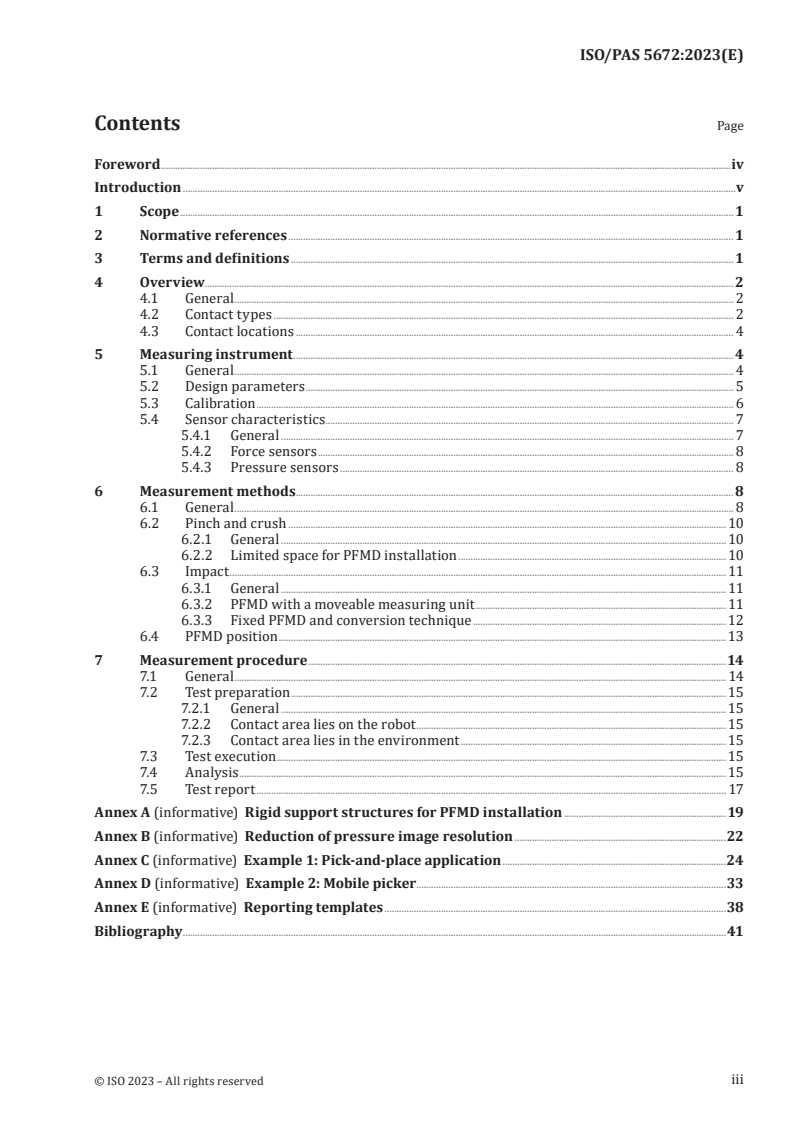
Contents Page
Foreword .iv
Introduction .v
1 Scope . 1
2 Normative references . 1
3 Terms and definitions . 1
4 Overview . 2
4.1 General . 2
4.2 Contact types . 2
4.3 Contact locations . 4
5 Measuring instrument . 4
5.1 General . 4
5.2 Design parameters . 5
5.3 Calibration . 6
5.4 Sensor characteristics. 7
5.4.1 General . 7
5.4.2 Force sensors . 8
5.4.3 Pressure sensors . 8
6 Measurement methods . 8
6.1 General . 8
6.2 Pinch and crush . 10
6.2.1 General . 10
6.2.2 Limited space for PFMD installation . 10
6.3 Impact . 11
6.3.1 General . 11
6.3.2 PFMD with a moveable measuring unit . 11
6.3.3 Fixed PFMD and conversion technique .12
6.4 PFMD position .13
7 Measurement procedure .14
7.1 General . 14
7.2 Test preparation . 15
7.2.1 General .15
7.2.2 Contact area lies on the robot . 15
7.2.3 Contact area lies in the environment . 15
7.3 Test execution . 15
7.4 Analysis . 15
7.5 Test report . 17
Annex A (informative) Rigid support structures for PFMD installation .19
Annex B (informative) Reduction of pressure image resolution .22
Annex C (informative) Example 1: Pick-and-place application .24
Annex D (informative) Example 2: Mobile picker .33
Annex E (informative) Reporting templates .38
Bibliography .41
iii
Foreword
ISO (the International Organization for Standardization) is a worldwide federation of national standards
bodies (ISO member bodies). The work of preparing International Standards is normally carried out
through ISO technical committees. Each member body interested in a subject for which a technical
committee has been established has the right to be represented on that committee. International
organizations, governmental and non-governmental, in liaison with ISO, also take part in the work.
ISO collaborates closely with the International Electrotechnical Commission (IEC) on all matters of
electrotechnical standardization.
The procedures used to develop this document and those intended for its further maintenance are
described in the ISO/IEC Directives, Part 1. In particular, the different approval criteria needed for the
different types of ISO document should be noted. This document was drafted in accordance with the
editorial rules of the ISO/IEC Directives, Part 2 (see www.iso.org/directives).
ISO draws attention to the possibility that the implementation of this document may involve the use
of (a) patent(s). ISO takes no position concerning the evidence, validity or applicability of any claimed
patent rights in respect thereof. As of the date of publication of this document, ISO had not received
notice of (a) patent(s) which may be required to implement this document. However, implementers are
cautioned that this may not represent the latest information, which may be obtained from the patent
database available at www.iso.org/patents. ISO shall not be held responsible for identifying any or all
such patent rights.
Any trade name used in this document is information given for the convenience of users and does not
constitute an endorsement.
For an explanation of the voluntary nature of standards, the meaning of ISO specific terms and
expressions related to conformity assessment, as well as information about ISO's adherence to
the World Trade Organization (WTO) principles in the Technical Barriers to Trade (TBT), see
www.iso.org/iso/foreword.html.
This document was prepared by Technical Committee ISO/TC 299, Robotics.
Any feedback or questions on this document should be directed to the user’s national standards body. A
complete listing of these bodies can be found at www.iso.org/members.html.
iv
Introduction
All testing methods specified in this document represent the latest state-of-the-art in the research
field of contact measurement and testing with robots made for biomechanically safe interactions with
humans. The procedures described in this document have been developed with a focus on practical
applicability and several examples have been included in the annexes to this effect. The intended
users of the document include integrators, operators, and users of collaborative applications as well as
manufacturers of pressure-force measurement devices (PFMD).
1)
The purpose of this document is to facilitate the application of other standards such as ISO 10218-2:— ,
Annex N, robot applications and robot cells integration (based on RIA TR R15.806:2018) or ISO/TS 15066.
1) Under preparation. Stage at the time of publication: ISO/FDIS 10218-2:2023.
v
PUBLICLY AVAILABLE SPECIFICATION ISO/PAS 5672:2023(E)
Robotics — Collaborative applications — Test methods for
measuring forces and pressures in human-robot contacts
1 Scope
This document specifies methods of measuring forces and pressures in physical human-robot contacts.
It also specifies methods for analyzing the measured forces and pressures. It further specifies the
characteristics of pressure-force measurement devices (PFMD).
This document applies to collaborative applications deployed in an industrial or service environment
for professional use.
This document does not apply to non-professional robots (i.e. consumer robots) or medical robots,
although the measurement methods presented can be applied in these areas, if deemed appropriate.
Additionally, this document does not apply to organizational aspects for performing contact
measurements (e.g. responsibilities or data management), assessment of other mechanical contact
types (e.g. friction or shearing), assessment of other contact-related hazards (e.g. falling, electrical
or chemical hazards). Further, this document does not set requirements for specific PFMD-design or
specify methods to identify contact hazards.
2 Normative references
The following documents are referred to in the text in such a way that some or all of their content
constitutes requirements of this document. For dated references, only the edition cited applies. For
undated references, the latest edition of the referenced document (including any amendments) applies.
2)
ISO 10218-2 , Robotics — Safety requirements — Part 2: Industrial robot systems, robot applications and
robot cells
ISO 12100, Safety of machinery — General principles for design — Risk assessment and risk reduction
ISO/IEC Guide 50, Safety aspects — Guidelines for child safety in standards and other specifications
3 Terms and definitions
For the purposes of this document, the terms and definitions given in ISO 12100 and ISO 10218-2 and
the following apply.
ISO and IEC maintain terminology databases for use in standardization at the following addresses:
— ISO Online browsing platform: available at https:// www .iso .org/ obp
— IEC Electropedia: available at https:// www .electropedia .org/
3.1
contact hazard
intended or unintended physical contact between human and robot or robot system in which the robot
or robot system exerts forces and pressures on the human body
3.2
pressure-force measurement device
PFMD
measuring instrument with sensors to record forces and pressures of mechanical contacts
2) Under preparation. Stage at the time of publication: ISO/FDIS 10218-2:2023.
3.3
biomechanical response
behaviour of a biological system when subjected to mechanical load that can be described by
biomechanical response curves (3.4)
3.4
biomechanical response curve
curves that plot the contact force as a function of tissue deformation
4 Overview
4.1 General
The test methods presented in this document provide evidence through measurement whether a robot
or robot system (hereinafter referred to as robot for simplicity) deployed in a collaborative application
(hereinafter referred to as application for simplicity) complies with applicable force and pressure
limits during physical contact with humans. Physical contact can result either from intended use or
reasonably foreseeable misuse of the robot under test.
The testing procedure typically comprises several measurements of contact hazards (as identified by
the risk assessment) that are replicated with the robot deployed in the target application environment.
In such tests the forces and pressures, that the robot can exert on humans during physical contact,
are measured. The robot passes the tests if the contact forces and pressures measured in the relevant
contact situations do not exceed the applicable biomechanical limits.
If the applicable biomechanical limits also apply to children, the measurement procedures given in this
document shall be executed in accordance with ISO/IEC Guide 50.
A pressure-force measurement device (PFMD) is used to measure forces and pressures, but also to
replicate the biomechanical response of the human body. For replicating the biomechanical response, a
PFMD can comprise various viscous and elastic materials.
The following list summarizes the steps of a proper test:
a) Preparation of the robot and the test conditions;
b) Replicating the contact situation by letting the robot under test collide with the PFMD;
c) Analyzing the forces and pressures measured;
d) Comparing the measurement values to the applicable biomechanical limits (if the measurement
values do not exceed the biomechanical limits, the robot passes the test for the target application
environment; otherwise, it does not pass the test);
e) Documentation of the test results;
f) If the robot does not pass the test for the target application environment, it will be possible to
reduce force and/or pressure by modifying the robot. Repeat all the steps from a) to e) if the robot
is modified and document the new test conditions.
4.2 Contact types
Human-robot contact situations can be categorized into intended or unintended contacts. Intended
human-robot contacts are typically interactions between human and robot to complete a common task.
Unintended human-robot contacts typically result from reasonably foreseeable misuse. Both contact
categories shall be assessed through measurement if identified as relevant by the risk assessment.
From here on, both contact categories will be referred to as contact hazard.
Any contact hazard can be classified by the following independent key contact characteristics:
a) Load profile – describes the course of the contact force and pressure measured over time. It can be
either quasi-static (contact force and pressure change slowly over contact time; no distinct global
maximum) or dynamic (contact force and pressure oscillate quickly over contact time; distinct
global maximum);
b) Spatial configuration – indicates the presence or absence of rigid obstacles that can restrict the
ability of the human body to recoil. It can be either constrained (obstacle restricts body part from
recoiling; body part is pinched) or unconstrained (no obstacle; body part can recoil).
NOTE 1 A condition for unconstrained spatial configurations is the free distance to the next fixed object or
obstacle which is at least 500 mm. More precise distance values can be found in ISO 13854.
All possible combinations of the key contact characteristics lead to the following contact types:
1) Push – robot moves against the moveable and spatially unconstrained body part. The force and
pressure increase slowly with time while the robot continues to move (i.e., quasi-static load profile).
When the body part contacted has the same speed as the robot, the force or pressure remains at a
constant level;
2) Pinch – robot moves against the unmovable and spatially constrained body part. The force and
pressure increase slowly with time and remains at a constant level once the robot has stopped (i.e.,
quasi-static load profile);
3) Impact – robot moves against the moveable and spatially unconstrained body part. The force and
pressure increase quickly with time and decrease quickly to zero after reaching its maximum (i.e.,
dynamic load profile);
4) Crush – robot moves against the unmovable and spatially constrained body part. The force and
pressure increase quickly with time (i.e., dynamic load profile) and remains at a constant value
after reaching its maximum once the robot has stopped.
NOTE 2 A quasi-static load profile typically occurs when a robot moves against a body part at lower speeds
(i.e., driving forces dominate). A dynamic load profile typically occurs when a robot moves against a body part at
higher speeds (i.e. inertial forces dominate).
Figure 1 assigns the expression to both key contact characteristics and illustrates typical courses of the
contact force.
Key
A illustration of the contact force plotted as a function of time
Figure 1 — Key contact characteristics of contact hazards and their relation to specific contact
types
The contact type push typically does not need to be tested unless the risk assessment specifies
otherwise. The risk from such contacts is typically low since the human will be able to release the
contact easily. In case the risk assessment specifies a push relevant for testing, this contact type shall
be treated as a pinch. All other contact types shall be assessed through measurement unless the risk
assessment specifies otherwise.
4.3 Contact locations
Contact hazards typically occur on moving parts of the robot such as:
— Links, joints, housing of the robot;
— End-effector;
— Workpiece handled by robot;
— Other periphery (e.g. dress packs).
Contacts can also occur with structures in the environment of the robot. Especially before testing pinch
or crush points, it should be identified if the contact surface with the smallest curvature radii is on
the robot or on the obstacle in the environment of the robot. The pressure shall be measured on the
outward part of the surface with the smallest curvature radii.
5 Measuring instrument
5.1 General
This document addresses only the mechanical response of a PFMD to contact and does not describe a
specific design of a PFMD. The response of a PFMD can be expressed by a function of contact force over
deformation. Like biomechanical response curves, the function describes the contact force that occurs
at a specific deformation of the human body part and vice versa.
In context of a PFMD, the contact force is the force measured by a PFMD force sensor. As for human
tissue, the force acting on a PFMD causes a deformation of its elastic components. A properly designed
and/or configured PFMD should replicate a given biomechanical response curve within the allowable
design tolerances specified in 5.2.
Key
X deformation of a human body part under B first line that approximates the first part of a
contact force response curve (i.e., from d to d )
0 1
Y contact force applied to a human body part C
point ( d ) at which the first line intersects with the
deformation axis
F force limit for transient contact phase D
T point ( d ) at which both lines intersect
A response curve as derived from the same E second line that approximates the second part of the
biomechanical data that were used to response curve (i.e., from d to d )
1 2
determine the transient force limit
F
point ( d ) at which the second line intersects the
transient force limit
Figure 2 — Illustration of a typical response curve for a specific human body part
Figure 2 displays a typical biomechanical response curve. Every curve is only valid for a specific human
body part and shall be developed from the same data from which the applicable transient force limit
was derived. When comparing a PFMD response with the reference response from biomechanical
experiments, the response curve of the PFMD shall be measured with an indenter (i.e., contact body
or probe) with the same characteristics as the one that is specified by the source that provides the
biomechanical response curves.
As shown in Figure 2 by (D), a response curve can be divided into two parts. In the first part of the
response curve, the contact force increases slightly as the deformation increases until the deformation
reaches a characteristic point. This part of the response typically contributes little to the overall
response and the maximum contact force. After the characteristic point, the response curve becomes
steeper. This steeper part of the response curve shall extend at least to the transient force limit to be
applied for the body part replicated by the curve.
5.2 Design parameters
To obtain a minimum number of numerical parameters for properly designed PFMDs, a response curve
shall be approximated by two lines. The first line shall approximate the first part of the response curve
(from d to d ). It intersects with the abscissa (deformation axis) at d with d ≥ 0 . An intersection
0 1 0 0
should not occur for negative deformation values. The first line shall end at the characteristic
deformation ( d ) at which the response curve becomes steeper, and the second approximation line
begins. Let d be the deformation variable, then the first line is defined by:
Fd()=×cd−d (1)
()
11 0
for any deformation ( d ) between d and d , i.e., dd≤≤ d .
0 1 01
The second line shall approximate the second part of the response curve (from d to d ). It begins at
1 2
the point at which the first line ends per definition ( d ) and ends at the point ( d ) at which it intersects
1 2
the transient force limit. Then, the second line is defined by:
Fd =×cd−dF+ d (2)
() () ()
22 11 1
for any deformation ( d ) between d and d , i.e., dd<≤ d .
1 2 12
Both deformation intervals, defined by Formulae (1) and (2), give the following parameters for a
properly designed PFMD:
D Distance between d and d , i.e., Dd=−d
1 0 1 11 0
c
Slope of the first line
c
Slope of the second line
NOTE The PFMD design parameters and the biomechanical limits belong together and thus have ideally to
come from the same source.
Specific values for these parameters are only valid for a particular human body part. They should,
therefore, be provided in combination with the limits for the associated human body part.
5.3 Calibration
For calibration, a PFMD response curve shall be measured using an indentation system that displaces
the PFMD at a constant indentation speed of 1 mm/s until the contact force reaches the transient force
limit that is given for the body part. During the calibration, force and deformation shall be measured
with a sampling frequency of ≥100Hz and at a resolution of ≤1N and ≤01,mm . Signal filters shall not
be applied. The contact body that transfers the force from the indentation system to the PFMD shall be
the same as the one indicated by the source of the reference response curves or curve parameters.
Once the response curve is measured accordingly, it shall be approximated by two lines. The first line
shall approximate the first of the response curve (from d to d ) and the second line the second part
0 1
(from d to d ). For the approximation of the first part, the starting slope ( c ) shall be used. For the
1 2 1
approximation of the second part, the end slope ( c ) shall be used. Figure 3 illustrates the approximation
procedure. The intersection of both lines gives parameter D .
The parameter values from the measured response curve shall then be compared with the parameter
values from the reference response curve. Each shall apply to the following conditions:
a)
DD≤ (i.e. D shall not exceed D from the reference response curve)
11 1 1
b)
cD×≤cD× (i.e. the product of c and D shall not exceed the product of c and D )
11 11 1 1 1 1
cc≥×07, 5 (i.e. c shall be equal to or higher than 75 % of c )
c)
22 1 2
NOTE The slope of the first approximation line ( c ) taken from the measured response curve can be lower
than c . It is, however, not recommended for avoiding a loss of robot efficiency. Same applies to the slope of the
second approximation line ( c ) which can but should not exceed c .
2 2
According to conditions a) and b), it is acceptable not to replicate the flat part of the reference response
curve (i.e., D =0 and c =0 ). Omitting this part of the response curve can be necessary, when its
1 1
replication is not possible because of technical constraints or other boundaries.
Key
X deformation C second line that has the end slope of the
response curve where it intersects with the
transient force limit (F )
T
Y contact force D intersection of the first and second line
A mechanical response curve measured with a PFMD E intersection of the second line with the transient
force limit (F )
T
B first line that has the starting slope of the
response curve measured
Figure 3 — Calibration parameters derived from a PFMD response curve
5.4 Sensor characteristics
5.4.1 General
Sensors used for pressure and/or force measurement can be sensitive to ambient temperature and
humidity. The instructions given by the sensor manufacturer shall be studied and followed accordingly.
All sensors shall be calibrated as specified by their manufacturers. Moreover, they shall also be
calibrated in accordance with all applicable standards that specify the design of PFMD used for testing.
Sensors used for force and pressure measurement should have a calibrated maximum measurement
range that exceeds the highest biomechanical limits at least by 20 %.
Force signals and continuously measured pressure signals (see 5.4.3) shall both be filtered using a
Butterworth four-pole phase-less low-pass filter with a cut-off frequency of 100 Hz and stop damping
of -30 dB.
NOTE Filter configuration corresponds to a CFC 60 filter as specified in ISO 6487. An exemplary filter
implementation can be found in ISO 6487:2015, Annex A. A CFC 60 filter will have only an effect on pressure
signals if these signals were sampled with frequencies of ≥600Hz .
5.4.2 Force sensors
Sensors used for force measurement shall sample the force at a frequency of 1 kHz or higher. The
resolution of the force measurement shall be ≤1N .
5.4.3 Pressure sensors
Sensors made for pressure measurement can either implement peak measurement or continuous
measurement. For peak measurement, the pressure sensor captures only the peak pressures that
appear in the pressure measurement area of the sensor. Consequently, the global maximum pressure
p (highest pressure in the contact area) measured by such sensors belong to both, the transient and
max
quasi-static contact phase. For continuous measurement, several separate force cells, equally
distributed within the sensing area, record the pressure over time. Sensors used for continuous
pressure measurement shall sample the pressure at a frequency of ≥250Hz . The measurement
resolution shall be ≤1Nc/ m .
Sensors used for pressure measurement shall sample the pressure with the same or higher spatial
resolution that is indicated in the source of the pressure limits. If pressure sensors with higher
resolutions are used, the spatial resolution should be reduced to the resolution given in the source of
the pressure limits. A technique to reduce the spatial resolution is described in Annex B.
NOTE The pressure values used as the foundation for the pressure limits listed in ISO/TS 15066 were
recorded with a spatial resolution of one pressure measurement value per mm (i.e., 25 DPI or dots per inch).
6 Measurement methods
6.1 General
In contact tests with robots, a PFMD that is fixed to a rigid structure typically measures a force signal
similar in shape to the curve displayed in Figure 4. For the assessment of such a measurement result,
the curve shall be divided into a transient contact phase and quasi-static contact phase.
NOTE The transient and quasi-static contact phases are typical stages of a contact as exhibited by the force
or pressure measured over time. These phases do not indicate the type of contact as specified in 4.2.
Unless otherwise specified, the transient contact phase begins at the initial contact threshold where
the force reaches 5 N and ends after 500 ms. During the transient contact phase, the force builds up
quickly and typically decreases immediately after reaching a maximum. The maximum force in the
transient contact phase shall be extracted as the maximum transient force (F ).
TR
The quasi-static contact phase begins at the end of the transient contact phase, i.e., 500 ms after initial
contact. It ends when the residual fluctuation of the force signal drops below twice the required
measurement resolution (see 5.4.2). At the end of this phase, the force is considered to have settled. The
maximum force in the quasi-static contact phase shall be extracted as the maximum quasi-static force (
F ).
QS
When using continuous pressure measurement (see 5.4.3), the maximum pressure in the transient
contact phase shall be extracted as the transient peak pressure (p ) and the maximum pressure in
TR
the quasi-static contact phase shall be extracted as the quasi-static peak pressure (p ). When using
QS
peak pressure measurement, the overall pressure maximum p shall be extracted and used as p
max TR
and p .
QS
Key
X time F area from initial contact to the global maximum force
of both phases
Y force G
time at which the force reaches its maximum (F )
TR
A maximum transient force H transient force limit
B maximum quasi-static force I end of the transient contact phase
C initial contact threshold (5 N) J quasi-static force limit
D initial contact (0 s) 1 transient contact phase
E force signal plotted as a function of time 2 quasi-static contact phase
Figure 4 — Typical trace of a force signal measured by a fixed PFMD during contact testing
(maximum area pressure, if measured over time, will deliver a similarly shaped trace)
Depending on the robot motion and the testing conditions, the shape of the force signal can significantly
differ from the shape displayed in Figure 4. Two examples of force signals with different shapes are
displayed in Figure 5. Variations of them or completely different shapes can occur.
Key
X time
Y force
A
contact has no quasi-static phase (quasi-static maximum force is zero F = 0 and quasi-static maximum
QS
pressure is zero p = 0 )
QS
B contact has no transient phase (transient maximum force and transient maximum pressure can be ignored
because the quasi-static maximum force and quasi-static maximum pressure are higher)
Figure 5 — Exceptional force-time traces of contact hazards (maximum area pressures, if
measured over time, will deliver similarly shaped traces)
6.2 Pinch and crush
6.2.1 General
To measure a pinch or a crush (see 4.2), the PFMD shall be affixed to solid and rigid structures or
obstacles that exist in the robot environment. If such structures do not exist, a rigid supportive
structure for holding the PFMD in place shall be created. The supportive structure should be as stiff as
possible. Annex A provides some examples of properly designed support structures.
The support structure should be at least twenty times stiffer than the PFMD.
6.2.2 Limited space for PFMD installation
Depending on the dimensions of the robot and surrounding structures, the space around a pinch or
crush zone in the collaborative application under test can be limited and not accommodate a PFMD.
When this is the case, the steps illustrated in Figure 6 shall be followed in the given order. A PFMD that
fits into the limited space shall be used whenever possible.
The steps illustrated in Figure 6 shall be followed only for testing pinch points. If the contact can occur
within the structure of the robot, the forces and pressures can become large and shall be measured
with a suitable PFMD that fits into the robot structure. Pinch points within the robot structure can
occur, for example:
— between links of an articulated robot manipulator,
— within a robotic gripper, or
— between a workpiece and part of the gripper.
The first step that shall be taken to measure force and pressure in small spaces is to modify the
environment of the robot. It shall be verified if surrounding structures of the robot can be removed
so that the PFMD can be placed properly. If modifications to the environment are not possible, the
justification for this shall be documented in the test report. Afterwards, it shall be verified if the robot
has symmetries (e.g. around a joint axis) and if these can be used to install the PFMD at a location
with more space. Most robot manipulators can be rotated around their first axis without changing
their parameters that affect the contact forces and pressures. Mobile platforms can usually be rotated
around their centre axis. The robot manufacturer should be contacted to figure out if the robot has
helpful symmetries. Otherwise, the absence of symmetries shall be documented in the test report. As
the last possibility to execute the test, the contact point shall be relocated to a location with sufficient
space in which testing is possible under almost equal conditions. The decision and the reasons that led
to this equivalent point shall be documented in the test report.
If measurement is not possible other assessment methodologies shall be applied.
Figure 6 — Procedure to follow when a PFMD cannot be installed at the testing point due to
limited space.
6.3 Impact
6.3.1 General
There are two methods to measure impact. The first method utilizes a PFMD with a movable measuring
unit and the second a fixed PFMD with a mathematical conversion technique.
6.3.2 PFMD with a moveable measuring unit
A moveable PFMD has a measuring unit that is not affixed to a rigid supportive structure and, thus, can
freely move in the direction of the force that the robot exerts on the PFMD. If such a PFMD is used, the
total mass of the moveable measuring unit shall match the effective mass of the human body part under
test.
NOTE 1 Most PFMD with movable measuring units only allow for measuring impacts in the horizontal plane.
In the event an oblique impact will be measured, the conversion technique described in 6.3.3 is used instead of
the PFMD with a movable measuring unit.
NOTE 2 Segment masses for various human body parts can be found in ISO/TS 15066.
NOTE 3 A PFMD with a moveable measuring unit cannot be used to assess crush.
6.3.3 Fixed PFMD and conversion technique
When testing impacts with a PFMD that does not have a moveable measuring unit and, thus, affixed
to a rigid structure, the following mathematical conversion technique should be used. The conversion
technique converts the results measured with a fixed PFMD into results like those measured with a
PFMD with a moveable measuring unit.
The conversion technique uses a scaling factor S that indicates the ratio of the measurement value
recorded with a movable PFMD to that recorded with a fixed PFMD. The scaling factor is given by:
m
H
S =
mm+
HR
where
m
is the effective mass of the colliding human body part;
H
m
is the effective mass of the robot under test.
R
The effective human body mass m is typically provided together with the biomechanical limits for
H
the body locations to be tested.
If the effective robot mass m is unknown, it can be estimated from the force signal measured by the
R
PFMD as follows:
I
R
m ≈
R
v
R
where
I
is the momentum (in newton seconds [Ns]) of the robot;
R
v is the speed (in meters per second [m/s]) of the robot before initial contact.
R
The momentum (I ) of the robot coincides with the area below the force signal curve between initial
R
contact ( t=0s ) to the maximum force in the transient contact phase (F ) that occurs at t . In
TR TR
Figure 4, this area is marked in blue. The conversion technique shall not be applied if the maximum
force does not lie in the transient contact phase (as displayed in Figure 5, B).
The momentum of the robot I can be estimated by:
R
IF≈ t
RTRTR
where
F
is the maximum force in the transient contact phase (in newtons [N]) measured;
TR
t is the time (in seconds [s]) at which F occurs (shall be ≤500ms ).
TR TR
A more precise estimation of the momentum of the robot I can be calculated by:
R
t
TR
IF≈ ()tdt
R
∫
where Ft is the contact force (in newtons [N]) measured over time.
()
The measured speed of the robot should be used for v . Alternatively, the maximum speed as monitored
R
by the safety functions may be used.
Unless not specified otherwise, the scaling factor S shall not be lower than S =01, 5 (lower
lim
boundary).
SS≤< 1
lim
The scaling factor Sshall be multiplied with the maximum transient force F measured with the
TR
fixed PFMD to achieve the projected maximum transient force F :
TR
FS=×F
TR TR
If pressure sensors for continuous measurement are used (see 5.4.3), the scaling factor S shall be
multiplied with the maximum transient pressure p to receive the projected maximum transient
TR
pressure p :
TR
pS=×p
TR TR
If pressure sensors for peak measurement are used (see 5.4.3), the scaling factor S shall be multiplied
with the overall maximum pressure p to receive the projected maximum pressure p :
max max
pS =×p
TR max
6.4 PFMD position
During a test, the contact area shall be centred on the measurement area of pressure sensor. Additionally,
the measurement area of the pressure sensor shall accommodate the entire contact area as illustrated
in Figure 7 (B). The contact area or pieces of it shall never exceed the measurement area.
Most sensors for pressure measurement are designed as a thin film that can bent around one axis.
During a test, significant deformation of the film should be avoided to avoid unrealistic high pressures
in the heavily deformed or wrinkled areas.
Key
A contact is not entirely covered by measurement C contact area
area of the pressure sensor
B contact is entirely covered by measurement D centre of the measurement area of the pressure
area of the pressure sensor sensor
Figure 7 — Typical pressure images that can result from different positions of the PFMD
pressure measurement area
The orientation of the PFMD with respect to the contact surface of the robot should be as perpendicular
as possible to avoid shear forces.
7 Measurement procedure
7.1 General
Firstly, switch on the robot and wait until all systems acknowledge that they are running correctly.
The robot should remain switched on until it is fully warmed up. If possible, all technical measures
that are not implemented as a safety function or as a safety function with the performance level and
implementation category required for the collaborative application shall be switched off or removed
prior to the tests.
NOTE 1 According to ISO 12100:2010, 3.30, a safety function is defined as a function whose failure can result
in an immediate increase of the risk(s).
NOTE 2 According to ISO 10218-2, the safety functions used in a collaborative application comply with
performance level PL d and implementation category 3 as specified by ISO 13849-1. All other technical measures
that are either not implemented as a safety function or that do not comply with the required performance level
and implementation category sh
...