


ISO/FDIS 11979-1
(Main)Ophthalmic implants - Intraocular lenses - Part 1: Vocabulary
Ophthalmic implants - Intraocular lenses - Part 1: Vocabulary
Implants ophtalmiques — Lentilles intraoculaires — Partie 1: Vocabulaire
General Information
- Status
- Not Published
- Technical Committee
- ISO/TC 172/SC 7 - Ophthalmic optics and instruments
- Drafting Committee
- ISO/TC 172/SC 7/WG 7 - Ophthalmic implants
- Current Stage
- 5020 - FDIS ballot initiated: 2 months. Proof sent to secretariat
- Start Date
- 11-Dec-2025
- Completion Date
- 11-Dec-2025
Relations
- Effective Date
- 26-Nov-2022
- Effective Date
- 23-Apr-2020
Overview
ISO/FDIS 11979-1:2025 is an international standard developed by ISO Technical Committee ISO/TC 172/SC 7 in collaboration with CEN/TC 170. This standard provides a comprehensive vocabulary for ophthalmic implants specifically focusing on intraocular lenses (IOLs). As part 1 of the ISO 11979 series, it establishes clear, standardized terms and definitions used globally within the field of intraocular lens design, evaluation, and clinical use.
The document is essential for manufacturers, healthcare professionals, regulatory authorities, and researchers who require a unified language to improve communication, documentation, and compliance related to IOLs. The latest edition includes updated and new definitions addressing advanced intraocular lens types and properties, supporting emerging technologies and clinical practices.
Key Topics
- Intraocular Lens Definitions: Detailed terms for various IOL models such as monofocal, multifocal (MIOL), accommodating (AIOL), extended depth of focus (EDF IOL), and full visual range (FVR IOL).
- Optical Properties: Definitions relating to dioptric power, addition power, cylindrical power, base power (far power), near power, optic shape factor, focal lengths (effective, paraxial, back focal length), and optical power of the eye.
- Mechanical Features: Key terms covering haptics (loops, plate, closed/open loops), body, optic, positioning holes, and axial displacement under compression.
- Testing and Evaluation Terms: Vocabulary describing test methodologies such as accelerated shelf-life studies, dynamic fatigue, Nd-YAG laser exposure tests, ocular and non-ocular implantation tests.
- Packaging and Traceability: Concepts for packaging systems, additional wrapping, patient implant cards (PIC), and device history records to ensure product sterility and traceability.
- Clinical and Regulatory Terms: Definitions relevant to patient outcomes such as adverse events (cumulative, persistent), best-case subjects, lost to follow-up subjects, and custom-made devices.
- Abbreviations and Acronyms: Commonly used abbreviated terms for ease of reference within the ophthalmic implant community.
Applications
- Medical Device Manufacturing: Helps manufacturers ensure consistent terminology in product design, labeling, packaging, and quality control of intraocular lenses.
- Clinical Practice: Assists ophthalmologists and surgeons in accurately understanding device specifications, improving communication regarding lens types and surgical procedures.
- Regulatory Compliance: Facilitates regulatory submission processes by providing an agreed-upon vocabulary that aligns with international standards, reducing ambiguities.
- Research and Development: Supports scientific studies and innovation by defining terms related to advanced IOL designs and performance metrics.
- Patient Information: Provides the basis for developing standardized patient information leaflets (PIL) and implant cards to enhance patient education and device traceability.
By harmonizing the language around intraocular lenses, ISO/FDIS 11979-1 helps bridge gaps between the technical, clinical, and regulatory communities worldwide, enhancing safety and effectiveness of ophthalmic implants.
Related Standards
- ISO 11979 Series: Other parts in this series provide detailed requirements and test methods for specific types of intraocular lenses, including optical and mechanical performance testing.
- ISO 10993 Series: Standards related to the biological evaluation of medical devices, complementing the biocompatibility and implantation test terms in ISO 11979-1.
- IEC Electropedia & ISO OBP: Terminology databases maintained by IEC and ISO offer access to standardized definitions for broader optics and photonics vocabulary used alongside this standard.
- Regulatory Guidelines for Ophthalmic Devices: Many global regulatory frameworks reference ISO 11979 standards as part of device approval and surveillance processes.
Keywords: intraocular lenses, IOL vocabulary, ophthalmic implants, ISO 11979-1, accommodating intraocular lens, multifocal IOL, extended depth of focus IOL, ophthalmic device terminology, IOL terminology, eye implants standard, optics standard, medical device standard, ophthalmic standards.



ISO/FDIS 11979-1 - Ophthalmic implants — Intraocular lenses — Part 1: Vocabulary Released:11/27/2025
REDLINE ISO/FDIS 11979-1 - Ophthalmic implants — Intraocular lenses — Part 1: Vocabulary Released:11/27/2025

ISO/FDIS 11979-1 - Implants ophtalmiques — Lentilles intraoculaires — Partie 1: Vocabulaire Released:20. 12. 2025
Frequently Asked Questions
ISO/FDIS 11979-1 is a draft published by the International Organization for Standardization (ISO). Its full title is "Ophthalmic implants - Intraocular lenses - Part 1: Vocabulary". This standard covers: Ophthalmic implants - Intraocular lenses - Part 1: Vocabulary
Ophthalmic implants - Intraocular lenses - Part 1: Vocabulary
ISO/FDIS 11979-1 is classified under the following ICS (International Classification for Standards) categories: 01.040.11 - Health care technology (Vocabularies); 11.040.70 - Ophthalmic equipment. The ICS classification helps identify the subject area and facilitates finding related standards.
ISO/FDIS 11979-1 has the following relationships with other standards: It is inter standard links to ISO/TS 23818-1:2020, ISO 11979-1:2018. Understanding these relationships helps ensure you are using the most current and applicable version of the standard.
ISO/FDIS 11979-1 is available in PDF format for immediate download after purchase. The document can be added to your cart and obtained through the secure checkout process. Digital delivery ensures instant access to the complete standard document.
Standards Content (Sample)
FINAL DRAFT
International
Standard
ISO/TC 172/SC 7
Ophthalmic implants — Intraocular
Secretariat: DIN
lenses —
Voting begins on:
2025-12-11
Part 1:
Vocabulary
Voting terminates on:
2026-02-05
Implants ophtalmiques — Lentilles intraoculaires —
Partie 1: Vocabulaire
RECIPIENTS OF THIS DRAFT ARE INVITED TO SUBMIT,
WITH THEIR COMMENTS, NOTIFICATION OF ANY
RELEVANT PATENT RIGHTS OF WHICH THEY ARE AWARE
AND TO PROVIDE SUPPOR TING DOCUMENTATION.
IN ADDITION TO THEIR EVALUATION AS
BEING ACCEPTABLE FOR INDUSTRIAL, TECHNO-
ISO/CEN PARALLEL PROCESSING LOGICAL, COMMERCIAL AND USER PURPOSES, DRAFT
INTERNATIONAL STANDARDS MAY ON OCCASION HAVE
TO BE CONSIDERED IN THE LIGHT OF THEIR POTENTIAL
TO BECOME STAN DARDS TO WHICH REFERENCE MAY BE
MADE IN NATIONAL REGULATIONS.
Reference number
FINAL DRAFT
International
Standard
ISO/TC 172/SC 7
Ophthalmic implants — Intraocular
Secretariat: DIN
lenses —
Voting begins on:
Part 1:
Vocabulary
Voting terminates on:
Implants ophtalmiques — Lentilles intraoculaires —
Partie 1: Vocabulaire
RECIPIENTS OF THIS DRAFT ARE INVITED TO SUBMIT,
WITH THEIR COMMENTS, NOTIFICATION OF ANY
RELEVANT PATENT RIGHTS OF WHICH THEY ARE AWARE
AND TO PROVIDE SUPPOR TING DOCUMENTATION.
© ISO 2025
IN ADDITION TO THEIR EVALUATION AS
All rights reserved. Unless otherwise specified, or required in the context of its implementation, no part of this publication may
BEING ACCEPTABLE FOR INDUSTRIAL, TECHNO-
ISO/CEN PARALLEL PROCESSING
LOGICAL, COMMERCIAL AND USER PURPOSES, DRAFT
be reproduced or utilized otherwise in any form or by any means, electronic or mechanical, including photocopying, or posting on
INTERNATIONAL STANDARDS MAY ON OCCASION HAVE
the internet or an intranet, without prior written permission. Permission can be requested from either ISO at the address below
TO BE CONSIDERED IN THE LIGHT OF THEIR POTENTIAL
or ISO’s member body in the country of the requester.
TO BECOME STAN DARDS TO WHICH REFERENCE MAY BE
MADE IN NATIONAL REGULATIONS.
ISO copyright office
CP 401 • Ch. de Blandonnet 8
CH-1214 Vernier, Geneva
Phone: +41 22 749 01 11
Email: copyright@iso.org
Website: www.iso.org
Published in Switzerland Reference number
ii
Contents Page
Foreword .iv
1 Scope . 1
2 Normative references . 1
3 Terms and definitions . 1
4 Abbreviated terms . 10
Bibliography .11
iii
Foreword
ISO (the International Organization for Standardization) is a worldwide federation of national standards
bodies (ISO member bodies). The work of preparing International Standards is normally carried out through
ISO technical committees. Each member body interested in a subject for which a technical committee
has been established has the right to be represented on that committee. International organizations,
governmental and non-governmental, in liaison with ISO, also take part in the work. ISO collaborates closely
with the International Electrotechnical Commission (IEC) on all matters of electrotechnical standardization.
The procedures used to develop this document and those intended for its further maintenance are described
in the ISO/IEC Directives, Part 1. In particular, the different approval criteria needed for the different types
of ISO document should be noted. This document was drafted in accordance with the editorial rules of the
ISO/IEC Directives, Part 2 (see www.iso.org/directives).
ISO draws attention to the possibility that the implementation of this document may involve the use of (a)
patent(s). ISO takes no position concerning the evidence, validity or applicability of any claimed patent
rights in respect thereof. As of the date of publication of this document, ISO had not received notice of (a)
patent(s) which may be required to implement this document. However, implementers are cautioned that
this may not represent the latest information, which may be obtained from the patent database available at
www.iso.org/patents. ISO shall not be held responsible for identifying any or all such patent rights.
Any trade name used in this document is information given for the convenience of users and does not
constitute an endorsement.
For an explanation of the voluntary nature of standards, the meaning of ISO specific terms and expressions
related to conformity assessment, as well as information about ISO's adherence to the World Trade
Organization (WTO) principles in the Technical Barriers to Trade (TBT), see www.iso.org/iso/foreword.html.
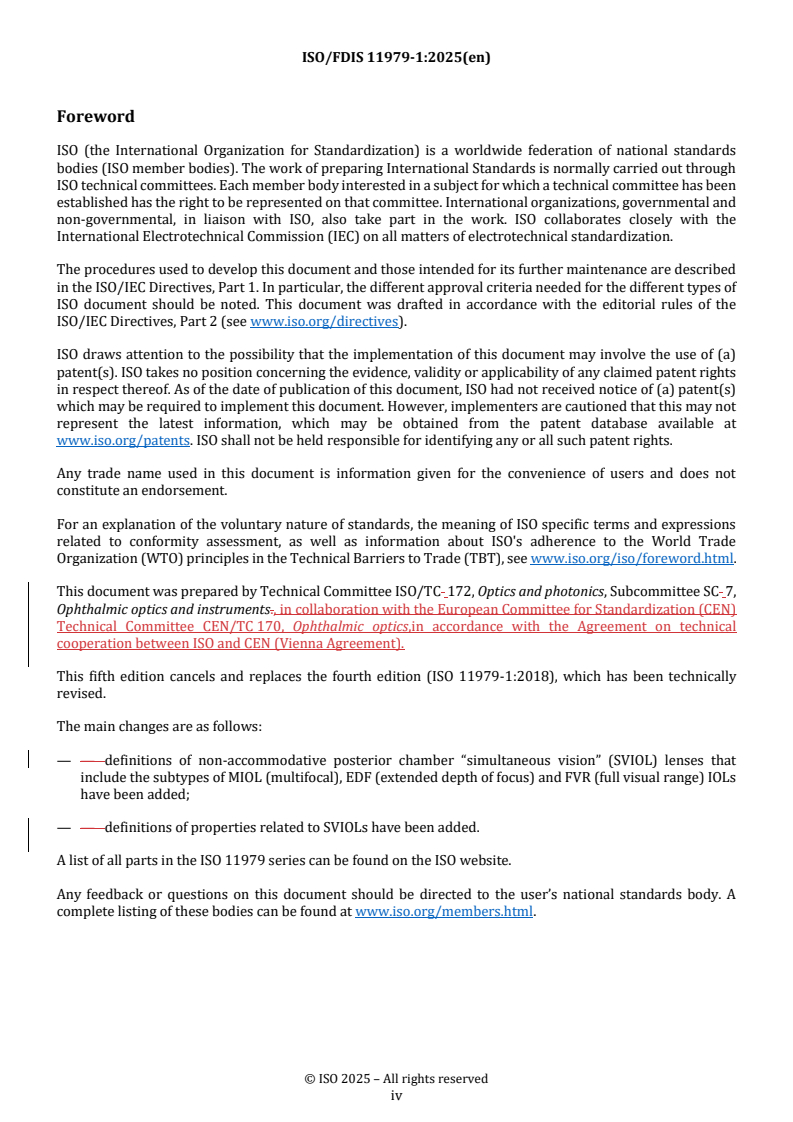
This document was prepared by Technical Committee ISO/TC 172, Optics and photonics, Subcommittee
SC 7, Ophthalmic optics and instruments, in collaboration with the European Committee for Standardization
(CEN) Technical Committee CEN/TC 170, Ophthalmic optics,in accordance with the Agreement on technical
cooperation between ISO and CEN (Vienna Agreement).
This fifth edition cancels and replaces the fourth edition (ISO 11979-1:2018), which has been technically
revised.
The main changes are as follows:
— definitions of non-accommodative posterior chamber “simultaneous vision” (SVIOL) lenses that include
the subtypes of MIOL (multifocal), EDF (extended depth of focus) and FVR (full visual range) IOLs have
been added;
— definitions of properties related to SVIOLs have been added.
A list of all parts in the ISO 11979 series can be found on the ISO website.
Any feedback or questions on this document should be directed to the user’s national standards body. A
complete listing of these bodies can be found at www.iso.org/members.html.
iv
FINAL DRAFT International Standard ISO/FDIS 11979-1:2025(en)
Ophthalmic implants — Intraocular lenses —
Part 1:
Vocabulary
1 Scope
This document contains definitions of terms related to intraocular lenses as well as definitions related to
the methods used to evaluate these IOLs.
NOTE The terms are listed in the alphabetical order of the English terms.
2 Normative references
There are no normative references in this document.
3 Terms and definitions
For the purposes of this document, the following terms and definitions apply.
ISO and IEC maintain terminology databases for use in standardization at the following addresses:
— ISO Online browsing platform: available at https:// www .iso .org/ obp
— IEC Electropedia: available at https:// www .electropedia .org/
3.1
accelerated shelf-life study
study to establish an initial expiration dating period by using exaggerated storage conditions by increased
temperature to be validated by real time study
3.2
accommodating intraocular lens
AIOL
IOL providing focusing from far point to near point by changing the dioptric power of the eye
3.3
accommodative amplitude
difference in refractive power between the near point and the far point of the eye
3.4
addition power
difference between the far power and the near power
3.5
additional wrapping
protective packaging used in addition to the primary packaging which can be used to maintain sterility of
the intraocular lens
3.6
anterior chamber lens
IOL designed to be placed entirely in the anterior chamber of the eye
3.7
aspheric intraocular lens
IOL having at least one optical surface whose curvature varies radially from the vertex to the periphery
3.8
axial displacement in compression
displacement of optic along the optical axis when the IOL is compressed to a specified diameter taking the
uncompressed state as reference
3.9
axis mark
indicator of the meridian of lowest dioptric power of a toric IOL
Note 1 to entry: See Figure 1.
3.10
back focal length
BFL
distance from the back vertex of the IOL to the focal point with collimated light incident on-axis upon the IOL
3.11
base power
dioptric power that is intended to provide an in-focus image of an object at far (infinity)
Note 1 to entry: Base power is the same as far power.
3.12
best-case subject
subject with no pre-operative ocular pathology detected at any time, e.g. no macular degeneration, and no
previous surgery for the correction of refractive errors
3.13
body
part of an IOL incorporating the optic excluding the haptics
Note 1 to entry: See Figure 1.
3.14
clear optic
diameter of concentric circle with the optical axis of an intraocular lens, containing only features of the
intraocular lens belonging to the optical design
Note 1 to entry: See Figure 1.
3.15
closed-loop intraocular lens
IOL model which contains two loops, each loop having both ends attached to the body of the optic
3.16
compression force
force exerted by the haptics of the IOL when compressed to a specified diameter
Key
1 overall diameter
2 positioning hole
3 clear optic
4 body
h vault height
h sagittal distance
Figure 1 — Overall diameter, vault height, sagittal distance, clear optic, body, positioning hole and
axis mark
3.17
cumulative adverse events
total number of adverse events that have occurred at any time up to a specified post-operative time point
3.18
custom-made device
device specifically made in accordance with a duly qualified medical practitioner's written prescription,
which gives, under his/her responsibility, specific design characteristics and is intended for the sole use of a
particular patient
Note 1 to entry: Mass-produced devices, which need to be adapted to meet the specific requirements of the medical
practitioner, are not considered to be custom-made devices.
3.19
cut-off wavelength
wavelength at which spectral transmission drops below a defined level
3.20
cylindrical power
difference in dioptric power between the meridians with the highest and the lowest dioptric powers
3.21
delivery system
system, either preloaded or combined, in which the IOL is compressed and/or folded and delivered into the eye
3.22
device history record
collection of records and reports assembled in a batch package, containing or referring to the relevant
information pertaining to the manufacture and control of that batch of devices
3.23
dioptric power
reciprocal of the reduced paraxial focal length in situ for light, where paraxial focal length is the distance
between the back principal plane and the back paraxial focal point, and reduced paraxial focal length is the
paraxial focal length divided by the refractive index of the surrounding medium
-1
Note 1 to entry: The unit for expressing dioptric power is the reciprocal metre (m ). The special name for this unit is
“dioptre”, for which the symbol “D” is used.
Note 2 to entry: Refer to ISO 11979-2 for the test conditions.
Note 3 to entry: For certain IOL optical designs, the use of paraxial focal length is not appropriate.
3.24
dynamic fatigue
durability of an IOL following cyclic compressive loading of the IOL haptic to a specified dimension
3.25
effective focal length
EFL
distance from the back principal plane to the focal point with collimated light incident on-axis upon the IOL
3.26
expiration date
termination of shelf-life, after which the IOL is not to be used
3.27
extended depth of
...
ISO /TC 172/SC 7
Secretariat: DIN
Date: 2025-10-28xx
Ophthalmic implants — Intraocular lenses —
Part 1:
Vocabulary
Implants ophtalmiques — Lentilles intraoculaires —
Partie 1: Vocabulaire
FDIS stage
All rights reserved. Unless otherwise specified, or required in the context of its implementation, no part of this publication
may be reproduced or utilized otherwise in any form or by any means, electronic or mechanical, including photocopying,
or posting on the internet or an intranet, without prior written permission. Permission can be requested from either ISO
at the address below or ISO’s member body in the country of the requester.
ISO copyright office
CP 401 • Ch. de Blandonnet 8
CH-1214 Vernier, Geneva
Phone: + 41 22 749 01 11
EmailE-mail: copyright@iso.org
Website: www.iso.org
Published in Switzerland
ii
Contents
Foreword . iv
1 Scope . 1
2 Normative references . 1
3 Terms and definitions . 1
4 Abbreviated terms . 11
Bibliography . 12
iii
Foreword
ISO (the International Organization for Standardization) is a worldwide federation of national standards
bodies (ISO member bodies). The work of preparing International Standards is normally carried out through
ISO technical committees. Each member body interested in a subject for which a technical committee has been
established has the right to be represented on that committee. International organizations, governmental and
non-governmental, in liaison with ISO, also take part in the work. ISO collaborates closely with the
International Electrotechnical Commission (IEC) on all matters of electrotechnical standardization.
The procedures used to develop this document and those intended for its further maintenance are described
in the ISO/IEC Directives, Part 1. In particular, the different approval criteria needed for the different types of
ISO document should be noted. This document was drafted in accordance with the editorial rules of the
ISO/IEC Directives, Part 2 (see www.iso.org/directives).
ISO draws attention to the possibility that the implementation of this document may involve the use of (a)
patent(s). ISO takes no position concerning the evidence, validity or applicability of any claimed patent rights
in respect thereof. As of the date of publication of this document, ISO had not received notice of (a) patent(s)
which may be required to implement this document. However, implementers are cautioned that this may not
represent the latest information, which may be obtained from the patent database available at
www.iso.org/patents. ISO shall not be held responsible for identifying any or all such patent rights.
Any trade name used in this document is information given for the convenience of users and does not
constitute an endorsement.
For an explanation of the voluntary nature of standards, the meaning of ISO specific terms and expressions
related to conformity assessment, as well as information about ISO's adherence to the World Trade
Organization (WTO) principles in the Technical Barriers to Trade (TBT), see www.iso.org/iso/foreword.html.
This document was prepared by Technical Committee ISO/TC 172, Optics and photonics, Subcommittee SC 7,
Ophthalmic optics and instruments., in collaboration with the European Committee for Standardization (CEN)
Technical Committee CEN/TC 170, Ophthalmic optics,in accordance with the Agreement on technical
cooperation between ISO and CEN (Vienna Agreement).
This fifth edition cancels and replaces the fourth edition (ISO 11979-1:2018), which has been technically
revised.
The main changes are as follows:
— — definitions of non-accommodative posterior chamber “simultaneous vision” (SVIOL) lenses that
include the subtypes of MIOL (multifocal), EDF (extended depth of focus) and FVR (full visual range) IOLs
have been added;
— — definitions of properties related to SVIOLs have been added.
A list of all parts in the ISO 11979 series can be found on the ISO website.
Any feedback or questions on this document should be directed to the user’s national standards body. A
complete listing of these bodies can be found at www.iso.org/members.html.
iv
Ophthalmic implants — Intraocular lenses
—
Part 1:
Vocabulary
1 Scope
This document contains definitions of terms related to intraocular lenses as well as definitions related to the
methods used to evaluate these IOLs.
NOTE The terms are listed in the alphabetical order of the English terms in the English version of this document.
2 Normative references
There are no normative references in this document.
3 Terms and definitions
For the purposes of this document, the following terms and definitions apply.
ISO and IEC maintain terminology databases for use in standardization at the following addresses:
— — ISO Online browsing platform: available at https://www.iso.org/obp
— — IEC Electropedia: available at https://www.electropedia.org/
3.1 3.1
accelerated shelf-life study
study to establish an initial expiration dating period by using exaggerated storage conditions by increased
temperature to be validated by real time study
3.2 3.2
accommodating intraocular lens
AIOL
IOL providing focusing from far point to near point by changing the dioptric power of the eye
3.3 3.3
accommodative amplitude
difference in refractive power between the near point and the far point of the eye
3.4 3.4
addition power
difference between the far power and the near power(s)
3.5 3.5
additional wrapping
protective packaging used in addition to the primary packaging which couldcan be used to maintain sterility
of the intraocular lens
3.6 3.6
anterior chamber lens
IOL designed to be placed entirely in the anterior chamber of the eye
3.7 3.7
aspheric intraocular lens
IOL having at least one optical surface whose curvature varies radially from the vertex to the periphery
3.8 3.8
axial displacement in compression
taking the uncompressed state as reference, the displacement of optic along the optical axis when the IOL is
compressed to a specified diameter taking the uncompressed state as reference
3.9 3.9
axis mark
indicator of the meridian of lowest dioptric power of a toric IOL
Note 1 to entry: See 0Figure 1.
3.10 3.10
back focal length
BFL
distance from the back vertex of the IOL to the focal point with collimated light incident on-axis upon the IOL
3.11 3.11
base power
dioptric power that is intended to provide an in-focus image of an object at far (infinity)
Note 1 to entry: Base power is the same as far power.
3.12 3.12
best-case subject
subject with no pre-operative ocular pathology detected at any time, e.g. no macular degeneration, and no
previous surgery for the correction of refractive errors
3.13 3.13
body
part of an IOL incorporating the optic excluding the haptics
Note 1 to entry: See 0Figure 1.
3.14 3.14
clear optic
diameter of circle concentric circle with the optical axis of an intraocular lens, containing only features of the
intraocular lens belonging to the optical design
Note 1 to entry: See 0Figure 1.
3.15 3.15
closed-loop intraocular lens
IOL model which contains two loops, each loop having both ends attached to the body of the optic
3.16 3.16
compression force
force exerted by the haptics of the IOL when compressed to a specified diameter
11979-1_ed5fig1.EPS
Key
1 overall diameter
2 positioning hole
3 clear optic
4 body
h1 vault height
h2 sagittal distance
Figure 1 — Overall diameter, vault height, sagittal distance, clear optic, body, positioning hole and
axis mark
3.17 3.17
cumulative adverse events
total number of adverse events that have occurred at any time up to a specified post -operative time point
3.18 3.18
custom-made device
device specifically made in accordance with a duly qualified medical practitioner's written prescription, which
gives, under his/her responsibility, specific design characteristics and is intended for the sole use of a
particular patient
Note 1 to entry: Mass-produced devices, which need to be adapted to meet the specific requirements of
the medical practitioner, are not considered to be custom-made devices.
3.19 3.19
cut-off wavelength
wavelength at which spectral transmission drops below a defined level
3.20 3.20
cylindrical power
difference in dioptric power between the meridians with the highest and the lowest dioptric powers
3.21 3.21
delivery system
system, either preloaded or combined, in which the IOL is compressed and/or folded and delivered into the
eye
3.22 3.22
device history record
collection of records and reports assembled in a batch package, containing or referring to the relevant
information pertaining to the manufacture and control of that batch of devices
3.23 3.23
dioptric power
reciprocal of the reduced paraxial focal length in situ for light, where paraxial focal length is the distance
between the back principal plane and the back paraxial focal point, and reduced paraxial focal length is the
paraxial focal length divided by the refractive index of the surrounding medium
-1
Note 1 to entry: The unit for expressing dioptric power is the reciprocal metre (m ). The special name
for this unit is “dioptre”, for which the symbol “D” is used.
Note 2 to entry: Refer to ISO 11979-2 for the test conditions.
Note 3 to entry: For certain IOL optical designs, the use of paraxial focal length is not appropriate.
3.24 3.24
dynamic fatigue
durability of an IOL following cyclic compressive loading of the IOL haptic to a specified dimension
3.25 3.25
effective focal length
EFL
distance from the back principal plane to the focal point with collimated light incident on-axis upon the IOL
3.26 3.26
expiration date
termination of shelf-life, after which the IOL is not to be used
3.27 3.27
extended depth of focus intraocular lens
EDF IOL
SVIOL providing useful visual acuity levels from far through intermediate focal distances
Note 1 to entry: Useful visual acuity levels are provided in ISO 11979-7.
3.28 3.28
far point
farthest distance at which an object can be focused on
3.29 3.29
far power
dioptric power that is intended to provide an in-focus image of an object at far (infinity)
Note 1 to entry: Far power is the same as base power.
3.30 3.30
far power configuration
configuration of an accommodating intraocular lens in the eye that is intended to result in a distant object
being in focus on the retinal plane
3.31 3.31
finished intraocular lens lot
specific quantity of uniform IOLs intended to fall within a set of specified characteristics produced according
to a single manufacturing order or during the same cycle of manufacture, and completed by sterilization,
packaging and labelling
3.32 3.32
full vis
...
PROJET FINAL
Norme
internationale
ISO/TC 172/SC 7
Implants ophtalmiques — Lentilles
Secrétariat: DIN
intraoculaires —
Début de vote:
2025-12-11
Partie 1:
Vocabulaire
Vote clos le:
2026-02-05
Ophthalmic implants — Intraocular lenses —
Part 1: Vocabulary
LES DESTINATAIRES DU PRÉSENT PROJET SONT
INVITÉS À PRÉSENTER, AVEC LEURS OBSERVATIONS,
NOTIFICATION DES DROITS DE PROPRIÉTÉ DONT ILS
AURAIENT ÉVENTUELLEMENT CONNAISSANCE ET À
FOURNIR UNE DOCUMENTATION EXPLICATIVE.
OUTRE LE FAIT D’ÊTRE EXAMINÉS POUR
ÉTABLIR S’ILS SONT ACCEPTABLES À DES FINS
INDUSTRIELLES, TECHNOLOGIQUES ET COM-MERCIALES,
AINSI QUE DU POINT DE VUE DES UTILISATEURS, LES
PROJETS DE NORMES
TRAITEMENT PARALLÈLE ISO/CEN
INTERNATIONALES DOIVENT PARFOIS ÊTRE CONSIDÉRÉS
DU POINT DE VUE DE LEUR POSSI BILITÉ DE DEVENIR DES
NORMES POUVANT
SERVIR DE RÉFÉRENCE DANS LA RÉGLEMENTATION
NATIONALE.
Numéro de référence
PROJET FINAL
Norme
internationale
ISO/TC 172/SC 7
Implants ophtalmiques — Lentilles
Secrétariat: DIN
intraoculaires —
Début de vote:
Partie 1: 2025-12-11
Vocabulaire
Vote clos le:
2026-02-05
Ophthalmic implants — Intraocular lenses —
Part 1: Vocabulary
LES DESTINATAIRES DU PRÉSENT PROJET SONT
INVITÉS À PRÉSENTER, AVEC LEURS OBSERVATIONS,
NOTIFICATION DES DROITS DE PROPRIÉTÉ DONT ILS
AURAIENT ÉVENTUELLEMENT CONNAISSANCE ET À
FOURNIR UNE DOCUMENTATION EXPLICATIVE.
DOCUMENT PROTÉGÉ PAR COPYRIGHT
OUTRE LE FAIT D’ÊTRE EXAMINÉS POUR
ÉTABLIR S’ILS SONT ACCEPTABLES À DES FINS
© ISO 2025 INDUSTRIELLES, TECHNOLOGIQUES ET COM-MERCIALES,
AINSI QUE DU POINT DE VUE DES UTILISATEURS, LES
Tous droits réservés. Sauf prescription différente ou nécessité dans le contexte de sa mise en œuvre, aucune partie de cette
PROJETS DE NORMES
TRAITEMENT PARALLÈLE ISO/CEN
INTERNATIONALES DOIVENT PARFOIS ÊTRE CONSIDÉRÉS
publication ne peut être reproduite ni utilisée sous quelque forme que ce soit et par aucun procédé, électronique ou mécanique,
DU POINT DE VUE DE LEUR POSSI BILITÉ DE DEVENIR DES
y compris la photocopie, ou la diffusion sur l’internet ou sur un intranet, sans autorisation écrite préalable. Une autorisation peut
NORMES POUVANT
être demandée à l’ISO à l’adresse ci-après ou au comité membre de l’ISO dans le pays du demandeur.
SERVIR DE RÉFÉRENCE DANS LA RÉGLEMENTATION
NATIONALE.
ISO copyright office
Case postale 401 • Ch. de Blandonnet 8
CH-1214 Vernier, Genève
Tél.: +41 22 749 01 11
E-mail: copyright@iso.org
Web: www.iso.org
Publié en Suisse Numéro de référence
ii
Sommaire Page
Avant-propos .iv
1 Domaine d’application . 1
2 Références normatives . 1
3 Termes et définitions . 1
4 Abréviations . 10
Bibliographie .12
Index .13
iii
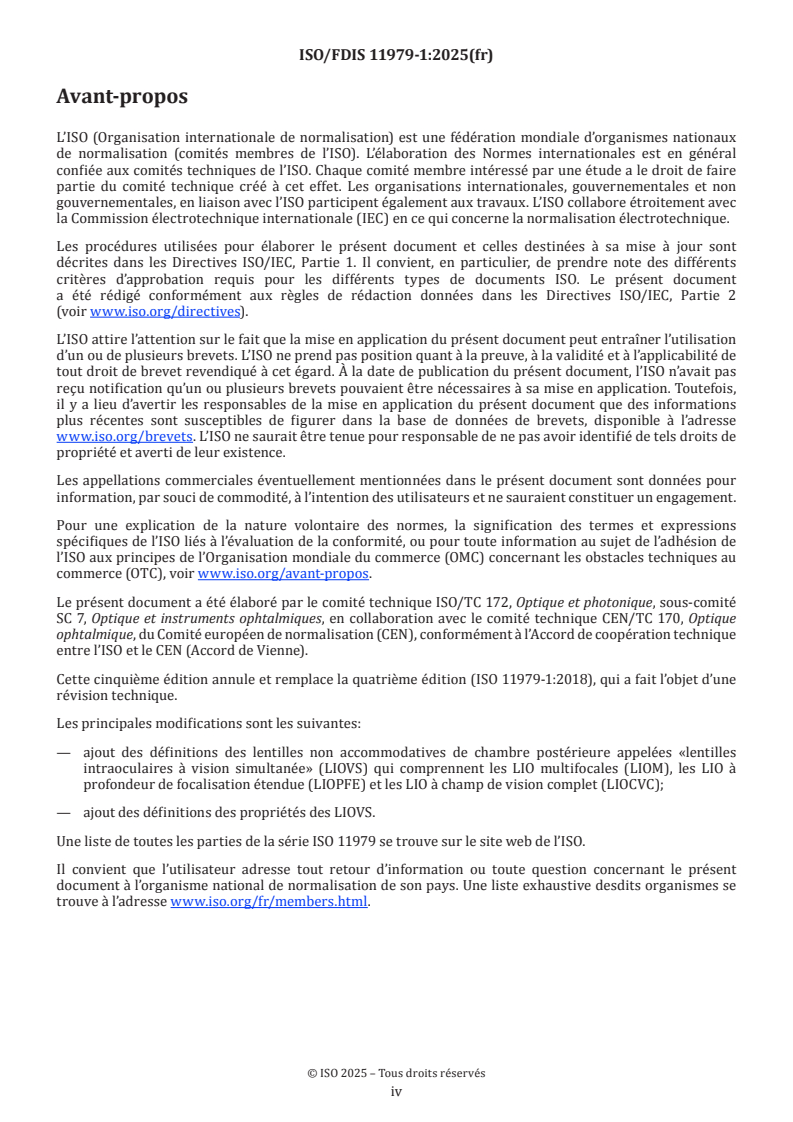
Avant-propos
L’ISO (Organisation internationale de normalisation) est une fédération mondiale d’organismes nationaux
de normalisation (comités membres de l’ISO). L’élaboration des Normes internationales est en général
confiée aux comités techniques de l’ISO. Chaque comité membre intéressé par une étude a le droit de faire
partie du comité technique créé à cet effet. Les organisations internationales, gouvernementales et non
gouvernementales, en liaison avec l’ISO participent également aux travaux. L’ISO collabore étroitement avec
la Commission électrotechnique internationale (IEC) en ce qui concerne la normalisation électrotechnique.
Les procédures utilisées pour élaborer le présent document et celles destinées à sa mise à jour sont
décrites dans les Directives ISO/IEC, Partie 1. Il convient, en particulier, de prendre note des différents
critères d’approbation requis pour les différents types de documents ISO. Le présent document
a été rédigé conformément aux règles de rédaction données dans les Directives ISO/IEC, Partie 2
(voir www.iso.org/directives).
L’ISO attire l’attention sur le fait que la mise en application du présent document peut entraîner l’utilisation
d’un ou de plusieurs brevets. L’ISO ne prend pas position quant à la preuve, à la validité et à l’applicabilité de
tout droit de brevet revendiqué à cet égard. À la date de publication du présent document, l’ISO n’avait pas
reçu notification qu’un ou plusieurs brevets pouvaient être nécessaires à sa mise en application. Toutefois,
il y a lieu d’avertir les responsables de la mise en application du présent document que des informations
plus récentes sont susceptibles de figurer dans la base de données de brevets, disponible à l’adresse
www.iso.org/brevets. L’ISO ne saurait être tenue pour responsable de ne pas avoir identifié de tels droits de
propriété et averti de leur existence.
Les appellations commerciales éventuellement mentionnées dans le présent document sont données pour
information, par souci de commodité, à l’intention des utilisateurs et ne sauraient constituer un engagement.
Pour une explication de la nature volontaire des normes, la signification des termes et expressions
spécifiques de l’ISO liés à l’évaluation de la conformité, ou pour toute information au sujet de l’adhésion de
l’ISO aux principes de l’Organisation mondiale du commerce (OMC) concernant les obstacles techniques au
commerce (OTC), voir www.iso.org/avant-propos.
Le présent document a été élaboré par le comité technique ISO/TC 172, Optique et photonique, sous-comité
SC 7, Optique et instruments ophtalmiques, en collaboration avec le comité technique CEN/TC 170, Optique
ophtalmique, du Comité européen de normalisation (CEN), conformément à l’Accord de coopération technique
entre l’ISO et le CEN (Accord de Vienne).
Cette cinquième édition annule et remplace la quatrième édition (ISO 11979-1:2018), qui a fait l’objet d’une
révision technique.
Les principales modifications sont les suivantes:
— ajout des définitions des lentilles non accommodatives de chambre postérieure appelées «lentilles
intraoculaires à vision simultanée» (LIOVS) qui comprennent les LIO multifocales (LIOM), les LIO à
profondeur de focalisation étendue (LIOPFE) et les LIO à champ de vision complet (LIOCVC);
— ajout des définitions des propriétés des LIOVS.
Une liste de toutes les parties de la série ISO 11979 se trouve sur le site web de l’ISO.
Il convient que l’utilisateur adresse tout retour d’information ou toute question concernant le présent
document à l’organisme national de normalisation de son pays. Une liste exhaustive desdits organismes se
trouve à l’adresse www.iso.org/fr/members.html.
iv
PROJET FINAL Norme internationale ISO/FDIS 11979-1:2025(fr)
Implants ophtalmiques — Lentilles intraoculaires —
Partie 1:
Vocabulaire
1 Domaine d’application
Le présent document contient des définitions de termes relatifs aux lentilles intraoculaires et de méthodes
d’essai utilisées pour les évaluer.
NOTE Les termes sont présentés dans l’ordre alphabétique des termes anglais.
2 Références normatives
Le présent document ne contient aucune référence normative.
3 Termes et définitions
Pour les besoins du présent document, les termes et définitions suivants s’appliquent.
L’ISO et l’IEC tiennent à jour des bases de données terminologiques destinées à être utilisées en normalisation,
consultables aux adresses suivantes:
— ISO Online browsing platform: disponible à l’adresse https:// www .iso .org/ obp
— IEC Electropedia: disponible à l’adresse https:// www .electropedia .org/
3.1
étude en accéléré de la durée de conservation
étude d’un produit visant à établir une période de péremption initiale en le soumettant à des conditions de
stockage exagérées par augmentation de la température, à valider par une étude en temps réel
3.2
lentille intraoculaire accommodative
LIOA
lentille intraoculaire (LIO) qui permet une mise au point entre le punctum remotum et le punctum proximum
en modifiant la puissance dioptrique de l’œil
3.3
amplitude d’accommodation
différence de puissance de réfraction entre le punctum proximum et le punctum remotum de l’œil
3.4
puissance d’addition
différence entre la puissance de loin et la puissance de près
3.5
emballage complémentaire
emballage de protection utilisé en complément de l’emballage primaire qui peut éventuellement servir au
maintien de la stérilité de la lentille intraoculaire
3.6
lentille de chambre antérieure
LIO destinée à être placée intégralement dans la chambre antérieure de l’œil
3.7
lentille intraoculaire asphérique
LIO avec au moins une surface optique dont la courbure varie radialement du sommet à la périphérie
3.8
déplacement axial en compression
l’état non comprimé étant pris comme référence, déplacement de l’optique le long de l’axe optique lorsque la
LIO est comprimée à un diamètre donné
3.9
repère d’axe
pour une LIO torique, indicateur du méridien ayant la plus faible puissance dioptrique
Note 1 à l'article: Voir la Figure 1.
3.10
longueur focale arrière
LFA
distance du sommet arrière de la LIO au point focal obtenu sur l’axe optique de la LIO, la lumière collimatée
incidente étant parallèle à l’axe optique
3.11
puissance de base
puissance dioptrique destinée à permettre l’obtention d’une image nette d’un objet de loin (infini)
Note 1 à l'article: La puissance de base est la même que la puissance de loin.
3.12
sujet idéal
sujet chez lequel aucune pathologie oculaire pré-opératoire n’a été détectée à quelque moment que ce soit,
par exemple ne présentant pas de dégénérescence maculaire, et sans antécédent chirurgical de correction
d’erreurs de réfraction
3.13
corps
partie d’une LIO comprenant l’optique, à l’exclusion des haptiques
Note 1 à l'article: Voir la Figure 1.
3.14
diamètre optique libre
diamètre d’un cercle dont le centre est situé sur l’axe optique d’une lentille intraoculaire et qui n’englobe que
des éléments appartenant à la configuration optique de la lentille intraoculaire
Note 1 à l'article: Voir la Figure 1.
3.15
lentille intraoculaire à boucles fermées
modèle de LIO comprenant deux boucles dont les extrémités sont fixées au corps de l’optique
3.16
force de compression
force exercée par les haptiques de la LIO lorsque celle-ci est comprimée à un diamètre donné
Légende
1 diamètre total
2 trou de positionnement
3 diamètre optique libre
4 corps
h hauteur de la voûte
h distance sagittale
Figure 1 — Diamètre total, hauteur de la voûte, distance sagittale, diamètre optique libre, corps,
trou de positionnement et repère d’axe
3.17
effets indésirables cumulés
nombre total d’effets indésirables survenus à tous moments d’une période post-opératoire définie
3.18
dispositif sur mesure
dispositif destiné à l’usage exclusif d’un patient en particulier et fabriqué selon la prescription écrite d’un
médecin dûment qualifié ayant défini, sous sa propre responsabilité, les caractéristiques particulières de
conception du dispositif en question
Note 1 à l'article: Les dispositifs produits en série, nécessitant une adaptation pour répondre aux exigences spécifiques
du médecin, ne sont pas considérés comme des dispositifs sur mesure.
3.19
longueur d’onde de coupure
longueur d’onde à laquelle le facteur spectral de transmission chute sous un niveau défini
3.20
puissance cylindrique
différence de puissance dioptrique entre les méridiens de puissance dioptrique maximale et de puissance
dioptrique minimale
3.21
système d’injection
système préchargé ou combiné permettant de comprimer et/ou de plier la LIO pour l’implanter dans l’œil
3.22
dossier historique d’un dispositif
ensemble d’enregistrements et de rapports rassemblés dans l’emballage d’un lot de dispositifs, contenant les
principales informations relatives à la fabrication et au contrôle dudit lot, ou s’y référant
3.23
puissance dioptrique
vergence dioptrique
inverse de la distance focale réduite paraxiale in situ pour la lumière, la distance focale paraxiale étant la
distance entre le plan principal image et le point focal image paraxial, et la distance focale réduite paraxiale
étant le quotient de la distance focale paraxiale par l’indice de réfraction du milieu environnant
−1
Note 1 à l'article: La puissance (ou vergence) dioptrique est exprimée en mètres à la puissance moins un (m ). Un nom
particulier est donné à cette unité: la «dioptrie», dont le symbole est «D».
Note 2 à l'article: Se reporter à l’ISO 11979-2 pour connaître les conditions d’essai.
Note 3 à l'article: Pour certaines conceptions optiques de LIO, l’utilisation de la distance focale paraxiale n’est pas
appropriée.
3.24
fatigue dynamique
résistance d’une LIO suite à des charges compressives cycliques appliquées à l’haptique à une dimension
donnée
3.25
longueur focale effective
LFE
distance du plan principal image au point focal sur l’axe optique de la LIO, la lumière collimatée incidente
étant parallèle à l’axe optique
3.26
date de péremption
fin de la durée de conservation au-delà de laquelle la LIO ne doit plus être utilisée
3.27
lentille intraoculaire à profondeur de focalisation étendue
LIOPFE
LIOVS offrant des niveaux d’acuité visuelle utiles de loin, ainsi qu’à des distances focales intermédiaires
Note 1 à l'article: Les niveaux d’acuité visuelle utiles sont fournis dans l’ISO 11979-7.
3.28
punctum remotum
distance la plus éloignée à laquelle il est possible d’effectuer la mise au point sur un objet
3.29
puissance de loin
puissance dioptrique destinée à permettre l’obtention d’une image nette d’un objet de loin (infini)
Note 1 à l'article: La puissance de loin est la même que la puissance de base.
3.30
configuration de la puissance de loin
configuration d’une lentille intraoculaire accommodative dans l’œil, en vue d’obtenir une image nette d’un
objet éloigné dans le plan rétinien
3.31
lot de lentilles intraoculaires finies
quantité définie de LIO uniformes destinées à présenter un ensemble de caractéristiques spécifiées, produite
conformément à un seul ordre de fabrication ou au cours d’un même cycle de fabrication, et qui est emballée,
étiquetée et stérilisée
3.32
lentille intraoculaire à champ de vision complet
LIOCVC
LIOVS offrant des niveaux d’acuité visuelle utiles de loin, de près, ainsi qu’à des distances focales
intermédiaires
Note 1 à l'article: Les niveaux d’acuité visuelle utiles sont fournis dans l’ISO 11979-7.
3.33
haptique
composant périphérique d’une LIO, ne faisant pas partie de l’optique et destiné à maintenir ladite lentille en
place dans l’œil et à la centrer sur l’axe optique de l’œil
3.34
lentille intraoculaire à boucles ouvertes/fermées hybrides
modèle de LIO comprenant deux boucles, l’une dont une extrémité est fixée au corps de la LIO et l’autre
extrémité est libr
...
Questions, Comments and Discussion
Ask us and Technical Secretary will try to provide an answer. You can facilitate discussion about the standard in here.
Loading comments...