

ISO 9806:2025
(Main)Solar energy — Solar thermal collectors — Test methods
General Information
- Abstract
This document specifies test methods for assessing the durability, reliability, safety and thermal performance of fluid heating solar collectors. The test methods are applicable for laboratory testing and for in situ testing. This document is applicable to all types of fluid heating solar collectors, air heating solar collectors, hybrid solar collectors co-generating heat and electric power, as well as to solar collectors using external power sources for normal operation and/or safety purposes. This document does not address electrical safety aspects or other specific properties directly related to electric power generation. This document is not applicable to devices in which a thermal storage unit is an integral part to such an extent that the collection process cannot be separated from the storage process for making the collector thermal performance measurements.
- Status
- Published
- Publication Date
- 30-Sep-2025
- Technical Committee
- ISO/TC 180 - Solar energy
- Drafting Committee
- ISO/TC 180/WG 4 - Solar collectors
- Current Stage
- 6060 - International Standard published
- Start Date
- 01-Oct-2025
- Due Date
- 25-Feb-2026
- Completion Date
- 01-Oct-2025
Buy Documents

ISO 9806:2025 - Solar energy — Solar thermal collectors — Test methods Released:10/1/2025
ISO 9806:2025 - Énergie solaire — Capteurs solaires thermiques — Méthodes d'essai Released:10/1/2025
Overview
ISO 9806:2025 - Solar energy - Solar thermal collectors - Test methods is the international standard that defines laboratory and in situ test methods for assessing the durability, reliability, safety and thermal performance of fluid-heating and air‑heating solar collectors. Applicable to conventional liquid collectors, air collectors, hybrid collectors (co‑generating heat and electric power), and collectors that use external power for normal operation or safety, ISO 9806:2025 provides a comprehensive test framework for manufacturers, test labs and certification bodies. The standard does not cover electrical safety aspects or systems where thermal storage is integral to the collector such that performance cannot be separated.
Key topics and technical requirements
ISO 9806:2025 organizes testing around the collector lifecycle and performance attributes. Major technical topics include:
- Test scope and sequence: Guidance on test overview, design operating range and testing of collectors with specific attributes (tracking, hybrid, active protection).
- Pressure and leakage tests: Internal pressure tests for fluid channels (non‑polymeric and polymeric materials) and air leakage rate tests for air collectors.
- Thermal performance: Methods to determine the standard stagnation temperature and efficiency parameters under stagnation and operating conditions.
- Environmental exposure: Exposure and half‑exposure procedures (outdoor, heat‑loop, indoor) to assess weathering and material degradation.
- Thermal shock: External thermal shock and internal thermal shock tests for liquid‑heating collectors.
- Precipitation and freeze: Rain penetration testing and freeze resistance protocols (including specific provisions for heat‑pipe collectors).
- Mechanical and impact resilience: Mechanical load tests (positive/negative pressure), mounting and load application methods, and impact resistance tests (ice or steel ball methods).
- Active self‑protection: Tests for collectors that use active mechanisms to prevent overheating, including loss‑of‑power and loss‑of‑communication scenarios.
- Results and reporting: Standardized requirements for test conditions, measurements, results and reporting to support consistent certification and comparison.
Applications and users
ISO 9806:2025 is widely used for:
- Product development and R&D to validate design durability and thermal performance.
- Third‑party testing and certification for market access and quality assurance.
- Procurement specifications and compliance checks by installers, building professionals and public authorities.
- Warranty validation, failure analysis and lifecycle assessment by manufacturers and service providers.
- Research institutions studying long‑term field performance and reliability of solar thermal collectors.
Users include solar collector manufacturers, accredited testing laboratories, certification bodies, specifiers, system integrators and researchers focused on solar thermal technologies.
Related standards
ISO 9806:2025 focuses on thermal and mechanical test methods; users should also consult relevant electrical safety and energy‑performance standards, national building codes and certification schemes when addressing electrical aspects, integrated thermal storage systems or grid‑connected hybrid equipment.
Relations
- Consolidates
EN ISO 9806:2025 - Solar energy - Solar thermal collectors - Test methods (ISO 9806:2025) - Effective Date
- 12-Feb-2026
- Effective Date
- 06-Jun-2022
- Effective Date
- 23-Apr-2020
Buy Documents
ISO 9806:2025 - Solar energy — Solar thermal collectors — Test methods Released:10/1/2025
ISO 9806:2025 - Énergie solaire — Capteurs solaires thermiques — Méthodes d'essai Released:10/1/2025
Get Certified
Connect with accredited certification bodies for this standard

DNV
DNV is an independent assurance and risk management provider.

Lloyd's Register
Lloyd's Register is a global professional services organisation specialising in engineering and technology.
DNV Energy Systems
Energy and renewable energy certification.
Sponsored listings
Frequently Asked Questions
ISO 9806:2025 is a standard published by the International Organization for Standardization (ISO). Its full title is "Solar energy — Solar thermal collectors — Test methods". This standard covers: This document specifies test methods for assessing the durability, reliability, safety and thermal performance of fluid heating solar collectors. The test methods are applicable for laboratory testing and for in situ testing. This document is applicable to all types of fluid heating solar collectors, air heating solar collectors, hybrid solar collectors co-generating heat and electric power, as well as to solar collectors using external power sources for normal operation and/or safety purposes. This document does not address electrical safety aspects or other specific properties directly related to electric power generation. This document is not applicable to devices in which a thermal storage unit is an integral part to such an extent that the collection process cannot be separated from the storage process for making the collector thermal performance measurements.
This document specifies test methods for assessing the durability, reliability, safety and thermal performance of fluid heating solar collectors. The test methods are applicable for laboratory testing and for in situ testing. This document is applicable to all types of fluid heating solar collectors, air heating solar collectors, hybrid solar collectors co-generating heat and electric power, as well as to solar collectors using external power sources for normal operation and/or safety purposes. This document does not address electrical safety aspects or other specific properties directly related to electric power generation. This document is not applicable to devices in which a thermal storage unit is an integral part to such an extent that the collection process cannot be separated from the storage process for making the collector thermal performance measurements.
ISO 9806:2025 is classified under the following ICS (International Classification for Standards) categories: 27.160 - Solar energy engineering. The ICS classification helps identify the subject area and facilitates finding related standards.
ISO 9806:2025 has the following relationships with other standards: It is inter standard links to EN ISO 9806:2025, ISO 23590:2020, ISO 9806:2017. Understanding these relationships helps ensure you are using the most current and applicable version of the standard.
ISO 9806:2025 is available in PDF format for immediate download after purchase. The document can be added to your cart and obtained through the secure checkout process. Digital delivery ensures instant access to the complete standard document.
Standards Content (Sample)
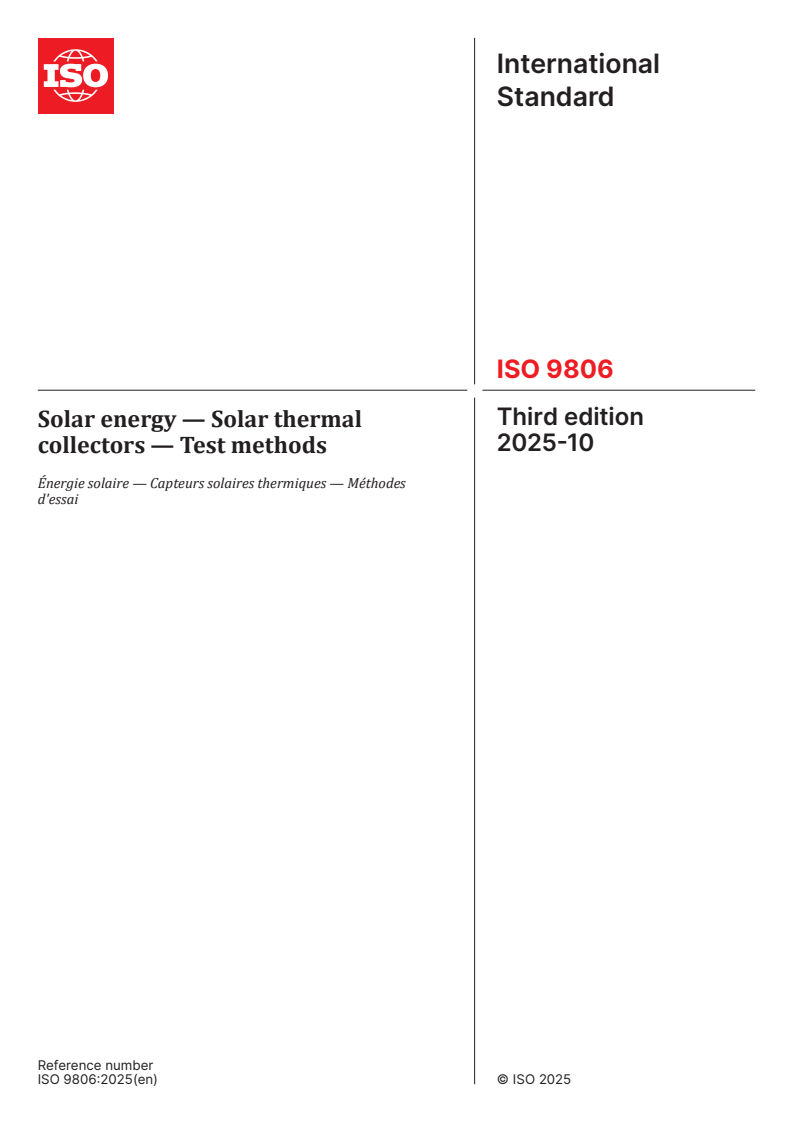
International
Standard
ISO 9806
Third edition
Solar energy — Solar thermal
2025-10
collectors — Test methods
Énergie solaire — Capteurs solaires thermiques — Méthodes
d'essai
Reference number
© ISO 2025
All rights reserved. Unless otherwise specified, or required in the context of its implementation, no part of this publication may
be reproduced or utilized otherwise in any form or by any means, electronic or mechanical, including photocopying, or posting on
the internet or an intranet, without prior written permission. Permission can be requested from either ISO at the address below
or ISO’s member body in the country of the requester.
ISO copyright office
CP 401 • Ch. de Blandonnet 8
CH-1214 Vernier, Geneva
Phone: +41 22 749 01 11
Email: copyright@iso.org
Website: www.iso.org
Published in Switzerland
ii
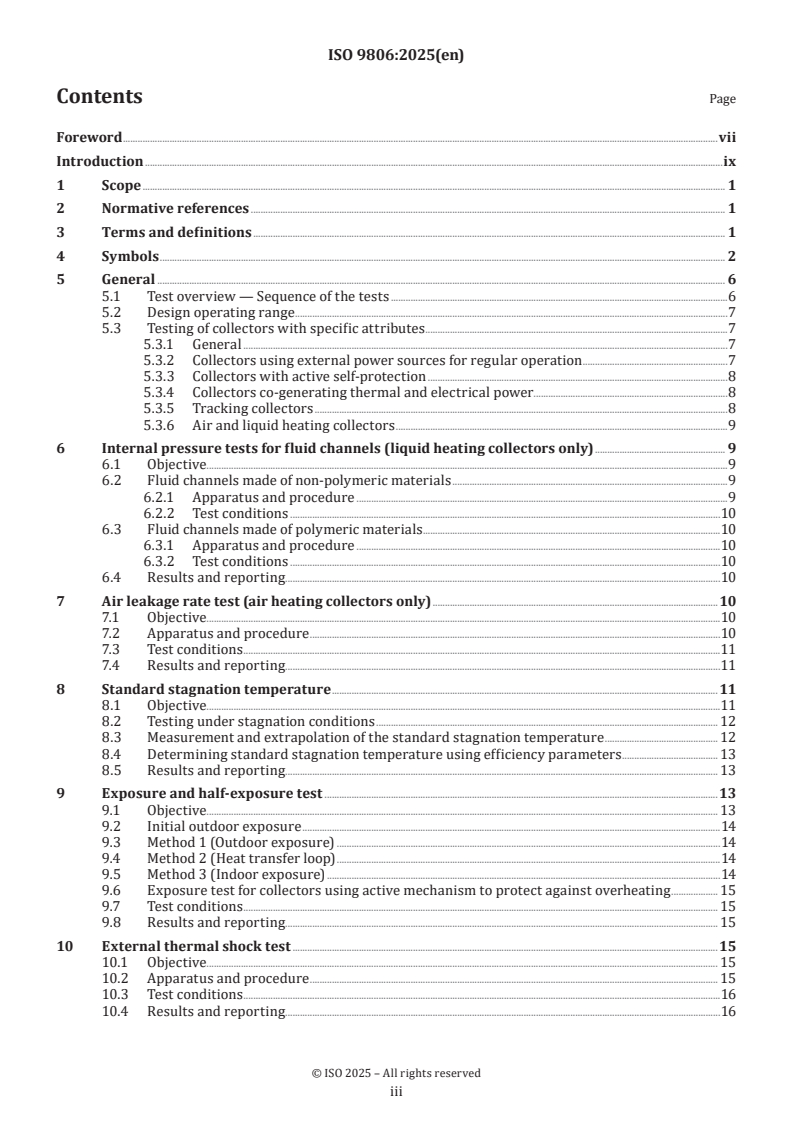
Contents Page
Foreword .vii
Introduction .ix
1 Scope . 1
2 Normative references . 1
3 Terms and definitions . 1
4 Symbols . 2
5 General . 6
5.1 Test overview — Sequence of the tests .6
5.2 Design operating range . .7
5.3 Testing of collectors with specific attributes .7
5.3.1 General .7
5.3.2 Collectors using external power sources for regular operation .7
5.3.3 Collectors with active self-protection .8
5.3.4 Collectors co-generating thermal and electrical power . .8
5.3.5 Tracking collectors .8
5.3.6 Air and liquid heating collectors .9
6 Internal pressure tests for fluid channels (liquid heating collectors only) . 9
6.1 Objective.9
6.2 Fluid channels made of non-polymeric materials .9
6.2.1 Apparatus and procedure .9
6.2.2 Test conditions .10
6.3 Fluid channels made of polymeric materials .10
6.3.1 Apparatus and procedure .10
6.3.2 Test conditions .10
6.4 Results and reporting . .10
7 Air leakage rate test (air heating collectors only) . 10
7.1 Objective.10
7.2 Apparatus and procedure .10
7.3 Test conditions .11
7.4 Results and reporting . .11
8 Standard stagnation temperature .11
8.1 Objective.11
8.2 Testing under stagnation conditions . 12
8.3 Measurement and extrapolation of the standard stagnation temperature . 12
8.4 Determining standard stagnation temperature using efficiency parameters . 13
8.5 Results and reporting . . 13
9 Exposure and half-exposure test .13
9.1 Objective. 13
9.2 Initial outdoor exposure .14
9.3 Method 1 (Outdoor exposure) .14
9.4 Method 2 (Heat transfer loop) .14
9.5 Method 3 (Indoor exposure) .14
9.6 Exposure test for collectors using active mechanism to protect against overheating . 15
9.7 Test conditions . 15
9.8 Results and reporting . . 15
10 External thermal shock test .15
10.1 Objective. 15
10.2 Apparatus and procedure . 15
10.3 Test conditions .16
10.4 Results and reporting . .16
iii
11 Internal thermal shock test (liquid heating collectors only) .16
11.1 Objective.16
11.2 Apparatus and procedure .16
11.3 Test conditions .16
11.4 Results and reporting .16
12 Rain penetration test . 17
12.1 Objective.17
12.2 Apparatus and procedure .17
12.3 Test conditions .17
12.4 Results and reporting . .19
13 Freeze resistance test . 19
13.1 Objective.19
13.2 Freeze resistant collectors .19
13.2.1 General .19
13.2.2 Test conditions .19
13.2.3 Results and reporting . 20
13.3 Heat pipe collectors . 20
13.3.1 General . 20
13.3.2 Test conditions . 20
13.3.3 Results and reporting . 20
14 Mechanical load test with positive or negative pressure .20
14.1 Objective. 20
14.2 Apparatus and procedure .21
14.2.1 Mounting .21
14.2.2 Methods for the application of the loads .21
14.2.3 Particular specifications for tracking collectors or other specific collector types . 22
14.3 Test conditions . 22
14.4 Results and reporting . 22
15 Impact resistance test .22
15.1 Objective. 22
15.2 Test procedure . 22
15.3 Impact location . 22
15.4 Method 1: Impact resistance test using ice balls . 23
15.4.1 Apparatus . 23
15.4.2 Ice balls . 23
15.4.3 Specific aspects of the test procedure using ice balls . 23
15.5 Method 2: Impact resistance test using steel balls . 23
15.6 Results and reporting . .24
16 Active self-protection mechanisms.24
16.1 Objective.24
16.2 Apparatus and procedure .24
16.3 Test conditions .24
16.3.1 Loss of power test .24
16.3.2 Loss of communication test .24
16.3.3 Overheating protection test . 25
16.3.4 Adverse climatic conditions protection test . 25
16.4 Results and reporting . 25
17 Final inspection .25
17.1 Objective. 25
17.2 Test procedure . 25
17.3 Results and reporting . 26
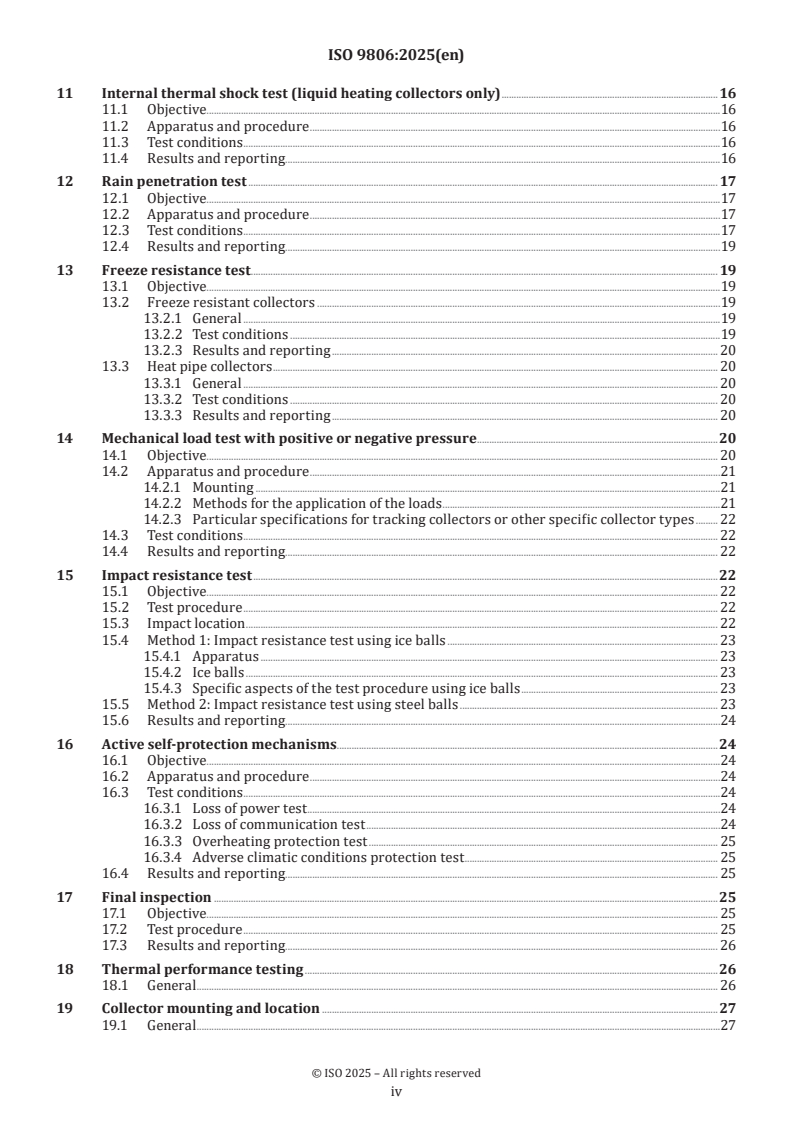
18 Thermal performance testing .26
18.1 General . 26
19 Collector mounting and location .27
19.1 General .27
iv
19.2 Shading from direct solar irradiance .27
19.3 Diffuse and reflected solar irradiance .27
19.4 Thermal irradiance.27
20 Instrumentation .28
20.1 Solar radiation measurement . 28
20.1.1 Pyranometer . 28
20.2 Thermal radiation measurement . 28
20.3 Temperature measurements . . 28
20.3.1 Heat transfer fluid temperatures (liquid heating collectors) . 28
20.3.2 Volume flow weighted mean temperature ϑ (air heating collectors). 29
m,th
20.3.3 Measurement of ambient air temperature . 29
20.4 Flow rate measurement. 30
20.4.1 Measurement of mass flow rate (liquid) . 30
20.4.2 Measurement of collector fluid flow rate (air heating collectors) . 30
20.5 Measurement of air speed over the collector . 30
20.5.1 General . 30
20.5.2 Required accuracy .31
20.5.3 Mounting of sensors for the measurement of air velocity over the collector.31
20.6 Elapsed time measurement .31
20.7 Humidity ratio (air collectors) .31
20.8 Collector dimensions.31
21 Test installation .31
21.1 Liquid heating collectors .31
21.1.1 General .31
21.1.2 Heat transfer fluid .32
21.1.3 Pipe work and fittings .32
21.2 Air heating collectors . 33
21.2.1 General . 33
21.2.2 Closed loop test circuit. 33
21.2.3 Open to ambient test circuit . 34
21.2.4 Heat transfer fluid . 34
21.2.5 Pump and flow control devices . 34
21.2.6 Air ducts . 34
21.2.7 Fan and flow control devices . 35
21.2.8 Air preconditioning apparatus . 35
21.2.9 Humidity ratio . 35
22 Thermal performance test procedures .35
22.1 General . 35
22.2 Preconditioning of the collector . 36
22.3 Test conditions . 36
22.3.1 General . 36
22.3.2 Flow rates . 36
22.3.3 Air speed parallel to the collector plane . 36
22.4 Test procedure .37
22.4.1 General .37
22.4.2 Steady-state method .37
22.4.3 Quasi-dynamic testing .37
22.5 Measurements . . 38
22.5.1 General . 38
22.5.2 Data acquisition requirements . 38
22.6 Test period . 38
22.6.1 Steady-state testing . 38
22.6.2 Quasi-dynamic testing . 39
22.7 Performance test using a solar irradiance simulator .42
22.7.1 General .42
22.7.2 Solar irradiance simulator for thermal performance testing .42
22.7.3 Additional measurements during tests in solar irradiance simulators .43
v
22.7.4 Solar irradiance simulator for the measurement of incidence angle modifiers . 44
23 Computation of the collector parameters .44
23.1 Liquid heating collectors . 44
23.1.1 General . 44
23.1.2 Steady-state test method for liquid heating collectors . 44
23.1.3 Quasi-dynamic test method for liquid heating collectors .45
23.1.4 Data analysis .45
23.2 Air heating collectors .45
23.2.1 General .45
23.2.2 Steady-state test method for closed loop air heating collectors .45
23.2.3 Steady-state test method for open to ambient air heating collectors . 46
23.3 Standard reporting conditions (SRC) . 46
23.4 Standard uncertainties .47
23.5 Reference area conversion .47
24 Determination of the effective thermal capacity and the time constant . 47
24.1 General .47
24.2 Measurement of the effective thermal capacity with irradiance .47
24.3 Measurement of the effective thermal capacity using the quasi-dynamic method . 48
24.4 Calculation method for the determination of the effective thermal capacity . 48
24.5 Determination of collector time constant . 48
25 Determination of the incidence angle modifier (IAM) .49
25.1 General . 49
25.2 Modelling . 50
25.2.1 General . 50
25.2.2 Steady-state method .51
25.2.3 Quasi-dynamic method .51
25.3 Test procedures .52
25.3.1 Steady-state liquid heating collectors .52
25.4 Calculation of the collector incidence angle modifier.52
25.5 Reporting . 53
26 Determination of the pressure drop .53
26.1 General . 53
26.2 Liquid heating collectors . 53
26.2.1 Apparatus and procedure . 53
26.2.2 Pressure drop caused by fittings . 53
26.2.3 Test conditions . 54
26.3 Air heating collectors . 54
26.3.1 Apparatus and procedure . 54
26.4 Calculation and presentation of results . 54
Annex A (normative) Test reports .56
Annex B (normative) Solar collector performance rating .73
Annex C (normative) Determination of the diffuse incidence angle modifier K .75
d
Annex D (normative) Density and heat capacity of water .77
Annex E (informative) Assessment of the standard uncertainty in solar collector testing .78
Annex F (informative) Measurement of the velocity weighted mean temperature.82
Annex G (normative) Material efficiency aspects .84
Annex H (normative) Area conversion of thermal performance parameters .85
Annex I (informative) Validation of collector parameters.86
Bibliography .89
vi
Foreword
ISO (the International Organization for Standardization) is a worldwide federation of national standards
bodies (ISO member bodies). The work of preparing International Standards is normally carried out through
ISO technical committees. Each member body interested in a subject for which a technical committee
has been established has the right to be represented on that committee. International organizations,
governmental and non-governmental, in liaison with ISO, also take part in the work. ISO collaborates closely
with the International Electrotechnical Commission (IEC) on all matters of electrotechnical standardization.
The procedures used to develop this document and those intended for its further maintenance are described
in the ISO/IEC Directives, Part 1. In particular, the different approval criteria needed for the different types
of ISO document should be noted. This document was drafted in accordance with the editorial rules of the
ISO/IEC Directives, Part 2 (see www.iso.org/directives).
ISO draws attention to the possibility that the implementation of this document may involve the use of (a)
patent(s). ISO takes no position concerning the evidence, validity or applicability of any claimed patent
rights in respect thereof. As of the date of publication of this document, ISO had not received notice of (a)
patent(s) which may be required to implement this document. However, implementers are cautioned that
this may not represent the latest information, which may be obtained from the patent database available at
www.iso.org/patents. ISO shall not be held responsible for identifying any or all such patent rights.
Any trade name used in this document is information given for the convenience of users and does not
constitute an endorsement.
For an explanation of the voluntary nature of standards, the meaning of ISO specific terms and expressions
related to conformity assessment, as well as information about ISO's adherence to the World Trade
Organization (WTO) principles in the Technical Barriers to Trade (TBT), see www.iso.org/iso/foreword.html.
This document was prepared by Technical Committee ISO/TC 180, Solar energy, in collaboration with the
European Committee for Standardization (CEN) Technical Committee CEN/TC 312, Thermal solar systems
and components, in accordance with the Agreement on technical cooperation between ISO and CEN (Vienna
Agreement).
This third edition cancels and replaces the second edition (ISO 9806:2017), which has been technically
revised.
The main changes are as follows:
— Subclause 5.2: language used concerning maximum operating conditions is harmonised by introducing
the concept of the design operating range;
— description of the testing of tracking collectors, such as parabolic trough collectors and Linear Fresnel
collectors, is updated in several places to improve coherence with the standards of IEC/TC 117, Solar
thermal electric plants;
— Clause 16: new clause is intr
...
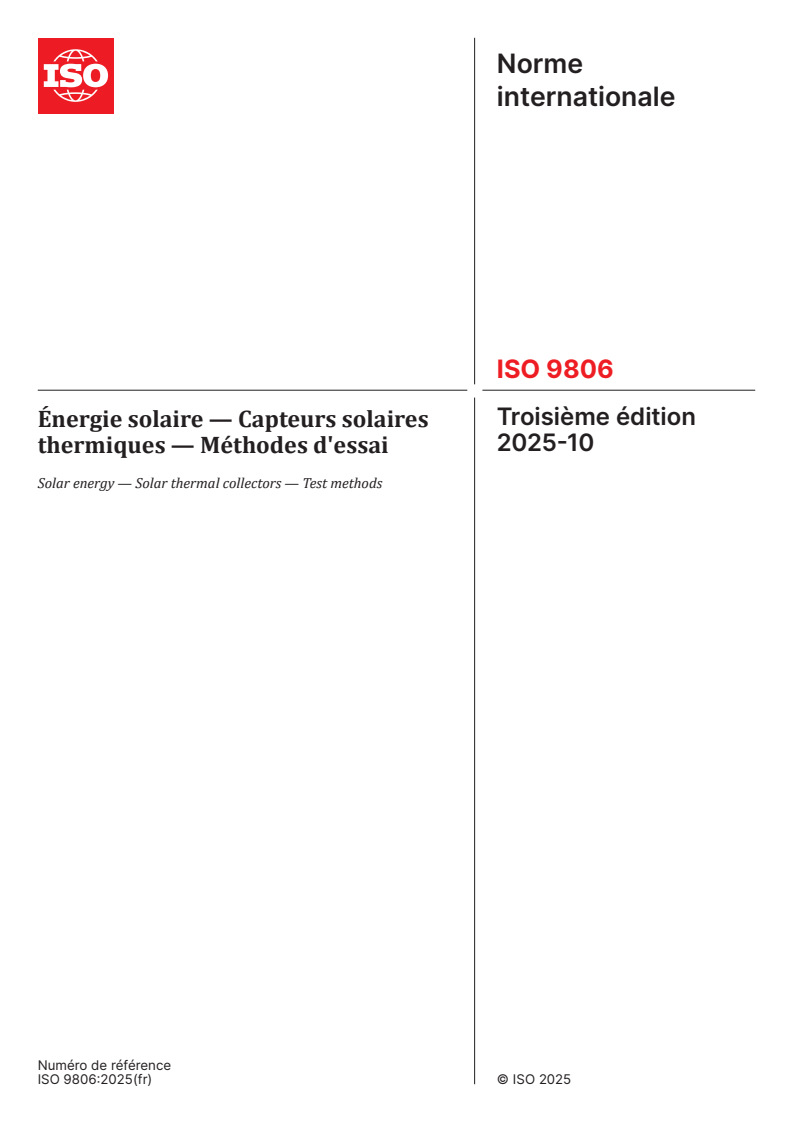
Norme
internationale
ISO 9806
Troisième édition
Énergie solaire — Capteurs solaires
2025-10
thermiques — Méthodes d'essai
Solar energy — Solar thermal collectors — Test methods
Numéro de référence
DOCUMENT PROTÉGÉ PAR COPYRIGHT
© ISO 2025
Tous droits réservés. Sauf prescription différente ou nécessité dans le contexte de sa mise en œuvre, aucune partie de cette
publication ne peut être reproduite ni utilisée sous quelque forme que ce soit et par aucun procédé, électronique ou mécanique,
y compris la photocopie, ou la diffusion sur l’internet ou sur un intranet, sans autorisation écrite préalable. Une autorisation peut
être demandée à l’ISO à l’adresse ci-après ou au comité membre de l’ISO dans le pays du demandeur.
ISO copyright office
Case postale 401 • Ch. de Blandonnet 8
CH-1214 Vernier, Genève
Tél.: +41 22 749 01 11
E-mail: copyright@iso.org
Web: www.iso.org
Publié en Suisse
ii
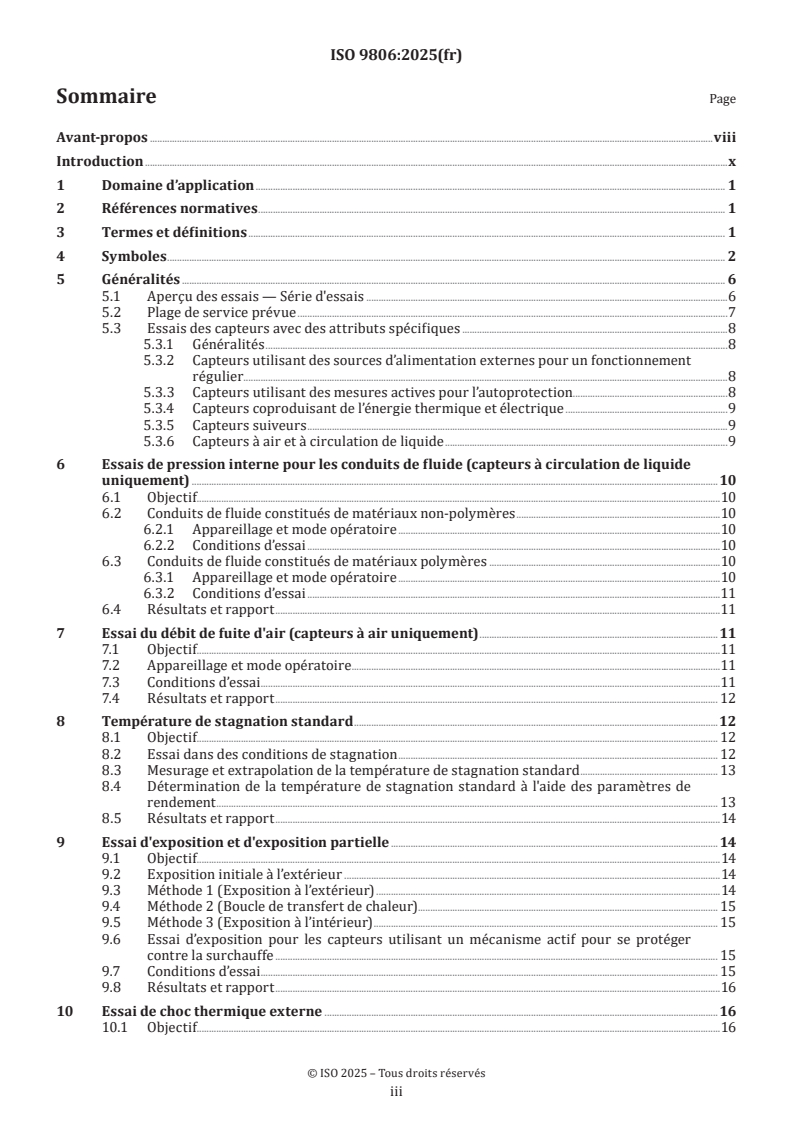
Sommaire Page
Avant-propos .viii
Introduction .x
1 Domaine d’application . 1
2 Références normatives . 1
3 Termes et définitions . 1
4 Symboles . 2
5 Généralités . 6
5.1 Aperçu des essais — Série d'essais .6
5.2 Plage de service prévue .7
5.3 Essais des capteurs avec des attributs spécifiques .8
5.3.1 Généralités .8
5.3.2 Capteurs utilisant des sources d’alimentation externes pour un fonctionnement
régulier .8
5.3.3 Capteurs utilisant des mesures actives pour l’autoprotection.8
5.3.4 Capteurs coproduisant de l’énergie thermique et électrique .9
5.3.5 Capteurs suiveurs .9
5.3.6 Capteurs à air et à circulation de liquide .9
6 Essais de pression interne pour les conduits de fluide (capteurs à circulation de liquide
uniquement) .10
6.1 Objectif.10
6.2 Conduits de fluide constitués de matériaux non-polymères .10
6.2.1 Appareillage et mode opératoire .10
6.2.2 Conditions d’essai .10
6.3 Conduits de fluide constitués de matériaux polymères .10
6.3.1 Appareillage et mode opératoire .10
6.3.2 Conditions d’essai .11
6.4 Résultats et rapport .11
7 Essai du débit de fuite d'air (capteurs à air uniquement) .11
7.1 Objectif.11
7.2 Appareillage et mode opératoire .11
7.3 Conditions d’essai . . .11
7.4 Résultats et rapport . 12
8 Température de stagnation standard .12
8.1 Objectif. 12
8.2 Essai dans des conditions de stagnation . 12
8.3 Mesurage et extrapolation de la température de stagnation standard . 13
8.4 Détermination de la température de stagnation standard à l'aide des paramètres de
rendement . 13
8.5 Résultats et rapport .14
9 Essai d'exposition et d'exposition partielle . 14
9.1 Objectif.14
9.2 Exposition initiale à l’extérieur .14
9.3 Méthode 1 (Exposition à l’extérieur) .14
9.4 Méthode 2 (Boucle de transfert de chaleur). 15
9.5 Méthode 3 (Exposition à l’intérieur) . 15
9.6 Essai d’exposition pour les capteurs utilisant un mécanisme actif pour se protéger
contre la surchauffe . 15
9.7 Conditions d’essai . . 15
9.8 Résultats et rapport .16
10 Essai de choc thermique externe .16
10.1 Objectif.16
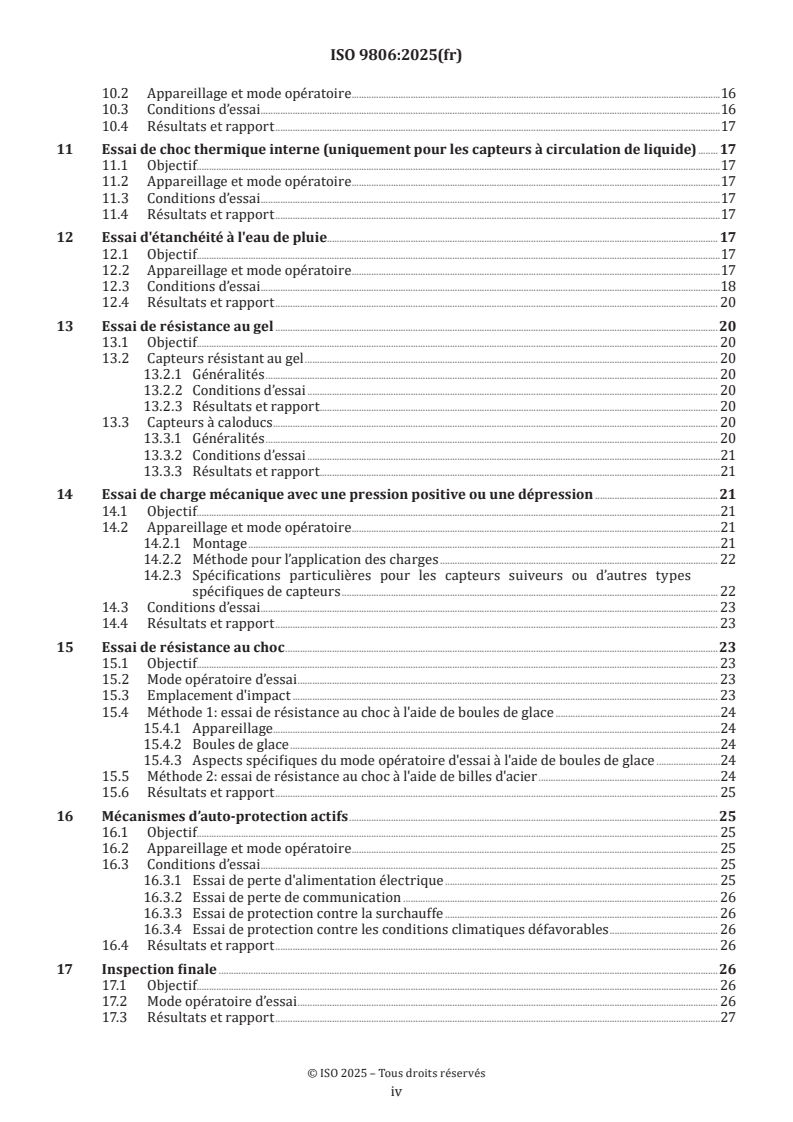
iii
10.2 Appareillage et mode opératoire .16
10.3 Conditions d’essai . .16
10.4 Résultats et rapport .17
11 Essai de choc thermique interne (uniquement pour les capteurs à circulation de liquide) . 17
11.1 Objectif.17
11.2 Appareillage et mode opératoire .17
11.3 Conditions d’essai . . .17
11.4 Résultats et rapport .17
12 Essai d'étanchéité à l'eau de pluie. 17
12.1 Objectif.17
12.2 Appareillage et mode opératoire .17
12.3 Conditions d’essai . . .18
12.4 Résultats et rapport . 20
13 Essai de résistance au gel .20
13.1 Objectif. 20
13.2 Capteurs résistant au gel . 20
13.2.1 Généralités . 20
13.2.2 Conditions d’essai . 20
13.2.3 Résultats et rapport . . 20
13.3 Capteurs à caloducs . 20
13.3.1 Généralités . 20
13.3.2 Conditions d’essai .21
13.3.3 Résultats et rapport . .21
14 Essai de charge mécanique avec une pression positive ou une dépression .21
14.1 Objectif.21
14.2 Appareillage et mode opératoire .21
14.2.1 Montage .21
14.2.2 Méthode pour l’application des charges . 22
14.2.3 Spécifications particulières pour les capteurs suiveurs ou d’autres types
spécifiques de capteurs . 22
14.3 Conditions d’essai . . . 23
14.4 Résultats et rapport . 23
15 Essai de résistance au choc .23
15.1 Objectif. 23
15.2 Mode opératoire d’essai . . 23
15.3 Emplacement d'impact . 23
15.4 Méthode 1: essai de résistance au choc à l'aide de boules de glace .24
15.4.1 Appareillage.24
15.4.2 Boules de glace .24
15.4.3 Aspects spécifiques du mode opératoire d'essai à l'aide de boules de glace .24
15.5 Méthode 2: essai de résistance au choc à l'aide de billes d'acier .24
15.6 Résultats et rapport . 25
16 Mécanismes d’auto-protection actifs .25
16.1 Objectif. 25
16.2 Appareillage et mode opératoire . 25
16.3 Conditions d’essai . . . 25
16.3.1 Essai de perte d'alimentation électrique . 25
16.3.2 Essai de perte de communication . 26
16.3.3 Essai de protection contre la surchauffe . 26
16.3.4 Essai de protection contre les conditions climatiques défavorables . 26
16.4 Résultats et rapport . 26
17 Inspection finale .26
17.1 Objectif. 26
17.2 Mode opératoire d’essai . . 26
17.3 Résultats et rapport .27
iv
18 Essais de performance thermique .27
18.1 Généralités .27
19 Montage et emplacement du capteur .28
19.1 Généralités . 28
19.2 Protection contre l'irradiance solaire directe . 28
19.3 Irradiance solaire diffuse et réfléchie . 28
19.4 Irradiance thermique . 29
20 Instrumentation .29
20.1 Mesurage du rayonnement solaire . 29
20.1.1 Pyranomètre . 29
20.2 Mesurage du rayonnement thermique . 30
20.3 Mesurages de la température . 30
20.3.1 Températures du fluide caloporteur (capteurs à circulation de liquide) . 30
20.3.2 Température moyenne pondérée en débit volumique ϑ (capteurs à air) . 30
m,th
20.3.3 Mesurage de la température de l'air environnant .31
20.4 Mesurage du débit .32
20.4.1 Mesurage du débit massique (liquide) .32
20.4.2 Mesurage du débit de fluide du capteur (capteurs à air) .32
20.5 Mesurage de la vitesse de l'air au-dessus du capteur .32
20.5.1 Généralités .32
20.5.2 Exactitude requise .32
20.5.3 Montage des sondes de mesure de la vitesse de l'air au niveau du capteur .32
20.6 Mesurage du temps écoulé . 33
20.7 Rapport de mélange (capteurs à air) . . 33
20.8 Dimensions du capteur. 33
21 Installation d'essai .33
21.1 Capteurs à circulation de liquide. 33
21.1.1 Généralités . 33
21.1.2 Fluide caloporteur . 34
21.1.3 Tuyauterie et accessoires . 34
21.2 Capteurs à air . 35
21.2.1 Généralités . 35
21.2.2 Circuit d’essai à boucle fermée . 35
21.2.3 Circuit d'essai ouvert à l'atmosphère . 36
21.2.4 Fluide caloporteur . 36
21.2.5 Pompe et dispositifs de régulation du débit . 36
21.2.6 Conduits d’air . . 36
21.2.7 Ventilateur et dispositifs de régulation du débit .37
21.2.8 Appareillage de conditionnement préalable de l'air .37
21.2.9 Rapport de mélange .37
22 Modes opératoires d'essai de performance thermique .37
22.1 Généralités .37
22.2 Conditionnement préalable du capteur . 38
22.3 Conditions d’essai . . . 38
22.3.1 Généralités . 38
22.3.2 Débits massiques . . 38
22.3.3 Vitesse de l’air parallèle au plan du capteur . 39
22.4 Mode opératoire d’essai . . 39
22.4.1 Généralités . 39
22.4.2 Méthode à l’état stationnaire. 39
22.4.3 Essais quasi-dynamiques. 40
22.5 Mesurages . 40
22.5.1 Généralités . 40
22.5.2 Exigences concernant le recueil des données .41
22.6 Durée de l'essai .41
22.6.1 Essai à l’état stationnaire .41
22.6.2 Essais quasi-dynamiques.41
v
22.7 Essai de performance à l'aide d’un simulateur de rayonnement solaire .45
22.7.1 Généralités .45
22.7.2 Simulateur d’irradiance solaire pour l’essai de performance thermique .45
22.7.3 Mesurages supplémentaires lors d'essais dans des simulateurs de rayonnement
solaire . 46
22.7.4 Simulateur de rayonnement solaire pour le mesurage des facteurs d'angle
d'incidence .47
23 Calcul des paramètres de capteur .47
23.1 Capteurs à circulation de liquide.47
23.1.1 Généralités .47
23.1.2 Méthode d’essai dans des conditions d'état stationnaire pour les capteurs à
circulation de liquide .47
23.1.3 Méthode d’essai quasi-dynamique pour les capteurs à circulation de liquide .47
23.1.4 Analyse des données .47
23.2 Capteurs à air . 48
23.2.1 Généralités . 48
23.2.2 Méthode d’essai dans des conditions d'état stationnaire pour les capteurs à air
en boucle fermée. 48
23.2.3 Méthode d’essai dans des conditions d'état stationnaire pour les capteurs à air
ambiant . 48
23.3 Conditions de rapport standard (SRC) . 48
23.4 Incertitudes standard . 49
23.5 Conversion de la superficie de référence . 49
24 Détermination de la capacité thermique effective et de la constante de temps .50
24.1 Généralités . 50
24.2 Mesurage de la capacité thermique effective avec irradiance . 50
24.3 Mesurage de la capacité thermique effective à l’aide de la méthode quasi-dynamique . 50
24.4 Méthodes de calcul pour la détermination de la capacité thermique effective . 50
24.5 Détermination de la constante de temps du capteur .51
25 Détermination du facteur d'angle d'incidence (IAM) .52
25.1 Généralités .52
25.2 Modélisation .52
25.2.1 Généralités .52
25.2.2 Méthode à l’état stationnaire. 54
25.2.3 Méthode quasi-dynamique . 54
25.3 Modes opératoires d’essai . 55
25.3.1 Capteurs à circulation de liquide dans des conditions d'état stationnaire . 55
25.4 Calcul du facteur d'angle d'incidence du capteur . 55
25.5 Rapport. 56
26 Détermination de la perte de charge .56
26.1 Généralités . 56
26.2 Capteurs à circulation de liquide. 56
26.2.1 Appareillage et mode opératoire . 56
26.2.2 Perte de chaleur due aux accessoires . 56
26.2.3 Conditions d’essai .57
26.3 Capteurs à air .57
26.3.1 Appareillage et mode opératoire .57
26.4 Calcul et présentation des résultats .57
Annexe A (informative) Rapports d'essai .59
Annexe B (normative) Indice de performance du capteur solaire . 76
Annexe C (normative) Détermination du facteur d'angle d'incidence pour l’irradiance solaire
diffuse K .78
d
Annexe D (normative) Densité et capacité calorifique de l’eau .80
Annexe E (informative) Évaluation de l'incertitude standard lors des essais du capteur solaire .81
vi
Annexe F (informative) Mesurage de la température moyenne pondérée par la vitesse.85
Annexe G (normative) Aspects de l’utilisation rationnelle des matériaux .87
Annexe H (normative) Conversion de la superficie des paramètres de performance thermique .88
Annexe I (informative) Validation des paramètres du capteur .89
Bibliographie .92
vii
Avant-propos
L'ISO (Organisation internationale de normalisation) est une fédération mondiale d'organismes nationaux
de normalisation (comités membres de l'ISO). L'élaboration des Normes internationales est en général
confiée aux comités techniques de l'ISO. Chaque comité membre intéressé par une étude a le droit de faire
partie du comité technique créé à cet effet. Les organisations internationales, gouvernementales et non
gouvernementales, en liaison avec l'ISO participent également aux travaux. L'ISO collabore étroitement avec
la Commission électrotechnique internationale (IEC) en ce qui concerne la normalisation électrotechnique.
Les procédures utilisées pour élaborer le présent document et celles destinées à sa mise à jour sont
décrites dans les Directives ISO/IEC, Partie 1. Il convient, en particulier, de prendre note des différents
critères d'approbation requis pour les différents types de documents ISO. Le présent document a
été rédigé conformément aux règles de rédaction données dans les Directives ISO/IEC, Partie 2 (voir
www.iso.org/directives).
L’ISO attire l’attention sur le fait que la mise en application du présent document peut entraîner l’utilisation
d’un ou de plusieurs brevets. L’ISO ne prend pas position quant à la preuve, à la validité et à l’applicabilité de
tout droit de propriété revendiqué à cet égard. À la date de publication du présent document, l’ISO n'avait pas
reçu notification qu’un ou plusieurs brevets pouvaient être nécessaires à sa mise en application. Toutefois,
il y a lieu d’avertir les responsables de la mise en application du présent document que des informations
plus récentes sont susceptibles de figurer dans la base de données de brevets, disponible à l'adresse
www.iso.org/brevets. L’ISO ne saurait être tenue pour responsable de ne pas avoir identifié tout ou partie de
tels droits de propriété.
Les appellations commerciales éventuellement mentionnées dans le présent document sont données pour
information, par souci de commodité, à l’intention des utilisateurs et ne sauraient constituer un engagement.
Pour une explication de la nature volontaire des normes, la signification des termes et expressions
spécifiques de l'ISO liés à l'évaluation de la conformité, ou pour toute information au sujet de l'adhésion de
l'ISO aux principes de l
...