

ISO/TR 5102:2025
(Main)Guidance for the analysis of differences between various standards of fibre reinforced plastic-working towers made of prefabricated elements
General Information
- Abstract
This document presents the main differences between the standards for working towers made of prefabricated elements in some regions and countries. It provides an analysis of different aspects, including product title, material performance, grade division, dimension requirements, product structure and design, test methods and fall prevention measures. This document gives guidance for the discussion of relevant technologies of working towers made of fibre-reinforced plastics, and also prepares for further development of applicable global technical standards for working towers.
- Status
- Published
- Publication Date
- 24-Jun-2025
- Technical Committee
- ISO/TC 61/SC 11 - Products
- Drafting Committee
- ISO/TC 61/SC 11 - Products
- Current Stage
- 6060 - International Standard published
- Start Date
- 25-Jun-2025
- Completion Date
- 25-Jun-2025

Overview
ISO/TR 5102:2025 is a Technical Report from ISO that analyses and compares existing regional and national standards for fibre-reinforced plastic (FRP) working towers made of prefabricated elements. It does not set new prescriptive requirements itself; instead, it identifies the main differences across standards (Europe, UK, USA, China, Australia/New Zealand, Russia, South Africa, Malaysia, Singapore, Japan, etc.) to support the future development of a harmonized international standard for FRP work towers.
Key topics and technical coverage
This guidance document examines and summarizes differences in the following technical areas:
- Product title and scope – how jurisdictions name and classify FRP working towers and modular prefabricated systems.
- Grade division and material performance – approaches to performance grading, mechanical and durability expectations for FRP components.
- Dimension requirements – dimensional rules and module geometry used for interchangeability and safe use.
- Product structure and design – typical prefabricated element designs, assembly concepts and structural considerations specific to FRP.
- Test methods – comparison of regional test procedures used to verify strength, stability and component performance.
- Fall prevention measures – mandated or recommended collective and personal fall protection provisions associated with tower use.
The report highlights variations in terminology, grading systems, test protocols and safety provisions, providing a clear map of areas needing alignment for a global standard.
Practical applications and who uses this standard
ISO/TR 5102:2025 is a reference tool for stakeholders involved with FRP prefabricated work towers, including:
- Manufacturers and product designers - to understand regional differences in performance expectations and testing when exporting or designing for multiple markets.
- Testing laboratories and conformity assessors - to align test programs and interpret differing regional requirements.
- Regulators and standards developers - to identify conflicts and convergences for drafting harmonized international requirements.
- Procurement, safety managers and end users - to compare product compliance claims and select appropriate systems for sensitive environments.
- Specialist sectors - such as glazing, heritage building maintenance, aviation, electrified rail and explosive/flammable environments where non-conductive, lightweight towers are preferred.
Related standards and next steps
ISO/TR 5102:2025 is preparatory guidance intended to inform the future work of ISO/TC 61 on creating an international standard for FRP prefabricated work towers. Users should consult national standards bodies and referenced regional standards when applying the report’s findings in design, testing or procurement decisions.
Keywords: ISO/TR 5102:2025, fibre reinforced plastic working towers, FRP work towers, prefabricated elements, material performance, test methods, fall prevention, international standardization.
Get Certified
Connect with accredited certification bodies for this standard

DIN CERTCO
DIN Group product certification.
DIBt (Deutsches Institut für Bautechnik)
German Institute for Building Technology.

Aboma Certification B.V.
Specialized in construction, metal, and transport sectors.
Sponsored listings
Frequently Asked Questions
ISO/TR 5102:2025 is a technical report published by the International Organization for Standardization (ISO). Its full title is "Guidance for the analysis of differences between various standards of fibre reinforced plastic-working towers made of prefabricated elements". This standard covers: This document presents the main differences between the standards for working towers made of prefabricated elements in some regions and countries. It provides an analysis of different aspects, including product title, material performance, grade division, dimension requirements, product structure and design, test methods and fall prevention measures. This document gives guidance for the discussion of relevant technologies of working towers made of fibre-reinforced plastics, and also prepares for further development of applicable global technical standards for working towers.
This document presents the main differences between the standards for working towers made of prefabricated elements in some regions and countries. It provides an analysis of different aspects, including product title, material performance, grade division, dimension requirements, product structure and design, test methods and fall prevention measures. This document gives guidance for the discussion of relevant technologies of working towers made of fibre-reinforced plastics, and also prepares for further development of applicable global technical standards for working towers.
ISO/TR 5102:2025 is classified under the following ICS (International Classification for Standards) categories: 83.120 - Reinforced plastics; 91.220 - Construction equipment. The ICS classification helps identify the subject area and facilitates finding related standards.
ISO/TR 5102:2025 is available in PDF format for immediate download after purchase. The document can be added to your cart and obtained through the secure checkout process. Digital delivery ensures instant access to the complete standard document.
Standards Content (Sample)
Technical
Report
ISO/TR 5102
First edition
Guidance for the analysis of
2025-06
differences between various
standards of fibre reinforced
plastic-working towers made of
prefabricated elements
Lignes directrices pour l'analyse des différences entre les diverses
normes d'échafaudages en plastique renforcé de fibres constitués
d'éléments préfabriqués
Reference number
© ISO 2025
All rights reserved. Unless otherwise specified, or required in the context of its implementation, no part of this publication may
be reproduced or utilized otherwise in any form or by any means, electronic or mechanical, including photocopying, or posting on
the internet or an intranet, without prior written permission. Permission can be requested from either ISO at the address below
or ISO’s member body in the country of the requester.
ISO copyright office
CP 401 • Ch. de Blandonnet 8
CH-1214 Vernier, Geneva
Phone: +41 22 749 01 11
Email: copyright@iso.org
Website: www.iso.org
Published in Switzerland
ii
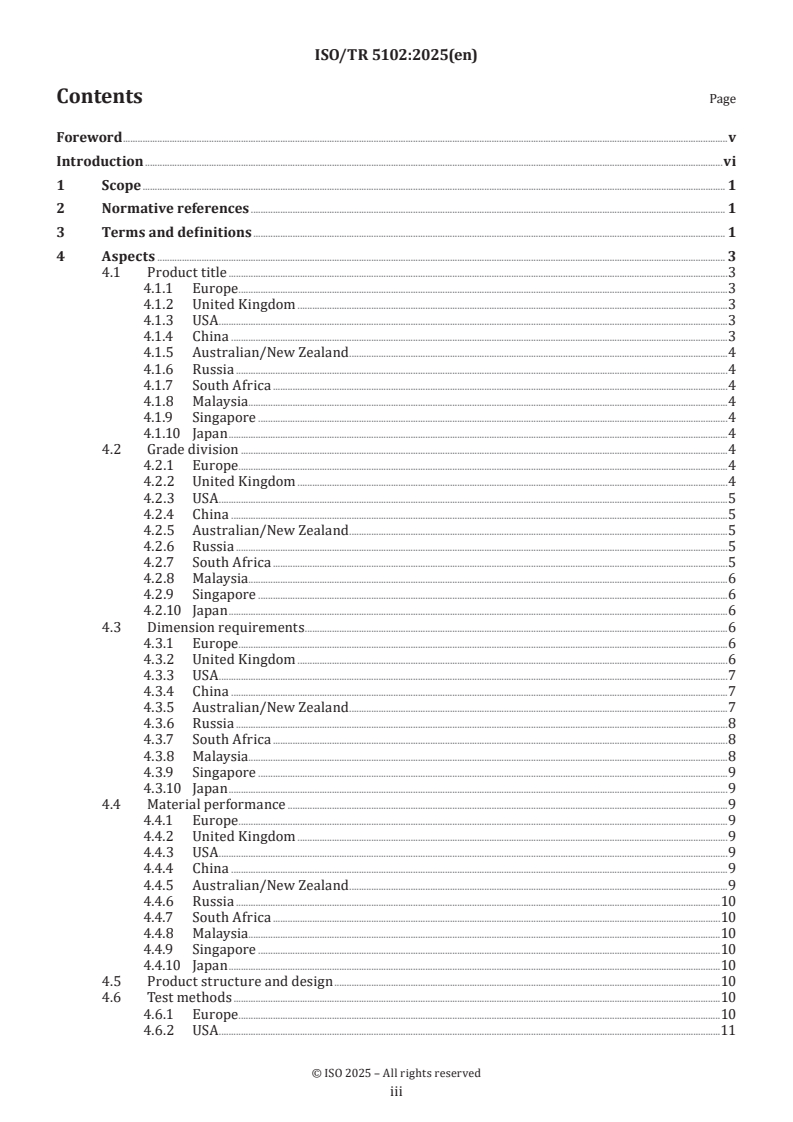
Contents Page
Foreword .v
Introduction .vi
1 Scope . 1
2 Normative references . 1
3 Terms and definitions . 1
4 Aspects . 3
4.1 Product title .3
4.1.1 Europe .3
4.1.2 United Kingdom .3
4.1.3 USA .3
4.1.4 China .3
4.1.5 Australian/New Zealand .4
4.1.6 Russia .4
4.1.7 South Africa .4
4.1.8 Malaysia.4
4.1.9 Singapore .4
4.1.10 Japan .4
4.2 Grade division .4
4.2.1 Europe .4
4.2.2 United Kingdom .4
4.2.3 USA .5
4.2.4 China .5
4.2.5 Australian/New Zealand .5
4.2.6 Russia .5
4.2.7 South Africa .5
4.2.8 Malaysia.6
4.2.9 Singapore .6
4.2.10 Japan .6
4.3 Dimension requirements .6
4.3.1 Europe .6
4.3.2 United Kingdom .6
4.3.3 USA .7
4.3.4 China .7
4.3.5 Australian/New Zealand .7
4.3.6 Russia .8
4.3.7 South Africa .8
4.3.8 Malaysia.8
4.3.9 Singapore .9
4.3.10 Japan .9
4.4 Material performance .9
4.4.1 Europe .9
4.4.2 United Kingdom .9
4.4.3 USA .9
4.4.4 China .9
4.4.5 Australian/New Zealand .9
4.4.6 Russia .10
4.4.7 South Africa .10
4.4.8 Malaysia.10
4.4.9 Singapore .10
4.4.10 Japan .10
4.5 Product structure and design .10
4.6 Test methods .10
4.6.1 Europe .10
4.6.2 USA .11
iii
4.6.3 China .11
4.6.4 Australian/New Zealand .11
4.6.5 Russia . 12
4.6.6 Malaysia. 12
4.6.7 Singapore . 13
4.6.8 Japan . 13
4.7 Fall prevention measures . 13
5 Summary . 14
Bibliography .16
iv
Foreword
ISO (the International Organization for Standardization) is a worldwide federation of national standards
bodies (ISO member bodies). The work of preparing International Standards is normally carried out through
ISO technical committees. Each member body interested in a subject for which a technical committee
has been established has the right to be represented on that committee. International organizations,
governmental and non-governmental, in liaison with ISO, also take part in the work. ISO collaborates closely
with the International Electrotechnical Commission (IEC) on all matters of electrotechnical standardization.
The procedures used to develop this document and those intended for its further maintenance are described
in the ISO/IEC Directives, Part 1. In particular, the different approval criteria needed for the different types
of ISO documents should be noted. This document was drafted in accordance with the editorial rules of the
ISO/IEC Directives, Part 2 (see www.iso.org/directives).
ISO draws attention to the possibility that the implementation of this document may involve the use of (a)
patent(s). ISO takes no position concerning the evidence, validity or applicability of any claimed patent
rights in respect thereof. As of the date of publication of this document, ISO had not received notice of (a)
patent(s) which may be required to implement this document. However, implementers are cautioned that
this may not represent the latest information, which may be obtained from the patent database available at
www.iso.org/patents. ISO shall not be held responsible for identifying any or all such patent rights.
Any trade name used in this document is information given for the convenience of users and does not
constitute an endorsement.
For an explanation of the voluntary nature of standards, the meaning of ISO specific terms and expressions
related to conformity assessment, as well as information about ISO's adherence to the World Trade
Organization (WTO) principles in the Technical Barriers to Trade (TBT), see www.iso.org/iso/foreword.html.
This document was prepared by Technical Committee ISO/TC 61, Plastics, Subcommittee SC 11, Products.
Any feedback or questions on this document should be directed to the user’s national standards body. A
complete listing of these bodies can be found at www.iso.org/members.html.
v
Introduction
This document concerns a fibre-reinforced composite work towers, composed of several standard
prefabricated components and designed in a 'building block' style for quick, tool-free on-site assembly. It is
widely used in workplaces where fragile, damage-prone, or electrically conductive objects are present, such
as glass facades, historic buildings, shopping malls, aircraft, flammable and explosive environments, and
electrified railways. Some countries and regions have developed relevant standards for this type of product,
but there is currently no unified international standard, leading some countries to adopt standards from
other countries or regions.
TC 61 aims to establish an ISO standard to regulate and harmonize the performance requirements and
testing methods for this type of product. However, different countries and regions can have varying
regulations for this product, which makes forming a unified ISO standard challenging at this stage.
Therefore, it is important to first identify existing national and regional standards related to this product,
and then analyse and compare the main differences among these standards. Current comparisons reveal
that there are differences in the naming, performance grades, product dimensions, materials, structure,
testing methods and fall protection measures for work towers across different countries and regions. These
differences will require careful consideration in drafting a unified ISO standard in the future.
vi
Technical Report ISO/TR 5102:2025(en)
Guidance for the analysis of differences between various
standards of fibre reinforced plastic-working towers made of
prefabricated elements
1 Scope
This document presents the main differences between the standards for working towers made of
prefabricated elements in some regions and countries. It provides an analysis of different aspects, including
product title, material performance, grade division, dimension requirements, product structure and design,
test methods and fall prevention measures.
This document gives guidance for the discussion of relevant technologies of working towers made of fibre-
reinforced plastics, and also prepares for further development of applicable global technical standards for
working towers.
2 Normative references
There are no normative references in this document.
3 Terms and definitions
For the purposes of this document, the following terms and definitions apply.
ISO and IEC maintain terminology databases for use in standardization at the following addresses:
— ISO Online browsing platform: available at https:// www .iso .org/ obp
— IEC Electropedia: available at https:// www .electropedia .org/
3.1
working tower
temporary free-standing structures consisting of prefabricated elements, having dimensions fixed by the
design and four legs with castors, providing one or more platforms
Note 1 to entry: In this document, working tower is sometimes written as scaffold or scaffolding, which refers to the
product according to different technical standards.
3.2
vertical framework
frame assembly preassembled into a portal shape with 2 vertical and several horizontal bars
Note 1 to entry: See Figure 1.
Figure 1 — Example of a vertical framework
3.3
working platform
platform in a working tower from where the work will be carried out
Note 1 to entry: Generally, it is the top platform.
Note 2 to entry: See Figure 2.
Figure 2 — Example of a working platform
3.4
adjustable leg
component incorporated into the structure of a working tower at its base used for the purpose of leveling
the structure when situated on uneven or sloping ground
Note 1 to entry: See Figure 3.
Figure 3 — Example of adjustable leg
3.5
castor wheel
swivelling wheel secured to the base of a working tower to enable the working tower to be moved
3.6
height
the distance from the ground (supporting surface) to the upper surface of the working platform
3.7
indoors
place where the working tower will not be exposed to wind loads
3.8
side protection
components forming a barrier to protect people from the risk of falling and to retain materials
3.9
rated working load
maximum load that the working platform or the rungs of the inclined ladder can bear when in normal use
Note 1 to entry: Including the total weight of all workers, materials and equipment.
4 Aspects
4.1 Product title
4.1.1 Europe
Working towers are commonly referred to as "working towers" in EN 1004-1:2020 or "working scaffolds" in
EN 12811-1:2003.
4.1.2 United Kingdom
Working towers are typically called "prefabricated tower scaffold" or "mobile access and working towers" in
BS 1139-6:2022.
4.1.3 USA
Working towers are typically called "scaffold" or "prefabricated mobile scaffold" in ANSI/ASSP A10.8-2019.
4.1.4 China
Working towers are commonly called "scaffold" or "scaffolding" in DL/T 1209.4-2023 or JC/T 2287-2014.
4.1.5 Australian/New Zealand
Working towers are typically called "frame scaffold" or "mobile minor scaffold" in AS/NZS 1576.1:2010.
4.1.6 Russia
Working towers are typically called "scaffolding" or "mobile and removable scaffolding" in GOST R 58752-
2019 or GOST R 58755-2019.
4.1.7 South Africa
Working towers are typically called “access scaffolding” in SANS 10085-1:2004 or “mobile access and
working towers” in SANS 51004:2009.
4.1.8 Malaysia
Working towers are typically called "Frame scaffolding" in MS 1462-1:1999.
4.1.9 Singapore
Working towers are typically called "Frame scaffoldings" in SS 280-1:2006 or “Modular scaffoldings” in SS
280-2:2009.
4.1.10 Japan
Working towers are typically called "scaffolds” in JIS A 8951-1995.
4.2 Grade division
4.2.1 Europe
The European standard EN 1004-1:2020 divides these products into two classes according to the uniformly
distributed load on the working platform. See Table 1.
Table 1 — EN 1004-1:2020 — Classes of uniformly distributed load
Uniformly distributed load, q
Load class
kN/m
2 1,50
3 2,00
4.2.2 United Kingdom
The British standard BS 1139-6:2022 divides these products into three classes according to the uniformly
distributed load on the working platform. See Table 2.
Table 2 — BS 1139-6:2022 — Classification of prefabricated tower scaffolds
Uniformly distributed load, q
Load class
kN/m
a
1 0,75
2 1,5
3 2,0
a
Load class 1 is for very light duty work such as inspection or painting.
4.2.3 USA
In ANSI/ASSP A10.8-2019, the products are usually divided into four classes according to the carrying
capacity requirements of the working platform. See Table 3.
Table 3 — ANSI/ASSP A10.8-2019 — Classification of prefabricated tower scaffolds
Uniformly distributed load, q
Load class
PSF
Light-duty 25(About equal to 1,20 kN/m )
Medium-duty 50(About equal to 2,39 kN/m )
Heavy-duty 75(About equal to 3,59 kN/m )
Special duty >75
4.2.4 China
The product is not classified into different classes in the Chinese standard DL/T 1209.4-2023, which means
there is only one class and the bearing capacity of the working platform of this class is specified.
4.2.5 Australian/New Zealand
According to the concentrated load-bearing capacity of the working tower, it is divided into three levels in
Australian and New Zealand: Light-duty, medium-duty and heavy-duty. See Table 4.
Table
...