


ISO/IEC 11801:2000
(Main)Information technology — Generic cabling for customer premises
Information technology — Generic cabling for customer premises
Technologies de l'information — Câblage générique des locaux d'utilisateurs
General Information
- Status
- Withdrawn
- Publication Date
- 23-Feb-2000
- Withdrawal Date
- 23-Feb-2000
- Technical Committee
- ISO/IEC JTC 1/SC 25 - Interconnection of information technology equipment
- Current Stage
- 9599 - Withdrawal of International Standard
- Start Date
- 23-Oct-2002
- Completion Date
- 12-Feb-2026
Relations
- Effective Date
- 15-Apr-2008
- Effective Date
- 15-Apr-2008
- Effective Date
- 15-Apr-2008
- Effective Date
- 15-Apr-2008
- Effective Date
- 15-Apr-2008
- Effective Date
- 15-Apr-2008

Get Certified
Connect with accredited certification bodies for this standard

BSI Group
BSI (British Standards Institution) is the business standards company that helps organizations make excellence a habit.

NYCE
Mexican standards and certification body.
Sponsored listings
Frequently Asked Questions
ISO/IEC 11801:2000 is a standard published by the International Organization for Standardization (ISO). Its full title is "Information technology — Generic cabling for customer premises". This standard covers: Information technology — Generic cabling for customer premises
Information technology — Generic cabling for customer premises
ISO/IEC 11801:2000 is classified under the following ICS (International Classification for Standards) categories: 35.200 - Interface and interconnection equipment. The ICS classification helps identify the subject area and facilitates finding related standards.
ISO/IEC 11801:2000 has the following relationships with other standards: It is inter standard links to ISO/IEC 11801:1995/Cor 1:1996, ISO/IEC 11801:1995/Amd 2:1999, ISO/IEC 11801:1995/Cor 2:1997, ISO/IEC 11801:2002, ISO/IEC 11801:1995, ISO/IEC 11801:1995/Amd 1:1999. Understanding these relationships helps ensure you are using the most current and applicable version of the standard.
ISO/IEC 11801:2000 is available in PDF format for immediate download after purchase. The document can be added to your cart and obtained through the secure checkout process. Digital delivery ensures instant access to the complete standard document.
Standards Content (Sample)
INTERNATIONAL ISO/IEC
STANDARD
Edition 1.2
2000-01
Edition 1:1995 consolidated with amendments 1:1999 and 2:1999
Information technology –
Generic cabling for customer premises
Technologies de l'information –
Câblage générique des locaux d'utilisateurs
Reference number
ISO/IEC 11801:1995+A1:1999+A2:1999(E)
INTERNATIONAL ISO/IEC
STANDARD
Edition 1.2
2000-01
Edition 1:1995 consolidated with amendments 1:1999 and 2:1999
Information technology –
Generic cabling for customer premises
Technologies de l'information –
Câblage générique des locaux d'utilisateurs
ISO/IEC 2000
All rights reserved. Unless otherwise specified, no part of this publication may be reproduced or utilized in any form or by any
means, electronic or mechanical, including photocopying and microfilm, without permission in writing from the publisher.
ISO/IEC Copyright Office Case postale 56 CH-1211 Genève 20 Switzerland
• • •
PRICE CODE
XA
For price, see current catalogue
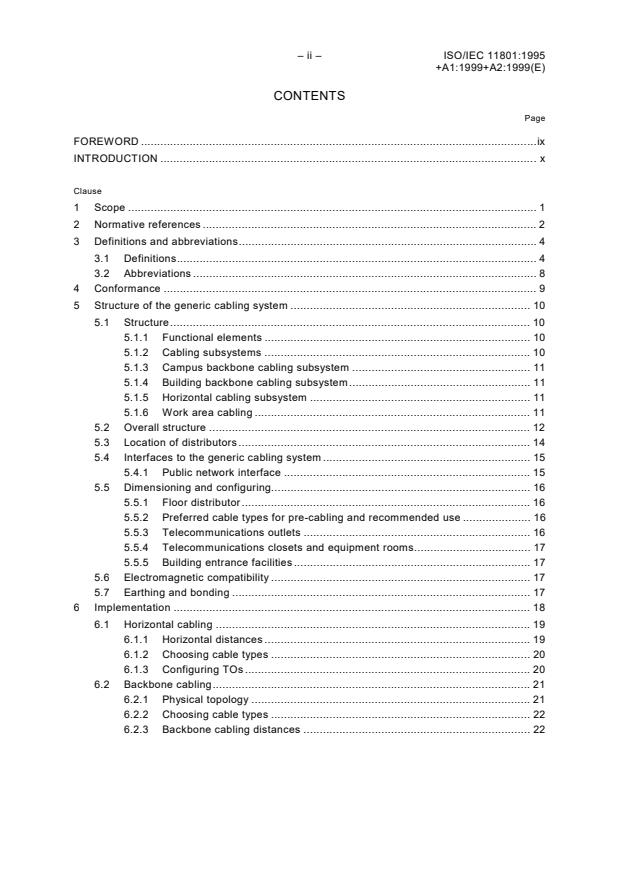
– ii – ISO/IEC 11801:1995
+A1:1999+A2:1999(E)
CONTENTS
Page
FOREWORD .ix
INTRODUCTION .x
Clause
1 Scope . 1
2 Normative references . 2
3 Definitions and abbreviations. 4
3.1 Definitions. 4
3.2 Abbreviations . 8
4 Conformance . 9
5 Structure of the generic cabling system . 10
5.1 Structure. 10
5.1.1 Functional elements . 10
5.1.2 Cabling subsystems . 10
5.1.3 Campus backbone cabling subsystem . 11
5.1.4 Building backbone cabling subsystem. 11
5.1.5 Horizontal cabling subsystem . 11
5.1.6 Work area cabling . 11
5.2 Overall structure . 12
5.3 Location of distributors . 14
5.4 Interfaces to the generic cabling system . 15
5.4.1 Public network interface . 15
5.5 Dimensioning and configuring. 16
5.5.1 Floor distributor. 16
5.5.2 Preferred cable types for pre-cabling and recommended use . 16
5.5.3 Telecommunications outlets . 16
5.5.4 Telecommunications closets and equipment rooms. 17
5.5.5 Building entrance facilities . 17
5.6 Electromagnetic compatibility . 17
5.7 Earthing and bonding . 17
6 Implementation . 18
6.1 Horizontal cabling . 19
6.1.1 Horizontal distances . 19
6.1.2 Choosing cable types . 20
6.1.3 Configuring TOs . 20
6.2 Backbone cabling. 21
6.2.1 Physical topology . 21
6.2.2 Choosing cable types . 22
6.2.3 Backbone cabling distances . 22
ISO/IEC 11801:1995 – iii –
+A1:1999+A2:1999(E)
7 Permanent link and channel specifications. 23
7.1 Permanent links and channels. 23
7.1.1 General. 23
7.1.2 Permanent links . 24
7.1.3 Channels. 24
7.2 Classification of applications, links and channels . 26
7.2.1 Application classification . 26
7.2.2 Link and channel classification . 27
7.3 Balanced cabling permanent links and channels . 28
7.3.1 General. 28
7.3.2 Nominal impedance. 28
7.3.3 Return loss. 28
7.3.4 Attenuation (insertion loss) . 29
7.3.5 NEXT loss. 30
7.3.6 Attenuation of crosstalk loss ratio . 31
7.3.7 ELFEXT . 33
7.3.8 DC loop resistance . 35
7.3.9 Propagation delay . 35
7.3.10 Delay skew. 36
7.3.11 Longitudinal to differential conversion loss (balance) . 36
7.3.12 Transfer impedance of shield . 37
7.4 Optical fibre permanent links/channels . 37
7.4.1 General. 37
7.4.2 Optical attenuation . 37
7.4.3 Multimode modal bandwidth . 38
7.4.4 Return loss. 38
7.4.5 Propagation delay . 38
8 Cable requirements . 39
8.1 General requirements for 100 Ω and 120 Ω balanced cable . 39
8.1.1 Additional requirements for 100 Ω balanced cable . 41
8.1.2 Additional requirements for 120 Ω balanced cable . 42
8.2 General requirements for 150 Ω balanced cable . 42
8.3 Additional crosstalk considerations for balanced cables . 44
8.3.1 Power summation. 44
8.3.2 Hybrid and multi-unit cables and cables connected to multiple TOs. 44
8.4 Multimode optical fibre cables . 45
8.5 Singlemode optical fibre cables . 45
9 Connecting hardware requirements . 46
9.1 General requirements. 46
9.1.1 Location . 46
9.1.2 Design . 46
9.1.3 Operating environment . 47
9.1.4 Mounting . 47
9.1.5 Cross-connect jumpers and patch cords . 47
9.1.6 Installation practices. 47
9.1.7 Marking and colour coding. 48
9.2 Connecting hardware for 100 Ω and 120 Ω cabling . 48
9.2.1 General requirements. 48
9.2.2 Performance marking . 48
– iv – ISO/IEC 11801:1995
+A1:1999+A2:1999(E)
9.2.3 Mechanical characteristics. 48
9.2.4 Electrical characteristics. 49
9.2.5 Telecommunications outlet requirements . 50
9.2.6 Installation practices. 51
9.3 Connecting hardware for 150 Ω cabling . 51
9.3.1 General requirements. 51
9.3.2 Performance marking . 51
9.3.3 Mechanical characteristics. 51
9.3.4 Electrical characteristics. 52
9.3.5 Telecommunications outlet requirements . 53
9.3.6 Installation practices. 53
9.4 Optical fibre connecting hardware . 54
9.4.1 General requirements. 54
9.4.2 Marking and colour coding. 54
9.4.3 Mechanical and optical characteristics. 54
9.4.4 Telecommunications outlet requirements . 55
9.4.5 Cross-connect jumpers and patch cords . 55
9.4.6 Optical fibre connectivity. 55
10 Shielding practices . 55
10.1 EMC . 55
10.2 Grounding. 56
11 Administration .56
11.1 Scope of administration. 56
11.2 Identifiers. 56
11.3 Records . 57
11.3.1 Documentation . 57
Annexes
A Test procedures . 58
A.1 Link performance testing . 58
A.1.1 Testing balanced cabling links . 58
A.1.2 Testing optical fibre cabling links . 60
A.1.3 Link tests . 62
A.2 Transmission testing of connecting hardware for balanced cabling. 62
A.2.1 Purpose and scope. 63
A.2.2 Applicability. 63
A.2.3 Test parameters. 64
A.2.4 Transmission testing of connecting hardware for balanced cables. 64
A.3 Termination procedure and set-up verification for modular jack and plug testing . 67
A.3.1 Test plug termination. 68
A.3.2 Balun and test plug qualification . 69
A.3.3 Typical TO measurement procedure . 70
B Reliability testing of connecting hardware for balanced cabling . 73
B.1 Introduction. 73
B.2 Contact resistance measurement . 74
B.3 Insulation resistance . 74
B.4 Durability . 74
B.5 Vibration . 74
ISO/IEC 11801:1995 – v –
+A1:1999+A2:1999(E)
B.6 Stress relaxation . 75
B.7 Thermal shock . 75
B.8 Humidity/temperature cycle . 75
B.9 Corrosion testing. 76
C Requirements for flexible 100 Ω, 120 Ω and 150 Ω balanced cables. 77
C.1 General requirements. 77
C.2 Additional requirements for 150 Ω flexible cables. 77
D Topology. 79
D.1 Common topologies . 79
D.1.1 Network topology. 79
D.2 Configurations. 80
D.3 Application of the structured framework. 81
E Acronyms for balanced cables . 83
F Tutorial on link performance . 84
F.1 Balanced cable transmission . 84
F.1.1 Link parameters . 84
F.1.2 Link parameter values . 86
F.2 Optical cabling . 86
G Supported applications . 87
H Fibre optic connectivity planning guide. 91
H.1 Introduction. 91
H.2 General recommendations . 91
H.3 Connectivity options at the TO. 92
H.3.1 Duplex SC connectivity configuration . 92
H.3.2 Simplex BFOC/2,5 connectivity configuration . 93
H.3.3 Simplex BFOC/2,5-to-Duplex SC (hybrid) connectivity configuration. 93
H.4 Connectivity options at distributors . 93
J Bibliographical references . 94
– vi – ISO/IEC 11801:1995
+A1:1999+A2:1999(E)
Figures
Page
1 Structure of generic cabling . 11
2 Inter-relationship of functional elements. 12
3 Example of the generic cabling system . 13
4 Typical accommodation of functional elements. 14
5 Potential interfaces to generic cabling. 15
6 Maximum cable lengths . 18
7 Examples of horizontal channel implementation . 19
8 Typical horizontal and work area cabling. 21
9 Backbone star topology . 22
10 Maximum backbone distances . 22
11 Permanent link . 24
12 Examples of cabling systems. 26
13 Eight position jack pin and pair grouping assignments. 50
A.1 Measurement configuration. 59
A.2 Calibration configuration . 59
A.3 Calibration. 61
A.4 Test set-up.61
A.5 Balun and test lead attenuation measurement. 67
A.6 Attenuation measurement using resistors. 67
A.7 Balanced test leads and jacket prior to untwisting . 68
A.8 Balanced test leads and jacket prior to plug termination . 69
A.9 Completed test plug. 69
A.10 Test plug qualification measurement. 70
A.11 Typical TO NEXT measurement set-up . 72
B.1 Reliability test programme . 73
D.1 Common topologies. 79
D.2 Accommodating star cabling topology in a bus pathway topology. 80
D.3 Star cabling topology . 80
D.4 Ring system topology realised from a star cabling topology . 80
D.5 Bus system topology realised from a star cabling topology . 81
D.6 Example of voice services over generic cabling. 81
D.7 Inter-relationship of functional elements in an installation with diversity
for protection against failure . 82
E.1 Cable types . 83
H.1 Duplex SC connectivity configuration . 92
H.2 Simplex BFOC/2,5 connectivity configuration . 93
H.3 Simplex BFOC/2,5-to-SC (hybrid) connectivity configuration. 93
ISO/IEC 11801:1995 – vii –
+A1:1999+A2:1999(E)
Tables
Page
1 Recommended media for pre-cabling. 16
2 Channel lengths achievable with different categories and types of cabling . 27
3 Minimum return loss for permanent link . 28
4 Minimum return loss for a channel . 29
5 Maximum attenuation values for a permanent link . 29
6 Maximum attenuation values for a channel. 29
7 Minimum NEXT loss for a permanent link. 30
8 Minimum NEXT loss for a channel . 30
9 Minimum PSNEXT loss for a permanent link . 31
10 Minimum PSNEXT loss for channels. 31
11 Minimum ACR values for permanent link. 32
12 Minimum ACR values for channels. 32
13 Minimum PSACR values for permanent link . 33
14 Minimum PSACR values for channels . 33
15 Minimum ELFEXT values for permanent link . 33
16 Minimum ELFEXT values for channels. 34
17 Minimum Power Sum ELFEXT values for permanent link . 34
18 Minimum Power Sun ELFEXT values for channels . 35
19 Maximum d.c. loop resistance. 35
20 Maximum propagation delay for permanent link. 35
21 Maximum propagation delay for a channel . 36
22 Maximum delay skew for permanent link. 36
23 Maximum delay skew for a channel. 36
24 Longitudinal to differential conversion loss . 36
25 Attenuation of optical fibre cabling subsystems . 37
26 Wavelength windows for multimode optical fibre cabling . 38
27 Wavelength windows for singlemode optical fibre cabling. 38
28 Minimum optical modal bandwidth. 38
29 Minimum optical return loss . 38
30 Mechanical characteristics of 100 Ω and 120 Ω balanced cables . 39
31 Electrical characteristics of 100 Ω and 120 Ω balanced cables . 40
32 Additional electrical characteristics of 100 Ω balanced cables . 41
33 Additional electrical characteristics of 120 Ω balanced cables . 42
34 Mechanical characteristics of 150 Ω balanced cables. 42
35 Electrical characteristics of 150 Ω balanced cables . 43
36 Cable transmission performance parameters . 45
37 Mechanical characteristics of connecting hardware intended for use
with 100 Ω or 120 Ω cabling. 49
38 Electrical characteristics of connecting hardware intended for use
with 100 Ω or 120 Ω cabling. 50
39 Mechanical characteristics of connecting hardware intended for use
with 150 Ω cabling . 52
40 Electrical characteristics of connecting hardware intended for use
with 150 Ω cabling . 53
41 Mechanical and optical characteristics of optical fibre connecting hardware. 54
– viii – ISO/IEC 11801:1995
+A1:1999+A2:1999(E)
A.1 Parameters for testing cabling links . 62
A.2 Test balun performance characteristics (1 MHz - 100 MHz). 65
A.3 Test plug NEXT loss requirements. 70
C.1 Different mechanical characteristics for 150 Ω flexible cables . 77
C.2 Different electrical characteristics for 150 Ω flexible cables . 78
E.1 Naming of balanced cables. 83
G.1 Supported applications . 87
G.2 Pairs and minimum performance requirements for emerging applications. 88
G.3 Pair assignment for applications listed in table G.1 . 89
G.4 Application standards and balanced cabling. 90
G.5 Application standards and optical fibre cabling . 90
ISO/IEC 11801:1995 – ix –
+A1:1999+A2:1999(E)
FOREWORD
ISO (the International Organization for Standardization) and IEC (the International Electro-
technical Commission) form the specialised system for worldwide standardization. National
bodies that are members of ISO or IEC participate in the development of International
Standards through technical committees established by the respective organization to deal with
particular fields of technical activity. ISO and IEC technical committees collaborate in fields of
mutual interest. Other international organizations, governmental and non-governmental, in
liaison with ISO and IEC, also take part in the work.
In the field of information technology, ISO and IEC have established a joint technical com-
mittee, ISO/IEC JTC 1. Draft International Standards adopted by the joint technical committee
are circulated to national bodies for voting. Publication as an International Standard requires
approval by at least 75 % of the national bodies casting a vote.
International Standard ISO/IEC 11801 was prepared by the Joint Technical Committee
ISO/IEC JTC 1, Information Technology, Subcommittee 25, Interconnection of Information
Technology Equipment.
This International Standard has taken into account requirements specified in application
standards listed in annex G. It refers to International Standards for components and test
methods whenever an appropriate International Standard was available.
This consolidated version of ISO/IEC 11801 is based on the first edition (1995), its amend-
ments 1 (1999) and 2 (1999) and the corrigendum 1 (December 1996) and the corrigendum 2
(June 1997).
It bears the edition number 1.2.
A vertical line in the margin shows where the base publication has been modified by
amendments 1 and 2, and corrigenda 1 and 2.
Annexes A, B and C form an integral part of this International Standard.
Annexes D, E, F, G, H and J are for information only.
– x – ISO/IEC 11801:1995
+A1:1999+A2:1999(E)
INTRODUCTION
Within customer premises, the importance of the cabling infrastructure is similar to that of
other fundamental building utilities such as heating, lighting and mains power. As with other
utilities, interruptions to service can have serious impact. Poor quality of service due to lack of
design foresight, use of inappropriate components, incorrect installation, poor administration or
inadequate support can threaten an organisation's effectiveness.
Historically, the cabling within a premises comprised both application specific and multipurpose
networks. Appropriate use of this International Standard will enable a controlled migration to
generic cabling. Certain circumstances may warrant the introduction of application specific
cabling; these instances should be minimised.
This International Standard provides:
a) users with an application independent generic cabling system and an open market for
cabling components;
b) users with a flexible cabling scheme such that modifications are both easy and economical;
c) building professionals (for example, architects) with guidance allowing the accommodation
of cabling before specific requirements are known; that is, in the initial planning either for
construction or refurbishment;
d) industry and applications standardisation bodies with a cabling system which supports
current products and provides a basis for future product development.
This International Standard specifies a multi-vendor cabling, and is related to:
a) International Standards for cabling components developed by committees of the IEC; for
)
example, copper cables IEC/TC 46 , copper connectors IEC/TC 48, optical fibre cables
and connectors IEC/TC 86;
)
b) applications developed by the sub-committees of ISO/IEC JTC 1 and study groups
) )
3 4
of ITU-T : for example, LANs: ISO/IEC JTC 1/SC 6 and SC 25/WG 4 ; ISDN: ITU-T
)
SG 13 ;
c) planning and installation guides for the implementation and use of generic cabling systems.
The applications listed in annex G have been analysed to determine the requirements for a
generic cabling system. These requirements, together with statistics concerning premises
geography from different countries and the model described in 6.1.1, have been used to
develop the requirements for cabling components and to stipulate their arrangement into
cabling systems. As a result, generic cabling defined within this International Standard is
targeted at, but not limited to, the general office environment.
It is anticipated that the generic cabling system defined by this International Standard will have
a life expectancy in excess of 10 years.
___________
1)
International Electrotechnical Commission – Technical Committee 46
2)
International Organization for Standardization/International Electrotechnical Commission – Joint Technical
Committee 1
3)
International Telecommunication Union – Telecommunications
4)
Subcommittee 25 – Working Group 4
5)
Study Group 13
ISO/IEC 11801:1995 – 1 –
+A1:1999+A2:1999(E)
INFORMATION TECHNOLOGY –
GENERIC CABLING FOR CUSTOMER PREMISES
1 Scope
International Standard ISO/IEC 11801 specifies generic cabling for use within commercial
premises, which may comprise single or multiple buildings on a campus.
The International Standard is optimised for premises having a geographical span of up to
3 000 m, with up to 1 000 000 m² of office space, and a population between 50 and 50 000
persons. It is recommended that the principles of this International Standard be applied to
installations that do not fall within this range.
Cabling defined by this International Standard supports a wide range of services including
voice, data, text, image and video.
This International Standard specifies:
1)
a) the structure and minimum configuration for generic cabling ,
b) implementation requirements,
c) performance requirements for individual cabling links and
d) conformance requirements and verification procedures.
Although safety (electrical, fire, etc.) and Electromagnetic Compatibility (EMC) requirements
are outside the scope of this International Standard, and may be covered by other standards
and regulations, information given in this International Standard may be of assistance in
meeting these requirements.
___________
1)
Cables and cords used to connect application specific equipment to the generic cabling system are outside of
the scope of this standard. Since they have significant effect on the transmission characteristics of the channel,
assumptions and guidance are provided on their performance and length.
– 2 – ISO/IEC 11801:1995
+A1:1999+A2:1999(E)
2 Normative references
The following normative documents contain provisions that, through reference in this text,
constitute provisions of ISO/IEC 11801. At the time of publication, the editions indicated were
valid. All normative documents are subject to revision, and parties to agreements based on this
International Standard are encouraged to investigate the possibility of applying the most recent
editions of the normative documents indicated below. Members of IEC and ISO maintain
registers of currently valid International Standards.
IEC 60068-1:1988, Basic environmental testing procedures – Environmental testing – Part 1:
General and guidance
IEC 60068-2-2:1974, Basic environmental testing procedures – Part 2: Tests – Tests B: Dry
heat
IEC 60068-2-6:1982, Basic environmental testing procedures – Part 2: Tests – Tests Fc and
guidance: Vibration (sinusoidal)
IEC 60068-2-14:1984, Basic environmental testing procedures – Part 2: Tests – Test N:
Change of temperature
IEC 60068-2-38:1974, Basic environmental testing procedures – Part 2: Tests – Test Z/AD:
Composite temperature/humidity cyclic test
IEC 60068-2-60 TTD:1990, Basic environmental testing procedures – Part 2: Tests – Test Ke:
Corrosion tests in artificial atmosphere at very low concentration of polluting gas(es) [Technical
Trend Document]
IEC 60096-1:1986, Radio-frequency cables – Part 1: General requirements and measuring
methods
IEC 60189-1:1986, Low-frequency cables and wires with p.v.c. insulation and p.v.c. sheath –
Part 1: General test and measuring methods
IEC 60227-2:1979, Polyvinyl chloride insulated cables of rated voltages up to and including
450/750 V – Part 2: Test methods
IEC 60512-1:1994, Electromechanical components for electronic equipment; basic testing
procedures and measuring methods – Part 1: General
IEC 60512-2:1985, Electromechanical components for electronic equipment; basic testing
procedures and measuring methods – Part 2: General examination, electrical continuity and
contact resistance tests, insulation tests and voltage stress tests
Amendment 1 (1988)
IEC 60603-7:1990, Connectors for frequencies below 3 MHz for use with printed boards –
Part 7: Detail specification for connectors, 8 way, including fixed and free connectors with
common mating features
IEC 60708-1:1981, Low-frequency cables with polyolefin insulation and moisture barrier
polyolefin sheath – Part 1: General design details and requirements
IEC 60793-1:1992, Optical fibres – Part 1: Generic specification
IEC 60793-1 (all parts), Optical fibres – Part 1: Generic specification
ISO/IEC 11801:1995 – 3 –
+A1:1999+A2:1999(E)
IEC 60793-2:1992, Optical fibres – Part 2: Product specifications
IEC 60794-1:1993, Optical fibre cables – Part 1: Generic specification
IEC 60794-2:1989, Optical fibre cables – Part 2: Product specifications
IEC 60807-8:1992, Rectangular connectors for frequencies below 3 MHz – Part 8: Detailed
specification for connectors, four signal contacts and earthing contacts for cable screen
IEC 60811-1-1:1993, Common test methods for insulating and sheathing materials of electric
cables – Part 1: Methods for general application – Section 1: Measurement of thickness and
overall dimensions – Tests for determining the mechanical properties
IEC 60874-1:1993, Connectors for optical fibres and cables – Part 1: Generic specification
IEC 60874-10:1992, Connectors for optical fibres and cables – Part 10: Sectional specification
for fibre optic connector – Type BFOC/2,5
IEC 60874-14:1993, Connectors for optical fibres and cables – Part 14: Sectional specification
for fibre optic connector – Type SC
IEC 60874-19 (all parts), Connectors for optical fibres and cables
IEC 61035-1, Specification for conduit fittings for electrical installations – Part 1: General
requirements
IEC 61073-1:1994, Splices for optical fibres and cables – Part 1: Generic specification –
Hardware and accessories
IEC 61156-1:1994, Multicore and symmetrical pair/quad cables for digital communications –
Part 1: Generic specification
IEC 61280-4 (all parts), Fibre optic communication subsystem basic test procedures – Part 4:
Fibre optic requirements
IEC 61935-1,— Generic specification for the testing of generic cabling in accordance with
1)
ISO/IEC 11801 – Part 1: Test methods
ISO/IEC 8802-5:1992, Information technology – Local and metropolitan area networks – Part 5:
Token ring access method and physical layer specifications
CISPR 22:1993, Limits and methods of measurement of radio disturbance characteristics of
information technology equipment
ITU-T Rec. G.117:1988, Transmission aspects of unbalance about earth (definitions and
methods)
ITU-T Rec. G.650:1993, Transmission media characteristics – Definition and test methods for
the relevant parameters of single-mode fibres
ITU-T Rec. G.651:1993, Characteristics of a 50/125 μm multimode graded index optical fibre
cable
___________
1)
To be published.
– 4 – ISO/IEC 11801:1995
+A1:1999+A2:1999(E)
ITU-T Rec. G.652:1993, Characteristics of a single-mode optical fibre cable
ITU-T Rec. O.9:1988, Measuring arrangements to assess the degree of unbalance about earth
3 Definitions and abbreviations
3.1 Definitions
For the purposes of this International Standard, the following definitions are applicable.
3.1.1
application
a system, with its associated transmission method which is supported by telecommunications
cabling
3.1.2
balanced cable
a cable consisting of one or more metallic symmetrical cable elements (twisted pairs or quads)
3.1.3
building backbone cable
a cable that connects the building distributor to a floor distributor. Building backbone cables
may also connect floor distributors in the same building
3.1.4
building distributor
a distributor in which the building backbone cable(s) terminate(s) and at which connections to
the campus backbone cable(s) may be made
3.1.5
building entrance facility
a facility that provides all necessary mechanical and electrical services, that complies with all
relevant regulations, for the entry of telecommunications cables into a building
3.1.6
cable
an assembly of one or more cable units of the same type and category in an overall sheath. It
may include an overall shield
3.1.7
cable element
the smallest construction unit (for example pair, quad, or single fibre) in a cable. A cable
element may have a shield
3.1.8
cable unit
a single assembly of one or more cable elements of the same type or category. The cable unit
may have a shield
NOTE A binder group is an example of a cable unit.
3.1.9
cabling
a system of telecommunications cables, cords, and connecting hardware that can support the
connection of information technology equipment
ISO/IEC 11801:1995 – 5 –
+A1:1999+A2:1999(E)
3.1.10
campus
a premises containing one or more buildings
3.1.11
campus backbone cable
a cable that connects the campus distributor to the building distributor(s). Campus backbone
cables may also connect building distributors directly
3.1.12
campus distributor
the distributor from which the campus backbone cabling emanates
3.1.13
channel
the end-to-end transmission path connecting any two pieces of application specific equipment.
Equipment and work area cables are included in the channel
3.1.14
cross-connect
a facility enabling the termination of cable elements and their connection, primarily by means of
patch cords or jumpers
3.1.15
distributor
the te
...
Questions, Comments and Discussion
Ask us and Technical Secretary will try to provide an answer. You can facilitate discussion about the standard in here.
Loading comments...