

ISO/TR 24371:2025
(Main)Financial services — Natural person identifier (NPI) — Natural person identifier lifecycle operation and management
General Information
- Abstract
This document provides an overview of regulatory, business and best practice risk mitigation specifications that apply to the implementation, operation and governance of natural person identifier (NPI) policies, procedures and mechanisms necessary to support the lifecycle of all NPIs. The purpose of this document is to provide the basis for the development of one or more international standards related to the safe creation, use and management of NPIs with maximum global interoperability. For the structure of the NPI, see ISO 24366. For reference, ISO 24366 specifies a machine-readable, unambiguous NPI and the relevant reference data to uniquely identify the natural person relevant to any financial transaction rather than the personal identifying information.
- Status
- Published
- Publication Date
- 07-Sep-2025
- Technical Committee
- ISO/TC 68/SC 8 - Reference data for financial services
- Drafting Committee
- ISO/TC 68/SC 8 - Reference data for financial services
- Current Stage
- 6060 - International Standard published
- Start Date
- 08-Sep-2025
- Completion Date
- 08-Sep-2025

Overview
ISO/TR 24371:2025, "Financial services - Natural person identifier (NPI) - Natural person identifier lifecycle operation and management," is an International Organization for Standardization (ISO) technical report. It outlines regulatory, business, and risk mitigation specifications crucial for the implementation, operation, and governance of Natural Person Identifier (NPI) policies and procedures. The main aim is to support the full lifecycle of NPIs, providing foundations for global, safe, and interoperable identification management in financial services.
This document does not specify the NPI's structure itself-that detail is provided by ISO 24366-but instead focuses on the strategic, operational, and risk elements necessary to ensure the secure and effective use of NPIs. NPIs are essential for enabling cross-border, compliant, and privacy-preserving identification of individuals during financial operations.
Key Topics
- Regulatory and Business Requirements
- Identifies global stakeholder expectations.
- Addresses privacy protection and regulatory compliance for both customers and employees.
- Highlights needs for consumer protection in digital financial services.
- Risk Mitigation
- Details risk types including compliance, cybersecurity, fraud, identity management, data quality, and reputational risks.
- Outlines comprehensive risk mitigation strategies and policies across the NPI lifecycle.
- NPI Lifecycle Management
- Sets requirements for safe creation, operation, use, suspension, restoration, and revocation of NPIs.
- Defines best practices and describes processes for enrolment, issuance, administration, and governance.
- Governance and Operational Procedures
- Discusses the importance of governance models and federations resembling those used for the Global Legal Entity Identifier (LEI).
- Artikulates the responsibilities of NPI issuers and relying parties (such as financial institutions).
- Interoperability and Extensibility
- Emphasizes that NPIs must be globally unique, persistent, interoperable, and compatible with both national identifiers and international standards.
- Supports the integration of NPIs within various digital ID systems and financial reference data frameworks.
Applications
NPIs have broad, practical uses across financial and regulatory ecosystems:
- Financial Transactions
- Facilitate secure and privacy-preserving identification of individuals in payments, cards, securities, trading, and crypto assets.
- Regulatory Compliance
- Aid organizations in meeting know your customer (KYC) and anti-money laundering (AML) requirements without exposing personal data.
- Enhance authorities’ ability to monitor, investigate, and prevent financial crime and fraud.
- Operational Efficiency
- Reduce costs and friction in straight-through processing across borders and institutions.
- Enable seamless and compliant cross-border operations in digital and traditional finance.
- Digital and Social Inclusion
- Support countries in advancing digital maturity and inclusion by providing a reliable, interoperable identification solution for citizens.
- Data Protection and Privacy
- Allow organizations to provide services while safeguarding individual privacy, meeting increasing regulatory expectations worldwide.
Related Standards
ISO/TR 24371:2025 is a foundational part of a suite of standards for interoperable identity management in financial services:
- ISO 24366: Specifies the structure, format, and reference attributes for NPIs, establishing them as machine-readable, unambiguous, and globally unique identifiers.
- ISO/IEC 29115: Provides frameworks and terminology used for authentication and entity verification.
- Additional References: Includes best practices and insight from leading organizations such as the World Bank, the OECD, and insights related to national ID systems.
By following ISO/TR 24371:2025, organizations can implement robust, interoperable, and secure NPI frameworks that meet evolving global regulatory standards while supporting privacy, operational efficiency, and digital innovation in the financial sector.
Get Certified
Connect with accredited certification bodies for this standard

Great Wall Tianjin Quality Assurance Center
Established 1993, first batch to receive national accreditation with IAF recognition.
Hong Kong Quality Assurance Agency (HKQAA)
Hong Kong's leading certification body.

Innovative Quality Certifications Pvt. Ltd. (IQCPL)
Known for integrity, providing ethical & impartial Assessment & Certification. CMMI Institute Partner.
Sponsored listings
Frequently Asked Questions
ISO/TR 24371:2025 is a technical report published by the International Organization for Standardization (ISO). Its full title is "Financial services — Natural person identifier (NPI) — Natural person identifier lifecycle operation and management". This standard covers: This document provides an overview of regulatory, business and best practice risk mitigation specifications that apply to the implementation, operation and governance of natural person identifier (NPI) policies, procedures and mechanisms necessary to support the lifecycle of all NPIs. The purpose of this document is to provide the basis for the development of one or more international standards related to the safe creation, use and management of NPIs with maximum global interoperability. For the structure of the NPI, see ISO 24366. For reference, ISO 24366 specifies a machine-readable, unambiguous NPI and the relevant reference data to uniquely identify the natural person relevant to any financial transaction rather than the personal identifying information.
This document provides an overview of regulatory, business and best practice risk mitigation specifications that apply to the implementation, operation and governance of natural person identifier (NPI) policies, procedures and mechanisms necessary to support the lifecycle of all NPIs. The purpose of this document is to provide the basis for the development of one or more international standards related to the safe creation, use and management of NPIs with maximum global interoperability. For the structure of the NPI, see ISO 24366. For reference, ISO 24366 specifies a machine-readable, unambiguous NPI and the relevant reference data to uniquely identify the natural person relevant to any financial transaction rather than the personal identifying information.
ISO/TR 24371:2025 is classified under the following ICS (International Classification for Standards) categories: 03.060 - Finances. Banking. Monetary systems. Insurance. The ICS classification helps identify the subject area and facilitates finding related standards.
ISO/TR 24371:2025 is available in PDF format for immediate download after purchase. The document can be added to your cart and obtained through the secure checkout process. Digital delivery ensures instant access to the complete standard document.
Standards Content (Sample)
Technical
Report
ISO/TR 24371
First edition
Financial services — Natural person
2025-09
identifier (NPI) — Natural person
identifier lifecycle operation and
management
Services financiers — Identifiant de personne physique —
Fonctionnement et gestion du cycle de vie de l'identifiant de la
personne physique
Reference number
© ISO 2025
All rights reserved. Unless otherwise specified, or required in the context of its implementation, no part of this publication may
be reproduced or utilized otherwise in any form or by any means, electronic or mechanical, including photocopying, or posting on
the internet or an intranet, without prior written permission. Permission can be requested from either ISO at the address below
or ISO’s member body in the country of the requester.
ISO copyright office
CP 401 • Ch. de Blandonnet 8
CH-1214 Vernier, Geneva
Phone: +41 22 749 01 11
Email: copyright@iso.org
Website: www.iso.org
Published in Switzerland
ii
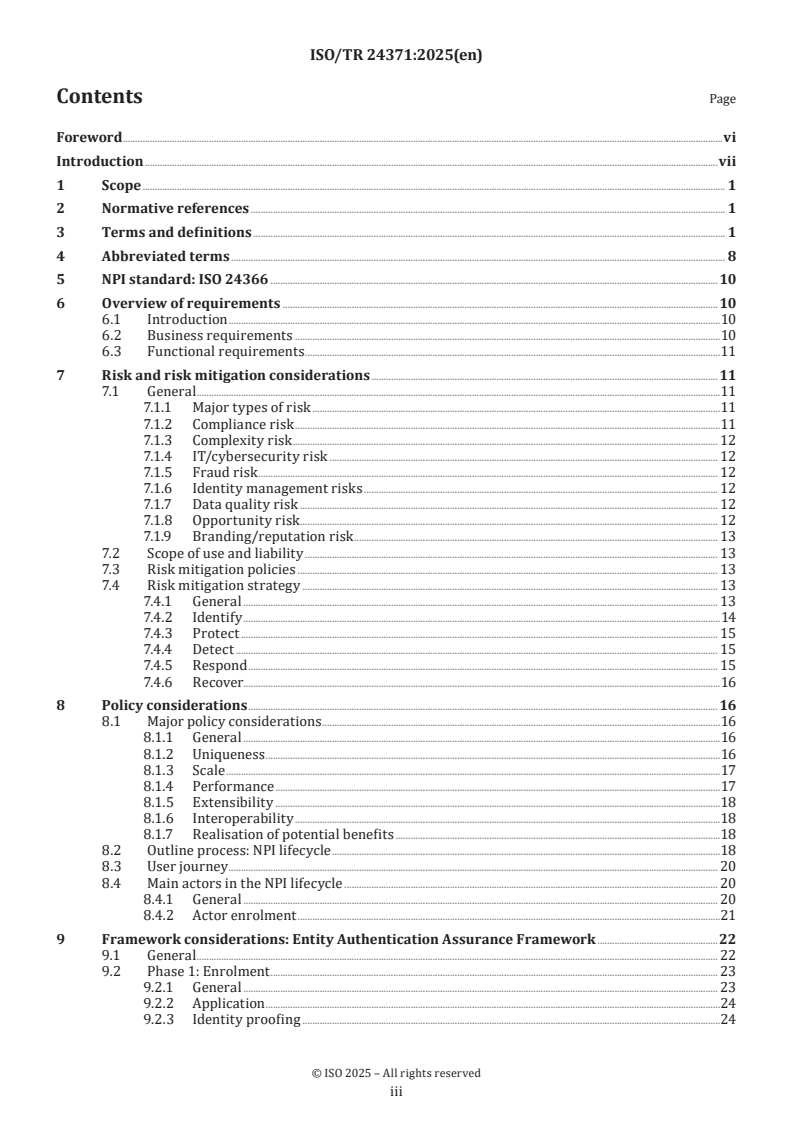
Contents Page
Foreword .vi
Introduction .vii
1 Scope . 1
2 Normative references . 1
3 Terms and definitions . 1
4 Abbreviated terms . 8
5 NPI standard: ISO 24366 . 10
6 Overview of requirements .10
6.1 Introduction .10
6.2 Business requirements .10
6.3 Functional requirements . .11
7 Risk and risk mitigation considerations .11
7.1 General .11
7.1.1 Major types of risk .11
7.1.2 Compliance risk .11
7.1.3 Complexity risk . 12
7.1.4 IT/cybersecurity risk . 12
7.1.5 Fraud risk . 12
7.1.6 Identity management risks . 12
7.1.7 Data quality risk . 12
7.1.8 Opportunity risk . 12
7.1.9 Branding/reputation risk . 13
7.2 Scope of use and liability . 13
7.3 Risk mitigation policies . 13
7.4 Risk mitigation strategy . 13
7.4.1 General . 13
7.4.2 Identify .14
7.4.3 Protect . 15
7.4.4 Detect . 15
7.4.5 Respond . 15
7.4.6 Recover.16
8 Policy considerations . 16
8.1 Major policy considerations .16
8.1.1 General .16
8.1.2 Uniqueness .16
8.1.3 Scale .17
8.1.4 Performance .17
8.1.5 Extensibility .18
8.1.6 Interoperability .18
8.1.7 Realisation of potential benefits .18
8.2 Outline process: NPI lifecycle .18
8.3 User journey . 20
8.4 Main actors in the NPI lifecycle . 20
8.4.1 General . 20
8.4.2 Actor enrolment .21
9 Framework considerations: Entity Authentication Assurance Framework .22
9.1 General . 22
9.2 Phase 1: Enrolment . 23
9.2.1 General . 23
9.2.2 Application .24
9.2.3 Identity proofing .24
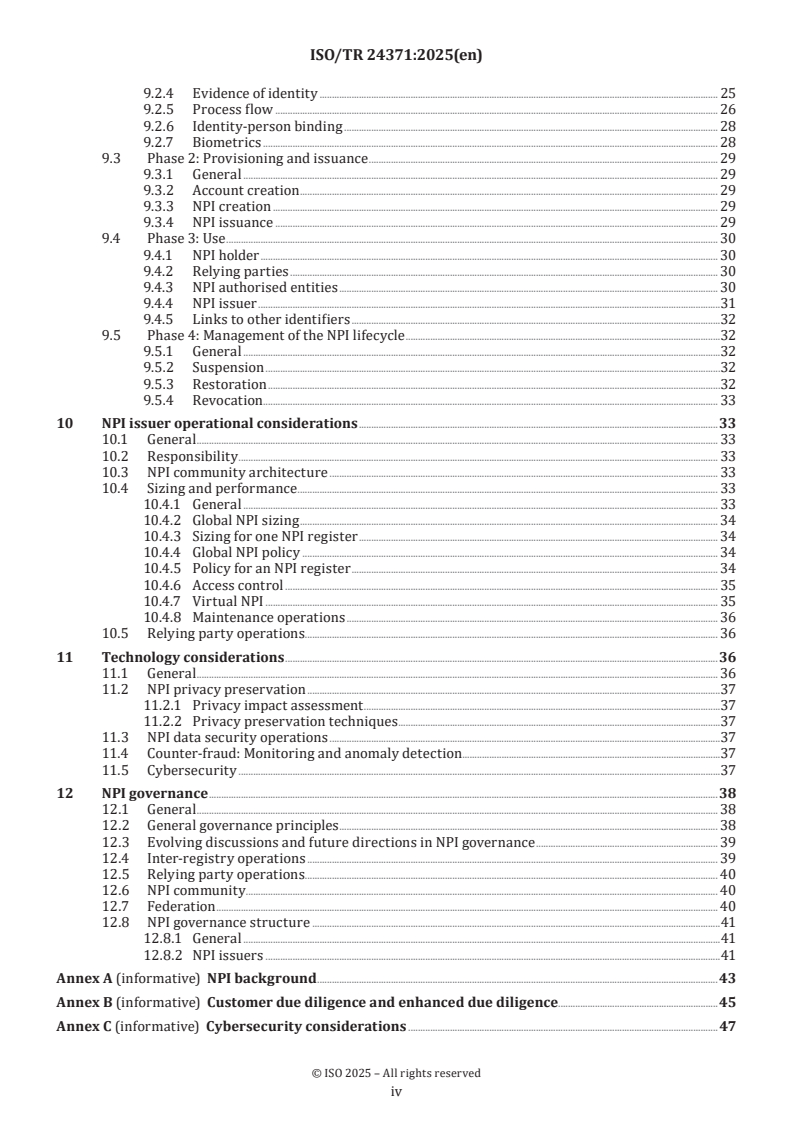
iii
9.2.4 Evidence of identity . 25
9.2.5 Process flow . 26
9.2.6 Identity-person binding . 28
9.2.7 Biometrics . 28
9.3 Phase 2: Provisioning and issuance . 29
9.3.1 General . 29
9.3.2 Account creation . 29
9.3.3 NPI creation . 29
9.3.4 NPI issuance . 29
9.4 Phase 3: Use . 30
9.4.1 NPI holder . 30
9.4.2 Relying parties . 30
9.4.3 NPI authorised entities . 30
9.4.4 NPI issuer .31
9.4.5 Links to other identifiers .32
9.5 Phase 4: Management of the NPI lifecycle .32
9.5.1 General .32
9.5.2 Suspension .32
9.5.3 Restoration .32
9.5.4 Revocation . . . 33
10 NPI issuer operational considerations .33
10.1 General . 33
10.2 Responsibility . 33
10.3 NPI community architecture . 33
10.4 Sizing and performance . 33
10.4.1 General . 33
10.4.2 Global NPI sizing . 34
10.4.3 Sizing for one NPI register . 34
10.4.4 Global NPI policy . 34
10.4.5 Policy for an NPI register . 34
10.4.6 Access control . 35
10.4.7 Virtual NPI . 35
10.4.8 Maintenance operations . 36
10.5 Relying party operations. 36
11 Technology considerations .36
11.1 General . 36
11.2 NPI privacy preservation .37
11.2.1 Privacy impact assessment .37
11.2.2 Privacy preservation techniques .37
11.3 NPI data security operations .37
11.4 Counter-fraud: Monitoring and anomaly detection .37
11.5 Cybersecurity .37
12 NPI governance .38
12.1 General . 38
12.2 General governance principles . 38
12.3 Evolving discussions and future directions in NPI governance . 39
12.4 Inter-registry operations . 39
12.5 Relying party operations. 40
12.6 NPI community . 40
12.7 Federation . 40
12.8 NPI governance structure .41
12.8.1 General .41
12.8.2 NPI issuers .41
Annex A (informative) NPI background .43
Annex B (informative) Customer due diligence and enhanced due diligence .45
Annex C (informative) Cybersecurity considerations . 47
iv
Annex D (informative) Biometric considerations .52
Annex E (informative) NPI data quality management considerations. 61
Annex F (informative) International organizations: the World Bank and the Organization for
Economic Co-operation and Development (OECD).63
Annex G (informative) NPI register operations: Challenges and best practices .66
Annex H (informative) Aadhaar . 74
Annex I (informative) Use cases .79
Annex J (informative) Business case for the NPI .92
Annex K (informative) Overview of key documents .95
Bibliography .97
v
Foreword
ISO (the International Organization for Standardization) is a worldwide federation of national standards
bodies (ISO member bodies). The work of preparing International Standards is normally carried out through
ISO technical committees. Each member body interested in a subject for which a technical committee
has been established has the right to be represented on that committee. International organizations,
governmental and non-governmental, in liaison with ISO, also take part in the work. ISO collaborates closely
with the International Electrotechnical Commission (IEC) on all matters of electrotechnical standardization.
The procedures used to develop this document and those intended for its further maintenance are described
in the ISO/IEC Directives, Part 1. In particular, the different approval criteria needed for the different types
of ISO documents should be noted. This document was drafted in accordance with the editorial rules of the
ISO/IEC Directives, Part 2 (see www.iso.org/directives).
ISO draws attention to the possibility that the implementation of this document may involve the use of (a)
patent(s). ISO takes no position concerning the evidence, validity or applicability of any claimed patent
rights in respect thereof. As of the date of publication of this document, ISO had not received notice of
patents which may be required to implement this document. However, implementers are cautioned that
this may not represent the latest information, which may be obtained from the patent database available at
www.iso.org/patents. ISO shall not be held responsible for identifying any or all such patent rights.
Any trade name used in this document is information given for the convenience of users and does not
constitute an endorsement.
For an explanation of the voluntary nature of standards, the meaning of ISO specific terms and expressions
related to conformity assessment, as well as information about ISO's adherence to the World Trade
Organization (WTO) principles in the Technical Barriers to Trade (TBT), see www.iso.org/iso/foreword.html.
This document was prepared by Technical Committee ISO/TC 68, Financial services, Subcommittee SC 8,
Reference data for financial services.
Any feedback or questions on this document should be directed to the user’s national standards body. A
complete listing of these bodies can be found at www.iso.org/members.html.
vi
Introduction
The regulatory, business and consumer requirements to identify natural persons for the purposes
of provision of an expanding range of digital financial services are rapidly increasing, nationally and
internationally. However, the abuse, misuse and criminal exploitation of personal data are also rising
significantly, facilitated by uncontrolled data proliferation and data sharing that is contrary to privacy
regulations and societal norms. Risks and tangible harms to people and organizations, and to our digital
economies and societies, are growing as a direct consequence. There are increasing requirements for
consumer protection.
Protecting the personal data of employees of financial services firms and of natural persons as customers of
financial and non-financial firms is important. This protection allows these firms to respond to regulatory
requirements without exposing personal information. It also provides regulators with a privacy-protected
way to identify all parties involved. This is crucial for the safe and conformant management of financial
assets at rest and in transit. This is particularly important in areas such as payments, cards, securities,
trading and crypto asset systems.
One of the biggest problems is the lack of a globally acceptable identifier for a natural person to enable cross-
organizational and cross-border financial processes to operate safely and with regulatory compliance. This
would provide the organizations involved with a common reference point for the purposes of validating an
identity but without unauthorised sharing or exposing personal data as part of the financial transaction.
The natural person identifier (NPI) is this global identifier, and its format is specified in ISO 24366. The
NPI supports many identifications, know your customer and traceability use cases, including persons
of significant control and beneficial owners. It can also support new safe and regulatory conformant
implementations of digital money, such as digital cash, central bank digital currencies (CBDCs), currency
trading and digital asset trading.
The NPI is primarily for financial purposes within and across legal, registered organizations. However, its
use is not limited to financial institutions or purposes. In practice, this includes almost all industry and
government organizations.
Benefits include:
— reducing costs and risks in straight-through processes;
— reducing friction and creating velocity in payment systems;
— enabling better monitoring of systemic risk across jurisdictions, particularly to reduce fraud and
financial crime;
— greater protection of citizens' personal information during the provision of services;
— improving measurable regulatory compliance;
— enabling better evidence for more successful investigations and prosecutions.
This document describes the needs of the global financial services industry and the regulatory community
for natural person identification in order to create NPI standards for implementation and operation.
Emerging key provisions are that such NPI standard(s):
— enable unique identification globally of natural persons requiring an identifier;
— support cross-border payment, card, trading and securities processes;
— enable interoperability and co-existence between national identifiers and the international NPI;
— define an NPI that contains no embedded intelligence;
— define an NPI that is interoperable with other standards and existing reference data and can be applied
globally to support the financial services industry;
vii
— address interoperability of existing natural person identifiers (e.g. national security number, social
security number, national insurance number, tax identification number, national ID) and the globally
applicable NPI;
— describe normative methods and procedures for authentication, identification and issuance;
— give guidance;
— define governance for the issuance and maintenance of NPIs, in a privacy protected way;
— leverage expertise in defining and maintaining identifier standards;
— define an NPI scheme that is reliable and an NPI that is persistent;
— define an NPI schema that is extensible and free from limitation on use and redistribution;
— can be linked to a verifiable legal entity identifier (vLEI) role for a legal person belonging to a legal entity
organization with a LEI.
Further background information is provided in Annex A. A business case for the NPI is provided in Annex J.
An overview of key documents is provided in Annex K.
ISO 24366 provides the syntax and a comprehensive list of reference data attributes to identify the natural
person uniquely to any financial organization or organization involved in financial processes.
Key factors affecting any considerations regarding the future success of the NPI include the following:
— The justification for the NPI remains strong and is growing. Its potential contribution to some UN
Sustainability Development Goals and programmes is recognised.
— The number of interested national and international parties is significant and continues to grow quickly,
but the situation is fragmented and there is no clear stakeholder community or collaborative convening
body. However, there is a growing desire to collaborate amongst many major and international
organizations.
— The NPI has the potential to address many privacy-preserving identification, compliance and traceability
risks and requirements in financial services, particularly in cross-border situations. However, the
benefits go much wider. It has the potential to address many other risks and requirements across
regulated industries and government services, and to assist in the fight against financial crime.
— The NPI can become an important interoperability mechanism, acting as a connector between national
digital ID systems that operate at high assurance according to international standards.
— The many benefits assist in increasing financial, digital and social inclusion within countries that have
growing digital economies and societies, which helps developing countries to accelerate their digital
maturity and inclusion.
— This document contains enough information and knowledge to inform a series of practical next steps to
implement ISO 24366, to operate and to deliver a series of first order and second order benefits.
— Action is required as soon as possible to ensure that the current NPI community of interest can continue
to work without interruption. The greatest concern amongst those investing in the NPI’s progress is that
it will stall due to bureaucratic delays that are incompatible with the pace of digitisation.
— This document provides a concise body of knowledge for regulators, stakeholders and participants and
to de-risk subsequent operational and counter-fraud implementations.
— Furthermore, a top-level regulatory and strategic mandate with an operational governance model
to match, similar to ICANN and the Global LEI Foundation (and its Regulatory Oversight Committee)
is considered fundamentally important to build the NPI community of stakeholders and shape the
global governance body – this would happen outside ISO. Organizations in TC 68, Financial services,
and elsewhere, particularly regulators and authorities, also seek to follow a similar approach to that
which created the LEI’s operational governance model and its top-level mandate from the G20 and key
viii
international organizations, including the FSB and FATF. This would accelerate progress, maximise re-
use and enable synergies and interoperability.
ix
Technical Report ISO/TR 24371:2025(en)
Financial services — Natural person identifier (NPI) —
Natural person identifier lifecycle operation and management
1 Scope
This document provides an overview of regulatory, business and best practice risk mitigation specifications
that apply to the implementation, operation and governance of natural person identifier (NPI) policies,
procedures and mechanisms necessary to support the lifecycle of all NPIs.
The purpose of this document is to provide the basis for the development of one or more international
standards related to the safe creation, use and management of NPIs with maximum global interoperability.
For the structure of the NPI, see ISO 24366. For reference, ISO 24366 specifies a machine-readable,
unambiguous NPI and the relevant reference data to uniquely identify the natural person relevant to any
financial transaction rather than the personal identifying information.
2 Normative references
There are no normative references in this document.
3 Terms and definitions
For the purposes of this document, the following terms and definitions apply.
ISO and IEC maintain terminology databases for use in standardization at the following addresses:
— ISO Online browsing platform: available at https:// www .iso .org/ obp
— IEC Electropedia: available at https:// www .electropedia .org/
3.1
authentication
provision of assurance in the identity of an entity
[SOURCE: ISO/IEC 29115:2013, 3.2].
3.2
authentication factor
piece of information and/or process used to authenticate or verify the identity of an entity
Note 1 to entry: Authentication factors are divided into four categories:
— something an entity has (e.g. device signature, passport, hardware device containing a credential, private key).
— something an entity knows [e.g. password, personal identification number (PIN)];
— something an entity is (e.g. biometric characteristic);
— something an entity typically does (e.g. behaviour pattern).
[SOURCE: ISO/IEC 29115:2013, 3.3]
3.3
authentication protocol
defined sequence of messages between an entity and a verifier that enables the verifier to perform
authentication of an entity
[SOURCE: ISO/IEC 29115:2013, 3.4]
3.4
authenticator
something the subject possesses and controls that is used to authenticate the subject’s identity
Note 1 to entry: An authenticator can be data in the form of a credential or an algorithm to process a challenge or
response, secured in software or a hardware device.
3.5
authoritative source
repository which is recognized as being an accurate and up-to-date source of information
Note 1 to entry: The authority is normally legally binding under statute or contract law.
[SOURCE: ISO/IEC 29115:2013, 3.5, modified – Note 1 to entry was added.]
3.6
biometric identification
process of searching against a biometric enrolment database to find and return the biometric reference
identifier(s) attributable to a single individual
[SOURCE: ISO/IEC 30108-1:2015, 4.6]
3.7
claim
statement that something is the case, without being able to give proof
Note 1 to entry: The meanings of the terms "claim" and "assertion" are generally agreed to be similar but slightly
different. For the purposes of this document, an assertion is considered to be a stronger statement than a claim,
because it is based on evidence or proof, whereas a claim is not.
[SOURCE: ITU-T X.1252: 04/2021, 6.19]
3.8
context
environment with defined boundary conditions in which entities exist and interact
[SOURCE: ITU-T X.1252: 04/2021, 6.22]
3.9
corroborative source
data source that is not legally authoritative
3.10
credential
set of data presented as evidence of a claimed or asserted identity and/or entitlements
Note 1 to entry: See ISO/IEC 29115:2013, Annex B for additional characteristics of a credential.
[SOURCE: ISO/IEC 29115:2013, 3.8]
3.11
credential service provider
trusted actor that issues and/or manages credentials
[SOURCE: ISO/IEC 29115:2013, 3.9]
3.12
data protection
implementation of appropriate administrative, technical or physical means to guard against unauthorised
intentional or accidental disclosure, modification or destruction of data
3.13
enrolment
process to make an entity known within a particular domain
Note 1 to entry: Enrolment typically comprises the collection and validation of identity information for identification
of an entity and the collection of the identity information required for identity registration, followed by identity
registration itself.
[SOURCE: ISO/IEC 24760-1:2019, 3.4.3]
3.14
entity
something that has separate and distinct existence and that can be identified in a context
Note 1 to entry: For the purposes of this document, entity is also used in the specific case for something that is claiming
an identity.
[SOURCE: ITU-T X.1252: 04/2021, 6.33]
3.15
entity authentication assurance
degree of confidence reached in the authentication process that the entity is what it is, or is expected to be
Note 1 to entry: The confidence is based on the degree of confidence in the binding between the entity and the identity
that is presented.
Note 2 to entry: This definition is based on that of authentication assurance given in b-ITU-T X.1252.
3.16
global NPI authority
GNPIA
global authority for the conformant operation of all natural person identifier (NPI) registers
Note 1 to entry: The GNPIA is subordinate to the NPI governance body.
3.17
identifier
one or more attributes that uniquely characterize an entity in a specific context
[SOURCE: ISO/IEC 29115:2013, 3.12]
3.18
identity
set of attributes related to an entity
Note 1 to entry: Within a particular context, an identity can have one or more identifiers to allow an entity to be
uniquely recognized within that context.
[SOURCE: ISO/IEC 24760-1:2019, 3.1.2, modified - Notes 1 to 3 to entry from the original document were
replaced with Note 1 to entry]
3.19
identity information verification
process of checking identity information and credentials against issuers, data sources, or other internal or
external resources with respect to authenticity, validity, correctness and binding to the entity
[SOURCE: ISO/IEC 29115:2013, 3.14]
3.20
identity proofing
process by which the registration authority captures and verifies sufficient information to identify an entity
to a specified or understood level of assurance
[SOURCE: ISO/IEC 29115:2013, 3.15]
3.21
issuance
controlled and secure process to give the natural person identifier (NPI) holder control of their NPI ready for use
Note 1 to entry: This includes checking that the NPI holder receiving the NPI is the subject of the NPI and is able to use
it for purposes conformant with the NPI policy.
3.22
legal entity
legal person or structure that is organized under the laws of any jurisdiction
[SOURCE: ISO 17442-1:2020, 3.1]
3.23
legal entity identifier
LEI
unique global identifier for legal entities participating in financial transactions and activities
Note 1 to entry: The legal entity identifier (LEI) is defined in ISO 17442-1. It is assigned by the global LEI system of
local operating units with issuing registers, which are operating under the management of the Global Legal Entity
Identifier Foundation (GLEIF). The GLEIF is subject to oversight by the Regulatory Oversight Committee.
3.24
legal person
individual, company or other entity which has legal rights and is subject to obligations
3.25
man-in-the-middle attack
attack in which an attacker is able to read, insert and modify messages between two parties without their
knowledge
[SOURCE: ISO/IEC 29115:2013, 3.16]
3.26
morphing attack
attack in which two or more facial images are combined and presented during registration as a biometric
reference
Note 1 to entry: The combined image, or morph, is designed to deceive the biometric system so that any of the persons,
whose images have been combined, can successfully pass the facial biometric check.
3.27
multifactor authentication
authentication of an operator using at least two independent authentication factors
[SOURCE: ISO/IEC 19790:2025, 3.86, modified – Notes 1, 2 and 3 to entry were removed.]
3.28
mutual authentication
authenticatio of identities of entities which provides both entities with assurance of each other’s identity
[SOURCE: ISO/IEC 29115:2013, 3.18]
3.29
natural person
human being with fundamental human rights
3.30
natural person identifier
NPI
global identifier for natural persons involved in financial transactions
3.31
non-repudiation
ability to protect against denial by one of the entities involved in an action of having participated in all or
part of the action
[SOURCE: ITU-T X.1252: 04/2021, 6.61]
3.32
NPI authorised entity
legal entity authorised to access specific personal information in a natural person identifier (NPI) register
Note 1 to entry: The authorised legal person in the legal entity is expected to have an NPI.
3.33
NPI community
community of natural person identifier (NPI) issuers, holders, registers, authorised entities and governance
organizatio
...