

ISO 6101-1:2019
(Main)Rubber — Determination of metal content by atomic absorption spectrometry — Part 1: Determination of zinc content
General Information
- Abstract
This document specifies an atomic absorption spectrometric method for the determination of the zinc content of rubbers. The method is applicable to raw rubber and rubber products having zinc contents at a minimum of 0,05 % (mass fraction). Zinc contents below this limit can be determined, provided that suitable adjustments are made to the mass of the test portion and/or to the concentrations of the solutions used. The use of the standard additions method might lower the bottom limit of detection.
- Status
- Published
- Publication Date
- 28-Nov-2019
- Technical Committee
- ISO/TC 45/SC 2 - Testing and analysis
- Drafting Committee
- ISO/TC 45/SC 2/WG 5 - Chemical tests
- Current Stage
- 9060 - Close of review
- Completion Date
- 02-Sep-2029
Buy Documents

ISO 6101-1:2019 - Rubber -- Determination of metal content by atomic absorption spectrometry
ISO 6101-1:2019 - Rubber — Determination of metal content by atomic absorption spectrometry — Part 1: Determination of zinc content/29/2019
Overview
ISO 6101-1:2019 specifies an atomic absorption spectrometric (AAS) method for the determination of zinc content in rubber. It applies to raw rubber and rubber products with zinc contents of at least 0.05% (mass fraction); lower concentrations can be measured by adjusting sample mass, solution concentrations or by using the standard additions method to improve detection limits. The method replaces the 1991 edition and clarifies organic-matter destruction, result expression and precision data.
Key topics and technical requirements
- Principle: Ash the test portion at 550 °C ± 25 °C, dissolve the ash in hydrochloric or nitric acid, and measure zinc absorption at 213.8 nm using a zinc hollow‑cathode lamp. Silicates can be volatilized using sulfuric and hydrofluoric acids.
- Sample sizes: Typical test portions recommended (from the standard) are about 1–5 g for rubber products and 5–10 g for raw rubber; halogenated rubbers use smaller portions (e.g., 0.1 g).
- Reagents and standards: Uses analytical-grade acids (HCl, HNO3, H2SO4, HF) and zinc standard solutions (stock 1 mg/ml and working 10 µg/ml preparations described).
- Instrumentation: Flame AAS with acetylene/air burner is specified; graphite furnace (electrothermal atomization) is an acceptable alternative when operated by qualified personnel.
- Procedure elements: sampling, ashing (ISO 247‑1), destruction of organic matter, dissolution of inorganic residue, calibration graph preparation, spectrometric measurement, blanks, dilution and calculation of results (expressed in mg/kg).
- Quality aspects: Use of standard additions to lower detection limits, blank determinations, and precision data provided (updated in Annex B).
Practical applications and users
- Applications:
- Quality control in rubber manufacturing (vulcanizates, compounds)
- Raw material inspection (natural and synthetic rubber)
- Compliance testing for product specifications and supplier acceptance
- R&D and formulation development where zinc levels (e.g., zinc oxide activator residues) are important
- Who uses this standard:
- Industrial and third‑party testing laboratories
- QC chemists and analysts in rubber and polymer plants
- Standards bodies, regulatory laboratories and academic researchers
Related standards
- ISO 247‑1 - Rubber - Determination of ash (combustion method)
- ISO 1795 - Sampling and preparative procedures for raw rubber
- ISO 123, ISO 124 - Latex sampling and total solids
- ISO 1042, ISO 648, ISO 1772, ISO 4793 - Laboratory glassware and filtration guidance
Safety note: follow normal laboratory safety, acid handling and waste‑disposal practices as the standard includes warnings about hazardous reagents and waste.
Relations
- Effective Date
- 10-Dec-2016
Buy Documents
ISO 6101-1:2019 - Rubber -- Determination of metal content by atomic absorption spectrometry
ISO 6101-1:2019 - Rubber — Determination of metal content by atomic absorption spectrometry — Part 1: Determination of zinc content/29/2019
Get Certified
Connect with accredited certification bodies for this standard

DIN CERTCO
DIN Group product certification.

Smithers Quality Assessments
US management systems and product certification.
Sponsored listings
Frequently Asked Questions
ISO 6101-1:2019 is a standard published by the International Organization for Standardization (ISO). Its full title is "Rubber — Determination of metal content by atomic absorption spectrometry — Part 1: Determination of zinc content". This standard covers: This document specifies an atomic absorption spectrometric method for the determination of the zinc content of rubbers. The method is applicable to raw rubber and rubber products having zinc contents at a minimum of 0,05 % (mass fraction). Zinc contents below this limit can be determined, provided that suitable adjustments are made to the mass of the test portion and/or to the concentrations of the solutions used. The use of the standard additions method might lower the bottom limit of detection.
This document specifies an atomic absorption spectrometric method for the determination of the zinc content of rubbers. The method is applicable to raw rubber and rubber products having zinc contents at a minimum of 0,05 % (mass fraction). Zinc contents below this limit can be determined, provided that suitable adjustments are made to the mass of the test portion and/or to the concentrations of the solutions used. The use of the standard additions method might lower the bottom limit of detection.
ISO 6101-1:2019 is classified under the following ICS (International Classification for Standards) categories: 83.060 - Rubber. The ICS classification helps identify the subject area and facilitates finding related standards.
ISO 6101-1:2019 has the following relationships with other standards: It is inter standard links to ISO 6101-1:1991. Understanding these relationships helps ensure you are using the most current and applicable version of the standard.
ISO 6101-1:2019 is available in PDF format for immediate download after purchase. The document can be added to your cart and obtained through the secure checkout process. Digital delivery ensures instant access to the complete standard document.
Standards Content (Sample)
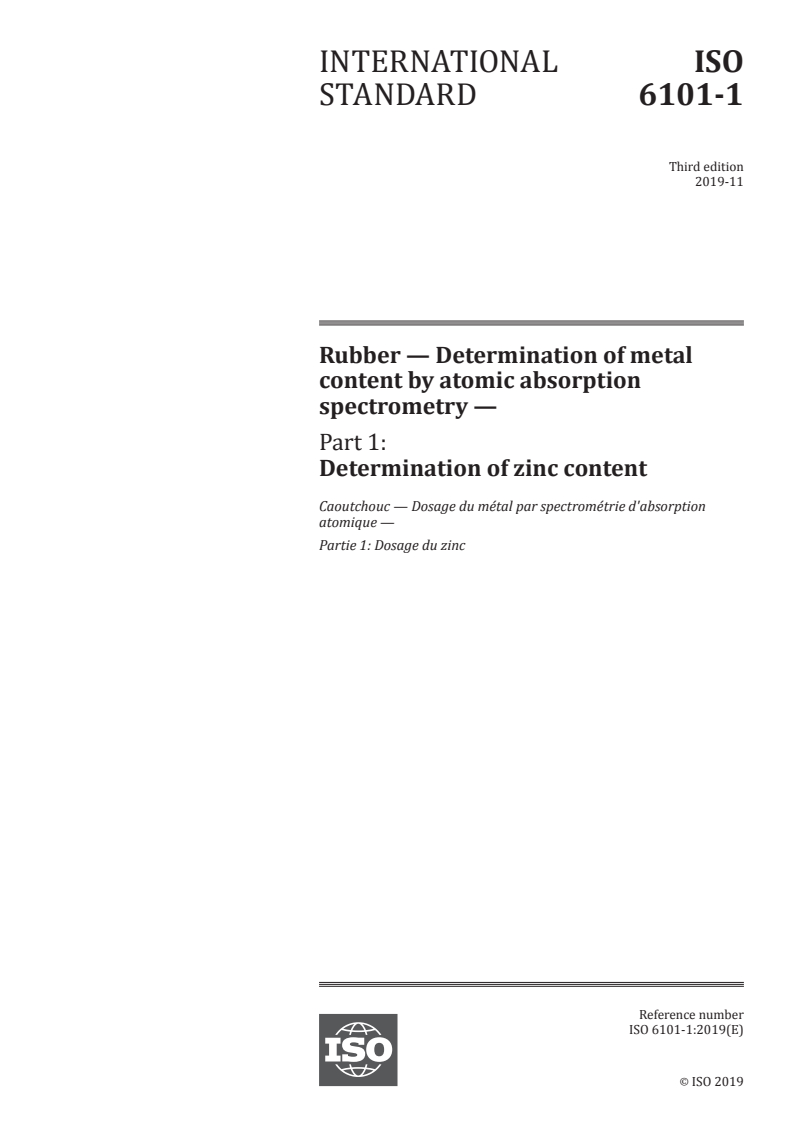
INTERNATIONAL ISO
STANDARD 6101-1
Third edition
2019-11
Rubber — Determination of metal
content by atomic absorption
spectrometry —
Part 1:
Determination of zinc content
Caoutchouc — Dosage du métal par spectrométrie d'absorption
atomique —
Partie 1: Dosage du zinc
Reference number
©
ISO 2019
© ISO 2019
All rights reserved. Unless otherwise specified, or required in the context of its implementation, no part of this publication may
be reproduced or utilized otherwise in any form or by any means, electronic or mechanical, including photocopying, or posting
on the internet or an intranet, without prior written permission. Permission can be requested from either ISO at the address
below or ISO’s member body in the country of the requester.
ISO copyright office
CP 401 • Ch. de Blandonnet 8
CH-1214 Vernier, Geneva
Phone: +41 22 749 01 11
Fax: +41 22 749 09 47
Email: copyright@iso.org
Website: www.iso.org
Published in Switzerland
ii © ISO 2019 – All rights reserved
Contents Page
Foreword .iv
1 Scope . 1
2 Normative references . 1
3 Terms and definitions . 1
4 Principle . 2
5 Reagents . 2
6 Apparatus . 3
7 Sampling . 3
8 Procedure. 4
8.1 Preparation of test portion . 4
8.2 Preparation of test solution . 4
8.2.1 Destruction of organic matter . 4
8.2.2 Dissolution of inorganic matter using hydrochloric acid . . 4
8.2.3 Dissolution of inorganic matter using nitric acid — Alternative method . 5
8.3 Preparation of the calibration graph . 5
8.3.1 Preparation of standard calibration solutions . 5
8.3.2 Spectrometric measurements . 5
8.3.3 Plotting the calibration graph . 6
8.4 Determination . 6
8.4.1 Spectrometric measurements . 6
8.4.2 Dilution. 6
8.4.3 Blank determination . 6
9 Expression of results . 6
10 Precision . 7
11 Test report . 7
Annex A (informative) Method of standard additions . 8
Annex B (informative) Precision .10
Bibliography .11
Foreword
ISO (the International Organization for Standardization) is a worldwide federation of national standards
bodies (ISO member bodies). The work of preparing International Standards is normally carried out
through ISO technical committees. Each member body interested in a subject for which a technical
committee has been established has the right to be represented on that committee. International
organizations, governmental and non-governmental, in liaison with ISO, also take part in the work.
ISO collaborates closely with the International Electrotechnical Commission (IEC) on all matters of
electrotechnical standardization.
The procedures used to develop this document and those intended for its further maintenance are
described in the ISO/IEC Directives, Part 1. In particular, the different approval criteria needed for the
different types of ISO documents should be noted. This document was drafted in accordance with the
editorial rules of the ISO/IEC Directives, Part 2 (see www .iso .org/ directives).
Attention is drawn to the possibility that some of the elements of this document may be the subject of
patent rights. ISO shall not be held responsible for identifying any or all such patent rights. Details of
any patent rights identified during the development of the document will be in the Introduction and/or
on the ISO list of patent declarations received (see www .iso .org/ patents).
Any trade name used in this document is information given for the convenience of users and does not
constitute an endorsement.
For an explanation of the voluntary nature of standards, the meaning of ISO specific terms and
expressions related to conformity assessment, as well as information about ISO's adherence to the
World Trade Organization (WTO) principles in the Technical Barriers to Trade (TBT), see www .iso .org/
iso/ foreword .html.
This document was prepared by Technical Committee ISO/TC 45, Rubber and rubber products,
Subcommittee SC 2, Testing and analysis.
This third edition cancels and replaces the second edition (ISO 6101-1:1991), which has been technically
revised.
The main changes compared to the previous edition are as follows.
— The procedure for the destruction of organic matter is further detailed.
— Formula (2) in 9.2 has been changed to zinc content being expressed as milligram per kilogram.
— Precision data have been updated in Annex B.
A list of all parts in the ISO 6101 series can be found on the ISO website.
Any feedback or questions on this document should be directed to the user’s national standards body. A
complete listing of these bodies can be found at www .iso .org/ members .html.
iv © ISO 2019 – All rights reserved
INTERNATIONAL STANDARD ISO 6101-1:2019(E)
Rubber — Determination of metal content by atomic
absorption spectrometry —
Part 1:
Determination of zinc content
WARNING 1 — Persons using this document should be familiar with normal laboratory practice.
This document does not purport to address all of the safety problems, if any, associated with its
use. It is the responsibility of the user to establish appropriate safety and health practices and to
determine the applicability of any other restrictions.
WARNING 2 — Certain procedures specified in this document might involve the use or generation
of substances, or the generation of waste, that could constitute a local environmental hazard.
Reference should be made to appropriate documentation on safe handling and disposal after use.
1 Scope
This document specifies an atomic absorption spectrometric method for the determination of the zinc
content of rubbers.
The method is applicable to raw rubber and rubber products having zinc contents at a minimum of
0,05 % (mass fraction). Zinc contents below this limit can be determined, provided that suitable
adjustments are made to the mass of the test portion and/or to the concentrations of the solutions used.
The use of the standard additions method might lower the bottom limit of detection.
2 Normative references
The following documents are referred to in the text in such a way that some or all of their content
constitutes requirements of this document. For dated references, only the edition cited applies. For
undated references, the latest edition of the referenced document (including any amendments) applies.
ISO 123, Rubber latex — Sampling
ISO 124, Latex, rubber — Determination of total solids content
ISO 247-1, Rubber — Determination of ash — Part 1: Combustion method
ISO 648, Laboratory glassware — Single-volume pipettes
ISO 1042, Laboratory glassware — One-mark volumetric flasks
ISO 1772, Laboratory crucibles in porcelain and silica
ISO 1795, Rubber, raw natural and raw synthetic — Sampling and further preparative procedures
ISO 4793, Laboratory sintered (fritted) filters — Porosity grading, classification and designation
3 Terms and definitions
No terms and definitions are listed in this document.
ISO and IEC maintain terminological databases for use in standardization at the following addresses:
— ISO Online browsing platform: available at https:// www .iso .org/ obp
— IEC Electropedia: available at http:// www .electropedia .org/
4 Principle
A test portion is ashed at 550 °C ± 25 °C in accordance with ISO 247-1. The ash is dissolved in hydrochloric
or nitric acid. The solution is aspirated into an atomic absorption spectrometer and the absorption is
measured at a wavelength of 213,8 nm, using a zinc hollow-cathode lamp as the zinc emission source.
Any silicates are volatilized by sulfuric acid and hydrofluoric acid.
5 Reagents
During the analysis, unless otherwise stated, use only reagents of recognized analytical grade, and only
distilled water or water of equivalent purity.
5.1 Sulfuric acid, ϱ = 1,84 Mg/m .
5.2 Hydrochloric acid, ϱ = 1, 18 Mg/m .
5.3 Hydrochloric acid solutions.
5.3.1 Hydrochloric acid, diluted 1 + 2.
Dilute 1 volume of the concentrated hydrochloric acid (5.2) with 2 volumes of water.
5.3.2 Hydrochloric acid, diluted 1 + 100.
Dilute 1 volume of the concentrated hydrochloric acid (5.2) with 100 volumes of water.
5.4 Hydrofluoric acid, ϱ = 1, 12 Mg/m .
5.5 Nitric acid, ϱ = 1,42 Mg/m .
5.5.1 Dilute nitric acid, 1,6 % (by mass), carefully pipette 11,5 cm of concentrated nitric acid (5.5)
into a 1 000 cm one-mark volumetric flask (6.5), making up to the mark with water, and mix thoroughly.
5.6 Zinc standard stock solution (1mg/ml).
Either use a commercially available standard zinc solution, or prepare as follows.
Weigh, to the nearest 0,1 mg, 1 g of pure zinc dust (minimum purity 99,9 %) and dissolve in a minimum
amount of the 1 + 2 hydrochloric acid solution (5.3.1). Allow to cool and transfer quantitatively to
1 000 cm one-mark volumetric flask (6.5). Make up to the mark with 1 + 100 hydrochloric acid solution
(5.3.2) and mix thoroughly.
1 cm of this standard stock solution contains 1 000 μg of Zn.
5.7 Zinc standard solution (10 μg/ml).
3 3
Using a pipette (6.6), carefully introduce 10 cm of the zinc standard stock solution (5.6) into 1 000 cm
one-mark volumetric flask (6.5). Dilute to the mark with 1 + 2 hydrochloric acid solution (5.3.1) or
dilute nitric acid (5.5.1) and mix thoroughly.
Prepare this solution on the day of use.
1 cm of this standard solution contains 10 μg of Zn.
2 © ISO 2019 – All rights reserved
6 Apparatus
Use ordinary laboratory apparatus and the following.
6.1 Atomic absorption spectrometer, fitted with a burner fed with acetylene and compressed air and
also fitted with a zinc hollow-cathode lamp capable of emitting radiation of the required wavelengths. A
high-brightness lamp is advisable.
The instrument shall be operated in accordance with the manufacturer's instructions for optimum
performance.
Alternatively, an electrothermal atomization device (graphite furnace) may be used. It shall be
operated by a competent person in accordance with the manufacturer's instructions for optimum
performance.
6.2 Balance, accurate to 0,1 mg.
6.3 Muffle furnace, capable of being maintained at a temperature of 550 °C ± 25 °C.
6.4 Beaker, of capacity 250 cm .
3 3 3 3
6.5 One-mark volumetric flasks, glass-stoppered, of capacity 50 cm , 100 cm , 200 cm , 500 cm and
1 000 cm , in accordance with the requirements of ISO 1042, class A.
3 3 3 3 3 3
6.6 One-mark volumetric pipettes, of capacity 0,5 cm , 1,0 cm , 5 cm , 10 cm , 20 cm and 50 cm , in
accordance with the requirements of ISO 648, class A.
6.7 Filter funnel, of diameter 65 mm and angle 60°, fitted with a sintered-glass disc of pore size 16 μm
to 40 μm (porosity grade P 40 — see ISO 4793).
3 3
6.8 Silica or porcelain crucible, of capacity 50 cm to 150 cm depending on the test portion size, in
accordance with the requirements of ISO 1772.
3 3
6.9 Platinum crucible, of capacity 50 cm to 150 cm depending on the test portion size.
6.10 Platinum or borosilicate-glass rod, for use as stirrer.
NOTE Platinum rod is used to stir samples digested with hydrofluoric acid.
6.11 Ashless filter pa
...
INTERNATIONAL ISO
STANDARD 6101-1
Third edition
2019-11
Rubber — Determination of metal
content by atomic absorption
spectrometry —
Part 1:
Determination of zinc content
Caoutchouc — Dosage du métal par spectrométrie d'absorption
atomique —
Partie 1: Dosage du zinc
Reference number
©
ISO 2019
© ISO 2019
All rights reserved. Unless otherwise specified, or required in the context of its implementation, no part of this publication may
be reproduced or utilized otherwise in any form or by any means, electronic or mechanical, including photocopying, or posting
on the internet or an intranet, without prior written permission. Permission can be requested from either ISO at the address
below or ISO’s member body in the country of the requester.
ISO copyright office
CP 401 • Ch. de Blandonnet 8
CH-1214 Vernier, Geneva
Phone: +41 22 749 01 11
Fax: +41 22 749 09 47
Email: copyright@iso.org
Website: www.iso.org
Published in Switzerland
ii © ISO 2019 – All rights reserved
Contents Page
Foreword .iv
1 Scope . 1
2 Normative references . 1
3 Terms and definitions . 1
4 Principle . 2
5 Reagents . 2
6 Apparatus . 3
7 Sampling . 3
8 Procedure. 4
8.1 Preparation of test portion . 4
8.2 Preparation of test solution . 4
8.2.1 Destruction of organic matter . 4
8.2.2 Dissolution of inorganic matter using hydrochloric acid . . 4
8.2.3 Dissolution of inorganic matter using nitric acid — Alternative method . 5
8.3 Preparation of the calibration graph . 5
8.3.1 Preparation of standard calibration solutions . 5
8.3.2 Spectrometric measurements . 5
8.3.3 Plotting the calibration graph . 6
8.4 Determination . 6
8.4.1 Spectrometric measurements . 6
8.4.2 Dilution. 6
8.4.3 Blank determination . 6
9 Expression of results . 6
10 Precision . 7
11 Test report . 7
Annex A (informative) Method of standard additions . 8
Annex B (informative) Precision .10
Bibliography .11
Foreword
ISO (the International Organization for Standardization) is a worldwide federation of national standards
bodies (ISO member bodies). The work of preparing International Standards is normally carried out
through ISO technical committees. Each member body interested in a subject for which a technical
committee has been established has the right to be represented on that committee. International
organizations, governmental and non-governmental, in liaison with ISO, also take part in the work.
ISO collaborates closely with the International Electrotechnical Commission (IEC) on all matters of
electrotechnical standardization.
The procedures used to develop this document and those intended for its further maintenance are
described in the ISO/IEC Directives, Part 1. In particular, the different approval criteria needed for the
different types of ISO documents should be noted. This document was drafted in accordance with the
editorial rules of the ISO/IEC Directives, Part 2 (see www .iso .org/ directives).
Attention is drawn to the possibility that some of the elements of this document may be the subject of
patent rights. ISO shall not be held responsible for identifying any or all such patent rights. Details of
any patent rights identified during the development of the document will be in the Introduction and/or
on the ISO list of patent declarations received (see www .iso .org/ patents).
Any trade name used in this document is information given for the convenience of users and does not
constitute an endorsement.
For an explanation of the voluntary nature of standards, the meaning of ISO specific terms and
expressions related to conformity assessment, as well as information about ISO's adherence to the
World Trade Organization (WTO) principles in the Technical Barriers to Trade (TBT), see www .iso .org/
iso/ foreword .html.
This document was prepared by Technical Committee ISO/TC 45, Rubber and rubber products,
Subcommittee SC 2, Testing and analysis.
This third edition cancels and replaces the second edition (ISO 6101-1:1991), which has been technically
revised.
The main changes compared to the previous edition are as follows.
— The procedure for the destruction of organic matter is further detailed.
— Formula (2) in 9.2 has been changed to zinc content being expressed as milligram per kilogram.
— Precision data have been updated in Annex B.
A list of all parts in the ISO 6101 series can be found on the ISO website.
Any feedback or questions on this document should be directed to the user’s national standards body. A
complete listing of these bodies can be found at www .iso .org/ members .html.
iv © ISO 2019 – All rights reserved
INTERNATIONAL STANDARD ISO 6101-1:2019(E)
Rubber — Determination of metal content by atomic
absorption spectrometry —
Part 1:
Determination of zinc content
WARNING 1 — Persons using this document should be familiar with normal laboratory practice.
This document does not purport to address all of the safety problems, if any, associated with its
use. It is the responsibility of the user to establish appropriate safety and health practices and to
determine the applicability of any other restrictions.
WARNING 2 — Certain procedures specified in this document might involve the use or generation
of substances, or the generation of waste, that could constitute a local environmental hazard.
Reference should be made to appropriate documentation on safe handling and disposal after use.
1 Scope
This document specifies an atomic absorption spectrometric method for the determination of the zinc
content of rubbers.
The method is applicable to raw rubber and rubber products having zinc contents at a minimum of
0,05 % (mass fraction). Zinc contents below this limit can be determined, provided that suitable
adjustments are made to the mass of the test portion and/or to the concentrations of the solutions used.
The use of the standard additions method might lower the bottom limit of detection.
2 Normative references
The following documents are referred to in the text in such a way that some or all of their content
constitutes requirements of this document. For dated references, only the edition cited applies. For
undated references, the latest edition of the referenced document (including any amendments) applies.
ISO 123, Rubber latex — Sampling
ISO 124, Latex, rubber — Determination of total solids content
ISO 247-1, Rubber — Determination of ash — Part 1: Combustion method
ISO 648, Laboratory glassware — Single-volume pipettes
ISO 1042, Laboratory glassware — One-mark volumetric flasks
ISO 1772, Laboratory crucibles in porcelain and silica
ISO 1795, Rubber, raw natural and raw synthetic — Sampling and further preparative procedures
ISO 4793, Laboratory sintered (fritted) filters — Porosity grading, classification and designation
3 Terms and definitions
No terms and definitions are listed in this document.
ISO and IEC maintain terminological databases for use in standardization at the following addresses:
— ISO Online browsing platform: available at https:// www .iso .org/ obp
— IEC Electropedia: available at http:// www .electropedia .org/
4 Principle
A test portion is ashed at 550 °C ± 25 °C in accordance with ISO 247-1. The ash is dissolved in hydrochloric
or nitric acid. The solution is aspirated into an atomic absorption spectrometer and the absorption is
measured at a wavelength of 213,8 nm, using a zinc hollow-cathode lamp as the zinc emission source.
Any silicates are volatilized by sulfuric acid and hydrofluoric acid.
5 Reagents
During the analysis, unless otherwise stated, use only reagents of recognized analytical grade, and only
distilled water or water of equivalent purity.
5.1 Sulfuric acid, ϱ = 1,84 Mg/m .
5.2 Hydrochloric acid, ϱ = 1, 18 Mg/m .
5.3 Hydrochloric acid solutions.
5.3.1 Hydrochloric acid, diluted 1 + 2.
Dilute 1 volume of the concentrated hydrochloric acid (5.2) with 2 volumes of water.
5.3.2 Hydrochloric acid, diluted 1 + 100.
Dilute 1 volume of the concentrated hydrochloric acid (5.2) with 100 volumes of water.
5.4 Hydrofluoric acid, ϱ = 1, 12 Mg/m .
5.5 Nitric acid, ϱ = 1,42 Mg/m .
5.5.1 Dilute nitric acid, 1,6 % (by mass), carefully pipette 11,5 cm of concentrated nitric acid (5.5)
into a 1 000 cm one-mark volumetric flask (6.5), making up to the mark with water, and mix thoroughly.
5.6 Zinc standard stock solution (1mg/ml).
Either use a commercially available standard zinc solution, or prepare as follows.
Weigh, to the nearest 0,1 mg, 1 g of pure zinc dust (minimum purity 99,9 %) and dissolve in a minimum
amount of the 1 + 2 hydrochloric acid solution (5.3.1). Allow to cool and transfer quantitatively to
1 000 cm one-mark volumetric flask (6.5). Make up to the mark with 1 + 100 hydrochloric acid solution
(5.3.2) and mix thoroughly.
1 cm of this standard stock solution contains 1 000 μg of Zn.
5.7 Zinc standard solution (10 μg/ml).
3 3
Using a pipette (6.6), carefully introduce 10 cm of the zinc standard stock solution (5.6) into 1 000 cm
one-mark volumetric flask (6.5). Dilute to the mark with 1 + 2 hydrochloric acid solution (5.3.1) or
dilute nitric acid (5.5.1) and mix thoroughly.
Prepare this solution on the day of use.
1 cm of this standard solution contains 10 μg of Zn.
2 © ISO 2019 – All rights reserved
6 Apparatus
Use ordinary laboratory apparatus and the following.
6.1 Atomic absorption spectrometer, fitted with a burner fed with acetylene and compressed air and
also fitted with a zinc hollow-cathode lamp capable of emitting radiation of the required wavelengths. A
high-brightness lamp is advisable.
The instrument shall be operated in accordance with the manufacturer's instructions for optimum
performance.
Alternatively, an electrothermal atomization device (graphite furnace) may be used. It shall be
operated by a competent person in accordance with the manufacturer's instructions for optimum
performance.
6.2 Balance, accurate to 0,1 mg.
6.3 Muffle furnace, capable of being maintained at a temperature of 550 °C ± 25 °C.
6.4 Beaker, of capacity 250 cm .
3 3 3 3
6.5 One-mark volumetric flasks, glass-stoppered, of capacity 50 cm , 100 cm , 200 cm , 500 cm and
1 000 cm , in accordance with the requirements of ISO 1042, class A.
3 3 3 3 3 3
6.6 One-mark volumetric pipettes, of capacity 0,5 cm , 1,0 cm , 5 cm , 10 cm , 20 cm and 50 cm , in
accordance with the requirements of ISO 648, class A.
6.7 Filter funnel, of diameter 65 mm and angle 60°, fitted with a sintered-glass disc of pore size 16 μm
to 40 μm (porosity grade P 40 — see ISO 4793).
3 3
6.8 Silica or porcelain crucible, of capacity 50 cm to 150 cm depending on the test portion size, in
accordance with the requirements of ISO 1772.
3 3
6.9 Platinum crucible, of capacity 50 cm to 150 cm depending on the test portion size.
6.10 Platinum or borosilicate-glass rod, for use as stirrer.
NOTE Platinum rod is used to stir samples digested with hydrofluoric acid.
6.11 Ashless filter pa
...