

ISO 21940-1:2019
(Main)Mechanical vibration — Rotor balancing — Part 1: Introduction
General Information
- Abstract
This document provides a general background to balancing technology, as used in the ISO 21940 series, and directs the reader to the appropriate parts of the series that include vocabulary, balancing procedures and tolerances, balancing machines and machine design for balancing. Individual procedures are not included here as these can be found in the appropriate parts of ISO 21940.
- Status
- Published
- Publication Date
- 18-Feb-2019
- Technical Committee
- ISO/TC 108/SC 2 - Measurement and evaluation of mechanical vibration and shock as applied to machines, vehicles and structures
- Drafting Committee
- ISO/TC 108/SC 2/WG 31 - Balancing
- Current Stage
- 9093 - International Standard confirmed
- Start Date
- 06-Sep-2024
- Completion Date
- 29-Aug-2026
Buy Documents
ISO 21940-1:2019 - Mechanical vibration -- Rotor balancing
ISO 21940-1:2019 - Mechanical vibration — Rotor balancing — Part 1: Introduction/19/2019
Overview
ISO 21940-1:2019 - "Mechanical vibration - Rotor balancing - Part 1: Introduction" provides a concise, authoritative introduction to rotor balancing technology and to the wider ISO 21940 series. It explains core concepts (for example the unbalance vector expressed as U = m·r and common units such as g·mm or kg·m), describes how unbalance generates once‑per‑revolution vibration, and directs users to the specific parts of the series that cover vocabulary, procedures, tolerances, balancing machines and machine design.
Key Topics
- Fundamentals of balancing: definition of balancing, sources of rotor unbalance (manufacture, assembly, wear, debris), and basic representations of unbalance.
- Unbalance representation: vector representation, units and practical interpretation of eccentricity and correction mass.
- Rotor behaviour: distinction between rotors with rigid and flexible behaviour; effects of shaft and component elasticity and settling behavior.
- Measurement and correction: measurement approaches (bearing motion, shaft motion, force gauges) and use of correction masses in one or multiple correction planes.
- Selection guidance: factors influencing choice of balancing procedure and balancing machine, including speed, support conditions and initial unbalance.
- Unbalance tolerances and vibration limits: overview of permissible residual unbalance concepts and factors that affect tolerances.
- Standards mapping: pointers to related ISO 21940 parts for vocabulary, procedures and machine requirements.
Applications
ISO 21940-1 is an essential reference for anyone involved in controlling rotor vibration and ensuring machine reliability. Typical applications and benefits:
- Manufacturers: setting production balancing practices and specifying acceptance criteria for new rotors.
- Maintenance & rotating equipment engineers: choosing appropriate balancing methods (shop vs in‑situ) after repair, retrofit or during vibration troubleshooting.
- Condition monitoring & reliability teams: understanding how unbalance contributes to vibration signatures and how balancing reduces dynamic forces.
- Balancing machine designers & test labs: selecting machine characteristics and protective measures in line with ISO series guidance.
- Machine designers: assessing machine susceptibility to unbalance and design features that facilitate balancing.
Related Standards
ISO 21940-1 references and directs users to the ISO 21940 family, including:
- ISO 21940-2 (vocabulary), ISO 2041 (vibration vocabulary)
- ISO 21940-11 / -12 (procedures & tolerances for rigid and flexible rotors)
- ISO 21940-13 (in‑situ balancing criteria)
- ISO 21940-14 (balancing error procedures)
- ISO 21940-21 / -23 (balancing machine description and safety measures)
- ISO 21940-31 / -32 (machine susceptibility and shaft conventions)
Use ISO 21940-1 as a practical starting point to navigate the full series for rotor balancing, mechanical vibration control, and implementation of industry‑level balancing practices.
Relations
- Effective Date
- 06-May-2017
Buy Documents
ISO 21940-1:2019 - Mechanical vibration -- Rotor balancing
ISO 21940-1:2019 - Mechanical vibration — Rotor balancing — Part 1: Introduction/19/2019
Frequently Asked Questions
ISO 21940-1:2019 is a standard published by the International Organization for Standardization (ISO). Its full title is "Mechanical vibration — Rotor balancing — Part 1: Introduction". This standard covers: This document provides a general background to balancing technology, as used in the ISO 21940 series, and directs the reader to the appropriate parts of the series that include vocabulary, balancing procedures and tolerances, balancing machines and machine design for balancing. Individual procedures are not included here as these can be found in the appropriate parts of ISO 21940.
This document provides a general background to balancing technology, as used in the ISO 21940 series, and directs the reader to the appropriate parts of the series that include vocabulary, balancing procedures and tolerances, balancing machines and machine design for balancing. Individual procedures are not included here as these can be found in the appropriate parts of ISO 21940.
ISO 21940-1:2019 is classified under the following ICS (International Classification for Standards) categories: 21.120.40 - Balancing and balancing machines. The ICS classification helps identify the subject area and facilitates finding related standards.
ISO 21940-1:2019 has the following relationships with other standards: It is inter standard links to ISO 19499:2007. Understanding these relationships helps ensure you are using the most current and applicable version of the standard.
ISO 21940-1:2019 is available in PDF format for immediate download after purchase. The document can be added to your cart and obtained through the secure checkout process. Digital delivery ensures instant access to the complete standard document.
Standards Content (Sample)
INTERNATIONAL ISO
STANDARD 21940-1
First edition
2019-02
Mechanical vibration — Rotor
balancing —
Part 1:
Introduction
Vibrations mécaniques — Équilibrage des rotors —
Partie 1: Introduction
Reference number
©
ISO 2019
© ISO 2019
All rights reserved. Unless otherwise specified, or required in the context of its implementation, no part of this publication may
be reproduced or utilized otherwise in any form or by any means, electronic or mechanical, including photocopying, or posting
on the internet or an intranet, without prior written permission. Permission can be requested from either ISO at the address
below or ISO’s member body in the country of the requester.
ISO copyright office
CP 401 • Ch. de Blandonnet 8
CH-1214 Vernier, Geneva
Phone: +41 22 749 01 11
Fax: +41 22 749 09 47
Email: copyright@iso.org
Website: www.iso.org
Published in Switzerland
ii © ISO 2019 – All rights reserved
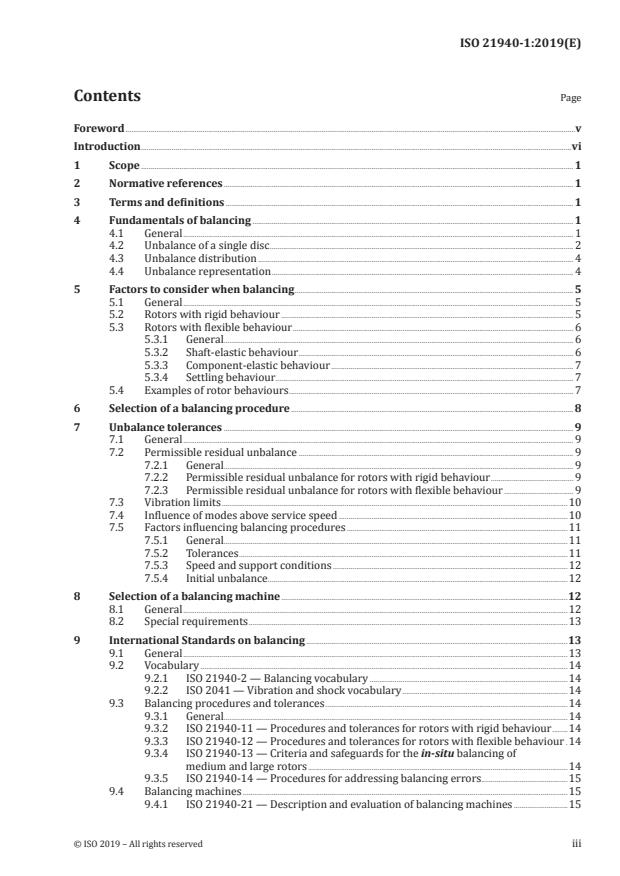
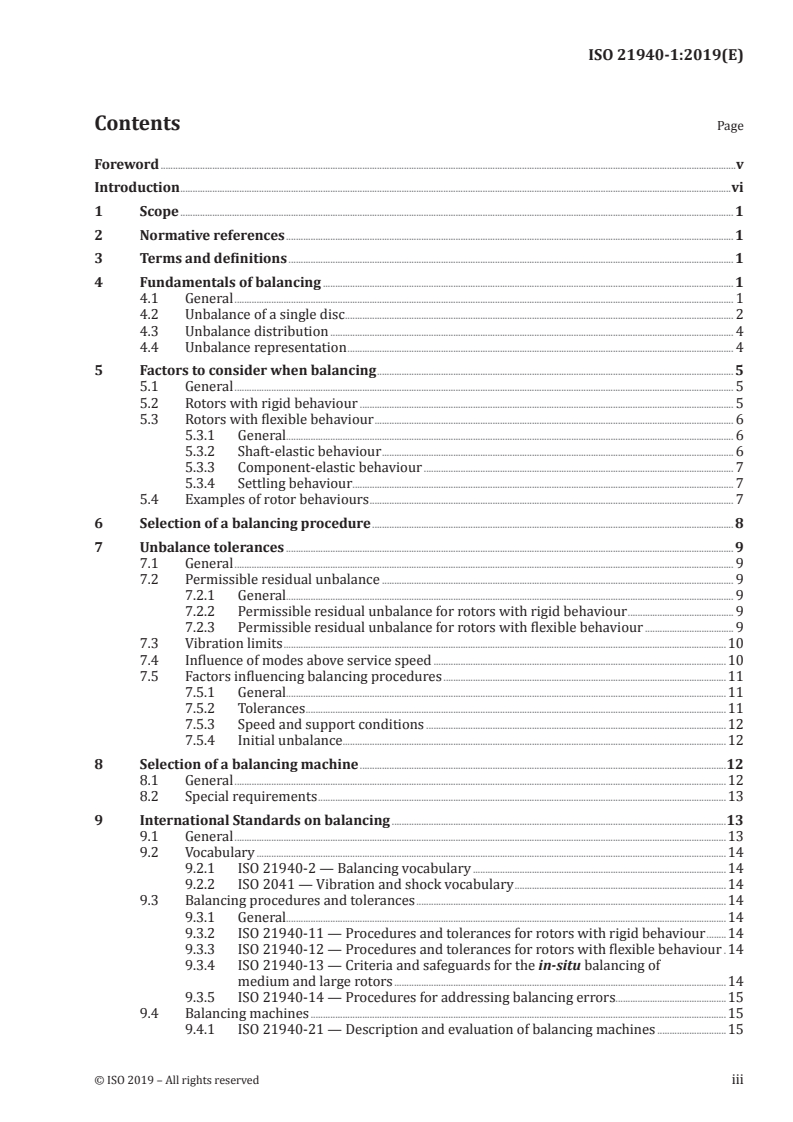
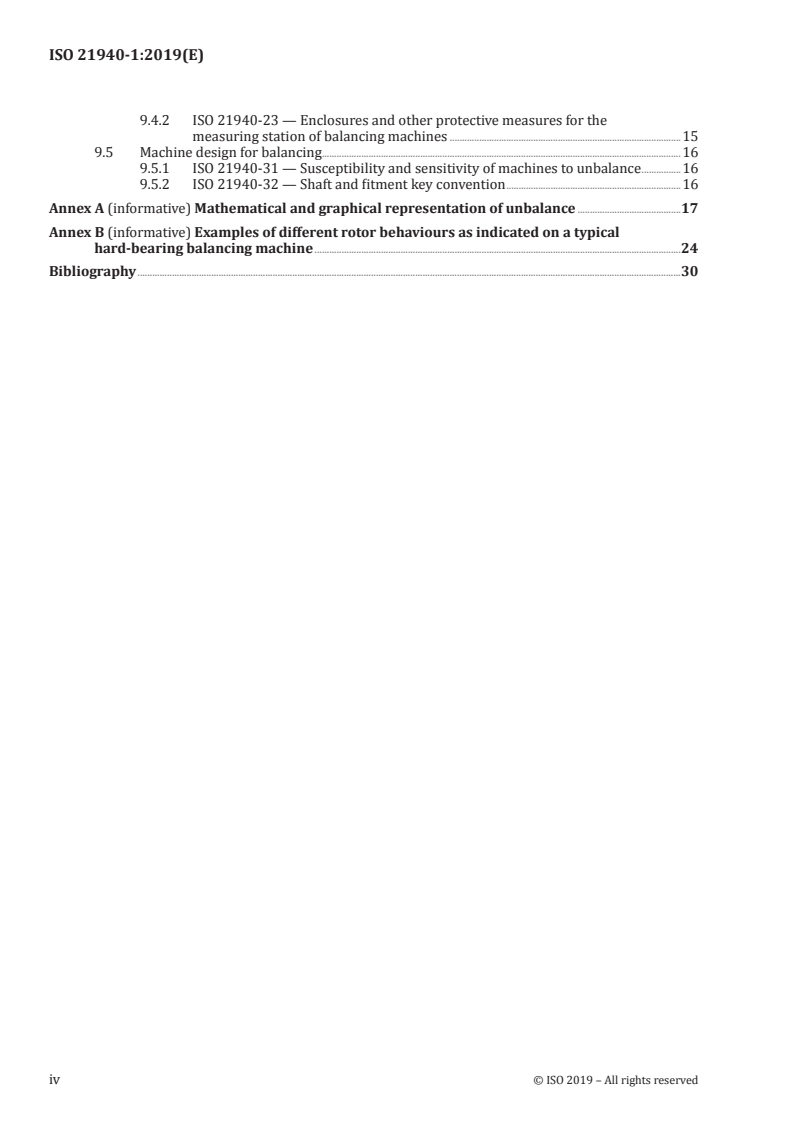
Contents Page
Foreword .v
Introduction .vi
1 Scope . 1
2 Normative references . 1
3 Terms and definitions . 1
4 Fundamentals of balancing . 1
4.1 General . 1
4.2 Unbalance of a single disc . 2
4.3 Unbalance distribution . 4
4.4 Unbalance representation . 4
5 Factors to consider when balancing . 5
5.1 General . 5
5.2 Rotors with rigid behaviour . 5
5.3 Rotors with flexible behaviour . 6
5.3.1 General. 6
5.3.2 Shaft-elastic behaviour . 6
5.3.3 Component-elastic behaviour . 7
5.3.4 Settling behaviour . 7
5.4 Examples of rotor behaviours . 7
6 Selection of a balancing procedure . 8
7 Unbalance tolerances . 9
7.1 General . 9
7.2 Permissible residual unbalance . 9
7.2.1 General. 9
7.2.2 Permissible residual unbalance for rotors with rigid behaviour . 9
7.2.3 Permissible residual unbalance for rotors with flexible behaviour . 9
7.3 Vibration limits .10
7.4 Influence of modes above service speed .10
7.5 Factors influencing balancing procedures .11
7.5.1 General.11
7.5.2 Tolerances .11
7.5.3 Speed and support conditions .12
7.5.4 Initial unbalance . .12
8 Selection of a balancing machine .12
8.1 General .12
8.2 Special requirements .13
9 International Standards on balancing .13
9.1 General .13
9.2 Vocabulary .14
9.2.1 ISO 21940-2 — Balancing vocabulary .14
9.2.2 ISO 2041 — Vibration and shock vocabulary .14
9.3 Balancing procedures and tolerances .14
9.3.1 General.14
9.3.2 ISO 21940-11 — Procedures and tolerances for rotors with rigid behaviour .14
9.3.3 ISO 21940-12 — Procedures and tolerances for rotors with flexible behaviour .14
9.3.4 ISO 21940-13 — Criteria and safeguards for the in-situ balancing of
medium and large rotors .14
9.3.5 ISO 21940-14 — Procedures for addressing balancing errors.15
9.4 Balancing machines .15
9.4.1 ISO 21940-21 — Description and evaluation of balancing machines .15
9.4.2 ISO 21940-23 — Enclosures and other protective measures for the
measuring station of balancing machines .15
9.5 Machine design for balancing.16
9.5.1 ISO 21940-31 — Susceptibility and sensitivity of machines to unbalance .16
9.5.2 ISO 21940-32 — Shaft and fitment key convention .16
Annex A (informative) Mathematical and graphical representation of unbalance .17
Annex B (informative) Examples of different rotor behaviours as indicated on a typical
hard-bearing balancing machine .24
Bibliography .30
iv © ISO 2019 – All rights reserved
Foreword
ISO (the International Organization for Standardization) is a worldwide federation of national standards
bodies (ISO member bodies). The work of preparing International Standards is normally carried out
through ISO technical committees. Each member body interested in a subject for which a technical
committee has been established has the right to be represented on that committee. International
organizations, governmental and non-governmental, in liaison with ISO, also take part in the work.
ISO collaborates closely with the International Electrotechnical Commission (IEC) on all matters of
electrotechnical standardization.
The procedures used to develop this document and those intended for its further maintenance are
described in the ISO/IEC Directives, Part 1. In particular the different approval criteria needed for the
different types of ISO documents should be noted. This document was drafted in accordance with the
editorial rules of the ISO/IEC Directives, Part 2 (see www .iso .org/directives).
Attention is drawn to the possibility that some of the elements of this document may be the subject of
patent rights. ISO shall not be held responsible for identifying any or all such patent rights. Details of
any patent rights identified during the development of the document will be in the Introduction and/or
on the ISO list of patent declarations received (see www .iso .org/patents).
Any trade name used in this document is information given for the convenience of users and does not
constitute an endorsement.
For an explanation on the voluntary nature of standards, the meaning of ISO specific terms and
expressions related to conformity assessment, as well as information about ISO's adherence to the
World Trade Organization (WTO) principles in the Technical Barriers to Trade (TBT) see the following
URL: www .iso .org/iso/foreword .html.
This document was prepared by Technical Committee ISO/TC 108, Mechanical vibration, shock and
condition monitoring, Subcommittee SC 2, Measurement and evaluation of mechanical vibration and shock
as applied to machines, vehicles and structures.
This first edition of ISO 21940-1 cancels and replaces ISO 19499:2007, which has been technically
revised. The main changes are as follows:
— reference made to all International Standards in the ISO 21940 series;
— deletion of former Table 2 "Guidelines for balancing procedures";
— deletion of former Annex C "How to determine rotor flexibility based on an estimation from its
geometric design".
A list of all parts in the ISO 21940 series can be found on the ISO website.
Any feedback or questions on this document should be directed to the user’s national standards body.
A complete listing of these bodies can be found at www .iso .org/members .html.
Introduction
Vibration caused by rotor unbalance is one of the most critical issues in the design and maintenance
of rotating machines. It gives rise to dynamic forces which adversely affect both machine and human
health and well-being. The purpose of this document is to give guidance on the usage of the other parts
of the ISO 21940 series.
Balancing is explained in a general manner, using the specific terms and definitions, to help readers to
select the appropriate balancing approach for their application.
vi © ISO 2019 – All rights reserved
INTERNATIONAL STANDARD ISO 21940-1:2019(E)
Mechanical vibration — Rotor balancing —
Part 1:
Introduction
1 Scope
This document provides a general background to balancing technology, as used in the ISO 21940
series, and directs the reader to the appropriate parts of the series that include vocabulary, balancing
procedures and tolerances, balancing machines and machine design for balancing.
Individual procedures are not included here as these can be found in the appropriate parts of ISO 21940.
2 Normative references
The following documents are referred to in the text in such a way that some or all of their content
constitutes requirements of this document. For dated references, only the edition cited applies. For
undated references, the latest edition of the referenced document (including any amendments) applies.
ISO 2041, Mechanical vibration, shock and condition monitoring — Vocabulary
ISO 21940-2, Mechanical vibration — Rotor balancing — Part 2: Vocabulary
3 Terms and definitions
For the purposes of this document, the terms and definitions given in ISO 2041 and ISO 21940-2 apply.
ISO and IEC maintain terminological databases for use in standardization at the following addresses:
— ISO Online browsing platform: available at https: //www .iso .org/obp/
— IEC Electropedia: available at http: //www .electropedia .org/
4 Fundamentals of balancing
4.1 General
Balancing is a procedure by which the mass distribution of a rotor (or part of a rotor or module) is
measured and adjusted to ensure that unbalance tolerances are met.
Many factors can cause rotor unbalance, e.g. non-homogenous material, manufacture, assembly, wear
during operation, debris or an operational event. It is important to understand that every rotor, even in
series production, has a unique individual unbalance distribution.
New rotors are commonly balanced by the manufacturer in balancing machines before installation into
their operational environment. Following rework or repair, rotors can be rebalanced in a balancing
machine or, if appropriate facilities are not available, the rotor can be balanced in situ (for details, see
ISO 21940-13). For in-situ balancing, the rotor is held in its service bearings and support structure and
rotated within its operational drive train.
When rotated, unbalance generates forces that can be directly measured by force gauges mounted on
the structures supporting the bearings or indirectly by measuring either the motion of the bearing or
the shaft. The unbalance vector can be calculated from these measurements and balancing achieved by
adding, removing or moving correction masses on the rotor. Depending on the balancing task, the mass
corrections are performed in one, two or more correction planes.
Inertia forces due to unbalances or correction masses added during the balancing process induce an
excitation of the rotor and support system, which is observed as once-per-revolution vibration. Once-
per-revolution vibration and vibration at other frequencies can also be excited by other effects, e.g.
asymmetric stiffness, magnetic or fluid forces, but it is only the once-per-revolution effects that can be
compensated for by balancing. Non-linear systems can also cause frequencies other than at once per
revolution to be generated but these are usually a second order effect.
The theory of balancing is widely described in the literature (see e.g. References [11], [12]), and
therefore only the basics are presented here to aid the understanding of the terms used in balancing
standards and to direct the user towards the appropriate parts of ISO 21940.
4.2 Unbalance of a single disc
The simplest mechanical model of a rotor consists of a single disc supported on two bearings by a
massless shaft as shown in Figure 1. An unbalance mass, m , on the disc with a radial distance from the
U
shaft axis, r, generates the unbalance vector, U, whereby U = m r. The unbalance vector U is expressed
U
in the unit of mass times length, usually kg⋅m, but for practical reasons, smaller units are generally
used, e.g. kg mm, g mm or, for very small unbalances, mg mm.
NOTE Bold font indicates vector quantities.
At a rotational speed n (angular velocity Ω), the unbalance causes a centrifugal force F = U Ω . When
expressing the unbalance, U, in kg⋅m, and the angular velocity, Ω, in rad/s, F is expressed in newtons, N.
2 © ISO 2019 – All rights reserved
a) Unbalance of a disc as unbalance mass m at radius r
U
b) Unbalance of a disc as unbalance vector U
Figure 1 — Unbalance of a disc
The unbalance, U, can be expressed as the eccentricity, e, of the disc mass, M, from the shaft axis, given
by the expression U = M e. See Figure 2.
Figure 2 — Unbalance of a disc, expressed as the eccentricity of the mass centre from the
shaft axis
4.3 Unbalance distribution
For a general rotor, with a certain axial length, unbalance is made up of an infinite number of unbalance
vectors, distributed along the shaft axis. If a lumped-mass model is used to simulate the rotor behaviour,
the unbalance can be represented by a finite number of unbalance vectors of different amplitudes and
angular directions, as illustrated in Figure 3.
Figure 3 — Unbalance distribution in a rotor modelled as K disc elements perpendicular to
the z axis
4.4 Unbalance representation
If all unbalance vectors were corrected in their respective planes, the rotor would be perfectly balanced
but, in practice, it is neither possible nor necessary to measure and correct for all the individual
4 © ISO 2019 – All rights reserved
unbalances. Throughout the ISO 21940 series, the following representations are used to specify rotor
unbalance:
a) resultant unbalance U , vector sum of all unbalance vectors distributed along the rotor;
r
NOTE 1 The plane to state the resultant unbalance can be arbitrarily chosen.
NOTE 2 If the plane for the resultant unbalance is the plane of the mass centre, the unbalance is called
static unbalance.
b) resultant moment unbalance P , the vector sum of the moments of all the unbalance vectors
r
distributed along the rotor with respect to an arbitrarily selected plane perpendicular to the
shaft axis;
c) resultant equivalent modal unbalance values U , the unbalance distribution which affects each of
ne,r
the nth natural modes of the rotor system.
Mathematical and graphical representations of unbalance are described in Annex A.
NOTE 3 The resultant unbalance [see a)] and resultant moment unbalance [see b)] can be combined. The
combination is called “dynamic unbalance” and is represented by two unbalance vectors in two arbitrarily
chosen planes perpendicular to the shaft axis.
NOTE 4 The balancing procedures described in the ISO 21940 series assume the rotor system is linear and the
modes of vibration are orthogonal. For example, adding 2 g mm mass correction has twice the effect of 1 g mm
and the mode shape of one mode is not affected by other modes. Fluid-film bearings, which are often used in
high-speed balancing machines, can introduce non-linearities and cross coupling between modes but generally
the effects are small and the balancing procedures described in the ISO 21940 series can be adopted.
5 Factors to consider when balancing
5.1 General
For the purpose of balancing, it is normal to refer to rotors as rigid or flexible, i.e. they have rigid or
flexible behaviour, respectively. However, the terms "rigid" or "flexible" are a gross simplification
which can lead to a misinterpretation by suggesting that the balance classification of the rotor is only
dependent on its physical construction. Unbalance is an intrinsic property of the rotor, but the dynamics
of the bearings and support structure and the rotational speed of the rotor can affect the rotor’s
response to unbalance. The balance quality to which the rotor is expected to run and the magnitude
and distribution of the initial unbalance along the rotor also influence the chosen balancing procedure
to be used. As a result, a rotor that behaves as rigid under one set of conditions (service speed, initial
unbalance, unbalance tolerances, etc.) can behave as flexible under another set of conditions.
Guidance on rigid and flexible rotor behaviours is given in 5.2 and 5.3.
There are special cases of rotors with unbalance indications that change with speed or time in a way
that cannot be explained with a bending shaft. These are considered in 5.3.3 and 5.3.4.
5.2 Rotors with rigid behaviour
Rigid rotor behaviour is where the flexure of a rotor caused by its unbalance distribution can be
neglected with respect to the agreed unbalance tolerance at any speed up to the maximum service
speed. The majority of these rotors operate way below the rotor-support system resonance speed.
Rotors with rigid behaviour can be balanced in accordance with the requirements of ISO 21940-11.
The aim of such balancing is to correct for the resultant unbalance, with at least a single-plane balance
correction for static unbalance, or with at least a two-plane balance correction for the dynamic
unbalance.
Rotors designated to have rigid behaviour in the operating environment can be balanced at any speed
on the balancing machine provided the speed is sufficiently low to ensure the rotor behaviour remains
rigid, with no significant flexure, but sufficiently high to generate an unbalance force that can be
accurately measured.
A rotor with unbalance, rotating with rigid behaviour on elastic supports, undergoes displacements
that are combinations of the rigid-body modes, as shown in Figure 4, which can be related to static and
moment unbalance. There is no significant flexure of the rotor and all displacements of the rotor arise
from movements of the bearings and their support structure.
a) Parallel mode due to static unbalance b) Tilting mode due to moment unbalance
Figure 4 — Rotating rigid-body modes of a symmetric rotor on a symmetric elastic support
structure
In the example shown in Figure 4 a), the principal axis of inertia of the rotor is offset parallel to the
shaft axis and is defined as static unbalance.
The example shown in Figure 4 b), where the principal axis of inertia is inclined and crossing the shaft
axis at the rotor’s centre of mass, is defined as moment unbalance.
The addition of both static and moment unbalance, where the principal axis of inertia of the rotor is
both inclined and offset from the shaft axis, is defined as dynamic unbalance.
In practice, every rotor has some flexural deflections in relation to the gross rigid-body motion of
the rotor, but provided this flexure is small, the rotor can normally be considered to behave as rigid.
ISO 21940-12:2016, Annex E, describes an experimental method to measure the rotor’s flexibility and
gives criteria for the degree of flexibility below which the rotor would normally be considered to be rigid.
NOTE Even with a rotor that is considered to behave as rigid and operates at rotational speeds well below
its first flexural resonance speed, it can be necessary to consider the rotor's flexural behaviour when a low
unbalance tolerance is required (as in 7.5.2).
5.3 Rotors with flexible behaviour
5.3.1 General
Flexible rotor behaviour classifies all rotors where the rotor’s mass can move as a function of the rotor’s
rotational speed and is fully described in ISO 21940-12, which includes the following types:
a) shaft-elastic behaviour (see 5.3.2);
b) component-elastic behaviour (see 5.3.3); and
c) settling behaviour (see 5.3.4).
5.3.2 Shaft-elastic behaviour
A rotor is considered to have flexible behaviour when the unbalance causes the body of the rotor to
bend in addition to the rigid-body modes described in 5.2. Figure 5 shows typical flexural mode shapes
6 © ISO 2019 – All rights reserved
for a symmetric rotor. Most rotors with flexible behaviour can be balanced in accordance with the
requirements of ISO 21940-12.
a) First mode
b) Second mode
c) Third mode
Figure 5 — Schematic representation of the first three flexural modes of a rotor with flexible
behaviour on an elastic support structure
For the rotor with rigid behaviour described in 5.2, if the speed is increased, the unbalance tolerance
reduced or the support structure changed, it can be necessary to take flexible behaviour into account,
since the rigid-body balancing procedures might not be sufficient to achieve the desired balance
condition.
5.3.3 Component-elastic behaviour
Rotors can have one or more components that are themselves either flexible or flexibly mounted so that
the unbalance of the whole system might consistently change with speed (e.g. rotors with tie bars that
deflect at high speed, rubber-bladed fans and single-phase induction motors with a centrifugal switch).
5.3.4 Settling behaviour
Rotors can have a method of construction where components settle after reaching a certain rotational
speed or other condition. This movement then becomes stable after one or just a few events. Once
components reach their final position and settle, the rotor can require further balancing (e.g. shrunk-
on turbine discs, built-up rotors, copper winding in generators and generator retaining rings).
Once the component has settled, the rotor shall be balanced using the appropriate balancing procedure
as discussed in 5.2 and 5.3.
5.4 Examples of rotor behaviours
Some examples of rotor behaviours are illustrated in Figure 6 and details of these types of behaviour
are further explained in Annex B.
a) Rigid behaviour (e.g. a solid gear wheel at b) Flexible behaviour (e.g. a disc on an elastic
low speed) shaft at high speed)
c) Component elastic behaviour (e.g. a drum d) Settling behaviour (e.g. a generator rotor
with tie bars, elastically deflecting under the with windings, once for all settling under a cer-
centrifugal load) tain centrifugal load)
Figure 6 — Examples of rotor types that demonstrate particular rotor behaviours
6 Selection of a balancing procedure
At a given rotational speed, the physical properties of the rotor and those of its supporting structure
control the rotor’s response to a distributed unbalance along its length. Balancing to a required
tolerance depends on these parameters and changing them or the unbalance tolerance specified can
change the procedure needed (for further information, see Clause 7).
Since different balancing procedures require the use of different types of balancing machine and
resource input, it is important to select an appropriate procedure to optimize the balancing process in
order to meet the required unbalance tolerances.
There are two International Standards dealing with balancing these rotors:
— ISO 21940-11 for rotors with rigid behaviour,
— ISO 21940-12 for rotors with flexible behaviour.
Table 1 gives information on descriptions, stated in this document, as well as in the other relevant parts
of ISO 21940, listing the balancing tasks and procedures.
Where possible, the rotor manufacturer or user should be consulted to establish the most suitable
balancing procedure.
8 © ISO 2019 – All rights reserved
Table 1 — Overview of rotor behaviours, the description in this document and in the relevant
parts of ISO 21940
Description in this document Description in the ISO 21940 series
Rotor behaviour Example Relevant part Balancing task or procedure
Single-plane and two-plane
Rigid behaviour (as described in 5.2) Figure 6 a) ISO 21940-11
a
balancing
Figure 6 b) Six low-speed balancing proce-
dures A to F
Balancing procedure G:
Shaft-elastic behaviour
(as described in 5.3.2) Multiple speed balancing
Balancing procedure H:
Flexible behaviour
ISO 21940-12
(see 5.3)
Service speed balancing
Component-elastic be- Figure 6 c) Procedure I:
haviour
Fixed-speed balancing
(as described in 5.3.3)
Settling behaviour Figure 6 d) Settling of components at high
b
(as described in 5.3.4) speed, before (final) balancing
a
Single-plane balancing can correct for the resultant unbalance and two-plane balancing can correct for the resultant
unbalance and the resultant moment unbalance.
b
This procedure is mentioned in ISO 21940-12:2016, 7.3.3.12, but no designated letter is given.
7 Unbalance tolerances
7.1 General
Modern balancing machines enable residual unbalances to be reduced to low limits but it is uneconomic
to over specify unbalance tolerance requirements. It is generally only necessary to define the unbalance
tolerance needed for a rotor to operate with acceptable vibration and dynamic forces in its normal
service environment.
7.2 Permissible residual unbalance
7.2.1 General
To achieve acceptable vibration magnitudes and dynamic forces for the rotor operating in situ, the
permissible values of residual unbalance should be stated by the rotor’s manufacturer. However, where
this information is not available, the ISO 21940 series can provide guidance.
7.2.2 Permissible residual unbalance for rotors with rigid behaviour
When balancing rotors with rigid behaviour, the measured force and vibration are directly related
to the permissible residual unbalance, U , which can be defined in different ways, as described in
per
ISO 21940-11. In this way, both the resultant unbalance, U , and resultant moment unbalance, P , can be
r r
balanced to the required tolerance for the rotor.
7.2.3 Permissible residual unbalance for rotors with flexible behaviour
When balancing rotors with flexible behaviour, the measured force and vibration are dependent on
the dynamics of the whole rotor system that includes its bearings and support structure. ISO 21940-12
describes methods to calculate the unbalance tolerance based on vibration values or permissible
residual unbalances, derived from the permissible residual unbalances calculated in ISO 21940-11.
Balancing rotors with flexible behaviour requires the residual static unbalance, U , residual moment
r
unbalance, P , and residual equivalent modal unbalance values, U (n = 1, 2, .), to be reduced to the
r ne,r
required tolerance for the rotor. This may include the consideration of vibration modes above service
speed (as described in 7.4).
The procedures to evaluate modal unbalance and methods to determine permissible residual modal
unbalance are described in ISO 21940-12.
7.3 Vibration limits
Vibration limits are commonly used when balancing rotors with flexible behaviour in high-speed
balancing machines. The balancing machine operator may supply vibration limits where it can be
demonstrated that similar rotors balanced to these limits operated successfully in situ.
NOTE Balancing machines can have different pedestal system dynamic properties and therefore vibration
limits for a given rotor can be set individually for each balancing machine and for a selected speed range.
Where detailed information is available concerning the relationship of support stiffness and
measurement positions between the balancing machine and the site conditions, a method to estimate
vibration limits is presented in ISO 21940-12.
7.4 Influence of modes above service speed
When a low residual unbalance or vibration magnitude is required, it can be necessary to consider shaft
flexural modes that occur at frequencies above the service speed. The effects of these higher modes can
become important depending upon their proximity to the service speed, the unbalance distribution
which can be affected by preceding balancing steps and the amount of damping in the rotor system
(see ISO 21940-31). For example, the rotor response schematically shown in Figure 7 is significantly
affected at the service speed (3 000 r/min, i.e. 50 Hz) by the higher mode, even though the lower modes
have been balanced within limits. Here, depending on the amount of damping, the rotor would not meet
the vibration limits based on an RMS vibration limit of 5 mm/s at the normal service speed due to the
higher mode, even though the lower modes are acceptable.
10 © ISO 2019 – All rights reserved
Key
a
f frequency, Hz Service speed 50 Hz.
b
v RMS vibration magnitude, mm/s Low damping.
c
High damping.
d
Vibration tolerance.
Figure 7 — Influence of a rotor mode above service speed
7.5 Factors influencing balancing procedures
7.5.1 General
The rotor’s response to a distributed unbalance along its length is controlled at all speeds by the
physical properties of the rotor and its supporting structure. Balancing to a required quality depends
on these parameters, and changing them or the unbalance tolerance specified can change the procedure
needed to meet the balance requirements.
7.5.2 Tolerances
By simply reducing the unbalance tolerance, it can be necessary to reconsider the behaviour of the rotor
and adopt a different procedure to bring the rotor within tolerance. Examples include:
a) A rotor with rigid behaviour, balanced using a single-plane procedure to reduce resultant
unbalance, can simply require a single-plane balancing with this reduced tolerance;
b) A rotor with rigid behaviour, balanced using a single-plane procedure to reduce resultant unbalance
can additionally require a two-plane procedure to account for the resultant moment unbalance;
c) A rotor with rigid behaviour, balanced in two planes to reduce both resultant and moment
unbalance (dynamic unbalance) can additionally require flexible-behaviour procedures to reduce
contributions from the modal unbalances, even though the rotor is running below its first flexural
resonance speed;
d) A rotor with flexible behaviour, which has been balanced to reduce the dynamic unbalance and a
number of modal unbalances, can require additional flexible rotor balancing procedures to reduce
modal unbalances of even more (higher) flexural modes of the rotor, even though the rotor is
running below the flexural resonance speeds of these higher modes (see 7.4);
e) It is possible that a rotor with either rigid or flexible behaviour, successfully balanced using the
appropriate procedure, needs to be balanced further to take account of component-elastic or
component settling behaviours;
f) Where a tighter tolerance can only be achieved at a single speed, the service speed balancing
procedure (ISO 21940-12, procedure I) sometimes needs to be considered.
7.5.3 Speed and support conditions
Other changes of rotor behaviour can occur if operational conditions are changed (e.g. by changing the
service speed or bearing design or support structure).
7.5.4 Initial unbalance
The initial unbalance distribution has an influence on the vibration response of the rotor system. It
determines which unbalance (see Clause 4) is out of tolerance and therefore needs attention. Different
manufacturing and assembling procedures can lead to different magnitudes of initial unbalance.
8 Selection of a balancing machine
8.1 General
Rotor behaviour together with the chosen balancing procedure dictate whether a low- or high-speed
balancing machine is required. Some examples of balancing machine requirements are provided in
Table 2.
Table 2 — Examples of balancing machine requirements
Balancing machine requirements
1 Rotor mass
2 Bearing types, size and centre distance
3 Rotor length
4 Rotor diameter
5 Minimum achievable residual unbalance
6 Unbalance reduction ratio
7 Bearing support stiffness to match the installed environment
8 Vacuum facilities for high-speed bladed rotors
9 Allowable maximum speed for bladed rotors on low-speed machines
10 Induced electrical current for high-speed electrical rotors
11 Influence of rotor overhangs in the balancing facility
NOTE 1 This list is not exhaustive and it is possible that other requirements are appropriate for
special machines.
NOTE 2 ISO 21940-21 gives detailed requirements for low-speed balancing machines.
Different types of unbalance require the use of different types of balancing machine, for example:
a) resultant unbalance: a single-plane balancing machine (low-speed balancing machine) is sufficient;
b) resultant moment unbalance: a two-plane balancing machine (low-speed balancing machine) is
needed;
12 © ISO 2019 – All rights reserved
c) modal unbalances: a high-speed balancing machine is often needed.
NOTE 1 Single-plane balancing can also be performed on a two-plane balancing machine.
NOTE 2 A high-speed balancing machine can usually handle both low-speed balancing and high-speed
balancing.
NOTE 3 Rotors with flexible behaviour as classified in ISO 21940-12, procedures A to F, can be adequately
balanced at low speed.
8.2 Special requirements
While the rotor is in the balancing machine, additional tests can be undertaken to ensure that it is fit
for purpose. Table 3 gives examples of additional tests that can be performed (e.g. on a large electrical
generator rotor) while the rotor is still in the balancing machine. Similarly, the need for additional tests
should be considered for specialized rotors whilst in the balancing machine.
Table 3 — Examples of tests that can be undertaken in the balancing machine
for an electrical generator rotor
Additional test requirements
1 Overspeed the rotor to settle the end rings
2 Undertake thermal stability checks
3 Perform electrical tests to check the integrity of the windings
These tests should only be carried out provided the appropriate facilities are available and safety
requirements are satisfied.
9 International Standards on balancing
9.1 General
In the field of balancing, most International Standards are collated in the ISO 21940 series, which to
aid the user are divided into five main areas, as shown in Table 4. Some application-specific balancing
standards for rotating machines which are not in the ISO 21940 series are included in the Bibliography.
Table 4 — Topic coverage in International Standards on balancing
Topic ISO number Topic
Introduction ISO 21940-1 Introduction
Vocabulary ISO 21940-2 Balancing vocabulary
ISO 2041 Vibration and shock vocabulary
Balancing ISO 21940-11 Procedures and tolerances for rotors with rigid behaviour
procedures and
ISO 21940-12 Procedures and tolerances for rotors with flexible behaviour
tolerances
ISO 21940-13 Criteria and safeguards for the in-situ balancing of medium and large rotors
ISO 21940-14 Procedures for addressing balancing errors
Balancing ma- ISO 21940-21 Description and evaluation of balancing machines
chines
ISO 21940-23 Enclosures and other protective measures for the measuring station of
balancing machines
Machine design ISO 21940-31 Susceptibility and sensitivity of machines to unbalance
for balancing
ISO 21940-32 Shaft and fitment key convention
9.2 Vocabulary
9.2.1 ISO 21940-2 — Balancing vocabulary
ISO 21940-2 defines the vocabulary used for balancing. It also
a) provides an alphabetical index of balancing vocabulary; and
b) gives an illustrated guide to balancing machines terminology.
9.2.2 ISO 2041 — Vibration and shock vocabulary
ISO 2041 defines the general vocabulary describing the terms used in vibration, shock and condition
monitoring.
9.3 Balancing procedures and tolerances
9.3.1 General
ISO 21940-11, ISO 21940-12, ISO 21940-13 and ISO 21940-14 give indications of procedures and
tolerances for different rotor behaviours, as well as how to avoid gross deficiencies and unnecessarily
restrictive requirements. They are not intended to be used as acceptance specifications.
9.3.2 ISO 21940-11 — Procedures and tolerances for rotors with rigid behaviour
ISO 21940-11 describes the procedures and tolerances to be used for rotors with rigid behaviour. It
specifies
a) the magnitude of the permissible residual unbalance;
b) the necessary number of correction planes;
c) the allocation of the permissible residual unbalance to the tolerance planes; and
d) how to account for errors in the balancing process.
9.3.3 ISO 21940-12 — Procedures and tolerances for rotors with flexible behaviour
ISO 21940-12 describes the procedures and tolerances for rotors with flexible behaviour and
a) provides typical configurations of rotors with flexible behaviour;
b) specifies balancing requirements in accordance with their characteristics;
c) lists balancing procedures;
d) provides methods of assessment of the final state of balance; and
e) gives guidelines for the unbalance tolerance.
Guidance given in ISO 21940-12 for acceptable unbalance tolerances is normally applicable for machines
that satisfy the susceptibility and sensitivity requirements outlined in ISO 21940-31 (for further
information, see 9.5.1).
9.3.4 ISO 21940-13 — Criteria and safeguards for the in-situ balancing of medium and large
rotors
ISO 21940-13 specifies procedures to be adopted when balancin
...
INTERNATIONAL ISO
STANDARD 21940-1
First edition
2019-02
Mechanical vibration — Rotor
balancing —
Part 1:
Introduction
Vibrations mécaniques — Équilibrage des rotors —
Partie 1: Introduction
Reference number
©
ISO 2019
© ISO 2019
All rights reserved. Unless otherwise specified, or required in the context of its implementation, no part of this publication may
be reproduced or utilized otherwise in any form or by any means, electronic or mechanical, including photocopying, or posting
on the internet or an intranet, without prior written permission. Permission can be requested from either ISO at the address
below or ISO’s member body in the country of the requester.
ISO copyright office
CP 401 • Ch. de Blandonnet 8
CH-1214 Vernier, Geneva
Phone: +41 22 749 01 11
Fax: +41 22 749 09 47
Email: copyright@iso.org
Website: www.iso.org
Published in Switzerland
ii © ISO 2019 – All rights reserved
Contents Page
Foreword .v
Introduction .vi
1 Scope . 1
2 Normative references . 1
3 Terms and definitions . 1
4 Fundamentals of balancing . 1
4.1 General . 1
4.2 Unbalance of a single disc . 2
4.3 Unbalance distribution . 4
4.4 Unbalance representation . 4
5 Factors to consider when balancing . 5
5.1 General . 5
5.2 Rotors with rigid behaviour . 5
5.3 Rotors with flexible behaviour . 6
5.3.1 General. 6
5.3.2 Shaft-elastic behaviour . 6
5.3.3 Component-elastic behaviour . 7
5.3.4 Settling behaviour . 7
5.4 Examples of rotor behaviours . 7
6 Selection of a balancing procedure . 8
7 Unbalance tolerances . 9
7.1 General . 9
7.2 Permissible residual unbalance . 9
7.2.1 General. 9
7.2.2 Permissible residual unbalance for rotors with rigid behaviour . 9
7.2.3 Permissible residual unbalance for rotors with flexible behaviour . 9
7.3 Vibration limits .10
7.4 Influence of modes above service speed .10
7.5 Factors influencing balancing procedures .11
7.5.1 General.11
7.5.2 Tolerances .11
7.5.3 Speed and support conditions .12
7.5.4 Initial unbalance . .12
8 Selection of a balancing machine .12
8.1 General .12
8.2 Special requirements .13
9 International Standards on balancing .13
9.1 General .13
9.2 Vocabulary .14
9.2.1 ISO 21940-2 — Balancing vocabulary .14
9.2.2 ISO 2041 — Vibration and shock vocabulary .14
9.3 Balancing procedures and tolerances .14
9.3.1 General.14
9.3.2 ISO 21940-11 — Procedures and tolerances for rotors with rigid behaviour .14
9.3.3 ISO 21940-12 — Procedures and tolerances for rotors with flexible behaviour .14
9.3.4 ISO 21940-13 — Criteria and safeguards for the in-situ balancing of
medium and large rotors .14
9.3.5 ISO 21940-14 — Procedures for addressing balancing errors.15
9.4 Balancing machines .15
9.4.1 ISO 21940-21 — Description and evaluation of balancing machines .15
9.4.2 ISO 21940-23 — Enclosures and other protective measures for the
measuring station of balancing machines .15
9.5 Machine design for balancing.16
9.5.1 ISO 21940-31 — Susceptibility and sensitivity of machines to unbalance .16
9.5.2 ISO 21940-32 — Shaft and fitment key convention .16
Annex A (informative) Mathematical and graphical representation of unbalance .17
Annex B (informative) Examples of different rotor behaviours as indicated on a typical
hard-bearing balancing machine .24
Bibliography .30
iv © ISO 2019 – All rights reserved
Foreword
ISO (the International Organization for Standardization) is a worldwide federation of national standards
bodies (ISO member bodies). The work of preparing International Standards is normally carried out
through ISO technical committees. Each member body interested in a subject for which a technical
committee has been established has the right to be represented on that committee. International
organizations, governmental and non-governmental, in liaison with ISO, also take part in the work.
ISO collaborates closely with the International Electrotechnical Commission (IEC) on all matters of
electrotechnical standardization.
The procedures used to develop this document and those intended for its further maintenance are
described in the ISO/IEC Directives, Part 1. In particular the different approval criteria needed for the
different types of ISO documents should be noted. This document was drafted in accordance with the
editorial rules of the ISO/IEC Directives, Part 2 (see www .iso .org/directives).
Attention is drawn to the possibility that some of the elements of this document may be the subject of
patent rights. ISO shall not be held responsible for identifying any or all such patent rights. Details of
any patent rights identified during the development of the document will be in the Introduction and/or
on the ISO list of patent declarations received (see www .iso .org/patents).
Any trade name used in this document is information given for the convenience of users and does not
constitute an endorsement.
For an explanation on the voluntary nature of standards, the meaning of ISO specific terms and
expressions related to conformity assessment, as well as information about ISO's adherence to the
World Trade Organization (WTO) principles in the Technical Barriers to Trade (TBT) see the following
URL: www .iso .org/iso/foreword .html.
This document was prepared by Technical Committee ISO/TC 108, Mechanical vibration, shock and
condition monitoring, Subcommittee SC 2, Measurement and evaluation of mechanical vibration and shock
as applied to machines, vehicles and structures.
This first edition of ISO 21940-1 cancels and replaces ISO 19499:2007, which has been technically
revised. The main changes are as follows:
— reference made to all International Standards in the ISO 21940 series;
— deletion of former Table 2 "Guidelines for balancing procedures";
— deletion of former Annex C "How to determine rotor flexibility based on an estimation from its
geometric design".
A list of all parts in the ISO 21940 series can be found on the ISO website.
Any feedback or questions on this document should be directed to the user’s national standards body.
A complete listing of these bodies can be found at www .iso .org/members .html.
Introduction
Vibration caused by rotor unbalance is one of the most critical issues in the design and maintenance
of rotating machines. It gives rise to dynamic forces which adversely affect both machine and human
health and well-being. The purpose of this document is to give guidance on the usage of the other parts
of the ISO 21940 series.
Balancing is explained in a general manner, using the specific terms and definitions, to help readers to
select the appropriate balancing approach for their application.
vi © ISO 2019 – All rights reserved
INTERNATIONAL STANDARD ISO 21940-1:2019(E)
Mechanical vibration — Rotor balancing —
Part 1:
Introduction
1 Scope
This document provides a general background to balancing technology, as used in the ISO 21940
series, and directs the reader to the appropriate parts of the series that include vocabulary, balancing
procedures and tolerances, balancing machines and machine design for balancing.
Individual procedures are not included here as these can be found in the appropriate parts of ISO 21940.
2 Normative references
The following documents are referred to in the text in such a way that some or all of their content
constitutes requirements of this document. For dated references, only the edition cited applies. For
undated references, the latest edition of the referenced document (including any amendments) applies.
ISO 2041, Mechanical vibration, shock and condition monitoring — Vocabulary
ISO 21940-2, Mechanical vibration — Rotor balancing — Part 2: Vocabulary
3 Terms and definitions
For the purposes of this document, the terms and definitions given in ISO 2041 and ISO 21940-2 apply.
ISO and IEC maintain terminological databases for use in standardization at the following addresses:
— ISO Online browsing platform: available at https: //www .iso .org/obp/
— IEC Electropedia: available at http: //www .electropedia .org/
4 Fundamentals of balancing
4.1 General
Balancing is a procedure by which the mass distribution of a rotor (or part of a rotor or module) is
measured and adjusted to ensure that unbalance tolerances are met.
Many factors can cause rotor unbalance, e.g. non-homogenous material, manufacture, assembly, wear
during operation, debris or an operational event. It is important to understand that every rotor, even in
series production, has a unique individual unbalance distribution.
New rotors are commonly balanced by the manufacturer in balancing machines before installation into
their operational environment. Following rework or repair, rotors can be rebalanced in a balancing
machine or, if appropriate facilities are not available, the rotor can be balanced in situ (for details, see
ISO 21940-13). For in-situ balancing, the rotor is held in its service bearings and support structure and
rotated within its operational drive train.
When rotated, unbalance generates forces that can be directly measured by force gauges mounted on
the structures supporting the bearings or indirectly by measuring either the motion of the bearing or
the shaft. The unbalance vector can be calculated from these measurements and balancing achieved by
adding, removing or moving correction masses on the rotor. Depending on the balancing task, the mass
corrections are performed in one, two or more correction planes.
Inertia forces due to unbalances or correction masses added during the balancing process induce an
excitation of the rotor and support system, which is observed as once-per-revolution vibration. Once-
per-revolution vibration and vibration at other frequencies can also be excited by other effects, e.g.
asymmetric stiffness, magnetic or fluid forces, but it is only the once-per-revolution effects that can be
compensated for by balancing. Non-linear systems can also cause frequencies other than at once per
revolution to be generated but these are usually a second order effect.
The theory of balancing is widely described in the literature (see e.g. References [11], [12]), and
therefore only the basics are presented here to aid the understanding of the terms used in balancing
standards and to direct the user towards the appropriate parts of ISO 21940.
4.2 Unbalance of a single disc
The simplest mechanical model of a rotor consists of a single disc supported on two bearings by a
massless shaft as shown in Figure 1. An unbalance mass, m , on the disc with a radial distance from the
U
shaft axis, r, generates the unbalance vector, U, whereby U = m r. The unbalance vector U is expressed
U
in the unit of mass times length, usually kg⋅m, but for practical reasons, smaller units are generally
used, e.g. kg mm, g mm or, for very small unbalances, mg mm.
NOTE Bold font indicates vector quantities.
At a rotational speed n (angular velocity Ω), the unbalance causes a centrifugal force F = U Ω . When
expressing the unbalance, U, in kg⋅m, and the angular velocity, Ω, in rad/s, F is expressed in newtons, N.
2 © ISO 2019 – All rights reserved
a) Unbalance of a disc as unbalance mass m at radius r
U
b) Unbalance of a disc as unbalance vector U
Figure 1 — Unbalance of a disc
The unbalance, U, can be expressed as the eccentricity, e, of the disc mass, M, from the shaft axis, given
by the expression U = M e. See Figure 2.
Figure 2 — Unbalance of a disc, expressed as the eccentricity of the mass centre from the
shaft axis
4.3 Unbalance distribution
For a general rotor, with a certain axial length, unbalance is made up of an infinite number of unbalance
vectors, distributed along the shaft axis. If a lumped-mass model is used to simulate the rotor behaviour,
the unbalance can be represented by a finite number of unbalance vectors of different amplitudes and
angular directions, as illustrated in Figure 3.
Figure 3 — Unbalance distribution in a rotor modelled as K disc elements perpendicular to
the z axis
4.4 Unbalance representation
If all unbalance vectors were corrected in their respective planes, the rotor would be perfectly balanced
but, in practice, it is neither possible nor necessary to measure and correct for all the individual
4 © ISO 2019 – All rights reserved
unbalances. Throughout the ISO 21940 series, the following representations are used to specify rotor
unbalance:
a) resultant unbalance U , vector sum of all unbalance vectors distributed along the rotor;
r
NOTE 1 The plane to state the resultant unbalance can be arbitrarily chosen.
NOTE 2 If the plane for the resultant unbalance is the plane of the mass centre, the unbalance is called
static unbalance.
b) resultant moment unbalance P , the vector sum of the moments of all the unbalance vectors
r
distributed along the rotor with respect to an arbitrarily selected plane perpendicular to the
shaft axis;
c) resultant equivalent modal unbalance values U , the unbalance distribution which affects each of
ne,r
the nth natural modes of the rotor system.
Mathematical and graphical representations of unbalance are described in Annex A.
NOTE 3 The resultant unbalance [see a)] and resultant moment unbalance [see b)] can be combined. The
combination is called “dynamic unbalance” and is represented by two unbalance vectors in two arbitrarily
chosen planes perpendicular to the shaft axis.
NOTE 4 The balancing procedures described in the ISO 21940 series assume the rotor system is linear and the
modes of vibration are orthogonal. For example, adding 2 g mm mass correction has twice the effect of 1 g mm
and the mode shape of one mode is not affected by other modes. Fluid-film bearings, which are often used in
high-speed balancing machines, can introduce non-linearities and cross coupling between modes but generally
the effects are small and the balancing procedures described in the ISO 21940 series can be adopted.
5 Factors to consider when balancing
5.1 General
For the purpose of balancing, it is normal to refer to rotors as rigid or flexible, i.e. they have rigid or
flexible behaviour, respectively. However, the terms "rigid" or "flexible" are a gross simplification
which can lead to a misinterpretation by suggesting that the balance classification of the rotor is only
dependent on its physical construction. Unbalance is an intrinsic property of the rotor, but the dynamics
of the bearings and support structure and the rotational speed of the rotor can affect the rotor’s
response to unbalance. The balance quality to which the rotor is expected to run and the magnitude
and distribution of the initial unbalance along the rotor also influence the chosen balancing procedure
to be used. As a result, a rotor that behaves as rigid under one set of conditions (service speed, initial
unbalance, unbalance tolerances, etc.) can behave as flexible under another set of conditions.
Guidance on rigid and flexible rotor behaviours is given in 5.2 and 5.3.
There are special cases of rotors with unbalance indications that change with speed or time in a way
that cannot be explained with a bending shaft. These are considered in 5.3.3 and 5.3.4.
5.2 Rotors with rigid behaviour
Rigid rotor behaviour is where the flexure of a rotor caused by its unbalance distribution can be
neglected with respect to the agreed unbalance tolerance at any speed up to the maximum service
speed. The majority of these rotors operate way below the rotor-support system resonance speed.
Rotors with rigid behaviour can be balanced in accordance with the requirements of ISO 21940-11.
The aim of such balancing is to correct for the resultant unbalance, with at least a single-plane balance
correction for static unbalance, or with at least a two-plane balance correction for the dynamic
unbalance.
Rotors designated to have rigid behaviour in the operating environment can be balanced at any speed
on the balancing machine provided the speed is sufficiently low to ensure the rotor behaviour remains
rigid, with no significant flexure, but sufficiently high to generate an unbalance force that can be
accurately measured.
A rotor with unbalance, rotating with rigid behaviour on elastic supports, undergoes displacements
that are combinations of the rigid-body modes, as shown in Figure 4, which can be related to static and
moment unbalance. There is no significant flexure of the rotor and all displacements of the rotor arise
from movements of the bearings and their support structure.
a) Parallel mode due to static unbalance b) Tilting mode due to moment unbalance
Figure 4 — Rotating rigid-body modes of a symmetric rotor on a symmetric elastic support
structure
In the example shown in Figure 4 a), the principal axis of inertia of the rotor is offset parallel to the
shaft axis and is defined as static unbalance.
The example shown in Figure 4 b), where the principal axis of inertia is inclined and crossing the shaft
axis at the rotor’s centre of mass, is defined as moment unbalance.
The addition of both static and moment unbalance, where the principal axis of inertia of the rotor is
both inclined and offset from the shaft axis, is defined as dynamic unbalance.
In practice, every rotor has some flexural deflections in relation to the gross rigid-body motion of
the rotor, but provided this flexure is small, the rotor can normally be considered to behave as rigid.
ISO 21940-12:2016, Annex E, describes an experimental method to measure the rotor’s flexibility and
gives criteria for the degree of flexibility below which the rotor would normally be considered to be rigid.
NOTE Even with a rotor that is considered to behave as rigid and operates at rotational speeds well below
its first flexural resonance speed, it can be necessary to consider the rotor's flexural behaviour when a low
unbalance tolerance is required (as in 7.5.2).
5.3 Rotors with flexible behaviour
5.3.1 General
Flexible rotor behaviour classifies all rotors where the rotor’s mass can move as a function of the rotor’s
rotational speed and is fully described in ISO 21940-12, which includes the following types:
a) shaft-elastic behaviour (see 5.3.2);
b) component-elastic behaviour (see 5.3.3); and
c) settling behaviour (see 5.3.4).
5.3.2 Shaft-elastic behaviour
A rotor is considered to have flexible behaviour when the unbalance causes the body of the rotor to
bend in addition to the rigid-body modes described in 5.2. Figure 5 shows typical flexural mode shapes
6 © ISO 2019 – All rights reserved
for a symmetric rotor. Most rotors with flexible behaviour can be balanced in accordance with the
requirements of ISO 21940-12.
a) First mode
b) Second mode
c) Third mode
Figure 5 — Schematic representation of the first three flexural modes of a rotor with flexible
behaviour on an elastic support structure
For the rotor with rigid behaviour described in 5.2, if the speed is increased, the unbalance tolerance
reduced or the support structure changed, it can be necessary to take flexible behaviour into account,
since the rigid-body balancing procedures might not be sufficient to achieve the desired balance
condition.
5.3.3 Component-elastic behaviour
Rotors can have one or more components that are themselves either flexible or flexibly mounted so that
the unbalance of the whole system might consistently change with speed (e.g. rotors with tie bars that
deflect at high speed, rubber-bladed fans and single-phase induction motors with a centrifugal switch).
5.3.4 Settling behaviour
Rotors can have a method of construction where components settle after reaching a certain rotational
speed or other condition. This movement then becomes stable after one or just a few events. Once
components reach their final position and settle, the rotor can require further balancing (e.g. shrunk-
on turbine discs, built-up rotors, copper winding in generators and generator retaining rings).
Once the component has settled, the rotor shall be balanced using the appropriate balancing procedure
as discussed in 5.2 and 5.3.
5.4 Examples of rotor behaviours
Some examples of rotor behaviours are illustrated in Figure 6 and details of these types of behaviour
are further explained in Annex B.
a) Rigid behaviour (e.g. a solid gear wheel at b) Flexible behaviour (e.g. a disc on an elastic
low speed) shaft at high speed)
c) Component elastic behaviour (e.g. a drum d) Settling behaviour (e.g. a generator rotor
with tie bars, elastically deflecting under the with windings, once for all settling under a cer-
centrifugal load) tain centrifugal load)
Figure 6 — Examples of rotor types that demonstrate particular rotor behaviours
6 Selection of a balancing procedure
At a given rotational speed, the physical properties of the rotor and those of its supporting structure
control the rotor’s response to a distributed unbalance along its length. Balancing to a required
tolerance depends on these parameters and changing them or the unbalance tolerance specified can
change the procedure needed (for further information, see Clause 7).
Since different balancing procedures require the use of different types of balancing machine and
resource input, it is important to select an appropriate procedure to optimize the balancing process in
order to meet the required unbalance tolerances.
There are two International Standards dealing with balancing these rotors:
— ISO 21940-11 for rotors with rigid behaviour,
— ISO 21940-12 for rotors with flexible behaviour.
Table 1 gives information on descriptions, stated in this document, as well as in the other relevant parts
of ISO 21940, listing the balancing tasks and procedures.
Where possible, the rotor manufacturer or user should be consulted to establish the most suitable
balancing procedure.
8 © ISO 2019 – All rights reserved
Table 1 — Overview of rotor behaviours, the description in this document and in the relevant
parts of ISO 21940
Description in this document Description in the ISO 21940 series
Rotor behaviour Example Relevant part Balancing task or procedure
Single-plane and two-plane
Rigid behaviour (as described in 5.2) Figure 6 a) ISO 21940-11
a
balancing
Figure 6 b) Six low-speed balancing proce-
dures A to F
Balancing procedure G:
Shaft-elastic behaviour
(as described in 5.3.2) Multiple speed balancing
Balancing procedure H:
Flexible behaviour
ISO 21940-12
(see 5.3)
Service speed balancing
Component-elastic be- Figure 6 c) Procedure I:
haviour
Fixed-speed balancing
(as described in 5.3.3)
Settling behaviour Figure 6 d) Settling of components at high
b
(as described in 5.3.4) speed, before (final) balancing
a
Single-plane balancing can correct for the resultant unbalance and two-plane balancing can correct for the resultant
unbalance and the resultant moment unbalance.
b
This procedure is mentioned in ISO 21940-12:2016, 7.3.3.12, but no designated letter is given.
7 Unbalance tolerances
7.1 General
Modern balancing machines enable residual unbalances to be reduced to low limits but it is uneconomic
to over specify unbalance tolerance requirements. It is generally only necessary to define the unbalance
tolerance needed for a rotor to operate with acceptable vibration and dynamic forces in its normal
service environment.
7.2 Permissible residual unbalance
7.2.1 General
To achieve acceptable vibration magnitudes and dynamic forces for the rotor operating in situ, the
permissible values of residual unbalance should be stated by the rotor’s manufacturer. However, where
this information is not available, the ISO 21940 series can provide guidance.
7.2.2 Permissible residual unbalance for rotors with rigid behaviour
When balancing rotors with rigid behaviour, the measured force and vibration are directly related
to the permissible residual unbalance, U , which can be defined in different ways, as described in
per
ISO 21940-11. In this way, both the resultant unbalance, U , and resultant moment unbalance, P , can be
r r
balanced to the required tolerance for the rotor.
7.2.3 Permissible residual unbalance for rotors with flexible behaviour
When balancing rotors with flexible behaviour, the measured force and vibration are dependent on
the dynamics of the whole rotor system that includes its bearings and support structure. ISO 21940-12
describes methods to calculate the unbalance tolerance based on vibration values or permissible
residual unbalances, derived from the permissible residual unbalances calculated in ISO 21940-11.
Balancing rotors with flexible behaviour requires the residual static unbalance, U , residual moment
r
unbalance, P , and residual equivalent modal unbalance values, U (n = 1, 2, .), to be reduced to the
r ne,r
required tolerance for the rotor. This may include the consideration of vibration modes above service
speed (as described in 7.4).
The procedures to evaluate modal unbalance and methods to determine permissible residual modal
unbalance are described in ISO 21940-12.
7.3 Vibration limits
Vibration limits are commonly used when balancing rotors with flexible behaviour in high-speed
balancing machines. The balancing machine operator may supply vibration limits where it can be
demonstrated that similar rotors balanced to these limits operated successfully in situ.
NOTE Balancing machines can have different pedestal system dynamic properties and therefore vibration
limits for a given rotor can be set individually for each balancing machine and for a selected speed range.
Where detailed information is available concerning the relationship of support stiffness and
measurement positions between the balancing machine and the site conditions, a method to estimate
vibration limits is presented in ISO 21940-12.
7.4 Influence of modes above service speed
When a low residual unbalance or vibration magnitude is required, it can be necessary to consider shaft
flexural modes that occur at frequencies above the service speed. The effects of these higher modes can
become important depending upon their proximity to the service speed, the unbalance distribution
which can be affected by preceding balancing steps and the amount of damping in the rotor system
(see ISO 21940-31). For example, the rotor response schematically shown in Figure 7 is significantly
affected at the service speed (3 000 r/min, i.e. 50 Hz) by the higher mode, even though the lower modes
have been balanced within limits. Here, depending on the amount of damping, the rotor would not meet
the vibration limits based on an RMS vibration limit of 5 mm/s at the normal service speed due to the
higher mode, even though the lower modes are acceptable.
10 © ISO 2019 – All rights reserved
Key
a
f frequency, Hz Service speed 50 Hz.
b
v RMS vibration magnitude, mm/s Low damping.
c
High damping.
d
Vibration tolerance.
Figure 7 — Influence of a rotor mode above service speed
7.5 Factors influencing balancing procedures
7.5.1 General
The rotor’s response to a distributed unbalance along its length is controlled at all speeds by the
physical properties of the rotor and its supporting structure. Balancing to a required quality depends
on these parameters, and changing them or the unbalance tolerance specified can change the procedure
needed to meet the balance requirements.
7.5.2 Tolerances
By simply reducing the unbalance tolerance, it can be necessary to reconsider the behaviour of the rotor
and adopt a different procedure to bring the rotor within tolerance. Examples include:
a) A rotor with rigid behaviour, balanced using a single-plane procedure to reduce resultant
unbalance, can simply require a single-plane balancing with this reduced tolerance;
b) A rotor with rigid behaviour, balanced using a single-plane procedure to reduce resultant unbalance
can additionally require a two-plane procedure to account for the resultant moment unbalance;
c) A rotor with rigid behaviour, balanced in two planes to reduce both resultant and moment
unbalance (dynamic unbalance) can additionally require flexible-behaviour procedures to reduce
contributions from the modal unbalances, even though the rotor is running below its first flexural
resonance speed;
d) A rotor with flexible behaviour, which has been balanced to reduce the dynamic unbalance and a
number of modal unbalances, can require additional flexible rotor balancing procedures to reduce
modal unbalances of even more (higher) flexural modes of the rotor, even though the rotor is
running below the flexural resonance speeds of these higher modes (see 7.4);
e) It is possible that a rotor with either rigid or flexible behaviour, successfully balanced using the
appropriate procedure, needs to be balanced further to take account of component-elastic or
component settling behaviours;
f) Where a tighter tolerance can only be achieved at a single speed, the service speed balancing
procedure (ISO 21940-12, procedure I) sometimes needs to be considered.
7.5.3 Speed and support conditions
Other changes of rotor behaviour can occur if operational conditions are changed (e.g. by changing the
service speed or bearing design or support structure).
7.5.4 Initial unbalance
The initial unbalance distribution has an influence on the vibration response of the rotor system. It
determines which unbalance (see Clause 4) is out of tolerance and therefore needs attention. Different
manufacturing and assembling procedures can lead to different magnitudes of initial unbalance.
8 Selection of a balancing machine
8.1 General
Rotor behaviour together with the chosen balancing procedure dictate whether a low- or high-speed
balancing machine is required. Some examples of balancing machine requirements are provided in
Table 2.
Table 2 — Examples of balancing machine requirements
Balancing machine requirements
1 Rotor mass
2 Bearing types, size and centre distance
3 Rotor length
4 Rotor diameter
5 Minimum achievable residual unbalance
6 Unbalance reduction ratio
7 Bearing support stiffness to match the installed environment
8 Vacuum facilities for high-speed bladed rotors
9 Allowable maximum speed for bladed rotors on low-speed machines
10 Induced electrical current for high-speed electrical rotors
11 Influence of rotor overhangs in the balancing facility
NOTE 1 This list is not exhaustive and it is possible that other requirements are appropriate for
special machines.
NOTE 2 ISO 21940-21 gives detailed requirements for low-speed balancing machines.
Different types of unbalance require the use of different types of balancing machine, for example:
a) resultant unbalance: a single-plane balancing machine (low-speed balancing machine) is sufficient;
b) resultant moment unbalance: a two-plane balancing machine (low-speed balancing machine) is
needed;
12 © ISO 2019 – All rights reserved
c) modal unbalances: a high-speed balancing machine is often needed.
NOTE 1 Single-plane balancing can also be performed on a two-plane balancing machine.
NOTE 2 A high-speed balancing machine can usually handle both low-speed balancing and high-speed
balancing.
NOTE 3 Rotors with flexible behaviour as classified in ISO 21940-12, procedures A to F, can be adequately
balanced at low speed.
8.2 Special requirements
While the rotor is in the balancing machine, additional tests can be undertaken to ensure that it is fit
for purpose. Table 3 gives examples of additional tests that can be performed (e.g. on a large electrical
generator rotor) while the rotor is still in the balancing machine. Similarly, the need for additional tests
should be considered for specialized rotors whilst in the balancing machine.
Table 3 — Examples of tests that can be undertaken in the balancing machine
for an electrical generator rotor
Additional test requirements
1 Overspeed the rotor to settle the end rings
2 Undertake thermal stability checks
3 Perform electrical tests to check the integrity of the windings
These tests should only be carried out provided the appropriate facilities are available and safety
requirements are satisfied.
9 International Standards on balancing
9.1 General
In the field of balancing, most International Standards are collated in the ISO 21940 series, which to
aid the user are divided into five main areas, as shown in Table 4. Some application-specific balancing
standards for rotating machines which are not in the ISO 21940 series are included in the Bibliography.
Table 4 — Topic coverage in International Standards on balancing
Topic ISO number Topic
Introduction ISO 21940-1 Introduction
Vocabulary ISO 21940-2 Balancing vocabulary
ISO 2041 Vibration and shock vocabulary
Balancing ISO 21940-11 Procedures and tolerances for rotors with rigid behaviour
procedures and
ISO 21940-12 Procedures and tolerances for rotors with flexible behaviour
tolerances
ISO 21940-13 Criteria and safeguards for the in-situ balancing of medium and large rotors
ISO 21940-14 Procedures for addressing balancing errors
Balancing ma- ISO 21940-21 Description and evaluation of balancing machines
chines
ISO 21940-23 Enclosures and other protective measures for the measuring station of
balancing machines
Machine design ISO 21940-31 Susceptibility and sensitivity of machines to unbalance
for balancing
ISO 21940-32 Shaft and fitment key convention
9.2 Vocabulary
9.2.1 ISO 21940-2 — Balancing vocabulary
ISO 21940-2 defines the vocabulary used for balancing. It also
a) provides an alphabetical index of balancing vocabulary; and
b) gives an illustrated guide to balancing machines terminology.
9.2.2 ISO 2041 — Vibration and shock vocabulary
ISO 2041 defines the general vocabulary describing the terms used in vibration, shock and condition
monitoring.
9.3 Balancing procedures and tolerances
9.3.1 General
ISO 21940-11, ISO 21940-12, ISO 21940-13 and ISO 21940-14 give indications of procedures and
tolerances for different rotor behaviours, as well as how to avoid gross deficiencies and unnecessarily
restrictive requirements. They are not intended to be used as acceptance specifications.
9.3.2 ISO 21940-11 — Procedures and tolerances for rotors with rigid behaviour
ISO 21940-11 describes the procedures and tolerances to be used for rotors with rigid behaviour. It
specifies
a) the magnitude of the permissible residual unbalance;
b) the necessary number of correction planes;
c) the allocation of the permissible residual unbalance to the tolerance planes; and
d) how to account for errors in the balancing process.
9.3.3 ISO 21940-12 — Procedures and tolerances for rotors with flexible behaviour
ISO 21940-12 describes the procedures and tolerances for rotors with flexible behaviour and
a) provides typical configurations of rotors with flexible behaviour;
b) specifies balancing requirements in accordance with their characteristics;
c) lists balancing procedures;
d) provides methods of assessment of the final state of balance; and
e) gives guidelines for the unbalance tolerance.
Guidance given in ISO 21940-12 for acceptable unbalance tolerances is normally applicable for machines
that satisfy the susceptibility and sensitivity requirements outlined in ISO 21940-31 (for further
information, see 9.5.1).
9.3.4 ISO 21940-13 — Criteria and safeguards for the in-situ balancing of medium and large
rotors
ISO 21940-13 specifies procedures to be adopted when balancin
...