


ISO/IEC 10164-19:1998
(Main)Information technology — Open Systems Interconnection — Systems Management: Management domain and management policy management function — Part 19:
Information technology — Open Systems Interconnection — Systems Management: Management domain and management policy management function — Part 19:
This Recommendation | International Standard defines the management domain and management policy management function. This Management Function is a System Management function which may be used by an application process in a centralized or decentralized management environment to interact for the purpose of systems management, as defined by the OSI Management Framework, CCITT Rec. X.700 and ISO/IEC 7498-4. This Recommendation | International Standard defines a function which consists of generic definitions and services. This function is positioned in the application layer of the OSI reference model (ITU-T Rec. X.200 | ISO/IEC 7498-1) and is defined according to the model provided by ISO/IEC 9545. The role of systems management functions is described by CCITT Rec. X.701 | ISO/IEC 10040. This Recommendation | International Standard: — identifies the set of requirements satisfied by the function; — provides a model for the behaviour of the management domain management objects; — provides a model for the behaviour of the management policy management objects; — specifies the management requirements of the function and how these are realized by specification of managed objects and their behaviour; — specifies the mapping of these services onto the CMIS services; — specifies the abstract syntax of the parameters of the MAPDUs that will be used to refer to managed objects and their characteristics; — provides a model, in accordance with the Management Information Model and the General Relationship Model, for information associated with management domains, policies, and jurisdictions and for the behaviour of managed objects through which that information is accessed and manipulated; — provides definitions of the information associated with management domains, policies, and jurisdictions, their representation and the operations which may be performed upon them in terms of managed object and management relationship templates. This Recommendation | International Standard does not: — define the nature of any implementation intended to provide the management domain and management policy management function; — specify the manner in which management is to be accomplished by the user of the management domain and management policy management function; — define the nature of any interactions which result in the use of the management domain and management policy management function; — specify the services necessary for the establishment, normal and abnormal release of a management association; — define the interactions which result by the simultaneous use of several management functions; — define connection establishment or authorization requirements for the use of this function or for any associated activity; — preclude the definition of further management domain, management policy, or management jurisdiction managed object classes.
Technologies de l'information — Interconnexion de systèmes ouverts (OSI) — Gestion-systèmes: Fonction de gestion de domaine de gestion et de politique de gestion — Partie 19:
La présente Recommandation | Norme internationale définit la fonction de gestion de domaine de gestion et de politique de gestion. Cette fonction de gestion est une fonction de gestion-systèmes qui peut être utilisée par un processus d'application, dans un environnement de gestion centralisée ou décentralisée, pour dialoguer aux fins de la gestion-systèmes, comme défini par le cadre de gestion de l'interconnexion des systèmes ouverts (OSI,open system interconnection), Rec.X.700 du CCITT et l'ISO/CEI 7498-4. La présente Recommandation | Norme internationale définit une fonction qui consiste en définitions et en services génériques. Cette fonction est située dans la couche d'Application du modèle de référence d'interconnexion des systèmes ouverts (Rec.UIT-T X.200 | ISO/CEI 7498-1) et est définie suivant le modèle fourni par l'ISO/CEI 9545. Le rôle des fonctions de la gestion-systèmes est décrit par la Rec.X.701 du CCITT | ISO/CEI 10040. La présente Recommandation | Norme internationale: — identifie l'ensemble des spécifications auxquelles satisfait cette fonction; —fournit un modèle pour le comportement des objets de gestion d'un domaine de gestion; — fournit un modèle pour le comportement des objets de gestion d'une politique de gestion; — précise les spécifications de la gestion de cette fonction, et comment elles sont satisfaites par la spécification des objets gérés et de leur comportement; — spécifie la mise en correspondance de ces services avec les services CMIS; — spécifie la syntaxe abstraite des paramètres des unités de données de protocoles d'application de gestion (MAPDU: management application protocol data unit) qui seront utilisés pour faire référence aux objets gérés et à leurs caractéristiques; — fournit un modèle, aux termes du modèle d'information de gestion et du modèle relationnel général, pour les informations associées à des domaines de gestion, à des politiques et à des juridictions, ainsi que pour le comportement des objets gérés servant à l'accès à ces informations et à leur manipulation; — fournit des définitions des informations associées à des domaines de gestion, à des politiques et à des juridictions, de leur représentation et des opérations qui peuvent être effectuées sur elles en termes de modèles d'objets gérés et de relations de gestion. — La présente Recommandation | Norme internationale: — ne définit la nature d'aucune réalisation destinée à fournir la fonction de gestion d'un domaine de gestion et de sa politique de gestion; — ne spécifie pas la manière dont la gestion doit être effectuée par l'utilisateur de fonction de gestion d'un domaine de gestion et de sa politique de gestion; — ne définit la nature d'aucune des interactions qui aboutissent à l'utilisation de la fonction de gestion d'un domaine de gestion et de sa politique de gestion; — ne spécifie pas les services nécessaires à l'établissement ni à la libération, normale ou anormale, d'une association de gestion; — ne définit pas les interactions dues à l'utilisation simultanée de plusieurs fonctions de gestion; — ne définit pas les spécifications de l'établissement ou de l'autorisation de connexion pour l'utilisation de cette fonction ou pour toute activité associée; — n'exclut pas la définition de classes additionnelles d'objets gérés domaine de gestion, politique de gestion ou juridiction de gestion.
General Information
- Status
- Published
- Publication Date
- 16-Dec-1998
- Technical Committee
- ISO/IEC JTC 1 - Information technology
- Drafting Committee
- ISO/IEC JTC 1 - Information technology
- Current Stage
- 9093 - International Standard confirmed
- Start Date
- 31-Mar-2009
- Completion Date
- 12-Feb-2026
Relations
- Consolidated By
ISO 16472:2006 - Animal feeding stuffs — Determination of amylase-treated neutral detergent fibre content (aNDF) - Effective Date
- 06-Jun-2022
Overview
ISO/IEC 10164-19:1998 - also published as ITU‑T Recommendation X.749 - defines the Management Domain and Management Policy Management Function within the OSI Systems Management framework. Positioned at the OSI application layer, the standard specifies generic definitions, managed object models, services and abstract syntaxes to support centralized or decentralized systems management. It aligns with the OSI Management Framework (X.700 / ISO/IEC 7498‑4), the Management Information Model, and the General Relationship Model.
Key topics and requirements
The standard focuses on the structure and behaviour of management domains, policies and jurisdictions. Key technical topics include:
- Management domain & policy models: formal models for the behaviour and relationships of management domain, policy, and jurisdiction managed objects.
- Managed object definitions: templates for managed object classes, relationships, attributes, notifications and actions.
- Service definitions: services such as membership listing, membership status verification, operation application, policy violation notification and violation status determination.
- Mapping to CMIS: specification of how the management-policy services map to CMIS (Common Management Information Service) operations.
- Abstract syntax for MAPDUs: definition of parameter syntaxes used to reference managed objects and their characteristics in MAPDUs.
- Conformance and testing: static and dynamic conformance requirements and proformas (MCS, MICS, MOCS, MRCS) for implementation statements.
- Administrative and procedural aspects: models for administrative characteristics, procedural behaviour and negotiation of functional units.
The standard also explicitly states what it does not define, e.g., implementation techniques, authorization/connection establishment requirements, or how users accomplish management tasks.
Applications and who uses it
ISO/IEC 10164-19 is intended for organizations and professionals building or operating OSI-based management systems. Typical users include:
- System architects and designers defining management domains and policy frameworks.
- Network and systems management tool vendors implementing OSI/CMIS-compatible management agents and managers.
- Integrators and operators working in large, distributed, or cross-domain environments who need standardized policy management and jurisdiction constructs.
- Standards teams and compliance testers producing Management Conformance Statements (MCS/MICS/MOCS/MRCS).
Practical applications include defining domain membership rules, automating policy enforcement, notifying policy violations, and providing interoperable management interfaces across heterogeneous systems.
Related standards
Relevant ISO/ITU references (normative in the document) include:
- ISO/IEC 7498-1 (OSI Basic Reference Model)
- ISO/IEC 7498-4 / ITU‑T X.700 (OSI Management Framework)
- ISO/IEC 10164 series (other systems management functions)
- CMIS-related Recommendations referenced for service mapping
Keywords: ISO/IEC 10164-19, management domain, management policy management function, OSI systems management, CMIS, MAPDU, managed objects, management information model, ITU‑T X.749.
ISO/IEC 10164-19:1998 - Information technology -- Open Systems Interconnection -- Systems Management: Management domain and management policy management function
ISO/IEC 10164-19:1998 - Technologies de l'information -- Interconnexion de systemes ouverts (OSI) -- Gestion-systemes: Fonction de gestion de domaine de gestion et de politique de gestion
Get Certified
Connect with accredited certification bodies for this standard

BSI Group
BSI (British Standards Institution) is the business standards company that helps organizations make excellence a habit.

NYCE
Mexican standards and certification body.
Sponsored listings
Frequently Asked Questions
ISO/IEC 10164-19:1998 is a standard published by the International Organization for Standardization (ISO). Its full title is "Information technology — Open Systems Interconnection — Systems Management: Management domain and management policy management function — Part 19:". This standard covers: This Recommendation | International Standard defines the management domain and management policy management function. This Management Function is a System Management function which may be used by an application process in a centralized or decentralized management environment to interact for the purpose of systems management, as defined by the OSI Management Framework, CCITT Rec. X.700 and ISO/IEC 7498-4. This Recommendation | International Standard defines a function which consists of generic definitions and services. This function is positioned in the application layer of the OSI reference model (ITU-T Rec. X.200 | ISO/IEC 7498-1) and is defined according to the model provided by ISO/IEC 9545. The role of systems management functions is described by CCITT Rec. X.701 | ISO/IEC 10040. This Recommendation | International Standard: — identifies the set of requirements satisfied by the function; — provides a model for the behaviour of the management domain management objects; — provides a model for the behaviour of the management policy management objects; — specifies the management requirements of the function and how these are realized by specification of managed objects and their behaviour; — specifies the mapping of these services onto the CMIS services; — specifies the abstract syntax of the parameters of the MAPDUs that will be used to refer to managed objects and their characteristics; — provides a model, in accordance with the Management Information Model and the General Relationship Model, for information associated with management domains, policies, and jurisdictions and for the behaviour of managed objects through which that information is accessed and manipulated; — provides definitions of the information associated with management domains, policies, and jurisdictions, their representation and the operations which may be performed upon them in terms of managed object and management relationship templates. This Recommendation | International Standard does not: — define the nature of any implementation intended to provide the management domain and management policy management function; — specify the manner in which management is to be accomplished by the user of the management domain and management policy management function; — define the nature of any interactions which result in the use of the management domain and management policy management function; — specify the services necessary for the establishment, normal and abnormal release of a management association; — define the interactions which result by the simultaneous use of several management functions; — define connection establishment or authorization requirements for the use of this function or for any associated activity; — preclude the definition of further management domain, management policy, or management jurisdiction managed object classes.
This Recommendation | International Standard defines the management domain and management policy management function. This Management Function is a System Management function which may be used by an application process in a centralized or decentralized management environment to interact for the purpose of systems management, as defined by the OSI Management Framework, CCITT Rec. X.700 and ISO/IEC 7498-4. This Recommendation | International Standard defines a function which consists of generic definitions and services. This function is positioned in the application layer of the OSI reference model (ITU-T Rec. X.200 | ISO/IEC 7498-1) and is defined according to the model provided by ISO/IEC 9545. The role of systems management functions is described by CCITT Rec. X.701 | ISO/IEC 10040. This Recommendation | International Standard: — identifies the set of requirements satisfied by the function; — provides a model for the behaviour of the management domain management objects; — provides a model for the behaviour of the management policy management objects; — specifies the management requirements of the function and how these are realized by specification of managed objects and their behaviour; — specifies the mapping of these services onto the CMIS services; — specifies the abstract syntax of the parameters of the MAPDUs that will be used to refer to managed objects and their characteristics; — provides a model, in accordance with the Management Information Model and the General Relationship Model, for information associated with management domains, policies, and jurisdictions and for the behaviour of managed objects through which that information is accessed and manipulated; — provides definitions of the information associated with management domains, policies, and jurisdictions, their representation and the operations which may be performed upon them in terms of managed object and management relationship templates. This Recommendation | International Standard does not: — define the nature of any implementation intended to provide the management domain and management policy management function; — specify the manner in which management is to be accomplished by the user of the management domain and management policy management function; — define the nature of any interactions which result in the use of the management domain and management policy management function; — specify the services necessary for the establishment, normal and abnormal release of a management association; — define the interactions which result by the simultaneous use of several management functions; — define connection establishment or authorization requirements for the use of this function or for any associated activity; — preclude the definition of further management domain, management policy, or management jurisdiction managed object classes.
ISO/IEC 10164-19:1998 is classified under the following ICS (International Classification for Standards) categories: 35.100.70 - Application layer. The ICS classification helps identify the subject area and facilitates finding related standards.
ISO/IEC 10164-19:1998 has the following relationships with other standards: It is inter standard links to ISO 16472:2006. Understanding these relationships helps ensure you are using the most current and applicable version of the standard.
ISO/IEC 10164-19:1998 is available in PDF format for immediate download after purchase. The document can be added to your cart and obtained through the secure checkout process. Digital delivery ensures instant access to the complete standard document.
Standards Content (Sample)
INTERNATIONAL ISO/IEC
STANDARD 10164-19
First edition
1998-12-15
Information technology — Open Systems
Interconnection — Systems Management:
Management domain and management
policy management function
Technologies de l’information — Interconnexion de systèmes ouverts
(OSI) — Gestion-systèmes: Fonction de gestion de police de gestion et
de domaine de gestion
Reference number
B C
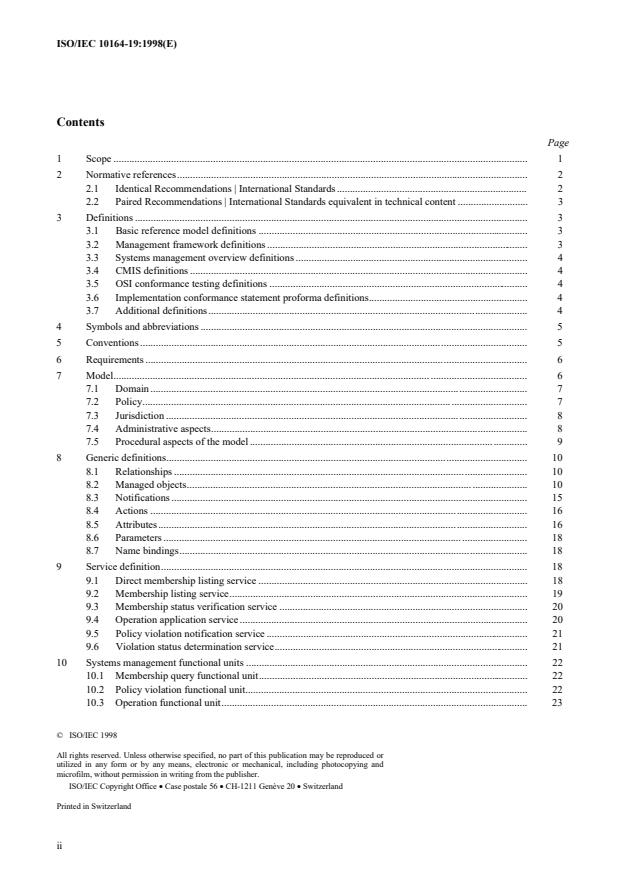
Contents
Page
1 Scope . 1
2 Normative references. 2
2.1 Identical Recommendations | International Standards . 2
2.2 Paired Recommendations | International Standards equivalent in technical content . 3
3 Definitions . 3
3.1 Basic reference model definitions . 3
3.2 Management framework definitions . 3
3.3 Systems management overview definitions . 4
3.4 CMIS definitions . 4
3.5 OSI conformance testing definitions . 4
3.6 Implementation conformance statement proforma definitions. 4
3.7 Additional definitions. 4
4 Symbols and abbreviations . 5
5 Conventions . 5
6 Requirements . 6
7 Model. . 6
7.1 Domain . 7
7.2 Policy. 7
7.3 Jurisdiction . 8
7.4 Administrative aspects. 8
7.5 Procedural aspects of the model . 9
8 Generic definitions. 10
8.1 Relationships . 10
8.2 Managed objects. 10
8.3 Notifications . 15
8.4 Actions . 16
8.5 Attributes. 16
8.6 Parameters . 18
8.7 Name bindings. 18
9 Service definition. 18
9.1 Direct membership listing service . 18
9.2 Membership listing service. 19
9.3 Membership status verification service . 20
9.4 Operation application service . 20
9.5 Policy violation notification service . 21
9.6 Violation status determination service. 21
10 Systems management functional units . 22
10.1 Membership query functional unit. 22
10.2 Policy violation functional unit. 22
10.3 Operation functional unit. 23
© ISO/IEC 1998
All rights reserved. Unless otherwise specified, no part of this publication may be reproduced or
utilized in any form or by any means, electronic or mechanical, including photocopying and
microfilm, without permission in writing from the publisher.
ISO/IEC Copyright Office • Case postale 56 • CH-1211 Genève 20 • Switzerland
Printed in Switzerland
ii
©
ISO/IEC ISO/IEC 10164-19:1998(E)
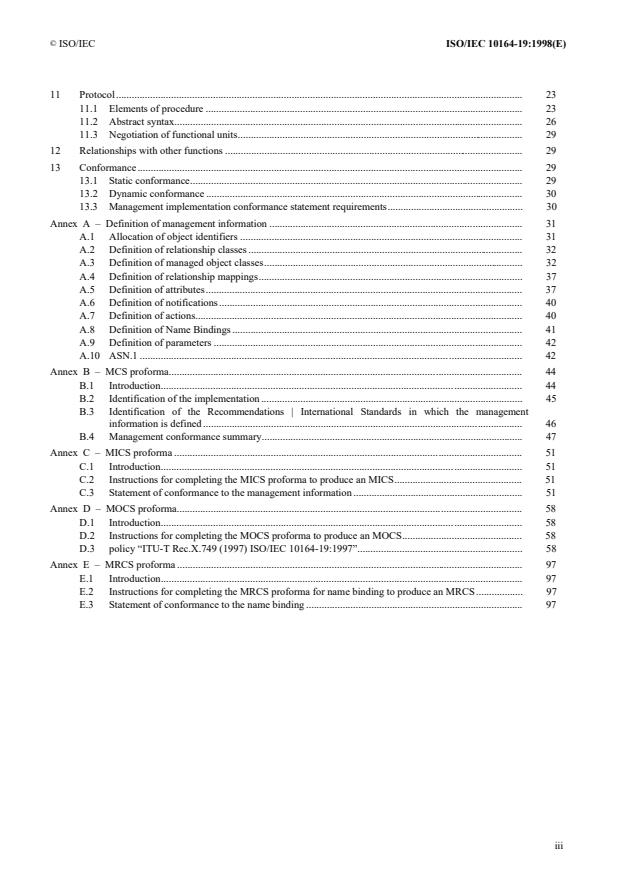
11 Protocol. 23
11.1 Elements of procedure . 23
11.2 Abstract syntax. 26
11.3 Negotiation of functional units. 29
12 Relationships with other functions . 29
13 Conformance . 29
13.1 Static conformance. 29
13.2 Dynamic conformance . 30
13.3 Management implementation conformance statement requirements. 30
Annex A – Definition of management information . 31
A.1 Allocation of object identifiers . 31
A.2 Definition of relationship classes . 32
A.3 Definition of managed object classes. 32
A.4 Definition of relationship mappings. 37
A.5 Definition of attributes. 37
A.6 Definition of notifications. 40
A.7 Definition of actions. 40
A.8 Definition of Name Bindings . 41
A.9 Definition of parameters . 42
A.10 ASN.1 . 42
Annex B – MCS proforma. 44
B.1 Introduction. 44
B.2 Identification of the implementation . 45
B.3 Identification of the Recommendations | International Standards in which the management
information is defined . 46
B.4 Management conformance summary. 47
Annex C – MICS proforma . 51
C.1 Introduction. 51
C.2 Instructions for completing the MICS proforma to produce an MICS. 51
C.3 Statement of conformance to the management information . 51
Annex D – MOCS proforma. 58
D.1 Introduction. 58
D.2 Instructions for completing the MOCS proforma to produce an MOCS. 58
D.3 policy “ITU-T Rec.X.749 (1997) ISO/IEC 10164-19:1997”. 58
Annex E – MRCS proforma . 97
E.1 Introduction. 97
E.2 Instructions for completing the MRCS proforma for name binding to produce an MRCS . 97
E.3 Statement of conformance to the name binding . 97
iii
©
Foreword
ISO (the International Organization for Standardization) and IEC (the International Electrotechnical Commission) form the
specialized system for worldwide standardization. National bodies that are members of ISO or IEC participate in the
development of International Standards through technical committees established by the respective organization to deal
with particular fields of technical activity. ISO and IEC technical committees collaborate in fields of mutual interest. Other
international organizations, governmental and non-governmental, in liaison with ISO and IEC, also take part in the work.
In the field of information technology, ISO and IEC have established a joint technical committee, ISO/IEC JTC 1. Draft
International Standards adopted by the joint technical committee are circulated to national bodies for voting. Publication as
an International Standard requires approval by at least 75 % of the national bodies casting a vote.
International Standard ISO/IEC 10164-19:1998 was prepared by Joint Technical Committee ISO/IEC JTC 1, Information
technology, Subcommittee SC 33, Distributed application services, in collaboration with ITU-T. The identical text is
published as ITU-T Recommendation X.749.
ISO/IEC 10164 consists of the following parts, under the general title Information technology — Open Systems
Interconnection — Systems Management:
— Part 1: Object management function
— Part 2: State management function
— Part 3: Attributes for representing relationships
— Part 4: Alarm reporting function
— Part 5: Event report management function
— Part 6: Log control function
— Part 7: Security alarm reporting function
— Part 8: Security audit trail function
— Part 9: Objects and attributes for access control
— Part 10: Usage metering function for accounting purposes
— Part 11: Metric objects and attributes
— Part 12: Test management function
— Part 13: Summarization function
— Part 14: Confidence and diagnostic test categories
— Part 15: Scheduling function
— Part 16: Management knowledge management function
— Part 17: Change over function
— Part 18: Software management function
— Part 19: Management domain and management policy management function
iv
©
ISO/IEC ISO/IEC 10164-19:1998(E)
— Part 20: Time management function
— Part 21: Command sequencer
— Part 22: Response time monitoring function
Annexes A to E form an integral part of this part of ISO/IEC 10164.
v
INTERNATIONAL STANDARD
ITU-T RECOMMENDATION
INFORMATION TECHNOLOGY – OPEN SYSTEMS INTERCONNECTION –
SYSTEMS MANAGEMENT: MANAGEMENT DOMAIN AND
MANAGEMENT POLICY MANAGEMENT FUNCTION
1 Scope
This Recommendation | International Standard defines the management domain and management policy management
function. This Management Function is a System Management function which may be used by an application process in a
centralized or decentralized management environment to interact for the purpose of systems management, as defined by
the OSI Management Framework, CCITT Rec. X.700 and ISO/IEC 7498-4. This Recommendation | International
Standard defines a function which consists of generic definitions and services. This function is positioned in the
application layer of the OSI reference model (ITU-T Rec. X.200 | ISO/IEC 7498-1) and is defined according to the model
provided by ISO/IEC 9545. The role of systems management functions is described by CCITT Rec. X.701 | ISO/IEC
10040.
This Recommendation | International Standard:
– identifies the set of requirements satisfied by the function;
– provides a model for the behaviour of the management domain management objects;
– provides a model for the behaviour of the management policy management objects;
– specifies the management requirements of the function and how these are realized by specification of
managed objects and their behaviour;
– specifies the mapping of these services onto the CMIS services;
– specifies the abstract syntax of the parameters of the MAPDUs that will be used to refer to managed
objects and their characteristics;
– provides a model, in accordance with the Management Information Model and the General Relationship
Model, for information associated with management domains, policies, and jurisdictions and for the
behaviour of managed objects through which that information is accessed and manipulated;
– provides definitions of the information associated with management domains, policies, and jurisdictions,
their representation and the operations which may be performed upon them in terms of managed object
and management relationship templates.
This Recommendation | International Standard does not:
– define the nature of any implementation intended to provide the management domain and management
policy management function;
– specify the manner in which management is to be accomplished by the user of the management domain
and management policy management function;
– define the nature of any interactions which result in the use of the management domain and management
policy management function;
– specify the services necessary for the establishment, normal and abnormal release of a management
association;
– define the interactions which result by the simultaneous use of several management functions;
– define connection establishment or authorization requirements for the use of this function or for any
associated activity;
– preclude the definition of further management domain, management policy, or management jurisdiction
managed object classes.
ITU-T Rec.X.749 (1997 E) 1
2 Normative references
The following Recommendations and International Standards contain provisions which, through reference in this text,
constitute provisions of this Recommendation | International Standard. At the time of publication, the editions indicated
were valid. All Recommendations and Standards are subject to revision, and parties to agreements based on this
Recommendation | International Standard are encouraged to investigate the possibility of applying the most recent edition
of the Recommendations and Standards listed below. Members of IEC and ISO maintain registers of currently valid
International Standards. The Telecommunication Standardization Bureau of the ITU maintains a list of currently valid
ITU-T Recommendations.
2.1 Identical Recommendations | International Standards
– ITU-T Recommendation X.200 (1994) | ISO/IEC 7498-1:1994, Information technology – Open systems
Interconnection – Basic Reference Model: The Basic Model.
– ITU-T Recommendation X.210 (1993) | ISO/IEC 10731:1994, Information technology – Open Systems
Interconnection – Basic Reference Model - Conventions for the definition of OSI services.
– CCITT Recommendation X.701 (1992) | ISO/IEC 10040:1992, Information technology – Open Systems
Interconnection – Systems management overview.
– CCITT Recommendation X.720 (1992) | ISO/IEC 10165-1:1993, Information technology – Open Systems
Interconnection – Structure of management information: Management information model.
– CCITT Recommendation X.721 (1992) | ISO/IEC 10165-2:1992, Information technology – Open Systems
Interconnection – Structure of management information: Definition of management information.
– CCITT Recommendation X.722 (1992) | ISO/IEC 10165-4:1992, Information technology – Open Systems
Interconnection – Structure of management information: Guidelines for the definition of managed objects.
– ITU-T Recommendation X.724 (1993) | ISO/IEC 10165-6:1994, Information technology – Open Systems
Interconnection – Structure of management information: Requirements and guidelines for implementation
conformance statement proformas associated with OSI management.
– ITU-T Recommendation X.725 (1995) | ISO/IEC 10165-7:1996, Information technology – Open Systems
Interconnection – Structure of management information: General relationship model.
– CCITT Recommendation X.730 (1992) | ISO/IEC 10164-1:1993, Information technology – Open Systems
Interconnection – Systems Management: Object management function.
– CCITT Recommendation X.731 (1992) | ISO/IEC 10164-2:1992, Information technology – Open Systems
Interconnection – Systems Management: State management function.
– CCITT Recommendation X.732 (1992) | ISO/IEC 10164-3:1993, Information technology – Open Systems
Interconnection – Systems Management: Attributes for representing relationships.
– CCITT Recommendation X.734 (1992) | ISO/IEC 10164-5:1993, Information technology – Open Systems
Interconnection – Systems Management: Event report management function.
– CCITT Recommendation X.735 (1992) | ISO/IEC 10164-6:1993, Information technology – Open Systems
Interconnection – Systems Management: Log control function.
1) 1)
– ITU-T Recommendation X.743 | ISO/IEC 10164-20 , Information technology – Open Systems
Interconnection – Systems Management: Time management function.
– ITU-T Recommendation X.746 (1995) | ISO/IEC 10164-15:1995, Information technology – Open Systems
Interconnection – Systems Management: Scheduling function.
_______________
1)
Presently at the stage of draft.
2 ITU-T Rec.X.749 (1997 E)
2.2 Paired Recommendations | International Standards equivalent in technical content
– CCITT Recommendation X.208 (1988), Specification of Abstract Syntax Notation One (ASN.1).
ISO/IEC 8824:1990, Information technology – Open Systems Interconnection – Specification of Abstract
Syntax Notation One (ASN.1).
– CCITT Recommendation X.209 (1988), Specification of basic encoding rules for Abstract Syntax
Notation (ASN.1).
ISO/IEC 8825:1990, Information technology – Open Systems Interconnection – Specification of Basic
Encoding Rules for Abstract Syntax Notation One (ASN.1).
– ITU-T Recommendation X.290 (1995), OSI conformance testing methodology and framework for
protocol Recommendations for ITU-T applications – General concepts.
ISO/IEC 9646-1:1994, Information technology – Open Systems Interconnection – Conformance testing
methodology and framework – Part 1: General concepts.
– ITU-T Recommendation X.291 (1995), OSI conformance testing methodology and framework for
protocol Recommendations for ITU-T applications – Abstract test suite specification.
ISO/IEC 9646-2:1994, Information technology – Open Systems Interconnection – Conformance testing
methodology and framework – Part 2: Abstract Test Suite specification.
– ITU-T Recommendation X.296 (1995), OSI conformance testing methodology and framework for
protocol Recommendations for ITU-T applications – Implementation conformance statements.
ISO/IEC 9646-7:1995, Information technology – Open Systems Interconnection – Conformance testing
methodology and framework – Part 7: Implementation conformance statements.
– CCITT Recommendation X.700 (1992), Management framework for Open Systems Interconnection (OSI)
for CCITT applications.
ISO/IEC 7498-4:1989, Information processing systems – Open Systems Interconnection – Basic
Reference Model – Part 4: Management framework.
– CCITT Recommendation X.710 (1991), Common management information service definition for CCITT
applications.
ISO/IEC 9595:1991, Information technology – Open Systems Interconnection – Common management
information service definition.
– CCITT Recommendation X.711 (1991), Common management information protocol specification for
CCITT applications.
ISO/IEC 9596-1:1991, Information technology – Open Systems Interconnection – Common management
information protocol – Part 1: Specification.
3 Definitions
For the purposes of this Recommendation | International Standard, the following definitions apply.
3.1 Basic reference model definitions
This Recommendation | International Standard makes use of the following term defined in ITU-T Rec. X.200 |
ISO/IEC 7498-1:
– systems management.
3.2 Management framework definitions
This Recommendation | International Standard makes use of the following terms defined in CCITT Rec. X.700 and
ISO/IEC 7498-4:
a) management information;
b) managed object.
ITU-T Rec.X.749 (1997 E) 3
3.3 Systems management overview definitions
This Recommendation | International Standard makes use of the following terms defined in CCITT Rec. X.701 | ISO/IEC
10040:
a) agent role;
b) agent;
c) generic definitions;
d) managed system;
e) management domain;
f) management jurisdiction;
g) management operation;
h) management policy violation;
i) management policy;
j) manager role;
k) manager;
l) managing system;
m) membership filter;
n) Managed Object Conformance Statement (MOCS);
o) Management Information Conformance Statement (MICS);
p) MOCS proforma;
q) MICS proforma;
r) notification;
s) systems management functional unit.
3.4 CMIS definitions
This Recommendation | International Standard makes use of the following terms defined in CCITT Rec. X.710 and
ISO/IEC 9595:
a) attribute;
b) Common Management Information Service.
3.5 OSI conformance testing definitions
This Recommendation | International Standard makes use of the following term defined in ITU-T Rec. X.290 and
ISO/IEC 9646-1:
– system conformance statement.
3.6 Implementation conformance statement proforma definitions
This Recommendation | International Standard makes use of the following terms defined in ITU-T Rec. X.724 |
ISO/IEC 10165-6:
a) Managed Relationship Conformance Statement (MRCS);
b) Management Conformance Summary (MCS);
c) MCS proforma;
d) MRCS proforma.
3.7 Additional definitions
The following terms are defined in this Recommendation | International Standard:
3.7.1 domain managed object: A managed object that represents a domain for the purposes of managing the
membership of that management domain.
4 ITU-T Rec.X.749 (1997 E)
3.7.2 (systems management) policy managed object: A managed object that represents a (systems management)
policy for the purpose of managing the policy.
3.7.3 violation detection: The activity which detects policy violations.
3.7.4 domain (membership specifier): A specification that, through explicit reference or predicates, serves to
identify a set of managed objects for the purposes of management.
3.7.5 jurisdiction managed object: A managed object that represents the relationship between a policy and a
domain to which it is to be applied.
3.7.6 administrative aspect managed object: A managed object used to represent non-procedural information
relevant to the administration of domains, jurisdictions, and policies.
4 Symbols and abbreviations
For the purposes of this Recommendation | International Standard, the following abbreviations apply:
ASN.1 Abstract Syntax Notation One
AVA Attribute Value Assertion
CMIP Common Management Information Protocol
CMIS Common Management Information Service
CMISE Common Management Information Service Element
Cnf Confirm
GDMO Guidelines for the Definition of Managed Objects
GRM General Relationship Model
ICS Implementation Conformance Statement
Id Identifier
Ind Indication
MAPDU Management Application Protocol Data Unit
MCS Management Conformance Summary
MICS Management Information Conformance Statement
MIS-user Management Information Service user
MOCS Managed Object Conformance Statement
MRCS Managed Relationship Conformance Statement
PICS Protocol Implementation Conformance Statement
Req request
Rsp response
SMAPM Systems Management Application Protocol Machine
5 Conventions
This Recommendation | International Standard defines services for the Management domain management function
following the descriptive conventions defined in ITU-T Rec. X.210 | ISO/IEC 10731.
The following notation is used in the service parameter tables:
M the parameter is mandatory;
C the parameter is conditional;
(=) the value of the parameter is identical to the corresponding parameter in the interaction described by the
preceding related service primitive;
U the use of the parameter is a service-user option;
– the parameter is not present in the interaction described by the primitive concerned;
P the parameter is subject to the constraints imposed by CCITT Rec. X.710 and ISO/IEC 9595.
ITU-T Rec.X.749 (1997 E) 5
NOTE – The parameters which are marked "P" in service tables of this Recommendation | International Standard are mapped
directly onto the corresponding parameters of the CMIS service primitive, without changing the semantics or syntax of the
parameters. The remaining parameters are used to construct an MAPDU.
Throughout this Specification, GDMO and ASN.1 productions are printed using Times New Roman font.
6 Requirements
For logistic or other management reasons, there is a requirement to modularize management activities and groups of
managed objects. The need to define groups of managed objects is associated with the concept of domains.
It may occur that there is a need to describe these activities so that they can be accessed by means of management
operations. The definition of such management activities is associated with the concept of policies. A policy defines a set
of management activities which apply to domains.
In the course of normal operations it may happen that the required operations or constraints on managed objects no longer
match the operational requirements associated with the group (perhaps for reasons of failure or lack of integrity) however
caused. It is therefore an essential management requirement that systems shall be able to recognize occasions when there
are violations and to take steps to resolve them.
In response to such situations, management policies and the rules associated with them may be modified and new rules
affirmed so that they might apply to new goals and to different managed objects. A minimal requirement of management
is the action to be taken in the event of violation detection, this action is known as violation resolution and is for further
study.
The requirements for management domain and management policy management are identified in the Systems
Management Overview (see CCITT Rec. X.701 | ISO/IEC 10040). Additional functional requirements are identified
below.
For management domains there are the requirements that:
– A mechanism shall be provided for managing the membership of a domain.
– There shall be mechanisms to generate a membership list for a given management domain (membership
enumeration).
– It shall be possible to discover whether a given managed object is a member of a particular management
domain (membership verification).
– It shall be possible to determine which management domain(s) a given managed object is a member of.
NOTE 1 – Actually performing this discovery may require considerable time and resources.
– It shall be possible to determine which management policies apply to a management domain.
– It shall be possible to access a representation of management domains for the purpose of managing the
domain.
– A member of one management domain may be a member of another management domain.
For management policies there are the requirements that:
– A mechanism shall be provided for managing the change of policies.
– It shall be possible to specify management policy violation detection and violation resolution.
NOTE 2 – Violation resolution mechanisms to accomplish this are for further study.
7 Model
An MIS-user in the manager role (manager) interacts with a managed object via an MIS-user in the agent role (agent)
over an interoperable interface.
A managed object may be subject to any number of policies; any number of policies may be of relevance to a given
object.
A domain managed object is a support object which allows the specification of a set of objects of interest.
A policy managed object is a support object which represents a system management policy, encapsulating any rules and
rule combination semantics used to construct that policy.
6 ITU-T Rec.X.749 (1997 E)
A jurisdiction managed object is a support object which represents the relationship between a policy and a domain.
An administrative aspect is a support object which represents non-procedural aspects and descriptive information for
domains, policies, and jurisdictions.
7.1 Domain
A domain allows the specification of a set of objects of interest. A domain permits the management of the specification of
its membership. The set of members specified by a domain is the union of its set of direct members with its set of indirect
members. Membership may change as objects are created or deleted.
The intersection of the set of objects described by a domain member selection list with the set of objects described by its
member selection filter is its set of direct members. The member selection list is a set whose elements name managed
object instances, which may or may not actually exist. If the member selection list is the empty set, it implies that all
objects are identified. The member selection filter is a single valued attribute representing a logical predicate. If its value
is empty, it evaluates to true for all objects.
A domain also allows reference by name to other domains. The union of the sets of members specified by the objects
identified in this manner is a domain's set of indirect members. The ability to specify membership both directly and
indirectly permits convenient grouping and representation of hierarchies of domains.
The management operations supported by a membership specifier include:
– list direct membership;
– list membership;
– verify membership of a given managed object instance.
Figure 1 illustrates how domain D1 describes a set which contains objects A, B, and C through direct membership.
Domain D2 describes a set containing D, E, and F through direct membership. Domain D3 describes a set containing F
and G through direct membership. Domain D4 has no direct members, but has A, B, C, D, E, and F as indirect members.
A
B
Domain D1
C
Domain D4
D
Domain D2
E
T0730490-97/d01
F
Domain D3
G
Figure 1 – Example of domain membership
FIGURE 1/X.749.[D01] = 3 CM
7.2 Policy
A policy encapsulates a representation of system management goals. Policies reflect obligations, authorizations, and
aspirations. Their representation may be transparent or opaque. A transparent policy does provide management access to
the representation of its semantics. An opaque policy does not provide management access to the representation of its
semantics.
This Recommendation | International Standard provides class definitions to support management of opaque policies.
Subclasses of policy may be defined to support capabilities such as scheduling, and the representation of policy
semantics. This Recommendation | International Standard provides class definitions for a scheduled opaque policy.
This Recommendation | International Standard describes one means of representing policy semantics in support of a
transparent policy class. The development of more powerful representations is for further study.
ITU-T Rec.X.749 (1997 E) 7
7.3 Jurisdiction
A jurisdiction managed object serves to relate a policy and a domain.
The relationship defined by a jurisdiction managed object indicates to which managed objects, identified by the domain,
the policy shall apply.
Figure 2 illustrates the following concepts:
– hierarchical domains for administrative convenience (domains D11 and D12 may be administered-
separately);
– re-use of a domain for multiple jurisdictions (domain D12 is used for both jurisdiction J1 and jurisdiction
J2);
– application of multiple policies to a single object (Object F is subject to policies P1, P2, and P3).
A
Domain D11
B
C
Domain D1 Jurisdiction J1 Policy P1
D
Domain D12
E
Jurisdiction J2
F
Policy P2
Domain D12
G
T0730500-97/d02
Jurisdiction J3 Policy P3
Figure 2 – Example of a jurisdiction
FIGURE 2/X.749.[D02] = 3 CM
This example shows the following:
– jurisdiction J1 associates policy P1 with domain D1;
– this means that policy P1 applies to objects A, B, C, D, E, F, the members specified directly or indirectly
by D1;
– jurisdiction J2 associates policy P2 with domain D12;
– this means that policy P2 applies to objects D, E, and F, the members specified directly or indirectly by
D12;
– both policy P1 and P2 are applicable to Objects D, E, and F;
– a change to domain D12 can affect the applicability of both policy P1 and P2;
– jurisdiction J3 associates policy P3 with domain D13;
– objects F and G are subject to policy P3;
– object F is also subject to policy P1 and to P2.
An enhanced jurisdiction managed object provides the ability to request the application of an operation to the members of
its domain.
7.4 Administrative aspects
The administrative aspects include identification of the authority responsible for setting the domain, the authority for
setting the policy and the application of policy to the domain members. An authority may be a composite entity; such an
entity must be identifiable. An authority may delegate some, or all, of its responsibilities to another authority.
Administrative aspects include non-procedural aspects for recording relevant descriptive information for objects.
8 ITU-T Rec.X.749 (1997 E)
7.5 Procedural aspects of the model
The following subclauses demonstrate that this function's requirements are satisfied by this model.
7.5.1 Managing membership
A jurisdiction's membership is defined to be the membership of the domain referenced by that jurisdiction.
Membership is managed by means of domains. A domain's membership may be changed in two ways:
a) a managed object's membership status may change, through its creation, deletion, or a change in a value of
one or more of its attributes;
b) attributes of the domain (or a domain to which it refers, at any level of indirection) may be modified.
7.5.2 Listing membership
The listing of a jurisdiction's membership is requested by directing a list membership request to the jurisdiction. The
result obtained is effectively the same as would be obtained by directing a list membership request to that jurisdiction's
domain.
7.5.3 Verifying membership
The verification of jurisdiction membership for an object is requested by directing a membership verification request to
the jurisdiction. The result obtained is effectively the same as would be obtained by directing a membership verification
request to that jurisdiction's domain.
7.5.4 Determining which jurisdictions a managed object is a member of
Determining which jurisdictions a managed object is a member of requires performing a membership verification
operation (or list membership operation) for all known jurisdictions. The discovery of jurisdictions can be performed by
directing an all-levels scoped get for objects of class jurisdiction to all relevant systems.
A similar procedure may be applied against domains to determine which domains a given managed object is a member of.
7.5.5 Determining which policy applies to the members of a jurisdiction
Determining which policies apply to the membership of a domain requires retrieving the attribute which names its policy
from all jurisdictions that reference the domain in question.
7.5.6 Determining whether a given object violates a policy
Determining whether a given object violates a policy is accomplished by sending a determine violation status operation to
the appropriate jurisdiction or policy managed object, supplying the name of the object instance in question as a
parameter. The response will be the determination of whether the policy was applicable (always true when query directed
to a policy object), and, if it was, the object's violation status.
7.5.7 Applying an operation to the membership of a domain
Applying an operation to membership of a domain can be accomplished by issuing an apply operation to membership
request to the appropriate jurisdiction object.
7.5.8 Determining which policies apply to a given object
In order to determine the policies applying to a managed object, it is necessary to determine the jurisdictions of which it
is a member. The object in question is not required by this model to have any knowledge of the set of applied policies.
The set of relevant jurisdictions can be retrieved using the procedure outlined above in 7.5.4. For each jurisdiction of
which the object in question is a member, the identity of the relevant policy may be retrieved using the procedures
of 7.5.5.
ITU-T Rec.X.749 (1997 E) 9
8 Generic definitions
8.1 Relationships
8.1.1 Jurisdiction relationship
8.1.1.1 Jurisdiction relationship class
The jurisdiction relationship class associates a set of roles with a jurisdiction. The roles in a jurisdiction relationship are
policy role and domain role.
A jurisdiction managed object represents single jurisdiction relationship for the purposes of management. The
information of an individual jurisdiction relationship mapping is stored in a jurisdiction managed object. In this clause, an
object fulfilling role X will be referred to as X itself. For example, a domain is a managed object fulfilling the role of
domain. For each jurisdiction, there is exactly one relationship to its members.
A member can participate in zero or more (member) relationships. The existence of a jurisdiction managed object is
coupled to the existence of a jurisdiction relationship mapping. A policy or domain can change during the existence of the
relationship with one exception: the name of the policy or domain cannot be changed.
A policy or domain may exist before it is mapped to in a jurisdiction relationship and it is not affected when this mapping
is established or ceases to exist. A jurisdiction is created by an ESTABLISH operation and deleted with a TERMINATE
operation.
8.1.1.2 Jurisdiction relationship mapping
The jurisdiction relationship mapping is a mapping of the jurisdiction relationship class. A jurisdiction is a relationship
object that binds a single policy to a single domain. The identity of the policy of the jurisdiction is set when the
relationship is created and cannot be modified during the lifetime of the relationship. The identity of the domain is set
when the relationship is created and cannot be modified during the lifetime of the relationship.
8.1.2 Administrative aspect relationship
8.1.2.1 Administrative aspect relationship class
The administrative aspect relationship class associates an object in the administrative aspect role with another object. The
roles in this relationship are the administrative aspect role and the administered object role.
An object in the administered object role can participate in at most one administrative aspect relationship in that role.
An object in the administrative aspect role can participate in any number of administrative aspect relationships in that
role.
Objects in either role may be modified during the lifetime of the relationship. Objects in either role may exist before the
establishment of the relationship, and may continue to exist after the termination of the relationship.
8.1.2.2 Administrative aspect relationship mapping
The administrative aspect relationship mapping is a mapping of the administrative aspect relationship class. An
administrative aspect pointer is a relationship attribute that binds a single object in the administrative aspect. The
relationship is established and terminated by setting the value of the administrative aspect pointer.
8.2 Managed objects
8.2.1 Jurisdiction managed object
The jurisdiction object class is a class of managed objects representing the functional aspects of a jurisdiction
relationship. This managed object class, derived from the generic relationship class, is characterized by a single
mandatory package, the jurisdiction package. This package adds the following mandatory characteristics:
– a jurisdiction identifier (a
...
NORME ISO/CEI
INTERNATIONALE 10164-19
Première édition
1998-12-15
Technologies de l'information —
Interconnexion de systèmes ouverts
(OSI) — Gestion-systèmes: Fonction de
gestion de domaine de gestion et de
politique de gestion
Information technology — Open Systems Interconnection — Systems
Management: Management domain and management policy management
function
Numéro de référence
ISO/CEI 10164-19:1998(F)
ISO/CEI 10164-19:1998(F)
PDF – Exonération de responsabilité
Le présent fichier PDF peut contenir des polices de caractères intégrées. Conformément aux conditions de licence d'Adobe, ce fichier peut
être imprimé ou visualisé, mais ne doit pas être modifié à moins que l'ordinateur employé à cet effet ne bénéficie d'une licence autorisant
l'utilisation de ces polices et que celles-ci y soient installées. Lors du téléchargement de ce fichier, les parties concernées acceptent de fait la
responsabilité de ne pas enfreindre les conditions de licence d'Adobe. Le Secrétariat central de l'ISO décline toute responsabilité en la
matière.
Adobe est une marque déposée d'Adobe Systems Incorporated.
Les détails relatifs aux produits logiciels utilisés pour la création du présent fichier PDF sont disponibles dans la rubrique General Info du
fichier; les paramètres de création PDF ont été optimisés pour l'impression. Toutes les mesures ont été prises pour garantir l'exploitation de
ce fichier par les comités membres de l'ISO. Dans le cas peu probable où surviendrait un problème d'utilisation, veuillez en informer le
Secrétariat central à l'adresse donnée ci-dessous.
© ISO/CEI 1998
Droits de reproduction réservés. Sauf prescription différente, aucune partie de cette publication ne peut être reproduite ni utilisée sous quelque
forme que ce soit et par aucun procédé, électronique ou mécanique, y compris la photocopie et les microfilms, sans l'accord écrit de l’ISO à
l’adresse ci-après ou du comité membre de l’ISO dans le pays du demandeur.
ISO copyright office
Case postale 56 � CH-1211 Geneva 20
Tel. + 41 22 749 01 11
Fax. + 41 22 734 10 79
E-mail copyright@iso.ch
Web www.iso.ch
Version française parue en 2000
ImpriméenSuisse
ii © ISO/CEI 1998 – Tous droits réservés
©ISO/CEI ISO/CEI 10164-19:1998(F)
Sommaire
0AGE
1 Domaine d’application. 1
2 Références normatives . 2
2.1 Recommandations | Normes internationales identiques. 2
2.2 Paires de Recommandations | Normes internationales équivalentes par leur contenu technique . 3
3 Définitions. 3
3.1 Définitions du modèle de référence de base . 4
3.2 Définitions du cadre général de gestion. 4
3.3 Définitions de l'aperçu général de la gestion-systèmes.4
3.4 Définitions du service commun de transfert d'informations de gestion (CMIS). 4
3.5 Définitions des tests de conformité OSI. 4
3.6 Définitions du formulaire de déclaration de conformité d'implémentation. 5
3.7 Définitions additionnelles . 5
4 Symboles et abréviations. 5
5 Conventions . 6
6 Spécifications . 6
7 Modèle . 7
7.1 Domaine. 7
7.2 Politique . 8
7.3 Juridiction . 8
7.4 Aspects administratifs. 9
7.5 Aspects procéduraux du modèle . 9
8 Définitions génériques . 10
8.1 Relations . 10
8.2 Objets gérés. 11
8.3 Notifications. 17
8.4 Actions . 17
8.5 Attributs . 18
8.6 Paramètres. 19
8.7 Corrélation de noms. 19
9 Définition des services . 19
9.1 Service de listage des membres directs. 20
9.2 Service de listage des membres. 20
9.3 Service de vérification de l'état d'appartenance . 21
9.4 Service d'application d'une opération. 22
9.5 Service de notification d'une violation de politique. 22
9.6 Service de détermination de l'état de violation . 23
10 Unités fonctionnelles de gestion-systèmes. 23
10.1 Unité fonctionnelle d'interrogation de la liste de membres. 23
10.2 Unité fonctionnelle d'état de violation de politique . 24
10.3 Unité fonctionnelle d'opération. 24
11 Protocole . 24
11.1 Eléments de procédure. 24
11.2 Syntaxe abstraite . 27
11.3 Négociation d'unités fonctionnelles . 30
iii
ISO/CEI 10164-19:1998(F) ©ISO/CEI
0AGE
12 Relations avec d’autres fonctions . 30
13 Conformité . 31
13.1 Conformité statique. 31
13.2 Conformité dynamique . 31
13.3 Spécifications des déclarations de conformité des instances de gestion . 31
Annexe A – Définition des informations de gestion . 32
A.1 Allocation des identificateurs d'objets . 32
A.2 Définition des classes de relations . 33
A.3 Définition des classes d'objets . 33
A.4 Définition des correspondances de relations. 38
A.5 Définition des attributs. 38
A.6 Définition des notifications. 41
A.7 Définition des actions . 41
A.8 Définition des corrélations de noms. 42
A.9 Définition des paramètres . 43
A.10 ASN.1 . 43
Annexe B – Formulaire MCS. 45
B.1 Introduction. 45
B.2 Identification of the implementation. 46
B.3 Identification of the Recommendations | International Standards in which the management
information is defined . 47
B.4 Management conformance summary . 48
Annexe C – Formulaire MICS . 52
C.1 Introduction. 52
C.2 Instructions for completing the MICS proforma to produce an MICS . 52
C.3 Statement of conformance to the management information. 52
Annexe D – Formulaire MOCS. 59
D.1 Introduction. 59
D.2 Instructions for completing the MOCS proforma to produce a MOCS . 59
D.3 policy "ITU-T Rec. X.749 (1997) | ISO/IEC 10164-19:1997" . 59
D.4 scheduledPolicy "ITU-T Rec. X.749 (1997) | ISO/IEC 10164-19:1997" (partial) . 64
D.5 jurisdiction "ITU-T Rec. X.749 (1997) | ISO/IEC 10164-19:1997" . 69
D.6 enhancedJurisdiction "ITU-T Rec. X.749 (1997) | ISO/IEC 10164-19:1997" (partial) . 75
D.7 domain "ITU-T Rec. X.749 (1997) | ISO/IEC 10164-19:1997" . 81
D.8 administrativeAspect "ITU-T Rec. X.749 (1997) | ISO/IEC 10164-19:1997" . 85
D.9 policyViolationLogRecord "ITU-T Rec. X.749 (1997) | ISO/IEC 10164-19:1997" . 88
D.10 valueAssertionPolicy "ITU-T Rec. X.749 (1997) | ISO/IEC 10164-19:1997" . 91
Annexe E – Formulaire MRCS . 96
E.1 Introduction. 96
E.2 Instructions for completing the MRCS proforma for name binding to produce an MRCS . 96
E.3 Statement of conformance to the name binding. 96
iv
©ISO/CEI ISO/CEI 10164-19:1998(F)
Avant-propos
L'ISO (Organisation internationale de normalisation) et la CEI (Commission électrotechnique internationale) forment le
système spécialisé de la normalisation mondiale. Les organismes nationaux membres de l'ISO ou de la CEI participent au
développement de Normes internationales par l'intermédiaire des comités techniques créés par l'organisation concernée afin de
s'occuper des domaines particuliers de l'activité technique. Les comités techniques de l'ISO et de la CEI collaborent dans des
domaines d'intérêt commun. D'autres organisations internationales, gouvernementales et non gouvernementales, en liaison
avec l'ISO et la CEI participent également aux travaux.
Dans le domaine des technologies de l'information, l'ISO et la CEI ont créé un comité technique mixte, l'ISO/CEI JTC 1. Les
projets de Normes internationales adoptés par le comité technique mixte sont soumis aux organismes nationaux pour vote.
Leur publication comme Normes internationales requiert l'approbation de 75 % au moins des organismes nationaux votants.
La Norme internationale ISO/CEI 10164-19 a été élaborée par le comité technique mixte ISO/CEI JTC 1, Technologies de
l'information, sous-comité SC 33, Services d'applications distribuées, en collaboration avec l'UIT-T. Le texte identique est
publié en tant que Recommandation UIT-T X.749.
L'ISO/CEI 10164 comprend les parties suivantes, présentées sous le titre général Technologies de l'information —
Interconnexion de systèmes ouverts (OSI) — Gestion-systèmes:
� Partie 1: Fonction de gestion d'objets
� Partie 2:Fonction de gestion d'états
� Partie 3: Attributs pour la représentation des relations
� Partie 4: Fonction de compte rendu d'alarme
� Partie 5: Fonction de gestion de rapport événementiel
� Partie 6: Fonction de contrôle d'accès
� Partie 7: Fonction de compte rendu d'alarme de sécurité
� Partie 8: Fonction de sécurité de l'expertise de l'historique
� Partie 9: Objets et attributs de contrôle d'accès
� Partie 10: Fonction de comptage d'utilisation aux fins de comptabilité
� Partie 11:Objets et attributs métriques
� Partie 12: Fonction de gestion des tests
� Partie 13: Fonction de récapitulation
� Partie 14: Catégories de test de confiance et de diagnostic
� Partie 15: Fonction de programmation
� Partie 16: Fonction de gestion de la connaissance de gestion
� Partie 17: Fonction de changement
� Partie 18: Fonction de gestion de logiciel
� Partie 19: Fonctions de gestion de domaine de gestion et de politique de gestion
� Partie 20: Fonctions de gestion de temps
� Partie 21: Séquenceur de commandes
� Partie 22: Fonction de contrôle de temps de réponse
Les annexes A à E font partie intégrante de la présente partie de l'ISO/CEI 10164.
v
)3/�#%)������������������&�
./2-%��).4%2.!4)/.!,%
2%#/--!.$!4)/.��5)4�4
TECHNOLOGIES DE L'INFORMATION – INTERCONNEXION DE SYSTÈMES
OUVERTS (OSI) – GESTION-SYSTÈMES: FONCTION DE GESTION
DE DOMAINE DE GESTION ET DE POLITIQUE DE GESTION
� $OMAINE�D�APPLICATION
La présente Recommandation | Norme internationale définit la fonction de gestion de domaine de gestion et de politique
de gestion. Cette fonction de gestion est une fonction de gestion-systèmes qui peut être utilisée par un processus
d'application, dans un environnement de gestion centralisée ou décentralisée, pour dialoguer aux fins de la
gestion-systèmes, comme défini par le cadre de gestion de l'interconnexion des systèmes ouverts (OSI, OPEN�SYSTEM
INTERCONNECTION), Rec. X.700 du CCITT et l'ISO/CEI 7498-4. La présente Recommandation | Norme internationale
définit une fonction qui consiste en définitions et en services génériques. Cette fonction est située dans la couche
d'Application du modèle de référence d'interconnexion des systèmes ouverts (Rec. UIT-T X.200 | ISO/CEI 7498-1) et
est définie suivant le modèle fourni par l'ISO/CEI 9545. Le rôle des fonctions de la gestion-systèmes est décrit par la
Rec. X.701 du CCITT | ISO/CEI 10040.
La présente Recommandation | Norme internationale:
– identifie l'ensemble des spécifications auxquelles satisfait cette fonction;
– fournit un modèle pour le comportement des objets de gestion d'un domaine de gestion;
– fournit un modèle pour le comportement des objets de gestion d'une politique de gestion;
– précise les spécifications de la gestion de cette fonction, et comment elles sont satisfaites par la
spécification des objets gérés et de leur comportement;
– spécifie la mise en correspondance de ces services avec les services CMIS;
– spécifie la syntaxe abstraite des paramètres des unités de données de protocoles d'application de gestion
(MAPDU: MANAGEMENT�APPLICATION�PROTOCOL�DATA�UNIT) qui seront utilisés pour faire référence aux objets
gérés et à leurs caractéristiques;
– fournit un modèle, aux termes du modèle d'information de gestion et du modèle relationnel général, pour
les informations associées à des domaines de gestion, à des politiques et à des juridictions, ainsi que pour
le comportement des objets gérés servant à l'accès à ces informations et à leur manipulation;
– fournit des définitions des informations associées à des domaines de gestion, à des politiques et à des
juridictions, de leur représentation et des opérations qui peuvent être effectuées sur elles en termes de
modèles d'objets gérés et de relations de gestion.
La présente Recommandation | Norme internationale:
– ne définit la nature d'aucune réalisation destinée à fournir la fonction de gestion d'un domaine de gestion
et de sa politique de gestion;
– ne spécifie pas la manière dont la gestion doit être effectuée par l'utilisateur de fonction de gestion d'un
domaine de gestion et de sa politique de gestion;
– ne définit la nature d'aucune des interactions qui aboutissent à l'utilisation de la fonction de gestion d'un
domaine de gestion et de sa politique de gestion;
– ne spécifie pas les services nécessaires à l'établissement ni à la libération, normale ou anormale, d'une
association de gestion;
2EC��5)4�4�8�����������&� 1
)3/�#%)������������������&�
– ne définit pas les interactions dues à l'utilisation simultanée de plusieurs fonctions de gestion;
– ne définit pas les spécifications de l'établissement ou de l'autorisation de connexion pour l'utilisation de
cette fonction ou pour toute activité associée;
– n'exclut pas la définition de classes additionnelles d'objets gérés domaine de gestion, politique de gestion
ou juridiction de gestion.
� 2'F'RENCES�NORMATIVES
Les Recommandations et Normes internationales suivantes contiennent des dispositions qui, par suite de la référence qui
y est faite, constituent des dispositions valables pour la présente Recommandation | Norme internationale. Au moment de
la publication, les éditions indiquées étaient en vigueur. Toutes Recommandations et Normes sont sujettes à révision et
les parties prenantes aux accords fondés sur la présente Recommandation | Norme internationale sont invitées à
rechercher la possibilité d'appliquer les éditions les plus récentes des Recommandations et Normes indiquées ci-après.
Les membres de la CEI et de l'ISO possèdent le registre des Normes internationales en vigueur. Le Bureau de la
normalisation des télécommunications de l'UIT tient à jour une liste des Recommandations de l'UIT-T en vigueur.
��� 2ECOMMANDATIONS�\�.ORMES�INTERNATIONALES�IDENTIQUES
– Recommandation UIT-T X.200 (1994) | ISO/CEI 7498-1:1994, 4ECHNOLOGIES�DE�L�INFORMATION –
)NTERCONNEXION�DES�SYST¤MES�OUVERTS – -OD¤LE�DE�R'F'RENCE�DE�BASE��LE�MOD¤LE�DE�R'F'RENCE�DE�BASE.
– Recommandation UIT-T X.210 (1993) | ISO/CEI 10731:1994, 4ECHNOLOGIES�DE�L�INFORMATION� –
)NTERCONNEXION�DES�SYST¤MES�OUVERTS – -OD¤LE�DE�R'F'RENCE�DE�BASE��CONVENTIONS�POUR�LA�D'FINITION�DES
SERVICES�DE�L�INTERCONNEXION�DE�SYST¤MES�OUVERTS.
– Recommandation X.701 du CCITT (1992) | ISO/CEI 10040:1992, 4ECHNOLOGIES�DE�L�INFORMATION –
)NTERCONNEXION�DES�SYST¤MES�OUVERTS – !PER§U�G'N'RAL�DE�LA�GESTION�DES�SYST¤MES.
– Recommandation X.720 du CCITT (1992) | ISO/CEI 10165-1:1993, 4ECHNOLOGIES�DE�L�INFORMATION –
)NTERCONNEXION�DES�SYST¤MES�OUVERTS – 3TRUCTURE�DES�INFORMATIONS�DE�GESTION��MOD¤LE�D�INFORMATION�DE
GESTION.
– Recommandation X.721 du CCITT (1992) | ISO/CEI 10165-2:1992, 4ECHNOLOGIES�DE�L�INFORMATION –
)NTERCONNEXION�DES�SYST¤MES�OUVERTS – 3TRUCTURE�DES�INFORMATIONS�DE�GESTION��D'FINITION�DES�INFORMATIONS
DE�GESTION.
– Recommandation X.722 du CCITT (1992) | ISO/CEI 10165-4:1992, 4ECHNOLOGIES�DE�L�INFORMATION –
)NTERCONNEXION�DES�SYST¤MES�OUVERTS – 3TRUCTURE�DES�INFORMATIONS�DE�GESTION��DIRECTIVES�POUR�LA�D'FINITION
DES�OBJETS�G'R'S.
– Recommandation UIT-T X.724 (1993) | ISO/CEI 10165-6:1994, 4ECHNOLOGIES�DE�L�INFORMATION�
)NTERCONNEXION�DES�SYST¤MES�OUVERTS� �3TRUCTURE�DE�L�INFORMATION�DE�GESTION��SP'CIFICATIONS�ET�DIRECTIVES
POUR�L�'TABLISSEMENT�DES�FORMULAIRES�DE�D'CLARATION�DE�CONFORMIT'�D�INSTANCES�ASSOCI'S���LA�GESTION�/3)�
– Recommandation UIT-T X.725 (1995) | ISO/CEI 10165-7:1996��4ECHNOLOGIES�DE�L�INFORMATION�
)NTERCONNEXION�DES�SYST¤MES�OUVERTS� �3TRUCTURE�DE�L�INFORMATION�DE�GESTION��MOD¤LE�DE�RELATION�G'N'RAL.
– Recommandation X.730 du CCITT (1992) | ISO/CEI 10164-1:1993, 4ECHNOLOGIES�DE�L�INFORMATION –
)NTERCONNEXION�DES�SYST¤MES�OUVERTS – ’ESTION�SYST¤MES��FONCTION�DE�GESTION�DES�OBJETS.
– Recommandation X.731 du CCITT (1992) | ISO/CEI 10164-2:1993, 4ECHNOLOGIES�DE�L�INFORMATION –
)NTERCONNEXION�DES�SYST¤MES�OUVERTS – ’ESTION�SYST¤MES��FONCTION�DE�GESTION�D�'TATS.
– Recommandation X.732 du CCITT (1992) | ISO/CEI 10164-3:1993, 4ECHNOLOGIES�DE�L�INFORMATION –
)NTERCONNEXION�DES�SYST¤MES�OUVERTS – ’ESTION�SYST¤MES��ATTRIBUTS�RELATIONNELS.
– Recommandation X.734 du CCITT (1992) | ISO/CEI 10164-5:1993, 4ECHNOLOGIES�DE�L�INFORMATION –
)NTERCONNEXION�DES�SYST¤MES�OUVERTS – ’ESTION�SYST¤MES��FONCTION�DE�GESTION�DES�RAPPORTS�D�'V'NEMENT.
– Recommandation X.735 du CCITT (1992) | ISO/CEI 10164-6:1993, 4ECHNOLOGIES�DE�L�INFORMATION –
)NTERCONNEXION� DES� SYST¤MES� OUVERTS – ’ESTION�SYST¤MES��FONCTION�DE�COMMANDE�DES�REGISTRES�DE
CONSIGNATION.
2 2EC��5)4�4�8�����������&�
)3/�#%)������������������&�
1) 1)
– Recommandation UIT-T X.743 | ISO/CEI 10164-20 , 4ECHNOLOGIES�DE�L�INFORMATION – )NTERCONNEXION
DES�SYST¤MES�OUVERTS – ’ESTION�SYST¤MES��FONCTION�DE�GESTION�DU�TEMPS.
– Recommandation UIT-T X.746 (1995) | ISO/CEI 10164-15:1995, 4ECHNOLOGIES�DE�L�INFORMATION –
)NTERCONNEXION�DES�SYST¤MES�OUVERTS – ’ESTION�SYST¤MES��FONCTION�DE�PROGRAMMATION.
��� 0AIRES�DE�2ECOMMANDATIONS�\�.ORMES�INTERNATIONALES�'QUIVALENTES�PAR�LEUR�CONTENU�TECHNIQUE
– Recommandation X.208 du CCITT (1988), 3P'CIFICATION�DE�LA�SYNTAXE�ABSTRAITE�NUM'RO�UN��!3.���.
ISO/CEI 8824:1990, 4ECHNOLOGIES�DE�L�INFORMATION – )NTERCONNEXION�DE�SYST¤MES�OUVERTS – 3P'CIFICATION
DE�LA�NOTATION�DE�SYNTAXE�ABSTRAITE�NUM'RO�UN��!3.���.
– Recommandation X.209 du CCITT (1988), 3P'CIFICATION�DES�R¤GLES�DE�CODAGE�DE�BASE�POUR�LA�NOTATION
DE�SYNTAXE�ABSTRAITE�NUM'RO�UN��!3.���.
ISO/CEI 8825:1990, 4ECHNOLOGIES�DE�L�INFORMATION – )NTERCONNEXION�DE�SYST¤MES�OUVERTS – 3P'CIFICATION
DE�R¤GLES�DE�BASE�POUR�CODER�LA�NOTATION�DE�SYNTAXE�ABSTRAITE�NUM'RO�UN��!3.���.
– Recommandation UIT-T X.290 (1995), #ADRE�G'N'RAL�ET�M'THODOLOGIE�DES�TESTS�DE�CONFORMIT'
D�INTERCONNEXION�DES�SYST¤MES�OUVERTS�POUR�LES�2ECOMMANDATIONS�SUR�LES�PROTOCOLES�POUR�LES�APPLICATIONS
DE�L�5)4�4 – #ONCEPTS�G'N'RAUX.
ISO/CEI 9646-1:1994, 4ECHNOLOGIES�DE�L�INFORMATION – )NTERCONNEXION�DE�SYST¤MES�OUVERTS – #ADRE
G'N'RAL�ET�M'THODOLOGIE�DES�TESTS�DE�CONFORMIT'�/3) – 0ARTIE����#ONCEPTS�G'N'RAUX.
– Recommandation UIT-T X.291 (1995), #ADRE�G'N'RAL�ET�M'THODOLOGIE�DES�TESTS�DE�CONFORMIT'
D�INTERCONNEXION�DES�SYST¤MES�OUVERTS�POUR�LES�2ECOMMANDATIONS�SUR�LES�PROTOCOLES�POUR�LES�APPLICATIONS
DE�L�5)4�4�–�3P'CIFICATION�DE�SUITE�DE�TESTS�ABSTRAITE.
ISO/CEI 9646-2:1994, 4ECHNOLOGIES�DE�L�INFORMATION – )NTERCONNEXION�DE�SYST¤MES�OUVERTS – #ADRE
G'N'RAL�ET�M'THODOLOGIE�DES�TESTS�DE�CONFORMIT'�/3) – 0ARTIE����3P'CIFICATION�DES�SUITES�DE�TESTS
ABSTRAITES.
– Recommandation UIT-T X.296 (1995), #ADRE�G'N'RAL�ET�M'THODOLOGIE�DES�TESTS�DE�CONFORMIT'�/3)�POUR
LES�2ECOMMANDATIONS�SUR�LES�PROTOCOLES�POUR�LES�APPLICATIONS�DE�L�5)4�4�–�$'CLARATIONS�DE�CONFORMIT'
D�INSTANCE.
ISO/CEI 9646-7:1995, 4ECHNOLOGIES�DE�L�INFORMATION – )NTERCONNEXION�DE�SYST¤MES�OUVERTS (/3)� –
%SSAIS�DE�CONFORMIT' – -'THODOLOGIE�G'N'RALE�ET�PROC'DURES – 0ARTIE����$'CLARATIONS�DE�CONFORMIT'�DES
MISES�EN� UVRE.
– Recommandation X.700 du CCITT (1992), #ADRE�DE�GESTION�POUR�L�INTERCONNEXION�DE�SYST¤MES�OUVERTS
POUR�LES�APPLICATIONS�DU�##)44.
ISO/CEI 7498-4:1989, 3YST¤MES�DE�TRAITEMENT�DE�L�INFORMATION – )NTERCONNEXION�DE�SYST¤MES�OUVERTS –
-OD¤LE�DE�R'F'RENCE�DE�BASE – 0ARTIE����#ADRE�G'N'RAL�DE�GESTION.
– Recommandation X.710 du CCITT (1991), $'FINITION�DU�SERVICE�COMMUN�DE�TRANSFERT�D�INFORMATIONS�DE
GESTION�POUR�LES�APPLICATIONS�DU�##)44.
ISO/CEI 9595:1991, 4ECHNOLOGIES�DE�L�INFORMATION – )NTERCONNEXION�DE�SYST¤MES�OUVERTS – $'FINITION�DU
SERVICE�COMMUN�D�INFORMATIONS�DE�GESTION.
– Recommandation X.711 du CCITT (1991), 3P'CIFICATION� DU� PROTOCOLE� COMMUN� DE� TRANSFERT
D�INFORMATIONS�DE�GESTION�POUR�LES�APPLICATIONS�DU�##)44.
ISO/CEI 9596-1:1991, 4ECHNOLOGIES�DE�L�INFORMATION – )NTERCONNEXION�DE�SYST¤MES�OUVERTS – 0ROTOCOLE
COMMUN�D�INFORMATION�DE�GESTION – 0ARTIE����3P'CIFICATION.
� $'FINITIONS
Pour les besoins de la présente Recommandation | Norme internationale, les définitions suivantes s'appliquent.
_______________
1)
Actuellement à l'état de projet.
2EC��5)4�4�8�����������&� 3
)3/�#%)������������������&�
��� $'FINITIONS�DU�MOD¤LE�DE�R'F'RENCE�DE�BASE
La présente Recommandation | Norme internationale utilise le terme suivant défini dans la Rec. UIT-T X.200 |
ISO/CEI 7498-1:
– gestion-systèmes.
��� $'FINITIONS�DU�CADRE�G'N'RAL�DE�GESTION
La présente Recommandation | Norme internationale utilise les termes suivants définis dans la Rec. X.700 du CCITT et
ISO/CEI 7498-4:
a) informations de gestion;
b) objet géré.
��� $'FINITIONS�DE�L�APER§U�G'N'RAL�DE�LA�GESTION�SYST¤MES
La présente Recommandation | Norme internationale utilise les termes suivants définis dans la Rec. X.701 du CCITT |
ISO/CEI 10040:
a) rôle d'agent;
b) agent;
c) définitions génériques;
d) système géré;
e) domaine de gestion;
f) juridiction de gestion;
g) opération de gestion;
h) transgression de politique de gestion;
i) politique de gestion;
j) rôle de gestionnaire;
k) gestionnaire;
l) système gestionnaire;
m) filtre d'appartenance;
n) déclaration de conformité d'un objet géré (MOCS)
o) déclaration de conformité d'informations de gestion (MICS);
p) formulaire MOCS;
q) formulaire MICS;
r) notification;
s) unité fonctionnelle de gestion-systèmes.
��� $'FINITIONS�DU�SERVICE�COMMUN�DE�TRANSFERT�D�INFORMATIONS�DE�GESTION��#-)3�
La présente Recommandation | Norme internationale utilise les termes suivants définis dans la Rec. X.710 du CCITT
et l'ISO/CEI 9595:
a) attribut;
b) service commun de transfert d'informations de gestion (CMIS).
��� $'FINITIONS�DES�TESTS�DE�CONFORMIT'�/3)
La présente Recommandation | Norme internationale utilise le terme suivant défini dans la Rec. UIT-T X.290
et l'ISO/CEI 9646-1:
– déclaration de conformité d'un système.
4 2EC��5)4�4�8�����������&�
)3/�#%)������������������&�
��� $'FINITIONS�DU�FORMULAIRE�DE�D'CLARATION�DE�CONFORMIT'�D�IMPL'MENTATION
La présente Recommandation | Norme internationale utilise les termes suivants définis dans la Rec. UIT-T X.724 |
ISO/CEI 10165-6:
a) déclaration de conformité de relation gérée (MRCS);
b) récapitulatif de conformité de gestion (MCS);
c) formulaire MCS;
d) formulaire MRCS.
��� $'FINITIONS�ADDITIONNELLES
Les termes suivants sont définis dans la présente Recommandation | Norme internationale:
����� OBJET�G'R'�kDOMAINE{: objet géré qui représente un domaine aux fins de la gestion des appartenances à ce
domaine de gestion.
����� OBJET�G'R'�kPOLITIQUE{��DE�GESTION�SYST¤MES�: objet géré qui représente une «politique» (de gestion-systèmes)
aux fins de la gestion de cette politique.
����� D'TECTION�DE�TRANSGRESSION:�activité qui décèle les transgressions de politique.
����� DOMAINE��SP'CIFICATEUR�D�APPARTENANCE���UN�:�spécification qui, par suite de la référence explicite qui y est
faite ou par des prédicats, sert à identifier un ensemble d'objets gérés aux fins de la gestion.
����� OBJET�G'R'�kJURIDICTION{: objet géré qui représente la relation entre une politique et un domaine auquel celle-ci
doit être appliquée.
����� OBJET�G'R'�kASPECT�ADMINISTRATIF{: objet géré utilisé pour représenter des informations non procédurales
pertinentes dans la gestion de domaines, de juridictions et de politiques.
� 3YMBOLES�ET�ABR'VIATIONS
Pour les besoins de la présente Recommandation | Norme internationale, les abréviations suivantes sont utilisées.
ASN.1 Notation de syntaxe abstraite numéro un (ABSTRACT�SYNTAX�NOTATION�ONE)
AVA Affirmation de valeur de l'attribut (ATTRIBUTE�VALUE�ASSERTION)
CMIP Protocole commun de transfert d'informations de gestion (COMMON�MANAGEMENT�INFORMATION
PROTOCOL)
CMIS Service commun de transfert d'informations de gestion (COMMON�MANAGEMENT�INFORMATION�SERVICE)
CMISE Elément du service commun de transfert d'informations de gestion (COMMON�MANAGEMENT
INFORMATION�SERVICE�ELEMENT)
Conf Confirmation
GDMO Directives pour la définition des objets gérés (GUIDELINES�FOR�THE�DEFINITION�OF�MANAGED�OBJECTS)
GRM Modèle relationnel général (GENERAL�RELATIONSHIP�MODEL)
ICS Déclaration de conformité d'une implémentation (IMPLEMENTATION�CONFORMANCE�STATEMENT)
Id Identificateur
Ind Indication
MAPDU Unité de données de protocole d'application de gestion (MANAGEMENT�APPLICATION�PROTOCOL�DATA
UNIT)
MCS Récapitulatif de conformité de gestion (MANAGEMENT�CONFORMANCE�SUMMARY)
MICS Déclaration de conformité d'information de gestion (MANAGEMENT�INFORMATION�CONFORMANCE
STATEMENT)
MIS-user Utilisateur d'un service d'informations de gestion (MANAGEMENT�INFORMATION�SERVICE�USER)
MOCS Déclaration de conformité d'objet géré (MANAGED�OBJECT�CONFORMANCE�STATEMENT)
2EC��5)4�4�8�����������&� 5
)3/�#%)������������������&�
MRCS Déclaration de conformité de relation gérée (MANAGED�RELATIONSHIP�CONFORMANCE�STATEMENT)
PICS Déclaration de conformité d'une implémentation de protocole (PROTOCOL� IMPLEMENTATION
CONFORMANCE�STATEMENT)
Req Demande (REQUEST)
Rsp Réponse (RESPONSE)
SMAPM Machine de protocole d'application de gestion-systèmes (SYSTEMS�MANAGEMENT�APPLICATION�PROTOCOL
MACHINE)
� #ONVENTIONS
La présente Recommandation | Norme internationale définit des services pour la fonction de gestion d'un domaine de
gestion suivant les conventions de description définies dans la Rec. UIT-T X.210 | ISO/CEI 10731.
La notation suivante est utilisée dans les tableaux de paramètres des services:
- le paramètre est obligatoire;
# le paramètre est conditionnel;
�=� la valeur du paramètre est identique au paramètre correspondant dans l'interaction décrite par la primitive
de service connexe précédente;
5 l'utilisation du paramètre est une option de l'utilisateur du service;
le paramètre n'est pas présent dans l'interaction décrite par la primitive concernée;
0 le paramètre est soumis aux contraintes imposées par la Rec. X.710 du CCITT et l'ISO/CEI 9595.
NOTE – Les paramètres marqués "P" dans les tableaux des services de la présente Recommandation | Norme internationale sont
appliqués directement vers les paramètres correspondants de la primitive de service CMIS, sans changement de sémantique ni de
syntaxe de ces paramètres. Les paramètres restants sont utilisés pour la construction d'une MAPDU.
Dans la présente Spécification, les productions de GDMO et d'ASN.1 sont imprimées en caractères 4IMES�.EW�2OMAN.
� 3P'CIFICATIONS
Pour des raisons de logistique ou pour d'autres raisons tenant à la gestion, il est spécifié de modulariser les activités de
gestion et les groupes d'objets gérés. La nécessité de définir les groupes d'objets gérés est associée au concept de
domaine.
Il peut se faire qu'il soit nécessaire de décrire ces activités de sorte qu'il soit possible d'y accéder au moyen des
opérations de gestion. La définition de telles activités de gestion est associée au concept de politique. Une politique
définit un ensemble d'activités de gestion qui s'appliquent aux domaines.
Au cours d'opérations normales, il peut arriver que les opérations ou les contraintes requises sur des objets gérés ne
correspondent plus aux spécifications opérationnelles associées au groupe (peut-être pour cause de défaillance ou de
faute d'intégrité), quelle qu'en soit la cause. C'est donc une spécification essentielle de la gestion que les systèmes
doivent être capables de reconnaître les occasions où il y a violation, et de prendre des mesures pour les résoudre.
En réponse à de telles situations, les politiques de gestion et les règles qui leur sont associées pourront être modifiées et
de nouvelles règles pourront être posées de sorte à pouvoir s'appliquer à de nouveaux objectifs et à des objets gérés
différents. Une spécification minimale de gestion est la mesure à prendre en cas de détection d'une violation; cette
mesure est appelée résolution de violation et fera l'objet d'études ultérieures.
Les spécifications pour la gestion d'un domaine de gestion et de la politique de gestion sont identifiées dans l'aperçu
général de la gestion-systèmes (Rec. X.701 du CCITT | ISO/CEI 10040). Les spécifications fonctionnelles
supplémentaires sont identifiées ci-dessous.
Pour les domaines de gestion, il est spécifié que:
– un mécanisme doit être fourni pour gérer l'appartenance à un domaine;
– il doit exister des mécanismes pour générer une liste de membres pour un domaine de gestion donné
(énumération d'appartenances);
6 2EC��5)4�4�8�����������&�
)3/�#%)������������������&�
– il doit être possible de reconnaître si un objet géré donné est membre d'un domaine de gestion particulier
(vérification d'appartenance);
– il doit être possible de déterminer le ou les domaines de gestion dont est membre un objet géré donné;
NOTE 1 – Procéder effectivement à cette reconnaissance peut exiger un temps et des ressources considérables.
– il doit être possible de déterminer les politiques de gestion qui s'appliquent à un domaine de gestion;
– il doit être possible d'accéder à une représentation des domaines de gestion, aux fins de la gestion de ces
domaines;
– un membre d'un domaine de gestion peut être membre d'un autre domaine de gestion.
Pour les politiques de gestion, il est spécifié que:
– un mécanisme doit être fourni pour gérer le changement de politiques;
– il doit être possible de spécifier la détection de violation de politique de gestion et la résolution de
violation.
NOTE 2 – Les mécanismes de résolution de violation à cet effet feront l'objet d'études ultérieures.
� -OD¤LE
Un utilisateur MIS (-)3�USER) dans le rôle de gestionnaire (gestionnaire) dialogue avec un objet géré à travers un
utilisateur MIS dans le rôle d'agent (agent) par une interface capable d'interopérabilité.
Un objet géré peut être soumis à un nombre illimité de politiques; un nombre illimité de politiques peuvent se rapporter à
un objet donné.
L'objet géré «domaine» est un objet de prise en charge qui permet la spécification d'un ensemble d'objets concernés.
Un objet géré «politique» (POLICY) est un objet de prise en charge qui représente une politique de gestion-systèmes, en
résumant toutes les règles et toute la sémantique combinatoire des règles utilisées dans la construction de cette politique.
Un objet géré «juridiction» (JURISDICTION) est un objet de prise en charge qui représente la relation entre une politique et
un domaine.
Un aspect administratif (ADMINISTRATIVE�ASPECT) est un objet de prise en charge qui représente les aspects non
procéduraux et les informations descriptives de domaines, de politiques et de juridictions.
��� $OMAINE
Un domaine permet de spécifier un ensemble d'objets concernés. Un domaine autorise la gestion de la spécification de
son appartenance. L'ensemble de membres spécifié par un domaine est l'union de l'ensemble de ses membres directs et
de l'ensemble de ses membres indirects. L'appartenance peut changer lorsque des objets sont créés ou supprimés.
L'intersection de l'ensemble des objets décrits par une liste de sélection de membres d'un domaine et de l'ensemble des
objets décrits par le filtre de sélection de membres de ce domaine est l'ensemble de ses membres directs. La liste de
sélection de membres est un ensemble dont les éléments dénomment des instances d'objets gérés, lesquels peuvent
réellement exister ou non. Si la liste de sélection de membres est un ensemble vide, cela implique que tous les objets sont
identifiés. Le filtre de sélection de membres est un attribut à valeur unique, qui représente un prédicat logique. Si sa
valeur est vide, il prend la valeur «vrai» pour tous les objets.
Un domaine permet aussi de faire référence à d'autres domaines par leur nom. L'union des ensembles de membres
spécifiés par les objets identifiés de cette façon est l'ensemble des membres indirects d'un domaine. La capacité de
spécifier l'appartenance directement et indirectement permet de regrouper des domaines et de représenter leurs
hiérarchies commodément.
Les opérations de gestion prises en charge par un spécificateur d'appartenance comprennent:
– le listage des membres directs (LIST�DIRECT�MEMBERSHIP);
– le listage des membres (LIST�MEMBERSHIP); et
– la vérification de l'appartenance (VERIFY�MEMBERSHIP) d'une instance donnée d'objet géré.
2EC��5)4�4�8�����������&� 7
)3/�#%)������������������&�
La Figure 1 montre comment le domaine D1 décrit un ensemble qui contient les objets A, B, et C par appartenance
directe. Le domaine D2 décrit un ensemble contenant D, E, et F par appartenance directe. Le domaine D3 décrit un
ensemble contenant F et G par appartenance directe. Le domaine D4 n'a aucun membre direct mais a les objets A, B, C,
D, E, et F comme membres indirects.
A
Domaine D1
B
C
Domaine D4
D
Domaine D2
E
T0730490-97/d01
F
Domaine D3
G
&IGURE��� �%XEMPLE�D�APPARTENANCE���UN�DOMAINE
FIGURE 1.[D01] = 7 CM
��� 0OLITIQUE
Une «politique» (POLICY) résume une représentation des objectifs de la gestion-systèmes. Les politiques reflètent les
obligations, les autorisations et les buts. Leur représentation peut être transparente ou opaque. Une politique transparente
fournit effectivement un accès de gestion à la représentation de sa sémantique. Une politique opaque ne fournit pas
d'accès de gestion à la représentation de sa sémantique.
La présente Recommandation | Norme internationale fournit des définitions de classes pour la prise en charge de la
gestion des politiques opaques.
Des sous-classes de politiques pourront être définies pour prendre en charge des capacités telles que la programmation et
la représentation de la sémantique d'une politique. La présente Recommandation | Norme internationale fournit des
définitions de classes pour une politique opaque programmée.
La présente Recommandation | Norme internationale décrit un moyen de représenter la sémantique d'une politique, pour
la prise en charge d'une classe de politique transparente. La mise au point de représentations plus puissantes fera l'objet
d'études ultérieures.
��� *URIDICTION
Un objet géré «juridiction» (JURISDICTION) sert à lier une politique et un domaine.
La relation définie par un objet géré «juridiction» indique les objets gérés, identifiés par le domaine, auxquels
s'appliquera la politique.
La Figure 2 illustre les concepts suivants:
– les domaines hiérarchiques par commodité d'administration (les domaines D11 et D12 peuvent être gérés
séparément);
– le réemploi d'un domaine pour des juridictions multiples (le domaine D12 est utilisé par les deux
juridictions J1 et J2);
– l'application de politiques multiples à un seul objet (l'objet F est soumis aux politiques P1, P2 et P3).
8 2EC��5)4�4�8�����������&�
)3/�#%)������������������&�
A
B Domaine D11
C
Domaine D1 Juridiction J1 Politique P1
D
Domaine D12
E
Juridiction J2
F
Politique P2
Domaine D12
G
T0730500-97/d02
Juridiction J3 Politique P3
&IGURE��� �%XEMPLE�DE�JURIDICTION
FIGURE 2.[D02] = 8.5 CM
Cet exemple montre ce qui suit:
– la juridiction J1 associe la politique P1 au domaine D1;
– cela veut dire que la politique P1 s'applique aux objets A, B, C, D, E, F, membres spécifiés directement
ou indirectement par D1;
– la juridiction J2 associe la politique P2 au domaine D12;
– cela veut dire que la politique P2 s'applique aux objets D, E, et F, membres spécifiés directement ou
indirectement par D12;
– les deux politiques P1 et P2 sont applicables aux objets D, E, et F;
– une modification du domaine D12 peut affecter l'applicabilité des politiques P1 et P2;
– la juridiction J3 associe la politique P3 au domaine D13;
– les objets F et G sont soumis à la politique P3;
– l'objet F est aussi soumis à la politique P1 et à P2.
Un objet géré «juridiction améliorée» (ENHANCED�JURISDICTION) fournit la capacité de demander l'application d'une
opération aux membres de son domaine.
��� !SPECTS�ADMINISTRATIFS
Les aspects administratifs (ADMINISTRATIVE� ASPECTS) comprennent l'identification de l'autorité responsable de
l'établissement d'un domaine, de l'autorité qui établit la politique et l'application de la politique aux membres du
domaine. Une autorité peut être une entité composite; une telle entité doit être identifiable. Une autorité peut déléguer
tout ou partie de ses responsabilités à une autre autorité.
Les aspects administratifs comprennent les aspects non procéduraux de l'enregistrement d'informations descriptives
pertinentes pour les objets.
��� !SPECTS�PROC'DURAUX�DU�MOD¤LE
Les paragraphes suivants démontrent que ce modèle satisfait aux spécifications de la présente fonction.
����� ’ESTION�DE�L�APPARTENANCE
L'appartenance (MEMBERSHIP) à une juridiction est définie comme étant l'a
...
Questions, Comments and Discussion
Ask us and Technical Secretary will try to provide an answer. You can facilitate discussion about the standard in here.
Loading comments...