


ISO 18113-1:2009
(Main)In vitro diagnostic medical devices — Information supplied by the manufacturer (labelling) — Part 1: Terms, definitions and general requirements
In vitro diagnostic medical devices — Information supplied by the manufacturer (labelling) — Part 1: Terms, definitions and general requirements
ISO 18113-1:2009 defines concepts, establishes general principles and specifies essential requirements for information supplied by the manufacturer of in vitro diagnostic (IVD) medical devices.
Dispositifs médicaux de diagnostic in vitro — Informations fournies par le fabricant (étiquetage) — Partie 1: Termes, définitions et exigences générales
L'ISO 18113-1:2009 définit les concepts, établit les principes généraux et spécifie les exigences essentielles relatives aux informations fournies par le fabricant de dispositifs médicaux de DIV.
General Information
- Status
- Withdrawn
- Publication Date
- 08-Dec-2009
- Current Stage
- 9599 - Withdrawal of International Standard
- Start Date
- 06-Oct-2022
- Completion Date
- 12-Feb-2026
Relations
- Effective Date
- 12-Feb-2026
- Effective Date
- 06-Jun-2022
- Effective Date
- 23-Apr-2020
ISO 18113-1:2009 - In vitro diagnostic medical devices -- Information supplied by the manufacturer (labelling)
ISO 18113-1:2009 - Dispositifs médicaux de diagnostic in vitro -- Informations fournies par le fabricant (étiquetage)
Get Certified
Connect with accredited certification bodies for this standard

BSI Group
BSI (British Standards Institution) is the business standards company that helps organizations make excellence a habit.

TÜV Rheinland
TÜV Rheinland is a leading international provider of technical services.

TÜV SÜD
TÜV SÜD is a trusted partner of choice for safety, security and sustainability solutions.
Sponsored listings
Frequently Asked Questions
ISO 18113-1:2009 is a standard published by the International Organization for Standardization (ISO). Its full title is "In vitro diagnostic medical devices — Information supplied by the manufacturer (labelling) — Part 1: Terms, definitions and general requirements". This standard covers: ISO 18113-1:2009 defines concepts, establishes general principles and specifies essential requirements for information supplied by the manufacturer of in vitro diagnostic (IVD) medical devices.
ISO 18113-1:2009 defines concepts, establishes general principles and specifies essential requirements for information supplied by the manufacturer of in vitro diagnostic (IVD) medical devices.
ISO 18113-1:2009 is classified under the following ICS (International Classification for Standards) categories: 11.100.10 - In vitro diagnostic test systems. The ICS classification helps identify the subject area and facilitates finding related standards.
ISO 18113-1:2009 has the following relationships with other standards: It is inter standard links to EN ISO 18113-1:2009, ISO/IEC 9804:1998, ISO 18113-1:2022. Understanding these relationships helps ensure you are using the most current and applicable version of the standard.
ISO 18113-1:2009 is available in PDF format for immediate download after purchase. The document can be added to your cart and obtained through the secure checkout process. Digital delivery ensures instant access to the complete standard document.
Standards Content (Sample)
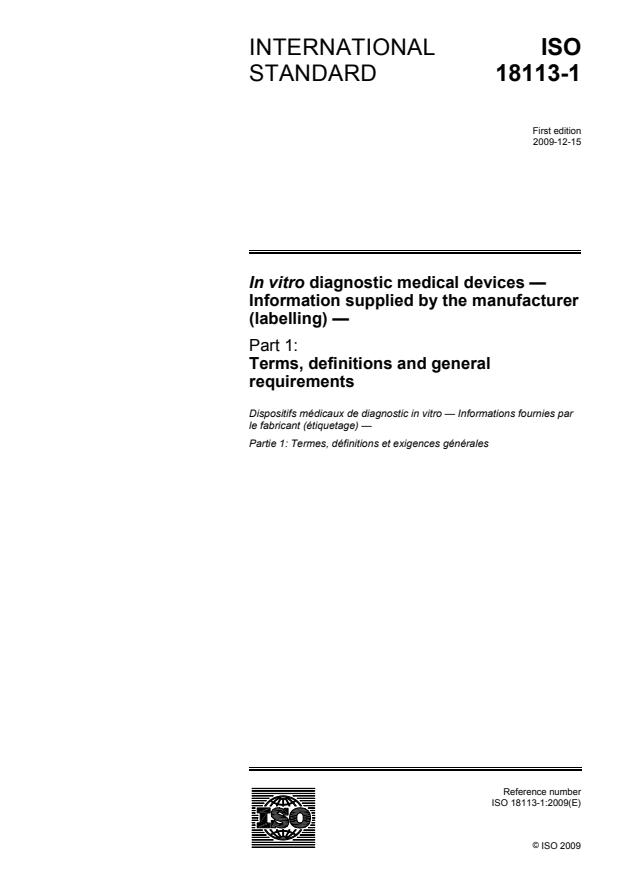
INTERNATIONAL ISO
STANDARD 18113-1
First edition
2009-12-15
In vitro diagnostic medical devices —
Information supplied by the manufacturer
(labelling) —
Part 1:
Terms, definitions and general
requirements
Dispositifs médicaux de diagnostic in vitro — Informations fournies par
le fabricant (étiquetage) —
Partie 1: Termes, définitions et exigences générales
Reference number
©
ISO 2009
PDF disclaimer
This PDF file may contain embedded typefaces. In accordance with Adobe's licensing policy, this file may be printed or viewed but
shall not be edited unless the typefaces which are embedded are licensed to and installed on the computer performing the editing. In
downloading this file, parties accept therein the responsibility of not infringing Adobe's licensing policy. The ISO Central Secretariat
accepts no liability in this area.
Adobe is a trademark of Adobe Systems Incorporated.
Details of the software products used to create this PDF file can be found in the General Info relative to the file; the PDF-creation
parameters were optimized for printing. Every care has been taken to ensure that the file is suitable for use by ISO member bodies. In
the unlikely event that a problem relating to it is found, please inform the Central Secretariat at the address given below.
© ISO 2009
All rights reserved. Unless otherwise specified, no part of this publication may be reproduced or utilized in any form or by any means,
electronic or mechanical, including photocopying and microfilm, without permission in writing from either ISO at the address below or
ISO's member body in the country of the requester.
ISO copyright office
Case postale 56 • CH-1211 Geneva 20
Tel. + 41 22 749 01 11
Fax + 41 22 749 09 47
E-mail copyright@iso.org
Web www.iso.org
Published in Switzerland
ii © ISO 2009 – All rights reserved
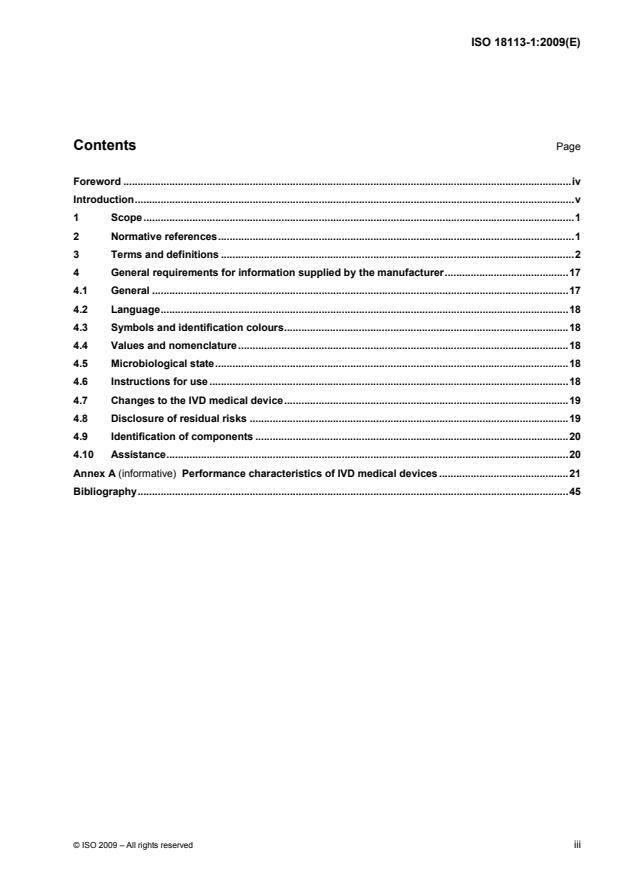
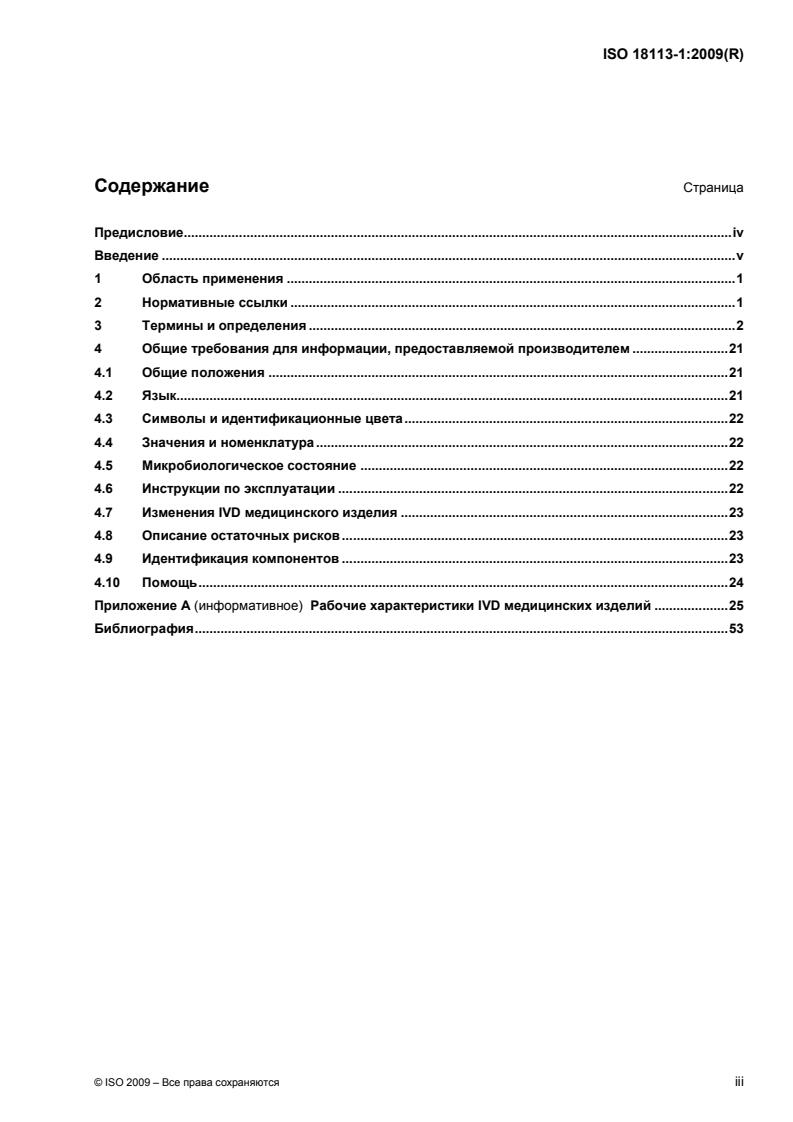
Contents Page
Foreword .iv
Introduction.v
1 Scope.1
2 Normative references.1
3 Terms and definitions .2
4 General requirements for information supplied by the manufacturer.17
4.1 General .17
4.2 Language.18
4.3 Symbols and identification colours.18
4.4 Values and nomenclature.18
4.5 Microbiological state.18
4.6 Instructions for use .18
4.7 Changes to the IVD medical device.19
4.8 Disclosure of residual risks .19
4.9 Identification of components .20
4.10 Assistance.20
Annex A (informative) Performance characteristics of IVD medical devices .21
Bibliography.45
Foreword
ISO (the International Organization for Standardization) is a worldwide federation of national standards bodies
(ISO member bodies). The work of preparing International Standards is normally carried out through
ISO technical committees. Each member body interested in a subject for which a technical committee has
been established has the right to be represented on that committee. International organizations, governmental
and non-governmental, in liaison with ISO, also take part in the work. ISO collaborates closely with the
International Electrotechnical Commission (IEC) on all matters of electrotechnical standardization.
International Standards are drafted in accordance with the rules given in the ISO/IEC Directives, Part 2.
The main task of technical committees is to prepare International Standards. Draft International Standards
adopted by the technical committees are circulated to the member bodies for voting. Publication as an
International Standard requires approval by at least 75 % of the member bodies casting a vote.
Attention is drawn to the possibility that some of the elements of this document may be the subject of patent
rights. ISO shall not be held responsible for identifying any or all such patent rights.
ISO 18113-1 was prepared by Technical Committee ISO/TC 212, Clinical laboratory testing and in vitro
diagnostic test systems.
ISO 18113 consists of the following parts, under the general title In vitro diagnostic medical devices —
Information supplied by the manufacturer (labelling):
⎯ Part 1: Terms, definitions and general requirements
⎯ Part 2: In vitro diagnostic reagents for professional use
⎯ Part 3: In vitro diagnostic instruments for professional use
⎯ Part 4: In vitro diagnostic reagents for self-testing
⎯ Part 5: In vitro diagnostic instruments for self-testing
iv © ISO 2009 – All rights reserved
Introduction
Manufacturers of in vitro diagnostic (IVD) medical devices supply users with information to enable the safe
use and expected performance of their devices. Traditionally, this information has been provided in the form of
labels, package inserts and user manuals, where the type and level of detail would depend on the intended
uses and country-specific regulations.
The Global Harmonization Task Force (GHTF) encourages convergence of the evolution of regulatory
systems for medical devices at the global level. The goal is to facilitate trade while preserving the right of
participating members to address the protection of public health by regulatory means. Consistent worldwide
labelling requirements offer significant benefits to manufacturers, users, patients and regulatory authorities.
Eliminating differences among regulatory jurisdictions could allow patients earlier access to new technologies
and treatments by decreasing the time necessary to gain regulatory compliance. See Reference [36]. This
part of ISO 18113 provides a basis for harmonization of labelling requirements for IVD medical devices.
The GHTF has established guiding principles that apply to the labelling of medical devices. See Reference
[36]. These principles have been incorporated into the ISO 18113 series. Of particular note, GHTF states that
country-specific requirements for the content, wording and format of labels and instructions for use should be
kept to a minimum, and eliminated over time as the opportunities arise.
This part of ISO 18113 contains a comprehensive list of terms and definitions necessary to develop the
labelling for IVD medical devices. Internationally agreed-upon definitions of important concepts promote
greater consistency in IVD medical device labelling. While the goal is to standardize the terminology used in
IVD medical device labelling to the extent possible, it is also recognised that current national and regional
usage by medical laboratories, healthcare providers, patients and regulatory authorities must be respected.
An obstacle to the timely and affordable availability of IVD medical devices in some countries is the
requirement for information to appear in multiple languages. Wherever practical, GHTF encourages the use of
standardized, internationally recognised symbols as long as safe use of the device is not compromised by
diminished understanding on the part of the user. This part of ISO 18113 provides support for the use of
symbols consistent with the GHTF objectives.
GHTF also encourages manufacturers to employ the most appropriate methods of delivering information. Until
recently, most information had been supplied as printed materials accompanying the IVD medical device.
Modern technologies enable instructions for use and technical information to be provided using a more
efficient means of delivery. Information can be digitally encoded on magnetic or optical media, displayed on a
screen, incorporated in the device, or even transmitted over the internet at the time of use. These advances
offer users the possibility of more timely availability of critical information, such as performance changes, and
offer manufacturers more effective means of disseminating the information.
The ISO 18113 series specifies requirements for information supplied by the manufacturer of IVD medical
devices. It consists of five parts, allowing it to address the specific needs of professional users and self-testing
users in the most appropriate manner. Furthermore, since manufacturers provide different types of
information for IVD reagents and instruments, their requirements are addressed in separate parts of the
ISO 18113 series.
This part of ISO 18113 is not intended to be used alone. It contains terms, definitions and general principles
that apply to all parts of ISO 18113. In addition, guidelines for the terms and definitions that describe the
performance characteristics of IVD medical devices are given in Annex A. This information is not repeated in
the subsequent parts, so this document is indispensable to the application of ISO 18113-2, ISO 18113-3,
ISO 18113-4 and ISO 18113-5.
ISO 18113-2 specifies the requirements for labels and instructions for use supplied with IVD reagents,
calibrators and control materials for professional use. ISO 18113-3 specifies the requirements for labels and
instructions for use supplied with IVD instruments for professional use. ISO 18113-4 specifies the
requirements for labels and instructions for use supplied with IVD reagents, calibrators and control materials
for self-testing. ISO 18113-5 specifies the requirements for labels and instructions for use supplied with IVD
instruments for self-testing.
Parts 1, 2 and 3 of ISO 18113 are the International Standards necessary for IVD medical devices intended for
medical laboratories and other professional uses; Parts 1, 4 and 5 of ISO 18113 are the International
Standards necessary for IVD medical devices intended for self-testing. However, recognising that
manufacturers often provide systems comprising an instrument with dedicated reagents, these International
Standards allow the flexibility to provide the necessary information in the most appropriate format for the
intended users, for example, a single operator's manual for an integrated IVD medical device system.
vi © ISO 2009 – All rights reserved
INTERNATIONAL STANDARD ISO 18113-1:2009(E)
In vitro diagnostic medical devices — Information supplied by
the manufacturer (labelling) —
Part 1:
Terms, definitions and general requirements
1 Scope
This part of ISO 18113 defines concepts, establishes general principles and specifies essential requirements
for information supplied by the manufacturer of IVD medical devices.
This part of ISO 18113 does not address language requirements, since that is the domain of national laws and
regulations.
This part of ISO 18113 does not apply to
a) IVD devices for performance evaluation (e.g., for investigational use only),
b) instrument marking,
c) material safety data sheets.
2 Normative references
The following referenced documents are indispensable for the application of this document. For dated
references, only the edition cited applies. For undated references, the latest edition of the referenced
document (including any amendments) applies.
ISO 1000, SI units and recommendations for the use of their multiples and of certain other units
ISO 13485, Medical devices — Quality management systems — Requirements for regulatory purposes
ISO 14971, Medical devices — Application of risk management to medical devices
ISO 15223-1, Medical devices — Symbols to be used with medical device labels, labelling and information to
be supplied — Part 1: General requirements
IEC 62366, Medical devices — Application of usability engineering to medical devices
EN 980, Symbols for use in the labelling of medical devices
3 Terms and definitions
For the purposes of this document and ISO 18113, Parts 2-5, the following terms and definitions apply.
However, definitions provided in national and regional regulations shall take precedence. Furthermore, while
the terms and definitions in International Standards are preferred, the terms and definitions used in the
information supplied by an IVD manufacturer shall be subject to the requirements of 4.6.2.
Where synonyms are given, either term may be used but the first term is preferred.
Some definitions had to be modified for relevance to IVD labelling or to conform to ISO terminology rules. In
these cases, a note indicates that the definition has been adapted and gives the source.
In some cases, additional notes or modifications to existing notes were needed to clarify the application to IVD
medical devices, and notes that did not apply to IVD medical devices were omitted. Such cases are not
considered modifications of the definition and are not identified as “adapted”.
Common English dictionary definitions apply to non-defined concepts, such as apparatus, device, constituent,
equipment, evaluation, instrument, magnitude, material, part, phenomenon, property, reaction, signal,
substance and system.
See Annex A for additional terms and definitions that may be used by IVD manufacturers to describe
performance claims.
3.1
accessory
article intended explicitly by its manufacturer to be used together with an IVD medical device
⎯ to enable the IVD medical device to achieve its intended purpose or
⎯ to augment or extend the capabilities of the IVD medical device in the fulfilment of its intended purpose
NOTE Adapted from Reference [37], 5.0, Note 3.
3.2
advisory notice
communication issued by an organization, subsequent to delivery of a medical device, to provide
supplementary information and/or to advise what action should be taken in
⎯ the use of a medical device,
⎯ the modification of a medical device,
⎯ the return of a medical device to its manufacturer,
⎯ the destruction of a medical device
NOTE Issue of an advisory notice might be required to comply with national or regional regulations.
[ISO 13485:2003, definition 3.3]
3.3
analyte
constituent of a sample with a measurable property
EXAMPLES In “mass of protein in 24-hour urine”, “protein” is the analyte and “mass” is the property. In “concentration
of glucose in plasma”, “glucose” is the analyte and “concentration” is the property. In both cases, the full phrase
designates the measurand (3.39).
NOTE Adapted from ISO 17511:2003, definition 3.2.
2 © ISO 2009 – All rights reserved
3.4
authorized representative
any natural or legal person established within a country or jurisdiction who has received a mandate from the
manufacturer to act on his behalf for specified tasks with regard to the latter's obligations under that country's
or jurisdiction's legislation
[38]
NOTE 1 In the European Union, Directive 98/79/EC requires the manufacturer to designate an “EC authorized
representative”, established in the European Community if the manufacturer is not located in the European Community.
NOTE 2 Adapted from Reference [39].
3.5
batch
lot
defined amount of material that is uniform in its properties and has been produced in one process or series of
processes
NOTE 1 The material can be either starting material, intermediate material or finished product.
NOTE 2 Adapted from EN 375:2001, definition 3.2.
3.6
batch code
lot number
distinctive set of numbers and/or letters that specifically identifies a batch and permits its manufacturing,
packaging, labelling and distribution history to be traced
NOTE Adapted from EN 375:2001, definition 3.3, Reference [40], 820.3 (c), and Reference [41], Section I.
3.7
biological reference interval
reference interval
specified interval of the distribution of values taken from a biological reference population
EXAMPLE The 0,95 biological reference interval for sodium ion concentration values in serum from a population of
healthy male and female adults is 135 mmol/l to 145 mmol/l.
NOTE 1 A reference interval is commonly defined as the central 95 % interval. Another size or an asymmetrical
location of the reference interval could be more appropriate in particular cases.
NOTE 2 A reference interval can depend upon the type of primary samples and the examination procedure used.
NOTE 3 In some cases, only one biological reference limit is important, usually an upper limit, “x”, so that the
corresponding biological reference interval would be less than or equal to “x”.
NOTE 4 Terms such as “normal range”, “normal values”, and “clinical range” are ambiguous and therefore discouraged.
NOTE 5 Adapted from References [42], [43], [44] and [45].
3.8
biological reference population
reference population
group of individuals in a well-defined state of health or disease
NOTE 1 When biological reference intervals are provided by a manufacturer in the instructions for use, laboratories
using the IVD medical device are responsible for verifying that the biological reference populations represent the
populations serviced by the laboratories.
NOTE 2 A biological reference population can be a defined homogenous group of apparently healthy individuals or
individuals with a specific medical condition. The concept allows for relating the reference interval to age, gender and
ethnicity of the reference population, as appropriate.
NOTE 3 Adapted from References [42], [43], [44] and [45].
3.9
calibration
operation that, under specified conditions in a first step, establishes a relationship between the quantity values
with measurement uncertainties provided by measurement standards and corresponding measurement
indications with associated measurement uncertainties and, in a second step, uses this information to
establish a relationship for obtaining a measurement result from an indication
NOTE 1 Calibration permits either the assignment of values of the measurands to the measurement indications
provided by the measuring instrument, or the determination of a correction with respect to the values provided by the
measuring instrument.
NOTE 2 Calibration is sometimes confused with adjustment of a measuring system, often mistakenly called self-
calibration, or with calibration verification (3.10).
[ISO/IEC Guide 99:2007, definition 2.39]
3.10
calibration verification
verification of calibration
confirmation that stated trueness claims for an IVD measuring system are achieved
NOTE 1 Calibration verification requires reference materials with assigned values at concentrations appropriate for the
intended use.
NOTE 2 Calibration verification is sometimes confused with calibration (3.9), linearity verification or routine control
procedures.
3.11
calibrator
measurement standard used in the calibration of an IVD instrument or system
NOTE Adapted from ISO/IEC Guide 99:2007, 5.12.
3.12
component
part of a finished, packaged and labelled IVD medical device
EXAMPLES Raw material, substance, piece, part, software, firmware, labelling or assembly.
NOTE 1 Typical kit components include antibody solutions, buffer solutions, calibrators and/or control materials.
NOTE 2 Adapted from Reference [40], 820.3(c).
3.13
control material
substance, material or article intended by its manufacturer to be used to verify the performance characteristics
of an IVD medical device
[EN 375:2001, definition 3.5]
3.14
control procedure
set of operations at the point of use, described specifically, intended to monitor the performance
characteristics of an IVD medical device and fulfil requirements for quality
NOTE 1 Control procedures can be intended to monitor all or part of the IVD examination process, from the collection
of the sample to reporting the result of the examination.
NOTE 2 Adapted from ISO 15198:2004, definition 3.5.
4 © ISO 2009 – All rights reserved
3.15
distributor
person or legal entity that furthers the marketing and/or selling of a device from the original place of
manufacture to the ultimate user without modifying the device, its packaging or its labelling
NOTE Adapted from Reference [46], 803.3 (g).
3.16
examination
set of operations having the object of determining the value or characteristics of a property
NOTE 1 In some disciplines (e.g., microbiology) an examination is the total activity of a number of tests, observations
or measurements.
NOTE 2 Laboratory examinations that determine the value of a property are called quantitative examinations; those
that determine the characteristics of a property are called qualitative examinations.
NOTE 3 In clinical chemistry, laboratory examinations have been called assays or tests.
[ISO 15189:2007, definition 3.4]
3.17
expiry date
expiration date
upper limit of the time interval during which the performance characteristics of a material stored under
specified conditions can be assured
NOTE 1 Expiry dates are assigned to IVD reagents, calibrators, control materials and other components by the
manufacturer, based on experimentally determined stability properties (see 3.68).
NOTE 2 Guidelines for determining the stability of IVD medical devices are found in EN 13640.
NOTE 3 Adapted from EN 375:2001, definition 3.6.
3.18
graphical symbol
visually perceptible figure used to transmit information independently of language
[ISO/IEC 80416-1:2001, definition 3.1]
3.19
harm
physical injury or damage to the health of people, or damage to property or the environment
[ISO/IEC Guide 51:1999, definition 3.3]
3.20
hazard
potential source of harm
[ISO/IEC Guide 51:1999, definition 3.5]
3.21
hazardous situation
circumstance in which people, property or the environment are exposed to one or more hazards
NOTE Incorrect IVD examination results can contribute to a hazardous situation for a patient. See ISO 14971:2007,
Annex H.
[ISO/IEC Guide 51:1999, definition 3.6]
3.22
hazardous waste
waste that is potentially harmful to human beings, property or the environment
EXAMPLES Used reagent strips contaminated with human blood; reagent solution containing sodium azide;
decommissioned instruments containing heavy metals.
NOTE 1 Includes waste that is flammable, combustible, ignitable, corrosive, toxic, reactive, injurious or infectious.
NOTE 2 Adapted from ISO 15190:2003, definition 3.13.
3.23
healthcare provider
individual authorized to deliver health services to a patient
EXAMPLES Physician, nurse, ambulance attendant, dentist, diabetes educator, laboratory technician, medical
assistant, medical specialist, respiratory care practitioner.
NOTE Adapted from Reference [41].
3.24
immediate container
primary container
packaging that protects the contents from contamination and other effects of the external environment
EXAMPLES Sealed vial, ampoule or bottle, foil pouch, sealed plastic bag.
NOTE Does not include package liners.
[EN 375:2001, definition 3.7]
3.25
importer
person or legal entity who brings goods, or causes goods to be brought into a country from another country
NOTE 1 Importers are not permitted to repackage the goods or change their container, packaging or labelling in some
jurisdictions, including the EU and USA.
NOTE 2 Adapted from Reference [46], 803.3 (m).
3.26
in vitro diagnostic instrument
IVD instrument
equipment or apparatus intended by a manufacturer to be used as an IVD medical device
NOTE Adapted from EN 591:2001, definition 3.5.
3.27
in vitro diagnostic medical device
IVD medical device
device, whether used alone or in combination, intended by the manufacturer for the in vitro examination of
specimens derived from the human body solely or principally to provide information for diagnostic, monitoring
or compatibility purposes and including reagents, calibrators, control materials, specimen receptacles,
software, and related instruments or apparatus or other articles
NOTE This is the definition adopted by the GHTF in [47].
6 © ISO 2009 – All rights reserved
3.28
in vitro diagnostic reagent
IVD reagent
chemical, biological or immunological components, solutions or preparations intended by the manufacturer to
be used as an IVD medical device
NOTE Adapted from EN 375:2001, definition 3.9.
3.29
information supplied by the manufacturer
labelling
written, printed or graphic matter
⎯ affixed to an IVD medical device or any of its containers or wrappers or
⎯ provided for use with an IVD medical device,
related to identification and use, and giving a technical description, of the IVD medical device, but excluding
shipping documents
EXAMPLES Labels, instructions for use.
NOTE 1 In IEC standards, documents provided with a medical device and containing important information for the
responsible organization or operator, particularly regarding safety, are called “accompanying documents”.
NOTE 2 Catalogues and material safety data sheets are not considered labelling of IVD medical devices.
NOTE 3 Adapted from ISO 13485:2003, definition 3.6.
3.30
instructions for use
information supplied by the manufacturer to enable the safe and proper use of an IVD medical device
NOTE 1 Includes the directions supplied by the manufacturer for the use, maintenance, troubleshooting and disposal of
an IVD medical device, as well as warnings and precautions.
NOTE 2 Adapted from EN 376:2002, definition 3.9 and EN 591:2001, definition 3.3.
3.31
intended use
intended purpose
objective intent of an IVD manufacturer regarding the use of a product, process or service as reflected in the
specifications, instructions and information supplied by the IVD manufacturer
NOTE 1 Intended use statements for IVD labelling can include two components: a description of the functionality of the
IVD medical device (e.g., an immunochemical measurement procedure for the detection of analyte “x” in serum or plasma),
and a statement of the intended medical use of the examination results.
NOTE 2 This is the definition adopted by the GHTF in Reference [36].
3.32
kit
set of components that are packaged together and intended to be used to perform a specific IVD examination
NOTE 1 Kit components can include reagents (such as antibodies, enzymes, buffer and diluents), calibrators, controls
and other articles and materials.
NOTE 2 Adapted from EN 375:2001, definition 3.10.
3.33
label
printed, written or graphic information placed on a medical device or its container
NOTE 1 A label permanently affixed to an IVD instrument is considered marking (3.37).
NOTE 2 Adapted from EN 375:2001, definition 3.12.
3.34
lay person
individual without formal training in a relevant medical field or discipline
EXAMPLE Person who performs self-testing without having a medical education.
NOTE Adapted from EN 376:2002, definintion 3.13.
3.35
limitation of the procedure
specific situation in which an IVD examination procedure might not perform as intended
NOTE 1 Factors that affect the performance of an IVD examination procedure can be physiological as well as
analytical.
NOTE 2 Adapted from Reference [48].
3.36
manufacturer
natural or legal person responsible for the design, manufacture, fabrication, assembly, packaging or labelling
of a medical device, for assembling a system, or adapting a medical device before it is placed on the market
and/or put into service, regardless of whether these operations are carried out by that person or on their
behalf by a third party
NOTE 1 Provisions of national or regional regulations could apply to the definition of manufacturer.
NOTE 2 Manufacturer includes those who perform the functions of contract sterilization, installation, relabelling,
remanufacturing, repacking or specification development, and initial distributors of foreign entities performing these
functions.
NOTE 3 A harmonized definition of "manufacturer" is being developed by the GHTF.
[ISO 14971:2007, definition 2.8]
3.37
marking
inscription, in writing or as a graphical symbol, permanently affixed to a medical device
NOTE 1 Marking is a label permanently affixed to an IVD instrument (3.26).
NOTE 2 Adapted from IEC 61010-2-101:2002, definition 3.106.
3.38
material safety data sheet
MSDS
document prepared in accordance with regulatory requirements for occupational safety to convey information
about a hazardous chemical substance
NOTE 1 Typically describes physical properties, health hazards, toxicity, fire and reactivity properties, and provides
storage and handling precautions.
NOTE 2 Material safety data sheets are not considered part of IVD medical device labelling.
NOTE 3 Adapted from Reference [49], 1910.1200 (c) and 1910.1200 (g).
8 © ISO 2009 – All rights reserved
3.39
measurand
quantity intended to be measured
NOTE 1 The specification of a measurand in laboratory medicine requires knowledge of the kind of quantity (e.g., mass
concentration), a description of the matrix carrying the quantity (e.g., blood plasma), and the chemical entities involved
(e.g., the analyte).
NOTE 2 The measurand can be a biological activity.
NOTE 3 See 3.3 for other examples of IVD measurands.
NOTE 4 In chemistry, “analyte”, or the name of a substance or compound, are terms sometimes used for “measurand”.
This usage is erroneous because these terms do not refer to quantities.
[ISO/IEC Guide 99:2007, definition 2.3]
3.40
measurement
process of experimentally obtaining one or more quantity values that can reasonably be attributed to a
quantity
NOTE 1 In chemistry, “analyte”, or the name of a substance or compound, are terms sometimes used for “measurand”.
This usage is erroneous because these terms do not refer to quantities.
NOTE 2 Measurement implies comparison of quantities or counting of entities.
NOTE 3 Measurement presupposes description of the quantity commensurate with the intended use of the
measurement result, of a measurement procedure, and of a calibrated measuring system operating according to the
specified measurement.
NOTE 4 The operations can be performed automatically.
[ISO/IEC Guide 99:2007, definition 2.1]
3.41
measurement method
generic description of a logical organization of operations used in a measurement
NOTE 1 A measurement method is used in a specific measurement procedure (3.44).
NOTE 2 Measurement methods can be qualified in various ways such as direct measurement method and indirect
measurement method. See IEC 60050-300 for further information.
[ISO/IEC Guide 99:2007, definition 2.5].
3.42
measurement model
mathematical relation among all quantities known to be involved in a measurement
EXAMPLE Four-parameter logistic function for fitting sigmoidal measurement indications to calibrator concentrations
in immunochemical measurement procedures.
NOTE 1 A general form of the measurement model is the equation h(Y, X , K, X ) = 0, where Y, the output quantity in
1 n
the measurement model, is the measurand that is to be inferred from information about input quantities in the
measurement model X , K, X .
1 n
NOTE 2 In more complex cases where there are two or more output quantities, the measurement model consists of
more than one equation.
NOTE 3 In clinical chemistry, measurement models have also been called calibration models.
[ISO/IEC Guide 99:2007, 2.48]
3.43
measurement principle
principle of measurement
phenomenon serving as a basis of a measurement
EXAMPLES
a) Ion selective electrode applied to the measurement of sodium activity;
b) Antibody affinity applied to the measurement of thyroid stimulating hormone (TSH) concentration;
c) Liquid chromatography applied to the measurement of digoxin concentration.
NOTE The phenomenon can be of a physical, chemical or biological nature.
[ISO/IEC Guide 99:2007, definition 2.4]
3.44
measurement procedure
detailed description of a measurement according to one or more measurement principles and to a given
measurement method, based on a measurement model and including any calculation necessary to obtain a
measurement result
NOTE 1 A measurement procedure is usually documented in sufficient detail to enable an operator to perform a
measurement.
NOTE 2 A measurement procedure can include a statement concerning a target measurement uncertainty.
[ISO/IEC Guide 99:2007, definition 2.6]
3.45
measurement result
set of quantity values being attributed to a measurand together with any other available relevant information
NOTE 1 In many fields of metrology, a measurement result is expressed as a single measured quantity value and a
measurement uncertainty. In laboratory medicine, measurement results are usually expressed as single measured
quantity values.
NOTE 2 A measurement generally provides information about the set of quantity values, such that some are more
representative of the measurand than others. This can be demonstrated in the form of a probability density function.
[81]
NOTE 3 In the traditional literature and in the previous edition of the VIM , measurement result was defined as a
value attributed to a measurand and explained to mean a measurement indication, or an uncorrected result, or a corrected
result, or an average of several values, according to the context.
[ISO/IEC Guide 99:2007, definition 2.9]
3.46
measuring interval
set of values of quantities of the same kind that can be measured by a given measuring instrument or
measuring system with specified instrumental uncertainty, under defined conditions
NOTE 1 The measuring interval over which the performance characteristics of an IVD medical device have been
validated has been called the reportable range.
NOTE 2 The lower limit of a measurement interval should not be confused with the detection limit (A.3.14). See A.2.8
for further information.
NOTE 3 For a discussion of the difference between interval and range, see A.2.11.
[ISO/IEC Guide 99:2007, definition 4.7]
10 © ISO 2009 – All rights reserved
3.47
medical device
instrument, apparatus, implement, machine, appliance, implant, in vitro reagent or calibrator, software,
material or other similar or related article, intended by the manufacturer to be used, alone or in combination,
for human beings for one or more of the specific purposes of
⎯ diagnosis, prevention, monitoring, treatment or alleviation of disease,
⎯ diagnosis, monitoring, treatment, alleviation of, or compensation for, an injury,
⎯ investigation, replacement, modification or support of the anatomy or of a physiological process,
⎯ supporting or sustaining life,
⎯ control of conception,
⎯ disinfection of medical devices,
⎯ providing information for medical purposes by means of in vitro examination of specimens derived from
the human body,
and which does not achieve its primary intended action in or on the human body by pharmacological,
immunological or metabolic means, but which can be assisted in its intended function by such means
[ISO 13485:2003, definition 3.7]
NOTE 1 The term medical device includes in vitro diagnostic medical devices.
NOTE 2 This is the definition adopted by the GHTF in Reference [37].
NOTE 3 See Clause 3 of ISO 13485:2003 for additional examples of medical devices.
3.48
metrological traceability
property of a measurement result whereby the result can be related to a reference through a documented
unbroken chain of calibrations, each contributing to the measurement uncertainty
NOTE 1 For this definition, a reference can be a definition of a measurement unit through its practical realization, or a
measurement procedure including the measurement unit for a nonordinal quantity, or a measurement standard.
NOTE 2 Metrological traceability requires an established calibration hierarchy. The sequence of measurement
standards and calibrations which is used to relate a measurement result to a reference is called a traceability chain. A
metrological traceability chain is used to establish metrological traceability of a measurement result, including calibrator
[16] [18]
values. See ISO 17511 and ISO 18153 for examples of traceability chains pertaining to IVD medical devices.
NOTE 3 Specification of the stated reference must include the time at which this reference was used in establishing the
calibration hierarchy, along with any other relevant metrological information about the reference, such as when the first
calibration in the calibration hierarchy was performed.
NOTE 4 For measurements with more than one input quantity in the measurement model, each of the quantity values
should itself be metrologically traceable and the calibration hierarchy involved can form a branched structure or a network.
The effort involved in establishing metrological traceability for each input quantity should be commensurate with its relative
contribution to the measurement result.
NOTE 5 A comparison between two measurement standards can be viewed as a calibration if the comparison is used
to check and, if necessary, correct the quantity value and measurement uncertainty attributed to one of the measurement
standards.
NOTE 6 The abbreviated term traceability is sometimes used to mean metrological traceability as well as other
concepts, such as sample traceability or document traceability or instrument traceability or material traceability, where the
history (trace) of an item is meant. Therefore, the full term of metrological traceability is preferred if there is any chance of
confusion.
[ISO/IEC Guide 99:2007, definition 2.41]
3.49
outer container
sales packaging
material used in the packaging of the immediate container or containers of an IVD medical device, which can
consist of a single component, a kit or an assembly of different or identical components
NOTE Adapted from EN 375:2001, definition 3.13.
3.50
performance characteristic
metrological property
one of the parameters used to define the performance of an IVD medical device
EXAMPLES Detection limit, precision, specificity.
NOTE Information about more than one performance characteristic is usually required to evaluate the suitability of an
IVD medical device for its intended medical use.
3.51
performance claim
specification of a performance characteristic of an IVD medical device as documented in the information
supplied by the manufacturer
NOTE 1 This can be based upon prospective performance studies, available performance data or studies published in
the scientific literature.
NOTE 2 Adapted from EN 13612:2002, definition 2.7.
3.52
performance evaluation
investigation of a device intended to become an IVD medical device for the purpose of establishing or
verifying its performance claims
NOTE Adapted from EN 13612:2002, definition 2.8.
3.53
precaution
statement that alerts users to special care or activities necessary for safe and effective use of an IVD medical
device or to avoid damage to the IVD medical device that could occur as a result of use, including misuse
NOTE 1 The distinction between warnings and precautions is a matter of degree, considering the likelihood and
seriousness of the hazard. See the definition of warning (3.74).
NOTE 2 Adapted from Reference [50].
3.54
primary sample
specimen
discrete portion of a body fluid or tissue taken for examination, study or analysis of one or more quantities or
characteristics to determine the character of the whole
NOTE 1 GHTF uses the term specimen in its harmonized guidance documents to mean a sample (3.64) of biological
origin intended for examination by a medical laboratory.
NOTE 2 Adapted from Reference [51].
12 © ISO 2009 – All rights reserved
3.55
primary sample collection device
specimen collection device
apparatus specifically intended by an IVD manufacturer to obtain, contain and preserve a body fluid or tissue
for in vitro diagnostic examination
NOTE 1 Includes devices intended to store a primary sample prior to examination.
NOTE 2 Includes both vacuum and non-vacuum primary sample collection devices.
NOTE 3 Adapted from Reference [38], Article 1, 2(b).
3.56
professional use
designation that an IVD medical device is intended for personnel who are qualified to perform IVD
examinations through special education and training
NOTE Adapted from EN 375:2001, definition 3.14.
3.57
reactive ingredient
constituent that participates in a chemical reaction intended to detect or measure a quantity
EXAMPLES Antibodies, specific viral nucleotide sequences, enzyme substrates.
NOTE 1 Constituents such as buffers, preservatives and stabilisers that do not participate in the chemical reaction are
not considered reactive ingredients.
NOTE 2 Adapted from EN 375:2001, definition 3.1.
3.58
reference material
material, sufficiently homogeneous and stable regarding one or more properties, with reference to specified
properties, which has been established to be fit for its intended use in measurement or in examination of
nominal properties
NOTE 1 Reference materials with or without assigned quantity values can be used for measurement precision control
whereas only reference materials with assigned quantity values can be used for calibration or measurement trueness
control.
NOTE 2 In a given measurement, a given reference material can only be used for either calibration or quality
assurance.
NOTE 3 Reference material comprises materials embodying quantities as well as nominal properties.
Examples of reference materials embodying quantities:
EXAMPLE 1 Water of stated purity, the dynamic viscosity of which is used to calibrate viscometers.
EXAMPLE 2 Blood plasma containing a stated mass fraction of glucose, used as a calibrator.
EXAMPLE 3 Human serum without an assigned quantity value for the inherent cholesterol concentration,
used only as a measuremen
...
NORME ISO
INTERNATIONALE 18113-1
Première édition
2009-12-15
Dispositifs médicaux de diagnostic in
vitro — Informations fournies par le
fabricant (étiquetage) —
Partie 1:
Termes, définitions et exigences
générales
In vitro diagnostic medical devices — Information supplied by the
manufacturer (labelling) —
Part 1: Terms, definitions and general requirements
Numéro de référence
©
ISO 2009
PDF – Exonération de responsabilité
Le présent fichier PDF peut contenir des polices de caractères intégrées. Conformément aux conditions de licence d'Adobe, ce fichier
peut être imprimé ou visualisé, mais ne doit pas être modifié à moins que l'ordinateur employé à cet effet ne bénéficie d'une licence
autorisant l'utilisation de ces polices et que celles-ci y soient installées. Lors du téléchargement de ce fichier, les parties concernées
acceptent de fait la responsabilité de ne pas enfreindre les conditions de licence d'Adobe. Le Secrétariat central de l'ISO décline toute
responsabilité en la matière.
Adobe est une marque déposée d'Adobe Systems Incorporated.
Les détails relatifs aux produits logiciels utilisés pour la création du présent fichier PDF sont disponibles dans la rubrique General Info
du fichier; les paramètres de création PDF ont été optimisés pour l'impression. Toutes les mesures ont été prises pour garantir
l'exploitation de ce fichier par les comités membres de l'ISO. Dans le cas peu probable où surviendrait un problème d'utilisation,
veuillez en informer le Secrétariat central à l'adresse donnée ci-dessous.
DOCUMENT PROTÉGÉ PAR COPYRIGHT
© ISO 2009
Droits de reproduction réservés. Sauf prescription différente, aucune partie de cette publication ne peut être reproduite ni utilisée sous
quelque forme que ce soit et par aucun procédé, électronique ou mécanique, y compris la photocopie et les microfilms, sans l'accord écrit
de l'ISO à l'adresse ci-après ou du comité membre de l'ISO dans le pays du demandeur.
ISO copyright office
Case postale 56 • CH-1211 Geneva 20
Tel. + 41 22 749 01 11
Fax + 41 22 749 09 47
E-mail copyright@iso.org
Web www.iso.org
Publié en Suisse
ii © ISO 2009 – Tous droits réservés
Sommaire Page
Avant-propos .iv
Introduction.v
1 Domaine d'application .1
2 Références normatives.1
3 Termes et définitions .2
4 Exigences générales relatives aux informations fournies par le fabricant.18
4.1 Généralités .18
4.2 Langue.19
4.3 Symboles et couleurs d'identification.19
4.4 Valeurs et nomenclature.19
4.5 Charge microbienne.19
4.6 Notices d'utilisation.19
4.7 Modifications apportées au dispositif médical de DIV .20
4.8 Présentation des risques résiduels.20
4.9 Identification des composants.20
4.10 Assistance.21
Annexe A (informative) Caractéristiques de performance des dispositifs médicaux de DIV .22
Bibliographie.46
Avant-propos
L'ISO (Organisation internationale de normalisation) est une fédération mondiale d'organismes nationaux de
normalisation (comités membres de l'ISO). L'élaboration des Normes internationales est en général confiée
aux comités techniques de l'ISO. Chaque comité membre intéressé par une étude a le droit de faire partie du
comité technique créé à cet effet. Les organisations internationales, gouvernementales et non
gouvernementales, en liaison avec l'ISO participent également aux travaux. L'ISO collabore étroitement avec
la Commission électrotechnique internationale (CEI) en ce qui concerne la normalisation électrotechnique.
Les Normes internationales sont rédigées conformément aux règles données dans les Directives ISO/CEI,
Partie 2.
La tâche principale des comités techniques est d'élaborer les Normes internationales. Les projets de Normes
internationales adoptés par les comités techniques sont soumis aux comités membres pour vote. Leur
publication comme Normes internationales requiert l'approbation de 75 % au moins des comités membres
votants.
L'attention est appelée sur le fait que certains des éléments du présent document peuvent faire l'objet de
droits de propriété intellectuelle ou de droits analogues. L'ISO ne saurait être tenue pour responsable de ne
pas avoir identifié de tels droits de propriété et averti de leur existence.
L'ISO 18113-1 a été élaborée par le comité technique ISO/TC 212, Laboratoires d'analyses de biologie
médicale et systèmes de diagnostic in vitro.
L'ISO 18113 comprend les parties suivantes, présentées sous le titre général Dispositifs médicaux de
diagnostic in vitro — Informations fournies par le fabricant (étiquetage):
⎯ Partie 1: Termes, définitions et exigences générales
⎯ Partie 2: Réactifs de diagnostic in vitro à usage professionnel
⎯ Partie 3: Instruments de diagnostic in vitro à usage professionnel
⎯ Partie 4: Réactifs de diagnostic in vitro pour auto-tests
⎯ Partie 5: Instruments de diagnostic in vitro pour auto-tests
iv © ISO 2009 – Tous droits réservés
Introduction
Les fabricants de dispositifs médicaux de diagnostic in vitro (DIV) fournissent aux utilisateurs des informations
permettant l'utilisation sans danger et les performances prévues de leurs dispositifs. Traditionnellement, ces
informations ont été fournies sous forme d'étiquettes, d'inserts d'emballage et de manuels d'utilisation, lorsque
le type et le niveau de détail dépendaient des utilisations prévues et des réglementations spécifiques à
chaque pays.
Le Groupe de travail sur l'harmonisation mondiale (GHTF) encourage la convergence de l'évolution des
systèmes réglementaires pour les dispositifs médicaux au niveau mondial. Le but est de favoriser le
commerce tout en préservant le droit des membres participants à traiter de la protection de la santé publique
par des moyens réglementaires. Des exigences de l'étiquetage cohérentes dans le monde entier offrent des
avantages significatifs pour les fabricants, les utilisateurs, les patients et les autorités de réglementation.
L'élimination des différences entre les juridictions de réglementation pourrait permettre aux patients d'accéder
plus précocement aux nouvelles technologies et aux nouveaux traitements en réduisant le temps nécessaire
à l'obtention d'une conformité aux réglementations. Voir Référence [35]. La présente partie de l'ISO 18113
fournit une base pour l'harmonisation des exigences relatives à l'étiquetage des dispositifs médicaux de DIV.
Le GHTF a établi des principes directeurs qui s'appliquent à l'étiquetage des dispositifs médicaux. Voir
Référence [35]. Ces principes ont été incorporés dans la série de l'ISO 18113. En particulier, le GHTF déclare
qu'il vaut mieux maintenir à un minimum les exigences spécifiques à chaque pays relatives au contenu, à la
rédaction et au format des étiquettes et des notices d'utilisation et de les supprimer au fil du temps à mesure
que les occasions se présentent.
La présente partie de l'ISO 18113 contient une liste exhaustive des termes et définitions nécessaires à
l'élaboration de l'étiquetage des dispositifs médicaux de DIV. Des définitions convenues au niveau
international pour les concepts importants assurent une plus grande cohérence de l'étiquetage des dispositifs
médicaux de DIV. Bien que l'objectif soit de normaliser la terminologie utilisée dans l'étiquetage des dispositifs
médicaux de DIV dans toute la mesure possible, il est toutefois admis qu'il faut respecter l'utilisation nationale
et régionale actuelle qu'en font les laboratoires d'analyses de biologie médicale, les prestataires de soins de
santé, les patients et les autorités de réglementation.
Un obstacle à la mise à disposition en temps utile et de façon abordable des dispositifs médicaux de DIV dans
certains pays est l'exigence que les informations apparaissent en plusieurs langues. Chaque fois que cela est
envisageable dans la pratique, le GHTF encourage l'emploi de symboles normalisés reconnus
internationalement tant que l'utilisation en toute sécurité du dispositif n'est pas compromise par une moindre
compréhension de la part de l'utilisateur. La présente partie de l'ISO 18113 fournit le support pour l'utilisation
de symboles compatibles avec les objectifs du GHTF.
Le GHTF invite également les fabricants à utiliser les méthodes les plus appropriées pour fournir les
informations. Jusqu'à une date récente, la plupart des informations étaient fournies sous forme de supports
imprimés accompagnant le dispositif médical de DIV. Les technologies modernes mettent à disposition des
moyens plus efficaces pour fournir les notices d'utilisation et les informations techniques. Les informations
peuvent être codées numériquement sur des supports magnétiques ou optiques, affichées sur un écran ou
incorporées dans le dispositif voire transmises par Internet au moment de l'utilisation. Ces avancées
permettent aux utilisateurs de disposer des informations cruciales en temps utile, telles que les modifications
de performance, tout en offrant aux fabricants un moyen plus efficace de diffuser les informations.
La série de l'ISO 18113 spécifie les exigences relatives aux informations fournies par le fabricant de
dispositifs médicaux de DIV. Elle est constituée de cinq parties, lui permettant de traiter de la manière la plus
appropriée les besoins spécifiques des utilisateurs professionnels et des utilisateurs d'auto-tests. En outre,
étant donné que les fabricants fournissent différents types d'informations relatives aux réactifs et
instruments de DIV, les exigences qui s'y rapportent ont été traitées dans des parties distinctes de la série
de l'ISO 18113.
La présente partie de l'ISO 18113 n’est pas censée être utilisée seule. Elle contient les termes, les définitions
et les principes généraux qui s'appliquent à toutes les normes. De plus, l'Annexe A donne des lignes
directrices sur les termes et définitions qui décrivent les caractéristiques de performance des dispositifs
médicaux de DIV. Ces informations ne sont pas reprises dans les parties ultérieures et donc la présente
partie de l'ISO 18113 est indispensable pour l'application de l'ISO 18113-2, de l'ISO 18113-3, de
l'ISO 18113-4 et de l'ISO 18113-5.
L'ISO 18113-2 spécifie les exigences relatives aux étiquettes et aux notices d'utilisation fournies avec les
réactifs de DIV, les étalons et les matériaux de contrôle pour usage professionnel. L'ISO 18113-3 spécifie les
exigences relatives aux étiquettes et aux notices d'utilisation fournies avec les instruments de DIV pour usage
professionnel. L'ISO 18113-4 spécifie les exigences relatives aux étiquettes et aux notices d'utilisation
fournies avec les réactifs de DIV, les étalons et les matériaux de contrôle pour auto-tests. L'ISO 18113-5
spécifie les exigences relatives aux étiquettes et aux notices d'utilisation fournies avec les instruments de DIV
pour auto-tests.
La présente partie de l'ISO 18113, l'ISO 18113-2 et l'ISO 18113-3 sont les Normes internationales
nécessaires pour les dispositifs médicaux de DIV destinés aux laboratoires d'analyses de biologie médicale et
autres usages professionnels; la présente partie de l'ISO 18113, l'ISO 18113-4, l'ISO 18113-5 sont les
Normes internationales nécessaires pour les dispositifs médicaux de DIV destinés aux auto-tests. Toutefois,
sachant que les systèmes fournis par les fabricants comprennent souvent un instrument avec les réactifs
dédiés, ces normes offrent la flexibilité de fournir les informations nécessaires dans le format le plus approprié
pour les utilisateurs prévus, par exemple un seul manuel d'utilisation pour un système intégré de dispositifs
médicaux de DIV.
vi © ISO 2009 – Tous droits réservés
NORME INTERNATIONALE ISO 18113-1:2009(F)
Dispositifs médicaux de diagnostic in vitro — Informations
fournies par le fabricant (étiquetage) —
Partie 1:
Termes, définitions et exigences générales
1 Domaine d'application
La présente partie de l'ISO 18113 définit les concepts, établit les principes généraux et spécifie les exigences
essentielles relatives aux informations fournies par le fabricant de dispositifs médicaux de DIV.
La présente partie de l'ISO 18113 ne traite pas des exigences relatives à la langue, car cela relève du
domaine des législations et réglementations nationales.
La présente partie de l'ISO 18113 ne s'applique pas
a) aux dispositifs de DIV utilisés pour l'évaluation des performances (par exemple pour un usage
expérimental uniquement),
b) au marquage des instruments,
c) aux fiches signalétiques des matériaux.
2 Références normatives
Les documents de référence suivants sont indispensables pour l'application du présent document. Pour les
références datées, seule l'édition citée s'applique. Pour les références non datées, la dernière édition du
document de référence s'applique (y compris les éventuels amendements).
ISO 1000, Unités SI et recommandations pour l'emploi de leurs multiples et de certaines autres unités
ISO 13485, Dispositifs médicaux — Systèmes de management de la qualité — Exigences à des fins
réglementaires
ISO 14971, Dispositifs médicaux — Application de la gestion des risques aux dispositifs médicaux
ISO 15223-1, Dispositifs médicaux — Symboles à utiliser avec les étiquettes, l'étiquetage et les informations à
fournir relatifs aux dispositifs médicaux — Partie 1: Exigences générales
CEI 62366, Dispositifs médicaux — Application de l'ingénierie de l'aptitude à l'utilisation aux dispositifs
médicaux
EN 980, Symboles utilisés pour l'étiquetage des dispositifs médicaux
3 Termes et définitions
Pour les besoins du présent document, les termes et définitions suivants s'appliquent. Toutefois, les
définitions données dans les réglementations nationales et régionales doivent prévaloir. En outre, alors que
les termes et définitions donnés dans les Normes internationales sont préférés, les termes et définitions
utilisés dans les informations fournies par un fabricant de dispositifs de DIV doivent être soumis aux
exigences de 4.6.2.
Lorsque des synonymes sont donnés, n'importe lequel des termes peut être utilisé, mais le premier terme est
préféré.
Certaines définitions doivent être modifiées pour s'adapter à l'étiquetage des dispositifs de DIV ou pour se
conformer aux règles terminologiques de l'ISO. Dans ce cas, une note indique que la définition a été adaptée
et en donne la source.
Dans certains cas, des notes supplémentaires ou des modifications apportées aux notes existantes ont été
nécessaires pour clarifier l'application aux dispositifs médicaux de DIV; les notes qui ne s'appliquent pas aux
dispositifs médicaux de DIV ont été supprimées. Ces cas ne sont pas considérés comme des modifications de
la définition et ne sont pas identifiés comme «adaptés».
Les définitions courantes des dictionnaires français s'appliquent aux concepts non définis, tels que
appareillage, dispositif, constituant, équipement, évaluation, instrument, magnitude, quantitatif, matériau,
partie, phénomène, propriété, réaction, signal, substance et système.
Voir l'Annexe A pour des termes et définitions supplémentaires qui peuvent être utilisés par des fabricants de
dispositifs de DIV pour décrire les revendications de performance.
3.1
accessoire
article désigné explicitement par le fabricant pour être utilisé avec un dispositif médical de DIV
⎯ pour permettre au dispositif médical de DIV afin de répondre à son usage prévu, ou
⎯ pour compléter ou étendre les capacités du dispositif médical de DIV de répondre à son usage prévu.
NOTE Adapté de la Référence [37], 5.0, NOTE 3.
3.2
fiche d'avertissement
notice diffusée par un organisme, suite à la livraison d'un dispositif médical, pour fournir des informations
supplémentaires et/ou donner des recommandations relatives à l'action corrective ou préventive qu'il convient
de prendre en compte lors
⎯ de l'utilisation d'un dispositif médical,
⎯ de la modification d'un dispositif médical,
⎯ du retour d'un dispositif médical à son fabricant,
⎯ de la destruction d'un dispositif médical.
NOTE La diffusion d'une fiche d'avertissement peut être requise pour satisfaire aux réglementations nationales ou
régionales.
[ISO 13485:2003, définition 3.3]
2 © ISO 2009 – Tous droits réservés
3.3
analyte
constituant d'un échantillon avec une propriété mesurable
EXEMPLES Dans l'expression «masse de protéine dans l'urine de 24 h», le terme «protéine» est l'analyte et le terme
«masse» la propriété. Dans l'expression «concentration du glucose dans le plasma», le terme «glucose» est l'analyte et le
terme «concentration» la propriété. Dans les deux cas, la longue expression désigne le mesurande (3.39).
NOTE Adapté de l'ISO 17511:2003, définition 3.2.
3.4
représentant autorisé
personne physique ou morale établie dans un pays ou dans une juridiction qui a reçu du fabricant un mandat
d'agir en son nom pour les tâches spécifiées en ce qui concerne les obligations de ce dernier dans le cadre
de la législation du pays ou de la juridiction en question
[38]
NOTE 1 Dans l'Union Européenne, la Directive 98/79/CE exige que le fabricant désigne un «représentant autorisé
CE» établi dans la Communauté Européenne si le fabricant n'est pas établi dans la Communauté Européenne.
NOTE 2 Adapté de la Référence [39].
3.5
lot
quantité définie de matériau dont les propriétés sont homogènes et qui a été produite en un procédé ou en
une série de procédés
NOTE 1 Le matériau peut être soit en vrac, soit sous forme de produit intermédiaire ou de produit fini.
NOTE 2 Adapté de l'EN 375:2001, définition 3.2.
3.6
numéro de lot
code de lot
association distinctive de chiffres et/ou de lettres qui identifie spécifiquement un lot et permet de retracer
l'historique de sa fabrication, de son emballage, de son étiquetage et de sa distribution
NOTE Adapté de l'EN 375:2001, définition 3.3, de la Référence [40], 820.3 (c) et de la Référence [41], Section I.
3.7
intervalle de référence biologique
intervalle de référence
intervalle spécifié de la distribution des valeurs prises dans une population de référence biologique
EXEMPLE L'intervalle de référence biologique de 0,95 pour les valeurs de la concentration des ions sodium dans le
sérum d'une population d'hommes et de femmes adultes sains est de 135 mmol/l à 145 mmol/l.
NOTE 1 Un intervalle de référence est couramment défini comme l'intervalle central de 95 %. Dans des cas particuliers,
une autre taille ou une forme asymétrique de l'intervalle de référence pourrait être plus appropriée.
NOTE 2 Un intervalle de référence peut dépendre du type d'échantillons primaires et de la méthode d'analyse utilisés.
NOTE 3 Dans certains cas, seule une limite de référence biologique est importante, en général une limite supérieure,
«x», afin que l'intervalle de référence biologique correspondant soit inférieur ou égal à «x».
NOTE 4 Les termes tels que «étendue normale», «valeurs normales» et «domaine clinique» sont ambigus et donc
déconseillés.
NOTE 5 Adapté des Références [42], [43], [44], et [45].
3.8
population de référence biologique
population de référence
groupe d'individus dont l'état de santé ou l'état pathologique est bien défini
NOTE 1 Lorsque des intervalles de référence biologiques sont fournis par un fabricant dans la notice d'utilisation, il
incombe aux laboratoires utilisant le dispositif médical de DIV de vérifier que les populations de référence biologique
représentent les populations desservies par les laboratoires.
NOTE 2 Une population de référence biologique peut être un groupe homogène défini d'individus apparemment sains
ou d'individus ayant un état médical spécifique. Le concept permet de relier l'intervalle de référence à l'âge, au sexe et à
l'appartenance ethnique de la population de référence, selon le cas.
NOTE 3 Adapté des Références [42], [43], [44], et [45].
3.9
étalonnage
opération qui, dans des conditions spécifiées, établit en une première étape une relation entre les valeurs et
les incertitudes de mesure associées qui sont fournies par des étalons et les indications de mesure
correspondantes avec les incertitudes associées, puis utilise en une seconde étape cette information pour
établir une relation permettant d'obtenir un résultat de mesure à partir d'une indication de mesure
NOTE 1 L'étalonnage permet soit l'attribution de valeurs de mesurandes à des indications de mesure fournies par
l'instrument de mesure, soit la détermination d'une correction par rapport aux valeurs fournies par l'instrument de mesure.
NOTE 2 L'étalonnage est parfois confondu avec l'ajustage d'un système de mesure, souvent appelé improprement
«auto-étalonnage» ou avec la vérification de l'étalonnage (3.10).
NOTE 3 Adapté de l'ISO/CEI Guide 99:2007, définition 2.39.
3.10
vérification de l'étalonnage
vérification d'étalonnage
confirmation que la justesse revendiquée pour un système de mesure de DIV est obtenue
NOTE 1 La vérification de l'étalonnage exige des matériaux de référence avec des valeurs attribuées aux
concentrations appropriées à l'utilisation prévue.
NOTE 2 La vérification de l'étalonnage est parfois confondue avec l'étalonnage (3.9), la vérification de la linéarité ou
les procédures de contrôle de routine.
3.11
agent d'étalonnage
étalon de mesure utilisé dans l'étalonnage d'un instrument ou d'un système de DIV
NOTE Adapté de l'ISO/CEI Guide 99:2007, définition 5.12.
3.12
élément
composant
constituant
partie d'un dispositif médical de DIV fini, emballé et étiqueté
EXEMPLES Matière première, substance, pièce, partie, logiciel, progiciel, étiquetage ou assemblage.
NOTE 1 Les composants types d'une trousse comprennent les solutions d'anticorps, les solutions tampons, les étalons
et/ou les matériaux de contrôle.
NOTE 2 Adapté de la Référence [40], 820.3 (c).
4 © ISO 2009 – Tous droits réservés
3.13
matériau de contrôle
substance, matériau ou article conçu par le fabricant pour vérifier les caractéristiques de performance d'un
dispositif médical de DIV
[EN 375:2001, définition 3.5]
3.14
procédure de contrôle
ensemble d'opérations mises en œuvre au point d'utilisation, décrit de manière spécifique, destiné à surveiller
les caractéristiques de performance d'un dispositif médical de DIV et répondre aux exigences requises pour la
qualité
NOTE 1 Les procédures de contrôle peuvent être destinées à surveiller tout ou partie du processus d'analyse de DIV,
depuis le recueil d'échantillon jusqu'au compte rendu du résultat d'analyse.
NOTE 2 Adapté de l'ISO 15198:2004, définition 3.5.
3.15
distributeur
personne physique ou morale qui promeut la commercialisation et/ou la vente d'un dispositif depuis
l'emplacement initial de fabrication jusqu'à l'utilisateur final sans modifier le dispositif, son emballage ou son
étiquetage
NOTE Adapté de la Référence [46], 803.3 (g).
3.16
analyse
ensemble d'opérations destinées à déterminer la valeur ou les caractéristiques d'une propriété
NOTE 1 Dans certaines disciplines (par exemple la microbiologie), une analyse correspond à la totalité des essais, des
observations ou des mesurages effectués.
[ISO 15189:2007, définition 3.4]
NOTE 2 Les analyses de laboratoire qui déterminent la valeur d'une propriété sont appelées «analyses quantitatives»;
celles qui déterminent les caractéristiques d'une propriété sont appelées «analyses qualitatives».
NOTE 3 En chimie clinique, les analyses de laboratoire ont été appelées «essais» ou «tests».
3.17
date de péremption
date d'expiration
limite supérieure de la durée pendant laquelle les caractéristiques de performance d'un matériau conservé
dans des conditions spécifiées peuvent être garanties
NOTE 1 Des dates de péremption sont attribuées aux réactifs de DIV, aux étalons, aux matériaux de contrôle et aux
autres éléments par le fabricant sur la base de propriétés de stabilité déterminées expérimentalement (voir 3.68).
NOTE 2 L'EN 13640 donne des lignes directrices pour la détermination de la stabilité des dispositifs médicaux de DIV.
NOTE 3 Adapté de l'EN 375:2001, définition 3.6.
3.18
symbole graphique
figure visuellement perceptible servant à transmettre des informations de manière indépendante du langage
[ISO/CEI 80416-1:2001, définition 3.1]
3.19
dommage
blessure physique ou atteinte à la santé des personnes, ou atteinte aux biens ou à l'environnement
[ISO/CEI Guide 51:1999, définition 3.3]
3.20
phénomène dangereux
risque
source potentielle de dommage
[ISO/CEI Guide 51:1999, définition 3.5]
3.21
situation dangereuse
situation dans laquelle des personnes, des biens ou l'environnement sont exposés à un ou plusieurs
phénomènes dangereux (3.20)
[ISO/CEI Guide 51:1999, définition 3.6]
NOTE Des résultats d'analyse de DIV incorrects peuvent contribuer à une situation dangereuse pour un patient. Voir
l'ISO 14971:2007, Annexe H.
3.22
déchet dangereux
déchet qui est potentiellement dommageable pour les personnes, les biens ou l'environnement
EXEMPLES Bandelettes usagées contaminées par du sang humain, solution de réactif contenant de l'azoture de
sodium et instruments déclassés contenant des métaux lourds.
NOTE 1 Sont inclus les déchets inflammables, combustibles, allumables, corrosifs, toxiques, réactifs, nocifs ou
infectieux.
NOTE 2 Adapté de l'ISO 15190:2003, définition 3.13.
3.23
prestataire de soins de santé
individu autorisé à fournir des services de santé à un patient
EXEMPLES Physicien, infirmière, ambulancier, dentiste, éducateur spécialisé en diabète, technicien de laboratoire,
assistant médical, médecin spécialiste, praticien de soins respiratoires.
NOTE Adapté de la Référence [41].
3.24
contenant primaire
emballage qui protège le(s) contenu(s) de toute contamination et/ou d'autres effets de l'environnement
extérieur
EXEMPLES Flacon, ampoule ou bouteille scellés, enveloppe métallisée et sac en plastique scellé.
NOTE Sont exclues les enveloppes intérieures d'emballage.
[EN 375:2001, définition 3.7]
3.25
importateur
personne physique ou morale qui apporte ou fait apporter des biens d'un pays dans un autre
NOTE 1 Les importateurs ne sont pas autorisés à remballer les produits ou à changer leur conteneur, leur emballage
ou leur étiquetage dans certaines juridictions, telles que l'UE et les USA.
NOTE 2 Adapté de la Référence [46], 803.3 (m).
6 © ISO 2009 – Tous droits réservés
3.26
instrument pour le diagnostic in vitro
instrument de DIV
équipement ou appareillage destiné par le fabricant pour être utilisé comme un dispositif médical de DIV
NOTE Adapté de l'EN 591:2001, définition 3.5.
3.27
dispositif médical de diagnostic in vitro
dispositif médical de DIV
dispositif, utilisé seul ou en combinaison, désigné par le fabricant pour l'examen in vitro d'échantillons
prélevés sur le corps humain uniquement ou principalement dans le but de fournir des informations à des fins
de diagnostic, de surveillance ou de compatibilité incluant les réactifs, les étalons, les matériaux de contrôle,
les réceptacles d'échantillons, les logiciels et les instruments ou appareillages associés ou autres articles
NOTE Cette définition est celle adoptée par le GHTF dans la Référence [47].
3.28
réactif de diagnostic in vitro
réactif de DIV
composant, solution ou préparation chimique, biologique ou microbiologique destiné(e) par le fabricant à être
utilisé(e) comme dispositif médical de DIV
NOTE Adapté de l'EN 375:2001, définition 3.9.
3.29
informations fournies par le fabricant
étiquetage
élément écrit, imprimé ou graphique
⎯ apposé sur un dispositif médical de DIV ou sur l'un de ses conteneurs ou emballages, ou
⎯ fourni pour être utilisé avec un dispositif médical de DIV,
relatif à l'identification, la description technique et l'utilisation du dispositif médical de DIV, mais excluant les
documents d'expédition
EXEMPLES Étiquettes, notice d'utilisation.
NOTE 1 Dans les normes CEI, les documents fournis avec un dispositif médical et contenant des informations
importantes pour l'organisation responsable ou l'opérateur, en particulier concernant la sécurité, sont appelés «documents
d'accompagnement».
NOTE 2 Les catalogues et les fiches de données de sécurité ne sont pas considérés comme un étiquetage des
dispositifs médicaux de DIV.
NOTE 3 Adapté de l'ISO 13485:2003, définition 3.6.
3.30
notice d'utilisation
notice d'emploi
instructions d'utilisation
informations fournies par le fabricant pour permettre l'utilisation correcte et sans danger d'un dispositif médical
de DIV
NOTE 1 Sont inclus les directions fournies par le fabricant pour l'utilisation, l'entretien, le dépannage et l'élimination
d'un dispositif médical de DIV et également les avertissements et les précautions à prendre.
NOTE 2 Adapté de l'EN 376:2002, définition 3.9 et de l'EN 591:2001, définition 3.3.
3.31
utilisation prévue
usage du produit
intention objective d'un fabricant DIV concernant l'utilisation d'un produit, d'un procédé ou d'un service, telle
que reflétée dans les spécifications, les instructions et les informations fournies par le fabricant de DIV
NOTE 1 Les déclarations d'utilisation prévue relatives à l'étiquetage en DIV peuvent comprendre deux composantes:
une description de la fonctionnalité du dispositif médical de DIV (par exemple une procédure de mesure immunochimique
ou la détection de l'analyte «x» dans le sérum ou dans le plasma) et une déclaration de l'utilisation médicale prévue des
résultats d'analyse.
NOTE 2 Il s'agit de la définition adoptée par le GHTF dans la Référence [36].
3.32
trousse
ensemble de composants qui sont emballés ensemble et destinés à être utilisés pour réaliser une analyse de
DIV spécifique
NOTE 1 Les composants d'une trousse peuvent comprendre les réactifs (tels que les anticorps, les enzymes, les
tampons et les diluants), les étalons, les témoins et autres articles et matériaux.
NOTE 2 Adapté de l'EN 375:2001, définition 3.10.
3.33
étiquette
toute information imprimée, écrite ou dessinée apposée sur un dispositif médical ou son conteneur
NOTE 1 Une étiquette apposée de façon permanente sur un instrument de DIV est considérée être un étiquetage
(3.37).
NOTE 2 Adaptée de l'EN 375:2001, défintion 3.12.
3.34
profane
individu sans formation formelle dans un domaine ou dans une discipline médical(e) considéré(e)
EXEMPLE Personne qui effectue des auto-tests sans avoir de formation médicale.
NOTE Adapté de l'EN 376:2002, définition 3.13.
3.35
limite de la procédure
situation spécifique dans laquelle la procédure d'analyse de DIV est susceptible de ne pas s'exécuter comme
prévu
NOTE 1 Les facteurs affectant la performance d'une procédure d'analyse de DIV peuvent être aussi bien
physiologiques qu'analytiques.
NOTE 2 Adapté de la Référence [48].
3.36
fabricant
personne physique ou légale responsable de la conception, de la fabrication, de l'assemblage, de l'emballage
ou de l'étiquetage d'un dispositif médical, de l'assemblage d'un système ou de l'adaptation d'un dispositif
médical avant qu'il ne soit mis sur le marché et/ou mis en service, que ces opérations soient réalisées par la
personne elle-même ou en son nom par une tierce partie
NOTE 1 Les dispositions des réglementations nationales ou régionales pourraient s'appliquer à la définition du
fabricant.
8 © ISO 2009 – Tous droits réservés
NOTE 2 «Fabricant» englobe ceux qui réalisent les fonctions de stérilisation, d'installation, de réétiquetage, de
refabrication, de remballage ou de développement de spécifications et les distributeurs initiaux d'entités étrangères
réalisant ces fonctions.
NOTE 3 Une définition harmonisée de «fabricant» est en cours d'élaboration par le GHTF.
[ISO 14971:2007, définition 2.8]
3.37
étiquetage
inscription, écrite ou en symbole graphique, apposée de façon permanente sur un dispositif médical
NOTE 1 Un étiquetage est une étiquette apposée de façon permanente sur un instrument de DIV (3.26).
NOTE 2 Adapté de la CEI 61010-2-101:2002, définition 3.106.
3.38
fiche de données de sécurité
FDS
document préparé conformément aux exigences réglementaires relatives à la sécurité au travail pour
transmettre des informations sur une substance chimique dangereuse
NOTE 1 Elle décrit habituellement les propriétés physiques, les dangers pour la santé, la toxicité, les propriétés au feu
et la réactivité et indique les précautions relatives à la conservation et à la manipulation.
NOTE 2 Les fiches de données de sécurité ne sont pas considérées comme faisant partie de l'étiquetage d'un
dispositif médical de DIV (3.27).
NOTE 3 Adapté de la Référence [49], 1910.1200 (c) et 1910.1200 (g).
3.39
mesurande
grandeur que l'on veut mesurer
NOTE 1 La spécification d'un mesurande en biologie médicale exige la connaissance de la nature de la grandeur (par
exemple la concentration massique), une description de la matrice dont la grandeur est une propriété (par exemple le
plasma sanguin) et les entités chimiques en jeu (par exemple l'analyte).
NOTE 2 Le mesurande peut être une activité biologique.
NOTE 3 Voir 3.3 pour d'autres exemples de mesurandes en DIV.
NOTE 4 En chimie, «analyte» ou le nom d'une substance ou d'un composé sont quelquefois utilisés à la place de
«mesurande». Cet usage est erroné puisque ces termes ne désignent pas des grandeurs.
NOTE 5 Adapté de l'ISO/CEI Guide 99:2007, définition 2.3.
3.40
mesurage
mesure
processus consistant à obtenir expérimentalement une ou plusieurs valeurs que l'on peut raisonnablement
attribuer à une grandeur
NOTE 1 En chimie, «analyte» ou le nom d'une substance ou d'un composé sont quelquefois utilisés à la place de
«mesurande». Cet usage est erroné puisque ces termes ne désignent pas des grandeurs.
NOTE 2 Un mesurage implique la comparaison de grandeurs ou le comptage d'entités.
NOTE 3 Un mesurage suppose une description de la grandeur compatible avec l'usage prévu du résultat de mesure,
une procédure de mesure et un système de mesure étalonné fonctionnant selon une procédure de mesure spécifiée,
incluant les conditions de mesure.
NOTE 4 Les opérations peuvent être effectuées automatiquement.
NOTE 5 Adapté de l'ISO/CEI Guide 99:2007, définition 2.1.
3.41
méthode de mesure
description générique de l'organisation logique des opérations mises en œuvre dans un mesurage
NOTE 1 Une méthode de mesure est utilisée dans une procédure de mesure (3.44) spécifique.
NOTE 2 Les méthodes de mesure peuvent être qualifiées de diverses façons telles que méthode de mesure directe et
méthode de mesure indirecte. Pour plus d'informations, voir la CEI 60050-300.
NOTE 3 Adapté de l'ISO/CEI Guide 99:2007, définition 2.5.
3.42
modèle de mesure
relation mathématique entre toutes les grandeurs qui interviennent dans un mesurage
EXEMPLE Fonction logistique à quatre paramètres servant à ajuster les indications de mesure sigmoïdales aux
concentrations d'étalon dans les procédures de mesure immunochimiques.
NOTE 1 Une forme générale d'un modèle de mesure est l'équation h(Y, X , K, …, X ) = 0, où Y, la grandeur de sortie
1 n
dans le modèle de mesure, est le mesurande dont la valeur doit être déduite de l'information sur les grandeurs d'entrée
dans le modèle de mesure X , K, X .
1 n
NOTE 2 Dans les cas plus complexes où il y a deux grandeurs de sortie ou plus, le modèle de mesure comprend plus
d'une seule équation.
NOTE 3 En chimie clinique, les modèles de mesure sont également appelés «modèles d'étalonnage».
NOTE 4 Adapté de l'ISO/CEI Guide 99:2007, définition 2.48.
3.43
principe de mesure
phénomène servant de base à un mesurage
EXEMPLE 1 Électrodes sélectives appliquées au mesurage de l'activité du sodium.
EXEMPLE 2 Affinité d'anticorps appliquée au dosage de la thyréostimuline (TSH).
EXEMPLE 3 Chromatographie liquide appliquée au dosage de la digoxine.
NOTE 1 Le phénomène peut être de nature physique, chimique ou biologique.
NOTE 2 Adapté de l'ISO/CEI Guide 99:2007, définition 2.4.
3.44
procédure de mesure
procédure opératoire
description détaillée d'un mesurage conformément à un ou plusieurs principes de mesure et à une méthode
de mesure donnée, fondée sur un modèle de mesure et incluant tout calcul nécessaire pour obtenir un
résultat de mesure
NOTE 1 Une procédure de mesure est habituellement documentée avec assez de détails pour permettre à un
opérateur d'effectuer un mesurage.
NOTE 2 Une procédure de mesure peut inclure une assertion concernant une incertitude cible.
NOTE 3 Le terme «mode opératoire de mesure» était employé en français dans la deuxième édition du VIM.
[ISO/CEI Guide 99:2007, définition 2.6]
10 © ISO 2009 – Tous droits réservés
3.45
résultat de mesure
ensemble de valeurs attribuées à un mesurande, complété par toute autre information pertinente disponible
NOTE 1 Dans de nombreux domaines de la métrologie, un résultat de mesure est exprimé par une valeur mesurée
unique et une incertitude de mesure. En biologie médicale, les résultats de mesure sont habituellement exprimés par des
valeurs mesurées uniques.
NOTE 2 Une mesure fournit généralement des informations pertinentes sur l'ensemble de valeurs, certaines étant plus
représentatives du mesurande que d'autres. Cela peut se présenter sous la forme d'une fonction de densité de probabilité.
[81]
NOTE 3 Dans la littérature traditionnelle et dans la version précédente du VIM , le résultat de mesure était défini
comme une valeur attribuée à un mesurande et pouvait se référer à une indication de mesurage, un résultat brut ou
corrigé ou une moyenne de plusieurs valeurs, selon le contexte.
NOTE 4 Adapté de l'ISO/CEI Guide 99:2007, définition 2.9.
3.46
intervalle de mesure
ensemble des valeurs de grandeurs d'une même nature qu'un instrument de mesure ou un système de
mesure donné peut mesurer avec une incertitude instrumentale spécifiée, dans des conditions déterminées
NOTE 1 L'intervalle de mesure sur lequel ont été validées les caractéristiques de performance d'un dispositif médical
de DIV a été appelé «domaine de rendu des résultats».
NOTE 2 Il convient de ne pas confondre la limite inférieure d'un intervalle de mesure avec la limite de détection
(A.3.14). Voir A.2.8 pour plus d'informations.
NOTE 3 Pour une discussion sur la différence entre «intervalle» et «étendue», voir A.2.11.
NOTE 4 Adapté de l'ISO/CEI Guide 99:2007, définition 4.7.
3.47
dispositif médical
instrument, appareil, équipement, machine, dispositif, implant, réactif in vitro ou étalon, logiciel, matériel ou
autre article similaire ou associé, dont le fabricant prévoit qu'il sera utilisé seul ou en association chez l'être
humain pour la (les) fin(s) spécifique(s) suivante(s):
⎯ diagnostic, prévention, surveillance, traitement ou atténuation d'une maladie;
⎯ diagnostic, surveillance, traitement, atténuation ou compensation d'une blessure;
⎯ étude, remplacement, modification ou entretien de l'anatomie ou d'un processus physiologique;
⎯ entretien (artificiel) ou maintien de la vie;
⎯ maîtrise de la conception;
⎯ désinfection des dispositifs médicaux;
⎯ communication d'informations à des fins médicales par une analyse in vitro de prélèvements provenant
du corps humain;
et dont l'action principale voulue dans le corps humain ou sur celui-ci n'est pas obtenue par des moyens
pharmacologiques, immunologiques ou par métabolisme, mais dont la fonction peut être assistée par de tels
moyens
[ISO 13485:2003, définition 3.7]
NOTE 1 Le terme «dispositif médical» englobe les dispositifs médicaux de diagnostic in vitro.
NOTE 2 Il s'agit de la définition adoptée par le GHTF dans la Référence [37].
NOTE 3 Voir l’ISO 13485:2003, Article 3 pour des exemples de dispositifs médicaux supplémentaires.
3.48
traçabilité métrologique
propriété d'un résultat de mesure selon laquelle ce résultat peut être relié à une référence par l'intermédiaire
d'une chaîne ininterrompue et documentée d'étalonnages dont chacun contribue à l'incertitude de mesure
NOTE 1 La référence mentionnée dans la définition peut être une définition d'une unité de mesure sous la forme de sa
réalisation pratique, une procédure de mesure, qui indique l'unité de mesure dans le cas d'une grandeur autre qu'une
grandeur ordinale, ou un étalon.
NOTE 2 La traçabilité métrologique nécessite l'existence d'une hiérarchie d'étalonnage. La succession d'étalons et
d'étalonnages qui est utilisée pour relier un résultat de mesure à une référence est appelée «chaîne de traçabilité». Une
chaîne de traçabilité métrologique est utilisée pour établir la traçabilité métrologique du résultat de mesure, y compris les
[16] [18]
valeurs des étalons. Voir l'ISO 17511 et l'ISO 18153 pour des exemples de chaînes de traçabilité se rapportant aux
dispositifs médicaux de DIV.
NOTE 3 La spécification de la référence déclarée doit comprendre la date à laquelle cette référence a été utilisée dans
l'établissement d'une hiérarchie d'étalonnage, ainsi que d'autres informations métrologiques pertinentes concernant la
référence, telles que la date à laquelle a été effectué le premier étalonnage de la hiérarchie.
NOTE 4 Pour des mesurages comportant plus d'une seule grandeur d'entrée dans le modèle de mesure, il convient
que chaque valeur d'entrée soit elle-même métrologiquement traçable et la hiérarchie d'étalonnage peut prendre la forme
d'une structure ramifiée ou d'un réseau. Il convient que l'effort consacré à établir la traçabilité métrologique de cha
...
МЕЖДУНАРОДНЫЙ ISO
СТАНДАРТ 18113-1
Первое издание
2009-12-15
Изделия медицинские для in vitro
диагностики. Информация,
предоставляемая производителем
(этикетирование).
Часть 1.
Термины, определения и общие
требования
In vitro diagnostic medical devices — Information supplied by the
manufacturer (labelling) —
Part 1: Terms, definitions and general requirements
Ответственность за подготовку русской версии несѐт GOST R
(Российская Федерация) в соответствии со статьѐй 18.1 Устава ISO
Ссылочный номер
©
ISO 2009
Отказ от ответственности при работе в PDF
Настоящий файл PDF может содержать интегрированные шрифты. В соответствии с условиями лицензирования, принятыми
фирмой Adobe, этот файл можно распечатать или смотреть на экране, но его нельзя изменить, пока не будет получена
лицензия на интегрированные шрифты и они не будут установлены на компьютере, на котором ведется редактирование. В
случае загрузки настоящего файла заинтересованные стороны принимают на себя ответственность за соблюдение
лицензионных условий фирмы Adobe. Центральный секретариат ISO не несет никакой ответственности в этом отношении.
Adobe - торговый знак фирмы Adobe Systems Incorporated.
Подробности, относящиеся к программным продуктам, использованные для создания настоящего файла PDF, можно найти в
рубрике General Info файла; параметры создания PDF были оптимизированы для печати. Были приняты во внимание все
меры предосторожности с тем, чтобы обеспечить пригодность настоящего файла для использования комитетами-членами
ISO. В редких случаях возникновения проблемы, связанной со сказанным выше, просьба проинформировать Центральный
секретариат по адресу, приведенному ниже.
ДОКУМЕНТ ЗАЩИЩЕН АВТОРСКИМ ПРАВОМ
Все права сохраняются. Если не указано иное, никакую часть настоящей публикации нельзя копировать или использовать в
какой-либо форме или каким-либо электронным или механическим способом, включая фотокопии и микрофильмы, без
предварительного письменного согласия ISO по адресу ниже или представительства ISO в соответствующей стране.
Бюро авторского права ISO
Почтовый ящик 56 CH-1211 Женева 20
Тел. + 41 22 749 01 11
Факс + 41 22 749 09 47
E-mail copyright@iso.org
Web www.iso.org
Опубликовано в Швейцарии
ii © ISO 2009 – Все права сохраняются
Содержание Страница
Предисловие. iv
Введение . v
1 Область применения . 1
2 Нормативные ссылки . 1
3 Термины и определения . 2
4 Общие требования для информации, предоставляемой производителем . 21
4.1 Общие положения . 21
4.2 Язык. 21
4.3 Символы и идентификационные цвета . 22
4.4 Значения и номенклатура . 22
4.5 Микробиологическое состояние . 22
4.6 Инструкции по эксплуатации . 22
4.7 Изменения IVD медицинского изделия . 23
4.8 Описание остаточных рисков . 23
4.9 Идентификация компонентов . 23
4.10 Помощь . 24
Приложение A (информативное) Рабочие характеристики IVD медицинских изделий . 25
Библиография . 53
Предисловие
Международная организация по стандартизации (ISO) является всемирной федерацией национальных
организаций по стандартизации (комитетов-членов ISO). Разработка международных стандартов
обычно осуществляется техническими комитетами ISO. Каждый комитет-член, заинтересованный в
деятельности, для которой был создан технический комитет, имеет право быть представленным в этом
комитете. Международные правительственные и неправительственные организации, имеющие связи с
ISO, также принимают участие в работах. Что касается стандартизации в области электротехники, то
ISO работает в тесном сотрудничестве с Международной электротехнической комиссией (IEC).
Проекты международных стандартов разрабатываются в соответствии с правилами Директив ISO/IEC,
Часть 2.
Основная задача технических комитетов заключается в подготовке международных стандартов.
Проекты международных стандартов, принятые техническими комитетами, рассылаются комитетам-
членам на голосование. Их опубликование в качестве международных стандартов требует одобрения
не менее 75 % комитетов-членов, принимающих участие в голосовании.
Следует иметь в виду, что некоторые элементы настоящего международного стандарта могут быть
объектом патентных прав. ISO не может нести ответственность за идентификацию какого-либо одного
или всех патентных прав.
ISO 18113-1 был подготовлен Техническим комитетом ISO/TC 212, Клинические лабораторные
исследования и испытательные системы для in vitro диагностики.
ISO 18113 состоит из следующих частей под общим заголовком Медицинские изделия для in vitro
диагностики. Информация, предоставляемая производителем (этикетирование):
Часть 1. Термины, определения и основные требования
Часть 2. Профессиональные реактивы для in vitro диагностики
Часть 3. Профессиональные инструменты для in vitro диагностики
Часть 4. Реактивы для in vitro диагностики для самоконтроля
Часть 5. Инструменты для in vitro диагностики для самоконтроля
iv © ISO 2009 – Все права сохраняются
Введение
Производители медицинских изделий для in vitro диагностики (in vitro diagnostic, IVD) снабжают
пользователей информацией, чтобы обеспечить безопасную работу и ожидаемые рабочие
характеристики их изделий. Традиционно это информация предоставляется в виде этикеток,
вкладышей в упаковку и инструкции по эксплуатации, в которых тип и степень подробности меняется в
зависимости от предполагаемого использования и нормативов конкретной страны.
Рабочая группа по глобальной гармонизации (Global Harmonization Task Force, GHTF) поддерживает
направленное на сближение развитие нормативных систем для медицинских устройств на мировом
уровне. Целью является облегчить производство, сохранив за членами-участниками право учитывать
защиту здравоохранения посредством нормативов. Последовательные мировые требования к
этикеткам приносят значительную пользу для производителей, пользователей, пациентов и
контролирующих органов. Устранение различий среди нормативных юрисдикций может предоставить
пациентам более быстрый доступ к новым технологиям и способам лечения за счет снижения времени,
необходимого для получения нормативного соответствия. См. ссылку [36]. В данной части ISO 18113
приведены основы для гармонизации требований к этикетированию IVD
GHTF установила руководящие принципы, которые применяются к этикетированию медицинских
изделий. См. ссылку [36]. Эти принципы включены в серию ISO 18113. Как особое примечание, GHTF
устанавливает, что требования, характерные для конкретной страны, к содержимому, форме
представления и формату этикеток и инструкции по эксплуатации должны быть сведены к минимуму и
со временем удалены при возникновении благоприятной возможности.
Данная часть ISO 18113 содержит исчерпывающий список терминов и определений, необходимых для
разработки этикеток для IVD медицинских изделий. Международное соглашение о терминах важных
понятий способствуют лучшей согласованности при этикетировании IVD медицинских изделий. Хотя
целью является стандартизация терминологии, используемой при этикетировании IVD медицинских
изделий в возможной степени, также признано, что необходимо учитывать национальные и
региональные практики медицинских лабораторий, органов здравоохранения, пациентов и
контролирующих органов.
Препятствием для своевременного и доступного появления IVD медицинских изделий в некоторых
странах является требование к присутствию информации на нескольких языках. Где это
целесообразно, GHTF поддерживает использование стандартизированных, международно-признанных
символов в той степени, в которой безопасное использование устройства не страдает от неполного
понимания части пользователей. Данная часть ISO 18113 поддерживает использование символов,
соответствующих целям GHTF.
GHTF также поощряет производителей использовать наиболее часто применимые методы
представления информации. До недавнего времени большая часть информации предоставлялась как
напечатанный материал, сопровождающий IVD медицинское изделие. Современные технологии
позволяют представлять инструкцию по эксплуатации и техническую информацию, используя более
эффективные medical device. Modern technologies enable instruct способы представления. Информация
может быть записана в цифровом виде на магнитный или оптический носитель, отображаться на
экране, быть включена в изделие, или даже передаваться через интернет во время использования.
Эти советы дают пользователям возможность более быстрого доступа к критической информации,
такой как изменения в работе, и предоставляют производителю более эффективные способы
распространения информации.
Серия ISO 18113 определяет требования к информации, предоставляемой производителем IVD
медицинских изделий. Она состоит из пяти частей, позволяет им учитывать специальные нужды
профессиональных пользователей и пользователей для целей самоконтроля в наиболее удобной
форме. Кроме того, если производители обеспечивают различные типы информации для IVD
реактивов и инструментов, их требования рассматриваются в различных частях серии ISO 18113.
Данная часть ISO 18113 не предназначена для самостоятельного использования. Она содержит
термины, определения и основные принципы, которые применяются ко всем частям ISO 18113. Кроме
того, в Приложении А приведено руководство для терминов и определений, описывающих рабочие
характеристики IVD медицинских изделий. Эта информация не повторяется в последующих частях,
поэтому этот документ необходим при применении ISO 18113-2, ISO 18113-3, ISO 18113-4 и
ISO 18113-5.
ISO 18113-2 определяет требования к этикеткам и инструкции по эксплуатации, предоставляемым с
профессиональными IVD реактивами, калибраторами и контрольными материалами. ISO 18113-3
определяет требования к этикеткам и инструкции по эксплуатации, предоставляемым с
профессиональными IVD инструментами. ISO 18113-4 определяет требования к этикеткам и
инструкции по эксплуатации, предоставляемым с IVD реактивами, калибраторами и контрольными
материалами для самоконтроля. ISO 18113-5 определяет требования к этикеткам и инструкции по
эксплуатации, предоставляемым с IVD инструментами для самоконтроля.
Части 1, 2 и 3 ISO 18113 являются международными стандартами, необходимыми для IVD
медицинских изделий, предназначенных для медицинских лабораторий и другого профессионального
использования; Части 1, 4 и 5 ISO 18113 являются международными стандартами, необходимыми для
IVD медицинских изделий, предназначенных для самоконтроля. Тем не менее, понимая, что
производители часто разрабатывают системы, состоящие из инструмента со специальным реактивом,
данный международный стандарт обладает некоторой гибкостью в вопросах предоставления
необходимой информации в формате, наиболее приемлемом для предполагаемых пользователей,
например, единое руководство по эксплуатации для единых систем IVD медицинских изделий.
vi © ISO 2009 – Все права сохраняются
МЕЖДУНАРОДНЫЙ СТАНДАРТ ISO 18113-1:2009(R)
Изделия медицинские для in vitro диагностики. Информация,
предоставляемая производителем (этикетирование).
Часть 1.
Термины, определения и общие требования
1 Область применения
Данная часть ISO 18113 определяет понятия, устанавливает основные принципы и определяет
основные требования к информации, предоставляемой производителем IVD медицинских устройств.
Данная часть ISO 18113 не касается требований к языку, т.к. это область национальных законов и
нормативов.
Данная часть ISO 18113 не применяется к
a) IVD устройствам для оценки качества работы (например, только для исследовательских целей),
b) маркировки инструмента,
c) материала паспорта безопасности.
2 Нормативные ссылки
Ссылка на следующие документы обязательна при использовании данного документа. Для жестких
ссылок применяются только указанное по тексту издание. Для плавающих ссылок необходимо
использовать самое последнее издание нормативного ссылочного документа (включая любые
изменения).
ISO 1000, Единицы СИ и рекомендации по использованию их производных и некоторых других единиц
ISO 13485, Изделия медицинские. Система менеджмента качества. Требования для целей
регулирования
ISO 14971, Изделия медицинские. Применение менеджмента риска к медицинским изделиям
ISO 15223-1, Устройства медицинские. Символы, используемые на ярлыках медицинских устройств,
при маркировке и в предоставляемой информации. Часть 1. Общие требования
IEC 62366, Изделия медицинские. Применение технологий по практичности к медицинским изделиям
EN 980, Символы для использования на этикетах медицинских изделий
3 Термины и определения
В рамках данного документа и ISO 18113, Части 2-5, применяются следующие термины и определения.
Тем не менее, определения, приведенные в региональных и национальных нормативах иметь
преимущественную силу. Кроме того, хотя предпочитаются термины и определения из международных
стандартов, термины и определения, используемые в информации, предоставляемой производителем
IVD, должны подчиняться требованиям 4.6.2.
Если приведены синонимы, может использоваться любой термин, но первый является
предпочтительным.
Некоторые термины были изменены, чтобы подходить для IVD этикеток или соответствовать правилам
терминологии ISO. В этих случаях, в примечании отображено, что определение было адаптировано и
приведен источник.
В некоторых случаях были необходимы дополнительные примечания или изменения существующих
примечаний для прояснения применения к IVD медицинским изделиям, и были опущены примечания,
которые не применяются к IVD медицинским изделиям. Эти случаи не считаются изменениями, и
определение не отмечается как ―адаптированное‖.
К неопределенным понятиям, таким как аппаратура, изделие, компонент, оборудование, оценка,
инструмент, интенсивность, материал, часть, феномен, свойство, реакция, сигнал, вещество и система
применяется общее английское словарное определение.
См. в Приложении А дополнительные термины и определения, которые могут использоваться
производителями IVD для описания рабочих характеристик.
3.1
аксессуар
accessory
часть, которая точно определена ее производителем для совместного использования с IVD
медицинским изделием
чтобы позволить IVD медицинскому изделию достичь предполагаемого назначения или
увеличить или расширить возможности IVD медицинского изделия при использовании согласно
предполагаемому назначению
ПРИМЕЧАНИЕ Адаптировано из Ссылки [37], 5.0, Примечание 3.
3.2
информационное сообщение
advisory notice
информация, предоставленная организацией после поставки медицинского изделия для обеспечения
дополнительной информацией и/или советами, какие действия необходимо применять при
использовании медицинского изделия,
изменении медицинского изделия,
возврате медицинского изделия производителю,
разрушении медицинского изделия
2 © ISO 2009 – Все права сохраняются
ПРИМЕЧАНИЕ Предоставления информационных сообщений может требоваться для соответствия
национальным или региональным нормативам.
[ISO 13485:2003, определение 3.3]
3.3
анализируемое вещество
analyte
часть образца с измеряемыми характеристиками
ПРИМЕРЫ Для ―массы белков в суточной моче‖, ―белок‖ – это анализируемое вещество, а ―масса‖ – это
свойство. Для ―концентрации глюкозы в плазме‖, ―глюкоза‖ – это анализируемое вещество, ―концентрация‖ – это
свойство. В обоих случаях вся фраза обозначает измеряемую величину (3.39).
ПРИМЕЧАНИЕ Адаптировано из ISO 17511:2003, определение 3.2.
3.4
авторизованный представитель
authorized representative
любое физическое или юридическое лицо, установленное в пределах страны или юрисдикции, которое
получает от производителя мандат на действия в его интересах по некоторым задачам, учитывая
обязанности последнего согласно законодательству страны или юрисдикции
[38]
ПРИМЕЧАНИЕ 1 В Европейском Союзе Директива 98/79/EC требует, чтобы производитель определил
―полномочного представителя в EC‖, находящегося в Европейском союзе, если производитель расположен не в
Европейском союзе.
ПРИМЕЧАНИЕ 2 Адаптировано из Ссылки [39].
3.5
партия
лот
batch
lot
определенное количество материала, которое обладает одинаковыми свойствами и произведено в
рамках одного процесса или одной серии процессов
ПРИМЕЧАНИЕ 1 Материалом может быть либо исходный материал, либо промежуточный продукт, либо
конечный продукт.
ПРИМЕЧАНИЕ 2 Адаптировано из EN 375:2001, определение 3.2.
3.6
номер партии
номер лота
batch code
lot number
характерный набор цифр и/или букв, которые однозначно определяют партию и позволяют проследить
историю ее производства, упаковки, этикетировании и распространения
ПРИМЕЧАНИЕ Адаптировано из EN 375:2001, определение 3.3, Ссылка [40], 820.3 (c), и Ссылка [41], Секция I.
3.7
биологический интервал нормальных значений
интервал нормальных значений
biological reference interval
reference interval
определенный интервал распределения значений, взятых для нормальной биологической популяции
ПРИМЕР 0,95 биологический интервал нормальных значений для значений концентрации ионов натрия в
сыворотке крови для популяции здоровых взрослых мужчин и женщин составляет от 135 ммоль/л до 145 ммоль/л.
ПРИМЕЧАНИЕ 1 Интервал нормальных значений обычно определяется как центральный 95 % интервал. В
некоторых случаях может быть более подходящим другой размер или ассиметричное расположение интервала
нормальных значений.
ПРИМЕЧАНИЕ 2 Интервал нормальных значений может зависеть от типа первичного образца и используемой
процедуры исследования.
ПРИМЕЧАНИЕ 3 В некоторых случаях важен только один биологический предел нормальных значений, обычно
верхний предел, ―x”, так что соответствующий биологический интервал нормальных значений будет меньше или равно ―x‖.
ПРИМЕЧАНИЕ 4 Такие термины, как ―нормальный диапазон‖, ―нормальные значения‖, и ―клинический диапазон‖
являются двусмысленными и, следовательно, не рекомендуемыми.
ПРИМЕЧАНИЕ 5 Адаптировано из Ссылки [42], [43], [44] и [45].
3.8
биологическая нормальная популяция
нормальная популяция
biological reference population
reference population
группа лиц с хорошо определяемым состоянием здоровья или болезни
ПРИМЕЧАНИЕ 1 Если производителем в инструкции по эксплуатации приведен биологический интервал
нормальных значений, лаборатории, использующие IVD медицинские изделия ответственны за проверку того, что
биологическая нормальная популяция соответствует популяциям, обслуживаемым лабораторией.
ПРИМЕЧАНИЕ 2 Биологическая нормальная популяция может быть определена как гомогенная группа очевидно
здоровых лиц или лиц с определенными медицинскими условиями. Имеющиеся представления позволяют связать
интервал с возрастом, полом и расовой принадлежностью нормальной популяции, если применимо.
ПРИМЕЧАНИЕ 3 Адаптировано из Ссылок [42], [43], [44] и [45].
3.9
калибровка
calibration
операция, которая при определенных условиях на первом этапе устанавливает взаимосвязь между
количественными значениями с погрешностями измерения, заданными измерительными стандартами,
и соответствующими показаниями измерения со связанной погрешностью измерения, и на втором
этапе использовать эту информацию для определения связи для отображаемых полученных
результатов измерения.
ПРИМЕЧАНИЕ 1 Калибровка позволяет либо оценивать значения измеряемой величины на основании
показаний измерений измеряющего инструмента, либо определять необходимую корректировку значений,
представляемых измеряющим инструментом.
ПРИМЕЧАНИЕ 2 Калибровку иногда путают с регулировкой измеряющего инструмента, часто ошибочно
называемой само-калибровкой, или с проверкой калибровки (3.10).
[ISO/IEC Guide 99:2007, определение 2.39]
3.10
проверка калибровки
калибровочная проверка
calibration verification
verification of calibration
подтверждение, что достигаются установленные для IVD измеряющих систем значения точности
4 © ISO 2009 – Все права сохраняются
ПРИМЕЧАНИЕ 1 При проверке калибровки требуется использование эталонных материалов с оцененными
значениями концентраций, применимых для предполагаемого использования.
ПРИМЕЧАНИЕ 2 Проверку калибровки иногда путают с калибровкой (3.9), верификацией линейности или
процедурами текущего контроля.
3.11
калибратор
calibrator
эталон, используемый при калибровке IVD инструмента или системы
ПРИМЕЧАНИЕ Адаптировано из Руководства ISO/IEC 99:2007, 5.12.
3.12
компонент
component
часть конечного упакованного и этикетированного IVD медицинского устройства
ПРИМЕРЫ Исходное вещество, субстанция, кусок, часть, программное обеспечение, микропрограммное
обеспечение, этикетка или сборка.
ПРИМЕЧАНИЕ 1 Типичные компоненты набора включают растворы антител, растворы буферы, калибраторы
и/или контрольные материалы.
ПРИМЕЧАНИЕ 2 Адаптировано из Ссылки [40], 820.3(c).
3.13
контрольный материал
control material
вещество, материал или предмет, предназначенный производителем для использования для проверки
рабочих характеристик IVD медицинских изделий
[EN 375:2001, определение 3.5]
3.14
контрольная процедура
control procedure
набор специально описанных операций на месте использования, предназначенных для контроля
рабочих характеристик IVD медицинских изделий и выполнения требований качества
ПРИМЕЧАНИЕ 1 Контрольные процедуры могут быть предназначены для контроля всего или части процесса IVD
исследования от сбора образца до записи результата исследования.
ПРИМЕЧАНИЕ 2 Адаптировано из ISO 15198:2004, определение 3.5.
3.15
дистрибьютор
distributor
физическое или юридическое лицо, которое содействует продаже и/или сбыту устройства из исходного
места производства конечному пользователю без изменения устройства, его распаковки или его
этикетирования
ПРИМЕЧАНИЕ Адаптировано из Ссылки [46], 803.3 (g).
3.16
исследование
examination
набор операций, имеющих целью определить значение или характеристики показателя
ПРИМЕЧАНИЕ 1 В некоторых дисциплинах (например, микробиологии) исследование – это вся деятельность по
проведению ряда испытаний, наблюдений или измерений.
ПРИМЕЧАНИЕ 2 Лабораторные исследования, которые определяют значение показателя, называются
количественными исследованиями; те, которые определяют характеристики показателя, называются
качественными исследованиями.
ПРИМЕЧАНИЕ 3 В клинической химии лабораторные исследования называются пробами или испытаниями.
[ISO 15189:2007, определение 3.4]
3.17
срок годности
срок действия
expiry date
expiration date
верхний предел временного интервала, во время которого могут быть гарантированы рабочие
характеристики материала, хранимого при определенных условиях
ПРИМЕЧАНИЕ 1 Срок годности присваивается производителям IVD реактивам, калибраторам, контрольным
материалам и другим компонентам, основываясь на экспериментально определенных характеристиках
стабильности (см. 3.68).
ПРИМЕЧАНИЕ 2 Руководство по определению стабильности IVD медицинских изделий можно найти в EN 13640.
ПРИМЕЧАНИЕ 3 Адаптировано из EN 375:2001, определение 3.6.
3.18
графический символ
graphical symbol
визуально воспринимаемая фигура, используемая для передачи информации независимо от языка
[ISO/IEC 80416-1:2001, определение 3.1]
3.19
вред
harm
физическое поражение или повреждение здоровья человека, или повреждение имущества или
окружающей среды
[ISO/IEC Guide 51:1999, определение 3.3]
3.20
опасность
hazard
потенциальный источник вреда
[ISO/IEC Guide 51:1999, определение 3.5]
3.21
опасная ситуация
hazardous situation
обстоятельства, в которых люди, имущество или окружающая среда подвергаются одной или более
опасности
ПРИМЕЧАНИЕ Неверные результаты IVD исследований могут приводить к опасным ситуациям для пациента. См.
ISO 14971:2007, Приложение H.
6 © ISO 2009 – Все права сохраняются
[ISO/IEC Guide 5151:1999, определение 3.6]
3.22
опасные отходы
hazardous waste
отходы, которые потенциально вредны для человека, имущества или окружающей среды
ПРИМЕРЫ Использованные полоски с реактивами, загрязненные кровью человека; растворы реактивов,
содержащих азид натрия; списанные инструменты, содержащие тяжелые металлы.
ПРИМЕЧАНИЕ 1 Включая отходы, которые воспламенимы, взрывоопасны, склонные к искрообразованию,
коррозии, токсичны, реакционно активны, вредны или заражены.
ПРИМЕЧАНИЕ 2 Адаптировано из ISO 15190:2003, определение 3.13.
3.23
лечащий врач
healthcare provider
лицо, уполномоченное обеспечивать медицинский контроль за пациентом
ПРИМЕРЫ Врач, сиделка, фельдшер скорой помощи, дантист, педагог по диабету, лабораторный техник,
медицинский ассистент, медицинский специалист, практикующий клиницист по искусственной вентиляции лѐгких.
ПРИМЕЧАНИЕ Адаптировано из Ссылки [41].
3.24
первичная упаковка
основная упаковка
immediate container
primary container
упаковка, которая защищает содержимое от загрязнения и другого влияния внешней окружающей среды
ПРИМЕРЫ Запечатанная пробирка, ампула или бутылка, покрытый фольгой пакет, изолированная пластиковая
сумка.
ПРИМЕЧАНИЕ Не включая упаковочные прокладки.
[EN 375:2001, определение 3.7]
3.25
импортер
importer
физическое или юридическое лицо, которое доставляет или распоряжается товарами, ввозимыми в
страну из другой страны
ПРИМЕЧАНИЕ 1 В некоторых юрисдикциях, включая ЕС и США, импортерам не разрешается распаковывать
товары или менять их тару, упаковку или этикетки.
ПРИМЕЧАНИЕ 2 Адаптировано из Ссылки [46], 803.3 (m).
3.26
инструмент для in vitro диагностики
IVD инструмент
in vitro diagnostic instrument
IVD instrument
оборудование или аппаратура, предназначенные производителем для использования как IVD
медицинское изделие
ПРИМЕЧАНИЕ Адаптировано из EN 591:2001, определение 3.5.
3.27
медицинское изделие для in vitro диагностики
IVD медицинское изделие
in vitro diagnostic medical device
IVD medical device
изделие, независимо от того, используется ли оно самостоятельно или в комбинации,
предназначенное производителем исключительно для in vitro исследований образцов, полученных из
тела человека или принципиально для предоставления информации для диагностики, контроля или
сходных задач и включающее реактивы, калибраторы, контрольные материалы, приемники для
образцов, программное обеспечение и связанные инструменты или аппаратура или другие детали
ПРИМЕЧАНИЕ Это определение, адоптированное GHTF в [47].
3.28
реактив для in vitro диагностики
IVD реактив
in vitro diagnostic reagent
IVD reagent
химические, биологические или иммунологические компоненты, растворы или препараты,
предназначенные производителем для использования как IVD медицинское изделие
ПРИМЕЧАНИЕ Адаптировано из EN 375:2001, определение 3.9.
3.29
информация, предоставляемая производителем
этикетирование
information supplied by the manufacturer
labelling
написанный, напечатанный или графический материал
прикрепленный к IVD медицинскому изделию или любой его упаковке или обертке или
предоставленный для использования с IVD медицинским изделием,
связанный с идентификацией и использованием, а также дающий техническое описание IVD
медицинского изделия, но исключая товаросопроводительные документы
ПРИМЕРЫ Этикетки, инструкции по эксплуатации.
ПРИМЕЧАНИЕ 1 В стандартах IEC документы, поставляемые с медицинскими изделиями и содержащие важную
информацию для ответственных организаций или оператора, касающуюся в частности безопасности, называются
―сопроводительными документами‖.
ПРИМЕЧАНИЕ 2 Каталоги и спецификации на безопасность материала не считаются этикетками IVD
медицинских изделий.
ПРИМЕЧАНИЕ 3 Адаптировано из ISO 13485:2003, определение 3.6.
3.30
инструкции по эксплуатации
instructions for use
информация, предоставляемая производителем для обеспечения безопасного и правильного
использования IVD медицинского изделия
8 © ISO 2009 – Все права сохраняются
ПРИМЕЧАНИЕ 1 Включая указания по эксплуатации, обслуживанию, выявлению неисправностей и утилизации
IVD медицинских изделий, также как и предупреждения и предосторожности.
ПРИМЕЧАНИЕ 2 Адаптировано из EN 376:2002, определение 3.9 и EN 591:2001, определение 3.3.
3.31
предполагаемое использование
предполагаемое назначение
intended use
intended purpose
объективная цель IVD производителя, касающаяся использования продукта, процесса или сервиса как
отображено в спецификациях, инструкциях и информации, предоставляемой IVD производителем
ПРИМЕЧАНИЕ 1 Утверждение о предполагаемом использовании для IVD этикеток может включать два
компонента: описание функционального назначения IVD медицинского изделия (например, процедура
иммунохимического измерении для определения анализируемого вещества ―x‖ в сыворотке или плазме), и
утверждение о предполагаемом медицинском использовании результатов исследования.
ПРИМЕЧАНИЕ 2 Это определение, адоптированное GHTF в Ссылке [36].
3.32
набор
kit
набор компонентов, упакованных вместе и предназначенных для использования для проведения
определенного IVD исследования
ПРИМЕЧАНИЕ 1 Компоненты набора могут включать реактивы (такие как антитела, энзимы, буфер и
растворители), калибраторы, контрольные вещества и другие части и материалы.
ПРИМЕЧАНИЕ 2 Адаптировано из EN 375:2001, определение 3.10.
3.33
этикетка
label
напечатанная, написанная или графическая информация, размещенная на медицинском изделии или
го упаковке
ПРИМЕЧАНИЕ 1 Этикетка, постоянно прикрепленная к IVD инструменту, считается маркировкой (3.37).
ПРИМЕЧАНИЕ 2 Адаптировано из EN 375:2001, определение 3.12.
3.34
неспециалист
lay person
лицо, формально не обученное в соответствующей области или дисциплине медицины
ПРИМЕР Лицо, которое проводит самоконтроль без медицинского образования.
ПРИМЕЧАНИЕ Адаптировано из EN 376:2002, определение 3.13.
3.35
ограничения процедуры
limitation of the procedure
определенные ситуации, в которых процедура IVD исследования не может быть проведена должным
образом
ПРИМЕЧАНИЕ 1 Факторы, которые влияют на рабочие характеристики процедуры IVD исследования, могут быть
физиологическими, также как и аналитическими.
ПРИМЕЧАНИЕ 2 Адаптировано из Ссылки [48].
3.36
производитель
manufacturer
физическое или юридическое лицо, ответственное за разработку, производство, монтаж, сборку,
упаковку или этикетирование медицинских изделий, за сборку системы или адаптацию медицинского
изделия до его помещения на рынок и/или ввода в эксплуатацию, независимо от того, выполняются ли
эти операции самим лицом или по его просьбе третьим лицом
ПРИМЕЧАНИЕ 1 К определению производитель могут применяться положения национальных или региональных
нормативов.
ПРИМЕЧАНИЕ 2 Производитель включает того, кто по договору выполняет функции стерилизации, установки,
повторного этикетирования, полной модернизации, повторной упаковки или специального развития, а также
начальных дистрибьюторов зарубежных предприятий, выполняющих эти функции
ПРИМЕЧАНИЕ 3 Гармонизированное определение "производителя" было разработано GHTF.
[ISO 14971:2007, определение 2.8]
3.37
маркировка
marking
надпись, в письменном виде или в виде графического символа, перманентно нанесенная на
медицинское изделие
ПРИМЕЧАНИЕ 1 Маркировка – это этикетка, перманентно нанесенная на IVD инструмент (3.26).
ПРИМЕЧАНИЕ 2 Адаптировано из IEC 61010-2-101:2002, определение 3.106.
3.38
спецификации на безопасность материала
material safety data sheet
MSDS
документ, подготовленный в соответствии с нормативными требованиями к технике безопасности, для
передачи информации о вредных химических веществах
ПРИМЕЧАНИЕ 1 Обычно описываются физические свойства, опасности для здоровья, токсичность, свойства
воспламенимости и реактивности, и приводятся предупреждения по хранению и обслуживанию.
ПРИМЕЧАНИЕ 2 Спецификации на безопасность материала не считаются частью этикеток IVD медицинских изделий.
ПРИМЕЧАНИЕ 3 Адаптировано из Ссылки [49], 1910.1200 (c) и 1910.1200 (g).
3.39
измеряемая величина
measurand
количество, предназначенное для измерения
ПРИМЕЧАНИЕ 1 Определение измеряемой величины в лабораторной медицине требует знания типов
количества (например, массовая концентрация), описания формы представления количества (например, плазма
крови), и вовлеченных химических сред (например, анализируемое вещество).
ПРИМЕЧАНИЕ 2 Измеряемой величиной может быть биологическая активность.
ПРИМЕЧАНИЕ 3 См. 3.3 для других примеров IVD измеряемых величин.
ПРИМЕЧАНИЕ 4 В химии для ―измеряемой величины‖ иногда используются термины ―анализируемое вещество‖,
или название субстанции или соединения.
10 © ISO 2009 – Все права сохраняются
[ISO/IEC Guide 99:2007, определение 2.3]
3.40
измерение
measurement
процесс экспериментального получения одного или более количественного значения, которое может
быть разумно приписано количеству
ПРИМЕЧАНИЕ 1 В химии для ―измеряемой величины‖ иногда используются термины ―анализируемое вещество‖, или
название субстанции или соединения. Это использование ошибочно, т.к. эти термины не относятся к количеству.
ПРИМЕЧАНИЕ 2 Измерение подразумевает определение количества единиц.
ПРИМЕЧАНИЕ 3 Измерение предполагает описание количества, соответствующее предполагаемому
использованию результатов измерения, процедуры измерения и калиброванной системы измерения, работающей
соответственно определенному измерению.
ПРИМЕЧАНИЕ 4 Операции могут проводиться автоматически.
[ISO/IEC Guide 99:2007, определение 2.1]
3.41
метод измерения
measurement method
обобщѐнное описание логической последовательности операций, используемых для измерения
ПРИМЕЧАНИЕ 1 Метод измерения используется в определенной процедуре измерения (3.44).
ПРИМЕЧАНИЕ 2 Методы измерения могут быть определены различными путями, такими как прямое метод
измерения и непрямой метод измерения. См. IEC 60050-300 на предмет дополнительной информации.
[ISO/IEC Guide 99:2007, определение 2.5].
3.42
модель измерения
measurement model
математическая взаимосвязь между всеми величинами, вовлеченными, как известно, в измерение
ПРИМЕР Логарифмическая функция с четырьмя параметрами для соответствия сигмоидальным
показаниям измерений концентрации калибратора в процедурах иммунохимических измерений.
ПРИМЕЧАНИЕ 1 Основная форма модели измерений – это уравнение вида h(Y, X , K, X ) = 0, где Y, выходная
1 n
величина в модели измерений, является измеряемой величиной, которая получается на основании информации
о входных величинах в модели измерения X , K, X .
1 n
ПРИМЕЧАНИЕ 2 В более общем случае, где выходных величин две или больше, модель измерения состоит из
более чем одно уравнение.
ПРИМЕЧАНИЕ 3 В клинической химии модели измерения также называются калибровочными моделями.
[ISO/IEC Guide 99:2007, 2.48]
3.43
принципы измерения
измерительные принципы
measurement principle
principle of measurement
эффект, выступающий в качестве основы измерений
ПРИМЕРЫ
a) Ионо-селективный электрод применяется в измерениях активности натрия;
b) Афинность антител применяется в измерении концентрации тиреотропного гормона (thyroid stimulating
hormone, TSH);
c) Жидкостная хроматография применяется в измерении концентрации дигоксина.
ПРИМЕЧАНИЕ Эффект может быть физической, химической или биологической природы.
[ISO/IEC Guide 99:2007, определение 2.4]
3.44
процедура измерения
measurement procedure
подробное описание измерения в соответствии с одним или более принципом измерения и данному
методу измерения, основанное на модели измерений и включающее любые вычисления, необходимые
для получения результата измерения
ПРИМЕЧАНИЕ 1 Процедура измерения обычно достаточно подробно фиксируется, чтобы оператор мог провести
измерения.
ПРИМЕЧАНИЕ 2 Процедура измерения может включать утверждение, касающееся ожидаемой погрешности
измерения.
[ISO/IEC Guide 99:2007, определение 2.6]
3.45
результат измерения
measurement result
набор количественных значений приписываемых измеряемой величине совместно с любой другой
доступной соответствующей информацией
ПРИМЕЧАНИЕ 1 Во многих областях метрологии результат измерений выражается как отдельное измеренное
количественное значение и погрешность измерения. В лабораторной медицине результаты измерения обычно
выражаются как отдельное измеренное количественное значение.
ПРИМЕЧАНИЕ 2 Измерения обычно предоставляют информацию о ряде количественных значений так, что
некоторые является более характерными для измеряемой величины, чем другие. Это может быть
продемонстрировано в виде функции распределения вероятности.
[81]
ПРИМЕЧАНИЕ 3 В традиционной литературе и предыдущих изданиях VIM результаты измерения
определяются как значения, приписываемые измеряемой величине и объяснения способа отображения
измерения, или некорректного результата, или корректного результата, или среднего нескольких значений, в
зависимости от контекста.
[ISO/IEC Guide 99:2007, определение 2.9]
3.46
интервал измерений
measuring interval
набор значений величин такого порядка, который может быть измерен данным измеряющим
инструментом или измеряющей системой с определенной инструментальной погрешностью при
определенных условиях
ПРИМЕЧАНИЕ 1 Интервал измерения, в котором валидированы рабочие характеристики IVD медицинского
изделия, называется фиксируемым диапазоном.
12 © ISO 2009 – Все права сохраняются
ПРИМЕЧАНИЕ 2 Нижний предел интервал измерений не следует путать с пределом определения (A.3.14). См.
A.2.8 по поводу дополнительной информации.
ПРИМЕЧАНИЕ 3 Для обсуждения разницы между интервалом и диапазоном, см. A.2.11.
[ISO/IEC Guide 99:2007, определение 4.7]
3.47
медицинское изделие
medical device
инструмент, аппаратура, приспособление, машина, устройство, имплантат, in vitro реактив или
калибратор, программное обеспечение, материал или другой сходный или соответствующий предмет,
предназначенный для использования, самостоятельно или в комбинации, человеком для одной или
более определенной цели
диагностики, предотвращения, лечения или смягчения болезни,
диагностики, контроля, лечения, смягчения или компенсации повреждения,
исследования, замещения, изменения или поддержания анатомии или физиологических процессов,
обеспечения или поддержки жизни,
контроля оплодотворения,
дезинфекции медицинских изделий,
предоставление информации медицинского назначения посредством in vitro исследований
образцов, полученных из человеческого тела,
и не выполняет своих основных предполагаемых действий в или на человеческом теле
фармакологическими, иммунологическими или метаболическими средствами, но которому эти
средства могут помогать в достижении предполагаемой функции
[ISO 13485:2003, определение 3.7]
ПРИМЕЧАНИЕ 1 Термин медицинское изделие включает медицинские изделия для in vitro диагностики.
ПРИМЕЧАНИЕ 2 Это определение, адоптированное GHTF в Ссылке [37].
ПРИМЕЧАНИЕ 3 См. Раздел 3 ISO 13485:2003 для дополнительных примеров медицинских изделий.
3.48
метрологическая прослеживаемость
metrological traceability
свойство результатов измерения, благодаря которому результат может быть приведен к эталону
посредством документированной неразрывной цепи калибровок, каждая из которых вносит вклад в
устранение погрешности измерения
ПРИМЕЧАНИЕ 1 В данном определении эталон может характеризовать единицу измерения через ее
практическую реализацию, или процедуру измерения, включая единицу измерения, для несчетных значений, или
измерительный стандарт.
ПРИМЕЧАНИЕ 2 Метрологическая прослеживаемость требует установки иерархии калибровок.
Последовательность измерительных стандартов и калибровок, используемых для приведения результата
измерения к эталону, называется цепью прослеживаемости. Цепь метрологической прослеживаемости
используется для установления метрологической прослеживаемости результата измерения, включая значения
[16] [18]
калибратора. См. ISO 17511 и ISO 18153 для примеров цепей прослеживаемости, касающихся IVD
медицинских изделий.
ПРИМЕЧАНИЕ 3 Спецификации установленных эталонов должны включать время, когда этот эталон
использовался для установления иерархии калибровки, вместе с любой другой соответствующей метрологической
информацией об эталоне, такой как, когда была проведена первая в иерархии калибровок калибровка.
ПРИМЕЧАНИЕ 4 Для измерений с более чем одной входной величиной в модели измерений, каждое
количественное значение должно быть метрологически прослеживаемым и вовлеченная иерархии калибровок
может формировать разветвленную структуру или сеть. Усилия, затраченные для установления метрологической
прослеживаемости для каждой входной величины должны быть сопоставимы с ее относительным вкладом в
результат измерения.
ПРИМЕЧАНИЕ 5 Сравнение между двумя измерительными стандартами может рассматриваться как калибровка,
если сравнение используется для проверки и, если необходимо, корректировки количественной величины и
погрешности измерения одного из измерительных стандартов.
ПРИМЕЧАНИЕ 6 Сокращенный термин прослеживаемость иногда используется в значении метрологической
прослеживаемости, также как и для других понятий, таких как прослеживаемость образца, или прослеживаемость
документов, или прослеживаемость инструментов, или прослеживаемость материалов, если важна история (путь)
данной единицы. Следовательно, чтобы исключить вероятность неверного понимания, лучше использовать
полный термин метрологическая прослеживаемость.
[ISO/IEC Guide 99:2007, определение 2.41]
3.49
внешняя упаковка
торговая упаковка
outer container
sales packaging
материал, используемый для упаковки первичной упаковки или упаковок IVD медицинских изделий,
которые могут
...
Questions, Comments and Discussion
Ask us and Technical Secretary will try to provide an answer. You can facilitate discussion about the standard in here.
Loading comments...