

ISO 24081:2021
(Main)Ground cassava leaves (Isombe) — Specification
General Information
- Abstract
This document specifies requirements and methods of sampling and testing for ground cassava leaves, which are obtained from the processing of fresh cassava leaves (Manihot esculenta Crantz or Manihot glaziovii) intended for human consumption.
- Status
- Published
- Publication Date
- 21-Jan-2021
- Technical Committee
- ISO/TC 34/SC 3 - Fruits and vegetables and their derived products
- Drafting Committee
- ISO/TC 34/SC 3 - Fruits and vegetables and their derived products
- Current Stage
- 9060 - Close of review
- Completion Date
- 02-Sep-2031
Buy Documents


ISO 24081:2021 - Ground cassava leaves (Isombe) -- Specification
ISO 24081:2021 - Ground cassava leaves (Isombe) — Specification/22/2021
Overview
ISO 24081:2021 specifies the requirements, sampling methods, and testing procedures for ground cassava leaves (Isombe), derived from fresh cassava leaves of Manihot esculenta Crantz or Manihot glaziovii. This international standard ensures the product's safety, quality, and suitability for human consumption. Ground cassava leaves are widely used in tropical regions, especially in soups and stews, as a nutritious leafy green vegetable.
Cassava leaves naturally contain cyanide compounds that require proper detoxification through traditional methods such as grinding and heat treatment. ISO 24081:2021 defines compositional, hygiene, and contaminant limits to guarantee consumer safety while preserving product integrity.
Key Topics
Scope and Definitions
The standard applies to ground cassava leaves intended for human food use and defines them as the detoxified product from fresh cassava leaves through pounding or grinding combined with heat treatment.Composition and Quality Requirements
- Maximum crude ash content: 3.0% (dry matter basis)
- Maximum moisture content: 5%
- Maximum crude fiber content: 2% (dry matter basis)
- Maximum acid insoluble ash: 0.35%
- Particle size specifications for fine (90% through 0.60 mm sieve) and coarse powders (90% through 1.20 mm sieve)
- Cyanide content (hydrocyanic acid) capped at 10 mg/kg to ensure detoxification
Food Safety and Contaminants
- Heavy metals limits: Copper (2.0 mg/kg), Lead (0.1 mg/kg), Arsenic (0.1 mg/kg), Mercury (0.01 mg/kg)
- Compliance with pesticide residue limits as per Codex Alimentarius
- Maximum aflatoxin limits: total (10 µg/kg) and aflatoxin B1 (5 µg/kg)
- Microbiological safety requirements including absence of Salmonella and Escherichia coli, with limits on total aerobic count, yeast, and molds
Hygiene and Packaging
Production facilities must adhere to established food hygiene standards (CXC 1-1969). Packaging materials must preserve the product’s hygienic, nutritional, technological, and organoleptic qualities without contamination or off-flavors.Labelling and Sampling
Labelling requirements align with Codex general standards for pre-packaged foods, mandating clear identification, net content, origin, manufacturer details, lot number, minimum durability date, and a statement confirming suitability for human consumption. Sampling must follow ISO 874 guidelines.
Applications
ISO 24081:2021 serves multiple practical functions for:
Food Manufacturers and Processors
Ensuring standardized quality for ground cassava leaves used in food processing, packaging, and distribution.Regulatory Authorities
Facilitating compliance checks and market surveillance related to the safety and quality of cassava leaf products.Exporters and Importers
Harmonizing trade requirements for ground cassava leaves across countries, easing international market access.Quality Control Laboratories
Implementing reliable testing methodologies for compositional analysis, contaminant screening, and microbiological assessment.Consumers and Nutrition Experts
Providing confidence in product safety, particularly regarding cyanide detoxification and contaminant levels.
Related Standards
- ISO 874: Sampling methods for fresh fruits and vegetables
- ISO 1026: Determination of moisture and dry matter content
- ISO 2171: Determination of ash content
- ISO 763: Ash insoluble in hydrochloric acid for fruit and vegetable products
- ISO 5498: Determination of crude fiber content in agricultural food products
- ISO 7952, ISO 6633, ISO 6634, ISO 6637: Methods for heavy metal content testing
- ISO 16050: Aflatoxin determination in foodstuffs
- Codex Alimentarius: Standards for food additives, contaminants, pesticide residues, hygiene, and labelling
Adherence to ISO 24081:2021 and its referenced standards supports the production and commercialization of safe, high-quality ground cassava leaves aligned with global food safety expectations.
Relations
- Consolidated By
ISO/ASTM 52959:2026 - Additive manufacturing of metals — Test artefacts — Compression validation specimens for lattice designs - Effective Date
- 01-Apr-2023
Buy Documents
ISO 24081:2021 - Ground cassava leaves (Isombe) -- Specification
ISO 24081:2021 - Ground cassava leaves (Isombe) — Specification/22/2021
Get Certified
Connect with accredited certification bodies for this standard

BSI Group
BSI (British Standards Institution) is the business standards company that helps organizations make excellence a habit.

Bureau Veritas
Bureau Veritas is a world leader in laboratory testing, inspection and certification services.

DNV
DNV is an independent assurance and risk management provider.
Sponsored listings
Frequently Asked Questions
ISO 24081:2021 is a standard published by the International Organization for Standardization (ISO). Its full title is "Ground cassava leaves (Isombe) — Specification". This standard covers: This document specifies requirements and methods of sampling and testing for ground cassava leaves, which are obtained from the processing of fresh cassava leaves (Manihot esculenta Crantz or Manihot glaziovii) intended for human consumption.
This document specifies requirements and methods of sampling and testing for ground cassava leaves, which are obtained from the processing of fresh cassava leaves (Manihot esculenta Crantz or Manihot glaziovii) intended for human consumption.
ISO 24081:2021 is classified under the following ICS (International Classification for Standards) categories: 67.080.20 - Vegetables and derived products. The ICS classification helps identify the subject area and facilitates finding related standards.
ISO 24081:2021 has the following relationships with other standards: It is inter standard links to ISO/ASTM 52959:2026. Understanding these relationships helps ensure you are using the most current and applicable version of the standard.
ISO 24081:2021 is available in PDF format for immediate download after purchase. The document can be added to your cart and obtained through the secure checkout process. Digital delivery ensures instant access to the complete standard document.
Standards Content (Sample)
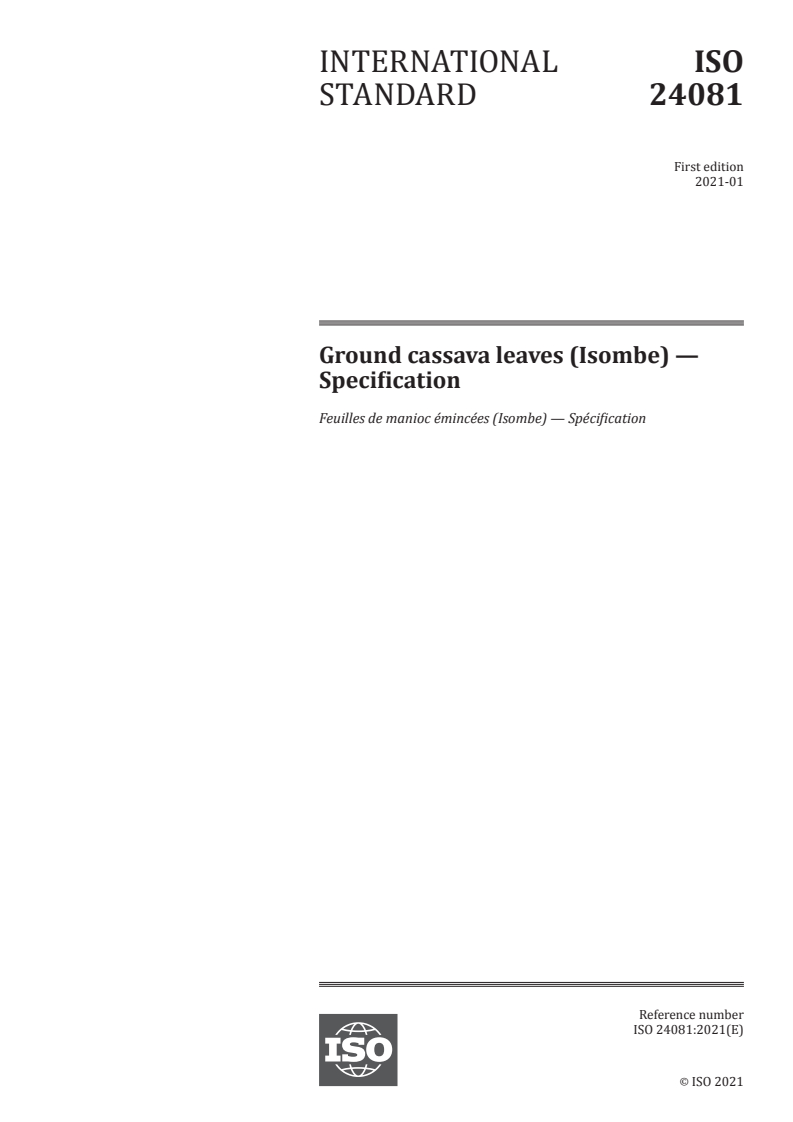
INTERNATIONAL ISO
STANDARD 24081
First edition
2021-01
Ground cassava leaves (Isombe) —
Specification
Feuilles de manioc émincées (Isombe) — Spécification
Reference number
©
ISO 2021
© ISO 2021
All rights reserved. Unless otherwise specified, or required in the context of its implementation, no part of this publication may
be reproduced or utilized otherwise in any form or by any means, electronic or mechanical, including photocopying, or posting
on the internet or an intranet, without prior written permission. Permission can be requested from either ISO at the address
below or ISO’s member body in the country of the requester.
ISO copyright office
CP 401 • Ch. de Blandonnet 8
CH-1214 Vernier, Geneva
Phone: +41 22 749 01 11
Email: copyright@iso.org
Website: www.iso.org
Published in Switzerland
ii © ISO 2021 – All rights reserved
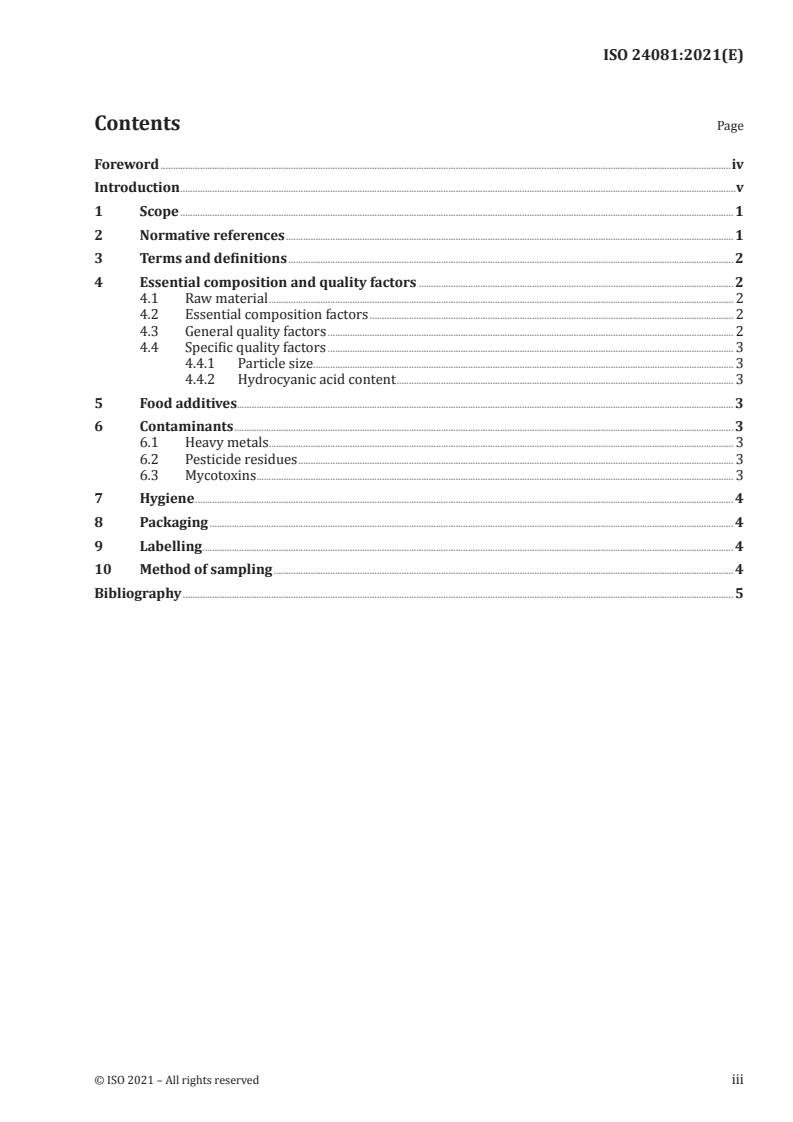
Contents Page
Foreword .iv
Introduction .v
1 Scope . 1
2 Normative references . 1
3 Terms and definitions . 2
4 Essential composition and quality factors . 2
4.1 Raw material . 2
4.2 Essential composition factors . 2
4.3 General quality factors . 2
4.4 Specific quality factors . 3
4.4.1 Particle size . . 3
4.4.2 Hydrocyanic acid content . 3
5 Food additives. 3
6 Contaminants . 3
6.1 Heavy metals . 3
6.2 Pesticide residues . 3
6.3 Mycotoxins . 3
7 Hygiene . 4
8 Packaging . 4
9 Labelling . 4
10 Method of sampling . 4
Bibliography . 5
Foreword
ISO (the International Organization for Standardization) is a worldwide federation of national standards
bodies (ISO member bodies). The work of preparing International Standards is normally carried out
through ISO technical committees. Each member body interested in a subject for which a technical
committee has been established has the right to be represented on that committee. International
organizations, governmental and non-governmental, in liaison with ISO, also take part in the work.
ISO collaborates closely with the International Electrotechnical Commission (IEC) on all matters of
electrotechnical standardization.
The procedures used to develop this document and those intended for its further maintenance are
described in the ISO/IEC Directives, Part 1. In particular, the different approval criteria needed for the
different types of ISO documents should be noted. This document was drafted in accordance with the
editorial rules of the ISO/IEC Directives, Part 2 (see www .iso .org/ directives).
Attention is drawn to the possibility that some of the elements of this document may be the subject of
patent rights. ISO shall not be held responsible for identifying any or all such patent rights. Details of
any patent rights identified during the development of the document will be in the Introduction and/or
on the ISO list of patent declarations received (see www .iso .org/ patents).
Any trade name used in this document is information given for the convenience of users and does not
constitute an endorsement.
For an explanation of the voluntary nature of standards, the meaning of ISO specific terms and
expressions related to conformity assessment, as well as information about ISO’s adherence to the
World Trade Organization (WTO) principles in the Technical Barriers to Trade (TBT), see www .iso .org/
iso/ foreword .html.
This document was prepared by Technical Committee ISO/TC 34, Food products, Subcommittee SC 3,
Fruits and vegetables and their derived products.
Any feedback or questions on this document should be directed to the user’s national standards body. A
complete listing of these bodies can be found at www .iso .org/ members .html.
iv © ISO 2021 – All rights reserved
Introduction
Cassava, originally from Brazil, is a staple root crop throughout the tropics where it is used in a variety
of dishes. Cassava is grown overwhelmingly for its roots and is found in markets.
In some countries there is a market for cassava leaves, where it is used in soups and stews. Cassava
contains cyanide, which varies greatly among cultivars and needs to be detoxified before human
consumption. Cassava roots are cooked and this sufficiently detoxifies them. Cassava leaves also
contain cyanide,
...
INTERNATIONAL ISO
STANDARD 24081
First edition
2021-01
Ground cassava leaves (Isombe) —
Specification
Feuilles de manioc émincées (Isombe) — Spécification
Reference number
©
ISO 2021
© ISO 2021
All rights reserved. Unless otherwise specified, or required in the context of its implementation, no part of this publication may
be reproduced or utilized otherwise in any form or by any means, electronic or mechanical, including photocopying, or posting
on the internet or an intranet, without prior written permission. Permission can be requested from either ISO at the address
below or ISO’s member body in the country of the requester.
ISO copyright office
CP 401 • Ch. de Blandonnet 8
CH-1214 Vernier, Geneva
Phone: +41 22 749 01 11
Email: copyright@iso.org
Website: www.iso.org
Published in Switzerland
ii © ISO 2021 – All rights reserved
Contents Page
Foreword .iv
Introduction .v
1 Scope . 1
2 Normative references . 1
3 Terms and definitions . 2
4 Essential composition and quality factors . 2
4.1 Raw material . 2
4.2 Essential composition factors . 2
4.3 General quality factors . 2
4.4 Specific quality factors . 3
4.4.1 Particle size . . 3
4.4.2 Hydrocyanic acid content . 3
5 Food additives. 3
6 Contaminants . 3
6.1 Heavy metals . 3
6.2 Pesticide residues . 3
6.3 Mycotoxins . 3
7 Hygiene . 4
8 Packaging . 4
9 Labelling . 4
10 Method of sampling . 4
Bibliography . 5
Foreword
ISO (the International Organization for Standardization) is a worldwide federation of national standards
bodies (ISO member bodies). The work of preparing International Standards is normally carried out
through ISO technical committees. Each member body interested in a subject for which a technical
committee has been established has the right to be represented on that committee. International
organizations, governmental and non-governmental, in liaison with ISO, also take part in the work.
ISO collaborates closely with the International Electrotechnical Commission (IEC) on all matters of
electrotechnical standardization.
The procedures used to develop this document and those intended for its further maintenance are
described in the ISO/IEC Directives, Part 1. In particular, the different approval criteria needed for the
different types of ISO documents should be noted. This document was drafted in accordance with the
editorial rules of the ISO/IEC Directives, Part 2 (see www .iso .org/ directives).
Attention is drawn to the possibility that some of the elements of this document may be the subject of
patent rights. ISO shall not be held responsible for identifying any or all such patent rights. Details of
any patent rights identified during the development of the document will be in the Introduction and/or
on the ISO list of patent declarations received (see www .iso .org/ patents).
Any trade name used in this document is information given for the convenience of users and does not
constitute an endorsement.
For an explanation of the voluntary nature of standards, the meaning of ISO specific terms and
expressions related to conformity assessment, as well as information about ISO’s adherence to the
World Trade Organization (WTO) principles in the Technical Barriers to Trade (TBT), see www .iso .org/
iso/ foreword .html.
This document was prepared by Technical Committee ISO/TC 34, Food products, Subcommittee SC 3,
Fruits and vegetables and their derived products.
Any feedback or questions on this document should be directed to the user’s national standards body. A
complete listing of these bodies can be found at www .iso .org/ members .html.
iv © ISO 2021 – All rights reserved
Introduction
Cassava, originally from Brazil, is a staple root crop throughout the tropics where it is used in a variety
of dishes. Cassava is grown overwhelmingly for its roots and is found in markets.
In some countries there is a market for cassava leaves, where it is used in soups and stews. Cassava
contains cyanide, which varies greatly among cultivars and needs to be detoxified before human
consumption. Cassava roots are cooked and this sufficiently detoxifies them. Cassava leaves also
contain cyanide,
...