

ISO 27830:2017
(Main)Metallic and other inorganic coatings — Requirements for the designation of metallic and inorganic coatings
General Information
- Abstract
ISO 27830:2017 specifies the technical requirements of metallic and other inorganic coatings in order to develop consistent technical standards and establishes a standard format for designating the coatings. It applies to International Standards for electrodeposited, autocatalytic and vapour-deposited coatings. Detailed technical requirements for individual coatings are not given in this document, but can be found in the International Standards listed in the Bibliography. ISO 27830:2017 does not apply to thermally sprayed and porcelain enamel coatings.
- Status
- Published
- Publication Date
- 20-Nov-2017
- Technical Committee
- ISO/TC 107/SC 3 - Electrodeposited coatings and related finishes
- Drafting Committee
- ISO/TC 107/SC 3 - Electrodeposited coatings and related finishes
- Current Stage
- 9093 - International Standard confirmed
- Start Date
- 04-Oct-2023
- Completion Date
- 29-Aug-2026
Buy Documents


ISO 27830:2017 - Metallic and other inorganic coatings -- Requirements for the designation of metallic and inorganic coatings
ISO 27830:2017 - Metallic and other inorganic coatings — Requirements for the designation of metallic and inorganic coatings/21/2017


ISO 27830:2017 - Revetements métalliques et autres revetements inorganiques -- Exigences pour la désignation des revetements métalliques et autres revetements inorganiques
ISO 27830:2017 - Revêtements métalliques et autres revêtements inorganiques — Exigences pour la désignation des revêtements métalliques et autres revêtements inorganiques/21/2017
Overview
ISO 27830:2017 specifies a standardized method for designating metallic and other inorganic coatings used in electroplating, autocatalytic and vapour-deposition processes. It sets out the technical requirements for how coatings are described on purchase orders, engineering drawings and product specifications so that purchasers, processors and inspectors share a consistent, unambiguous designation system. ISO 27830:2017 does not give detailed performance requirements for individual coatings (these are found in the cited International Standards) and it does not apply to thermally sprayed or porcelain-enamel coatings.
Key Topics
- Designation format: A structured identity made of a description + International Standard number, an individual-item module, and stage-by-stage codes separated by solidi (/) - double separators indicate omitted stages.
- Symbols and codes: Annex A provides standard symbols for basis materials (e.g., Fe, Zn, Al), coatings (e.g., Ni, Cr, ZnNi) and undercoats, enabling compact, machine- and human-readable designations.
- Thickness and units: Coating thickness is specified as a minimum local thickness in micrometres; the standard clarifies the measurement convention (e.g., local thickness is measured at any point touchable by a 20 mm diameter ball).
- Heat treatment codes: Heat‑treatment and de-embrittlement treatments are designated with SR, HR or HT with temperature and duration in parentheses and hours (example: SR(210)2).
- Information to be supplied: Clause 4 lists essential purchaser-supplied data (standard number, significant surface, basis material condition, tensile strength, any heat-treatment needs) plus optional additional details (appearance, sampling, packaging).
- Sampling & inspection: References sampling plans (ISO 4519 and ISO 2859) for lot verification and measurement protocols.
- Guidance annexes: Annex B gives designation examples; Annex C links coating thickness guidance to standardized service-condition severity numbers.
Applications
ISO 27830:2017 is used by:
- Purchasers and specifiers preparing contract documents and engineering drawings for coated parts.
- Electroplaters and processors receiving unambiguous instructions for coating type, thickness and post-treatments.
- Quality assurance and inspection teams verifying that coatings meet contractual designations.
- OEMs and manufacturing engineers in sectors requiring corrosion protection and surface finishes (automotive, aerospace, electronics, fasteners, industrial components).
- Standards writers and product certification bodies ensuring consistent cross-references to coating standards.
Keywords: ISO 27830, metallic coatings, inorganic coatings, designation format, coating thickness, electrodeposited coatings, autocatalytic coatings, vapour-deposited coatings, corrosion protection, sampling.
Related Standards
- ISO 1456, ISO 2081, ISO 4527 (examples of coating-specific standards referenced)
- ISO 9587 / ISO 9588 (pretreatment and post-coating heat treatments to reduce hydrogen embrittlement)
- ISO 2064 (thickness conventions)
- ISO 4519, ISO 2859 (sampling and inspection plans)
Use ISO 27830 to ensure clear, consistent coating specifications and reduce ambiguity between purchaser, processor and inspector.
Relations
- Effective Date
- 12-Feb-2026
- Effective Date
- 06-Jun-2022
- Effective Date
- 10-May-2014
Buy Documents
ISO 27830:2017 - Metallic and other inorganic coatings -- Requirements for the designation of metallic and inorganic coatings
ISO 27830:2017 - Metallic and other inorganic coatings — Requirements for the designation of metallic and inorganic coatings/21/2017
ISO 27830:2017 - Revetements métalliques et autres revetements inorganiques -- Exigences pour la désignation des revetements métalliques et autres revetements inorganiques
ISO 27830:2017 - Revêtements métalliques et autres revêtements inorganiques — Exigences pour la désignation des revêtements métalliques et autres revêtements inorganiques/21/2017
Get Certified
Connect with accredited certification bodies for this standard

DVS-ZERT GmbH
German welding certification society.
CARES (UK Certification Authority for Reinforcing Steels)
UK certification for reinforcing steels and construction.
EWF/IIW (European/International Welding Federation)
International welding personnel certification.
Sponsored listings
Frequently Asked Questions
ISO 27830:2017 is a standard published by the International Organization for Standardization (ISO). Its full title is "Metallic and other inorganic coatings — Requirements for the designation of metallic and inorganic coatings". This standard covers: ISO 27830:2017 specifies the technical requirements of metallic and other inorganic coatings in order to develop consistent technical standards and establishes a standard format for designating the coatings. It applies to International Standards for electrodeposited, autocatalytic and vapour-deposited coatings. Detailed technical requirements for individual coatings are not given in this document, but can be found in the International Standards listed in the Bibliography. ISO 27830:2017 does not apply to thermally sprayed and porcelain enamel coatings.
ISO 27830:2017 specifies the technical requirements of metallic and other inorganic coatings in order to develop consistent technical standards and establishes a standard format for designating the coatings. It applies to International Standards for electrodeposited, autocatalytic and vapour-deposited coatings. Detailed technical requirements for individual coatings are not given in this document, but can be found in the International Standards listed in the Bibliography. ISO 27830:2017 does not apply to thermally sprayed and porcelain enamel coatings.
ISO 27830:2017 is classified under the following ICS (International Classification for Standards) categories: 25.220.20 - Surface treatment; 25.220.40 - Metallic coatings. The ICS classification helps identify the subject area and facilitates finding related standards.
ISO 27830:2017 has the following relationships with other standards: It is inter standard links to EN ISO 27830:2017, ISO 20706-1:2019, ISO 27830:2008. Understanding these relationships helps ensure you are using the most current and applicable version of the standard.
ISO 27830:2017 is available in PDF format for immediate download after purchase. The document can be added to your cart and obtained through the secure checkout process. Digital delivery ensures instant access to the complete standard document.
Standards Content (Sample)
INTERNATIONAL ISO
STANDARD 27830
Second edition
2017-11
Metallic and other inorganic
coatings — Requirements for the
designation of metallic and inorganic
coatings
Revêtements métalliques et autres revêtements inorganiques —
Exigences pour la désignation des revêtements métalliques et autres
revêtements inorganiques
Reference number
©
ISO 2017
© ISO 2017, Published in Switzerland
All rights reserved. Unless otherwise specified, no part of this publication may be reproduced or utilized otherwise in any form
or by any means, electronic or mechanical, including photocopying, or posting on the internet or an intranet, without prior
written permission. Permission can be requested from either ISO at the address below or ISO’s member body in the country of
the requester.
ISO copyright office
Ch. de Blandonnet 8 • CP 401
CH-1214 Vernier, Geneva, Switzerland
Tel. +41 22 749 01 11
Fax +41 22 749 09 47
copyright@iso.org
www.iso.org
ii © ISO 2017 – All rights reserved
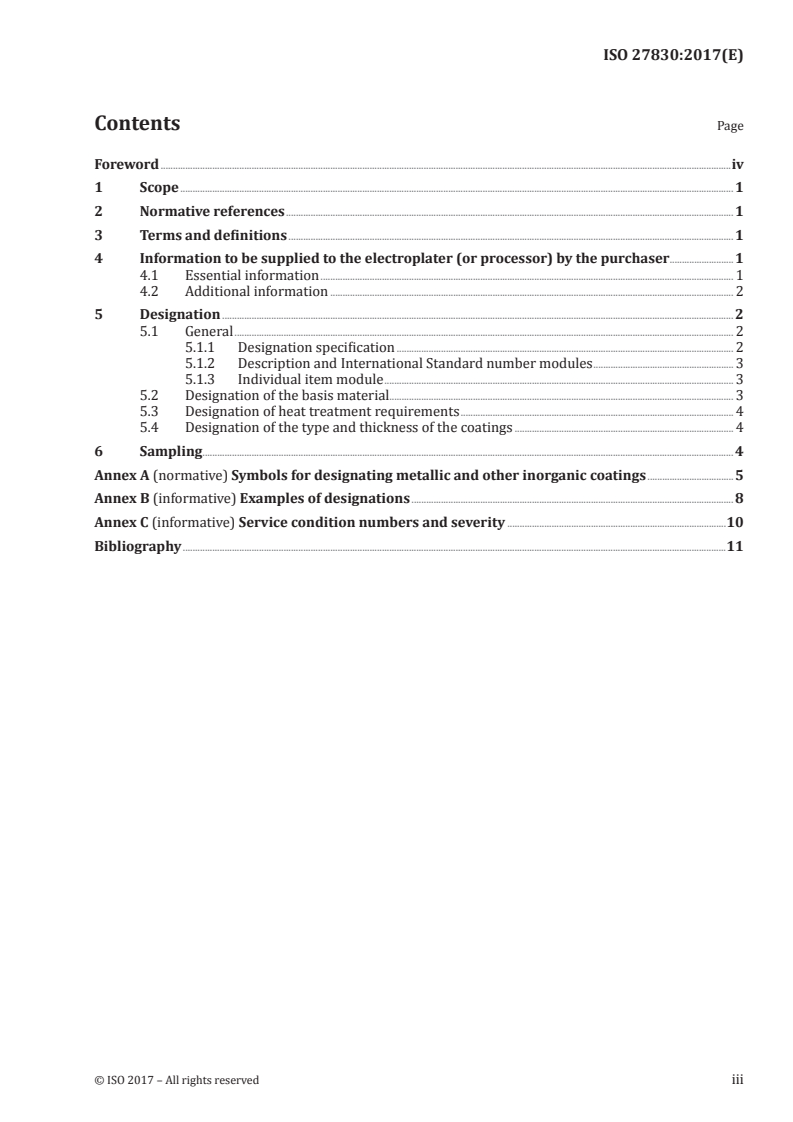
Contents Page
Foreword .iv
1 Scope . 1
2 Normative references . 1
3 Terms and definitions . 1
4 Information to be supplied to the electroplater (or processor) by the purchaser .1
4.1 Essential information . 1
4.2 Additional information . 2
5 Designation . 2
5.1 General . 2
5.1.1 Designation specification . 2
5.1.2 Description and International Standard number modules . 3
5.1.3 Individual item module . 3
5.2 Designation of the basis material. 3
5.3 Designation of heat treatment requirements . 4
5.4 Designation of the type and thickness of the coatings . 4
6 Sampling . 4
Annex A (normative) Symbols for designating metallic and other inorganic coatings .5
Annex B (informative) Examples of designations . 8
Annex C (informative) Service condition numbers and severity .10
Bibliography .11
Foreword
ISO (the International Organization for Standardization) is a worldwide federation of national standards
bodies (ISO member bodies). The work of preparing International Standards is normally carried out
through ISO technical committees. Each member body interested in a subject for which a technical
committee has been established has the right to be represented on that committee. International
organizations, governmental and non-governmental, in liaison with ISO, also take part in the work.
ISO collaborates closely with the International Electrotechnical Commission (IEC) on all matters of
electrotechnical standardization.
The procedures used to develop this document and those intended for its further maintenance are
described in the ISO/IEC Directives, Part 1. In particular the different approval criteria needed for the
different types of ISO documents should be noted. This document was drafted in accordance with the
editorial rules of the ISO/IEC Directives, Part 2 (see www.iso.org/directives).
Attention is drawn to the possibility that some of the elements of this document may be the subject of
patent rights. ISO shall not be held responsible for identifying any or all such patent rights. Details of
any patent rights identified during the development of the document will be in the Introduction and/or
on the ISO list of patent declarations received (see www.iso.org/patents).
Any trade name used in this document is information given for the convenience of users and does not
constitute an endorsement.
For an explanation on the voluntary nature of standards, the meaning of ISO specific terms and
expressions related to conformity assessment, as well as information about ISO's adherence to the
World Trade Organization (WTO) principles in the Technical Barriers to Trade (TBT) see the following
URL: www.iso.org/iso/foreword.html.
This document was prepared by the European Committee for Standardization (CEN) Technical
Committee CEN/TC 262, Metallic and other inorganic coatings, in collaboration with ISO Technical
Committee TC 107, Metallic and other inorganic coatings, Subcommittee SC 3, Electrodeposited coatings
and related finishes, in accordance with the agreement on technical cooperation between ISO and CEN
(Vienna Agreement).
This second edition cancels and replaces the first edition (ISO 27830:2008), which has been technically
revised.
iv © ISO 2017 – All rights reserved
INTERNATIONAL STANDARD ISO 27830:2017(E)
Metallic and other inorganic coatings — Requirements for
the designation of metallic and inorganic coatings
WARNING — This document can be non-compliant with some countries’ health, safety and
environmental legislations and calls for the use of substances and/or procedures that can be
injurious to health, if adequate safety measures are not taken. This document does not address
any health hazards, safety or environmental matters and legislations associated with its use.
It is the responsibility of the user of this document to establish appropriate health, safety and
environmentally acceptable practices and take appropriate action to comply with any national,
regional and/or International regulations.
1 Scope
This document specifies the technical requirements of metallic and other inorganic coatings in order to
develop consistent technical standards and establishes a standard format for designating the coatings.
It applies to International Standards for electrodeposited, autocatalytic and vapour-deposited coatings.
Detailed technical requirements for individual coatings are not given in this document, but can be
found in the International Standards listed in the Bibliography.
This document does not apply to thermally sprayed and porcelain enamel coatings.
2 Normative references
The following documents are referred to in the text in such a way that some or all of their content
constitutes requirements of this document. For dated references, only the edition cited applies. For
undated references, the latest edition of the referenced document (including any amendments) applies.
ISO 9587, Metallic and other inorganic coatings — Pretreatment of iron or steel to reduce the risk of
hydrogen embrittlement
ISO 9588, Metallic and other inorganic coatings — Post-coating treatments of iron or steel to reduce the
risk of hydrogen embrittlement
3 Terms and definitions
No terms and definitions are listed in this document.
ISO and IEC maintain terminological databases for use in standardization at the following addresses:
— IEC Electropedia: available at http://www.electropedia.org/
— ISO Online browsing platform: available at http://www.iso.org/obp
4 Information to be supplied to the electroplater (or processor) by the
purchaser
4.1 Essential information
The purchaser shall provide the essential information requested in this sub-clause, in writing, as part
of the contract, purchase order, detailed product specification and/or on engineering drawings.
The essential information shall include the following items with cross-references, in parentheses, to the
clauses and sub-clauses that provide further details about the requirements and test methods:
a) the number of the International Standard and the designation as specified in this document (see
Clause 5);
b) the significant surface indicated by drawings or by suitably marked specimens;
c) the nature, condition and finish of the basis material, if they affect serviceability and/or the
appearance of the coating;
d) the tensile strength of the component to enable possible de-embrittlement requirements to be
taken into account;
e) the requirements for heat treatment before and/or after coating, if the requirements are not in
accordance with ISO 9587 or ISO 9588.
4.2 Additional information
Additional information, not included in 4.1, that may be required for a specific coating, product or
application, may include, for example,
a) the appearance required, for example, bright, dull, colour, preferably with samples of the required
finish (if not specified in an applicable ISO Standard);
b) the accepted position(s) on the surface for unavoidable defects, such as jigs, contact marks or areas
in which it is permitted for the coating to be absent;
c) the standards for determining that thickness, corrosion resistance, adhesion, porosity or other
requirements have been met;
d) sampling methods, acceptance levels and inspection requirements for quality control purposes;
e) extra information, for example, packaging or handling instructions or a delivery address shall be
included where relevant.
5 Designation
5.1 General
5.1.1 Designation specification
Symbols for designating metallic and other inorganic coatings shall be applied, as specified in Annex A.
The designation shall comprise the following:
a) description and International Standard number modules in accordance with 5.1.2;
b) a hyphen;
c) the individual item module in accordance with 5.1.3;
d) a solidus;
e) the additional applicable codes separated by solidi for every stage of the coating sequence in the
order of application (see 5.3).
2 © ISO 2017 – All rights reserved
Double separators shall be used to indicate any missing stages (i.e. when a particular stage is not
required).
NOTE Allowed composition and purity tolerances for the values shown in the designation are specified in
the International Standards for the coatings to which they are applicable.
The purchaser should be guided in their choice of designation by the severity of service conditions to be
withstood by the coating.
See Annex B for examples.
5.1.2 Description and International Standard number modules
The description module briefly describes the designated coating:
a) electrodeposited coating;
b) autocatalytic coating;
c) vapour-deposited coating.
The description module shall be followed by the number of the International Standard of the particular
[1] [4] [11]
coating that is being designated; for example, ISO 1456, ISO 2081, ISO 4527, , etc.
The identity set is comprised of the International Standard number module plus the individual item
module, both being essential for designating coating requirements.
5.1.3 Individual item module
The individual item module designates the following items:
a) the basis material (see 5.2);
b) the specific alloy, if applicable (see 5.2);
c) stress relief requirements, when necessary (see 5.3);
d) the type and thickness of undercoats, when present (see 5.4);
e) the coating and its minimum local thickness (see 5.4);
f) the type of coating (see 5.4);
g) the type and thickness of coatings applied over the designated coating, if present (see 5.4);
h) post-treatments, including heat treatment, if applicable (see 5.3).
Each of these steps in the coating sequence is separated by a solidus (/). Double separators or solidi
indicate that a step in the process is either not required or has been omitted.
5.2 Designation of the basis material
5.2.1 The basis metal shall be designated by its chemical symbol, or by that of the principal constituent
in the case of an alloy. In the case of plastics and non-metallic materials, appropriate symbols have been
established.
See Table A.1 for the symbols that are commonly used.
5.2.2 It is recommended (optional) that the specific alloy be designated by its standard designation.
References to national or local systems for identifying the specific alloy have bee
...
INTERNATIONAL ISO
STANDARD 27830
Second edition
2017-11
Metallic and other inorganic
coatings — Requirements for the
designation of metallic and inorganic
coatings
Revêtements métalliques et autres revêtements inorganiques —
Exigences pour la désignation des revêtements métalliques et autres
revêtements inorganiques
Reference number
©
ISO 2017
© ISO 2017, Published in Switzerland
All rights reserved. Unless otherwise specified, no part of this publication may be reproduced or utilized otherwise in any form
or by any means, electronic or mechanical, including photocopying, or posting on the internet or an intranet, without prior
written permission. Permission can be requested from either ISO at the address below or ISO’s member body in the country of
the requester.
ISO copyright office
Ch. de Blandonnet 8 • CP 401
CH-1214 Vernier, Geneva, Switzerland
Tel. +41 22 749 01 11
Fax +41 22 749 09 47
copyright@iso.org
www.iso.org
ii © ISO 2017 – All rights reserved
Contents Page
Foreword .iv
1 Scope . 1
2 Normative references . 1
3 Terms and definitions . 1
4 Information to be supplied to the electroplater (or processor) by the purchaser .1
4.1 Essential information . 1
4.2 Additional information . 2
5 Designation . 2
5.1 General . 2
5.1.1 Designation specification . 2
5.1.2 Description and International Standard number modules . 3
5.1.3 Individual item module . 3
5.2 Designation of the basis material. 3
5.3 Designation of heat treatment requirements . 4
5.4 Designation of the type and thickness of the coatings . 4
6 Sampling . 4
Annex A (normative) Symbols for designating metallic and other inorganic coatings .5
Annex B (informative) Examples of designations . 8
Annex C (informative) Service condition numbers and severity .10
Bibliography .11
Foreword
ISO (the International Organization for Standardization) is a worldwide federation of national standards
bodies (ISO member bodies). The work of preparing International Standards is normally carried out
through ISO technical committees. Each member body interested in a subject for which a technical
committee has been established has the right to be represented on that committee. International
organizations, governmental and non-governmental, in liaison with ISO, also take part in the work.
ISO collaborates closely with the International Electrotechnical Commission (IEC) on all matters of
electrotechnical standardization.
The procedures used to develop this document and those intended for its further maintenance are
described in the ISO/IEC Directives, Part 1. In particular the different approval criteria needed for the
different types of ISO documents should be noted. This document was drafted in accordance with the
editorial rules of the ISO/IEC Directives, Part 2 (see www.iso.org/directives).
Attention is drawn to the possibility that some of the elements of this document may be the subject of
patent rights. ISO shall not be held responsible for identifying any or all such patent rights. Details of
any patent rights identified during the development of the document will be in the Introduction and/or
on the ISO list of patent declarations received (see www.iso.org/patents).
Any trade name used in this document is information given for the convenience of users and does not
constitute an endorsement.
For an explanation on the voluntary nature of standards, the meaning of ISO specific terms and
expressions related to conformity assessment, as well as information about ISO's adherence to the
World Trade Organization (WTO) principles in the Technical Barriers to Trade (TBT) see the following
URL: www.iso.org/iso/foreword.html.
This document was prepared by the European Committee for Standardization (CEN) Technical
Committee CEN/TC 262, Metallic and other inorganic coatings, in collaboration with ISO Technical
Committee TC 107, Metallic and other inorganic coatings, Subcommittee SC 3, Electrodeposited coatings
and related finishes, in accordance with the agreement on technical cooperation between ISO and CEN
(Vienna Agreement).
This second edition cancels and replaces the first edition (ISO 27830:2008), which has been technically
revised.
iv © ISO 2017 – All rights reserved
INTERNATIONAL STANDARD ISO 27830:2017(E)
Metallic and other inorganic coatings — Requirements for
the designation of metallic and inorganic coatings
WARNING — This document can be non-compliant with some countries’ health, safety and
environmental legislations and calls for the use of substances and/or procedures that can be
injurious to health, if adequate safety measures are not taken. This document does not address
any health hazards, safety or environmental matters and legislations associated with its use.
It is the responsibility of the user of this document to establish appropriate health, safety and
environmentally acceptable practices and take appropriate action to comply with any national,
regional and/or International regulations.
1 Scope
This document specifies the technical requirements of metallic and other inorganic coatings in order to
develop consistent technical standards and establishes a standard format for designating the coatings.
It applies to International Standards for electrodeposited, autocatalytic and vapour-deposited coatings.
Detailed technical requirements for individual coatings are not given in this document, but can be
found in the International Standards listed in the Bibliography.
This document does not apply to thermally sprayed and porcelain enamel coatings.
2 Normative references
The following documents are referred to in the text in such a way that some or all of their content
constitutes requirements of this document. For dated references, only the edition cited applies. For
undated references, the latest edition of the referenced document (including any amendments) applies.
ISO 9587, Metallic and other inorganic coatings — Pretreatment of iron or steel to reduce the risk of
hydrogen embrittlement
ISO 9588, Metallic and other inorganic coatings — Post-coating treatments of iron or steel to reduce the
risk of hydrogen embrittlement
3 Terms and definitions
No terms and definitions are listed in this document.
ISO and IEC maintain terminological databases for use in standardization at the following addresses:
— IEC Electropedia: available at http://www.electropedia.org/
— ISO Online browsing platform: available at http://www.iso.org/obp
4 Information to be supplied to the electroplater (or processor) by the
purchaser
4.1 Essential information
The purchaser shall provide the essential information requested in this sub-clause, in writing, as part
of the contract, purchase order, detailed product specification and/or on engineering drawings.
The essential information shall include the following items with cross-references, in parentheses, to the
clauses and sub-clauses that provide further details about the requirements and test methods:
a) the number of the International Standard and the designation as specified in this document (see
Clause 5);
b) the significant surface indicated by drawings or by suitably marked specimens;
c) the nature, condition and finish of the basis material, if they affect serviceability and/or the
appearance of the coating;
d) the tensile strength of the component to enable possible de-embrittlement requirements to be
taken into account;
e) the requirements for heat treatment before and/or after coating, if the requirements are not in
accordance with ISO 9587 or ISO 9588.
4.2 Additional information
Additional information, not included in 4.1, that may be required for a specific coating, product or
application, may include, for example,
a) the appearance required, for example, bright, dull, colour, preferably with samples of the required
finish (if not specified in an applicable ISO Standard);
b) the accepted position(s) on the surface for unavoidable defects, such as jigs, contact marks or areas
in which it is permitted for the coating to be absent;
c) the standards for determining that thickness, corrosion resistance, adhesion, porosity or other
requirements have been met;
d) sampling methods, acceptance levels and inspection requirements for quality control purposes;
e) extra information, for example, packaging or handling instructions or a delivery address shall be
included where relevant.
5 Designation
5.1 General
5.1.1 Designation specification
Symbols for designating metallic and other inorganic coatings shall be applied, as specified in Annex A.
The designation shall comprise the following:
a) description and International Standard number modules in accordance with 5.1.2;
b) a hyphen;
c) the individual item module in accordance with 5.1.3;
d) a solidus;
e) the additional applicable codes separated by solidi for every stage of the coating sequence in the
order of application (see 5.3).
2 © ISO 2017 – All rights reserved
Double separators shall be used to indicate any missing stages (i.e. when a particular stage is not
required).
NOTE Allowed composition and purity tolerances for the values shown in the designation are specified in
the International Standards for the coatings to which they are applicable.
The purchaser should be guided in their choice of designation by the severity of service conditions to be
withstood by the coating.
See Annex B for examples.
5.1.2 Description and International Standard number modules
The description module briefly describes the designated coating:
a) electrodeposited coating;
b) autocatalytic coating;
c) vapour-deposited coating.
The description module shall be followed by the number of the International Standard of the particular
[1] [4] [11]
coating that is being designated; for example, ISO 1456, ISO 2081, ISO 4527, , etc.
The identity set is comprised of the International Standard number module plus the individual item
module, both being essential for designating coating requirements.
5.1.3 Individual item module
The individual item module designates the following items:
a) the basis material (see 5.2);
b) the specific alloy, if applicable (see 5.2);
c) stress relief requirements, when necessary (see 5.3);
d) the type and thickness of undercoats, when present (see 5.4);
e) the coating and its minimum local thickness (see 5.4);
f) the type of coating (see 5.4);
g) the type and thickness of coatings applied over the designated coating, if present (see 5.4);
h) post-treatments, including heat treatment, if applicable (see 5.3).
Each of these steps in the coating sequence is separated by a solidus (/). Double separators or solidi
indicate that a step in the process is either not required or has been omitted.
5.2 Designation of the basis material
5.2.1 The basis metal shall be designated by its chemical symbol, or by that of the principal constituent
in the case of an alloy. In the case of plastics and non-metallic materials, appropriate symbols have been
established.
See Table A.1 for the symbols that are commonly used.
5.2.2 It is recommended (optional) that the specific alloy be designated by its standard designation.
References to national or local systems for identifying the specific alloy have bee
...
NORME ISO
INTERNATIONALE 27830
Deuxième édition
2017-11
Revêtements métalliques et autres
revêtements inorganiques —
Exigences pour la désignation des
revêtements métalliques et autres
revêtements inorganiques
Metallic and other inorganic coatings — Requirements for the
designation of metallic and inorganic coatings
Numéro de référence
©
ISO 2017
DOCUMENT PROTÉGÉ PAR COPYRIGHT
© ISO 2017, Publié en Suisse
Droits de reproduction réservés. Sauf indication contraire, aucune partie de cette publication ne peut être reproduite ni utilisée
sous quelque forme que ce soit et par aucun procédé, électronique ou mécanique, y compris la photocopie, l’affichage sur
l’internet ou sur un Intranet, sans autorisation écrite préalable. Les demandes d’autorisation peuvent être adressées à l’ISO à
l’adresse ci-après ou au comité membre de l’ISO dans le pays du demandeur.
ISO copyright office
Ch. de Blandonnet 8 • CP 401
CH-1214 Vernier, Geneva, Switzerland
Tel. +41 22 749 01 11
Fax +41 22 749 09 47
copyright@iso.org
www.iso.org
ii © ISO 2017 – Tous droits réservés
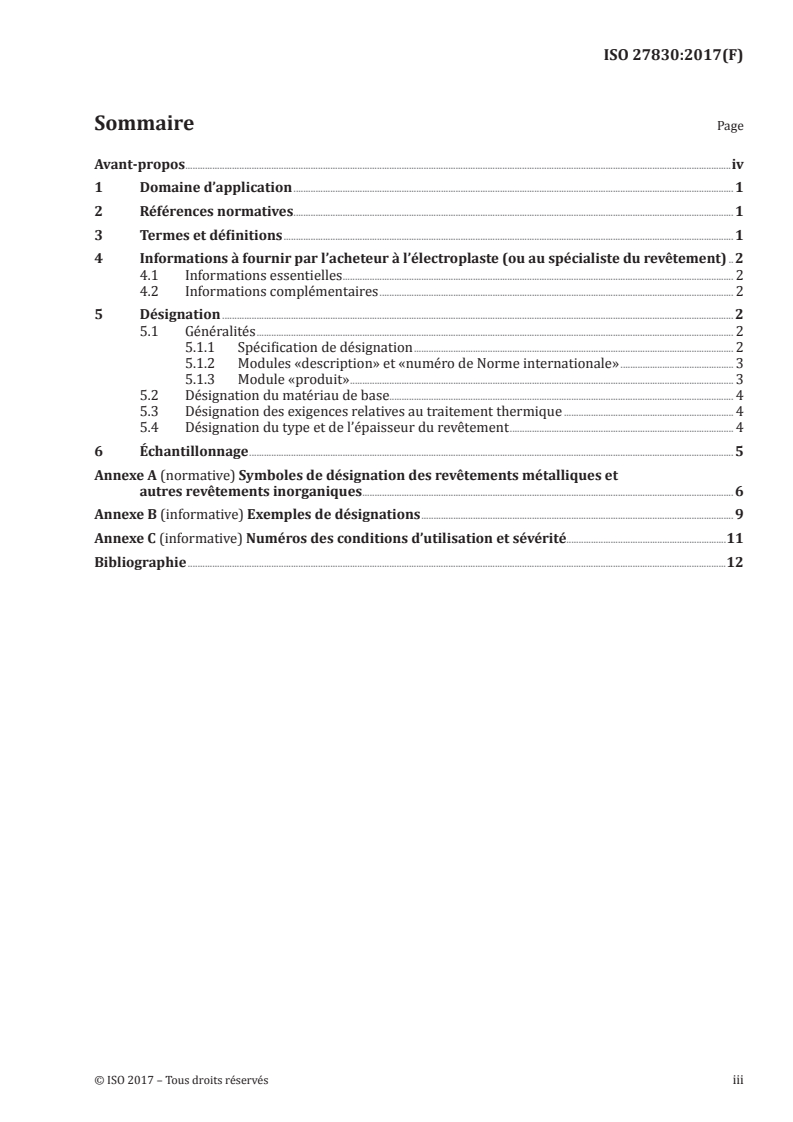
Sommaire Page
Avant-propos .iv
1 Domaine d’application . 1
2 Références normatives . 1
3 Termes et définitions . 1
4 Informations à fournir par l’acheteur à l’électroplaste (ou au spécialiste du revêtement) .2
4.1 Informations essentielles . 2
4.2 Informations complémentaires . 2
5 Désignation . 2
5.1 Généralités . 2
5.1.1 Spécification de désignation . 2
5.1.2 Modules «description» et «numéro de Norme internationale» . 3
5.1.3 Module «produit» . 3
5.2 Désignation du matériau de base. 4
5.3 Désignation des exigences relatives au traitement thermique . 4
5.4 Désignation du type et de l’épaisseur du revêtement . 4
6 Échantillonnage . 5
Annexe A (normative) Symboles de désignation des revêtements métalliques et
autres revêtements inorganiques . 6
Annexe B (informative) Exemples de désignations . 9
Annexe C (informative) Numéros des conditions d’utilisation et sévérité .11
Bibliographie .12
Avant-propos
L'ISO (Organisation internationale de normalisation) est une fédération mondiale d'organismes
nationaux de normalisation (comités membres de l'ISO). L'élaboration des Normes internationales est
en général confiée aux comités techniques de l'ISO. Chaque comité membre intéressé par une étude
a le droit de faire partie du comité technique créé à cet effet. Les organisations internationales,
gouvernementales et non gouvernementales, en liaison avec l'ISO participent également aux travaux.
L'ISO collabore étroitement avec la Commission électrotechnique internationale (IEC) en ce qui
concerne la normalisation électrotechnique.
Les procédures utilisées pour élaborer le présent document et celles destinées à sa mise à jour sont
décrites dans les Directives ISO/IEC, Partie 1. Il convient, en particulier de prendre note des différents
critères d'approbation requis pour les différents types de documents ISO. Le présent document a été
rédigé conformément aux règles de rédaction données dans les Directives ISO/IEC, Partie 2 (voir www.
iso.org/directives).
L'attention est attirée sur le fait que certains des éléments du présent document peuvent faire l'objet de
droits de propriété intellectuelle ou de droits analogues. L'ISO ne saurait être tenue pour responsable
de ne pas avoir identifié de tels droits de propriété et averti de leur existence. Les détails concernant
les références aux droits de propriété intellectuelle ou autres droits analogues identifiés lors de
l'élaboration du document sont indiqués dans l'Introduction et/ou dans la liste des déclarations de
brevets reçues par l'ISO (voir www.iso.org/brevets).
Les appellations commerciales éventuellement mentionnées dans le présent document sont données
pour information, par souci de commodité, à l’intention des utilisateurs et ne sauraient constituer un
engagement.
Pour une explication de la nature volontaire des normes, la signification des termes et expressions
spécifiques de l'ISO liés à l'évaluation de la conformité, ou pour toute information au sujet de l'adhésion
de l'ISO aux principes de l’Organisation mondiale du commerce (OMC) concernant les obstacles
techniques au commerce (OTC), voir le lien suivant: www.iso.org/avant-propos.
Le présent document a été élaboré par le Comité technique CEN/TC 262, Revêtements métalliques et
autres revêtements inorganiques, du Comité européen de normalisation (CEN) en collaboration avec le
comité technique ISO/TC 107, Revêtements métalliques et autres revêtements inorganiques, sous-comité
SC 3, Dépôts électrolytiques et finitions apparentées, conformément à l’accord de coopération technique
entre l’ISO et le CEN (Accord de Vienne).
Cette deuxième édition annule et remplace la première édition (ISO 27830:2008), qui a fait l’objet d’une
révision technique.
iv © ISO 2017 – Tous droits réservés
NORME INTERNATIONALE ISO 27830:2017(F)
Revêtements métalliques et autres revêtements
inorganiques — Exigences pour la désignation des
revêtements métalliques et autres revêtements
inorganiques
AVERTISSEMENT — Le présent document peut ne pas être conforme à la législation de certains
pays en matière d’hygiène, de sécurité et d’environnement, et nécessite l’utilisation de
substances et/ou la mise en œuvre de modes opératoires qui peuvent être préjudiciables à la
santé si les précautions appropriées ne sont pas prises. Le présent document ne traite pas des
risques pour la santé, la sécurité ou l’environnement, ni des législations liées à son utilisation.
Il incombe à l’utilisateur du présent document d’établir des règles acceptables en matière
d’hygiène, de sécurité et de respect de l’environnement, et de mener les actions appropriées
pour être conforme aux réglementations nationales, régionales et/ou internationales.
1 Domaine d’application
Le présent document spécifie les exigences techniques relatives aux revêtements métalliques et autres
revêtements inorganiques afin d’élaborer des normes techniques cohérentes, et établit un format
normalisé pour désigner les revêtements. Il s’applique aux Normes internationales relatives aux dépôts
par voie électrolytique, autocatalytique et en phase vapeur.
Les exigences techniques détaillées s’appliquant à des revêtements spécifiques ne sont pas fournies
dans le présent document, mais elles peuvent être trouvées dans les Normes internationales citées
dans la Bibliographie.
Le présent document ne s’applique pas aux revêtements déposés par projection thermique ou par
émaillage.
2 Références normatives
Les documents suivants cités dans le texte constituent, pour tout ou partie de leur contenu, des
exigences du présent document. Pour les références datées, seule l’édition citée s’applique. Pour les
références non datées, la dernière édition du document de référence s’applique (y compris les éventuels
amendements).
ISO 9587, Revêtements métalliques et autres revêtements inorganiques — Prétraitements du fer ou de
l'acier visant à réduire le risque de fragilisation par l'hydrogène
ISO 9588, Revêtements métalliques et autres revêtements inorganiques — Traitements après revêtement
sur fer ou acier pour diminuer le risque de fragilisation par l'hydrogène
3 Termes et définitions
Aucun terme n’est défini dans le présent document.
L’ISO et l’IEC tiennent à jour des bases de données terminologiques destinées à être utilisées en
normalisation, consultables aux adresses suivantes:
— IEC Electropedia: disponible à l’adresse http://www.electropedia.org/
— ISO Online browsing platform: disponible à l’adresse http://www.iso.org/obp
4 Informations à fournir par l’acheteur à l’électroplaste (ou au spécialiste
du revêtement)
4.1 Informations essentielles
L’acheteur doit fournir les informations essentielles requises dans ce paragraphe, par écrit, en tant que
partie intégrante du contrat, du bon de commande, de la spécification de produit détaillée et/ou des
dessins techniques.
Les informations essentielles doivent inclure les points suivants, avec référence, entre parenthèses,
aux articles et paragraphes fournissant des précisions supplémentaires relatives aux exigences et aux
méthodes d’essai:
a) le numéro de la Norme internationale et la désignation spécifiée dans le présent document
(voir Article 5);
b) la surface significative, indiquée par des dessins ou par des échantillons dûment repérés;
c) la nature, l’état et la finition du matériau de base, s’ils affectent l’aptitude à l’usage et/ou l’aspect du
revêtement;
d) la résistance à la traction du composant pour permettre la prise en compte des éventuelles
exigences contre la fragilisation;
e) les exigences relatives au traitement thermique avant et/ou après revêtement, si celles-ci ne sont
pas conformes à l’ISO 9587 ou à l’ISO 9588.
4.2 Informations complémentaires
Les informations complémentaires ne figurant pas en 4.1 et qui peuvent être nécessaires pour un
revêtement, un produit ou une application spécifiques, peuvent inclure, par exemple:
a) l’aspect requis, par exemple: brillant, mat, coloré, de préférence avec des échantillons ayant la
finition requise (si non spécifié dans une Norme ISO applicable);
b) la position sur la surface des défauts inévitables tels que ceux dus aux dispositifs de fixation, les
marques de contact ou les zones sur lesquelles une absence de revêtement est autorisée;
c) les normes permettant de déterminer que les exigences d’épaisseur, de tenue à la corrosion,
d’adhérence, de porosité ou autres sont respectées;
d) les méthodes d’échantillonnage, les niveaux d’acceptation et les exigences d’inspection aux fins de
contrôle de la qualité;
e) des informations complémentaires, par exemple des instructions d’emballage ou de manutention
ou une adresse de livraison, qui doivent être incluses le cas échéant.
5 Désignation
5.1 Généralités
5.1.1 Spécification de désignation
Les symboles de désignation des revêtements métalliques et autres revêtements inorganiques doivent
être appliqués, comme spécifié à l’Annexe A.
La désignation doit comprendre les éléments suivants:
a) les modules «description» et «numéro de Norme internationale» conformément à 5.1.2;
2 © ISO 2017 – Tous droits réservés
b) un tiret;
c) le module «produit» conformément à 5.1.3;
d) une barre oblique;
e) les codes supplémentaires applicables, séparés par des barres obliques pour chaque étape de la
séquence de revêtement dans l’ordre d’application (voir 5.3).
Des caractères de séparation doubles doivent être utilisés pour indiquer toute étape manquante (par
exemple, lorsqu’une étape particulière n’est pas requise).
NOTE La composition et les tolérances de pureté autorisées pour les valeurs indiquées dans la désignation
sont spécifiées dans les Normes internationales pour les revêtements auxquels celles-ci sont applicables.
Il convient de guider l’acheteur dans son choix de désignation en fonction de la sévérité des conditions
d’utilisation à supporter par le revêtement.
Des exemples sont donnés à l’Annexe B.
5.1.2 Modules «description» et «numéro de Norme internationale»
Le module «description» décrit brièvement le revêtement désigné:
a) dépôts électrolytiques;
b) dépôts autocatalytiques;
c) dépôts en phase vapeur.
Le module «description» doit être suivi du numéro de la Norme internationale concernant le revêtement
[1] [4] [11]
désigné; par exemple, ISO 1456 , ISO 2081 , ISO 4527 , etc.
Le bloc d’identité comprend le module «numéro de la Norme internationale» plus le module «produit»,
les deux étant indispensables pour la désignation des exigences relatives au revêtement.
5.1.3 Module «produit»
Le module «produit» désigne les points suivants:
a) le matériau de base (voir 5.2);
b) l’alliage spécifique, le cas échéant (voir 5.2);
c) les exigences de relaxation des contraintes, si nécessaire (voir 5.3);
d) le type et l’épaisseur des sous-couches éventuelles (voir 5.4);
e) le revêtement et son épaisseur locale minimale (voir 5.4);
f) le type de revêtement (voir 5.4);
g) le type et l’épaisseur des dépôts appliqués sur le revêtement désigné, le cas échéant (voir 5.4);
h) les traitements ultérieurs, incluant les traitements thermiques, le cas échéant (voir 5.3).
Chacune de ces étapes de la séquence de revêtement est séparée par une barre oblique (/). Un double
séparateur ou une double barre oblique indique qu’une étape du processus n’est pas requise ou a été omise.
5.2 Désignation du matériau de base
5.2.1 Le métal de base doit être désigné par son symbole chimique ou par celui de son principal
constituant, dans le cas d’un alliage. Des symboles appropriés ont été établis pour les plastiques et les
matériaux non métalliques.
Voir dans le Tableau A.1 les symboles couramment utilisés.
5.2.2 Il est recommandé (facultatif) de désigner l’alliage spécifique par sa désignation normalisée. Des
références à des systèmes nationaux ou locaux d’identification de l’alliage spécifique ont été incluses
dans certaine
...
NORME ISO
INTERNATIONALE 27830
Deuxième édition
2017-11
Revêtements métalliques et autres
revêtements inorganiques —
Exigences pour la désignation des
revêtements métalliques et autres
revêtements inorganiques
Metallic and other inorganic coatings — Requirements for the
designation of metallic and inorganic coatings
Numéro de référence
©
ISO 2017
DOCUMENT PROTÉGÉ PAR COPYRIGHT
© ISO 2017, Publié en Suisse
Droits de reproduction réservés. Sauf indication contraire, aucune partie de cette publication ne peut être reproduite ni utilisée
sous quelque forme que ce soit et par aucun procédé, électronique ou mécanique, y compris la photocopie, l’affichage sur
l’internet ou sur un Intranet, sans autorisation écrite préalable. Les demandes d’autorisation peuvent être adressées à l’ISO à
l’adresse ci-après ou au comité membre de l’ISO dans le pays du demandeur.
ISO copyright office
Ch. de Blandonnet 8 • CP 401
CH-1214 Vernier, Geneva, Switzerland
Tel. +41 22 749 01 11
Fax +41 22 749 09 47
copyright@iso.org
www.iso.org
ii © ISO 2017 – Tous droits réservés
Sommaire Page
Avant-propos .iv
1 Domaine d’application . 1
2 Références normatives . 1
3 Termes et définitions . 1
4 Informations à fournir par l’acheteur à l’électroplaste (ou au spécialiste du revêtement) .2
4.1 Informations essentielles . 2
4.2 Informations complémentaires . 2
5 Désignation . 2
5.1 Généralités . 2
5.1.1 Spécification de désignation . 2
5.1.2 Modules «description» et «numéro de Norme internationale» . 3
5.1.3 Module «produit» . 3
5.2 Désignation du matériau de base. 4
5.3 Désignation des exigences relatives au traitement thermique . 4
5.4 Désignation du type et de l’épaisseur du revêtement . 4
6 Échantillonnage . 5
Annexe A (normative) Symboles de désignation des revêtements métalliques et
autres revêtements inorganiques . 6
Annexe B (informative) Exemples de désignations . 9
Annexe C (informative) Numéros des conditions d’utilisation et sévérité .11
Bibliographie .12
Avant-propos
L'ISO (Organisation internationale de normalisation) est une fédération mondiale d'organismes
nationaux de normalisation (comités membres de l'ISO). L'élaboration des Normes internationales est
en général confiée aux comités techniques de l'ISO. Chaque comité membre intéressé par une étude
a le droit de faire partie du comité technique créé à cet effet. Les organisations internationales,
gouvernementales et non gouvernementales, en liaison avec l'ISO participent également aux travaux.
L'ISO collabore étroitement avec la Commission électrotechnique internationale (IEC) en ce qui
concerne la normalisation électrotechnique.
Les procédures utilisées pour élaborer le présent document et celles destinées à sa mise à jour sont
décrites dans les Directives ISO/IEC, Partie 1. Il convient, en particulier de prendre note des différents
critères d'approbation requis pour les différents types de documents ISO. Le présent document a été
rédigé conformément aux règles de rédaction données dans les Directives ISO/IEC, Partie 2 (voir www.
iso.org/directives).
L'attention est attirée sur le fait que certains des éléments du présent document peuvent faire l'objet de
droits de propriété intellectuelle ou de droits analogues. L'ISO ne saurait être tenue pour responsable
de ne pas avoir identifié de tels droits de propriété et averti de leur existence. Les détails concernant
les références aux droits de propriété intellectuelle ou autres droits analogues identifiés lors de
l'élaboration du document sont indiqués dans l'Introduction et/ou dans la liste des déclarations de
brevets reçues par l'ISO (voir www.iso.org/brevets).
Les appellations commerciales éventuellement mentionnées dans le présent document sont données
pour information, par souci de commodité, à l’intention des utilisateurs et ne sauraient constituer un
engagement.
Pour une explication de la nature volontaire des normes, la signification des termes et expressions
spécifiques de l'ISO liés à l'évaluation de la conformité, ou pour toute information au sujet de l'adhésion
de l'ISO aux principes de l’Organisation mondiale du commerce (OMC) concernant les obstacles
techniques au commerce (OTC), voir le lien suivant: www.iso.org/avant-propos.
Le présent document a été élaboré par le Comité technique CEN/TC 262, Revêtements métalliques et
autres revêtements inorganiques, du Comité européen de normalisation (CEN) en collaboration avec le
comité technique ISO/TC 107, Revêtements métalliques et autres revêtements inorganiques, sous-comité
SC 3, Dépôts électrolytiques et finitions apparentées, conformément à l’accord de coopération technique
entre l’ISO et le CEN (Accord de Vienne).
Cette deuxième édition annule et remplace la première édition (ISO 27830:2008), qui a fait l’objet d’une
révision technique.
iv © ISO 2017 – Tous droits réservés
NORME INTERNATIONALE ISO 27830:2017(F)
Revêtements métalliques et autres revêtements
inorganiques — Exigences pour la désignation des
revêtements métalliques et autres revêtements
inorganiques
AVERTISSEMENT — Le présent document peut ne pas être conforme à la législation de certains
pays en matière d’hygiène, de sécurité et d’environnement, et nécessite l’utilisation de
substances et/ou la mise en œuvre de modes opératoires qui peuvent être préjudiciables à la
santé si les précautions appropriées ne sont pas prises. Le présent document ne traite pas des
risques pour la santé, la sécurité ou l’environnement, ni des législations liées à son utilisation.
Il incombe à l’utilisateur du présent document d’établir des règles acceptables en matière
d’hygiène, de sécurité et de respect de l’environnement, et de mener les actions appropriées
pour être conforme aux réglementations nationales, régionales et/ou internationales.
1 Domaine d’application
Le présent document spécifie les exigences techniques relatives aux revêtements métalliques et autres
revêtements inorganiques afin d’élaborer des normes techniques cohérentes, et établit un format
normalisé pour désigner les revêtements. Il s’applique aux Normes internationales relatives aux dépôts
par voie électrolytique, autocatalytique et en phase vapeur.
Les exigences techniques détaillées s’appliquant à des revêtements spécifiques ne sont pas fournies
dans le présent document, mais elles peuvent être trouvées dans les Normes internationales citées
dans la Bibliographie.
Le présent document ne s’applique pas aux revêtements déposés par projection thermique ou par
émaillage.
2 Références normatives
Les documents suivants cités dans le texte constituent, pour tout ou partie de leur contenu, des
exigences du présent document. Pour les références datées, seule l’édition citée s’applique. Pour les
références non datées, la dernière édition du document de référence s’applique (y compris les éventuels
amendements).
ISO 9587, Revêtements métalliques et autres revêtements inorganiques — Prétraitements du fer ou de
l'acier visant à réduire le risque de fragilisation par l'hydrogène
ISO 9588, Revêtements métalliques et autres revêtements inorganiques — Traitements après revêtement
sur fer ou acier pour diminuer le risque de fragilisation par l'hydrogène
3 Termes et définitions
Aucun terme n’est défini dans le présent document.
L’ISO et l’IEC tiennent à jour des bases de données terminologiques destinées à être utilisées en
normalisation, consultables aux adresses suivantes:
— IEC Electropedia: disponible à l’adresse http://www.electropedia.org/
— ISO Online browsing platform: disponible à l’adresse http://www.iso.org/obp
4 Informations à fournir par l’acheteur à l’électroplaste (ou au spécialiste
du revêtement)
4.1 Informations essentielles
L’acheteur doit fournir les informations essentielles requises dans ce paragraphe, par écrit, en tant que
partie intégrante du contrat, du bon de commande, de la spécification de produit détaillée et/ou des
dessins techniques.
Les informations essentielles doivent inclure les points suivants, avec référence, entre parenthèses,
aux articles et paragraphes fournissant des précisions supplémentaires relatives aux exigences et aux
méthodes d’essai:
a) le numéro de la Norme internationale et la désignation spécifiée dans le présent document
(voir Article 5);
b) la surface significative, indiquée par des dessins ou par des échantillons dûment repérés;
c) la nature, l’état et la finition du matériau de base, s’ils affectent l’aptitude à l’usage et/ou l’aspect du
revêtement;
d) la résistance à la traction du composant pour permettre la prise en compte des éventuelles
exigences contre la fragilisation;
e) les exigences relatives au traitement thermique avant et/ou après revêtement, si celles-ci ne sont
pas conformes à l’ISO 9587 ou à l’ISO 9588.
4.2 Informations complémentaires
Les informations complémentaires ne figurant pas en 4.1 et qui peuvent être nécessaires pour un
revêtement, un produit ou une application spécifiques, peuvent inclure, par exemple:
a) l’aspect requis, par exemple: brillant, mat, coloré, de préférence avec des échantillons ayant la
finition requise (si non spécifié dans une Norme ISO applicable);
b) la position sur la surface des défauts inévitables tels que ceux dus aux dispositifs de fixation, les
marques de contact ou les zones sur lesquelles une absence de revêtement est autorisée;
c) les normes permettant de déterminer que les exigences d’épaisseur, de tenue à la corrosion,
d’adhérence, de porosité ou autres sont respectées;
d) les méthodes d’échantillonnage, les niveaux d’acceptation et les exigences d’inspection aux fins de
contrôle de la qualité;
e) des informations complémentaires, par exemple des instructions d’emballage ou de manutention
ou une adresse de livraison, qui doivent être incluses le cas échéant.
5 Désignation
5.1 Généralités
5.1.1 Spécification de désignation
Les symboles de désignation des revêtements métalliques et autres revêtements inorganiques doivent
être appliqués, comme spécifié à l’Annexe A.
La désignation doit comprendre les éléments suivants:
a) les modules «description» et «numéro de Norme internationale» conformément à 5.1.2;
2 © ISO 2017 – Tous droits réservés
b) un tiret;
c) le module «produit» conformément à 5.1.3;
d) une barre oblique;
e) les codes supplémentaires applicables, séparés par des barres obliques pour chaque étape de la
séquence de revêtement dans l’ordre d’application (voir 5.3).
Des caractères de séparation doubles doivent être utilisés pour indiquer toute étape manquante (par
exemple, lorsqu’une étape particulière n’est pas requise).
NOTE La composition et les tolérances de pureté autorisées pour les valeurs indiquées dans la désignation
sont spécifiées dans les Normes internationales pour les revêtements auxquels celles-ci sont applicables.
Il convient de guider l’acheteur dans son choix de désignation en fonction de la sévérité des conditions
d’utilisation à supporter par le revêtement.
Des exemples sont donnés à l’Annexe B.
5.1.2 Modules «description» et «numéro de Norme internationale»
Le module «description» décrit brièvement le revêtement désigné:
a) dépôts électrolytiques;
b) dépôts autocatalytiques;
c) dépôts en phase vapeur.
Le module «description» doit être suivi du numéro de la Norme internationale concernant le revêtement
[1] [4] [11]
désigné; par exemple, ISO 1456 , ISO 2081 , ISO 4527 , etc.
Le bloc d’identité comprend le module «numéro de la Norme internationale» plus le module «produit»,
les deux étant indispensables pour la désignation des exigences relatives au revêtement.
5.1.3 Module «produit»
Le module «produit» désigne les points suivants:
a) le matériau de base (voir 5.2);
b) l’alliage spécifique, le cas échéant (voir 5.2);
c) les exigences de relaxation des contraintes, si nécessaire (voir 5.3);
d) le type et l’épaisseur des sous-couches éventuelles (voir 5.4);
e) le revêtement et son épaisseur locale minimale (voir 5.4);
f) le type de revêtement (voir 5.4);
g) le type et l’épaisseur des dépôts appliqués sur le revêtement désigné, le cas échéant (voir 5.4);
h) les traitements ultérieurs, incluant les traitements thermiques, le cas échéant (voir 5.3).
Chacune de ces étapes de la séquence de revêtement est séparée par une barre oblique (/). Un double
séparateur ou une double barre oblique indique qu’une étape du processus n’est pas requise ou a été omise.
5.2 Désignation du matériau de base
5.2.1 Le métal de base doit être désigné par son symbole chimique ou par celui de son principal
constituant, dans le cas d’un alliage. Des symboles appropriés ont été établis pour les plastiques et les
matériaux non métalliques.
Voir dans le Tableau A.1 les symboles couramment utilisés.
5.2.2 Il est recommandé (facultatif) de désigner l’alliage spécifique par sa désignation normalisée. Des
références à des systèmes nationaux ou locaux d’identification de l’alliage spécifique ont été incluses
dans certaine
...