

ISO 3209:2016
(Main)Aerospace — Nuts, anchor, self-locking, floating, two lug, with counterbore, with MJ threads, classifications: 1 100 MPa (at ambient temperature )/235 degrees C, 1 100 MPa (at ambient temperature )/315 degrees C and 1 100 MPa (at ambient temperature)/425 degrees C — Dimensions
General Information
- Abstract
ISO 3209:2016 specifies the dimensions of self-locking, floating, two lug anchor nuts, with counterbore, with MJ threads, of classifications: 1 100 MPa/235 °C, 1 100 MPa/315 °C and 1 100 MPa/425 °C. It is only applicable for the compilation of aerospace product standards.
- Status
- Published
- Publication Date
- 17-Feb-2016
- Technical Committee
- ISO/TC 20/SC 4 - Aerospace fastener systems
- Drafting Committee
- ISO/TC 20/SC 4 - Aerospace fastener systems
- Current Stage
- 9093 - International Standard confirmed
- Start Date
- 19-Oct-2021
- Completion Date
- 29-Aug-2026
Buy Documents
ISO 3209:2016 - Aerospace -- Nuts, anchor, self-locking, floating, two lug, with counterbore, with MJ threads, classifications: 1 100 MPa (at ambient temperature )/235 degrees C, 1 100 MPa (at ambient temperature )/315 degrees C and 1 100 MPa (at ambient temperature)/425 degrees C -- Dimensions
ISO 3209:2016 - Aerospace — Nuts, anchor, self-locking, floating, two lug, with counterbore, with MJ threads, classifications: 1 100 MPa (at ambient temperature )/235 degrees C, 1 100 MPa (at ambient temperature )/315 degrees C and 1 100 MPa (at ambient temperature)/425 degrees C — Dimensions/18/2016
Overview
ISO 3209:2016 is an international standard that defines the dimensions of aerospace-grade anchor nuts designed with specific features such as self-locking, floating capability, two lugs, counterbore, and MJ thread profiles. These nuts are classified by their mechanical performance at ambient temperature-specifically a tensile stress level of 1,100 MPa-and resistance to elevated temperatures of 235 °C, 315 °C, and 425 °C. This precise dimensional specification ensures compatibility and reliability in aerospace product assemblies.
Developed under the auspices of ISO Technical Committee 20 (Aircraft and Space Vehicles), Subcommittee SC 4 (Aerospace Fastener Systems), ISO 3209:2016 supports the aerospace industry's demand for consistent, high-performance fasteners that maintain integrity under challenging thermal and mechanical conditions.
Key Topics
- Self-locking, floating two lug anchor nuts: These nuts provide secure fastening with resistance to loosening from vibration and mechanical stress, essential for aerospace structural integrity.
- MJ threads: The standard applies to nuts with MJ thread profiles, commonly used in aerospace applications for enhanced strength and reliability.
- Classifications by temperature resistance: Three classifications correspond to maximum operating temperatures-235 °C, 315 °C, and 425 °C-ensuring that fasteners retain strength and functional properties after heat exposure.
- Dimensional specifications: The document details exact measurements in millimetres, including tolerances for form and position, consistent with complementary standards such as ISO 5855-2 (threads limits) and ISO 8788 (tolerances).
- Surface treatment considerations: Dimensions apply after any surface coating but before application of lubricants, with metallic caps designed to remain attached at operating temperatures.
- Application scope: ISO 3209:2016 is intended exclusively for the compilation of aerospace product standards, emphasizing its niche but critical role in aerospace fastener design and procurement.
Applications
- Aerospace manufacturing: Ensures fasteners meet stringent dimensional and mechanical requirements for aircraft and spacecraft assembly.
- Maintenance and repair: Provides verified dimensional data to source compliant replacement anchor nuts for critical aerospace hardware.
- Product specification and procurement: Acts as a reference for aerospace engineers and procurement specialists in selecting standardized anchor nuts that comply with defined strength and temperature classifications.
- Quality assurance and testing: Facilitates conformity assessment by specifying tolerances and form requirements, helping manufacturers maintain quality control.
- Design engineering: Enables engineers to design compatible components by referencing precise nut dimensions and tolerance ranges based on ISO 3209:2016.
Related Standards
- ISO 5855-2: Aerospace MJ threads – Part 2 covers limit dimensions for bolts and nuts, complementing the thread specifications in ISO 3209.
- ISO 5858: Procurement specification for aerospace self-locking nuts operating up to 425 °C, outlining mechanical properties and performance testing.
- ISO 8788: Defines tolerances of form and position for aerospace nuts, ensuring precise manufacturing and interchangeability.
- ISO/IEC Directives: Provides procedural and editorial rules adhered to in the development of ISO 3209.
By aligning with these interconnected standards, ISO 3209:2016 helps maintain the integrity, safety, and interoperability of aerospace fasteners critical to the sector’s demanding environmental and mechanical conditions.
Keywords: aerospace standards, anchor nuts, self-locking nuts, MJ threads, aerospace fasteners, anchor nut dimensions, aerospace temperature classifications, ISO 3209, floating nuts, two lug nuts, aerospace product standards, fastener tolerances, aerospace manufacturing.
Relations
- Effective Date
- 29-Mar-2014
Buy Documents
ISO 3209:2016 - Aerospace -- Nuts, anchor, self-locking, floating, two lug, with counterbore, with MJ threads, classifications: 1 100 MPa (at ambient temperature )/235 degrees C, 1 100 MPa (at ambient temperature )/315 degrees C and 1 100 MPa (at ambient temperature)/425 degrees C -- Dimensions
ISO 3209:2016 - Aerospace — Nuts, anchor, self-locking, floating, two lug, with counterbore, with MJ threads, classifications: 1 100 MPa (at ambient temperature )/235 degrees C, 1 100 MPa (at ambient temperature )/315 degrees C and 1 100 MPa (at ambient temperature)/425 degrees C — Dimensions/18/2016
Get Certified
Connect with accredited certification bodies for this standard

BUREAU VERITAS Certification Germany
Bureau Veritas certification in Germany.

Element Materials Technology
Materials testing and product certification.

AQMS Ltd.
AQMS provides ISO certification to SMEs across the UK.
Sponsored listings
Frequently Asked Questions
ISO 3209:2016 is a standard published by the International Organization for Standardization (ISO). Its full title is "Aerospace — Nuts, anchor, self-locking, floating, two lug, with counterbore, with MJ threads, classifications: 1 100 MPa (at ambient temperature )/235 degrees C, 1 100 MPa (at ambient temperature )/315 degrees C and 1 100 MPa (at ambient temperature)/425 degrees C — Dimensions". This standard covers: ISO 3209:2016 specifies the dimensions of self-locking, floating, two lug anchor nuts, with counterbore, with MJ threads, of classifications: 1 100 MPa/235 °C, 1 100 MPa/315 °C and 1 100 MPa/425 °C. It is only applicable for the compilation of aerospace product standards.
ISO 3209:2016 specifies the dimensions of self-locking, floating, two lug anchor nuts, with counterbore, with MJ threads, of classifications: 1 100 MPa/235 °C, 1 100 MPa/315 °C and 1 100 MPa/425 °C. It is only applicable for the compilation of aerospace product standards.
ISO 3209:2016 is classified under the following ICS (International Classification for Standards) categories: 49.030.30 - Nuts. The ICS classification helps identify the subject area and facilitates finding related standards.
ISO 3209:2016 has the following relationships with other standards: It is inter standard links to ISO 3209:1998. Understanding these relationships helps ensure you are using the most current and applicable version of the standard.
ISO 3209:2016 is available in PDF format for immediate download after purchase. The document can be added to your cart and obtained through the secure checkout process. Digital delivery ensures instant access to the complete standard document.
Standards Content (Sample)
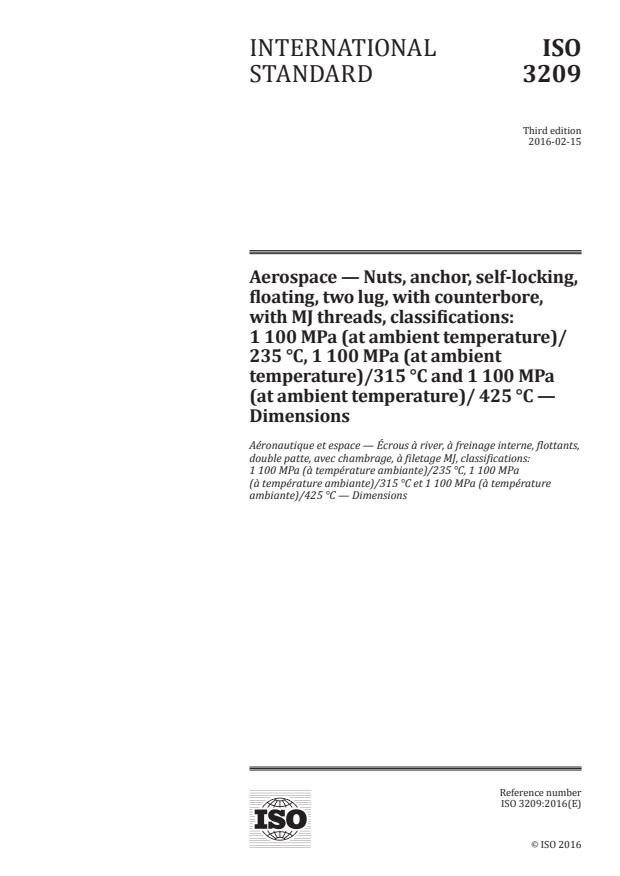
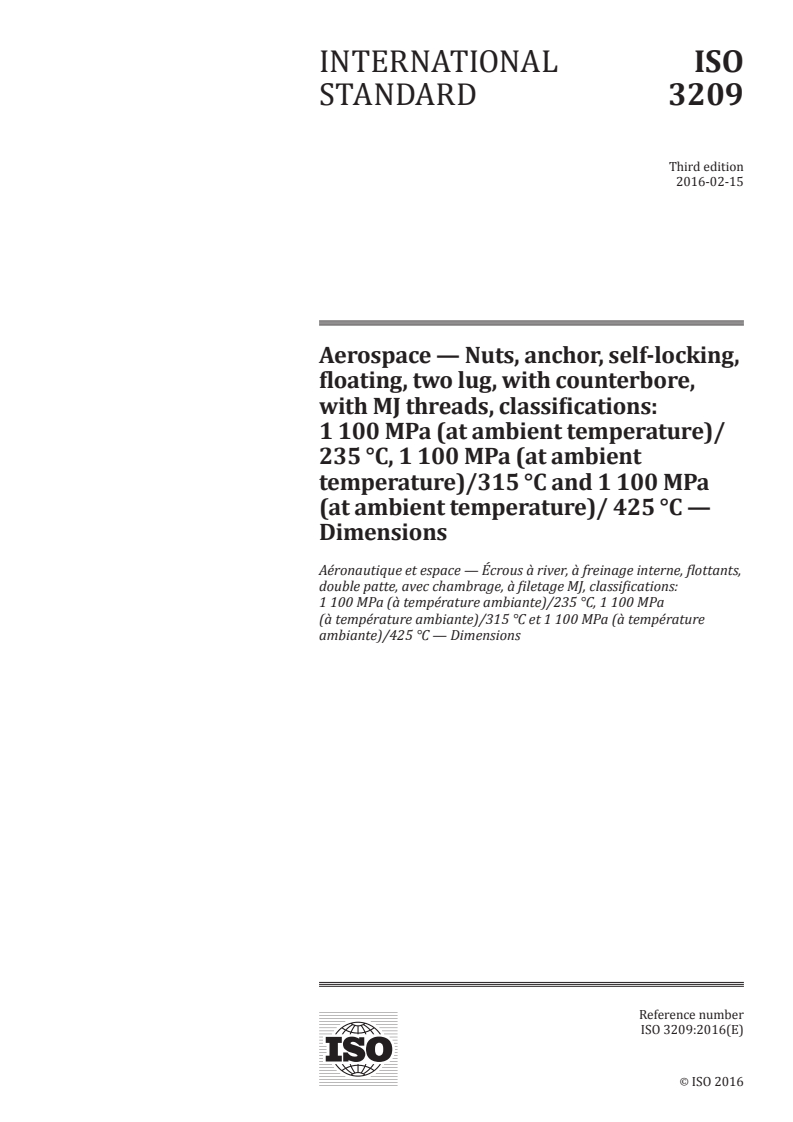
INTERNATIONAL ISO
STANDARD 3209
Third edition
2016-02-15
Aerospace — Nuts, anchor, self-locking,
floating, two lug, with counterbore,
with MJ threads, classifications:
1 100 MPa (at ambient temperature)/
235 °C, 1 100 MPa (at ambient
temperature)/315 °C and 1 100 MPa
(at ambient temperature)/ 425 °C —
Dimensions
Aéronautique et espace — Écrous à river, à freinage interne, flottants,
double patte, avec chambrage, à filetage MJ, classifications:
1 100 MPa (à température ambiante)/235 °C, 1 100 MPa
(à température ambiante)/315 °C et 1 100 MPa (à température
ambiante)/425 °C — Dimensions
Reference number
©
ISO 2016
© ISO 2016, Published in Switzerland
All rights reserved. Unless otherwise specified, no part of this publication may be reproduced or utilized otherwise in any form
or by any means, electronic or mechanical, including photocopying, or posting on the internet or an intranet, without prior
written permission. Permission can be requested from either ISO at the address below or ISO’s member body in the country of
the requester.
ISO copyright office
Ch. de Blandonnet 8 • CP 401
CH-1214 Vernier, Geneva, Switzerland
Tel. +41 22 749 01 11
Fax +41 22 749 09 47
copyright@iso.org
www.iso.org
ii © ISO 2016 – All rights reserved
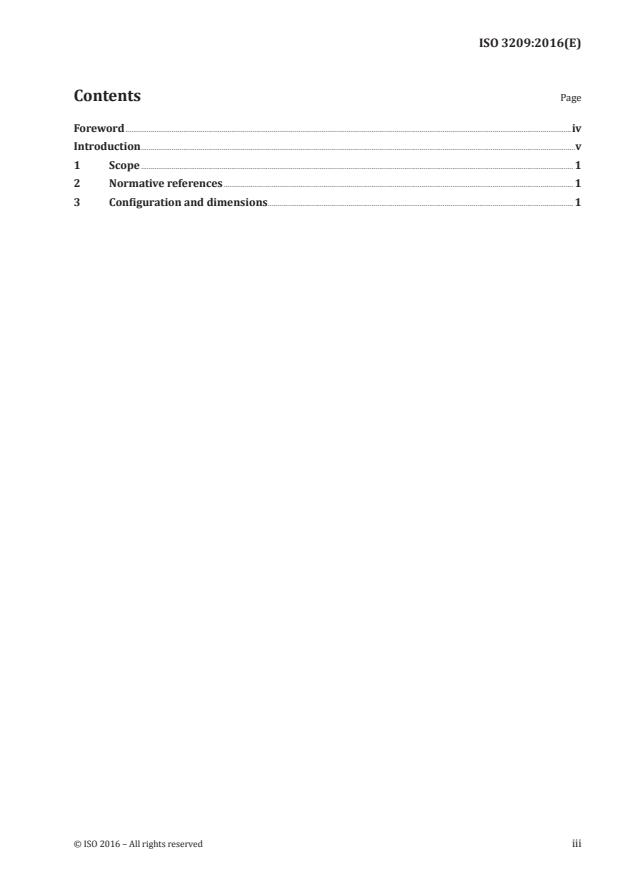
Contents Page
Foreword .iv
Introduction .v
1 Scope . 1
2 Normative references . 1
3 Configuration and dimensions . 1
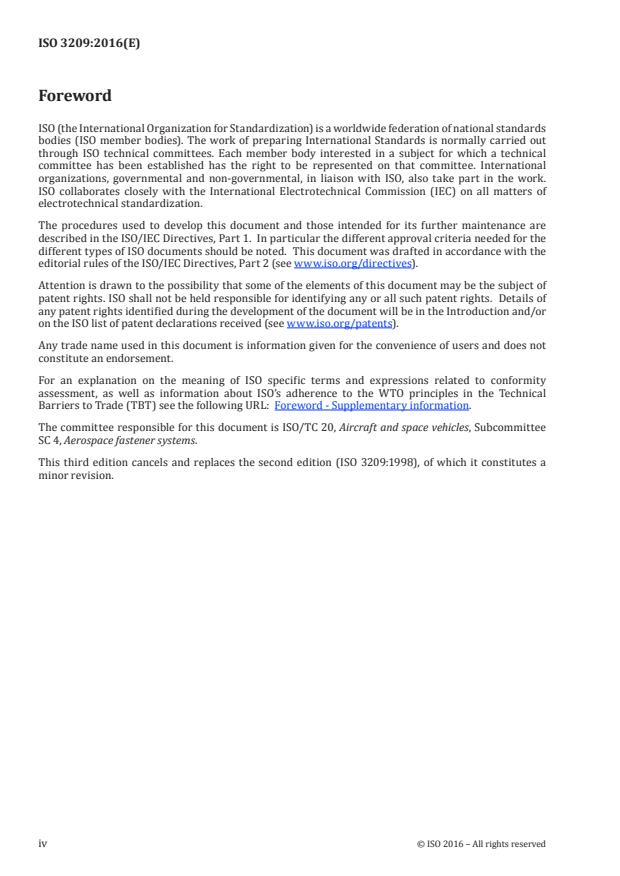
Foreword
ISO (the International Organization for Standardization) is a worldwide federation of national standards
bodies (ISO member bodies). The work of preparing International Standards is normally carried out
through ISO technical committees. Each member body interested in a subject for which a technical
committee has been established has the right to be represented on that committee. International
organizations, governmental and non-governmental, in liaison with ISO, also take part in the work.
ISO collaborates closely with the International Electrotechnical Commission (IEC) on all matters of
electrotechnical standardization.
The procedures used to develop this document and those intended for its further maintenance are
described in the ISO/IEC Directives, Part 1. In particular the different approval criteria needed for the
different types of ISO documents should be noted. This document was drafted in accordance with the
editorial rules of the ISO/IEC Directives, Part 2 (see www.iso.org/directives).
Attention is drawn to the possibility that some of the elements of this document may be the subject of
patent rights. ISO shall not be held responsible for identifying any or all such patent rights. Details of
any patent rights identified during the development of the document will be in the Introduction and/or
on the ISO list of patent declarations received (see www.iso.org/patents).
Any trade name used in this document is information given for the convenience of users and does not
constitute an endorsement.
For an explanation on the meaning of ISO specific terms and expressions related to conformity
assessment, as well as information about ISO’s adherence to the WTO principles in the Technical
Barriers to Trade (TBT) see the following URL: Foreword - Supplementary information.
The committee responsible for this document is ISO/TC 20, Aircraft and space vehicles, Subcommittee
SC 4, Aerospace fastener systems.
This third edition cancels and replaces the second edition (ISO 3209:1998), of which it constitutes a
minor revision.
iv © ISO 2016 – All r
...
INTERNATIONAL ISO
STANDARD 3209
Third edition
2016-02-15
Aerospace — Nuts, anchor, self-locking,
floating, two lug, with counterbore,
with MJ threads, classifications:
1 100 MPa (at ambient temperature)/
235 °C, 1 100 MPa (at ambient
temperature)/315 °C and 1 100 MPa
(at ambient temperature)/ 425 °C —
Dimensions
Aéronautique et espace — Écrous à river, à freinage interne, flottants,
double patte, avec chambrage, à filetage MJ, classifications:
1 100 MPa (à température ambiante)/235 °C, 1 100 MPa
(à température ambiante)/315 °C et 1 100 MPa (à température
ambiante)/425 °C — Dimensions
Reference number
©
ISO 2016
© ISO 2016, Published in Switzerland
All rights reserved. Unless otherwise specified, no part of this publication may be reproduced or utilized otherwise in any form
or by any means, electronic or mechanical, including photocopying, or posting on the internet or an intranet, without prior
written permission. Permission can be requested from either ISO at the address below or ISO’s member body in the country of
the requester.
ISO copyright office
Ch. de Blandonnet 8 • CP 401
CH-1214 Vernier, Geneva, Switzerland
Tel. +41 22 749 01 11
Fax +41 22 749 09 47
copyright@iso.org
www.iso.org
ii © ISO 2016 – All rights reserved
Contents Page
Foreword .iv
Introduction .v
1 Scope . 1
2 Normative references . 1
3 Configuration and dimensions . 1
Foreword
ISO (the International Organization for Standardization) is a worldwide federation of national standards
bodies (ISO member bodies). The work of preparing International Standards is normally carried out
through ISO technical committees. Each member body interested in a subject for which a technical
committee has been established has the right to be represented on that committee. International
organizations, governmental and non-governmental, in liaison with ISO, also take part in the work.
ISO collaborates closely with the International Electrotechnical Commission (IEC) on all matters of
electrotechnical standardization.
The procedures used to develop this document and those intended for its further maintenance are
described in the ISO/IEC Directives, Part 1. In particular the different approval criteria needed for the
different types of ISO documents should be noted. This document was drafted in accordance with the
editorial rules of the ISO/IEC Directives, Part 2 (see www.iso.org/directives).
Attention is drawn to the possibility that some of the elements of this document may be the subject of
patent rights. ISO shall not be held responsible for identifying any or all such patent rights. Details of
any patent rights identified during the development of the document will be in the Introduction and/or
on the ISO list of patent declarations received (see www.iso.org/patents).
Any trade name used in this document is information given for the convenience of users and does not
constitute an endorsement.
For an explanation on the meaning of ISO specific terms and expressions related to conformity
assessment, as well as information about ISO’s adherence to the WTO principles in the Technical
Barriers to Trade (TBT) see the following URL: Foreword - Supplementary information.
The committee responsible for this document is ISO/TC 20, Aircraft and space vehicles, Subcommittee
SC 4, Aerospace fastener systems.
This third edition cancels and replaces the second edition (ISO 3209:1998), of which it constitutes a
minor revision.
iv © ISO 2016 – All r
...