

ISO 16424:2012
(Main)Nuclear energy — Evaluation of homogeneity of Gd distribution within gadolinium fuel blends and determination of Gd2O3 content in gadolinium fuel pellets by measurements of uranium and gadolinium elements
General Information
- Abstract
ISO 16424:2012 is applicable to the evaluation of the homogeneity of Gd distribution within gadolinium fuel blends, and the determination of the Gd2O3 content in sintered fuel pellets of Gd2O3+UO2 from 1 % to 10 %, by measurements of gadolinium (Gd) and uranium (U) elements using ICP-AES. After performing measurements of Gd and U elements using ICP-AES, if statistical methodology is additionally applied, homogeneity of Gd distribution within a Gd fuel pellet lot can also be evaluated. However, ISO 16424:2012 covers the statistical methodology only on a limited basis.
- Status
- Published
- Publication Date
- 05-Dec-2012
- Technical Committee
- ISO/TC 85/SC 5 - Nuclear installations, processes and technologies
- Drafting Committee
- ISO/TC 85/SC 5 - Nuclear installations, processes and technologies
- Current Stage
- 9093 - International Standard confirmed
- Start Date
- 21-Feb-2024
- Completion Date
- 29-Aug-2026
Buy Documents

ISO 16424:2012 - Nuclear energy — Evaluation of homogeneity of Gd distribution within gadolinium fuel blends and determination of Gd2O3 content in gadolinium fuel pellets by measurements of uranium and gadolinium elements Released:12/6/2012

ISO 16424:2012 - Énergie nucléaire — Évaluation de l'homogénéité de la distribution du Gd dans les mélanges de combustibles au gadolinium et détermination de la teneur en Gd2O3 dans les pastilles combustibles au gadolinium par mesurage des éléments uranium et gadolinium Released:8/4/2014
Overview
ISO 16424:2012 specifies analytical procedures for evaluating the homogeneity of gadolinium (Gd) distribution in blended nuclear fuel powders and for determining Gd2O3 content in sintered Gd2O3+UO2 fuel pellets (mass fraction 1 % to 10 %) using inductively coupled plasma atomic emission spectrometry (ICP‑AES). The standard uses measured Gd and uranium (U) element concentrations and stoichiometric relationships (including the oxygen-to-metal, O/M, ratio) to calculate Gd2O3 content. It also provides a limited approach to statistical assessment of homogeneity within a pellet lot.
Key topics and technical requirements
- Measurement technique: ICP‑AES (high dispersion direct‑reading) with sufficient resolution to report concentrations to two decimal places for the 1–100 mg/L range.
- Recommended emission lines: Gd ~354.580 nm and U ~398.579 nm (other peaks may be used).
- Calibration: use certified reference solutions - Gd at 5, 10 and 15 mg/L; U at 50, 70 and 100 mg/L - to build intensity vs. concentration regression curves.
- Sample preparation: dissolve small, randomly taken powder or crushed pellet fragments in 50 % nitric acid; prepare sample solutions to yield U concentrations ≈ 50–100 mg/L.
- Repetition and sampling: each sample solution is measured repeatedly (typically six replicates) and at least five independent samples are recommended for homogeneity evaluation.
- Calculations: determine Gd2O3 mass fraction from measured Gd and U concentrations using stoichiometric formulas and O/M considerations; Annexes cover uncertainty and precision guidance.
- Instrument and lab requirements: analytical balance sensitivity ±0.1 mg, micropipettes, PTFE/glassware, hot plate and percussion mortar are specified.
Applications and practical value
- Quality control in nuclear fuel fabrication for Gd‑doped UO2 pellets used as burnable absorbers.
- Incoming material inspection and homogeneity evaluation of powder blends to ensure consistent Gd distribution prior to sintering.
- Verification of final pellet Gd2O3 content for specification compliance, material accounting and traceability.
- Use by analytical laboratories, fuel manufacturers, regulatory bodies and R&D groups involved in nuclear fuel chemistry and metrology.
Who should use this standard
- Nuclear fuel manufacturers and QA/QC laboratories
- Analytical chemistry labs performing ICP‑AES on nuclear materials
- Nuclear safeguards and materials accounting teams
- Metrology institutes and certification bodies
Related standards
- ISO 16796 - alternative ICP‑AES method for Gd2O3 determination (different methodology)
- ISO 3696 - water for analytical laboratory use (referred in ISO 16424)
- ISO 3951‑4 - statistical sampling procedures (for extended homogeneity/statistics guidance)
Keywords: ISO 16424, Gd2O3 content, gadolinium fuel pellets, ICP‑AES, gadolinium homogeneity evaluation, UO2, nuclear fuel quality control, O/M ratio.
Buy Documents
ISO 16424:2012 - Nuclear energy — Evaluation of homogeneity of Gd distribution within gadolinium fuel blends and determination of Gd2O3 content in gadolinium fuel pellets by measurements of uranium and gadolinium elements Released:12/6/2012
ISO 16424:2012 - Énergie nucléaire — Évaluation de l'homogénéité de la distribution du Gd dans les mélanges de combustibles au gadolinium et détermination de la teneur en Gd2O3 dans les pastilles combustibles au gadolinium par mesurage des éléments uranium et gadolinium Released:8/4/2014
Get Certified
Connect with accredited certification bodies for this standard

DNV
DNV is an independent assurance and risk management provider.

Lloyd's Register
Lloyd's Register is a global professional services organisation specialising in engineering and technology.
DNV Energy Systems
Energy and renewable energy certification.
Sponsored listings
Frequently Asked Questions
ISO 16424:2012 is a standard published by the International Organization for Standardization (ISO). Its full title is "Nuclear energy — Evaluation of homogeneity of Gd distribution within gadolinium fuel blends and determination of Gd2O3 content in gadolinium fuel pellets by measurements of uranium and gadolinium elements". This standard covers: ISO 16424:2012 is applicable to the evaluation of the homogeneity of Gd distribution within gadolinium fuel blends, and the determination of the Gd2O3 content in sintered fuel pellets of Gd2O3+UO2 from 1 % to 10 %, by measurements of gadolinium (Gd) and uranium (U) elements using ICP-AES. After performing measurements of Gd and U elements using ICP-AES, if statistical methodology is additionally applied, homogeneity of Gd distribution within a Gd fuel pellet lot can also be evaluated. However, ISO 16424:2012 covers the statistical methodology only on a limited basis.
ISO 16424:2012 is applicable to the evaluation of the homogeneity of Gd distribution within gadolinium fuel blends, and the determination of the Gd2O3 content in sintered fuel pellets of Gd2O3+UO2 from 1 % to 10 %, by measurements of gadolinium (Gd) and uranium (U) elements using ICP-AES. After performing measurements of Gd and U elements using ICP-AES, if statistical methodology is additionally applied, homogeneity of Gd distribution within a Gd fuel pellet lot can also be evaluated. However, ISO 16424:2012 covers the statistical methodology only on a limited basis.
ISO 16424:2012 is classified under the following ICS (International Classification for Standards) categories: 27.120.30 - Fissile materials and nuclear fuel technology. The ICS classification helps identify the subject area and facilitates finding related standards.
ISO 16424:2012 is available in PDF format for immediate download after purchase. The document can be added to your cart and obtained through the secure checkout process. Digital delivery ensures instant access to the complete standard document.
Standards Content (Sample)
INTERNATIONAL ISO
STANDARD 16424
First edition
2012-12-01
Nuclear energy — Evaluation of
homogeneity of Gd distribution
within gadolinium fuel blends and
determination of Gd O content
2 3
in gadolinium fuel pellets by
measurements of uranium and
gadolinium elements
Énergie nucléaire — Évaluation de l’homogénéité de la distribution
du Gd dans les mélanges de combustibles au gadolinium et
détermination de la teneur en Gd O dans les pastilles combustibles
2 3
au gadolinium par mesurage des éléments uranium et gadolinium
Reference number
©
ISO 2012
© ISO 2012
All rights reserved. Unless otherwise specified, no part of this publication may be reproduced or utilized in any form or by any
means, electronic or mechanical, including photocopying and microfilm, without permission in writing from either ISO at the
address below or ISO’s member body in the country of the requester.
ISO copyright office
Case postale 56 • CH-1211 Geneva 20
Tel. + 41 22 749 01 11
Fax + 41 22 749 09 47
E-mail copyright@iso.org
Web www.iso.org
Published in Switzerland
ii © ISO 2012 – All rights reserved
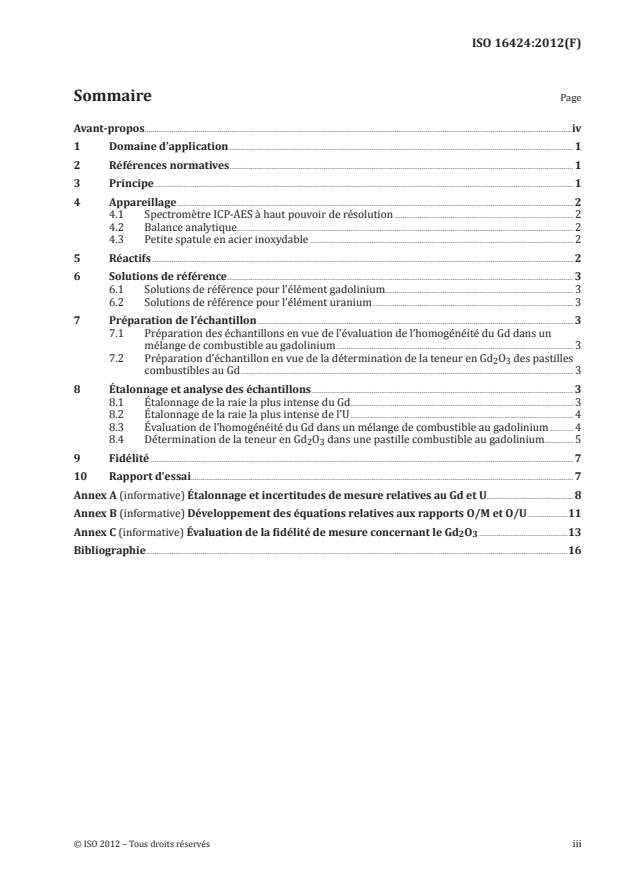
Contents Page
Foreword .iv
1 Scope . 1
2 Normative references . 1
3 Principle . 1
4 Apparatus . 2
4.1 High dispersion direct reading ICP-AES . 2
4.2 Analytical balance. 2
4.3 Small stainless steel spoon . 2
5 Reagents . 2
6 Reference solutions . 2
6.1 Gadolinium element reference solutions . 2
6.2 Uranium element reference solutions . 3
7 Sample preparation . 3
7.1 Sample preparation for evaluation of Gd homogeneity in gadolinium fuel blend . 3
7.2 Sample preparation for determining the Gd O content of Gd fuel pellets . 3
2 3
8 Calibration and analysis of the samples . 3
8.1 Calibration of Gd peak line intensity . 3
8.2 Calibration of U peak line intensity . 3
8.3 Evaluation of Gd homogeneity in gadolinium fuel blend . 3
8.4 Determination of Gd O content in gadolinium fuel pellet . 4
2 3
9 Precision . 6
10 Test report . 6
Annex A (informative) Calibration and Gd and U measurement uncertainties .7
Annex B (informative) Derivation of O/M and O/U ratio formulas .10
Annex C (informative) Evaluation of Gd O measurement precision .12
2 3
Bibliography .15
Foreword
ISO (the International Organization for Standardization) is a worldwide federation of national standards
bodies (ISO member bodies). The work of preparing International Standards is normally carried out
through ISO technical committees. Each member body interested in a subject for which a technical
committee has been established has the right to be represented on that committee. International
organizations, governmental and non-governmental, in liaison with ISO, also take part in the work.
ISO collaborates closely with the International Electrotechnical Commission (IEC) on all matters of
electrotechnical standardization.
International Standards are drafted in accordance with the rules given in the ISO/IEC Directives, Part 2.
The main task of technical committees is to prepare International Standards. Draft International
Standards adopted by the technical committees are circulated to the member bodies for voting.
Publication as an International Standard requires approval by at least 75 % of the member bodies
casting a vote.
Attention is drawn to the possibility that some of the elements of this document may be the subject of
patent rights. ISO shall not be held responsible for identifying any or all such patent rights.
ISO 16424 was prepared by Technical Committee ISO/TC 85, Nuclear Energy, Nuclear Technologies, and
Radiological Protection, Subcommittee SC 5, Nuclear Fuel Cycle.
iv © ISO 2012 – All rights reserved
INTERNATIONAL STANDARD ISO 16424:2012(E)
Nuclear energy — Evaluation of homogeneity of
Gd distribution within gadolinium fuel blends and
determination of Gd O content in gadolinium fuel pellets
2 3
by measurements of uranium and gadolinium elements
1 Scope
This International Standard is applicable to the evaluation of the homogeneity of Gd distribution within
gadolinium fuel blends, and the determination of the Gd O content in sintered fuel pellets of Gd O +UO
2 3 2 3 2
from 1 % to 10 %, by measurements of gadolinium (Gd) and uranium (U) elements using ICP-AES.
After performing measurements of Gd and U elements using ICP-AES, if statistical methodology is
additionally applied, homogeneity of Gd distribution within a Gd fuel pellet lot can also be evaluated.
However, this International Standard covers the statistical methodology only on a limited basis.
NOTE 1 ISO 16796 also provides a method for Gd O content determination by atomic emission spectrometry
2 3
using an inductively coupled plasma source (ICP-AES). The methodology of ISO 16796 is different from the one of
this International Standard.
NOTE 2 In this International Standard, gadolinium fuel blend represents a mixture of uranium dioxide (UO )
powder and gadolinium oxide (Gd O ) powder. The physically blended and homogenized powder may additionally
2 3
contain in it rather large quantities of uranium oxide (U O ) powder particles and/or the M O powder particles
3 8 3 8
obtained by oxidation of Gd pellets. In this International Standard, the symbol “M” in the chemical formula “M O ”
3 8
and in the terminology “O/M ratio” represents metallic elements U and Gd.
2 Normative references
The following documents, in whole or in part, are normatively referenced in this document and are
indispensible for its application. For dated references, only the edition cited applies. For undated
references, the latest edition of the referenced document (including amendments) applies.
ISO 3696:1987, Water for analytical laboratory use — Specification and test methods
3 Principle
If the Gd and U element contents and the oxygen to metal atomic ratio (commonly referred to as O/M
ratio) in a gadolinium fuel pellet are measured or determined, the Gd O content of that pellet can be
2 3
determined by calculation based on the stoichiometry of the pellet. The stoichiometric compositions
for Gd and U will depend upon pellet manufacturing specification. If the specification requires that the
Gd O content in the pellet be 6 % as mass fraction, after manufacturing, the ratio of total Gd mass to
2 3
total U mass in that pellet will be close to 0,063.
The Gd and U element content values measured from a powder blend can make it possible to evaluate
whether Gd distribution in the powder is sufficiently homogeneous. Moreover, the two values make it
possible to estimate accurately the actual Gd O content of the pellet after sintering. The estimated
2 3
Gd O content can be used to anticipate whether the Gd pellets to be produced will meet Gd O content
2 3 2 3
specifications or not.
Impurity interferences have not been observed for the usual samples of the nuclear grade material.
Very small quantities of impurity elements which might be contained in the samples do not affect the
principle of this International Standard.
NOTE Even in the case of M O powder or mixture of UO powder and Gd O powder, if the Gd and U element
3 8 2 2 3
contents and the O/M ratio are measured or determined, the Gd O content (or Gd content) of that powder can be
2 3
determined by calculation based on the stoichiometry of the powder. Using the Gd O content (or Gd content) thus
2 3
obtained and the O/M ratio, the uranium concentration factor of the powder can also be calculated so as to obtain
accurate uranium accounting data.
4 Apparatus
4.1 High dispersion direct reading ICP-AES
The measured values should be indicated down to at least two decimal places when element
concentrations in the range from 1 mg/l to 100 mg/l are measured. For determination of Gd and U
element concentrations, 354,580 nm and 398,579 nm peaks in atomic emission spectrum are used,
respectively. However, instead of the two peaks, other peaks are also available.
4.2 Analytical balance
The sensitivity of the balance is ± 0,1 mg.
4.3 Small stainless steel spoon
The small spoon is able to accommodate powder in the range from 1 mg to 100 mg.
4.4 Hot plate.
4.5 Glass beakers or polytetrafluoroethylene (PTFE) beakers.
4.6 Micropipettes.
4.7 Volumetric flasks.
4.8 Percussion mortar.
5 Reagents
5.1 Nitric acid, aqueous solution at a volume fraction of 50 %.
5.2 Water, distilled water or water complying with grade 3 of ISO 3696:1987.
6 Reference solutions
6.1 Gadolinium element reference solutions
Three Gd reference solutions whose Gd concentrations are 5 mg/l, 10 mg/l and 15 mg/l, respectively,
1)
are used for calibration. These Gd reference solutions are the ones that have been manufactured by
diluting a reference material with the water specified in 5.2.
1) A certified gadolinium reference material from NIST (National Institute of Standards and Technology, USA) is an
example of a suitable product available commercially. This information is given for the convenience of users of this
document and does not constitute an endorsement of this product by ISO.
2 © ISO 2012 – All rights reserved
6.2 Uranium element reference solutions
Three U reference solutions whose U concentrations are 50 mg/l, 70 mg/l and 100 mg/l, respectively,
2)
are used for calibration. These U reference solutions are the ones that have been manufactured by
diluting a reference material with the water specified in 5.2.
7 Sample preparation
7.1 Sample preparation for evaluation of Gd homogeneity in gadolinium fuel blend
Using a small spoon, take randomly at least five different powder samples from the blended powder, then
dissolve each of the samples in the nitric acid solution of 5.1. Number each beaker individually. The U
concentrations of the sample solutions prepared should be somewhere in the range from 50 mg/l to 100 mg/l.
To evaluate the homogeneity of the Gd distribution within a Gd fuel pellet lot, take at least five different
pellet samples from the lot and then crush each of the pellets into small pellet fragments as described in 7.2.
NOTE 1 If about 2 mg of the powder sample is dissolved in 20 ml of the nitric acid solution, the required uranium
concentration range will be obtained. Alternatively, if about 100 mg of sample is dissolved and then diluted by
proper pipetting and addition of distilled water, the concentration range can also be obtained.
7.2 Sample preparation for determining the Gd O content of Gd fuel pellets
2 3
After crushing a gadolinium fuel pellet using a percussion mortar, randomly take a small sample from
the pellet fragments, and dissolve it in the nitric acid solution. The U concentration should be somewhere
in the range from 50 mg/l to 100 mg/l.
8 Calibration and analysis of the samples
8.1 Calibration of Gd peak line intensity
The three Gd reference solutions of 6.1 are used to calibrate the intensity of the Gd peak line. The Gd peak
line intensity is repeatedly measured to establish an intensity-versus-concentration curve (regression
curve) needed for determination of Gd concentrations. See A.1.
8.2 Calibration of U peak line intensity
The three U reference solutions of 6.2 are used to calibrate the intensity of the U peak line. The U peak
line intensity is repeatedly measured to establish an intensity-versus-concentration curve (regression
curve) needed for determination of U concentrations. See A.2.
8.3 Evaluation of Gd homogeneity in gadolinium fuel blend
8.3.1 Estimated Gd O content
2 3
Measure the concentrations of Gd and U elements contained in the sample solutions (at least five different
solutions) that were prepared according to 7.1. Each sample solution is repeatedly measured six times,
and the six measurement values of Gd and U each are averaged. Each sample solution will be given a Gd
2) A certified uranium reference material from NIST (National Institute of Standards and Technology, USA) is an
example of a suitable product available commercially. This information is given for the convenience of users of this
document and does not constitute an endorsement of this product by ISO.
average and a U average. After all of the Gd concentration average and U concentration average sets have
been obtained, the estimated Gd O content for each sample is calculated by the following formula:
2 3
1 (,15 999 43× )
( )(100)[ + 2](ρ )
Gd
2 157,25
w =
Gd2O3,est
ρ ρ
Gd U
((ρρ++)2)((,15 999 4) +
Gd
U
157,,25 238 03
(,05)(100)(2,)3052ρ
Gd
=
()ρρ++()20,,10170ρρ+ 0672
()
Gd UGd U
where
w is the estimated Gd O content, mass fraction (%) as given by Gd O /(Gd,U)O ;
Gd2O3,est 2 3 2 3 2
157,25 is the atomic mass of gadolinium (Gd);
238,03 is the atomic mass of uranium (U);
15,9994 is the atomic mass of oxygen (O);
is the Gd concentration average in mg/l, indicated down to two decimal places;
ρ
Gd
is the U concentration average in mg/l, indicated down to two decimal places.
ρ
U
If five different sample solutions have been prepared and measured, five estimated values of Gd O
2 3
content will be obtained by this procedure.
NOTE The estimated Gd O content represents the most possible Gd O content of the expected Gd pellet to
2 3 2 3
be manufactured from the powder blend. As a general rule, after the powder blend has been sintered, the O/M
ratio of manufactured Gd pellet will be 2 or very close to 2. Therefore, the actual Gd O content of the pellet will
2 3
be very close to this estimated Gd O content.
2 3
8.3.2 Evaluation of homogeneity of Gd distribution
Evaluate the homogeneity of Gd distribution within the blended powder by applying a statistical
methodology to the estimated contents of Gd O obtained in Clause 8.3.1. The average and the standard
2 3
deviation calculated from at least five estimated values of Gd O content will be used for the evaluation.
2 3
EXAMPLE If the homogeneity specification of the blended powder requires that one standard deviation of
estimated Gd O content values of five blended powder samples randomly taken shall be within 1 % relative from
2 3
the mean of the five values, and if the mean and the standard deviation of the five estimated Gd O contents are
2 3
6,03 % and 0,04 %, respectively, it can be said that the blended powder meets the homogeneity specification, because
al
...
NORME ISO
INTERNATIONALE 16424
Première édition
2012-12-01
Énergie nucléaire — Évaluation de
l’homogénéité de la distribution du
Gd dans les mélanges de combustibles
au gadolinium et détermination de
la teneur en Gd2O3 dans les pastilles
combustibles au gadolinium par
mesurage des éléments uranium et
gadolinium
Nuclear energy — Evaluation of homogeneity of Gd distribution
within gadolinium fuel blends and determination of Gd2O3 content in
gadolinium fuel pellets by measurements of uranium and gadolinium
elements
Numéro de référence
©
ISO 2012
DOCUMENT PROTÉGÉ PAR COPYRIGHT
© ISO 2012
Droits de reproduction réservés. Sauf indication contraire, aucune partie de cette publication ne peut être reproduite ni utilisée
sous quelque forme que ce soit et par aucun procédé, électronique ou mécanique, y compris la photocopie, l’affichage sur
l’internet ou sur un Intranet, sans autorisation écrite préalable. Les demandes d’autorisation peuvent être adressées à l’ISO à
l’adresse ci-après ou au comité membre de l’ISO dans le pays du demandeur.
ISO copyright office
Case postale 56 • CH-1211 Geneva 20
Tel. + 41 22 749 01 11
Fax + 41 22 749 09 47
E-mail copyright@iso.org
Web www.iso.org
Version française parue en 2014
Publié en Suisse
ii © ISO 2012 – Tous droits réservés
Sommaire Page
Avant-propos .iv
1 Domaine d’application . 1
2 Références normatives . 1
3 Principe . 1
4 Appareillage . 2
4.1 Spectromètre ICP-AES à haut pouvoir de résolution . 2
4.2 Balance analytique . 2
4.3 Petite spatule en acier inoxydable . 2
5 Réactifs . 2
6 Solutions de référence . 3
6.1 Solutions de référence pour l’élément gadolinium. 3
6.2 Solutions de référence pour l’élément uranium . 3
7 Préparation de l’échantillon . 3
7.1 Préparation des échantillons en vue de l’évaluation de l’homogénéité du Gd dans un
mélange de combustible au gadolinium . 3
7.2 Préparation d’échantillon en vue de la détermination de la teneur en Gd O des pastilles
2 3
combustibles au Gd . 3
8 Étalonnage et analyse des échantillons . 3
8.1 Étalonnage de la raie la plus intense du Gd . 3
8.2 Étalonnage de la raie la plus intense de l’U . 4
8.3 Évaluation de l’homogénéité du Gd dans un mélange de combustible au gadolinium . 4
8.4 Détermination de la teneur en Gd O dans une pastille combustible au gadolinium . 5
2 3
9 Fidélité . 7
10 Rapport d’essai . 7
Annex A (informative) Étalonnage et incertitudes de mesure relatives au Gd et U .8
Annex B (informative) Développement des équations relatives aux rapports O/M et O/U .11
Annex C (informative) Évaluation de la fidélité de mesure concernant le Gd
O .13
2 3
Bibliographie .16
Avant-propos
L’ISO (Organisation internationale de normalisation) est une fédération mondiale d’organismes
nationaux de normalisation (comités membres de l’ISO). L’élaboration des Normes internationales est
en général confiée aux comités techniques de l’ISO. Chaque comité membre intéressé par une étude
a le droit de faire partie du comité technique créé à cet effet. Les organisations internationales,
gouvernementales et non gouvernementales, en liaison avec l’ISO participent également aux travaux.
L’ISO collabore étroitement avec la Commission électrotechnique internationale (IEC) en ce qui concerne
la normalisation électrotechnique.
Les procédures utilisées pour élaborer le présent document et celles destinées à sa mise à jour sont
décrites dans les Directives ISO/IEC, Partie 1. Il convient, en particulier de prendre note des différents
critères d’approbation requis pour les différents types de documents ISO. Le présent document a été
rédigé conformément aux règles de rédaction données dans les Directives ISO/IEC, Partie 2 (voir www.
iso.org/directives).
L’attention est appelée sur le fait que certains des éléments du présent document peuvent faire l’objet de
droits de propriété intellectuelle ou de droits analogues. L’ISO ne saurait être tenue pour responsable
de ne pas avoir identifié de tels droits de propriété et averti de leur existence. Les détails concernant les
références aux droits de propriété intellectuelle ou autres droits analogues identifiés lors de l’élaboration
du document sont indiqués dans l’Introduction et/ou dans la liste des déclarations de brevets reçues par
l’ISO (voir www.iso.org/brevets).
Les appellations commerciales éventuellement mentionnées dans le présent document sont données
pour information, par souci de commodité, à l’intention des utilisateurs et ne sauraient constituer un
engagement.
Pour une explication de la signification des termes et expressions spécifiques de l’ISO liés à l’évaluation de
la conformité, ou pour toute information au sujet de l’adhésion de l’ISO aux principes de l’OMC concernant
les obstacles techniques au commerce (OTC), voir le lien suivant: Avant-propos — Informations
supplémentaires.
L’ISO 16424 a été élaborée par le comité technique ISO/TC 85, Énergie nucléaire, technologies nucléaires,
et radioprotection, sous-comité SC 5, Cycle du combustible nucléaire.
iv © ISO 2012 – Tous droits réservés
NORME INTERNATIONALE ISO 16424:2012(F)
Énergie nucléaire — Évaluation de l’homogénéité de la
distribution du Gd dans les mélanges de combustibles au
gadolinium et détermination de la teneur en Gd2O3 dans
les pastilles combustibles au gadolinium par mesurage des
éléments uranium et gadolinium
1 Domaine d’application
La présente Norme internationale spécifie une méthode d’évaluation de l’homogénéité de la distribution
du Gd dans les mélanges de combustibles au gadolinium et de détermination de la teneur en Gd O
2 3
dans les pastilles combustibles frittées de Gd O +UO allant de 1 % à 10 %, par mesurage des éléments
2 3 2
gadolinium (Gd) et uranium (U) en utilisant la méthode de spectrométrie par émission atomique à
plasma à couplage inductif (ICP-AES).
Après mesurage des éléments Gd et U en utilisant la méthode ICP-AES, si la méthodologie statistique est
en outre appliquée, l’homogénéité de la distribution du Gd dans un lot de pastilles combustibles au Gd
peut également être évaluée. Cependant, la présente Norme internationale ne couvre la méthodologie
statistique que sur une base restreinte.
NOTE 1 L’ISO 16796 spécifie également une méthode de détermination de la teneur en Gd O au moyen
2 3
de la spectrométrie par émission atomique utilisant une source de plasma à couplage inductif (ICP-AES). La
méthodologie de l’ISO 16796 est différente de celle de la présente Norme internationale.
NOTE 2 Dans la présente Norme internationale, un mélange de combustible au gadolinium représente un
mélange d’une poudre de dioxyde d’uranium (UO ) et d’une poudre d’oxyde de gadolinium (Gd O ). La poudre
2 2 3
mélangée et homogénéisée mécaniquement peut en outre contenir des quantités assez importantes de particules
de poudre d’oxyde d’uranium (U O ) et/ou des particules de poudre de M O obtenues par oxydation de pastilles
3 8 3 8
au Gd. Dans la présente Norme internationale, le symbole «M» présent dans la formule chimique «M O » et dans
3 8
le terme «rapport O/M» représente les éléments métalliques U et Gd.
2 Références normatives
Les documents ci-après, dans leur intégralité ou non, sont des références normatives indispensables
à l’application du présent document. Pour les références datées, seule l’édition citée s’applique. Pour
les références non datées, la dernière édition du document de référence s’applique (y compris les
amendements).
ISO 3696:1987, Eau pour laboratoire à usage analytique — Spécification et méthodes d’essai
3 Principe
Si les teneurs en éléments Gd et U ainsi que le rapport atomique oxygène/métal (communément appelé
rapport O/M) dans une pastille combustible au gadolinium sont mesurés ou déterminés, la teneur en
Gd O de cette pastille peut être déterminée par calcul en se basant sur la stœchiométrie de la pastille.
2 3
Les compositions stœchiométriques du Gd et de l’U dépendront des spécifications de fabrication des
pastilles. Si les spécifications exigent que la teneur en Gd O dans la pastille représente 6 % de la fraction
2 3
massique à l’issue de la fabrication, alors le rapport masse totale de Gd/masse totale de U dans la pastille
sera proche de 0,063.
Les valeurs des teneurs en éléments Gd et U obtenues par mesurage sur un mélange de poudre permettent
d’évaluer si la distribution du Gd dans la poudre est suffisamment homogène. De plus, ces deux valeurs
permettent d’estimer avec exactitude la teneur en Gd O réelle de la pastille après frittage. La teneur en
2 3
Gd O estimée peut être utilisée pour anticiper le fait que les pastilles au Gd à produire satisferont aux
2 3
spécifications sur la teneur en Gd O ou pas.
2 3
Il n’a pas été observé d’interférences dues aux impuretés couramment présentes dans les échantillons
de pureté nucléaire. De très petites quantités d’éléments d’impureté qui pourraient être présentes dans
les échantillons n’ont pas d’incidence sur le principe de la présente Norme internationale.
NOTE Même dans le cas d’une poudre de M O ou d’un mélange d’une poudre de UO et d’une poudre de
3 8 2
Gd O , si les teneurs en éléments Gd et U et le rapport O/M sont mesurés ou déterminés, la teneur en Gd O (ou la
2 3 2 3
teneur en Gd) de cette poudre peut être déterminée par calcul en se basant sur la stœchiométrie de la poudre. À
l’aide de la teneur en Gd O (ou de la teneur en Gd) ainsi obtenue et du rapport O/M, le facteur de concentration en
2 3
uranium de la poudre peut également être calculé de manière à obtenir des données chiffrées exactes concernant
l’uranium.
4 Appareillage
4.1 Spectromètre ICP-AES à haut pouvoir de résolution
Lorsque les concentrations en éléments se situent dans une plage allant de 1 mg/l à 100 mg/l, il convient
d’arrondir les valeurs mesurées avec au moins deux décimales. Les concentrations en éléments Gd et U
sont déterminées en se basant sur les pics du spectre d’émission atomique à 354,580 nm et à 398,579 nm,
respectivement. Toutefois, il est également possible d’employer d’autres pics à la place de ces deux pics.
4.2 Balance analytique
La sensibilité de la balance est de ± 0,1 mg.
4.3 Petite spatule en acier inoxydable
La petite spatule est capable de contenir entre 1 mg et 100 mg de poudre.
4.4 Plaque chauffante
4.5 Béchers en verre ou en polytétrafluoroéthylène (PTFE)
4.6 Micropipettes
4.7 Fioles jaugées
4.8 Mortier
5 Réactifs
5.1 Acide nitrique, en solution aqueuse à une fraction volumique de 50 %
5.2 Eau, eau distillée ou eau conforme à la qualité 3 de l’ISO 3696:1987.
2 © ISO 2012 – Tous droits réservés
6 Solutions de référence
6.1 Solutions de référence pour l’élément gadolinium
Trois solutions de référence pour le Gd présentant des concentrations en Gd de 5 mg/l, 10 mg/l et
1)
15 mg/l, respectivement, sont employées pour l’étalonnage. Ces solutions de référence pour le Gd sont
préparées par dilution d’un matériau de référence avec l’eau spécifiée en 5.2.
6.2 Solutions de référence pour l’élément uranium
Trois solutions de référence pour l‘uranium présentant des concentrations en U de 50 mg/l, 70 mg/l et
2)
100 mg/l, respectivement, sont employées pour l’étalonnage. Ces solutions de référence pour le U sont
préparées par dilution d’un matériau de référence avec l’eau spécifiée en 5.2.
7 Préparation de l’échantillon
7.1 Préparation des échantillons en vue de l’évaluation de l’homogénéité du Gd dans un
mélange de combustible au gadolinium
À l’aide d’une petite spatule, prélever au hasard au moins cinq échantillons de poudre différents dans la
poudre mélangée, puis dissoudre chaque échantillon dans la solution d’acide nitrique spécifiée en 5.1.
Numéroter chaque bécher un à un. Il convient que les concentrations en U des solutions d’échantillons
préparées soient comprises dans une plage allant de 50 mg/l à 100 mg/l.
Pour évaluer l’homogénéité de la distribution du Gd dans un lot de pastilles combustibles au Gd, prélever
au moins cinq échantillons de pastilles différents du lot, puis broyer chaque pastille en petits fragments
comme décrit en 7.2.
NOTE 1 Si environ 2 mg de l’échantillon de poudre sont dissous dans 20 ml de la solution d’acide nitrique, la
plage de concentration d’uranium requise sera obtenue. En variante, la même plage de concentration pourra être
obtenue si environ 100 mg de l’échantillon sont dissous, puis dilués par un ajout approprié d’eau distillée à l’aide
d’une pipette.
7.2 Préparation d’échantillon en vue de la détermination de la teneur en Gd O des
2 3
pastilles combustibles au Gd
Après avoir broyé une pastille combustible au gadolinium dans un mortier, prélever au hasard un petit
échantillon des fragments de pastille, puis le dissoudre dans la solution d’acide nitrique. Il convient que
la concentration en U soit comprise dans une plage allant de 50 mg/l à 100 mg/l.
8 Étalonnage et analyse des échantillons
8.1 Étalonnage de la raie la plus intense du Gd
Les trois solutions de référence de Gd en 6.1 sont utilisées pour étalonner l’intensité de la raie du Gd.
L’intensité de la raie du Gd est mesurée plusieurs fois de manière à établir la droite de régression
intensité en fonction de la concentration nécessaire pour déterminer les concentrations en Gd. Voir A.1.
1) Un matériau de référence de gadolinium certifié par le NIST (National Institute of Standards and Technology,
États-Unis) est un exemple de produit adapté, disponible dans le commerce. Ces informations sont données aux
utilisateurs du présent document pour des raisons de commodité et ne signifient pas que l’ISO soutient ces produits.
2) Un matériau de référence d’uranium certifié par le NIST (National Institute of Standards and Technology,
États-Unis) est un exemple de produit adapté, disponible dans le commerce. Ces informations sont données aux
utilisateurs du présent document pour des raisons de commodité et ne signifient pas que l’ISO soutient ces produits.
8.2 Étalonnage de la raie la plus intense de l’U
Les trois solutions de référence de U en 6.2 sont utilisées pour étalonner l’intensité de la raie de l’U.
L’intensité de la raie de U est mesurée plusieurs fois de manière à établir la droite de régression intensité
en fonction de la concentration nécessaire pour déterminer les concentrations en U. Voir A.2.
8.3 Évaluation de l’homogénéité du Gd dans un mélange de combustible au gadolinium
8.3.1 Teneur en Gd O estimée
2 3
Mesurer les concentrations en éléments Gd et U contenus dans les solutions d’échantillons (au moins
cinq solutions différentes) préparées conformément à 7.1. Chaque solution d’échantillon est mesurée
six fois et les six mesures obtenues pour le Gd et le U sont moyennées pour chacune des cinq solutions.
À chaque solution d’échantillon correspond donc une moyenne pour le Gd et une moyenne pour le U.
Après avoir déterminé toutes les moyennes de concentration en Gd et de concentration en U, la teneur
en Gd O estimée pour chaque échantillon est calculée grâce à l’équation suivante:
2 3
1 15 999 43
(, × )
( )(100)[ + 2](ρ )
Gd
2 157,25
w =
Gd2O3,est
ρ ρ
Gd U
((ρρ++)2)((,15 999 4) +
Gd U
157,,25 238 03
(,05)(100)(2,)3052ρ
Gd
=
()ρρ++()20,,10170ρρ+ 0672
()
Gd UGd U
où
w est la teneur en Gd O estimée, exprimée sous la forme d’une fraction massique (%), don-
Gd2O3,est 2 3
née par Gd O /(Gd,U)O ;
2 3 2
157,25 représente la masse atomique du gadolinium (Gd);
238,03 représente la masse atomique de l’uranium (U);
15,9994 représente la masse atomique de l’oxygène (O);
représente la concentration moyenne en Gd exprimée en mg/l, arrondie à deux déci-
ρ
Gd
males;
représente la concentration moyenne en U exprimée en mg/l, arrondie à deux décimales.
ρ
U
Si cinq solutions d’échantillons différentes ont été préparées et mesurées, cinq valeurs estimées de la
teneur en Gd O seront obtenues grâce à cette méthode.
2 3
NOTE La teneur en Gd O estimée représente la teneur en Gd O la plus probable de la pastille au Gd qu’il
2 3 2 3
est prévu de fabriquer à partir du mélange de poudres. À titre de règle générale, après frittage du mélange de
poudres, le rapport O/M de la pastille au Gd sera de 2 ou très proche de 2. Par conséquent, la teneur en Gd O
2 3
réelle de la pastille sera très proche de la teneur en Gd O estimée.
2 3
4 © ISO 2012 – Tous droits réservés
8.3.2 Évaluation de l’homogénéité de la distribution du Gd
Évaluer l’homogénéité de la distribution du Gd dans le mélange de poudres en appliquant la méthode
statistique aux teneurs estimées en Gd O obtenues au paragraphe 8.3.1. La moyenne et l’écart-type
2 3
calculés à partir d’au moins cinq valeurs estimées de la teneur en Gd O seront utilisés pour l’évaluation.
2 3
EXEMPLE Si la spécification de l’homogénéité de la poudre mélangée impose qu’un écart-type des valeurs
de teneurs en Gd O estimées de cinq échantillons de mélange de poudres prélevés au hasard doit correspondre
2 3
à la moyenne des cinq valeurs à ± 1 %, et si la moyenne et
...