


ISO/IEC TR 19075-6:2017
(Main)Information technology — Database languages — SQL Technical Reports — Part 6: SQL support for JavaScript Object Notation (JSON)
Information technology — Database languages — SQL Technical Reports — Part 6: SQL support for JavaScript Object Notation (JSON)
ISO/IEC TR 19075-6:2017 describes the support in SQL for JavaScript Object Notation. ISO/IEC TR 19075-6:2017 discusses the following features of the SQL language: - Storing JSON data. - Publishing JSON data. - Querying JSON data. - SQL/JSON data model and path language.
Technologies de l'information — Langages de base de données — SQL rapport techniques — Partie 6: Support de SQL pour JavaScript Object Notation (JSON)
General Information
- Status
- Withdrawn
- Publication Date
- 28-Mar-2017
- Withdrawal Date
- 28-Mar-2017
- Technical Committee
- ISO/IEC JTC 1/SC 32 - Data management and interchange
- Drafting Committee
- ISO/IEC JTC 1/SC 32 - Data management and interchange
- Current Stage
- 9599 - Withdrawal of International Standard
- Start Date
- 01-Sep-2021
- Completion Date
- 12-Feb-2026
Relations
- Effective Date
- 23-Apr-2020

Get Certified
Connect with accredited certification bodies for this standard

BSI Group
BSI (British Standards Institution) is the business standards company that helps organizations make excellence a habit.

NYCE
Mexican standards and certification body.
Sponsored listings
Frequently Asked Questions
ISO/IEC TR 19075-6:2017 is a technical report published by the International Organization for Standardization (ISO). Its full title is "Information technology — Database languages — SQL Technical Reports — Part 6: SQL support for JavaScript Object Notation (JSON)". This standard covers: ISO/IEC TR 19075-6:2017 describes the support in SQL for JavaScript Object Notation. ISO/IEC TR 19075-6:2017 discusses the following features of the SQL language: - Storing JSON data. - Publishing JSON data. - Querying JSON data. - SQL/JSON data model and path language.
ISO/IEC TR 19075-6:2017 describes the support in SQL for JavaScript Object Notation. ISO/IEC TR 19075-6:2017 discusses the following features of the SQL language: - Storing JSON data. - Publishing JSON data. - Querying JSON data. - SQL/JSON data model and path language.
ISO/IEC TR 19075-6:2017 is classified under the following ICS (International Classification for Standards) categories: 35.060 - Languages used in information technology. The ICS classification helps identify the subject area and facilitates finding related standards.
ISO/IEC TR 19075-6:2017 has the following relationships with other standards: It is inter standard links to ISO/IEC 19075-6:2021. Understanding these relationships helps ensure you are using the most current and applicable version of the standard.
ISO/IEC TR 19075-6:2017 is available in PDF format for immediate download after purchase. The document can be added to your cart and obtained through the secure checkout process. Digital delivery ensures instant access to the complete standard document.
Standards Content (Sample)
TECHNICAL ISO/IEC TR
REPORT 19075-6
First edition
2017-03
Information technology — Database
languages — SQL Technical Reports —
Part 6:
SQL support for JavaScript Object
Notation (JSON)
Technologies de l’information — Langages de base de données — SQL
rapport techniques —
Partie 6: Support de SQL pour JavaScript Object Notation (JSON)
Reference number
©
ISO/IEC 2017
© ISO/IEC 2017, Published in Switzerland
All rights reserved. Unless otherwise specified, no part of this publication may be reproduced or utilized otherwise in any form
or by any means, electronic or mechanical, including photocopying, or posting on the internet or an intranet, without prior
written permission. Permission can be requested from either ISO at the address below or ISO’s member body in the country of
the requester.
ISO copyright office
Ch. de Blandonnet 8 • CP 401
CH-1214 Vernier, Geneva, Switzerland
Tel. +41 22 749 01 11
Fax +41 22 749 09 47
copyright@iso.org
www.iso.org
ii © ISO/IEC 2017 – All rights reserved
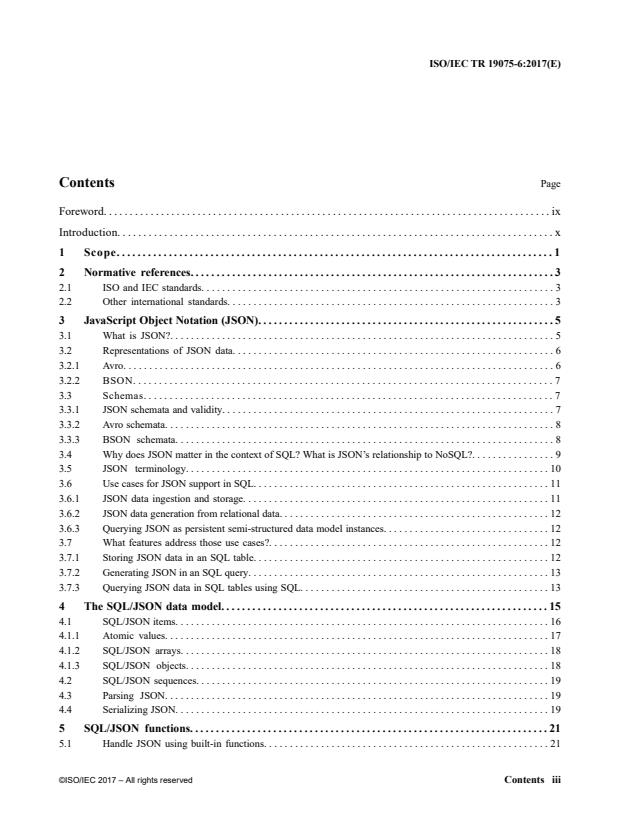
Contents Page
Foreword. . . . . . . . . . . . . . . . . . . . . . . . . . . . . . . . . . . . . . . . . . . . . . . . . . . . . . . . . . . . . . . . . . . . . . . . . . . . . . . . . . . . . . ix
Introduction. . . . . . . . . . . . . . . . . . . . . . . . . . . . . . . . . . . . . . . . . . . . . . . . . . . . . . . . . . . . . . . . . . . . . . . . . . . . . . . . . . . . x
1 Scope. . . . . . . . . . . . . . . . . . . . . . . . . . . . . . . . . . . . . . . . . . . . . . . . . . . . . . . . . . . . . . . . . . . . . . . . . . . . . . . . . . . . 1
2 Normative references. . . . . . . . . . . . . . . . . . . . . . . . . . . . . . . . . . . . . . . . . . . . . . . . . . . . . . . . . . . . . . . . . . . . . .3
2.1 ISO and IEC standards. . . . . . . . . . . . . . . . . . . . . . . . . . . . . . . . . . . . . . . . . . . . . . . . . . . . . . . . . . . . . . . . . . . . 3
2.2 Other international standards. . . . . . . . . . . . . . . . . . . . . . . . . . . . . . . . . . . . . . . . . . . . . . . . . . . . . . . . . . . . . . . 3
3 JavaScript Object Notation (JSON). . . . . . . . . . . . . . . . . . . . . . . . . . . . . . . . . . . . . . . . . . . . . . . . . . . . . . . . . 5
3.1 What is JSON?. . . . . . . . . . . . . . . . . . . . . . . . . . . . . . . . . . . . . . . . . . . . . . . . . . . . . . . . . . . . . . . . . . . . . . . . . . 5
3.2 Representations of JSON data. . . . . . . . . . . . . . . . . . . . . . . . . . . . . . . . . . . . . . . . . . . . . . . . . . . . . . . . . . . . . . 6
3.2.1 Avro. . . . . . . . . . . . . . . . . . . . . . . . . . . . . . . . . . . . . . . . . . . . . . . . . . . . . . . . . . . . . . . . . . . . . . . . . . . . . . . . . . . 6
3.2.2 BSON. . . . . . . . . . . . . . . . . . . . . . . . . . . . . . . . . . . . . . . . . . . . . . . . . . . . . . . . . . . . . . . . . . . . . . . . . . . . . . . . . 7
3.3 Schemas. . . . . . . . . . . . . . . . . . . . . . . . . . . . . . . . . . . . . . . . . . . . . . . . . . . . . . . . . . . . . . . . . . . . . . . . . . . . . . . 7
3.3.1 JSON schemata and validity. . . . . . . . . . . . . . . . . . . . . . . . . . . . . . . . . . . . . . . . . . . . . . . . . . . . . . . . . . . . . . . . 7
3.3.2 Avro schemata. . . . . . . . . . . . . . . . . . . . . . . . . . . . . . . . . . . . . . . . . . . . . . . . . . . . . . . . . . . . . . . . . . . . . . . . . . . 8
3.3.3 BSON schemata. . . . . . . . . . . . . . . . . . . . . . . . . . . . . . . . . . . . . . . . . . . . . . . . . . . . . . . . . . . . . . . . . . . . . . . . .8
3.4 Why does JSON matter in the context of SQL? What is JSON’s relationship to NoSQL?. . . . . . . . . . . . . . . . 9
3.5 JSON terminology. . . . . . . . . . . . . . . . . . . . . . . . . . . . . . . . . . . . . . . . . . . . . . . . . . . . . . . . . . . . . . . . . . . . . .10
3.6 Use cases for JSON support in SQL. . . . . . . . . . . . . . . . . . . . . . . . . . . . . . . . . . . . . . . . . . . . . . . . . . . . . . . . . 11
3.6.1 JSON data ingestion and storage. . . . . . . . . . . . . . . . . . . . . . . . . . . . . . . . . . . . . . . . . . . . . . . . . . . . . . . . . . . 11
3.6.2 JSON data generation from relational data. . . . . . . . . . . . . . . . . . . . . . . . . . . . . . . . . . . . . . . . . . . . . . . . . . . . 12
3.6.3 Querying JSON as persistent semi-structured data model instances. . . . . . . . . . . . . . . . . . . . . . . . . . . . . . . . 12
3.7 What features address those use cases?. . . . . . . . . . . . . . . . . . . . . . . . . . . . . . . . . . . . . . . . . . . . . . . . . . . . . . 12
3.7.1 Storing JSON data in an SQL table. . . . . . . . . . . . . . . . . . . . . . . . . . . . . . . . . . . . . . . . . . . . . . . . . . . . . . . . . 12
3.7.2 Generating JSON in an SQL query. . . . . . . . . . . . . . . . . . . . . . . . . . . . . . . . . . . . . . . . . . . . . . . . . . . . . . . . . . 13
3.7.3 Querying JSON data in SQL tables using SQL. . . . . . . . . . . . . . . . . . . . . . . . . . . . . . . . . . . . . . . . . . . . . . . . 13
4 The SQL/JSON data model. . . . . . . . . . . . . . . . . . . . . . . . . . . . . . . . . . . . . . . . . . . . . . . . . . . . . . . . . . . . . . . 15
4.1 SQL/JSON items. . . . . . . . . . . . . . . . . . . . . . . . . . . . . . . . . . . . . . . . . . . . . . . . . . . . . . . . . . . . . . . . . . . . . . . . 16
4.1.1 Atomic values. . . . . . . . . . . . . . . . . . . . . . . . . . . . . . . . . . . . . . . . . . . . . . . . . . . . . . . . . . . . . . . . . . . . . . . . . . 17
4.1.2 SQL/JSON arrays. . . . . . . . . . . . . . . . . . . . . . . . . . . . . . . . . . . . . . . . . . . . . . . . . . . . . . . . . . . . . . . . . . . . . . . 18
4.1.3 SQL/JSON objects. . . . . . . . . . . . . . . . . . . . . . . . . . . . . . . . . . . . . . . . . . . . . . . . . . . . . . . . . . . . . . . . . . . . . .18
4.2 SQL/JSON sequences. . . . . . . . . . . . . . . . . . . . . . . . . . . . . . . . . . . . . . . . . . . . . . . . . . . . . . . . . . . . . . . . . . . . 19
4.3 Parsing JSON. . . . . . . . . . . . . . . . . . . . . . . . . . . . . . . . . . . . . . . . . . . . . . . . . . . . . . . . . . . . . . . . . . . . . . . . . .19
4.4 Serializing JSON. . . . . . . . . . . . . . . . . . . . . . . . . . . . . . . . . . . . . . . . . . . . . . . . . . . . . . . . . . . . . . . . . . . . . . . . 19
5 SQL/JSON functions. . . . . . . . . . . . . . . . . . . . . . . . . . . . . . . . . . . . . . . . . . . . . . . . . . . . . . . . . . . . . . . . . . . . .21
5.1 Handle JSON using built-in functions. . . . . . . . . . . . . . . . . . . . . . . . . . . . . . . . . . . . . . . . . . . . . . . . . . . . . . . 21
©ISO/IEC 2017 – All rights reserved Contents iii
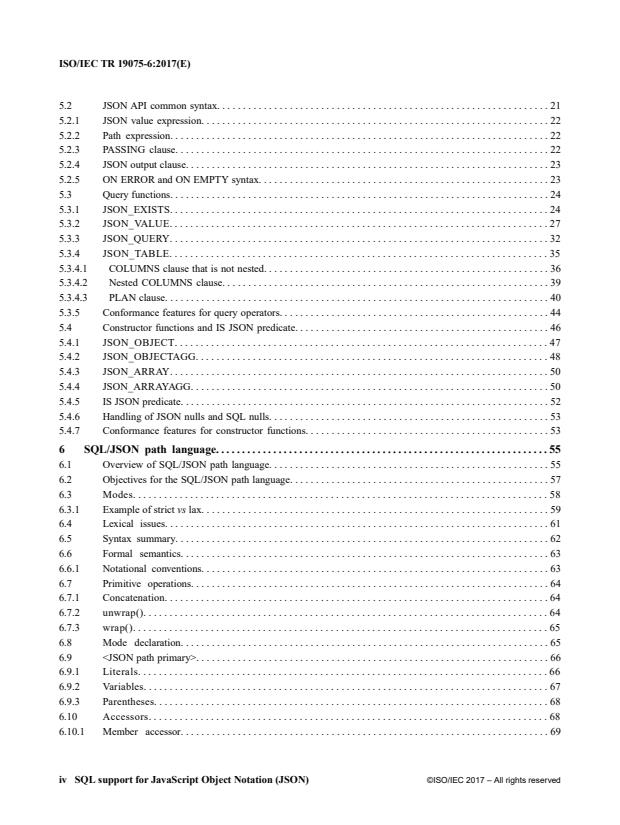
5.2 JSON API common syntax. . . . . . . . . . . . . . . . . . . . . . . . . . . . . . . . . . . . . . . . . . . . . . . . . . . . . . . . . . . . . . . . 21
5.2.1 JSON value expression. . . . . . . . . . . . . . . . . . . . . . . . . . . . . . . . . . . . . . . . . . . . . . . . . . . . . . . . . . . . . . . . . . . 22
5.2.2 Path expression. . . . . . . . . . . . . . . . . . . . . . . . . . . . . . . . . . . . . . . . . . . . . . . . . . . . . . . . . . . . . . . . . . . . . . . . . 22
5.2.3 PASSING clause. . . . . . . . . . . . . . . . . . . . . . . . . . . . . . . . . . . . . . . . . . . . . . . . . . . . . . . . . . . . . . . . . . . . . . . . 22
5.2.4 JSON output clause. . . . . . . . . . . . . . . . . . . . . . . . . . . . . . . . . . . . . . . . . . . . . . . . . . . . . . . . . . . . . . . . . . . . . . 23
5.2.5 ON ERROR and ON EMPTY syntax. . . . . . . . . . . . . . . . . . . . . . . . . . . . . . . . . . . . . . . . . . . . . . . . . . . . . . . . 23
5.3 Query functions. . . . . . . . . . . . . . . . . . . . . . . . . . . . . . . . . . . . . . . . . . . . . . . . . . . . . . . . . . . . . . . . . . . . . . . . . 24
5.3.1 JSON_EXISTS. . . . . . . . . . . . . . . . . . . . . . . . . . . . . . . . . . . . . . . . . . . . . . . . . . . . . . . . . . . . . . . . . . . . . . . . . 24
5.3.2 JSON_VALUE. . . . . . . . . . . . . . . . . . . . . . . . . . . . . . . . . . . . . . . . . . . . . . . . . . . . . . . . . . . . . . . . . . . . . . . . . 27
5.3.3 JSON_QUERY. . . . . . . . . . . . . . . . . . . . . . . . . . . . . . . . . . . . . . . . . . . . . . . . . . . . . . . . . . . . . . . . . . . . . . . . . 32
5.3.4 JSON_TABLE. . . . . . . . . . . . . . . . . . . . . . . . . . . . . . . . . . . . . . . . . . . . . . . . . . . . . . . . . . . . . . . . . . . . . . . . . 35
5.3.4.1 COLUMNS clause that is not nested. . . . . . . . . . . . . . . . . . . . . . . . . . . . . . . . . . . . . . . . . . . . . . . . . . . . . . . 36
5.3.4.2 Nested COLUMNS clause. . . . . . . . . . . . . . . . . . . . . . . . . . . . . . . . . . . . . . . . . . . . . . . . . . . . . . . . . . . . . . . 39
5.3.4.3 PLAN clause. . . . . . . . . . . . . . . . . . . . . . . . . . . . . . . . . . . . . . . . . . . . . . . . . . . . . . . . . . . . . . . . . . . . . . . . . . 40
5.3.5 Conformance features for query operators. . . . . . . . . . . . . . . . . . . . . . . . . . . . . . . . . . . . . . . . . . . . . . . . . . . . 44
5.4 Constructor functions and IS JSON predicate. . . . . . . . . . . . . . . . . . . . . . . . . . . . . . . . . . . . . . . . . . . . . . . . . 46
5.4.1 JSON_OBJECT. . . . . . . . . . . . . . . . . . . . . . . . . . . . . . . . . . . . . . . . . . . . . . . . . . . . . . . . . . . . . . . . . . . . . . . . 47
5.4.2 JSON_OBJECTAGG. . . . . . . . . . . . . . . . . . . . . . . . . . . . . . . . . . . . . . . . . . . . . . . . . . . . . . . . . . . . . . . . . . . . 48
5.4.3 JSON_ARRAY. . . . . . . . . . . . . . . . . . . . . . . . . . . . . . . . . . . . . . . . . . . . . . . . . . . . . . . . . . . . . . . . . . . . . . . . . 50
5.4.4 JSON_ARRAYAGG. . . . . . . . . . . . . . . . . . . . . . . . . . . . . . . . . . . . . . . . . . . . . . . . . . . . . . . . . . . . . . . . . . . . . 50
5.4.5 IS JSON predicate. . . . . . . . . . . . . . . . . . . . . . . . . . . . . . . . . . . . . . . . . . . . . . . . . . . . . . . . . . . . . . . . . . . . . . . 52
5.4.6 Handling of JSON nulls and SQL nulls. . . . . . . . . . . . . . . . . . . . . . . . . . . . . . . . . . . . . . . . . . . . . . . . . . . . . . 53
5.4.7 Conformance features for constructor functions. . . . . . . . . . . . . . . . . . . . . . . . . . . . . . . . . . . . . . . . . . . . . . . 53
6 SQL/JSON path language. . . . . . . . . . . . . . . . . . . . . . . . . . . . . . . . . . . . . . . . . . . . . . . . . . . . . . . . . . . . . . . .55
6.1 Overview of SQL/JSON path language. . . . . . . . . . . . . . . . . . . . . . . . . . . . . . . . . . . . . . . . . . . . . . . . . . . . . . 55
6.2 Objectives for the SQL/JSON path language. . . . . . . . . . . . . . . . . . . . . . . . . . . . . . . . . . . . . . . . . . . . . . . . . . 57
6.3 Modes. . . . . . . . . . . . . . . . . . . . . . . . . . . . . . . . . . . . . . . . . . . . . . . . . . . . . . . . . . . . . . . . . . . . . . . . . . . . . . . . 58
6.3.1 Example of strict vs lax. . . . . . . . . . . . . . . . . . . . . . . . . . . . . . . . . . . . . . . . . . . . . . . . . . . . . . . . . . . . . . . . . . . 59
6.4 Lexical issues. . . . . . . . . . . . . . . . . . . . . . . . . . . . . . . . . . . . . . . . . . . . . . . . . . . . . . . . . . . . . . . . . . . . . . . . . .61
6.5 Syntax summary. . . . . . . . . . . . . . . . . . . . . . . . . . . . . . . . . . . . . . . . . . . . . . . . . . . . . . . . . . . . . . . . . . . . . . . . 62
6.6 Formal semantics. . . . . . . . . . . . . . . . . . . . . . . . . . . . . . . . . . . . . . . . . . . . . . . . . . . . . . . . . . . . . . . . . . . . . . .63
6.6.1 Notational conventions. . . . . . . . . . . . . . . . . . . . . . . . . . . . . . . . . . . . . . . . . . . . . . . . . . . . . . . . . . . . . . . . . . . 63
6.7 Primitive operations. . . . . . . . . . . . . . . . . . . . . . . . . . . . . . . . . . . . . . . . . . . . . . . . . . . . . . . . . . . . . . . . . . . . .64
6.7.1 Concatenation. . . . . . . . . . . . . . . . . . . . . . . . . . . . . . . . . . . . . . . . . . . . . . . . . . . . . . . . . . . . . . . . . . . . . . . . . . 64
6.7.2 unwrap(). . . . . . . . . . . . . . . . . . . . . . . . . . . . . . . . . . . . . . . . . . . . . . . . . . . . . . . . . . . . . . . . . . . . . . . . . . . . . . 64
6.7.3 wrap(). . . . . . . . . . . . . . . . . . . . . . . . . . . . . . . . . . . . . . . . . . . . . . . . . . . . . . . . . . . . . . . . . . . . . . . . . . . . . . . . 65
6.8 Mode declaration. . . . . . . . . . . . . . . . . . . . . . . . . . . . . . . . . . . . . . . . . . . . . . . . . . . . . . . . . . . . . . . . . . . . . . .65
6.9 . . . . . . . . . . . . . . . . . . . . . . . . . . . . . . . . . . . . . . . . . . . . . . . . . . . . . . . . . . . . . . . . . . . . 66
6.9.1 Literals. . . . . . . . . . . . . . . . . . . . . . . . . . . . . . . . . . . . . . . . . . . . . . . . . . . . . . . . . . . . . . . . . . . . . . . . . . . . . . . 66
6.9.2 Variables. . . . . . . . . . . . . . . . . . . . . . . . . . . . . . . . . . . . . . . . . . . . . . . . . . . . . . . . . . . . . . . . . . . . . . . . . . . . . . 67
6.9.3 Parentheses. . . . . . . . . . . . . . . . . . . . . . . . . . . . . . . . . . . . . . . . . . . . . . . . . . . . . . . . . . . . . . . . . . . . . . . . . . . . 68
6.10 Accessors. . . . . . . . . . . . . . . . . . . . . . . . . . . . . . . . . . . . . . . . . . . . . . . . . . . . . . . . . . . . . . . . . . . . . . . . . . . . . 68
6.10.1 Member accessor. . . . . . . . . . . . . . . . . . . . . . . . . . . . . . . . . . . . . . . . . . . . . . . . . . . . . . . . . . . . . . . . . . . . . . .69
iv SQL support for JavaScript Object Notation (JSON) ©ISO/IEC 2017 – All rights reserved
6.10.2 Member wildcard accessor. . . . . . . . . . . . . . . . . . . . . . . . . . . . . . . . . . . . . . . . . . . . . . . . . . . . . . . . . . . . . . . . 72
6.10.3 Element accessor. . . . . . . . . . . . . . . . . . . . . . . . . . . . . . . . . . . . . . . . . . . . . . . . . . . . . . . . . . . . . . . . . . . . . . . . 73
6.10.4 Element wildcard accessor. . . . . . . . . . . . . . . . . . . . . . . . . . . . . . . . . . . . . . . . . . . . . . . . . . . . . . . . . . . . . . . . 75
6.10.5 Sequence semantics of the accessors. . . . . . . . . . . . . . . . . . . . . . . . . . . . . . . . . . . . . . . . . . . . . . . . . . . . . . . . 76
6.11 Item methods. . . . . . . . . . . . . . . . . . . . . . . . . . . . . . . . . . . . . . . . . . . . . . . . . . . . . . . . . . . . . . . . . . . . . . . . . . . 77
6.11.1 type(). . . . . . . . . . . . . . . . . . . . . . . . . . . . . . . . . . . . . . . . . . . . . . . . . . . . . . . . . . . . . . . . . . . . . . . . . . . . . . . . . 77
6.11.2 size(). . . . . . . . . . . . . . . . . . . . . . . . . . . . . . . . . . . . . . . . . . . . . . . . . . . . . . . . . . . . . . . . . . . . . . . . . . . . . . . . . 78
6.11.3 Numeric item methods (double, ceiling, floor, abs). . . . . . . . . . . . . . . . . . . . . . . . . . . . . . . . . . . . . . . . . . . . . 78
6.11.4 datetime(). . . . . . . . . . . . . . . . . . . . . . . . . . . . . . . . . . . . . . . . . . . . . . . . . . . . . . . . . . . . . . . . . . . . . . . . . . . . . 78
6.11.5 keyvalue(). . . . . . . . . . . . . . . . . . . . . . . . . . . . . . . . . . . . . . . . . . . . . . . . . . . . . . . . . . . . . . . . . . . . . . . . . . . . . 79
6.12 Arithmetic expressions. . . . . . . . . . . . . . . . . . . . . . . . . . . . . . . . . . . . . . . . . . . . . . . . . . . . . . . . . . . . . . . . . . .80
6.12.1 Unary plus and minus. . . . . . . . . . . . . . . . . . . . . . . . . . . . . . . . . . . . . . . . . . . . . . . . . . . . . . . . . . . . . . . . . . . . 81
6.12.2 Binary operations. . . . . . . . . . . . . . . . . . . . . . . . . . . . . . . . . . . . . . . . . . . . . . . . . . . . . . . . . . . . . . . . . . . . . . .82
6.13 Filter expression. . . . . . . . . . . . . . . . . . . . . . . . . . . . . . . . . . . . . . . . . . . . . . . . . . . . . . . . . . . . . . . . . . . . . . . .82
6.13.1 true/false and True/False. . . . . . . . . . . . . . . . . . . . . . . . . . . . . . . . . . . . . . . . . . . . . . . . . . . . . . . . . . . . . . 83
6.13.2 null and Unknown. . . . . . . . . . . . . . . . . . . . . . . . . . . . . . . . . . . . . . . . . . . . . . . . . . . . . . . . . . . . . . . . . . . . . 83
6.13.3 Error handling in filters. . . . . . . . . . . . . . . . . . . . . . . . . . . . . . . . . . . . . . . . . . . . . . . . . . . . . . . . . . . . . . . . . . . 83
6.13.4 Truth tables. . . . . . . . . . . . . . . . . . . . . . . . . . . . . . . . . . . . . . . . . . . . . . . . . . . . . . . . . . . . . . . . . . . . . . . . . . . . 86
6.13.5 Comparison predicates. . . . . . . . . . . . . . . . . . . . . . . . . . . . . . . . . . . . . . . . . . . . . . . . . . . . . . . . . . . . . . . . . . .87
6.13.6 like_regex predicate. . . . . . . . . . . . . . . . . . . . . . . . . . . . . . . . . . . . . . . . . . . . . . . . . . . . . . . . . . . . . . . . . . 89
6.13.7 starts with predicate. . . . . . . . . . . . . . . . . . . . . . . . . . . . . . . . . . . . . . . . . . . . . . . . . . . . . . . . . . . . . . . . 90
6.13.8 exists predicate. . . . . . . . . . . . . . . . . . . . . . . . . . . . . . . . . . . . . . . . . . . . . . . . . . . . . . . . . . . . . . . . . . . . . .90
6.13.9 is unknown predicate. . . . . . . . . . . . . . . . . . . . . . . . . . . . . . . . . . . . . . . . . . . . . . . . . . . . . . . . . . . . . . . . . . 92
6.14 Conformance features for SQL/JSON path language. . . . . . . . . . . . . . . . . . . . . . . . . . . . . . . . . . . . . . . . . . . . 93
Bibliography. . . . . . . . . . . . . . . . . . . . . . . . . . . . . . . . . . . . . . . . . . . . . . . . . . . . . . . . . . . . . . . . . . . . . . . . . . . . . . . . . 95
Index. . . . . . . . . . . . . . . . . . . . . . . . . . . . . . . . . . . . . . . . . . . . . . . . . . . . . . . . . . . . . . . . . . . . . . . . . . . . . . . . . . . . . . . . 97
©ISO/IEC 2017 – All rights reserved Contents v
Tables
Table Page
1 Terms and definitions. . . . . . . . . . . . . . . . . . . . . . . . . . . . . . . . . . . . . . . . . . . . . . . . . . . . . . . . . . . . . . . . . . . . . . . . 10
2 JSON, SQL/JSON, and SQL (other than SQL/JSON values and counterparts). . . . . . . . . . . . . . . . . . . . . . . . . . . 15
3 Parallels between JSON text and SQL/JSON data model. . . . . . . . . . . . . . . . . . . . . . . . . . . . . . . . . . . . . . . . . . . . 19
4 JSON_EXISTS sample data. . . . . . . . . . . . . . . . . . . . . . . . . . . . . . . . . . . . . . . . . . . . . . . . . . . . . . . . . . . . . . . . . . . 24
5 Result of the sample query. . . . . . . . . . . . . . . . . . . . . . . . . . . . . . . . . . . . . . . . . . . . . . . . . . . . . . . . . . . . . . . . . . . . 25
6 Accessor example. . . . . . . . . . . . . . . . . . . . . . . . . . . . . . . . . . . . . . . . . . . . . . . . . . . . . . . . . . . . . . . . . . . . . . . . . . . 26
7 Result 1. . . . . . . . . . . . . . . . . . . . . . . . . . . . . . . . . . . . . . . . . . . . . . . . . . . . . . . . . . . . . . . . . . . . . . . . . . . . . . . . . .28
8 Result 2. . . . . . . . . . . . . . . . . . . . . . . . . . . . . . . . . . . . . . . . . . . . . . . . . . . . . . . . . . . . . . . . . . . . . . . . . . . . . . . . . .29
9 Result 3. . . . . . . . . . . . . . . . . . . . . . . . . . . . . . . . . . . . . . . . . . . . . . . . . . . . . . . . . . . . . . . . . . . . . . . . . . . . . . . . . .29
10 Result 4. . . . . . . . . . . . . . . . . . . . . . . . . . . . . . . . . . . . . . . . . . . . . . . . . . . . . . . . . . . . . . . . . . . . . . . . . . . . . . . . . .30
11 Result 5. . . . . . . . . . . . . . . . . . . . . . . . . . . . . . . . . . . . . . . . . . . . . . . . . . . . . . . . . . . . . . . . . . . . . . . . . . . . . . . . . .31
12 Result 6. . . . . . . . . . . . . . . . . . . . . . . . . . . . . . . . . . . . . . . . . . . . . . . . . . . . . . . . . . . . . . . . . . . . . . . . . . . . . . . . . .31
13 Comparison of wrapper options. . . . . . . . . . . . . . . . . . . . . . . . . . . . . . . . . . . . . . . . . . . . . . . . . . . . . . . . . . . . . . . . 35
14 JSON_TABLE sample data in a book recommendation table. . . . . . . . . . . . . . . . . . . . . . . . . . . . . . . . . . . . . . . . . 36
15 Query result. . . . . . . . . . . . . . . . . . . . . . . . . . . . . . . . . . . . . . . . . . . . . . . . . . . . . . . . . . . . . . . . . . . . . . . . . . . . . . .38
16 Query result. . . . . . . . . . . . . . . . . . . . . . . . . . . . . . . . . . . . . . . . . . . . . . . . . . . . . . . . . . . . . . . . . . . . . . . . . . . . . . .39
17 Query result. . . . . . . . . . . . . . . . . . . . . . . . . . . . . . . . . . . . . . . . . . . . . . . . . . . . . . . . . . . . . . . . . . . . . . . . . . . . . . .42
18 Query result. . . . . . . . . . . . . . . . . . . . . . . . . . . . . . . . . . . . . . . . . . . . . . . . . . . . . . . . . . . . . . . . . . . . . . . . . . . . . . .42
19 Query result. . . . . . . . . . . . . . . . . . . . . . . . . . . . . . . . . . . . . . . . . . . . . . . . . . . . . . . . . . . . . . . . . . . . . . . . . . . . . . .44
20 DEPTS table. . . . . . . . . . . . . . . . . . . . . . . . . . . . . . . . . . . . . . . . . . . . . . . . . . . . . . . . . . . . . . . . . . . . . . . . . . . . . . . 46
21 JOBS table. . . . . . . . . . . . . . . . . . . . . . . . . . . . . . . . . . . . . . . . . . . . . . . . . . . . . . . . . . . . . . . . . . . . . . . . . . . . . . . .47
22 EMPLOYEES table. . . . . . . . . . . . . . . . . . . . . . . . . . . . . . . . . . . . . . . . . . . . . . . . . . . . . . . . . . . . . . . . . . . . . . . . .47
23 The JSON object returned. . . . . . . . . . . . . . . . . . . . . . . . . . . . . . . . . . . . . . . . . . . . . . . . . . . . . . . . . . . . . . . . . . . . 48
24 Returned JSON object with the corresponding job sequence number. . . . . . . . . . . . . . . . . . . . . . . . . . . . . . . . . . . 49
25 Query result. . . . . . . . . . . . . . . . . . . . . . . . . . . . . . . . . . . . . . . . . . . . . . . . . . . . . . . . . . . . . . . . . . . . . . . . . . . . . . .51
26 Query Results. . . . . . . . . . . . . . . . . . . . . . . . . . . . . . . . . . . . . . . . . . . . . . . . . . . . . . . . . . . . . . . . . . . . . . . . . . . . . . 51
27 Query Results. . . . . . . . . . . . . . . . . . . . . . . . . . . . . . . . . . . . . . . . . . . . . . . . . . . . . . . . . . . . . . . . . . . . . . . . . . . . . . 52
28 Three aspects of path evaluation governed by modes. . . . . . . . . . . . . . . . . . . . . . . . . . . . . . . . . . . . . . . . . . . . . . . 58
29 Example of strict vs lax. . . . . . . . . . . . . . . . . . . . . . . . . . . . . . . . . . . . . . . . . . . . . . . . . . . . . . . . . . . . . . . . . . . . . . 59
30 Features of the SQL/JSON path language. . . . . . . . . . . . . . . . . . . . . . . . . . . . . . . . . . . . . . . . . . . . . . . . . . . . . . . . 62
31 Data used by unwrap() example. . . . . . . . . . . . . . . . . . . . . . . . . . . . . . . . . . . . . . . . . . . . . . . . . . . . . . . . . . . . . . . . 64
32 Data used by wrap() example. . . . . . . . . . . . . . . . . . . . . . . . . . . . . . . . . . . . . . . . . . . . . . . . . . . . . . . . . . . . . . . . . . 65
33 Examples of atomic values in the SQL/JSON path language . . . . . . . . . . . . . . . . . . . . . . . . . . . . . . . . . . . . . . . . . 66
34 Examples of the escaping rules. . . . . . . . . . . . . . . . . . . . . . . . . . . . . . . . . . . . . . . . . . . . . . . . . . . . . . . . . . . . . . . . 66
35 Evaluation of '$.phones.type' in lax mode. . . . . . . . . . . . . . . . . . . . . . . . . . . . . . . . . . . . . . . . . . . . . . . . . . 70
36 Intermediate step. . . . . . . . . . . . . . . . . . . . . . . . . . . . . . . . . . . . . . . . . . . . . . . . . . . . . . . . . . . . . . . . . . . . . . . . . . .70
37 Evaluation of'$.phones[*].type' . . . . . . . . . . . . . . . . . . . . . . . . . . . . . . . . . . . . . . . . . . . . . . . . . . . . . . . . 71
38 Evaluation of '$.phones[*] ? (exists (@.type)).type'. . . . . . . . . . . . . . . . . . . . . . . . . . . . . . . . 71
39 Evaluation of '$.phones.*' in lax mode. . . . . . . . . . . . . . . . . . . . . . . . . . . . . . . . . . . . . . . . . . . . . . . . . . . . . 72
40 Evaluation of '$.phones[*].*'. . . . . . . . . . . . . . . . . . . . . . . . . . . . . . . . . . . . . . . . . . . . . . . . . . . . . . . . . . . . 73
41 Evaluation of 'lax $.sensors.*[0, last, 2]'. . . . . . . . . . . . . . . . . . . . . . . . . . . . . . . . . . . . . . . . . . . 75
42 The step in the evaluation . . . . . . . . . . . . . . . . . . . . . . . . . . . . . . . . . . . . . . . . . . . . . . . . . . . . . . . . . . . . . . . . . . . . 76
43 Result of the query with the sample data . . . . . . . . . . . . . . . . . . . . . . . . . . . . . . . . . . . . . . . . . . . . . . . . . . . . . . . . 80
vi SQL support for JavaScript Object Notation (JSON) ©ISO/IEC 2017 – All rights reserved
44 Evaluation of lax -$.readings.floor(). . . . . . . . . . . . . . . . . . . . . . . . . . . . . . . . . . . . . . . . . . . . . . . . . . 81
45 Evaluation of 'lax (-$.readings).floor()'. . . . . . . . . . . . . . . . . . . . . . . . . . . . . . . . . . . . . . . . . . . . . 81
46 Table T with two rows . . . . . . . . . . . . . . . . . . . . . . . . . . . . . . . . . . . . . . . . . . . . . . . . . . . . . . . . . . . . . . . . . . . . . . . 84
47 Computation on row K=102 . . . . . . . . . . . . . . . . . . . . . . . . . . . . . . . . . . . . . . . . . . . . . . . . . . . . . . . . . . . . . . . . . . 84
48 Modified table T . . . . . . . . . . . . . . . . . . . . . . . . . . . . . . . . . . . . . . . . . . . . . . . . . . . . . . . . . . . . . . . . . . . . . . . . . . . 85
49 Computation on row K=102 in modified table T. . . . . . . . . . . . . . . . . . . . . . . . . . . . . . . . . . . . . . . . . . . . . . . . . . . 85
50 Computation of 'lax $ ? (@.hours > 9)' on row K=102 . . . . . . . . . . . . . . . . . . . . . . . . . . . . . . . . . . . . 86
51 Computation of 'strict $ ? (@.hours > 9)' in strict mode . . . . . . . . . . . . . . . . . . . . . . . . . . . . . . . . . 86
52 Result of &&. . . . . . . . . . . . . . . . . . . . . . . . . . . . . . . . . . . . . . . . . . . . . . . . . . . . . . . . . . . . . . . . . . . . . . . . . . . . . . . 87
53 Result of ||. . . . . . . . . . . . . . . . . . . . . . . . . . . . . . . . . . . . . . . . . . . . . . . . . . . . . . . . . . . . . . . . . . . . . . . . . . . . . . . 87
54 Result of !. . . . . . . . . . . . . . . . . . . . . . . . . . . . . . . . . . . . . . . . . . . . . . . . . . . . . . . . . . . . . . . . . . . . . . . . . . . . . . . . 87
55 Supported comparisons . . . . . . . . . . . . . . . . . . . . . . . . . . . . . . . . . . . . . . . . . . . . . . . . . . . . . . . . . . . . . . . . . . . . . . 88
56 Final result . . . . . . . . . . . . . . . . . . . . . . . . . . . . . . . . . . . . . . . . . . . . . . . . . . . . . . . . . . . . . . . . . . . . . . . . . . . . . . . . 89
57 A table with JSON column . . . . . . . . . . . . . . . . . . . . . . . . . . . . . . . . . . . . . . . . . . . . . . . . . . . . . . . . . . . . . . . . . . . 91
58 Evaluation of 'strict $ ? (exists (@.name)).name' on row K=201. . . . . . . . . . . . . . . . . . . . . . . . 91
59 Evaluation of 'strict $ ? (exists (@.name)).name' on row K=202. . . . . . . . . . . . . . . . . . . . . . . . 91
©ISO/IEC 2017 – All rights reserved Contents vii
Figures
Figure Page
1 Relationships between “JSON” and “SQL/JSON”. . . . . . . . . . . . . . . . . . . . . . . . . . . . . . . . . . . . . . . . . . . . . . . . . 15
2 The SQL/JSON path language architecture. . . . . . . . . . . . . . . . . . . . . . . . . . . . . . . . . . . . . . . . . . . . . . . . . . . . . . . 55
viii SQL support for JavaScript Object Notation (JSON) ©ISO/IEC 2017 – All rights reserved
Foreword
ISO (the International Organization for Standardization) and IEC (the International Electrotechnical
Commission) form the specialized system for worldwide standardization. National bodies that are members
of ISO or IEC participate in the development of International Standards through technical committees
established by the respective organization to deal with particular fields of technical activity. ISO and IEC
technical committees collaborate in fields of mutual interest. Other international organizations,
governmental and non-governmental, in liaison with ISO and IEC, also take part in the work. In the field of
information technology, ISO and IEC have established a joint technical committee, ISO/IEC JTC 1.
The procedures used to develop this document and those intended for its further maintenance are described
in the ISO/IEC Directives, Part 1. In particular the different approval criteria needed for the different types
of document should be noted. This document was drafted in accordance with the editorial rules of the ISO/
IEC Directives, Part 2 (see www.iso.org/directives).
Attention is drawn to the possibility that some of the elements of this document may be the subject of patent
rights. ISO and IEC shall not be held responsible for identifying any or all such patent rights. Details of
any patent rights identified during the development of the document will be in the Introduction and/or on
the ISO list of patent declarations received (see www.iso.org/patents).
Any trade name used in this document is information given for the convenience of users and does not
constitute an endorsement.
For an explanation on the voluntary nature of standards, the meaning of ISO specific terms and expressions
related to conformity assessment, as well as information about ISO's adherence to the World Trade
Organization (WTO) principles in the Technical Barriers to Trade (TBT) see the following URL:
www.iso.org/iso/foreword.html.
This document was prepared by Technical Committee ISO/IEC JTC 1, Information technology,
Subcommittee SC 32, Data management and interchange.
A list of all parts in the ISO/IEC 19075 series can be found on the ISO website.
NOTE 1 — The individual parts of multi-part technical reports are not necessarily published together. New editions of one or more
parts can be published without publication of new editions of other parts.
©ISO/IEC 2017 – All rights reserved Foreword ix
Introduction
The organization of this part of ISO/IEC 19075 is as follows:
1) Clause 1, “Scope”, specifies the scope of this part of ISO/IEC 19075.
2) Clause 2, “Normative references”, identifies additional standards that, through reference in this part of
ISO/IEC 19075, constitute provisions of this part of ISO/IEC 19075.
3) Clause 3, “JavaScript Object Notation (JSON)”, introduces what is JSON.
4) Clause 4, “The SQL/JSON data model”, introduces the data model that is used by the SQL/JSON functions
and the SQL/JSON path language.
5) Clause 5, “SQL/JSON functions”, introduces the SQL/JSON functions to query and construct JSON.
6) Clause 6, “SQL/JSON path language”, introduces the SQL/JSON path language.
x SQL support for JavaScript Object Notation (JSON) ©ISO/IEC 2017 – All rights reserved
TECHNICAL REPORT ISO/IEC TR19075-6:2017(E)
Information technology — Database languages — SQL Technical Reports —
Part 6:
SQL support for JavaScript Object Notation (JSON)
1 Scope
This Technical Report describes the support in SQL for JavaScript Object Notation.
This Technical Report discusses the following features of the SQL language:
— Storing JSON data.
— Publishing JSON data.
— Querying JSON data.
— SQL/JSON data model and path language.
©ISO/IEC 2017 – All rights reserved Scope 1
(Blank page)
2 SQL support for JavaScript Object Notation (JSON) ©ISO/IEC 2017 – All rights reserved
2.1 ISO and IEC standards
2 Normative references
The following referenced documents are indispensable for the application of this document. For dated references,
only the edition cited applies. For undated references, the latest edition of the referenced document (including
any amendments) applies.
2.1 ISO and IEC standards
[ISO9075-2] ISO/IEC 9075-2:2016, Information technology — Database languages — SQL — Part 2:
Foundation (SQL/Foundation)
2.2 Other international standards
[ECMAscript] ISO/IEC 16262:2011, Information technology — Programming languages, their environments
and system software interfaces — ECMAScript language specification; also available as ECMAScript
Language Specification,
http://www.ecma-international.org/publications/files/ecma-st/ECMA-262.pdf
[Unicode] The Unicode Standard,
http://unicode.org
[RFC7159] Internet Engineering Task Force, RFC 7159, The JavaScript Object Notation (JSON) Data
Interchange Format, March 2014,
https://tools.ietf.org/rfc/rfc7159.txt
©ISO/IEC 2017 – All rights reserved Normative references 3
(Blank page)
4 SQL support for JavaScript Object Notation (JSON) ©ISO/IEC 2017 – All rights reserved
3.1 What is JSON?
3 JavaScript Object Notation (JSON)
3.1 What is JSON?
JSON (an acronym for “JavaScript Object Notation”) is both a notation (that is, a syntax) for representing data
and an implied data model. JSON is not an object-oriented data model; that is, it does not define sets of classes
and methods, type inheritance, or data abstraction. Instead, JSON “objects” are simple data structures, including
arrays. [RFC7159] says that JSON is a text format for the serialization of structured data. Its initial intended
use was as a data transfer syntax.
The complete syntax of JSON is specified in [RFC7159].
The first-class components of the JSON data model are JSON values. A JSON value is one of the following:
JSON object, JSON array, JSON string, JSON number, or one of the JSON literals: true, false, and null. A
JSON object is zero or more name-value pairs and is enclosed in curly braces — { }. A JSON array is an
ordered sequence of zero or more values and is enclosed in square brackets — [ ].
Here is an example of a JSON object:
{ "Name" : "Isaac Newton",
"Weight" : 80,
"Famous" : true,
"Phone" : null }
The name-value pairs are separated by commas, and the names are separated from the values by colons. The
names are always strings and are enclosed in (double) quotation marks.
Here is an example of a JSON array:
[ "Robert J. Oppenheimer", 98, false, "Beechwood 45789" ]
In a JSON array, the values are separated by commas. JSON arrays and objects are fully nestable. That is, values
in both JSON objects and JSON arrays may be JSON strings, JSON numbers, JSON Booleans (represented by
the JSON literals true and false), JSON nulls (represented by the JSON literal null), JSON objects, or JSON
arrays.
JSON can be used to represent associative arrays — arrays whose elements are addressed by content, not by
position. An associative array can be represented in JSON as a JSON object whose members are name-value
pairs; the name is used as the “index” into the “array” — that is, to locate the appropriate member in the object
— and the value is used as the content of the appropriate member. Here is such an associative array:
{ "Isaac Newton" : "apple harvester" ,
"Robert J. Oppenheimer": "security risk" ,
"Albert Einstein" : "patent clerk" ,
"Stephen Hawking" : "inspiration" }
An extremely important part of JSON’s design is that it is inherently schema-less. Any JSON object can be
modified by adding new name-value pairs, even with names that were never considered when the object was
©ISO/IEC 2017 – All rights reserved JavaScript Object Notation (JSON) 5
3.1 What is JSON?
initially created or designed. Similarly, any JSON array can be modified by changing the number of values in
the array.
3.2 Representations of JSON data
Before delving much deeper into the primary topic of this Technical Report, readers should understand that
JSON data can be represented in several widely-acknowledged and -used forms. The most obvious and most
easily recognizable is its “character string” representation, in which JSON data is represented in Unicode
characters as plain text. More specifically, explicit characters such as the left square brace, comma, right curly
brace, quotation mark, and letters and digits are all used in their native Unicode representation (UTF-8, UTF-
16, UTF-32).
However, for a variety of reasons, JSON data is sometimes stored and exchanged in one of several binary rep-
resentations. For example, a binary representation of JSON data may be significantly smaller (fewer octets)
than the character representation of the same data, so a reduction in network bandwidth and or storage media
can be achieved by transferring or storing that data in a binary representation.
Readers should note that there are no published standards, either from traditional de jure standards organizations
nor from consortia or other de facto standards groups, for any binary representations of JSON. The two described
in this Technical Report are frequently used and may be representative of binary JSON representations generally.
The following discussion is intended only to illustrate the use of and issues with binary serializations of JSON.
The SQL standard leaves it implementation-defined whether or not such representations are supported in any
particular implementation.
3.2.1 Avro
Avro [Avro] is described as a “data serialization system”. As such, its use is not limited to a binary representation
or as a compression representation of JSON data. However, a number of JSON environments have chosen Avro
as their preferred binary, compressed representation.
Avro has a number of important characteristics that affect its choice as a JSON representation.
— Data is represented in a variable-length, “shortest” form; e.g., the integer 2 and the integer 2000 occupy a
different number of octets in an Avro string.
— Numbers are represented using a rather arcane “zig-zag” encoding (this notation “moves” the sign bit from
its normal position as the first bit to the last bit; doing so permits removing leading zeros from the numbers,
thus making their representation occupy fewer octets).
— There is not a one-to-one mapping between JSON atomic types and Avro atomic types.
— Avro data is always associated with an Avro schema. An Avro schema describes the physical structure of
the corresponding Avro data and is needed merely to “unpack” Avro data because of the variable-length
fields and the various encoding rules. An Avro schema may accompany each individual Avro data string,
or it may be specified separately and applied to all Avro data strings in, say, an Avro data file. Avro schemas
tell almost nothing about the data other than how it is packed into a data string.
— Avro strings can be encoded using JSON notation (which sort of contradicts its use as a different represen-
tation for JSON data) or using a binary notation.
6 SQL support for JavaScript Object Notation (JSON) ©ISO/IEC 2017 – All rights reserved
3.2 Representations of JSON data
Readers should recognize that Avro is not a different kind of data at all. It is, instead, merely another way of
representing the same data that the JSON character string format represents. (It should be noted that not all
possible Avro strings can be treated as JSON data; similarly, not every character string is a valid bit of JSON
data.) In this Technical Report, Avro is referenced as one possible serialization of JSON data; the character
string format is another serialization of the same data.
3.2.2 BSON
BSON [BSON] (variously pronounced as though it were spelled “bison” or as “beeson”) is another data serial-
ization system. [BSON] says that it is “a binary format in which zero or more key/value pairs are stored as a
single entity,” called a “document.” BSON is used by — and apparently was created for — a specific commercial
product.
BSON strings are no less difficult for human beings to read than Avro strings are, but the design of BSON is
significantly different than Avro’s. A BSON document is roughly a sequence of elements, each of which is
introduced by a single-octet code (for example, the hexadecimal value ‘01’ identifies the element as a double
precision floating point value, which is always eight octets in length, and ‘0D’ identifies the element as a string
containing JavaScript code), followed by an optional element name, followed by the (mandatory) element
value.
BSON, like Avro, is not a different kind of data, but merely provides yet another way of representing JSON
data. (Also like Avro, not all BSON strings represent valid JSON data.)
3.3 Schemas
3.3.1 JSON schemata and validity
Neither [RFC7159] nor [ECMAscript] provide any mechanism by which JSON values can be tested for validity
other than strict syntactic validity.
JSON text is sufficiently “self-describing” that data encoded in JSON is easily parsed and can often be used in
application components that have no specific knowledge of the data contained therein. This last fact explains
why JSON is so successful in the broader data management community, in spite of the lack of a standard way
to document its structure.
There is at least one effort to define a schema for JSON [JSONschema] that would describe the structure of
JSON data to be considered “valid” for some given application. However, there does not appear to be any sig-
nificant amount of interest from the JSON community for the rapid development of a schema definition language
for JSON.
While a schema language for JSON data could be useful in some circumstances, it does not appear that such a
language is widely used, and [ISO9075-2] neither relies on nor creates such a language.
[ISO9075-2] uses the word “valid” to describe data instances that satisfy all JSON syntactic requirements.
[ISO9075-2] specifies a new SQL predicate, IS JSON, to test the (syntactic) validity of JSON data instances.
©ISO/IEC 2017 – All rights reserved JavaScript Object Notation (JSON) 7
3.3 Schemas
3.3.2 Avro schemata
Because Avro is a representation in which each “field” (a bit of JSON data) occupies no more octets than is
required, using the particular encoding method for data of each type, it is not possible to simply index to a
specific field in each Avro string. In fact, because of the way that Avro encodes its fields, it is not possible to
scan an Avro string and identify the start of the second, third, or twenty-fifth field in that string.
Consequently, Avro specifies that each Avro value be described by an Avro schema. Avro schemata are
expressed in the character representation of JSON. The schema that represents an entire Avro string is composed
of “smaller” schemata that represent each field in the Avro string. The schema describes each field by its name,
data type, and (if not already unambiguous) length. Thus, an application wishing to access the fields in an Avro
string must first parse the schema of that string, then use that information to locate the desired fields in the
string and to “decode” the field contents into a value of a JSON data type.
Because each JSON text can be of a different size or contain different components, one might wish to provide
a different schema for each JSON text.a schema that uniquely describes that text and not (necessaril
...
Questions, Comments and Discussion
Ask us and Technical Secretary will try to provide an answer. You can facilitate discussion about the standard in here.
Loading comments...