


ISO/FDIS 18739
(Main)Dentistry - Vocabulary of process chain for CAD/CAM systems
Dentistry - Vocabulary of process chain for CAD/CAM systems
ISO 18739:2016 specifies terms, synonyms for terms and definitions used in the process chain for CAD/CAM systems in dentistry.
Médecine bucco-dentaire — Vocabulaire de la chaîne de processus pour les systèmes de CFAO
ISO 18739:2016 spécifie les termes, leurs synonymes, et les définitions utilisés dans la chaîne de procédé applicable aux systèmes dentaires de CFAO.
General Information
- Status
- Not Published
- Technical Committee
- ISO/TC 106/SC 9 - Dental CAD/CAM systems
- Drafting Committee
- ISO/TC 106/SC 9 - Dental CAD/CAM systems
- Current Stage
- 5020 - FDIS ballot initiated: 2 months. Proof sent to secretariat
- Start Date
- 09-Dec-2025
- Completion Date
- 09-Dec-2025
Relations
- Effective Date
- 15-Oct-2022
- Effective Date
- 06-Jun-2022
Overview
ISO/FDIS 18739:2025 sets forth the standardized vocabulary essential for the dentistry process chain involving CAD/CAM systems. This international standard provides precise terms, synonyms, and definitions used throughout the computer-aided design and computer-aided manufacturing workflow in dental applications. It updates and replaces ISO 18739:2016, incorporating new terminology and clarifications to ensure clear communication within the dental industry, including professionals, technicians, and manufacturers.
By harmonizing vocabulary, ISO 18739 enhances understanding and reduces confusion related to terminology differences across manufacturers and practitioners when describing dental digital workflows, devices, and products.
Key Topics
CAD/CAM Process Chain: Defines the stages and terms involved in computer-aided design (CAD) and computer-aided manufacturing (CAM) of dental restorations, prostheses, and appliances, covering data acquisition, design, manufacturing, and quality control.
3D Data Acquisition: Covers methods such as 3D scanning and digital impression techniques, including devices used to capture three-dimensional surface information of teeth and oral structures.
Digital Dental Products: Specifies terminology for digitally fabricated dental items including dental restorations, prostheses, and appliances produced via CAD/CAM systems.
Manufacturing Technologies: Differentiates between additive manufacturing (3D printing) and subtractive manufacturing (computer-aided milling), including details on blanks, blocks, discs, and machining devices.
Software and Hardware Components: Clarifies terms related to CAD software, CAM software, milling machines, data structures, and digital workflows, emphasizing interoperability and standard data formats.
Error Types and Quality Concepts: Introduces terms like artefact, direct and indirect errors, and fit, which relate to data integrity and the precision of fabricated dental products.
Terminology Management: Encourages adoption of preferred terms over admitted synonyms, supporting consistent use of language across the dental CAD/CAM industry.
Applications
ISO 18739:2025 is crucial for dental professionals, dental laboratory technicians, manufacturers, and software developers involved in digital dentistry. Its practical applications include:
Product Development: Guiding manufacturers in consistent documentation, labeling, and design of dental CAD/CAM components and software.
Clinical and Laboratory Communication: Enabling precise understanding between dentists and technicians to improve workflow efficiency and reduce errors in digital impression capturing and restoration fabrication.
Regulatory and Quality Assurance: Supporting compliance with international standards by providing unambiguous terminology for conformity assessment, process validation, and quality control protocols.
Education and Training: Serving as a reference for academic programs detailing digital dentistry processes and technologies, enhancing curriculum and competency frameworks.
Interoperability Enhancement: Facilitating seamless data exchange between different CAD/CAM systems through standardized definitions of file formats and process steps.
Related Standards
ISO/ASTM 52900:2021 - Standard terminology for additive manufacturing processes, informing definitions related to 3D printing and additive manufacturing technologies referenced in ISO 18739.
ISO 10360-1:2000 - Specifies terms and performance requirements for coordinate measuring machines, referenced for measuring spatial coordinates during CAD/CAM processes.
ISO/IEC Directives Part 1 & Part 2 - Editorial and procedural guidelines followed in the development and maintenance of ISO 18739.
ISO 5139:2023 - Related terminology for dental milling blanks and holders, complementing material definitions within ISO 18739.
Keywords
Dentistry CAD/CAM vocabulary, dental process chain, digital impression terminology, dental CAD software, computer-aided manufacturing, additive manufacturing dentistry, dental 3D scanning, dental milling machine, dental restoration vocabulary, digital dental prosthesis, ISO dentistry standards, standardized dental terminology, dental CAD/CAM systems glossary, dental device definitions.

ISO/FDIS 18739 - Dentistry — Vocabulary of process chain for CAD/CAM systems Released:11/25/2025
REDLINE ISO/FDIS 18739 - Dentistry — Vocabulary of process chain for CAD/CAM systems Released:11/25/2025
ISO/FDIS 18739 - Médecine bucco-dentaire — Vocabulaire de la chaîne de processus pour les systèmes de CFAO Released:22. 12. 2025
Frequently Asked Questions
ISO/FDIS 18739 is a draft published by the International Organization for Standardization (ISO). Its full title is "Dentistry - Vocabulary of process chain for CAD/CAM systems". This standard covers: ISO 18739:2016 specifies terms, synonyms for terms and definitions used in the process chain for CAD/CAM systems in dentistry.
ISO 18739:2016 specifies terms, synonyms for terms and definitions used in the process chain for CAD/CAM systems in dentistry.
ISO/FDIS 18739 is classified under the following ICS (International Classification for Standards) categories: 01.040.11 - Health care technology (Vocabularies); 11.060.01 - Dentistry in general. The ICS classification helps identify the subject area and facilitates finding related standards.
ISO/FDIS 18739 has the following relationships with other standards: It is inter standard links to ISO 14488:2007/Amd 1:2019, ISO 18739:2016. Understanding these relationships helps ensure you are using the most current and applicable version of the standard.
ISO/FDIS 18739 is available in PDF format for immediate download after purchase. The document can be added to your cart and obtained through the secure checkout process. Digital delivery ensures instant access to the complete standard document.
Standards Content (Sample)
FINAL DRAFT
International
Standard
ISO/TC 106/SC 9
Dentistry — Vocabulary of process
Secretariat: JISC
chain for CAD/CAM systems
Voting begins on:
Médecine bucco-dentaire — Vocabulaire de la chaîne de 2025-12-09
processus pour les systèmes de CFAO
Voting terminates on:
2026-02-03
RECIPIENTS OF THIS DRAFT ARE INVITED TO SUBMIT,
WITH THEIR COMMENTS, NOTIFICATION OF ANY
RELEVANT PATENT RIGHTS OF WHICH THEY ARE AWARE
AND TO PROVIDE SUPPOR TING DOCUMENTATION.
IN ADDITION TO THEIR EVALUATION AS
BEING ACCEPTABLE FOR INDUSTRIAL, TECHNO
ISO/CEN PARALLEL PROCESSING LOGICAL, COMMERCIAL AND USER PURPOSES, DRAFT
INTERNATIONAL STANDARDS MAY ON OCCASION HAVE
TO BE CONSIDERED IN THE LIGHT OF THEIR POTENTIAL
TO BECOME STAN DARDS TO WHICH REFERENCE MAY BE
MADE IN NATIONAL REGULATIONS.
Reference number
FINAL DRAFT
International
Standard
ISO/TC 106/SC 9
Dentistry — Vocabulary of process
Secretariat: JISC
chain for CAD/CAM systems
Voting begins on:
Médecine bucco-dentaire — Vocabulaire de la chaîne de
processus pour les systèmes de CFAO
Voting terminates on:
RECIPIENTS OF THIS DRAFT ARE INVITED TO SUBMIT,
WITH THEIR COMMENTS, NOTIFICATION OF ANY
RELEVANT PATENT RIGHTS OF WHICH THEY ARE AWARE
AND TO PROVIDE SUPPOR TING DOCUMENTATION.
© ISO 2025
IN ADDITION TO THEIR EVALUATION AS
All rights reserved. Unless otherwise specified, or required in the context of its implementation, no part of this publication may
BEING ACCEPTABLE FOR INDUSTRIAL, TECHNO
ISO/CEN PARALLEL PROCESSING
LOGICAL, COMMERCIAL AND USER PURPOSES, DRAFT
be reproduced or utilized otherwise in any form or by any means, electronic or mechanical, including photocopying, or posting on
INTERNATIONAL STANDARDS MAY ON OCCASION HAVE
the internet or an intranet, without prior written permission. Permission can be requested from either ISO at the address below
TO BE CONSIDERED IN THE LIGHT OF THEIR POTENTIAL
or ISO’s member body in the country of the requester.
TO BECOME STAN DARDS TO WHICH REFERENCE MAY BE
MADE IN NATIONAL REGULATIONS.
ISO copyright office
CP 401 • Ch. de Blandonnet 8
CH-1214 Vernier, Geneva
Phone: +41 22 749 01 11
Email: copyright@iso.org
Website: www.iso.org
Published in Switzerland Reference number
ii
Contents Page
Foreword .iv
Introduction .v
1 Scope . 1
2 Normative references . 1
3 Terms and definitions . 1
3.1 Process step terms .1
3.2 Measurement and calibration terms . .9
Annex A (informative) Process chain for CAD/CAM system .13
Bibliography . 14
Index .15
iii
Foreword
ISO (the International Organization for Standardization) is a worldwide federation of national standards
bodies (ISO member bodies). The work of preparing International Standards is normally carried out through
ISO technical committees. Each member body interested in a subject for which a technical committee
has been established has the right to be represented on that committee. International organizations,
governmental and non-governmental, in liaison with ISO, also take part in the work. ISO collaborates closely
with the International Electrotechnical Commission (IEC) on all matters of electrotechnical standardization.
The procedures used to develop this document and those intended for its further maintenance are described
in the ISO/IEC Directives, Part 1. In particular, the different approval criteria needed for the different types
of ISO document should be noted. This document was drafted in accordance with the editorial rules of the
ISO/IEC Directives, Part 2 (see www.iso.org/directives).
ISO draws attention to the possibility that the implementation of this document may involve the use of (a)
patent(s). ISO takes no position concerning the evidence, validity or applicability of any claimed patent
rights in respect thereof. As of the date of publication of this document, ISO had not received notice of (a)
patent(s) which may be required to implement this document. However, implementers are cautioned that
this may not represent the latest information, which may be obtained from the patent database available at
www.iso.org/patents. ISO shall not be held responsible for identifying any or all such patent rights.
Any trade name used in this document is information given for the convenience of users and does not
constitute an endorsement.
For an explanation of the voluntary nature of standards, the meaning of ISO specific terms and expressions
related to conformity assessment, as well as information about ISO's adherence to the World Trade
Organization (WTO) principles in the Technical Barriers to Trade (TBT), see www.iso.org/iso/foreword.html.
This document was prepared by Technical Committee ISO/TC 106, Dentistry, Subcommittee SC 9, Dental
CAD/CAM systems, in collaboration with the European Committee for Standardization (CEN) Technical
Committee CEN/TC 55, Dentistry, in accordance with the Agreement on technical cooperation between ISO
and CEN (Vienna Agreement).
This second edition cancels and replaces the first edition (ISO 18739:2016), which has been technically
revised.
The main changes are as follows:
— addition of terms used in the process chain;
— information given in the source statements has been updated.
Any feedback or questions on this document should be directed to the user’s national standards body. A
complete listing of these bodies can be found at www.iso.org/members.html.
iv
Introduction
Terms and designations for individual system parts and process steps used in product descriptions and
instructions for use provided by manufacturers of dental computer-aided design and computer-aided
manufacturing (CAD/CAM) systems differ from each other, creating confusion among dentists and dental
technicians. In order to overcome these ambiguities, this document defines terminology used in the process
chain for CAD/CAM systems.
In the terminological entries, first the preferred term and then the admitted terms which have been in use so
far are given. It is intended that the preferred terms will be used instead of the admitted terms in the future.
v
FINAL DRAFT International Standard ISO/FDIS 18739:2025(en)
Dentistry — Vocabulary of process chain for CAD/CAM systems
1 Scope
This document defines terms and definitions used in the process chain for computer-aided design and
computer-aided manufacturing (CAD/CAM) systems in dentistry.
NOTE: See Annex A for a flow chart of the process chain.
2 Normative references
There are no normative references in this document.
3 Terms and definitions
ISO and IEC maintain terminology databases for use in standardization at the following addresses:
— ISO Online browsing platform: available at https:// www .iso .org/ obp
— IEC Electropedia: available at https:// www .electropedia .org/
3.1 Process step terms
3.1.1
3D data acquisition
three-dimensional data acquisition
3D digitization and generation of a digital data set
3.1.2
3D data acquisition system
three-dimensional data acquisition system
hardware and software used for 3D data acquisition
3.1.3
3D file format
common file format used for storing or encoding information about a 3D model’s geometry, colour, texture,
etc., as plain text or binary data commonly used in computer-aided design (CAD) (3.1.16) and computer-aided
manufacturing (CAM) (3.1.17)
EXAMPLE Wavefront object (.obj), polygon model (.ply), binary or ASCII stereolithography (.stl).
3.1.4
3D scanning
3D digitizing
raw data acquisition
method of acquiring the shape and size of an object as a three-dimensional representation by recording x, y, z
coordinates on the object's surface and, through software, the collection of points is converted into digital data
Note 1 to entry: This collection of data via the scanning process creates a raw data set (3.1.23).
Note 2 to entry: Typical methods use some amount of automation, coupled with a touch probe or an optical sensor, or
another device.
Note 3 to entry: In additive manufacturing (3.1.7) process chains, 3D scanning can typically be used for generation of
surface models, in situ monitoring, non-destructive testing as well as verification of part geometry.
[SOURCE: ISO/ASTM 52900:2021, 3.4.13, modified — Note 1 to entry has been added and the former Note 1
to entry and Note 2 to entry have become Note 2 to entry and Note 3 to entry has been added.
3.1.5
3D printing
fabrication of objects through the deposition of a material using a print head, nozzle or another printer
technology
Note 1 to entry: This term is often used in a non-technical context synonymously with additive manufacturing (3.1.7)
and, in these cases, typically associated with machines used for non-industrial purposes including personal use.
[SOURCE: ISO/ASTM 52900:2021, 3.3.1]
3.1.6
activation key
dongle
means to allow for the operation, design, production, and/or fabrication
of a dental restoration, a dental prosthesis and a dental appliance using computer-aided design (CAD) (3.1.16)
and computer-aided manufacturing (CAM) (3.1.17) technologies when the software is either considered
closed or proprietary
3.1.7
additive manufacturing
AM
process of joining materials to make parts from 3D model data, usually layer upon layer, as opposed to
subtractive manufacturing and formative manufacturing methodologies
Note 1 to entry: Historical terms include: additive fabrication, additive processes, additive techniques, additive layer
manufacturing, layer manufacturing, solid freeform fabrication and freeform fabrication.
Note 2 to entry: “Additive-”, “subtractive-” and “formative-” manufacturing methodologies are further discussed
in ISO/ASTM 52900:2021, Annex B.
[SOURCE: ISO/ASTM 52900:2021, 3.1.2, modified — "Annex B" has been replaced with “ISO/ASTM 52900:2021,
Annex B”.]
3.1.8
artefact
unwanted or unintended feature or defect that results from the computer-aided design (CAD) (3.1.16) in
the data acquisition step and is an undesired alteration of data introduced in a digital process by either an
involved technique or an involved technology or both
3.1.9
blank
material to be machined by a computer-aided milling machine (3.1.20)
Note 1 to entry: A blank can be a block (3.1.11) or a disc (3.1.36).
3.1.10
blank holder
frame to fasten a blank (3.1.9) to an accurate position within a computer-aided milling machine (3.1.20)
3.1.11
block
cuboidal material with holding device for machining on a computer-aided milling machine (3.1.20)
3.1.12
build platform
build plate
base which provides a surface upon which the building of the parts is started and supported throughout the
build process
[SOURCE: ISO/ASTM 59200:2021 3.3.5, modified — The second preferred term "build plate" has been added;
the domain "" and Note 1 to entry have been removed.]
3.1.13
CAD data
design data set
result of the CAD process (3.1.14) gained by manipulating the model data set for the purposes of transfer to
the computer-aided manufacturing (CAM) (3.1.17) system
3.1.14
CAD process
DEPRECATED: design process
process of generating design data set (3.1.23)
3.1.15
CAD software
design system
system for the generation of a design data set (3.1.23)
3.1.16
CAD
computer-aided design
hardware and software supporting the designing process
Note 1 to entry: The acronym "CAD" is commonly used as the preferred term.
3.1.17
CAM
computer-aided manufacturing
hardware and software supporting the manufacturing process
Note 1 to entry: The acronym "CAM" is commonly used as the preferred term.
3.1.18
CAM software
computer-aided manufacturing software
plans and converts design data used to execute the manufacturing process
EXAMPLE Software for the calculation of milling paths.
3.1.19
CAM system
computer-aided manufacturing system
digitally controlled system for the manufacture of dental CAD/CAM restorations (3.1.27), dental CAD/CAM
prostheses (3.1.26) and dental CAD/CAM appliances (3.1.25)
3.1.20
computer-aided milling machine
computer-aided device design for subtractive manufacturing process (3.1.59) of dental CAD/CAM restorations
(3.1.27), dental CAD/CAM prostheses (3.1.26) and a dental CAD/CAM appliance (3.1.25) using rotary
instruments for cutting and grinding
3.1.21
coordinate measuring machine
CMM
measuring system with the means to move a probing system and capability to determine spatial coordinates
on a workpiece surface
[SOURCE: ISO 10360-1:2000, 2.1, modified — “CMM” has also been given as a preferred term and Note 1 to
entry has been removed.]
3.1.22
data record
one or more data items treated as a unit within a data set (3.1.23)
3.1.23
data set
collection of numerical information that corresponds to a scanned object used for CAD (3.1.16) or CAM
(3.1.17) operations
EXAMPLE Raw data set (dot model), digitization data set (manipulated raw data set), surface model, facet model
or volume model.
Note 1 to entry: Raw data set is obtained by processing scanning data.
3.1.24
data structure
defined format interrelating the data (records) in the data set (3.1.23)
3.1.25
dental CAD/CAM appliance
digital dental appliance
appliance used in dentistry, produced by a dental CAD/CAM system (3.1.28)
3.1.26
dental CAD/CAM prosthesis
digital dental prosthesis
dental prosthesis produced by a dental CAD/CAM system (3.1.28)
3.1.27
dental CAD/CAM restoration
digital dental restoration
dental restoration produced by a dental CAD/CAM system (3.1.28)
3.1.28
dental CAD/CAM system
set of hardware, software, materials and devices used to fabricate dental restorations
Note 1 to entry: Hardware and software are used for data acquisition, design and manufacturing.
3.1.29
design data manipulation process
CAD data manipulation process
process of generating the manufacturing data set (3.1.23)
EXAMPLE Tool path generation process.
3.1.30
digital impression
acquisition of a data set with the numerical 3D-representation of the surfaces from the patient directly
3.1.31
digital impression data
set of numerical coordinates providing a three-dimensional representation of the surfaces of teeth and
surrounding tissue acquired directly from the patient by a digital impression device (3.1.32) and presented in
a format suited to a computer-aided dental design and manufacturing (CAD/CAM) process
Note 1 to entry: A digital impression data set can be supplemented by data on surface colour.
Note 2 to entry: A set of digital impression data is distinct from a virtual model (3.1.64).
3.1.32
digital impression device
combination of a hand-held scanning device (3.1.38) suited for use in the oral cavity, and computer hardware
and software that outputs a numerical, three-dimensional description of scanned surface
3.1.33
digital registration
digital data set (3.1.23) of sub-process in analysis of scanning data in which segments of surface topography
derived from data acquired by a scanning device in successive positions and orientations are aligned in
order to create a full data set of the whole topography with least possible alignment error
3.1.34
digitizing device
device for computer-aided design(CAD) (3.1.16) and manufacturing of custom-made indirect dental CAD/CAM
restorations (3.1.27), dental CAD/CAM prostheses (3.1.26) and a dental CAD/CAM appliance (3.1.25) used to
record the topographical characteristics (e.g. surface) of teeth and surrounding tissues, implant connecting
components, dental impressions, dental moulds or stone models by analogue or digital methods
Note 1 to entry: These systems consist of a scanning device, hardware and software.
Note 2 to entry: A surface digitization procedure starts with the generation of measured surface points (or their
conversion, e.g. in STL format), which are the measured digitization data. In most digitizing systems, the measured
points are mathematically processed by operations such as:
— matching;
— filtering;
— weighting;
— selective removal;
— smoothing.
Note 3 to entry: This results in the processed digitization data (or surface data). These data depend on, for example,
the digitization protocol (e.g. the number of passes), the extraction method of a surface from the raw data points and
the matching of point clouds.
3.1.35
direct error
error resulting in corrupted set of data values in its intended use
3.1.36
disc
flat circular-shaped material for machining on a computer-aided milling machine (3.1.20)
3.1.37
fit
range of tightness or looseness between two or more mating parts
Note 1 to entry: The fit is relative to a device, process or material in the accurate reproduction of a copy or product
that has the accuracy within the tolerance of the device, process or material used.
3.1.38
hand-held scanning device
device comprising a camera or similar sensor and a structured light source which may be moved freely as it
projects a structured light pattern to the surface and captures light reflected or diffusely scattered from a
surface and converts it into a sequence of data from which a 3D surface topography can be calculated
Note 1 to entry: The instrument may have its own source of illumination.
Note 2 to entry: The scanning device may operate by any technology that provides data on range and direction from
the device to the surface.
Note 3 to entry: The values for range and corresponding directions constitute the raw data for creating the digital
impression.
3.1.39
holding jig
mandrel
jig that attaches to a blank (3.1.9) to be mounted for a milling machine
[SOURCE: ISO 5139: 2023, 3.3, modified — “composite resin block” has been replaced with “blank”.]
3.1.40
indirect data acquisition
data acquisition process performed not directly on the patient
3.1.41
indirect dental restoration
restoration manufactured extra orally which replaces both intra-oral hard soft tissues
EXA
...
ISO/DISFDIS 18739:2025(en)
ISO/TC 106/SC 9
Secretariat: JISC
Date: 2025-06-2711-25
Dentistry — Vocabulary of process chain for CAD/CAM systems
Médecine bucco-dentaire — Vocabulaire de la chaîne de processus pour les systèmes de CFAO
FDIS stage
All rights reserved. Unless otherwise specified, or required in the context of its implementation, no part of this publication
may be reproduced or utilized otherwise in any form or by any means, electronic or mechanical, including photocopying,
or posting on the internet or an intranet, without prior written permission. Permission can be requested from either ISO
at the address below or ISO’s member body in the country of the requester.
ISO copyright office
CP 401 • Ch. de Blandonnet 8
CH-1214 Vernier, Geneva
Phone: + 41 22 749 01 11
EmailE-mail: copyright@iso.org
Website: www.iso.org
Published in Switzerland
ii
ISO/DISFDIS 18739:2025(en)
Contents
Foreword . iv
Introduction . v
1 Scope . 1
2 Normative references . 1
3 Terms and definitions . 1
Annex A (informative) Process chain for CAD/CAM system . 14
Bibliography . 16
Index 17
iii
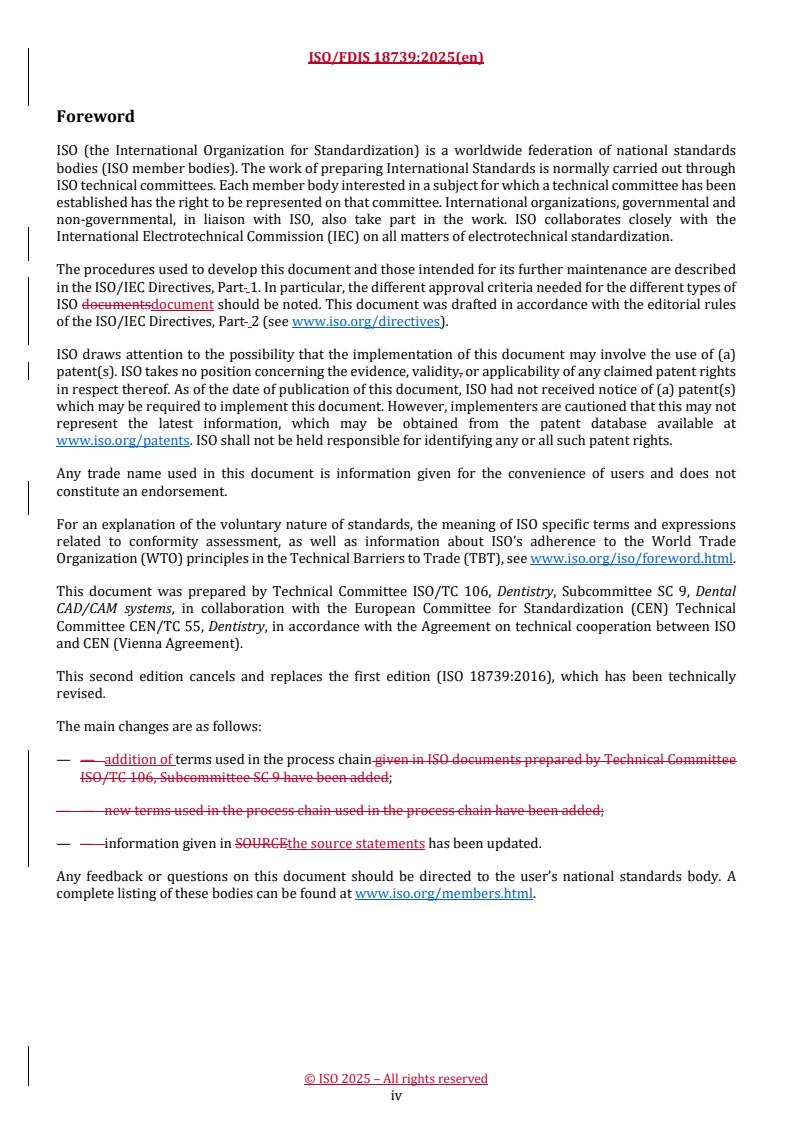
Foreword
ISO (the International Organization for Standardization) is a worldwide federation of national standards
bodies (ISO member bodies). The work of preparing International Standards is normally carried out through
ISO technical committees. Each member body interested in a subject for which a technical committee has been
established has the right to be represented on that committee. International organizations, governmental and
non-governmental, in liaison with ISO, also take part in the work. ISO collaborates closely with the
International Electrotechnical Commission (IEC) on all matters of electrotechnical standardization.
The procedures used to develop this document and those intended for its further maintenance are described
in the ISO/IEC Directives, Part 1. In particular, the different approval criteria needed for the different types of
ISO documentsdocument should be noted. This document was drafted in accordance with the editorial rules
of the ISO/IEC Directives, Part 2 (see www.iso.org/directives).
ISO draws attention to the possibility that the implementation of this document may involve the use of (a)
patent(s). ISO takes no position concerning the evidence, validity, or applicability of any claimed patent rights
in respect thereof. As of the date of publication of this document, ISO had not received notice of (a) patent(s)
which may be required to implement this document. However, implementers are cautioned that this may not
represent the latest information, which may be obtained from the patent database available at
www.iso.org/patents. ISO shall not be held responsible for identifying any or all such patent rights.
Any trade name used in this document is information given for the convenience of users and does not
constitute an endorsement.
For an explanation of the voluntary nature of standards, the meaning of ISO specific terms and expressions
related to conformity assessment, as well as information about ISO's adherence to the World Trade
Organization (WTO) principles in the Technical Barriers to Trade (TBT), see www.iso.org/iso/foreword.html.
This document was prepared by Technical Committee ISO/TC 106, Dentistry, Subcommittee SC 9, Dental
CAD/CAM systems, in collaboration with the European Committee for Standardization (CEN) Technical
Committee CEN/TC 55, Dentistry, in accordance with the Agreement on technical cooperation between ISO
and CEN (Vienna Agreement).
This second edition cancels and replaces the first edition (ISO 18739:2016), which has been technically
revised.
The main changes are as follows:
— — addition of terms used in the process chain given in ISO documents prepared by Technical Committee
ISO/TC 106, Subcommittee SC 9 have been added;
— — new terms used in the process chain used in the process chain have been added;
— — information given in SOURCEthe source statements has been updated.
Any feedback or questions on this document should be directed to the user’s national standards body. A
complete listing of these bodies can be found at www.iso.org/members.html.
iv
ISO/DISFDIS 18739:2025(en)
Introduction
Terms and designations for individual system parts and process steps used in product descriptions and
instructions for use provided by the manufacturers of dental computer-aided design and computer-aided
manufacturing (CAD/CADCAM) systems differ from each other, thus creating confusion among dentists and
dental technicians. In order to overcome these ambiguities, it was decided to prepare an International
Standard forthis document defines terminology used in the process chain for CAD/CAM systems.
In the terminological entries, first the preferred term and then the admitted terms which have been in use so
far are given. For the future itIt is recommended to useintended that the preferred terms will be used instead
of the admitted terms in the future.
v
DRAFT International Standard ISO/DIS 18739:2025(en)
Dentistry — Vocabulary of process chain for CAD/CAM systems
1 Scope
This document defines terms and definitions used in the process chain for computer-aided design and
computer-aided manufacturing (CAD/CAM) systems in dentistry in the process chain for CAD/CAM systems
in dentistry (see Annex A).
NOTE: See Annex A for a flow chart of the process chain.
2 Normative references
There are no normative references in this document.
3 Terms and definitions
ISO and IEC maintain terminology databases for use in standardization at the following addresses:
— — ISO Online browsing platform: available at https://www.iso.org/obp
— — IEC Electropedia: available at https://www.electropedia.org/
3.1 Process step terms
3.1.1 3.1.1
3D data acquisition
three-dimensional data acquisition
3D digitization and generation of a digital data set
3.1.2 3.1.2
3D data acquisition system
three-dimensional data acquisition system
hardware and software used for 3D data acquisition
3.1.3 3.1.3
3D file format
common file format used for storing or encoding information about a 3D model’s geometry, colour, texture,
etc., as plain text or binary data commonly used in computer-aided design (CAD) (3.1.163.1.16) /) and
computer-aided manufacturing (CAM) (3.1.173.1.17))
EXAMPLE Wavefront object (.obj), polygon model (.ply), binary or ASCII stereolithography (.stl).
3.1.4 3.1.4
3D scanning
3D digitizing
raw data acquisition
method of acquiring the shape and size of an object as a three-dimensional representation by recording x, y, z
coordinates on the objectsobject's surface and, through software, the collection of points is converted into
digital data
Note 1 to entry: This collection of data via the scanning process creates a raw data set (3.1.23(3.1.23).).
Note 2 to entry: Typical methods use some amount of automation, coupled with a touch probe or an optical sensor, or
otheranother device.
Note 3 to entry: In additive manufacturing (3.1.7(3.1.7)) process chains, 3D scanning can typically be used for generation
of surface models, in situ monitoring, non-destructive testing as well as verification of part geometry.
[SOURCE: ISO/ASTM 52900:2021, 3.4.13, modified — Note 1 to entry has been added and the former Note 1
to entry and Note 2 to entry have become Note 2 to entry and Note 3 to entry has been added.
3.1.5 3.1.5
3D printing
fabrication of objects through the deposition of a material using a print head, nozzle or another printer
technology
Note 1 to entry: This term is often used in a non-technical context synonymously with additive manufacturing
(3.1.7(3.1.7)) and, in these cases, typically associated with machines used for non-industrial purposes including personal
use.
[SOURCE: ISO/ASTM 52900:2021, 3.3.1]
3.1.6 3.1.6
activation key
dongle
means to allow for the operation, designingdesign, production, and /or
fabrication of a dental restoration, a dental prosthesis and a dental appliance using computer-aided design
(CAD) (3.1.163.1.16)) and computer-aided manufacturing (CAM) (3.1.173.1.17)) technologies when the
software is either considered closed or proprietary
3.1.7 3.1.7
additive manufacturing
AM
process of joining materials to make parts from 3D model data, usually layer upon layer, as opposed to
subtractive manufacturing and formative manufacturing methodologies
Note 1 to entry: Historical terms include: additive fabrication, additive processes, additive techniques, additive layer
manufacturing, layer manufacturing, solid freeform fabrication and freeform fabrication.
Note 2 to entry: The meaning of “additive“Additive-”, “subtractive-” and “formative-” manufacturing methodologies
isare further discussed in ISO/ASTM 52900:2021, Annex B.
[SOURCE: ISO/ASTM 52900:2021, 3.1.2, modified – — "Annex B" has been replaced with “ISO/ASTM
52900:2021, Annex B”.]
3.1.8 3.1.8
artefact
unwanted or unintended feature or defect that results from the computer-aided design (CAD) (3.1.16) in the
data acquisition step and is an undesired alteration of data introduced in a digital process by either an involved
technique or an involved technology or both
3.1.9 3.1.9
blank
material to be machined by a computer-aided milling machine (3.1.20(3.1.20))
Note 1 to entry: A blank can be a block (3.1.11(3.1.11)) or a disc (3.1.36(3.1.36).).
ISO/DISFDIS 18739:2025(en)
3.1.10 3.1.10
blank holder
frame to fasten a blank (3.1.9(3.1.9)) to an accurate position within a computer-aided milling machine
(3.1.20(3.1.20))
3.1.11 3.1.11
block
cuboidal material with holding device for machining on a computer-aided milling machine (3.1.20(3.1.20))
3.1.12 3.1.12
build platform
build plate
base which provides a surface upon which the building of the parts is started and supported throughout the
build process
[SOURCE: ISO/ASTM 59200:2021 3.3.5, modified — The second preferred term "build plate" has been added;
the domain "" and Note 1 to entry have been removed.]
3.1.13 3.1.13
CAD data
design data set
result of the CAD process (3.1.14(3.1.14)) gained by manipulating the model data set for the purposes of
transfer to the computer-aided manufacturing (CAM) (3.1.17 (3.1.17)) system
3.1.14 3.1.14
CAD process
DEPRECATED: design process
process of generating design data set (3.1.23(3.1.23))
3.1.15 3.1.15
CAD software
design system
system for the generation of a design data set (3.1.23(3.1.23))
3.1.16 3.1.16
CAD
computer-aided design
hardware and software supporting the designing process
Note 1 to entry: The acronym "CAD" is commonly used as the preferred term.
3.1.17 3.1.17
CAM
computer-aided manufacturing
hardware and software supporting the manufacturing process
Note 1 to entry: The acronym "CAM" is commonly used as the preferred term.
3.1.18 3.1.18
CAM software
computer-aided manufacturing software
plans and converts design data used to execute the manufacturing process
EXAMPLE Software for the calculation of milling paths.
3.1.19 3.1.19
CAM system
computer-aided manufacturing system
digitally controlled system for the manufacture of dental CAD/CAM restorations (3.1.27(3.1.27),), dental
CAD/CAM prostheses (3.1.26(3.1.26)) and dental CAD/CAM appliances (3.1.25(3.1.25))
3.1.20 3.1.20
computer-aided milling machine
computer-aided device design for subtractive manufacturing process (3.1.59(3.1.59)) of dental CAD/CAM
restorations (3.1.27(3.1.27),), dental CAD/CAM prostheses (3.1.26(3.1.26)) and a dental CAD/CAM appliance
(3.1.25(3.1.25)) using rotary instruments for cutting and grinding
3.1.21 3.1.21
coordinate measuring machine
CMM
measuring system with the means to move a probing system and capability to determine spatial coordinates
on a workpiece surface
[SOURCE: ISO 10360-1:2000, 2.1, modified — “CMM” has also been given as a preferred term and Note 1 to
entry has been removed.]
3.1.22 3.1.22
data record
one or more data items treated as a unit within a data set (3.1.23(3.1.23))
3.1.23 3.1.23
data set
collection of numerical information that corresponds to a scanned object used for CAD (3.1.16(3.1.16)) or CAM
(3.1.17(3.1.17)) operations
EXAMPLE Raw data set (dot model), digitization data set (manipulated raw data set), surface model, facet model or
volume model.
Note 1 to entry: Raw data set is obtained by processing scanning data.
3.1.24 3.1.24
data structure
defined format interrelating the data (records) in the data set (3.1.23(3.1.23))
3.1.25 3.1.25
dental CAD/CAM appliance
digital dental appliance
appliance used in dentistry, produced by a dental CAD/CAM system (3.1.28(3.1.28))
3.1.26 3.1.26
dental CAD/CAM prosthesis
digital dental prosthesis
dental prosthesis produced by a dental CAD/CAM system (3.1.28(3.1.28))
3.1.27 3.1.27
dental CAD/CAM restoration
digital dental restoration
dental restoration produced by a dental CAD/CAM system (3.1.28(3.1.28))
ISO/DISFDIS 18739:2025(en)
3.1.28 3.1.28
dental CAD/CAM system
set of hardware, software, materials and devices used to fabricate dental restorations
Note 1 to entry: Hardware and software are used for data acquisition, design and manufacturing.
3.1.29 3.1.29
design data manipulation process
CAD data manipulation process
process of generating the manufacturing data set (3.1.23(3.1.23))
EXAMPLE Tool path generation process.
3.1.30 3.1.30
digital impression
acquisition of a data set with the numerical 3D-representation of the surfaces from the patient directly
3.1.31 3.1.31
digital impression data
set of numerical coordinates providing a three-dimensional representation of the surfaces of teeth and
surrounding tissue acquired directly from the patient by a digital impression device (3.1.32 (3.1.32)) and
presented in a format suited to a computer-aided dental design and manufacturing (CAD/CAM) process
Note 1 to entry: A digital impression data set can be supplemented by data on surface colour.
Note 2 to entry: A set of digital impression data is distinct from a virtual model (3.1.64(3.1.64).).
3.1.32 3.1.32
digital impression device
combination of a hand-held scanning device (3.1.38(3.1.38)) suited for use in the oral cavity, and computer
hardware and software that outputs a numerical, three -dimensional description of scanned surface
3.1.33 3.1.33
digital registration
digital data set (3.1.23(3.1.23)) of sub-process in analysis of scanning data in which segments of surface
topography derived from data acquired by a scanning device in successive positions and orientations are
aligned in order to create a full data set of the whole topography with least possible alignment error
3.1.34 3.1.34
digitizing device
device for computer-aided design (CAD) (3.1.16(3.1.16)) and manufacturing of custom-made indirect dental
CAD/CAM restorations (3.1.27(3.1.27),), dental CAD/CAM prostheses (3.1.26(3.1.26)) and a dental CAD/CAM
appliance (3.1.25(3.1.25)) used to record the topographical characteristics (e.g. surface) of teeth and
surrounding tissues, implant connecting components, dental impressions, dental moulds or stone models by
analogue or digital methods
Note 1 to entry: These systems consist of a scanning device, hardware and software.
Note 2 to entry: A surface digitization procedure starts with the generation of measured surface points (or their
conversion, e.g. in STL format), which are the measured digitization data. In most digitizing systems, the measured points
are mathematically processed by operations such as:
— — matching;
— — filtering;
— — weighting;
— — selective removal;
— — smoothing.
Note 3 to entry: This results in the processed digitization data (or surface data). These data depend very much on, for
example, the digitization protocol (e.g. the number of passes), the extraction method of a surface from the raw data points
and the matching of point clouds.
3.1.35 3.1.35
direct error
error resulting in corrupted set of data values in its intended use
3.1.36 3.1.36
disc
flat circular-shaped material for machining on a computer-aided milling machine (3.1.20(3.1.20))
3.1.37 3.1.37
fit
range of tightness or looseness between two or more mating parts
Note 1 to entry: The fit is relative to a device, process or material in the accurate reproduction of a copy or product that
has the accuracy within the tolerance of the device, process or material used.
3.1.38 3.1.38
hand-held scanning device
device comprising a camera or similar sensor and a structured light source which may be moved freely as it
projects a structured light pattern to the surface and captures light reflected or diffusely scattered from a
surface and converts it into a sequence of data from which a 3D surface topography can be calculated
Note 1 to entry: The instrument may have its own source of illumination.
Note 2 to entry: The scanning device may operate by any technology that provides data on range and direction from the
device to the surface.
Note 3 to entry: The values for range and corresponding directions constitute the raw data for creating the digital
impression.
3.1.39 3.1.39
holding jig
mandrel
jig that attaches to a blank (3.1.9(3.1.9)) to be mounted for a milling machine
[SOURCE: ISO 5139: 2023, 3.3, modified –— “composite resin block” has been replaced with “blank”.]
3.1.40 3.1.40
indirect data acquisition
data acquisition process performed not directly on the patient
3.1.41 3.1.41
indirect dental restoration
restoration manufactured extra orally which replaces both intra-oral hard soft tissues
EXAMPLE Crowns, bridges, inlays, implant superstructures, prostheses, provisional restorations.
ISO/DISFDIS 18739:2025(en)
3.1.42 3.1.42
indirect error
error resulting in corrupted set of data values when communicating the data from one device or software to
another
3.1.43 3.1.43
IGES
initial graphics exchange specification
platform neutral CAD data (3.1.13(3.1.13)) exchange format intended for exchange of product geometry and
geometry annotation information
Note 1 to entry: The abbreviated term "IGES" is commonly used as the preferred term.
3.1.44 3.1.44
laboratory accessory
laboratory aid
tool, prosthetic implement or oral replication not directly applied to the patient
EXAMPLE Master model.
3.1.45 3.1.45
light scanning
structured light scanning method using a narrowband spectrum of various light waves (e.g. blue, white, red)
to scan a 3D object with precise measurements independent of environmental lighting conditions
3.1.46 3.1.46
machining damage
effect on surface and sub surface structure occurring during machining the blank (3.1.9(3.9)) to form the final
part or device
3.1.47 3.1.47
manufacturing data set
manufacturing process data set
collection of numerical information resulting from the manipulation of the design data, used for the digital
manufacturing process
EXAMPLE: CAM software (3.1.18(3.1.18)) output file.
3.1.48 3.1.48
nesting
process of a purposed virtual 3D arrangement of one or more object(s) within a given 3D field of geometry in
both computer-aided design (3.1.16(3.1.16)) computer-aided manufacturing (3.1.17(3.1.17)) software to
fabricate one or more dental object through an additive manufacturing (3.1.7(3.1.7)) and or subtractive
manufacturin
...
PROJET FINAL
Norme
internationale
ISO/TC 106/SC 9
Médecine bucco-dentaire —
Secrétariat: JISC
Vocabulaire de la chaîne de
Début de vote:
processus pour les systèmes de
2025-12-09
CFAO
Vote clos le:
2026-02-03
Dentistry — Vocabulary of process chain for CAD/CAM systems
LES DESTINATAIRES DU PRÉSENT PROJET SONT
INVITÉS À PRÉSENTER, AVEC LEURS OBSERVATIONS,
NOTIFICATION DES DROITS DE PROPRIÉTÉ DONT ILS
AURAIENT ÉVENTUELLEMENT CONNAISSANCE ET À
FOURNIR UNE DOCUMENTATION EXPLICATIVE.
OUTRE LE FAIT D’ÊTRE EXAMINÉS POUR
ÉTABLIR S’ILS SONT ACCEPTABLES À DES FINS
INDUSTRIELLES, TECHNOLOGIQUES ET COM-MERCIALES,
AINSI QUE DU POINT DE VUE DES UTILISATEURS, LES
PROJETS DE NORMES
TRAITEMENT PARALLÈLE ISO/CEN
INTERNATIONALES DOIVENT PARFOIS ÊTRE CONSIDÉRÉS
DU POINT DE VUE DE LEUR POSSI BILITÉ DE DEVENIR DES
NORMES POUVANT
SERVIR DE RÉFÉRENCE DANS LA RÉGLEMENTATION
NATIONALE.
Numéro de référence
PROJET FINAL
Norme
internationale
ISO/TC 106/SC 9
Médecine bucco-dentaire —
Secrétariat: JISC
Vocabulaire de la chaîne de
Début de vote:
processus pour les systèmes de
2025-12-09
CFAO
Vote clos le:
2026-02-03
Dentistry — Vocabulary of process chain for CAD/CAM systems
LES DESTINATAIRES DU PRÉSENT PROJET SONT
INVITÉS À PRÉSENTER, AVEC LEURS OBSERVATIONS,
NOTIFICATION DES DROITS DE PROPRIÉTÉ DONT ILS
AURAIENT ÉVENTUELLEMENT CONNAISSANCE ET À
FOURNIR UNE DOCUMENTATION EXPLICATIVE.
DOCUMENT PROTÉGÉ PAR COPYRIGHT
OUTRE LE FAIT D’ÊTRE EXAMINÉS POUR
ÉTABLIR S’ILS SONT ACCEPTABLES À DES FINS
© ISO 2025 INDUSTRIELLES, TECHNOLOGIQUES ET COM-MERCIALES,
AINSI QUE DU POINT DE VUE DES UTILISATEURS, LES
Tous droits réservés. Sauf prescription différente ou nécessité dans le contexte de sa mise en œuvre, aucune partie de cette
PROJETS DE NORMES
TRAITEMENT PARALLÈLE ISO/CEN
INTERNATIONALES DOIVENT PARFOIS ÊTRE CONSIDÉRÉS
publication ne peut être reproduite ni utilisée sous quelque forme que ce soit et par aucun procédé, électronique ou mécanique,
DU POINT DE VUE DE LEUR POSSI BILITÉ DE DEVENIR DES
y compris la photocopie, ou la diffusion sur l’internet ou sur un intranet, sans autorisation écrite préalable. Une autorisation peut
NORMES POUVANT
être demandée à l’ISO à l’adresse ci-après ou au comité membre de l’ISO dans le pays du demandeur.
SERVIR DE RÉFÉRENCE DANS LA RÉGLEMENTATION
NATIONALE.
ISO copyright office
Case postale 401 • Ch. de Blandonnet 8
CH-1214 Vernier, Genève
Tél.: +41 22 749 01 11
E-mail: copyright@iso.org
Web: www.iso.org
Publié en Suisse Numéro de référence
ii
Sommaire Page
Avant-propos .iv
Introduction .v
1 Domaine d’application . 1
2 Références normatives . 1
3 Termes et définitions . 1
3.1 Termes de l'étape du processus .1
3.2 Termes de mesure et d'étalonnage .9
Annexe A (informative) Chaîne de processus pour système CAD/CAM .13
Bibliographie . 14
Index .15
iii
Avant-propos
L’ISO (Organisation internationale de normalisation) est une fédération mondiale d’organismes nationaux
de normalisation (comités membres de l’ISO). L’élaboration des Normes internationales est en général
confiée aux comités techniques de l’ISO. Chaque comité membre intéressé par une étude a le droit de faire
partie du comité technique créé à cet effet. Les organisations internationales, gouvernementales et non
gouvernementales, en liaison avec l’ISO participent également aux travaux. L’ISO collabore étroitement avec
la Commission électrotechnique internationale (IEC) en ce qui concerne la normalisation électrotechnique.
Les procédures utilisées pour élaborer le présent document et celles destinées à sa mise à jour sont
décrites dans les Directives ISO/IEC, Partie 1. Il convient, en particulier, de prendre note des différents
critères d’approbation requis pour les différents types de documents ISO. Le présent document a
été rédigé conformément aux règles de rédaction données dans les Directives ISO/IEC, Partie 2 (voir
www.iso.org/directives).
L’ISO attire l’attention sur le fait que la mise en application du présent document peut entraîner l’utilisation
d’un ou de plusieurs brevets. L’ISO ne prend pas position quant à la preuve, à la validité et à l’applicabilité de
tout droit de brevet revendiqué à cet égard. À la date de publication du présent document, l’ISO n’avait pas
reçu notification qu’un ou plusieurs brevets pouvaient être nécessaires à sa mise en application. Toutefois,
il y a lieu d’avertir les responsables de la mise en application du présent document que des informations
plus récentes sont susceptibles de figurer dans la base de données de brevets, disponible à l’adresse
www.iso.org/brevets. L’ISO ne saurait être tenue pour responsable de ne pas avoir identifié de tels droits de
propriété et averti de leur existence.
Les appellations commerciales éventuellement mentionnées dans le présent document sont données pour
information, par souci de commodité, à l’intention des utilisateurs et ne sauraient constituer un engagement.
Pour une explication de la nature volontaire des normes, la signification des termes et expressions
spécifiques de l’ISO liés à l’évaluation de la conformité, ou pour toute information au sujet de l’adhésion de
l’ISO aux principes de l’Organisation mondiale du commerce (OMC) concernant les obstacles techniques au
commerce (OTC), voir www.iso.org/avant-propos.
Le présent document a été élaboré par le comité technique ISO/TC 106, Médecine bucco-dentaire, sous-comité
SC 9, Systèmes dentaires de CAD/CAM, en collaboration avec le comité technique CEN/TC 55, Médecine bucco-
dentaire du Comité européen de normalisation (CEN), conformément à l'Accord de coopération technique
entre l'ISO et le CEN (Accord de Vienne).
Cette deuxième édition annule et remplace la première édition (ISO 18739:2016), qui a fait l’objet d’une
révision technique.
Les principales modifications sont les suivantes:
— ajout de termes utilisés dans la chaîne de production;
— les informations fournies dans les déclarations des sources ont été mises à jour.
Il convient que l’utilisateur adresse tout retour d’information ou toute question concernant le présent
document à l’organisme national de normalisation de son pays. Une liste exhaustive desdits organismes se
trouve à l’adresse www.iso.org/fr/members.html.
iv
Introduction
Les termes et désignations des parties de systèmes individuels et des étapes de processus utilisés dans les
descriptions de produits et les instructions d'utilisation fournies par les fabricants de systèmes dentaires
de conception assistée par ordinateur et de fabrication assistée par ordinateur (CAD/CAM) diffèrent les
uns des autres, créant une confusion parmi les dentistes et les techniciens dentaires. Afin de surmonter
ces ambiguïtés, le présent document définit la terminologie utilisée dans la chaîne de processus pour les
systèmes de CFAO.
Dans les articles terminologiques, on donne d'abord le terme privilégié, puis les termes admis qui ont été
utilisés jusqu'à présent. Il est prévu que les termes privilégiés soient utilisés à la place des termes admis à
l'avenir.
v
PROJET FINAL Norme internationale ISO/FDIS 18739:2025(fr)
Médecine bucco-dentaire — Vocabulaire de la chaîne de
processus pour les systèmes de CFAO
1 Domaine d’application
Le présent document définit les termes et définitions utilisés dans la chaîne de processus pour les systèmes
de conception assistée par ordinateur et de fabrication assistée par ordinateur (CFAO) en médecine bucco-
dentaire.
NOTE Voir l' Annexe A pour un organigramme de la chaîne de processus.
2 Références normatives
Le présent document ne contient aucune référence normative.
3 Termes et définitions
L’ISO et l’IEC tiennent à jour des bases de données terminologiques destinées à être utilisées en normalisation,
consultables aux adresses suivantes:
— ISO Online browsing platform: disponible à l’adresse https:// www .iso .org/ obp
— IEC Electropedia: disponible à l’adresse https:// www .electropedia .org/
3.1 Termes de l'étape du processus
3.1.1
Acquisition de données 3D
acquisition de données tridimensionnelles
Numérisation 3D et génération d'un ensemble de données numériques
3.1.2
Système d’acquisition de données 3D
système d'acquisition de données tridimensionnelles
matériel et logiciel utilisés pour l'acquisition de données 3D
3.1.3
Format de fichier 3D
format de fichier courant utilisé pour stocker ou encoder des informations sur la géométrie, la couleur,
la texture, etc. d’un modèle 3D, sous forme de texte brut ou de données binaires couramment utilisées en
conception assistée par ordinateur (CAO) (3.1.16) et en fabrication assistée par ordinateur (FAO) (3.1.17)
EXEMPLE Objet front d'onde (.obj), modèle polygonal (.ply), stéréolithographie binaire ou ASCII (.stl).
3.1.4
balayage 3D
numérisation 3D
acquisition de données brutes
méthode d'acquisition de la forme et de la taille d'un objet sous forme de représentation tridimensionnelle
en enregistrant les coordonnées x, y, z sur la surface de l'objet et, au moyen d'un logiciel, la collecte de points
est convertie en données numériques
Note 1 à l'article: Cette collecte de données via le processus de numérisation crée un jeu de données brutes (3.1.23).
Note 2 à l'article: Les méthodes typiques utilisent une certaine quantité d'automatisation, couplée à une sonde tactile,
un capteur optique ou un autre dispositif.
Note 3 à l'article: Dans les chaînes de processus de fabrication additive (3.1.7), le balayage 3D peut généralement
être utilisé pour la génération de modèles de surface, la surveillance in situ, les contrôles non destructifs ainsi que la
vérification de la géométrie des pièces.
[SOURCE: ISO/ASTM 52900:2021, 3.4.13, modifiée — La Note 1 à l'article a été ajoutée et les anciennes Note
1 à l'article et Note 2 à l'article sont devenues Note 2 à l'article et la Note 3 à l'article a été ajoutée.
3.1.5
impression 3D
fabrication d'objets par dépôt d'un matériau à l'aide d'une tête d'impression, d'une buse ou d'une autre
technologie d'impression
Note 1 à l'article: Ce terme est souvent utilisé dans un contexte non technique synonyme de fabrication additive (3.1.7)
et, dans ces cas, généralement associé aux machines utilisées à des fins non industrielles y compris personnelles.
[SOURCE: ISO/ASTM 52900:2021, 3.3.1]
3.1.6
clé d'activation
clé de sécurité
signifie permettre le fonctionnement, la conception, la production
et/ou la fabrication d'une restauration dentaire, d'une prothèse dentaire et d'un appareil dentaire en
utilisant des technologies de conception assistée par ordinateur (CAD) (3.1.16) et de fabrication assistée par
ordinateur (CAM) (3.1.17) lorsque le logiciel est considéré comme fermé ou propriétaire
3.1.7
fabrication additive
AM
processus d'assemblage de matériaux pour fabriquer des pièces à partir de données de modèles 3D,
généralement couche après couche, par opposition aux méthodologies de fabrication soustractive et de
fabrication formative
Note 1 à l'article: Les termes historiques comprennent: la fabrication additive, les procédés additive, les techniques
additive, la fabrication de couches additives, la fabrication de couches, la fabrication de formes libres solides et la
fabrication de formes libres.
Note 2 à l'article: Les méthodologies de fabrication «additive», «soustractive» et «formative» sont traitées plus en
détail dans l'ISO/ASTM 52900:2021, Annexe B.
[SOURCE: ISO/ASTM 52900:2021, 3.1.2, modifiée — «Annexe B» a été remplacée par «ISO/ASTM 52900:2021,
Annexe B».]
3.1.8
artefact
caractéristique ou défaut indésirable ou non intentionnel qui résulte de la conception assistée par ordinateur
(CAO) (3.1.16) dans l'étape d'acquisition des données et qui est une altération indésirable des données
introduite dans un processus numérique par une technique impliquée ou une technologie impliquée ou les
deux
3.1.9
blanc
matériau à usiner par une fraiseuse assistée par ordinateur (3.1.20)
Note 1 à l'article: Un obturateur peut être un bloc (3.1.11) ou un disque (3.1.36).
3.1.10
support d’ébauche
cadre pour fixer un obturateur (3.1.9) à une position précise dans une fraiseuse assistée par ordinateur
(3.1.20)
3.1.11
bloc
matériau cuboïdal avec dispositif de maintien pour usinage sur fraiseuse assistée par ordinateur (3.1.20)
3.1.12
plateforme de fabrication
plaque de construction
base qui fournit une surface sur laquelle la construction des pièces est commencée et soutenue tout au long
du processus de construction
[SOURCE: ISO/ASTM 59200:2021 3.3.5, modifiée — Le deuxième terme préféré “plaque de construction” a
été ajouté; le domaine “” et la Note 1 à l'article ont été supprimés.]
3.1.13
Données CAD
ensemble de données de conception
résultat du processus CAO (3.1.14) obtenu en manipulant l'ensemble des données du modèle à des fins de
transfert vers le système de fabrication assistée par ordinateur (CAM) (3.1.17)
3.1.14
processus CAD
DÉCONSEILLÉ: processus de conception
processus de génération d'un ensemble de données de conception (3.1.23)
3.1.15
logiciels CAD
système de conception
système de génération d'un ensemble de données de conception (3.1.23)
3.1.16
CAO
conception assistée par ordinateur
matériel et logiciel supportant le processus de conception
Note 1 à l'article: L'acronyme “CAD” est couramment utilisé comme terme privilégié.
3.1.17
GCC
fabrication assistée par ordinateur
matériel et logiciel supportant le processus de fabrication
Note 1 à l'article: L'acronyme “CAM” est couramment utilisé comme terme privilégié.
3.1.18
logiciels CAM
logiciel de fabrication assisté par ordinateur
planifie et convertit les données de conception utilisées pour exécuter le processus de fabrication
EXEMPLE Logiciel de calcul des chemins de fraisage.
3.1.19
système CAM
système de fabrication assisté par ordinateur
système à commande numérique pour la fabrication de restaurations dentaires CFAO (3.1.27), de prothèses
dentaires CFAO (3.1.26) et d' appareils dentaires CFAO (3.1.25)
3.1.20
fraiseuse à commande numérique
conception de dispositif assisté par ordinateur pour un procédé de fabrication soustractive (3.1.59) de
restaurations dentaires CFAO (3.1.27), de prothèses dentaires CFAO (3.1.26) et d'un appareil dentaire CFAO
(3.1.25) utilisant des instruments rotatifs pour la découpe et le meulage
3.1.21
machine à mesurer les coordonnées
CENTREUR
système de mesure doté d'un moyen de déplacement d'un système de palpage et d'une capacité de
détermination des coordonnées spatiales sur la surface d'une pièce
[SOURCE: ISO 10360‑1:2000, 2.1, modifiée — «MMT» a également été donnée comme terme privilégié et la
Note 1 à l'article a été supprimée.]
3.1.22
registre de données
une ou plusieurs données traitées comme une unité au sein d’un ensemble de données (3.1.23)
3.1.23
ensemble de données
ensemble d'informations numériques qui correspondent à un objet scanné utilisé pour les opérations de
CAD (3.1.16) ou de CAM (3.1.17)
EXEMPLE Ensemble de données brutes (modèle à points), ensemble de données de numérisation (ensemble de
données brutes manipulées), modèle de surface, modèle de facette ou modèle de volume.
Note 1 à l'article: L'ensemble de données brutes est obtenu par traitement des données de balayage.
3.1.24
structure de données
format défini reliant les données (enregistrements) dans l’ ensemble de données (3.1.23)
3.1.25
appareil de CFAO dentaire
appareil dentaire numérique
appareil utilisé en médecine bucco-dentaire, produit par un système CAD/CAM dentaire (3.1.28)
3.1.26
prothèse dentaire CFAO
prothèse dentaire numérique
prothèse dentaire réalisée par un système CAD/CAM dentaire (3.1.28)
3.1.27
restauration dentaire CAD/CAM
restauration dentaire numérique
restauration dentaire réalisée par un système CAD/CAM dentaire (3.1.28)
3.1.28
système CAD/CAM dentaire
ensemble du matériel, des logiciels, des matériaux et des dispositifs utilisés pour fabriquer des restaurations
dentaires
Note 1 à l'article: Le matériel et les logiciels sont utilisés pour l'acquisition, la conception et la fabrication des données.
3.1.29
processus de manipulation des données de conception
Processus de manipulation des données CAO
processus de génération de l’ ensemble de données de fabrication (3.1.23)
EXEMPLE Processus de génération des chemins d'outils.
3.1.30
impression numérique
acquisition d'un ensemble de données avec représentation numérique en 3D des surfaces à partir du patient
directement
3.1.31
données d'impression numérique
ensemble de coordonnées numériques fournissant une représentation tridimensionnelle des surfaces des
dents et du tissu environnant acquises directement auprès du patient par undispositif d'empreinte numérique
(3.1.32) et présentées dans un format adapté à un processus de conception et de fabrication dentaire assistée
par ordinateur (CFAO)
Note 1 à l'article: Un ensemble de données d'impression numérique peut être complété par des données relatives à la
couleur de surface.
Note 2 à l'article: Un ensemble de données d’impression numérique est distinct d’un modèle virtuel (3.1.64).
3.1.32
dispositif d'impression numérique
combinaison d’un dispositif de balayage portatif (3.1.38) adapté à une utilisation dans la cavité buccale, et
d’un matériel informatique et d’un logiciel qui produit une description numérique et tridimensionnelle de la
surface balayée
3.1.33
enregistrement numérique
ensemble de données numériques (3.1.23) du sous-processus d'analyse de données de balayage dans lequel
des segments de topographie de surface dérivés de données acquises par un dispositif de balayage dans des
positions et orientations successives sont alignés afin de créer un ensemble de données complet de toute la
topographie avec le moins d'erreur d'alignement possible
3.1.34
dispositif de numérisation
dispositif de conception assistée par ordinateur (CAO) (3.1.16) et de fabrication de restaurations dentaires
CAO/FAO indirectes sur mesure (3.1.27), de prothèses dentaires CAO/FAO (3.1.26) et d'un appareil dentaire
CAO/FAO (3.1.25) utilisés pour enregistrer les caractéristiques topographiques (par exemple la surface) des
dents et des tissus environnants, des composants de connexion d'implant, des empreintes dentaires, des
moules dentaires ou des modèles en pierre par des méthodes analogiques ou numériques
Note 1 à l'article: Ces systèmes consistent en un dispositif de balayage, du matériel et des logiciels.
Note 2 à l'article: Une procédure de numérisation de surface commence par la génération de points de surface mesurés
(ou leur conversion, par exemple au format STL), qui sont les données de numérisation mesurées. Dans la plupart des
systèmes de numérisation, les points mesurés sont traités mathématiquement par des opérations telles que:
— mise en correspondance;
— le filtrage;
— pondération;
— élimination sélective;
— lissage.
Note 3 à l'article: Il en résulte les données de numérisation traitées (ou données de surface). Ces données dépendent,
par exemple, du protocole de numérisation (par exemple, du nombre de passes), de la méthode d'extraction d'une
surface à partir des points de données brutes et de la correspondance des nuages de points.
3.1.35
erreur directe
erreur résultant en un ensemble corrompu de valeurs de données dans son utilisation prévue
3.1.36
disque
matériau plat de forme circulaire pour usinage sur fraiseuse assistée par ordinateur (3.1.20)
3.1.37
mise en place
plage d'étanchéité ou de desserrage entre deux ou plusieurs pièces appariées
Note 1 à l'article: L'ajustement est relatif à un dispositif, un procédé ou un matériau dans la reproduction précise d'une
copie ou d'un produit dont la précision est comprise dans la tolérance du dispositif, du procédé ou du matériau utilisé.
3.1.38
dispositif de balayage portatif
dispositif comprenant une caméra ou un capteur similaire et une source de lumière structurée qui peut être
déplacée librement lorsqu'elle projette un motif de lumière structurée vers la surface et capture la lumière
réfléchie ou diffusée de manière diffuse à partir d'une surface et la convertit en une séquence de données à
partir de laquelle une topographie de surface en 3D peut être calculée
Note 1 à l'article: L'instrument peut avoir sa propre source d'éclairage.
Note 2 à l'article: Le dispositif de balayage peut fonctionner par n'importe quelle technologie fournissant des données
sur la portée et la direction du dispositif à la surface.
Note 3 à l'article: Les valeurs de la plage et des directions correspondantes constituent les données brutes pour créer
l'impression numérique.
3.1.39
dispositif de maintien
mandrin
gabarit qui se fixe sur un obturateur (3.1.9)
...
Questions, Comments and Discussion
Ask us and Technical Secretary will try to provide an answer. You can facilitate discussion about the standard in here.
Loading comments...