

ISO 4917-6:2024
(Main)Design of nuclear power plants against seismic events — Part 6: Post-seismic measures
General Information
- Abstract
This document applies to nuclear power plants with water cooled reactors. This document does not apply to earthquakes stronger than the design basis earthquake. This document specifies guidance on the actions to be taken in preparation for and following an earthquake at a nuclear power plant. This document is intended to be used as a guideline for decision making regarding continued operation, shutdown and restart of the nuclear power plant after an earthquake. It can also be used to assist operating organizations in the preparation and implementation of an overall pre- and post-earthquake action programme for dealing with situations in accordance with the level of seismic ground motion experienced at the site, and the seismic design level of the plant.
- Status
- Published
- Publication Date
- 26-Feb-2024
- Technical Committee
- ISO/TC 85/SC 6 - Reactor technology
- Current Stage
- 6060 - International Standard published
- Start Date
- 27-Feb-2024
- Due Date
- 15-Feb-2024
- Completion Date
- 27-Feb-2024


Overview
ISO 4917-6:2024 - "Design of nuclear power plants against seismic events - Part 6: Post-seismic measures" provides guidance for actions to be taken before, during and after an earthquake at nuclear power plants with water‑cooled reactors. It is a decision‑support guideline for plant operators and safety engineers covering verification, classification and graded post‑seismic measures for continued operation, shutdown and restart. The standard explicitly does not apply to earthquakes stronger than the plant’s design basis earthquake (DBE).
Key topics
- Verification of an earthquake
- Activation of seismic recorders, checking for faulty signals and using at least two instrument locations (trigger thresholds) to confirm an event.
- Classification using recorded response spectra
- Evaluation against plant‑specific acceleration levels and reference spectra (e.g., design basis × factor). The document notes a recommended factor f = 1.5 (larger values require plant‑specific verification).
- Graded procedure for post‑seismic actions
- Concept of graded measures tied to recorded ground motion: initial measures, in‑depth measures and resulting measures (continued operation, shutdown, restart).
- Initial measures
- Control‑room checkups, immediate plant walk‑down inspections (visual checks per Annex B), and documentation as quality records.
- In‑depth and special inspections
- Engineering analyses, special/seismic inspections (Annex C), and shutdown inspections where the inspection level is decisively exceeded.
- Decision criteria
- Guidance on when specified normal operation can be maintained, when to initiate in‑depth measures, and when to shut down the plant (includes guidance for high‑frequency exceedances, e.g., > ~16 Hz).
- Documentation & quality records
- Emphasis on documenting checks, faulty signals and inspection results for auditability.
Applications and users
Who should use this standard:
- Nuclear plant operators and control‑room staff for post‑quake decision making
- Plant safety and seismic engineers for inspection and analysis protocols
- Emergency planners and operations managers for pre/post‑earthquake action programmes
- Regulators and auditors assessing conformance with seismic post‑event procedures
Practical uses include drafting operator manuals, defining plant‑specific inspection levels and trigger thresholds, developing walk‑down checklists, and setting procedures for shutdown and restart decisions after seismic events.
Related standards
- ISO 4917‑1 - Principles for seismic design of nuclear power plants (normative reference)
- ISO 4917‑5 - Seismic instrumentation (normative reference)
Keywords: ISO 4917-6:2024, post-seismic measures, nuclear power plants, seismic events, plant walk-down, seismic instrumentation, design basis earthquake, operating basis earthquake, inspection level.
Get Certified
Connect with accredited certification bodies for this standard

DNV
DNV is an independent assurance and risk management provider.

Lloyd's Register
Lloyd's Register is a global professional services organisation specialising in engineering and technology.

DIBt (Deutsches Institut für Bautechnik)
German Institute for Building Technology.
Sponsored listings
Frequently Asked Questions
ISO 4917-6:2024 is a standard published by the International Organization for Standardization (ISO). Its full title is "Design of nuclear power plants against seismic events — Part 6: Post-seismic measures". This standard covers: This document applies to nuclear power plants with water cooled reactors. This document does not apply to earthquakes stronger than the design basis earthquake. This document specifies guidance on the actions to be taken in preparation for and following an earthquake at a nuclear power plant. This document is intended to be used as a guideline for decision making regarding continued operation, shutdown and restart of the nuclear power plant after an earthquake. It can also be used to assist operating organizations in the preparation and implementation of an overall pre- and post-earthquake action programme for dealing with situations in accordance with the level of seismic ground motion experienced at the site, and the seismic design level of the plant.
This document applies to nuclear power plants with water cooled reactors. This document does not apply to earthquakes stronger than the design basis earthquake. This document specifies guidance on the actions to be taken in preparation for and following an earthquake at a nuclear power plant. This document is intended to be used as a guideline for decision making regarding continued operation, shutdown and restart of the nuclear power plant after an earthquake. It can also be used to assist operating organizations in the preparation and implementation of an overall pre- and post-earthquake action programme for dealing with situations in accordance with the level of seismic ground motion experienced at the site, and the seismic design level of the plant.
ISO 4917-6:2024 is classified under the following ICS (International Classification for Standards) categories: 27.120.20 - Nuclear power plants. Safety; 91.120.25 - Seismic and vibration protection. The ICS classification helps identify the subject area and facilitates finding related standards.
ISO 4917-6:2024 is available in PDF format for immediate download after purchase. The document can be added to your cart and obtained through the secure checkout process. Digital delivery ensures instant access to the complete standard document.
Standards Content (Sample)
International
Standard
ISO 4917-6
First edition
Design of nuclear power plants
2024-02
against seismic events —
Part 6:
Post-seismic measures
Conception parasismique des installations nucléaires —
Partie 6: Dispositions et actions post-sismiques
Reference number
© ISO 2024
All rights reserved. Unless otherwise specified, or required in the context of its implementation, no part of this publication may
be reproduced or utilized otherwise in any form or by any means, electronic or mechanical, including photocopying, or posting on
the internet or an intranet, without prior written permission. Permission can be requested from either ISO at the address below
or ISO’s member body in the country of the requester.
ISO copyright office
CP 401 • Ch. de Blandonnet 8
CH-1214 Vernier, Geneva
Phone: +41 22 749 01 11
Email: copyright@iso.org
Website: www.iso.org
Published in Switzerland
ii
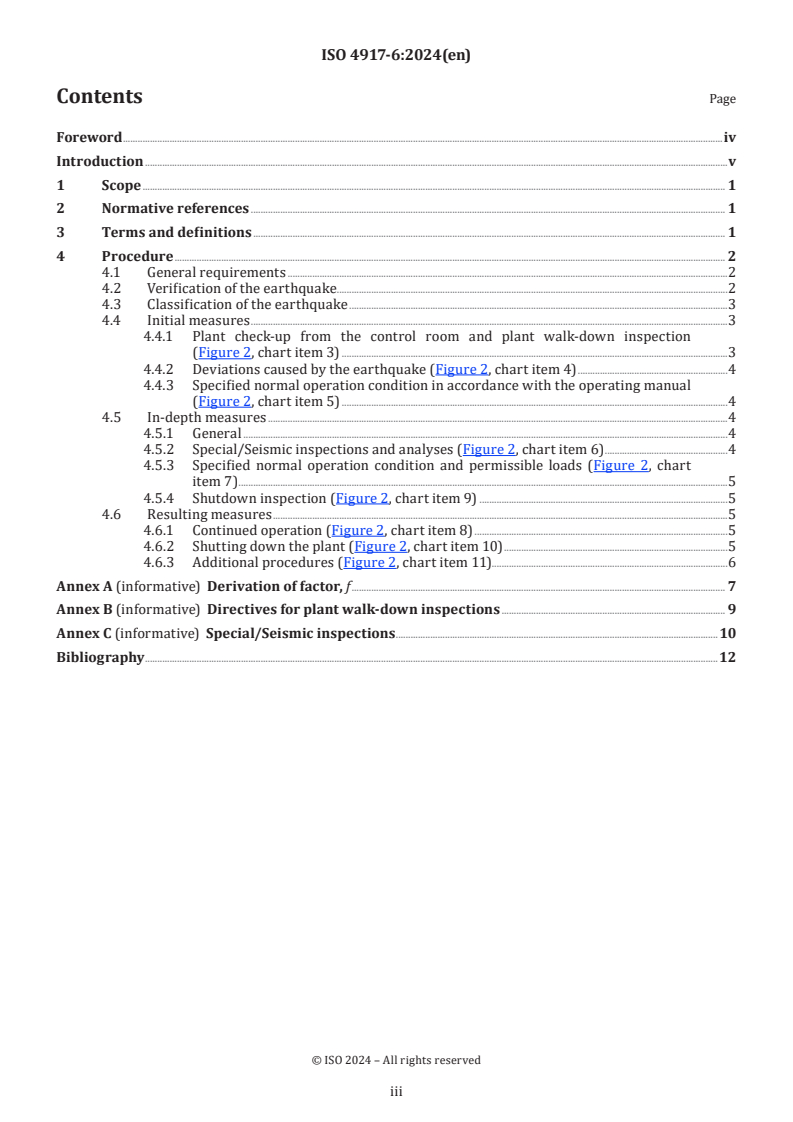
Contents Page
Foreword .iv
Introduction .v
1 Scope . 1
2 Normative references . 1
3 Terms and definitions . 1
4 Procedure . 2
4.1 General requirements .2
4.2 Verification of the earthquake . .2
4.3 Classification of the earthquake .3
4.4 Initial measures .3
4.4.1 Plant check-up from the control room and plant walk-down inspection
(Figure 2, chart item 3) .3
4.4.2 Deviations caused by the earthquake (Figure 2, chart item 4) .4
4.4.3 Specified normal operation condition in accordance with the operating manual
(Figure 2, chart item 5) .4
4.5 In-depth measures .4
4.5.1 General .4
4.5.2 Special/Seismic inspections and analyses (Figure 2, chart item 6) .4
4.5.3 Specified normal operation condition and permissible loads (Figure 2, chart
item 7) .5
4.5.4 Shutdown inspection (Figure 2, chart item 9) .5
4.6 Resulting measures .5
4.6.1 Continued operation (Figure 2, chart item 8) .5
4.6.2 Shutting down the plant (Figure 2, chart item 10) .5
4.6.3 Additional procedures (Figure 2, chart item 11).6
Annex A (informative) Derivation of factor, f . 7
Annex B (informative) Directives for plant walk-down inspections . 9
Annex C (informative) Special/Seismic inspections . 10
Bibliography .12
iii
Foreword
ISO (the International Organization for Standardization) is a worldwide federation of national standards
bodies (ISO member bodies). The work of preparing International Standards is normally carried out through
ISO technical committees. Each member body interested in a subject for which a technical committee
has been established has the right to be represented on that committee. International organizations,
governmental and non-governmental, in liaison with ISO, also take part in the work. ISO collaborates closely
with the International Electrotechnical Commission (IEC) on all matters of electrotechnical standardization.
The procedures used to develop this document and those intended for its further maintenance are described
in the ISO/IEC Directives, Part 1. In particular, the different approval criteria needed for the different types
of ISO document should be noted. This document was drafted in accordance with the editorial rules of the
ISO/IEC Directives, Part 2 (see www.iso.org/directives).
ISO draws attention to the possibility that the implementation of this document may involve the use of (a)
patent(s). ISO takes no position concerning the evidence, validity or applicability of any claimed patent
rights in respect thereof. As of the date of publication of this document, ISO had not received notice of (a)
patent(s) which may be required to implement this document. However, implementers are cautioned that
this may not represent the latest information, which may be obtained from the patent database available at
www.iso.org/patents. ISO shall not be held responsible for identifying any or all such patent rights.
Any trade name used in this document is information given for the convenience of users and does not
constitute an endorsement.
For an explanation of the voluntary nature of standards, the meaning of ISO specific terms and expressions
related to conformity assessment, as well as information about ISO's adherence to the World Trade
Organization (WTO) principles in the Technical Barriers to Trade (TBT), see www.iso.org/iso/foreword.html.
This document was prepared by Technical Committee ISO/TC 85, Nuclear energy, nuclear technologies, and
radiological protection, Subcommittee SC 6, Reactor technology.
A list of all parts in the ISO 4917 series can be found on the ISO website.
Any feedback or questions on this document should be directed to the user’s national standards body. A
complete listing of these bodies can be found at www.iso.org/members.html.
iv
Introduction
The requirements in this document are based on the verification concept ‘Inspection earthquake level' given
in ISO 4917-1.
Up to the point where the value of the inspection level is not decisively exceeded, no earthquake-related
deviations that could put specified normal operation conditions into question need to be expected in any
areas designed against seismic events. Nevertheless, certain measures are performed to verify specified
normal operation conditions before the inspection level is decisively exceeded, those measures are specified
in this document.
Whenever the value of the inspection level is decisively exceeded, earthquake-related deviations that
could put the specified normal operation condition into question cannot anymore be ruled out in the areas
designed against seismic events. Therefore, if the inspection level is decisively exceeded the nuclear power
plant is shut down and the measures are performed as specified in this document.
v
International Standard ISO 4917-6:2024(en)
Design of nuclear power plants against seismic events —
Part 6:
Post-seismic measures
1 Scope
This document applies to nuclear power plants with water cooled reactors.
This document does not apply to earthquakes stronger than the design basis earthquake.
This document specifies guidance on the actions to be taken in preparation for and following an earthquake
at a nuclear power plant. This document is intended to be used as a guideline for decision making regarding
continued operation, shutdown and restart of the nuclear power plant after an earthquake. It can also be
used to assist operating organizations in the preparation and implementation of an overall pre- and post-
earthquake action programme for dealing with situations in accordance with the level of seismic ground
motion experienced at the site, and the seismic design level of the plant.
2 Normative references
The following documents are referred to in the text in such a way that some or all of their content constitutes
requirements of this document. For dated references, only the edition cited applies. For undated references,
the latest edition of the referenced document (including any amendments) applies.
ISO 4917-1, Design of nuclear power plants against seismic events — Part 1: Principles
ISO 4917-5, Design of nuclear power plants against seismic events — Part 5: Seismic instrumentation
3 Terms and definitions
For the purposes of this document, the following terms and definitions apply.
ISO and IEC maintain terminology databases for use in standardization at the following addresses:
— ISO Online browsing platform: available at https:// www .iso .org/ obp
— IEC Electropedia: available at https:// www .electropedia .org/
3.1
specified normal operation
operation for which the nuclear power plant is technically intended, designed and suited
Note 1 to entry: The specified normal operation comprises the operating conditions and operating procedures
a) during functioning condition of the facilities (undisturbed operational state, normal operation, “Normal
Operation” according to IAEA Safety Standards Series No. SSR-2/1),
b) during abnormal operation (disturbed operation, malfunction, “Anticipated operational occurrences” according
to IAEA Safety Standards Series No. SSR-2/1), and
c) during maintenance procedures (inspection, maintenance, repair).
4 Procedure
4.1 General requirements
After occurrence of an earthquake and depending on the level of the recorded acceleration time history
a concept of graded measures shall be applied. This concept is shown in Figure 1. The corresponding
acceleration levels can be defined as plant-specific. Recommend values are indicated in this figure. Other
types of intensity measures (e.g. cumulative absolute velocity (CAV) values) can also be specified additionally.
The individual required measures can be found in 4.4, 4.5 and 4.6. These measures should also be addressed
in the operator’s manual.
NOTE Individual cases can require long-term measures. These can be performed even after the restart of the
plant, however, they are not the subjects of this document.
Key
DBE design basis earthquake
OBE operating basis earthquake
a
Trigger threshold for data registration in accordance with ISO 4917-5.
Figure 1 — Concept of graded measures
In case an earthquake leads to an operational malfunction or design-basis accident, then the required
measures to mitigate these events shall be performed with the highest priority.
4.2 Verification of the earthquake
Whenever the seismic recorder is activated (Figure 2, chart item 1) it shall be determined whether an
earthquake has occurred. This requirement may be met, e.g., by contacting institutions outside of the
nuclear power plant and evaluating the recorded time histories with respect to faulty signals.
If the trigger thresholds for data recording of at least two installation locations of seismic instrumentations
were exceeded (plant walk-down inspection level), it shall precautionarily be assumed that an earthquake
has occurred.
In case of a faulty signal, its cause shall be determined. All faulty signals shall be documented. The
documentation should be maintained as a quality record.
4.3 Classification of the earthquake
When an earthquake has occurred, the response spectra generated from the recorded time histories shall
be evaluated based on the following criteria.
The earthquake shall be classified as specified in Figure 2, chart item 2. The corresponding acceleration
levels can be defined plant-specific. Recommended values are indicated in Figure 1. Other types of intensity
measures (e.g. CAV values) can also be specified additionally.
The factor f (see Annex A) may be assumed as being equal to 1,5. Using a factor f larger than 1,5 requires an
individual plant-specific verification.
If the measured response spectrum exceeds the shutdown level (e.g. design basis response spectrum times
f∙0,4, or if available, the operating basis earthquake, OBE, response spectrum) at any frequency, it should be
assumed that the inspection level has been decisively exceeded.
A different reference level (deviating from “design basis spectrum times f∙0,4” or “operating basis earthquake
OBE response spectrum”) is permissible in accordance with ISO 4917-1, provided that, it was verified that
specified normal operation of the plant is possible even after the occurrence of an earthquake of that size.
If the inspection level is decisively exceeded only for frequencies above a predetermined plant specific upper
bound frequency (e.g. 16 Hz), the status of the plant shall be evaluated by engineering-based considerations.
For the length of these activities, a continued operation of the plant is permissible.
NOTE 1 The engineering-based evaluation may be based on, e.g., ground motion, spectral values, magnitudes or
cumulative absolute velocity (CAV) values.
NOTE 2 In the case of safety-related buildings and components, the essential frequencies for the evaluation are
typically the ones up to 16 Hz.
4.4 Initial measures
To obtain a quick overview of the effects that the earthquake had on the plant, the plant condition shall be
determined by performing quickly executable measures.
Independent of the earthquake classification, the plant condition shall be determined by a plant inspection.
This requires performing plant check-ups from the control room and plant walk-down inspections.
If the classification of the earthquake indicates that the inspection level was decisively exceeded, then a
plant shutdown inspection shall be performed and the plant should be shut down.
4.4.1 Plant check-up from the control room and plant walk-down inspection (Figure 2, chart item 3)
The condition of the plant shall be checked from the control room (e.g. computer printouts, displays, failure
alarms, hazard alarms, indications of leakages).
Within th
...