

ISO 21046:2018
(Main)Silk — Test method for determining the size of silk yarns
General Information
- Abstract
This document specifies the test method for determining the size of silk yarns in all types of package forms. It is applicable to various kinds of silk yarns. It is not applicable to spun silk yarns.
- Status
- Published
- Publication Date
- 30-Oct-2018
- Technical Committee
- ISO/TC 38/SC 23 - Fibres and yarns
- Drafting Committee
- ISO/TC 38/SC 23/WG 5 - Fibres - Natural proteins
- Current Stage
- 9093 - International Standard confirmed
- Start Date
- 26-Jun-2025
- Completion Date
- 29-Aug-2026
Buy Documents
ISO 21046:2018 - Silk -- Test method for determining the size of silk yarns
ISO 21046:2018 - Silk — Test method for determining the size of silk yarns/31/2018
Overview
ISO 21046:2018 specifies a standardized test method for determining the size (linear density) of silk yarns in all package forms (skeins, cones, bobbins). Applicable to raw silk, tussah, dupion, thrown silk and similar natural-silk yarns, the standard is not applicable to spun silk yarns. It defines sampling, conditioning, apparatus, weighing, drying and calculation procedures so that results (expressed in dtex or denier) are comparable across laboratories and commercial transactions.
Key topics and technical requirements
- Definition of size: linear density (mass per unit length), expressed in dtex (or denier; 1 den = 0.9 dtex per ISO 1144).
- Sampling & sample length: sizing skein length is 112.5 m (e.g., 100 revolutions on a 1 125 mm wrap reel or 112.5 revolutions on a 1 000 mm reel).
- Sample quantity: a multiple of 50 skeins; default test amounts are 100 skeins for nominal size ≥78 dtex and 200 skeins for <78 dtex.
- Conditioning: atmospheres per ISO 139; condition samples for a minimum of 12 hours prior to testing and maintain condition during testing.
- Apparatus:
- Wrap reel: circumference (1 125 ± 2.5) mm, speed (300 ± 15) r/min, or equivalent positive-feed at controlled tension (0.05 ± 0.01 cN/dtex).
- Balance resolution ≤ 0.001 g; size tester resolution ≤ 0.25 dtex.
- Oven: drying at (140 ± 2) °C (as specified).
- Weighing & rounding rules: weigh skeins individually and in 50-skein groups; rounding varies with size (e.g., <56 dtex to 0.5 dtex; 56–166 dtex to 1.0 dtex; ≥167 dtex to 2.0 dtex).
- Data control & tolerances: compare sum of individually measured sizes with the total-group size; specific tolerances depend on nominal size (table provided in the standard).
- Conditioned size & moisture: conditioned size accounts for commercial moisture regain (historically 11.0% for silk) by weighing to constant mass after oven drying (constant mass = successive weights differing by <0.1%).
- Calculations: compute average size, size deviation (standard deviation), maximum size deviation (top/bottom 2% assessment), and coefficient of variation (CV) with prescribed rounding.
Applications and users
ISO 21046:2018 is intended for:
- Textile testing laboratories performing quality control and certification of silk yarns.
- Silk producers and reeling houses requiring consistent sizing data for sales and specification compliance.
- Yarn traders and quality assurance teams verifying commercial mass/linear density for lot acceptance.
- R&D groups studying yarn uniformity, process control, and product development for silk applications.
Practical uses include lot acceptance testing, incoming inspection, process control in reeling/throwing, and supporting contractual specifications where accurate, reproducible dtex measurements are required.
Related standards
- ISO 2060 - size (linear density) test methods for many conventional yarns (not fully applicable to silk; ISO 21046 covers silk-specific requirements).
- ISO 139 - standard atmospheres for conditioning and testing.
- ISO 6741-1:1989 - mass determination and oven-drying procedures referenced for commercial mass calculations.
Keywords: ISO 21046:2018, silk yarn sizing, test method, dtex, conditioned size, wrap reel, size deviation, silk yarn testing.
Relations
- Effective Date
- 06-Jun-2022
Buy Documents
ISO 21046:2018 - Silk -- Test method for determining the size of silk yarns
ISO 21046:2018 - Silk — Test method for determining the size of silk yarns/31/2018
Get Certified
Connect with accredited certification bodies for this standard

Control Union Certifications
Global certification for agriculture and sustainability.

Hohenstein Institut
Textile testing and certification.

Bureau Veritas Bangladesh
Bureau Veritas certification services in Bangladesh.
Sponsored listings
Frequently Asked Questions
ISO 21046:2018 is a standard published by the International Organization for Standardization (ISO). Its full title is "Silk — Test method for determining the size of silk yarns". This standard covers: This document specifies the test method for determining the size of silk yarns in all types of package forms. It is applicable to various kinds of silk yarns. It is not applicable to spun silk yarns.
This document specifies the test method for determining the size of silk yarns in all types of package forms. It is applicable to various kinds of silk yarns. It is not applicable to spun silk yarns.
ISO 21046:2018 is classified under the following ICS (International Classification for Standards) categories: 59.080.01 - Textiles in general. The ICS classification helps identify the subject area and facilitates finding related standards.
ISO 21046:2018 has the following relationships with other standards: It is inter standard links to ISO 12643-5:2023. Understanding these relationships helps ensure you are using the most current and applicable version of the standard.
ISO 21046:2018 is available in PDF format for immediate download after purchase. The document can be added to your cart and obtained through the secure checkout process. Digital delivery ensures instant access to the complete standard document.
Standards Content (Sample)
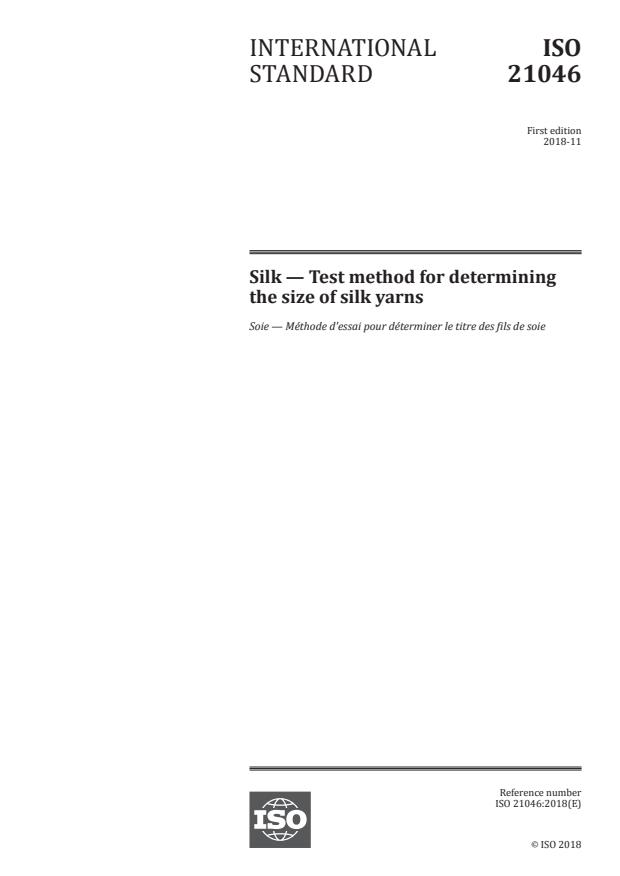
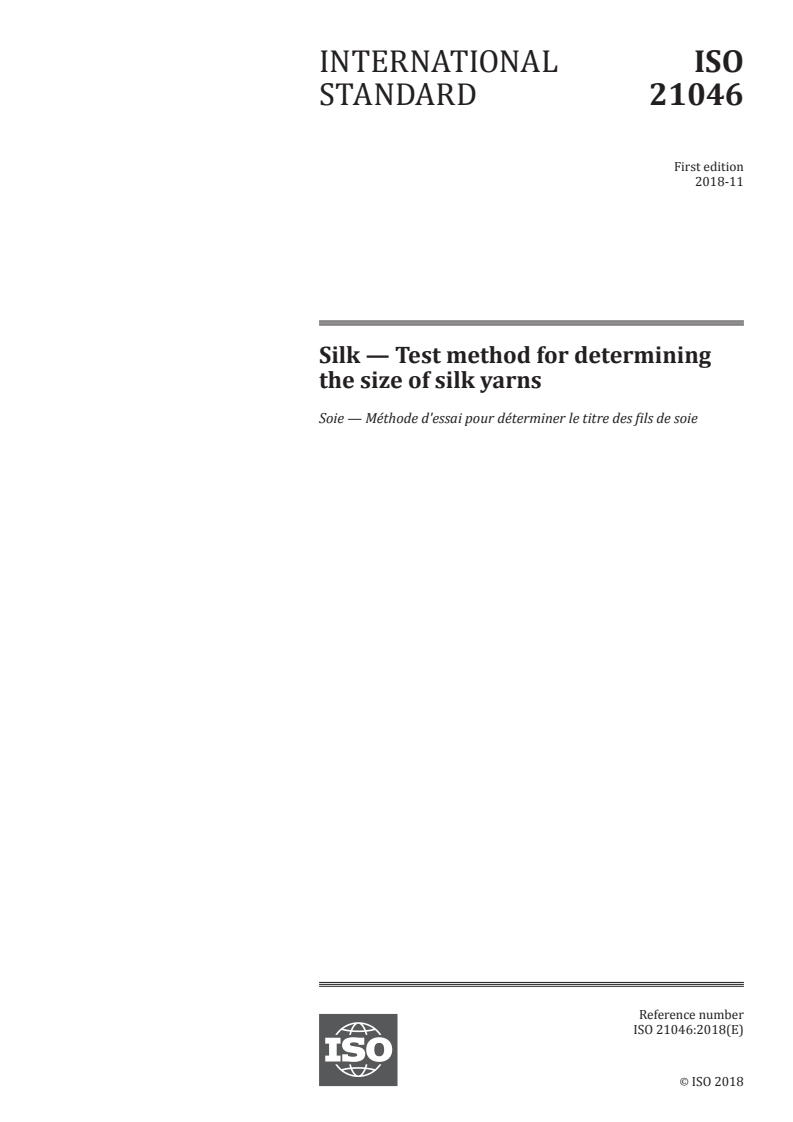
INTERNATIONAL ISO
STANDARD 21046
First edition
2018-11
Silk — Test method for determining
the size of silk yarns
Soie — Méthode d'essai pour déterminer le titre des fils de soie
Reference number
©
ISO 2018
© ISO 2018
All rights reserved. Unless otherwise specified, or required in the context of its implementation, no part of this publication may
be reproduced or utilized otherwise in any form or by any means, electronic or mechanical, including photocopying, or posting
on the internet or an intranet, without prior written permission. Permission can be requested from either ISO at the address
below or ISO’s member body in the country of the requester.
ISO copyright office
CP 401 • Ch. de Blandonnet 8
CH-1214 Vernier, Geneva
Phone: +41 22 749 01 11
Fax: +41 22 749 09 47
Email: copyright@iso.org
Website: www.iso.org
Published in Switzerland
ii © ISO 2018 – All rights reserved
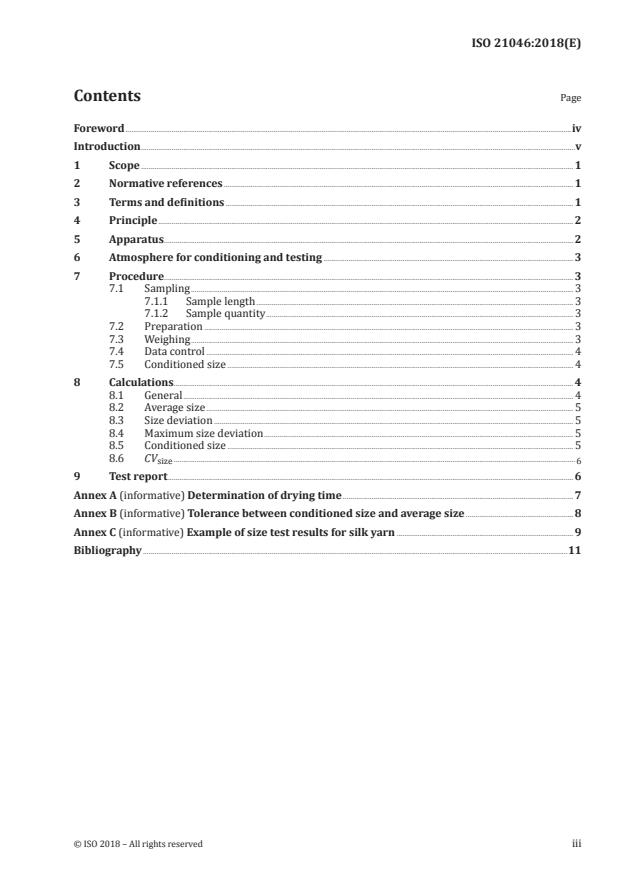
Contents Page
Foreword .iv
Introduction .v
1 Scope . 1
2 Normative references . 1
3 Terms and definitions . 1
4 Principle . 2
5 Apparatus . 2
6 Atmosphere for conditioning and testing . 3
7 Procedure. 3
7.1 Sampling . 3
7.1.1 Sample length . 3
7.1.2 Sample quantity . 3
7.2 Preparation . 3
7.3 Weighing . 3
7.4 Data control . 4
7.5 Conditioned size . 4
8 Calculations. 4
8.1 General . 4
8.2 Average size . 5
8.3 Size deviation . 5
8.4 Maximum size deviation . 5
8.5 Conditioned size . 5
8.6 CV .
size 6
9 Test report . 6
Annex A (informative) Determination of drying time . 7
Annex B (informative) Tolerance between conditioned size and average size .8
Annex C (informative) Example of size test results for silk yarn . 9
Bibliography .11
Foreword
ISO (the International Organization for Standardization) is a worldwide federation of national standards
bodies (ISO member bodies). The work of preparing International Standards is normally carried out
through ISO technical committees. Each member body interested in a subject for which a technical
committee has been established has the right to be represented on that committee. International
organizations, governmental and non-governmental, in liaison with ISO, also take part in the work.
ISO collaborates closely with the International Electrotechnical Commission (IEC) on all matters of
electrotechnical standardization.
The procedures used to develop this document and those intended for its further maintenance are
described in the ISO/IEC Directives, Part 1. In particular the different approval criteria needed for the
different types of ISO documents should be noted. This document was drafted in accordance with the
editorial rules of the ISO/IEC Directives, Part 2 (see www .iso .org/directives).
Attention is drawn to the possibility that some of the elements of this document may be the subject of
patent rights. ISO shall not be held responsible for identifying any or all such patent rights. Details of
any patent rights identified during the development of the document will be in the Introduction and/or
on the ISO list of patent declarations received (see www .iso .org/patents).
Any trade name used in this document is information given for the convenience of users and does not
constitute an endorsement.
For an explanation on the voluntary nature of standards, the meaning of ISO specific terms and
expressions related to conformity assessment, as well as information about ISO's adherence to the
World Trade Organization (WTO) principles in the Technical Barriers to Trade (TBT) see the following
URL: www .iso .org/iso/foreword .html.
This document was prepared by Technical Committee ISO/TC 38, Textiles, Subcommittee SC 23, Fibres
and yarns.
Any feedback or questions on this document should be directed to the user’s national standards body. A
complete listing of these bodies can be found at www .iso .org/members .html.
iv © ISO 2018 – All rights reserved
Introduction
Silk yarns are made of natural silk fibres, including raw silk, tussah silk, dupion silk, thrown silk, etc.
Due to the intrinsic unevenness of the property of silk fibres and its manufacturing technique differing
from yarns made of staple fibres, the size (linear density) deviation of the silk yarns, such as raw silk
reeled from cocoon baves, is much bigger than that of the conventional yarns covered by ISO 2060.
Therefore, when measuring the size of silk yarns, the sample quantity, sample length, test device,
drying temperature, test items, calculation method of the results and tolerance for weighing errors are
all different from that for the conventional yarns. These special requirements are not prescribed in
ISO 2060. This document covers special size test regulations for silk yarns which are not covered by
ISO 2060.
INTERNATIONAL STANDARD ISO 21046:2018(E)
Silk — Test method for determining the size of silk yarns
1 Scope
This document specifies the test method for determining the size of silk yarns in all types of
package forms.
It is applicable to various kinds of silk yarns.
It is not applicable to spun silk yarns.
2 Normative references
The following documents are referred to in the text in such a way that some or all of their content
constitutes requirements of this document. For dated references, only the edition cited applies. For
undated references, the latest edition of the referenced document (including any amendments) applies.
ISO 139, Textiles — Standard atmospheres for conditioning and testing
ISO 6741-1:1989, Textiles — Fibres and yarns — Determination of commercial mass of consignments —
Part 1: Mass determination and calculations
3 Terms and definitions
For the purposes of this document, the following terms and definitions apply.
ISO and IEC maintain terminological databases for use in standardization at the following addresses:
— ISO Online browsing platform: available at https: //www .iso .org/obp
— IEC Electropedia: available at http: //www .electropedia .org/
3.1
silk yarn
yarn made of nature silk fibres, including raw silk, tussah silk, dupion silk, thrown silk
3.2
thrown silk
silk that has been twisted or doubled and twisted
3.3
size
linear density (mass per unit length) of silk yarns
Note 1 to entry: Size expresses the degree of coarseness or fineness of silk yarns.
Note 2 to entry: Size is expressed in dtex. It may also be expressed in deniers (den), for which the conversion from
[1]
dtex, as given in ISO 1144 , is 1 den = 0,9 dtex.
3.4
nominal size
size indicated by the manufacturer
3.5
average size
average value of the tested size of the sizing skeins
3.6
conditioned size
size calculated by adding the commercial moisture regain weight to the oven-dry weight
Note 1 to entry: For silk, the commercial moisture regain is 11,0 %, which was developed in 1841, and then was
widely used by Japan, China, India, etc. See Reference [4].
3.7
size deviation
standard deviation of the value of the tested size of the silk samples indicating the deviation degree of
the sizing skeins from the average size of the whole lot
3.8
maximum size deviation
indication of the deviation degree of the finest sizing skeins or the coarsest sizing skeins from the
average size of the whole lot
3.9
coefficient of variation of size
CV
size
percentage ratio between the size deviation and the average size
4 Principle
Under standard atmosphere, the sizing skeins are prepared by winding prescribed revolutions of silk
yarn on a reel with a
...
INTERNATIONAL ISO
STANDARD 21046
First edition
2018-11
Silk — Test method for determining
the size of silk yarns
Soie — Méthode d'essai pour déterminer le titre des fils de soie
Reference number
©
ISO 2018
© ISO 2018
All rights reserved. Unless otherwise specified, or required in the context of its implementation, no part of this publication may
be reproduced or utilized otherwise in any form or by any means, electronic or mechanical, including photocopying, or posting
on the internet or an intranet, without prior written permission. Permission can be requested from either ISO at the address
below or ISO’s member body in the country of the requester.
ISO copyright office
CP 401 • Ch. de Blandonnet 8
CH-1214 Vernier, Geneva
Phone: +41 22 749 01 11
Fax: +41 22 749 09 47
Email: copyright@iso.org
Website: www.iso.org
Published in Switzerland
ii © ISO 2018 – All rights reserved
Contents Page
Foreword .iv
Introduction .v
1 Scope . 1
2 Normative references . 1
3 Terms and definitions . 1
4 Principle . 2
5 Apparatus . 2
6 Atmosphere for conditioning and testing . 3
7 Procedure. 3
7.1 Sampling . 3
7.1.1 Sample length . 3
7.1.2 Sample quantity . 3
7.2 Preparation . 3
7.3 Weighing . 3
7.4 Data control . 4
7.5 Conditioned size . 4
8 Calculations. 4
8.1 General . 4
8.2 Average size . 5
8.3 Size deviation . 5
8.4 Maximum size deviation . 5
8.5 Conditioned size . 5
8.6 CV .
size 6
9 Test report . 6
Annex A (informative) Determination of drying time . 7
Annex B (informative) Tolerance between conditioned size and average size .8
Annex C (informative) Example of size test results for silk yarn . 9
Bibliography .11
Foreword
ISO (the International Organization for Standardization) is a worldwide federation of national standards
bodies (ISO member bodies). The work of preparing International Standards is normally carried out
through ISO technical committees. Each member body interested in a subject for which a technical
committee has been established has the right to be represented on that committee. International
organizations, governmental and non-governmental, in liaison with ISO, also take part in the work.
ISO collaborates closely with the International Electrotechnical Commission (IEC) on all matters of
electrotechnical standardization.
The procedures used to develop this document and those intended for its further maintenance are
described in the ISO/IEC Directives, Part 1. In particular the different approval criteria needed for the
different types of ISO documents should be noted. This document was drafted in accordance with the
editorial rules of the ISO/IEC Directives, Part 2 (see www .iso .org/directives).
Attention is drawn to the possibility that some of the elements of this document may be the subject of
patent rights. ISO shall not be held responsible for identifying any or all such patent rights. Details of
any patent rights identified during the development of the document will be in the Introduction and/or
on the ISO list of patent declarations received (see www .iso .org/patents).
Any trade name used in this document is information given for the convenience of users and does not
constitute an endorsement.
For an explanation on the voluntary nature of standards, the meaning of ISO specific terms and
expressions related to conformity assessment, as well as information about ISO's adherence to the
World Trade Organization (WTO) principles in the Technical Barriers to Trade (TBT) see the following
URL: www .iso .org/iso/foreword .html.
This document was prepared by Technical Committee ISO/TC 38, Textiles, Subcommittee SC 23, Fibres
and yarns.
Any feedback or questions on this document should be directed to the user’s national standards body. A
complete listing of these bodies can be found at www .iso .org/members .html.
iv © ISO 2018 – All rights reserved
Introduction
Silk yarns are made of natural silk fibres, including raw silk, tussah silk, dupion silk, thrown silk, etc.
Due to the intrinsic unevenness of the property of silk fibres and its manufacturing technique differing
from yarns made of staple fibres, the size (linear density) deviation of the silk yarns, such as raw silk
reeled from cocoon baves, is much bigger than that of the conventional yarns covered by ISO 2060.
Therefore, when measuring the size of silk yarns, the sample quantity, sample length, test device,
drying temperature, test items, calculation method of the results and tolerance for weighing errors are
all different from that for the conventional yarns. These special requirements are not prescribed in
ISO 2060. This document covers special size test regulations for silk yarns which are not covered by
ISO 2060.
INTERNATIONAL STANDARD ISO 21046:2018(E)
Silk — Test method for determining the size of silk yarns
1 Scope
This document specifies the test method for determining the size of silk yarns in all types of
package forms.
It is applicable to various kinds of silk yarns.
It is not applicable to spun silk yarns.
2 Normative references
The following documents are referred to in the text in such a way that some or all of their content
constitutes requirements of this document. For dated references, only the edition cited applies. For
undated references, the latest edition of the referenced document (including any amendments) applies.
ISO 139, Textiles — Standard atmospheres for conditioning and testing
ISO 6741-1:1989, Textiles — Fibres and yarns — Determination of commercial mass of consignments —
Part 1: Mass determination and calculations
3 Terms and definitions
For the purposes of this document, the following terms and definitions apply.
ISO and IEC maintain terminological databases for use in standardization at the following addresses:
— ISO Online browsing platform: available at https: //www .iso .org/obp
— IEC Electropedia: available at http: //www .electropedia .org/
3.1
silk yarn
yarn made of nature silk fibres, including raw silk, tussah silk, dupion silk, thrown silk
3.2
thrown silk
silk that has been twisted or doubled and twisted
3.3
size
linear density (mass per unit length) of silk yarns
Note 1 to entry: Size expresses the degree of coarseness or fineness of silk yarns.
Note 2 to entry: Size is expressed in dtex. It may also be expressed in deniers (den), for which the conversion from
[1]
dtex, as given in ISO 1144 , is 1 den = 0,9 dtex.
3.4
nominal size
size indicated by the manufacturer
3.5
average size
average value of the tested size of the sizing skeins
3.6
conditioned size
size calculated by adding the commercial moisture regain weight to the oven-dry weight
Note 1 to entry: For silk, the commercial moisture regain is 11,0 %, which was developed in 1841, and then was
widely used by Japan, China, India, etc. See Reference [4].
3.7
size deviation
standard deviation of the value of the tested size of the silk samples indicating the deviation degree of
the sizing skeins from the average size of the whole lot
3.8
maximum size deviation
indication of the deviation degree of the finest sizing skeins or the coarsest sizing skeins from the
average size of the whole lot
3.9
coefficient of variation of size
CV
size
percentage ratio between the size deviation and the average size
4 Principle
Under standard atmosphere, the sizing skeins are prepared by winding prescribed revolutions of silk
yarn on a reel with a
...