

ISO 1139:2025
(Main)Textiles — Designation of yarns
General Information
- Abstract
This document specifies two methods of indicating the composition of yarns, whether single, folded, cabled or multiple wound. The notation comprises linear density indicated in the Tex system, number of filaments in filament yarns, direction and amount of twist, and number of folds. This document is not applicable to some special kinds of yarns, for example to fancy yarns, textured or bulked yarns or yarns produced by wrapping a textile or non-textile material round a core. It is not applicable to yarns with other features such as constituent fibres, after treatment and type of package.
- Status
- Published
- Publication Date
- 25-Nov-2025
- Technical Committee
- ISO/TC 38/SC 23 - Fibres and yarns
- Drafting Committee
- ISO/TC 38/SC 23 - Fibres and yarns
- Current Stage
- 6060 - International Standard published
- Start Date
- 26-Nov-2025
- Due Date
- 18-Mar-2026
- Completion Date
- 26-Nov-2025
Buy Documents
ISO 1139:2025 - Textiles — Designation of yarns Released:11/26/2025
ISO 1139:2025 - Textiles — Désignation des fils Released:16. 12. 2025
REDLINE ISO 1139:2025 - Textiles — Désignation des fils Released:16. 12. 2025
ISO 1139:2025 - Textiles — Designation of yarns
Overview
ISO 1139:2025 - Textiles - Designation of yarns defines standardized, concise notations for describing yarn construction using the Tex system. The second edition (2025) specifies two complementary notation methods for single, folded, cabled and multiple wound yarns: the single-to-fold method (starting from single-yarn linear density) and the fold-to-single method (starting from the resultant linear density). The notation covers linear density (tex), number of filaments, direction and amount of twist, and number of folds. It excludes certain special yarns (for example, fancy, textured/bulked, wrapped-core yarns) and does not specify constituent fibres, after-treatment or package type.
Key topics and technical requirements
- Linear density in the Tex system: All linear densities are expressed in tex (and submultiples where applicable) as nominal or actual values.
- Yarn construction elements: Notation must capture number of filaments, twist direction (Z or S), twist amount (turns per metre or explicit unit), and number of folds/cables.
- Two notation methods:
- Single-to-fold notation: Starts from single yarn parameters; uses the multiplication sign (×) to indicate folding/plying.
- Fold-to-single notation: Starts from resultant linear density of the final yarn; uses the solidus (/) in the notation.
- Nominal vs actual values: Nominal values are used for general description and commercial transactions (subject to tolerances); actual values come from authorized test procedures.
- Resultant linear density: The standard recognizes that folding, cabling and twist can change resultant linear density and that manufacturing conditions (tension, machine type, moisture) influence final values.
- Symbols and terminology: Uses standardized terms (single yarn, folded yarn, cabled yarn, multiple wound yarn) and symbols consistent with ISO conventions.
Applications
- Standardized yarn specification and labeling for procurement and trade.
- Technical communication between spinners, textile mills, converters, and testers.
- Basis for manufacturing calculations (machine settings, material planning) using nominal tex values.
- Input to quality control, testing reports and product datasheets when reporting actual measured values.
- Useful for industries producing woven/knitted fabrics, ropes, fishing nets and technical textiles where precise yarn description is required.
Who should use ISO 1139:2025
- Yarn and textile manufacturers
- Quality assurance and laboratory testing teams
- Product designers and textile engineers
- Procurement and specification writers in textile supply chains
- Standards committees and educators in textile technology
Related standards
- ISO 1144 (linear density nomenclature / tex/dtex)
- ISO 2061 (twist measurement terminology)
- ISO 858 (yarns for fishing nets-uses single-to-fold notation)
- ISO 2947 (lists of nominal linear densities and industry practice)
ISO 1139:2025 provides a clear, consistent framework for yarn designation, improving interoperability across textile production, testing and trade while aligning with established ISO terminology and measurement practices.
Relations
- Effective Date
- 23-Mar-2024
Buy Documents
ISO 1139:2025 - Textiles — Designation of yarns Released:11/26/2025
ISO 1139:2025 - Textiles — Désignation des fils Released:16. 12. 2025
REDLINE ISO 1139:2025 - Textiles — Désignation des fils Released:16. 12. 2025
ISO 1139:2025 - Textiles — Designation of yarns
Get Certified
Connect with accredited certification bodies for this standard

Control Union Certifications
Global certification for agriculture and sustainability.

Hohenstein Institut
Textile testing and certification.

Bureau Veritas Bangladesh
Bureau Veritas certification services in Bangladesh.
Sponsored listings
Frequently Asked Questions
ISO 1139:2025 is a standard published by the International Organization for Standardization (ISO). Its full title is "Textiles — Designation of yarns". This standard covers: This document specifies two methods of indicating the composition of yarns, whether single, folded, cabled or multiple wound. The notation comprises linear density indicated in the Tex system, number of filaments in filament yarns, direction and amount of twist, and number of folds. This document is not applicable to some special kinds of yarns, for example to fancy yarns, textured or bulked yarns or yarns produced by wrapping a textile or non-textile material round a core. It is not applicable to yarns with other features such as constituent fibres, after treatment and type of package.
This document specifies two methods of indicating the composition of yarns, whether single, folded, cabled or multiple wound. The notation comprises linear density indicated in the Tex system, number of filaments in filament yarns, direction and amount of twist, and number of folds. This document is not applicable to some special kinds of yarns, for example to fancy yarns, textured or bulked yarns or yarns produced by wrapping a textile or non-textile material round a core. It is not applicable to yarns with other features such as constituent fibres, after treatment and type of package.
ISO 1139:2025 is classified under the following ICS (International Classification for Standards) categories: 59.080.20 - Yarns. The ICS classification helps identify the subject area and facilitates finding related standards.
ISO 1139:2025 has the following relationships with other standards: It is inter standard links to ISO 1139:1973. Understanding these relationships helps ensure you are using the most current and applicable version of the standard.
ISO 1139:2025 is available in PDF format for immediate download after purchase. The document can be added to your cart and obtained through the secure checkout process. Digital delivery ensures instant access to the complete standard document.
Standards Content (Sample)
International
Standard
ISO 1139
Second edition
Textiles — Designation of yarns
2025-11
Textiles — Désignation des fils
Reference number
© ISO 2025
All rights reserved. Unless otherwise specified, or required in the context of its implementation, no part of this publication may
be reproduced or utilized otherwise in any form or by any means, electronic or mechanical, including photocopying, or posting on
the internet or an intranet, without prior written permission. Permission can be requested from either ISO at the address below
or ISO’s member body in the country of the requester.
ISO copyright office
CP 401 • Ch. de Blandonnet 8
CH-1214 Vernier, Geneva
Phone: +41 22 749 01 11
Email: copyright@iso.org
Website: www.iso.org
Published in Switzerland
ii
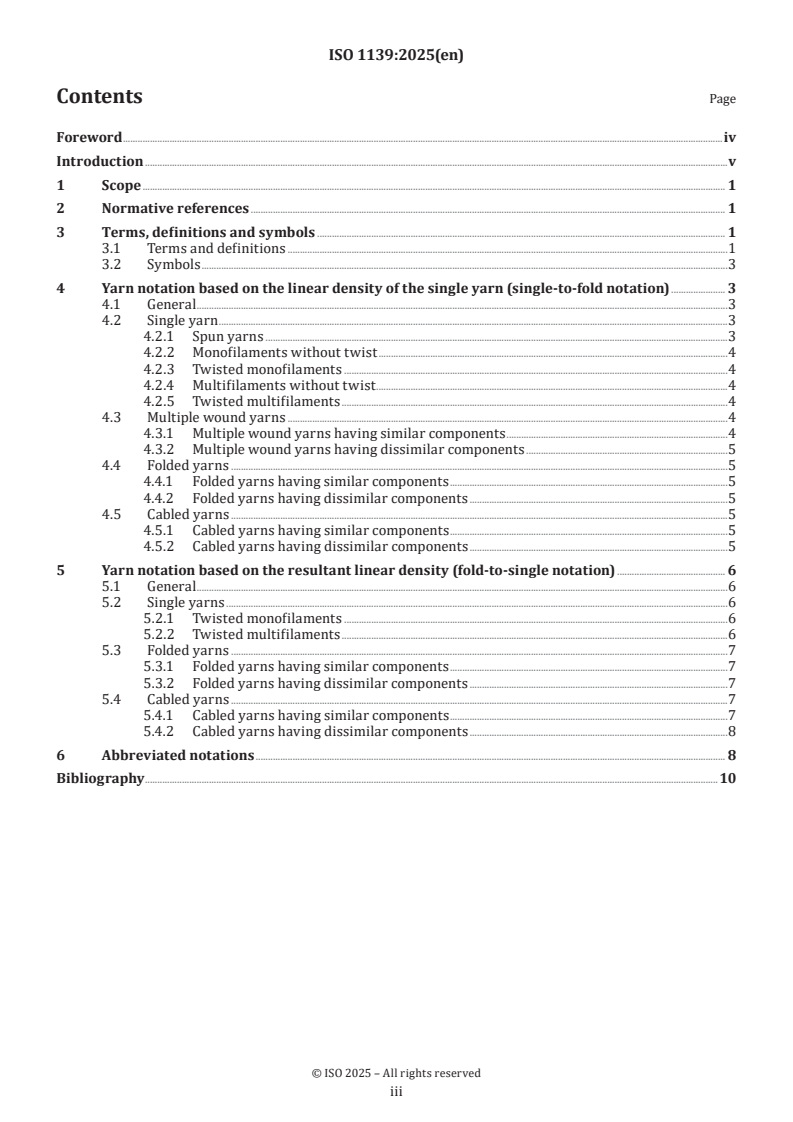
Contents Page
Foreword .iv
Introduction .v
1 Scope . 1
2 Normative references . 1
3 Terms, definitions and symbols . 1
3.1 Terms and definitions .1
3.2 Symbols .3
4 Yarn notation based on the linear density of the single yarn (single-to-fold notation) . 3
4.1 General .3
4.2 Single yarn .3
4.2.1 Spun yarns .3
4.2.2 Monofilaments without twist .4
4.2.3 Twisted monofilaments .4
4.2.4 Multifilaments without twist .4
4.2.5 Twisted multifilaments .4
4.3 Multiple wound yarns .4
4.3.1 Multiple wound yarns having similar components .4
4.3.2 Multiple wound yarns having dissimilar components .5
4.4 Folded yarns .5
4.4.1 Folded yarns having similar components .5
4.4.2 Folded yarns having dissimilar components .5
4.5 Cabled yarns .5
4.5.1 Cabled yarns having similar components .5
4.5.2 Cabled yarns having dissimilar components .5
5 Yarn notation based on the resultant linear density (fold-to-single notation) . 6
5.1 General .6
5.2 Single yarns .6
5.2.1 Twisted monofilaments .6
5.2.2 Twisted multifilaments .6
5.3 Folded yarns .7
5.3.1 Folded yarns having similar components .7
5.3.2 Folded yarns having dissimilar components .7
5.4 Cabled yarns .7
5.4.1 Cabled yarns having similar components .7
5.4.2 Cabled yarns having dissimilar components .8
6 Abbreviated notations . 8
Bibliography .10
iii
Foreword
ISO (the International Organization for Standardization) is a worldwide federation of national standards
bodies (ISO member bodies). The work of preparing International Standards is normally carried out through
ISO technical committees. Each member body interested in a subject for which a technical committee
has been established has the right to be represented on that committee. International organizations,
governmental and non-governmental, in liaison with ISO, also take part in the work. ISO collaborates closely
with the International Electrotechnical Commission (IEC) on all matters of electrotechnical standardization.
The procedures used to develop this document and those intended for its further maintenance are described
in the ISO/IEC Directives, Part 1. In particular, the different approval criteria needed for the different types
of ISO documents should be noted. This document was drafted in accordance with the editorial rules of the
ISO/IEC Directives, Part 2 (see www.iso.org/directives).
ISO draws attention to the possibility that the implementation of this document may involve the use of (a)
patent(s). ISO takes no position concerning the evidence, validity or applicability of any claimed patent
rights in respect thereof. As of the date of publication of this document, ISO had not received notice of (a)
patent(s) which may be required to implement this document. However, implementers are cautioned that
this may not represent the latest information, which may be obtained from the patent database available at
www.iso.org/patents. ISO shall not be held responsible for identifying any or all such patent rights.
Any trade name used in this document is information given for the convenience of users and does not
constitute an endorsement.
For an explanation of the voluntary nature of standards, the meaning of ISO specific terms and expressions
related to conformity assessment, as well as information about ISO's adherence to the World Trade
Organization (WTO) principles in the Technical Barriers to Trade (TBT), see www.iso.org/iso/foreword.html.
This document was prepared by Technical Committee ISO/TC 38, Textiles, Subcommittee SC 23, Fibres and yarn.
This second edition cancels and replaces the first edition (ISO 1139:1973), which has been technically
revised.
The main changes are as follows:
— the content structure has been updated to comply with the ISO/IEC Directives, Part 2;
— Clauses 2 and 3 have been updated.
Any feedback or questions on this document should be directed to the user’s national standards body. A
complete listing of these bodies can be found at www.iso.org/members.html.
iv
Introduction
The general introduction of the Tex system for expressing the linear density of yarns requires standardization
of the notation for yarn construction. In designating yarns, it has been customary - and it remains desirable
- to reflect in a condensed form details of the components of a yarn including values of the linear densities,
directions and amounts of twist, number of folds, etc. of these components and/or characteristics of the
yarn resulting from this construction, such as its linear density indicated as resultant linear density.
The resultant linear density of folded and/or cabled yarns - in some cases with strong twisted filament yarns
- generally differs from the sum of the linear densities of the components. Even when starting from the same
component yarns, using the same direction and amount of twist, number of folds, etc., yarns with different
resultant linear densities can be produced due to differences in conditions during manufacturing of yarns,
such as yarn tensions, types of machine used, moisture content of the yarns, atmospheric conditions, etc.
A yarn notation serves two purposes:
— it is used as a general indication of a yarn; in this case the values for linear densities, amounts of twist,
etc. used in the yarn notation will be referred to as nominal values;
— it may be used for reporting the result of an analysis of a yarn; in this case the values derived from an
authorised testing procedure for linear densities and amounts of twist used in the yarn notation will be
referred to as actual values.
Attention is drawn to the fact that the application of the notation of yarns in the Tex system does not affect
existing commercial practices in the trade.
Values of linear density and amount of twist used in commercial transactions are nominal unless explicitly
stated as being actual.
Nominal linear densities and amounts of twist are subject to tolerances, the numerical values of which are
usually agreed in the various branches of the textile industry or directly between seller and buyer.
In this document, two methods for the notation of yarns are specified, namely:
a) yarn notation starting from the linear density of the single yarn: it may be referred to as single-to-fold
notation;
b) yarn notation starting from the linear density of the resultant yarn: it may be referred to as fold-to-
single notation.
The symbols used in both systems are identical. The differences are in the order of presentation, the use of
the multiplication sign (×) in the single-to-fold notation, and of the solidus (/) in the fold-to-single notation.
Distinction between these two methods does not apply to single spun yarns, monofilaments and
multifilaments without twist, nor to multiple wound yarns. The notation of these yarns is given under the
heading of the first method (see 4.2 and 4.3).
It is hoped that, ultimately, one method can be used to the exclusion of the other. In fact, ISO 858, dealing
with yarns for fishing nets, employs only the single-to-fold method, although giving, in the abbreviations,
only those items of information that are appropriate.
v
International Standard ISO 1139:2025(en)
Textiles — Designation of yarns
1 Scope
This document specifies two methods of indicating the composition of yarns, whether single,
...
Norme
internationale
ISO 1139
Deuxième édition
Textiles — Désignation des fils
2025-11
Textiles — Designation of yarns
Numéro de référence
DOCUMENT PROTÉGÉ PAR COPYRIGHT
© ISO 2025
Tous droits réservés. Sauf prescription différente ou nécessité dans le contexte de sa mise en œuvre, aucune partie de cette
publication ne peut être reproduite ni utilisée sous quelque forme que ce soit et par aucun procédé, électronique ou mécanique,
y compris la photocopie, ou la diffusion sur l’internet ou sur un intranet, sans autorisation écrite préalable. Une autorisation peut
être demandée à l’ISO à l’adresse ci-après ou au comité membre de l’ISO dans le pays du demandeur.
ISO copyright office
Case postale 401 • Ch. de Blandonnet 8
CH-1214 Vernier, Genève
Tél.: +41 22 749 01 11
E-mail: copyright@iso.org
Web: www.iso.org
Publié en Suisse
ii
Sommaire Page
Avant-propos .iv
Introduction .v
1 Domaine d’application . 1
2 Références normatives . 1
3 Termes, définitions et symboles . 1
3.1 Termes et définitions .1
3.2 Symboles .3
4 Désignation du fil fondée sur la masse linéique du fil simple (désignation du fil simple
au retors) . 3
4.1 Généralités .3
4.2 Fils simples.3
4.2.1 Filés .3
4.2.2 Monofilaments sans torsion .4
4.2.3 Monofilaments avec torsion .4
4.2.4 Multifilaments sans torsion .4
4.2.5 Multifilaments avec torsion .4
4.3 Fils assemblés .4
4.3.1 Fils assemblés composés de fils identiques .4
4.3.2 Fils assemblés composés de fils différents .5
4.4 Retors .5
4.4.1 Retors composés de fils identiques .5
4.4.2 Retors composés de fils différents .5
4.5 Câblés .5
4.5.1 Câblés composés de fils identiques .5
4.5.2 Câblés composés de fils différents.5
5 Désignation du fil fondée sur la masse linéique résultante (désignation du retors au fil
simple) . 6
5.1 Généralités .6
5.2 Fils simples.6
5.2.1 Monofilaments avec torsion .6
5.2.2 Multifilaments avec torsion .6
5.3 Retors .7
5.3.1 Retors composés de fils identiques .7
5.3.2 Retors composés de fils différents .7
5.4 Câblés .7
5.4.1 Câblés composés de fils identiques .7
5.4.2 Câblés composés de fils différents.7
6 Désignations abrégées . 8
Bibliographie . 10
iii
Avant-propos
L'ISO (Organisation internationale de normalisation) est une fédération mondiale d'organismes nationaux
de normalisation (comités membres de l'ISO). L'élaboration des Normes internationales est en général
confiée aux comités techniques de l'ISO. Chaque comité membre intéressé par une étude a le droit de faire
partie du comité technique créé à cet effet. Les organisations internationales, gouvernementales et non
gouvernementales, en liaison avec l'ISO participent également aux travaux. L'ISO collabore étroitement avec
la Commission électrotechnique internationale (IEC) en ce qui concerne la normalisation électrotechnique.
Les procédures utilisées pour élaborer le présent document et celles destinées à sa mise à jour sont
décrites dans les Directives ISO/IEC, Partie 1. Il convient, en particulier, de prendre note des différents
critères d'approbation requis pour les différents types de documents ISO. Le présent document a
été rédigé conformément aux règles de rédaction données dans les Directives ISO/IEC, Partie 2 (voir
www.iso.org/directives).
L’ISO attire l’attention sur le fait que la mise en application du présent document peut entraîner l’utilisation
d’un ou de plusieurs brevets. L’ISO ne prend pas position quant à la preuve, à la validité et à l’applicabilité de
tout droit de brevet revendiqué à cet égard. À la date de publication du présent document, l’ISO n'avait pas
reçu notification qu’un ou plusieurs brevets pouvaient être nécessaires à sa mise en application. Toutefois,
il y a lieu d’avertir les responsables de la mise en application du présent document que des informations
plus récentes sont susceptibles de figurer dans la base de données de brevets, disponible à l'adresse
www.iso.org/brevets. L’ISO ne saurait être tenue pour responsable de ne pas avoir identifié tout ou partie de
tels droits de propriété.
Les appellations commerciales éventuellement mentionnées dans le présent document sont données pour
information, par souci de commodité, à l’intention des utilisateurs et ne sauraient constituer un engagement.
Pour une explication de la nature volontaire des normes, la signification des termes et expressions
spécifiques de l'ISO liés à l'évaluation de la conformité, ou pour toute information au sujet de l'adhésion de
l'ISO aux principes de l’Organisation mondiale du commerce (OMC) concernant les obstacles techniques au
commerce (OTC), voir www.iso.org/avant-propos.
Le présent document a été élaboré par le comité technique ISO/TC 38, Textiles, Sous-comité SC 23, Fibres et
fils.
Cette deuxième édition annule et remplace la première édition (ISO 1139:1973), qui a fait l’objet d’une
révision technique.
Les principales modifications sont les suivantes:
— la structure du contenu a été mise à jour pour se conformer aux Directives ISO/IEC, Partie 2;
— les Articles 2 et 3 ont été mis à jour.
Il convient que l’utilisateur adresse tout retour d’information ou toute question concernant le présent
document à l’organisme national de normalisation de son pays. Une liste exhaustive desdits organismes se
trouve à l’adresse www.iso.org/fr/members.html.
iv
Introduction
La mise en application générale du système Tex pour exprimer la masse linéique des fils, exige la
normalisation d’un mode de désignation de la construction du fil. Dans la désignation des fils, il était d’usage
(et il reste souhaitable) de représenter, par une formule condensée, les détails de la composition du fil,
notamment les valeurs des masses linéiques, les torsions et les sens de torsion, le nombre de bouts, etc. de
ses composants et les propriétés caractéristiques du fil résultant de cette construction, telle que sa masse
linéique indiquée comme masse linéique résultante.
La masse linéique résultante des fils retors et des câblés (constitués parfois de fils continus multifilaments
ayant une forte torsion) diffère, en général, de la somme des masses linéiques des composants. Même en
partant des mêmes fils composants, en se servant des mêmes valeurs et sens de torsion, avec le même
nombre de bouts, etc., on peut aboutir à des fils de différentes masses linéiques résultantes, ce qui est dû
à des différences dans les conditions de fabrication des fils, telles que tensions des fils, types de machines
utilisées, teneur en humidité des fils, conditions atmosphériques, etc.
Une désignation des fils sert à deux fins:
— elle est utilisée pour la description générale d’un fil; dans ce cas, les valeurs de masse linéique, de torsion,
etc. utilisées dans la désignation du fil, seront dites valeurs nominales;
— elle peut être utilisée pour rendre compte du résultat de l’analyse du fil; dans ce cas, les valeurs provenant
d’une méthode d’essai admise pour déterminer les masses linéiques et les valeurs de la torsion, utilisées
dans la désignation du fil, seront dites valeurs réelles.
L’attention est attirée sur le fait que l’application de la désignation des fils dans le système Tex n’affecte en
aucune manière les pratiques commerciales existant dans l’industrie.
Les valeurs des masses linéiques et des torsions utilisées dans les transactions commerciales sont nominales,
sauf s’il est mentionné de façon explicite qu’elles sont réelles.
Les masses linéiques nominales et les valeurs des torsions sont assorties de tolérances dont les valeurs
numériques sont acceptées en pratique dans les différentes branches de l’industrie textile ou bien sont
convenues directement entre le vendeur et l’acheteur.
Dans le présent document, deux méthodes pour la désignation des fils sont spécifiées, à savoir:
a) désignation du fil en commençant par la masse linéique du fil simple: elle peut être appelée désignation
du fil simple au retors;
b) désignation du fil en commençant par la masse linéique du fil résultant: elle peut être appelée désignation
du retors au fil simple
Les symboles utilisés dans les deux systèmes sont identiques. Les différences résident dans l’ordre de la
présentation et dans l’emploi du signe de multiplication ( × ) dans la désignation du fil simple au retors et de
la barre oblique (/) dans la désignation du retors au fil simple.
La distinction entre ces deux méthodes n’est applicable ni aux fils simples filés, aux monofilaments et aux
multifilaments sans torsion, ni aux fils assemblés. Le mode de désignation de ces fils est indiqué dans le
chapitre consacré à la première méthode (voir 4.2 et 4.3).
Il est souhaitable que, finalement, une seule méthode soit utilisée à l’exclusion de l’autre. En fait, I’ISO 858,
relative aux fils pour filets de pêche, utilise seulement la m
...
ISO/TC 38/SC 23 1139:2025(fr)
Deuxième édition
Date : 2025-11
ISO 1139:Date: 2025(fr)-12-01
Textiles — Désignation des fils
Textiles — Designation of yarns
ICS: 59.080.20
Tous droits réservés. Sauf prescription différente ou nécessité dans le contexte de sa mise en œuvreoeuvre, aucune partie
de cette publication ne peut être reproduite ni utilisée sous quelque forme que ce soit et par aucun procédé, électronique
ou mécanique, y compris la photocopie, ou la diffusion sur l’internet ou sur un intranet, sans autorisation écrite préalable.
Une autorisation peut être demandée à l’ISO à l’adresse ci-après ou au comité membre de l’ISO dans le pays du
demandeur.
ISO copyright office
Case postaleCP 401 • Ch. de Blandonnet 8
CH-1214 Vernier, Geneva
Tél. : +Phone: + 41 22 749 01 11
Email E-mail: copyright@iso.org
Web : www.iso.org
Website: www.iso.org
Publié en Suisse
ii
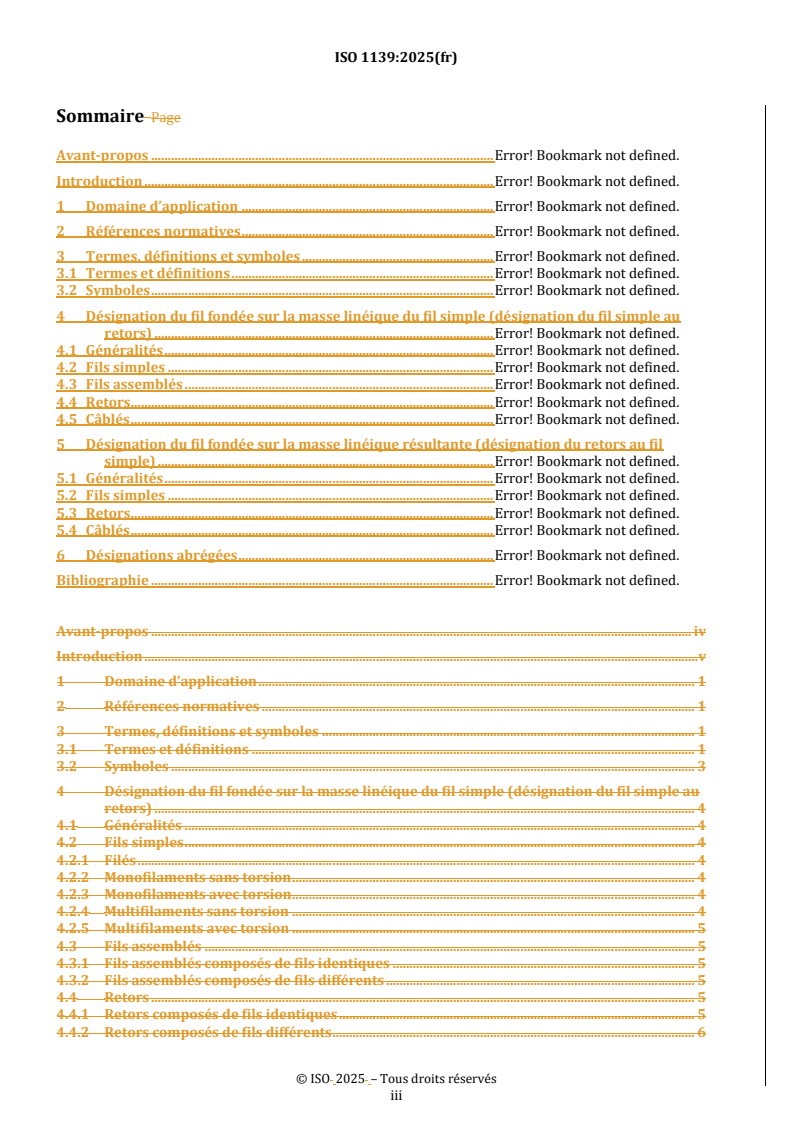
Sommaire Page
Avant-propos . Error! Bookmark not defined.
Introduction . Error! Bookmark not defined.
1 Domaine d’application . Error! Bookmark not defined.
2 Références normatives . Error! Bookmark not defined.
3 Termes, définitions et symboles . Error! Bookmark not defined.
3.1 Termes et définitions . Error! Bookmark not defined.
3.2 Symboles . Error! Bookmark not defined.
4 Désignation du fil fondée sur la masse linéique du fil simple (désignation du fil simple au
retors) . Error! Bookmark not defined.
4.1 Généralités . Error! Bookmark not defined.
4.2 Fils simples . Error! Bookmark not defined.
4.3 Fils assemblés . Error! Bookmark not defined.
4.4 Retors . Error! Bookmark not defined.
4.5 Câblés . Error! Bookmark not defined.
5 Désignation du fil fondée sur la masse linéique résultante (désignation du retors au fil
simple) . Error! Bookmark not defined.
5.1 Généralités . Error! Bookmark not defined.
5.2 Fils simples . Error! Bookmark not defined.
5.3 Retors . Error! Bookmark not defined.
5.4 Câblés . Error! Bookmark not defined.
6 Désignations abrégées . Error! Bookmark not defined.
Bibliographie . Error! Bookmark not defined.
Avant-propos . iv
Introduction . v
1 Domaine d’application . 1
2 Références normatives . 1
3 Termes, définitions et symboles . 1
3.1 Termes et définitions . 1
3.2 Symboles . 3
4 Désignation du fil fondée sur la masse linéique du fil simple (désignation du fil simple au
retors) . 4
4.1 Généralités . 4
4.2 Fils simples . 4
4.2.1 Filés . 4
4.2.2 Monofilaments sans torsion . 4
4.2.3 Monofilaments avec torsion . 4
4.2.4 Multifilaments sans torsion . 4
4.2.5 Multifilaments avec torsion . 5
4.3 Fils assemblés . 5
4.3.1 Fils assemblés composés de fils identiques . 5
4.3.2 Fils assemblés composés de fils différents . 5
4.4 Retors . 5
4.4.1 Retors composés de fils identiques . 5
4.4.2 Retors composés de fils différents . 6
© ISO 2025 – Tous droits réservés
iii
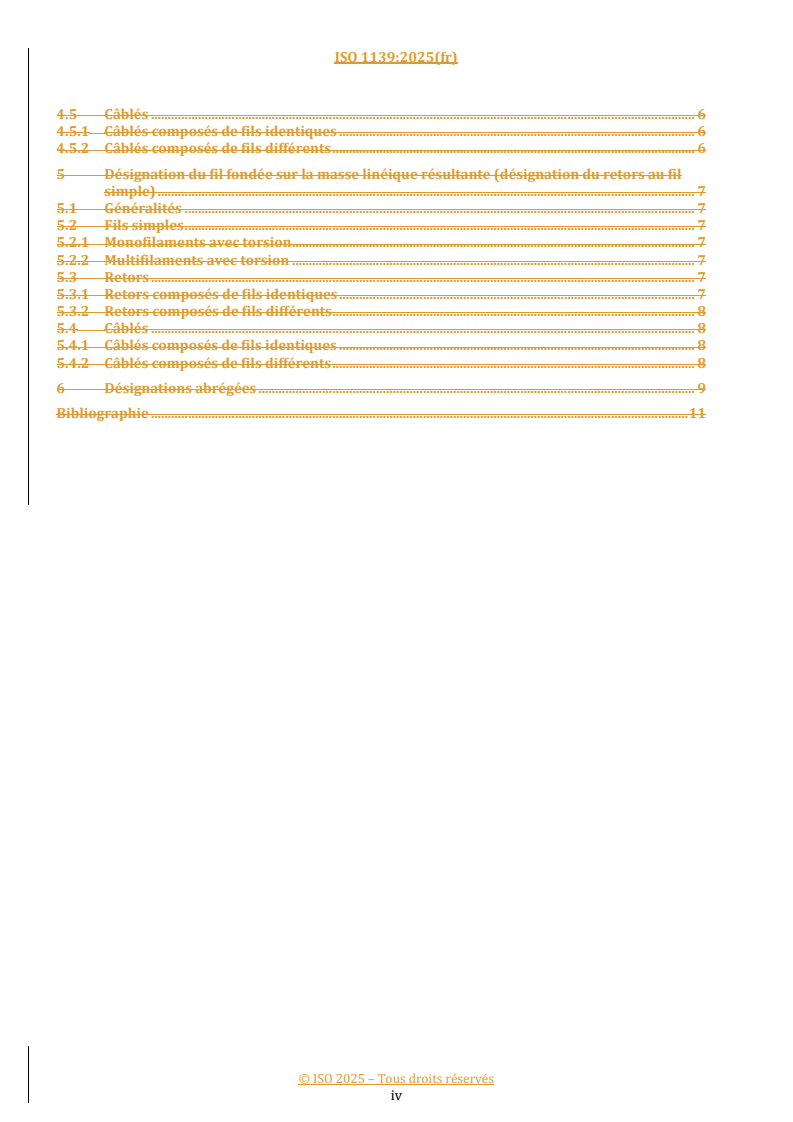
4.5 Câblés . 6
4.5.1 Câblés composés de fils identiques . 6
4.5.2 Câblés composés de fils différents . 6
5 Désignation du fil fondée sur la masse linéique résultante (désignation du retors au fil
simple) . 7
5.1 Généralités . 7
5.2 Fils simples . 7
5.2.1 Monofilaments avec torsion . 7
5.2.2 Multifilaments avec torsion . 7
5.3 Retors . 7
5.3.1 Retors composés de fils identiques . 7
5.3.2 Retors composés de fils différents . 8
5.4 Câblés . 8
5.4.1 Câblés composés de fils identiques . 8
5.4.2 Câblés composés de fils différents . 8
6 Désignations abrégées . 9
Bibliographie . 11
iv
Avant-propos
L’ISOL'ISO (Organisation internationale de normalisation) est une fédération mondiale
d’organismesd'organismes nationaux de normalisation (comités membres de l’ISO). L’élaborationl'ISO).
L'élaboration des Normes internationales est en général confiée aux comités techniques de l’ISOl'ISO. Chaque
comité membre intéressé par une étude a le droit de faire partie du comité technique créé à cet effet. Les
organisations internationales, gouvernementales et non gouvernementales, en liaison avec l’ISOl'ISO
participent également aux travaux. L’ISOL'ISO collabore étroitement avec la Commission électrotechnique
internationale (IEC) en ce qui concerne la normalisation électrotechnique.
Les procédures utilisées pour élaborer le présent document et celles destinées à sa mise à jour sont décrites
dans les Directives ISO/IEC, Partie 1. Il convient, en particulier, de prendre note des différents critères
d’approbationd'approbation requis pour les différents types de documents ISO. Le présent document a été
rédigé conformément aux règles de rédaction données dans les Directives ISO/IEC, Partie 2
(voir www.iso.org/directives www.iso.org/directives).
L’ISO attire l’attention sur le fait que la mise en application du présent document peut entraîner l’utilisation
d’un ou de plusieurs brevets. L’ISO ne prend pas position quant à la preuve, à la validité et à l’applicabilité de
tout droit de brevet revendiqué à cet égard. À la date de publication du présent document, l’ISO n’avaitn'avait
pas reçu notification qu’un ou plusieurs brevets pouvaient être nécessaires à sa mise en application. Toutefois,
il y a lieu d’avertir les responsables de la mise en application du présent document que des informations plus
récentes sont susceptibles de figurer dans la base de données de brevets, disponible à l’adressel'adresse
www.iso.org/brevets. L’ISO ne saurait être tenue pour responsable de ne pas avoir identifié tout ou partie de
tels droits de brevetpropriété.
Les appellations commerciales éventuellement mentionnées dans le présent document sont données pour
information, par souci de commodité, à l’intention des utilisateurs et ne sauraient constituer un engagement.
Pour une explication de la nature volontaire des normes, la signification des termes et expressions spécifiques
de l’ISOl'ISO liés à l’évaluationl'évaluation de la conformité, ou pour toute information au sujet de
l’adhésionl'adhésion de l’ISOl'ISO aux principes de l’Organisation mondiale du commerce (OMC) concernant
les obstacles techniques au commerce (OTC), voir le lien suivant : www.iso.org/iso/fr/avant-propos.html.
Le présent document a été élaboré par le comité technique ISO/TC 38, Textiles, Sous--comité SC 23, Fibres et
fils.
Cette deuxième édition annule et remplace la première édition (ISO 1139:1973), qui a fait l’objet d’une
révision d'ordre technique.
Les principaux changementsprincipales modifications sont les suivants suivantes:
— la structure du contenu a été mise à jour pour se conformer aux Directives ISO/IEC, Partie 2;
— les Articles 2 et 32 et 3 ont été mis à jour.
Il convient que l’utilisateur adresse tout retour d’information ou toute question concernant le présent
document à l’organisme national de normalisation de son pays. Une liste exhaustive desdits organismes se
trouve à l’adresse www.iso.org/fr/members.html www.iso.org/fr/members.html.
© ISO 2025 – Tous droits réservés
v
Introduction
La mise en application générale du système Tex pour exprimer la masse linéique des fils, exige la
normalisation d’un mode de désignation de la construction du fil. Dans la désignation des fils, il était d’usage
(et il reste souhaitable) de représenter, par une formule condensée, les détails de la composition du fil,
notamment les valeurs des masses linéiques, les torsions et les sens de torsion, le nombre de bouts, etc. de ses
composants et les propriétés caractéristiques du fil résultant de cette construction, telle que sa masse linéique
indiquée comme masse linéique résultante.
La masse linéique résultante des fils retors et des câblés (constitués parfois de fils continus multifilaments
ayant une forte torsion) diffère, en général, de la somme des masses linéiques des composants. Même en
partant des mêmes fils composants, en se servant des mêmes valeurs et sens de torsion, avec le même nombre
de bouts, etc., on peut aboutir à des fils de différentes masses linéiques résultantes, ce qui est dû à des
différences dans les conditions de fabrication des fils, telles que tensions des fils, types de machines utilisées,
teneur en humidité des fils, conditions atmosphériques, etc.
Une désignation des fils sert à deux fins :
— — elle est utilisée pour la description générale d’un fil ; dans ce cas, les valeurs de masse linéique, de
torsion, etc. utilisées dans la désignation du fil, seront dites valeurs nominales ;
— — elle peut être utilisée pour rendre compte du résultat de l’analyse du fil ; dans ce cas, les valeurs
provenant d’une méthode d’essai admise pour déterminer les masses linéiques et les valeurs de la torsion,
utilisées dans la désignation du fil, seront dites valeurs réelles.
L’attention est attirée sur le fait que l’application de la désignation des fils dans le système Tex n’affecte en
aucune manière les pratiques commerciales existant dans l’industrie.
Les valeurs des masses linéiques et des torsions utilisées dans les transactions commerciales sont nominales,
sauf s’il est mentionné de façon explicite qu’elles sont réelles.
Les masses linéiques nominales et les valeurs des torsions sont assorties de tolérances dont les valeurs
numériques sont acceptées en pratique dans les différentes branches de l’industrie textile ou bien sont
convenues directement entre le vendeur et l’acheteur.
Dans le présent document, deux méthodes pour la désignation des fils sont spécifiées, à savoir :
a) désignation du fil en commençant par la masse linéique du fil simple : elle peut être appelée désignation
du fil simple au retors ;
b) désignation du fil en commençant par la masse linéique du fil résultant : elle peut être appelée désignation
du retors au fil simple
Les symboles utilisés dans les deux systèmes sont identiques. Les différences résident dans l’ordre de la
présentation et dans l’emploi du signe de multiplication (×)( × ) dans la désignation du fil simple au retors et
de la barre oblique (/) dans la désignation du retors au fil simple.
La distinction entre ces deux méthodes n’est applicable ni aux fils simples filés, aux monofilaments et aux
multifilaments sans torsion, ni aux fils assemblés. Le mode de désignation de ces fils est indiqué dans le
chapitre consacré à la
...
ة�يلود ة�يسا�يق ةفصاوم
�����
ISO 1139
طس�يخلا ز�ي�يمت — تاجوس�نملا ة�ينايلا ةع�بطلا
���������
2025-11
Textiles — Designation of yarns
عجرملاا م�قر
ة�يكلم قسقخ�ب ة�يمخم ةق�يتو
�������
ISO 2025 ©
ال�ن ،ةــ�تك�تناك�تم و�ا ة�تنومتكاإا ةل�تسو �ي�ا�ن و�ا لاكس�الا نم لكس �ي�ا�ن ةماذحتسا و�ا روسنلاا اذه نم ءمجر �ي�ا خسن رو�ح�ي ال ،�كاذ �فالر ىلع صن�ي ما ام .ةظوقحم قوقحاا لك
���������������������������
وسإا وضع ةن�تهاا و�ا هانذ�ا ناونعاا ىلع وسإا نم �ي�ا نم نذإالا �تلظ نكل�ي .ق�نسم �ى�ناتك نذإا ىلع لوضحاا نوذ ،تنامتنإالا و�ا تنمتنإالا ىلع مسناا و�ا �ىنوضاا خسناا �كاذ �ى�ق
�������������������������������
.�تااطاا ذل�ن �ى�ق
ISO copyright office
CP 401 • Ch. de Blandonnet 8
CH-1214 Vernier, Geneva
Tel. + 41 22 749 01 11
E-mail copyright@iso.org
Website www.iso.org
امس�يوس �ى�ق تمسن
���
ISO 2025 — All rights reserved ©
�ت
ةحقضاا تا�تسيخم
��
��
د . م�تدقت
��
ه . �ةمدقم
�
1 . ق�ي�نطيلا قاطبو لا�خملا 1
����
1 . �ة�يل�يمكيلا� جوازملا 2
�
1 . رسمزلاو تاخلطصملاو ف�تراعيلا 3
����
1 . تاحلطضلااو ف�يراعتاا 1.3
���
3 . رومر 2.3
�
3 . (�يوزم – ىل�ا – دزقم) دزقملا ط�يخلل �ة�يلسطلا �ة�فايكلا ىلع ءان�ب ط�يخلا ز�ي�يمت 4
���������
3 . ماع 1.4
5 . (دزقم – ىل�ا – يوزم) ة�ختانلا ة�يلسطلا ةفايكلا نم ًاءد�ب طس�يخلا ز�ي�يمت 5
��������������
5 . ماع 1.5
7 . ز�ي�يميلا تاراصيوا 6
�����
ISO 2025 — All rights reserved ©
جج
م�تدقت
��
ة�ت اوذاا تاقصاولاا ذاذعإا مت�ي ام ا�نااعو ،(وم�ي�الا ى�ق ءاضع�الا) ة�تنظواا س�ت�تقتاا تاه�حا ىلااع ذاحيا ىه (س�ت�تقتلا ة�تاوذاا ةلطنلاا) وم�ي�الا
�����������������������
ة ا نوك�ي ن�ا ى�ق قحاا وضعاا اذها نإا�ق ، ة�تن�ق ةن�حا ةا تلكس ذ�ق عوصول�ن مالتهإا اها وضعاا ةه�حاا تناك اذإاو ، وم�ي�الا ة�تنقاا نا�حلاا لالر نم
���������������������������
نواعتي و .وم�ي�الا ةلطنم عم لصاوي اها ىتاا ة�تموكحاا م�تعو اهنم ة�تموكحاا ة�تاوذاا تالطنلااا �كاذك للعاا ى�ق �كراس�يو .ةن�حلاا �كلي ى�ق لتلم
��������������������������
.ىنقيومهكاا لا�حلاا ى�ق س�ت�تقتاا مهي ىتاا روم�الا ع�تلجر ى�ق (IEC) ة�تاوذاا ة�تنقيومهكاا ةن�حلاا عم ق�تيو لكس�ن وم�ي�الا ةلطنم
�������������������������
ةــقلتح لاا تاذذــحلاا هاعامم �ت�ح�ي .لو�الا ءم�حاا ISO/IEC تاه�تجروتاا ىق ةحصوم اهيال�يذعيو ةق�تيواا هذه م�يوطتا ةع�نتلاا تاءامجرإالا نإا
������������������������
مطنا) ISO/IEC تاه�تجروتاا ىق ةــ�يم�يمحتاا ذــعاوقلا ًاققو ةق�تيواا هذه م�يوطي مي صار لكس�ن وم�ي�الا قنايو نم هذذعتلاا عاون�الا ةمرالاا
�����������������������������
( www.iso.org/directives
ةلطن لاا �يذ�نُي الو .متك�ا و�ا عامترا هءام�ن ماذحتسا ةق�تيواا هذه ق�ت�نطي نلضت�ي ن�ا لالترا ىاإا ها�نتنالا (ISO) س�ت�ياقللا ة�تاوذاا ةلطنلاا تقلُي
�������������������������������
َّقلتي ما ،ةق�تيواا هذه مسن خ�يراي ىترو .ن�اساا اذه �ى�ق اه�ن �تااطُم عامترا تاءام�ن قوقر �ي�ا ق�ت�نطي ة�تل�نا�ق و�ا ةحص و�ا ةاذ�الا ن�اس�ن ف�قوم �ي�ا
����������������������������
ا ل ذ�ق تامولعلاا هذه ن�ا�ن ق�ت�نطتاا ىلع نولناقاا خضنُ�ي ،�كاذ عمو .اهق�ت�نطتا ة�نولطم نوكي ذ�ق متك�ا و�ا عامترا هءام�ن ن�اس�ن راعسإا �ي�ا ةلطنلاا
�������������������������
www.iso.org/ :�ىااــتاا ط�ناماا ىلع ةــراتلاا عامتراــاا تاءام�ن تانا�ت�ن هذعا�ق نم اه�تلع لوــضحاا نكلُ�ي �ىتااو ،تاــمولعلاا تذر�ا لتلُي
����������������
. اهع�تلجر و�ا هذه عامترالا تاءام�ن قوقر نم �ي�ا ذ�يذحي ة�تاووسم ةلطنلاا للحتي ناو . .patents
���������������ٍّ�
.اها ىن�ني ي�ا لكس�ي الو ن�تمذحتسلاا ىلع مم�الا ل�تهستا ةمذقم تامولعم ىه ةق�تيواا هذه ى�ق ةمذحتسم ة�يرا�حي ةمالع ي�ا نإا
��������������������������
ة�ت اوذاا ةلطنلاا مامتاا نع تامولعلاا �كاذكو ةق�ناطلاا م�يوقت�ن ةط�نيملاا تاحلطضلااو ف�يراعتلا ىنعلااو ة�يرا�تترالا ةقصاولاا خ�تصوي فذه�ن
���������������������������
www.iso.org/iso/foreword.html ط�ناماا مطنا هرا�حتلا ة�تنقاا قناوعاا صوضح�ن ة�تلااعاا هرا�حتاا ةلطنم يذا�نل�ن س�ت�تقتلا
�������������������
طو�تح ااو �فا�تا�الا ,SC 23 ة�تعمقاا ةن�حلاا ,تاجروسنلاا ,ISO/TC 38 ة�تاوذاا ةقصاولاا هذه م�يوطي مي
�������������
.ًا�تن�ق ةتعجرامم مي يذاا ,( ISO 1139:1973 ) لو�الا راذصإالا لحم لح�يو ىعل�ي ىناتاا راذصإالا
����������
:ىااتااك ىه ة�تساس�الا تام�ت�تعتاا
�������
�ىناتاا ءم�حاا ISO/IEC تاه�تجروي عم ق�قاوتتا يوتحلاا ة�تلك�ته ت�يذحي مي —
�������������
.اهت�يذحي مي 3 و 2 ذن�ناا —
����
ةــلنا�ق ىلع عالظالا نكل�ي �ىنظواا س�ت�تقتاا راهجر �ى�نوسنم ىاإا اهه�تجروي �ت�ح�ي ة�تاوذاا ةقصاولاا هذه لور تاراسقتسا و�ا تاطرالم �ي�ا نإا
�������������������
www.iso.org/members.html :�ىااتاا ط�ناماا لالر نم ة�تنظواا س�ت�تقتاا همهجر�ا
���������
ISO 2025 — All rights reserved ©
د
ةمدقم
��
- هذاــعاا تمجر طو�تحاا ة�تلــسي يذا .طوــ�تحاا �ت�تكمي رومر ذ�تروي مت�ي ن�ا طو�تحلا ة�تطحاا ة�قاتكاا نع م�ت�نعتلا سكي ماطن ق�ت�نطي �تلطت�ي
������������������������
ذذ عو ءاوتاالا تا�تلكو تاها�حياو ة�تطحاا ة�قاتكاا م�ت�ق �كاذ ى�ق ال�ن ،مضتحم لكس�ن ط�تحاا تانوكم ل�تصاقي ن�تلضي ىلع -ة�نوعمم تاارامو
�������������������������
ة�حياناا ة�تطحاا ة�قاتكاا�ن اه�تاإا ءاسلاا ة�تطحاا ةت�قاتك لتم �ت�تكمتاا اذه نع ة�حنياناا ط�تحاا صناضر و�ا/و تانوكلاا هذها �كاذ ىاإا امو تا�تطاا
����������������������������
ن ع اــًمولع - هذس�ن ة�يوتللاا تام�تعــساا طو�تر عم تالاحاا صع�ن ىقو - ةاوذ�حلاا و�ا ة�يوطلاا طو�تحاا نع ة�حياناا ة�تطحاا ةقاتكاا فلتحي
����������������������������
ا مو ،تاــ�تطاا ذذعو ءاوتاالا ة�تلكو ها�حيا سقن ماذحتسا�نو ،تانوكلاا طو�تر سقن نم ءذ�ناا ذنع ىتر .تانوكللا ة�تطحاا تاقاتكاا عول�حم
�����������������������
تاــا�ا لا عاون�او ،طوــ�تحاا ذس لتم ،ع�تنضتاا �فومظ ىق تاــقالترالا �ت�نس�ن ةقلتحم ة�حيان ة�تطر تاقاتك تاذ طو�تر ججاتنإا نكل�ي ،�كاذ ىاإا
���������������������������������
.�كاذ ىاإا امو ،ة�يو�حاا �فومطااو ،طو�تحاا ىق ة�نوظماا يوتحمو ،ةمذحتسلاا
�����������
ن�ت�تساس�ا ن�ت�قذه مذح�ي طو�تحاا م�تممي نإا
�������
ىــاإا امو ،ءاوتاالا تاــ�تلكو ،ة�تطحاا تا�قاتكاا�ن ةصاحاا م�تقاا ىاإا هراسإالا متتس ،ةااحاا هذه ى�ق ؛طو�تحلا ماع مسولك ةماذحتسا مت�ي —
����������������������
؛ة�تلسا م�تق اهن�ا ىلع طو�تحاا ن�يوذي ى�ق ةمذحتسلاا �كاذ
�����������
تاقا تكلا ذلتعم را�نترا ءامجرإا نم هذلتسلاا م�تقاا ىاإا هراسإالا متتس ،ةااحاا هذه ىق ؛لمعاا ل�تلحي ة�ح�تتن نع عال�نإالا ةماذحتسا نكل�ي —
�����������������������������
.ة�تلعق م�تق اهن�ا ىلع لمعاا ن�يوذي ىق ةمذحتسلاا ءاوتاالا تا�تلكو ة�تطحاا
�����������������
.لا�حلاا اذه �ى�ق ة�تااحاا ة�يرا�حتاا تاسراللاا ىلع ميو�ي ال سكي ماطن �ى�ق طو�تحاا ن�يوذي ق�ت�نطي ن�ا ةق�تقر ىاإا ها�نتنالا �ت�ح�ي
���������������������
.ة�تلع�ق م�تق اهن�ا ىلع ةرامص صنُ�ي ما ام ة�تلسا ًال�تق ة�يرا�حتاا تالماعلاا ى�ق ةمذحتسلاا ءاوتاالا راذقمو ة�تطحاا ة�قاتكاا م�تق م�نتعي
�����������������������
جخ�تسن اا ةعانص عومق فلتحم ىق هذاع ة�يذذعاا اهل�تق ىلع قاقيالا مت�ي ىتااو ،تايواقتلا ءاوتاالا تا�تلكو ة�تلسالا ة�تطحاا تاقاتكاا عضحي
���������������������������������
.يمتسلااو عنا�ناا ن�ت�ن همسا�نم و�ا
�������
:الهو ،طو�تحاا م�تممتا ن�تتق�يمظ ذ�يذحي مي ،ةق�تيواا هذه �ى�ق
������������
؛ذمقلاا نم ىطاا ن�يوذي مسا�ن ة�تاإا هراسإالا نكل�ي :ذمقلاا ط�تحلا ة�تطحاا ة�قاتكاا نم اءذ�ن طو�تحاا ن�يوذي (a
�������������ً�����
.ذمقلاا ط�تحاا ىاإا ىطاا ن�يوذي مسا�ن ة�تاإا هراسإالا نكل�ي :جخياناا ط�تحلا ة�تطحاا ةقاتكاا نم اءذ�ن طو�تحاا ن�يوذي (b
����������������ً����
ماذحت ساو ،�ىطاا ن�يوذي �ى�ق (×) �تمضاا ةمالع ماذحتساو ،صمعاا �ت�تيمي �ى�ق تا�قالترالا نلكي .ةق�ناطتم ن�تماطناا الك �ى�ق ةمذحتسلاا رومماا
��������������������������
.ذمقلاا ىاإا �ىطاا ن�يوذي �ى�ق (/) لصواا ةمالع
����
تام�تعــــس اا هذذعتم طو�تحاا و�ا ،هم�تعساا ة�يذار�ا طو�تحاا و�ا ،هم�تعساا ة�يذار�ا ةاومعلاا طو�تحاا ىلع ن�تتق�يمطاا ن�تياه ن�ت�ن م�ت�تلتاا ق�نطن�ي ال
��������������������������
.(3.4 و 2.4 مطنا) .ىاو�الا ةق�يمطاا ناونع تحي طو�تحاا هذه رومر ذمي .تامم هذع ةقوقللاا طو�تحاا ىلع الو ،ة�يوتللاا م�تع
���������������������
مذحتس�ي ال ذ�تضاا �كا�نس طو�تر عم لماعتاا نإا , ISO 858 ,عقاواا ىق .يمر�الا نوذ ن�تتق�يمطاا يذرإا ماذحتسا فاطلاا ة�ياهن ىق مت�ي ن�ا لمو�ي
������ُ������������������
.ة�نسانلاا تامولعلاا �كلي طقق ،تاراضترالا ىق ،مذق�ي ةن�ا نم معماا ىلع ،يذمقاا ىطاا ةق�يمظ الإا
��������������������
ISO 2025 — All rights reserved ©
ه
�����
طس�يخلا ز�ي�يمت — تاجوس�نملا
�����
ق�ي�نطيلا قاطبو لا�خملا 1
����
ناــــتق�يم طاا . ةقو�نطم و�ا ، ة�يذا�تــص ، ة�يومم ، هذمقم تناك ءاوس طو�تحاا �ت�تكامي م�ت�تلتا ن�تتق�يمظ ذ�يذحت�ن ة�تسا�تقاا ةقصاولاا هذه صتحي
����������������������������
صــع�ن م�ت�تلي ةقــصاولاا هذه للسي ال . يوماا ذذعو تامم�ناا ها�حياو ذذع ، هملتسلاا تام�تعساا ذذع ، سكتاا ماطن�ن ة�تاوطاا ةقاتكاا نام�تلي
��������������������������
لت م صاوحاا صع�ن م�ت�تلي للسي ال الك روحم لور ةقوقللاا ة�ت�حسناا م�تع و�ا هذع�حلاا و�ا ة�تقمرماا طو�تحاا لتم طو�تحاا نم ةصاحاا عاون�الا
�������������������������
. (ةنوكاا) طومحلاا عون و�ا م�ته�حتاا قمظ و�ا ةمذحتسلاا ذاولاا عون
�����������
ة�يل�يمكيلا �جوازملا 2
��
ةقصاولاا هذها ة�تل�تلكي عجرامم ذجرو�يال
�����
رسمزلاو تاخلطصملاو ف�تراعيلا 3
����
تاخلطصملاو ف�تراعيلا 1.3
���
:ة�تااتاا تاحلطضلااو ف�يراعتاا ق�نطي ةقصاولاا هذه صامع�ال
������������
فذه�ن ة�تااتاا ن�يوانعاا ىق تاحلطضلاا تانا�ت�ن ذعاوق�ن (IEC) ة�تاوذاا ة�تنقيومهكاا ةن�حلااو (ISO) س�ت�ياقللا ة�تاوذاا ةلطنلاا نم لك طقتحي
����������������������������
:س�ت�تقتاا ىق اهماذحتسا
������
https://www.iso.org/obp/ui :�ىااتاا ط�ناماا ىلع جاتلاا س�ت�تقتلا ة�تاوذاا ةلطنللا �ىنومتكاالا خقضتاا ماطن −
��������������
/ https://www.electropedia.org :ىااتاا ط�ناماا ىلع جاتلاا ،ة�تنقيومهكاا ة�تاوذاا ةن�تهلا ة�تنومتكاالا تاحلطضلاا م�حعم −
��������������
1.1.3
:ط�يو
�
ةق�تيواا هذه ىق ةحصولاا هذذحلاا لكا�تهااو عاون�الا ع�تلجر للس�ي ماع خلطضم
�����������
2.1.3
:دز�قم ط�يو
�
:ة�ت�ح�تسن ذاوم نم ةنوكم هملتسمو ةاومعم ةل�يذجر طس�ن�ا
�����������
:ىل�ي الم هذراو نم نوكم ذمقلاا ط�تحاا :لورذاا ةطرالم
���������
،ةاومعم طو�تر اهن�ا�ن طو�تحاا هذه فصويو .مم�ناا ق�يمظ نع ًهذاع صع�ناا اهضع�ن�ن ط�نيمي �ىتااو ،ةلضتلاا م�تع �فا�تا�الا نم ذذع (�ا
���������������������
. مم�ناا نم ة�تاار نوكي ذقو هملتسلاا تام�تعساا طو�تح�ن طو�تحاا هذه لتم �فمعي :هملتسم هم�تعس نم متك�ا و�ا ذراو (�ت
���������������������
.هملتسلاا هذمقلاا هم�تعساا طو�تح�ن طو�تحاا هذه لتم �فمعي :هملتسم هذراو هم�تعس (جج
����������������
.تام�تعساا هذذعتم طو�تح�ن طو�تحاا هذه لتم �فمعي :هملتسم هذراو هم�تعس نم متك�ا (ذ
����������������
�يم�تل�تاو�ناا ط�يمساا طو�تر ف�يمعتاا للس�يال نهاماا ت�قواا �ى�ق :لورذاا ةطرالم
����������
3.1.3
:قس�نطم ط�يو
��
يور نوذ�ن ذمقم ط�تر نم متك�ا نم نوكم ط�تر
����������
4.1.3
:يسطم ط�يو
��
هذراو فا ة�تللع ىق متك�ا و�ا ن�يذمقم ن�تط�تر فا لالر نم لكسم ط�تر
���������������
ISO 2025 — All rights reserved ©
5.1.3
:لود�خم ط�يو
�
...