

ISO 16093:2017
(Main)Machine tools — Safety — Sawing machines for cold metal
General Information
- Abstract
ISO 16093:2017 deals with all significant hazards, hazardous situations and events to sawing machines as defined in Clause 3, whose primary intended use is for sawing cold metal (ferrous and non-ferrous), or material partly of cold metal and under conditions of misuse which are reasonably foreseeable by the manufacturer (see Clause 4). ISO 16093:2017 is applicable to (metal) sawing machines which are manufactured after the date of publication of this document. When additional processing (i.e. milling, boring, marking, finishing operation, etc.) is considered, this document can serve as a basis for safety requirements. For more detailed information, refer to the bibliography. ISO 16093:2017 deals with noise hazards but does not provide a full noise test code. It is intended to draft such a code in the next revision of this document. ISO 16093:2017 does not include requirements and safety measures for fire and explosion hazards. It is intended to deal with them in the next revision of this document.
- Status
- Published
- Publication Date
- 16-Mar-2017
- Technical Committee
- ISO/TC 39/SC 10 - Safety
- Drafting Committee
- ISO/TC 39/SC 10/WG 6 - Sawing machines
- Current Stage
- 9093 - International Standard confirmed
- Start Date
- 01-Dec-2022
- Completion Date
- 29-Aug-2026
Buy Documents
ISO 16093:2017 - Machine tools — Safety — Sawing machines for cold metal Released:3/17/2017
ISO 16093:2017 - Machine-outils — Sécurité — Machines a scier les métaux a froid Released:3/17/2017
Overview - What ISO 16093:2017 covers
ISO 16093:2017, "Machine tools - Safety - Sawing machines for cold metal", is a type‑C machine safety standard that addresses significant hazards, hazardous situations and events for sawing machines whose primary intended use is sawing cold metal (ferrous and non‑ferrous). It applies to metal sawing machines manufactured after publication and can serve as a safety basis when machines perform additional processing (milling, boring, marking, finishing). The standard covers mechanical, electrical, thermal, noise, vibration, ergonomic and material‑related hazards, while noting that fire/explosion measures and a full noise test code are intended for future revisions.
Key topics and technical requirements
- Scope and definitions - clear definitions of sawing machine types and main hazard zones.
- Guard requirements - general guarding principles for all sawing machines and type‑specific guard examples (band saws, circular saws, hack saws).
- Modes of operation & control systems - safe modes, control system design and safety‑related parts of control systems (performance level considerations).
- Type‑specific safeguards - detailed safety measures for band‑sawing, circular sawing and horizontal‑pivot hacksaw machines.
- Mechanical hazards - transmission elements, work‑holding/clamping, loading/unloading devices, chip/swarf handling and preventive maintenance.
- Electrical, thermal, noise and vibration hazards - mitigation principles; note that the document addresses noise hazards but does not provide a full noise test code in this edition.
- Ergonomics and human factors - design to avoid unhealthy posture, excessive effort, poor control layout and human error.
- Unexpected start/overrun - requirements for prevention and safe restoration after power interruptions.
- Verification & information for use - verification procedures, markings, instruction handbook and noise declaration.
- Normative annexes - noise emission measurement and test conditions; informative annexes include guard examples and performance level determination guidance.
Practical applications - who uses ISO 16093:2017
- Machine manufacturers - to design and certify safe sawing machines and integrate safeguards for band, circular and hacksaw types.
- Safety engineers & compliance officers - for risk assessment, machine modification, CE marking support and conformity verification.
- Purchasers and end‑users (workshops, fabrication shops) - to evaluate machine safety features, documentation and operator information.
- Regulators, market surveillance & test laboratories - to assess compliance and to reference for inspections or safety testing.
- Maintenance and service providers - to apply preventive maintenance and safe access provisions.
Related standards
ISO 16093 references several normative standards for design and testing, including:
- ISO 12100 (risk assessment & risk reduction), ISO 13849‑1 (safety‑related control systems)
- Acoustic and noise standards: ISO 3744 / ISO 3746 / ISO 9614‑1 / ISO 4871 / ISO 11202 / ISO 11204
- Fluid power: ISO 4413 (hydraulic), ISO 4414 (pneumatic)
- Ergonomics: ISO 9355 series
Use ISO 16093:2017 as a practical guide for machine safety design, conformity, operator protection and for integrating relevant acoustic, ergonomic and control‑system requirements into sawing machines for cold metal.
Relations
- Consolidates
EN ISO 16093:2017 - Machine tools - Safety - Sawing machines for cold metal (ISO 16093:2017) - Effective Date
- 12-Feb-2026
Buy Documents
ISO 16093:2017 - Machine tools — Safety — Sawing machines for cold metal Released:3/17/2017
ISO 16093:2017 - Machine-outils — Sécurité — Machines a scier les métaux a froid Released:3/17/2017
Get Certified
Connect with accredited certification bodies for this standard

DVS-ZERT GmbH
German welding certification society.
CARES (UK Certification Authority for Reinforcing Steels)
UK certification for reinforcing steels and construction.
EWF/IIW (European/International Welding Federation)
International welding personnel certification.
Sponsored listings
Frequently Asked Questions
ISO 16093:2017 is a standard published by the International Organization for Standardization (ISO). Its full title is "Machine tools — Safety — Sawing machines for cold metal". This standard covers: ISO 16093:2017 deals with all significant hazards, hazardous situations and events to sawing machines as defined in Clause 3, whose primary intended use is for sawing cold metal (ferrous and non-ferrous), or material partly of cold metal and under conditions of misuse which are reasonably foreseeable by the manufacturer (see Clause 4). ISO 16093:2017 is applicable to (metal) sawing machines which are manufactured after the date of publication of this document. When additional processing (i.e. milling, boring, marking, finishing operation, etc.) is considered, this document can serve as a basis for safety requirements. For more detailed information, refer to the bibliography. ISO 16093:2017 deals with noise hazards but does not provide a full noise test code. It is intended to draft such a code in the next revision of this document. ISO 16093:2017 does not include requirements and safety measures for fire and explosion hazards. It is intended to deal with them in the next revision of this document.
ISO 16093:2017 deals with all significant hazards, hazardous situations and events to sawing machines as defined in Clause 3, whose primary intended use is for sawing cold metal (ferrous and non-ferrous), or material partly of cold metal and under conditions of misuse which are reasonably foreseeable by the manufacturer (see Clause 4). ISO 16093:2017 is applicable to (metal) sawing machines which are manufactured after the date of publication of this document. When additional processing (i.e. milling, boring, marking, finishing operation, etc.) is considered, this document can serve as a basis for safety requirements. For more detailed information, refer to the bibliography. ISO 16093:2017 deals with noise hazards but does not provide a full noise test code. It is intended to draft such a code in the next revision of this document. ISO 16093:2017 does not include requirements and safety measures for fire and explosion hazards. It is intended to deal with them in the next revision of this document.
ISO 16093:2017 is classified under the following ICS (International Classification for Standards) categories: 25.080.01 - Machine tools in general. The ICS classification helps identify the subject area and facilitates finding related standards.
ISO 16093:2017 has the following relationships with other standards: It is inter standard links to EN ISO 16093:2017. Understanding these relationships helps ensure you are using the most current and applicable version of the standard.
ISO 16093:2017 is available in PDF format for immediate download after purchase. The document can be added to your cart and obtained through the secure checkout process. Digital delivery ensures instant access to the complete standard document.
Standards Content (Sample)
INTERNATIONAL ISO
STANDARD 16093
First edition
2017-03
Machine tools — Safety — Sawing
machines for cold metal
Machine-outils — Sécurité — Machines à scier les métaux à froid
Reference number
©
ISO 2017
© ISO 2017, Published in Switzerland
All rights reserved. Unless otherwise specified, no part of this publication may be reproduced or utilized otherwise in any form
or by any means, electronic or mechanical, including photocopying, or posting on the internet or an intranet, without prior
written permission. Permission can be requested from either ISO at the address below or ISO’s member body in the country of
the requester.
ISO copyright office
Ch. de Blandonnet 8 • CP 401
CH-1214 Vernier, Geneva, Switzerland
Tel. +41 22 749 01 11
Fax +41 22 749 09 47
copyright@iso.org
www.iso.org
ii © ISO 2017 – All rights reserved
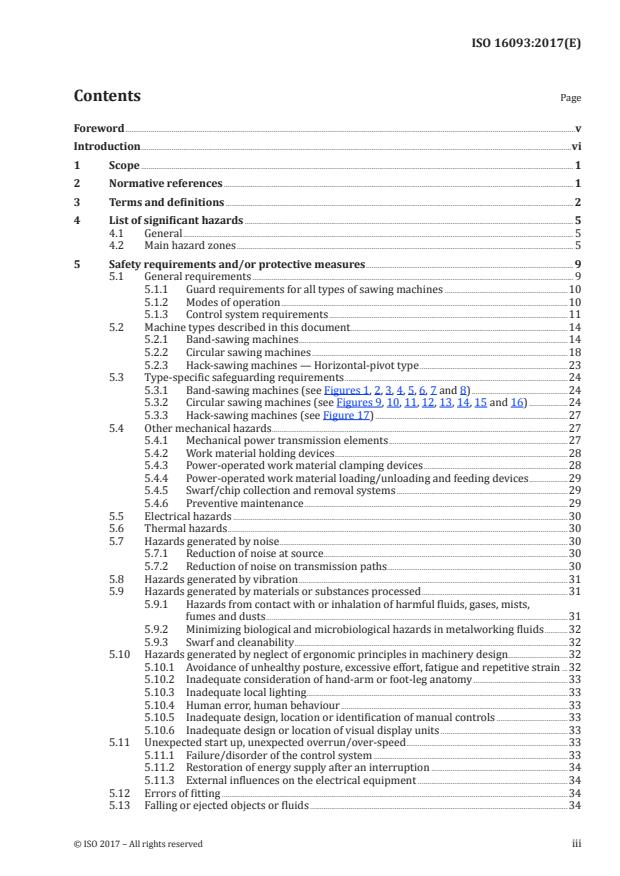
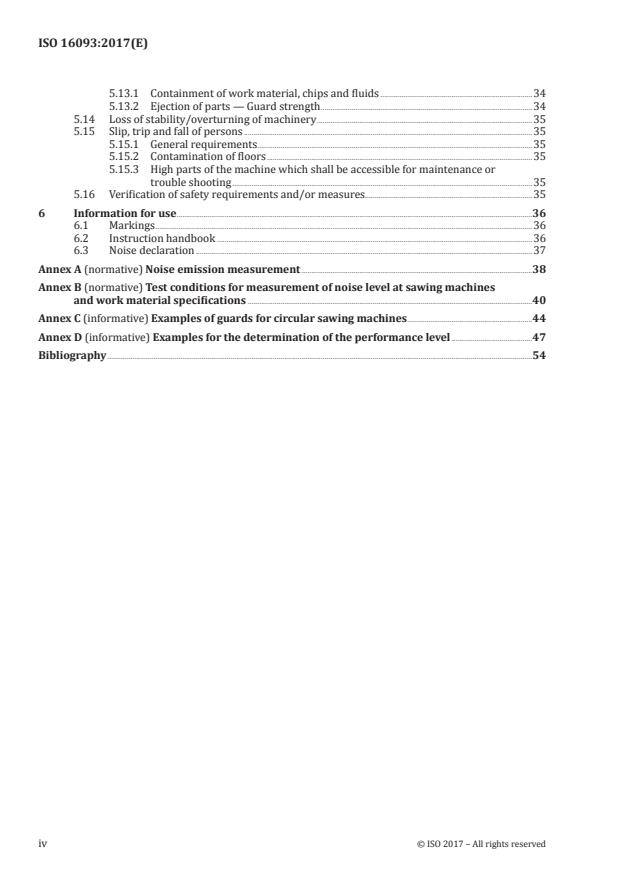
Contents Page
Foreword .v
Introduction .vi
1 Scope . 1
2 Normative references . 1
3 Terms and definitions . 2
4 List of significant hazards . 5
4.1 General . 5
4.2 Main hazard zones . 5
5 Safety requirements and/or protective measures . 9
5.1 General requirements . 9
5.1.1 Guard requirements for all types of sawing machines .10
5.1.2 Modes of operation .10
5.1.3 Control system requirements .11
5.2 Machine types described in this document .14
5.2.1 Band-sawing machines.14
5.2.2 Circular sawing machines .18
5.2.3 Hack-sawing machines — Horizontal-pivot type .23
5.3 Type-specific safeguarding requirements .24
5.3.1 Band-sawing machines (see Figures 1, 2, 3, 4, 5, 6, 7 and 8) .24
5.3.2 Circular sawing machines (see Figures 9, 10, 11, 12, 13, 14, 15 and 16) .24
5.3.3 Hack-sawing machines (see Figure 17) .27
5.4 Other mechanical hazards .27
5.4.1 Mechanical power transmission elements .27
5.4.2 Work material holding devices .28
5.4.3 Power-operated work material clamping devices .28
5.4.4 Power-operated work material loading/unloading and feeding devices .29
5.4.5 Swarf/chip collection and removal systems .29
5.4.6 Preventive maintenance .29
5.5 Electrical hazards .30
5.6 Thermal hazards .30
5.7 Hazards generated by noise .30
5.7.1 Reduction of noise at source .30
5.7.2 Reduction of noise on transmission paths.30
5.8 Hazards generated by vibration .31
5.9 Hazards generated by materials or substances processed .31
5.9.1 Hazards from contact with or inhalation of harmful fluids, gases, mists,
fumes and dusts .31
5.9.2 Minimizing biological and microbiological hazards in metalworking fluids .32
5.9.3 Swarf and cleanability .32
5.10 Hazards generated by neglect of ergonomic principles in machinery design .32
5.10.1 Avoidance of unhealthy posture, excessive effort, fatigue and repetitive strain .32
5.10.2 Inadequate consideration of hand-arm or foot-leg anatomy .33
5.10.3 Inadequate local lighting.33
5.10.4 Human error, human behaviour .33
5.10.5 Inadequate design, location or identification of manual controls .33
5.10.6 Inadequate design or location of visual display units .33
5.11 Unexpected start up, unexpected overrun/over-speed .33
5.11.1 Failure/disorder of the control system .33
5.11.2 Restoration of energy supply after an interruption .34
5.11.3 External influences on the electrical equipment .34
5.12 Errors of fitting .34
5.13 Falling or ejected objects or fluids .34
5.13.1 Containment of work material, chips and fluids .34
5.13.2 Ejection of parts — Guard strength .34
5.14 Loss of stability/overturning of machinery .35
5.15 Slip, trip and fall of persons .35
5.15.1 General requirements .35
5.15.2 Contamination of floors .35
5.15.3 High parts of the machine which shall be accessible for maintenance or
trouble shooting .35
5.16 Verification of safety requirements and/or measures.35
6 Information for use .36
6.1 Markings .36
6.2 Instruction handbook .36
6.3 Noise declaration .37
Annex A (normative) Noise emission measurement .38
Annex B (normative) Test conditions for measurement of noise level at sawing machines
and work material specifications .40
Annex C (informative) Examples of guards for circular sawing machines .44
Annex D (informative) Examples for the determination of the performance level .47
Bibliography .54
iv © ISO 2017 – All rights reserved
Foreword
ISO (the International Organization for Standardization) is a worldwide federation of national standards
bodies (ISO member bodies). The work of preparing International Standards is normally carried out
through ISO technical committees. Each member body interested in a subject for which a technical
committee has been established has the right to be represented on that committee. International
organizations, governmental and non-governmental, in liaison with ISO, also take part in the work.
ISO collaborates closely with the International Electrotechnical Commission (IEC) on all matters of
electrotechnical standardization.
The procedures used to develop this document and those intended for its further maintenance are
described in the ISO/IEC Directives, Part 1. In particular the different approval criteria needed for the
different types of ISO documents should be noted. This document was drafted in accordance with the
editorial rules of the ISO/IEC Directives, Part 2 (see www .iso .org/ directives).
Attention is drawn to the possibility that some of the elements of this document may be the subject of
patent rights. ISO shall not be held responsible for identifying any or all such patent rights. Details of
any patent rights identified during the development of the document will be in the Introduction and/or
on the ISO list of patent declarations received (see www .iso .org/ patents).
Any trade name used in this document is information given for the convenience of users and does not
constitute an endorsement.
For an explanation on the voluntary nature of standards, the meaning of ISO specific terms and
expressions related to conformity assessment, as well as information about ISO’s adherence to the
World Trade Organization (WTO) principles in the Technical Barriers to Trade (TBT) see the following
URL: w w w . i s o .org/ iso/ foreword .html.
This document was prepared by Technical Committee ISO/TC 39, Machine tools, Subcommittee
SC 10, Safety.
Introduction
This document is a type-C standard as stated in ISO 12100.
This document is of relevance, in particular, for the following stakeholder groups representing the
market players with regard to machinery safety:
— machine manufacturers (small, medium and large enterprises);
— health and safety bodies (regulators, accident prevention organisations, market surveillance, etc.)
Others can be affected by the level of machinery safety achieved with the means of the document by the
abovementioned stakeholder groups:
— machine users/employers (small, medium and large enterprises);
— machine users/employees (e.g. trade unions, organizations for people with special needs);
— service providers, e. g. for maintenance (small, medium and large enterprises);
— consumers (in case of machinery intended for use by consumers).
The above mentioned stakeholder groups have been given the possibility to participate at the drafting
process of this document.
The machinery concerned and the extent to which hazards, hazardous situations or hazardous events
are indicated in the scope of this document.
When requirements of this type-C standard are different from those which are stated in type-A or
type-B standards, the requirements of this type-C standard take precedence over the requirements of
the other standards for machines that have been designed and built according to the requirements of
this type-C standard.
vi © ISO 2017 – All rights reserved
INTERNATIONAL STANDARD ISO 16093:2017(E)
Machine tools — Safety — Sawing machines for cold metal
1 Scope
This document deals with all significant hazards, hazardous situations and events to sawing machines
as defined in Clause 3, whose primary intended use is for sawing cold metal (ferrous and non-ferrous),
or material partly of cold metal and under conditions of misuse which are reasonably foreseeable by
the manufacturer (see Clause 4).
This document is applicable to (metal) sawing machines which are manufactured after the date of
publication of this document.
When additional processing (i.e. milling, boring, marking, finishing operation, etc.) is considered, this
document can serve as a basis for safety requirements. For more detailed information, refer to the
bibliography.
This document deals with noise hazards but does not provide a full noise test code. It is intended to
draft such a code in the next revision of this document.
This document does not include requirements and safety measures for fire and explosion hazards. It is
intended to deal with them in the next revision of this document.
2 Normative references
The following documents are referred to in the text in such a way that some or all of their content
constitutes requirements of this document. For dated references, only the edition cited applies. For
undated references, the latest edition of the referenced document (including any amendments) applies.
ISO 683-1, Heat-treatable steels, alloy steels and free-cutting steels — Part 1: Non-alloy steels for quenching
and tempering·
ISO 3744, Acoustics — Determination of sound power levels and sound energy levels of noise sources using
sound pressure — Engineering methods for an essentially free field over a reflecting plane
ISO 3746:2010, Acoustics — Determination of sound power levels and sound energy levels of noise sources
using sound pressure — Survey method using an enveloping measurement surface over a reflecting plane
ISO 4413, Hydraulic fluid power — General rules and safety requirements for systems and their components
ISO 4414, Pneumatic fluid power — General rules and safety requirements for systems and their components
ISO 4871, Acoustics — Declaration and verification of noise emission values of machinery and equipment
ISO 9355-1, Ergonomic requirements for the design of displays and control actuators — Part 1: Human
interactions with displays and control actuators
ISO 9355-2, Ergonomic requirements for the design of displays and control actuators — Part 2: Displays
ISO 9355-3, Ergonomic requirements for the design of displays and control actuators — Part 3: Control
actuators
ISO 9614-1, Acoustics — Determination of sound power levels of noise sources using sound intensity —
Part 1: Measurement at discrete points
ISO 11202:2010, Acoustics — Noise emitted by machinery and equipment — Determination of emission
sound pressure levels at a work station and at other specified positions applying approximate environmental
corrections
ISO 11204:2010, Acoustics — Noise emitted by machinery and equipment — Determination of emission
sound pressure levels at a work station and at other specified positions applying accurate environmental
corrections
ISO 12100:2010, Safety of machinery — General principles for design — Risk assessment and risk reduction
ISO 13849-1:2015, Safety of machinery — Safety-related parts of control systems — Part 1: General
principles for design
ISO 13850, Safety of machinery — Emergency stop function — Principles for design
ISO 13854, Safety of machinery — Minimum gaps to avoid crushing of parts of the human body
ISO 13855:2010, Safety of machinery — Positioning of safeguards with respect to the approach speeds of
parts of the human body
ISO 13856-1, Safety of machinery — Pressure-sensitive protective devices — Part 1: General principles for
design and testing of pressure-sensitive mats and pressure-sensitive floors
ISO 13857:2008, Safety of machinery — Safety distances to prevent hazard zones being reached by upper
and lower limbs
ISO 14119:2013, Safety of machinery — Interlocking devices associated with guards — Principles for
design and selection
ISO 14120:2015, Safety of machinery — Guards — General requirements for the design and construction of
fixed and movable guards
ISO 14122-2, Safety of machinery — Permanent means of access to machinery — Part 2: Working platforms
and walkways
ISO 14122-3, Safety of machinery — Permanent means of access to machinery — Part 3: Stairs, stepladders
and guard-rails
ISO/TR 11688-1, Acoustics — Recommended practice for the design of low-noise machinery and
equipment — Part 1: Planning
IEC 60204-1:2009, Safety of machinery — Electrical equipment of machines — Part 1: General requirements
IEC 61000-6-2, Electromagnetic compatibility (EMC) — Part 6-2: Generic standards — immunity for
industrial environments
IEC 61000-6-4, Electromagnetic compatibility (EMC) — Part 6-4: Generic standards — Emission standard
for industrial environments
E N 1037:1995+A 1: 2008 , Safety of machinery — Prevention of unexpected start-up
E N 1837:1999+A 1: 200 9, Safety of machinery — Integral lighting of machines
3 Terms and definitions
For the purposes of this document, the terms and definitions given in ISO 12100, ISO 13849-1 and the
following apply.
ISO and IEC maintain terminological databases for use in standardization at the following addresses:
— IEC Electropedia: available at http:// www .electropedia .org/
— ISO Online browsing platform: available at http:// www .iso .org/ obp
2 © ISO 2017 – All rights reserved
3.1
sawing machine
machine tool that is used for cutting material and cutting into length using a sawing tool (3.9)
3.1.1
band-sawing machine
sawing machine (3.1) that is mainly used for cutting material and cutting into length using a sawing tool
(3.9) which is designed as an flexible endless saw band
Note 1 to entry: Examples are given in Clause 5 and Figures 1 to 8.
3.1.2
circular sawing machine
sawing machine (3.1) for cutting bar and profile material to length with a sawing tool (3.9) which is
designed as a circular saw blade
Note 1 to entry: Examples are given in Clause 5, Figures 9 to 16 and Annex C.
3.1.3
hack-sawing machine
sawing machine (3.1) for cutting bar and profile material to length with a sawing tool (3.9) which is
clamped between the ends of a downwardly open bow
Note 1 to entry: Examples are given in Clause 5 and Figure 17.
3.1.4
automatic sawing machine
sawing machine (3.1) in which the power-operated elements perform continuous or repeat cycles
Note 1 to entry: The first cycle initiated by a control system starts from the operator until either an automatically
determined condition is achieved, or a stop signal is given by the operator.
Note 2 to entry: A typical cycle can be feeding of work material (3.13), clamping of work material, feeding of
sawing tool (3.9) through work material, sawing tool retraction, unclamping of workpiece (3.14), unloading of
workpiece and unclamping of work material. Repeat the above cycle until a stop signal is actuated.
3.2
back jaw feed
power-operated work material (3.13) feeding device having a carriage-mounted vice which grips the
work material at any point along its length and traverses it to the sawing position
3.3
load/unload position
zone of the machine where provision exists for manual loading onto, or unloading work material(s)
(3.13) from the machine
Note 1 to entry: Frequent, but not continuous access, is required of operators during normal operation of the
machine.
3.4
manual sawing process
operation of the machine under manual control, all process steps in the machining sequence being
started or manually controlled by the operator
3.5
metalworking fluid
fluid to cool and lubricate the sawing process
EXAMPLE Oil, oil mist, alcohol, mixture of oil and water.
3.6 Metalworking fluid systems
3.6.1
recirculating system
metalworking fluid system with collection and pumped recirculation of the fluid
3.6.2
minimum quantity system
system where a small volume of the fluid is supplied to the sawing tool (3.9)
Note 1 to entry: No circulation of the fluid is required due to the small consumption.
3.7
push feed
power-operated work material (3.13) feeding device pushing on the tail end of the work material to
advance it to a position or length stop which determines the required workpiece (3.14) length
3.8
roller feed
power-operated work material (3.13) feeding device in which the work material is fed by rollers
Note 1 to entry: The roller feed can incorporate lateral guide rollers and an additional length measuring system.
3.9
sawing tool
tool for sawing operation, consisting of tough blade or band with a hard toothed edge used with a
circular–, band–, and hack–sawing machine
3.10
semi-automatic machine
single-cycle machine
sawing machine (3.1) in which the power-operated elements perform a single cycle initiated by the
operator
Note 1 to entry: A typical cycle can be clamp workpiece (3.14), feed sawing tool (3.9) to workpiece, begin sawing
process, retract sawing tool and unclamp workpiece.
3.11 Types of sawing processes
3.11.1
contour cutting
pushing work material (3.13) either by hand or under power through the sawing tool (3.9), following a
path which is not parallel to the plane of the sawing tool
Note 1 to entry: Contour cutting uses a vertical band-sawing machine (3.1.1), fixed sawing frame and contour
cutting type.
3.11.2
mitre-sawing
process in which work material (3.13) is cut out of square to the longitudinal axis
3.12
work zone
maximum range determined by the sawing tool (3.9) and the clamping device
3.13
work material
material which is fed into the machine and intended to be machined by a sawing tool (3.9)
3.14
workpiece
object which has been machined by a sawing tool (3.9)
4 © ISO 2017 – All rights reserved
4 List of significant hazards
4.1 General
The list of hazards contained in Table 1 is the result of a hazard identification and risk assessment
carried out as described by ISO 12100 for sawing machines covered by the scope of this document. The
safety requirements and/or protective measures and information for use contained in Clause 5 and
Clause 6 are based on the risk assessment and deal with the identified hazards by either eliminating
them or reducing the effects of the risks they generate.
4.2 Main hazard zones
The main hazard zones are the following:
a) work zone(s) with moving sawing tools;
b) workpiece clamping device;
c) workpiece loading and unloading devices, including the workpiece feed;
d) frames of sawing machines (for band-sawing machines);
e) chip conveyor area;
f) sawing tool brushes;
g) mitre cut devices.
Table 1 — List of significant hazards and major sources of these hazards
a
Nr. Causes of hazards and Examples of hazardous Possible Relevant subclause in
hazardous situations situations and hazard zones consequences this
on sawing machines document
1 Mechanical hazards
1.1 Approach of a moving Power-operated work Crushing hazard 5.1.1
component to a stationary material clamping during
5.4.3
component loading/re-orientating/
unloading work material 5.10
— between clamps and
work material
Power-operated in feed dur- Crushing hazard 5.1.1
ing running of the machine,
5.4.3
during sawing process, saw-
ing tool changing, mainte-
nance, repair
— between material and
workpiece support; between
fixed and moving parts of
the machine
Power-operated and manual Shearing hazard 5.4.4
work material feeding during
loading, unloading, machine
setting, sawing tool fitting
— between sawing tool and
workpiece support; workpiece
and workpiece support
Table 1 (continued)
a
Nr. Causes of hazards and Examples of hazardous Possible Relevant subclause in
hazardous situations situations and hazard zones consequences this
on sawing machines document
1.2 Moving parts Moving sawing tool during Impact hazard 5.1.1
operation, machine setting,
Crushing hazard 5.4.4
sawing tool changing, mainte-
nance, repair
Cutting or sever-
— power-operated and man-
ing hazard
ual sawing tool feed during
Entanglement
operation
hazard
Chip transportation/ejection
Drawing-in or
— at moving machine ele-
trapping hazard
ments
1.3 Rotating parts At or near sawing tools or Cutting or sever- 5.1.1
power transmission elements ing hazard
5.3
Drawing-in or
5.4
trapping hazard
1.4 Sharp/cutting parts Unintended contact with Cutting or punc- 5.1.1
the idle sawing tool while ture hazard
5.3
loading/unloading and/or
Abrasion hazard
measuring 5.4
1.5 Falling or ejected objects Ejection or fall of work Crushing hazard 5.1.1
material and swarf during
Impact hazard
running, sawing, machine
setting, sawing tool changing, Stabbing or punc-
maintenance ture hazard
— falling workpiece
— sawing tool break or saw-
ing tool teeth stripping and
ejection
Ejected broken machine ele-
ment(s)
— at or near machine
1.6 Gravity Falling of moving machine Crushing hazard 5.1.1
elements during machine Impact hazard
setting, sawing tool changing, Shearing hazard
maintenance cutting hazard
— sawing head at column
guide
1.7 High pressure At hydraulic elements Penetration of 5.1.3
— during stay at or near pressurized media
machine
1.8 Stability Unrestrained machine or ma- Impact hazard 5.14
chine part falls or overturns
Crushing hazard
— during stay at or near
machine
6 © ISO 2017 – All rights reserved
Table 1 (continued)
a
Nr. Causes of hazards and Examples of hazardous Possible Relevant subclause in
hazardous situations situations and hazard zones consequences this
on sawing machines document
1.9 Rough, slippery surface Floor and stepping areas on Slip, trip and fall 5.15
and around machine and work hazards
material
— ejection or spillage of met-
alworking fluid, lubricants
and hydraulic fluid
— swarf and detritus en-
trained in spilled fluids
— inadequate railing (edge
protection) or other restraint
means particularly where
there is a risk of falling from
one level to another
2 Electrical hazards
2.1 Live parts Contact with live parts during Electric shock 5.5
operation, machine setting,
sawing tool changing, and
maintenance
— control and other electrical
equipment
2.2 Parts which have become Contact with parts which are Electric shock 5.5
live under fault conditions live by fault during operation,
machine setting, sawing tool
changing, and maintenance
— conductive parts of the
machine
Table 1 (continued)
a
Nr. Causes of hazards and Examples of hazardous Possible Relevant subclause in
hazardous situations situations and hazard zones consequences this
on sawing machines document
3 Thermal hazards
Objects or materials Ejection of hot swarf or work- Burn 5.1.1
pieces during sawing
with high temperature 5.6
— during stay at and/or near
machine
4 Noise hazards
Manufacturing process Aerodynamic noise from Permanent hear-
and moving elements sawing tool ing loss
Vibration of sawing tool All further (e.g. 5.7
and/or work material while mechanical, elec-
processing trical) problems
due to interfer-
Work material handling
ence with speech
The power generation and communication
transmission elements
Disturbance of
— during stay at and/or near
acoustical signals
machine
5 Vibration hazards
Vibrating elements Work material or handle held Discomfort 5.8
by operator during running
Neurological
or sawing, machine or operat-
disorder
ing element
Damage of bone
joints
6 Radiation hazard
6.1 Laser Alignment laser Damage of eyes 5.1.1
7 Material/Substance hazard
7.1 Biological and microbio- Contact with contaminated Infection 5.9
logical (viral or bacteri- coolant
al) hazard — during stay at and/or near
machine
7.2 Liquid Skin contact with coolant Skin damage 5.9.1
— during stay at and/or near
machine
7.3 Mists Inhalation and ingestion of Difficulties of 5.9
substances used or generated breathing
during operation (e.g. coolant)
Poisoning
— during stay at and/or near
machine
8 Ergonomic hazards
8.1 Design or location of Misinterpretation of dis- All further (e.g. 5.10.6
visual display units played information mechanical, elec-
— at workplace of operator trical) problems
due to human
8.2 Design, location or identi- Maloperation of the machine 5.10.5
errors
fication of control devices — at workplace of operator
8.3 Excessive effort Feeding work material by Fatigue 5.10.1
hand into sawing tool during
8.4 Body posture Musculoskeletal 5.10.1
idle running and sawing
disorders
8.5 Repetitive activities Fatigue 5.10.1
8 © ISO 2017 – All rights reserved
Table 1 (continued)
a
Nr. Causes of hazards and Examples of hazardous Possible Relevant subclause in
hazardous situations situations and hazard zones consequences this
on sawing machines document
8.6 Visibility, local lighting Judgement and accuracy of Fatigue 5.10.3
manual actions impaired
All further (e.g.
during handling/positioning
mechanical, elec-
of work material and sawing
trical) problems
tools
due to human
— during loading and unload-
errors
ing, during machine setting,
sawing tool changing and
maintenance
— at load/unload and sawing
tool mounting positions
9 Hazards related to the operational environment of the machine
Human errors, human Reasonably foreseeable misuse All further (e.g. 5.10.4
behaviour mechanical, elec-
Maloperation of the machine
trical) problems
Incorrect work material and due to human
sawing tool handling and errors
setting
10 Combination of hazards
10.1 Failure of the power Fall or ejection of moving Crushing hazard 5.11
supply machine elements or clamped
Shearing hazard
workpiece
Impact hazard
Failure of stopping moving
elements Cutting or sever-
ing hazard
10.2 Restoration of energy sup- Uncontrolled movements 5.11.2
ply after an interruption (including change of velocity)
Entanglement
unintended/unexpected
hazard
start up
Drawing-in or
10.3 Failure/disorder of the Fall or ejection of moving 5.11
trapping hazard
control system machine elements or clamped
Stabbing or punc-
workpiece
ture hazard
Failure of stopping moving
Abrasion hazard
elements
Uncontrolled movements
(including change of velocity)
unintended/unexpected
start up
Other hazardous situations
due to failure or inadequate
design of the control system
a
The selection made in this table for sawing tool–specific hazards and their numbering are based on
ISO 12100:2010, Table 1.
5 Safety requirements and/or protective measures
5.1 General requirements
Sawing machines shall comply with the safety requirements and/or protective/risk reduction measures
of this clause. In addition, the machine shall be designed according to the principles of ISO 12100 for
relevant but not significant hazards which are not dealt with by this document.
For guidance on risk reduction by means of design, see ISO 12100:2010, Clause 4; and for safeguarding
measures, see ISO 12100:2010, Clause 5.
5.1.1 Guard requirements for all types of sawing machines
5.1.1.1 General
Guards shall be in accordance with ISO 14120. The fixing systems of fixed guards shall remain attached
to the guards or to the machinery when the guards are removed.
5.1.1.2 Height and position
Where guards are floor-mounted (e.g. perimeter fencing), they shall be fixed securely and have a
minimum height of 1,4 m. The distance from the hazard zone shall be in accordance with ISO 13857:2008,
Table 2. Any opening between the bottom of the guard and the floor shall not exceed 200 mm (see
ISO 11161:2007, 8.5.2).
5.1.1.3 Guarding of drives
Access to mechanical power transmission drives (e.g. chains and sprockets, gears, lead screws, feed
screws and ball screws, etc.) shall be prevented by fixed guards (including telescope type guards),
unless they are safe by position. If access to these parts is required during normal operation of the
machine, interlocked movable guards shall be provided.
For requirements concerning the safety function interlocking devices associated with movable guards,
see 5.3.
5.1.1.4 Interlocking of guards
Movable guards shall be interlocked with or without guard locking in accordance with ISO 14119
in order to prevent access to hazard zones in which hazardous machine movements take place. The
selection of interlocking devices shall be in accordance with ISO 14119:2013, Clause 7.
Opening the interlocked guard shall initiate a category 0 or category 1 stop of the machine in accordance
with IEC 60204-1:2009, 9.2.2.
Where, due to sawing tool run-down time, it is possible to access the hazardous zones after the
interlocked movable guard has been opened, the guard shall be fitted with guard locking (see
EN 1088:1995, 7.4), which allows an opening only after the hazardous movement has stopped. The
appropriate distance for reaching the hazard zones can be determined from ISO 13855.
5.1.2 Modes of operation
5.1.2.1 Mode selection
When machine movements on automatic and semi-automatic sawing machines are required while the
guard is being opened (e. g. measuring or adjustments for subsequent machining process), there shall
be a “setting mode” provided in addition to the “automatic mode.”
The selection of a mode of operation shall be either by key switch, selector switch with access code or
other equally secure means (e.g. electronic key), and shall only be permitted from outside the hazard
zones (see Table 2 for requirements). The selected mode shall be easily visible (e.g. by display or by
position of the selector switch). Selection of a mode shall not initiate hazardous movements of machine
parts. If a lockable mode selection switch is used, it shall be in accordance with IEC 60204-1:2009, 9.2.3.
10 © ISO 2017 – All rights reserved
5.1.2.2 Mode 1: Automatic mode
All moveable interlocked guards shall be closed and/or the safeguards shall be active to permit
automatic or semi-automatic sawing machining.
5.1.2.3 Mode 2: Setting mode
This mode allows adjustment of the machine to be performed under reduced risk conditions.
Interlocking of movable guards is suspended in this mode and only those powered machine movements
that are essential shall be permitted when initiated and sustained by a hold-to-run control. Examples
of movements permitted under hold-to-run conditions are powered motion of the sawing tool, powered
movement or clamping of the work material and powered chip removal by conveyors. The additional
requirements specified in 5.4 shall remain in effect when setting mode is selected.
Where more than one control panel is provided with hold-to-run controls, only one of them shall be
active in setting mode.
5.1.3 Control system requirements
5.1.3.1 Safety-related parts and safety functions
For the purpose of this document, “safety-related parts of the control system” means the chain of
components from receipt of initial actuator signal (e.g. control device or position detector) to delivery
of the final actuator command (e.g. contactor, solenoid valve). The following functions shall be treated
as safety functions and satisfy the requirements of ISO 13849-1, considering the performance level
given in Table 2. An example for the determination of a performance level is given in Annex D.
Table 2 — Required performance level for safety functions
No. of Safety function Explanation of safety function Additional information/ Proposed
SF (SF) (SF) effect requirements PLr
1 Start/restart The unexpected start-up for all c
power units is prevented.
2 Operational stop The stop-function shall be sup- The power drives shall not c
plied with each mode of oper- be switched off.
ation. All functions and move-
ments are stopped under safe
conditions.
3 Emergency stop When the emergency stop is c
activated, all power units shall be
switched off.
4 Mode selection The mode of operation and the Only required with auto- c
functions connected with this matic or semi-automatic
mode shall be selected in a safe sawing machines while the
manner. safeguards are inactive
and hazardous movements
are necessary (e.g. with
special mode, changing the
sawing tool).
5 Guard interlocking When the guards are open, all If access is more than once d
drives which can cause hazardous per hour. category 3
movements shall be stopped safe.
If access is less or equal c
The position of the guards shall
than once per hour.
be monitored (open/closed).
6 Enabling function For additional information, c
see ISO 12100:2010, 3.28.2.
Table 2 (continued)
No. of Safety function Explanation of safety function Additional information/ Proposed
SF (SF) (SF) effect requirements PLr
7 Hold-to-run control Prevention of the start from rest Combination with enabling c
position and the safe function of device is not practicable
the control device. due to the kind of activity of
the operator (e.g. change of
sawing tool).
If PL = c cannot be achieved, d
a combination of hold-to-
run control and an enabling
device complying with
PL = d shall be used.
8 Control function to If the drive units are switched off, For machines where access c
prevent the unintended the unintended descent of vertical into the danger zone is
descent of vertical or axis due to gravitational force possible.
slant axes shall be prevented.
Control system for workpiece clamping
9 Power-operated work- To avoid crushing and shearing in For machines with access a
piece-clamping device the area of the workpiece clamp- into danger zone.
— Limiting of the speed ing device, the movements of
This function shall always
clamping shall be limited to less
be used in combination
or equal 10 mm/s.
with an enabling device.
10 Power-operated work- The locking of the control system For automatic and semi-au- a
piece-clamping device during the sawing process pre- tomatic machines, the
— Interlocking of the vents the unintended unclamping starting of the drive unit of
control system of the workpiece. the sawing device shall only
be possible after the full
clamping energy has been
achieved.
11 Power-operated work- In case of loss of the power sup- a
piece-clamping device ply, the clamping energy shall be
— Loss of clamping kept up.
energy during sawing
In the case of loss of clamping
operation
energy, the sawing process shall
be switched off.
12 Power-operated work- Before the manual opening of the For automatic and semi-au- a
piece-clamping device clamping device is possible, the tomatic machines, the
— Manual controlled power units for the sawing device power units for the sawing
opening shall switched off. device shall be switched off.
Verification: Inspection of circuit diagrams, performance check/test.
5.1.3.2 Start
Start control devices shall be located outside the hazard zone and shall be active only when all safeguards
are active. When any interlocked guard is open or protective devices are suspended, all unexpected
start-ups and all hazardous movements shall be prevented in accordance with EN 1037:1995+A1: 2008,
Clause 6. The closure of an interlocked guard shall not result in a machine restart.
Verification: Inspection of circuit diagrams, performance check/test.
12 © ISO 2017 – All rights reserved
5.1.3.3 Normal stop
Each workstation at the machine shall be fitted with a stop control device which, when activated,
brings all machine actuators and, if fitted, a demountable power feed safely to a complete stop. After
hazardous functions have stopped, the energy supply to the actuators concerned shall be cut off.
NOTE 1 A stop control device can
...
NORME ISO
INTERNATIONALE 16093
Première édition
2017-03
Machine-outils — Sécurité —
Machines à scier les métaux à froid
Machine tools — Safety — Sawing machines for cold metal
Numéro de référence
©
ISO 2017
DOCUMENT PROTÉGÉ PAR COPYRIGHT
© ISO 2017, Publié en Suisse
Droits de reproduction réservés. Sauf indication contraire, aucune partie de cette publication ne peut être reproduite ni utilisée
sous quelque forme que ce soit et par aucun procédé, électronique ou mécanique, y compris la photocopie, l’affichage sur
l’internet ou sur un Intranet, sans autorisation écrite préalable. Les demandes d’autorisation peuvent être adressées à l’ISO à
l’adresse ci-après ou au comité membre de l’ISO dans le pays du demandeur.
ISO copyright office
Ch. de Blandonnet 8 • CP 401
CH-1214 Vernier, Geneva, Switzerland
Tel. +41 22 749 01 11
Fax +41 22 749 09 47
copyright@iso.org
www.iso.org
ii © ISO 2017 – Tous droits réservés
Sommaire Page
Avant-propos .v
Introduction .vi
1 Domaine d’application . 1
2 Références normatives . 1
3 Termes et définitions . 3
4 Liste des phénomènes dangereux significatifs . 5
4.1 Généralités . 5
4.2 Principales zones dangereuses . 5
5 Exigences de sécurité et/ou mesures de protection .10
5.1 Exigences générales .10
5.1.1 Exigences relatives aux protecteurs pour tous les types de machines à scier .10
5.1.2 Modes de fonctionnement .11
5.1.3 Exigences relatives au système de commande .12
5.2 Types de machines décrites dans le présent document .15
5.2.1 Machines à scie à ruban .15
5.2.2 Machines à scie circulaire .19
5.2.3 Machines à scie alternative — Type à pivot horizontal .25
5.3 Exigences de protection spécifiques du type .25
5.3.1 Machines à scie à ruban (voir les Figures 1, 2, 3, 4, 5, 6, 7 et 8) .25
5.3.2 Machines à scie circulaire (voir les Figures 9, 10, 11, 12, 13, 14, 15 et 16) .26
5.3.3 Machines à scie alternative (voir Figure 17) .29
5.4 Autres phénomènes dangereux mécaniques .29
5.4.1 Éléments de transmission de puissance mécaniques .29
5.4.2 Dispositifs de maintien du matériau à usiner .29
5.4.3 Dispositifs de bridage mécanisés du matériau à usiner .30
5.4.4 Dispositifs mécanisés de chargement/déchargement et d’avance du
matériau à usiner .31
5.4.5 Système de collecte et d’enlèvement des copeaux .31
5.4.6 Maintenance préventive .32
5.5 Phénomènes dangereux électriques .32
5.6 Phénomènes dangereux thermiques .32
5.7 Phénomènes dangereux engendrés par le bruit .32
5.7.1 Réduction du bruit à la source .32
5.7.2 Réduction du bruit sur les trajectoires de transmission .33
5.8 Phénomènes dangereux engendrés par les vibrations .33
5.9 Phénomènes dangereux engendrés par les matériaux ou les substances traités .33
5.9.1 Phénomènes dangereux résultant du contact ou de l’inhalation de fluides,
gaz, brouillards, fumées et poussières nocifs .33
5.9.2 Réduction des phénomènes dangereux biologiques et microbiologiques
dans les fluides de coupe .34
5.9.3 Copeaux et nettoyabilité .35
5.10 Phénomènes dangereux engendrés par le non-respect des principes
ergonomiques lors de la conception des machines .35
5.10.1 Prévention d’une posture dangereuse, d’un effort excessif, de la fatigue et
des contraintes répétées .35
5.10.2 Prise en considération inadéquate de l’anatomie main-bras ou pied-jambe .35
5.10.3 Éclairage local inadéquat .35
5.10.4 Erreurs humaines, comportement humain .35
5.10.5 Conception, emplacement ou identification inadéquat(e) des
commandes manuelles .36
5.10.6 Conception ou emplacement inadéquat(e) des unités d’affichage visuel .36
5.11 Démarrage intempestif, surcourse/survitesse intempestive .36
5.11.1 Défaillance/dysfonctionnement du système de commande .36
5.11.2 Rétablissement de l’alimentation en énergie après une coupure .36
5.11.3 Influences externes sur l’équipement électrique .36
5.12 Erreurs de montage .37
5.13 Chute ou éjection d’objets ou de fluides .37
5.13.1 Confinement du matériau à usiner, des copeaux et des fluides.37
5.13.2 Éjection de pièces — Résistance des protecteurs .37
5.14 Perte de stabilité/renversement des machines .37
5.15 Glissade, trébuchement et chute de personnes .37
5.15.1 Exigences générales .37
5.15.2 Contamination des sols .37
5.15.3 Parties hautes de la machine qui doivent être accessibles pour la
maintenance ou la recherche de pannes .38
5.16 Vérification des exigences et/ou mesures de sécurité .38
6 Informations pour l’utilisation .38
6.1 Marquages .38
6.2 Notice d’instructions .39
6.3 Déclaration de bruit .40
Annexe A (normative) Mesurage des émissions sonores .41
Annexe B (normative) Conditions d’essai pour le mesurage du niveau de bruit des
machines à scier et spécifications relatives au matériau à usiner .43
Annexe C (informative) Exemples de protecteurs pour les machines à scie circulaire .47
Annexe D (informative) Exemples pour la détermination du niveau de performance .50
Bibliographie .57
iv © ISO 2017 – Tous droits réservés
Avant-propos
L’ISO (Organisation internationale de normalisation) est une fédération mondiale d’organismes
nationaux de normalisation (comités membres de l’ISO). L’élaboration des Normes internationales est
en général confiée aux comités techniques de l’ISO. Chaque comité membre intéressé par une étude
a le droit de faire partie du comité technique créé à cet effet. Les organisations internationales,
gouvernementales et non gouvernementales, en liaison avec l’ISO participent également aux travaux.
L’ISO collabore étroitement avec la Commission électrotechnique internationale (IEC) en ce qui
concerne la normalisation électrotechnique.
Les procédures utilisées pour élaborer le présent document et celles destinées à sa mise à jour sont
décrites dans les Directives ISO/IEC, Partie 1. Il convient, en particulier, de prendre note des différents
critères d’approbation requis pour les différents types de documents ISO. Le présent document a été
rédigé conformément aux règles de rédaction données dans les Directives ISO/IEC, Partie 2 (voir www
.iso .org/ directives).
L’attention est appelée sur le fait que certains des éléments du présent document peuvent faire l’objet de
droits de propriété intellectuelle ou de droits analogues. L’ISO ne saurait être tenue pour responsable
de ne pas avoir identifié de tels droits de propriété et averti de leur existence. Les détails concernant
les références aux droits de propriété intellectuelle ou autres droits analogues identifiés lors de
l’élaboration du document sont indiqués dans l’Introduction et/ou dans la liste des déclarations de
brevets reçues par l’ISO (voir www .iso .org/ brevets).
Les appellations commerciales éventuellement mentionnées dans le présent document sont données
pour information, par souci de commodité, à l’intention des utilisateurs et ne sauraient constituer un
engagement.
Pour une explication de la nature volontaire des normes, de la signification des termes et expressions
spécifiques de l’ISO liés à l’évaluation de la conformité, ou pour toute information au sujet de l’adhésion
de l’ISO aux principes de l’Organisation mondiale du commerce (OMC) concernant les obstacles
techniques au commerce (OTC), voir le lien suivant: w w w . i s o .org/ iso/ fr/ avant -propos .html.
Le présent document a été élaboré par le comité techniquel’ISO/TC 39, Machines-outils, sous-comité
SC 10, Sécurité.
Introduction
Le présent document est une norme de type C tel que mentionné dans l’ISO 12100.
Ce document est destiné en particulier aux groupes de parties intéressées suivantes, qui représentent
les acteurs du marché en matière de sécurité des machines:
— les fabricants de machines (petites, moyennes et grandes entreprises);
— les organismes d’hygiène et de sécurité (autorités réglementaires, organismes de prévention des
accidents, surveillance du marché, etc.).
D’autres personnes peuvent être concernées par le niveau de sécurité des machines obtenu par
l’intermédiaire des moyens mis en œuvre dans le présent document par les groupes de parties
intéressées mentionnés ci-dessus:
— les utilisateurs de machines/employeurs (petites, moyennes et grandes entreprises);
— les utilisateurs de machines/employés (par exemple, syndicats, organisations de personnes ayant
des besoins spécifiques);
— les prestataires de services, par exemple, pour la maintenance (petites, moyennes et grandes
entreprises);
— les consommateurs (dans le cas de machines conçues pour une utilisation par des consommateurs).
Les groupes de parties intéressées mentionnés ci-dessus ont eu la possibilité de participer à l’élaboration
du présent document.
Les machines concernées et l’étendue des phénomènes dangereux, des situations dangereuses ou des
événements dangereux sont indiquées dans le domaine d’application du présent document.
Lorsque des exigences de la présente norme de type C sont différentes de celles énoncées dans les
normes de type A ou de type B, les exigences de la présente norme de type C ont priorité sur celles des
autres normes pour les machines ayant été conçues et fabriquées conformément aux exigences de la
présente norme de type C.
vi © ISO 2017 – Tous droits réservés
NORME INTERNATIONALE ISO 16093:2017(F)
Machine-outils — Sécurité — Machines à scier les
métaux à froid
1 Domaine d’application
Le présent document traite de tous les phénomènes dangereux, situations dangereuses et événements
dangereux significatifs pour les machines à scier telles que définies dans l’Article 3, destinées
principalement au sciage des métaux à froid (ferreux et non ferreux) ou des matériaux constitués
partiellement de métaux à froid, et dans des conditions de mauvaise utilisation qui sont raisonnablement
prévisibles par le fabricant (voir l’Article 4).
Le présent document est applicable aux machines à scier (les métaux) fabriquées après la date de
publication du présent document.
Lorsqu’un traitement supplémentaire (c’est-à-dire fraisage, alésage, marquage, opération de finition,
etc.) est envisagé, le présent document peut servir de base pour les exigences de sécurité. Pour des
informations plus détaillées, se reporter à la Bibliographie.
Le présent document traite des phénomènes dangereux engendrés par le bruit mais ne fournit pas de
code d’essai acoustique complet. Il est prévu d’intégrer un tel code lors de la prochaine révision du
présent document.
Le présent document ne contient pas d’exigences ni de mesures de sécurité pour les phénomènes
dangereux d’incendie et d’explosion. Il est prévu de les traiter lors de la prochaine révision du présent
document.
2 Références normatives
Les documents suivants cités dans le texte constituent, pour tout ou partie de leur contenu, des
exigences du présent document. Pour les références datées, seule l’édition citée s’applique. Pour les
références non datées, la dernière édition du document de référence s’applique (y compris les éventuels
amendements).
ISO 683-1, Aciers pour traitement thermique, aciers alliés et aciers pour décolletage — Partie 1: Aciers non
alliés pour trempe et revenu
ISO 3744, Acoustique — Détermination des niveaux de puissance acoustique et des niveaux d’énergie
acoustique émis par les sources de bruit à partir de la pression acoustique — Méthodes d’expertise pour des
conditions approchant celles du champ libre sur plan réfléchissant
ISO 3746:2010, Acoustique — Détermination des niveaux de puissance acoustique et des niveaux d’énergie
acoustique émis par les sources de bruit à partir de la pression acoustique — Méthode de contrôle employant
une surface de mesure enveloppante au-dessus d’un plan réfléchissant
ISO 4413, Transmissions hydrauliques — Règles générales et exigences de sécurité relatives aux systèmes et
leurs composants
ISO 4414, Transmissions pneumatiques — Règles générales et exigences de sécurité pour les systèmes et
leurs composants
ISO 4871, Acoustique — Déclaration et vérification des valeurs d’émission sonore des machines et
équipements
ISO 9355-1, Spécifications ergonomiques pour la conception des dispositifs de signalisation et des organes
de service — Partie 1: Interactions entre l’homme et les dispositifs de signalisation et organes de service
ISO 9355-2, Spécifications ergonomiques pour la conception des dispositifs de signalisation et des organes
de service — Partie 2: Dispositifs de signalisation
ISO 9355-3, Spécifications ergonomiques pour la conception des dispositifs de signalisation et des organes
de service — Partie 3: Organes de service
ISO 9614-1, Acoustique — Détermination par intensimétrie des niveaux de puissance acoustique émis par
les sources de bruit — Partie 1: Mesurages par points
ISO 11202:2010, Acoustique — Bruit émis par les machines et équipements — Détermination des niveaux
de pression acoustique d’émission au poste de travail et en d’autres positions spécifiées en appliquant des
corrections d’environnement approximatives
ISO 11204:2010, Acoustique — Bruit émis par les machines et équipements — Détermination des niveaux
de pression acoustique d’émission au poste de travail et en d’autres positions spécifiées en appliquant des
corrections d’environnement exactes
ISO 12100:2010, Sécurité des machines — Principes généraux de conception — Appréciation du risque et
réduction du risque
ISO 13849-1:2015, Sécurité des machines — Parties des systèmes de commande relatives à la sécurité —
Partie 1: Principes généraux de conception
ISO 13850, Sécurité des machines — Fonction d’arrêt d’urgence — Principes de conception
ISO 13854, Sécurité des machines — Écartements minimaux pour prévenir les risques d’écrasement de
parties du corps humain
ISO 13855:2010, Sécurité des machines — Positionnement des moyens de protection par rapport à la
vitesse d’approche des parties du corps
ISO 13856-1, Sécurité des machines — Dispositifs de protection sensibles à la pression — Partie 1: Principes
généraux de conception et d’essai des tapis et planchers sensibles à la pression
ISO 13857:2008, Sécurité des machines — Distances de sécurité empêchant les membres supérieurs et
inférieurs d’atteindre les zones dangereuses
ISO 14119:2013, Sécurité des machines — Dispositifs de verrouillage associés à des protecteurs — Principes
de conception et de choix
ISO 14120:2015, Sécurité des machines — Protecteurs — Prescriptions générales pour la conception et la
construction des protecteurs fixes et mobiles
ISO 14122-2, Sécurité des machines — Moyens d’accès permanents aux machines — Partie 2: Plates-formes
de travail et passerelles
ISO 14122-3, Sécurité des machines — Moyens d’accès permanents aux machines — Partie 3: Escaliers,
échelles à marches et garde-corps
ISO/TR 11688-1, Acoustique — Pratique recommandée pour la conception de machines et d’équipements à
bruit réduit — Partie 1: Planification
IEC 60204-1:2009, Sécurité des machines — Equipement électrique des machines — Partie 1: Règles
générales
IEC 61000-6-2, Compatibilité électromagnétique (CEM) — Partie 6-2: Normes génériques — Immunité
pour les environnements industriels
IEC 61000-6-4, Compatibilité électromagnétique (CEM) — Partie 6-4: Normes génériques — Norme sur
l’émission pour les environnements industriels
E N 1037:1995+A 1: 2008 , Sécurité des machines — Prévention de la mise en marche intempestive
2 © ISO 2017 – Tous droits réservés
E N 1837:1999+A 1: 200 9, Sécurité des machines — Éclairage intégré aux machines
3 Termes et définitions
Pour les besoins du présent document, les termes et définitions donnés dans l’ISO 12100 et l’ISO 13849-1
ainsi que les suivants, s’appliquent.
L’ISO et l’IEC tiennent à jour des bases de données terminologiques destinées à être utilisées en
normalisation, consultables aux adresses suivantes:
— IEC Electropedia: disponible à l’adresse http:// www .electropedia .org/
— ISO Online browsing platform: disponible à l’adresse http:// www .iso .org/ obp
3.1
machine à scier
machine-outil qui est utilisée pour la coupe de matériaux et la coupe à longueur au moyen d’un outil de
sciage (3.9)
3.1.1
machine à scie à ruban
machine à scier (3.1) qui est principalement utilisée pour la coupe de matériaux et la coupe à longueur
au moyen d’un outil de sciage (3.9) qui est conçu sous forme d’une lame-ruban sans fin flexible
Note 1 à l’article: Des exemples sont donnés à l’Article 5 et aux Figures 1 à 8.
3.1.2
machine à scie circulaire
machine à scier (3.1) pour la coupe à longueur de barres et de matériaux profilés au moyen d’un outil de
sciage (3.9) qui est conçu sous forme d’une lame de scie circulaire
Note 1 à l’article: Des exemples sont donnés à l’Article 5, aux Figures 9 à 16 et dans l’Annexe C.
3.1.3
machine à scie alternative
machine à scier (3.1) pour la coupe à longueur de barres et de matériaux profilés au moyen d’un outil de
sciage (3.9) qui est fixé entre les extrémités d’un arc ouvert vers le bas
Note 1 à l’article: Des exemples sont donnés à l’Article 5 et à la Figure 17.
3.1.4
machine à scier automatique
machine à scier (3.1) dont les éléments mécanisés effectuent des cycles continus ou répétitifs
Note 1 à l’article: Le premier cycle, déclenché par un système de commande, est démarré par l’opérateur et se
poursuit jusqu’à ce que, soit une condition déterminée automatiquement soit atteinte, soit un signal d’arrêt soit
donné par l’opérateur.
Note 2 à l’article: Un cycle type peut être l’alimentation du matériau à usiner (3.13), le bridage du matériau à
usiner, l’avance de l’outil de sciage dans le matériau à usiner, la rétraction de l’outil de sciage (3.9), le débridage de
la pièce (3.14), le déchargement de la pièce et le débridage du matériau à usiner. Répéter le cycle ci-dessus jusqu’à
ce qu’un signal d’arrêt soit déclenché.
3.2
avance par saccade
dispositif d’avance mécanisé du matériau à usiner (3.13) muni d’un étau monté sur chariot qui enserre
le matériau à usiner en tout point de sa longueur et le déplace jusqu’à la position de sciage
3.3
poste de chargement/déchargement
zone de la machine où un équipement existe pour le chargement ou le déchargement manuel d’un ou
plusieurs matériaux à usiner (3.13) de la machine
Note 1 à l’article: L’accès fréquent, mais non continu, des opérateurs est requis pendant le fonctionnement normal
de la machine.
3.4
procédé de sciage manuel
fonctionnement de la machine au moyen d’une commande manuelle, toutes les étapes du processus
dans la séquence d’usinage étant démarrées ou commandées manuellement par l’opérateur
3.5
fluide de coupe
fluide pour refroidir et lubrifier le procédé de sciage
EXEMPLE L’huile, le brouillard d’huile, l’alcool, un mélange d’huile et d’eau.
3.6 Systèmes de fluide de coupe
3.6.1
système de recirculation
système de fluide de coupe à collecte et recirculation par pompe du fluide
3.6.2
système à quantité minimale
système dans lequel un petit volume de fluide est apporté à l’outil de sciage (3.9)
Note 1 à l’article: Aucune circulation de fluide n’est requise du fait de la faible consommation.
3.7
avance par poussée
dispositif d’avance mécanisé du matériau à usiner (3.13) exerçant une poussée sur l’extrémité du
matériau à usiner pour l’avancer jusqu’à une butée de position ou de longueur qui détermine la longueur
requise de la pièce
3.8
avance par rouleau
dispositif d’avance mécanisé du matériau à usiner (3.13) dans lequel le matériau à usiner est alimenté
par des rouleaux
Note 1 à l’article: L’avance par rouleau peut comprendre des rouleaux de guidage latéraux et un système de
mesure de longueur supplémentaire.
3.9
outil de sciage
outil pour opération de sciage, composé d’une lame dure ou d’un ruban avec un bord denté dur, utilisé
avec une machine à scie circulaire, à ruban et alternative
3.10
machine semi-automatique
machine à cycle unique
machine à scier (3.1) dont les éléments mécanisés effectuent un seul cycle déclenché par l’opérateur
Note 1 à l’article: Un cycle type peut être le bridage de la pièce (3.14), l’avance de l’outil de sciage (3.9) vers la pièce,
le démarrage du procédé de sciage, la rétraction de l’outil de sciage et le débridage de la pièce.
3.11 Types de procédés de sciage
4 © ISO 2017 – Tous droits réservés
3.11.1
coupe chantournée
poussée du matériau à usiner (3.13) soit manuelle, soit mécanisée, contre l’outil de sciage (3.9), suivant
un trajet qui n’est pas parallèle au plan de l’outil de sciage
Note 1 à l’article: La coupe chantournée utilise une machine à scie à ruban (3.1.1) vertical, à bâti fixe et de type à
coupe chantournée.
3.11.2
coupe d’onglets
procédé dans lequel le matériau à usiner (3.13) est découpé perpendiculairement à l’axe longitudinal
3.12
zone de travail
portée maximale déterminée par l’outil de sciage (3.9) et le dispositif de bridage
3.13
matériau à usiner
matériau qui est introduit dans la machine et destiné à être usiné par un outil de sciage (3.9)
3.14
pièce
objet qui a été usiné par un outil de sciage (3.9)
4 Liste des phénomènes dangereux significatifs
4.1 Généralités
La liste des phénomènes dangereux contenue dans le Tableau 1 est le résultat d’une identification des
phénomènes dangereux et d’une appréciation du risque effectuées comme décrit par l’ISO 12100, pour
les machines à scier couvertes par le domaine d’application du présent document. Les exigences de
sécurité et/ou les mesures de protection et les informations pour l’utilisation contenues dans l’Article 5
et l’Article 6 sont basées sur l’appréciation du risque et traitent des phénomènes dangereux identifiés
soit en les éliminant, soit en réduisant les effets des risques qu’ils engendrent.
4.2 Principales zones dangereuses
Les principales zones dangereuses sont les suivantes:
a) zone(s) de travail avec des outils de sciage en mouvement;
b) dispositif de bridage de pièce;
c) dispositifs de chargement et de déchargement de pièce, y compris l’avance de la pièce;
d) bâtis des machines à scier (pour les machines à scie à ruban);
e) zone du convoyeur de copeaux;
f) brosses d’outil de sciage;
g) dispositifs de coupe d’onglets.
Tableau 1 — Liste des phénomènes dangereux significatifs et origines principales de ces
phénomènes dangereux
Exemples de situations dan- Paragraphe
Causes des phénomènes
gereuses et de zones dan- Conséquences correspondant
a
N° dangereux et des situa-
gereuses sur les machines à possibles dans le présent
tions dangereuses
scier document
1 Phénomènes dangereux mécaniques
1.1 Approche d’un élément Bridage mécanisé du matériau Phénomène dange- 5.1.1
en mouvement vers un à usiner pendant le chargement reux d’écrasement
5.4.3
élément fixe /la réorientation/le décharge-
ment 5.10
— entre les bridages et le
matériau à usiner
Avance mécanisée pendant le Phénomène dange- 5.1.1
fonctionnement de la machine, reux d’écrasement
5.4.3
pendant le procédé de sciage, le
changement d’outil de sciage, la
maintenance, la réparation
— entre le matériau et le sup-
port de pièce; entre les parties
fixes et mobiles de la machine
Avance mécanisée et manuelle Phénomène dange- 5.4.4
du matériau à usiner pendant le reux de cisaillement
chargement, le déchargement,
le réglage de la machine, le
montage de l’outil de sciage
— entre l’outil de sciage et le
support de pièce; pièce et sup-
port de pièce
1.2 Parties en mouvement Mouvement de l’outil de sciage Phénomène dange- 5.1.1
pendant le fonctionnement, reux de choc
5.4.4
le réglage de la machine, le
Phénomène dange-
changement d’outil de sciage, la
reux d’écrasement
maintenance, la réparation
— avance mécanisée et
Phénomène dange-
manuelle de l’outil de sciage
reux de coupure ou
pendant le fonctionnement
de sectionnement
Transport/éjection de copeaux Phénomène dange-
— au niveau des éléments en reux de happement
mouvement de la machine
Phénomène dan-
gereux d’entraîne-
ment ou d’empri-
sonnement
1.3 Parties tournantes Au niveau ou à proximité des Phénomène dange- 5.1.1
outils de sciage ou des éléments reux de coupure ou
5.3
de transmission d’énergie de sectionnement
5.4
Phénomène dan-
gereux d’entraîne-
ment ou d’empri-
sonnement
1.4 Parties tranchantes/cou- Contact involontaire avec l’outil Phénomène dange- 5.1.1
pantes de sciage au repos, pendant le reux de coupure ou
5.3
chargement/le déchargement de piqûre
et/ou le mesurage 5.4
Phénomène dange-
reux d’abrasion
6 © ISO 2017 – Tous droits réservés
Tableau 1 (suite)
Exemples de situations dan- Paragraphe
Causes des phénomènes
gereuses et de zones dan- Conséquences correspondant
a
N° dangereux et des situa-
gereuses sur les machines à possibles dans le présent
tions dangereuses
scier document
1.5 Chutes ou éjection d’objets Éjection ou chute du matériau à Phénomène dange- 5.1.1
usiner et des copeaux pendant reux d’écrasement
le fonctionnement, du sciage,
Phénomène dange-
le réglage de la machine, le
reux de choc
changement d’outil de sciage, la
maintenance
Phénomène dange-
— chute de la pièce
reux de perforation
— rupture de l’outil de sciage
ou de piqûre
ou démontage des dents de
l’outil de sciage et éjection
Éjection d’un ou plusieurs élé-
ments brisés de la machine
— au niveau ou à proximité de
la machine
1.6 Gravité Chute d’éléments en mouve- Phénomène dange- 5.1.1
ment de la machine pendant reux d’écrasement
le réglage de la machine, le Phénomène dange-
changement d’outil de sciage, la reux de choc
maintenance Phénomène dange-
— tête de sciage au niveau du reux de cisaillement
guide de la colonne Phénomène dange-
reux de coupure
1.7 Haute pression Au niveau des éléments Pénétration des 5.1.3
hydrauliques milieux sous pres-
— pendant la station au niveau sion
ou à proximité de la machine
1.8 Stabilité Chutes ou retournements de la Phénomène dange- 5.14
machine ou d’une partie de la reux de choc
machine non fixées
Phénomène dange-
— pendant la station au niveau
reux d’écrasement
ou à proximité de la machine
1.9 Surface rugueuse, glissante Surfaces du sol et des marches Phénomènes dan- 5.15
sur et autour de la machine et gereux de glissade,
du matériau à usiner de trébuchement et
— éjection ou fuite de fluide de chute
de coupe, de lubrifiants et de
liquide hydraulique
— copeaux et détritus entraî-
nés par les liquides répandus
— garde-corps (protection
du bord) ou autre dispositif de
retenue inappropriés, en par-
ticulier lorsqu’il y a risque de
chute d’un niveau à un autre
2 Phénomènes dangereux électriques
2.1 Parties sous tension Contact avec des parties sous Choc électrique 5.5
tension pendant le fonctionne-
ment, le réglage de la machine,
le changement d’outil de sciage
et la maintenance
— commande et autres équipe-
ment électrique
Tableau 1 (suite)
Exemples de situations dan- Paragraphe
Causes des phénomènes
gereuses et de zones dan- Conséquences correspondant
a
N° dangereux et des situa-
gereuses sur les machines à possibles dans le présent
tions dangereuses
scier document
2.2 Parties qui sont devenues Contact avec des parties qui Choc électrique 5.5
actives à la suite d’une sont actives à la suite d’une dé-
défaillance faillance pendant le fonctionne-
ment, le réglage de la machine,
le changement d’outil de sciage
et la maintenance
— éléments conducteurs de la
machine
3 Phénomènes dangereux thermiques
Objets ou matériaux Éjection de copeaux chauds ou Brûlure 5.1.1
de pièces chaudes pendant le
à haute température 5.6
sciage
— pendant la station au niveau
et/ou à proximité de la machine
4 Phénomènes dangereux engendrés par le bruit
Procédé de fabrication et Bruit aérodynamique de l’outil Perte auditive per- 5.7
éléments en mouvement de sciage manente
Vibration de l’outil de sciage et/ Tous les autres
ou du matériau à usiner pen- problèmes (par
dant l’usinage exemple, méca-
niques, électriques)
Manipulation du matériau à
dus aux interfé-
usiner
rences avec la com-
Générateurs d’énergie et élé- munication orale
ments de transmission
Perturbation des
— pendant la station au niveau
signaux acoustiques
et/ou à proximité de la machine
5 Phénomènes dangereux engendrés par les vibrations
Éléments vibrants Matériau à usiner ou poignée Inconfort 5.8
tenu(e) par l’opérateur pendant
Troubles neurolo-
le fonctionnement ou le sciage,
giques
élément de la machine ou du
processus
Troubles ostéoarti-
culaires
6 Phénomènes dangereux engendrés par les rayonnements
6.1 Laser Laser d’alignement Lésions oculaires 5.1.1
7 Phénomènes dangereux engendrés par des matériaux / produits
7.1 Phénomènes dangereux Contact avec un fluide de Infection 5.9
dus à des agents biolo- refroidissement contaminé
giques et microbiologiques — pendant la station au niveau
(viraux ou bactériens) et/ou à proximité de la machine
7.2 Liquide Contact de la peau avec le fluide Lésions cutanées 5.9.1
de refroidissement
— pendant la station au niveau
et/ou à proximité de la machine
7.3 Brouillards Inhalation et ingestion de subs- Difficultés respira- 5.9
tances utilisées ou produites toires
pendant le fonctionnement (par
Intoxication
exemple, fluide de refroidisse-
ment)
— pendant la station au niveau
et/ou à proximité de la machine
8 © ISO 2017 – Tous droits réservés
Tableau 1 (suite)
Exemples de situations dan- Paragraphe
Causes des phénomènes
gereuses et de zones dan- Conséquences correspondant
a
N° dangereux et des situa-
gereuses sur les machines à possibles dans le présent
tions dangereuses
scier document
8 Phénomènes dangereux engendrés par le non-respect des principes ergonomiques
8.1 Conception ou emplace- Mauvaise interprétation des Tous les autres 5.10.6
ment des unités d’affi- informations affichées problèmes (par
chage visuel — au poste de travail de exemple, méca-
l’opérateur niques, électriques)
dus à des erreurs
8.2 Conception, emplacement Dysfonctionnement de la 5.10.5
humaines
ou identification des dispo- machine
sitifs de commande — au poste de travail de
l’opérateur
8.3 Effort excessif Avance manuelle du maté- Fatigue 5.10.1
riau à usiner contre l’outil de
8.4 Posture du corps Troubles musculo- 5.10.1
sciage pendant la marche à
squelettiques
vide et le sciage
8.5 Activités répétitives Fatigue 5.10.1
8.6 Visibilité, éclairage local Appréciation et exactitude des Fatigue 5.10.3
actions manuelles perturbées
Tous les autres
pendant la manipulation/le
problèmes (par
positionnement du matériau à
exemple, méca-
usiner et des outils de sciage
niques, électriques)
— pendant le chargement et
dus à des erreurs
le déchargement, pendant le
humaines
réglage de la machine, le chan-
gement d’outil de sciage et la
maintenance
— au niveau des postes de
chargement/déchargement et
de montage des outils de sciage
9 Phénomènes dangereux associés à l’environnement opérationnel de la machine
Erreurs humaines, com- Mauvaise utilisation raisonna- Tous les autres 5.10.4
portement humain blement prévisible problèmes (par
exemple, méca-
Dysfonctionnement de la
niques, électriques)
machine
dus à des erreurs
Manipulation et réglage incor- humaines
rects du matériau à usiner et de
l’outil de sciage
Tableau 1 (suite)
Exemples de situations dan- Paragraphe
Causes des phénomènes
gereuses et de zones dan- Conséquences correspondant
a
N° dangereux et des situa-
gereuses sur les machines à possibles dans le présent
tions dangereuses
scier document
10 Combinaison de phénomènes dangereux
10.1 Défaillance de l’alimenta- Chute ou éjection d’éléments en Phénomène dange- 5.11
tion en énergie mouvement de la machine ou reux d’écrasement
d’une pièce bridée
Phénomène dange-
Incapacité d’arrêter des élé- reux de cisaillement
ments en mouvement
Phénomène dange-
10.2 Rétablissement de l’ali- Mouvements incontrôlés 5.11.2
reux de choc
mentation en énergie après (y compris changement de
Phénomène dange-
une coupure vitesse)
reux de coupure ou
Démarrage intempestive/
de sectionnement
imprévue
Phénomène dange-
10.3 Défaillance/dysfonction- Chute ou éjection d’éléments en 5.11
reux de happement
nement du système de mouvement de la machine ou
commande d’une pièce bridée
Phénomène dan-
gereux d’entraîne-
Incapacité d’arrêter des élé-
ment ou d’empri-
ments en mouvement
sonnement
Mouvements incontrôlés
Phénomène dange-
(y compris changement de
reux de perforation
vitesse)
ou de piqûre
Démarrage intempestive/
imprévue
Phénomène dange-
reux d’abrasion
Autres situations dangereuses
dues à une défaillance ou à une
conception inappropriée du
système de commande
a
Le choix effectué dans le présent tableau pour les phénomènes dangereux spécifiques des outils de sciage et
leur numérotation sont basés sur l’ISO 12100:2010, Tableau 1.
5 Exigences de sécurité et/ou mesures de protection
5.1 Exigences générales
Les machines à scier doivent être conformes aux exigences de sécurité et/ou aux mesures de
protection/réduction du risque du présent articles. En complément, la machine doit être conçue
conformément aux principes de l’ISO 12100 pour les phénomènes dangereux pertinents mais non
significatifs qui ne sont pas traités dans le présent document.
À titre de guide pour la réduction du risque par la conception, voir l’ISO 12100:2010, Article 4; et pour
les mesures de protection, voir l’ISO 12100:2010, Article 5.
5.1.1 Exigences relatives aux protecteurs pour tous les types de machines à scier
5.1.1.1 Généralités
Les protecteurs doivent être conformes à l’ISO 14120. Les systèmes de fixation des protecteurs fixes
doivent rester fixés aux protecteurs ou à la machine lorsque les protecteurs sont retirés.
10 © ISO 2017 – Tous droits réservés
5.1.1.2 Hauteur et position
Lorsque les protecteurs sont montés au sol (par exemple, protecteurs de maintien à distance), ils
doivent être fixés de manière sûre et avoir une hauteur minimale de 1,4 m. La distance séparant de
la zone dangereuse doit être conforme à l’ISO 13857:2008, Tableau 2. Toute ouverture entre la partie
inférieure du protecteur et le sol ne doit pas dépasser 200 mm (voir l’ISO 11161:2007, 8.5.2).
5.1.1.3 Protection des entraînements
L’accès aux entraînements mécaniques de la transmission de puissance (par exemple, chaînes et
pignons, engrenages, vis-mère, vis d’avance et vis à billes, etc.) doit être empêché par des protecteurs
fixes (y compris des protecteurs de type télescopique), sauf s’ils sont sécurisée par position. Si l’accès
à ces parties est requis pendant le fonctionnement normal de la machine, des protecteurs mobiles
verrouillés doivent être fournis.
Pour les exigences relatives aux fonctions de sécurité des dispositifs de verrouillage associés aux
protecteurs mobiles, voir 5.3.
5.1.1.4 Verrouillage des protecteurs
Les protecteurs mobiles doivent être verrouillés avec ou sans interverrouillage conformément à
l’ISO 14119 pour empêcher l’accès aux zones dangereuses dans lesquelles des mouvements dangereux
de la machine ont lieu. Le choix des dispositifs de verrouillage doit être conforme à l’ISO 14119:2013,
Article 7.
L’ouverture du protecteur verrouillé doit déclencher un arrêt de la machine de catégorie 0 ou de
catégorie 1 conforme à l’IEC 60204-1:2009, 9.2.2.
Lorsque, du fait du temps d’arrêt de l’outil de sciage, il est possible d’accéder aux zones dangereuses après
l’ouverture du protecteur mobile verrouillé, le protecteur doit être muni d’un interverrouillage (voir
l’EN 1088:1995, 7.4) qui autorise une ouverture uniquement après l’arrêt du mouvement dangereux. La
distance appropriée pour atteindre les zones dangereuses peut être déterminée à l’aide de l’ISO 13855.
5.1.2 Modes de fonctionnement
5.1.2.1 Sélection du mode
Lorsque les mouvements de la machine sur les machines à scier automatiques et semi-automatiques
sont requis alors que le protecteur est ouvert (par exemple, mesurage ou réglages pour le procédé
d’usinage suivant), un «mode réglage» doit être fourni en complément du «mode automatique».
La sélection d’un mode de fonctionnement doit être effectuée à l’aide soit d’un interrupteur à clé, soit
d’un sélecteur avec un code d’accès, soit d’un autre moyen aussi sûr (par exemple, clé électronique),
et elle doit être autorisée uniquement depuis l’extérieur des zones dangereuses (voir Tableau 2 pour
les exigences). Le mode sélectionné doit être facilement visible (par exemple, par un affichage ou par
la position du sélecteur). La sélection d’un mode ne doit pas déclencher de mouvements dangereux
des parties de la machine. Si un sélecteur de mode verrouillable est u
...