

ISO 21257:2024
(Main)Plastics — Polymer polyols for use in the production of polyurethanes — Determination of the residual acrylonitrile and styrene monomer content by gas chromatography
General Information
- Abstract
This document specifies a method for the determination of the residual acrylonitrile monomer and styrene monomer in polymer polyols by gas chromatography.
- Status
- Published
- Publication Date
- 22-Oct-2024
- Technical Committee
- ISO/TC 61/SC 12 - Thermosetting materials
- Drafting Committee
- ISO/TC 61/SC 12/WG 6 - Polyurethane raw materials
- Current Stage
- 6060 - International Standard published
- Start Date
- 23-Oct-2024
- Due Date
- 08-Nov-2025
- Completion Date
- 23-Oct-2024


Overview
ISO 21257:2024 specifies an analytical method by gas chromatography (GC) for determining residual acrylonitrile and styrene monomers in polymer polyols used to produce polyurethanes. The second edition updates sample preparation precision and clarifies the title. The method uses internal standardization and established calibration curves to quantify low levels of residual monomers, supporting product safety and regulatory compliance for polyurethane applications.
Key topics and technical requirements
- Scope and principle: Measurement of residual acrylonitrile and styrene in polymer polyols by GC with internal standardization; amounts are calculated from peak areas against a calibration curve.
- Suitable solvents: Analytical-grade methanol, N,N‑dimethylformamide (DMF), tetrahydrofuran (THF), dipropylene glycol monomethyl ether (DPGME), or toluene; other solvents allowed if separation and stability are adequate.
- Internal standards and pairings: Selection based on retention times; recommended combinations include methanol + 2‑methyl‑1‑propanol, DMF + ethylbenzene, DPGME + bromobenzene.
- GC configuration: Flame ionization detector (FID) required; both open tubular (OT / capillary) and packed columns are acceptable using split or splitless injectors. Typical operating conditions are provided in Annex A.
- Calibration and sample prep: Four-level calibrations with internal standard. Two preparation methods are given - Method A for OT columns and Method B for packed columns - with example sample dilutions (e.g., 4.0 g sample to 50 ml for Method A).
- Quality controls and limits: Guidance on calibration curve preparation, single-point and multi-point calculations, measurement sensitivity and acceptability criteria. Typical chromatograms and precision data are included in Annexes B and C.
- Instrumentation care: Notes on injector contamination risk from high‑molecular‑weight polyol components and recommendations for monitoring/cleaning injector liners (glass wool liners suggested).
Applications and users
ISO 21257:2024 is intended for:
- Quality control and analytical laboratories in polymer polyol and polyurethane manufacturing.
- Safety and compliance teams assessing residual acrylonitrile and residual styrene for product safety (skin or food contact applications).
- Third‑party testing labs, regulatory bodies, and R&D groups developing polymer polyols or formulating polyurethane foams and molded parts.
Benefits include reproducible quantification of volatile monomers, improved product safety evaluation, and a standardized approach for inter‑laboratory comparability.
Related standards
- ISO 472 - Plastics - Vocabulary
- ISO 648 - Laboratory glassware - Single‑volume pipettes
- ISO 1042 - Laboratory glassware - One‑mark volumetric flasks
Annexes in ISO 21257:2024 provide typical GC conditions, example chromatograms and precision data to assist implementation.
Relations
- Effective Date
- 18-May-2024
Get Certified
Connect with accredited certification bodies for this standard

DIN CERTCO
DIN Group product certification.

Smithers Quality Assessments
US management systems and product certification.
Sponsored listings
Frequently Asked Questions
ISO 21257:2024 is a standard published by the International Organization for Standardization (ISO). Its full title is "Plastics — Polymer polyols for use in the production of polyurethanes — Determination of the residual acrylonitrile and styrene monomer content by gas chromatography". This standard covers: This document specifies a method for the determination of the residual acrylonitrile monomer and styrene monomer in polymer polyols by gas chromatography.
This document specifies a method for the determination of the residual acrylonitrile monomer and styrene monomer in polymer polyols by gas chromatography.
ISO 21257:2024 is classified under the following ICS (International Classification for Standards) categories: 83.080.10 - Thermosetting materials. The ICS classification helps identify the subject area and facilitates finding related standards.
ISO 21257:2024 has the following relationships with other standards: It is inter standard links to ISO 21257:2018. Understanding these relationships helps ensure you are using the most current and applicable version of the standard.
ISO 21257:2024 is available in PDF format for immediate download after purchase. The document can be added to your cart and obtained through the secure checkout process. Digital delivery ensures instant access to the complete standard document.
Standards Content (Sample)
International
Standard
ISO 21257
Second edition
Plastics — Polymer polyols for use
2024-10
in the production of polyurethanes
— Determination of the residual
acrylonitrile and styrene monomer
content by gas chromatography
Plastiques — Polyols polymères pour la production de
polyuréthanes — Détermination de la teneur résiduelle en
monomères d'acrylonitrile et de styrène par chromatographie en
phase gazeuse
Reference number
© ISO 2024
All rights reserved. Unless otherwise specified, or required in the context of its implementation, no part of this publication may
be reproduced or utilized otherwise in any form or by any means, electronic or mechanical, including photocopying, or posting on
the internet or an intranet, without prior written permission. Permission can be requested from either ISO at the address below
or ISO’s member body in the country of the requester.
ISO copyright office
CP 401 • Ch. de Blandonnet 8
CH-1214 Vernier, Geneva
Phone: +41 22 749 01 11
Email: copyright@iso.org
Website: www.iso.org
Published in Switzerland
ii
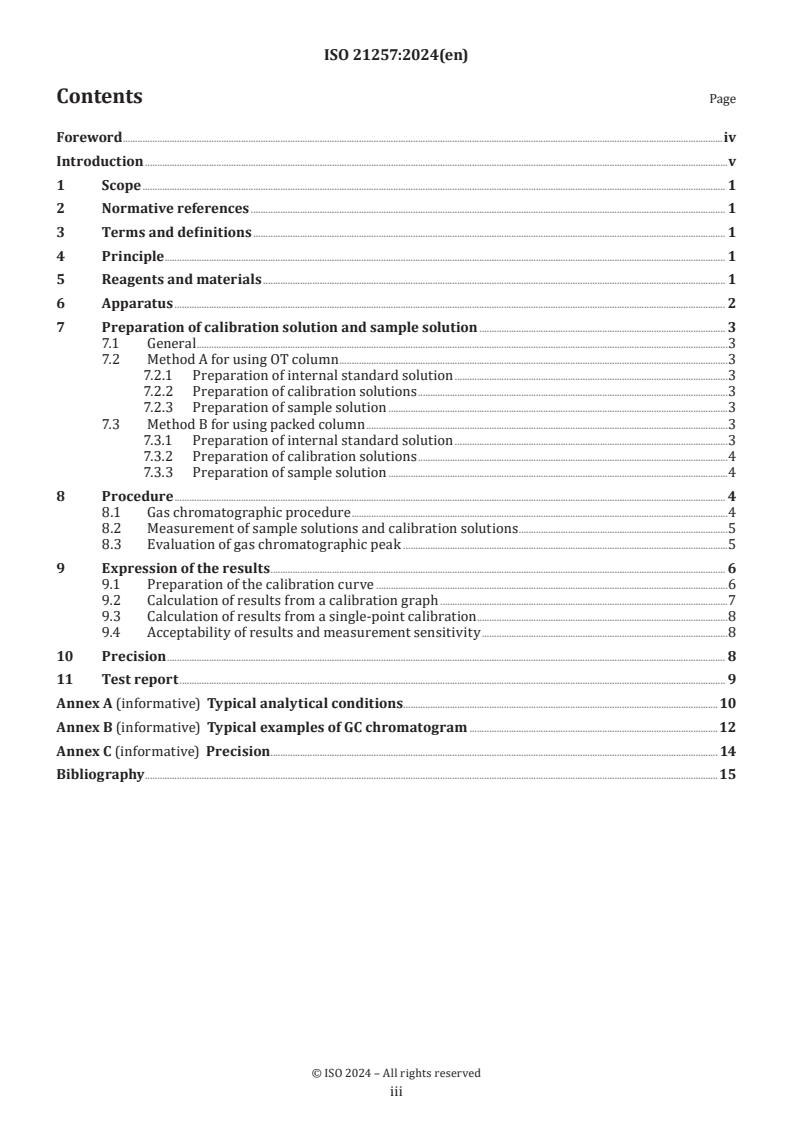
Contents Page
Foreword .iv
Introduction .v
1 Scope . 1
2 Normative references . 1
3 Terms and definitions . 1
4 Principle . 1
5 Reagents and materials . 1
6 Apparatus . 2
7 Preparation of calibration solution and sample solution . 3
7.1 General .3
7.2 Method A for using OT column .3
7.2.1 Preparation of internal standard solution .3
7.2.2 Preparation of calibration solutions .3
7.2.3 Preparation of sample solution .3
7.3 Method B for using packed column .3
7.3.1 Preparation of internal standard solution .3
7.3.2 Preparation of calibration solutions .4
7.3.3 Preparation of sample solution .4
8 Procedure . 4
8.1 Gas chromatographic procedure .4
8.2 Measurement of sample solutions and calibration solutions .5
8.3 Evaluation of gas chromatographic peak .5
9 Expression of the results . 6
9.1 Preparation of the calibration curve .6
9.2 Calculation of results from a calibration graph .7
9.3 Calculation of results from a single-point calibration .8
9.4 Acceptability of results and measurement sensitivity .8
10 Precision . 8
11 Test report . 9
Annex A (informative) Typical analytical conditions . 10
Annex B (informative) Typical examples of GC chromatogram .12
Annex C (informative) Precision . 14
Bibliography .15
iii
Foreword
ISO (the International Organization for Standardization) is a worldwide federation of national standards
bodies (ISO member bodies). The work of preparing International Standards is normally carried out through
ISO technical committees. Each member body interested in a subject for which a technical committee
has been established has the right to be represented on that committee. International organizations,
governmental and non-governmental, in liaison with ISO, also take part in the work. ISO collaborates closely
with the International Electrotechnical Commission (IEC) on all matters of electrotechnical standardization.
The procedures used to develop this document and those intended for its further maintenance are described
in the ISO/IEC Directives, Part 1. In particular, the different approval criteria needed for the different types
of ISO document should be noted. This document was drafted in accordance with the editorial rules of the
ISO/IEC Directives, Part 2 (see www.iso.org/directives).
ISO draws attention to the possibility that the implementation of this document may involve the use of (a)
patent(s). ISO takes no position concerning the evidence, validity or applicability of any claimed patent
rights in respect thereof. As of the date of publication of this document, ISO had not received notice of (a)
patent(s) which may be required to implement this document. However, implementers are cautioned that
this may not represent the latest information, which may be obtained from the patent database available at
www.iso.org/patents. ISO shall not be held responsible for identifying any or all such patent rights.
Any trade name used in this document is information given for the convenience of users and does not
constitute an endorsement.
For an explanation of the voluntary nature of standards, the meaning of ISO specific terms and expressions
related to conformity assessment, as well as information about ISO's adherence to the World Trade
Organization (WTO) principles in the Technical Barriers to Trade (TBT), see www.iso.org/iso/foreword.html.
This document was prepared by Technical Committee ISO/TC 61, Plastics, Subcommittee SC 12, Thermosetting
materials.
This second edition cancels and replaces the first edition (ISO21257:2018), of which it constitutes a minor
revision. The changes are as follows:
— the title has been changed to plural form to read: "Plastics — Polymer polyols for use in the production
of polyurethanes — Determination of the residual acrylonitrile and styrene monomer content by gas
chromatography";
— in 7.2.1, 7.2.2, 7.2.3, 7.3.1, 7.3.2 and 7.3.3, “to the nearest 1 mg” have been changed to “to the nearest
0,1 mg”;
— in 8.3 Table 4, the table title has been changed to “Table 4 — Typical retention times of acrylonitrile,
styrene, internal standard and solvent with typical operating conditions in Annex A”.
Any feedback or questions on this document should be directed to the user’s national standards body. A
complete listing of these bodies can be found at www.iso.org/members.html.
iv
Introduction
Polymer polyols are defined as very fine and stable dispersions of solid, vinylic polymers (for example,
acrylonitrile/styrene copolymers are typical) in liquid polyether polyols.
Polymer polyol is used to improve the physical properties of seat cushions, especially hardness. Because the
toxicity of acrylonitrile and styrene is high, it is important to establish an analytical method to determine
residual amounts of these reactants.
The importance of residual toxicity has increased with the use of polyurethane foam, etc. which comes in
contact with food and skin. This document is intended to help manufacturers evaluate the safety of their
products.
v
International Standard ISO 21257:2024(en)
Plastics — Polymer polyols for use in the production of
polyurethanes — Determination of the residual acrylonitrile
and styrene monomer content by gas chromatography
1 Scope
This document specifies a method for the determination of the residual acrylonitrile monomer and styrene
monomer in polymer polyols by gas chromatography.
2 Normative references
The following documents are referred to in the text in such a way that some or all of their content constitutes
requirements of this document. For dated references, only the edition cited applies. For undated references,
the latest edition of the referenced document (including any amendments) applies.
ISO 472, Plastics — Vocabulary
ISO 648, Laboratory glassware — Single-volume pipettes
ISO 1042, Laboratory glassware — One-mark volumetric flasks
3 Terms and definitions
For the purposes of this document, the terms and definitions given in ISO 472 apply.
ISO and IEC maintain terminology databases for use in standardization at the following addresses:
— ISO Online browsing platform: available at https:// www .iso .org/ obp
— IEC Electropedia: available at https:// www .electropedia .org/
4 Principle
The polymer polyol sample is dissolved in a suitable solvent. This sample solution is then analysed using gas
chromatography with internal standardization. The amounts of residual acrylonitrile monomer and styrene
monomer are determined from peak areas using a previously established calibration curve.
NOTE Because of the high molecular weight of substances which are part of the polymer polyol, and because these
are injected directly into the chromatograph, injector contamination can occur which leads to erroneous results.
Monitor the condition of the chromatographic parts and clean or replace as necessary.
An injector liner packed with glass wool has been used to improve vaporization and ease of cleaning.
5 Reagents and materials
5.1 Solvent, use analytical-grade methanol, N, N-dimethylformamide, tetrahydrofuran, dipropylene
glycol monomethyl ether or toluene.
Other solvents can also be used if suitable results are obtained for the retention time, thermal stability and
separation performance.
5.2 Internal standard, shall be selected based on the retention times of the volatile materials contained
in the polymer polyol sample and the solvent.
Recommended combinations of solvent from 5.1 and internal standard are methanol and 2-methyl1-propanol,
N, N-dimethylformamide and ethylbenzene, dipropylene glycol monomethyl ether and bromobenzene.
Other combinations are also possible if the retention times, thermal stability and separation performance
are suitable.
5.3 Carrier gases and fuel gases for gas chromatograph.
Use helium or nitrogen as carrier gas, hydrogen as fuel gas, dry air as supporting fuel gas.
6 Apparatus
Normal laboratory equipment and the following apparatus are required.
6.1 Gas chromatograph, with flame ionization detector and capable of employing packed or open tubular
columns with either split or splitless injector. Typical operating conditions are described in Annex A.
6.1.1 Injection port, for liquid samples.
When using open tubular column (hereafter called an OT column), an injection port with splitter may be
applicable.
6.1.2 Column and packing material.
The column diameter and length, as well as the packing material and liquid phase, are to be selected based
on consideration of column resolution (Re) and calibration curve linearity. Both packed columns and OT
(capillary) columns (hereafter referred to as OT columns) are acceptable.
Typical columns are described in Annex A.
— OT columns: The OT column are to be selected from suitable manufacturer(s), and then shall be
conditioned sufficiently.
— Packed columns: The packed column should be packed with the liquid phase and support particles from
suitable manufacturer(s), and then conditioned sufficiently.
6.1.3 Detector, hydrogen flame ionization detector (hereafter referred to as FID).
6.2 Data processor, selected based on suitability for recording the signals from the detector and
processing the chromatograms.
6.3 Sample injection syringe, micro-syringe with a volume range 1 μl to 50 μl. Manual and autoinjector
syringes are suitable.
6.4 Analytical balance, capable of measuring to 0,1 mg, is required.
6.5 One-mark volumetric flasks (hereafter volumetric flasks), as specified in ISO 1042.
Needed volumes are 50 ml and 500 ml.
6.6 Single-volume pipettes (hereafter volumetric pipettes), as specified in ISO 648.
Needed volumes are 0,5 ml, 1,0 ml, 2,0 ml, 5,0 ml and 10,0 ml.
NOTE Graduated pipettes (see ISO 835) and piston pipettes (see ISO 8655) are also suitable.
7 Preparation of calibration solution and sample solution
7.1 General
Two sample preparation methods are described in 7.2 and 7.3. Method A is to be used for an OT-column
chromatograph and Method B is used for a packed-column chromatograph. The range of calibration
concentrations should be selected based on expected levels of acrylonitrile and styrene monomers.
Calibrations with 4 levels of each monomer are to be used.
7.2 Method A for using OT column
7.2.1 Preparation of internal standard solution
Into a 500 ml volumetric flask, weigh to the nearest 0,1 mg, the amount of internal standard specified in
Table 1. Add solvent to make 500 m
...